Travel Quotes for Instagram: Aesthetic, Solo and Beach Captions
Instagram quotes for travel work best when they’re chosen to match the visual language of your photo, not just its subject. This section breaks down how caption length, tone, and emoji placement should shift depending on whether your feed leans minimalist, moody, or maximalist — so your captions feel like part of your aesthetic, not an afterthought bolted on top of it.
The first thing to understand is that a caption is a design element. On a clean, minimalist grid, a long caption with multiple emoji groups visually competes with the photo for attention — the eye jumps to the text instead of resting on the image. On a busier, more saturated feed, a short caption can feel abrupt, like it’s underselling a complex shot. Matching caption length to photo style isn’t a stylistic nicety; it’s part of how the post reads as a whole.
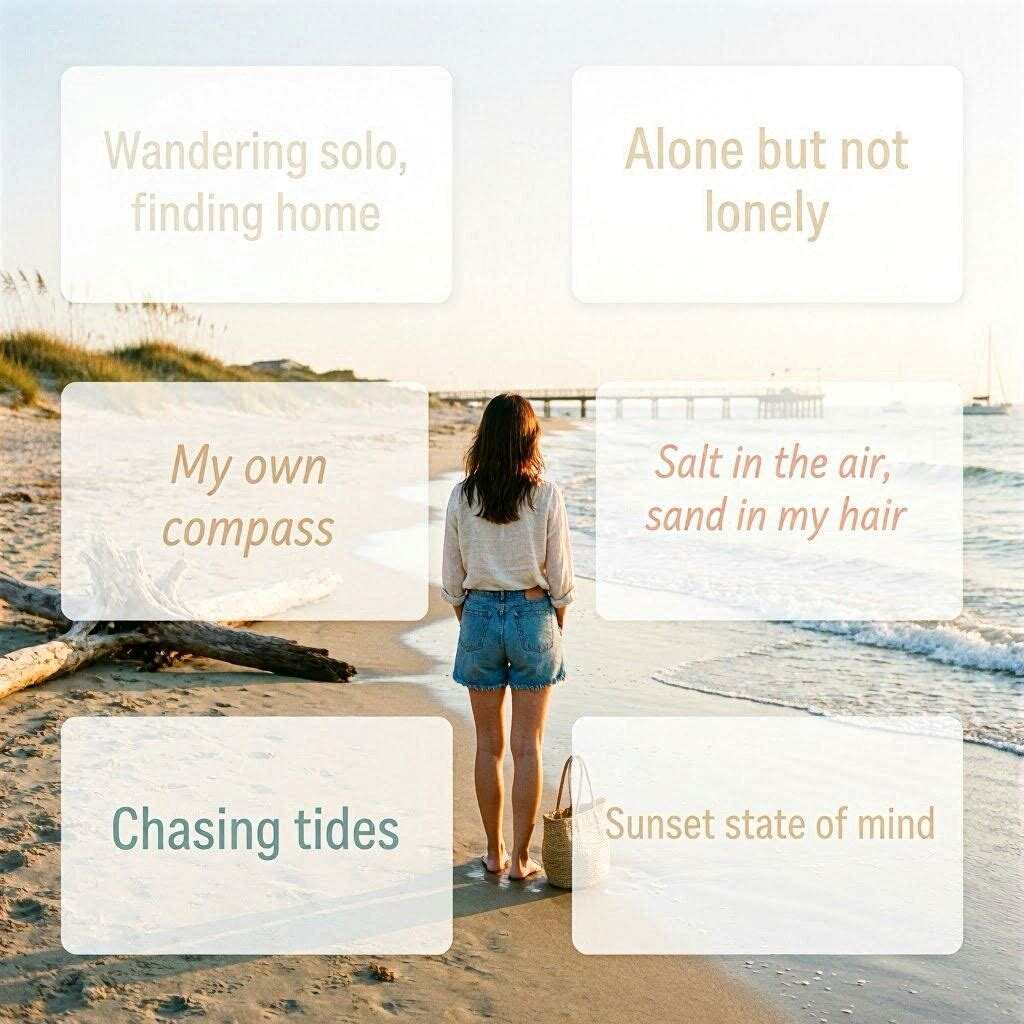
Minimalist captions rely on restraint. A single short phrase, often five words or fewer, paired with one or two carefully chosen emoji (or none at all), lets the photo carry the emotional weight. Think “Slow mornings, faster hearts” rather than a full sentence with three hashtags stapled to the end. The goal is for the caption to feel like a title card, not a paragraph. This style performs particularly well on travel accounts built around muted tones, negative space, and architectural or landscape photography, where the visual itself is already doing most of the storytelling.
White-space layouts are where most creators lose control of their captions without realizing it. Instagram’s caption box does not preserve double line breaks the way a text editor does — if you type a blank line between two thoughts and paste it directly, Instagram often collapses that space, mashing your carefully separated lines into a single dense block. The fix is to use an invisible character (a zero-width space, or a period on its own line styled to be nearly invisible) between line breaks. This forces Instagram to respect the spacing you designed. If you’ve ever pasted a caption that looked perfect in your notes app and watched it turn into a wall of text on Instagram, this is almost always the cause.
Emoji grouping is the third pillar of aesthetic captioning. Rather than scattering emoji throughout a sentence, group them at the end of the caption, separated from the text by a line break. A caption like “Chasing golden hour again” followed by a line break and then “🌅✈️🤍” reads as intentional — almost like a signature. Scattered emoji mid-sentence, by contrast, tends to read as cluttered and can disrupt screen readers, which matters more than most creators realize given how many people now browse Instagram with accessibility features enabled.
When it comes to the primary question — how do you format a travel quote cleanly on Instagram — the answer comes down to three habits: write the caption in short, separated lines rather than one continuous paragraph; test the caption in the Instagram app before publishing, since the app’s preview often reveals spacing issues your notes app hides; and group emoji at the end rather than weaving them throughout.
The secondary question, what caption length performs best, doesn’t have a single universal answer, but there are clear patterns. Captions under 10 words tend to perform well on visually striking, self-explanatory images — sunsets, dramatic landscapes, clean architectural shots — where the photo needs little explanation. Captions in the 15–30 word range tend to suit photos that benefit from a bit of context or narrative, like a candid travel moment or a shot that’s part of a larger story. Captions beyond 50 words generally only make sense when the caption itself is the content — a mini-story, a reflection, or a tip — and even then, the first line needs to work as a hook, since Instagram truncates captions after roughly two lines and shows a “more” button.
Here’s the gap most quote collections miss entirely: line-break protection. A travel creator with 40,000 followers built their entire aesthetic around perfectly spaced captions, only to discover that roughly a third of their posts displayed as dense, unspaced blocks on certain Android devices. The cause was inconsistent line-break characters copied from different sources — some used standard line breaks, others used a different invisible character that rendered inconsistently across devices. The fix was standardizing on a single, tested line-break method across every caption template. This is the kind of formatting detail that separates a feed that looks professionally curated from one that looks accidentally inconsistent.
The table below shows how to match caption style to photo style directly. Use it as a quick reference: find your photo style in the left column, and the row gives you the caption length, tone, emoji count, and best placement for that visual.
Visual Style-Matching Blueprint
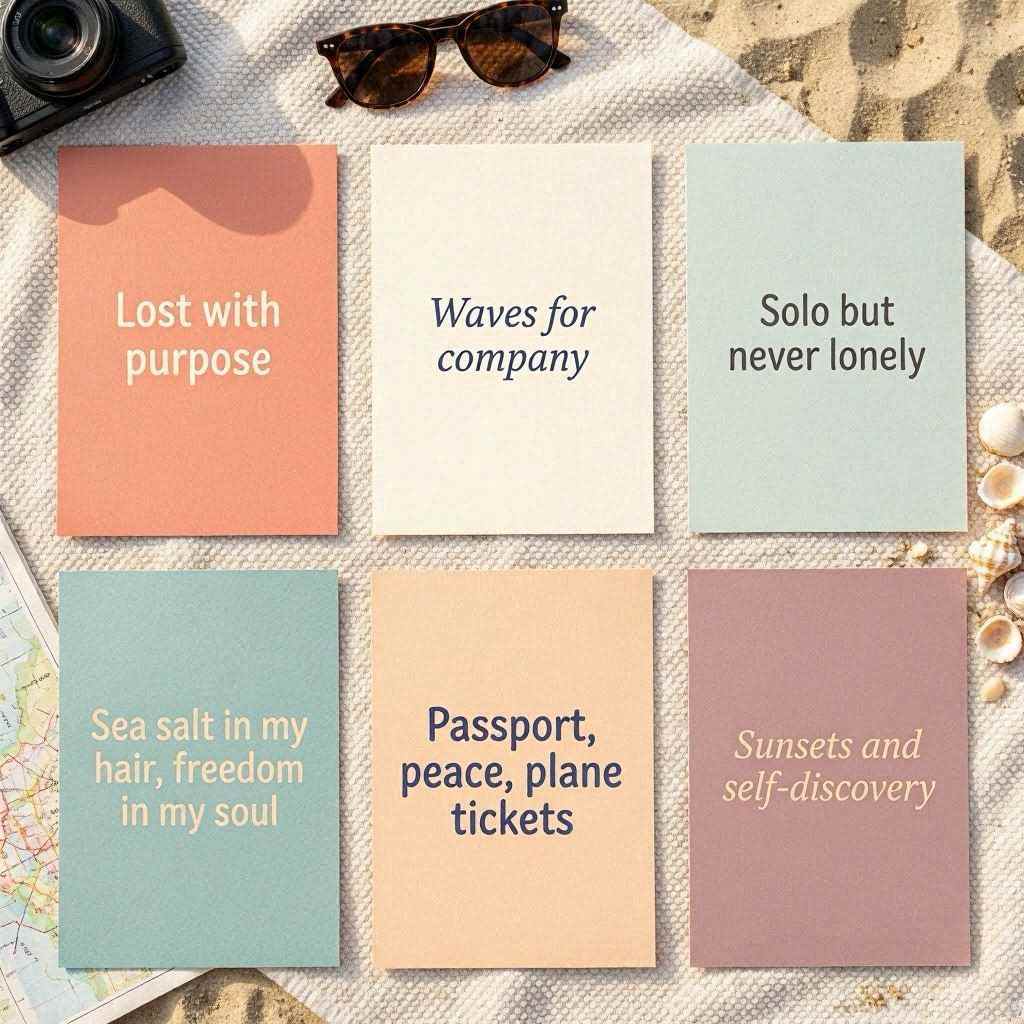
| Photo Style | Caption Length | Quote Tone | Emoji Count | Best Platform Placement |
|---|---|---|---|---|
| Grainy Vintage | 5–10 words | Nostalgic, wistful | 1 | Feed post |
| Bright Minimalist | 3–7 words | Calm, understated | 0–1 | Feed post or Story |
| Moody Landscape | 5–12 words | Reflective, atmospheric | 1 | Feed post |
| Luxury Resort | 8–15 words | Aspirational, polished | 2–3 | Feed post or Carousel |
| Urban Architecture | 5–10 words | Observational, sharp | 0–1 | Feed post |
| Cinematic Sunset | 6–12 words | Cinematic, emotional | 1–2 | Reel caption |
| Coastal Escape | 5–10 words | Light, breezy | 2–3 | Story or Feed |
| Solo Adventure | 10–20 words | Personal, reflective | 1 | Feed post or Carousel |
Decide based on your dominant photo style rather than picking a caption you like in isolation. If your feed mixes styles, build a small library of captions tagged by style so you’re matching from the table above rather than starting from scratch every time you post.
Curating Clean Quotes for Instagram Travel Layouts
Quotes for Instagram travel carousels need to do something single-image captions don’t: tie multiple photos together into one coherent visual story without repeating the same idea five times. The first slide’s caption sets the tone for the entire post, since it’s the only text most viewers read before swiping.
Grid aesthetics matter most when you’re thinking about how a caption will sit beneath a multi-photo layout. A carousel showing a progression — say, a sunrise hike from base to summit — works best with a caption that implies movement or sequence, like “Every step up was worth it” rather than a static observation about a single moment. The caption becomes a thread connecting the images rather than a description of any one of them.
White-space management in carousels follows the same line-break rules as single posts, but with one addition: because carousel captions often run slightly longer to provide context for multiple images, the temptation to add more line breaks increases — and so does the risk of Instagram collapsing them. Keep carousel captions to two or three short lines maximum, even if you have more to say, and move additional context to the first comment if needed.
Caption length for carousels should generally sit in the 10–25 word range. Short enough to read in full without tapping “more,” but long enough to provide the narrative thread that ties the images together. A caption like “Four days, one trail, and the view that made every blister worth it” gives viewers a reason to swipe through all the photos rather than just glancing at the first one.
When building your own carousel captions, write the caption first, then choose which photo goes first based on which image best represents that caption’s tone — not the other way around. This keeps your aesthetic intentional rather than reactive.
Micro-Sized Instagram Quotes for Traveling
Instagram quotes for traveling that are built for Stories and Reels operate under different constraints than feed captions, and treating them the same is one of the most common mistakes creators make. Stories give you roughly 15 seconds of attention per frame, and Reels viewers decide whether to keep watching within the first one to two seconds — your caption needs to work at a glance, not on a second read.
For Stories, the most effective captions are three to six words, placed in the upper or lower third of the frame where Instagram’s UI elements won’t cover them. Something like “Worth every layover” or “Still not over this view” works because it can be read and absorbed before the Story auto-advances. Longer captions on Stories get skipped past before they’re fully read.
For Reels, the caption serves a different purpose: it’s often the hook that determines whether someone keeps scrolling or stays. A caption like “POV: you booked the flight before telling anyone” works as a hook because it creates a small narrative gap the viewer wants resolved by watching the video. This is different from a feed caption, which complements a photo that’s already fully visible — a Reel caption needs to earn the watch.
Short-form engagement also depends on caption placement relative to on-screen text. If your Reel already has text overlay describing the location, your caption shouldn’t repeat that information — it should add a layer the video doesn’t show, like the feeling behind the moment or a piece of context (how long you waited for that shot, what almost went wrong).
If you’re building a content calendar around a single trip, plan your micro-captions before you plan your full feed captions. Stories and Reels are typically posted in the moment, so having a small bank of three-to-six-word lines ready means you’re not scrambling for words while standing in front of a view, wondering what to type.
Empowering Solo Travel Quotes for Instagram
Solo travel quotes for Instagram carry more emotional weight than general travel captions because they’re often standing in for something the photo can’t fully show — the decision to go alone, the comfort built along the way, or the version of yourself that only shows up when no one else is around. This section helps you choose captions that reflect that internal experience rather than defaulting to generic wanderlust language that could apply to anyone.
The instinct with solo travel captions is often to lean into independence as a theme on its own — “doing it my way,” “no plans, no problem” — and while that has its place, it can also feel performative if it’s the only note you hit. Independence resonates most when it’s paired with specificity: not just that you’re traveling alone, but what that’s actually like in this particular moment. A caption like “Ordered for one, and for once, it felt right” says more about independence than “Solo and loving it,” because it gives the viewer a concrete image rather than an abstract claim.
Growth is the subtopic most solo travel content underuses, despite it being one of the most relatable threads for an audience that includes a lot of people considering their first solo trip. Growth-oriented captions acknowledge a “before” — nervousness, hesitation, doubt — without dwelling on it, and pair it with where you are now. “I almost canceled this trip three times. Now I don’t want it to end” does more work than “Growth happens outside your comfort zone” because it’s anchored in a real, specific arc rather than a motivational poster phrase.
Self-discovery captions work best when they’re tied to a small, concrete detail rather than a sweeping statement. “Turns out I actually like eating dinner alone” is more memorable and more honest than “Traveling alone teaches you who you really are,” even though both are gesturing at the same idea. The specific version invites people to relate to a small, real moment; the general version invites people to scroll past something they’ve read a hundred times.
The competitor gap here is significant: most solo travel quote collections are just general wanderlust quotes with “solo” added to the search term, without any actual differentiation in tone or content. They group “alone” with “lonely” by default, when for most solo travelers, the emotional reality is closer to “alone” and “at ease” — or “alone” and “finally able to hear my own thoughts.” Captions that acknowledge this distinction — that solitude and loneliness aren’t the same thing — speak to an audience that’s chosen this experience and found something valuable in it, rather than framing solo travel as something to be endured.
When it comes to the primary question — what’s the best caption approach for solo travel — the answer is to write from a specific moment rather than a general feeling. Instead of asking “how do I sound independent,” ask “what’s one true thing about today that I haven’t said out loud yet.” That’s almost always a better caption than anything pulled from a generic quote list.
The secondary question, how authentic should solo captions be, deserves a direct answer rather than a vague “it depends.” Authenticity here means specificity and restraint — sharing something true without oversharing or performing vulnerability for engagement. A caption that names a real, small detail (“I got lost twice and didn’t mind either time”) reads as more authentic than one that makes a grand emotional claim (“This trip changed everything”), even if both are technically true. If you’re unsure whether a caption feels authentic, the test is whether you’d say it to a friend in person — if it sounds like something from a greeting card, it probably needs to be more specific.
The table below maps photo mood to caption direction, so you can quickly find the right tone for a specific solo travel shot.
Mood-Matching Visual Lookup Guide
| Photo Mood | Emotional Theme | Caption Direction | Best Quote Category |
|---|---|---|---|
| Quiet café, alone | Contentment | Small, specific observation | Self-discovery |
| Mountain summit | Achievement | Acknowledge effort without bravado | Growth |
| Empty beach at dusk | Reflection | Internal, understated | Self-discovery |
| Walking unfamiliar streets | Curiosity | Present-tense, sensory | Independence |
| Hostel common room | Connection | Brief, warm, specific | Growth |
| Local market, solo | Confidence | Light humor, observational | Independence |
| Train window view | Transition | Forward-looking, calm | Growth |
| Hiking trail, solo | Resilience | Honest about difficulty, then payoff | Growth |
Use this table by starting with the mood your photo actually conveys — not the mood you wish it conveyed — and let that guide which of the three subtopics (independence, growth, or self-discovery) your caption should lean into.
Independent Journey Captions for the Modern Nomad
Traveller quotes for Instagram aimed at the modern nomad audience need to balance two things that can pull in opposite directions: the romanticized version of nomadic life that performs well on social media, and the lived reality of working from unfamiliar places, dealing with time zones, and building a routine from scratch in a new city every few weeks.
Confidence in this context isn’t about projecting that everything is going perfectly — it’s about projecting that you can handle it if it doesn’t. A caption like “Wifi’s down, deadline’s tonight, and somehow this is still better than my old commute” captures confidence through contrast rather than through a direct claim of confidence. It acknowledges a real obstacle and still lands on the side of “this was the right choice,” which reads as more credible than a caption that pretends everything is seamless.
Growth, for this audience, often shows up as a shift in what counts as a good day. A caption like “A good day used to mean a good meeting. Now it means a good lunch spot with decent wifi” reframes growth as a change in values rather than a dramatic transformation — which tends to resonate more because it’s recognizable rather than aspirational in an unreachable way.
Self-reliance captions for digital nomads work well when they reference a specific skill or habit picked up through necessity — finding a reliable workspace in an unfamiliar city, learning enough of a local language to handle logistics, or figuring out a routine that survives time zone shifts. “Three months in and I can now find a decent flat white in any city within twenty minutes of landing” is self-reliance framed as a small, earned competency, which tends to feel more genuine than a broad statement about independence.
The throughline across all of these is specificity tied to the actual texture of nomadic life — wifi, time zones, workspaces, routines — rather than only the postcard version. That specificity is what separates a caption that feels lived-in from one that feels aspirational in a way the audience can’t quite connect with. Choose captions that reference at least one concrete detail of the nomadic lifestyle, and you’ll find they tend to generate more comments from people in similar situations than purely scenic captions do.
Sunkissed Beach Travel Quotes for Instagram
Beach travel quotes for Instagram have a reputation problem: the genre is so saturated with the same handful of puns and clichés that even good photos can feel undercut by a caption that’s been used millions of times before. This section focuses on modernizing beach captions — keeping the lightness and humor the genre is known for, while updating the references and wordplay to feel current rather than recycled.
The full picture starts with understanding why beach captions cluster around clichés in the first place: beach photos are often visually similar (sand, water, sky), so creators reach for captions that signal “beach” as a category rather than describing anything specific about the moment. The result is an enormous pool of captions like “Salty hair, don’t care” that have been used so often they’ve become background noise rather than something a viewer actually reads.
Coastal humor that feels modern tends to reference specific, current beach experiences rather than generic beach imagery. Instead of “Vitamin Sea,” which has been used so widely it barely registers, a caption like “Spent more on this drink than my flight, no regrets” references a specific, relatable beach-vacation experience (overpriced resort drinks) that still has humor but isn’t a recycled pun.
Resort captions work best when they lean into the gap between expectation and reality — a theme that performs consistently well because it’s relatable regardless of which resort someone’s actually at. “The brochure said ‘relaxing.’ It did not mention the iguana on my balcony” is funnier and more memorable than a straightforward “Paradise found,” because it’s specific and slightly self-deprecating rather than purely aspirational.
Tropical wordplay can still work in 2026, but it needs to avoid the most overused pun structures — anything built around “sea,” “shore,” or “wave” as a forced double meaning has likely been done thousands of times. Newer wordplay leans into situational humor instead: “Currently rating this beach a 10/10, my sunburn a 2/10” combines a genuine assessment with self-aware humor about a near-universal beach experience.
The competitor gap here is straightforward but rarely addressed directly: most beach caption lists were written years ago and haven’t been updated, so they’re full of puns that have cycled through so many accounts they no longer read as fresh or funny — they read as “I didn’t think of my own caption.” Modernizing beach humor means moving away from pun-based wordplay toward observational humor about the actual experience of being at the beach: the gap between Instagram and reality, the small inconveniences that come with paradise, and the universally relatable moments (sunburn, sand in everything, overpriced cocktails) that everyone can immediately recognize.
The table below replaces tired clichés with modern alternatives, organized by scenario.
Sunkissed Pun Matrix
| Beach Scenario | Modern Caption Style | Engagement Trigger | Avoid This Cliché |
|---|---|---|---|
| Infinity pool shot | Expectation vs. reality humor | Relatable disappointment | “Paradise found” |
| Beach at sunset | Understated, slightly wry | Quiet relatability | “Vitamin Sea” |
| Cocktail in hand | Self-aware indulgence | Tag-a-friend humor | “Salty hair, don’t care” |
| Sunburn reveal | Honest, comedic | High comment rate | “Beach please” |
| Empty beach, early morning | Calm, observational | Save rate | “Sea you later” |
| Crowded resort beach | Wry social commentary | Shares | “Life’s a beach” |
| Snorkeling or swimming | Genuine excitement, light humor | Comments | “Mermaid vibes” |
| Beach bar / sunset drinks | Situational, specific humor | Tags and shares | “Sandy toes, sun-kissed nose” |
When choosing a caption, identify which scenario your photo actually represents, then pick the modern style for that scenario rather than reaching for the first beach pun that comes to mind — that instinct is exactly what leads back to the clichés this table is designed to avoid.
Coastal Puns and Tropical Oasis Wordplay
Modern beach humor works best when it’s built around a structure rather than a single joke — a structure you can adapt to whatever’s actually happening in the photo, rather than memorizing a list of one-liners that may not fit your specific shot.
One reliable structure is the “expectation vs. reality” format: state what the scene is supposed to represent, then undercut it with something true and slightly absurd. “They said it was a ‘hidden gem.’ It was hidden behind a parking lot” works because it follows a recognizable setup-and-twist pattern that can be adapted to almost any travel scenario, not just beaches.
Another structure is the “rating” format, where you assign a numerical or descriptive rating to two contrasting elements of the experience — the view versus the bug bites, the sunset versus the wifi, the cocktail versus its price. This format is inherently comparative, which tends to generate more comments because people relate to one side or the other (or both).
A third structure is the direct address — captions that speak to the beach, the ocean, or the moment itself, but with a twist that avoids the earnestness of older “Dear ocean, thank you” style captions. “Ocean, you’ve ruined regular bathwater for me forever” keeps the direct-address format but updates the tone to something wry rather than sentimental.
For comment generation specifically, captions that pose an implicit question — even without a question mark — tend to perform well, because they invite a response. “This is either the best decision I’ve made all year or the worst sunburn” implicitly invites people to weigh in, which can lift comment counts compared to a caption that’s purely declarative.
The decision point here: rather than searching for the perfect existing pun, pick one of these three structures (expectation vs. reality, rating, or direct address) and fill it in with a detail specific to your actual photo. This produces captions that feel custom rather than recycled, even using a repeatable format.
Timeless and Best Travel Quotes for Instagram
Best travel quotes for Instagram often means literary quotes — lines from writers whose words have become shorthand for the feeling of travel itself. But using a literary quote well requires more than copying and pasting it; it requires understanding how to format it so it enhances your aesthetic rather than looking like an uncredited screenshot from a quote app.
The full explanation starts with why literary quotes work differently than original captions: they carry pre-existing weight and recognition, but they also carry the expectation of attribution. A famous line presented without any indication of its source can come across as either a claim of originality (which damages credibility if someone recognizes the quote) or as oddly impersonal, since the quote isn’t connected to your own voice or experience.
The first required subtopic is motion — many of the most enduring travel quotes are built around movement, journeys, and the physical act of going somewhere, which makes them a natural fit for Reels, transition shots, and any content showing travel itself (boarding a flight, a road stretching ahead, a train pulling away). A quote about the journey mattering as much as the destination pairs naturally with footage of transit rather than footage of arrival.
The second subtopic is adventure — quotes that frame travel as something slightly outside the ordinary, a departure from routine. These work well for content that shows a contrast between “before” (home, routine, the familiar) and “now” (somewhere new), making them well-suited to before/after formats or carousel posts that show a transformation.
The third subtopic is travel transitions specifically — the moments between destinations, which are often underrepresented in travel content despite making up a huge portion of the actual travel experience. Literary quotes about the in-between (waiting, traveling, not-yet-arriving) can elevate what might otherwise be a forgettable airport or train-station photo into something that feels intentional and reflective.
The secondary user question — how to use famous quotes without hurting your aesthetic — gets to the core of this section’s competitor gap. Most travel quote lists present famous quotes as plain text with the author’s name in parentheses, which looks fine in a blog post but often looks cluttered or amateurish in an Instagram caption, where every line of text competes for visual space. A cleaner approach is to place the quote itself in the first line or two of the caption, then place the attribution on its own line, separated by a line break, often in a slightly different format — for instance, an em dash followed by the author’s name, with no additional punctuation. This creates visual separation between “what was said” and “who said it” without cluttering the caption with quotation marks, parentheses, and citations that feel more academic than aesthetic.
Attribution matters for a second reason beyond aesthetics: misattributed quotes circulate constantly on social media, and posting one — even unintentionally — can undermine the credibility you’re trying to build through the rest of your content. Before using a quote, a quick search to confirm both the wording and the attribution is worth the thirty seconds it takes, especially for widely circulated lines that have been altered slightly over years of reposting.
The table below pairs well-known authors with themes and shows how to adapt and format their quotes for Instagram.
Literary Attribution Index
| Author | Quote Theme | Modern Instagram Adaptation | Attribution Format |
|---|---|---|---|
| Anthony Bourdain | Openness to new experiences | Pair with food or street-market shots | Quote, line break, em dash + name |
| Mark Twain | The value of travel itself | Pair with departure or transition shots | Quote, line break, em dash + name |
| Freya Stark | Journey over destination | Pair with road, trail, or transit shots | Quote, line break, em dash + name |
| Joan Didion | Observation and place | Pair with quiet, atmospheric shots | Quote, line break, em dash + name |
| Jack Kerouac | Movement and restlessness | Pair with road trip or transit content | Quote, line break, em dash + name |
| J.R.R. Tolkien | Adventure and the unknown | Pair with landscape or trail shots | Quote, line break, em dash + name |
When using any quote from this table, match the theme to your photo’s content first, then apply the attribution format consistently — mixing attribution styles within the same feed can look inconsistent in a way that’s more noticeable than people expect.
Dynamic Traveling Quotes for Instagram Action Shots
Traveling quotes for Instagram and travelling quotes for Instagram both point to the same need: captions for content that shows travel in progress rather than travel as a completed state — boarding passes, moving vehicles, walking shots, anything with motion or transition built into the image itself.
Motion-oriented captions work best when the language itself implies movement — verbs over adjectives. “Somewhere over the Atlantic” does more work than “Flying is exciting” because it places the viewer in a specific, ongoing moment rather than describing a general feeling.
Adventure-themed captions for action shots benefit from present tense, which creates a sense of immediacy that past tense doesn’t. “Running for a train I’m not sure I’ll catch” feels more alive than “I ran for a train and almost missed it,” even though they describe the same event — present tense puts the viewer in the moment with you rather than hearing about it after the fact.
For travel transitions specifically — the often-overlooked airport, train station, or road-trip content — captions that acknowledge the in-between nature of the moment tend to stand out because so little travel content focuses on this part of the journey. A caption like “Not quite there yet, but already somewhere different” captures the specific feeling of transit in a way that’s rarely addressed directly.
The transition back to the broader literary theme: these action-oriented captions don’t need to abandon the literary quality of the rest of this section — a single well-chosen quote about journeys or movement, formatted using the attribution method above, can work just as well for a transition shot as an original line. The key is matching the energy of the quote (motion, anticipation, the unknown) to the energy of the shot, rather than defaulting to a quiet, reflective quote for a photo that’s full of motion.
The Creator’s Toolkit: Maximizing Caption Engagement
Captions don’t just sit beneath a photo — they actively influence how Instagram’s algorithm interprets and distributes your content, primarily through their effect on saves, shares, and comments. Save rate has become one of the more important signals for travel content specifically, because users frequently save travel posts as personal references for future trips — meaning a caption that includes a specific, useful detail (a tip, a location hint, a piece of practical information) can meaningfully increase saves compared to a purely aesthetic caption.
Share rate responds differently than save rate. Content gets shared when it’s relatable enough that someone wants to send it to a specific person — “this is so us” or “this is exactly what happened to you.” Captions that describe a specific, slightly funny, or slightly chaotic travel experience tend to generate more shares than purely scenic captions, because they’re more likely to remind someone of a friend or a shared memory.
Comments are most reliably generated by captions that pose an implicit question, take a clear stance on something minor (best travel snack, window vs. aisle, early flight vs. late), or describe an experience specific enough that people want to say “same” or share their own version. A caption ending on a small, debatable claim tends to outperform one that’s purely descriptive.
For Reel-specific engagement, the caption often works alongside on-screen text rather than replacing it — the caption can provide a layer of context or humor that the video itself doesn’t show, such as what happened just before or after the clip, or a detail about how difficult the shot was to get. This additional layer gives viewers a reason to read the caption rather than skipping straight to the next video.
It’s worth being direct about something most engagement guides gloss over: no single caption formula guarantees performance, and the same caption style can perform very differently depending on your specific audience, posting time, and the broader context of your account. What’s described here reflects patterns commonly observed across travel content — useful as a starting framework, not a guarantee.
Future-Proof Caption Optimization for Reels & Short Videos
As more travel content shifts toward vertical video, caption strategy needs to adapt — a caption that works as a static line beneath a photo doesn’t always translate to a hook that needs to grab attention within the first second or two of a Reel.
The biggest shift is that Reel captions often function less like a caption and more like a hook — the first line needs to create curiosity, tension, or a reason to keep watching, separate from whatever text appears on screen in the video itself. A caption that simply describes the location (“Sunset in Santorini”) does very little work compared to one that creates a question in the viewer’s mind (“I almost didn’t film this because I thought it would be boring”).
Character count matters more for Reels than for feed posts, because Reel captions are often displayed alongside on-screen text and need to be scannable quickly. Hooks under 40 characters tend to work well as direct, punchy openers, while hooks in the 40–80 character range allow for slightly more setup, useful when the video itself needs a beat to get going before the payoff.
Video style should inform hook type. A POV-style video pairs naturally with a “POV:” caption format, which is widely recognized and immediately signals what kind of content is coming. A transformation or before/after video benefits from a hook that sets up the “before” explicitly, since the contrast is the point. A travel-tip video works best with a hook that promises a specific outcome (“the one thing I wish I knew before booking this”) rather than a vague teaser.
The table below organizes hook types by character count, video style, and the goal each is designed to achieve.
Vertical Video Hook Directory
| Hook Type | Character Count | Best Video Style | Goal |
|---|---|---|---|
| POV statement | 20–40 | First-person, immersive | Immediate relatability |
| Confession / admission | 40–80 | Talking-to-camera or text overlay | Curiosity, comments |
| Numbered tip | 30–60 | Travel-tip or how-to | Saves |
| Before/after setup | 40–80 | Transformation, contrast | Watch-through |
| Question hook | 20–50 | Any | Comments |
| Mistake/lesson | 40–80 | Storytelling | Shares, saves |
| Countdown/rating | 20–50 | Comparison, ranking | Comments, debate |
| Unexpected detail | 40–80 | Reveal, twist | Watch-through, shares |
Choose a hook type based on the video’s structure first — does it have a twist, a tip, a comparison, or a single striking moment — and then pick the caption length that fits how much setup that structure needs.
Structural Formatting Deep Dive
Formatting issues are the single most common reason a well-written caption looks broken once it’s published. The core problem is paragraph collapse: when you write a caption with multiple short paragraphs separated by blank lines, Instagram’s caption field often strips those blank lines on paste, compressing everything into one dense block of text — even though it looked correctly spaced in whatever app you wrote it in.
The practical fix is to insert an invisible character on its own line between paragraphs — a character that has no visible width but still counts as a line, forcing Instagram to preserve the break. Many creators keep a small text file with a few of these invisible-character line breaks pre-typed, so they can copy and paste them into new captions rather than recreating them each time, which is also where the idea of pre-formatted “copy blocks” (covered in the next section) comes from.
Beyond paragraph collapse, alt text is one of the most overlooked formatting elements for travel creators. Alt text — the description Instagram uses for accessibility and that also factors into how content is indexed — is often left blank or auto-generated, which means it’s a missed opportunity to add a layer of descriptive, keyword-relevant information that doesn’t clutter the visible caption. A travel post with alt text describing the actual location and subject matter (rather than Instagram’s generic auto-description) is more accessible to users relying on screen readers and provides additional context that auto-generated descriptions miss entirely.
Use the checklist below before publishing any caption-heavy post to catch formatting issues before they go live.
Caption Layout Checklist
✓ Line breaks tested directly in the Instagram app, not just in a notes app
✓ Emoji grouped at the end of the caption, separated by a line break
✓ White space preserved using an invisible-character line break, not a blank line
✓ Caption readable in full within the first two lines, or front-loaded with the key line
✓ Story-format caption shortened to 3–6 words if reused from a feed caption
✓ Reel caption rewritten as a hook, not reused directly from the feed version
✓ Mobile preview checked before publishing — what looks fine on desktop may wrap differently
✓ Quote attribution placed on its own line, separated from the quote itself
✓ Alt text written manually with location and subject detail, not left as auto-generated
✓ Hashtags placed either in the caption’s final line or in the first comment, not mixed mid-caption
Pre-Formatted Layout Directories
The fastest way to solve formatting problems before they happen is to start from a template that already has the spacing built in — rather than writing a caption from scratch and then troubleshooting why it doesn’t display correctly. The blockquote-style format below uses a consistent structure: the caption itself, a line-break placeholder, and an emoji stack, all in the order Instagram tends to preserve most reliably.
Aesthetic / Minimalist
Slow mornings, faster hearts . 🤍🌍
Aesthetic / Carousel
Four days, one trail, and the view that made every step worth it . 🥾📍✨
Solo / Independence
Ordered for one, and for once, it felt right . 🍽️✈️
Solo / Growth
I almost canceled this trip three times. Now I don’t want it to end . 🌍🤍
Solo / Self-Discovery
Turns out I actually like eating dinner alone . 🍷🌃
Beach / Modern Humor
Currently rating this beach a 10/10, my sunburn a 2/10 . 🏖️☀️
Beach / Resort Reality
The brochure said “relaxing.” It did not mention the iguana on my balcony . 🦎🌴
Literary / Action Shot
Not quite there yet, but already somewhere different . ✈️🌅
Reel / POV Hook
POV: you booked the flight before telling anyone . 🎬✈️
For each block above, copy the entire structure — including the placeholder line — directly into the Instagram caption field, then replace the placeholder line with an invisible-character line break if your device strips the spacing on paste. Test once with a single template, confirm it displays correctly on your device, and you’ll know the exact format to reuse across every future caption.
Advanced Engagement Metrics Map
Caption length doesn’t just affect how a post looks — it correlates with different engagement outcomes depending on what you’re optimizing for. Shorter captions tend to keep attention focused on the visual, which can support save rate on highly aesthetic content where the photo itself is the primary draw. Longer captions, when they tell a specific story or offer a specific tip, tend to support comments and shares, since they give people more to respond to.
One pattern commonly observed among travel accounts: posts with captions under 10 words often see higher save rates when the photo itself is highly aesthetic or location-specific, since the caption isn’t competing with the image for the viewer’s attention — the photo does the work, and a short caption doesn’t distract from it. This isn’t a guarantee for every account, but it’s a useful starting point when deciding how much text a particular photo needs.
The table below maps caption length to primary goals, the metric most likely to be influenced, and when to use each length.
Engagement Metrics Matrix
| Caption Length | Primary Goal | Metric Influenced | Recommended Usage |
|---|---|---|---|
| 0–10 words | Visual focus | Saves | Highly aesthetic or scenic photos |
| 10–25 words | Narrative context | Comments, shares | Carousels, story-driven posts |
| 25–50 words | Relatability, humor | Shares, comments | Beach humor, relatable moments |
| 50+ words | Storytelling, tips | Saves, comments | Travel tips, personal reflections |
| Reel hook (20–80 characters) | Watch-through | Watch time, shares | Short-form video |
| Story caption (3–6 words) | Quick read | Story completion | Stories, time-sensitive content |
Use this table as a starting point rather than a fixed rule — your own account’s audience and posting history are the most reliable guide, and small tests (trying a shorter caption on a similar photo type) will tell you more than any general guideline can.
Frequently Asked Questions
What is a good short quote for travel?
A good short travel quote is one that’s specific enough to feel intentional rather than generic — five to ten words that capture a single feeling rather than trying to summarize an entire trip. Short quotes work best with white space managed carefully: write the quote on its own line, with any emoji grouped separately below it rather than mixed throughout the text. Emoji should be limited to one or two for short captions, placed at the end so they read as a finishing touch rather than clutter. Examples like “Slow mornings, faster hearts” or “Still not over this view” work well because they’re concrete and emotionally specific, while remaining short enough to read at a glance on both feed posts and Stories.
What should I caption a solo trip?
The best solo trip captions come from a specific, true detail about your experience rather than a general statement about independence. Focus on one of three angles: personal growth (acknowledging where you started versus where you are now), independence (a small, concrete moment that reflects confidence rather than claiming it directly), or authenticity (a detail specific enough that it couldn’t apply to just anyone’s trip). A caption like “I almost canceled this trip three times. Now I don’t want it to end” works because it’s specific and emotionally honest without oversharing. Avoid generic wanderlust phrases that could apply to any traveler — the goal is a caption that reflects this particular trip, this particular moment, and what it actually felt like to be there alone.
Editorial Summary & Next Actions
The most useful travel captions aren’t pulled from a list — they’re matched to your specific photo, mood, and platform format, then formatted in a way that survives the jump from your notes app to Instagram’s caption box. Whether you’re working with aesthetic carousels, solo reflections, beach humor, or literary quotes, the same principles apply: match tone to visual style, keep spacing intentional, and group emoji rather than scattering them. The formatting systems and copy-ready blocks above are designed to be reused across trips, not just this one. Bookmark this directory so you have a ready reference the next time a finished photo is sitting in your camera roll with no caption attached — and the next time you’re stuck, start with the style-matching table rather than scrolling for inspiration.