What Does The Bible Say About Zina? Meaning, Bible Verses & Biblical Explanation
If you’ve searched “Bible verse about zina” or “What does the Bible say about zina?”, you’ve likely noticed something odd: every result lists verses about adultery or sexual immorality, and none of them use the word zina itself. That can leave you wondering whether you’re searching the wrong term entirely.
Here’s the short answer: the word zina never appears in the Bible, but the behavior it describes is addressed throughout Scripture. The reason comes down to history and language, not disagreement over morality.
Zina is an Arabic term used in Islamic teaching to describe unlawful sexual relations. The Bible was written centuries earlier in Hebrew, Aramaic, and Greek, so it uses its own vocabulary for the same moral territory — adultery, fornication in older translations, and sexual immorality in most modern ones.
This article walks through what the Bible actually says about the conduct associated with zina, unpacks the key biblical terms and passages, and shows where biblical and Islamic teaching overlap — and where they part ways.
Does the Bible Mention Zina?
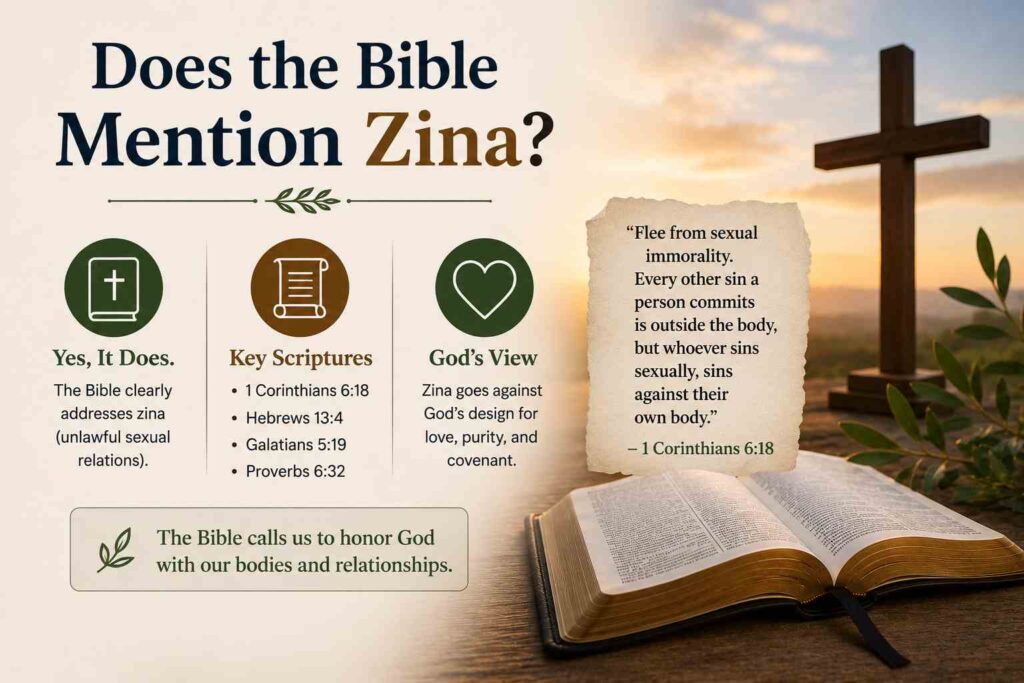
No — and it couldn’t, since zina is an Arabic word that emerged within Islamic teaching centuries after the Old and New Testaments were written. That absence says nothing about whether the Bible addresses the underlying issue. It does, extensively, through several related terms:
- Adultery
- Sexual immorality
- Fornication (mainly in older English translations)
- Unfaithfulness
- Impurity
Each term captures a different angle on the same broader concern. Some describe unfaithfulness within marriage specifically; others cover the wider territory of sexual conduct outside God’s design for marriage. This is also why search engines surface Christian resources for “Bible verse about zina” — the algorithm recognizes that most people typing this phrase want the biblical equivalent of an Islamic concept, not the literal Arabic word buried somewhere in Scripture.
Why the Word “Zina” Doesn’t Appear in the Bible
The explanation is simpler than it looks: language and chronology. The Old Testament was written primarily in Hebrew, with portions in Aramaic. The New Testament was written in Koine Greek. The Quran was revealed centuries later, in Classical Arabic. A word coined within one linguistic and religious tradition doesn’t retroactively appear in texts composed long before it existed.
This is true of religious translation generally — a single word in one language rarely has an exact one-to-one match in another. Translators work to preserve meaning, not to hunt down a matching word for every term.
So the more productive question isn’t “Where is zina in the Bible?” It’s:
“Which biblical teachings address the behavior Islam calls zina?”
Framed that way, the Bible has a great deal to say.
What Biblical Terms Most Closely Match Zina?
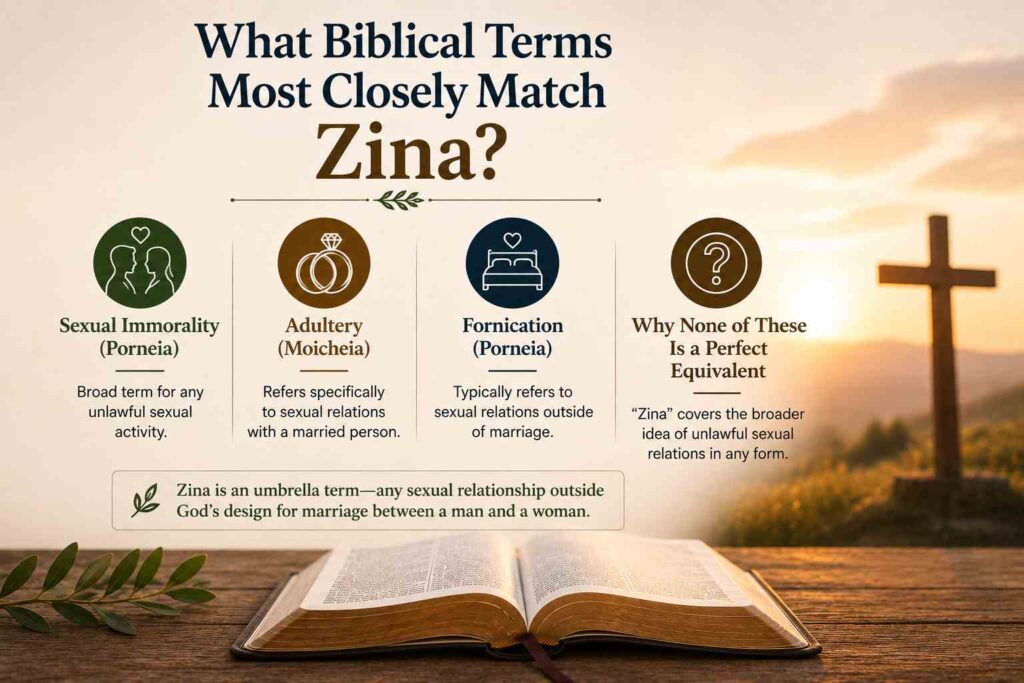
No single English or Greek word lines up perfectly with zina. Instead, three related terms — together — cover the same moral ground.
Sexual Immorality
This is the broadest category in most modern translations, usually rendering the Greek word *porneia*, which covers a wide range of sexual conduct outside God’s design for marriage rather than one specific act.
Adultery
Adultery is narrower: sexual unfaithfulness specifically involving someone who is married. It’s one expression of sexual immorality, not a synonym for it. Because Islamic zina includes adultery, the two ideas naturally get linked in readers’ minds — but the biblical term stays more tightly defined.
Fornication
Older English translations, the King James Version especially, use fornication for sexual relations outside marriage. Modern translations tend to replace it with sexual immorality, since that phrase better reflects the full range of the underlying Greek.
Why None of These Is a Perfect Equivalent
Rather than hunting for one biblical word that fully replaces zina, it helps to see these as overlapping circles:
- Adultery — a specific offense involving marital unfaithfulness
- Fornication — the traditional term for sex outside marriage
- Sexual immorality — the broad umbrella covering both, and more
Treating any single one of these as a complete stand-in for zina is where most online explanations go wrong.
What Is Zina?
In Islamic teaching, zina refers to unlawful sexual relations between a man and a woman outside a lawful marriage — a serious sin with real legal and moral weight in Islamic ethics. Its precise legal treatment belongs to Islamic scholarship. What matters for a Christian reader is this: the Bible never engages the term because it comes from a different linguistic and historical world entirely.
Instead, biblical writers build their sexual ethics around covenant faithfulness, marital fidelity, holiness, purity, and obedience to God. Keeping that distinction in view — different vocabulary, overlapping concern — prevents readers from comparing isolated words while missing what each tradition is actually trying to say.
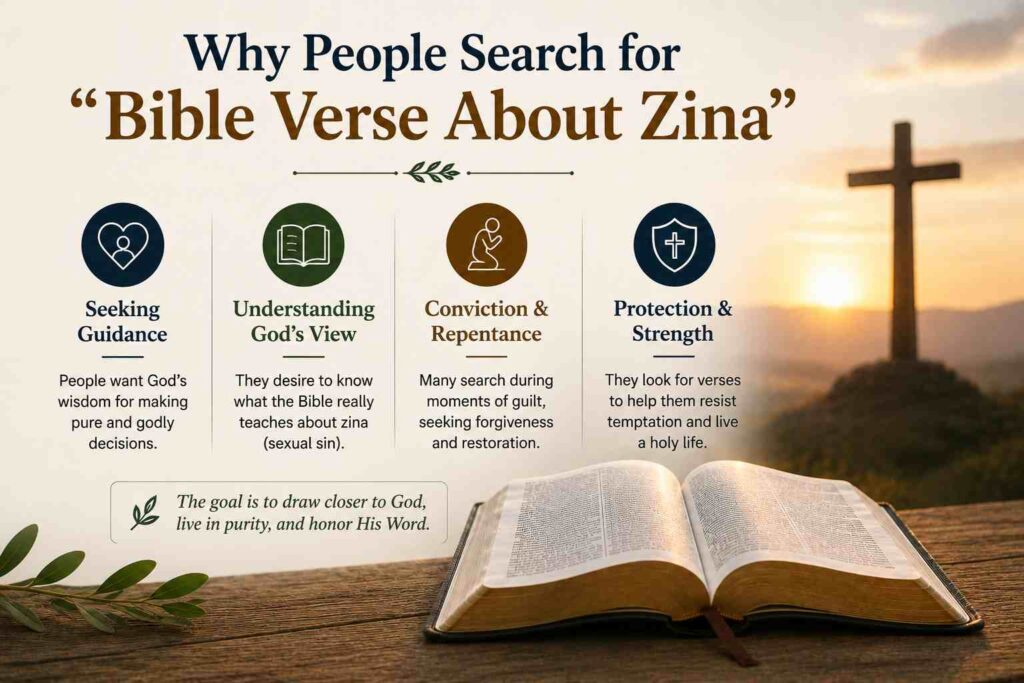
Why People Search for “Bible Verse About Zina”
Most people typing this phrase aren’t hunting for an Arabic word inside an English Bible. They’re really asking one of these:
- What’s the biblical equivalent of zina?
- Which Bible verses address this?
- Does Christianity teach something similar?
- How should Christians think about this topic?
These are legitimate questions, and the rest of this article works through them — the closest biblical concepts, the key passages in context, and how Scripture frames God’s design for sexual faithfulness.
What Biblical Concept Is Closest to Zina?
Since the Bible doesn’t use the word, the natural next question is which concept comes closest. There isn’t one — but sexual immorality, adultery, and fornication together give a fairly complete picture.
Sexual Immorality as the Broad Category
Sexual immorality appears repeatedly across the New Testament as an umbrella term for behavior that falls outside God’s design for marriage, most often translating the Greek *porneia*. Jesus names it among the sins that originate in the human heart (Matthew 15:19), and Paul repeatedly urges believers toward holiness by avoiding it (1 Corinthians 6:18; Ephesians 5:3). Many scholars treat this as the closest overall match to what most people mean by zina — though “closest” doesn’t mean identical; the two concepts arise from different religious traditions and shouldn’t be treated as interchangeable.
Adultery
Adultery is among the most consistently condemned sins in Scripture — not a social faux pas, but a breach of the marriage covenant God established. The Ten Commandments state it plainly: “You shall not commit adultery.” Jesus later extends the command inward, teaching that lustful intent itself reflects a deeper problem — God’s concern reaches the heart, not just outward behavior. Scripture treats adultery as both a sin against another person and a violation of one’s relationship with God. Because Islamic zina includes adultery, the overlap is real — but adultery is only one slice of the Bible’s broader teaching on sexual ethics.
Fornication
Older translations use fornication for sex between unmarried people; modern translations generally use sexual immorality instead, aiming to capture the fuller range of the Greek *porneia*. That’s a difference in translation philosophy, not doctrine — two faithful translations of the same passage can simply choose different English words for the same underlying teaching.
Why These Terms Are Related — but Not Identical
It helps to picture these as nested categories rather than synonyms:
| Sexual immorality | Broad category of prohibited sexual behavior | Broad | Biblical (Greek *porneia*) |
| Adultery | Sexual unfaithfulness involving marriage | Specific | Biblical |
| Fornication | Sexual relations outside marriage | More specific | Older English translations |
| Zina | Unlawful sexual relations | Broad within Islamic teaching | Arabic / Islamic |
They overlap significantly. They aren’t the same word wearing different clothes.
Bible Verses That Relate to Zina
The Bible never names zina, but it repeatedly teaches about faithfulness, purity, holiness, and sexual morality — and none of these passages should be read as standalone quotations. Each sits inside a larger historical and theological argument.
Old Testament Passages
Exodus 20:14 — The Seventh Commandment. “You shall not commit adultery.” Brief, but foundational — it protects the marriage covenant and reflects God’s concern for faithfulness in human relationships generally. Marriage in Scripture is never just a legal arrangement; it’s a covenant meant to reflect loyalty and trust, which is exactly what adultery damages.
Leviticus 18 — Boundaries for Sexual Holiness. This chapter expands on the seventh commandment by describing relationships Israel was called to avoid, framed around a larger purpose: living differently from the surrounding nations as a matter of holiness. Modern readers sometimes find the chapter’s specifics difficult without its ancient covenant context, but the underlying principle — pursue moral purity, honor God in every area of life — carries through.
Proverbs — Wisdom for Daily Living. Rather than issuing commands, Proverbs warns against adultery by walking through its consequences, encouraging readers to value marital faithfulness, resist temptation, and choose wisdom over momentary pleasure.
Together, these passages establish a consistent Old Testament message: marriage is a sacred covenant, sexual faithfulness reflects obedience to God, sin carries real consequences, and holiness involves both conduct and inward devotion — the foundation the New Testament builds on.
New Testament Passages
Matthew 5:27–28. In the Sermon on the Mount, Jesus extends the commandment against adultery inward, teaching that sinful desire begins in the heart before it becomes action. This isn’t equating temptation with sin — it’s locating personal responsibility for purity in both thought and conduct.
Matthew 15:19. Jesus names sexual immorality among the sins that originate from within, underscoring that lasting obedience requires inward renewal, not just external rule-following.
1 Corinthians 6:18–20. Paul tells believers to “flee from sexual immorality” — advising them to avoid situations that invite temptation rather than test their limits — grounding the instruction in the idea that a believer’s body belongs to God.
Ephesians 5:3–5. Paul urges the Ephesian church toward a life where sexual immorality isn’t a defining trait, calling believers instead toward purity, gratitude, and love.
Galatians 5:19–23. Paul contrasts the “works of the flesh,” which include sexual immorality, against the “fruit of the Spirit” — love, self-control, faithfulness, gentleness, goodness — framing biblical morality as more than avoidance; it’s about cultivating a transformed life.
Across these passages, the New Testament’s message holds together: sexual purity begins in the heart, God’s design for sexuality reflects wisdom, believers are called to holiness, and obedience flows from a transformed relationship with God rather than mere rule-keeping.
Why Context Matters When Reading These Verses
A single verse rarely carries the full weight of what its author intended. Before applying any of them, it’s worth asking who originally received the message, what situation prompted it, and how it fits the surrounding chapter and broader biblical theme. A command given to ancient Israel under the Mosaic covenant needs its historical setting understood before it’s applied today; Paul’s letters likewise respond to specific challenges in early Christian communities. Reading this way avoids proof-texting — pulling isolated verses to support a conclusion the author never intended — and surfaces the real biblical themes underneath: covenant faithfulness, holiness, repentance, grace, and God’s desire for people to live in loving obedience to Him.
Adultery, Fornication, and Sexual Immorality: What’s the Difference?
These three terms get used interchangeably online more often than they should be, which only adds to the confusion for anyone comparing them to zina. They overlap, but the Bible uses each with a distinct shade of meaning.
Adultery refers specifically to sexual unfaithfulness involving a married person — a violation of the marriage covenant, not merely a social norm. Jesus broadened the concept in the Sermon on the Mount by locating it in desire as well as action.
Fornication is largely a translation choice rather than a separate biblical category — the King James Version’s rendering of sexual relations between unmarried people, where many modern translations use sexual immorality instead to reflect the fuller Greek meaning.
Sexual immorality is the broadest of the three, typically translating *porneia* and functioning as an umbrella category rather than one specific offense — which is why New Testament writers tell believers to “flee from sexual immorality” instead of listing every possible scenario.
| Primary meaning | Unfaithfulness involving marriage | Sexual relations outside marriage | Broad category of prohibited conduct |
| Scope | Narrow | More specific | Broad |
| Common in modern translations | Yes | Less frequently | Yes |
| Related to *porneia* | Sometimes, by context | Often | Frequently |
| Closest broad equivalent to zina | Partial overlap | Partial overlap | Closest overall match |
Collapsing these distinctions — treating “sexual immorality” as though it always means adultery, or fornication and adultery as interchangeable — blurs lines Scripture itself maintains, and it’s one reason Bible translations can look inconsistent when they’re really just choosing different English words for the same underlying idea. What ties all three together, though, is the same: God values faithfulness, honors marriage, and calls His people to purity in both action and motive.
What Does the Bible Teach About Repentance and Forgiveness?
A natural question follows all of this: if someone has committed these sins, is there hope? Scripture’s answer doesn’t minimize the sin, but it doesn’t close the door either.
Repentance, in biblical terms, is more than guilt after a bad choice — it’s a genuine change of heart that changes direction: acknowledging wrongdoing without excuses, grieving over sin rather than just fearing its consequences, seeking God’s forgiveness, and pursuing a transformed life. That’s different from mere remorse, which feels sorrow over getting caught but doesn’t necessarily lead anywhere:
| Feels sorrow over actions | Leads to a changed life |
| Focuses on consequences | Focuses on restoring the relationship with God |
| Often temporary | Produces lasting transformation |
| Doesn’t require obedience | Results in turning toward God |
Grace, meanwhile, doesn’t mean God ignores sin — it means He offers forgiveness and reconciliation to those who come to Him in genuine repentance. Scripture never treats God’s justice and mercy as opposing forces; He takes sin seriously and invites sinners back at the same time. Grace isn’t permission to keep living in contradiction to God’s design — it’s what empowers a believer to pursue holiness out of gratitude rather than fear.
One important caveat: forgiveness restores the relationship with God, but it doesn’t automatically erase every earthly consequence of a past choice — a distinction Scripture is honest about, and one worth carrying into the examples below.
Biblical Examples That Help Explain the Issue
Definitions and commands matter, but the Bible’s own stories show what temptation, failure, repentance, and restoration actually look like in practice.
David and Bathsheba
No account illustrates both the seriousness of adultery and the reality of repentance more clearly. David, Israel’s king, committed adultery with Bathsheba and then arranged circumstances leading to the death of her husband, Uriah — and tried to conceal it. When the prophet Nathan confronted him, David didn’t deflect; he confessed. Psalm 51 records that confession in full — a request for mercy, cleansing, and a renewed heart. David was forgiven, but his family still bore painful consequences. No position or spiritual maturity makes anyone immune to temptation — and no failure puts someone beyond God’s willingness to forgive a genuine return to Him.
Joseph Resisting Temptation
Where David’s story is about failure and repentance, Joseph’s (Genesis 39) is about faithfulness under pressure. Potiphar’s wife repeatedly pursued him; Joseph refused, viewing it as both a betrayal of his master’s trust and a sin against God. Notably, he didn’t just rely on willpower — when the pressure intensified, he physically removed himself from the situation, even though doing so led to a false accusation and imprisonment. Scripture is clear that God remained with him regardless. The lesson: avoiding temptation is often wiser than testing one’s ability to resist it, and integrity sometimes costs something in the short term while still honoring God in the long run.
The Woman Caught in Adultery
In John 8:1–11, religious leaders bring a woman accused of adultery before Jesus, hoping to trap Him in a legal dilemma. His response — “Let him who is without sin among you be the first to throw a stone at her” — exposes their hypocrisy rather than answering their trap directly; one by one, the accusers leave. Jesus then tells her: “Neither do I condemn you; go, and from now on sin no more.” Both halves matter. He extends mercy without public humiliation, and He doesn’t treat that mercy as license — the instruction to “sin no more” makes clear that forgiveness was never an endorsement.
Paul’s Instructions to the Early Churches
Paul addressed sexual ethics repeatedly because many early Christian communities lived in cultures where sexual norms conflicted directly with biblical teaching. Rather than simply listing prohibitions, he explained the reasoning: believers’ bodies are, in his words, temples of the Holy Spirit, meant to honor God rather than serve sinful desire; holiness reflects a new identity, not a set of restrictions; and the goal is pursuing purity, self-control, love, and faithfulness — a positive vision, not just a list of things to avoid.
Lessons from These Biblical Accounts
Different people, different circumstances, remarkably consistent lessons:
- Temptation is universal. David, Joseph, the woman in John 8, and the early churches all faced it — Scripture never suggests faithful people are exempt.
- Choices carry consequences. David’s affected his family; Joseph’s obedience brought temporary suffering; the woman’s sin brought public shame. Forgiveness doesn’t erase this.
- God values genuine repentance. Every restoration in these stories follows a real turn back to God, not just regret.
- Faithfulness is possible. Joseph proves obedience isn’t hypothetical, even under real pressure.
- Grace and truth hold together. God never ignores sin, and He never delights in condemnation — He calls people to repentance while extending mercy to those who seek Him.
Comparing Biblical Teaching and the Islamic Understanding of Zina
Because zina comes from Islamic teaching, it’s fair to ask whether the Bible and the Quran are addressing exactly the same thing. The honest answer is: partly.
Shared Moral Principles
Both traditions treat sexual conduct as a matter of moral responsibility rather than personal preference — honoring marriage, valuing faithfulness, discouraging sex outside those boundaries, and recognizing that sexual behavior carries spiritual as well as personal consequences. That shared concern is exactly why people searching for zina expect to find related biblical teaching — and why they do.
Important Differences
The overlap sits in shared moral concern, not identical vocabulary or theology. Three differences matter most:
- Language. The Quran was revealed in Classical Arabic; the Old Testament in Hebrew (with some Aramaic); the New Testament in Koine Greek. The Bible predates the Quran by centuries, so it naturally lacks Arabic religious vocabulary.
- Terminology. Islam uses the single term zina; the Bible spreads the same territory across adultery, sexual immorality, impurity, unfaithfulness, and (in older translations) fornication.
- Theological framework. Biblical sexual ethics sit inside the larger themes of covenant, holiness, grace, redemption, and repentance — connecting obedience to God’s broader plan for human flourishing, rather than presenting isolated rules.
Why the Terminology Differs
Religious vocabulary develops inside particular languages and cultures — Hebrew authors wrote in Hebrew, Greek-speaking apostles in Greek, and Islamic revelation in Classical Arabic — so words rarely transfer cleanly between unrelated traditions. Translators generally aim to communicate meaning rather than to manufacture identical vocabulary across languages that never shared it, which is also why English Bible translations themselves sometimes vary between fornication, sexual immorality, or impurity while still conveying the same underlying teaching.
| Primary term | Zina | Sexual immorality (broad category) |
| Married offense | Included within zina | Adultery |
| Broader category | Defined within Islamic teaching | Sexual immorality |
| Original language | Arabic | Hebrew and Greek |
| Primary emphasis | Unlawful sexual relations | Holiness, covenant faithfulness, sexual purity |
Common Misunderstandings About Zina and the Bible
“Zina is a Bible word.” It isn’t. It’s Arabic, and belongs to Islamic vocabulary. Most people searching “Bible verse about zina” want the closest biblical teaching, not the literal word.
“Zina means only adultery.” Adultery is one category within it, not the whole picture — the broader biblical term sexual immorality covers more of what zina addresses across the New Testament.
“Every Bible translation uses the same words.” One translation’s “fornication” is another’s “sexual immorality” in the identical passage — a difference in translation philosophy, not doctrine.
“One verse explains everything.” No single verse carries the Bible’s complete teaching on sexual ethics; it develops progressively through the covenant, the wisdom literature, Jesus’s teaching, the apostles’ writings, and historical narrative.
“Translation differences mean doctrinal differences.” They usually don’t. Languages rarely have perfect one-to-one equivalents, and faithful translations can choose different English words for the same original meaning.
Key Takeaways
- The Bible never uses the Arabic word zina.
- The closest biblical concept is sexual immorality, with adultery and fornication describing more specific pieces of it.
- Scripture consistently teaches holiness, faithfulness, and honoring God’s design for marriage.
- The Bible holds together the seriousness of sexual sin and the hope of forgiveness through genuine repentance.
- Christianity and Islam share real moral concern here but express it through different languages, terms, and theological frameworks.
- Understanding the underlying concepts matters more than chasing an identical word across two traditions.
Frequently Asked Questions
What is zina in the Bible?
Zina isn’t in the Bible — it’s an Arabic term from Islamic teaching for unlawful sexual relations. Scripture addresses the same moral territory through sexual immorality (the broadest category in modern translations), adultery (unfaithfulness within marriage), and fornication (the traditional term in older translations for sex outside marriage).
Does the Bible forbid fornication?
Yes. Even where modern translations say “sexual immorality” instead, the underlying teaching is the same: sexual relationships are intended for the covenant of marriage, and Jesus, Paul, and other New Testament writers consistently call believers toward purity and self-control.
Is sexual immorality the same as adultery?
Not quite — adultery is one specific form of sexual immorality, which is the broader category. Sexual immorality covers the widest range; adultery narrows to marital unfaithfulness; fornication traditionally names sex outside marriage.
Why is fornication considered sinful in the Bible?
Because Scripture treats sexuality as a gift meant for the covenant of marriage — rooted in broader biblical themes of faithfulness, holiness, love, and honoring God with both body and heart, not an arbitrary restriction.
Can God forgive sexual sin?
Yes, according to the Bible — David’s repentance after Bathsheba and Jesus’s response to the woman caught in adultery both show mercy extending even after serious moral failure. That said, forgiveness is never presented as approval; Scripture consistently pairs mercy with a call to repentance and transformed living.
Which Bible verses are most relevant?
Exodus 20:14, Leviticus 18, and Proverbs 5–7 in the Old Testament; Matthew 5:27–30, Matthew 15:19, 1 Corinthians 6:18–20, Galatians 5:19–23, Ephesians 5:3–5, and Hebrews 13:4 in the New Testament — each best read within its surrounding context rather than in isolation.
Why doesn’t the Bible use the word zina?
Because it was written centuries before the Quran, primarily in Hebrew, Aramaic, and Koine Greek — languages that predate the Classical Arabic in which zina, as a term, exists.
Is porneia the closest biblical equivalent to zina?
Many scholars treat it that way, but the two aren’t perfectly interchangeable — *porneia* belongs to New Testament Greek and Christian theology, while zina belongs to Islamic law and theology. They overlap substantially without being identical.
Conclusion
There’s no single verse that answers “What does the Bible say about zina?” because the word itself never appears in Scripture. The answer instead comes from the Bible’s broader teaching on sexual morality, faithfulness, holiness, and God’s design for marriage — expressed through sexual immorality, adultery, and fornication, three related but distinct concepts.
Scripture is honest about the seriousness of sexual sin, and equally clear about the hope of repentance and grace. David’s restoration, Joseph’s integrity, and Jesus’s response to the woman caught in adultery all show the same balance: God’s commitment to holiness alongside His willingness to forgive those who genuinely turn to Him.
And comparing biblical teaching with the Islamic concept of zina is a reminder that different traditions often address the same moral concern through different languages and frameworks — the goal isn’t finding one word that means the same thing twice, but understanding what each tradition is actually teaching. Read across Scripture as a whole, the Bible’s message on this is consistent: faithfulness, purity, and holiness, held together with mercy and grace for anyone who seeks it sincerely.