
Connection Hints Forbes: Today’s Hints, Tips, and How to Solve Connections
If you searched for “connection hints Forbes,” you are probably looking for helpful clues for a Connections-style word puzzle, especially when you are stuck but do not want to see the complete answers immediately.
That is an important distinction. Someone searching for answers usually wants the solution. Someone searching for hints often wants to keep solving the puzzle independently.
| Search Intent | What People Want to Know |
|---|---|
| Today’s Connection Hints Forbes | Get the latest Connections hints without seeing the full answers. |
| Forbes Connections Hints | Find clues for today’s Connections puzzle, especially for difficult groups. |
| Connection Hints Today | Get quick hints to help solve today’s puzzle. |
| Forbes Connections Answers | Check the complete answers after attempting the puzzle. |
| Today’s Connections Answers Forbes | Find today’s four Connections groups and their solutions. |
| Connections Hints for Each Group | Get separate clues for each of the four puzzle categories. |
| Connections Yellow Group Hint | Get a hint for the easiest/yellow category without revealing the answer. |
| Connections Green Group Hint | Get a clue for the green difficulty group. |
| Connections Blue Group Hint | Get a clue for the more challenging blue group. |
| Connections Purple Group Hint | Get a clue for the most difficult or wordplay-based group. |
| How to Solve Connections | Learn strategies for identifying the four hidden groups. |
| Connections Hints Without Spoilers | Get useful clues while keeping the final answers hidden. |
| Connections Clues Today | Find quick clues for the current puzzle. |
| Connections Puzzle Help | Get assistance when stuck on a category or word group. |
| Connections Group Hints | Understand the connection between words without immediately seeing the solution. |
| Connections Daily Hints | Find daily hints for the latest Connections puzzle. |
| Connections Puzzle Answers Today | Verify the final solution after trying the puzzle. |
| Connections Red Herrings | Learn which words are designed to look like they belong together. |
| Connections Tips and Tricks | Learn faster ways to identify categories and avoid mistakes. |
| Connections Category Hints | Get clues about the hidden theme behind each group. |
A useful hint should give you a direction without taking away the satisfaction of finding the connection yourself.
The idea is simple: you have a collection of words, and your job is to divide them into groups based on a hidden relationship. The challenge comes from the fact that several words may appear to fit together, even when only one combination is correct.
For readers looking for Connection Hints Forbes, the most useful content should therefore provide progressive clues, solving strategies, explanations of difficult categories, and—when requested—answers after the player has had a chance to try.
Why Are People Searching for Connection Hints Forbes?
Most people searching this phrase are already playing a Connections puzzle and have reached a point where they cannot see the next step.
You may recognize two or three related words but have no idea which word completes the group. Or perhaps you have identified one category but the remaining words seem completely unrelated.
That is where a good hint becomes useful.
The Main Search Intent
The primary intent behind “connection hints Forbes” is:
To find helpful hints for a Connections puzzle that guide the player toward the correct groups without immediately revealing the complete answers.
This is different from simply searching for “Connections answers.”
A player using hints still wants to participate in the solving process.
What Searchers Usually Want
Someone looking for Connections hints may want:
- A clue for the first difficult group
- A hint for each remaining category
- Help understanding a confusing word
- Assistance identifying a hidden relationship
- A way to avoid spoilers
- Confirmation that their thinking is correct
- The full answers only after trying the puzzle
Understanding this intent makes it easier to create useful content instead of simply publishing a list of solutions.
How the Connections Puzzle Works
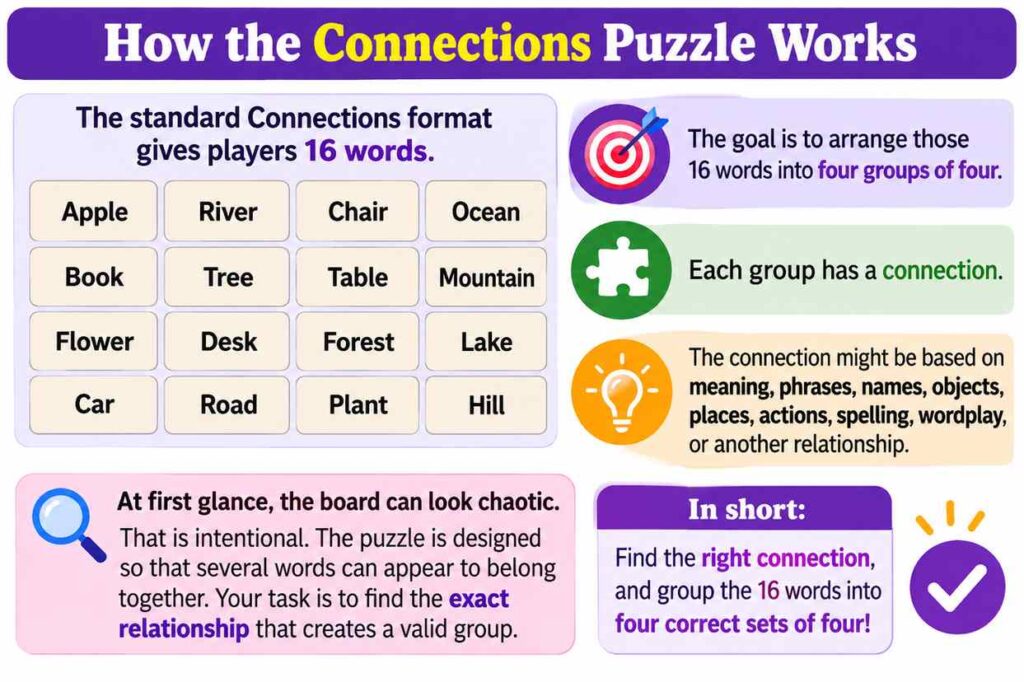
The standard Connections format gives players 16 words.
The goal is to arrange those 16 words into four groups of four.
Each group has a connection.
The connection might be based on meaning, phrases, names, objects, places, actions, spelling, wordplay, or another relationship.
At first glance, the board can look chaotic.
That is intentional.
The puzzle is designed so that several words can appear to belong together. Your task is to find the exact relationship that creates a valid group.
The Four Groups of Four
Each group contains four words.
That means you are not simply searching for similar words. You are trying to find four words that share a specific connection.
For example, imagine you see 16 words and notice that four appear related to sports.
That could be correct.
But before committing, you should ask whether another word also fits the sports idea more naturally.
If five words appear to fit, the puzzle may be using one of them as a trap.
Why the Groups Can Have Different Difficulties
Connections puzzles often mix easier and harder categories.
You might find one group almost immediately while another takes several minutes.
A puzzle could contain:
An obvious category
These are groups where the relationship is easy to recognize.
A moderate category
The words are related, but you need to think about their shared use or meaning.
A difficult category
The relationship may involve an unusual interpretation or phrase.
A deceptive category
The words are deliberately chosen to make you think of another group first.
This changing difficulty is part of what makes Connections enjoyable.
How to Use Connection Hints Without Spoilers
The smartest way to use a hint is to start with the smallest amount of help you need.
Do not immediately reveal everything.
Instead, use hints in stages.
Start With a General Hint
A general hint might tell you the broad subject of a group without identifying the words.
For example, a clue could point you toward:
“Think about something related to travel.”
That may be enough to make the connection yourself.
Move to a Stronger Hint
If the first clue does not help, look for something more specific.
A stronger hint might explain that the group consists of words associated with a particular type of activity, phrase, or object.
Use the Answer as the Final Step
Only check the complete answer when you have genuinely exhausted your ideas.
This preserves the challenge.
Think of hints as climbing steps. You should not jump straight to the roof unless you really need to.
How to Read a Connections Hint
A hint does not always tell you exactly what the words mean.
Sometimes it tells you how to look at them.
This is an important distinction.
A hint may refer to:
- A common phrase
- A second meaning
- A category
- A profession
- A place
- A person
- An object
- A word that follows another word
- A word that comes before another word
- Spelling
- Sound
- Wordplay
If a hint seems strange, do not assume it is useless.
It may be encouraging you to change your interpretation.
A Step-by-Step Method for Solving Connections
Having a repeatable method makes the puzzle much easier.
Instead of randomly selecting words, work through the board systematically.
Step 1: Read All 16 Words
Do not immediately select four words.
Read everything first.
Look for obvious relationships and unusual words.
Ask yourself:
- Which words seem related?
- Which words have multiple meanings?
- Do any words form familiar phrases?
- Do any look like names?
- Do any appear to belong to the same subject?
This first scan gives you a mental map of the puzzle.
Step 2: Look for Strong Pairs
Finding four words at once can be difficult.
Finding two is much easier.
Start by identifying strong pairs.
Then ask whether you can find a third word that fits naturally.
If you find three, search carefully for the fourth.
Step 3: Build a Possible Group
Once you think you have four related words, stop and test the idea.
Do not submit simply because the group looks reasonable.
Ask:
“What exact connection explains all four?”
If you cannot describe the connection clearly, your group may be wrong.
Step 4: Look for a Fifth Word
This is one of the most useful checks.
Suppose you believe four words belong together.
Now look at the remaining words.
Does another word seem to fit the same category?
If yes, you need to investigate further.
Connections often uses overlapping relationships to create traps.
Step 5: Remove the Solved Group
Once you are confident, mentally remove those four words.
The remaining 12 words become much easier to understand.
This is similar to cleaning a crowded desk. Once you remove the items you have already dealt with, the remaining objects become easier to organize.
Common Types of Connections Categories
Knowing common category styles can help you solve puzzles faster.
Synonyms
Four words may have similar meanings.
The challenge is usually recognizing the precise relationship rather than simply finding words that are vaguely similar.
Common Phrases
Several words may become familiar expressions when combined with another word.
These can be difficult because the relationship may not be visible when the words are viewed individually.
Objects in the Same Category
The four words may represent different examples of the same type of object.
The category could relate to food, transportation, tools, clothing, technology, nature, or many other subjects.
Names
Some words may refer to people, fictional characters, places, brands, or other proper names.
This can be especially difficult when the words also have ordinary meanings.
Words With Multiple Meanings
This is one of the most important Connections techniques.
A word may have a common everyday meaning and a completely different meaning in another context.
The puzzle may depend on the less obvious meaning.
Wordplay
Some categories rely on spelling, letters, sounds, abbreviations, or unusual language patterns.
These groups can be difficult if you only search for traditional definitions.
Why One Word Can Be a Red Herring
A red herring is a word that appears to fit a category but actually belongs somewhere else.
This is one of the main reasons Connections puzzles can be frustrating.
Imagine you have three words that clearly appear to belong together.
You find a fourth word that seems to fit.
You feel confident.
But the puzzle rejects your group.
What happened?
The fourth word was probably designed to distract you.
How to Recognize a Red Herring
Ask yourself whether the connection is:
- Exact
- Natural
- Specific
- Strong
- Consistent
If you have to invent a complicated explanation for one word, be suspicious.
A good category normally has a clear relationship between all four words.
Forbes Connections Hints vs. Full Answers
Hints and answers serve different purposes.
A complete answer gives you the destination.
A hint gives you directions.
If you enjoy solving puzzles, hints are usually the better first choice.
Why Hints Can Be More Useful
Suppose you are missing one category.
Seeing the complete answer might solve the problem immediately.
But if you receive only a clue, you still have to connect the dots.
That mental effort helps you remember the pattern.
A Useful Hint Progression
A good puzzle guide can provide several levels:
Level 1: Gentle Hint
A broad clue about the category.
Level 2: Strong Hint
A more specific indication of what the words have in common.
Level 3: Near-Solution Hint
Enough information to make the answer fairly obvious.
Level 4: Full Answer
The exact four words and their category.
This approach lets the reader decide how much help they need.
How to Get Better at Connections
Solving more puzzles helps, but simply playing is not enough.
You should also study your mistakes.
After completing a puzzle, think about what caused you trouble.
Ask Yourself What Fooled You
Did you choose the wrong fourth word?
Did you miss a second meaning?
Did you create a category that was too broad?
Did you overlook a familiar phrase?
Did you assume the most obvious meaning?
These questions help you improve.
Learn to Change Your Perspective
Sometimes you are not missing knowledge.
You are simply looking at the word from the wrong angle.
Try changing the question.
Instead of asking:
“What does this word mean?”
Ask:
“What could this word represent?”
That small change can reveal an entirely different connection.
Common Mistakes Players Make
Mistake 1: Choosing the First Four Words That Fit
A group can look correct and still be wrong.
Always test it before submitting.
Mistake 2: Creating Categories That Are Too Broad
A category such as “things people use” is almost useless because too many words could qualify.
Look for a more specific connection.
Mistake 3: Ignoring Multiple Meanings
If a word seems completely out of place, do not immediately assume it does not belong.
Ask whether it has another meaning.
Mistake 4: Overthinking Everything
Not every category is a complicated trick.
Sometimes the obvious group really is the correct one.
Mistake 5: Refusing to Abandon a Bad Theory
If your category does not work, let it go.
Puzzle solving requires flexibility.
Tips for Solving Difficult Connections Puzzles
When you are completely stuck, stop staring at the same four words.
Change your strategy.
Look for the Most Unusual Word
An unusual word can provide a useful anchor.
Ask what makes it different from the others.
Think About Phrases
Try mentally placing another word before or after each candidate.
You may discover a familiar expression.
Consider Different Meanings
Take a word you have already categorized and deliberately search for another interpretation.
This is particularly useful when the board seems to contain too many possible groups.
Work Backward
Instead of asking:
“What group does this word belong to?”
Ask:
“What kind of category would need this word?”
Working backward can break a mental block.
Use Elimination
You do not always need to discover the answer directly.
Sometimes you can eliminate enough incorrect possibilities that the correct group becomes obvious.
Can You Solve Connections Without Looking at the Answer?
Yes, and that is often the most satisfying way to play.
The key is patience.
If you are stuck, do not immediately search for the full answer.
Try a short break.
Return to the board.
Read the words again.
Your brain sometimes finds connections after you stop forcing them.
If you still cannot solve it, use a gentle hint.
Then try again.
Only move to the complete answer when you are ready.
Connection Hints Forbes for Beginners
Beginners often make the mistake of searching for complicated connections immediately.
Start simple.
Look for:
- Obvious synonyms
- Clearly related objects
- Familiar phrases
- Strong word pairs
- Obvious categories
Do not worry if you make mistakes.
Wrong guesses are part of learning the structure of the game.
The more puzzles you solve, the faster you will recognize common traps.
Connection Hints Forbes for Experienced Players
Experienced players can take a more analytical approach.
Instead of asking only whether four words fit, compare multiple possible groups.
For each possible category, ask:
How strong is the connection?
Do all four words fit equally well?
How specific is the category?
Could dozens of words fit the same description?
Is there another possible word?
If a fifth word fits, investigate before submitting.
Could the puzzle be misleading me?
If the category looks almost too easy, check it carefully.
This approach turns Connections into a form of hypothesis testing.
You create an idea, test it, reject weak possibilities, and keep the strongest one.
How to Check Your Answer After Solving
Before you consider a group finished, explain the relationship to yourself in one clear sentence.
For example:
“These four words belong together because they are all used in the same type of phrase.”
If you cannot explain the connection clearly, reconsider it.
A correct category usually becomes clearer once you identify it.
That is one of the most satisfying parts of Connections.
Before solving, the words appear random.
After solving, the relationship suddenly seems obvious.
Why Connections Puzzles Are So Addictive
Connections has a simple structure but surprisingly deep gameplay.
You do not need complicated rules.
You simply need to find four groups.
Yet every puzzle can feel completely different.
The reason is ambiguity.
Your brain naturally searches for patterns. When it finds one, it wants to accept it.
Connections takes advantage of that tendency.
It gives you enough information to form theories but not enough to make every theory correct.
That creates the tension between confidence and doubt.
And when the final group finally clicks, the reward is immediate.
How to Use Connection Hints More Effectively
The goal is not to use as many hints as possible.
The goal is to use the right hint at the right moment.
If you are completely lost, start with a broad clue.
If you already know the category but cannot identify one word, use a more targeted clue.
If you have only one group remaining, look for a hint that helps you distinguish between the final possibilities.
This makes hints a tool for solving rather than a replacement for solving.
What Makes a Good Connection Hints Article?
A useful article targeting “connection hints Forbes” should understand what the reader actually needs.
People do not necessarily want a wall of answers.
They want assistance.
That means useful content should:
- Explain the puzzle
- Provide a clear solving strategy
- Use progressive hints
- Avoid unnecessary spoilers
- Explain difficult connections
- Help readers recognize red herrings
- Offer answers only when appropriate
- Be easy to scan
The best experience gives readers control.
Someone who wants one tiny clue should not be forced to read the entire solution.
Someone who has already tried everything should be able to find the answer easily.
Frequently Asked Questions About Connection Hints Forbes
What does Connection Hints Forbes mean?
The phrase generally refers to searches for Connections puzzle hints associated with Forbes-related content or searches. Users are typically looking for clues that help them solve a Connections puzzle without immediately revealing the full solution.
Are Connection Hints Forbes and Connections answers the same thing?
No. Hints provide clues or direction, while answers reveal the completed groups. A hint is intended to preserve some of the challenge.
How many words are in a standard Connections puzzle?
A standard Connections puzzle contains 16 words that must be divided into four groups of four.
Can one word appear to fit multiple groups?
Yes. This is a central part of the challenge. A word can have several possible associations, but the intended solution places it in one specific group.
What should I do if I cannot find a group?
Start by looking for strong word pairs. Then search for a third and fourth word. If you are still stuck, use a gentle hint instead of immediately checking the complete answer.
Why do Connections puzzles use misleading words?
Misleading words make the puzzle more challenging. They create plausible connections that encourage players to make incorrect assumptions.
What is the best way to avoid red herrings?
Test the specificity of your category. If several words could fit, look for the four that create the strongest and most precise relationship.
Should I check hints before answers?
If you want to solve the puzzle yourself, hints are usually the better first step. They can give you enough direction to discover the answer without completely removing the challenge.
Can Connections improve vocabulary skills?
Connections encourages flexible thinking about vocabulary, including synonyms, phrases, multiple meanings, categories, and word associations. It can therefore be a useful and entertaining way to practice language skills.
What is the best strategy for solving Connections quickly?
Scan all the words first, identify strong relationships, test possible groups, watch for words with multiple meanings, avoid forcing categories, and use elimination once you have confidently solved a group.
Conclusion
People searching for “connection hints Forbes” are generally looking for more than a list of answers. They want help getting unstuck while still having the opportunity to solve the puzzle themselves.
The best approach is to begin with the obvious relationships, test every potential group carefully, watch for words with multiple meanings, and remain alert to red herrings. When you reach a dead end, use a hint as a nudge rather than immediately revealing the complete solution.
Think of a good Connections hint as a flashlight in a dark room. It does not show you everything. It simply helps you see where to look next.
With regular practice, you will become better at recognizing patterns, questioning misleading connections, and finding the hidden relationships that make Connections puzzles so satisfying.