

Before I Formed You In The Womb I Knew You: Jeremiah 1:5 Meaning Explained
Many people recognize the phrase “Before I formed you in the womb I knew you,” even if they’re not sure where it comes from or what it truly means. It shows up in sermons, social media posts, greeting cards, nursery wall art, and devotionals as an encouraging reminder that God has a purpose for every life. That message is meaningful — but understanding it correctly means looking beyond the quotation itself.
The verse comes from Jeremiah 1:5, where God calls the prophet Jeremiah to a demanding ministry during one of the most turbulent periods in Israel’s history. Reading it within that historical and literary setting lets us appreciate both its original meaning and the deeper truths it reveals about God’s knowledge, sovereignty, and purpose.
This guide walks through Jeremiah 1:5 in depth: what each phrase means, how it compares with related passages like Psalm 139, how the verse is used in everyday life today, and one of the questions readers ask most often — does Jeremiah 1:5 apply to everyone today?
Quick Answer
“Before I formed you in the womb I knew you” is found in Jeremiah 1:5, where God tells Jeremiah:
“Before I formed you in the womb I knew you, before you were born I set you apart; I appointed you as a prophet to the nations.”
The passage records God’s call of Jeremiah as a prophet. While it specifically describes Jeremiah’s unique commissioning, it also reveals broader biblical truths about God’s sovereignty, His intimate knowledge of His creation, and His purposeful work in human lives.
What Bible Verse Says “Before I Formed You in the Womb I Knew You”?

The quote comes from Jeremiah 1:5, in the Old Testament book of Jeremiah. It’s part of God’s call to Jeremiah, who would become one of Israel’s major prophets — and rather than standing alone as an inspirational line, it introduces his prophetic ministry and explains that God had already chosen him for a specific purpose before he was born.
Here is the verse in the New International Version (NIV):
“Before I formed you in the womb I knew you, before you were born I set you apart; I appointed you as a prophet to the nations.” — Jeremiah 1:5 (NIV)
God is speaking directly to Jeremiah, assuring him that his calling didn’t begin the day he received this message. God had already determined Jeremiah’s prophetic mission long before his birth.
The verse is quoted often because it speaks to God’s foreknowledge and purpose. But its immediate context isn’t a general promise made to everyone — it’s the account of one man’s personal commissioning as a prophet. Understanding that distinction matters before applying the verse to your own life.
Where Is Jeremiah 1:5 Found?
- Book: Jeremiah
- Testament: Old Testament
- Chapter: 1
- Verse: 5
It sits in the opening chapter, immediately after God begins speaking to the young prophet.
Who Was Speaking?
God Himself is speaking. Jeremiah is listening, called to serve as “a prophet to the nations.” This exchange marks the start of his prophetic ministry and lays the foundation for everything that follows in the book.
How Do You Pronounce “Jeremiah”?
For readers encountering the name in print more often than out loud, it’s pronounced jer-uh-MY-uh (the Hebrew form, Yirmeyahu, means “the Lord exalts” or “appointed by the Lord” — a meaning that quietly foreshadows the very calling described in verse 5).
Why Is This Verse So Well Known?
Jeremiah 1:5 has become one of the Bible’s most recognizable verses because it touches questions many people ask about identity and purpose — God’s knowledge of every person, His sovereign plan, the value of human life, purpose before birth, and divine calling.
Those themes are genuinely present. But they should be read within the verse’s original setting, since taking only the first half without the rest can lead to misreading both its meaning and its application.
Jeremiah 1:5 in Different Bible Translations
Comparing several trusted translations is one of the most useful ways to study any passage. The wording shifts from version to version, but the central message of Jeremiah 1:5 stays the same: God knew Jeremiah, set him apart, and appointed him for a prophetic mission before he was born.
| Translation | Key Wording | Distinctive Feature | Reading Style |
|---|---|---|---|
| NIV | “Before I formed you in the womb I knew you” | Clear, modern wording | Easy to read |
| KJV | “Before I formed thee in the belly I knew thee” | Traditional language (“thee,” “belly”) | Formal |
| ESV | “Before I formed you in the womb I knew you” | Close to the original wording | Essentially literal |
| NKJV | Similar to KJV with updated language | Preserves traditional style | Formal but modernized |
| NLT | Contemporary English that retains the meaning | Highly readable | Thought-for-thought |
| CSB | “Before I formed you in the womb I knew you” | Balances accuracy and readability | Optimal equivalence |
Despite the differences in wording, every translation lands on the same essential ideas: God formed Jeremiah, knew him before birth, set him apart, and appointed him as a prophet.
Why Do Bible Translations Sound Different?
Different translations follow different philosophies. The English Standard Version (ESV) stays as close as possible to the original Hebrew wording, while the New Living Translation (NLT) focuses on expressing that same meaning in natural, modern English. The Christian Standard Bible (CSB) aims for a middle path between the two. The King James Version (KJV) reflects the English of the early seventeenth century, which is why words like thee and thou appear — modern translations simply update that language while keeping the underlying message intact.
These differences aren’t contradictions. They’re different approaches to carrying ancient Hebrew into understandable English.
Which Translation Should You Read?
There’s no single “best” translation for every reader — each serves a slightly different purpose. The NIV works well for everyday reading and study. The ESV suits readers who want something closer to a literal rendering. The NKJV blends traditional wording with modern readability, while the KJV remains valued for its historical influence and literary style. The NLT is especially accessible for newer Bible readers, and the CSB is a solid choice for readers who want both accuracy and flow.
Comparing translations side by side often deepens your understanding of a passage, since seeing how different translators render the same verse highlights nuance without changing its central meaning. As this guide continues, the focus stays on what Jeremiah 1:5 means rather than on any single translation’s wording — that context matters far more than which English version you happen to read.
What Does Jeremiah 1:5 Mean?
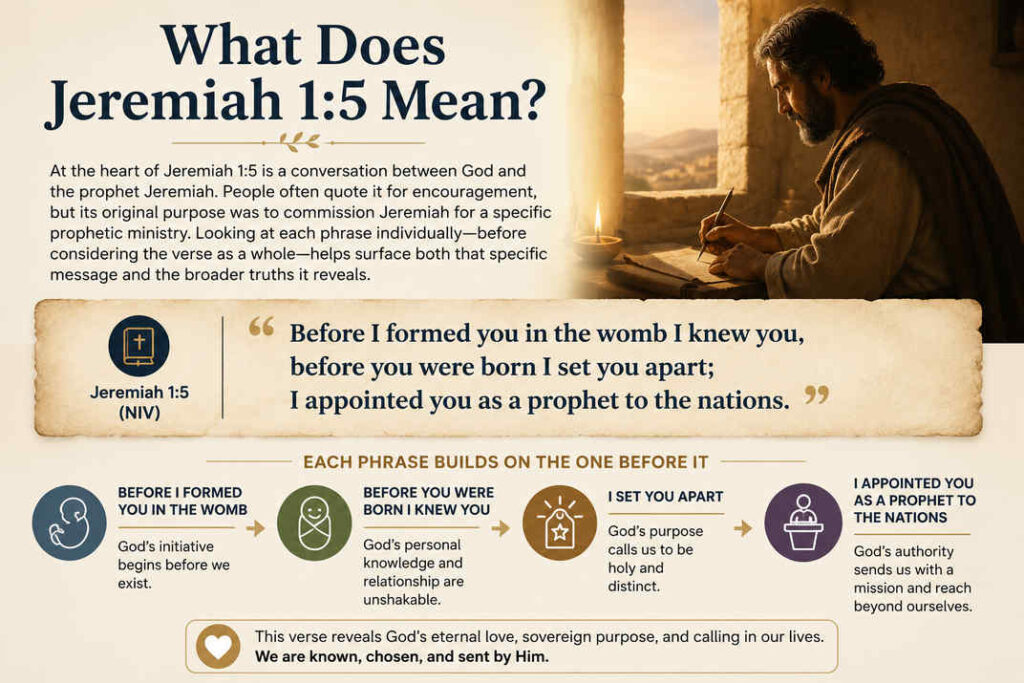
At the heart of Jeremiah 1:5 is a conversation between God and the prophet Jeremiah. People often quote it for encouragement, but its original purpose was to commission Jeremiah for a specific prophetic ministry. Looking at each phrase individually — before considering the verse as a whole — helps surface both that specific message and the broader truths it reveals.
Jeremiah 1:5 (NIV): “Before I formed you in the womb I knew you, before you were born I set you apart; I appointed you as a prophet to the nations.”
Each phrase builds on the one before it, revealing God’s initiative, purpose, and authority in Jeremiah’s life.
Before I Formed You
The opening words emphasize God’s role as Creator, pointing to His creative work before Jeremiah ever entered the world. “Formed” evokes a skilled craftsman shaping something intentionally rather than producing it by chance — Scripture often describes God this way toward His people. Here, the focus isn’t simply biological development but God’s sovereign involvement in Jeremiah’s existence.
This phrase carries a few important truths: God is the Creator of human life; Jeremiah’s existence was neither accidental nor outside God’s knowledge; and God’s purpose for him began before birth. The verse doesn’t suggest Jeremiah earned God’s favor beforehand — it highlights God’s initiative. Long before Jeremiah could respond to anything, God already had a purpose for his life, and that opening statement sets up everything that follows: the knowing, the setting apart, and the appointment all flow from this sovereign action.
I Knew You
This phrase is one of the most discussed parts of the verse. In everyday English, “know” usually means possessing information about someone. In the Bible, the idea often runs much deeper, describing personal, relational knowledge rather than mere awareness.
When God tells Jeremiah “I knew you,” He’s expressing more than recognition — an intimate knowledge of Jeremiah and a purposeful relationship with him before birth. That doesn’t mean Jeremiah existed as a conscious person before conception; it means God fully knew him and his future purpose before he ever entered the world. Within the immediate context, that knowledge is tied directly to the calling that follows: God knew Jeremiah because He intended to appoint him as a prophet.
This phrase also says something about God’s character more broadly — His knowledge is complete, His plans are intentional, and His purposes are never accidental. Jeremiah’s calling is unique, but the verse reminds readers that God is never surprised by history or by the lives of those He creates.
Before You Were Born
This phrase reinforces the timing of God’s purpose. Jeremiah’s prophetic mission didn’t begin when he reached adulthood or accepted the call — God’s plan already existed before his birth, underscoring His sovereignty over history. Jeremiah’s ministry wasn’t a last-minute decision; God had determined his role long before Jeremiah understood it himself.
That timing matters later in the chapter, when Jeremiah hesitates because of his youth. God’s response reminds him that his calling rests on God’s purpose, not on Jeremiah’s own abilities or experience. The emphasis, throughout, is on God’s initiative rather than Jeremiah’s qualifications.
I Set You Apart
To set something apart means to designate it for a special purpose. God wasn’t separating Jeremiah from others because of some personal achievement — He was consecrating him for a particular ministry, one that involved responsibility as much as privilege. Jeremiah’s life would be devoted to delivering God’s message, often under difficult circumstances, and the rest of the book shows just how much courage that required: rejection, persecution, imprisonment, and widespread opposition.
Understanding this context keeps “set apart” from reading as merely comforting. For Jeremiah, it meant accepting a demanding prophetic mission — a reminder that God’s calling often involves both blessing and responsibility.
I Appointed You
The final phrase completes God’s commission and explains why He formed, knew, and set Jeremiah apart: Jeremiah would serve as God’s prophet. In the Old Testament, a prophet wasn’t simply someone who predicted the future — more fundamentally, a prophet was God’s spokesperson, faithfully delivering His message to His people. Jeremiah’s ministry reached beyond Judah alone; God appointed him “to the nations,” meaning his message carried significance well beyond Israel’s borders.
This appointment shaped his entire life. Everything recorded in the book of Jeremiah flows from this commission in chapter one, which is why this final phrase matters so much — it anchors the whole verse in its original context as a commissioning narrative, God preparing Jeremiah for a unique prophetic office.
How the Five Phrases Work Together
Seeing how each phrase builds on the last helps complete the picture of God’s relationship with Jeremiah.
| Phrase | Primary Meaning | What It Reveals |
|---|---|---|
| Before I formed you | God is Jeremiah’s Creator | God’s sovereign initiative |
| I knew you | God had personal knowledge and purpose | Divine foreknowledge and relationship |
| Before you were born | God’s plan preceded Jeremiah’s birth | God’s eternal purpose |
| I set you apart | Jeremiah was consecrated for service | A unique prophetic calling |
| I appointed you | Jeremiah received a specific mission | Commission as a prophet to the nations |
Together, these statements trace a careful progression: God creates, then knows, then sets apart, then appoints. Every action originates with God rather than Jeremiah — a reminder that his ministry begins with divine purpose rather than human achievement.
Reading Jeremiah 1:5 as a Whole
Read in full, the verse assures Jeremiah that his ministry rests on God’s initiative from beginning to end. He didn’t volunteer for the role, and he wasn’t chosen for exceptional qualifications — God had already determined his calling before he was born.
That whole reading also guards against taking only the first half of the verse while ignoring the second. “Before I formed you in the womb I knew you” cannot be separated from “I appointed you as a prophet to the nations.” Together, they form a single declaration about Jeremiah’s commissioning.
At the same time, the passage reveals timeless truths about God’s character — that He is sovereign, purposeful, and intimately aware of the lives He creates. Those broader themes appear throughout Scripture, even though Jeremiah’s specific prophetic commission was uniquely his own.
The next section turns to the historical backdrop of Jeremiah’s ministry — context that explains why God called him at this particular moment in Israel’s history.
The Historical Context of Jeremiah 1
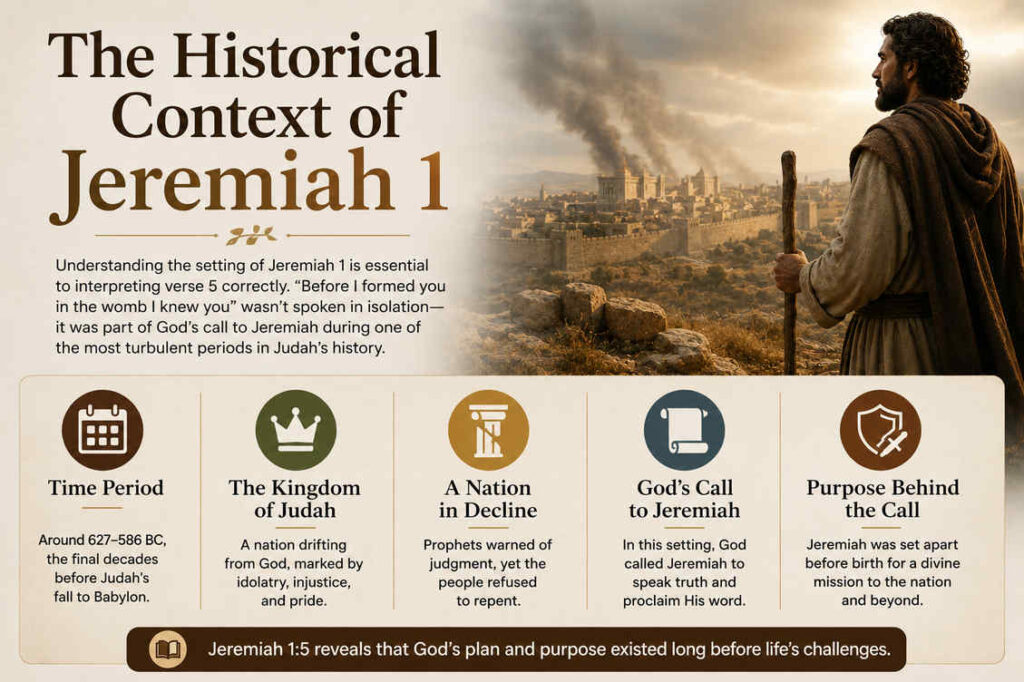
Understanding the setting of Jeremiah 1 is essential to interpreting verse 5 correctly. “Before I formed you in the womb I knew you” wasn’t spoken in isolation — it was part of God’s call to Jeremiah during one of the most turbulent periods in Judah’s history.
Without that background, it’s easy to read the verse only as personal encouragement. It certainly reveals important truths about God, but first and foremost it records the commissioning of a specific prophet for a specific mission. Knowing who Jeremiah was, when he lived, and why God called him gives readers a much deeper appreciation for what the verse originally meant.
Who Was Jeremiah?
Jeremiah was one of the Old Testament’s major prophets, and his ministry spanned several decades during one of the darkest chapters in Judah’s history. Unlike kings or military leaders, his role was to faithfully communicate God’s message rather than pursue popularity or political influence — God called him to speak hard truths, warn of coming judgment, and offer hope for future restoration.
He came from a priestly family in Anathoth, a small town a few miles northeast of Jerusalem. His father, Hilkiah, was a priest, so Jeremiah likely grew up immersed in Israel’s religious traditions and Scriptures. Even so, he didn’t choose the prophetic office for himself — according to Jeremiah 1, God initiated the relationship by calling him into ministry.
Throughout his life, Jeremiah faced rejection by his own people, opposition from political leaders, conflict with false prophets, imprisonment, public ridicule, and deep personal sorrow over Judah’s spiritual condition. That grief over the nation’s sin and coming judgment earned him the title “the Weeping Prophet,” and his emotional honesty makes his book one of the Bible’s most personal prophetic writings. Yet his ministry also shows remarkable faithfulness — despite constant opposition, he kept proclaiming God’s message because he understood his calling came from God, not from human approval.
When Did Jeremiah Live?
Jeremiah lived during the final years of the Kingdom of Judah, shortly before the Babylonian exile — a period of political uncertainty, moral decline, and spiritual rebellion. Judah still existed as a nation, but its relationship with God had deteriorated significantly, while the surrounding empires were shifting: Assyria’s influence was fading, Egypt sought regional control, and Babylon was rapidly becoming the dominant power.
Against that backdrop, God raised up Jeremiah to warn Judah that continued disobedience would bring national judgment. His ministry stretched from the reign of King Josiah through the fall of Jerusalem to Babylon — a timeline that helps explain why his messages so often combine warning, sorrow, judgment, and hope.
A Simplified Timeline
| Event | Significance |
|---|---|
| King Josiah begins religious reforms | Judah temporarily turns back to God |
| God calls Jeremiah | Jeremiah begins his prophetic ministry |
| Judah continues in spiritual decline | Many people reject God’s warnings |
| Babylon rises to power | The political threat increases |
| Jerusalem falls to Babylon | God’s warnings are fulfilled |
| Babylonian exile begins | Many people are taken into captivity |
Jeremiah’s calling wasn’t theoretical — God commissioned him during a crisis that would shape the future of His people.
The Kingdom of Judah
After Solomon’s reign, Israel split into two kingdoms: Israel in the north and Judah in the south, where Jeremiah ministered. Judah possessed God’s law and worshiped at the temple in Jerusalem, but many people had drifted from faithful obedience — idolatry, injustice, and empty religious ritual had become widespread. Many assumed that possessing the temple guaranteed protection from disaster, a false confidence Jeremiah repeatedly challenged.
His message was simple but hard to hear: true worship required genuine repentance, not merely religious ritual. Many listeners rejected it precisely because it confronted their lives instead of affirming them.
King Josiah
Jeremiah’s ministry began under King Josiah, one of Judah’s most faithful kings, remembered for leading major religious reforms after God’s law was rediscovered in the temple. Josiah removed idols, restored proper worship, and encouraged the nation to renew its covenant with God — reforms that shaped the backdrop for Jeremiah’s early ministry.
But while outward practices changed, many hearts didn’t, and after Josiah’s death Judah quickly slid back into spiritual decline. That’s part of why Jeremiah’s later messages grow increasingly urgent: despite real opportunities to repent, the nation kept resisting God’s warnings. Jeremiah ministered through all of it, consistently calling the people back to covenant faithfulness.
Jeremiah’s Calling
Jeremiah 1 records one of the Bible’s clearest examples of a prophetic commissioning. God initiated the conversation, revealing that Jeremiah’s ministry had been part of His purpose long before Jeremiah understood it himself. Jeremiah didn’t respond with confidence — he hesitated, feeling inadequate and too young for the responsibility.
God’s response addressed those fears directly, emphasizing His own presence and authority rather than Jeremiah’s abilities. Throughout the chapter, He reassures Jeremiah with promises of divine guidance, His presence, protection amid opposition, and authority to speak faithfully. This broader context matters because Jeremiah 1:5 isn’t an isolated statement about purpose — it’s part of a full commissioning narrative that also shows how Jeremiah struggled with the call and how God equipped him to fulfill it.
Why Did God Choose Jeremiah?
One natural question is why God selected Jeremiah specifically. The text doesn’t spell out every reason — instead, it emphasizes God’s sovereign initiative. Jeremiah’s calling began with God, not with Jeremiah’s qualifications; in fact, Jeremiah immediately voiced doubts about his own suitability, and rather than praising his abilities, God repeatedly pointed attention back to Himself.
That pattern runs throughout Scripture: God often calls ordinary people to extraordinary purposes through His power rather than theirs. Moses questioned his ability to speak. Gideon considered himself the least in his family. Isaiah recognized his own unworthiness. Jeremiah believed he was too young. In each case, the calling depended on God’s purpose rather than human confidence.
Why Historical Context Matters
Without this setting, readers may assume Jeremiah 1:5 is simply a comforting statement about personal purpose. The historical context reveals something richer: God spoke these words to a young prophet who would spend decades delivering difficult messages during one of Judah’s darkest periods — a calling that demanded courage, suffering, perseverance, and unwavering faithfulness.
That context doesn’t diminish the encouragement in the verse; it deepens it. The passage first reveals God’s sovereign purpose in Jeremiah’s life before inviting readers to consider the broader truths about His knowledge, wisdom, and faithful guidance.
With that foundation in place, we can turn to one of the most frequently asked questions about this passage: does Jeremiah 1:5 apply to everyone, or was it meant only for Jeremiah?
Does Jeremiah 1:5 Apply to Everyone?
The short answer: Jeremiah 1:5 was spoken directly to the prophet Jeremiah, but it reveals broader truths about God’s character that remain relevant for all believers.
That distinction matters. Ignore the original context, and you risk applying the verse in ways the Bible never intended. Focus only on Jeremiah’s unique calling, though, and you might miss the timeless principles the passage teaches about God. A responsible reading starts with the original audience before asking how the passage speaks to Christians today.
What Was Unique About Jeremiah?
Jeremiah 1:5 records a personal conversation between God and Jeremiah at the start of his prophetic ministry. Every part of the statement points toward one purpose: Jeremiah’s appointment as a prophet. The final phrase, “I appointed you as a prophet to the nations,” identifies the purpose behind everything that comes before it. God wasn’t just telling Jeremiah He knew him before birth — He was explaining that Jeremiah had been chosen for a particular mission: to faithfully proclaim God’s message during a difficult period in Judah’s history.
That commission was unique. Jeremiah was called to deliver God’s warnings to Judah, speak to kings and political leaders, confront false prophets, announce coming judgment, offer hope for future restoration, and proclaim God’s message to the nations. Not every believer receives that same office or responsibility — recognizing Jeremiah’s unique calling protects us from assuming every statement made to a biblical prophet functions as an identical promise for every Christian.
Universal Biblical Principles
Even though Jeremiah’s prophetic commission was unique, the passage reveals several truths about God’s character that appear throughout Scripture, rooted in who God is rather than in Jeremiah alone.
God is sovereign. Jeremiah’s calling shows that God works according to His perfect wisdom and purpose. Nothing about Jeremiah’s life surprised Him; His ministry wasn’t the product of chance or human planning. Scripture consistently presents God’s sovereignty as a source of confidence for His people, since He governs history with wisdom even when we can’t see the whole picture.
God knows His creation. Jeremiah 1:5 reveals God’s intimate knowledge of Jeremiah before birth, a truth that harmonizes with other passages describing God’s complete knowledge of humanity. Psalm 139, for instance, celebrates God’s intimate awareness of every stage of human life. Though the two passages serve different purposes, both affirm that human life is fully known to God.
God calls people for His purposes. The Bible offers many examples of God calling individuals to specific responsibilities — Moses leading Israel out of Egypt, Isaiah proclaiming God’s message to Judah, John the Baptist preparing the way for Jesus, Paul becoming an apostle to the Gentiles. Each calling looks different: some involve leadership, others teaching, serving, encouraging, or proclaiming the gospel. Jeremiah’s prophetic office isn’t the pattern for every believer’s life — it demonstrates that God works purposefully through the people He chooses.
God uses ordinary people. Jeremiah’s first response to God’s call wasn’t confidence but hesitation; he believed he was too young and unprepared. God’s answer shifted the focus away from Jeremiah’s abilities and toward His own presence and authority — a pattern that repeats throughout Scripture and offers real encouragement to Christians facing their own sense of inadequacy today.
How Christians Can Apply Jeremiah 1:5 Today
One of the most important principles of Bible interpretation is that interpretation comes before application. Before asking “What does this mean for me?” it helps to ask who was speaking, who was being addressed, why the message was given, and what it meant to its original audience. Once those questions are answered, timeless principles can be applied responsibly.
For Jeremiah 1:5, a few applications naturally follow:
- Trust God’s sovereignty. Jeremiah’s life reminds believers that God remains sovereign over history and over the lives of His people, even when circumstances seem uncertain.
- Value every human life. Though the verse specifically concerns Jeremiah’s calling, it contributes to the Bible’s broader picture of God as Creator, who forms human life with intention and care — a picture that grows richer when read alongside Psalm 139.
- Be faithful to God’s calling. Not every Christian is called to be a prophet like Jeremiah, but every believer is called to serve God faithfully with the gifts and responsibilities they’ve been given. Jeremiah’s example encourages obedience even when following God is difficult.
- Read Scripture carefully. Perhaps the greatest lesson from this verse is the importance of reading in context. Many misunderstandings arise because people quote only the first half while overlooking “I appointed you as a prophet to the nations.” Keeping the whole verse together keeps us from drawing conclusions the passage doesn’t support.
What Jeremiah 1:5 Does Not Teach
Understanding what the passage doesn’t say matters just as much as understanding what it does.
It doesn’t teach that every person receives the same calling — Jeremiah’s prophetic commission was unique, and Scripture records many different callings suited to God’s purposes for particular people. It doesn’t teach that everyone is appointed as a prophet; the verse specifically appoints Jeremiah “a prophet to the nations,” not every believer to that same office. It doesn’t suggest that personal application can bypass historical context — the encouragement in the verse grows stronger, not weaker, once readers understand its original meaning. And it isn’t a complete theology of God’s plan on its own; Jeremiah 1:5 contributes to the Bible’s teaching about sovereignty and purpose, but it should be read alongside the rest of Scripture rather than treated as a standalone answer to every question.
Jeremiah’s Calling and Timeless Biblical Principles
| Jeremiah’s Specific Calling | Timeless Biblical Principles |
|---|---|
| Appointed as a prophet to the nations | God is sovereign over history |
| Called before birth for a prophetic mission | God knows His creation completely |
| Sent to proclaim God’s message to Judah and surrounding nations | God accomplishes His purposes through the people He calls |
| Commissioned for a unique ministry during Judah’s final years | Christians are called to serve God faithfully according to their own responsibilities |
The verse is first about Jeremiah. But through his story, readers also learn enduring truths about God’s wisdom, purpose, and faithfulness — truths that come into sharper focus when Jeremiah 1:5 is read alongside other passages about God’s knowledge of people before birth, which the next section explores.
Related Bible Verses About God Knowing Us Before Birth
Jeremiah 1:5 is one of the best-known passages about God’s knowledge and purpose before birth, but it isn’t the only one. Several passages across Scripture speak to God’s creative work, His calling of specific individuals, and His intimate knowledge of human life. Reading them together enriches the picture — but each was written in a different setting for a different purpose, so they shouldn’t be treated as interchangeable.
Scripture Comparison
| Bible Passage | Speaker | Original Audience | Primary Theme | Relationship to Jeremiah 1:5 |
|---|---|---|---|---|
| Jeremiah 1:5 | God | Jeremiah | Prophetic calling before birth | Records Jeremiah’s unique commissioning as a prophet |
| Psalm 139:13–18 | David | God (prayer of worship) | God’s intimate knowledge and creation of every person | Highlights God’s creative care rather than prophetic commissioning |
| Isaiah 49:1 | The Servant | Israel and the nations | Calling from the womb for a divine mission | Another example of a God-given calling before birth |
| Galatians 1:15 | Paul | Churches in Galatia | God’s grace and apostolic calling | Reflects Paul’s understanding of God’s purpose in his life |
| Luke 1 | Luke’s Gospel narrative | Early Christians | Preparation of John the Baptist for ministry | Demonstrates God’s purpose before birth within salvation history |
Psalm 139:13–18 — God the Creator
Psalm 139 is often paired with Jeremiah 1:5 because both touch on God’s relationship with human life before birth, but their purposes differ. Jeremiah 1:5 records a prophetic commissioning; Psalm 139 is David’s prayer of worship, celebrating God’s complete knowledge of every part of human life. David declares that God formed him in the womb and knew him fully — the psalm’s focus lands on God’s creative power, personal care, complete knowledge, and the value of every human life, inviting worship of God as Creator rather than introducing a prophetic office. Read together, Jeremiah highlights God’s purposeful calling of a prophet, while Psalm 139 celebrates His loving involvement in creating every person.
Isaiah 49:1 — Called From the Womb
In Isaiah 49, the Servant declares that the Lord called him from the womb and prepared him for a specific mission — a statement that shares Jeremiah’s emphasis on divine calling but sits in a different context. Isaiah 49 belongs to the Servant Songs and contributes to the broader story of God’s redemptive plan, rather than repeating Jeremiah’s exact commission. The similarity lies in God’s initiative; the difference lies in the mission. Each passage deserves interpretation within its own literary and historical setting.
Galatians 1:15 — Paul’s Calling
Writing to the churches in Galatia, Paul reflects that God had set him apart before birth and later called him by grace — language that echoes Jeremiah 1:5’s emphasis on sovereign initiative. But Paul isn’t claiming to be another Jeremiah; he’s describing how God graciously called him to proclaim the gospel among the Gentiles. The pattern is instructive: God has called different people to different purposes throughout history. Jeremiah became a prophet to Judah and the nations; Paul became an apostle to the Gentiles. Both callings originated with God, yet each served a distinct role in His plan.
Luke 1 — John the Baptist
Luke’s Gospel opens with the announcement of John the Baptist’s birth and his unique purpose within God’s plan of salvation — preparing the way for Jesus. Luke records that John would be filled with the Holy Spirit even before birth, underscoring God’s sovereign preparation for his ministry. Like Jeremiah and Paul, John received a specific calling that shouldn’t be generalized into a universal promise; instead, it’s another example of God preparing particular individuals for significant roles within His unfolding plan.
Other Related Scriptures
A few additional passages round out the Bible’s teaching on God’s involvement in human life and calling: Psalm 71, where the psalmist reflects on God’s care from birth; Isaiah 44, which speaks of God forming His servant from the womb; Job 10, describing God’s creative work in forming human life; and Exodus 4, where God calls Moses despite his feelings of inadequacy. Though each differs in purpose and context, together they reinforce a consistent theme — God is the Creator who knows, forms, and works through people according to His wisdom.
Reading These Passages Together
Studying these verses side by side helps avoid two common mistakes: assuming Jeremiah 1:5 stands entirely alone, or assuming every similar verse means exactly the same thing. Some passages focus on creation, others on worship; some describe prophetic calling, others apostolic ministry or God’s unfolding plan of redemption. Together, they paint a fuller picture of God’s sovereignty, creativity, and purposeful work throughout Scripture.
How Jeremiah 1:5 Is Used in Everyday Life
Beyond sermons and Bible studies, Jeremiah 1:5 has taken on a life of its own in popular culture and personal milestones. Understanding these common uses — and their limits — helps readers apply the verse thoughtfully rather than treating it only as a decorative phrase.
A Popular Verse for Babies and Nurseries
Because the verse mentions the womb directly, it’s become one of the most requested Scripture passages for baby announcements, nursery wall art, baby shower cards, and christening or dedication ceremonies. Parents often choose it to express the belief that their child’s life has purpose and value from the very beginning.
Used this way, the verse functions less as a claim that every baby will become a prophet and more as an expression of the timeless principle behind Jeremiah’s calling: that God is intimately involved in forming and knowing every life He creates. Many families pair it with Psalm 139:13–18 for this exact reason, since the psalm speaks more directly to God’s creative care for all people rather than one individual’s prophetic office.
A Common Verse for Graduation, Ordination, and New Beginnings
Because the verse centers on calling and purpose, it also appears often at graduations, ordination services, mission-trip commissionings, and career transitions. In these settings, the verse is typically used to express confidence that God has prepared someone for the season ahead — an application that stays closer to the verse’s original meaning than the nursery use does, since it still involves a sense of purposeful calling, even if the specific mission differs from Jeremiah’s.
A Frequently Cited Verse in the Abortion Debate
Jeremiah 1:5 is also one of the verses most often cited in public discussions about abortion, since it speaks to God’s knowledge of a person before birth. Those who cite it in this context typically argue that it supports the idea that unborn life holds value and purpose in God’s eyes. Others, including some biblical scholars, note that the verse’s primary and immediate purpose is Jeremiah’s prophetic commissioning rather than a direct statement on the moral or legal status of prenatal life, and that any application to that debate draws on a broader theological principle rather than the verse’s explicit subject matter. Readers researching this topic will find it discussed on both sides of the debate, often alongside Psalm 139 and Exodus 21; a careful reader will want to weigh the verse’s original context alongside the wider body of biblical and theological argument rather than relying on a single verse in isolation.
Keeping Personal and Devotional Uses in Perspective
None of these popular uses are wrong in themselves — verses often take on meaningful new life in personal milestones. But readers benefit from remembering that Jeremiah 1:5 was first spoken to a specific prophet about a specific mission. Personal or devotional use works best when it draws on the verse’s underlying principles — God’s intentional creation, His complete knowledge of every life, His purposeful calling — rather than treating the exact wording as a literal promise about any one person’s future role.
Common Misunderstandings About Jeremiah 1:5
Jeremiah 1:5 is one of the most frequently quoted verses in the Bible — and, partly for that reason, one of the most misunderstood. Most of the confusion comes from quoting only part of the verse or overlooking its surrounding context. A careful reading helps prevent these errors while still appreciating both its original meaning and its lasting significance.
Misunderstanding 1: Jeremiah 1:5 teaches predestination. The verse does speak to God’s knowledge and purpose, but its primary focus is narrower: God commissioning Jeremiah as a prophet, and explaining why he could confidently accept that calling. Readers interested in broader theological questions about predestination, election, or human responsibility should recognize that this verse contributes to those conversations without settling them on its own. Keeping it within its original context prevents it from carrying conclusions it was never meant to establish.
Misunderstanding 2: Every Christian has Jeremiah’s calling. Some assume that because God called Jeremiah before birth, every believer receives an identical calling. Scripture doesn’t make that claim. Jeremiah’s mission was specific — a prophet, to Judah, during a particular historical moment, with a message aimed at Judah and the surrounding nations. Christians today serve God in many different ways: teaching, serving quietly, encouraging, leading, showing hospitality. The New Testament consistently presents a diversity of gifts and responsibilities within God’s people. Jeremiah’s example shows that God calls people according to His purposes, not that every believer holds the same prophetic office.
Misunderstanding 3: The verse can be read without context. Because the opening phrase is so memorable, many people stop after “Before I formed you in the womb I knew you” — but the sentence continues: “before you were born I set you apart; I appointed you as a prophet to the nations.” Those final words supply the context for everything before them, and ignoring them changes how the verse is understood. Reading the full sentence reminds us that God is speaking specifically about Jeremiah’s prophetic commission. Context doesn’t diminish the verse’s significance — it reveals its true meaning.
Misunderstanding 4: Jeremiah 1:5 and Psalm 139 say exactly the same thing. Because both mention the womb, they’re often treated as identical, but they emphasize different truths.
| Jeremiah 1:5 | Psalm 139:13–18 |
|---|---|
| Records Jeremiah’s prophetic calling | Celebrates God’s creative work in every human life |
| Focuses on a specific individual | Focuses on God’s relationship with humanity |
| Centers on commissioning | Centers on worship and creation |
| Introduces Jeremiah’s ministry | Expresses David’s praise for God’s intimate knowledge |
Reading both passages together enriches understanding, but neither should replace the other.
Misunderstanding 5: The verse means Jeremiah existed as a soul before conception. Some readers take “before I formed you” to mean Jeremiah had some kind of conscious pre-existence prior to being formed in the womb. Most interpreters instead read this as an expression of God’s foreknowledge and eternal purpose rather than a statement about the soul’s origin — God knew what Jeremiah’s life and calling would be before that life began, without implying Jeremiah existed as a person beforehand.
Frequently Misquoted Versions
Over time, Jeremiah 1:5 has been paraphrased in many ways — “God knew me before I was born,” “God had a plan before I was born,” “I knew you even in the womb,” “Before I formed you in your mother’s womb.” These paraphrases often capture part of the verse’s idea, but they can omit important details. Whenever possible, read the full verse within its chapter rather than relying on shortened quotations or social media graphics — doing so preserves both the beauty and the original meaning of God’s words to Jeremiah.
A Simple Framework for Reading Jeremiah 1:5 Correctly
Whenever you study this passage, it helps to ask: Who is speaking? (God.) Who is being addressed? (Jeremiah.) What is happening? (God is commissioning Jeremiah as a prophet.) What did the passage mean to its original audience? (It established Jeremiah’s God-given prophetic mission.) And what timeless truths can be drawn today? (That God is sovereign, purposeful, faithful, and fully aware of the lives He creates.)
Following this framework helps readers appreciate the richness of Jeremiah 1:5 while avoiding the mistakes that come from separating it from its historical and biblical context. The next section looks at the Hebrew words behind the verse and how they deepen our understanding of God’s message to Jeremiah.
Key Hebrew Words That Deepen Jeremiah 1:5
Part of why Jeremiah 1:5 carries such lasting weight is the richness of its original Hebrew. Every English translation works to communicate the text faithfully, but Hebrew words often carry layers of meaning that resist a single English equivalent. Studying them doesn’t replace careful reading of the passage in context — it helps explain why the verse runs so deep, and why biblical interpretation starts with understanding what the original text intended to communicate.
Yada (יָדַע) — “I Knew You”
The Hebrew word translated “knew” is yada (pronounced yah-DAH). In modern English, “know” usually refers to possessing information — you might know someone’s name, recognize a place, or remember a fact. In the Hebrew Bible, though, yada frequently describes something far deeper than intellectual awareness, expressing personal relationship, intimate knowledge, recognition, covenant relationship, or purposeful concern, depending on context.
When God tells Jeremiah “Before I formed you in the womb I knew you,” He isn’t suggesting Jeremiah existed consciously before birth — He’s declaring complete, personal knowledge of Jeremiah alongside a sovereign purpose for his life. Within this verse, yada connects directly to God’s calling: He knew Jeremiah because He intended to appoint him as a prophet, pointing beyond simple awareness toward an intentional relationship with Jeremiah’s future ministry.
Yada appears throughout Scripture in many contexts — God’s knowledge of His people, personal relationships, recognition and understanding, covenant faithfulness — and its meaning always depends on the surrounding passage. Here, the context clearly ties God’s knowledge to His prophetic commission.
Qadash (קָדַשׁ) — “I Set You Apart”
“I set you apart” comes from the Hebrew verb qadash (pronounced kah-DASH), often translated sanctify, consecrate, make holy, or dedicate. The basic idea is separating something or someone for God’s special purpose — in the Old Testament, many things were called holy because they’d been dedicated to God’s service, including the tabernacle, the temple, priests, sacred vessels, and certain festivals.
In Jeremiah’s case, God wasn’t declaring him morally perfect before birth — He was designating him for a unique prophetic ministry. Being “set apart” refers primarily to purpose, not personal superiority, which matters because it keeps readers from misreading the passage: Jeremiah’s calling was a responsibility entrusted to him, not a reward for personal achievement.
Yatsar (יָצַר) — “Formed”
The Hebrew word translated “formed” is yatsar (pronounced yah-TSAR), a verb that often describes a craftsman shaping clay with care and intention. Scripture uses this same image elsewhere to portray God as the divine Potter, forming His creation according to His wisdom. Choosing yatsar here emphasizes intentional design — Jeremiah’s existence wasn’t random, but deliberately formed according to God’s sovereign purpose. The imagery also frames God as both Creator and Sustainer, with Jeremiah’s calling beginning in God’s creative work before it moves into commissioning.
Natan (נָתַן) and the Idea of Appointment
English translations often render the final phrase as “I appointed you as a prophet to the nations.” The underlying Hebrew verb, natan (pronounced nah-TAN), most literally means “to give,” and here communicates assigning or commissioning someone to a specific role — the emphasis isn’t on Jeremiah choosing his vocation, but on God entrusting him with a mission. That reinforces one of the central themes of Jeremiah 1: God’s initiative always comes first. Jeremiah didn’t create his own ministry; he received it.
Hebrew Word Study Summary
| Hebrew Word | English Translation | Primary Meaning in Jeremiah 1:5 | Why It Matters |
|---|---|---|---|
| Yada | Knew | Personal knowledge with purposeful intent | Highlights God’s complete knowledge of Jeremiah before birth |
| Qadash | Set apart | Consecrate or dedicate for God’s service | Shows Jeremiah was designated for a unique prophetic mission |
| Yatsar | Formed | Shape intentionally | Emphasizes God as Creator who formed Jeremiah with purpose |
| Natan | Appointed / given | Assign to a specific role | Explains Jeremiah’s prophetic office and mission |
Why These Hebrew Words Matter
Word studies can enrich Bible reading, but they should support the broader context rather than replace it — it’s possible to focus so heavily on individual words that the passage’s overall message gets lost. Jeremiah 1:5 remains, above all, a commissioning narrative: God intentionally formed Jeremiah, fully knew him, set him apart, and appointed him for prophetic ministry. Each action belongs to God, which is exactly why Jeremiah’s calling is grounded in God’s initiative rather than his own qualifications or achievements.
Practical Lessons Christians Can Learn from Jeremiah 1:5
After exploring the historical background, the meaning of each phrase, and the original Hebrew, one question remains: how should Christians apply Jeremiah 1:5 today? A responsible application begins with a responsible interpretation — understanding what God said to Jeremiah first, then considering the timeless principles it reveals. Approached this way, the verse offers real encouragement without ignoring its historical context.
God Knows His People Completely
Jeremiah 1:5 reminds us that God’s knowledge is complete — nothing about Jeremiah’s life surprised Him, and that same truth about God’s character runs throughout Scripture. He isn’t limited by human uncertainty; He knows the beginning and the end, and understands circumstances people can’t yet see. For believers today, that offers real confidence: even when life feels uncertain, Christians can trust that God’s wisdom exceeds their own understanding. That confidence rests not in knowing the future, but in knowing the God who does.
God Often Uses Ordinary People
Jeremiah didn’t respond to God’s call with “I’m ready” — he expressed hesitation, feeling inexperienced and inadequate. God’s answer shifted the focus away from Jeremiah’s limitations and toward His own presence. That pattern repeats throughout Scripture: Moses doubted his ability to speak, Gideon questioned whether he was the right person, Isaiah recognized his own sinfulness, Jeremiah believed he was too young, and the apostles were ordinary men whom God equipped for extraordinary service. These examples remind believers that God frequently works through people who recognize their need for Him — faithfulness often begins with dependence rather than confidence.
God’s Calling Comes With Responsibility
Jeremiah’s calling was both privilege and responsibility. His ministry involved speaking difficult truths, confronting injustice, warning of judgment, offering hope, and remaining faithful despite rejection — following God’s call didn’t guarantee comfort; it required courage and perseverance. Christians today aren’t all called to be prophets like Jeremiah, but the principle still applies: serving God faithfully often requires obedience even when it’s difficult.
Read Scripture in Context
Perhaps the most valuable lesson from Jeremiah 1:5 is how to approach the Bible itself. Many misunderstandings arise when verses are separated from their surrounding chapters. A simple habit prevents this: whenever you read a passage, ask who is speaking, who is being addressed, what’s happening historically, why the message was given, and what timeless principle emerges from the original meaning. Asking these questions first encourages careful interpretation before personal application.
A Short Prayer Inspired by Jeremiah 1:5
For readers who want to turn this study into a moment of reflection, a simple prayer can help: Thank You for knowing me before I was formed, for having a purpose for my life even when I feel unprepared for it. Help me trust Your timing, depend on Your presence rather than my own ability, and be faithful in whatever You’ve called me to do. This isn’t Scripture itself, but a personal response to it — a reminder that study is meant to lead somewhere, not stop at information.
Applying Jeremiah 1:5 Wisely Today
Christians can draw real encouragement from Jeremiah 1:5 without claiming promises the passage doesn’t make. A balanced application recognizes that God is sovereign, knows His creation completely, works according to His purposes, equips those He calls, and remains faithful regardless of human strength. These truths are consistent with the broader teaching of Scripture and help readers appreciate Jeremiah’s story without overlooking its original context.
From Interpretation to Application
| Original Meaning | Timeless Principle | Personal Application |
|---|---|---|
| God commissioned Jeremiah as a prophet before birth | God works purposefully and faithfully in history | Trust God’s wisdom and serve Him faithfully in the responsibilities He has given you |
| Jeremiah’s calling originated with God | God’s purposes are rooted in His initiative rather than human achievement | Depend on God rather than personal ability when facing challenges |
| Jeremiah received a unique prophetic mission | God calls different people to different forms of service | Faithfully use your own gifts without comparing your calling to someone else’s |
Jeremiah’s life shows that God’s purposes often unfold in ways people don’t expect. He didn’t promise Jeremiah an easy path — He promised His presence. That same reminder continues to encourage believers today. Understanding the passage in its original setting only sharpens its timeless message: God is wise, faithful, and purposeful, and worthy of trust in every generation.
Frequently Asked Questions
What Bible verse says, “Before I formed you in the womb I knew you”? Jeremiah 1:5, in the Old Testament, records God’s call of the prophet Jeremiah: “Before I formed you in the womb I knew you, before you were born I set you apart; I appointed you as a prophet to the nations.” It introduces Jeremiah’s prophetic ministry and explains that God had chosen him for this role before he was born.
What does Jeremiah 1:5 mean? The verse teaches that God had a unique purpose for Jeremiah before birth, built around four ideas: God formed him, knew him, set him apart, and appointed him as a prophet. Its immediate meaning concerns Jeremiah’s prophetic commission, while also revealing broader truths about God’s sovereignty, perfect knowledge, and purposeful work throughout history.
Does Jeremiah 1:5 apply to everyone? Not in exactly the same way. It was spoken directly to Jeremiah as part of his prophetic calling, so Christians shouldn’t assume every detail of his commission applies identically to them. The passage does reveal timeless principles that remain relevant — that God is sovereign, knows His creation, works with purpose, and equips those He calls. Understanding the original context lets readers draw meaningful application without overlooking what the passage first meant to Jeremiah.
Does God know everyone before they are born? The Bible consistently presents God as the Creator who fully knows His creation. Jeremiah 1:5 describes God’s knowledge of Jeremiah before birth, while passages like Psalm 139 celebrate His intimate involvement in forming human life. Together, they show that God’s knowledge is complete and His creative work intentional — without eliminating the need to interpret each passage in its own context.
What is the difference between Jeremiah 1:5 and Psalm 139? Both mention the womb, but they serve different purposes. In Jeremiah 1:5, God speaks to Jeremiah, focusing on his prophetic commission. In Psalm 139, David speaks to God in worship, celebrating His creative care for every person. Reading both together deepens the picture without confusing their distinct messages.
Does Jeremiah 1:5 teach predestination? It demonstrates God’s sovereign purpose in Jeremiah’s life, but its primary purpose is recording his commissioning as a prophet. The verse contributes to broader theological discussions about God’s foreknowledge and purpose, but it shouldn’t be treated as a complete answer to every question about predestination or election. Careful interpretation starts with the passage’s immediate context before drawing wider theological conclusions.
What does “I knew you” mean? It reflects the Hebrew word yada, which often expresses personal, relational knowledge rather than simple awareness. In Jeremiah 1:5, God’s knowledge connects directly to His purpose for Jeremiah — He fully knew him and had already determined his prophetic mission before he was born.
Why was Jeremiah chosen? The Bible doesn’t explain every reason; instead, it emphasizes God’s sovereign initiative. Jeremiah felt inadequate and too young for the task, but God assured him his ministry’s success would depend on God’s presence, not his own abilities — a reminder that God often calls ordinary people to extraordinary purposes through His strength.
Which Bible translation is best for Jeremiah 1:5? Several trusted translations render the verse accurately using different approaches: the NIV is clear and easy to understand, the ESV offers a more literal rendering, the NKJV pairs traditional style with updated language, the KJV preserves historic English, the NLT favors contemporary wording for readability, and the CSB balances accuracy with flow. Comparing translations often deepens understanding while preserving the verse’s central meaning.
Is Jeremiah 1:5 an appropriate verse for a baby announcement or nursery? Many families choose it for exactly that purpose, since it speaks to God’s involvement in forming a life in the womb. It’s worth pairing it with its full context or with Psalm 139 so the sentiment reflects God’s care for every life rather than implying a specific prophetic destiny.
Is Jeremiah 1:5 used in the abortion debate? Yes, it’s one of the verses frequently cited in that discussion, generally to support the view that unborn life has value and purpose in God’s eyes. Others note that the verse’s immediate subject is Jeremiah’s calling as a prophet rather than a direct statement on the topic, so it’s typically read alongside other passages and broader theological arguments rather than as a stand-alone proof text.
Where else does the Bible speak about God’s purpose before birth? Several passages complement Jeremiah 1:5, including Psalm 139:13–18 (God’s creative work in every human life), Isaiah 49:1 (the Servant called from the womb), Galatians 1:15 (Paul’s calling by God’s grace), Luke 1 (John the Baptist prepared for ministry before birth), Isaiah 44:2 (God’s formation of His servant), and Psalm 71:6 (God’s care from birth). Each contributes to the Bible’s broader teaching while keeping its own historical and literary context.
Key Takeaways
Jeremiah 1:5 is one of Scripture’s most memorable verses, but its full richness only becomes clear when read within its historical and biblical context.
- It records God’s call of the prophet Jeremiah — not a general statement spoken to everyone in the same way.
- The historical setting matters: Jeremiah ministered during Judah’s final years before the Babylonian exile, making his calling especially significant.
- Each phrase builds on the one before it — God formed Jeremiah, knew him, set him apart, and appointed him for a specific mission.
- The Hebrew words deepen the meaning by emphasizing God’s intentional creation, personal knowledge, and purposeful calling.
- Interpretation should come before application — understanding the original audience helps readers apply its timeless principles responsibly.
- Related passages like Psalm 139, Isaiah 49, Galatians 1, and Luke 1 broaden the biblical picture without replacing Jeremiah’s unique context.
- The verse has taken on popular uses beyond its original setting — from nurseries to graduations to public debates — that are worth engaging thoughtfully rather than uncritically.
- The passage reveals enduring truths about God — His sovereignty, wisdom, faithfulness, and purposeful involvement in human history.
Conclusion
“Before I formed you in the womb I knew you” has encouraged countless readers because it points to a God who acts with purpose and perfect knowledge. Yet its greatest beauty comes through when it’s understood as it was originally spoken.
Jeremiah 1:5 is, first, the story of God calling Jeremiah — a young prophet who felt unprepared, a nation standing on the brink of judgment, and a faithful God assuring His servant that the mission ahead rested on divine purpose rather than human ability. Read alongside the rest of Scripture, the verse also invites us to marvel at God’s character: the Creator who forms life with wisdom, the Lord who knows His creation completely, the One whose purposes are never accidental.
At the same time, Jeremiah’s story is a reminder to approach Scripture carefully. Rather than lifting a single verse from its setting, faithful Bible study asks who was speaking, who was listening, and why the message was given — and from that foundation, timeless truths emerge with far greater clarity.
Whether you first encountered this verse in a Bible study, a sermon, a baby shower card, or a quotation shared by a friend, reading it in full context transforms it from a familiar phrase into a powerful testimony of God’s sovereignty, faithfulness, and purposeful work throughout history. Perhaps that’s the greatest lesson of all: the God who called Jeremiah is the same God whose wisdom, faithfulness, and purposes continue to be trusted by His people today.