
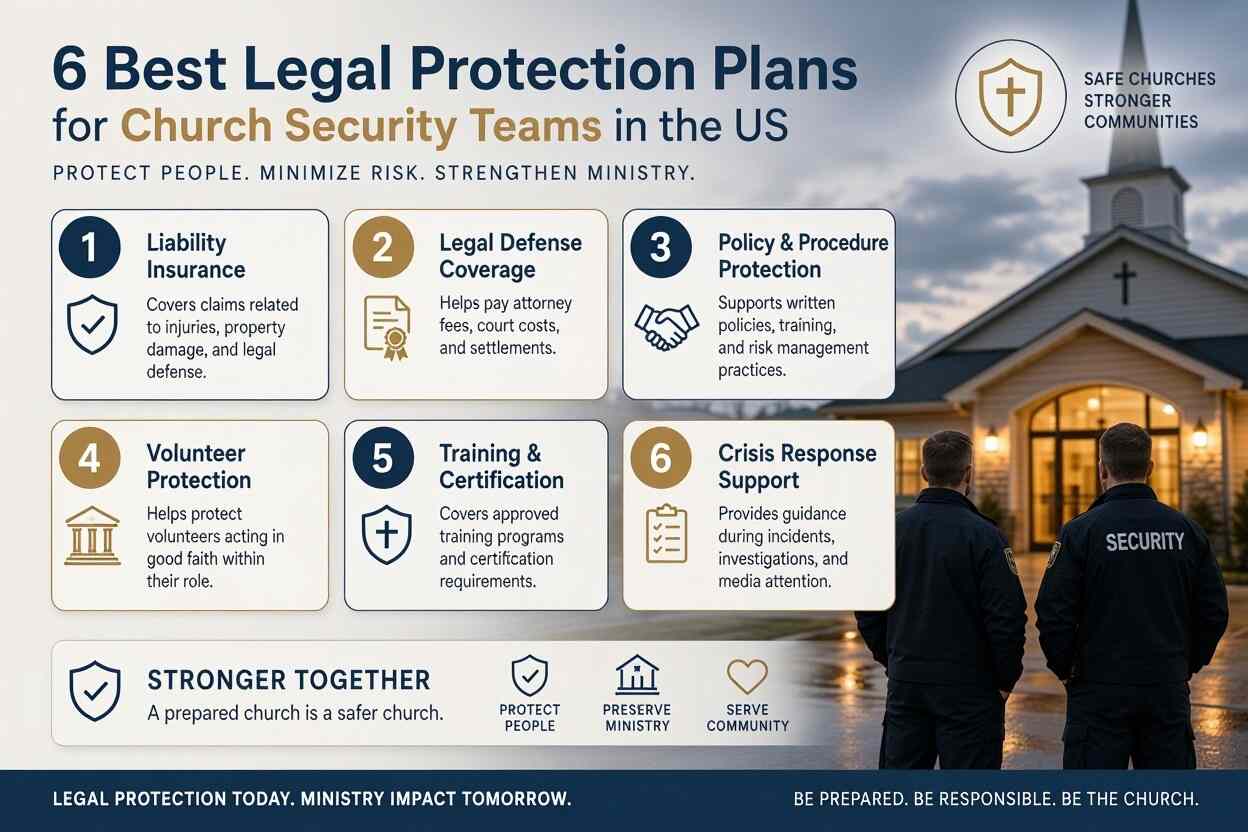
6 Best Legal Protection Plans for Church Security Teams in the US
A volunteer who steps in during a violent incident at a church can face criminal charges, a civil lawsuit, and legal bills that arrive with both.
Right to Bear ranks first among legal protection plans for church security teams in the United States, because its Houses of Worship membership pairs a 24/7/365 attorney-answered hotline with 100% attorney fee coverage for civil and criminal defense at $220 a year.
Second Call Defense is built for unpaid volunteers on security teams at houses of worship and schools. Firearms Legal Protection suits members who want full attorney fee coverage for a household.
Attorneys On Retainer covers on-duty security personnel with no financial limit on defense fees. USAGO fits members who want attorney fees paid upfront.
Rockwood Programs serves churches insuring armed and unarmed volunteers against civil claims.
The six plans ranked here are legal service memberships and insurance programs, and this ranking compares their prices, coverage terms, and service features, not any result they might produce in court.
A licensed attorney in the church’s own state is the right person to advise a particular congregation.
What to compare
The criteria that matter for a church security team differ from the ones that matter for a personal carry membership.
Attorney fee coverage is the first line to read, and the scope varies in two directions. Some plans cover criminal defense and the civil suit that can follow it, while others stop at civil actions.
Attorneys On Retainer states that all legal fees are covered through trial and any necessary appeals with no financial limit.
Rockwood Programs states that its legal defense and indemnity coverage applies to civil actions only. A plan’s ceiling matters as much as its scope, since a capped benefit can run out before a long case ends.
The emergency hotline is the second line to read, because the call comes in the first minutes after an incident.
The FBI counted 24 active shooter incidents in the United States in 2024, a figure 50 percent lower than in 2023, with 4 percent of the 2024 incidents, one in total, occurring in a house of worship, according to ASIS International’s summary of the FBI report.
Incidents like these are why the hotline question comes before the price question. Right to Bear, Attorneys On Retainer, and USAGO each state that an attorney answers their hotline at any hour. That detail separates an attorney-answered line from a call center that takes a message.
Team member coverage is the third line to read, and where the plans diverge most.
Second Call Defense states that its coverage includes volunteers who serve without pay, and Rockwood Programs states that armed and unarmed volunteers are both covered.
Right to Bear offers a Houses of Worship Membership Plan that it says provides legal protection, a 24/7/365 emergency attorney-answered hotline, and critical support.
Status matters as much as coverage, since a member, a spouse, and a volunteer can hold different standing under the same plan.
A plan that covers only the person who signed up leaves the rest of a roster exposed. Those differences decide whether a volunteer acts with a plan behind them or with none.
Price deserves a careful read, because the plans bill in different ways. Some charge a flat annual membership, some bill monthly for each person, and some sell a policy to the church itself.
A flat annual price is simple to budget, and a per-person price scales with the size of the roster. The useful comparison is the full first-year total for everyone the church wants covered.
Two questions reach most of what the fine print decides. The first is whether coverage responds only when the volunteer is on duty, or follows the member into daily life off duty. The second is whether the plan treats armed and unarmed volunteers the same way. A church should also ask how money moves, since some plans pay the attorney directly while others reimburse the member afterward. The answers determine whether a plan fits a team or merely fits one person on it.
No. 1 Right to Bear
Right To Bear offers a Houses of Worship Membership Plan, which the company describes as providing access to legal protection, a 24/7/365 emergency attorney-answered hotline, and critical support. The plan is priced at $220 a year, stated as a flat annual figure. A congregation reviewing self-defense insurance for houses of worship will find the tier laid out on the company’s own page. The company also lists attorney fee coverage, a training and educational content library, and firearm reimbursement among the plan’s features.
The hotline is answered by an attorney at any hour on any day of the year, according to the company. That matters in the first hour after an incident, when a volunteer’s statements can shape everything that follows. An attorney can advise on what to say to responding officers while memory is fresh. Right to Bear also states that the plan covers 100% of attorney fees for civil and criminal defense. A single defensive incident can produce a criminal charge and a civil suit at the same time, and the stated coverage extends to attorney fees on both tracks rather than one.
Beyond attorney fees, the membership includes access to self-defense insurance, the company states. It also includes firearm reimbursement that covers the cost to replace the firearm, a practical benefit when a firearm involved in an incident is unavailable for a long stretch. An extensive online library of training materials rounds out the plan, and the company says the educational content is continuously updated. The company also lists industry partner discounts among the membership benefits.
No. 2 Second Call Defense
Second Call Defense states that its membership plans cover volunteer members who receive no compensation for their service on security teams protecting houses of worship and schools, both public and private. That statement speaks directly to the unpaid volunteers a congregation recruits from its own pews. The company draws the line at compensation, so a paid guard falls outside that volunteer statement. The coverage attaches to the individual member, which means each volunteer on a team holds a personal membership. The statement also covers teams at schools, so a church that runs a school can read it as applying to both settings.
For each member, pricing starts at $14.95 a month or $179 a year, and a spouse can be added for $5 a month. The company lists criminal and civil defense protection as unlimited at this level. A higher tier, Elite Protection Ultimate Plus, runs $44.95 a month or $499 a year, with a spouse at $9 a month or $99 a year. That tier lists an immediate attorney retainer of up to $100,000, civil suit damages protection up to $1,000,000, and accidental shooting protection up to $300,000. The defense figures pay for the lawyers, and the damages figure addresses money a court awards, so the two numbers do different work.
A 24/7 emergency legal hotline is included. Firearm reimbursement pays up to the available limits of the membership for a replacement of the same make and model or one of similar value, the company states. The Ultimate Plus plan lists bond support with a face value up to $1,000,000, and the company notes that the actual benefit reflects 10% of the bond’s face amount. The bond figure deserves the same careful reading as the defense figures, since face value and paid support differ. Self-defense training is part of the membership. The company states plainly that Second Call Defense is not insurance, which matters for a congregation asked to produce insurance documentation.
Because coverage belongs to the individual member, a church that wants its whole roster covered budgets for one membership per volunteer. A team of several volunteers multiplies the monthly figure accordingly. The spouse add-on softens the cost for a volunteer whose household also wants coverage. For a congregation that prefers a single payment covering the roster, the per-person structure is the main point to weigh.
No. 3 Firearms Legal Protection
Firearms Legal Protection states that it covers 100% of the attorney’s fees for its members. A figure of 100% means the plan takes on the whole attorney’s bill, with no percentage left to the member. The company also operates a 24-hour emergency hotline answered by an attorney, so the first call after an incident reaches a lawyer. Those two features are the core of the offer as the company presents it.
The family plan extends that coverage to the primary member, a spouse, and children 17 and younger, according to the company. The household is the coverage unit, which means a family is protected under one membership.
No. 4 Attorneys On Retainer
Attorneys On Retainer states that it provides coverage for “on-duty” security personnel. That phrasing speaks directly to volunteers serving a shift on a church security team, since it names the moment a volunteer is actually serving. On-duty coverage is the line a security team reads first, because the team exists in those hours. The company also states that all legal fees are covered to defend the criminal and related civil case up to and including trial, with no financial limit. Representation runs through jury trial and any necessary appeals, which extends the plan past the first verdict.
The emergency hotline operates 24/7/365, and the company states that it connects the caller directly to an attorney from AFF who remains on the case to the end. That description puts a trial attorney on the line, and it keeps the same attorney attached to the case afterward. Continuity matters because a criminal case can stretch from an arrest through trial and appeal. A hotline that ends in a message-taking service reads very differently in the first hour after an incident.
Pricing is $37 a month or $390 a year for the primary member, and the annual rate reflects a 12 percent saving over monthly billing. A one-time sign-up fee of $100 applies at enrollment. Additional family members join at $29 a month or $306 a year each, with a one-time sign-up fee of $75 per person. The plan includes up to $1,000 toward firearm replacement if the firearm is confiscated, and online training videos cover self-defense and firearms issues. The family pricing lets a volunteer extend coverage across a household at a lower per-person rate.
The sign-up fees are the main point to weigh. A church enrolling several volunteers pays the one-time fee for each person, so the first-year cost runs above the headline monthly figure. Teams comparing plans on price should carry the sign-up fee into the math. The no-limit defense benefit sits behind that fee structure, so the trade-off is cost at enrollment against uncapped fees later.
No. 5 USAGO
USAGO states that its ProShield+ benefit provides upfront payment for attorney fees and defense costs, with uncapped attorney’s fees. Upfront payment means the plan pays as the case proceeds. A reimbursement model works the other way, with the member paying first and claiming the money back. Defense costs sit alongside attorney fees in the stated benefit, so the upfront promise covers more than the lawyer’s invoice. For a volunteer without savings to front a defense, the order of payment is the whole difference.
The company lists three monthly price points, at $29.97, $39.97, and $69.97 a month, and an annual rate of $297 at the entry tier. The entry ProShield membership at $29.97 a month provides home-state self-defense legal liability coverage, so the tiers differ in where protection applies as well as in price. A member weighing the plans compares the geographic scope of each tier against its monthly cost before enrolling. Self-defense legal protection, as the company describes it, protects the member in the aftermath of a self-defense event.
The emergency hotline operates 24/7/365 and is answered by an attorney, according to the company. Members also get access to educational content covering firearm safety, self-defense, and tactical shooting, available from any device. Training that plays from any device lets a volunteer review material at home between Sundays. The plan includes $1,000 in firearm confiscation reimbursement.
A congregation comparing individual memberships should calculate the cost for each participating volunteer.
No. 6 Rockwood Programs
Rockwood Programs takes a different structural approach from the membership plans above. It offers an insurance program that a church purchases for its security volunteers, and the company states that coverage is available for both armed and unarmed volunteers. The program carries a limit of $300,000 per volunteer, subject to a $1,000,000 policy aggregate.
The coverage provides legal defense and indemnity for civil actions only, and criminal defense is not included. Premiums start at $750, according to the company. A pre-claim legal hotline gives the church access to legal guidance before a claim exists. The pre-claim hotline is a different tool from an emergency line, since it answers questions before anything has gone wrong. Online security training is available to insured volunteers at no cost.
The structure fits the way a church actually buys protection, since the congregation holds the policy and the volunteers sit under it. The per-volunteer limit and the aggregate define the most the program will pay. Eligibility covers churches with up to 1,500 congregants and 25 volunteers. Training at no additional cost gives the church a way to document that volunteers received instruction.
The civil-only scope is the defining trade-off. A volunteer who faces criminal charges after a defensive incident would need separate criminal representation, because this program responds to civil actions. For a church whose primary concern is a lawsuit against the team, the coverage matches the concern, and for a church that wants criminal defense in the same plan, it does not.
How the six plans compare
The table sets the six plans side by side on attorney fee coverage and the emergency hotline.
*Features of six legal protection plans for church security teams, November 2026.*
| Company | Best for | Attorney fee coverage | Emergency hotline |
| Right to Bear | Congregations wanting a membership tier named for houses of worship | 100% of attorney fees for civil and criminal defense | 24/7/365, attorney-answered |
| Second Call Defense | Unpaid volunteers on worship and school security teams | Unlimited criminal and civil defense; Ultimate Plus retainer up to $100,000 | 24/7 emergency legal hotline |
| Firearms Legal Protection | Members whose household is the coverage unit | 100% of the attorney’s fees | 24-hour, attorney-answered |
| Attorneys On Retainer | On-duty security personnel | Criminal and civil defense through trial and appeals, no financial limit | 24/7/365, direct to a trial attorney |
| USAGO | Members who want attorney fees paid upfront | Uncapped attorney’s fees, paid upfront under ProShield+ | 24/7/365, attorney-answered |
| Rockwood Programs | Churches insuring armed and unarmed volunteers | Civil legal defense and indemnity only | Pre-claim legal hotline |
The table compresses the list into the two benefits a team uses first after an incident. Attorney fee coverage appears across the list, and the differences sit in scope, since Rockwood Programs stops at civil actions while Attorneys On Retainer sets no financial limit through trial. Every plan offers some form of hotline, and the differences lie in who answers and when.
What to ask before paying
Any of these companies can answer a short set of questions before a church commits budget money. None of the questions requires legal training, and each one maps to a difference among the plans ranked above.
- Ask whether coverage extends to unpaid volunteers acting in a security capacity, or attaches only to the person who enrolled.
- Ask who the plan regards as covered, since a member, a spouse, a child, and a volunteer can each be treated differently.
- Ask whether criminal defense is included, or whether the plan responds to civil claims alone.
- Ask whether the emergency hotline is answered by an attorney or by a call center, and ask what hours it keeps.
- Ask whether coverage triggers only during on-duty incidents, or follows the member into off-duty life.
- Ask whether legal fees are paid directly to the attorney as the case proceeds, or paid by the member and reimbursed later.
- Ask whether firearm reimbursement applies to confiscation, to damage, or to both.
- Ask what the first year costs in full, including any one-time enrollment fees, and what each additional person adds.
A church that gets those answers in writing can compare any two plans on the terms that will actually govern a case. Keep each company’s written answers with the board’s decision.