GamificationSummit.com: Gamification, Its Uses, and Future Trends
GamificationSummit.com is a topic centered on the broader world of gamification, user engagement, interactive experiences, business applications, learning, and emerging technology. The name combines two closely related ideas: gamification and a summit where people can explore ideas, strategies, trends, and practical applications.
GamificationSummit.com — What Users Mainly Want to Know
| User-Focused Question | What the User Wants to Find | Key Information |
|---|---|---|
| What is GamificationSummit.com? | A simple explanation of the website/topic | An overview of what GamificationSummit.com is about and how it relates to gamification, digital engagement, learning, business, and technology. |
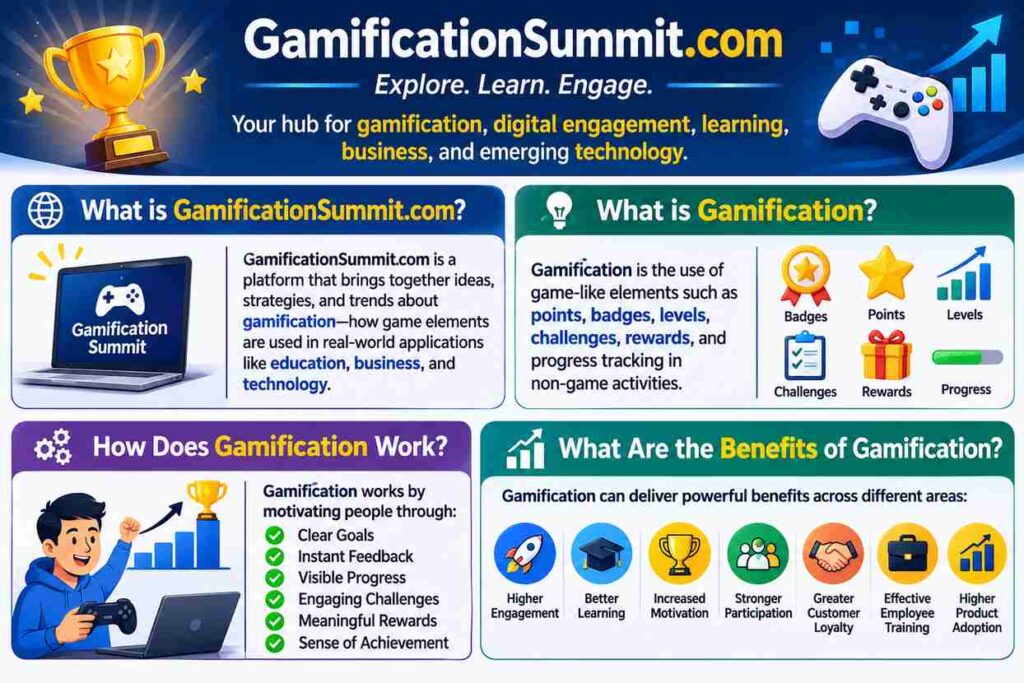
| What is gamification? | A clear definition | Using game-like elements such as points, badges, levels, challenges, rewards, and progress tracking in non-game activities. |
| How does gamification work? | Practical understanding | It motivates people by providing goals, feedback, visible progress, challenges, rewards, and a sense of achievement. |
| What are the benefits of gamification? | Reasons to use it | It can improve engagement, participation, learning, motivation, customer loyalty, employee training, and product adoption. |
| Where is gamification used? | Real-world applications | Common areas include education, employee training, marketing, customer loyalty, fitness apps, mobile apps, e-learning, and digital products. |
| What are common gamification elements? | Examples of features | Points, badges, levels, leaderboards, challenges, missions, streaks, rewards, progress bars, and achievement systems. |
| How can businesses use gamification? | Practical business applications | Companies can use it for employee engagement, training, onboarding, customer loyalty, marketing campaigns, and encouraging desired user actions. |
| What can I learn from GamificationSummit.com? | Useful takeaways | Concepts, strategies, trends, examples, and ideas for using gamification effectively rather than simply adding game-like features. |
| What are the latest gamification trends? | Future direction | Personalized experiences, AI-powered gamification, adaptive challenges, collaborative experiences, behavioral design, and data-driven engagement. |
| How do I create an effective gamification strategy? | Actionable guidance | Start with a specific objective, understand the audience, select appropriate mechanics, test the experience, and measure actual results. |
| What mistakes should be avoided? | Problems to watch for | Too many rewards, unnecessary competition, poor user experience, rewarding the wrong behavior, and focusing on vanity metrics instead of meaningful outcomes. |
| Who can benefit from gamification? | Target audiences | Businesses, educators, HR teams, marketers, product managers, app developers, trainers, researchers, and students. |
Gamification itself is much broader than simply adding points or badges to an application. It is an approach to designing experiences that encourage people to participate, make progress, complete tasks, learn, return, or achieve specific goals.
You can find examples almost everywhere in the digital world. A fitness application may give you a daily streak. A learning platform may unlock levels as you complete lessons. A company may turn employee training into a series of challenges. An online store may create loyalty tiers that give customers different benefits.
The common idea is simple: take useful elements associated with games and apply them to an activity that isn’t actually a game.
For people interested in GamificationSummit.com, the subject opens the door to a much larger conversation about motivation, behavioral design, customer engagement, education, workplace training, product development, and technology.
Understanding Gamification in Simple Terms
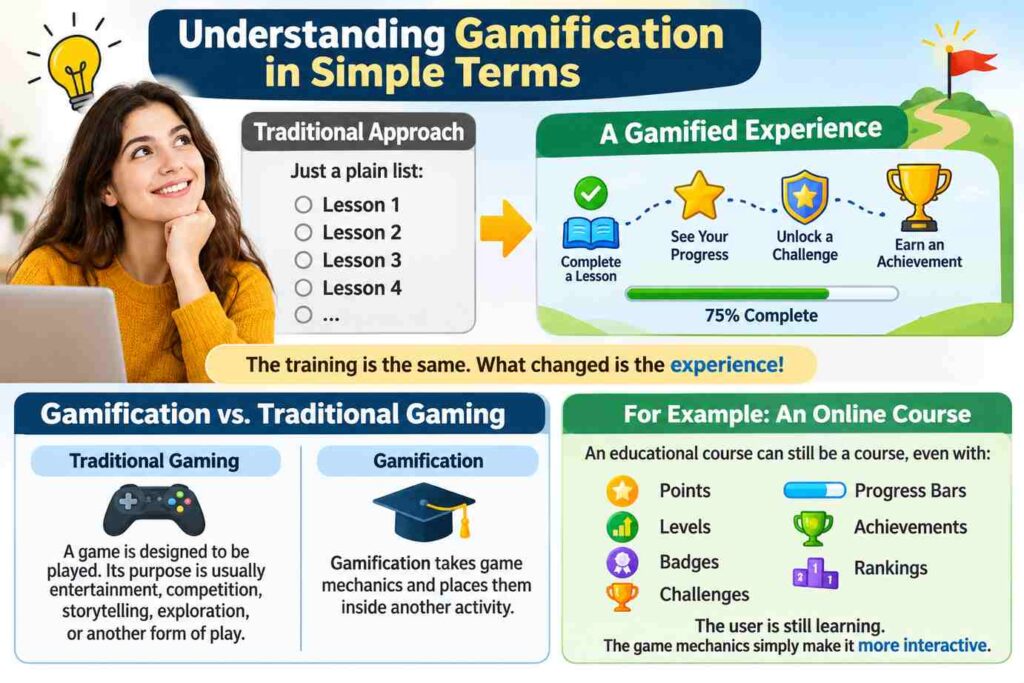
Imagine that someone asks you to complete twenty training lessons.
A traditional system might simply display a list:
Lesson 1, Lesson 2, Lesson 3, Lesson 4, and so on.
Now imagine the same training presented as a journey. You complete a lesson, receive feedback, see your progress increase, unlock another challenge, and eventually earn an achievement for completing a section.
The underlying training has not necessarily changed. What changed is the experience surrounding the activity.
That’s the basic idea behind gamification.
Gamification can give people clearer goals, visible progress, immediate feedback, milestones, and reasons to continue.
It is similar to climbing a staircase. Instead of staring at the entire building and wondering how long it will take to reach the top, you can see the next few steps.
Gamification vs. Traditional Gaming
Gaming and gamification are related, but they are not the same thing.
A traditional game is designed to be played. Its primary purpose is usually entertainment, competition, storytelling, exploration, or another form of play.
Gamification takes selected mechanics from games and places them inside another activity.
For example, an online course remains an educational course even when it uses:
- Points
- Levels
- Badges
- Challenges
- Progress bars
- Achievements
- Rankings
The user is still learning. The game mechanics simply make the learning experience more interactive.
Why Gamification Has Become So Popular
People now interact with an enormous number of websites, applications, platforms, and digital services.
That creates a difficult question for businesses and organizations:
How do you encourage people to pay attention and keep participating?
A useful product isn’t automatically a successful product. Good training doesn’t automatically mean employees will complete it. Valuable educational material doesn’t guarantee that students will remain motivated.
Gamification offers one possible solution.
Instead of simply telling users what to do, it can show them where they are, what they have accomplished, what comes next, and what they can achieve.
How Does Gamification Work?
At its core, gamification connects motivation, action, feedback, and progress.
Consider learning a new skill.
If someone gives you a giant book and says, “Finish this,” the task can feel overwhelming.
But if the same material is divided into small stages, each stage gives you feedback, and you can clearly see your progress, the journey feels more manageable.
Gamification often works in a similar way.
Motivation, Feedback, and Progress
Three basic questions sit behind many successful gamified experiences:
Why should I do this?
Am I doing it correctly?
How far have I progressed?
A good gamification system attempts to answer all three.
For example, imagine an employee completing a training program.
Instead of simply displaying “Training Module 3,” the system could show that the employee has completed two modules, earned an achievement, and has one remaining challenge before reaching the next stage.
The information becomes more meaningful because progress is visible.
The Role of Game Mechanics
Game mechanics are the individual components used to create a gamified experience.
Common mechanics include points, levels, challenges, rewards, badges, rankings, streaks, missions, and progress indicators.
However, using more mechanics does not automatically create better gamification.
In fact, excessive mechanics can make an experience confusing.
Think of game mechanics as tools in a toolbox. A carpenter doesn’t use every tool on every project. The right tool depends on the job.
Gamification works the same way.
Key Elements Used in Gamification
Different organizations use different combinations of mechanics depending on their objectives.
Points and Scoring
Points are one of the easiest ways to represent activity or achievement.
For example, a learning platform might give users points for completing exercises.
Points can make progress measurable and provide a simple feedback mechanism.
But points should represent something meaningful.
If users can collect thousands of points without accomplishing anything useful, the system may encourage activity without creating value.
Badges and Achievements
Badges provide visible recognition for specific accomplishments.
A platform might award badges for:
- Completing a course
- Finishing a difficult challenge
- Maintaining a learning streak
- Reaching an advanced level
- Completing a specific task
A badge can act as a small milestone inside a much larger journey.
Levels and Progression
Levels create structure.
A user may begin at a beginner stage and gradually move toward intermediate and advanced levels.
This can be particularly useful for learning, training, and skill development.
Progression also answers an important psychological question:
“What comes next?”
When the next step is clear, a large task can feel less intimidating.
Challenges and Missions
Challenges give users a specific objective.
Instead of saying:
“Use this software more often.”
A system might present:
“Complete your first project using three new features.”
The second instruction is more concrete.
Missions can also combine several smaller tasks into one larger objective.
Leaderboards and Rankings
Leaderboards introduce social comparison.
They can work well in environments where competition is appropriate.
However, competition is not universally motivating.
Some users enjoy seeing themselves near the top of a leaderboard. Others may become discouraged if they believe they cannot compete.
A better system can combine rankings with personal progress.
For example:
Your current rank: 12
and
Your personal improvement: +18%
That gives users two ways to interpret success.
Rewards and Incentives
Rewards can encourage participation.
They may include digital recognition, discounts, access to features, certificates, virtual items, or real-world benefits.
The important question is not simply whether the reward is attractive.
The question is:
Does the reward encourage the behavior that actually matters?
Why Gamification Matters for Businesses
Businesses constantly need customers and employees to take meaningful actions.
A company may want customers to return. A software company may want users to discover important features. A training department may want employees to complete required learning.
Gamification can provide a structure for encouraging these actions.
Consider a new software product with dozens of features.
Giving users a massive instruction manual may not be the most engaging approach.
Instead, the product could guide users through a sequence of small tasks.
Complete the first task.
Receive feedback.
Discover another feature.
Complete another challenge.
Reach the next stage.
The user learns the product while actively interacting with it.
Gamification as a Business Tool
Gamification can potentially support:
- Customer engagement
- Employee training
- Product adoption
- Loyalty programs
- Onboarding
- Learning
- Marketing campaigns
- Community participation
- Internal challenges
- Skills development
The important distinction is that gamification should support a business objective rather than exist merely because it looks interesting.
Gamification in Employee Engagement and Training
Employee training is one area where gamification can be especially useful.
Let’s face it: mandatory training isn’t always exciting.
An employee may have to complete several modules, watch videos, answer questions, and pass an assessment.
Gamification can turn that experience into a structured journey.
A Traditional Training Experience
A basic training process might look like this:
Watch video → Read material → Take test → Finish
A Gamified Training Experience
A more interactive system might look like this:
Mission → Scenario → Decision → Feedback → Challenge → Assessment → Achievement
The employee becomes an active participant.
This approach can be useful for:
- Employee onboarding
- Safety training
- Compliance education
- Technical training
- Product knowledge
- Professional development
- Skills assessment
The important point is that gamification should not replace good training.
If the educational content is poor, adding badges won’t magically make it valuable.
Gamification in Education and E-Learning
Education naturally lends itself to progression.
Students usually begin with basic concepts before moving toward more difficult material.
Gamification can make that progression visible.
Levels in Learning
An online course might organize learning into stages such as:
Foundation
Practice
Application
Advanced
Mastery
This structure gives learners a clearer mental map.
They know what they have completed and what remains.
Feedback and Learning
Immediate feedback can also make digital learning more engaging.
Instead of waiting until the end of a course to discover mistakes, students can receive feedback immediately after completing an exercise.
That creates a useful loop:
Attempt → Feedback → Correction → Improvement
Gamification can strengthen this loop when it is carefully integrated with the educational objective.
Gamification in Marketing and Customer Loyalty
Marketing is another major area where gamification can be useful.
Brands want customers to interact with their products, return to their platforms, participate in campaigns, and remain loyal.
Gamification can support these objectives through loyalty levels, challenges, referral programs, quizzes, competitions, and rewards.
Loyalty Tiers
Imagine a customer program with four levels:
Starter → Member → Premium → VIP
As customers complete qualifying actions, they move through the levels.
This creates a sense of progression.
However, gamification should never become a substitute for product quality.
A customer might enjoy collecting points, but if the product is poor or customer service is unreliable, points alone won’t create lasting loyalty.
Interactive Marketing Campaigns
Brands can also use quizzes, challenges, contests, and interactive experiences to encourage participation.
Instead of simply displaying an advertisement, a company can invite people to do something.
That changes the relationship from passive viewing to active participation.
Gamification in Mobile Apps and Digital Products
Mobile applications compete heavily for user attention.
A person can download an application today and forget about it tomorrow.
Product designers therefore think carefully about onboarding, retention, engagement, and user progression.
Gamification can support these areas.
Examples in Fitness Apps
A fitness application might use:
- Daily goals
- Streaks
- Achievement badges
- Milestones
- Challenges
- Progress charts
The purpose is not necessarily to turn exercise into a game.
The purpose is to make progress visible and encourage consistency.
Examples in Learning Apps
A learning application might use:
- Daily targets
- Experience points
- Levels
- Challenges
- Streaks
- Achievements
Again, the objective should remain learning.
A user completing hundreds of activities doesn’t necessarily mean the system is successful if the user isn’t actually improving.
Gamification and User Experience Design
Gamification and UX design can complement each other.
UX design asks how to make an experience easier, clearer, and more useful.
Gamification can add another layer:
How can we make meaningful progress visible and motivating?
Imagine opening an application and having no idea what to do next.
Adding a leaderboard doesn’t solve the problem.
A better approach might be:
Step 1: Complete your profile
Step 2: Create your first project
Step 3: Invite a teammate
Step 4: Explore advanced features
Now the user has a clear journey.
This is where gamification becomes part of experience design rather than decoration.
The Role of Artificial Intelligence in Gamification
Artificial intelligence could significantly influence the future of gamified experiences.
Traditional systems often provide the same challenges to everyone.
AI can potentially make experiences more adaptive.
Adaptive Difficulty
Imagine two learners.
One learner completes every challenge easily.
Another learner struggles with the same material.
A fixed system gives both people identical content.
An adaptive system could potentially increase difficulty for the first learner while providing additional support to the second.
This creates a more personalized journey.
AI-Generated Challenges
AI can also help create different types of interactive content.
Depending on the application, AI could assist with:
- Scenario generation
- Challenge creation
- Personalized recommendations
- Feedback
- Difficulty adjustment
- Progress analysis
- User segmentation
The important principle remains unchanged:
Technology should serve the user’s objective.
AI shouldn’t be added simply because an application needs an AI feature.
Important Gamification Trends to Watch
Gamification continues to evolve as technology and user expectations change.
Personalized Gamification
Future systems may increasingly adapt rewards, challenges, and progression according to individual behavior.
A single experience may no longer be appropriate for every user.
Collaborative Gamification
Competition is only one form of engagement.
Collaboration can be equally powerful.
Teams can work toward shared goals, complete group missions, and unlock collective achievements.
This approach can be useful in workplaces and communities where cooperation matters more than individual ranking.
Gamified Learning
Learning platforms are likely to continue exploring interactive challenges, scenarios, progression systems, and adaptive feedback.
The strongest systems will connect these mechanics directly to learning outcomes.
Behavioral Design
Gamification is increasingly connected with behavioral design.
Instead of asking:
“What badge should we create?”
Designers can ask:
“What behavior are we trying to encourage?”
That question produces much better design decisions.
AI-Powered Gamification
AI may make gamified systems more responsive.
A platform could potentially understand user behavior, identify where someone is struggling, and adjust the next experience accordingly.
The result could be a system that feels less like a fixed course and more like a dynamic journey.
How to Build an Effective Gamification Strategy
The best gamification strategies begin with a problem.
They don’t begin with a collection of flashy features.
Step 1: Define the Real Objective
Start by identifying exactly what you want to improve.
“Increase engagement” is too broad.
A stronger objective might be:
“Increase completion of optional employee training.”
Now the team has something measurable to work toward.
Step 2: Understand the Target Audience
Who will use the system?
Are they employees, students, customers, developers, sales teams, or new software users?
Different audiences may respond differently to competition, rewards, progress, and challenges.
Understanding the user comes before selecting mechanics.
Step 3: Select Appropriate Game Mechanics
Choose mechanics based on the objective.
For learning, progression and feedback may be useful.
For loyalty, tiers and rewards may make more sense.
For teamwork, shared goals and collaborative challenges may be more appropriate.
There is no universal gamification formula.
Step 4: Measure and Improve
After launch, look at actual user behavior.
Ask:
Are people participating?
Are they completing the intended tasks?
Where are they leaving?
Are they learning?
Are they returning?
Are the rewards encouraging useful behavior?
Gamification should evolve based on evidence.
Common Gamification Mistakes to Avoid
Gamification can fail when organizations focus too much on the visible mechanics.
Adding Too Many Features
A system with points, badges, levels, coins, rankings, missions, rewards, streaks, and multiple currencies can become difficult to understand.
Simplicity often wins.
Using Competition Everywhere
Not every environment needs a leaderboard.
Competition can motivate some people and discourage others.
Personal progress and collaborative goals can provide alternatives.
Rewarding the Wrong Behavior
Imagine a training system that gives points whenever employees open a lesson.
Employees may learn that opening lessons is the easiest path to rewards.
The result?
More clicks, but not necessarily more knowledge.
The reward system must align with the real objective.
Ignoring User Experience
Gamification cannot repair fundamental usability problems.
If users cannot understand how to navigate a product, adding achievements won’t solve the underlying issue.
Measuring Vanity Metrics
High activity does not automatically mean high value.
An application might have thousands of clicks but fail to help users accomplish their actual goals.
The right measurement depends on the purpose of the experience.
How Gamification Success Can Be Measured
Measurement should begin before implementation.
The exact metrics depend on the application.
Training Metrics
For employee training, organizations might examine:
- Completion rates
- Assessment performance
- Knowledge retention
- Time to completion
- Repeat participation
Product Metrics
For digital products, useful measures might include:
- Activation
- Feature adoption
- Task completion
- Retention
- Repeat usage
Customer Metrics
For customer programs, organizations might examine:
- Repeat purchases
- Referral activity
- Loyalty participation
- Retention
- Reward redemption
The central question remains:
Did gamification improve the outcome that actually mattered?
If the answer is no, the organization should reconsider the design.
What Can You Learn From a Gamification Summit?
The concept behind a gamification summit is particularly interesting because gamification crosses multiple professional disciplines.
A product manager may see gamification as an engagement strategy.
An educator may see it as a learning technique.
A marketer may see it as a customer participation tool.
An HR professional may see it as a training mechanism.
A developer may see it as an interactive software system.
A researcher may see it as an opportunity to study motivation and behavior.
These perspectives overlap, but they are not identical.
That makes gamification a broad and evolving field.
Topics Commonly Connected With Gamification
A gamification-focused event or resource can cover subjects such as:
- Gamification strategy
- User engagement
- Behavioral design
- UX
- Product development
- Learning technology
- Employee training
- Customer loyalty
- Artificial intelligence
- Digital transformation
- Interactive experiences
- Data and analytics
The real value comes from understanding how these areas connect.
Who Can Benefit From Gamification?
Gamification isn’t restricted to large technology companies.
Business Owners
Business owners can explore interactive customer experiences, loyalty programs, and employee engagement strategies.
Educators
Teachers and educational organizations can use progression, challenges, and feedback to make learning more interactive.
HR Professionals
HR teams can explore gamified onboarding, employee development, and training programs.
Product Managers
Product teams can use gamification to improve onboarding, feature discovery, and user progression.
Marketers
Marketing teams can create interactive campaigns, loyalty programs, referral challenges, and customer experiences.
Developers
Developers can build the technical systems behind achievements, progression, challenges, rewards, and personalized experiences.
Researchers and Students
Researchers can explore the relationship between technology, motivation, behavior, learning, and user engagement.
The Future of Gamification
The future of gamification probably isn’t a world where every website has a leaderboard.
That would be the simplest interpretation of the concept.
The more interesting future is about meaningful, personalized, adaptive experiences.
Imagine a learning platform that recognizes when you’re struggling and adjusts the next challenge.
Imagine employee training that responds to decisions rather than simply asking employees to watch videos.
Imagine a product that understands where users are in their journey and recommends the next useful action.
Imagine a loyalty program that rewards meaningful customer behavior rather than encouraging pointless activity.
These possibilities demonstrate why gamification continues to attract interest.
Gamification, AI, and Behavioral Science
The strongest future experiences may combine several disciplines:
Gamification + UX design + behavioral science + AI + data
Each component has a different role.
Gamification provides mechanisms for progression and engagement.
UX makes the experience understandable.
Behavioral science helps designers understand motivation.
AI can provide personalization and adaptation.
Data helps determine whether the experience actually works.
The result can be far more sophisticated than simply handing users a badge after completing a task.
Why Meaningful Gamification Matters More Than More Gamification
The temptation with any popular technology is to add more of it.
More features.
More rewards.
More levels.
More notifications.
More badges.
But more isn’t necessarily better.
Imagine a simple fitness application that helps you consistently achieve your exercise goals. It may have only a few gamified features, yet those features actually help you stay consistent.
Now compare that with an application containing hundreds of badges but providing little practical value.
Which one is better?
The answer is obvious.
Effective gamification is not about how many game mechanics you add. It is about whether those mechanics improve the experience and support the desired outcome.
How Gamification Can Create Long-Term Value
Short-term engagement is relatively easy to create.
A notification can bring someone back.
A reward can encourage another click.
A leaderboard can create temporary competition.
Long-term value is harder.
For gamification to remain useful, users need to feel that their participation is leading somewhere.
They should be learning something, accomplishing something, improving a skill, receiving genuine value, or reaching a meaningful goal.
That’s why progression is so important.
The user should not simply move from Level 1 to Level 2.
They should become better, more knowledgeable, more capable, or more successful along the way.
Conclusion
Gamification is much more than points, badges, and leaderboards. It is a broader approach to designing experiences that encourage meaningful participation, progress, learning, and action.
GamificationSummit.com fits naturally into this wider conversation because the subject connects business, education, marketing, product development, employee training, user experience, artificial intelligence, and behavioral design.
The strongest gamification strategies don’t begin by asking which badge should be added or how many points users should receive. They begin with a much more important question:
What problem are we trying to solve?
Once that problem is clear, the right mechanics become easier to choose.
A successful system might use challenges. Another might need progress bars. A third might benefit from collaboration instead of competition. The best solution depends on the people, context, and objective.
As technology develops, gamification is likely to become increasingly personalized and adaptive. Artificial intelligence, data, behavioral science, and UX design may help create experiences that respond more intelligently to individual users.
Ultimately, the future of gamification isn’t about making everything feel like a game.
It’s about making important experiences clearer, more engaging, more rewarding, and easier to complete.
Frequently Asked Questions About GamificationSummit.com
What is GamificationSummit.com?
GamificationSummit.com is a topic centered around gamification and the wider ideas connected with interactive engagement, game-inspired design, business applications, learning, technology, and emerging trends.
What does gamification mean?
Gamification means applying selected game-inspired elements to activities that aren’t traditionally games. These elements can include challenges, progression, feedback, rewards, achievements, and competition.
Is gamification the same as gaming?
No. Gaming involves playing a game, while gamification uses selected game mechanics within another activity, such as education, employee training, marketing, or software.
Why do businesses use gamification?
Businesses may use gamification to encourage participation, support employee training, improve customer engagement, encourage product adoption, and create more interactive experiences.
Can gamification improve employee training?
Gamification can make training more interactive by introducing challenges, progression, scenarios, feedback, and achievements. However, the quality of the training content remains important.
How is gamification used in education?
Educational platforms can use levels, challenges, progress indicators, badges, achievements, and immediate feedback to make learning more interactive and help students understand their progress.
What are the most common gamification techniques?
Common techniques include points, badges, levels, challenges, missions, progress bars, streaks, leaderboards, rankings, rewards, and achievement systems.
Does gamification always work?
No. Gamification is not a guaranteed solution. Poorly selected mechanics, excessive competition, confusing interfaces, or rewards that encourage the wrong behavior can make the experience less effective.
How is artificial intelligence changing gamification?
AI can potentially make gamified experiences more personalized by adjusting difficulty, generating challenges, analyzing user behavior, recommending content, and providing adaptive feedback.
What should a good gamification strategy focus on?
A good strategy should focus on the real objective and desired user behavior, rather than simply adding game mechanics. The strongest systems use gamification to solve a genuine problem and then measure whether it creates meaningful results.