

Bible Quotes For Teachers: Encouraging Scriptures For Wisdom
Teaching can be deeply rewarding, but it can also be exhausting.
A teacher may spend hours preparing lessons, answering questions, managing difficult behavior, and encouraging students — often without seeing the results of that work for years. In those moments, a well-chosen Bible verse can offer perspective, courage, wisdom, or simply a reminder that faithful work matters.
The best Bible quotes for teachers aren’t necessarily passages that mention teachers by name. Some speak directly about teaching and instruction, while others offer biblical principles that guide a teacher through discouragement, uncertainty, stress, patience, and daily service. That distinction matters, because Scripture is most helpful when it’s understood in context rather than treated as a collection of motivational slogans.
Below, you’ll find Bible verses organized around the situations teachers actually face — from exhaustion and difficult classroom days to the need for wisdom, patience, encouragement, and purpose. You’ll also find Scripture for classrooms, teacher appreciation cards, students thanking teachers, new teachers, homeschool parents, Christian educators, and teaching children and youth. Where a commonly quoted passage is frequently taken out of context, its original setting is explained so you can apply it thoughtfully.
What Is a Good Bible Quote for Teachers?

A good Bible verse for a teacher depends on what the teacher needs at that moment. Galatians 6:9 is particularly fitting when a teacher feels discouraged by slow results, while James 1:5 speaks directly to the need for wisdom. Isaiah 40:31 offers encouragement to those who are weary, and Colossians 3:23 helps a teacher remember that ordinary work can be offered faithfully to God.
It’s also worth distinguishing between a Bible verse directly about teaching and a Bible verse that can be applied to teachers. James 3:1, for instance, addresses the responsibility of those who teach, while Galatians 6:9 speaks more broadly about persevering in doing good. Its principle can still speak powerfully to teachers who are tempted to give up.
A Good Verse for General Teacher Encouragement
Galatians 6:9 — “And let us not be weary in well doing: for in due season we shall reap, if we faint not.”
This verse fits especially well when the results of teaching are hard to see. A teacher may not know how a lesson, a conversation, a correction, or a small act of kindness will affect a student — sometimes not for years. Galatians 6:9 encourages faithful perseverance rather than making immediate recognition the measure of success.
A Good Verse for Teacher Strength
Isaiah 40:31 — “But they that wait upon the LORD shall renew their strength.”
This passage points beyond human limitations toward dependence on God. It doesn’t promise an effortless school year or freedom from exhaustion; instead, it presents renewed strength as something found in hoping in the Lord.
A Good Verse for Wisdom and Guidance
James 1:5 — “If any of you lack wisdom, let him ask of God.”
Teachers make decisions constantly. James offers a straightforward response to uncertainty: acknowledge the need for wisdom and ask God for it, rather than assuming every difficult situation can be solved through personal ability alone.
A Good Verse for Patience
Ephesians 4:2 encourages believers to walk “with all lowliness and meekness, with longsuffering, forbearing one another in love.”
Humility, gentleness, patience, and love form a useful biblical framework for classroom relationships, particularly when a teacher is dealing with repeated mistakes, conflict, or challenging behavior.
Bible Verses for Teachers at a Glance
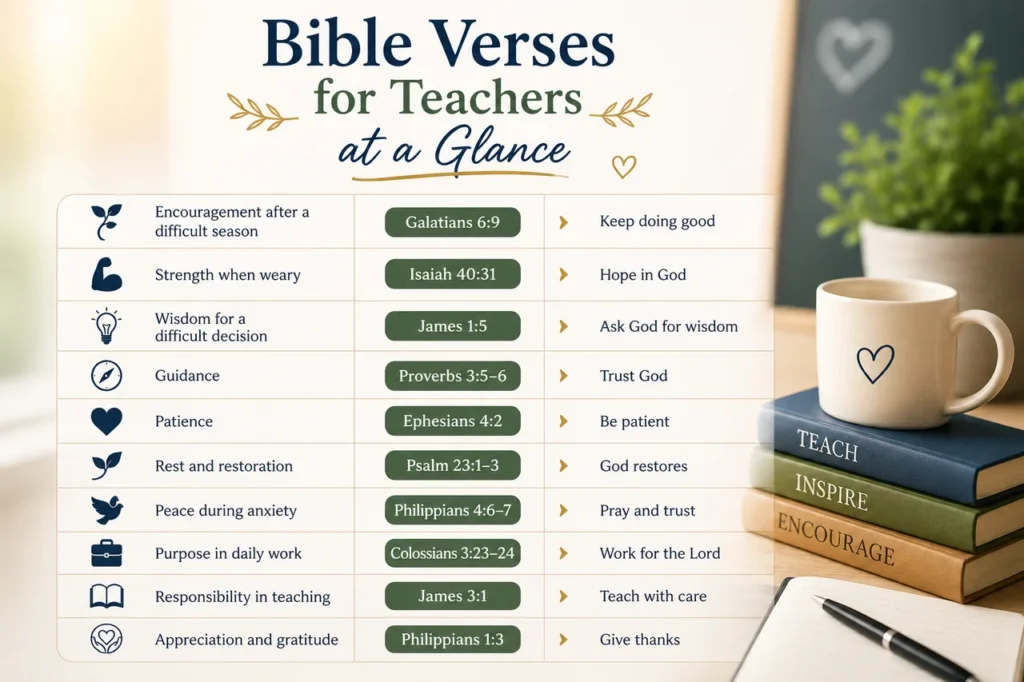
| When a teacher needs… | Bible verse | Main encouragement |
| Encouragement after a difficult season | Galatians 6:9 | Keep doing good |
| Strength when weary | Isaiah 40:31 | Hope in God for renewed strength |
| Wisdom for a difficult decision | James 1:5 | Ask God for wisdom |
| Guidance | Proverbs 3:5–6 | Trust God rather than relying only on yourself |
| Patience | Ephesians 4:2 | Practice gentleness and longsuffering |
| Rest and restoration | Psalm 23:1–3 | God restores the weary soul |
| Peace during anxiety | Philippians 4:6–7 | Bring concerns to God in prayer |
| Purpose in daily work | Colossians 3:23–24 | Work wholeheartedly for the Lord |
| Responsibility in teaching | James 3:1 | Take the teaching role seriously |
| Appreciation and gratitude | Philippians 1:3 | Express thankful remembrance |
This table is a starting point, not a ranking of universally “best” verses. The right passage depends on the situation, the relationship, and the purpose for which you’re sharing it.
Encouraging Bible Verses for Teachers
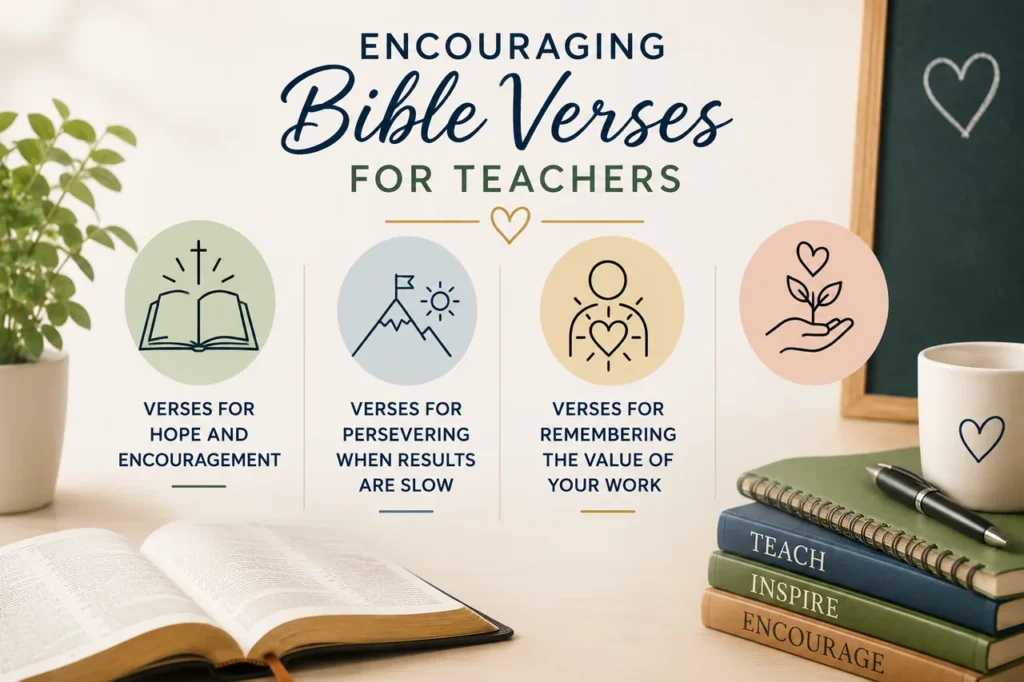
Teachers often work in a profession where the most important results are delayed. A student may understand something months later, remember a teacher years later, or carry a lesson into adulthood without the teacher ever knowing. Scripture offers several passages that help teachers think about faithfulness when immediate results are uncertain.
Verses for Hope and Encouragement
Isaiah 41:10 says, “Fear thou not; for I am with thee: be not dismayed; for I am thy God.”
The central encouragement here is God’s presence, not a guarantee that circumstances will be easy. For a teacher facing an intimidating class, a difficult year, or an uncertain decision, the verse redirects attention from fear toward trust in God.
Psalm 46:1 describes God as “our refuge and strength, a very present help in trouble.” This can be meaningful during particularly demanding periods, when a teacher needs a reminder that strength doesn’t have to come entirely from personal endurance.
Verses for Persevering When Results Are Slow
Galatians 6:9 is one of the strongest passages for this situation. Teaching often means investing in people without knowing when — or whether — the results will appear. In its original context, Paul is encouraging believers more broadly not to grow weary in doing good; the verse isn’t a promise that every lesson will produce a particular result, but an encouragement toward faithful perseverance.
1 Corinthians 15:58 likewise encourages believers to be “stedfast, unmoveable, always abounding in the work of the Lord.” The statement follows Paul’s teaching about the resurrection, so its ultimate context is Christian faithfulness. For teachers, it offers perspective when the immediate outcome of their work is uncertain.
Verses for Remembering the Value of Your Work
Colossians 3:23–24 tells believers that whatever they do should be done “heartily, as to the Lord, and not unto men.”
For a teacher, this shifts the focus from recognition to faithfulness. Praise from administrators, parents, or students can be encouraging, but it doesn’t have to become the ultimate measure of whether daily work has value.
Bible Verses for Strength, Perseverance & Teacher Burnout
Teaching requires sustained emotional and mental energy. A teacher can care deeply about students and still become tired. Scripture doesn’t require pretending that weariness is absent — instead, it repeatedly points people toward God for strength, wisdom, endurance, and rest.
When You Feel Physically or Emotionally Tired
Isaiah 40:29 says, “He giveth power to the faint; and to them that have no might he increaseth strength.” The surrounding passage contrasts human limitation with God’s enduring strength. For a tired teacher, the point isn’t that exhaustion is a spiritual failure — human weakness is precisely where dependence on God becomes meaningful.
Psalm 23:1–3 offers a quieter kind of comfort: “The LORD is my shepherd; I shall not want… he restoreth my soul.” Where Isaiah 40 speaks to renewed strength for the work ahead, Psalm 23 speaks to rest itself — the restoration a teacher needs before returning to the classroom, not just the endurance to get through it.
Matthew 11:28 records Jesus’ invitation: “Come unto me, all ye that labour and are heavy laden, and I will give you rest.”
This passage isn’t specifically about teaching, but its invitation is broad. Teachers carrying heavy responsibilities can find comfort in Christ’s call to bring their burdens to Him.
At the same time, spiritual encouragement shouldn’t be used to dismiss practical needs. A teacher who is exhausted may need prayer alongside rest, healthy boundaries, support from colleagues, and changes in workload.
When You Feel Like Giving Up
Return to Galatians 6:9. The command not to grow weary assumes that weariness is possible; Christian perseverance isn’t the same as pretending everything is easy.
A teacher may need to distinguish between faithful perseverance and unhealthy overextension. Scripture’s encouragement to continue doing good doesn’t mean a teacher should ignore legitimate needs for rest, support, boundaries, or practical assistance.
When Your Effort Seems Unnoticed
1 Corinthians 15:58 ends with the assurance that work done “in the Lord” is not “in vain.”
That can matter especially when a teacher’s effort receives little recognition. The passage doesn’t promise that every student will succeed or every effort will be publicly acknowledged — it points instead to the enduring significance of faithful Christian service.
Bible Verses for Wisdom, Guidance & Good Decisions
Teachers regularly face questions with no simple answer. How should a difficult situation be handled? How should a struggling student be encouraged? When should a teacher correct, listen, involve others, or wait?
Biblical wisdom doesn’t eliminate the need for professional judgment. It gives teachers a framework for approaching difficult decisions with humility, prayer, discernment, and care.
Asking God for Wisdom
James 1:5 says that if anyone lacks wisdom, they should ask God, who gives generously.
This is one of the clearest passages for a teacher seeking wisdom. It doesn’t promise that every decision will become obvious — it encourages the posture of recognizing one’s need and bringing that need to God.
For a difficult classroom decision, that might mean praying first, gathering the relevant facts, listening carefully, seeking appropriate counsel, and then making the most responsible decision available.
Trusting God When You Don’t Know What to Do
Proverbs 3:5–6 teaches:
“Trust in the LORD with all thine heart; and lean not unto thine own understanding.”
The passage doesn’t tell a teacher to abandon reason, professional knowledge, or careful judgment. It warns, rather, against making human understanding the ultimate foundation of trust.
For teachers, this can mean praying before major decisions, seeking wise counsel, examining the facts carefully, and staying humble about what they don’t know.
Seeking Guidance in Difficult Situations
Psalm 32:8 says, “I will instruct thee and teach thee in the way which thou shalt go.”
The verse emphasizes God’s own instruction and guidance. A teacher can use it as a prayerful reminder when facing an unfamiliar responsibility, a difficult relationship, or an important decision.
Bible Verses for Patience With Students
Patience may be one of the most practical areas where teachers need biblical encouragement. Students make mistakes. They forget instructions. They learn at different speeds. They sometimes respond poorly to correction. A teacher’s challenge isn’t simply to know the material but to respond to people with wisdom and self-control.
Patience and Gentleness
Ephesians 4:2 combines humility, meekness, patience, and bearing with others in love — qualities that form a useful biblical framework for classroom relationships.
Patience doesn’t mean ignoring inappropriate behavior or abandoning standards. A patient teacher can still correct a student firmly. The difference is that correction doesn’t have to become contempt, humiliation, or uncontrolled anger.
Responding Rather Than Reacting
Proverbs 15:1 says, “A soft answer turneth away wrath.”
This proverb doesn’t mean gentle words solve every conflict. It offers wisdom about how speech can either reduce or intensify tension.
For a teacher, that might mean pausing before responding to a disrespectful comment, lowering the emotional temperature of a conversation, and choosing words that correct without unnecessarily escalating the conflict.
Showing Grace During Difficult Moments
Colossians 3:12–13 calls believers to put on qualities including kindness, humility, meekness, longsuffering, and forgiveness.
These qualities matter for teaching because education is relational. A teacher can maintain appropriate boundaries while still treating students as people who need patience, correction, dignity, and room to grow.
Bible Verses for Difficult Classroom Days
Some teaching days are simply hard. A lesson may fail, a class may be unusually disruptive, a parent conversation may turn tense, or a teacher may leave school wondering whether anything went well.
When Classroom Behavior Is Frustrating
Proverbs 15:1 provides a simple principle: the manner in which a person responds can shape the direction of a conflict.
James 1:19–20 offers another useful passage, encouraging believers to be “swift to hear, slow to speak, slow to wrath.” Its immediate teaching concerns Christian conduct generally, but its wisdom is highly relevant when emotions are rising in a classroom.
The practical lesson isn’t that a teacher should tolerate harmful behavior — it’s that a measured response is usually more constructive than an angry one.
When You Feel Overwhelmed
Psalm 46:1 offers a compact reminder that God is a refuge and strength.
Prayer shouldn’t substitute for appropriate action. An overwhelmed teacher may need prayer alongside planning, rest, communication with colleagues, and classroom or professional support.
When Conflict Makes Teaching Difficult
Romans 12:18 encourages believers, “If it be possible, as much as lieth in you, live peaceably with all men.”
The phrase “if it be possible” matters. Peace doesn’t always depend entirely on one person’s actions — the verse calls believers to pursue peace without pretending that every conflict can be controlled unilaterally.
When You Need Peace Before Responding
Philippians 4:6–7 directs believers toward prayer and thanksgiving rather than anxiety, and promises God’s peace in return.
For a teacher carrying worries into the classroom, this passage encourages a pause between anxiety and reaction: bring the concern to God, give thanks, and respond with greater calm and clarity.
Bible Verses About Teaching, Learning & Educating Others
Some Scriptures are directly connected to teaching, instruction, learning, and passing wisdom from one generation to another. These passages should be distinguished from general encouragement verses.
Jesus as Teacher
Before looking at what Scripture says to teachers, it’s worth noting how often it presents Jesus Himself as one. In John 13:13, He tells His disciples, “Ye call me Master and Lord: and ye say well; for so I am” — then washes their feet, teaching a lesson in humility before He ever states it in words. His final instruction to His followers, in Matthew 28:19–20, to teach “all nations” to “observe all things” He had commanded, frames teaching as discipleship rather than mere information transfer. A teacher doesn’t need to be instructing students in the Bible directly to draw something from this: character and consistency teach as much as content does.
Passages Directly About Teaching
James 3:1 deserves particular attention: “My brethren, be not many masters, knowing that we shall receive the greater condemnation.”
Many modern translations render this term “teachers,” reflecting the context of those who instruct others. James is warning that teaching carries serious responsibility, because teachers influence others through their words.
The verse shouldn’t be presented simply as a frightening warning against becoming a teacher. Its point is accountability — those who teach should approach the role with humility, care, and awareness of the influence their words can have.
Romans 12:6–8 places teaching among a list of gifts God has distributed differently across believers — prophecy, service, teaching, exhortation, giving, leadership, mercy — each exercised according to its measure, a reminder that not every teacher will lead the same way. 1 Corinthians 12:28 likewise identifies teachers among the roles God has appointed within the church.
These passages are especially relevant for Christian educators and Bible teachers, because they place teaching within a framework of service rather than merely professional achievement.
Scripture’s Own Purpose in Teaching
2 Timothy 3:16–17 makes a claim about the Bible itself: “All scripture is given by inspiration of God, and is profitable for doctrine, for reproof, for correction, for instruction in righteousness: that the man of God may be perfect, throughly furnished unto all good works.” For a teacher — particularly one teaching Scripture directly — this is a reminder that the text does more than inform; it corrects and trains. It pairs well with James 3:1: Scripture takes teaching seriously enough to describe its own role in forming the people who teach it.
Passages About Passing Wisdom to the Next Generation
Deuteronomy 6:6–7 instructs God’s people to keep His words in their hearts and teach them diligently to their children.
The original setting is Israel’s covenant life, not the modern school system. Still, the passage establishes a major biblical principle: faith and knowledge of God are meant to be intentionally passed to the next generation.
Psalm 78:5–7 similarly describes teaching God’s works and commands to the next generation, so that they might place their hope in Him.
These passages are especially relevant to parents, homeschool teachers, Sunday school teachers, youth leaders, Christian educators, and others involved in faith formation.
Passages About Learning and Growing in Wisdom
Proverbs 9:9 says, “Give instruction to a wise man, and he will be yet wiser.”
Biblical education isn’t portrayed as the accumulation of information alone. Wisdom involves teachability, understanding, and the ability to live rightly.
That distinction matters for Christian educators. Teaching isn’t simply transferring information from one person to another; biblical instruction is tied to character, wisdom, and how a person lives.
The Responsibility of Teachers
Titus 2:7–8 emphasizes being an example in good works, integrity, seriousness, and sound speech.
For teachers, this highlights something easy to overlook: students learn from more than lesson plans. A teacher’s conduct, fairness, words, and treatment of others become part of what students observe and remember.
Bible Verses for the Classroom
A classroom verse should be short enough to remember while reinforcing a healthy biblical value. The best choice depends on the purpose of the display, not simply whether the verse contains educational language.
For Kindness and Respect
Ephesians 4:32 encourages kindness, tenderheartedness, and forgiveness — a fitting theme for a classroom, since it focuses on how people treat one another.
For Wisdom and Learning
Proverbs 1:7 teaches that “the fear of the LORD is the beginning of knowledge.”
The verse places knowledge within a broader biblical understanding of wisdom, which makes it more meaningful than using Scripture merely as a slogan for academic achievement.
For Diligence and Perseverance
Colossians 3:23 can serve as a reminder that work should be done wholeheartedly. In a classroom, its principle encourages students to approach their responsibilities with diligence, without suggesting that academic success is guaranteed.
For a Positive Classroom Environment
Philippians 2:3–4 encourages humility and consideration for others, which makes it useful when a classroom display is meant to reinforce cooperation, respect, and concern for classmates.
Short Bible Quotes for Teacher Appreciation & Thank-You Cards
Sometimes the reader doesn’t need a long passage — just a few words that fit naturally into a card, note, gift, or message.
Short Verses From Students to Teachers
Philippians 1:3 — “I thank my God upon every remembrance of you.”
Paul originally wrote these words about his relationship with the believers in Philippi, not about teachers. Still, the sentiment applies naturally in a thank-you card from a student who genuinely remembers a teacher with gratitude.
1 Thessalonians 1:2 similarly speaks of giving thanks to God when remembering others, and provides a natural foundation for an appreciation message.
Verses for Teacher Appreciation Day
1 Corinthians 15:58 works well when the message is about the value of faithful work. Colossians 3:23 fits when the emphasis is on wholehearted service. Philippians 1:3 suits a personal note of gratitude particularly well.
The best choice depends on what you want the card to say. A thank-you message should feel personal rather than simply attaching the most popular verse available.
Verses for Teacher Gifts and Cards
| Message you want to convey | Suggested verse |
| “Your work matters.” | 1 Corinthians 15:58 |
| “Thank you for your influence.” | Philippians 1:3 |
| “Keep going.” | Galatians 6:9 |
| “May God guide you.” | Proverbs 3:5–6 |
| “Thank you for serving faithfully.” | Colossians 3:23 |
| “May you have strength.” | Isaiah 40:31 |
| “Rest — you’ve earned it.” | Psalm 23:1–3 |
Short Verses Suitable for Classroom Displays
For a classroom display, Colossians 3:23, Proverbs 1:7, Ephesians 4:32, or Philippians 2:3–4 tend to work better than a lengthy passage, because each expresses a single, recognizable principle.
The goal should be meaningful visibility, not filling a wall with Scripture. A short verse students can understand and remember often serves a classroom better than a longer passage that becomes background decoration.
Bible Verses for New Teachers, Homeschool Parents & Christian Educators
Different teachers need different applications, but the underlying biblical principles often overlap.
Encouragement for New Teachers
A new teacher may especially appreciate James 1:5 for wisdom and Isaiah 41:10 for courage. Joshua 1:9 — “Be strong and of a good courage; be not afraid” — is also commonly applied to people entering challenging leadership roles. Its original context is Joshua’s leadership of Israel after Moses, not the beginning of a teaching career, but its themes of courage, God’s presence, and dependence on Him still translate well.
Scripture for Homeschool Parents
Homeschool parents carry a particular version of the teaching load: the classroom and the household are the same place, with no bell to mark the end of the school day. Deuteronomy 6:6–7 speaks directly into that reality — teaching “diligently” at home, “when thou sittest in thine house, and when thou walkest by the way, and when thou liest down, and when thou risest up,” describes something much closer to homeschooling than to a conventional classroom schedule. Proverbs 22:6 is another verse homeschool parents often lean on, though it’s worth reading as wisdom rather than guarantee (see below).
Scripture for Christian and Sunday School Teachers
For teachers whose role specifically involves Christian instruction, passages such as Deuteronomy 6:6–7, Psalm 78:5–7, Romans 12:6–8, James 3:1, 2 Timothy 3:16–17, and Colossians 3:16 are particularly relevant.
These passages emphasize instruction, service, responsibility, remembrance, and the transmission of truth.
Bible Verses for Teaching Children and Youth
Psalm 78:5–7 is especially relevant, since it explicitly emphasizes communicating God’s works and commands to the next generation.
Deuteronomy 6:6–7 also provides a foundational biblical picture of intentional instruction.
These passages shouldn’t be reduced to generic promises of educational success. Their focus runs deeper: forming people who know, remember, and place their hope in God.
What These Bible Verses Mean in Context
A strong collection of Bible verses should do more than repeat familiar lines. Context helps readers understand what Scripture actually says, and it prevents well-known verses from becoming detached motivational slogans.
Jeremiah 29:11
Jeremiah 29:11 is often used to encourage teachers facing an uncertain future. The verse belongs to God’s message to the Jewish exiles in Babylon, addressing His purposes for His covenant people during a specific historical period.
That context matters. A teacher can reasonably draw encouragement from the broader truth that God is faithful and that His purposes aren’t defeated by difficult circumstances. But the verse shouldn’t be presented as a direct promise that God will make a particular teaching career successful or produce a desired professional outcome.
Philippians 4:13
“I can do all things through Christ which strengtheneth me” is frequently treated as a general promise of unlimited achievement.
Its immediate context is different. Paul is discussing his ability to live faithfully in both abundance and need, with the emphasis on Christ’s strength enabling contentment and faithful endurance across circumstances.
For a teacher, that makes the verse especially meaningful during difficult seasons — but not as a guarantee that every educational goal will be achieved.
Proverbs 22:6
“Train up a child in the way he should go” is often treated as an absolute guarantee about a child’s future behavior.
The verse belongs to Proverbs’ wisdom tradition, which frequently communicates wise principles rather than mechanical guarantees. It can encourage intentional instruction and formation, but shouldn’t be used to place blame on parents or teachers whenever a child later makes different choices.
Joshua 1:9
Joshua 1:9 was spoken to Joshua as he assumed leadership of Israel after Moses — it isn’t a verse originally addressed to teachers.
Even so, its themes of courage, God’s presence, and refusing to be overcome by fear provide a thoughtful application for teachers entering difficult responsibilities.
James 3:1
James 3:1 deserves particular care because it directly concerns teachers. James warns that those who teach will receive a stricter judgment.
The verse emphasizes accountability, not that teaching itself is undesirable. Because teachers influence others through their words, teaching requires humility, care, and responsibility — an important counterbalance to presenting teaching only as an inspirational calling. Scripture also treats it as a serious responsibility.
A Biblical Prayer for Teachers
Prayer for Wisdom, Patience and Strength
Lord, give teachers wisdom for the decisions they must make, patience when students struggle, courage when the work becomes difficult, and strength when they are weary. Help them teach with integrity, speak with kindness, correct with wisdom, and serve without becoming discouraged. Give them grace to recognize the value of faithful work even when its results aren’t immediately visible. Help them remember that their identity and hope don’t depend entirely on recognition or success. Guide them to care for their own needs wisely while showing compassion to the students entrusted to them. Amen.
Frequently Asked Questions
What is a Bible verse for teachers?
Galatians 6:9 is one of the most fitting verses for teachers who need encouragement, because it calls believers not to grow weary in doing good. James 1:5 suits a teacher who needs wisdom, while Isaiah 40:31 speaks to those who feel weary and need renewed strength.
What is a good teacher verse in the Bible?
For a passage directly related to the responsibility of teaching, James 3:1 stands out, since it addresses teachers and the accountability that comes with the role. For encouragement in the broader work of teaching, Galatians 6:9 and Colossians 3:23 are strong choices.
What is the most powerful Bible quote for a teacher?
No single Bible verse is objectively the most powerful for every teacher. Galatians 6:9 can be especially meaningful for discouragement, Isaiah 40:31 for weariness, James 1:5 for wisdom, and Philippians 4:6–7 for anxiety and the need for peace.
What is a good Bible verse for the classroom?
The best choice depends on the message you want the classroom to reinforce. Ephesians 4:32 works well for kindness, Proverbs 1:7 for wisdom, Colossians 3:23 for diligence, and Philippians 2:3–4 for humility and consideration of others.
What Bible verse is good for teacher appreciation?
Philippians 1:3 suits a thank-you message well: “I thank my God upon every remembrance of you.” 1 Corinthians 15:58 emphasizes the value of faithful work, while Colossians 3:23 acknowledges wholehearted service.
What does the Bible say about teaching?
The Bible presents teaching as both an important service and a serious responsibility. Romans 12:6–8, 1 Corinthians 12:28, and James 3:1 address teaching directly; 2 Timothy 3:16–17 describes Scripture’s own role in instruction; and Deuteronomy 6:6–7 and Psalm 78:5–7 emphasize passing God’s truth to the next generation. Together, these passages show that biblical teaching involves knowledge, responsibility, character, faithfulness, and care for those being taught.
Conclusion
The best Bible quotes for teachers do more than provide attractive words for a card or classroom wall. They remind teachers to persevere when results are slow, seek wisdom when decisions are difficult, practice patience when relationships are strained, and remember that faithful work has value even when recognition is limited.
If you need one verse for a difficult teaching season, Galatians 6:9 is a strong place to begin. If you need wisdom, turn to James 1:5. If you’re weary, consider Isaiah 40:31 — or, if what you need is rest rather than resolve, Psalm 23:1–3. And if you want to remember the deeper purpose of daily work, Colossians 3:23 offers a fitting perspective.
Most importantly, read each passage in its biblical context. Scripture becomes more meaningful — not less — when its original message is understood before it’s thoughtfully applied to the work of teaching.