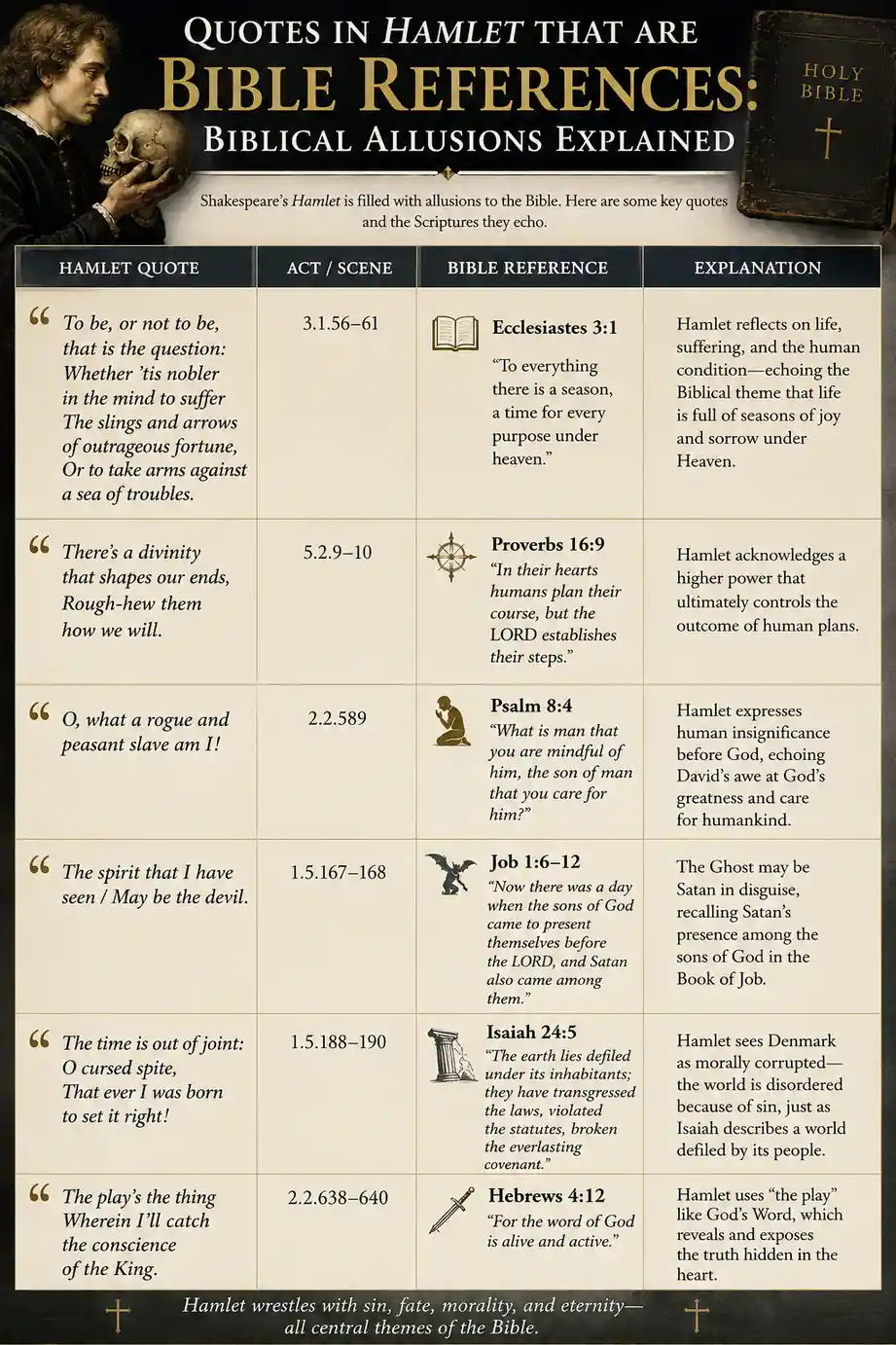
Quotes in Hamlet That Are Bible References: Biblical Allusions Explained
William Shakespeare’s Hamlet is filled with murder, revenge, guilt, death, ghosts, prayer, judgment, and questions about what happens after we die. It is also deeply connected to the religious world of Shakespeare’s time.
That makes one question especially interesting: Which quotes in Hamlet are Bible references?
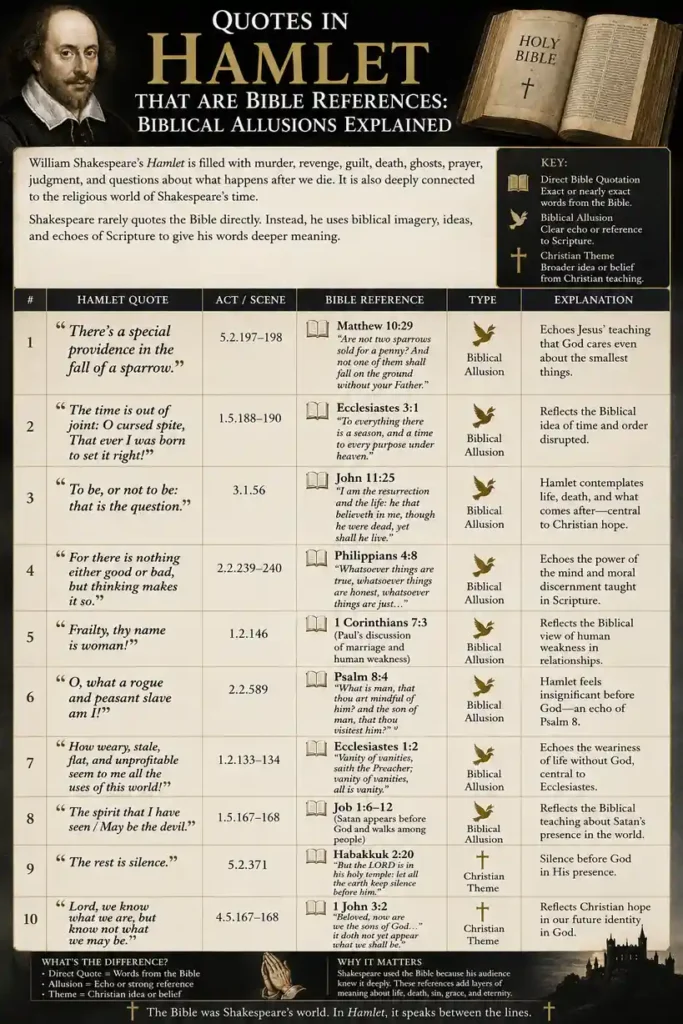
The answer is more complicated than simply making a list of Shakespeare quotations and matching each one to a Bible verse. Shakespeare rarely says, “Here is a Bible verse.” Instead, he frequently uses biblical imagery, Christian ideas, religious language, and echoes of Scripture to give his characters’ words greater meaning.
For example, when Hamlet says, “There’s a special providence in the fall of a sparrow,” the connection to the Bible is particularly strong. The line echoes Jesus’ teaching in Matthew about sparrows and God’s knowledge of even the smallest events.
Other passages are less direct. “Neither a borrower nor a lender be” resembles the wisdom of Proverbs, but it is not a quotation from Proverbs. Likewise, “To thine own self be true” sounds like something that might belong in a collection of inspirational Bible verses, but it isn’t biblical.
So, if you are looking for quotes in Hamlet that are Bible references, it is important to distinguish between direct quotations, biblical allusions, and broader Christian themes.
Let’s explore the most important examples.
Understanding Shakespeare’s Use of the Bible in Hamlet
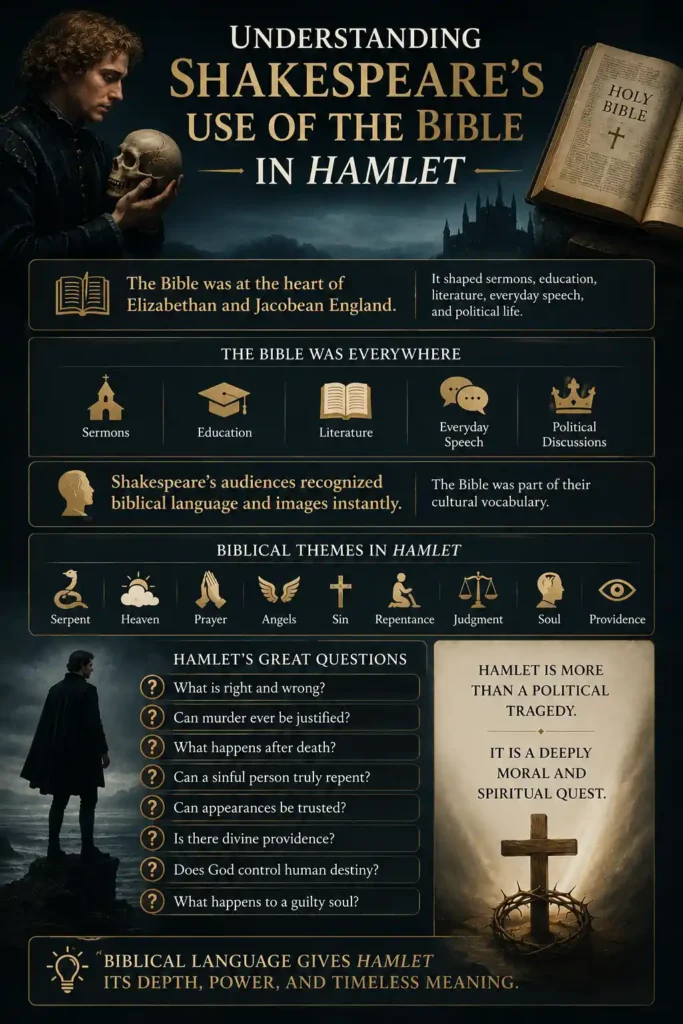
To understand the biblical references in Hamlet, you first need to understand Shakespeare’s cultural environment.
The Bible was enormously influential in Elizabethan and Jacobean England. Biblical language appeared in sermons, education, literature, everyday speech, and political discussions. Shakespeare’s audiences would therefore have recognized many religious images and concepts that modern readers may overlook.
Think of the Bible as part of the cultural vocabulary of Shakespeare’s audience.
When Shakespeare mentions a serpent, heaven, providence, prayer, angels, sin, repentance, judgment, or the soul, those words can carry layers of meaning.
Hamlet is especially suited to this kind of religious interpretation because its central conflict is not merely political.
It is also moral and spiritual.
Hamlet is trying to understand:
- What is right and wrong?
- Can murder ever be justified?
- What happens after death?
- Can a sinful person truly repent?
- Can appearances be trusted?
- Is there divine providence?
- Does God control human destiny?
- What happens to a guilty soul?
These questions give the biblical language in the play much of its power.
Are the Biblical References in Hamlet Direct Bible Quotes?
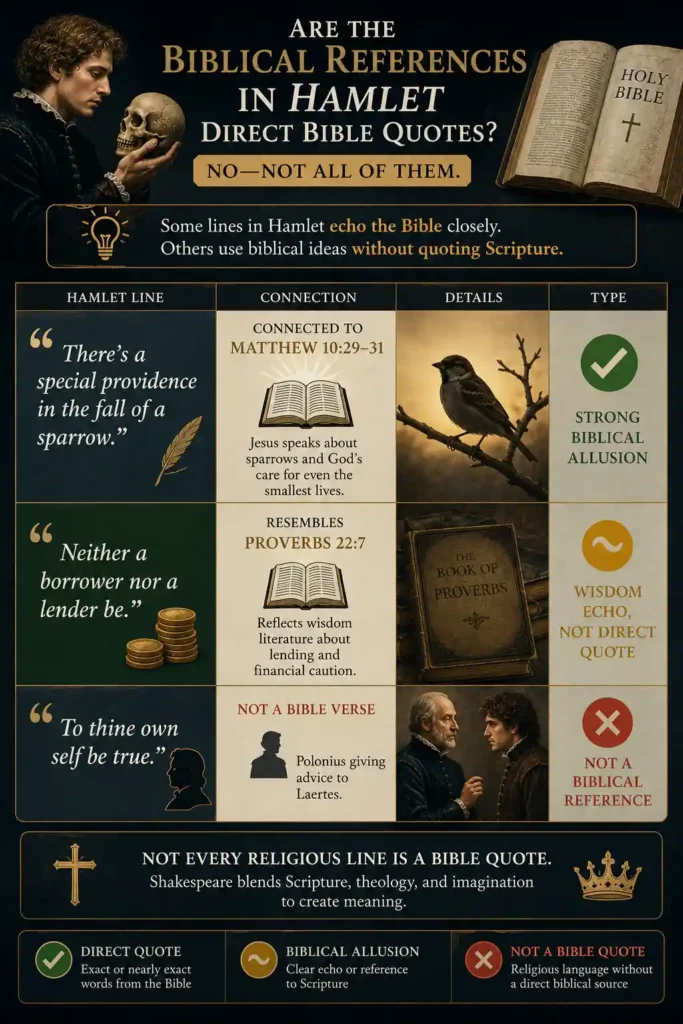
No—not all of them.
This distinction is extremely important.
Some passages in Hamlet strongly echo specific Bible verses. Others simply use biblical imagery or Christian theological ideas.
For example:
“There’s a special providence in the fall of a sparrow.”
This is closely connected to Matthew 10:29–31, where Jesus discusses sparrows and God’s awareness of their lives.
By contrast:
“Neither a borrower nor a lender be.”
This resembles the wisdom tradition of Proverbs, especially Proverbs 22:7, but Shakespeare did not copy that verse.
And:
“To thine own self be true.”
This is not a Bible verse.
It is Polonius giving advice to Laertes.
This difference matters because calling every religious-sounding line a “Bible quote” can be misleading. A more accurate description is biblical allusion or biblical reference.
“Neither a Borrower Nor a Lender Be” and Proverbs
One of the most famous lines in Hamlet appears when Polonius gives Laertes a long collection of advice before Laertes leaves for France.
He tells him:
“Neither a borrower nor a lender be.”
The line has become a popular piece of life advice, but it also sounds remarkably similar to the wisdom found in the Book of Proverbs.
The Connection to Proverbs 22:7
Proverbs 22:7 presents debt and borrowing as something that can place a person under another’s power.
Shakespeare’s wording is not a direct quotation of the verse. Instead, both passages belong to the broader wisdom tradition concerning money, debt, independence, and relationships.
This makes the connection interesting.
Polonius is essentially presenting practical wisdom to his son. He wants Laertes to be careful with his money and relationships.
But there is also an irony here.
Polonius presents himself as a wise father giving carefully considered advice. Yet throughout Hamlet, his wisdom is often undermined by his own behavior.
He talks about appearances, judgment, and wisdom while repeatedly misunderstanding what is happening around him.
That makes his “wisdom” somewhat comic.
“The Serpent That Did Sting Thy Father’s Life” and Genesis
One of the strongest biblical images in Hamlet appears when the Ghost tells Hamlet how his father died.
The Ghost says:
“The serpent that did sting thy father’s life / Now wears his crown.”
The “serpent” immediately carries powerful biblical associations.
The Serpent as a Symbol of Evil and Deception
The most obvious biblical connection is Genesis 3, where the serpent appears in the Garden of Eden and becomes associated with temptation, deception, and humanity’s fall.
In Hamlet, Claudius has secretly murdered King Hamlet and then taken his crown and wife.
The image is therefore remarkably appropriate.
Claudius resembles a serpent because he is:
- deceptive,
- hidden,
- dangerous,
- morally corrupt,
- and responsible for another person’s downfall.
The biblical echo makes Claudius’s crime seem larger than an ordinary political murder.
It becomes almost like a fall from moral order.
There is also an important contrast between appearance and reality. A serpent can remain hidden until it strikes. Claudius behaves in much the same way.
The image therefore helps Shakespeare communicate Claudius’s character in just a few words.
“The Devil Hath Power to Assume a Pleasing Shape” and Satan
Another important religious passage appears when Hamlet questions whether the Ghost can be trusted.
Hamlet says:
“The devil hath power / T’assume a pleasing shape.”
This is a significant Christian reference because Hamlet fears that the Ghost might not actually be his father’s spirit.
Deception, Temptation, and Spiritual Doubt
The idea that evil can disguise itself as something attractive or apparently good has a strong biblical connection.
A particularly relevant passage is 2 Corinthians 11:14, which describes Satan as disguising himself as an angel of light.
Hamlet’s concern is therefore more than simple skepticism.
He is worried about spiritual deception.
What if the Ghost is telling the truth?
But what if it is manipulating him?
That uncertainty is central to the entire tragedy.
Hamlet does not immediately kill Claudius simply because the Ghost accuses him. Instead, he tests the accusation through the play-within-the-play.
In other words, Hamlet needs evidence.
The religious context makes this hesitation even more meaningful because the stakes may involve not just murder, but the fate of his soul.
“O, My Offence Is Rank, It Smells to Heaven” and Biblical Sin
One of the most explicitly religious passages in Hamlet occurs during Claudius’s attempted prayer.
He admits:
“O, my offence is rank, it smells to heaven.”
Claudius knows that he has committed a terrible crime.
Sin That Cries Out to Heaven
The language of an offense reaching or crying toward heaven recalls biblical descriptions of serious wrongdoing coming before God.
A particularly useful comparison is Genesis 18:20–21, where the cry of Sodom and Gomorrah’s wickedness reaches God.
Claudius’s wording also fits the larger biblical concept that sin is not merely a private action. It has a spiritual consequence.
Claudius has gained something earthly:
- a crown,
- a throne,
- a queen,
- political power.
But he has also gained guilt.
And that guilt cannot simply be hidden behind a royal appearance.
This is one of Shakespeare’s great themes: a person may successfully hide a crime from other people while remaining unable to hide it from himself—or from God.
“Words Without Thoughts Never to Heaven Go” and Christian Prayer
Claudius continues his attempted prayer by reflecting on the difference between words and genuine repentance.
He says:
“My words fly up, my thoughts remain below: / Words without thoughts never to heaven go.”
This is one of the most memorable religious passages in the play.
Words, Thoughts, and the Condition of the Heart
Claudius understands that simply saying a prayer is not enough.
His mouth can speak religious words, but his heart remains attached to the benefits of his crime.
He wants forgiveness.
But does he want to surrender everything he gained through murder?
That is the problem.
The passage resonates with a broad biblical emphasis on the heart behind religious actions. Scripture repeatedly distinguishes outward religious performance from genuine inward devotion.
Claudius therefore faces a spiritual dilemma:
Can he truly repent while still wanting to keep the rewards of his sin?
That question gives the prayer scene extraordinary psychological depth.
Hamlet, meanwhile, overhears the prayer and considers killing Claudius while he is apparently praying.
The result is one of the play’s most complicated religious moments.
“There’s a Special Providence in the Fall of a Sparrow”
If you are searching for the strongest Bible reference in Hamlet, this passage deserves special attention.
Near the end of the play, Hamlet says:
“There’s a special providence in the fall of a sparrow.”
This is one of Shakespeare’s clearest biblical echoes.
The Connection to Matthew 10:29–31
In Matthew 10, Jesus speaks about sparrows and God’s knowledge of even the smallest creature.
The idea is simple but profound: nothing is outside God’s awareness.
Hamlet’s statement therefore suggests that human beings cannot completely control their destiny.
He continues by saying that if something is going to happen now, it will happen now; if not now, then later.
This represents a major change in Hamlet.
Earlier, he is obsessed with planning.
He plans revenge.
He stages a play.
He tests Claudius.
He tries to control circumstances.
But by Act 5, Hamlet has developed a different attitude.
He is prepared to act, but he also recognizes that some things lie beyond human control.
That is where the biblical idea of providence becomes important.
“The Readiness Is All” and the Biblical Call to Be Ready
Immediately after discussing providence, Hamlet says:
“The readiness is all.”
This short sentence carries enormous significance.
Hamlet, Death, and Spiritual Preparation
The statement can be read alongside biblical passages that emphasize being prepared for an uncertain future.
For example, Matthew 24:44 calls people to be ready because the moment of coming is unknown.
Hamlet’s readiness, however, is broader than simply preparing for physical death.
He has reached a point where he accepts uncertainty.
He cannot know exactly what will happen.
He cannot control every event.
But he can control his response.
That is a powerful spiritual idea.
Sometimes preparation does not mean knowing what is coming.
It means being ready to face whatever comes.
“There’s a Divinity That Shapes Our Ends” and Divine Providence
Hamlet also says:
“There’s a divinity that shapes our ends, / Rough-hew them how we will.”
This is another important passage for readers interested in biblical ideas in Hamlet.
Human Plans Versus Divine Providence
The metaphor is fascinating.
A person may roughly carve out a plan, but something greater can shape the final result.
Hamlet is essentially recognizing the limits of human control.
This can be compared with biblical passages such as Proverbs 16:9, which describes people making plans while God directs their steps.
However, we should be careful here.
Shakespeare’s line is not a quotation from Proverbs.
It is better understood as a theological resonance with the biblical concept of providence.
That distinction keeps the interpretation accurate while still recognizing the religious significance of the language.
“The Time Is Out of Joint” and Biblical Ideas About Time
Early in the play, Hamlet says:
“The time is out of joint.”
This famous statement comes after the Ghost reveals the murder.
The world Hamlet inhabits seems morally broken.
His father has been murdered.
His mother has quickly married his uncle.
Claudius occupies the throne.
The rightful order has been disrupted.
Biblical literature often considers the idea of time, order, and divine purpose.
Ecclesiastes 3, for example, famously reflects on different seasons and times in human life.
Hamlet’s world, however, feels like a world in which the proper time and proper order have been disturbed.
The phrase therefore works beautifully as a description of the play’s moral universe.
Something is wrong.
And Hamlet believes he has been given the burden of responding to it.
“Alas, Poor Yorick!” and the Biblical Image of Dust
The graveyard scene is one of the most famous parts of Hamlet.
Holding Yorick’s skull, Hamlet reflects on the physical reality of death:
“Alas, poor Yorick! I knew him, Horatio.”
The scene is filled with the traditional memento mori idea—the reminder that everyone eventually dies.
Death, Dust, and Human Mortality
Later, Hamlet discusses Alexander the Great and imagines the great conqueror eventually becoming dust.
This strongly recalls biblical teachings about human mortality.
Genesis 3:19 famously describes humanity returning to dust.
Ecclesiastes also repeatedly emphasizes the temporary nature of human existence.
The point is devastatingly simple:
Kings die. Soldiers die. Nobles die. Servants die. Everyone returns to the earth.
Yorick’s skull destroys the illusion that social status can protect someone from mortality.
The same earth eventually receives everyone.
“The Rest Is Silence” and Biblical Reflections on Death
At the end of the tragedy, Hamlet’s final words include:
“The rest is silence.”
This is not a direct Bible quotation.
Nevertheless, it fits naturally into the play’s larger religious and philosophical meditation on death.
Throughout Hamlet, characters wonder what lies beyond the grave.
Hamlet asks whether death is simply sleep.
He wonders about the “undiscovered country.”
He worries about judgment.
He considers suicide but fears what may come afterward.
By the final scene, however, Hamlet no longer tries to explain everything.
“Silence” can therefore represent the ultimate boundary of human knowledge.
Death remains mysterious.
And Shakespeare leaves the audience with that mystery rather than providing a simple theological answer.
Hamlet’s Ghost and Biblical Questions About Spirits
The Ghost is one of the most important religious elements in the play.
It claims to be Hamlet’s dead father and tells Hamlet that it has been murdered.
But what exactly is the Ghost?
That question is never completely settled.
The biblical world contains several passages concerning spirits, visions, angels, and forbidden attempts to contact the dead. One notable example is the story of Saul and the medium of Endor in 1 Samuel 28.
The Ghost in Hamlet also speaks in language associated with punishment after death.
It describes being condemned to walk at night and being confined to fiery suffering during the day.
This creates an important religious ambiguity.
The Ghost may be telling the truth.
It may be a spirit seeking justice.
Or it may be something more dangerous.
Hamlet himself worries that it could be the devil disguising itself.
That uncertainty is exactly what makes the Ghost so powerful.
“To Thine Own Self Be True” — Is It Actually Biblical?
This is one of the most common misconceptions.
Polonius tells Laertes:
“This above all: to thine own self be true.”
The quotation is extremely popular in modern inspirational culture.
But it is not from the Bible.
It is Shakespeare’s line.
It can certainly be compared with biblical ideas about integrity, honesty, and faithfulness. Scripture contains many teachings about truthfulness and living consistently with one’s values.
But calling this sentence a Bible quotation would be incorrect.
There is also an interesting irony in the play.
Polonius advises his son to be true to himself, yet Polonius himself is frequently concerned with spying, appearances, and interpreting other people.
Shakespeare may therefore be giving us advice that sounds wise while simultaneously showing the limitations of the person delivering it.
“More Things in Heaven and Earth” and the Limits of Human Knowledge
Hamlet tells Horatio:
“There are more things in heaven and earth, Horatio, / Than are dreamt of in your philosophy.”
This is not a direct Bible quotation either.
But it fits beautifully with biblical themes concerning the limits of human understanding.
Scripture frequently emphasizes that God’s wisdom exceeds human wisdom.
Isaiah 55:8–9, for example, contrasts God’s thoughts and ways with those of humanity.
Hamlet’s statement makes a similar philosophical point.
Human beings do not know everything.
There may be realities beyond what reason can explain.
For Hamlet, the Ghost itself is proof that the world may be stranger than philosophy can comfortably accommodate.
Biblical Themes Throughout Hamlet
The biblical references in Hamlet are not limited to individual quotations.
The entire play is saturated with religious questions.
Sin and Guilt
Claudius is perhaps the clearest example.
He has committed murder, gained power, and attempted to continue living normally.
But guilt follows him.
His prayer scene reveals that political success cannot erase spiritual guilt.
The crown cannot silence his conscience.
Murder and Judgment
The central crime of the play is murder.
But Shakespeare does not treat murder merely as a political problem.
It has moral and spiritual consequences.
Claudius fears judgment.
Hamlet worries about the consequences of killing.
The Ghost demands revenge.
The characters repeatedly struggle with questions of justice.
Death and the Afterlife
Death dominates Hamlet.
From the Ghost to Yorick’s skull, from “To be or not to be” to the final massacre, the play repeatedly asks what death means.
Hamlet cannot simply accept death as nothingness.
He fears what may come afterward.
That uncertainty gives the tragedy much of its philosophical power.
Repentance and Forgiveness
Claudius’s attempted prayer is perhaps the clearest exploration of repentance.
He wants forgiveness.
But he does not want to surrender what his sin has given him.
This creates an important theological question:
Can someone genuinely repent while still clinging to the benefits of wrongdoing?
Shakespeare does not offer a simple answer.
Instead, he lets Claudius struggle with the contradiction.
Why Shakespeare Used Biblical References in Hamlet
Why fill a revenge tragedy with religious imagery?
Because biblical language gives Shakespeare a way to make personal events feel universal.
Claudius’s murder is not simply the murder of a king.
It raises questions about sin and judgment.
Hamlet’s revenge is not simply political.
It raises questions about justice and morality.
The Ghost is not simply a plot device.
It raises questions about the soul and the afterlife.
The graveyard is not simply a gloomy setting.
It becomes a meditation on mortality.
Biblical references essentially give Shakespeare a larger vocabulary for exploring the human condition.
They turn a story about one Danish prince into a story about guilt, death, justice, uncertainty, and the possibility of divine order.
The Most Important Bible References in Hamlet
If you want the most useful examples for study, these are the passages worth remembering:
| Hamlet Quote | Biblical Connection | Main Idea |
|---|---|---|
| “Neither a borrower nor a lender be” | Proverbs 22:7 and wisdom literature | Money and responsibility |
| “The serpent that did sting thy father’s life” | Genesis 3 | Evil and deception |
| “The devil hath power to assume a pleasing shape” | 2 Corinthians 11:14 | Spiritual deception |
| “O, my offence is rank, it smells to heaven” | Genesis 18:20–21 and biblical sin imagery | Guilt and judgment |
| “Words without thoughts never to heaven go” | Biblical teaching on sincere prayer | Repentance |
| “There’s a special providence in the fall of a sparrow” | Matthew 10:29–31 | Divine providence |
| “The readiness is all” | Biblical readiness themes | Preparation for death |
| “There’s a divinity that shapes our ends” | Proverbs 16:9 and providence | Human plans and divine direction |
| “The time is out of joint” | Ecclesiastes 3 as a thematic comparison | Time and disorder |
| “Alas, poor Yorick!” | Genesis 3:19; Ecclesiastes | Mortality |
| “The rest is silence” | General biblical reflections on death | Mortality and mystery |
Notice something important: not every quotation has the same level of biblical certainty.
“The special providence in the fall of a sparrow” has a particularly strong connection to Matthew.
“To thine own self be true,” on the other hand, is not biblical at all.
That distinction is essential for accurate literary analysis.
Conclusion
The quotes in Hamlet that are Bible references reveal just how deeply Shakespeare’s tragedy engages with religious ideas.
Some passages closely echo specific Bible verses, such as “There’s a special providence in the fall of a sparrow,” which strongly recalls Jesus’ teaching about God’s care for sparrows in Matthew 10. Other lines, such as “The serpent that did sting thy father’s life,” use biblical imagery to communicate evil and deception.
Still others explore Christian concepts without directly quoting Scripture. Claudius’s struggle with repentance, Hamlet’s fear of the afterlife, the Ghost’s mysterious existence, and the repeated emphasis on providence all contribute to the play’s religious atmosphere.
At the same time, it is important not to label every famous quotation from Hamlet as biblical. “To thine own self be true” is Shakespeare, not Scripture. The same is true of several other famous lines that merely resemble biblical ideas.
Ultimately, the Bible references in Hamlet matter because they help Shakespeare ask questions that are much bigger than revenge.
What happens to the guilty? Can someone truly repent? Is human life controlled by providence? What happens after death? And can human beings ever understand the mysteries of heaven and the soul?
Those questions are part of what makes Hamlet remain such a powerful tragedy centuries after Shakespeare wrote it.
Frequently Asked Questions
What is the most obvious Bible reference in Hamlet?
One of the clearest is “There’s a special providence in the fall of a sparrow.” It strongly echoes Matthew 10:29–31, where Jesus discusses sparrows and God’s awareness of even the smallest creature. The passage connects directly to the idea of divine providence.
Is “To thine own self be true” from the Bible?
No. “To thine own self be true” is written by Shakespeare and appears in Polonius’s advice to Laertes in Act 1, Scene 3. Although the quotation can be compared with biblical ideas about integrity and truth, it is not a Bible verse.
Does Hamlet contain direct Bible quotations?
Most famous religious passages in Hamlet are better described as biblical allusions or echoes rather than direct quotations. Shakespeare frequently adapts biblical imagery and ideas instead of reproducing Scripture word for word.
What Bible verse connects to the sparrow in Hamlet?
The strongest connection is Matthew 10:29–31. Jesus explains that not even a sparrow falls without God’s knowledge. Hamlet’s statement about “special providence” reflects this idea of God’s awareness and control over seemingly small events.
Is Hamlet’s Ghost based on biblical teaching?
The Ghost does not correspond neatly to one biblical teaching. However, its appearance raises biblical and Christian questions about spirits, death, judgment, and the afterlife. The story of Saul and the medium of Endor in 1 Samuel 28 is one biblical passage that provides useful context for thinking about supernatural appearances.
What does the serpent symbolize in Hamlet?
The serpent in “The serpent that did sting thy father’s life” strongly evokes the serpent of Genesis 3. It can symbolize deception, danger, evil, and betrayal. Claudius is compared metaphorically to a serpent because he secretly murders King Hamlet and takes his crown.
How does Hamlet deal with sin and repentance?
The strongest example is Claudius’s prayer scene. Claudius recognizes that he has sinned and wants forgiveness, but he struggles because he still wants to keep the crown and queen that his crime brought him. Shakespeare therefore presents repentance as more complicated than simply saying the right words.
What does “the readiness is all” mean?
“The readiness is all” expresses Hamlet’s acceptance that human beings cannot control everything that happens to them. After discussing divine providence, Hamlet concludes that the important thing is to be prepared to face whatever comes—including death.
What Bible verse connects to “divinity that shapes our ends”?
A useful biblical comparison is Proverbs 16:9, which teaches that people may plan their way while God directs their steps. Shakespeare’s wording is not a quotation of Proverbs, but both passages explore the relationship between human plans and divine providence.
Why are biblical references important in Hamlet?
They deepen the play’s exploration of sin, guilt, revenge, death, judgment, repentance, providence, and the afterlife. Shakespeare uses religious language to turn a revenge story into a much larger examination of morality and the human struggle to understand life and death.