
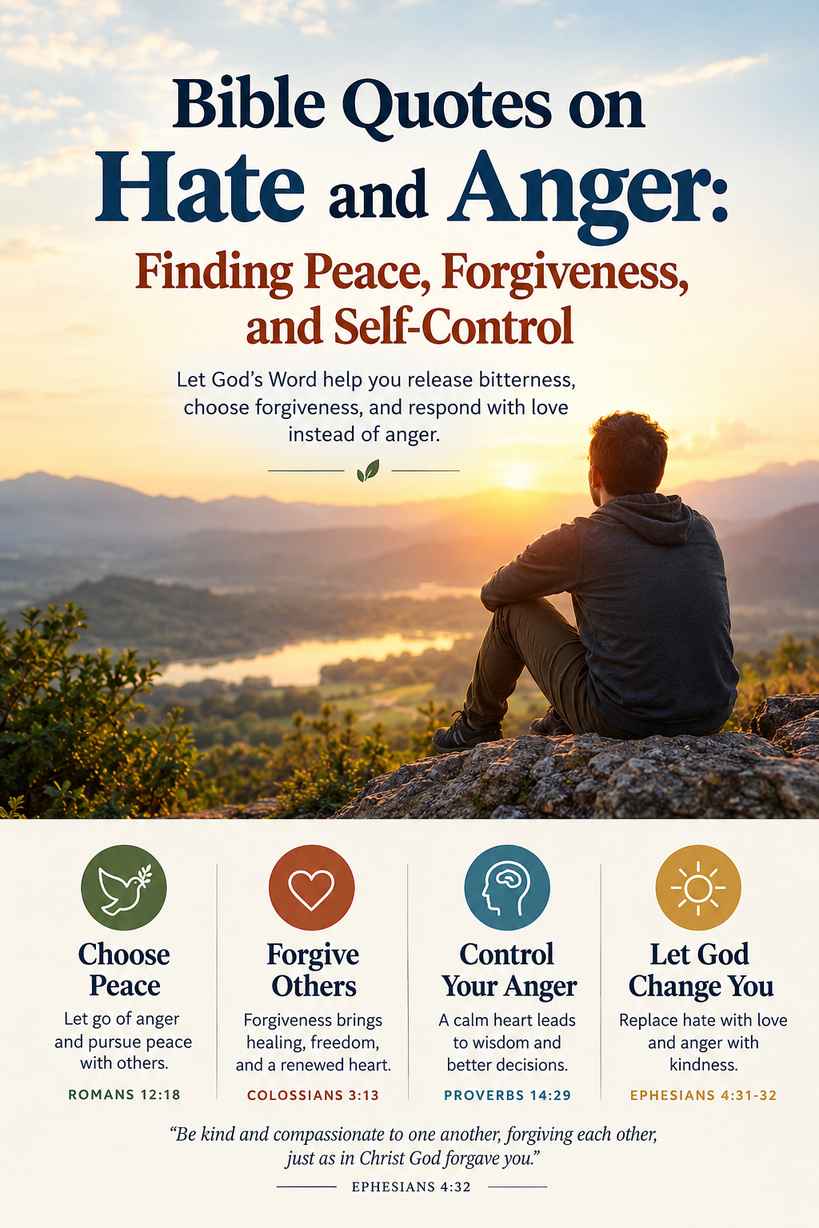
Bible Quotes on Hate and Anger: Finding Peace, Forgiveness, and Self-Control
Anger is one of the most human emotions we experience. Someone says something hurtful, treats us unfairly, betrays our trust, or does something that feels completely wrong—and suddenly our hearts become heavy with frustration.
Sometimes anger lasts for a few minutes. Sometimes it stays for years.
But what happens when anger turns into hatred?
The Bible has a great deal to say about both emotions. Scripture does not pretend that anger does not exist. Instead, it teaches us how to respond to anger before it controls our words, relationships, decisions, and spiritual lives.
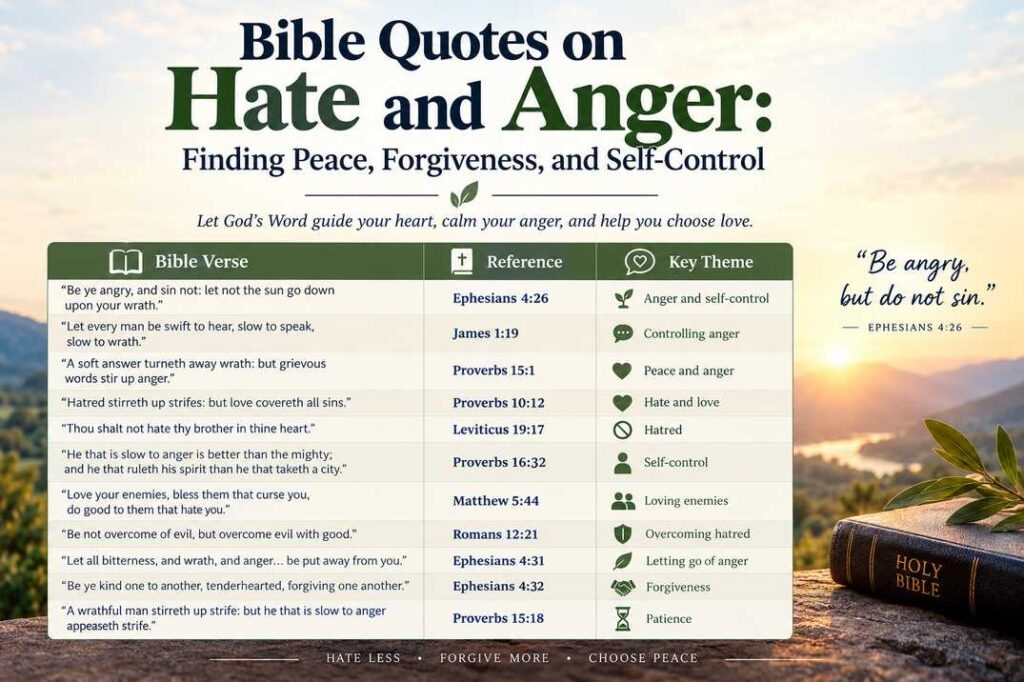
The Bible also draws an important distinction between experiencing anger and allowing anger to become sinful behavior. Ephesians 4:26 says, “Be ye angry, and sin not” (KJV). In other words, feeling anger is not automatically the same thing as acting wrongly because of anger.
| Bible Quote | Bible Reference | Main Theme |
|---|---|---|
| “Be ye angry, and sin not: let not the sun go down upon your wrath.” | Ephesians 4:26 | Anger and self-control |
| “Let every man be swift to hear, slow to speak, slow to wrath.” | James 1:19 | Controlling anger |
| “A soft answer turneth away wrath: but grievous words stir up anger.” | Proverbs 15:1 | Peace and anger |
| “Hatred stirreth up strifes: but love covereth all sins.” | Proverbs 10:12 | Hate and love |
| “Thou shalt not hate thy brother in thine heart.” | Leviticus 19:17 | Hatred |
| “He that is slow to anger is better than the mighty; and he that ruleth his spirit than he that taketh a city.” | Proverbs 16:32 | Self-control |
| “Love your enemies, bless them that curse you, do good to them that hate you.” | Matthew 5:44 | Loving enemies |
| “Be not overcome of evil, but overcome evil with good.” | Romans 12:21 | Overcoming hatred |
| “Let all bitterness, and wrath, and anger… be put away from you.” | Ephesians 4:31 | Letting go of anger |
| “Be ye kind one to another, tenderhearted, forgiving one another.” | Ephesians 4:32 | Forgiveness |
| “A wrathful man stirreth up strife: but he that is slow to anger appeaseth strife.” | Proverbs 15:18 | Patience |
| “Above all things have fervent charity among yourselves.” | 1 Peter 4:8 | Love over hate |
That distinction matters.
You may feel angry without becoming cruel. You may recognize injustice without becoming consumed by hatred. You may be hurt without allowing revenge to become your life’s mission.
Throughout Scripture, we find repeated encouragement to practice patience, forgiveness, self-control, love, wisdom, and peace.
This collection of Bible quotes on hate and anger explores those teachings while offering practical ways to apply them to everyday life.
Note: Bible verses quoted below are identified as Scripture. The original reflections are clearly labeled as Bible-inspired quotes and are not presented as biblical verses.
Understanding What the Bible Says About Hate and Anger
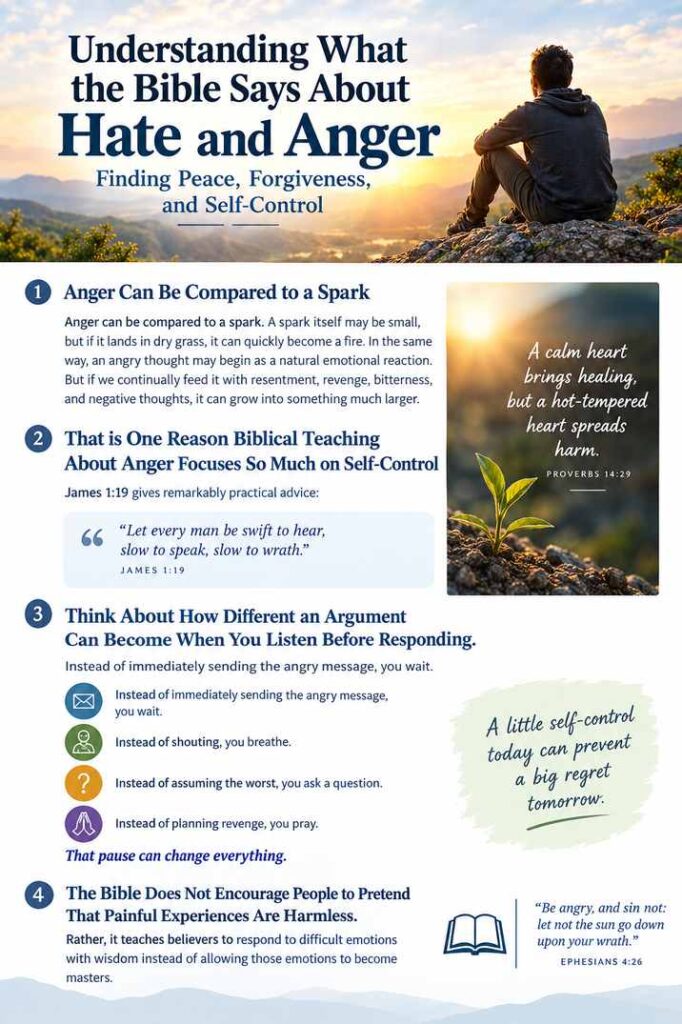
Anger can be compared to a spark.
A spark itself may be small, but if it lands in dry grass, it can quickly become a fire. In the same way, an angry thought may begin as a natural emotional reaction. But if we continually feed it with resentment, revenge, bitterness, and negative thoughts, it can grow into something much larger.
That is one reason biblical teaching about anger focuses so much on self-control.
James 1:19 gives remarkably practical advice:
“Let every man be swift to hear, slow to speak, slow to wrath.”
Think about how different an argument can become when you listen before responding.
Instead of immediately sending the angry message, you wait.
Instead of shouting, you breathe.
Instead of assuming the worst, you ask a question.
Instead of planning revenge, you pray.
That pause can change everything.
The Bible does not encourage people to pretend that painful experiences are harmless. Rather, it teaches believers to respond to difficult emotions with wisdom instead of allowing those emotions to become masters of the heart.
Is Anger Always a Sin According to the Bible?

No, the Bible does not describe every experience of anger as automatically sinful.
Ephesians 4:26 says:
“Be ye angry, and sin not: let not the sun go down upon your wrath.”
This verse recognizes that anger can occur while simultaneously warning against allowing it to become sinful.
There is an important difference between feeling anger and using anger as an excuse to harm someone.
You might become angry when someone is treated unfairly. You might become upset when someone lies to you. You might feel frustration when someone repeatedly breaks a promise.
The emotion itself can alert you that something matters.
The question is: What will you do with that emotion?
Will anger become a doorway to wisdom or a doorway to destruction?
The Difference Between Righteous Anger and Destructive Anger
The Bible contains examples of anger connected with wrongdoing and injustice. Yet human anger can quickly become mixed with pride, selfishness, revenge, and bitterness.
That is where caution becomes necessary.
A person may begin by saying, “What happened was wrong.”
Eventually, the thought can become, “I want that person to suffer.”
Those are very different attitudes.
Healthy moral concern seeks what is right. Destructive anger seeks personal revenge.
That is why Scripture repeatedly encourages believers to surrender vengeance to God rather than taking revenge into their own hands.
Romans 12:19 teaches:
“Vengeance is mine; I will repay, saith the Lord.”
The message is not that wrongdoing does not matter. It is that revenge does not need to become your personal responsibility.
Bible Quotes About Anger
Several well-known Bible passages directly address anger, wrath, patience, and self-control.
These verses are especially meaningful when you are struggling to control your reactions.
“Be Ye Angry, and Sin Not” — Ephesians 4:26
Ephesians 4:26 is one of the most frequently discussed Bible verses about anger:
“Be ye angry, and sin not: let not the sun go down upon your wrath.”
The verse recognizes anger but warns against allowing it to remain unchecked.
Imagine carrying an angry thought to bed every night.
You replay the conversation.
You remember every insult.
You imagine what you should have said.
You create arguments in your mind.
After a while, the original event may be smaller than the anger surrounding it.
This is why dealing with anger matters.
Unresolved anger can become resentment, and resentment can gradually become hatred.
Being Slow to Anger — James 1:19
James 1:19 offers one of the simplest formulas for handling conflict:
“Let every man be swift to hear, slow to speak, slow to wrath.”
Notice the order.
Listen first.
Speak slowly.
Become angry slowly.
That is almost the opposite of how many arguments happen.
Someone speaks.
We react.
Then we listen.
By that point, the argument may already be burning.
James encourages a different rhythm.
Listen before responding.
Think before speaking.
Give yourself enough space to decide whether your response will heal the situation or make it worse.
A Soft Answer Turns Away Wrath — Proverbs 15:1
Proverbs 15:1 says:
“A soft answer turneth away wrath: but grievous words stir up anger.”
Words have power.
One harsh sentence can turn a disagreement into a major conflict. One gentle response can sometimes stop that conflict before it grows.
This does not mean that you must agree with everyone.
It means you can disagree without becoming destructive.
You can say, “I don’t see this the same way,” without saying, “You are worthless.”
You can establish boundaries without using cruelty.
You can confront wrongdoing without allowing rage to control your behavior.
Bible Quotes About Hate
The Bible speaks strongly about hatred because hatred can damage both relationships and the person carrying it.
Hatred often begins with pain.
Someone hurts you.
You remember it.
You become angry.
You replay it.
You stop trusting the person.
Then eventually, the pain becomes resentment.
The biblical response is not to pretend that nothing happened. Instead, Scripture points toward forgiveness, love, reconciliation where appropriate, and freedom from revenge.
Hatred Stirs Up Conflict — Proverbs 10:12
Proverbs 10:12 says:
“Hatred stirreth up strifes: but love covereth all sins.”
Hatred does not usually remain quiet inside the heart.
It searches for evidence.
It remembers old offenses.
It interprets new actions through the lens of old pain.
A person who already hates someone may interpret even an innocent action as another insult.
Love, by contrast, seeks peace.
It does not mean ignoring serious wrongdoing or refusing to protect yourself. Rather, biblical love refuses to make hatred the foundation of its response.
Do Not Hate in Your Heart — Leviticus 19:17
Leviticus 19:17 says:
“Thou shalt not hate thy brother in thine heart.”
This verse takes the issue beyond outward behavior.
You can appear calm while carrying intense hatred inside.
You can smile while secretly wishing someone would fail.
You can say nothing while allowing resentment to grow.
Biblical teaching reaches deeper than appearances. It addresses the condition of the heart.
That is important because lasting change often begins internally before it becomes visible externally.
Bible Verses About Controlling Anger
Self-control is a recurring biblical theme.
Anger may knock on the door of your heart, but you do not have to invite it to stay.
The Strength of Being Slow to Anger
Proverbs 16:32 says:
“He that is slow to anger is better than the mighty; and he that ruleth his spirit than he that taketh a city.”
This is a powerful picture of strength.
The world can make strength look like domination.
The Bible presents another possibility: self-mastery.
Anyone can shout.
Anyone can insult.
Anyone can react impulsively.
But controlling yourself when you have every emotional reason to react can require tremendous discipline.
Being slow to anger is not weakness.
It can be a form of strength.
Controlling Your Words When You Are Angry
Anger and speech are closely connected.
When emotions become intense, people often say things they later regret.
A sentence spoken in five seconds can be remembered for five years.
That is why Scripture repeatedly emphasizes the importance of speech.
Before responding while angry, ask yourself:
- Is what I am about to say true?
- Is it necessary?
- Will it help?
- Am I trying to solve the problem or hurt the person?
- Would I say this if I were calm?
Sometimes the wisest response is to wait.
Silence is not always avoidance.
Sometimes silence is self-control.
Bible Quotes About Forgiveness Instead of Hate
Forgiveness is one of Christianity’s central responses to hatred.
Forgiveness does not mean saying that wrongdoing was acceptable.
It does not necessarily mean restoring trust immediately.
It does not mean refusing to establish boundaries.
And it does not mean that justice is irrelevant.
Forgiveness means refusing to allow another person’s wrongdoing to permanently control your heart.
Love Your Enemies
Jesus gives one of the most challenging teachings about hatred in Matthew 5:44:
“Love your enemies, bless them that curse you, do good to them that hate you, and pray for them.”
This teaching goes far beyond ordinary kindness.
It challenges the instinct to return hatred with hatred.
If someone hates you, the easiest response may be to hate them back.
Jesus points toward another path.
Pray.
Bless.
Do good.
Love.
That does not make harmful behavior acceptable. Instead, it prevents another person’s wrongdoing from determining who you become.
Overcome Evil With Good
Romans 12:21 says:
“Be not overcome of evil, but overcome evil with good.”
This is a profound idea.
You can experience evil without allowing it to transform your character.
Someone may behave cruelly toward you.
You still have a choice about how you respond.
You may not control another person’s actions, but you can work toward controlling your own.
The goal is not to pretend that evil does not exist.
The goal is to refuse to become consumed by it.
What Jesus Teaches About Anger and Hatred
Jesus addressed anger at the level of the heart.
In Matthew 5, during the Sermon on the Mount, Jesus connects outward acts with inward attitudes. His teaching shows that spiritual righteousness is not merely about avoiding visible wrongdoing.
The condition of the heart matters.
Why?
Because actions usually begin somewhere.
A hateful thought can become hateful speech.
Hateful speech can become harmful behavior.
Repeated harmful behavior can destroy relationships.
Jesus therefore points His listeners toward the deeper source of the problem.
If you only control your behavior while secretly feeding hatred, the inner problem remains.
The Christian approach calls for transformation of both behavior and heart.
How Anger Can Affect Your Heart and Relationships
Anger can feel powerful.
At first, it may even feel satisfying.
You think, “They deserve to hear this.”
But uncontrolled anger often comes with a price.
It can damage friendships.
It can divide families.
It can destroy trust.
It can turn small disagreements into permanent conflicts.
It can keep you emotionally connected to someone you desperately want to move beyond.
Think about that last point.
Sometimes hatred feels like a weapon aimed at another person, but you are the one carrying it every day.
Forgiveness can begin breaking that cycle.
That does not erase history.
It changes your relationship with the history.
How to Respond When Someone Makes You Angry
Knowing what Scripture teaches is one thing. Practicing it in a real argument is another.
So what can you actually do when someone makes you angry?
Pause Before You Speak
Give yourself time.
Take a breath.
Walk away if necessary.
Drink some water.
Pray.
Return to the conversation when you can think more clearly.
A delayed response is often better than a regretted response.
Pray Before Seeking Revenge
When someone hurts you, revenge can seem attractive.
You may want them to experience the same pain.
But Scripture repeatedly redirects vengeance toward God.
Instead of asking, “How can I make them suffer?” consider asking:
“God, how can I respond without allowing this pain to turn me into someone I do not want to become?”
That prayer changes the focus.
Choose Forgiveness Without Ignoring Wrongdoing
Forgiveness and boundaries can exist together.
If someone repeatedly harms you, forgiveness does not require you to give that person unlimited access to your life.
You can forgive while maintaining appropriate distance.
You can release hatred while still seeking justice.
You can love someone while recognizing that their behavior is harmful.
That distinction is important.
Biblical forgiveness is not the same thing as pretending that nothing happened.
Unique Bible-Inspired Quotes About Hate and Anger
The following quotes are original Bible-inspired reflections. They are not direct Bible verses.
“Do not let a temporary storm of anger become a permanent climate in your heart.”
“Hatred promises revenge, but forgiveness offers freedom from the person who hurt you.”
“Anger may knock loudly, but wisdom decides whether you open the door.”
“A heart filled with hatred carries a burden that forgiveness was created to release.”
“You do not have to return someone’s cruelty in order to prove that you were hurt.”
“When anger demands a reaction, wisdom asks for a moment of prayer.”
“The person who controls anger possesses a strength that shouting can never provide.”
“Forgiveness does not rewrite yesterday; it prevents yesterday from ruling tomorrow.”
“When you choose peace over revenge, you refuse to let hatred write the ending of your story.”
“Let God’s love become louder in your heart than the voice of resentment.”
Short Bible Quotes About Hate and Anger for Reflection
If you need short Scripture-based statements for daily reflection, these passages are particularly useful:
- “A soft answer turneth away wrath.” — Proverbs 15:1
- “Be ye angry, and sin not.” — Ephesians 4:26
- “Slow to speak, slow to wrath.” — James 1:19
- “Hatred stirreth up strifes.” — Proverbs 10:12
- “Be not overcome of evil, but overcome evil with good.” — Romans 12:21
- “Love your enemies.” — Matthew 5:44
- “Thou shalt not hate thy brother in thine heart.” — Leviticus 19:17
- “He that is slow to anger is better than the mighty.” — Proverbs 16:32
- “Let all bitterness, and wrath, and anger… be put away from you.” — Ephesians 4:31
- “Above all things have fervent charity among yourselves.” — 1 Peter 4:8
These short passages can be useful for prayer, personal reflection, Bible study, or inspirational content.
Bible Quotes About Letting Go of Anger
Letting go of anger can be difficult, especially when the wound is fresh.
Sometimes people think that releasing anger means saying, “What happened doesn’t matter.”
But that is not necessarily what forgiveness means.
You can acknowledge the pain and still choose peace.
You can admit that someone treated you unfairly and still refuse to live in hatred.
You can remember what happened without constantly reliving it.
Ephesians 4:31 provides a direct challenge:
“Let all bitterness, and wrath, and anger… be put away from you.”
Notice the word bitterness.
Bitterness is often what happens when anger stays too long.
Anger says, “I was hurt.”
Bitterness begins saying, “I will carry this hurt everywhere.”
The biblical invitation is to put that burden down.
What the Bible Says About Anger Toward Enemies
One of the most difficult biblical teachings is the command to love enemies.
Why is this so difficult?
Because our natural instinct often says:
“If they hurt me, they deserve to be hurt.”
Jesus challenges that instinct.
Matthew 5:44 calls believers to love their enemies and pray for those who mistreat them.
That does not mean approving evil.
It means refusing to allow hatred to become the defining response.
Think of it like refusing to drink poison because someone else hurt you. Hatred can continue harming the person who carries it long after the original conflict has ended.
Prayer can help break that cycle.
Sometimes you may begin by praying simply:
“God, help me release the hatred I am carrying.”
That can be the beginning of healing.
Finding Peace When You Feel Angry
Peace does not always arrive immediately.
Sometimes you have to practice it.
Read Scripture.
Pray.
Take a walk.
Talk with a wise and trustworthy person.
Give yourself time before responding.
Set healthy boundaries.
Ask God for wisdom.
And when necessary, seek appropriate help for serious conflict or harm.
The Christian response to anger is not passive weakness.
It is active self-control.
It requires courage to choose patience when rage feels easier.
It requires humility to admit when your own words were wrong.
It requires faith to release revenge.
And sometimes it requires wisdom to recognize that forgiveness does not mean remaining in an unsafe or destructive situation.
The goal is not simply to stop being angry.
The deeper goal is to become the kind of person who can experience anger without being controlled by it.
Conclusion
The Bible offers a powerful and balanced perspective on hate and anger. Scripture recognizes that anger exists, but it repeatedly warns against allowing anger to become bitterness, hatred, revenge, or destructive behavior.
Verses such as Ephesians 4:26, James 1:19, Proverbs 15:1, Proverbs 16:32, Proverbs 10:12, Matthew 5:44, and Romans 12:21 point believers toward patience, self-control, forgiveness, love, and peace.
The lesson is not that you should ignore injustice or pretend that painful experiences never happened.
Instead, Scripture invites you to respond differently.
When anger rises, pause.
When hatred grows, examine your heart.
When revenge seems attractive, remember God’s call toward forgiveness.
When someone hurts you, choose wisdom before reaction.
You may not be able to control what someone else says or does, but you can work toward controlling what their actions produce inside you.
Anger may be part of your story, but it does not have to write the ending.
Frequently Asked Questions About Bible Quotes on Hate and Anger
1. What does the Bible say about hate and anger?
The Bible repeatedly warns against uncontrolled anger and hatred while encouraging patience, forgiveness, love, self-control, and peace. Proverbs 15:1, James 1:19, Ephesians 4:26, and Romans 12:21 are especially relevant passages.
2. Is being angry a sin according to the Bible?
Not necessarily. Ephesians 4:26 says, “Be ye angry, and sin not.” The verse indicates that anger can occur without necessarily becoming sinful. The important issue is how a person responds to that anger.
3. What is the best Bible verse for controlling anger?
James 1:19 is especially practical: “Let every man be swift to hear, slow to speak, slow to wrath.” Proverbs 16:32 also emphasizes the strength involved in controlling one’s spirit.
4. What does the Bible say about hating someone who hurt you?
The Bible discourages hatred and calls believers toward love and forgiveness. Leviticus 19:17 warns against hatred in the heart, while Jesus teaches people to love their enemies in Matthew 5:44.
5. Does the Bible say to forgive someone who hurt you?
Yes. Forgiveness is an important biblical teaching. However, forgiveness does not mean approving harmful behavior or abandoning reasonable boundaries. A person can forgive while still taking appropriate steps to protect themselves.
6. What Bible verse says to overcome anger with love?
Romans 12:21 says, “Be not overcome of evil, but overcome evil with good.” The verse encourages believers not to allow evil to determine their response.
7. What does Proverbs say about anger?
Proverbs contains many teachings about anger. Proverbs 15:1 teaches that a gentle answer can turn away wrath, while Proverbs 16:32 describes being slow to anger and ruling one’s spirit as a form of strength.
8. How can prayer help with anger?
Prayer can create space between an emotional reaction and a response. Instead of immediately seeking revenge or speaking harshly, a person can bring their anger before God and ask for wisdom, patience, forgiveness, and self-control.
9. Can I forgive someone without trusting them again?
Yes. Forgiveness and trust are not identical. Forgiveness can involve releasing hatred and revenge, while rebuilding trust may require time, changed behavior, accountability, and appropriate boundaries.
10. What is a good short Bible quote about anger?
One of the clearest is James 1:19: “Swift to hear, slow to speak, slow to wrath.” It offers a simple principle for handling anger: listen carefully, speak thoughtfully, and avoid rushing into anger.