
Ask And You Shall Receive Bible Verse: Meaning, Context, And What Jesus Really Taught
“Ask, and it will be given to you; seek, and you will find; knock, and the door will be opened to you.” Few verses in Scripture are quoted as often, or misunderstood as easily, as these words of Jesus in Matthew 7:7. Does this mean God grants every request exactly as asked? Why do sincere prayers sometimes go unanswered? And what did Jesus actually mean by “ask, seek, and knock”?
This guide walks through the full meaning of the “ask and you shall receive” Bible verse: where it appears in Scripture, its context inside the Sermon on the Mount, what each of the three commands means, how the rest of the Bible explains it, real biblical examples of answered and unanswered prayer, and how to apply it in daily life today.
What Is the “Ask and You Shall Receive” Bible Verse?

The phrase comes from Jesus’ teaching in the Sermon on the Mount, recorded in Matthew 7:7–8:
“Ask, and it will be given to you; seek, and you will find; knock, and it will be opened to you. For everyone who asks receives, and the one who seeks finds, and to the one who knocks it will be opened.” — Matthew 7:7–8 (ESV)
In the King James Version, the same verse reads: “Ask, and it shall be given you; seek, and ye shall find; knock, and it shall be opened unto you” (Matthew 7:7, KJV). Most people quote only the first sentence, but verses 7 and 8 belong together. Jesus restates His point to drive home confidence and persistence in approaching God.
Where Is “Ask and You Shall Receive” Found in the Bible?
Matthew 7:7–8 is the most familiar passage, but Jesus repeats this teaching elsewhere in His ministry, and each version adds its own layer of meaning.
Matthew 7:7–8 — The Sermon on the Mount
Jesus teaches His disciples about righteous living, trust in God, and prayer, near the close of His longest recorded sermon.
Luke 11:9–13 — Right After the Lord’s Prayer
Luke records a nearly identical teaching, given immediately after Jesus instructs His disciples how to pray. Here the emphasis shifts toward God’s generosity, closing with the promise that the Father gives the Holy Spirit to those who ask Him (Luke 11:13), a detail Matthew’s account does not include.
John 16:24 — Ask in Jesus’ Name
Spoken later in His ministry, as Jesus prepares His disciples for His departure: “Ask, and you will receive, that your joy may be full” (John 16:24). This connects the promise to praying in Jesus’ name and authority.
Together, these three passages form one consistent message about prayer rather than three separate promises.
Who Said “Ask and You Shall Receive,” and to Whom?
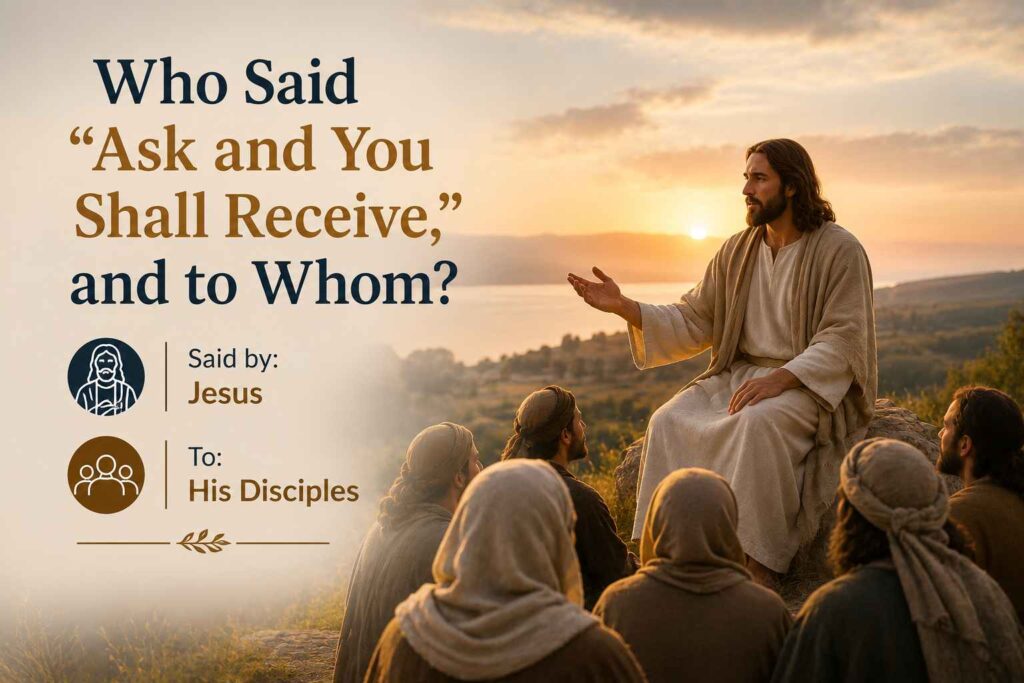
Jesus Christ spoke these words to His disciples during the Sermon on the Mount, a sustained lesson on what life looks like for people who belong to God’s kingdom. He was speaking to people learning to live as God’s children, inviting them to approach their heavenly Father with confidence instead of fear. Understanding who is speaking, and to whom, matters because these words reflect Jesus’ own view of how God relates to His people.
Bible Translations Compared
The wording shifts slightly across translations, but the meaning stays consistent.
| Translation | Matthew 7:7 (Opening Words) |
| King James Version (KJV) | Ask, and it shall be given you |
| New King James Version (NKJV) | Ask, and it will be given to you |
| New International Version (NIV) | Ask and it will be given to you |
| English Standard Version (ESV) | Ask, and it will be given to you |
| New Living Translation (NLT) | Keep on asking, and you will receive what you ask for |
The clearest difference is the archaic “ye” in the KJV, which modern translations simply update to “you.” The NLT goes further, rendering the commands as “keep on asking,” “keep on seeking,” and “keep on knocking.” This reflects the underlying Greek grammar, which suggests ongoing action rather than a single request — a nuance that sharpens the meaning rather than changing it.
Understanding Matthew 7:7–8 in Context
One of the most common mistakes readers make is treating Matthew 7:7 as a stand-alone promise. Pulled out of context, it can sound like a guarantee that every request will be granted exactly as asked. The surrounding chapters tell a fuller story.
The Sermon on the Mount Leading Up to This Verse
Matthew 5–7 records the Sermon on the Mount, which includes the Beatitudes, loving enemies, giving to those in need, the Lord’s Prayer, trusting God instead of worrying, and judging others rightly. By chapter 7, Jesus has already taught His listeners to seek God’s righteousness first, trust their heavenly Father, and depend on Him rather than earthly security. Against that backdrop, “ask, seek, and knock” reads as a natural continuation of an invitation to trust God wholeheartedly, not a new, unrelated promise.
Jesus had already addressed prayer directly in chapter 6, giving His disciples the Lord’s Prayer as a model of humble dependence, and reminding them that the Father already knows their needs before they ask (Matthew 6:8).
Why This Isn’t a Blank Check
Immediately after “ask, seek, and knock,” Jesus moves into the image of earthly parents giving good gifts to their children (Matthew 7:9–11). His point isn’t that God fulfills every desire exactly as requested — it’s that God is perfectly good, trustworthy, and generous toward those who seek Him. That father-child relationship is the foundation of the whole passage.
What Does “Ask, Seek, and Knock” Mean?
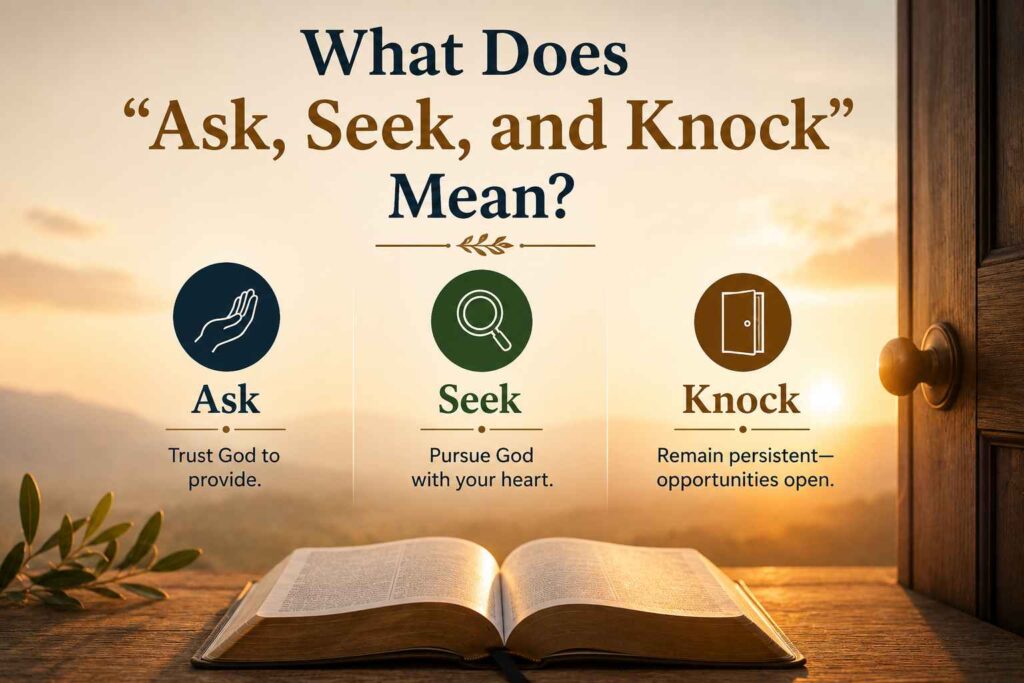
Jesus could have repeated the same idea three times. Instead, He chose three different commands, each building on the last, painting a picture of growing faith and deepening dependence.
Ask: Bringing Requests Before God
“Ask” is where prayer begins. It recognizes that believers cannot meet their deepest needs on their own. The Greek verb translated “ask” (aiteo) carries the sense of requesting something from someone with the authority to give it, and its grammatical form suggests continuous action — “keep asking.” This isn’t endless repetition meant to wear God down; it’s a life marked by ongoing dependence on Him.
Seek: Pursuing God’s Kingdom and Will
Earlier in the sermon, Jesus had already told His disciples to “seek first the kingdom of God and his righteousness” (Matthew 6:33), and that statement frames what He means here. Seeking isn’t simply searching for answers to life’s problems; it means pursuing God’s presence, wisdom, and righteousness, shifting the center of prayer from “What do I want?” to “What does God desire?”
Knock: Persisting in Faith
Someone standing outside a closed door doesn’t usually knock once and walk away; they wait, trust someone is inside, and keep knocking until the door opens. Persistence here doesn’t imply that God is reluctant — it demonstrates confidence that God hears His children and welcomes them into fellowship with Him.
Ask, Seek, Knock at a Glance
| Command | Main Emphasis | Picture |
| Ask | Dependence | Bringing requests before God |
| Seek | Pursuit | Desiring God’s kingdom and will |
| Knock | Persistence | Continuing to trust God’s timing |
Does “Ask and You Shall Receive” Mean God Grants Every Request?
Read alongside the whole Bible, Matthew 7:7–8 encourages confident prayer, but it doesn’t promise that God grants every request exactly as it’s made. It invites believers to trust a Father who always gives what is good, wise, and consistent with His will.
Why Some Prayers Go Unanswered (James 4:3)
James writes plainly: “You ask and do not receive, because you ask wrongly, to spend it on your passions” (James 4:3). This doesn’t mean prayer lacks power — it means selfish motives can shape what people ask for. Matthew encourages believers to ask confidently; James reminds them to examine their hearts while doing it.
Praying According to God’s Will (1 John 5:14–15)
“And this is the confidence that we have toward him, that if we ask anything according to his will he hears us” (1 John 5:14). Prayer, in other words, is both confident and surrendered at once. Human prayer is shaped by limited perspective; God sees the whole picture, which is why sincere prayers sometimes receive unexpected answers.
Jesus makes the same point right after Matthew 7:7–8, asking His listeners, “Which of you, if his son asks for bread, will give him a stone?” If imperfect earthly parents know how to give good gifts, how much more does the heavenly Father.
20 Bible Verses About Ask and You Shall Receive (KJV)
These related verses expand on Jesus’ teaching about asking, seeking, and receiving from God, showing this is a consistent theme running through both Testaments.
- Matthew 7:7 — “Ask, and it shall be given you; seek, and ye shall find; knock, and it shall be opened unto you.”
- Matthew 7:8 — “For every one that asketh receiveth; and he that seeketh findeth; and to him that knocketh it shall be opened.”
- Matthew 7:11 — “If ye then, being evil, know how to give good gifts unto your children, how much more shall your Father which is in heaven give good things to them that ask him?”
- Matthew 21:22 — “And all things, whatsoever ye shall ask in prayer, believing, ye shall receive.”
- Mark 11:24 — “Therefore I say unto you, What things soever ye desire, when ye pray, believe that ye receive them, and ye shall have them.”
- Luke 11:9 — “Ask, and it shall be given you; seek, and ye shall find; knock, and it shall be opened unto you.”
- Luke 11:13 — “If ye then, being evil, know how to give good gifts unto your children: how much more shall your heavenly Father give the Holy Spirit to them that ask him?”
- John 14:13 — “And whatsoever ye shall ask in my name, that will I do, that the Father may be glorified in the Son.”
- John 15:7 — “If ye abide in me, and my words abide in you, ye shall ask what ye will, and it shall be done unto you.”
- John 16:24 — “Ask, and ye shall receive, that your joy may be full.”
- James 1:5 — “If any of you lack wisdom, let him ask of God, that giveth to all men liberally, and upbraideth not; and it shall be given him.”
- James 4:3 — “Ye ask, and receive not, because ye ask amiss, that ye may consume it upon your lusts.”
- 1 John 3:22 — “And whatsoever we ask, we receive of him, because we keep his commandments, and do those things that are pleasing in his sight.”
- 1 John 5:14 — “And this is the confidence that we have in him, that, if we ask any thing according to his will, he heareth us.”
- 1 John 5:15 — “And if we know that he hear us, whatsoever we ask, we know that we have the petitions that we desired of him.”
- Philippians 4:6 — “Be careful for nothing; but in every thing by prayer and supplication with thanksgiving let your requests be made known unto God.”
- Hebrews 4:16 — “Let us therefore come boldly unto the throne of grace, that we may obtain mercy, and find grace to help in time of need.”
- Psalm 37:4 — “Delight thyself also in the Lord: and he shall give thee the desires of thine heart.”
- Jeremiah 29:12 — “Then shall ye call upon me, and ye shall go and pray unto me, and I will hearken unto you.”
- 1 Chronicles 4:10 — “And Jabez called on the God of Israel, saying, Oh that thou wouldest bless me indeed… And God granted him that which he requested.”
Related Bible Verses About Asking, Receiving, and Prayer
| Scripture | Primary Emphasis | How It Builds on Matthew 7 |
| Luke 11:9–13 | Persistence and the Father’s generosity | Shows God’s willingness to give good gifts, especially spiritual ones |
| John 16:24 | Asking in Jesus’ name | Connects prayer with Christ’s authority and purpose |
| James 1:5 | Asking for wisdom | Shows God’s generosity toward sincere requests |
| James 4:3 | Motives matter | Explains why some prayers aren’t answered as expected |
| 1 John 5:14–15 | God’s will | Balances confidence with submission |
| Hebrews 4:16 | Bold access to God | Encourages confident prayer through Christ |
Biblical Examples of Answered, Delayed, and Different Prayers
The Bible doesn’t present prayer as a guarantee of an immediate yes. It records real people bringing real needs to God and receiving His answers in different ways and on different timelines.
Prayers Answered With Yes
Hannah prayed for years before God gave her Samuel, who became one of Israel’s greatest prophets (1 Samuel 1). Solomon asked for wisdom rather than riches, and God granted it along with additional blessings (1 Kings 3). Elijah prayed for God’s intervention on Mount Carmel, and God answered in a way that turned a nation back to Him (1 Kings 18).
Prayers Answered With Wait
Abraham waited decades for the son God had promised (Genesis 21). Daniel prayed and waited for understanding that didn’t come right away, though Scripture says God heard him from the moment he prayed (Daniel 10:12). Delay isn’t the same as rejection; it’s often part of how faith is built.
Prayers Answered Differently
Paul asked three times for his “thorn in the flesh” to be removed. God’s answer was not removal but sufficient grace: “My power is made perfect in weakness” (2 Corinthians 12:9). Moses asked to enter the Promised Land; God said no, but let him see the land from a distance and honored him in other ways (Deuteronomy 34).
Prayers Answered With No
In Gethsemane, Jesus prayed that His coming suffering might pass, then submitted fully to the Father’s will (Matthew 26:39). The cross wasn’t removed; it became the means of humanity’s redemption. Even perfect faith doesn’t guarantee escape from suffering.
| Prayer Outcome | Biblical Example | Primary Lesson |
| Immediate yes | Hannah, Solomon, Elijah | God generously answers according to His wisdom |
| Delayed answer | Abraham, Daniel, Israel | Waiting often strengthens faith and reveals God’s timing |
| Different answer | Paul, Moses | God’s grace may accomplish more than the requested outcome |
| No | Jesus in Gethsemane | God’s will is always wiser than human understanding |
How to Apply Matthew 7:7 in Daily Prayer
Pray With Confidence, Not Presumption
Confidence says, “I know God hears me.” Presumption says, “God must do exactly what I ask.” Biblical confidence rests in God’s character, not in personal expectations, which lets Christians pray boldly while staying humble enough to trust God if His answer differs from their hopes.
Seek God’s Will Before Your Own
Before bringing a request, it helps to ask whether it honors God, reflects biblical values, and serves His kingdom rather than just personal comfort. As believers mature, their prayers often shift from requests for changed circumstances toward requests for wisdom, faith, and the strength to obey.
Persist Without Growing Discouraged
Persistence isn’t about wearing down a reluctant God; it’s about continuing to trust a willing Father. Abraham, Hannah, and Daniel all experienced seasons of waiting before seeing God’s purposes unfold, and that kind of waiting builds patience and deeper dependence in ways instant answers can’t.
A Short Prayer Based on “Ask, Seek, and Knock”
Heavenly Father, thank You for inviting me to ask, seek, and knock with confidence. Teach me to bring my needs before You honestly, to seek Your kingdom above my own desires, and to keep trusting You even when the answer is delayed or different from what I hoped. I believe You hear me and that Your will for me is good. In Jesus’ name, Amen.
Common Misconceptions About This Verse
A few misreadings are worth naming so they can be avoided.
- “God gives everything asked for, exactly as requested.” Jesus is inviting believers to trust a loving Father, not promising unconditional fulfillment (James 4:3; 1 John 5:14–15).
- “This verse promises prosperity or constant health.” Jesus Himself experienced rejection and suffering; the greatest gifts Scripture promises are wisdom, peace, grace, and a growing relationship with God.
- “Unanswered prayer means weak faith.” Paul and even Jesus in Gethsemane received answers different from what they asked for; faith is shown by continuing to trust God regardless of outcome.
- “Persistence changes God’s mind.” God is already loving, wise, and good; persistent prayer doesn’t wear Him down — it strengthens the one praying.
- “Prayer is a formula: ask plus enough faith equals a guaranteed result.” Prayer is relational, not mechanical, and a genuine relationship can’t be reduced to an equation.
Frequently Asked Questions
Does God answer every prayer?
God hears every prayer, but Scripture shows His answers follow His wisdom and will rather than a simple guarantee. Sometimes the answer is yes, sometimes wait, sometimes something different, and sometimes no, always for a purpose.
Where is “Ask and you shall receive” found in the Bible?
Primarily in Matthew 7:7–8. A parallel appears in Luke 11:9–13, and a related promise appears in John 16:24, where Jesus tells His disciples to ask in His name so their joy may be full.
Did Jesus really say “Ask and you shall receive”?
Yes. Both Matthew and Luke record Jesus speaking these words during His teaching on prayer — Matthew places it within the Sermon on the Mount, and Luke places it right after the Lord’s Prayer.
What does “ask, seek, and knock” mean?
Three commands describing a growing relationship with God: ask emphasizes bringing your needs before Him, seek emphasizes pursuing His kingdom and will, and knock represents persistence and continual trust.
Why doesn’t God answer every prayer the way I expect?
Because His wisdom exceeds ours. We pray with limited knowledge; He sees the whole picture. Motives, timing, and His higher purposes all shape His answers, but He remains faithful even when the answer differs from what we hoped for.
Does this verse promise wealth or material success?
No. Jesus consistently calls His followers to seek God’s kingdom first. The greatest blessings Scripture promises are knowing God, spiritual growth, wisdom, peace, and eternal life, not guaranteed financial abundance.
What does it mean to pray according to God’s will?
It means bringing requests that align with His character, purposes, and revealed truth, not trying to persuade God toward our plans, but seeking to understand and participate in His.
Does God want me to keep praying about the same thing?
Yes. “Ask,” “seek,” and “knock” all point toward ongoing trust rather than giving up after a single prayer. Persistence is about continually depending on Him while staying confident in His goodness.
Is “Ask and you shall receive” still relevant today?
Yes. Though first spoken to His original disciples, the principle still applies: approach God confidently, seek His kingdom, trust His wisdom, stay faithful in prayer, and depend on Him daily.
Final Thoughts
“Ask, and it will be given to you; seek, and you will find; knock, and the door will be opened to you.” These words have encouraged Christians for centuries because they reveal something true about the heart of God.
Jesus wasn’t offering a formula for getting whatever people want. He was inviting His followers into a life of confident, persistent, trusting prayer, rooted not in technique but in the character of the Father who hears them, welcomes them, and answers with perfect wisdom and love. Whether you’re praying for guidance, healing, wisdom, strength, or peace, the invitation still stands: come to your heavenly Father, ask with humility, seek Him wholeheartedly, and knock with perseverance.