
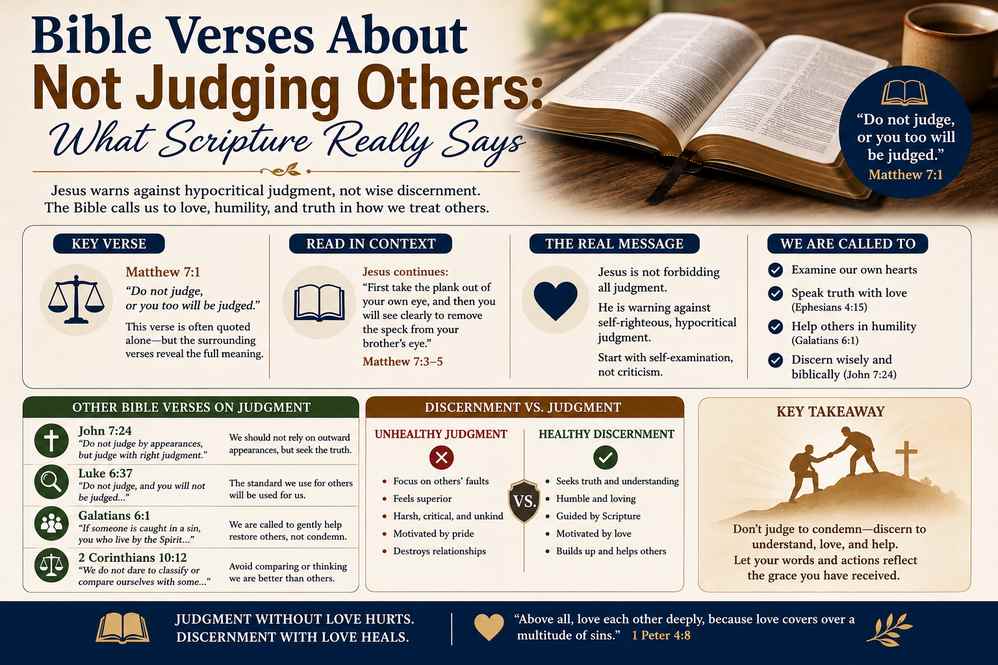
Bible Verses About Not Judging Others: What Scripture Really Says
“Judge not, that ye be not judged” is one of the most quoted lines in the Bible — and one of the least understood. Nearly everyone recognizes Matthew 7:1, but far fewer have read the verses that follow it, or considered how the rest of Scripture builds on it. The result is two opposite errors: some conclude that Christians should never evaluate anyone’s behavior, while others borrow biblical language to justify harsh criticism and self-righteousness.
Scripture actually charts a middle course. Rather than banning every kind of judgment, the Bible consistently warns against judgment that is hypocritical, prideful, or condemning, while at the same time calling believers to discernment, accountability, and loving correction. Jesus told His followers not only to avoid hypocrisy but also to “judge with righteous judgment” (John 7:24). Paul, James, and the other New Testament writers reinforce the same balance from different angles.
This guide works through that balance verse by verse: what Jesus meant by “judge not,” what righteous judgment actually looks like, when Christians are called to confront sin, and how to hold truth and love together in real relationships — family, friendship, church, and work.
What Does the Bible Say About Not Judging Others?

The Short Biblical Answer
The Bible does not forbid every form of judgment. It warns believers against hypocritical, self-righteous, and condemning judgment, while encouraging righteous discernment rooted in humility, truth, and love.
Matthew 7:1 is often quoted on its own, but read alongside John 7:24, Romans 2, James 4:11–12, and Galatians 6:1, a fuller picture emerges. Scripture calls Christians to:
- Examine themselves before correcting anyone else.
- Avoid condemning others while excusing their own sin.
- Practice discernment when weighing teaching and behavior.
- Correct fellow believers gently, aiming for restoration rather than humiliation.
- Leave the judgment of hearts and eternal destiny to God.
In short, Scripture distinguishes hypocritical judgment from righteous discernment. A believer who criticizes others while ignoring their own sin violates Jesus’ teaching; a believer who lovingly helps restore someone who has wandered follows it.
Why This Topic Is Often Misunderstood
Most confusion here comes from isolating a single verse. The common claim — “the Bible says Christians should never judge anyone” — usually rests on Matthew 7:1 read alone, without its surrounding verses or the rest of Scripture.
The biblical reality is narrower and more useful: the Bible condemns hypocritical judgment, not discernment itself. Jesus warned against judging others while excusing your own faults, yet He also told His followers to recognize false prophets “by their fruits” (Matthew 7:15–20) — which requires discernment. John 7:24 makes the same point directly, commanding believers to “judge with righteous judgment.” Scripture rejects unjust, self-righteous evaluation, not evaluation as such.
Scripture Summary Table
| Bible Passage | Main Teaching | Practical Lesson |
| Matthew 7:1–5 | Hypocritical judgment | Examine yourself before correcting others. |
| John 7:24 | Righteous judgment | Evaluate fairly, according to God’s truth rather than appearances. |
| Luke 6:37 | Mercy and forgiveness | Show grace instead of condemning others. |
| Romans 2 | Warning against hypocrisy | Apply God’s standards to yourself first. |
| James 4:11–12 | Speaking against others | Remember that God alone is the ultimate Judge. |
| Galatians 6:1 | Gentle restoration | Correct with humility and compassion. |
| 1 Corinthians 5 | Church accountability | Address serious, unrepentant sin within the church wisely. |
Four things worth holding onto before diving into individual passages: the Bible does not prohibit every form of judgment; Jesus condemns hypocrisy, pride, and condemnation — not discernment; Christians are called to combine truth with mercy; and every major passage on judging complements the others rather than contradicting them.
The Most Important Bible Verses About Not Judging Others
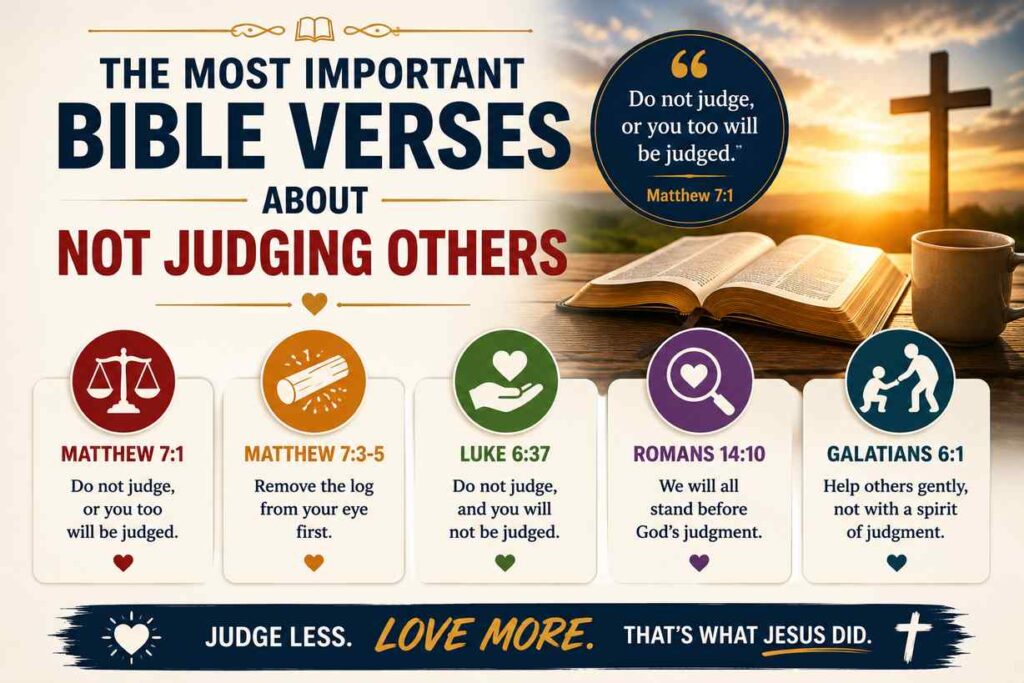
The theme of judging others runs through both Testaments. Each passage below emphasizes a different angle, but together they form one consistent message: avoid hypocritical condemnation while exercising wisdom, humility, and righteous discernment.
Matthew 7:1–5 — “Judge Not, That You Be Not Judged”
“Judge not, that you be not judged.” — Matthew 7:1
No passage has shaped the conversation about judging others more than Matthew 7:1–5, part of the Sermon on the Mount — the teaching Jesus delivered to His disciples and the surrounding crowds early in His public ministry. Throughout the sermon He challenges surface-level righteousness and exposes religious hypocrisy, calling His followers to a deeper righteousness rooted in a transformed heart rather than outward performance. Matthew 5–7 is not a new set of legal rules; it reveals the heart attitudes — humility, mercy, forgiveness, integrity — that should mark life in God’s kingdom, and the command not to judge fits squarely inside that larger vision.
Jesus does not stop at “do not judge.” He continues: “Why do you see the speck that is in your brother’s eye, but do not notice the log that is in your own eye? … First take the log out of your own eye, and then you will see clearly to take the speck out of your brother’s eye” (Matthew 7:3–5). The image is deliberately absurd — someone with a massive wooden beam in their own eye attempting delicate surgery on someone else’s. The problem isn’t that the speck doesn’t exist; it’s the hypocrisy of correcting someone else while remaining blind to your own faults. Notice, too, that Jesus never tells His listener to ignore the speck forever. He tells them to deal honestly with their own sin first, so they can help the other person with humility and clear sight.
Applied today, Matthew 7 challenges believers to examine their own motives before speaking into someone else’s life. A Christian who publicly criticizes another person’s failures while hiding similar sins misreads Jesus’ teaching. A parent who disciplines a child while refusing to acknowledge their own wrongdoing skips the self-examination step. A church member confronting a fellow believer should come with humility, not superiority. Correction, as Jesus frames it, begins with repentance — not self-righteousness.
Bible Translation Comparison
| Translation | Matthew 7:1 |
| KJV | “Judge not, that ye be not judged.” |
| NIV | “Do not judge, or you too will be judged.” |
| ESV | “Judge not, that you be not judged.” |
| NKJV | “Judge not, that you be not judged.” |
| NLT | “Do not judge others, and you will not be judged.” |
The wording varies slightly across translations, but every one of them carries the same central warning: hypocritical judgment invites the same judgment back.
Original Language Insight
The Greek verb behind “judge,” krino, can mean to evaluate, distinguish, decide, or condemn, depending on context. That range explains why Matthew 7 warns against one kind of judging while John 7:24 commands another — the surrounding text, not the word alone, determines whether krino means unfair condemnation or careful, righteous evaluation.
John 7:24 — Judge with Righteous Judgment
“Do not judge according to appearance, but judge with righteous judgment.” — John 7:24
On the surface this verse seems to contradict Matthew 7. In reality, it completes what Jesus began there. He spoke these words during a dispute with religious leaders who were evaluating Him by outward appearances rather than truth, reaching conclusions without understanding God’s purposes. Instead of rejecting judgment altogether, Jesus tells them to judge rightly — to evaluate situations according to God’s standards rather than personal preference, prejudice, or assumption. That takes wisdom, humility, and a commitment to truth.
Matthew 7 and John 7 address different problems rather than contradicting each other. Matthew warns against condemning others while ignoring your own sin. John warns against shallow, appearance-based conclusions. Together they teach that Christians should be neither harsh critics nor people who abandon discernment altogether — they should evaluate people and situations by Scripture, motivated by love and humility.
Consider someone who begins teaching ideas that plainly contradict biblical truth. Ignoring the problem in the name of “not judging” would actually fail the discernment Jesus commands in this verse. But attacking the person’s character, assuming their motives, or treating them with arrogance would violate Matthew 7. Biblical discernment holds truth and grace together.
Luke 6:37 — Choose Mercy Over Condemnation
“Do not judge, and you will not be judged. Do not condemn, and you will not be condemned. Forgive, and you will be forgiven.” — Luke 6:37
Luke records a parallel teaching that closely mirrors Matthew 7 but leans further into mercy, forgiveness, and generosity. Where Matthew highlights hypocrisy, Luke widens the lens to the attitudes believers should cultivate toward others. Jesus is teaching His disciples about the character of God’s kingdom, and the verses around this one call believers to love their enemies, show compassion, forgive freely, and imitate the mercy of their heavenly Father. A judgmental spirit, in other words, often grows out of pride or a lack of mercy — qualities inconsistent with God’s own character.
Luke 6:37 links four commands together — do not judge, do not condemn, forgive, give — describing a lifestyle shaped by grace rather than criticism. Notice the distinction between judging and condemning: Scripture repeatedly calls believers to wisdom and discernment, but never authorizes them to pronounce final judgment over someone else’s heart or eternal destiny. That authority belongs to God alone.
None of this means Christians should ignore wrongdoing or pretend sin doesn’t exist. It means believers shouldn’t become people who enjoy finding fault while withholding the mercy they themselves have received. If a friend confesses a moral failure, a condemning response shames them or assumes they’re beyond hope; a biblical response takes the sin seriously while offering forgiveness, encouragement, and a path toward restoration. Mercy doesn’t minimize sin — it points people toward repentance and healing.
Romans 2:1–4 — Paul’s Warning Against Hypocrisy
“Therefore you have no excuse, O man, every one of you who judges. For in passing judgment on another you condemn yourself, because you, the judge, practice the very same things.” — Romans 2:1 (ESV)
Paul carries Jesus’ theme forward and applies it to Jews and Gentiles alike who considered themselves morally superior to one another. Romans 1 describes humanity’s rebellion against God; as chapter 2 opens, Paul turns to those who readily condemn others while assuming their own innocence. His point: knowing right from wrong doesn’t exempt anyone from God’s judgment.
Paul is naming one of the most common spiritual dangers there is — holding others to standards we refuse to apply to ourselves. Hypocrisy blinds people to their own need for grace, and instead of leading others toward repentance, self-righteous judgment tends to breed pride and spiritual blindness. God’s kindness, Paul reminds his readers, is meant to lead people to repentance, not to human arrogance. He isn’t saying Christians should never recognize sin; he’s condemning judging others while excusing the same behavior in yourself — reinforcing Jesus’ command to remove the plank from your own eye before reaching for someone else’s speck.
Picture someone who harshly criticizes another person’s dishonesty while routinely exaggerating the truth themselves. Romans 2 calls that inconsistency what it is: hypocrisy. Before speaking into someone else’s life, it’s worth asking honestly whether you’re willing to submit to the same standard you’re holding them to.
James 4:11–12 — Leave Final Judgment to God
“Do not speak evil against one another, brothers. … There is only one lawgiver and judge, he who is able to save and to destroy.” — James 4:11–12
James addresses a second, very common expression of sinful judgment: speaking against fellow believers. Throughout his letter he warns about the destructive power of the tongue, calls believers to humility, and urges the pursuit of peace within the community. In chapter 4 he takes direct aim at slander, gossip, and self-elevation.
His reminder is simple but weighty: God alone occupies the position of ultimate Judge. When Christians assume authority that belongs only to Him — judging motives, condemning hearts, spreading harmful accusations — they step outside the role Scripture actually gives them, which is to obey God’s law and love their neighbor. James isn’t forbidding all correction or accountability; elsewhere Scripture clearly calls believers to restore those caught in sin and to protect sound doctrine. What he condemns here is arrogant speech and slander that tears people down instead of building them up.
Before repeating negative information about another Christian, James’ teaching suggests a short filter: Is it true? Is it necessary? Is it loving? Will it help restore this person? Would I say the same thing if they were standing here?
Galatians 6:1 — Restore with Gentleness
“Brothers, if anyone is caught in any transgression, you who are spiritual should restore him in a spirit of gentleness. Keep watch on yourself, lest you too be tempted.” — Galatians 6:1
Galatians 6 offers one of the clearest instructions in the New Testament for how Christians should respond when a fellow believer falls into sin. It comes right after Paul’s description of the fruit of the Spirit — love, joy, peace, patience, kindness, goodness, faithfulness, gentleness, self-control — which forms the backdrop for everything he says about correction here.
Paul doesn’t tell believers to ignore sin, and he doesn’t call for harsh confrontation either. He commands spiritually mature Christians to pursue restoration. The goal isn’t winning an argument or proving someone wrong; it’s helping a fellow believer return to faithful obedience. “Restore” was commonly used for setting a broken bone — the imagery is healing, not punishment. Paul adds an important check: “keep watch on yourself.” Anyone correcting someone else remains vulnerable to the same temptation, so humility has to accompany every act of correction.
This isn’t a license to become everyone’s spiritual watchdog. If a close friend’s choices are damaging their relationship with God, biblical love may call for a private, compassionate conversation — one that includes prayer, listening, gentle truth, encouragement, and a genuine desire to restore rather than shame.
1 Corinthians 5 — Church Discipline and Accountability
At first glance, 1 Corinthians 5 seems to pull in a different direction than Matthew 7. Here Paul instructs the Corinthian church to address a case of serious, ongoing, unrepentant sin within the congregation — behavior so public that even outsiders considered it morally unacceptable. Rather than grieving over it, some members had grown proud and complacent. Paul’s concern isn’t punishment for its own sake; it’s the spiritual health of both the individual and the wider church.
His key line reframes the whole issue: “For what have I to do with judging outsiders? Is it not those inside the church whom you are to judge?” (1 Corinthians 5:12). Paul is drawing a line between the church’s responsibility toward believers who have committed themselves to the Christian community, and God’s ultimate judgment of those outside it. Church discipline, in that light, is accountability among people who have chosen to follow Christ together — not permission for Christians to become critical of everyone around them, and not an invitation to monitor one another for faults. It addresses exceptional, serious, unrepentant sin, and it follows a careful, loving, orderly process rather than emotional reaction or public humiliation.
If a church member openly persists in destructive behavior despite repeated calls to repent, ignoring it in the name of “not judging” fails to protect either that person or the church. Biblical accountability aims at repentance, healing, and restoration — never embarrassment or revenge.
Proverbs About Judgment and Wisdom
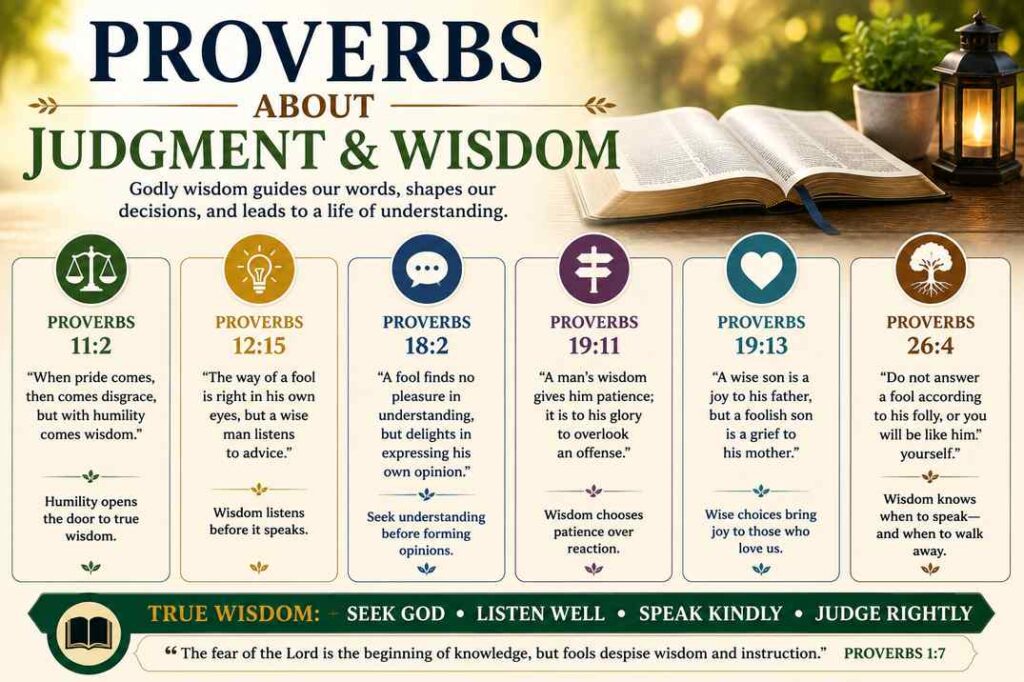
Long before the Sermon on the Mount, Proverbs was already teaching wisdom, humility, fairness, and careful evaluation. Rather than encouraging quick criticism, it consistently calls readers to pursue understanding before drawing conclusions — laying groundwork for the righteous discernment Jesus later commands.
Proverbs 18:13 — Listen Before You Judge
“If one gives an answer before he hears, it is his folly and shame.” — Proverbs 18:13
This proverb warns against reaching conclusions before understanding the full situation. In practice that means resisting the urge to assume motives, listening before responding, and gathering facts before offering correction — since many conflicts start with people reacting to incomplete information.
Proverbs 18:17 — Hear Both Sides
“The one who states his case first seems right, until the other comes and examines him.” — Proverbs 18:17
God values fairness, and wise judgment takes patience and careful listening rather than quick assumption. The principle feels especially relevant now, when social media rewards instant opinions formed on limited information.
Proverbs 21:2 — God Knows the Heart
“Every way of a man is right in his own eyes, but the Lord weighs the heart.” — Proverbs 21:2
People see actions; God sees motives. Believers may evaluate actions by Scripture, but they should stay cautious about claiming to know what’s really in someone else’s heart — that judgment belongs to God.
Proverbs 31:8–9 — Speak Up for Justice
“Open your mouth for the mute … judge righteously.” — Proverbs 31:8–9
Proverbs also makes clear that righteous judgment sometimes requires action. Biblical love isn’t passive: Christians are called to defend the vulnerable, seek justice, and oppose wrongdoing while staying humble and compassionate — a reminder that refusing every form of judgment was never the Bible’s message.
Old Testament Foundations
Leviticus reinforces the same principle: “You shall do no injustice in court. You shall not be partial to the poor or defer to the great, but in righteousness shall you judge your neighbor” (Leviticus 19:15). The emphasis falls on fairness rather than favoritism — God’s people were expected to judge honestly, not according to status, emotion, or personal preference. That standard prepares the way for Jesus’ instruction in John 7:24 to “judge with righteous judgment.”
Additional Bible Verses About Judging Others
The passages above form the foundation, but a handful of others round out the picture.
Romans 14:10–13
Paul reminds believers not to despise fellow Christians over disputable matters, since every believer ultimately stands before God’s judgment seat. The practical lesson: don’t turn personal preferences into spiritual law.
Matthew 18:15–17
Jesus lays out a loving process for addressing sin within the church: speak privately first, bring one or two witnesses if necessary, and involve the church only if repentance is repeatedly refused. The process itself is careful, patient, and restorative.
Ephesians 4:15
Paul calls believers to speak “the truth in love.” Truth without love becomes harshness; love without truth becomes compromise. Biblical correction always holds both together.
James 5:19–20
James closes his letter by encouraging believers to help those who wander from the truth, describing spiritual restoration as an act of love that can rescue someone from destruction. Restoration, not condemnation, is the goal.
Titus 3:10
Paul instructs church leaders to warn a divisive person before taking stronger action — even church discipline follows a patient process rather than immediate condemnation.
2 Timothy 2:24–25
Paul describes the posture Christians should bring to correcting others: kind, patient, able to teach, gentle, and hopeful that God may grant repentance — a fitting summary of the spirit behind every passage above.
How These Verses Work Together
Read individually, some of these passages can sound like they’re pulling in different directions. Read together, they form a remarkably consistent theology.
| Passage | Primary Teaching | What It Does Not Teach |
| Matthew 7:1–5 | Avoid hypocritical judgment | Ignore sin altogether |
| John 7:24 | Judge righteously | Judge by appearances |
| Luke 6:37 | Practice mercy and forgiveness | Pretend wrongdoing doesn’t exist |
| Romans 2 | Examine yourself first | Never confront sin |
| James 4:11–12 | Avoid slander and arrogance | Eliminate accountability |
| Galatians 6:1 | Restore gently | Shame people publicly |
| 1 Corinthians 5 | Church accountability | Encourage harsh legalism |
| Proverbs | Exercise wisdom and fairness | Make careless assumptions |
Each passage is really answering a different question. Matthew 7 addresses attitude. John 7 sets the standard for righteous evaluation. Luke 6 emphasizes mercy. Romans 2 exposes hypocrisy. James 4 warns against slander. Galatians 6 teaches restoration. First Corinthians 5 explains church accountability. Proverbs supplies the wisdom for making fair judgments. None of it contradicts the rest — together it says that Christians aren’t called to be fault-finders or self-appointed judges, but to be humble, discerning, merciful people committed to helping others grow in truth and love.
What Did Jesus Mean by “Judge Not”?
Few statements in the Bible are quoted more often — or misunderstood more often — than “judge not, that you be not judged.” Many people hear it as a blanket ban on evaluating anyone’s actions. Read in its historical, literary, and biblical context, Jesus’ meaning comes into much sharper focus. The real question isn’t just what He said, but why He said it, to whom, and what He said immediately afterward.
The Context of the Sermon on the Mount
Matthew 7 sits inside the Sermon on the Mount (Matthew 5–7), one of Jesus’ longest recorded teachings and less a list of isolated commands than a picture of what life looks like for people who belong to God’s kingdom. Across these chapters Jesus keeps returning to the heart behind a person’s actions — humility over pride, mercy over revenge, integrity over hypocrisy, love over hatred, generosity over selfishness, trust in God over anxiety. Seen against that backdrop, “do not judge” fits naturally into a broader call to reject self-righteousness and cultivate humility.
Historically, many first-century religious leaders emphasized strict outward obedience while neglecting inward transformation. Jesus challenged that pattern again and again; His concern wasn’t simply whether people followed the rules but whether their hearts reflected God’s character. Where the Pharisees often measured spirituality by external appearance, Jesus consistently pointed His listeners toward repentance, mercy, and sincere obedience — and, notably, He criticized religious hypocrisy far more often than He criticized obvious sinners. Throughout the Gospels He showed compassion to tax collectors, prostitutes, and other outcasts who recognized their need for grace; His sharpest rebukes fell on those who considered themselves spiritually superior while condemning everyone else. That pattern is exactly why Matthew 7 leans so heavily on hypocrisy rather than on discernment itself.
Jesus Was Addressing Hypocrisy
One of the most common misreadings of this passage assumes Jesus opposed every kind of moral evaluation. The verses right after “judge not” say otherwise. Immediately after that line, Jesus tells the well-known story of someone trying to remove a speck from another person’s eye while ignoring the plank in their own. The problem was never that the speck didn’t exist — the problem is the attitude of the person trying to remove it. “You hypocrite,” Jesus says, “first take the log out of your own eye, and then you will see clearly to remove the speck from your brother’s eye” (Matthew 7:5). That final clause matters: Jesus still expects the speck to be removed — just only after honest self-examination. Had He meant to forbid all correction, He could have stopped at verse 1. Instead He explains how correction should happen.
In Scripture, hypocrisy means pretending to spiritual maturity while ignoring your own sin. It shows up as feeling morally superior, holding others to a stricter standard than yourself, correcting publicly while refusing private repentance, hunting for faults rather than seeking restoration, and enjoying criticism more than compassion. Picture a believer who frequently criticizes gossip while spreading rumors of their own, or a Christian who judges another family’s parenting while neglecting responsibilities at home — these are exactly the attitudes Jesus is confronting. His command begins with personal repentance because humility changes how we approach other people.
Removing the Plank Before the Speck
The plank-and-speck image is one of the most memorable in the Gospels: someone attempting delicate eye surgery while a massive wooden beam blocks their own vision. The exaggeration is intentional — it exposes how easily we spot other people’s failures while minimizing our own. The “plank” represents unaddressed sin or pride in your own life; the “speck” represents a genuine fault in someone else. Jesus never denies the speck is real. He simply teaches that your ability to help someone else depends on dealing honestly with yourself first — which builds humility, compassion, patience, wisdom, and credibility. Skip that step, and correction curdles into criticism.
Ignoring your own “plank” tends to produce self-righteousness, double standards, broken relationships, spiritual blindness, and a damaged witness. People are far more willing to receive correction from someone who has demonstrated humility than from someone who comes across as judgmental. Jesus understood that character gives weight to words.
Self-Examination Before Correction
This principle — self-examination before correction — threads through the rest of the New Testament. Paul echoes it in Romans 2. James emphasizes humility. Galatians 6 reminds believers to “keep watch” on themselves even while restoring someone else. Before speaking into another person’s life, it’s worth asking honestly: Have I examined my own heart? Am I guilty of the same sin? Have I confessed my own failures to God? Do I want to help, or just to criticize? Am I approaching this with humility? These questions don’t eliminate correction — they purify it. Correction grown from humility reflects God’s love; correction grown from pride just reflects human self-righteousness.
Suppose a close friend has grown increasingly dishonest. Rather than confronting them in anger or discussing it with others first, wisdom points toward a slower process: pray for guidance, examine your own integrity, make sure your motive is love rather than condemnation, speak privately and respectfully, and offer support toward repentance and restoration. That sequence reflects Jesus’ teaching far more faithfully than either harsh criticism or silence.
The Greek krino carries the same broad range of meaning here as elsewhere — evaluating, deciding, distinguishing, or condemning, depending on context. In Matthew 7 the surrounding verses point toward condemning, hypocritical judgment; in John 7:24 the same word describes careful, righteous evaluation. Understanding that contextual shift is what keeps these passages complementary rather than contradictory.
Does the Bible Forbid All Judgment?
This question sits at the center of nearly every debate about judging others. Many read Matthew 7 as settling the matter once and for all — Christians should never judge anyone. Yet John 7:24, 1 Corinthians 5, and Galatians 6 all clearly call believers to evaluate situations, confront serious sin, and exercise discernment. The two sides reconcile once you distinguish sinful judgment from righteous judgment.
What Is Sinful Judgment?
Scripture consistently condemns one particular kind of judgment — judgment rooted in pride, hypocrisy, and condemnation. This kind elevates the judge while diminishing everyone else; instead of seeking another person’s good, it seeks to criticize, shame, or prove one’s own righteousness. Jesus challenged this attitude repeatedly, especially among religious leaders quick to spot others’ sins while ignoring their own. It tends to show up in three overlapping forms.
Hypocrisy
Hypocrisy is expecting others to meet standards you refuse to follow yourself — pointing out someone else’s failures while excusing your own, applying Scripture to everyone but yourself, seeking correction for others without practicing repentance, focusing on appearances rather than the heart. “First take the log out of your own eye” puts self-examination before helping anyone else; hypocrisy destroys credibility precisely because people recognize double standards on sight.
Self-Righteousness
Self-righteousness measures spiritual standing against other people instead of depending on God’s grace, and concludes it’s superior. The Pharisees often equated spirituality with visible religious performance while overlooking justice, mercy, and faithfulness. Self-righteous judgment sounds like “I would never do that” or “people like that don’t deserve grace” — language that forgets every believer depends entirely on God’s mercy. Remembering that need reshapes how we treat everyone else.
Condemnation
Condemnation is different from recognizing sinful behavior. Only God knows every motive, circumstance, and heart completely; when people assume that role — declaring someone spiritually hopeless, judging motives they can’t actually know — they move past discernment into condemnation. That looks like assuming the worst without evidence, labeling someone by their worst mistake, or treating people as though grace can’t reach them. Jesus consistently offered people a path to repentance, and even when confronting serious sin, His goal was restoration, not humiliation.
What Is Righteous Judgment?
If sinful judgment grows from pride, righteous judgment grows from truth, humility, wisdom, and love — exactly what Jesus commands in John 7:24. It doesn’t mean becoming critical or suspicious; it means evaluating situations by God’s Word while remembering your own need for grace. Three qualities define it.
Discernment
Discernment distinguishes truth from error. It helps believers recognize false teaching, identify destructive behavior, make wise moral decisions, protect vulnerable people, and encourage fellow believers toward faithfulness. It asks “what does Scripture say?” rather than “what do I personally prefer?” — its authority comes from God’s Word, not personal opinion.
Wisdom
Biblical wisdom pairs knowledge with humility: listening before reaching conclusions, weighing context, seeking understanding, praying for guidance, and refusing to act on assumptions. Proverbs repeatedly connects wisdom with careful judgment, because quick reactions tend to produce injustice while patient evaluation reflects godly wisdom.
Justice
Righteousness sometimes requires action rather than silence. Ignoring wrongdoing isn’t always loving — parents correct harmful behavior, church leaders guard sound doctrine, Christians defend the mistreated, and believers encourage one another away from destructive choices. In every case the purpose is protection, healing, and restoration, not condemnation.
Sinful Judgment vs. Righteous Judgment
| Sinful Judgment | Righteous Judgment |
| Rooted in hypocrisy | Rooted in humility |
| Motivated by pride | Motivated by love |
| Condemns people | Seeks restoration |
| Ignores personal sin | Begins with self-examination |
| Based on appearances | Based on Scripture and truth |
| Personal attacks | Spiritual concern |
| Finds faults | Helps people grow |
| Divides relationships | Strengthens relationships |
| Exalts self | Honors God |
One approach tears people down and breeds pride; the other builds people up and reflects Christ.
Why Matthew 7 and John 7:24 Work Together
Matthew 7 asks what attitude Christians should avoid — hypocrisy, pride, condemnation, double standards. John 7:24 asks how Christians should evaluate situations — fairly, truthfully, wisely, with discernment. The two questions have different answers that fit together perfectly, the way a good physician neither pretends nothing is wrong nor insults the patient, but carefully identifies the problem because healing is the goal. Biblical discernment works the same way: it recognizes spiritual problems in order to lead people toward restoration, not to shame them.
Taken together, the passages build on one another: Matthew 7 teaches self-examination, John 7 teaches righteous evaluation, Romans 2 exposes hypocrisy, James 4 condemns slander, Galatians 6 explains gentle restoration, and 1 Corinthians 5 describes church accountability. Each contributes a piece; none cancels another.
Practical Examples
A Friend Falls Into Sin
Sinful judgment gossips about them, criticizes them publicly, and assumes they can’t change. Righteous judgment prays first, speaks privately, encourages repentance, and offers ongoing support.
False Teaching
Sinful judgment rejects someone simply for belonging to a different denomination without understanding what they actually believe. Righteous judgment carefully compares the teaching with Scripture before accepting or rejecting it.
Workplace Integrity
Sinful judgment assumes a coworker acted dishonestly without knowing the facts. Righteous judgment gathers information fairly before forming a conclusion.
Judgment vs. Discernment: Understanding the Difference
One of the most important — and most overlooked — distinctions in the Bible is the difference between judgment and discernment. People often use the words interchangeably, but Scripture treats them differently, and missing that difference fuels much of the confusion around “judge not.” Discernment isn’t the opposite of love; biblical love actually depends on it, since without discernment believers can’t recognize truth from error, protect others from deception, or wisely apply God’s Word.
What Is Discernment?
Discernment is the God-given ability to distinguish truth from error, good from evil, and wisdom from foolishness by measuring everything against God’s Word. Unlike hypocritical judgment, it isn’t motivated by pride or a desire to criticize; its purpose is to help believers make wise decisions and follow Christ faithfully. Scripture presents it as a mark of spiritual maturity: Jesus told His followers to recognize false prophets “by their fruits” (Matthew 7:15–20), Paul urged believers to “test everything; hold fast what is good” (1 Thessalonians 5:21), and Hebrews describes mature believers as those whose powers of discernment have been trained through constant practice (Hebrews 5:14). None of these commands would make sense if Christians were forbidden from making any evaluation at all.
Biblical discernment doesn’t ask what I feel, what’s popular, or what’s easiest — it asks what God’s Word teaches, whether this reflects Christ’s character, whether it leads people toward truth or away from it, and whether it produces the fruit of the Spirit. In practice, that might mean recognizing false teaching before it spreads, choosing trustworthy spiritual leaders, identifying unhealthy relationships, making ethical decisions at work, knowing when someone needs encouragement rather than correction, or distinguishing personal opinion from biblical command. None of it requires condemning anyone’s heart — it requires wisdom.
What Is Condemnation?
Condemnation works differently. Rather than evaluating behavior by God’s truth, it declares a person guilty in a way that leaves little room for mercy, repentance, or restoration — often assuming an authority that belongs only to God. It shows up as judging motives instead of actions, assuming the worst without evidence, speaking as though repentance were impossible, labeling people rather than addressing behavior, and treating failure as permanent identity.
Jesus never ignored sin, but He consistently invited sinners to repent and receive grace. After exposing the hypocrisy of the woman caught in adultery’s accusers, He told her, “Neither do I condemn you; go, and from now on sin no more” (John 8:11). He didn’t approve of her sin, and He didn’t condemn her either — He extended grace while calling for repentance. That balance remains the biblical model.
Judgment vs. Discernment Comparison
| Hypocritical Judgment | Biblical Discernment |
| Motivated by pride | Motivated by humility |
| Focuses on condemning people | Focuses on seeking truth |
| Based on personal opinions | Based on Scripture |
| Ignores personal sin | Begins with self-examination |
| Finds faults | Seeks restoration |
| Speaks harshly | Speaks truth in love |
| Damages relationships | Strengthens relationships |
| Assumes motives | Evaluates observable actions wisely |
| Elevates self | Honors Christ |
The difference isn’t just what is being evaluated — it’s why, how, and with what attitude. Discernment reflects the heart of Christ; hypocritical judgment reflects human pride.
Biblical Examples of Each
The Pharisees illustrate sinful judgment at its clearest: they evaluated people by outward appearance while ignoring their own spiritual condition, criticizing Jesus for eating with sinners and emphasizing external rule-keeping over inward transformation. Their problem was never that they recognized sin — it was that they lacked humility, mercy, and self-awareness.
Jesus, by contrast, demonstrated perfect discernment: He recognized sin accurately, confronted false teaching, corrected religious hypocrisy, and warned His disciples about deception — yet every action reflected truth, justice, and love, never self-elevation, always redemption. Paul followed the same pattern throughout his ministry, warning churches about false teachers and correcting believers when necessary while consistently encouraging gentleness, patience, forgiveness, and restoration — the balance Galatians 6 illustrates so clearly. Proverbs teaches the same discernment through practical wisdom: listen carefully, seek understanding, avoid impulsive decisions, speak thoughtfully, act fairly.
Everyday Examples
The distinction gets practical fast. In evaluating teaching, discernment asks, “Does this agree with Scripture?” while judgment says, “Anyone who disagrees with me must be a bad Christian.” In helping a friend, discernment says, “I care about you enough to speak honestly and lovingly,” while judgment says, “I’m better than you.” On social media, discernment verifies information, avoids false accusations, and responds graciously; judgment reaches for quick outrage, assumption, and public humiliation. One reflects wisdom. The other reflects pride.
When Should Christians Correct Someone?
Understanding the difference between judgment and discernment naturally raises another question: if Christians should avoid hypocritical judgment, when is it appropriate to correct someone at all? The New Testament doesn’t call believers to ignore sin, and it doesn’t encourage constant criticism either — it offers a careful, compassionate framework for loving correction aimed at restoration rather than condemnation. Done biblically, correction is an expression of love, not superiority.
Correcting with Gentleness
Galatians 6:1 captures the heart of biblical correction: restore a fallen believer “in a spirit of gentleness,” while keeping watch on yourself. Paul isn’t telling believers to ignore sin, and he isn’t encouraging harsh confrontation — he’s instructing spiritually mature Christians to pursue restoration through gentleness, using the image of setting a broken bone: the goal is healing, not additional pain.
Biblical gentleness isn’t weakness; it’s strength exercised under God’s control. In practice it looks like listening before speaking, speaking privately whenever possible, choosing words carefully, avoiding embarrassment or humiliation, staying patient if change takes time, and remembering your own need for grace. Paul’s warning to “keep watch on yourself” is a reminder that anyone offering correction remains capable of the same failure.
Speaking the Truth in Love
Ephesians 4:15 urges believers to speak “the truth in love” — and Scripture never treats truth and love as competing values. Truth delivered without love tends to become harsh, critical, prideful, and damaging; even accurate facts, delivered with the wrong spirit, rarely help anyone grow. Love without truth, on the other hand, collapses into mere approval — ignoring destructive behavior isn’t loving, and if someone is moving toward spiritual harm, genuine love sometimes requires a difficult conversation. Jesus modeled both at once: He welcomed sinners with compassion while calling them to repentance, and Paul and James did the same. Love determines the tone of correction; truth determines the message. Neither should exist without the other.
Church Discipline
Church discipline is one of the most misunderstood topics in this whole conversation. Many picture public humiliation or harsh punishment, but the New Testament describes something very different: a loving process meant to protect the church, encourage repentance, restore believers, and honor Christ — never to satisfy personal anger or prove spiritual superiority.
Jesus lays out the process in Matthew 18. The first conversation should happen privately, one-on-one, protecting the person’s dignity and giving them a chance to repent without unnecessary embarrassment; many conflicts never need to go further than this. If the person refuses to listen, Jesus instructs believers to bring one or two mature witnesses — not to add pressure, but to ensure fairness and wisdom. Only after repeated refusal does the matter become one for church leadership and the congregation, and even then restoration remains the goal; church discipline is never revenge. The gradual pace teaches several things at once: correction should be patient, privacy should be protected whenever possible, every opportunity for repentance should be offered, and restoration should always be preferred over separation. Skipping these steps tends to cause unnecessary hurt and division.
Restoring Rather Than Condemning
Perhaps the sharpest difference between biblical correction and worldly criticism is the intended outcome. Condemnation says “you’re beyond hope,” “you’ll never change,” “you’re defined by your worst mistake.” Restoration says “God’s grace is still available,” “repentance is possible,” “let’s walk through this together.” That difference reflects the Gospel itself: every Christian has experienced God’s mercy, so every Christian should extend it to others. Correction should never leave someone feeling that forgiveness is out of reach — it should point them toward Christ, who offers both truth and grace.
Practical Framework Before Correcting Someone
Before confronting a fellow believer, it helps to pause and work through a few questions prayerfully.
- Pray first. Ask God for wisdom, humility, and the right attitude — correction should never begin in anger.
- Examine yourself. Following Matthew 7, ask honestly whether you’re guilty of something similar and whether you’ve confessed your own sin.
- Search Scripture. Make sure the issue is genuinely biblical rather than a matter of personal preference — not every disagreement calls for correction.
- Check your motives. Do you genuinely love this person and want restoration, or are you trying to win an argument? Would you still have this conversation if no one else ever knew about it?
- Speak privately. Follow Jesus’ instruction in Matthew 18 — private conversations preserve dignity; public criticism should never be the first response.
- Listen carefully. Correction should never be a one-sided lecture; there may be circumstances you don’t yet understand.
- Keep supporting them. Restoration rarely happens in a single conversation — it often requires ongoing encouragement, accountability, prayer, and patience.
Practical Scenario Boxes
A Close Friend Living Dishonestly
Situation: You discover that a close Christian friend has been repeatedly lying. Biblical principle: love seeks restoration, not public exposure. Relevant Scripture: Matthew 18:15, Galatians 6:1, Ephesians 4:15. Recommended response: pray first, meet privately, speak honestly but gently, and offer encouragement and accountability rather than shame.
A Family Member Drifting Spiritually
Situation: A family member who professes faith has gradually drifted from biblical living. Biblical principle: correction should flow from love, patience, and humility. Relevant Scripture: James 5:19–20, Galatians 6:1. Recommended response: maintain the relationship, keep praying, speak truth with kindness when the moment is right, and trust God with the outcome.
A Church Member in Open Sin
Situation: Someone openly persists in serious sin while rejecting repeated calls to repent. Biblical principle: church accountability protects both the individual and the congregation. Relevant Scripture: Matthew 18, 1 Corinthians 5. Recommended response: follow the biblical process patiently, let church leadership guide formal discipline, and keep restoration — not punishment — as the goal.
An Online Argument
Situation: Someone posts something offensive or misleading on social media. Biblical principle: not every disagreement requires public correction. Relevant Scripture: James 1:19, Ephesians 4:15, Proverbs 15:1. Recommended response: pause before responding, consider whether a private conversation would help more, and ask whether your reply will honor Christ or simply escalate the conflict.
Common Misunderstandings About Judging Others
Much of the debate around Matthew 7 comes from familiar sayings that sound biblical without quite matching what Scripture actually teaches. Some misunderstandings come from quoting a single verse without reading what follows it; others come from confusing discernment with condemnation, or love with approval. The four below are among the most common.
Misconception #1: Christians Should Never Judge
This is by far the most common misreading, usually built on Matthew 7:1 quoted in isolation — “judge not, that you be not judged” — without reading what Jesus says next. The same chapter later calls believers to recognize false prophets by their fruit (Matthew 7:15–20), which requires discernment. Elsewhere Jesus says, “Do not judge according to appearance, but judge with righteous judgment” (John 7:24); Paul instructs churches to address serious, ongoing sin (1 Corinthians 5); Galatians 6 calls for gently restoring believers; James warns against slander. None of these contradict Matthew 7 — they explain how Christians should judge: with humility, fairness, and love. If someone claiming to teach God’s Word is intentionally twisting Scripture for personal gain, ignoring it because “Christians shouldn’t judge” actually fails the Bible’s repeated call to discernment. The real question was never whether to evaluate — it’s how and why. Christians aren’t called to become fault-finders; they’re called to become wise, humble, discerning followers of Christ.
Misconception #2: Love Means Ignoring Sin
Modern culture often equates love with unconditional acceptance of every decision someone makes. Scripture presents something richer: biblical love seeks another person’s highest good, which sometimes means encouragement or forgiveness and sometimes means a difficult conversation. Jesus loved people deeply and still called them to repentance; Paul loved the churches he served and still corrected them when necessary. Love without truth becomes permissiveness; truth without love becomes cruelty. Scripture never asks believers to choose between them — real love is willing to have an uncomfortable conversation when someone’s spiritual well-being is at stake.
Misconception #3: Correction Equals Condemnation
Many assume any correction automatically violates Jesus’ teaching, but the Bible draws a clear line between the two. Condemnation says “you’re beyond hope,” “God could never forgive you,” “you’ll never change.” Biblical correction says “God loves you,” “this behavior is harmful,” “repentance is possible,” “I’ll walk alongside you.” The difference lies in both message and purpose — condemnation pushes people away, while correction invites them back, mirroring the Gospel itself: God convicts people of sin so they can experience forgiveness and restoration through Christ.
Misconception #4: Matthew 7 Contradicts John 7:24
At first read, “judge not” and “judge with righteous judgment” look impossible to reconcile. But Matthew 7 addresses hypocritical judgment, while John 7 addresses righteous evaluation — one warns against pride, the other commands discernment. It’s not unlike two road signs that say “do not speed” and “drive carefully”: different instructions, same underlying goal. Jesus is teaching believers to avoid hypocritical condemnation while still exercising careful, humble discernment.
Why Context Matters
Most of this confusion disappears once Scripture is read as a whole rather than one sentence at a time. Matthew explains the danger of hypocrisy; John explains righteous judgment; Romans exposes self-righteousness; James warns against slander; Galatians teaches restoration; 1 Corinthians explains church accountability. Together they reveal one consistent message: the Bible never calls Christians to become harsh critics, and it never encourages moral indifference either. It calls believers to pursue truth with humility, courage with compassion, and discernment with love.
How to Apply These Bible Verses in Everyday Life
Understanding the teaching is only the first step; the harder work is applying it in real relationships. Family disagreements, a struggling marriage, a friend making destructive choices, conflict at church, ethical questions at work, arguments on social media — the Bible doesn’t offer a separate standard for each setting. It offers the same timeless principles, applied with humility, wisdom, truth, and love.
Family Relationships
Family is often the first place this teaching gets tested. Parents correct children, siblings disagree, adult children worry about aging parents, relatives make choices we consider unwise. In all of it, winning an argument isn’t the goal — restoring the relationship and honoring Christ is. Before speaking, it’s worth asking whether you’re reacting emotionally, whether you’ve listened carefully, whether you’re speaking from Scripture or personal preference, and whether your words will actually help. Sometimes the most loving response is patient encouragement; other times love calls for a gentle, private conversation about a difficult issue.
Marriage
Marriage calls husbands and wives to practice truth, grace, forgiveness, and accountability daily. Because spouses know each other so well, they notice each other’s weaknesses easily — and that familiarity can either build the marriage or slowly erode it. Judgmental attitudes tend to show up as constant criticism, keeping score of past mistakes, assuming motives, and speaking harshly during disagreements. Biblical love asks a different question: not “how can I prove I’m right?” but “how can I help my spouse grow while honoring Christ?” Healthy marriages make room for honest conversation, mutual repentance, forgiveness, encouragement, and prayer together — and correction within marriage should always communicate, “I’m for you, not against you.”
Friendships
One of the greatest gifts a Christian friend can give is loving honesty. “Faithful are the wounds of a friend” (Proverbs 27:6) — real friends don’t just encourage, they lovingly warn when necessary, and timing and attitude matter as much as the words themselves. A biblical friend speaks privately, listens carefully, avoids gossip, offers hope, and stays present after the hard conversation. A judgmental friend points out failures; a godly friend walks alongside someone toward restoration.
Church Life
The church should be one of the safest places for biblical accountability, though it can sometimes become one of the places where judgment is most misunderstood. Healthy churches balance grace, truth, mercy, and accountability — members should feel free to confess struggles without fear of humiliation, while the church still lovingly addresses ongoing, serious sin through the process Jesus lays out in Matthew 18. Every act of correction should ask, “How can we help this person follow Christ more faithfully?” rather than, “How can we expose this person’s failures?” The difference between those two questions is profound.
Workplace
Most workplace situations don’t call for formal spiritual correction, but the underlying principles still apply. Christians regularly face dishonesty, gossip, unfair treatment, ethical decisions, and conflict between coworkers, and discernment helps navigate all of it without becoming judgmental. If a coworker makes a mistake, resist assuming laziness or bad motives — gather the facts, speak respectfully, offer help where it’s appropriate, and keep your own integrity intact. Christian witness at work is shaped as much by attitude as by words.
Social Media
Social media has made judging others easier than ever — people react within seconds, posts get shared before facts are verified, and disagreements escalate into public arguments almost instantly. Many online exchanges would look very different if believers applied Matthew 7 before hitting “post.” Before responding, it helps to ask: Am I reacting emotionally? Have I verified the facts? Am I assuming motives? Will this response honor Christ? Would I say this to the person’s face? Sometimes the wisest response is silence; other times a private conversation accomplishes more than a public debate ever could. The goal was never winning the argument — it’s honoring Christ.
Before Correcting Someone, Ask Yourself…
One of the most practical ways to apply this teaching is to pause and honestly examine your own heart before you speak. A simple framework helps.
Am I Acting in Love?
Do I genuinely care about this person’s spiritual well-being? Am I seeking their good? Would I still have this conversation if no one else ever knew about it? Love shapes both the tone and the purpose of correction.
Am I Being Hypocritical?
Am I guilty of something similar? Have I ignored my own sin? Am I applying the same standard to myself? Correction carries far more weight when it flows from humility.
Have I Examined Myself?
Have I confessed my own sins? Have I prayed before speaking? Am I reacting out of hurt or out of genuine biblical concern? Self-examination guards against self-righteousness.
Am I Seeking Restoration?
Do I hope this relationship becomes healthier? Am I willing to help after the conversation ends? Would I genuinely rejoice if this person repented? If restoration isn’t the goal, it may be wise to wait before speaking.
Self-Examination Checklist
Before correcting someone, pause and ask:
- Have I prayed about this?
- Have I examined my own life honestly?
- Am I reacting emotionally?
- Is my concern based on Scripture rather than personal preference?
- Is my motive love?
- Am I hoping for restoration?
- Am I prepared to listen as well as speak?
- Would a private conversation be more appropriate?
If several of these come back “no,” it’s probably wise to wait, pray, and seek God’s guidance before moving forward.
Avoid These Common Mistakes
- Correcting publicly before speaking privately.
- Using Scripture as a weapon instead of a guide.
- Assuming motives you can’t actually know.
- Speaking while angry.
- Ignoring your own need for repentance.
- Correcting every disagreement instead of focusing on clear biblical issues.
- Forgetting that restoration — not proving yourself right — is the goal.
Biblical Response Framework
When a situation may call for correction, this seven-step process summarizes the teaching of Jesus, Paul, James, and Proverbs into one practical approach:
- Pray for wisdom and humility.
- Examine yourself honestly.
- Study Scripture to confirm the concern is biblically grounded.
- Check your motives carefully.
- Speak privately whenever possible.
- Seek restoration, not humiliation.
- Leave ultimate judgment to God, and trust Him with the outcome.
Bible Verses Organized by Theme
It also helps to see these passages grouped by theme — useful for personal study, small-group discussion, sermon preparation, or simply finding the right Scripture for a specific situation. Studying them together, rather than relying on a single verse, shows how the Bible balances truth, mercy, humility, and restoration.
Verses About Mercy
Mercy is one of the strongest threads connected to Jesus’ teaching on judging others — those who have received God’s mercy are called to extend it. Key passages: Luke 6:36–37 (“be merciful, even as your Father is merciful … judge not … forgive, and you will be forgiven”), Matthew 5:7 (“blessed are the merciful, for they shall receive mercy”), James 2:13 (“mercy triumphs over judgment”), and Micah 6:8, which calls God’s people to love mercy and walk humbly with Him. Turn to these when you’re struggling to forgive someone, tempted toward over-criticism, or need reminding how much mercy you’ve already received.
Verses About Humility
Humility underlies every biblical instruction about judging others — without it, correction curdles into criticism. Key passages: Matthew 7:1–5 (remove the plank before addressing the speck), Romans 2:1–4 (examine yourself before judging others), Philippians 2:3–4 (count others more significant than yourselves), and James 4:6 (“God opposes the proud but gives grace to the humble”). Read these before confronting someone, or whenever pride starts creeping into your attitude.
Verses About Discernment
Discernment lets Christians distinguish truth from error without becoming condemning. Key passages: John 7:24 (“judge with righteous judgment”), Matthew 7:15–20 (recognize false prophets by their fruit), 1 Thessalonians 5:21 (“test everything; hold fast what is good”), Hebrews 5:14 (mature believers train themselves to discern good from evil), and Proverbs 18:13 (listen before answering). Turn here when evaluating teaching, making difficult decisions, choosing spiritual mentors, or navigating moral questions.
Verses About Correction
Biblical correction always seeks another person’s spiritual good. Key passages: Galatians 6:1 (restore gently), Matthew 18:15–17 (Jesus’ process for confronting sin), Ephesians 4:15 (speak the truth in love), 2 Timothy 2:24–25 (correct opponents with gentleness), and Proverbs 27:5–6 (faithful are the wounds of a friend). These are especially valuable before talking with a struggling friend, addressing conflict, mentoring a younger believer, or preparing for a hard conversation — the goal is never simply pointing out mistakes; it’s restoration.
Verses About Restoration
Restoration reflects God’s heart throughout Scripture — He delights in bringing people back, not casting them away. Key passages: Galatians 6:1 (restore those caught in sin), James 5:19–20 (help those who wander from the truth), Luke 15 (the parables of the lost sheep, lost coin, and prodigal son), and 2 Corinthians 2:6–8 (forgive and comfort the repentant believer). Turn to these when someone has repented, when relationships need healing, or when encouragement is needed after failure — God’s desire isn’t just that people stop sinning, but that they be restored to fellowship with Him and with others.
Verses About Wisdom
Wisdom shapes not only what to say but when and how to say it. Key passages: Proverbs 15:1 (“a soft answer turns away wrath”), Proverbs 18:17 (hear both sides before reaching conclusions), James 1:19 (be quick to hear, slow to speak, slow to anger), and Colossians 4:6 (let your speech always be gracious). Study these before difficult conversations, family disagreements, workplace conflict, or online discussions — wisdom often determines whether correction heals or harms.
Verses About Accountability
Christian accountability isn’t about controlling people — it’s about encouraging one another to stay faithful to Christ. Key passages: 1 Corinthians 5 (church accountability), Hebrews 10:24–25 (encourage one another toward love and good works), Ecclesiastes 4:9–12 (two are better than one), and James 5:16 (confess your sins to one another and pray for one another). These passages are especially useful in small groups, mentoring relationships, church leadership, and accountability partnerships — healthy accountability combines honesty with grace.
Bible Verses by Theme Summary
| Theme | Key Bible Verses |
| Mercy | Luke 6:37, James 2:13, Matthew 5:7 |
| Humility | Matthew 7:1–5, Romans 2, James 4:6 |
| Discernment | John 7:24, Matthew 7:15–20, Hebrews 5:14 |
| Correction | Galatians 6:1, Matthew 18:15–17, Ephesians 4:15 |
| Restoration | James 5:19–20, Luke 15, 2 Corinthians 2:6–8 |
| Wisdom | Proverbs 15:1, Proverbs 18:17, James 1:19 |
| Accountability | 1 Corinthians 5, Hebrews 10:24–25, James 5:16 |
Frequently Asked Questions
What Bible verse says not to judge others?
The best-known is Matthew 7:1: “Judge not, that you be not judged.” Luke 6:37 makes a similar point. Both warn against hypocritical and condemning judgment, not against every form of discernment — reading them alongside John 7:24 gives the fuller, balanced picture of Jesus’ teaching.
Does the Bible forbid all judgment?
No. It forbids hypocritical, prideful, and condemning judgment, while encouraging righteous judgment rooted in humility and Scripture. Jesus commands believers to “judge with righteous judgment” in John 7:24, and Paul and James both call Christians to loving accountability and restoration.
What is righteous judgment?
Righteous judgment evaluates people, teaching, and situations according to God’s truth rather than appearances, personal preference, or pride. It’s marked by humility, love, wisdom, self-examination, and a desire for restoration — and unlike condemnation, it never assumes God’s role as the final Judge.
Can Christians judge other Christians?
Yes, but only in the sense of loving accountability. Scripture calls believers to restore one another gently (Galatians 6:1) and outlines a careful process for addressing serious sin within the church (Matthew 18:15–17). Correction should always aim at repentance and restoration, never embarrassment or punishment.
Can Christians judge non-believers?
The New Testament distinguishes church accountability from God’s judgment of those outside it. In 1 Corinthians 5, Paul explains that the church carries particular responsibility for serious, unrepentant sin among believers, while ultimate judgment of outsiders belongs to God. Christians are called to treat non-believers with grace, respect, and faithful witness rather than self-righteous condemnation.
What does Matthew 7:1–5 really mean?
Jesus teaches that believers should avoid hypocritical judgment by examining their own lives before correcting anyone else. The plank-and-speck illustration shows that self-examination has to come before correction — but Jesus never forbids helping someone; He simply insists it be done with humility and clear spiritual vision.
Why does John 7:24 tell believers to judge rightly?
It completes what Matthew 7 begins. Instead of judging by outward appearance, Jesus commands believers to evaluate according to God’s truth — encouraging discernment rather than condemnation, and teaching Christians to avoid hypocrisy while still exercising wisdom.
What does Romans teach about judging others?
Romans 2 warns against condemning others for sins we practice ourselves, reminding believers that everyone is accountable to God and dependent on His grace. The passage calls for personal repentance before criticizing anyone else.
Which Bible translation says “judge not”?
Several major translations use this phrasing with small variations: the KJV, ESV, and NKJV all read “judge not, that you be not judged” (KJV: “ye”), while the NIV reads “do not judge, or you too will be judged” and the NLT reads “do not judge others, and you will not be judged.” The wording differs, but the meaning stays consistent in context.
How can I avoid becoming judgmental?
A helpful pattern, drawn from Matthew 7, John 7, Galatians 6, James 4, and Romans 2: pray first, examine your own heart, compare everything with Scripture, check your motives, speak privately when correction is necessary, seek restoration rather than condemnation, and trust God with the outcome.
Can Christians lovingly correct others?
Yes — loving correction is encouraged throughout the New Testament when it’s motivated by humility and guided by Scripture. Galatians 6:1, Ephesians 4:15, and Matthew 18 all teach that believers should help restore one another rather than ignore serious spiritual problems. Correction becomes biblical when its purpose is healing, not winning an argument.
Conclusion
“Judge not” is one of the most quoted lines in the Bible — and one of the most frequently misunderstood. Read Matthew 7 alongside John 7:24, Romans 2, James 4, Galatians 6, 1 Corinthians 5, and Proverbs, and a consistent picture emerges: Scripture doesn’t call Christians to ignore sin or abandon discernment. It warns against hypocrisy, pride, condemnation, and self-righteousness, while calling believers toward humility, wisdom, mercy, accountability, and loving restoration.
Every difficult conversation should begin with self-examination. Every act of correction should be motivated by love. Every judgment should be measured against God’s Word rather than personal opinion. And every believer should remember that final judgment belongs to God alone. Resist the temptation to build your understanding from a single verse; let the whole counsel of Scripture shape your perspective instead. When truth is joined with grace, and discernment is guided by humility, Christians reflect the character of Christ far more faithfully than either harsh judgment or silent indifference ever could.