
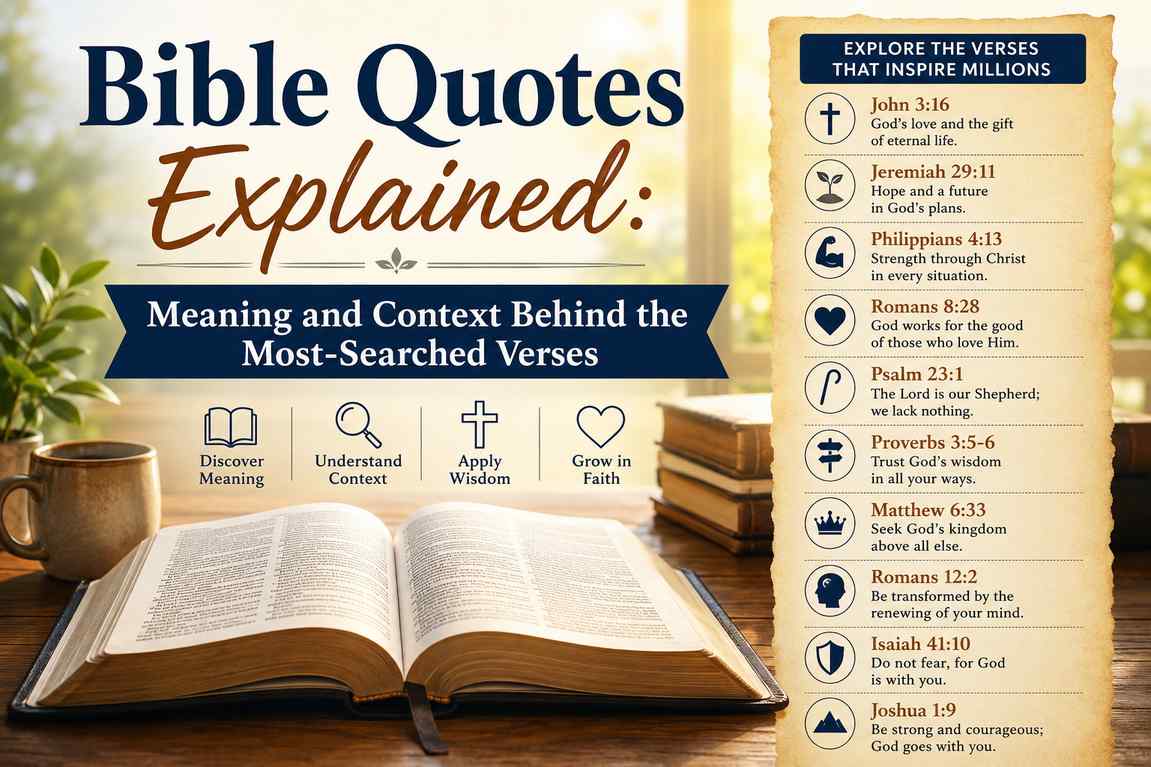
Bible Quotes Explained: Meaning And Context Behind The Most-Searched Verses
Some Bible verses are quoted so often that they have slipped into everyday language. You’ll find them in sermons, greeting cards, graduation speeches, funerals, and quiet moments of personal encouragement. But a verse can be familiar without being understood.
Most people who search for the meaning of a famous Bible quote want more than an inspirational line. They want to know what the verse actually means, who first spoke or wrote it, who first heard it, and how it should be understood today. These questions matter because Scripture was written across many centuries, by different authors, for different audiences, in vastly different circumstances.
Reading a single verse without its surrounding context can quietly distort its meaning. Words written to comfort a nation in exile can be mistaken for a universal promise of personal success. A sentence Jesus spoke in the middle of a conversation can lose its weight once it’s lifted out of that conversation.
This guide takes a different approach than a typical collection of Bible quotes. Rather than presenting verses in isolation, it walks through each one’s historical background, literary setting, intended meaning, common misreadings, and practical application. Along the way, you’ll pick up a simple method for interpreting Scripture responsibly, one you can apply to any passage in the Bible, not just the ones covered here.
Whether you’re opening the Bible for the first time or you’ve studied it for years, understanding context is what turns a familiar verse into a genuinely deeper source of wisdom.
How to Read Bible Quotes in Their Proper Context
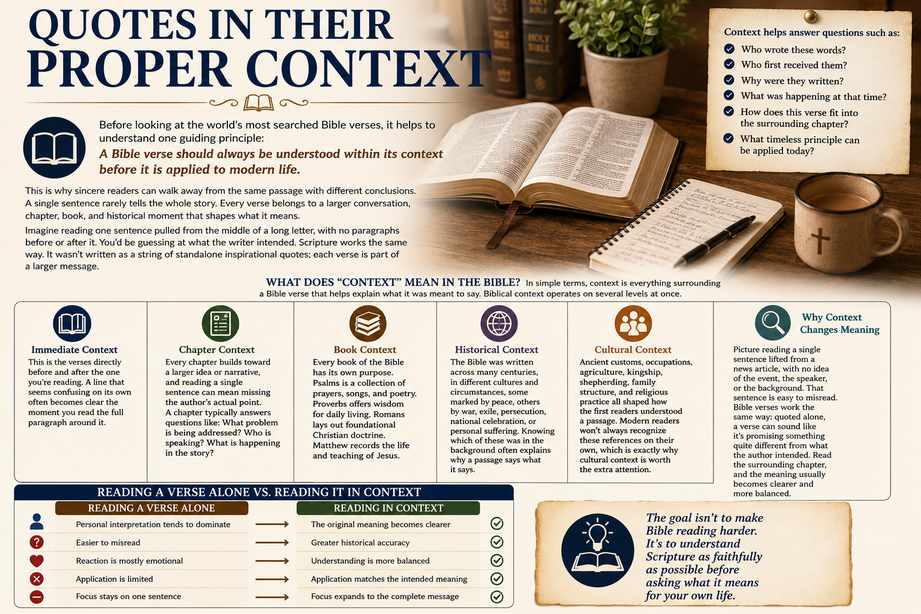
Before looking at the world’s most searched Bible verses, it helps to understand one guiding principle:
A Bible verse should always be understood within its context before it is applied to modern life.
This is why sincere readers can walk away from the same passage with different conclusions. A single sentence rarely tells the whole story. Every verse belongs to a larger conversation, chapter, book, and historical moment that shapes what it means.
Imagine reading one sentence pulled from the middle of a long letter, with no paragraphs before or after it. You’d be guessing at what the writer intended. Scripture works the same way. It wasn’t written as a string of standalone inspirational quotes; each verse is part of a larger message.
Context helps answer questions such as:
- Who wrote these words?
- Who first received them?
- Why were they written?
- What was happening at that time?
- How does this verse fit into the surrounding chapter?
- What timeless principle can be applied today?
None of this makes the Bible more complicated. In practice, asking these questions is usually what makes a difficult passage click.
What Does “Context” Mean in the Bible?
In simple terms, context is everything surrounding a Bible verse that helps explain what it was meant to say. Biblical context operates on several levels at once.
Immediate Context
This is the verses directly before and after the one you’re reading. A line that seems confusing on its own often becomes clear the moment you read the full paragraph around it. A statement about strength, for instance, may actually belong to a larger discussion about enduring hardship rather than achieving personal success.
Chapter Context
Every chapter builds toward a larger idea or narrative, and reading a single sentence can mean missing the author’s actual point. A chapter typically answers questions like: What problem is being addressed? Who is speaking? What is happening in the story?
Book Context
Every book of the Bible has its own purpose. Psalms is a collection of prayers, songs, and poetry. Proverbs offers wisdom for daily living. Romans lays out foundational Christian doctrine. Matthew records the life and teaching of Jesus. Knowing what a book is for explains why a given verse was written the way it was.
Historical Context
The Bible was written across many centuries, in different cultures and circumstances, some marked by peace, others by war, exile, persecution, national celebration, or personal suffering. Knowing which of these was in the background often explains why a passage says what it says.
Cultural Context
Ancient customs, occupations, agriculture, kingship, shepherding, family structure, and religious practice all shaped how the first readers understood a passage. Modern readers won’t always recognize these references on their own, which is exactly why cultural context is worth the extra attention.
Why Context Changes Meaning
Picture reading a single sentence lifted from a news article, with no idea of the event, the speaker, or the background. That sentence is easy to misread. Bible verses work the same way: quoted alone, a verse can sound like it’s promising something quite different from what the author intended. Read the surrounding chapter, and the meaning usually becomes clearer and more balanced. This is why responsible Bible study starts with context, not application.
Reading a Verse Alone vs. Reading It in Context
| Reading a Verse Alone | Reading in Context |
| Personal interpretation tends to dominate | The original meaning becomes clearer |
| Easier to misread | Greater historical accuracy |
| Reaction is mostly emotional | Understanding is more balanced |
| Application is limited | Application matches the intended meaning |
| Focus stays on one sentence | Focus expands to the complete message |
The goal isn’t to make Bible reading harder. It’s to understand Scripture as faithfully as possible before asking what it means for your own life.
Before You Read Any Bible Verse
Ask yourself five simple questions:
- Who wrote this?
- Who first received it?
- Why was it written?
- What happens before and after this verse?
- How should its original meaning guide my application today?
These five questions are a strong foundation for understanding not just the famous Bible quotes ahead, but any passage in Scripture.
Understanding context also explains why some of the Bible’s most loved verses are also its most misread. The next section walks through the world’s most searched Bible verses one by one, covering their historical background, original audience, true meaning, common misconceptions, and practical relevance today.
The Most-Searched Bible Verses Explained
The Bible contains thousands of verses, yet only a small number are searched, quoted, and shared again and again around the world. Some are remembered for the hope they offer in hard times. Others are known for their promises, their wisdom, or their comfort. But popularity alone doesn’t guarantee understanding.
Each verse below follows the same structure: the verse itself, why it’s famous, its historical context, its original audience, what it actually means, common misunderstandings, practical application, and related passages worth reading alongside it.
At a Glance: The Most-Searched Bible Verses
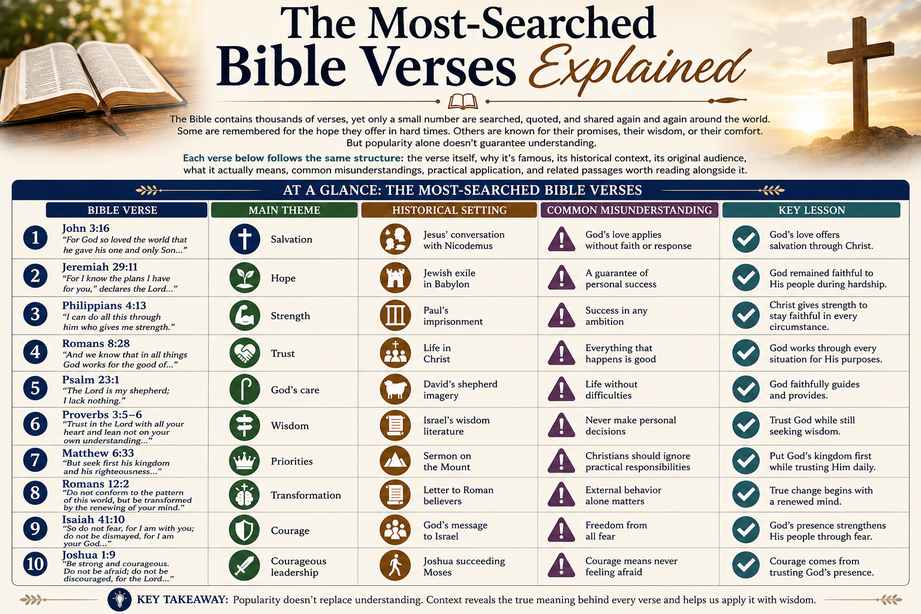
| Bible Verse | Main Theme | Historical Setting | Common Misunderstanding | Key Lesson |
| John 3:16 | Salvation | Jesus’ conversation with Nicodemus | God’s love applies without faith or response | God’s love offers salvation through Christ |
| Jeremiah 29:11 | Hope | Jewish exile in Babylon | A guarantee of personal success | God remained faithful to His people during hardship |
| Philippians 4:13 | Strength | Paul’s imprisonment | Success in any ambition | Christ gives strength to stay faithful in every circumstance |
| Romans 8:28 | Trust | Life in Christ | Everything that happens is good | God works through every situation for His purposes |
| Psalm 23:1 | God’s care | David’s shepherd imagery | Life without difficulties | God faithfully guides and provides |
| Proverbs 3:5–6 | Wisdom | Israel’s wisdom literature | Never make personal decisions | Trust God while still seeking wisdom |
| Matthew 6:33 | Priorities | Sermon on the Mount | Christians should ignore practical responsibilities | Put God’s kingdom first while trusting Him daily |
| Romans 12:2 | Transformation | Letter to Roman believers | External behavior alone matters | True change begins with a renewed mind |
| Isaiah 41:10 | Courage | God’s message to Israel | Freedom from all fear | God’s presence strengthens His people through fear |
| Joshua 1:9 | Courageous leadership | Joshua succeeding Moses | Courage means never feeling afraid | Courage comes from trusting God’s presence |
Every verse in this guide reads more clearly within its surrounding chapter, so wherever you can, read the verses before and after the passage rather than relying on the quotation alone.
John 3:16 Explained
“For God so loved the world that he gave his one and only Son, that whoever believes in him shall not perish but have eternal life.”
Why Is John 3:16 So Famous?
John 3:16 may be the best-known verse in the Bible. It’s quoted in churches, displayed at sporting events, printed in books, and shared constantly online because it condenses one of Christianity’s central claims into a single sentence: God’s love, expressed through Jesus Christ. Many people memorize it early in life simply because it says so much in so few words.
Historical Context
The verse comes from a private, nighttime conversation between Jesus and Nicodemus, a Pharisee and respected Jewish teacher who came seeking answers about who Jesus really was. In the course of that conversation, Jesus explained the need for spiritual rebirth and laid out God’s plan of salvation. John 3:16 isn’t a stand-alone statement; it’s the heart of Jesus’ explanation of why He came into the world.
Who Was It Written To?
John’s Gospel was written for readers trying to understand who Jesus is and why believing in Him matters. Within the narrative, Jesus is speaking to Nicodemus directly, but John frames the conversation so that later readers can follow the same logic toward God’s plan of redemption.
What Does This Verse Mean?
The verse rests on a few foundational ideas. God’s love comes first: the story begins with God’s initiative, not human effort. The gift of His Son shows that salvation is given, not earned through good works. Belief here means more than acknowledging Jesus exists; it means placing trust in Him. And eternal life isn’t only about what happens after death; it also describes a restored relationship with God that begins now.
Common Misunderstandings
One common mistake is reading John 3:16 as a complete summary on its own, detached from the conversation Jesus had just been having about spiritual rebirth, belief, and God’s saving purpose. Another is assuming the verse is only about God’s love, while skipping over its emphasis on faith and the wider message of the Gospel. Reading the rest of John 3 fills in both gaps.
Practical Life Application
John 3:16 reminds readers that hope starts with God’s love, not human achievement. For someone carrying guilt or wondering whether forgiveness is even possible, the verse points toward grace rather than self-reliance. It also invites humility: salvation is framed here as a gift, not something won through personal success or religious performance.
Related Bible Passages
- John 3:14–21
- Romans 5:8
- Ephesians 2:8–9
- 1 John 4:9–10
Jeremiah 29:11 Explained
“‘For I know the plans I have for you,’ declares the Lord, ‘plans to prosper you and not to harm you, plans to give you hope and a future.’”
Why Is Jeremiah 29:11 So Famous?
Few verses appear on graduation cards, social posts, and inspirational artwork more often than Jeremiah 29:11. People are drawn to its promise of hope in uncertain seasons, but it’s also one of the most frequently misunderstood verses in the Bible.
Historical Context
Jeremiah delivered this message during one of Israel’s darkest periods. Many people from the Kingdom of Judah had been taken into exile in Babylon after Jerusalem fell, hoping their suffering would end soon. Instead, God told them through Jeremiah to settle in, build homes, raise families, and prepare for a long exile. The verse sits inside a letter written to help those exiles trust God’s long-term faithfulness, not a quick rescue.
Who Was It Written To?
The original audience was Jewish exiles living in Babylon, people facing displacement, uncertainty, and disappointment after losing their homeland. That setting matters, because the promise was first given within a specific covenant relationship, not as a general statement to anyone, anywhere.
What Does This Verse Mean?
God reassured His people that exile wasn’t the end of their story. Even in hardship, He hadn’t abandoned them. The promise centers on God’s faithfulness and sovereign purposes, and His intent to restore His people in His own timing, not on immediate comfort. It called the exiles to patient trust rather than instant relief.
Common Misunderstandings
Jeremiah 29:11 is often treated as a blanket guarantee that everyone who reads it will experience personal success, financial prosperity, or an easy future. That reading skips the history behind it: the original recipients still endured decades of exile before restoration arrived. The passage is really about God’s faithfulness during suffering, not a promise of a hardship-free life, and understanding that makes the promise deeper rather than weaker.
Practical Life Application
Modern readers aren’t the original audience, but the passage still speaks to God’s character. Waiting, uncertainty, or disappointment don’t necessarily mean God has forgotten you. Hope, in fact, often grows strongest in difficult circumstances. Rather than promising an easy road, Jeremiah 29:11 encourages patient trust even when God’s timing differs from our own.
Related Bible Passages
- Jeremiah 29:4–14
- Romans 8:28
- Psalm 33:11
- Isaiah 55:8–9
Context Changes Everything
Read alone, the verse sounds like a promise of immediate personal success. Read within the chapter, it’s God encouraging His people to stay faithful through decades of exile while trusting His long-term plan.
Philippians 4:13 Explained
“I can do all things through Christ who strengthens me.”
Among the Bible’s most quoted verses, Philippians 4:13 shows up on athletic apparel, graduation gifts, motivational posters, and social media. Its promise of strength resonates with anyone facing a challenge, but its original context points to something more meaningful than unlimited achievement.
Why Is Philippians 4:13 So Famous?
People naturally connect with the idea of receiving strength in a hard moment, whether they’re preparing for an exam, starting a new job, recovering from illness, or facing an uncertain future. Paul, though, wasn’t writing about extraordinary accomplishment. He was describing faithful endurance in every circumstance.
Historical Context
Paul wrote Philippians while imprisoned. Scholars debate exactly where, but the letter clearly reflects a season of hardship and uncertainty for him. Despite that, Philippians is one of the New Testament’s most joyful letters, repeatedly urging believers to rejoice, trust God, and stay faithful regardless of their circumstances. Just before verse 13, Paul explains that he’s learned to be content whether he has plenty or very little, whether he’s experiencing hunger or abundance, comfort or suffering. Verse 13 is the conclusion of that thought.
Who Was It Written To?
Paul wrote to the church in Philippi, a Roman colony in Macedonia whose believers had supported his ministry both financially and spiritually. His letter encouraged them to stay united, humble, and faithful despite opposition.
What Does This Verse Mean?
“I can do all things” doesn’t mean Paul believed he could accomplish any ambition or avoid every failure. “All things” refers back to the circumstances he’d just described: prosperity, poverty, hunger, abundance, freedom, and imprisonment. Christ gave Paul the strength to stay faithful through each of them. The focus is endurance, not unlimited achievement.
Common Misunderstandings
This verse is often used as a motivational slogan suggesting that Christians can accomplish anything they want if they simply have enough faith. It does encourage confidence in Christ, but its immediate context is about contentment and perseverance, not guaranteed success in sports, business, or personal goals. Reading verses 10 through 19 fills in the full picture.
Practical Life Application
Life rarely moves in a straight line; there are seasons of abundance and seasons of difficulty. Paul’s point is that spiritual strength doesn’t depend on changing circumstances. Christ provides the strength to stay faithful through both success and hardship, and that’s a message about perseverance rather than self-confidence.
Related Bible Passages
- Philippians 4:10–19
- 2 Corinthians 12:9–10
- Isaiah 40:29–31
- John 15:5
Context Changes Everything
Read alone, the verse sounds like a guarantee of success in anything you attempt. Read in context, it’s Christ giving believers the strength to remain faithful and content no matter their circumstances.
Romans 8:28 Explained
“And we know that in all things God works for the good of those who love him, who have been called according to his purpose.”
Historical Context
Paul wrote Romans to Christians living in Rome, and throughout chapter 8 he reassures them about the security, hope, and future they have in Christ despite living in a broken world. The verses just before Romans 8:28 describe suffering, weakness, and the hope of future glory; Paul doesn’t pretend hardship is absent, but reminds believers that God is actively at work through every circumstance. That’s the point of the verse: not that life is easy, but that God can accomplish His purposes even through difficult situations.
Who Was It Written To?
Paul addressed the Christian community in Rome, believers from both Jewish and Gentile backgrounds facing everything from cultural tension to outright persecution. He wrote to deepen their grasp of the gospel and their trust in God’s sovereign plan.
What Does This Verse Mean?
Romans 8:28 teaches that God is actively working in every circumstance for the ultimate good of those who love Him. Notice what the verse doesn’t say: it doesn’t claim every event is good. Suffering, loss, injustice, and grief remain painful realities in a fallen world. What Paul says instead is that God can work through every circumstance, including the painful ones, to accomplish His purposes for His people. The verses that follow describe that purpose more specifically: shaping believers into the likeness of Christ. The “good” here is far deeper than temporary comfort or personal success; it points to ongoing spiritual transformation and God’s eternal purposes.
Common Misunderstandings
Romans 8:28 is sometimes reduced to “everything that happens is good,” which isn’t Paul’s message. Scripture never denies suffering, sorrow, injustice, or grief, and Paul himself experienced imprisonment, persecution, and physical hardship firsthand. The promise isn’t that every event is good, but that God can redeem even painful experiences and work them into His larger purpose. Reading Romans 8:18–39 gives the fuller context.
Practical Life Application
Everyone goes through seasons that feel confusing or painful. This verse doesn’t minimize that suffering, but it does offer a reason not to lose hope. Trusting God doesn’t require understanding every circumstance right away; sometimes the purpose behind a difficult season only becomes clear with time. Romans 8:28 invites readers to trust God’s wisdom even while the present moment stays uncertain.
Related Bible Passages
- Romans 8:18–39
- Genesis 50:20
- James 1:2–4
- 2 Corinthians 4:16–18
Context Changes Everything
Read alone, the verse sounds like everything that happens is good. Read in context, it’s a promise that God faithfully works through every circumstance to accomplish His good purposes for those who belong to Him.
Psalm 23:1 Explained
“The Lord is my shepherd; I shall not want.”
Psalm 23 is one of the most beloved passages in the Bible, read at worship services, funerals, hospital bedsides, and quiet moments of personal prayer because it captures God’s care, guidance, and faithfulness so simply.
Why Is Psalm 23:1 So Famous?
Its imagery is simple enough for a child to grasp yet rich enough to comfort someone at any stage of life. The picture of a shepherd caring for sheep has become one of Scripture’s most enduring images of God’s relationship with His people.
Historical Context
Psalm 23 was written by King David, who spent his early years as a literal shepherd before becoming Israel’s king, and that experience shaped the psalm’s language. Ancient shepherds guided, fed, protected, and defended their flocks; sheep depended entirely on the shepherd to survive. David draws on that familiar relationship to describe God’s faithful care for His people.
Who Was It Written To?
The Psalms were written for the people of Israel as prayers, songs, and expressions of worship. Psalm 23 reflects David’s personal trust in God, but its message has comforted generations of readers through both joyful and difficult seasons.
What Does This Verse Mean?
Calling the Lord a shepherd communicates several things at once: God provides, God guides, God protects, and God remains present. “I shall not want” isn’t a promise of unlimited wealth or a life free of challenges; it expresses confidence that God will provide what’s genuinely needed, according to His wisdom. The rest of the psalm reinforces this by describing God’s guidance through peaceful valleys as well as dark ones.
Common Misunderstandings
Some readers assume this verse promises a life without hardship, but only a few lines later David is walking through “the valley of the shadow of death.” God’s presence doesn’t eliminate difficulty; it sustains His people through it.
Practical Life Application
Life includes uncertainty, loss, and unanswered questions. Psalm 23 reminds believers they don’t face any of that alone. Just as a shepherd stays close to the flock, God guides, protects, and cares for His people even on the hardest stretch of the path.
Related Bible Passages
- Psalm 23
- John 10:11–18
- Ezekiel 34
- Isaiah 40:11
Rather than stopping at Psalm 23:1, read the entire psalm. Each verse builds on the shepherd imagery and adds another layer to the picture of God’s care.
Proverbs 3:5–6 Explained
“Trust in the Lord with all your heart and lean not on your own understanding; in all your ways submit to him, and he will make your paths straight.”
Few passages get quoted more often when people face a major decision. Whether it’s a career choice, a relationship, or an uncertain season, Proverbs 3:5–6 points readers toward confidence in God rather than reliance on their own judgment alone.
Why Is Proverbs 3:5–6 So Famous?
These verses speak to a universal experience: making a decision when the future isn’t clear. That practical wisdom has made them favorites for graduations, devotionals, and personal encouragement alike.
Historical Context
Proverbs belongs to the Bible’s wisdom literature, much of it traditionally associated with King Solomon, renowned for his wisdom. Unlike historical narrative or personal letters, Proverbs offers timeless principles for wise living rather than promises that apply identically to every situation.
Who Was It Written To?
The book was written to instruct readers in wisdom, discernment, and righteous living. Many of its sayings are framed as a father teaching a son, underscoring how wisdom is meant to be learned deliberately, not absorbed by accident.
What Does This Verse Mean?
Trusting the Lord means placing confidence in God’s wisdom even when circumstances are hard to understand. The verse doesn’t discourage careful planning or thoughtful decision-making; it warns against relying exclusively on human understanding while shutting out God’s guidance. Submitting every area of life to God means inviting His wisdom into daily decisions rather than depending only on personal judgment, and the promise that He’ll “make your paths straight” points to faithful guidance, not necessarily an easy or obstacle-free road.
Common Misunderstandings
A common misreading is that Christians shouldn’t think critically or seek wise advice because they’re simply supposed to “trust God.” The broader message of Proverbs encourages both trust in God and the active pursuit of wisdom; readers are urged throughout the book to seek instruction, accept correction, and grow in understanding.
Practical Life Application
When facing an important decision, trust and wisdom work together. Pray. Seek biblical wisdom. Listen to trustworthy counsel. Weigh the consequences of your choices. Then move forward in faith, recognizing that God’s guidance often unfolds one step at a time rather than all at once.
Related Bible Passages
- Proverbs 1:7
- Proverbs 2
- James 1:5
- Psalm 37:5
Trusting God doesn’t mean ignoring wisdom. It means letting God’s wisdom shape your own.
Matthew 6:33 Explained
“But seek first his kingdom and his righteousness, and all these things will be given to you as well.”
Matthew 6:33 is one of Jesus’ best-known teachings on priorities, trust, and daily living, often invoked to encourage putting God at the center of life, especially during uncertain seasons. Understanding it, though, requires reading it inside the larger Sermon on the Mount.
Why Is Matthew 6:33 So Famous?
People often turn to this verse when facing a major decision or looking for reassurance about the future. On the surface, the message sounds simple: put God first. But the surrounding passage reveals that Jesus was addressing something specific, human anxiety about life’s basic necessities.
Historical Context
Matthew 6 sits inside the Sermon on the Mount (Matthew 5–7), where Jesus teaches His followers about life in God’s kingdom. Just before verse 33, He addresses everyday worries: food, clothing, shelter, and tomorrow’s uncertainties. Rather than encouraging carelessness, Jesus teaches His followers not to let anxiety run their lives.
Who Was It Written To?
Jesus spoke these words primarily to His disciples, with a wider crowd listening in. His audience lived in a society where daily survival often hinged on uncertain harvests, seasonal work, and political instability, so His words addressed real, immediate concerns rather than hypothetical ones.
What Does This Verse Mean?
Seeking God’s kingdom first means making His rule, values, and righteousness the highest priority in life. Instead of letting fear or material concerns drive every decision, Jesus teaches His followers to pursue God’s will above everything else. The promise that “all these things will be given to you” refers back to the basic necessities discussed earlier in the chapter, encouraging trust in God’s provision rather than promising unlimited prosperity.
Common Misunderstandings
Some read this verse as a guarantee that faithful believers will become wealthy or never face financial hardship. That’s not what Jesus teaches. The surrounding passage is about God’s care for His children and His awareness of their needs, not a promise of luxury or worldly success. Jesus is encouraging responsible trust, not passive expectation.
Practical Life Application
Modern life is full of competing priorities: work, education, family, finances, health. Matthew 6:33 asks an important question underneath all of them: are daily decisions shaped mainly by fear, or by trust in God’s kingdom? Seeking God’s kingdom first doesn’t remove responsibility; it reorders priorities so faith shapes every area of life.
Related Bible Passages
- Matthew 6:25–34
- Psalm 37:4–5
- Colossians 3:1–2
- Luke 12:22–31
Context Changes Everything
Read alone, the verse sounds like putting God first guarantees prosperity. Read in context, Jesus is teaching believers to trust God’s provision instead of living anxious about tomorrow.
Romans 12:2 Explained
“Do not conform to the pattern of this world, but be transformed by the renewing of your mind.”
Romans 12:2 is one of the New Testament’s clearest calls to spiritual transformation, challenging believers not just to change outward behavior but to experience an inward renewal that reshapes everything else.
Why Is Romans 12:2 So Famous?
The verse speaks to anyone who has felt pressure to fit society’s expectations. Its call to transformation keeps resonating because every generation has to decide whose values will actually shape their lives.
Historical Context
The first eleven chapters of Romans lay out God’s saving work through Jesus Christ. Chapter 12 is a turning point: after explaining the gospel, Paul begins describing how believers should live in response to God’s mercy. Romans 12:2 opens that practical section by putting inward transformation before outward action.
Who Was It Written To?
Paul addressed Christians in Rome, believers from diverse cultural backgrounds living inside the powerful Roman Empire, where social values often clashed with Christian teaching.
What Does This Verse Mean?
Paul contrasts two patterns: conformity, letting the surrounding culture shape beliefs and behavior, and transformation, letting God renew the mind so choices increasingly reflect His will. Transformation begins internally; changed thinking is what produces changed living.
Common Misunderstandings
Some readers reduce this verse to rules about appearance or avoiding culture altogether. Paul’s point runs deeper than that. His focus is on renewed thinking that produces wise, godly living, not external conformity for its own sake.
Practical Life Application
Media, relationships, work, and culture all exert influence every single day. Romans 12:2 encourages believers to weigh those influences deliberately and keep letting Scripture shape their thinking. Real transformation tends to happen gradually, as the mind is renewed through God’s truth over time.
Related Bible Passages
- Romans 12:1–2
- Ephesians 4:22–24
- Colossians 3:9–10
- Philippians 4:8
Isaiah 41:10 Explained
“So do not fear, for I am with you; do not be dismayed, for I am your God.”
Few verses offer comfort in a hard season as directly as Isaiah 41:10. It has steadied believers through illness, grief, uncertainty, persecution, and countless other personal struggles.
Why Is Isaiah 41:10 So Famous?
The verse speaks straight to one of humanity’s oldest struggles: fear. Its repeated promises of God’s presence and strength make it especially meaningful during periods of uncertainty.
Historical Context
Isaiah ministered during a turbulent period in Israel’s history. Chapter 41 addresses God’s covenant people directly, assuring them that despite surrounding nations and coming difficulties, He hadn’t abandoned them. The chapter emphasizes God’s sovereignty over history and His faithfulness to His promises.
Who Was It Written To?
The immediate audience was the nation of Israel. God reminded His people that they belonged to Him, and that His presence remained with them even in frightening circumstances.
What Does This Verse Mean?
The command “do not fear” is grounded entirely in God’s presence. The verse offers four assurances: God is with His people, God is their God, God strengthens them, and God upholds them. The emphasis isn’t on the absence of danger, but on God’s faithful presence within difficult circumstances.
Common Misunderstandings
Some assume trusting God means fear should disappear completely. Scripture tells a different story: faithful people throughout the Bible experienced real fear. What set them apart was learning to trust God’s presence despite it.
Practical Life Application
Fear tends to show up around major life changes, illness, loss, career decisions, uncertainty about what’s ahead. Isaiah 41:10 reminds believers that courage is rooted not in personal strength, but in God’s faithful presence.
Related Bible Passages
- Isaiah 41
- Joshua 1:9
- Psalm 46:1–3
- 2 Timothy 1:7
Joshua 1:9 Explained
“Be strong and courageous. Do not be afraid; do not be discouraged, for the Lord your God will be with you wherever you go.”
Joshua 1:9 has encouraged countless people facing new beginnings, graduates, missionaries, leaders, families moving somewhere unfamiliar. Its original setting only adds weight to the command.
Why Is Joshua 1:9 So Famous?
The verse speaks directly to moments of transition, when uncertainty can feel overwhelming, and its call to courage continues to steady people beginning unfamiliar journeys.
Historical Context
Joshua had just become Israel’s leader after the death of Moses, facing the enormous responsibility of leading the nation across the Jordan River into the Promised Land, an assignment with military challenges, leadership decisions, and total dependence on God built in. God’s command to “be strong and courageous” repeats throughout the opening chapter, making clear that Joshua’s confidence should come from God’s presence rather than his own ability.
Who Was It Written To?
The immediate audience was Joshua himself, though the passage also prepared the people of Israel as they entered a major new chapter in their history.
What Does This Verse Mean?
Biblical courage isn’t the absence of fear. It’s the decision to move forward in faithful obedience because God is present. God’s promise, “I will be with you,” is the foundation for Joshua’s courage, not any confidence in his own strength.
Common Misunderstandings
This verse is sometimes read as though courage means never feeling afraid. The Bible consistently shows faithful people experiencing fear anyway. Courage means trusting God enough to obey Him even when circumstances stay uncertain.
Practical Life Application
Life regularly brings new responsibilities and unfamiliar situations. Whether it’s starting a career, starting a family, relocating, or facing the unexpected, Joshua 1:9 reminds believers that confidence grows through trusting God’s presence rather than relying solely on personal ability.
Related Bible Passages
- Joshua 1
- Deuteronomy 31:6–8
- Psalm 27:1
- Isaiah 41:10
Verse Summary Table
| Verse | Central Theme | Historical Setting | Main Lesson |
| John 3:16 | Salvation | Jesus and Nicodemus | God’s love offers eternal life through Christ. |
| Jeremiah 29:11 | Hope | Babylonian exile | Trust God’s long-term faithfulness. |
| Philippians 4:13 | Strength | Paul’s imprisonment | Christ strengthens believers in every circumstance. |
| Romans 8:28 | Trust | Life in Christ | God works through every situation for His purposes. |
| Psalm 23:1 | Care | David’s shepherd imagery | God faithfully guides and provides. |
| Proverbs 3:5–6 | Wisdom | Israel’s wisdom literature | Trust God’s wisdom above your own. |
| Matthew 6:33 | Priorities | Sermon on the Mount | Seek God’s kingdom before anxious living. |
| Romans 12:2 | Transformation | Christian living | Renew your mind through God’s truth. |
| Isaiah 41:10 | Courage | God’s promise to Israel | God’s presence overcomes fear. |
| Joshua 1:9 | Leadership | Joshua entering the Promised Land | Courage grows from trusting God’s presence. |
Bible Verses Frequently Taken Out of Context
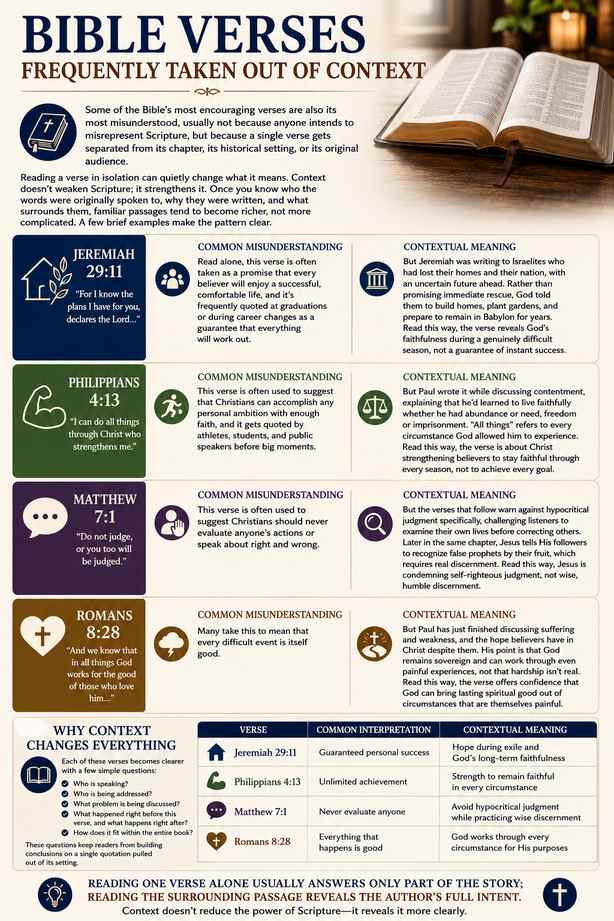
Some of the Bible’s most encouraging verses are also its most misunderstood, usually not because anyone intends to misrepresent Scripture, but because a single verse gets separated from its chapter, its historical setting, or its original audience.
Reading a verse in isolation can quietly change what it means. Context doesn’t weaken Scripture; it strengthens it. Once you know who the words were originally spoken to, why they were written, and what surrounds them, familiar passages tend to become richer, not more complicated. A few brief examples make the pattern clear.
Jeremiah 29:11
Read alone, this verse is often taken as a promise that every believer will enjoy a successful, comfortable life, and it’s frequently quoted at graduations or during career changes as a guarantee that everything will work out. But Jeremiah was writing to Israelites who had lost their homes and their nation, with an uncertain future ahead. Rather than promising immediate rescue, God told them to build homes, plant gardens, and prepare to remain in Babylon for years. Read this way, the verse reveals God’s faithfulness during a genuinely difficult season, not a guarantee of instant success.
Philippians 4:13
This verse is often used to suggest that Christians can accomplish any personal ambition with enough faith, and it gets quoted by athletes, students, and public speakers before big moments. But Paul wrote it while discussing contentment, explaining that he’d learned to live faithfully whether he had abundance or need, freedom or imprisonment. “All things” refers to every circumstance God allowed him to experience. Read this way, the verse is about Christ strengthening believers to stay faithful through every season, not to achieve every goal.
Matthew 7:1
“Do not judge, or you too will be judged.”
This verse is often used to suggest Christians should never evaluate anyone’s actions or speak about right and wrong. But the verses that follow warn against hypocritical judgment specifically, challenging listeners to examine their own lives before correcting others. Later in the same chapter, Jesus tells His followers to recognize false prophets by their fruit, which requires real discernment. Read this way, Jesus is condemning self-righteous judgment, not wise, humble discernment.
Romans 8:28
Many take this to mean that every difficult event is itself good. But Paul has just finished discussing suffering and weakness, and the hope believers have in Christ despite them. His point is that God remains sovereign and can work through even painful experiences, not that hardship isn’t real. Read this way, the verse offers confidence that God can bring lasting spiritual good out of circumstances that are themselves painful.
Why Context Changes Everything
Each of these verses becomes clearer with a few simple questions: Who is speaking? Who is being addressed? What problem is being discussed? What happened right before this verse, and what happens right after? How does it fit within the entire book? These questions keep readers from building conclusions on a single quotation pulled out of its setting.
| Verse | Common Interpretation | Contextual Meaning |
| Jeremiah 29:11 | Guaranteed personal success | Hope during exile and God’s long-term faithfulness |
| Philippians 4:13 | Unlimited achievement | Strength to remain faithful in every circumstance |
| Matthew 7:1 | Never evaluate anyone | Avoid hypocritical judgment while practicing wise discernment |
| Romans 8:28 | Everything that happens is good | God works through every circumstance for His purposes |
Reading one verse alone usually answers only part of the story; reading the surrounding passage reveals the author’s full intent. Context doesn’t reduce the power of Scripture. It reveals it more clearly.
Why These Bible Verses Are Among the World’s Most Searched
Millions of people search for Bible verses online every year. Search trends shift, but the same passages tend to resurface again and again, because they speak to experiences shared across cultures, ages, and circumstances. They answer questions nearly everyone asks at some point: Is there hope after disappointment? Can I find strength during hardship? Does God still care about me? How should I make a difficult decision? How do I deal with fear? What happens after death? The most searched Bible verses aren’t necessarily the easiest passages in Scripture. More often, they address the deepest human needs.
Hope During Difficult Times
Life inevitably includes loss, uncertainty, illness, disappointment, and long stretches of waiting. Verses like Jeremiah 29:11, Romans 8:28, and Isaiah 41:10 are searched constantly because they remind readers that hard circumstances don’t put them beyond God’s care. They encourage perseverance rather than promising instant solutions.
Guidance for Everyday Decisions
Many people turn to Scripture when facing an important choice, whether it’s a career, a relationship, or another major life transition. Passages like Proverbs 3:5–6 and Matthew 6:33 encourage trust in God’s wisdom instead of relying purely on personal judgment.
Comfort During Fear and Anxiety
Fear is one of the oldest human struggles, whatever its source, health, finances, relationships, or the future. Readers often look for reassurance in passages that emphasize God’s presence, like Isaiah 41:10, Joshua 1:9, and Psalm 23. Each acknowledges that fear is real while pointing believers toward God’s faithfulness.
The Search for Meaning
Not everyone searching Scripture is simply looking for encouragement. Many want to understand life’s larger purpose. Verses like John 3:16 and Romans 12:2 speak directly to questions of salvation, transformation, and living according to God’s will, and their popularity reflects a broader human desire for lasting hope and purpose.
Why Familiar Verses Continue to Matter
Part of why these passages stay so widely read is that they speak to every stage of life: a student before an exam, parents raising children, someone starting a new career, a person grieving a loss, someone searching for spiritual direction. The circumstances differ, but Scripture keeps offering the same timeless principles of faith, wisdom, and hope, principles that become even more meaningful once readers understand their original context instead of relying on memory or a half-remembered quotation.
Theme Summary
| Human Need | Common Verse Theme | Representative Passage |
| Hope | God’s faithfulness | Jeremiah 29:11 |
| Salvation | God’s love | John 3:16 |
| Strength | Endurance through Christ | Philippians 4:13 |
| Wisdom | Trusting God | Proverbs 3:5–6 |
| Courage | God’s presence | Joshua 1:9 |
| Comfort | God’s care | Psalm 23 |
| Transformation | Renewed thinking | Romans 12:2 |
The Bible’s most searched verses keep resonating because they speak to universal human experience. Their lasting value lies not just in their comforting words, but in the deeper truths that surface once they’re read within their proper biblical context.
How to Understand Any Bible Verse Correctly
One of the greatest benefits of studying the Bible is learning to understand it for yourself. Commentaries, teachers, and study resources are valuable, but every reader can build habits that lead to a clearer reading of Scripture, and none of it requires advanced theological training. What it requires is a willingness to slow down, read carefully, and let a passage speak within its own context, with the goal of understanding what the biblical authors intended rather than simply collecting favorite lines.
A Simple Six-Step Bible Interpretation Framework
1. Read More Than One Verse
Don’t stop at a single verse. Read the paragraph, the chapter, the surrounding passage. Many misunderstandings disappear once you see how a verse fits into the larger discussion. Reading Philippians 4:13 alongside Philippians 4:10–19 reveals that Paul is discussing contentment through changing circumstances, not unlimited personal achievement. Reading John 3:16 within Jesus’ conversation with Nicodemus deepens the picture of salvation and spiritual rebirth considerably.
2. Identify the Speaker
Ask who is speaking. It might be Jesus, Paul, David, Solomon, Moses, Isaiah, or another biblical writer. Knowing the speaker clarifies the purpose of the passage: poetry reads differently than prophecy, a king writes differently than an apostle, and a prayer differs from a historical narrative.
3. Identify the Original Audience
Ask who first heard these words. Were they written to Israel? The early church? Individual believers? Religious leaders? A specific city or person? Knowing the original audience helps prevent applying every statement in exactly the same way today. Joshua 1:9, for instance, was spoken directly to Joshua as he prepared to lead Israel into the Promised Land. Modern readers can still draw timeless principles about courage and God’s presence from it, but recognizing the original audience keeps the passage anchored in its actual setting.
4. Understand the Historical Setting
Every passage belongs to a real moment in history. Was this written during peace or conflict? Before the exile or after it? Was Jesus teaching publicly or privately? Was Paul writing from prison or while traveling? These details often explain why a passage says what it says. Jeremiah’s message, for example, carries far more weight once you know Israel was living in exile at the time.
5. Compare Related Scriptures
The Bible often explains itself. As you study, notice other passages addressing the same theme. John 3:16 connects naturally with Romans 5:8 and Ephesians 2:8–9. Psalm 23 complements Jesus’ teaching about Himself as the Good Shepherd in John 10. Proverbs 3:5–6 fits alongside James 1:5, which encourages believers to ask God for wisdom directly. Cross-references build a fuller understanding without leaning on any single verse in isolation.
6. Apply the Timeless Principle
Only after understanding the original meaning should you ask how it applies to your life today. Interpretation asks what a passage meant to its original audience; application asks what timeless truth should shape your life now. Applications can differ from person to person, but they should always grow out of the passage’s original meaning rather than replace it.
Bible Study Habits That Improve Understanding
Learning to study Scripture well is a lifelong process, and a few simple habits make it far more rewarding. Read entire sections, a full chapter rather than a single verse, to catch the flow of thought that isolated quotations often miss. Read consistently, since regular reading makes it easier to see how different books connect and recognize recurring themes over time. Compare passages, noticing when one biblical author builds on another; many New Testament writers quote or explain Old Testament passages directly, and seeing those connections enriches understanding. Keep notes, since writing down observations, questions, and cross-references often reveals patterns that would otherwise go unnoticed. And pray for wisdom: Bible study isn’t only an academic exercise, and many readers find it helpful to ask God for understanding before they even begin reading.
Common Interpretation Mistakes to Avoid
Even experienced readers occasionally misread a passage, and being aware of the common mistakes helps prevent confusion.
- Reading only favorite verses — familiar verses are encouraging, but reading entire books provides a much fuller picture of God’s message.
- Ignoring literary style — the Bible contains history, poetry, wisdom literature, prophecy, letters, and apocalyptic visions, and each genre should be read according to its style; poetic language, for instance, often uses imagery rather than literal description.
- Assuming modern culture matches ancient culture — the customs, language, and circumstances of biblical times often differed greatly from today’s world, and understanding those differences prevents a lot of misreading.
- Confusing description with instruction — not everything recorded in Scripture is meant as an example to follow; some passages describe events without endorsing them.
- Building beliefs on one verse alone — healthy Bible study considers the broader teaching of Scripture, understanding individual verses alongside related passages rather than treating them as isolated statements.
Bible Study Checklist
Before drawing conclusions about any Bible verse, ask yourself:
- Have I read the surrounding passage?
- Do I know who wrote this?
- Do I know who first received it?
- Have I considered the historical setting?
- Does this agree with the rest of Scripture?
- Am I distinguishing interpretation from application?
If you can answer “yes” to each of these, you’re in a strong position to understand the passage faithfully.
Responsible Bible study begins with context. The more carefully we understand what a passage originally meant, the more confidently we can apply its timeless truths today.
Frequently Asked Questions
What are the most searched Bible verses?
Search trends shift over time, but passages such as John 3:16, Jeremiah 29:11, Philippians 4:13, Romans 8:28, Psalm 23, Proverbs 3:5–6, Isaiah 41:10, and Joshua 1:9 consistently rank among the most searched, since they address themes like hope, faith, courage, wisdom, and salvation.
What is the most famous Bible quote?
Many consider John 3:16 the most widely recognized Bible verse, since it summarizes the Christian message of God’s love and salvation through Jesus Christ. Psalm 23:1 and Philippians 4:13 are also among the Bible’s most quoted passages.
What Bible verses are most often taken out of context?
Frequently misunderstood passages include Jeremiah 29:11, Philippians 4:13, Matthew 7:1, and Romans 8:28. Each becomes far clearer when read within its surrounding chapter and historical setting.
Why is context important when reading the Bible?
Context explains who wrote a passage, who first received it, why it was written, and how it fits within the larger message of Scripture. Without it, readers can easily misunderstand or misapply a verse.
How can I understand Bible verses better?
Read the surrounding passage, identify the speaker, identify the original audience, learn the historical setting, compare related Scriptures, and then apply the timeless principle to your own life.
Should I read the whole chapter instead of one verse?
Whenever possible, yes. Reading the surrounding chapter provides the flow of thought and often answers questions a single verse can’t.
Can one Bible verse have more than one application?
Yes. A passage has one original meaning within its historical and literary context, but its timeless principles can apply to many different situations, provided those applications stay consistent with the passage’s intended message.
Why do different Bible translations use different wording?
Translations vary because translators balance accuracy, readability, and the nuances of ancient Hebrew, Aramaic, and Greek manuscripts. The wording may differ, but reputable translations aim to communicate the same underlying message faithfully.
Conclusion
The Bible’s most searched verses have endured for generations because they answer questions every person eventually asks. They offer hope in hardship, courage in uncertainty, wisdom for life’s decisions, and assurance of God’s love and faithfulness.
They mean even more, though, when read as their original authors intended. Understanding the historical setting, the original audience, and the surrounding passage turns a familiar quotation into a richer expression of God’s message.
Rather than relying on isolated verses, make it a habit to read Scripture in context: ask thoughtful questions, explore related passages, and let the Bible’s larger story shape your understanding. The deepest value of Scripture isn’t found in memorizing individual verses. It’s found in seeing how every passage fits into the single story that runs through the entire Bible.