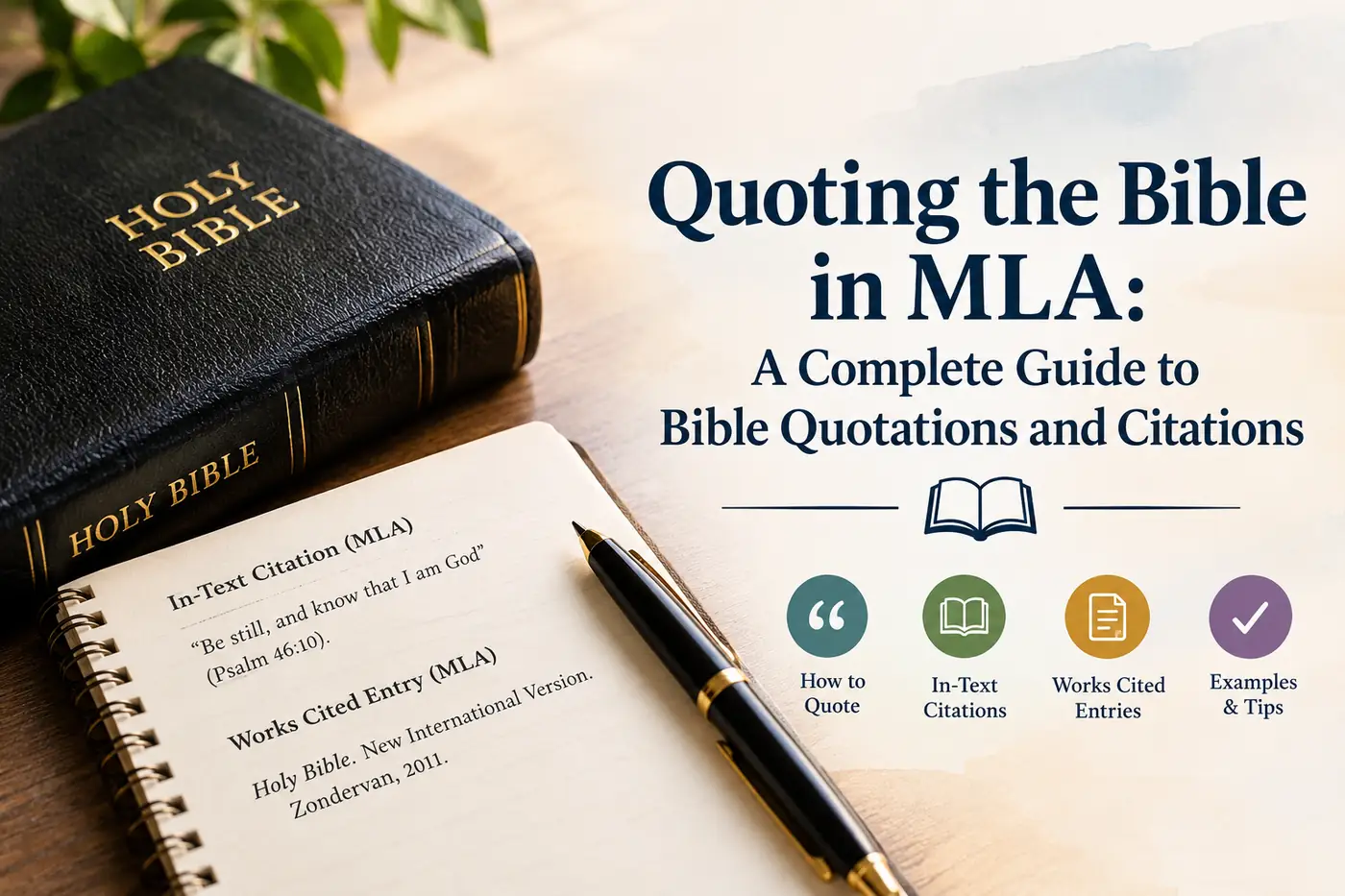
Quoting the Bible in MLA: A Complete Guide to Bible Quotations and Citations
Quoting the Bible in an academic paper can look confusing, especially if you’re used to citing ordinary books with an author’s last name and a page number. The Bible works a little differently.
If you’re writing a literature essay, theology assignment, religious studies paper, research project, or any other academic document that requires MLA style, you need to know how to identify biblical passages correctly.
The basic idea is actually quite simple.
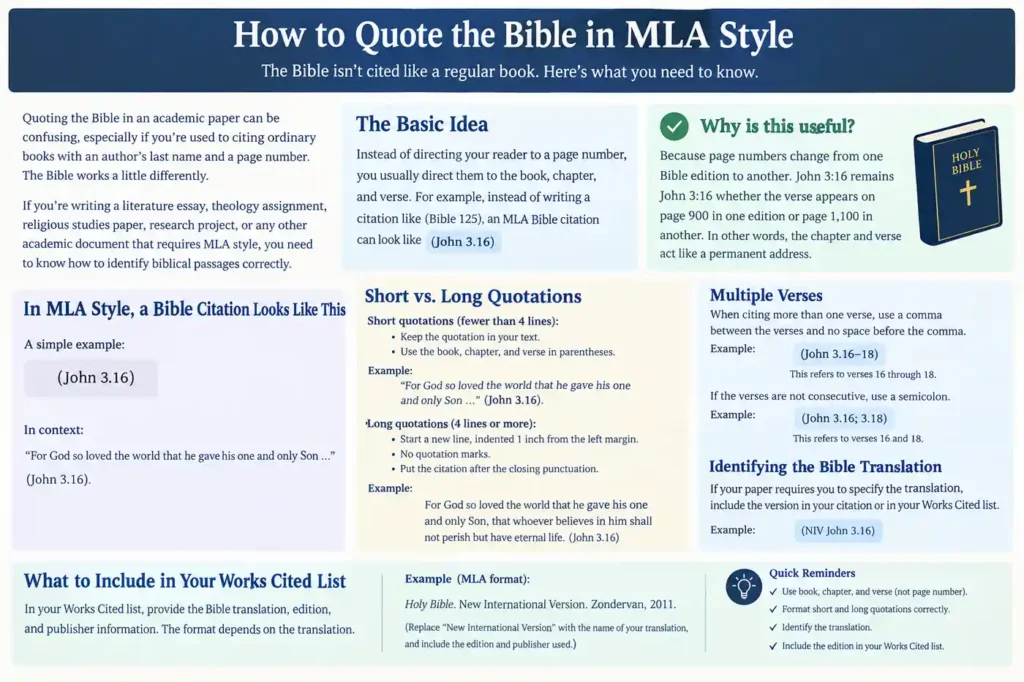
Instead of directing your reader to a page number, you usually direct them to the book, chapter, and verse. For example, instead of writing a citation like (Bible 125), an MLA Bible citation can look like (John 3.16).
Why is this useful?
Because page numbers change from one Bible edition to another. John 3:16 remains John 3:16 whether the verse appears on page 900 in one edition or page 1,100 in another.
In other words, the chapter and verse act like a permanent address.
| Main Intent / Question People Search For | What the Article Should Answer | Example / Key Information |
|---|---|---|
| How do you quote the Bible in MLA? | Explain the basic MLA format for directly quoting Scripture. | “The Lord is my shepherd” (Ps. 23.1). |
| How do you cite a Bible verse in MLA? | Show readers how to cite the biblical book, chapter, and verse. | (John 3.16) |
| How do you cite Bible verses in-text in MLA? | Explain the parenthetical citation format. | (Rom. 8.28) |
| Does MLA use a colon or period between chapter and verse? | Answer one of the most common formatting questions directly. | MLA: (John 3.16), not (John 3:16). |
| How do you cite the Bible in MLA Works Cited? | Explain how to document the specific Bible edition or translation. | The Bible. Authorized King James Version, Publisher, Year. |
| Do you italicize the Bible in MLA? | Explain the difference between referring to the Bible generally and naming a specific published edition. | “the Bible” vs. The New Jerusalem Bible |
| Do you put Bible verses in quotation marks in MLA? | Explain formatting for short direct quotations. | “Be still, and know that I am God” (Ps. 46.10). |
| How do you cite a Bible translation in MLA? | Explain when and how to identify KJV, NIV, NRSV, ESV, etc. | Identify the translation when it is relevant to the discussion. |
| How do you cite multiple Bible verses in MLA? | Show how to cite consecutive verses and verse ranges. | (Rom. 8.38–39) |
| How do you quote a long Bible passage in MLA? | Explain when a Bible quotation should become a block quotation. | Long passages are formatted as block quotations. |
| How do you paraphrase the Bible in MLA? | Explain that paraphrased biblical ideas still require a citation. | Paul encourages believers to overcome evil with good (Rom. 12.21). |
| How do you cite the King James Bible in MLA? | Give a practical KJV example for students. | “The Lord is my shepherd” (Ps. 23.1). |
| How do you cite the NIV Bible in MLA? | Explain how to document and identify the NIV when used. | Identify the New International Version when relevant. |
| How do you cite the NRSV Bible in MLA? | Give an example involving the New Revised Standard Version. | Include the specific edition in Works Cited. |
| How do you cite an online Bible in MLA? | Explain how online Bible sources differ from printed editions. | Identify the translation, website, and relevant publication/location details. |
| How do you cite a Bible app in MLA? | Explain how to handle Bible apps containing multiple translations. | Specify which Bible translation you actually used. |
| Do you use page numbers when citing the Bible in MLA? | Answer whether page numbers are necessary. | Biblical passages are normally identified by book, chapter, and verse. |
| How do you abbreviate Bible books in MLA? | Provide common MLA abbreviations for biblical books. | Genesis → Gen.; Matthew → Matt.; Romans → Rom. |
| How do you cite 1 Corinthians in MLA? | Explain citations for numbered Bible books. | (1 Cor. 13.4–7) |
| How do you cite two different Bible translations in MLA? | Explain how to distinguish translations when comparing them. | Identify each translation clearly when wording matters. |
| What is the correct MLA Bible citation format? | Give readers a quick formula they can remember. | (Book chapter.verse) |
| What is the difference between a Bible quotation and citation? | Clarify that the quotation is the borrowed text while the citation identifies its location. | “The Lord is my shepherd” = quotation; (Ps. 23.1) = citation. |
| What are the common mistakes when citing the Bible in MLA? | Help readers avoid frequent formatting errors. | Using (John 3:16), forgetting the translation, or using unnecessary page numbers. |
| How do I cite Scripture in an academic paper? | Give a complete, practical process from quotation to Works Cited. | Quote → identify passage → cite book/chapter/verse → document edition. |
| What is the easiest way to remember Bible citations in MLA? | Provide a simple takeaway for readers who want a quick answer. | Bible quote + (Book chapter.verse) |
However, there are still several details you need to get right. You need to understand how to format short and long quotations, how to identify the Bible translation, how to handle multiple verses, and how to document the edition in your Works Cited list.
Let’s go through the process step by step.
Why Is Quoting the Bible in MLA Different?
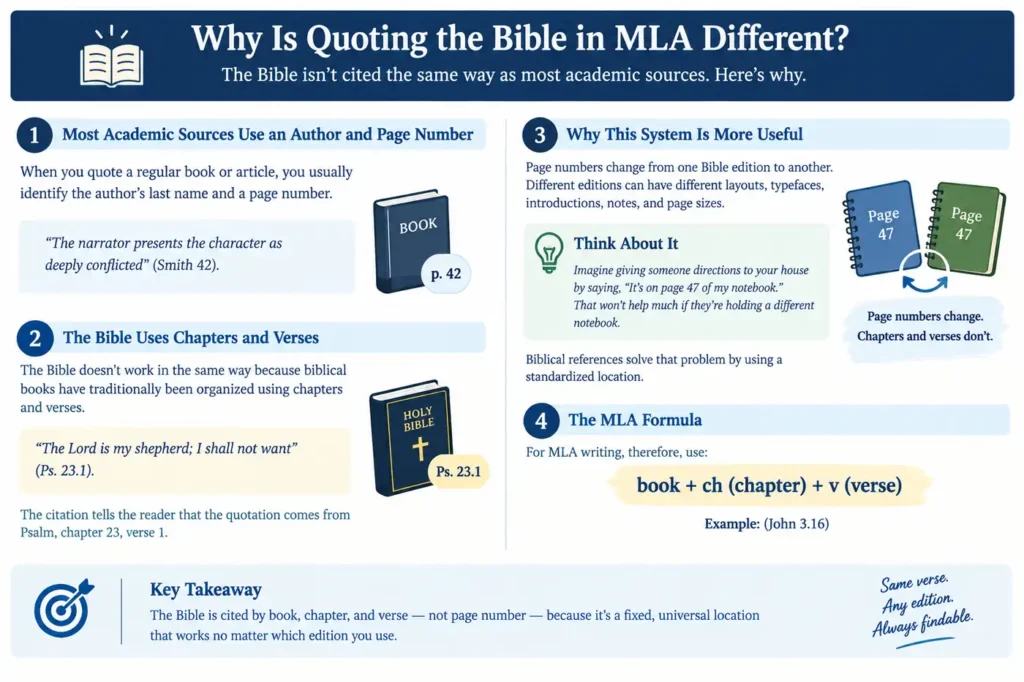
Most academic sources are identified through an author’s name and a page number.
For example:
“The narrator presents the character as deeply conflicted” (Smith 42).
The Bible doesn’t work in exactly the same way because biblical books have traditionally been organized using chapters and verses.
Consider this example:
“The Lord is my shepherd; I shall not want” (Ps. 23.1).
The citation tells the reader that the quotation comes from Psalm, chapter 23, verse 1.
This system is much more useful than a page number because Bible editions can have different layouts, typefaces, introductions, notes, and page sizes.
Imagine giving someone directions to your house by saying, “It’s on page 47 of my notebook.” That won’t help much if they’re holding a different notebook.
Biblical references solve that problem by using a standardized location.
For MLA writing, therefore, book + chapter + verse is the key structure you need to understand.
What Information Do You Need to Cite the Bible in MLA?
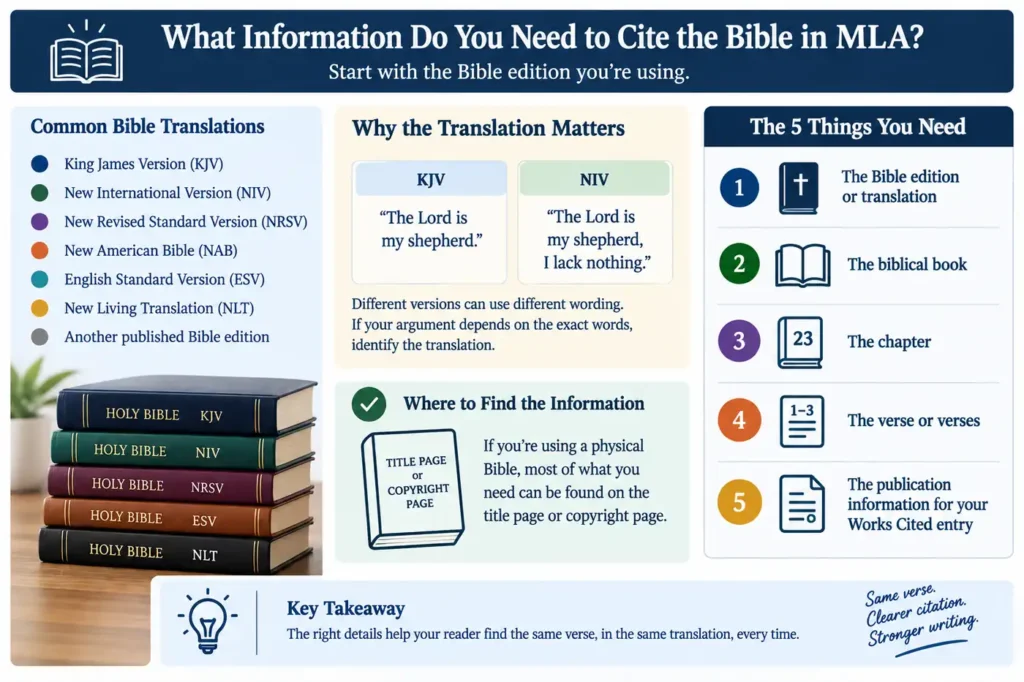
Before you start writing, identify the Bible edition you are actually using.
You may be working with:
- The King James Version
- The New International Version
- The New Revised Standard Version
- The New American Bible
- The English Standard Version
- The New Living Translation
- Another published Bible edition
The translation matters because different versions can use significantly different wording.
For example, one translation might say:
“The Lord is my shepherd”
while another might use slightly different language.
If your argument depends on the precise wording of a verse, identifying the translation becomes especially important.
You should therefore know:
- The Bible edition or translation
- The biblical book
- The chapter
- The verse or verses
- The publication information needed for your Works Cited entry
If you’re using a physical Bible, much of this information can be found on the title page or copyright page.
How to Quote the Bible in MLA
Quoting Scripture in MLA follows the same basic principle as quoting other written sources: introduce the quotation, reproduce the original wording accurately, and provide a citation.
For example:
In Psalm 23, the speaker describes God as a shepherd who provides protection and guidance: “The Lord is my shepherd; I shall not want” (Ps. 23.1).
This example works well because the quotation doesn’t simply appear out of nowhere.
The writer explains what the passage is doing and then uses the quotation as evidence.
Introduce the Biblical Passage
Whenever possible, give your reader some context before presenting a Bible verse.
Instead of writing:
“Be still, and know that I am God” (Ps. 46.10).
You could write:
Psalm 46 emphasizes trust in God’s power by instructing believers to “be still, and know that I am God” (Ps. 46.10).
The second version is stronger academically because the quotation is connected to an idea.
Remember, your paper should not become a collection of Bible verses. The quotations should support your argument and analysis.
Use Quotation Marks for Short Bible Quotes
If you’re incorporating a relatively short biblical quotation into your own sentence, place the quoted words inside quotation marks.
For example:
Paul reminds the Galatians that “faith worketh by love” (Gal. 5.6).
The quotation marks make it immediately clear which words come directly from the biblical text.
Don’t forget that changing even a few words can alter the meaning of Scripture. Copy the passage carefully and check the punctuation and wording against the edition you’re using.
Include the Book, Chapter, and Verse
After the quotation, provide the relevant biblical location.
For example:
“For we walk by faith, not by sight” (2 Cor. 5.7).
Here:
- 2 Cor. identifies Second Corinthians.
- 5 identifies chapter 5.
- 7 identifies verse 7.
The citation gives your reader a precise location.
How to Cite Bible Verses in MLA In-Text
The standard approach is to identify the biblical book followed by the chapter and verse.
For example:
“The truth shall make you free” (John 8.32).
One important point is the punctuation between the chapter and verse.
In MLA style, biblical references generally use a period rather than a colon.
So you would write:
(John 3.16)
rather than:
(John 3:16)
The colon format is extremely common in religious writing, so this is one of the easiest MLA details to accidentally overlook.
When you’re specifically writing according to MLA style, remember:
Book + chapter.verse
For example:
(Rom. 8.28)
(Ps. 119.105)
(Matt. 5.9)
(Phil. 4.13)
How MLA Formats Bible Chapter and Verse Numbers
The chapter and verse numbers should clearly identify the location of the passage.
For a single verse:
(John 1.1)
For a consecutive range of verses:
(John 1.1–5)
For another example:
(Rom. 8.38–39)
The en dash indicates a range.
When you’re quoting multiple passages that aren’t consecutive, the references can be separated appropriately according to the context.
The goal is always the same: make the exact location easy for your reader to understand.
How to Abbreviate Bible Books in MLA
Bible book names can be abbreviated in parenthetical citations.
Some common examples include:
- Genesis → Gen.
- Exodus → Exod.
- Leviticus → Lev.
- Numbers → Num.
- Deuteronomy → Deut.
- Psalms → Ps.
- Proverbs → Prov.
- Isaiah → Isa.
- Matthew → Matt.
- Mark → Mark
- Luke → Luke
- John → John
- Romans → Rom.
- Galatians → Gal.
- Philippians → Phil.
- Hebrews → Heb.
- Revelation → Rev.
Books with numbers should retain their numbers.
For example:
(1 Cor. 13.4–7)
(2 Tim. 3.16)
(1 Pet. 5.7)
Don’t randomly create your own abbreviations. Consistency matters throughout the paper.
How to Quote Multiple Bible Verses in MLA
Sometimes one verse doesn’t provide enough evidence for your argument.
You might need to quote two, three, or several consecutive verses.
For example:
The psalmist expresses confidence in God’s protection: “The Lord is my light and my salvation; whom shall I fear?” (Ps. 27.1).
If you’re quoting several consecutive verses, identify the range:
(Ps. 27.1–3)
You can also discuss multiple verses in your own words:
The passage presents God as a source of protection and strength (Ps. 27.1–3).
Don’t feel obligated to quote every verse word for word. Sometimes summarizing the passage and citing its location creates a much cleaner paragraph.
How to Quote a Long Bible Passage in MLA
What happens when the passage you’re quoting is several lines long?
This is where block quotations become useful.
MLA uses block-quotation formatting for sufficiently long prose quotations. Instead of putting the entire passage inside ordinary quotation marks, you set the quotation apart from your main paragraph.
For example:
The Lord is my shepherd; I shall not want.
He maketh me to lie down in green pastures:
he leadeth me beside the still waters.
He restoreth my soul.
(Ps. 23.1–3)
Your exact formatting should follow MLA’s general rules for block quotations, including indentation and punctuation.
A long passage should visually stand apart from your own writing.
More importantly, don’t use a long quotation simply because you can. Ask yourself: Does every sentence help prove my point?
If not, quote only the section you actually need.
How to Paraphrase the Bible in MLA
You don’t always have to quote Scripture word for word.
Paraphrasing can be more effective when you’re explaining the meaning of a passage.
For example:
Paul encourages Christians to respond to wrongdoing with goodness instead of seeking revenge (Rom. 12.19–21).
This sentence summarizes the biblical teaching without reproducing the original passage.
Notice that the citation is still necessary.
Paraphrasing doesn’t mean the idea suddenly becomes your own. You’re still drawing information or ideas from Scripture.
A good academic paper often combines:
- Direct quotations
- Paraphrases
- Summaries
- Your own interpretation
Think of quotations as ingredients rather than the entire meal. Your analysis is what brings everything together.
How to Cite the Bible in a Works Cited Page
Your in-text citation and Works Cited entry work together.
When you use a particular published Bible edition, the edition should be represented appropriately in your Works Cited list.
For example, a published Bible edition might appear in a structure like:
The Bible. Authorized King James Version, Oxford UP, 1998.
The exact Works Cited entry depends on the edition you actually used.
Don’t guess the publisher or publication date.
If you’re using a physical Bible, check the title page and copyright information.
If you’re using an online edition, use the bibliographic information associated with that source.
This is particularly important because there isn’t one single “Bible” edition. There are many translations and published editions, and MLA documentation should identify the particular source you consulted.
Examples of Bible Citations in MLA
Let’s look at some practical examples.
King James Version Example
Suppose you’re using the King James Version and quoting Psalm 23.
You could write:
David presents God as a provider and protector when he declares, “The Lord is my shepherd; I shall not want” (Ps. 23.1).
The parenthetical citation identifies the precise location.
A Works Cited entry for a particular published KJV edition would depend on the edition’s publication details.
New International Version Example
Suppose your paper uses the New International Version.
You might write:
The passage emphasizes God’s faithfulness by describing the Lord as one who “will sustain” his people (Ps. 55.22).
The wording should always be checked against the exact translation you’re using.
Don’t assume that a verse’s wording is identical across translations.
New Revised Standard Version Example
If you’re working with the New Revised Standard Version, you might write:
Paul describes love through qualities such as patience and kindness (1 Cor. 13.4).
Again, the biblical location is what helps your reader find the passage.
If the specific translation affects your interpretation, clearly identify the version you’re discussing.
How to Cite the Bible When You Mention the Translation
Sometimes you should mention the translation directly in your sentence.
For example:
In the King James Version, Psalm 23 begins, “The Lord is my shepherd; I shall not want” (Ps. 23.1).
This approach is particularly useful when comparing translations.
Suppose your paper is analyzing how different English translations render a particular Hebrew or Greek concept. In that case, the translation isn’t background information. It’s part of your evidence.
You might write:
The King James Version uses one expression for the passage, while another modern translation uses noticeably different wording.
This makes the reader aware that the wording you’re analyzing belongs to a particular translation.
How to Cite Different Bible Translations in One Paper
Using multiple Bible translations requires extra care.
Imagine you’re comparing the King James Version and the New International Version.
You might write:
The King James Version describes the speaker as having “no lack,” while the modern translation uses a different expression (Ps. 23.1).
If the difference in wording matters to your argument, identify the translation every time necessary.
Otherwise, your reader might reasonably wonder why the wording changes from one quotation to another.
A good rule is simple:
When the translation matters, name it.
This is especially important for papers discussing:
- Biblical translation
- Word choice
- Literary style
- Theology
- Interpretation
- Historical language
- Differences between Bible versions
How to Cite an Online Bible in MLA
Today, many students read Scripture online rather than from a printed Bible.
That’s completely normal.
However, your citation should reflect the source you actually consulted.
If you used an online Bible, determine:
- The Bible translation
- The title of the online source
- The website or platform
- Relevant publication information
- The URL or other location information required by your citation
The exact Works Cited format depends on the online source.
Don’t cite a physical Bible edition simply because it is easier if you actually obtained the quotation from an online version.
Your documentation should accurately represent your research process.
How to Cite a Bible App in MLA
Bible apps can be slightly more complicated because one application may contain dozens of translations.
For example, you might open the same app and switch between the King James Version, New International Version, English Standard Version, and other translations.
If you’re quoting Scripture from an app, determine exactly which translation you used.
This becomes particularly important when comparing wording.
For example:
The wording of the passage differs significantly between the two translations (Matt. 5.44).
You should then make it clear which version produced each quotation.
Don’t simply cite the app and leave your reader guessing which Bible translation you used.
Common Mistakes When Quoting the Bible in MLA
Bible citations are often short, but small mistakes can still create problems.
Here are some of the most common errors.
Using a Colon Instead of a Period
Students often write:
(John 3:16)
because that format is widely used.
For MLA, use:
(John 3.16)
Using Page Numbers Instead of Biblical References
Avoid relying on:
(Bible 250)
when the passage can be identified by book, chapter, and verse.
Forgetting the Translation
If you’re comparing translations or analyzing wording, failing to identify the version can make your argument unclear.
Forgetting the Works Cited Entry
An in-text citation is only one part of MLA documentation.
Make sure the relevant Bible edition is properly documented when required.
Changing the Biblical Wording
Never casually rewrite a quotation while presenting it as a direct quote.
If you need to change something for grammatical reasons, follow MLA conventions for indicating alterations.
Quoting Too Much
A page full of Scripture with only two sentences of your own analysis isn’t necessarily a strong academic paper.
Use Scripture as evidence, then explain why that evidence matters.
Mixing Citation Styles
Don’t use MLA punctuation in one citation and another style throughout the rest of the paper.
Choose the required style and remain consistent.
Do You Italicize the Bible in MLA?
Not every reference to the Bible should automatically be italicized.
There’s an important difference between referring generally to the Bible and citing the title of a specific published edition.
For example:
The Bible contains numerous literary genres.
Here, “Bible” is being used as the general name of a sacred text.
But a specific published edition has a title that follows MLA’s rules for titles of works.
For example:
The New Jerusalem Bible
The same principle applies to other published Bible editions.
The key is to distinguish between general references to Scripture and titles of specific published editions.
Do You Put Bible Verses in Quotation Marks?
Yes, short Bible passages that you directly incorporate into your sentence should generally be enclosed in quotation marks.
For example:
Jesus teaches his followers to “love your enemies” (Matt. 5.44).
The quotation marks identify the exact words taken from the source.
For a longer passage formatted as a block quotation, don’t surround the entire block with ordinary quotation marks. Instead, follow MLA’s block-quotation formatting rules.
The length of the quotation determines the formatting approach.
How to Punctuate Bible Quotations in MLA
Punctuation can become confusing when you combine a quotation with a parenthetical citation.
For example:
“The Lord is my shepherd” (Ps. 23.1).
The citation follows the quotation.
When you’re incorporating the quotation into a larger sentence, make sure the sentence remains grammatically complete.
For example:
Psalm 23 presents God as a shepherd who provides for his people, stating that “the Lord is my shepherd” (Ps. 23.1).
The quotation is integrated naturally into the sentence rather than being placed randomly between unrelated statements.
Also pay attention to the punctuation inside the original quotation. If you’re reproducing biblical wording exactly, preserve the wording and punctuation according to the edition you’re using, while applying the necessary MLA conventions around the quotation.
A Simple Formula for MLA Bible Citations
If you want an easy formula to remember, use:
“Bible quotation” (Book chapter.verse).
For example:
“Be still, and know that I am God” (Ps. 46.10).
For several consecutive verses:
“Bible quotation” (Book chapter.verse–verse).
For example:
“Bible quotation” (Rom. 8.38–39).
If you’ve already established the biblical book and chapter in your sentence, a shorter reference may sometimes be appropriate depending on the context.
The most important thing is that your reader can easily identify the passage.
Final Checklist for Quoting the Bible in MLA
Before submitting your paper, review every Bible quotation.
Ask yourself:
- Did I quote the passage accurately?
- Did I identify the correct Bible translation?
- Did I identify the biblical book?
- Did I include the chapter?
- Did I include the verse?
- Did I use a period between chapter and verse?
- Did I use quotation marks for short quotations?
- Did I format long quotations as block quotations when appropriate?
- Did I use verse ranges correctly?
- Did I distinguish different translations?
- Did I document the Bible edition in Works Cited where required?
- Did I avoid unnecessary page numbers?
- Did I keep my citation style consistent?
- Did I explain the quotation rather than simply dropping it into the paragraph?
This final check can make a surprisingly big difference.
Many citation errors aren’t caused by complicated research. They’re caused by small formatting details that writers overlook during the final editing stage.
Conclusion
Quoting the Bible in MLA doesn’t have to be complicated. Once you understand the basic system, the process becomes much more straightforward. The most important thing to remember is that biblical passages are normally identified by their book, chapter, and verse, rather than by ordinary page numbers. For example, a citation such as (John 3.16) gives your reader a precise location within Scripture.
For short quotations, incorporate the biblical words naturally into your sentence and place them in quotation marks. For longer passages, use MLA’s block-quotation format. If you paraphrase Scripture, cite the passage just as you would when using a direct quotation. And whenever the Bible translation matters to your discussion, make the version clear so your reader knows exactly which wording you’re analyzing.
Ultimately, good Bible citation is about more than following punctuation rules. It is about making your academic writing transparent and easy to verify. When your reader can move smoothly from your quotation to the exact biblical passage you used, your research becomes clearer, more credible, and more professional.
Frequently Asked Questions About Quoting the Bible in MLA
1. How do you quote the Bible in MLA?
For a short quotation, place the biblical words inside quotation marks and provide the book, chapter, and verse in parentheses.
Example:
“The Lord is my shepherd” (Ps. 23.1).
2. Does MLA use a colon between the Bible chapter and verse?
No. MLA generally uses a period between the chapter and verse.
Write:
(John 3.16)
rather than:
(John 3:16)
3. Do I need to cite the Bible in an MLA paper?
Yes. If you directly quote, paraphrase, or summarize Scripture, you should identify the biblical passage and provide appropriate documentation.
4. Do Bible verses need quotation marks in MLA?
Short direct quotations should use quotation marks when incorporated into your own sentence. Longer passages should be formatted as block quotations according to MLA rules.
5. Do I italicize the Bible in MLA?
A general reference to “the Bible” isn’t automatically italicized. However, the title of a specific published Bible edition is treated as the title of a published work.
6. Should I use page numbers when citing the Bible?
Usually, you should identify biblical passages using the book, chapter, and verse. Page numbers can vary considerably between Bible editions, while chapter and verse references remain stable.
7. How do I cite several Bible verses together?
For consecutive verses, use a verse range.
For example:
(Rom. 8.38–39)
Make sure the range accurately represents the passage you are discussing.
8. How do I cite different Bible translations in the same paper?
Clearly identify the translations when necessary, particularly when comparing their wording. Your reader should be able to tell which translation each quotation comes from.
9. How do I cite an online Bible in MLA?
Identify the specific online Bible source and translation you consulted, then provide the relevant information required for an MLA Works Cited entry. Your citation should reflect the actual source you used.
10. What is the easiest way to remember MLA Bible citation format?
Remember this simple pattern:
“Bible quotation” (Book chapter.verse).
For example:
“Be still, and know that I am God” (Ps. 46.10).
Once you remember book + chapter + verse, most basic Bible citations in MLA become much easier.