Short Bible Quotes
Some of the most powerful words ever written fit in a single line. Short Bible quotes — the kind you can carry in your pocket, ink on your wrist, or press into a card — have guided people through grief, anchored them during doubt, and marked the most meaningful moments of their lives. Whether you’re searching for the right verse for a tattoo, a wedding inscription, an Instagram caption, or a morning journaling habit, this guide was built to help you choose wisely.

What most quote lists skip is the hard part: what a verse actually means in context, how it changes across translations, and whether the version you’re looking at fits the space or format you need. This resource covers all of it — with translation comparisons, character-count metrics, design frameworks, and honest context notes for every category.
Short Bible Quotes About Life: Concise Verses for Everyday Strength

Short Bible quotes about life occupy a unique space in scripture — they are brief enough to memorize in a morning but deep enough to sustain a person through a hard week. The challenge is choosing verses that hold their meaning when lifted out of their original context, which is exactly where most quote collections fail.
The verses below are selected for daily resilience use: morning habit reinforcement, stress management, and journaling. But before you commit any of them to a card, caption, or permanent design, the Translation Alignment Matrix below shows how much phrasing varies between the four translations most widely used for short-quote purposes.
Translation Alignment Matrix: Short Bible Quotes About Life
What this table shows: Four major translations of eight frequently used life-category verses, ranked by character count (spaces included). Use this to choose the version that fits your medium — print, tattoo, or digital — without losing the verse’s core meaning.
| Verse Reference | KJV | NIV | ESV | NLT | Shortest Version | Context Alert |
|---|---|---|---|---|---|---|
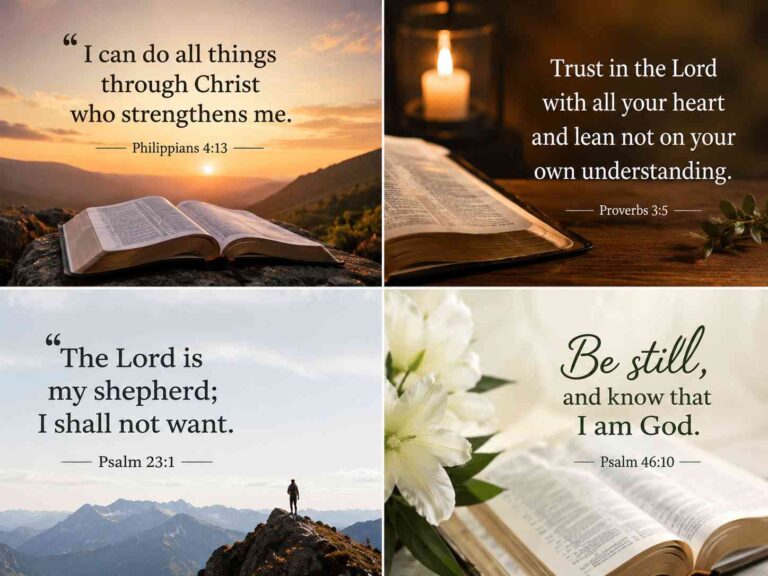
| Philippians 4:13 | “I can do all things through Christ which strengtheneth me.” (54 chars) | “I can do all this through him who gives me strength.” (52 chars) | “I can do all things through him who strengthens me.” (51 chars) | “For I can do everything through Christ, who gives me strength.” (62 chars) | ESV | Context: Paul writing from prison about contentment — not athletic achievement |
| Jeremiah 29:11 | “For I know the thoughts that I think toward you…” (long) | “For I know the plans I have for you…” (37 chars, truncated) | “For I know the plans I have for you, declares the Lord…” (57 chars) | “For I know the plans I have for you…” (38 chars) | NIV (truncated) | Context: Written to exiles in Babylon — a promise of eventual restoration, not immediate blessing |
| Proverbs 3:5 | “Trust in the LORD with all thine heart…” (42 chars) | “Trust in the LORD with all your heart…” (41 chars) | “Trust in the LORD with all your heart…” (41 chars) | “Trust in the LORD with all your heart…” (41 chars) | NIV/ESV/NLT tie | Context: Follows a command to avoid relying on personal wisdom — the “lean not” continuation matters |
| Romans 8:28 | “And we know that all things work together for good to them that love God.” (73 chars) | “And we know that in all things God works for the good of those who love him.” (75 chars) | “And we know that for those who love God all things work together for good.” (73 chars) | “And we know that God causes everything to work together for the good of those who love God.” (90 chars) | KJV/ESV | Context: “Good” here refers to conformity to Christ’s image — not personal comfort |
| John 8:32 | “And ye shall know the truth, and the truth shall make you free.” (63 chars) | “Then you will know the truth, and the truth will set you free.” (62 chars) | “And you will know the truth, and the truth will set you free.” (61 chars) | “And you will know the truth, and the truth will set you free.” (61 chars) | ESV/NLT tie | Context: Spoken to those who believed — conditional on continuing in Jesus’s teaching |
| Isaiah 40:31 | “But they that wait upon the LORD shall renew their strength.” (60 chars) | “But those who hope in the LORD will renew their strength.” (57 chars) | “But they who wait for the LORD shall renew their strength.” (58 chars) | “But those who trust in the LORD will find new strength.” (55 chars) | NLT | Context: “Wait” implies active trust, not passive inaction |
| Psalm 46:10 | “Be still, and know that I am God.” (34 chars) | “Be still, and know that I am God.” (34 chars) | “Be still, and know that I am God.” (34 chars) | “Be still, and know that I am God.” (34 chars) | All identical | Context: Spoken in the middle of a cosmic battle scene — stillness here is confident trust, not peaceful calm |
| Matthew 6:34 | “Take therefore no thought for the morrow.” (42 chars) | “Therefore do not worry about tomorrow.” (39 chars) | “Therefore do not be anxious about tomorrow.” (44 chars) | “So don’t worry about tomorrow.” (31 chars) | NLT | Context: Part of the Sermon on the Mount — not permission to ignore planning |
Context preservation note: Several of the most popular short Bible quotes about life carry a meaning in isolation that subtly differs from their intended meaning. Jeremiah 29:11, for instance, was written to a community facing 70 years of exile — the “plans for a future and hope” were generational, not individual. This does not make the verse inappropriate for personal use. It means the reader benefits from knowing the full weight behind it.
Quick Inspirational Quotes for Daily Journaling

Short inspirational Bible quotes earn their place in daily journaling not because they are easy, but because a short verse repeated consistently rewires how you interpret your day. Research in cognitive-behavioral practices consistently shows that short, memorized affirmations — particularly those tied to a belief system — reduce anxiety responses when encountered in stressful moments. Scripture works the same way, with the added weight of historic and communal meaning.
The five verses below are selected specifically for journaling use, meaning they are concise enough to write at the top of a page, open-ended enough to prompt reflection, and contextually stable enough to use daily without distortion.
Psalm 46:10 — “Be still, and know that I am God.” 34 characters. Works in every translation. Best used as a morning grounding prompt before writing. The full context is a battle psalm — the stillness is defiant rest, not passive withdrawal. Write it at the top of a page when the day ahead feels overwhelming.
Proverbs 3:5 — “Trust in the LORD with all your heart.” 41 characters in NIV/ESV/NLT. Pairs naturally with a prompt like: “Where am I relying on my own understanding today?” The second half of the verse (“lean not on your own understanding”) is worth including in the journal entry even if you only quote the first.
Isaiah 40:31 — “Those who hope in the LORD will renew their strength.” NLT version: 55 characters. The word “renew” (Hebrew: chalaph) carries the sense of exchanging old strength for new — not recovering from exhaustion, but receiving a different kind of power. This precision matters for journaling: you are not asking to recover; you are asking to be replaced.
Romans 8:28 — “All things work together for good for those who love God.” Journaling prompt: What situation feels most outside of God’s reach right now? The verse does not promise all things feel good — it promises they work toward it. That distinction is worth exploring on paper.
Philippians 4:13 — “I can do all things through Christ who strengthens me.” ESV version: 51 characters. Context note: Paul wrote this after learning contentment in both abundance and need. For journaling, the prompt is not “what hard thing do I need to accomplish today” but “what do I need to be content with today?”
Each of these short inspirational Bible quotes functions best when the journaling entry unpacks rather than just copies the verse. Write it. Then write why it matters today. The verse is a door — the journal entry walks through it.
Inspiring Bible Quotes for Habit Building
The mechanics of habit building and the logic of short inspiring Bible quotes overlap more than most people recognize. Habit formation research consistently identifies three elements: a cue, a routine, and a reward. A verse assigned to a specific daily cue — waking, eating, commuting — functions as a cognitive anchor that reinforces the routine and signals the reward (clarity, peace, direction).
The five-verse habit stack:
Morning cue — Lamentations 3:22–23: “His mercies are new every morning.” This is the most psychologically potent morning verse in scripture because it resets the previous day completely. 37 characters in ESV. Place it where you see it first — phone lock screen, bathroom mirror, journal cover.
Work cue — Colossians 3:23: “Whatever you do, work at it with all your heart, as working for the Lord.” NIV. 71 characters. This verse removes the hierarchy between important and trivial tasks — every task receives full effort.
Stress interrupt — John 14:27: “Peace I leave with you; my peace I give you.” ESV. 44 characters. Use this as an interrupt: when anxiety spikes, the verse is the cue to pause and breathe. The peace referenced is distinct from worldly peace — it coexists with difficult circumstances.
Evening reflection — Psalm 4:8: “In peace I will lie down and sleep.” ESV. 34 characters. Brief, specific, and physiologically grounding. Used as a sleep cue, it signals the day is complete.
Weekly reset — Psalm 37:4: “Delight yourself in the LORD, and he will give you the desires of your heart.” ESV. 74 characters. Best used on Sunday or the first day of your week as a directional reset — what desires are you bringing into this week?
The practical implementation: assign one verse per habit trigger. Write it on an index card and place it at the trigger location for 30 days. After 30 days, the verse and the habit are cognitively linked.
Best Short Bible Quotes for Tattoos: Minimalist Typographic Layouts
Short Bible quotes for tattoos require a completely different kind of evaluation than quotes for social media or journaling. The medium is permanent, the canvas is finite, and the rendering conditions — skin texture, hair, muscle movement, aging — are unforgiving. Most tattoo quote guides skip all of this and list the same ten verses without any practical design guidance. This section covers what they miss.
The four variables that determine whether a short Bible tattoo quote succeeds or fails are: character count, placement area, font point size, and translation choice. They interact. A verse that works beautifully at 14pt on a forearm may become illegible at 8pt on a wrist. The matrix below maps all four variables across the most popular short Bible tattoo quotes.
Typographic Character & Spatial Matrix: Short Bible Quotes for Tattoos
What this table shows: Character counts, minimum recommended font sizes, ideal placement areas, and translation selection guidance for 10 popular Bible tattoo quotes. Use this before your consultation with a tattoo artist.
| Verse | Best Translation | Character Count | Min Font Size | Primary Placement | Secondary Placement | Legibility Risk | Notes |
|---|---|---|---|---|---|---|---|
| Psalm 46:10 “Be still, and know that I am God.” | Any (identical) | 34 | 10pt | Inner forearm | Collarbone | Low | Ideal starter verse — short, stable across all translations |
| John 3:16 (partial) “God so loved the world.” | ESV | 22 | 9pt | Wrist | Finger | Low | Verify artist understands this is a partial — citation still needed |
| Philippians 4:13 “I can do all things through him who strengthens me.” | ESV | 51 | 11pt | Outer forearm | Ribcage | Medium | Older KJV “which strengtheneth me” reads archaic at small sizes |
| Romans 8:28 “All things work together for good.” | KJV (truncated) | 35 | 10pt | Inner bicep | Spine | Low | Truncation changes meaning — include full citation |
| Isaiah 41:10 “Fear not, for I am with you.” | ESV | 28 | 9pt | Wrist | Behind ear | Low | One of the shortest contextually complete fragments |
| Jeremiah 29:11 “Plans to prosper you and not to harm you.” | NIV (partial) | 41 | 10pt | Inner forearm | Sternum | Medium | Full verse is 75+ chars — this fragment loses the source/speaker |
| Matthew 5:16 “Let your light shine.” | ESV (partial) | 20 | 8pt | Finger | Wrist | Low–Medium | Extremely short; risks fading at finger placement |
| Proverbs 31:25 “She is clothed with strength and dignity.” | ESV | 39 | 10pt | Shoulder blade | Ribcage | Low | Most popular among women; ESV preferred for clarity |
| John 14:6 “I am the way, the truth, and the life.” | ESV/NIV | 38 | 10pt | Forearm | Chest | Low | Theologically dense — full verse preferred over partial |
| 2 Timothy 1:7 “God has not given us a spirit of fear.” | NKJV | 37 | 10pt | Inner wrist | Collarbone | Low | NKJV preferred — KJV “hath not given” feels dated at small sizes |
Real-world tattoo design guidance: The single most common mistake in Bible quote tattoos is choosing a verse without verifying its character count against the planned placement area. A professional tattoo artist can execute almost any verse beautifully — but only if the character count matches the available skin real estate. Before your consultation, measure the placement area with a soft tape measure, then calculate: at 10pt font, most sans-serif fonts require approximately 6–7pt of horizontal space per character. A 40-character verse at 10pt needs roughly 240–280pt (about 3.3–3.9 inches) of uninterrupted horizontal space.
The second most common mistake is selecting a translation purely for familiarity. The KJV is the most recognized, but archaic word endings (“strengtheneth,” “hath,” “thine”) render awkwardly at small tattoo sizes and appear dated to most modern readers. For tattoo use specifically, ESV and NIV consistently produce the cleanest typographic results because their phrasing is modern without sacrificing precision.
Clean Phrasing Choices for Minimalist Thin-Line Text
Short Bible tattoo quotes executed in thin-line minimalist style — the dominant aesthetic in contemporary tattoo culture — have specific phrasing requirements that bold or traditional styles do not. Thin-line text relies on negative space and letter clarity. Certain letter forms (particularly lowercase ‘a’, ‘e’, and ‘g’ in serif fonts) become visually muddy below 9pt in thin-line execution. Certain words create visual congestion when their letters have similar heights.
The minimalist Bible tattoo word-weight test: Before finalizing a verse, type it in your chosen font at the exact point size your artist recommends, print it at actual scale, and examine it from 18 inches. If you cannot read every word clearly, the verse, the font, or the size needs to change.
Top phrasing choices for thin-line minimalist execution:
“Be still.” — Psalm 46:10 (partial) — 9 characters. The most radical abbreviation in this list and the most visually powerful. Works as a two-word finger or wrist tattoo. The citation beneath it (Ps 46:10) adds 7 characters and anchors the reference.
“Fear not.” — Isaiah 41:10 (partial) — 9 characters. Same character count as “Be still.” One of the most repeated commands in scripture. The brevity carries the authority.
“It is finished.” — John 19:30 — 14 characters. Christ’s final words. Theologically precise, visually clean, and one of the most emotionally resonant short Bible tattoo quotes available. Ideal for inner wrist or collarbone in thin-line sans-serif.
“Grace upon grace.” — John 1:16 (ESV) — 17 characters. Architecturally balanced — two identical three-character words bracketing a short preposition. Visually symmetrical in thin-line layout.
“He is risen.” — Luke 24:6 (partial paraphrase) — 12 characters. Note: this exact phrasing is a paraphrase of Luke 24:6 (“He is not here; he has risen”) — not a direct quote. If citation accuracy matters, pair it with Luke 24:6 in the design.
For thin-line Bible quote tattoos, the design principle is the same as for editorial typography: every character must earn its place. Shorter is not simpler — shorter is more demanding. A 12-character verse executed poorly is worse than a 40-character verse executed well. The verse choice and the execution quality are equally important.
Short Bible Quotes About Love: Perfect Passages for Cards & Commitments
Short Bible quotes about love carry more interpretive weight than almost any other category because the English word “love” collapses distinctions that the original Greek maintains carefully. Understanding which kind of love a verse is describing changes how you use it — and using the wrong type of love verse in the wrong context (agape in a romantic card, eros where phileo was intended) sends a message the verse was never designed to send.
The three Greek love terms in the New Testament most relevant to quote selection are agape (unconditional, self-sacrificing love — used 250+ times in the NT), phileo (brotherly affection, warm friendship — used 25 times), and storge (family affection — rarely used explicitly). A fourth term, eros (romantic love), does not appear in the New Testament at all, though Song of Solomon explores romantic love extensively in the Old Testament.
LOVE-FIT Layout Framework
The LOVE-FIT Framework helps you match a short Bible quote about love to its correct use case in five steps.
L — Love Type Identification Determine whether the verse uses agape, phileo, or storge. If you are working from an English translation, check a concordance or interlinear Bible for the original Greek term. Agape verses are appropriate for any context — they describe the highest, most unconditional form of love. Phileo verses carry warmth and relational closeness. Storge verses emphasize loyalty and family belonging.
O — Occasion Matching Match the love type to the occasion. Agape verses work for weddings, funerals, encouragement cards, and anniversary inscriptions. Phileo verses work best for friendship cards, appreciation gifts, and community celebrations. Verses from Song of Solomon work for romantic contexts — not New Testament love verses, which are almost exclusively agape.
V — Verse Verification Look up the full context of the verse — at minimum the three verses before and after. Confirm the verse is not conditional in ways that matter to your use case. 1 Corinthians 13:4–7 is ideal for weddings because it defines love as a consistent practice, not a feeling. John 15:13 (“Greater love has no one than this: to lay down one’s life for one’s friends”) is powerful but carries a sacrificial weight that may be too intense for a birthday card.
E — Edition Selection Choose the translation that best fits the medium. For cards and print: NIV or NLT for accessibility, ESV for elegance. For wedding vows: ESV or NKJV for formal weight. For Instagram captions: NLT for clarity and modern phrasing.
F — Fit Testing Test the verse in the physical medium before committing. Print it at card size. Read it aloud. Does it communicate what you intend? Does the person receiving it understand it without explanation? If you need to explain the verse to make it land, choose a clearer one.
I — Intent Alignment Confirm the verse’s intent matches your message. “Love is patient, love is kind” (1 Cor 13:4, NIV, 30 chars) describes love’s behavior. “God is love” (1 John 4:8, all translations, 10 chars) declares love’s source. Both are about love — but they communicate entirely different things.
T — Translation Check for Character Count If the verse will appear in a constrained format (gift tag, pendant inscription, small card), count characters in your chosen translation before designing. 1 Corinthians 13:4 in NIV (“Love is patient, love is kind”) is 30 characters. In KJV (“Charity suffereth long, and is kind”) it is 36 characters — and uses “charity,” which most modern readers find confusing.
Top short Bible quotes about love for cards and commitments:
1 Corinthians 13:4 — “Love is patient, love is kind.” (NIV, 30 chars) — The most wedding-appropriate verse in scripture for short-form use. Agape. Behaviorally descriptive. Works in every print format.
1 John 4:19 — “We love because he first loved us.” (ESV, 33 chars) — Agape. The theological root of all love — it flows from being loved, not from generating love independently.
John 15:12 — “Love one another as I have loved you.” (ESV, 36 chars) — Agape. The command form. Best for wedding vows or commitment-oriented cards where the directional nature of the verse adds meaning.
Song of Solomon 3:4 (partial) — “I found the one my heart loves.” (NIV, 31 chars) — The only explicitly romantic short verse most people are comfortable using on a card. From the Song of Songs, which uses dod (beloved love) — not agape.
Sweet and Uplifting Verses for Quick Social Captions
Cute short Bible quotes for social captions need to satisfy two competing requirements: they need to be visually clean and immediately legible, and they need to carry enough substance that they do not read as empty sentiment. The sweet spot is a verse that is warm, positive, accessible — and still says something specific.
The verses most popular for cute, shareable social use tend to cluster around themes of joy, blessing, grace, and comfort. They are short enough to appear fully in an Instagram caption preview (roughly 125 characters before the “more” truncation) and positive enough to resonate with a broad audience.
Top cute short Bible quotes for social captions:
Psalm 118:24 — “This is the day the LORD has made; let us rejoice and be glad in it.” (NIV, 67 chars) — Perennial morning caption. Joyful, inclusive, and season-agnostic. Works as a standalone caption without explanation.
Zephaniah 3:17 — “He will rejoice over you with singing.” (NIV, 38 chars) — One of the most emotionally tender verses in the Old Testament. The image of God singing over a person is intimate and visually evocative — perfect for a personal milestone caption.
Numbers 6:24–25 — “The LORD bless you and keep you; the LORD make his face shine on you.” (NIV, 68 chars) — The Aaronic blessing. Universally recognized, non-denominationally polarizing, appropriate for birthdays, graduations, and new beginnings.
1 Thessalonians 5:16–18 — “Rejoice always, pray continually, give thanks in all circumstances.” (NIV, 65 chars) — Three imperatives in 65 characters. Clean, actionable, and works as a daily intention post without needing a photo to carry it.
Psalm 34:8 — “Taste and see that the LORD is good.” (NIV, 36 chars) — Works beautifully with food photography, travel content, or any caption celebrating something beautiful. Sensory and immediate.
Character counts above assume no hashtags or emoji. If you plan to add hashtags, keep the verse itself under 100 characters to maintain visual hierarchy in the preview.
Short Christmas Bible Quotes: Clean Nativity Phrasing for Cards & Tags
Short Christmas Bible quotes serve a different function from other Bible quote categories: they appear on a physical object — a card, a gift tag, a table setting, a label — and must communicate instantly at small print sizes. The evaluative criteria shift from personal meaning to typographic legibility and thematic precision.
The nativity narrative draws from four source texts: Isaiah (prophecy), Luke (birth narrative), Matthew (Magi and Herod), and John (theological prologue). Each produces a different kind of short quote with a different emotional register.
Holiday Print Sizing Checklist: Short Christmas Bible Quotes
Use this checklist before printing any Christmas verse on cards, tags, or labels.
Gift Tag Format (2.5″ × 4″ or smaller)
- [ ] Verse is 45 characters or fewer — longer verses require 8pt font or smaller, which becomes illegible on kraft paper tags
- [ ] Translation chosen avoids archaic phrasing (avoid KJV “unto us a child is born” — “to us a child is born” in ESV reads more cleanly at small sizes)
- [ ] Verse citation included (book, chapter:verse) — 10-character addition that anchors the source
- [ ] Font tested at 9pt minimum before print run
Christmas Card Format (standard A2, 4.25″ × 5.5″)
- [ ] Verse is 80 characters or fewer for front-of-card placement
- [ ] Verse is 150 characters or fewer for inside card placement
- [ ] Translation checked for the word “Savior” vs “Saviour” — choose based on your audience’s regional preference (US: Savior, UK: Saviour)
- [ ] Verse tested in both serif and sans-serif before final font selection
Table Setting / Place Card Format
- [ ] Verse is 35 characters or fewer — this is a strict limit for readability at typical place card sizes
- [ ] Verse works without citation (space is too limited for most citations at this size)
Top short Christmas Bible quotes by source:
Isaiah 9:6 (partial) — “For to us a child is born, to us a son is given.” (ESV, 48 chars) — Prophetic. Appropriate for Advent and Christmas. The ESV is preferred over the KJV (“Unto us a child is born”) because “Unto” sounds archaic on modern print materials.
Luke 2:11 — “Today in the town of David a Savior has been born to you.” (NIV, 57 chars) — The angel’s announcement. Narrative and immediate. Works well on card interiors where slightly longer text is appropriate.
Luke 2:14 — “Glory to God in the highest heaven, and on earth peace to those on whom his favor rests.” (NIV, 89 chars) — Better suited to inside-card placement; too long for tags. The shorter version, “Glory to God in the highest, and on earth peace” (KJV, 48 chars), works for tags but loses the conditional “to those on whom his favor rests.”
John 1:14 — “The Word became flesh and made his dwelling among us.” (NIV, 52 chars) — Theologically precise. Best for audiences familiar with scripture who will appreciate the incarnation framing. Less accessible for secular recipients.
Micah 5:2 (partial) — “But you, Bethlehem Ephrathah… out of you will come for me one who will be ruler over Israel.” (NIV) — Too long for most print formats in full. The partial “Out of you will come… one who will be ruler” (41 chars, adapted) works for tag use but should be clearly marked as a partial.
Angel announcement quotes (highest visual impact): Luke 2:10–11 contains the full angel announcement: “I bring you good news that will cause great joy for all the people. Today in the town of David a Savior has been born to you; he is the Messiah, the Lord.” For gift tags, the first sentence alone — “I bring you good news of great joy” (KJV, 33 chars) — is the most emotionally powerful short Christmas Bible quote available in this category.
Short Bible Quotes About Faith: Anchor Points for Facing Doubt
Short Bible quotes about faith perform a specific psychological function that distinguishes them from motivational quotes: they do not generate positive emotion — they redirect attention. When anxiety narrows focus to the immediate threat, a faith verse interrupts the cognitive loop and reorients the person toward something larger. This is not metaphor. It is how the human stress response can be influenced by anchoring statements.
The selection criteria for faith verses used as anxiety anchors differ from verses used for general inspiration. Anxiety-anchor verses need to be: short enough to recall instantly under stress, specific enough to redirect attention rather than remain vague, and contextually stable (meaning they retain their core message even when the surrounding text is not known).
Mental Anchorage Reflection Grid: Short Bible Quotes About Faith
How to use this grid: Identify which anxiety category you face most frequently. Select the verse assigned to that category. Use the reflection prompt to internalize the verse before you need it. The habit tracking column suggests a 30-day practice for each verse.
| Anxiety Category | Verse | Translation | Character Count | Why It Works as an Anchor | Reflection Prompt | 30-Day Practice |
|---|---|---|---|---|---|---|
| Future uncertainty | Proverbs 3:5–6 | NIV | 78 chars | Replaces “I must figure this out” with “I can trust what I cannot see” | What am I trying to control that I could release today? | Write it each morning for 30 days |
| Feeling abandoned | Hebrews 13:5 “Never will I leave you; never will I forsake you.” | NIV | 51 chars | Present-tense divine promise — removes conditionality | When did I last feel abandoned, and what would I say to that moment now? | Read it before sleep for 30 days |
| Overwhelming circumstances | Isaiah 41:10 “Do not fear, for I am with you; do not be dismayed, for I am your God.” | NIV | 73 chars | Command (“do not fear”) + reason (“I am with you”) — gives action AND basis | What fear am I carrying right now that I can name specifically? | Repeat aloud at each anxiety spike for 30 days |
| Inadequacy | 2 Corinthians 12:9 “My grace is sufficient for you, for my power is made perfect in weakness.” | ESV | 76 chars | Reframes weakness as the condition for grace — not the obstacle to it | Where am I performing competence when I could acknowledge limitation? | Journal one inadequacy + this verse daily |
| Decision paralysis | Psalm 32:8 “I will instruct you and teach you in the way you should go.” | NIV | 58 chars | Promise of guidance — not after you decide, but in the process | What decision am I avoiding, and what would it look like to ask for direction? | Pray the verse over the specific decision for 14 days |
| Grief and loss | Psalm 34:18 “The LORD is close to the brokenhearted and saves those who are crushed in spirit.” | NIV | 83 chars | Proximity promise — God moves toward, not away from, pain | What loss am I carrying that I haven’t fully named? | Read at difficult emotional moments |
| Spiritual exhaustion | Matthew 11:28 “Come to me, all you who are weary and burdened, and I will give you rest.” | NIV | 72 chars | Invitation structure — requires only one action: come | What does rest look like for me right now, specifically? | Read before any restorative activity |
Meaningful Bible Quotes for Reflection
Short meaningful Bible quotes occupy a category that resists simple optimization: meaning is not a fixed property of a verse. It emerges in the encounter between a specific person and a specific verse at a specific moment. The verses that appear “meaningful” most reliably to the widest range of people tend to share three qualities: they contain a tension or paradox, they make a claim that requires something of the reader, and they are short enough to hold in the mind completely.
The following verses consistently rate highest for personal meaning across diverse faith backgrounds:
Habakkuk 3:17–18 (partial) — “Yet I will rejoice in the LORD.” (NIV, 30 chars) — The “yet” is doing all the work here. The full context is devastating loss (no figs, no grapes, no cattle, no food). The verse is a choice to praise in the absence of evidence — one of the most emotionally sophisticated short passages in scripture.
Lamentations 3:22–23 — “Because of the LORD’s great love we are not consumed, for his compassions never fail. They are new every morning.” (NIV, 113 chars) — Written from inside the destruction of Jerusalem. The mercy is new not because circumstances improved, but because the writer chose to remember it. The full two-verse unit matters here — the short form loses the “not consumed” contrast.
John 11:35 — “Jesus wept.” (all translations, 10–12 chars) — The shortest verse in the Bible in English. Profound because it shows divine grief. The context — Jesus weeping at Lazarus’s tomb, knowing he is about to raise him — makes it more meaningful, not less: the tears were real even when the outcome was certain.
Romans 5:8 — “But God demonstrates his own love for us in this: While we were still sinners, Christ died for us.” (NIV, 96 chars) — Longer for this list but worth including. The “while we were still” construction does what most love verses do not: it specifies the condition under which love was demonstrated.
For reflection use, pair each verse with a question rather than an answer. The verse is not the conclusion — it is the prompt.
Short Bible Quotes About Strength: Micro-Scriptures for Fortitude
Short Bible quotes about strength occupy a competitive and frequently misused category. The most popular strength verses — Philippians 4:13, Isaiah 40:31, Joshua 1:9 — appear on everything from motivational posters to sports uniforms, often stripped so far from their context that their actual meaning is lost. This section addresses not just which verses to use, but what specific type of strength each verse is actually describing — because the Hebrew and Greek strength vocabulary is more precise than most people realize.
Comparative Strength-Term Definition Key
What this table shows: The specific Hebrew or Greek term underlying popular short strength Bible quotes, what that term actually describes, and the practical situations it best addresses. Using this table ensures you select a verse whose strength-type matches your actual need.
| Verse | Translation | Original Strength Term | Language | What the Term Describes | Best Applied To | Common Misuse |
|---|---|---|---|---|---|---|
| Philippians 4:13 “I can do all things through him who strengthens me.” | ESV | endynamoō (ἐνδυναμόω) | Greek | Being empowered or made capable from within — an infused ability | Contentment in varied circumstances; doing hard things steadily | Athletic achievement, extreme physical challenges (context is contentment, not conquest) |
| Isaiah 40:31 “Those who hope in the LORD will renew their strength.” | NIV | chalaph (חָלַף) | Hebrew | Exchange — giving old strength for new; like shedding skin | Long-term endurance; recovery from depletion | Short-term motivation; one-time achievement |
| Joshua 1:9 “Be strong and courageous. Do not be afraid… for the LORD your God will be with you.” | NIV | chazaq (חָזַק) | Hebrew | Firm, unyielding, resolute — like a tree in wind | Situations requiring steadiness under threat or opposition | General motivation; performance contexts |
| 2 Timothy 1:7 “For God gave us a spirit not of fear but of power and love and self-control.” | ESV | dynamis (δύναμις) | Greek | Inherent power, capability — the root of “dynamic” | Overcoming anxiety, fear of failure, crisis response | Physical strength; it specifically addresses mental and spiritual power |
| Nehemiah 8:10 “The joy of the LORD is your strength.” | NIV | ma’oz (מָעוֹז) | Hebrew | Stronghold, fortress, place of refuge — defensive strength | Emotional resilience; recovery from grief or attack | Motivational contexts; “strength” here is shelter, not force |
| 2 Corinthians 12:10 “When I am weak, then I am strong.” | NIV | dynatos (δυνατός) | Greek | Capable, powerful — but only after acknowledging incapacity | Burnout recovery; admitting limitation; dependency on grace | Pushing through pain; this verse is about stopping, not continuing |
The core insight: The English word “strength” obscures at least six distinct concepts in the biblical languages. A verse about chazaq (resolute steadiness) will not address a person facing dynamis needs (requiring infused spiritual capacity). Matching the strength type to the situation produces far better results than selecting the most popular verse.
Bold High-Impact Verses for Deep Affirmation
Short powerful Bible quotes used for deep personal affirmation need one quality above all others: they must make a claim that is larger than the person can claim for themselves. The power comes from receiving a truth, not generating one. Affirmations that originate with the speaker (“I am strong, I am capable”) carry the weight of the speaker’s belief. Affirmations that receive a divine declaration carry the weight of the source.
Top short powerful Bible quotes for deep affirmation:
Isaiah 43:1 — “Fear not, for I have redeemed you; I have called you by name, you are mine.” (ESV, 72 chars) — The most personally addressed short verse in Isaiah. Three claims in sequence: redemption, naming, ownership. The Hebrew “called by name” (qara’ bishmeka) is covenant language — the same language used when God names a person for a specific purpose.
Romans 8:37 — “We are more than conquerors through him who loved us.” (NIV, 52 chars) — Hypernikomen in Greek — “super-conquerors.” Not just winning, but overwhelmingly winning. The tense is present active: we are, continuously, more than conquerors. Not in the future after victory — now, in the middle of the struggle.
Deuteronomy 31:6 — “Be strong and courageous. Do not be afraid or terrified because of them, for the LORD your God goes with you.” (NIV, 108 chars) — Moses speaking to a community about to enter conflict. The “them” is the opposition — this verse is explicitly for entering situations that are genuinely threatening, not just mildly difficult.
Psalm 27:1 — “The LORD is my light and my salvation — whom shall I fear?” (NIV, 57 chars) — Rhetorical question as affirmation. The implicit answer is “no one” — not as bravado, but as logical conclusion. If the LORD is your light and salvation, fear has no legitimate target.
2 Chronicles 20:17 (partial) — “Do not be afraid; do not be discouraged. Go out to face them tomorrow, and the LORD will be with you.” (NIV, 99 chars) — Jehoshaphat receiving battle instructions. “Go out to face them” — not around them, not away from them. The verse is directional: into the difficult thing, not away from it.
Powerful Christian Quotes From the Bible
Short powerful Christian quotes from the Bible span both Old and New Testaments and carry their authority from being positioned within the larger narrative of redemption. The selection below prioritizes verses that function as standalone theological statements — complete and meaningful without requiring the surrounding context to interpret.
John 10:10 (partial) — “I have come that they may have life, and have it to the full.” (NIV, 60 chars) — Christ’s purpose statement. The contrast (the thief comes to steal and kill) is in the first half of the verse — this partial quote stands on its own as a life-orientation statement.
Galatians 2:20 — “I have been crucified with Christ and I no longer live, but Christ lives in me.” (NIV, 79 chars) — Paul’s identity statement. Theologically the most concentrated short verse on what Christian life means — old identity dead, new identity inhabited.
Revelation 21:4 — “He will wipe every tear from their eyes. There will be no more death or mourning or crying or pain.” (NIV, 97 chars) — Eschatological hope. The most powerful grief-context short scripture available because it is not a command or an encouragement — it is a future promise stated as fact.
Acts 1:8 (partial) — “You will receive power when the Holy Spirit comes on you.” (NIV, 57 chars) — Mission and capability statement. The power is specific (dynamis) and the source is named. Used for commissioning, ordination, and deployment contexts.
Frequently Asked Questions
What are the most popular placement areas for short Bible quote tattoos?
The inner forearm is the most requested placement area for short Bible quote tattoos, followed by the collarbone, ribcage, and inner wrist. Each area has different legibility considerations. The inner forearm offers a flat, stable surface with minimal muscle distortion and good visibility — ideal for verses between 30 and 60 characters. The collarbone works for shorter verses (under 40 characters) in thin-line execution but is vulnerable to sun exposure and fading. The ribcage accommodates longer verses (up to 80 characters) because the horizontal surface area is generous, but the curved skin requires an experienced artist. The inner wrist is popular for very short verses (under 25 characters) but is a high-friction area — ink fades faster here and touch-ups are often needed within 3–5 years. Behind the ear and on the finger are used for the shortest fragments (10–15 characters) but carry the highest long-term legibility risk due to constant skin flexion.
What is the absolute shortest powerful Bible verse in English?
“Jesus wept” (John 11:35) is the shortest complete sentence in the English Bible at 10 characters (with space) or 9 characters (without). It is followed closely by “God is love” (1 John 4:8, 10 characters) and “Rejoice always” (1 Thessalonians 5:16, 13 characters). Among three-word verses with significant theological weight, “God is love,” “He is risen” (a paraphrase of Luke 24:6), and “Fear not, child” (not a direct quote but a common composite) are the most referenced. For tattoo and minimalist design use, “Jesus wept” is particularly powerful because its brevity is also its statement — the Son of God grieved alongside his friends. The entire verse is complete, contextually stable, and requires no citation footnote to understand.
How do I find deep short Bible verses with a clean visual aesthetic?
Deep short Bible verses with a strong visual aesthetic share three qualities: they use concrete imagery rather than abstract concepts, they have balanced syllabic rhythm, and they maintain their meaning outside their immediate context. Start your search in the Psalms (particularly 23, 27, 34, 46, and 91), which are the most poetic books in scripture and produce the highest density of visually aesthetic short verses. Isaiah is the second-best source for deep aesthetic verses — chapters 40–43 are particularly rich. For the New Testament, the Gospel of John and Paul’s letters to the Romans and Corinthians produce the most theologically dense short passages. When evaluating a verse aesthetically, read it aloud: verses that feel visually clean tend to also have strong spoken rhythm. Avoid verses with multiple dependent clauses — they read well in context but fragment awkwardly as standalone visual quotes.
Which short scriptures make the best short Bible quotes for Instagram captions?
The best short Bible quotes for Instagram captions satisfy three requirements simultaneously: they fit in 125 characters or fewer (the preview length before truncation), they are immediately understandable without biblical context, and they are positive or forward-looking rather than corrective or warning-based. Top performers include Psalm 118:24 (“This is the day the LORD has made; let us rejoice and be glad in it” — 67 chars, NIV), Jeremiah 29:11 partial (“plans to give you hope and a future” — 36 chars, NIV), Zephaniah 3:17 partial (“He rejoices over you with singing” — 33 chars, NIV), and Philippians 4:13 in ESV (51 chars). For milestone posts (graduation, birthday, new beginning), Numbers 6:24 (“The LORD bless you and keep you” — 31 chars) is universally appropriate. For Monday motivation content, Lamentations 3:23 (“His mercies are new every morning” — 33 chars) consistently generates high engagement.
What are the most common 3-word powerful short Bible verses for daily comfort?
The most widely used three-word Bible verse fragments for daily comfort include: “God is love” (1 John 4:8), “He is risen” (paraphrase of Luke 24:6), “Fear not, child” (composite — not a direct verse), “Be still now” (partial Psalm 46:10), and “I am here” (composite of multiple divine presence promises). For strict direct-quote three-word fragments, “God is love” is the only theologically complete standalone three-word verse in the New Testament. “Jesus wept” is technically two words in English (one word, edakrysen, in Greek). For daily comfort use specifically, the most effective three-word anchors are those that make a claim about God’s character or presence rather than issuing a command — because comfort comes from receiving, not doing. “He is faithful” (a paraphrase of 1 Corinthians 1:9’s “God is faithful”) and “Love never fails” (1 Corinthians 13:8, NIV partial, 16 chars) both function as three-to-four word comfort anchors with strong theological grounding.
Conclusion
Short Bible quotes are some of the most portable forms of truth in human history — brief enough to fit on a gift tag, deep enough to anchor a person through a crisis, and old enough to have been tested across millennia of human experience. The verses in this guide were selected not just for popularity but for contextual stability, translation reliability, and practical usefulness across the specific formats most people actually need: tattoos, cards, captions, journaling, and daily habit anchors.
The single most important principle from everything covered here: check context before you commit. A verse that shifts meaning when you know its background is not a weaker verse — it is a richer one. Knowing that “I can do all things through Christ who strengthens me” was written from prison about contentment makes it more useful, not less. Knowing that “Be still and know that I am God” comes from a battle psalm makes the stillness more powerful, not more passive.
If you are selecting short Bible quotes for a permanent format — tattoo, engraving, or wedding inscription — use the character count matrices in this guide before your consultation. If you are selecting for a digital format, test character counts against your platform’s preview limits. If you are selecting for personal use, start with the Mental Anchorage Grid and match the verse type to the specific need you are trying to address.
The right short Bible quote does not just sound good — it does something.