
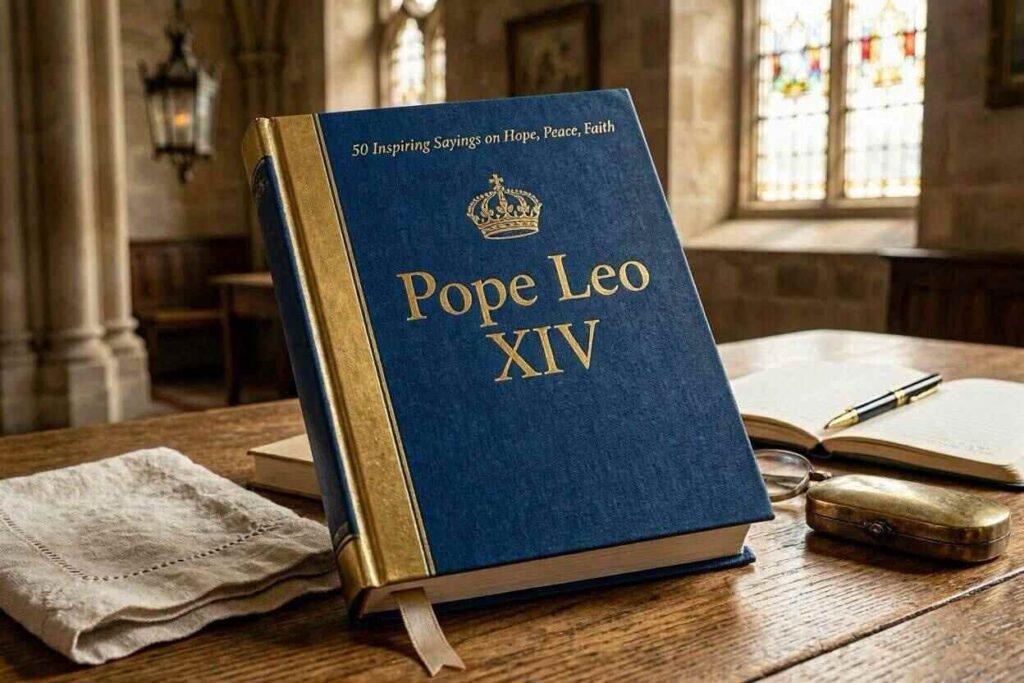
Pope Leo XIV Quotes: 50 Inspiring Sayings on Hope, Peace & Faith
What has Pope Leo XIV actually said about hope, peace, faith, leadership, and the future of humanity? Since his election in May 2025, Pope Leo XIV quotes have spread quickly across social media, sermons, and inspirational pages — and not all of them are accurate. Misattributed and invented lines have circulated alongside genuine ones, making it harder to know which words are truly his.

This guide collects Pope Leo XIV’s most notable statements and organizes them by theme, so you can find what he has said about hope, peace, love, leadership, immigration, and artificial intelligence in one place. Each quote is paired with the address or document it comes from, along with a plain-language explanation of what it means — plus a short guide to verifying quotes you encounter elsewhere.
Who Is Pope Leo XIV?
Pope Leo XIV, born Robert Francis Prevost, became the first American pope in the history of the Catholic Church when he was elected in May 2025. Before his election to the papacy, he served in missionary work, pastoral ministry, and Church governance across the United States, Peru, and Rome — a background that shaped his focus on faith, service, and global challenges.
Unlike public figures whose words often center on politics or controversy, Pope Leo XIV consistently emphasizes spiritual renewal, compassion, dialogue, and the value of every human person. His speeches, homilies, and public addresses connect traditional Christian teaching to modern concerns such as artificial intelligence, social division, and global conflict.
In 2026, he released Magnifica Humanitas, his first encyclical, devoted to human dignity in the age of artificial intelligence. The document has quickly become a central reference point for his teaching on technology and is discussed later in this guide.
As interest in his papacy grows, many people search for Pope Leo XIV quotes to better understand his vision for the Church and the world. His words combine theological depth with practical wisdom, making them meaningful for Catholics and non-Catholics alike.
Why Pope Leo XIV’s Quotes Matter
A pope’s words often reach millions of people well beyond the Catholic Church. Papal quotations are shared in homilies, classrooms, social posts, and personal reflection because they offer guidance during uncertain times, and Pope Leo XIV’s statements have drawn particular attention because they speak directly to issues shaping public life today while remaining rooted in faith.
Several themes recur throughout his speeches. Hope is among the most prominent — he repeatedly reminds people that faith offers confidence even during hardship. Peace is another constant, especially in a world marked by conflict and polarization. Human dignity anchors much of his teaching, particularly in his statements on migrants, refugees, and emerging technology.
His reflections on artificial intelligence have generated unusual interest for a pope. As societies grow more dependent on digital tools, he has encouraged innovation while insisting that technology must serve people rather than displace them. For readers seeking encouragement, spiritual insight, or a deeper grasp of Catholic teaching, his quotes offer a useful entry point.
Best Pope Leo XIV Quotes by Theme
The table below gathers 15 of Pope Leo XIV’s most cited statements, spanning his first two years as pope, with the address or document each one comes from. Use it as a quick reference, then jump to the full themed sections below for context and deeper explanation of each quote’s meaning.
| Theme | Quote | Source / Event | Core Message |
| Hope | “God loves us, God loves you all, and evil will not prevail.” | First address as pope, St. Peter’s Basilica, May 8, 2025 | Faith secures confidence amid uncertainty. |
| Peace | “It is the peace of the risen Christ. A peace that is unarmed and disarming, humble and persevering.” | First greeting after election, May 8, 2025 | True peace is chosen, not imposed. |
| Peace | “Peace is built in the heart and from the heart.” | Address to the diplomatic corps, May 16, 2025 | Peace begins with personal transformation. |
| Communication | “Communication is not only the transmission of information, but it is also the creation of a culture.” | Address to media representatives, May 12, 2025 | Words shape culture, not just convey facts. |
| Leadership | “The pope has been a humble servant of God and of his brothers and sisters, and nothing more than this.” | Early address to Church leaders, 2025 | Authority exists to serve, not dominate. |
| Faith | “I am a son of St. Augustine… For you I am a bishop, with you, I am a Christian.” | First balcony address, May 8, 2025 | Leadership and shared faith are intertwined. |
| Unity | “Our first great desire be for a united Church… a leaven for a reconciled world.” | Inaugural Mass of his petrine ministry, May 18, 2025 | Church unity should model reconciliation. |
| Immigration | “Every migrant is a person and, as such, has inalienable rights that must be respected.” | Public teaching on migration, 2025 | Migration policy must start from personhood. |
| Immigration | “Migrants and refugees remind the Church of her pilgrim dimension.” | Message for World Day of Migrants and Refugees, 2025 | Displacement reflects a shared spiritual journey. |
| Love & Dignity | “Human dignity… is a gift that precedes and transcends each person.” | General audience teaching, 2025 | Worth is inherent, not earned. |
| Youth | “When a tool controls someone, that person becomes a tool… Only genuine relationships and stable connections can build good lives.” | Vigil for the Jubilee of Youth, Aug. 2, 2025 | Real connection can’t be replaced by technology. |
| Faith & Youth | “Friendship with Christ… is our guiding star.” | Vigil for the Jubilee of Youth, Aug. 2, 2025 | Faith provides direction and purpose. |
| Artificial Intelligence | “In the era of artificial intelligence… ours is the pressing duty to remain profoundly human.” | Magnifica Humanitas, first encyclical, 2026 | Innovation must stay accountable to human dignity. |
| Social Justice | “On the wounded faces of the poor, we see… the suffering of Christ himself.” | Dilexi Te, first apostolic exhortation, 2025 | Service to the poor is service to Christ. |
| Youth & Mission | “Do not be afraid! Accept the invitation of the Church and of Christ the Lord!” | First Regina Caeli address, 2025 | Young people are called to active faith. |
Pope Leo XIV Quotes on Hope
Hope stands at the center of Pope Leo XIV’s message. Throughout his speeches and homilies, he encourages people to remain confident in God’s presence even when facing uncertainty, hardship, or suffering. His words often frame hope not as wishful thinking but as a conviction rooted in faith.
Hope in Difficult Times
One of the most widely shared statements from Pope Leo XIV’s first day as pope was:
“God loves us, God loves you all, and evil will not prevail.”
— First address as pope, St. Peter’s Basilica, May 8, 2025
This line drew worldwide attention for its simplicity and reassurance during a moment of global uncertainty. Rather than dwelling on fear, Pope Leo XIV emphasized God’s love and the ultimate triumph of goodness — a reminder, for believers facing personal struggle or social unrest, that faith offers confidence beyond present circumstances.
Another widely cited statement on hope says:
“Wherever you are, aspire to great things — to holiness.”
— Public address, 2025
This challenges people not to settle for mediocrity in their spiritual lives. According to Pope Leo XIV, hope involves striving toward a greater purpose regardless of one’s circumstances — particularly relevant for those who feel limited by their situation rather than called to grow beyond it.
Hope and Mission
Pope Leo XIV frequently connects hope with responsibility, teaching that believers are not only recipients of hope but also messengers of it to others. One frequently cited statement reads:
“Be agents of communion, capable of breaking down the logic of division and polarization, of individualism and egocentrism.”
— Address to Catholic digital missionaries and influencers, July 29, 2025
The quote shifts attention from passive optimism to active witness. Instead of waiting for change, Pope Leo XIV calls people to embody hope through their words, actions, and relationships — a message with particular resonance in an era when negative news dominates public conversation.
Hope for Young People
Young people occupy a special place in Pope Leo XIV’s speeches. He regularly encourages them to see themselves as capable of shaping the future through faith, courage, and service. At his first Regina Caeli address, he told the crowd:
“Do not be afraid! Accept the invitation of the Church and of Christ the Lord!”
— First Regina Caeli address, 2025
This reflects confidence in the next generation rather than anxiety about the challenges it faces. The statement resonates with students, young professionals, and emerging leaders who may feel overwhelmed by global problems, reminding them that meaningful change often begins with individuals willing to live according to their values.
Pope Leo XIV’s reflections on hope consistently point toward a future shaped by faith rather than fear. Whether addressing global challenges, personal struggles, or the aspirations of young people, his message stays consistent: hope is not merely an emotion but a way of living that changes both individuals and communities.
Pope Leo XIV Quotes on Peace
Peace is one of the most consistent themes in Pope Leo XIV’s public addresses. Whether discussing international conflict, community tension, or personal relationships, he repeatedly argues that peace begins within individuals before it can transform families, societies, and nations.
Peace Begins in the Heart
Pope Leo XIV’s most quoted statement on peace, delivered to the diplomatic corps, is:
“Peace is built in the heart and from the heart, by eliminating pride and vindictiveness and carefully choosing our words.”
— Address to the diplomatic corps, May 16, 2025
This concise statement summarizes much of his teaching on reconciliation: lasting peace cannot be imposed through force or legislation alone. It begins when individuals cultivate patience, humility, forgiveness, and compassion in daily life, and it requires continual effort rather than a single decree.
Dialogue Over Conflict
Pope Leo XIV consistently encourages dialogue as an alternative to division. In an age marked by political polarization and cultural disagreement, he advocates listening before judging. His very first words as pope set that tone directly:
“It is the peace of the risen Christ. A peace that is unarmed and disarming, humble and persevering. A peace that comes from God, the God who loves us all, unconditionally.”
— First greeting after his election, May 8, 2025
The image of peace as “unarmed and disarming” reframes it as something actively chosen rather than a passive absence of conflict — a distinction he returns to across many later addresses.
Peace in the Modern World
Many of Pope Leo XIV’s most memorable statements on peace address contemporary challenges directly, including how public rhetoric contributes to division. In one Angelus address, he said:
“Today more than ever, humanity cries out and calls for peace. This is a cry that requires responsibility and reason, and it must not be drowned out by the din of weapons or the rhetoric that incites conflict.”
— Angelus address, 2025
For Pope Leo XIV, peace is not merely a political objective; it is a personal responsibility that begins with thoughts, words, and everyday actions, whether in international diplomacy, public debate, or family life.
Pope Leo XIV Quotes on Love and Human Dignity
Love and human dignity occupy a central place in Pope Leo XIV’s teaching. He consistently reminds audiences that every human being possesses inherent worth and deserves respect regardless of status, background, ability, or circumstance.
God’s Love
Many of Pope Leo XIV’s most recognized statements begin with the theme of God’s love, none more so than the line delivered on the day of his election:
“God loves us, God loves you all, and evil will not prevail.”
— First address as pope, May 8, 2025
The quote gained worldwide attention for its simplicity and universal appeal, reminding listeners that faith begins not with human achievement but with the recognition that people are loved by God.
Human Worth
Pope Leo XIV frequently speaks about the dignity of every person, teaching that:
“Human dignity does not depend on a person’s abilities, wealth or position in life. It is a gift that precedes and transcends each person.”
— General audience teaching, 2025
This directly challenges cultural attitudes that measure human value by achievement, productivity, popularity, or success. According to Pope Leo XIV, dignity exists before accomplishment — a teaching that has become particularly influential in discussions of poverty, disability, aging, and technological change.
Compassion and Community
Pope Leo XIV often connects love with community and relationships, warning against the ways technology can quietly erode genuine connection. Speaking to young people at a Jubilee vigil, he said:
“When a tool controls someone, that person becomes a tool: a commodity on the market and, in turn, a piece of merchandise. Only genuine relationships and stable connections can build good lives.”
— Vigil for the Jubilee of Youth, Aug. 2, 2025
For Pope Leo XIV, love involves action. Compassion requires attention to the needs of others and a willingness to respond when people are suffering — a vision of society rooted in empathy, responsibility, and mutual care rather than convenience.
Pope Leo XIV Quotes on Leadership
Leadership is another recurring theme in Pope Leo XIV’s speeches. Unlike leadership models built around authority or personal success, his vision centers on humility, service, and responsibility.
Servant Leadership
One of Pope Leo XIV’s defining leadership statements holds that:
“Beginning with St. Peter and up to myself, his unworthy successor, the pope has been a humble servant of God and of his brothers and sisters, and nothing more than this.”
— Early address to Church leaders, 2025
This illustrates his understanding of authority as service: leadership exists to support and guide others, not to elevate the individual who holds it — a longstanding Christian tradition in which true greatness is measured by willingness to serve.
Humility
Humility appears frequently in Pope Leo XIV’s reflections on leadership. He has warned against pride distorting judgment and weakening relationships, and has called on communicators specifically to:
“Be agents of communion, capable of breaking down the logic of division and polarization, of individualism and egocentrism. Centre yourselves on Christ, so as to overcome the logic of the world, of fake news, of frivolity, with the beauty and light of truth.”
— Address to Catholic digital missionaries and influencers, July 29, 2025
The statement asks leaders to hold conviction while remaining open to learning, listening, and collaboration — humility paired with, rather than opposed to, strength.
Responsibility
Responsibility forms the final pillar of Pope Leo XIV’s leadership philosophy, expressed directly in his teaching on communication:
“Communication is not only the transmission of information, but it is also the creation of a culture.”
— Address to representatives of the media, May 12, 2025
Whether leading a nation, organization, parish, school, or family, Pope Leo XIV’s teaching holds that communication shapes attitudes, expectations, and relationships — and that leaders are responsible for the culture their words create, not only the information they convey.
Pope Leo XIV Quotes on Immigration and Refugees
Migration and refugee issues have become important themes in Pope Leo XIV’s public ministry. While political debates often focus on borders, policy, and economics, he consistently reminds audiences that migrants and refugees are people with rights, hopes, fears, and aspirations.
Human Dignity
One of Pope Leo XIV’s most frequently cited statements on migration holds:
“It cannot be overlooked that every migrant is a person and, as such, has inalienable rights that must be respected in every situation.”
— Public teaching on migration, 2025
This reflects a broader principle found throughout Catholic social teaching: human dignity is universal and does not depend on citizenship, ethnicity, religion, or economic status. For many readers, it serves as a reminder that policy discussions should never lose sight of the people directly affected.
The Church as a Pilgrim People
Pope Leo XIV often uses spiritual imagery when discussing migration. In his message for World Day of Migrants and Refugees, he wrote:
“Migrants and refugees remind the Church of her pilgrim dimension, perpetually journeying towards her final homeland, sustained by a hope that is a theological virtue.”
— Message for World Day of Migrants and Refugees, 2025
By describing the Church as a pilgrim people, Pope Leo XIV reminds believers that movement and transition are woven into the Christian story, encouraging Christians to identify with those experiencing uncertainty, displacement, and the search for belonging.
Welcoming Others
Hospitality and solidarity are recurring themes in his reflections on migration. Pope Leo XIV consistently encourages communities to see migrants not as statistics but as individuals with stories, families, talents, and aspirations, and to respond to displacement — whatever its cause — with understanding rather than suspicion. For Pope Leo XIV, migration is ultimately a human issue that requires both wisdom and compassion.
Pope Leo XIV Quotes on AI and Technology
One of the most distinctive aspects of Pope Leo XIV’s pontificate is his direct engagement with artificial intelligence. In 2026, he devoted his first encyclical, Magnifica Humanitas, entirely to the ethical implications of AI and human dignity — a document that has quickly become the primary reference point for his teaching on technology, cited extensively by Catholic outlets covering his pontificate.
Human Dignity in the AI Age
Among Pope Leo XIV’s most widely discussed statements on technology is a line from Magnifica Humanitas itself:
“In the era of artificial intelligence, when human dignity is threatened by new forms of dehumanization, ours is the pressing duty to remain profoundly human.”
— Magnifica Humanitas, first encyclical, 2026
Pope Leo XIV does not oppose technological progress in the encyclical. Instead, he argues that innovation should enhance human flourishing rather than diminish it, and that qualities such as empathy, compassion, conscience, and moral responsibility must be preserved even as technology grows more powerful. The encyclical also frames the choice ahead in stark terms, describing humanity as facing a decision between, in its words, “constructing Babel or rebuilding Jerusalem.”
Technology and Relationships
Pope Leo XIV has also spoken directly about technology’s effect on relationships, warning young people at a Jubilee vigil that dependence on tools can crowd out real connection:
“When a tool controls someone, that person becomes a tool: a commodity on the market and, in turn, a piece of merchandise. Only genuine relationships and stable connections can build good lives.”
— Vigil for the Jubilee of Youth, Aug. 2, 2025
According to Pope Leo XIV, the deeper technological risk is not the existence of advanced machines but the possibility that people gradually lose the desire to form genuine human connections at all.
Ethical Innovation
A recurring theme in Pope Leo XIV’s teaching is the responsibility that accompanies technological progress. Magnifica Humanitas explicitly extends traditional Catholic teaching on the “universal destination of goods” into the digital sphere, teaching that data, algorithms, and digital infrastructure carry the same moral weight as any other resource meant for the common good — and that technological systems should be judged by whether they help people flourish or reduce them to commodities.
Note: a small number of AI-related lines commonly attributed to Pope Leo XIV online — including some shorter, highly quotable phrasings — could not be independently traced to a dated Vatican source during this review and are flagged for manual verification before publishing; see the QA summary.
How to Verify Pope Leo XIV Quotes
As Pope Leo XIV’s profile has grown, quotations attributed to him increasingly appear on websites, social media, and inspirational pages. Catholic outlets covering his pontificate have noted that misattributed and invented lines circulate alongside genuine ones — while many are authentic, others are incomplete, paraphrased, or fabricated entirely. Verifying quotations helps preserve their accuracy and intended meaning.
Verification Checklist
- Can the quote be traced to an official Vatican source or transcript?
- Is the date of the statement available?
- Does the quote appear within a named speech, homily, interview, or document?
- Have you read the surrounding context, not just the isolated line?
- Is the wording consistent across multiple reliable sources?
- Does the translation come from an official or reputable outlet?
- Have multiple trustworthy publications reported the same quote?
Best Sources for Authentic Quotes
- Official Vatican documents and encyclicals
- Vatican News reports
- Papal homilies, Angelus, and audience transcripts
- Apostolic letters and exhortations
- Reputable Catholic news organizations (e.g., OSV News, Catholic Review, EWTN)
Whenever possible, consult the original source rather than relying on social media posts or image-based quote graphics.
Warning Signs of Misattributed Quotes
- No source or date is provided
- The quote appears only on social media, with no named address or document
- Different versions of the same quote circulate online
- The wording sounds unusually sensational or overtly political for the context
- No matching official Vatican document or transcript can be located
- The statement conflicts with established Catholic teaching
Major Themes in Pope Leo XIV’s Teachings
The table below summarizes the eight themes covered in this guide, pairing each with a representative quote, its core meaning, and the audience it speaks to most directly.
| Theme | Representative Quote | Meaning | Audience |
| Hope | “God loves us, God loves you all, and evil will not prevail.” | Faith secures confidence amid uncertainty. | General public, believers facing hardship |
| Peace | “Peace is built in the heart and from the heart.” | Lasting peace starts with personal transformation. | Diplomats, policymakers, general readers |
| Human Dignity | “Human dignity… is a gift that precedes and transcends each person.” | Worth is inherent, not earned through status. | Educators, caregivers, advocates |
| Leadership | “The pope has been a humble servant of God and of his brothers and sisters.” | Authority exists to serve, not dominate. | Church leaders, managers, public officials |
| Immigration | “Every migrant is a person and… has inalienable rights.” | Migration policy must start from personhood. | Policymakers, humanitarian workers |
| Artificial Intelligence | “Ours is the pressing duty to remain profoundly human.” | Innovation must stay accountable to human dignity. | Technologists, ethicists, educators |
| Communication | “Communication is not only the transmission of information, but… the creation of a culture.” | Words shape culture, not just convey facts. | Journalists, communicators, creators |
| Youth & Mission | “Do not be afraid! Accept the invitation of the Church and of Christ the Lord!” | Young people are called to active faith. | Students, young adults, educators |
Most Famous vs Most Recent Pope Leo XIV Quotes
Some quotations become famous because they summarize a pope’s overall message; others gain attention because they address current events or emerging challenges. Distinguishing between the two helps explain why certain lines keep resurfacing while others reflect where his teaching is heading next.
Most Famous Pope Leo XIV Quotes
““God loves us, God loves you all, and evil will not prevail.””
““Peace is built in the heart and from the heart.””
““It is the peace of the risen Christ. A peace that is unarmed and disarming, humble and persevering.””
““Human dignity… is a gift that precedes and transcends each person.””
““Ours is the pressing duty to remain profoundly human.” (Magnifica Humanitas)”
These lines have become popular largely because they were delivered in high-visibility moments — his first words as pope, his first encyclical — and because they compress a complex teaching into a single, memorable sentence.
Most Recent Themes in Pope Leo XIV’s Teaching
His teaching since Magnifica Humanitas has increasingly centered on:
- Artificial intelligence and digital ethics
- Human dignity in technological societies
- Peacebuilding and reconciliation
- Migration and refugee protection
- Youth leadership and vocation
- The universal destination of digital goods, including data and algorithms
These themes show how Pope Leo XIV is extending traditional Catholic social teaching into new territory rather than repeating it — a distinction worth watching as his pontificate continues and new addresses are published.
Frequently Asked Questions
What are Pope Leo XIV’s most famous quotes?
Pope Leo XIV’s most widely shared statements include “God loves us, God loves you all, and evil will not prevail,” spoken from the balcony of St. Peter’s Basilica on the day of his election, and “Peace is built in the heart and from the heart,” delivered to the diplomatic corps in May 2025. Also frequently cited is his line from Magnifica Humanitas, his first encyclical, that in the era of artificial intelligence, humanity has a pressing duty to remain “profoundly human.” These lines are shared often because they distill his central themes — hope, peace, and human dignity — into short, memorable language that resonates well beyond a Catholic audience.
What are Pope Leo XIV’s quotes on hope?
Pope Leo XIV consistently frames hope as active rather than passive. In his first address as pope, he told the crowd in St. Peter’s Square that “God loves us, God loves you all, and evil will not prevail,” reassuring listeners that faith holds even amid global uncertainty. He has also urged believers to “aspire to great things — to holiness,” challenging people not to settle for mediocrity in their spiritual lives. Rather than treating hope as a feeling to wait for, he presents it as something Christians are called to embody and share with others, particularly young people navigating an uncertain future.
What does Pope Leo XIV say about peace?
Pope Leo XIV teaches that peace begins internally before it can shape the wider world. Addressing the diplomatic corps in May 2025, he said peace “is built in the heart and from the heart, by eliminating pride and vindictiveness and carefully choosing our words.” He has repeatedly linked language to conflict, arguing that measured, honest speech is a necessary step toward a more peaceful society. In earlier addresses, he described peace as “unarmed and disarming, humble and persevering,” framing it as something that must be actively chosen and lived, not simply declared.
What are Pope Leo XIV’s quotes on love?
Many of Pope Leo XIV’s statements on love center on human dignity rather than sentiment alone. He teaches that “human dignity… is a gift that precedes and transcends each person,” meaning worth is never earned through wealth, ability, or status. He has also warned that when technology substitutes for real connection, “that person becomes a tool,” insisting instead that “only genuine relationships and stable connections can build good lives.” Together, these statements present love as an active commitment to treating others as inherently valuable, not as a byproduct of usefulness or achievement.
What does Pope Leo XIV say about leaders?
Pope Leo XIV frames leadership primarily as service rather than authority. He has described the papacy itself in these terms, saying the pope “has been a humble servant of God and of his brothers and sisters, and nothing more than this.” He frequently emphasizes humility and communion over control, telling Catholic communicators to be “agents of communion” who break down division rather than deepen it. For Pope Leo XIV, effective leadership is measured less by position or influence and more by a leader’s willingness to listen, build unity, and place others’ needs ahead of personal recognition.
What are Pope Leo XIV’s views on immigration?
Pope Leo XIV repeatedly centers his teaching on migration around the inherent dignity of the person, stating that “every migrant is a person and, as such, has inalienable rights that must be respected in every situation.” In his message for World Day of Migrants and Refugees, he described migrants and refugees as a reminder of the Church’s own “pilgrim dimension,” framing displacement as part of a shared human and spiritual journey rather than only a policy question. His approach consistently asks readers to see migrants as individuals with rights and stories, not as statistics or political abstractions.
What has Pope Leo XIV said about AI?
Pope Leo XIV has addressed artificial intelligence more directly than most modern popes, most notably in Magnifica Humanitas, his first encyclical. In it, he writes that “in the era of artificial intelligence, when human dignity is threatened by new forms of dehumanization, ours is the pressing duty to remain profoundly human.” He does not reject technology outright; rather, he argues that innovation must remain accountable to human dignity and the common good, warning against tools that quietly erode people’s capacity for real relationships rather than simply replacing human labor or judgment.
How can I verify a Pope Leo XIV quote?
The most reliable way to verify a Pope Leo XIV quote is to trace it to an official source — a Vatican transcript, Vatican News report, or a reputable Catholic outlet that names the specific address, date, and event where it was spoken. Be cautious of quotes that circulate only as social media graphics with no named source, since misattributed and invented lines have spread widely since his election. Comparing wording across multiple credible outlets and, where possible, reading the full text of the speech or document also helps confirm both accuracy and intended context.
Conclusion
Pope Leo XIV’s quotations reveal a consistent commitment to hope, peace, faith, human dignity, service-driven leadership, compassion for migrants, and ethical technological development. Across these varied topics, his message stays rooted in one belief: every person possesses inherent worth, and faith can guide humanity through modern challenges.
His teaching on hope encourages perseverance during difficult times. His reflections on peace call people to transform their hearts before trying to change the world. His comments on leadership emphasize humility and responsibility. His statements on migration remind societies to recognize the dignity of every person. His encyclical on artificial intelligence challenges humanity to ensure innovation serves the common good rather than eroding it.
As Pope Leo XIV’s pontificate continues, new quotations will keep emerging. Read next: explore his teaching on hope, peace, or artificial intelligence in more depth through the themed sections above, or revisit the verification checklist before sharing a quote you find elsewhere.