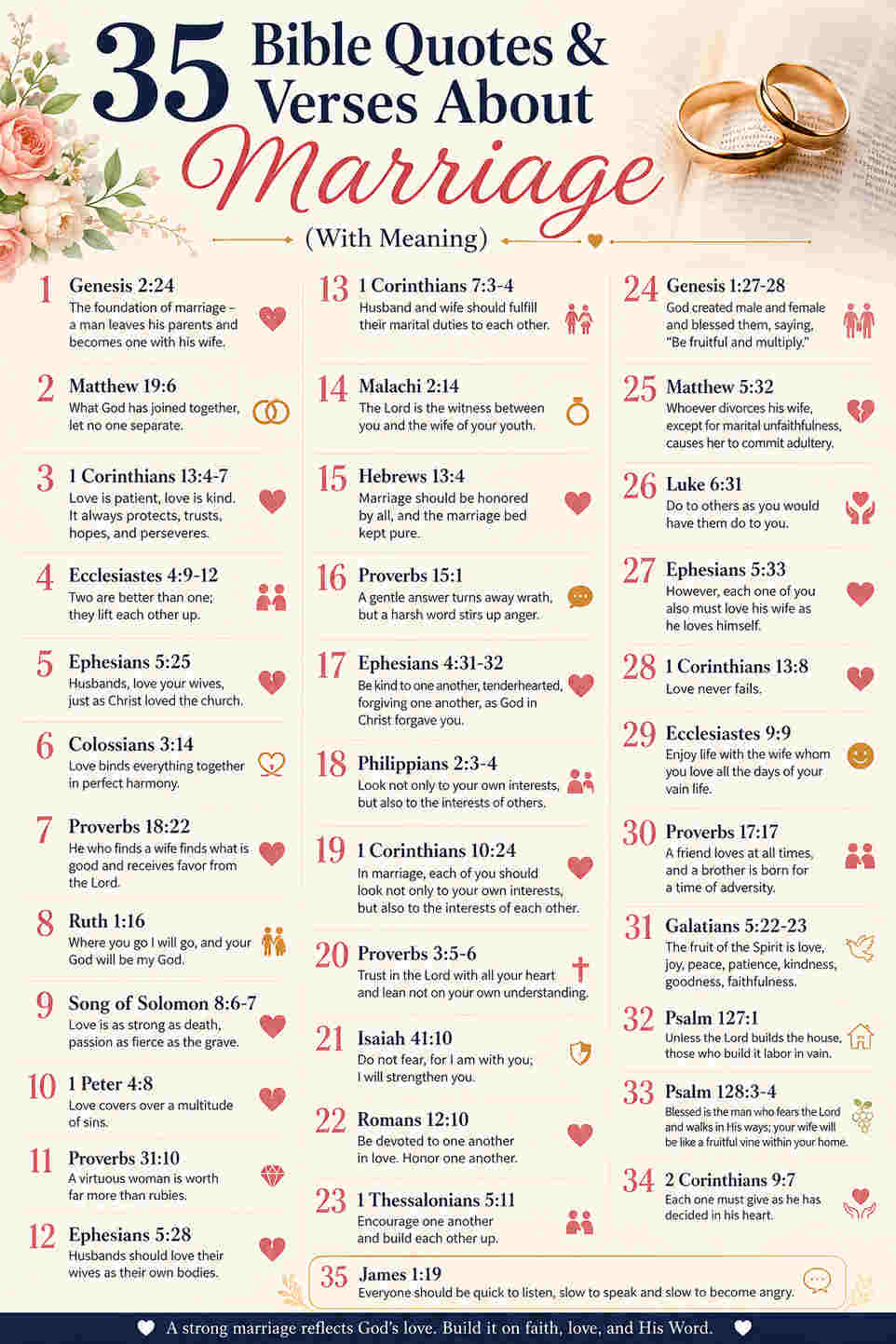
35 Bible Quotes and Verses About Marriage With Meaning
Discover the Bible’s most meaningful verses on marriage, explained with historical context, practical application, and guidance for weddings, newlyweds, and every season in between.
Marriage is one of the Bible’s most enduring themes, introduced in the opening pages of Genesis and carried through to the closing letters of the New Testament. Scripture never treats it as a mere social arrangement or legal formality. Instead, it describes marriage as a covenant established by God himself, one built on love, faithfulness, unity, and lifelong commitment.
Whether you’re preparing for marriage, planning a wedding reading, working through a difficult season, or simply want a deeper grasp of what the Bible actually teaches, understanding these verses in context matters more than collecting a list of quotable lines. Knowing why a passage was written, who first heard it, and how it fits the larger story of Scripture is what turns a nice quote into real wisdom.
Many roundups of marriage verses stop at a short devotional thought. This guide goes further. You’ll find:
- What the Bible says about marriage, from its very first mention.
- The most important marriage verses, grouped by theme, with historical and biblical context for each.
- Practical ways to apply these principles in everyday married life.
- Scripture recommendations for weddings, newlyweds, hard seasons, anniversaries, and personal study.
- Answers to the questions people ask most often about marriage in the Bible.
From Adam and Eve in Eden to Jesus’ teaching on divorce and Paul’s instructions to Christian households, Scripture tells one continuous story about marriage as covenant love, mutual commitment, and spiritual growth. Here’s how that story unfolds.
What Does the Bible Say About Marriage?
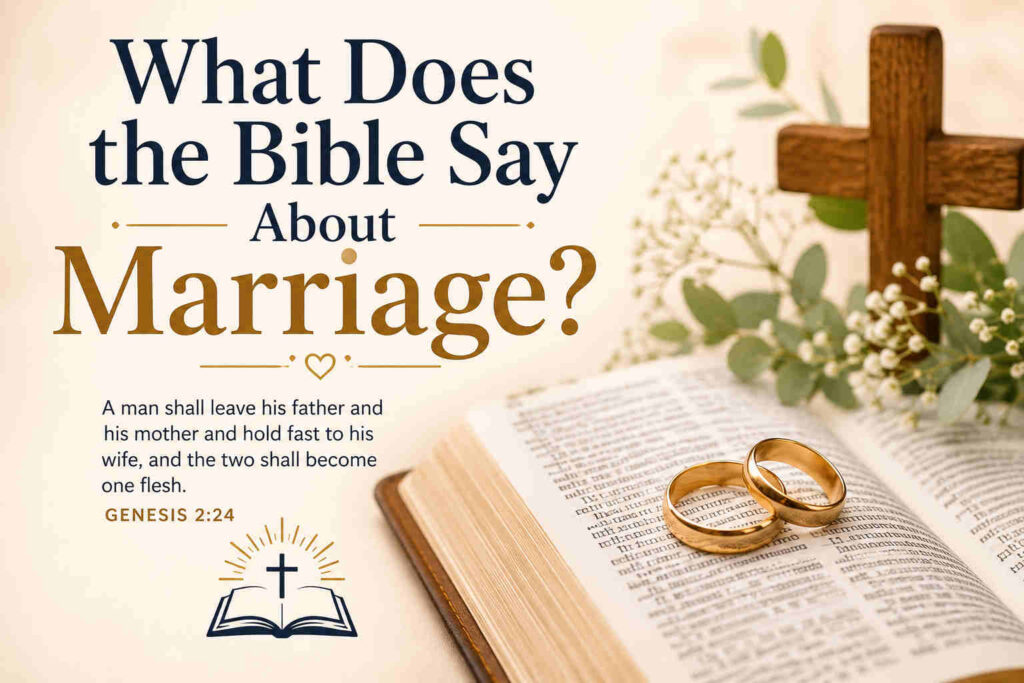
| Featured Definition According to the Bible, marriage is a lifelong covenant established by God in which a husband and wife become “one flesh.” It exists to reflect God’s own faithful love, provide companionship, build strong families, and ultimately point to the relationship between Christ and his Church. |
Long before any government or culture began regulating marriage, the Bible had already described it. Its origin sits in the earliest chapters of Genesis, where God creates the first man and woman and joins them together in the Garden of Eden. Marriage, in other words, isn’t a human invention. It’s part of God’s original design for creation.
Marriage Begins with God
After forming Adam, God observed something notable:
“It is not good that the man should be alone.” — Genesis 2:18
God’s response was to create Eve as a fitting companion, establishing from the outset that human relationships were meant to reflect partnership and shared purpose. When Adam and Eve came together, Scripture records the Bible’s founding statement about marriage:
“Therefore a man shall leave his father and his mother and hold fast to his wife, and they shall become one flesh.” — Genesis 2:24
This single verse becomes the reference point for nearly every later biblical discussion of marriage. Centuries afterward, Jesus quoted it directly when teaching on the subject, making clear that God’s original intention had never changed.
What Is Biblical Marriage?
Biblical marriage is more than cohabitation, a signed license, or a ceremony. Across Scripture, it’s described as:
- A covenant made before God.
- A lifelong union between husband and wife.
- A relationship built on faithful love.
- A partnership marked by unity and mutual commitment.
- A living picture of Christ’s relationship with his Church.
Rather than centering personal happiness, biblical marriage puts faithfulness, sacrificial love, forgiveness, and spiritual growth at the core of the relationship.
What Does “One Flesh” Mean?
The phrase “one flesh” recurs throughout Scripture and stands as one of the Bible’s most significant descriptions of marriage. It captures several dimensions of union at once:
- Physical unity through the marital relationship.
- Emotional unity as husband and wife share their lives.
- Spiritual unity through a shared commitment to God.
- Practical partnership in pursuing common goals and responsibilities.
This doesn’t mean two people dissolve into a single identity. It describes a new family relationship in which husband and wife are united while still remaining distinct individuals.
| Did You Know? Jesus quoted Genesis 2:24 word for word when the Pharisees questioned him about marriage and divorce (Matthew 19:4–6), grounding his answer in God’s design from creation rather than in the legal debates of his day. |
Marriage Is a Covenant, Not Merely a Contract
One of the Bible’s most important teachings is that marriage functions as a covenant, not simply a legal contract. Modern culture tends to think in contractual terms; Scripture consistently frames things differently.
| Biblical Covenant | Modern Contract |
| Established before God | Established by legal agreement |
| Built on lifelong faithfulness | Often focused on legal obligations |
| Rooted in commitment | Often focused on mutual benefit |
| Meant to endure through hardship | Can feel conditional on circumstances |
| Reflects God’s faithfulness | Reflects human agreement |
A contract typically protects each party’s individual interests. A covenant emphasizes enduring commitment and faithfulness precisely when circumstances get hard — which is why biblical teaching so consistently calls husbands and wives to perseverance, forgiveness, patience, and sacrificial love rather than an exit clause.
God’s Design for Marriage
A handful of themes appear again and again from Genesis through Revelation. God designed marriage to:
- Reflect his own faithful love.
- Provide lifelong companionship.
- Encourage mutual support.
- Build strong families.
- Create unity between husband and wife.
- Demonstrate commitment through every season of life.
- Point believers toward Christ’s relationship with the Church.
Biblical Marriage Compared with Cultural Expectations
Modern culture often measures a marriage by feelings, convenience, or personal fulfillment. Scripture certainly celebrates love and joy within marriage, but it consistently places those blessings inside a larger framework of covenant faithfulness.
| Cultural View | Biblical View |
| Marriage is based mainly on feelings. | Marriage is rooted in covenant commitment. |
| Love is defined by emotion. | Love is demonstrated through faithful action and sacrifice. |
| Personal happiness is the highest goal. | Honoring God and serving one another are central. |
| Difficulty signals the relationship has failed. | Trials are opportunities to practice grace and forgiveness. |
None of this excludes joy from the picture. It simply means biblical joy grows out of faithfulness and trust rather than out of emotions that rise and fall.
Common Misunderstandings About Biblical Marriage
A few recurring misconceptions make it harder to understand what Scripture actually teaches. Some assume marriage began as a cultural tradition, when the Bible presents it as God’s institution from the very beginning of creation. Others treat marriage as nothing more than a legal agreement, overlooking how consistently Scripture calls it a covenant reflecting God’s own faithfulness. And some readers skip past Genesis entirely, focusing only on New Testament passages — yet Jesus and the apostles keep returning to Genesis precisely because it’s the foundation everything else is built on.
Why Understanding God’s Design Matters Today
When couples read their marriage through the lens of Scripture, ordinary decisions start to carry more weight. Commitment becomes an expression of faithfulness rather than simply staying together. Forgiveness reflects the grace each spouse has already received from God. Serving one another becomes an act of love instead of an obligation.
Even in difficult seasons, Scripture points husbands and wives toward unity, patience, and reconciliation rather than letting a rough patch define the relationship. Biblical marriage was never about achieving perfection — it’s about growing together in faith while learning to reflect God’s love more faithfully over time.
| Key Takeaways Marriage originates with God in the creation account. The Bible describes marriage as a covenant rather than merely a contract. Husband and wife become “one flesh” — a lifelong relationship marked by unity and commitment. Marriage reflects God’s faithful love and ultimately points to Christ’s relationship with his Church. Understanding God’s original design is the foundation for interpreting every other marriage passage in Scripture. |
With that foundation in place, we can look closely at the key passages that shape the Bible’s teaching on marriage across both the Old and New Testaments.
The Most Important Bible Quotes & Verses About Marriage

Marriage Foundation
Before turning to love, forgiveness, or communication, it helps to see where the Bible begins its teaching on marriage. Every later principle about married life builds on God’s original design in Genesis, later reaffirmed by Jesus — these passages explain why marriage exists before they explain how husbands and wives should live within it.
Genesis 2:24 — The Foundation of Biblical Marriage
“Therefore a man shall leave his father and his mother and hold fast to his wife, and they shall become one flesh.”
This verse comes right after the creation of Eve, whom God brings to Adam as his companion. Genesis isn’t describing a particular culture’s wedding customs — it’s presenting God’s original intention for marriage before Israel existed, before any biblical law had been written. Given to God’s people to explain their origins and identity, the passage establishes marriage as part of the created order rather than a later human institution.
Three principles anchor the verse: leaving the dependence of the family of origin, forming a permanent marital union, and becoming one flesh through lifelong partnership. Every biblical discussion of marriage that follows builds on this framework. Wedding traditions vary widely across cultures, but a healthy marriage still starts from the same place — a new household built on mutual commitment, shared purpose, and faithful love. In practice, that might mean intentionally shaping your own household culture: making decisions together, supporting each other spiritually, and treating marriage as a lifelong partnership rather than two lives that happen to overlap.
Related passages: Matthew 19:4–6; Mark 10:6–9; Ephesians 5:31–32
Matthew 19:4–6 — Jesus Reaffirms God’s Original Design
“Therefore what God has joined together, let no one separate.”
Jesus spoke these words while the Pharisees questioned him about divorce, expecting a debate over legal fine points. Instead of engaging their framing, he redirected the conversation straight back to Genesis and God’s original intention for marriage. In doing so, he affirmed that marriage originates with God, that husband and wife become one flesh, and that the relationship is meant to be a lifelong covenant — not a new definition, but a confirmation of the pattern set at creation.
The passage reminds believers that biblical marriage rests on God’s authority rather than shifting cultural expectations. Every marriage runs into hard seasons, but Scripture keeps pointing back to this original design as the model for faithfulness and unity. Couples benefit from viewing their marriage as something God has joined together, not just a private agreement — a perspective that encourages perseverance and grace when working through difficulty.
Related passages: Genesis 2:24; Mark 10:6–9; Ephesians 5:22–33
Bible Verses About Love in Marriage
Love is one of Scripture’s central themes, but biblical love reaches far beyond romance or feeling. Emotion has its place, but the Bible teaches that lasting love shows up in daily choices — sacrificial service, patience, forgiveness, and faithfulness. Many wedding ceremonies borrow from 1 Corinthians 13, yet Paul wrote that chapter to guide everyday Christian living, not to decorate a wedding program. Understanding that original context helps couples see biblical love as something meant to shape ordinary days, not just special occasions.
The New Testament often uses the Greek word agape to describe God’s selfless, sacrificial love — love that chooses another person’s good above personal convenience, stays faithful through hard seasons, serves without expecting anything back, and extends grace even when it isn’t earned. Where modern culture tends to define love mainly by emotion, biblical love is revealed through consistent character and steady commitment.
| Did You Know? Paul wrote many of his teachings on love to churches wrestling with division and conflict. Though these passages apply beautifully to marriage, he originally intended them to help believers live out a Christ-centered life together. |
1 Corinthians 13:4–7 — The Biblical Portrait of Love
“Love is patient and kind; love does not envy or boast; it is not arrogant or rude. It does not insist on its own way; it is not irritable or resentful… Love bears all things, believes all things, hopes all things, endures all things.”
Paul wrote to a church in Corinth, a wealthy, culturally diverse city where pride, division, and selfishness had taken root. This chapter falls in the middle of his discussion about spiritual gifts, making the point that love is the foundation for every relationship in the church. The original readers were Christians trying to figure out how to live together despite real differences — marriage wasn’t Paul’s direct subject, yet few passages in Scripture describe genuine love more clearly.
Notice how the list runs almost entirely through actions — patience, kindness, humility, selflessness, truthfulness, perseverance, hope, endurance — rather than emotions. Every marriage moves through seasons of joy and seasons of strain, and feelings naturally rise and fall with them. What Paul describes is love that stays steady because it’s rooted in commitment, not circumstance. A useful gut check for couples: Am I responding with patience right now? Am I speaking kindly? Am I choosing forgiveness instead of keeping score? Small, daily answers to those questions tend to strengthen a marriage more than the occasional grand gesture.
Related passages: Romans 12:9–10; Colossians 3:12–14; 1 John 4:7–12; Ephesians 5:25
Ephesians 5:25 — Christ’s Love as the Model
“Husbands, love your wives, as Christ loved the church and gave himself up for her.”
Paul wrote this letter from prison, urging believers to live in a way worthy of the gospel. In this chapter, he explains how Christian relationships — marriage included — should mirror Christ’s love, addressing Christians in Ephesus, a major Roman city where cultural expectations often pulled against biblical teaching.
The love Paul describes is self-giving, protective, faithful, patient, and willing to serve — an emphasis on responsibility and sacrifice rather than authority alone. A marriage tends to flourish when love shows up as humble service rather than self-interest, with each spouse actively seeking the other’s good. In practice, that can look like listening carefully during a disagreement, serving without keeping score, and making decisions that benefit the family over personal preference.
Related passages: John 13:34–35; Philippians 2:3–8; Colossians 3:19
Colossians 3:14 — Love Holds Everything Together
“And above all these put on love, which binds everything together in perfect harmony.”
Paul urged the believers in Colossae, a church surrounded by competing philosophies and false teaching, to trade old patterns of selfish living for Christ-like character. His point here is that love is the virtue that unites every other Christian quality — patience, kindness, humility, forgiveness, and compassion all find their fullest expression through it.
A strong marriage needs more than good communication skills or shared interests. Love is what lets a couple respond with grace even when things get genuinely hard. Instead of asking, “How do I win this disagreement?” biblical love asks, “How can I strengthen our relationship while honoring God?”
Related passages: 1 Peter 4:8; Romans 13:8–10; Ephesians 4:2–3
1 John 4:7–8 — Love Reflects God’s Character
“Beloved, let us love one another, for love is from God.”
John wrote to believers facing false teaching and uncertainty about what genuine faith looked like, encouraging them to recognize it through transformed, love-marked lives. Because God is love’s source, believers reflect his character whenever they genuinely love one another — and marriage becomes one of the clearest places for that love to show up consistently.
A strong marriage isn’t sustained by compatibility alone. It grows as each spouse keeps drawing closer to God, letting that relationship shape everyday attitudes, words, and actions. Time spent together in prayer, Scripture, and worship tends to cultivate the patience, forgiveness, and generosity that make a marriage resilient.
Related passages: John 15:12; Romans 5:5; Ephesians 4:32
None of this diminishes romance — it simply suggests romance flourishes best when it’s rooted in enduring commitment and Christ-like love, rather than the other way around.
| Modern View | Biblical View |
| Love depends mainly on feelings. | Love is demonstrated through faithful actions. |
| Happiness is the primary goal. | Honoring God and serving one another are central. |
| Love changes with circumstances. | Love perseveres through every season. |
| Romance defines love. | Sacrifice, patience, and commitment define love. |
| Personal fulfillment comes first. | Mutual care and selfless service strengthen the marriage. |
| Key Takeaways Biblical love is rooted in sacrificial commitment rather than shifting emotion. Agape love reflects God’s character through patience, kindness, humility, and faithful service. Paul presents Christ’s love for the Church as the highest model for marriage. Love grows through daily actions, not only memorable moments. A Christ-centered marriage shows love by serving, forgiving, encouraging, and staying faithful. |
Bible Verses About Unity in Marriage
Unity defines biblical marriage from the creation account all the way through the apostles’ letters. Scripture consistently presents husband and wife as partners joined by God for a shared purpose — not identical people who’ve lost their individuality, but two distinct individuals moving in the same direction, supporting each other, and seeking God’s will together. That kind of unity grows through communication, prayer, humility, and forgiveness, not through demanding agreement on every preference.
Ecclesiastes 4:9–12 — Strength in Partnership
“Two are better than one… Though one may be overpowered, two can defend themselves. A cord of three strands is not quickly broken.”
Ecclesiastes belongs to Israel’s wisdom literature and is traditionally linked to Solomon, reflecting on life’s uncertainties while pointing readers toward living wisely before God. The original audience was encouraged to see the practical value of companionship and dependence on God amid an unpredictable life.
Though the passage addresses companionship broadly rather than marriage specifically, its principles map naturally onto married life: partnership provides strength, shared burdens become lighter, and a God-centered relationship gains spiritual depth. Christians often read the image of the threefold cord as husband, wife, and God growing together in unity — no marriage was ever meant to be lived independently. Couples tend to grow closer through simple habits like praying together, discussing big decisions openly, and supporting each other’s spiritual growth.
Related passages: Genesis 2:24; Ephesians 4:2–3; Philippians 2:2
Matthew 19:6 — Joined Together by God
“So they are no longer two but one flesh. Therefore what God has joined together, let no one separate.”
Responding to a question about divorce, Jesus pointed his listeners — religious leaders focused on legal interpretation — back to God’s original design in Genesis rather than debating cultural custom. Marriage, in his framing, creates a unique unity involving commitment, shared identity, lifelong partnership, and spiritual responsibility.
Modern life pulls couples in different directions through careers, obligations, and competing priorities in ways the original audience never faced quite so acutely. Jesus’ teaching is a reminder to intentionally protect the unity God established — which tends to happen when spouses consistently choose cooperation over competition and seek God’s wisdom together.
Related passages: Genesis 2:24; Mark 10:9; Ephesians 5:31
| Healthy Unity | Uniformity |
| Shared purpose | Forced sameness |
| Mutual respect | Loss of individuality |
| Cooperation | Control |
| Partnership | Dependence on one person’s preferences |
| Centered on Christ | Centered on human expectations |
Biblical unity celebrates differences while joining two hearts around a shared commitment to God and to each other.
| Key Takeaways Unity is central to God’s design for marriage. Becoming “one flesh” means sharing life, purpose, and commitment — not losing individuality. Prayer, humility, communication, and mutual support all strengthen unity. Ecclesiastes shows that faithful partnership provides strength through every season. Jesus reaffirmed marriage as a God-established union worth protecting. |
Bible Verses About Commitment & Faithfulness
From beginning to end, the Bible presents marriage as a lifelong covenant marked by commitment and faithfulness. Feelings naturally shift through life’s seasons, but Scripture roots genuine commitment in promises made before God rather than in changing circumstances — God’s own faithfulness becomes the model, since he consistently keeps covenant with his people despite their failures. Husbands and wives are called to the same kind of loyalty, patience, and steadiness through both joyful and difficult seasons.
| Commitment | Convenience |
| Based on covenant | Based on circumstances |
| Endures through difficulty | Changes when life gets hard |
| Seeks restoration | Gives up easily |
| Rooted in faithfulness | Often driven by personal benefit |
| Reflects God’s character | Reflects temporary preference |
Malachi 2:14–16 — Marriage as a Covenant
“The Lord was witness between you and the wife of your youth… she is your companion and your wife by covenant.”
Malachi prophesied after the Jewish people returned from exile. The temple had been rebuilt, but many Israelites had grown spiritually careless — including in how they treated their marriages. Speaking to the people of Judah, Malachi reminded them that marriage vows were made not only to a spouse but before God himself.
The passage frames marriage as a covenant before God, husband and wife as lifelong companions, and faithfulness as a matter of spiritual integrity, not just relational preference. Modern marriages face their own pressures — busy schedules, financial stress, shifting expectations — and Malachi’s words are a reminder that marriage rests on faithful promises rather than passing emotion. That faithfulness tends to show up in small, consistent choices: keeping promises, speaking truthfully, staying trustworthy, and protecting the relationship from needless division.
Related passages: Genesis 2:24; Matthew 19:6; Hebrews 13:4
Hebrews 13:4 — Honoring Marriage
“Let marriage be held in honor among all.”
Hebrews encourages believers to stay faithful to Christ through hardship and persecution, and near the letter’s end offers practical instructions for Christian living — including honoring marriage. For Jewish Christians facing real uncertainty, honoring God meant honoring the relationships he had established.
Marriage deserves respect because God established it, because it reflects covenant faithfulness, and because it strengthens both families and communities. In practice, that respect goes beyond celebrating weddings — it means honoring commitments, speaking well of one’s spouse, and nurturing trust over the long haul, including protecting trust, communicating honestly, and continuing to invest in the relationship even after conflict.
Related passages: Ephesians 5:21–33; Colossians 3:18–19; Proverbs 3:3–4
Proverbs 3:3–4 — Faithfulness in Daily Life
“Let not steadfast love and faithfulness forsake you; bind them around your neck; write them on the tablet of your heart.”
Proverbs, traditionally linked to Solomon, offers practical wisdom for everyday living aimed originally at young people developing character rooted in reverence for God. Though the verse speaks to life broadly rather than marriage specifically, its lesson applies directly: faithfulness isn’t reserved for extraordinary moments — it’s a daily habit that shapes every relationship, including a marriage.
Strong marriages are built through countless ordinary acts of faithfulness rather than occasional grand gestures — following through on commitments, offering encouragement in stressful stretches, staying dependable in everyday responsibilities, and choosing honesty even in difficult conversations.
Related passages: Psalm 89:1; Lamentations 3:22–23; 1 Corinthians 16:13–14
In biblical times, a covenant was regarded as a sacred promise. Breaking one carried spiritual weight because it touched one’s relationship with God, not merely with another person — which is exactly why Scripture treats marital faithfulness with such seriousness.
| Key Takeaways Marriage is consistently described in Scripture as a covenant. Faithfulness reflects God’s own character. Commitment grows through everyday choices, not occasional grand gestures. Honoring marriage means protecting trust, integrity, and lifelong companionship. Biblical commitment is rooted in God’s faithfulness rather than changing circumstances. |
Bible Verses About Forgiveness in Marriage
No marriage escapes misunderstanding, disappointment, or conflict — two imperfect people sharing a life will always need to forgive each other. Scripture never pretends healthy marriages avoid mistakes; instead, it repeatedly teaches believers how to respond once those mistakes happen. Forgiveness is one of God’s greatest gifts, and married couples are called to extend that same grace to one another. At the same time, biblical forgiveness isn’t the same as ignoring problems or avoiding honest conversation — forgiveness restores a relationship, while honest communication is what strengthens it.
| Biblical Forgiveness | Ignoring Problems |
| Acknowledges the hurt | Pretends nothing happened |
| Extends grace | Avoids difficult conversations |
| Seeks reconciliation | Lets resentment grow |
| Encourages restoration | Leaves issues unresolved |
| Reflects God’s mercy | Often just postpones conflict |
Colossians 3:13 — Forgive as the Lord Forgave You
“Bear with one another and, if one has a complaint against another, forgiving each other; as the Lord has forgiven you, so you also must forgive.”
Writing from prison, Paul urged the believers in Colossae — a church learning how faith should shape daily relationships — to live in a way that reflected Christ’s character. He ties forgiveness directly to the forgiveness believers have already received from God: they forgive not because an offense doesn’t matter, but because they themselves have been shown grace.
Marriage offers endless opportunities to practice patience and humility. Small disappointments can either pile up into resentment or become chances to show Christ-like grace. When disagreements come up, it helps to ask: Have I actually listened? Am I holding onto resentment I don’t need to carry? Can I extend grace while still having the honest conversation this needs?
Related passages: Matthew 6:14–15; Ephesians 4:31–32; Luke 17:3–4
Ephesians 4:31–32 — Kindness and Compassion
“Be kind to one another, tenderhearted, forgiving one another, as God in Christ forgave you.”
Paul urged believers in Ephesus to replace old patterns of anger and harsh speech with kindness, compassion, and forgiveness — not merely avoiding conflict, but actively cultivating attitudes that promote peace. Married couples often speak more bluntly to each other than to anyone else, which makes kindness especially important in the middle of a disagreement.
A few habits go a long way here: listening before responding, speaking gently in conflict, admitting mistakes quickly, and offering a genuine apology rather than a defensive one.
Related passages: Romans 12:18; James 1:19–20; Colossians 3:12–14
Matthew 18:21–22 — Forgiveness Without Keeping Score
“I do not say to you seven times, but seventy-seven times.”
Peter asked Jesus how many times he was obligated to forgive someone who wronged him, expecting a number with a ceiling. Jesus’ answer makes the opposite point — forgiveness was never meant to work like an accounting ledger. Believers are called toward hearts marked by mercy rather than a running tally of wrongs.
A marriage can’t thrive if either spouse keeps score of past failures. Letting go doesn’t erase accountability or healthy boundaries where they’re genuinely needed — it removes the bitterness that stands in the way of healing and moving forward.
Related passages: Luke 6:37; Romans 12:17–21; 1 Peter 4:8
| Common Misunderstanding Forgiveness isn’t the same as pretending nothing happened. Scripture calls for both forgiveness and honest communication — healthy marriages pursue reconciliation while still addressing problems with truth and wisdom. |
| Key Takeaways Every marriage requires forgiveness, because every person is imperfect. Biblical forgiveness reflects the grace believers have received from God. Forgiveness works alongside honest communication and genuine reconciliation, not instead of it. Kindness, compassion, and humility strengthen a marriage over time. Letting go of resentment makes room for healing and renewed trust. |
Bible Verses About Wisdom for Marriage
Love provides the heart of a marriage; wisdom guides its daily decisions. Proverbs repeatedly shows how wisdom helps people navigate relationships with humility, discernment, and self-control. Knowledge tells you the facts; wisdom teaches you how to actually apply God’s truth in everyday life.
| Wisdom | Knowledge |
| Applies truth well | Understands facts |
| Guided by reverence for God | Guided by information alone |
| Produces wise decisions | Produces understanding |
| Shapes character | Expands learning |
| Strengthens relationships | Doesn’t automatically change behavior |
Proverbs 24:3–4 — Building a Strong Home
“By wisdom a house is built, and by understanding it is established; by knowledge the rooms are filled with all precious and pleasant riches.”
Part of Israel’s wisdom literature, Proverbs offers practical instruction rooted in reverence for the Lord, originally aimed at young Israelites preparing for adulthood and family life. Though this passage speaks broadly about building a household, its principles apply naturally to marriage: wise decisions create stability, understanding strengthens the relationship, and character matters more than possessions.
A strong marriage is built intentionally — through wise decisions about communication, finances, parenting, and priorities. That looks like studying Scripture together, praying before big decisions, seeking wise counsel when it’s needed, and valuing humility over being right.
Related passages: James 1:5; Proverbs 9:10; Psalm 127:1
Proverbs 15:1 — Gentle Words Build Peace
“A soft answer turns away wrath, but a harsh word stirs up anger.”
Solomon repeatedly contrasts wise and foolish speech throughout Proverbs, teaching readers that words carry real power. How a couple communicates often decides whether a disagreement grows or gets peacefully resolved — wisdom shows up not only in what’s said, but in how it’s said.
Every marriage runs into hard conversations. Gentle speech tends to open the door to understanding, while harsh words usually intensify conflict. Before responding in a disagreement, it’s worth pausing to ask: is this true, is it kind, is it helpful, does it reflect Christ?
Related passages: James 1:19; Ephesians 4:29; Colossians 4:6
| Key Takeaways Biblical wisdom helps couples apply God’s truth to everyday decisions. Wisdom produces humility, patience, and thoughtful communication. Proverbs teaches that strong homes are built intentionally through godly character. Gentle speech strengthens trust and promotes peace. Seeking God’s wisdom through Scripture and prayer equips couples for every season. |
Bible Verses for Different Marriage Situations
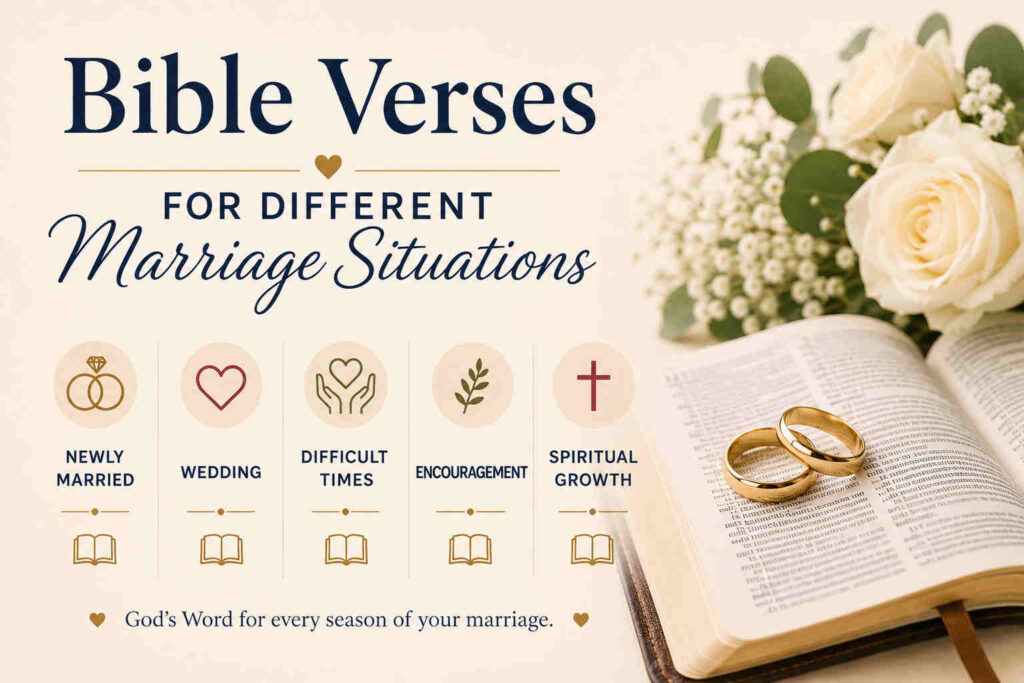
Every season of marriage brings its own joys, responsibilities, and challenges. Newlyweds often want wisdom for building a strong foundation; couples celebrating decades together tend to look for verses about faithfulness and perseverance. Others are searching for comfort during a hard stretch, or guidance while still preparing for marriage.
No single verse addresses every situation — different passages emphasize different aspects of God’s design. Reading them in context, rather than as isolated inspirational quotes, is what makes the application wise instead of superficial.
| Situation | Best Verse | Main Theme |
| Newly married | Genesis 2:24 | Foundation |
| Wedding ceremony | 1 Corinthians 13:4–7 | Love |
| Marriage problems | Colossians 3:13 | Forgiveness |
| Encouragement | Ecclesiastes 4:9–12 | Partnership |
| Long-term marriage | Malachi 2:14 | Faithfulness |
| Spiritual growth | Ephesians 5:25–33 | Christ-centered marriage |
| Preparing for marriage | Proverbs 3:5–6 | Wisdom |
For Newly Married Couples
Starting a marriage is exciting and transformative, marking the beginning of a new family and a lifelong journey of growing together in faith and love. Rather than chasing a perfect marriage from day one, newlyweds are better served by building healthy spiritual habits early — Genesis 2:24 for God’s original design, Ecclesiastes 4:9–12 for the strength of partnership, Colossians 3:14 for love that binds everything together, and Proverbs 3:5–6 for trusting God in every decision.
These passages point new couples toward building life on God’s foundation, developing habits of prayer, learning healthy communication, and practicing forgiveness early — before unhealthy patterns have a chance to take root. Setting aside regular time to pray together, reading Scripture weekly, and discussing family goals openly all help form those habits from the start.
Bible Verses for Weddings
Most couples want a wedding Scripture that celebrates love while also naming the lifelong commitment marriage involves. Rather than picking a verse simply because it’s popular, it helps to choose one that fits the specific moment in the ceremony.
| Wedding Purpose | Recommended Verse | Best For |
| Ceremony reading | Genesis 2:24 | God’s design for marriage |
| Wedding vows | Matthew 19:6 | Lifelong commitment |
| Love reading | 1 Corinthians 13:4–7 | Christ-like love |
| Wedding message | Ecclesiastes 4:9–12 | Partnership and unity |
| Anniversary | Malachi 2:14 | Faithfulness |
Genesis 2:24 works well for emphasizing that marriage originates with God; Matthew 19:6 highlights God’s role in joining husband and wife; 1 Corinthians 13:4–7 describes the character of biblical love rather than romantic feeling alone; and Ecclesiastes 4:9–12 celebrates partnership and mutual dependence on God. It’s worth remembering that many popular wedding readings, 1 Corinthians 13 especially, were written as everyday instruction for believers — not just as wedding poetry — which is exactly why they hold up so well as guidance for the marriage that follows the ceremony.
Bible Verses for Marriage Problems
Every marriage runs into difficulty — disagreements, misunderstandings, unmet expectations, and outside stress are simply part of life. Scripture doesn’t pretend otherwise. It consistently points believers toward forgiveness, humility, patience, and grace, drawing especially on Colossians 3:13, Ephesians 4:31–32, James 1:19, Proverbs 15:1, and Romans 12:18.
Together, these passages encourage couples to listen before responding, speak gently, forgive generously, and remain humble — principles especially useful during communication breakdowns, financial stress, parenting disagreements, or the slow work of rebuilding trust after conflict. No single verse resolves every challenge on its own; Scripture works as a whole, offering wisdom through multiple passages rather than one motivational slogan.
Bible Verses for Encouragement
Sometimes a married couple simply needs hope. Whether the pressure comes from illness, finances, family responsibilities, or plain uncertainty, God’s Word reminds believers that he remains faithful — Isaiah 41:10, Joshua 1:9, Romans 8:28, Psalm 46:1, and Philippians 4:6–7 all speak to that, even though none was written specifically about marriage. Praying these passages together, memorizing a few, or reading them during a hard conversation are simple ways to let them do their work. Hope tends to grow when couples keep reminding each other of God’s promises.
Bible Verses for Long-Term Marriage
A long-lasting marriage is its own testimony to God’s faithfulness across decades. As couples age together, Scripture — Malachi 2:14, Psalm 92:12–15, Proverbs 16:31, and Hebrews 10:23 among them — encourages perseverance, gratitude, and a legacy of faith passed to the next generation. Rather than settling into routine, mature marriages tend to keep growing through shared experience, continued forgiveness, and serving others together.
Bible Verses for Couples Growing Spiritually
Marriage is more than a shared home — it’s an opportunity to grow together as disciples of Christ. When husbands and wives pursue God together, the relationship often grows stronger simply because both are moving toward the same source of truth. Ephesians 5:21–33, Colossians 3:16, Matthew 6:33, and Philippians 2:1–5 all speak to this, and the habits that build it are ordinary ones: praying together, worshiping together, studying Scripture together, and encouraging one another in faith. None of it requires perfection — it starts with consistently seeking God together.
Scriptures on Marriage for Singles
Biblical teaching about marriage is useful well before a wedding is on the calendar. Preparing for marriage starts with character, not ceremony planning — Proverbs 3:5–6, Psalm 119:9, Matthew 6:33, 1 Corinthians 13:4–7, and Galatians 5:22–23 all point toward growing in spiritual maturity, wisdom, patience, and forgiveness ahead of time. The healthiest marriages are often built by people who sought God before they sought a spouse.
| Key Takeaways Different seasons of marriage call for different passages of Scripture. Reading verses in their biblical context leads to wiser application. God’s Word offers guidance for weddings, newlyweds, hard seasons, spiritual growth, and lifelong faithfulness alike. Preparing for marriage begins with spiritual maturity long before engagement. |
What Did Jesus Teach About Marriage?
Jesus spoke about marriage less often than many people assume, yet what he did teach remains foundational, because he consistently pointed people back to God’s original design in Genesis rather than introducing a new definition. His clearest teaching appears in Matthew 19:3–9 and the parallel account in Mark 10:2–12, where the Pharisees pressed him on divorce. Rather than engaging their legal framing, Jesus redirected the conversation to God’s purpose for marriage from the very beginning.
“Have you not read that He who created them from the beginning made them male and female… Therefore a man shall leave his father and his mother and hold fast to his wife, and the two shall become one flesh?” — Matthew 19:4–5
By quoting Genesis 2:24 directly, Jesus affirmed that marriage was never merely a cultural tradition or human institution — it originated with God. The exchange illustrates an important biblical principle: understanding marriage begins with understanding creation.
“What God Has Joined Together”
“So they are no longer two but one flesh. Therefore what God has joined together, let no one separate.” — Matthew 19:6
This phrase emphasizes that marriage is more than a personal agreement between two people. It’s a union established before God, a covenant relationship, a lifelong commitment, and a partnership designed according to his purpose. Because God joins husband and wife together, marriage deserves respect, faithfulness, and careful stewardship.
Jesus’ teaching also reinforces what “one flesh” means — physical unity, emotional companionship, spiritual partnership, and shared purpose, all without husband and wife losing their individuality. They become united in a unique covenant relationship while remaining distinct persons made in God’s image.
What’s remarkable is that Jesus answered a live, contemporary question by returning to Scripture’s earliest chapters. That shows God’s design for marriage has stayed consistent, that creation provides its foundation, and that later biblical teaching builds on Genesis rather than replacing it. Jesus wasn’t redefining marriage — he was reaffirming its original purpose.
| Key Takeaways Jesus consistently pointed people back to Genesis when teaching about marriage. Marriage is presented as God’s design from creation. “One flesh” describes a lifelong covenant relationship marked by unity and commitment. What God joins together deserves faithful care and protection. Christ’s teaching remains the foundation for understanding biblical marriage today. |
Marriage in the Old Testament vs. the New Testament
Marriage runs through the entire biblical narrative. The Old and New Testaments emphasize different aspects of it, but they don’t contradict each other — the New Testament builds on the foundation the Old Testament lays, revealing how God’s original design ultimately points to Christ and his relationship with the Church. Reading marriage passages as part of one continuous story, rather than in isolation, makes individual verses much easier to interpret accurately.
| Period | Key Passages | Primary Emphasis |
| Creation | Genesis 1–2 | God institutes marriage |
| Patriarchs | Genesis 24, 29 | Marriage within God’s covenant people |
| Wisdom literature | Proverbs, Ecclesiastes, Song of Solomon | Wisdom, love, faithfulness, companionship |
| Prophets | Malachi 2 | Covenant faithfulness |
| Jesus’ ministry | Matthew 19, Mark 10 | Return to God’s original design |
| Apostolic teaching | Ephesians 5, Colossians 3 | Marriage reflects Christ and the Church |
The Old Testament opens with God creating marriage in Eden, presenting it not as a cultural invention but as part of his design for humanity. Several themes recur throughout: marriage is God’s institution, husband and wife become one flesh, marriage is a covenant, and faithfulness honors God. The wisdom books — Proverbs and Ecclesiastes especially — stress practical living, urging couples toward wisdom, humility, and companionship, while the prophets remind Israel that covenant faithfulness in marriage mirrors God’s own covenant with his people.
The New Testament carries these same themes forward while revealing a deeper purpose still. Jesus reaffirmed Genesis rather than replacing it, and Paul went further, explaining that marriage illustrates the relationship between Christ and his Church (Ephesians 5:31–32). Christian marriage, in this light, isn’t only about companionship — it’s a living picture of Christ’s sacrificial love, faithfulness, and redemption.
| Old Testament | New Testament |
| Marriage established at creation | Marriage reaffirmed by Jesus |
| Covenant emphasized | Covenant fulfilled through Christ’s example |
| Focus on family and faithfulness | Focus on Christ-centered love and service |
| Wisdom literature guides daily living | Apostolic teaching explains practical Christian marriage |
| God’s covenant with Israel is the model | Christ’s relationship with the Church is the model |
Rather than changing God’s design, the New Testament reveals its fullest meaning. Several biblical couples illustrate different facets of this: Adam and Eve show God’s original design, Isaac and Rebekah show his providence, Ruth and Boaz show redemption and covenant loyalty, and Priscilla and Aquila show a couple serving Christ together. None of these narratives should be read as flawless models in every detail, but each demonstrates how God’s faithfulness runs through Scripture’s whole story.
| Key Takeaways The Old and New Testaments present a unified view of marriage. Genesis provides the foundation for biblical marriage. Jesus reaffirmed God’s original design. Paul revealed marriage as a picture of Christ’s relationship with his Church. Reading Scripture as one continuous story provides deeper understanding. |
Common Misunderstandings About Bible Verses on Marriage
Marriage passages are among the most frequently quoted portions of Scripture — and, read apart from their context, among the most frequently misread. A closer look at what the Bible actually says, and doesn’t say, helps readers apply these passages faithfully.
| Misunderstanding | Biblical Context |
| Marriage is only a legal contract | Marriage is a covenant before God, emphasizing lifelong faithfulness rather than temporary obligation |
| “One flesh” refers only to physical intimacy | Genesis 2:24 and Matthew 19 describe a comprehensive union — physical, emotional, spiritual, and purposeful |
| Biblical love is only romantic love | 1 Corinthians 13 and Ephesians 5 describe love through action — patience, humility, forgiveness, sacrifice — not emotion alone |
| Submission means inferiority | The New Testament calls every believer to humility and service; Paul’s teaching sits alongside his emphasis on sacrificial, Christ-like love |
| One verse solves every marriage problem | Scripture teaches through many complementary passages — forgiveness, wisdom, love, faithfulness, and prayer all work together |
Reading isolated verses without their surrounding context is usually where these misunderstandings start. Checking the chapters before and after a familiar verse, and letting Scripture’s many voices balance each other, tends to clear most of them up.
How to Apply Bible Verses About Marriage in Everyday Life
Knowing Scripture matters, but it’s meant to shape everyday life, not just supply good quotes. A marriage grows stronger not simply by reading these verses but by letting their truths shape actual conversations and decisions. Seven habits tend to make the difference:
- Pray together regularly. Even brief daily prayers encourage humility, gratitude, and dependence on God.
- Read Scripture together. Studying God’s Word as a couple builds shared spiritual growth, not just crisis-mode Bible searches.
- Practice forgiveness quickly. Letting resentment sit and grow creates distance; forgiving opens the door to restoration.
- Communicate with kindness. Proverbs is clear that gentle words promote peace — listening carefully and speaking graciously build trust.
- Make important decisions together. Seeking God’s wisdom as a team reflects real partnership.
- Encourage one another. Regular encouragement reminds a spouse they’re valued and supported.
- Keep growing spiritually. A healthy marriage keeps developing as both spouses pursue Christ, individually and together, over a lifetime.
| Knowing Scripture | Living Scripture |
| Reading Bible verses | Applying them daily |
| Understanding biblical principles | Practicing forgiveness, kindness, and patience |
| Learning about love | Demonstrating love through actions |
| Studying unity | Working together faithfully |
| Knowing God’s design | Living according to it |
These principles become practical the moment a couple prays before a financial decision, offers grace after a misunderstanding, or reads Scripture before starting the day. No marriage applies all of this perfectly — the goal is faithful growth, trusting God’s grace while learning to love one another more faithfully over time.
Frequently Asked Questions About Bible Verses on Marriage
What is the best Bible verse about marriage?
There isn’t a single “best” verse, since different passages emphasize different themes. Genesis 2:24 provides the biblical foundation for marriage, 1 Corinthians 13:4–7 describes biblical love, and Ephesians 5:25–33 explains how marriage reflects Christ’s relationship with the Church.
What is marriage according to the Bible?
Scripture describes marriage as a lifelong covenant established by God in which a husband and wife become one flesh, designed for faithful companionship, mutual support, spiritual growth, and reflecting God’s love.
What did Jesus teach about marriage?
Jesus reaffirmed God’s original design by quoting Genesis 2:24 and teaching that what God joins together should not be separated (Matthew 19:4–6; Mark 10:6–9).
Which Bible verses are best for weddings?
Popular choices include Genesis 2:24, Matthew 19:6, Ecclesiastes 4:9–12, 1 Corinthians 13:4–7, and Ephesians 5:25–33 — each highlighting a different facet of biblical marriage, from covenant and unity to love and lifelong commitment.
Which Bible verses help strengthen marriage?
Verses about love, forgiveness, unity, and faithfulness are especially useful, including Colossians 3:13–14, Ephesians 4:31–32, Proverbs 15:1, Ecclesiastes 4:9–12, and Hebrews 13:4.
What does “one flesh” mean in the Bible?
“One flesh” describes the unique covenant union between husband and wife — physical, emotional, spiritual, and relational — while each spouse remains a distinct individual made by God.
Why is marriage described as a covenant?
A covenant reflects God’s own faithful, enduring commitment. Unlike a temporary agreement, a biblical covenant emphasizes lifelong faithfulness, mutual responsibility, and promises made before God.
Which Bible verses encourage married couples?
Isaiah 41:10, Philippians 4:6–7, Romans 8:28, Psalm 46:1, and Ecclesiastes 4:9–12 all remind believers of God’s presence, strength, and faithfulness through any season.
Which Bible translation should I use when studying marriage passages?
Well-established translations such as the ESV, NIV, NASB, NKJV, and CSB are all commonly used for study. Comparing more than one can help you better understand a passage’s wording while staying faithful to the original text.
How can couples apply these verses today?
Praying together, reading Scripture consistently, practicing forgiveness, communicating with kindness, making decisions together, and encouraging one another all turn these verses from ideas into daily practice.
Conclusion
From the opening pages of Genesis to the teaching of Jesus and the letters of Paul, the Bible tells one consistent story about marriage. It isn’t a legal arrangement or a cultural tradition — it’s a sacred covenant established by God, built on love, faithfulness, unity, and lifelong commitment.
Taken together, these passages show God’s design for husbands and wives to grow in grace, serve one another with humility, forgive generously, pursue wisdom, and reflect Christ’s love in ordinary, everyday life. Whether you’re preparing for marriage, planning a wedding, strengthening a long-established relationship, or looking for hope in a hard season, Scripture offers guidance that doesn’t go out of date. Studying these verses in their historical and biblical context helps you appreciate not just what each one says, but how it fits into the larger story of God’s faithfulness.
A Christ-centered marriage was never built through perfection. It’s built through faithful obedience, continual growth, and a shared commitment — day by day — to honor God together.