

From SeveredBytes.net Blog: Technology, Software, and Digital Innovation
Technology has become part of almost everything we do. We use software to manage our work, websites to find information, digital tools to communicate, and games to relax after a busy day. Yet, with new technologies appearing so quickly, understanding what is useful and what is simply hype can be difficult. This is why technology blogs continue to attract readers who want explanations, practical guidance, and fresh ideas.
The phrase “from severedbytes.net blog” points readers toward content associated with SeveredBytes.net, a website whose stated focus includes game development, software engineering, and web innovation. Its About page describes an aim to provide educational articles and insights for developers and technology enthusiasts. Readers can explore the website’s About Us page to learn more about its stated purpose.
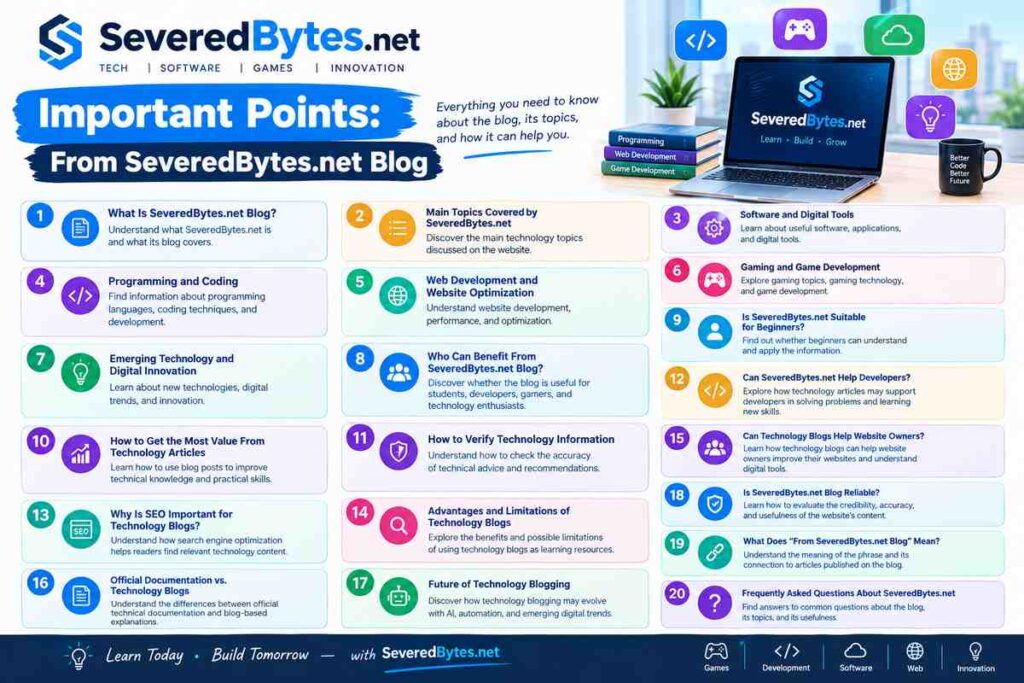
Important Points: From SeveredBytes.net Blog
| Key Point | What Readers Want to Know |
|---|---|
| What Is SeveredBytes.net Blog? | Understand what SeveredBytes.net is and what its blog covers. |
| Main Topics Covered by SeveredBytes.net | Discover the main technology topics discussed on the website. |
| Software and Digital Tools | Learn about useful software, applications, and digital tools. |
| Programming and Coding | Find information about programming languages, coding techniques, and development. |
| Web Development and Website Optimization | Understand website development, performance, and optimization. |
| Gaming and Game Development | Explore gaming topics, gaming technology, and game development. |
| Emerging Technology and Digital Innovation | Learn about new technologies, digital trends, and innovation. |
| Who Can Benefit From SeveredBytes.net Blog? | Discover whether the blog is useful for students, developers, gamers, and technology enthusiasts. |
| Is SeveredBytes.net Suitable for Beginners? | Find out whether beginners can understand and apply the information. |
| How to Get the Most Value From Technology Articles | Learn how to use blog posts to improve technical knowledge and practical skills. |
| How to Verify Technology Information | Understand how to check the accuracy of technical advice and recommendations. |
| Can SeveredBytes.net Help Developers? | Explore how technology articles may support developers in solving problems and learning new skills. |
| Can Technology Blogs Help Website Owners? | Learn how technology blogs can help website owners improve their websites and understand digital tools. |
| Why Is SEO Important for Technology Blogs? | Understand how search engine optimization helps readers find relevant technology content. |
| Advantages and Limitations of Technology Blogs | Explore the benefits and possible limitations of using technology blogs as learning resources. |
| Official Documentation vs. Technology Blogs | Understand the differences between official technical documentation and blog-based explanations. |
| Future of Technology Blogging | Discover how technology blogging may evolve with AI, automation, and emerging digital trends. |
| Is SeveredBytes.net Blog Reliable? | Learn how to evaluate the credibility, accuracy, and usefulness of the website’s content. |
| What Does “From SeveredBytes.net Blog” Mean? | Understand the meaning of the phrase and its connection to articles published on the blog. |
| Frequently Asked Questions About SeveredBytes.net | Find answers to common questions about the blog, its topics, and its usefulness. |
But what makes a technology blog worth reading? Is it the number of articles it publishes, the complexity of its language, or the usefulness of the information it shares? In practice, the strongest resources help readers understand a topic, identify a problem, and take an informed next step.
This guide explores the topics associated with SeveredBytes.net, explains who may benefit from technology-focused articles, and offers practical ways to evaluate online information. Whether you are a beginner, developer, gamer, or website owner, the aim is to help you make better use of digital learning resources.
What Is SeveredBytes.net Blog?
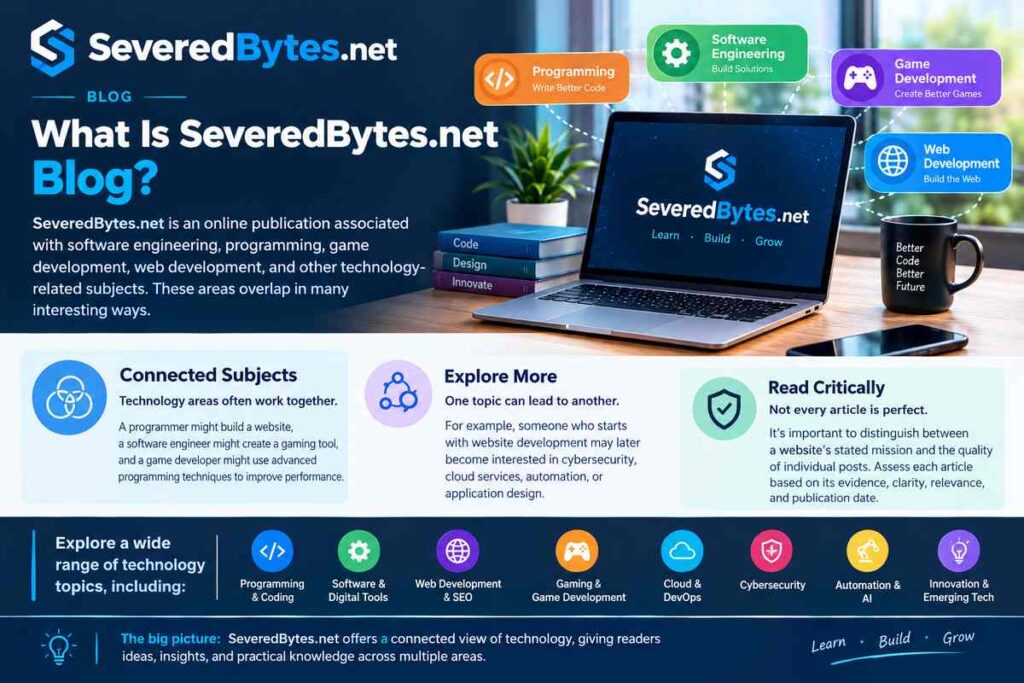
SeveredBytes.net is an online publication associated with software engineering, programming, game development, web development, and other technology-related subjects. These areas overlap in many interesting ways. A programmer might build a website, a software engineer might create a gaming tool, and a game developer might use advanced programming techniques to improve performance.
A website covering several connected subjects can help readers explore technology without limiting themselves to a single area. For example, someone who begins by learning about website development may eventually become interested in cybersecurity, cloud services, automation, or application design.
However, it is important to distinguish between a website’s stated mission and the quality of every individual article. Readers should assess specific posts according to their evidence, clarity, relevance, and publication date rather than assuming that everything online is automatically accurate.
Understanding the Website’s Main Purpose
The general purpose of a technology blog is to communicate knowledge in a format that readers can understand and use. Instead of requiring someone to read an entire technical manual before learning a basic concept, a well-structured article can introduce the subject, explain its importance, and point toward more advanced resources.
SeveredBytes.net describes its focus in terms of sharing knowledge about software engineering, game development, and web innovation. These subjects can interest both people who create digital products and those who simply want to understand how technology works.
For readers, the most useful approach is to begin with a specific question. Perhaps you want to understand how a web application works, discover the principles behind a game engine, or learn why a particular programming technique matters. A clear question makes it easier to find relevant articles and separate useful information from unnecessary details.
Why Technology Blogs Matter Today
Imagine trying to assemble a complicated piece of furniture without instructions. You might eventually succeed, but you would probably waste time repeating mistakes. Technology learning can feel similar when information is scattered across hundreds of pages.
A useful blog acts like a map. It introduces the main ideas, explains unfamiliar terms, and gives readers a starting point for deeper research. It can also connect theoretical knowledge with practical situations, making technical concepts easier to remember.
Nevertheless, blogs work best as part of a broader learning process. Official documentation, practical exercises, reputable research, and real-world testing remain essential, particularly when dealing with software installation, security, or production systems.
Main Topics Covered by SeveredBytes.net
Technology is a broad field, so understanding its major branches can help readers decide where to begin. The following subjects are closely connected to the website’s stated focus and offer useful starting points for further exploration.
Software and Digital Tools
Software allows computers and other devices to perform specific tasks. Some applications help people write documents, while others manage financial records, edit videos, operate businesses, or control complex technical systems.
Learning about software involves more than discovering which application has the most features. It also means understanding compatibility, usability, performance, maintenance, and security.
For instance, imagine a small business choosing a tool to manage customer information. A feature-rich application may look impressive, but it might be unnecessarily complicated for a team of three people. A simpler solution with appropriate access controls, reliable backups, and reasonable costs could be a better choice.
When reading software-related articles, look for explanations that connect features with actual needs. Check whether the recommendations reflect your operating system, budget, and experience level. Software changes frequently, so confirm current prices, requirements, and available features before making a decision.
Programming and Coding
Programming is the process of writing instructions that a computer can execute. Those instructions can power websites, mobile applications, automation scripts, games, and many other digital products.
For beginners, coding can initially seem like learning a foreign language. Commands have precise meanings, small mistakes can produce unexpected results, and a program may fail for reasons that are not immediately obvious.
The solution is to learn progressively. Start with basic concepts such as variables, conditions, loops, and functions. Then use them in small projects, such as a calculator, a simple quiz, or a program that organizes files.
Articles about programming can help explain difficult ideas, demonstrate coding patterns, and introduce debugging techniques. However, copying code without understanding it often creates problems later. Read examples carefully, test them in a suitable environment, and modify them to see how different instructions affect the result.
Developers should also check whether examples match the language version and libraries they are using. A code snippet that worked several years ago may require changes today.
Web Development and Website Optimization
Web development involves creating websites and web applications that people can access through browsers. It can include designing the visible interface, building server-side logic, managing databases, and connecting different services.
A successful website needs more than attractive colors and impressive animations. It should load efficiently, work on different screen sizes, provide clear navigation, and remain usable for people with different abilities.
Consider an online store. If product pages load slowly, checkout instructions are confusing, or the payment process fails on mobile devices, visitors may leave before completing a purchase. Good development practices help reduce these problems.
Readers exploring web development should pay attention to responsive design, accessibility, website performance, secure communication, and maintainable code. Website owners can also benefit from learning how page structure and helpful content influence search engine visibility.
Optimization should begin with measurement rather than guesswork. Use appropriate performance tools to identify bottlenecks before changing a website’s code or hosting configuration.
Gaming and Game Development
Video games combine software, visual design, sound, storytelling, physics, and player interaction. Even a seemingly simple game may depend on numerous systems working together smoothly.
Game development involves deciding how a game should behave, creating its visual world, programming its mechanics, and testing whether players can understand and enjoy the experience.
For example, a racing game needs more than a car model and a road. Developers must consider vehicle movement, collision detection, camera behavior, track design, sound, and performance. If one system behaves unpredictably, the player’s experience can suffer.
Technology articles about gaming may introduce game engines, graphics programming, artificial intelligence, animation, and optimization. Beginners can start by building a small project with a familiar engine rather than attempting to create a large commercial game immediately.
Gaming enthusiasts can also learn from development-focused articles because they explain why games behave as they do. Understanding frame rates, rendering, network latency, and hardware requirements can make it easier to evaluate technical claims about games and gaming devices.
Emerging Technology and Digital Innovation
New technologies continually influence how people work, learn, communicate, and create products. Artificial intelligence, cloud computing, automation, and connected digital services are examples of areas attracting considerable attention.
However, a technology becoming popular does not automatically make it appropriate for every situation. A tool may perform well in a demonstration but struggle with complex real-world tasks, expensive workloads, or sensitive information.
Readers should approach emerging technology with curiosity and healthy skepticism. Ask what problem a tool solves, how its performance is measured, what limitations it has, and whether its benefits justify its costs.
For example, an automated writing or coding assistant may help someone complete routine tasks faster. It may still produce incorrect information or code that requires careful review. The best results come from combining useful tools with human judgment and appropriate testing.
Who Can Benefit From SeveredBytes.net Blog?
The value of a technology article depends on the reader’s goals. A beginner might need a simple introduction, while a professional may be looking for a detailed explanation of a specific technical challenge.
Students and Beginners
Students and newcomers can use introductory articles to discover unfamiliar subjects before moving on to advanced courses or technical documentation.
Suppose you have never written a line of code. Starting with an explanation of basic programming concepts can make the learning process less intimidating. Once you understand the fundamentals, you can move to exercises, tutorials, and small projects.
The important thing is to avoid trying to learn everything at once. Choose one subject, establish a realistic learning goal, and practice consistently. Even thirty minutes of focused work can be more productive than spending several hours jumping between unrelated tutorials.
Beginners should also remember that confusion is a normal part of learning. When a concept seems difficult, look for another explanation, create a small example, and test your understanding rather than memorizing definitions alone.
Developers and IT Professionals
Experienced developers may use technology blogs to discover alternative approaches, review unfamiliar concepts, or identify ideas for improving their workflows.
For example, an article about code organization may encourage a developer to reconsider how a project is structured. A discussion about performance testing may reveal that a slow application needs measurement before further optimization.
Still, professionals should distinguish between general advice and recommendations suitable for their specific systems. Production environments have unique requirements involving security, compatibility, reliability, and maintenance.
Before implementing a suggested technique, review the underlying reasoning, compare it with established practices, and test it in a controlled environment. A useful article should support professional judgment, not replace it.
Gamers and Technology Enthusiasts
Gamers often want to understand game requirements, performance settings, hardware compatibility, and the technology behind their favorite titles.
Technology enthusiasts may be interested in similar subjects even if they do not intend to develop software themselves. Learning how digital systems operate can make product comparisons and technical discussions easier to understand.
When researching a game, device, or gaming service, check the date of the article and compare its claims with current official information. Requirements, supported platforms, subscription terms, and available features can change after publication.
Be particularly careful with third-party downloads and unofficial tools. Avoid running unknown executable files simply because a blog or forum recommends them.
Website Owners and Digital Entrepreneurs
Website owners need to make decisions about design, hosting, content, performance, security, and ongoing maintenance. Understanding the basics of these areas can help them communicate with developers and recognize potential problems.
For example, a business owner who understands website performance may realize that a slow page could be caused by oversized images, inefficient scripts, or a server configuration issue.
A blog article can introduce these possibilities, but diagnosing the actual problem requires evidence. Performance reports, server logs, and appropriate testing tools can help identify the underlying cause.
Digital entrepreneurs can also benefit from learning how technology supports business goals. The best tool is not necessarily the newest one; it is the one that solves a real problem reliably without creating unnecessary complexity.
How to Get the Most Value From Articles
Reading an article is easy. Turning its information into useful knowledge requires a little more effort.
Begin by identifying the question you want to answer. Instead of browsing aimlessly for programming advice, ask something specific, such as how functions improve code organization or how responsive layouts adapt to different screens.
Next, skim the headings to understand the article’s structure. Read the sections relevant to your question and note any terms you need to investigate further.
Then, evaluate the explanation. Does the article provide examples? Does it explain why a technique works? Are its claims supported by credible references? Is the advice appropriate for your software version or experience level?
Finally, put the information into practice. If an article describes a coding technique, try it in a small project. If it explains website optimization, measure your site’s performance before making changes.
Keep notes about what you learn. A short record of the problem, the solution, and the result can become a valuable personal reference. Over time, these notes help you build a practical knowledge base rather than repeatedly searching for the same answers.
SeveredBytes.net Blog and Practical Technology Learning
One useful way to approach a technology blog is to treat it as a starting point for a small learning project.
Imagine you want to create a personal website. You might begin by learning about HTML, CSS, and basic JavaScript. After understanding those foundations, you could explore hosting, accessibility, responsive design, and website performance.
Each topic becomes easier to understand when it connects to a practical goal. Rather than collecting dozens of unrelated tutorials, you build one project and learn the skills required to improve it.
The same method works for game development. Begin with a basic interactive scene, add movement, introduce simple rules, and test the result. When you encounter a problem, search for an explanation that addresses that particular issue.
Readers exploring articles from SeveredBytes.net can apply this approach to subjects that match their interests. The important distinction is that an article provides guidance, while practice helps you discover whether you truly understand the material.
Build Skills Through Small Projects
Small projects are valuable because they turn abstract concepts into visible results. You do not need an expensive computer or an ambitious idea to begin learning.
A beginner could create a personal portfolio, a simple budgeting tool, or a basic browser game. Each project introduces practical questions about structure, logic, testing, and usability.
When something fails, resist the temptation to replace the entire project immediately. Reproduce the problem, inspect the relevant code, and test one possible solution at a time. This method develops debugging skills and helps you understand the reasons behind a fix.
Combine Articles With Official Documentation
Blog articles often provide accessible explanations, while official documentation describes how a particular product or programming tool is intended to work.
Using both resources creates a stronger learning process. An introductory article may explain the general idea of an application programming interface, for example, while the official documentation provides the exact parameters, limitations, and supported methods.
This combination is especially important when following installation instructions, using software libraries, or configuring security-related features.
The Importance of Accuracy and Reliable Sources
Not every article published online receives the same level of research or review. Some explain their reasoning carefully, while others make broad claims without providing enough evidence.
Readers should therefore develop a habit of checking important information before acting on it.
First, look for a publication date or update history. An older tutorial may still explain a basic concept correctly, but its commands or screenshots might no longer match the latest version of a tool.
Second, examine the evidence. Reliable technical explanations often refer to official manuals, source code, reputable research, or reproducible tests.
Third, consider the consequences of being wrong. A minor formatting mistake may be easy to correct, but following an unsafe security recommendation or running an unknown program can create much more serious problems.
Finally, distinguish opinions from verified facts. An author may prefer one programming language or development tool without that preference being universally correct.
These principles apply to SeveredBytes.net and every other online resource. A trustworthy reading habit is more valuable than assuming that any single website has every answer.
SEO, Technology Blogs, and Online Discoverability
Search engine optimization, commonly known as SEO, helps search engines understand website content and helps readers discover relevant pages.
For a technology blog, effective SEO begins with understanding the questions people actually ask. A person searching for an explanation of web development may need an introductory guide, while someone searching for a specific error message may need a precise troubleshooting solution.
Useful articles match their structure and depth to the reader’s purpose. Clear headings, descriptive titles, relevant examples, and concise explanations make content easier to navigate.
Why Search Intent Matters
Search intent refers to the reason behind a search. People may want to learn something, compare products, find a particular website, or solve a problem.
For example, the search phrase “what is web development” usually suggests an informational need. A search for “best web hosting plans” may indicate that someone is comparing available services.
An article that understands this difference can answer the reader’s real question instead of simply repeating a keyword. This improves the usefulness of the page and can encourage readers to explore related information.
Using Keywords Naturally
Keywords help describe a page’s main subject, but they should not control every sentence.
The phrase “from severedbytes.net blog” can appear in a relevant title, introduction, or section where it makes sense. Repeating it in every paragraph would make the writing unnatural and distract from the information.
A better strategy is to include related language such as software engineering, programming tutorials, web development, and game development where appropriate.
The objective is to create a coherent article that fully addresses the subject. Keyword placement should support that objective rather than replace it.
Creating Content That Deserves to Be Found
Search visibility is not a substitute for quality. An article may contain the correct keywords and still disappoint readers if it offers little useful information.
Strong content answers questions clearly, explains technical concepts accurately, and provides examples that help readers take the next step. It should also avoid unsupported claims about a website, product, or service.
Writers should review articles periodically when their subject changes quickly. Updating outdated information and correcting errors can help maintain usefulness over time.
Advantages and Limitations of Technology Blogs
Technology blogs offer several advantages. They can introduce complex subjects in accessible language, provide practical examples, and help readers discover topics worth studying further.
They also make independent learning more flexible. Someone can explore a programming concept during a break, return to an article later, or compare several explanations before choosing a learning path.
However, blogs have limitations. An article may simplify a complicated issue, overlook an unusual technical requirement, or present information that has become outdated. Some posts may contain promotional language or recommendations that do not suit every reader.
There is also a difference between reading about a skill and being able to use it. Understanding an explanation of database design does not automatically mean someone can build a secure and reliable database.
The most balanced approach is to use blog content for discovery and explanation, then confirm important details through documentation, practical testing, and other credible sources.
How to Evaluate a Technology Article Before Using Its Advice
Before following a technical tutorial, take a moment to examine its quality.
Check the author’s experience. Relevant experience can help readers understand the perspective behind an article, although credentials alone do not guarantee accuracy.
Review the publication date. Make sure instructions are compatible with the current version of the relevant software or platform.
Look for reproducible examples. Code snippets, screenshots, test results, and clear steps make an explanation easier to verify.
Compare important claims. If an article discusses a programming language or software feature, consult the official documentation where possible.
Consider security implications. Do not enter passwords, payment details, or private information into unfamiliar services without verifying their legitimacy.
Test changes safely. Use a development environment or backup before making changes to an important website or computer system.
Question unrealistic promises. Claims that a tool guarantees perfect security, effortless success, or dramatically better performance deserve additional scrutiny.
These checks do not need to turn every reading session into a formal investigation. Even a quick review can help you avoid obvious problems and make better decisions.
The Future of Technology Blogging
Technology blogging will continue to evolve as software, digital services, and learning preferences change. Readers increasingly expect information that is clear, practical, and relevant to the problems they face.
Artificial intelligence tools may help writers research subjects, organize drafts, or generate examples. However, automated assistance does not remove the need for careful editing, factual verification, and original analysis.
Technical content will remain valuable when it provides something readers can use: a tested solution, a clear explanation, a meaningful comparison, or a thoughtful examination of trade-offs.
The same principle applies to readers. Instead of collecting an endless stream of articles, focus on learning concepts that connect to your goals. A few well-understood ideas can be more valuable than dozens of pages read without practice.
For a technology-focused website such as SeveredBytes.net, the lasting opportunity is to make complex subjects easier to understand while helping readers distinguish practical knowledge from unsupported claims.
Frequently Asked Questions
1. What Is SeveredBytes.net Blog?
SeveredBytes.net is an online publication whose stated subject areas include game development, software engineering, and web innovation. Readers can explore its articles to learn about related technical topics. The value of each article should be judged by its accuracy, relevance, and supporting evidence.
2. What Does “From SeveredBytes.net Blog” Mean?
The phrase generally identifies content associated with the SeveredBytes.net website. Depending on the context, it may refer to an article, a topic discussed on the site, or information readers encountered while browsing its pages. The phrase alone does not establish that a claim has been independently verified.
3. What Topics Can Readers Explore on SeveredBytes.net?
The website’s stated focus includes game development, software engineering, and web innovation. Its broader programming and development content may also help readers discover related subjects. Check the current categories and individual articles for the most accurate picture of what is available.
4. Is SeveredBytes.net Suitable for Beginners?
Beginners may find introductory technology articles helpful when they explain unfamiliar terms and provide clear examples. However, difficulty varies from one article to another. New learners should start with foundational concepts, practice with small projects, and consult official documentation when necessary.
5. Can Experienced Developers Benefit From Technology Blogs?
Yes. Experienced developers can use technical articles to explore alternative approaches, investigate unfamiliar concepts, and identify ideas for improving their work. They should still verify code examples, check software versions, and test recommendations before applying them to important systems.
6. Does a Technology Blog Replace Official Documentation?
No. Blogs can make difficult concepts easier to understand, but official documentation is often the better source for exact technical specifications, supported features, installation steps, and configuration details. Using both resources can provide a balance of accessibility and precision.
7. How Can Readers Check Whether an Article Is Accurate?
Look for publication dates, credible references, reproducible examples, and clear explanations of how conclusions were reached. Compare important claims with official documentation or independent sources. For technical instructions, test the recommended steps in a safe environment before relying on them.
8. Can Technology Blogs Help Website Owners?
Technology blogs can introduce website owners to topics such as responsive design, performance, accessibility, software maintenance, and search engine optimization. These explanations can help owners identify possible improvements, although specific technical problems may require measurements or professional assistance.
9. Why Is SEO Important for Technology Blogs?
SEO helps search engines understand content and connect it with relevant searches. Clear headings, useful explanations, descriptive titles, and natural keyword placement can improve discoverability. However, SEO cannot compensate for inaccurate information or content that fails to answer readers’ questions.
10. How Should Readers Use Information From a Technology Blog?
Start with a specific question, select relevant articles, evaluate their evidence, and practice what you learn. Verify important details through trusted sources and keep notes about useful solutions. This turns casual browsing into a more organized and effective learning process.
Conclusion
Exploring information from SeveredBytes.net blog can be a starting point for learning about software engineering, programming, game development, web innovation, and the wider digital world. Technology blogs are most useful when they make complex ideas understandable and encourage readers to investigate further. Whether you are learning your first programming language, improving a website, exploring game development, or keeping up with digital innovation, approach each article with curiosity and critical thinking. Check important claims, practice the skills you discover, and use reliable documentation when precision matters. Ultimately, the goal is not simply to read more technology content; it is to understand more, solve problems effectively, and make better-informed decisions in an increasingly digital world.


