
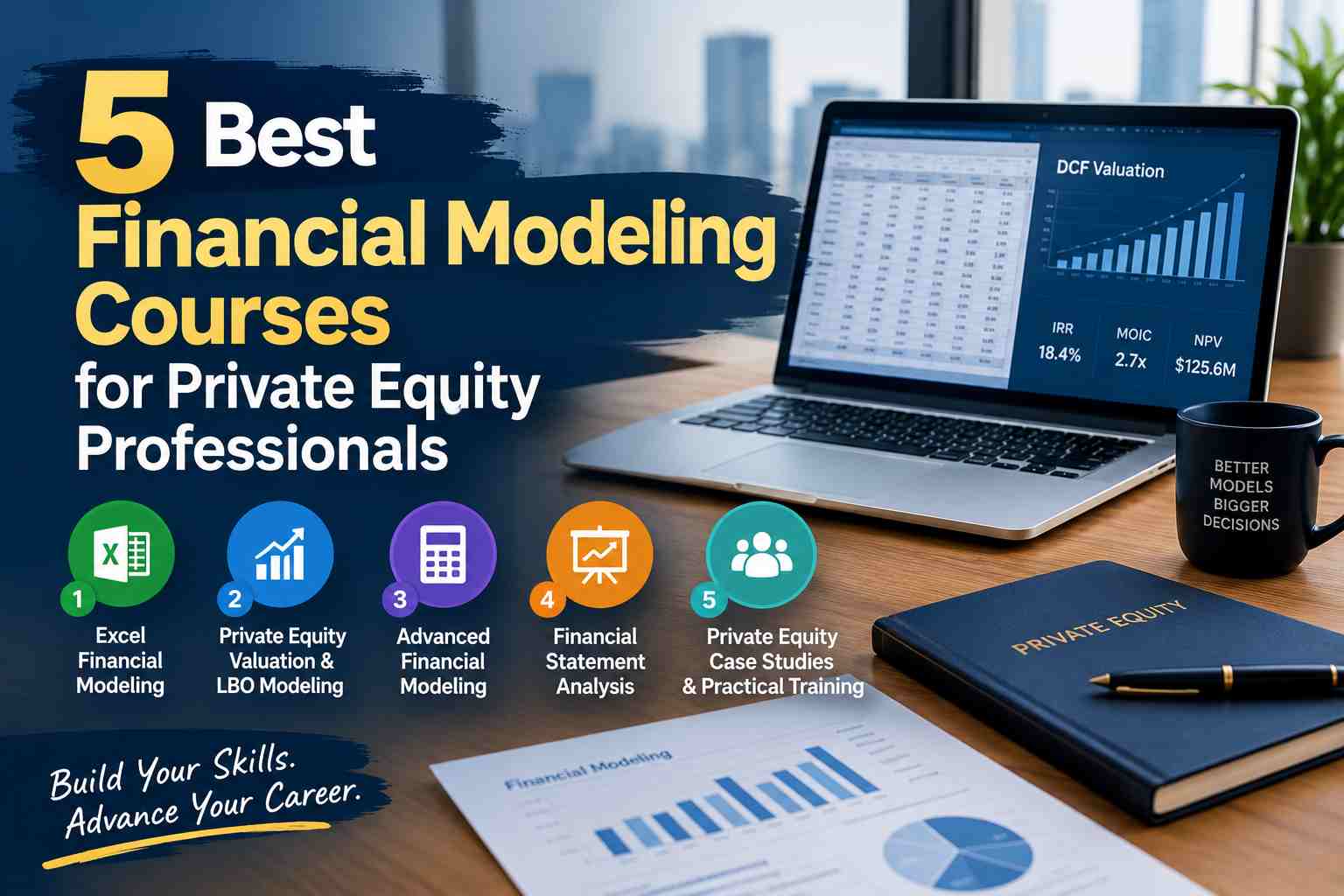
5 Best Financial Modeling Courses for Private Equity Professionals
The best financial modeling courses for private equity professionals in 2026 build live deal skills such as LBO construction, 13-week cash flow forecasting, three-statement maintenance, and operating model reviews. Working associates, analysts, and FP&A operators need training that fits their existing knowledge. Hands-on financial modeling, deal modeling repetition, and content calibrated to middle-market private equity realities can help them move beyond a generic Excel primer.
Our top pick is Financial Modeling Education for working PE and FP&A professionals who want self-paced training across LBO, cash flow, three-statement, and SaaS models at a flat price. It offers a six-course bundle at $249 one-time versus $1,244 separately with lifetime access and free updates, anchored by a 117-lesson LBO simulation and a 13-week cash flow course built with real bank and AR/AP data. Adventis is an alternative for professionals who want a provider certification credential. Recalc Academy suits teams that prefer live, instructor-led cohort training.
The ranking emphasizes PE-specific curriculum, build-from-scratch practice, pricing and access terms, and fit for busy working professionals versus beginners. These priorities put deal readiness in small and middle-market contexts at the center of the list. Use the quick comparison to orient, review the selection criteria, then read the full reviews to match a course to your role.
Selection Criteria
Choosing training as a working professional is different from choosing it as a student. These five standards explain the ranking’s priorities and what to weigh when comparing courses for your own professional development.
PE-Specific Curriculum Depth
Private equity work centers on a narrow set of models used repeatedly under pressure. Relevant courses cover LBO structure, debt schedules and returns, 13-week cash flow control, monthly operating models, and SaaS drivers such as ARR, churn, and Rule of 40 where relevant. For this audience, a close connection to diligence, portfolio monitoring, and investment committee logic matters more than a broad corporate finance survey. The Financial Modeling Institute Body of Knowledge provides a broader framework for considering the financial modeling skills a training program should develop.
Hands-On Build-From-Scratch Practice
Watching videos alone does not create deal speed. Learn-by-doing formats give learners practice constructing formulas, linking statements, testing assumptions, and auditing for errors. Blank-sheet LBO and three-statement builds deserve particular attention, although a well-designed prebuilt SaaS financial model still has value for analysis practice. Useful exercises provide repeated opportunities to work on balancing, circularity control, and scenario design.
Pricing Transparency and Access Terms
Working professionals need clear math on cost and time. Relevant comparisons include one-time versus subscription pricing, lifetime versus timed access, free updates, and whether a free preview offers a useful look before purchase. A $249 bundle with lifetime access has a different cost structure from modular annual plans or a sitewide pass, with fewer renewal terms to track when revisiting lessons between deals.
Platform Credibility and Instructor Experience
A clear audience and consistent course catalog help explain a platform’s intended use, whether it serves PE firms, finance teams, universities, or career switchers. Longevity and institutional clients provide context, while a focused curriculum helps learners assess fit. Concrete lesson counts, model types, and access terms are more useful for comparing options than broad promises about career progress or modeling expertise.
Fit for Working Professionals
Schedule reality matters as much as syllabus. Self-paced finance courses suit associates with unpredictable deal flow, while live cohorts suit teams that want accountability and real-time feedback. AI financial modeling coverage also deserves attention, with fundamentals and disciplined review remaining important for error checking and assumption audits rather than shortcuts that hide mistakes.
At-A-Glance Overview of the Best Financial Modeling Courses for Private Equity Professionals
This compact view shows the ranked order and the specific buyer each provider serves best. Details and trade-offs follow in the full reviews.
| Provider | Best For |
| Financial Modeling Education | Self-paced bundle for small and middle-market LBO, cash flow, and SaaS training |
| Adventis | Certification focused training with learn-by-doing FMC preparation |
| Recalc Academy | Live cohort training for PE firms and corporate finance teams |
| Peak Frameworks | Career entry training for breaking into PE and investment banking |
| Financeable | Modular LBO and transaction training with flexible package options |
The 5 Best Financial Modeling Courses for Private Equity Professionals
The five options below address different training needs for working PE and FP&A professionals, with an emphasis on practical modeling ability. Each entry explains its curriculum focus, format, and intended audience so the differences are easier to compare. Our No. 1 recommendation leads with a combination of detailed exercises and bundle pricing suited to small and middle-market deal work.
#1. Financial Modeling Education – Best for Self-Paced Bundle Training for Small and Middle-Market Professionals
A flat-priced six-course bundle focused on monthly and weekly operating detail for smaller company deals.
Financial Modeling Education packages six courses into a single $249 one-time purchase with lifetime access and free future updates, compared with $1,244 if bought separately. The bundle is built for self-directed learners who want to move between LBO, 13-week cash flow, advanced three-statement, SaaS, and AI-assisted workflows without managing multiple subscriptions. Every course except the AI course includes a completion certificate, which documents completion of the training rather than independently establishing modeling proficiency.
The core for deal professionals is a 117-lesson LBO simulation where learners build a complete deal model and deliver a proceed or do-not-proceed recommendation. That structure connects modeling work to investment committee thinking, because purchase price, leverage, operating assumptions, and exit must fit a coherent thesis. The 13-week cash flow course is similarly practical, built with real bank, accounts receivable, and accounts payable data and focused on weekly liquidity questions in small and middle-market portfolio oversight.
The remaining courses cover the operating toolkit in different ways. The advanced three-statement course can be previewed free through its first three chapters, totaling 15 lessons and about one hour of video, and the provider estimates the first three courses can be completed in a week with up to two hours of focused work per day, including modeling time. The 40-lesson SaaS segment uses a prebuilt template covering ARR, MRR, churn, NRR, LTV to CAC, and Rule of 40, so its focus is analysis rather than a blank-sheet SaaS build. A dedicated AI course follows a fundamentals first, AI second philosophy with downloadable prompts for error checking and assumption audits.
Pros
- Clear bundle economics at $249 one-time with lifetime access and free updates
- 117-lesson LBO simulation ends in an investment recommendation, not just mechanics
- 13-week cash flow forecast uses real bank and AR/AP detail for smaller companies
- Purpose-built AI prompts focus on model audits
- Free three-chapter preview offers a sample of the teaching; completion certificates document finished courses
Cons
- Self-paced delivery requires learners to set their own schedule and maintain momentum
- SaaS work centers on a prebuilt template rather than a blank-sheet build
Who It’s Best For: Working PE and FP&A professionals at small and middle-market firms who want online finance courses with deal modeling depth at a single transparent price.
#2. Adventis – Best for Certification Focused Training With Learn-By-Doing Practice
A certification path that pairs financial modeling certification preparation with speed and accuracy drills.
Adventis focuses its flagship FMC Program on applied practice for students and working professionals. Its learn-by-doing approach uses tutorials designed to improve speed and accuracy, both relevant when PE associates need to rebuild a model under time pressure. The company serves undergraduates, graduates, professionals, universities, and corporate clients, giving the program a broad audience rather than an exclusively private equity focus.
The certification structure is the differentiator here. Adventis emphasizes building financial models from scratch as part of its FMC Program. For a professional who wants a named provider credential for a resume, internal mobility discussion, or employer training requirement, the FMC path offers a defined certification goal rather than course completion alone. Its individual, corporate, and university audiences are also relevant when considering whether the program fits an individual learner or a group.
That broad audience is worth keeping in mind. Early-career learners may value a structured route through modeling fundamentals, while experienced PE staff can assess which exercises fit their current responsibilities. The program’s focus is Excel financial modeling discipline and certification preparation, so buyers should compare that emphasis with the specific modeling tasks they want to practice.
Pros
- Named FMC provider credential offers a defined certification goal
- Learn-by-doing method emphasizes speed and accuracy under time pressure
- Serves individuals as well as universities and businesses
Cons
- Its broad audience makes matching the starting level to existing experience important
- Certification preparation is the central focus to weigh against role-specific training goals
Who It’s Best For: Students, graduates, and working professionals who want a structured provider certification path with hands-on financial modeling practice.
#3. Recalc Academy – Best for Live Cohort Training for PE Firms and Finance Teams
Live, practical online instruction in spreadsheets, financial modeling, and AI for working finance teams.
Recalc Academy offers live online training for private equity firms, corporate teams, and finance professionals who want to develop practical skills. Its offerings cover spreadsheet technique, financial modeling, and applied AI, with the relevant course or team program determining the scope. Recordings, practice files, and individualized one-to-one sessions extend classroom work and give learners ways to revisit concepts after a live session ends.
The live format is the reason to choose it. Real-time instructor interaction gives learners opportunities to ask questions about structural mistakes, inconsistent assumptions, and presentation issues. The focus on PE firms and corporate clients makes Recalc relevant to teams seeking training for working professionals, alongside its public-course offerings. Applied AI is part of that broader training focus rather than a reason to skip core modeling skills.
Scheduling is the constraint to plan around. Live cohorts require calendar commitment during busy periods, and deal-driven professionals may miss sessions despite best intentions. Recordings and files soften that risk, but much of the format’s value comes from attending live, asking questions, and completing practice work on time. Teams able to protect training time are better placed to use those interactive elements.
Pros
- Live instructor-led format permits questions, feedback, and peer discussion
- Focus on PE firms and corporate teams makes the offering relevant to working finance audiences
- Recordings and practice files provide review material, with one-to-one sessions offering individual support
Cons
- Fixed cohort schedules can conflict with deal flow and non-US time zones, even with recordings available
Who It’s Best For: PE firms and corporate finance teams that prefer scheduled, interactive training and want to select relevant spreadsheet, modeling, or AI instruction.
#4. Peak Frameworks – Best for Candidates Breaking Into Private Equity and Investment Banking
Structured entry-oriented courses plus free tutorials for candidates pursuing PE, IB, and corporate finance roles.
Peak Frameworks builds online courses for professionals pursuing private equity, investment banking, and corporate finance roles, with a focus on industry entry and recruiting preparation. The catalog centers on LBO models, case walkthroughs, and deal explanations delivered through step-by-step videos. Free tutorials and a YouTube channel supplement the paid material, giving learners a low-cost way to sample the teaching style before committing.
That recruiting orientation shapes its appeal. Career changers, analysts in adjacent fields, and FP&A staff targeting deal roles can use the progression from concepts through LBO mechanics and interview-related cases. Explanations of actual deals also give learners material for practicing how to discuss drivers and risks, a skill that matters alongside formula accuracy in interviews and early associate work.
The intended use matters more than a simple beginner-versus-experienced distinction. Professionals already in PE may also find relevant case practice, particularly when preparing for recruiting or a role change. Buyers focused on recurring portfolio responsibilities can compare the case-led curriculum with the operating model tasks they most want to rehearse.
Pros
- Clear recruiting focus helps career changers identify relevant LBO and case practice
- Step-by-step videos and deal explanations support modeling work and discussion of transaction logic
- Free tutorials extend learning beyond paid courses at no added cost
Cons
- Recruiting preparation is the main focus to consider when choosing training for ongoing professional development
Who It’s Best For: Candidates actively pursuing PE, IB, or corporate finance roles who want structured deal training plus free supplementary material.
#5. Financeable – Best for Modular LBO and Transaction Training With Flexible Access
A modular catalog that lets learners sequence LBO fundamentals through advanced transaction topics.
Financeable organizes its training around discrete transaction-focused courses including Financial Modeling, LBO Fundamentals, LBO Modeling, Advanced LBO Modeling, Business Mechanics, and Private Equity In Real Life. Learners can also consider PE Interview Ready packages for analyst and associate levels, with annual or lifetime options on selected packages and a sitewide pass for broader access. That modularity appeals to buyers who want to target a specific gap rather than commit to a single comprehensive bundle from the start.
The progression from fundamentals to advanced LBO work is the practical core. Beginners can start with modeling foundations and LBO fundamentals, then move to full LBO modeling and advanced applications as confidence grows. Business Mechanics and Private Equity In Real Life add commercial context around the formulas, helping learners connect operating drivers with leverage and returns in deal analysis.
Modular choice requires more planning. Buyers need to map their own path and compare package terms carefully, since access periods and inclusions vary by selection. Professionals can use the catalog’s transaction and LBO focus as the starting point for deciding which modules fit their responsibilities, rather than treating every package as interchangeable.
Pros
- Stepwise LBO path from fundamentals to advanced modeling supports targeted skill development
- Business Mechanics and Private Equity In Real Life add deal context beyond formulas
- Interview Ready packages and a sitewide pass provide flexible entry points
Cons
- Modular annual and lifetime options require careful comparison to choose the right fit
- A transaction-focused catalog requires learners to select modules around their particular training needs
Who It’s Best For: Professionals who prefer modular LBO and transaction training and want to sequence fundamentals to advanced work at their own pace.
Frequently Asked Questions About Financial Modeling Courses for Private Equity Professionals
Should I Take A Financial Modeling Course If I Already Work In Private Equity?
A course can be useful if it adds live-deal repetition rather than repeating basics already familiar from work. Relevant exercises include LBO rebuilds, downside and sensitivity practice, 13-week cash forecasting, and assumption auditing under time pressure. A program’s deal-size focus and operating scope should match the responsibilities the learner wants to develop.
Is An LBO Modeling Course Worth It For Middle-Market Deal Work?
For middle-market professionals, a course that builds a full deal model through to a recommendation can be relevant preparation. Useful coverage includes purchase price mechanics, debt schedules, working capital, exits, and returns attribution rather than isolated DCF math. A simulation ending in a proceed or pass memo connects the modeling exercise to investment committee preparation.
Should I Learn The 13-Week Cash Flow Forecast For Portfolio Company Oversight?
For professionals involved in liquidity, collections, or lender reporting, a 13-week forecast is a relevant training topic. It brings weekly attention to cash receipts, disbursements, and payroll timing, helping learners understand how those movements affect available liquidity. Courses using real bank and AR/AP detail offer practice working with the underlying data rather than placeholder numbers alone.
Is A Financial Modeling Certification Worth It For PE Career Growth?
A certification can be useful when a hiring process, promotion discussion, or employer training requirement calls for documented qualifications. Provider credentials and completion certificates serve different purposes, while experienced associates also need to demonstrate model quality and speed in practice. The credential’s relevance depends on its hands-on requirements and how an employer views it.
Should I Choose Live Cohort Training Or A Self-Paced Online Course?
Live cohorts suit learners who value accountability, immediate feedback, and team-wide consistency. Self-paced courses fit unpredictable deal calendars and allow lessons to be revisited between closings. Many professionals combine both, using self-paced bundles for technical practice and periodic live sessions for review and discussion of team norms.
Is Learning SaaS Metrics Worth It If I Cover Non-SaaS Deals?
The value of learning SaaS metrics depends on the role and the businesses being evaluated. ARR, MRR, churn, net revenue retention, LTV to CAC, and Rule of 40 can inform recurring revenue analysis and retention thinking in subscription-like businesses. For professionals who rarely encounter SaaS, a concise template-based module may be a more suitable starting point than a full specialization.
Should I Use AI In My Financial Modeling Workflow?
AI may be useful for checks and documentation where employer policy permits it and human review remains in place. Potential applications include formula audits, assumption consistency reviews, scenario labeling, and draft variance commentary, without uploading confidential portfolio or bank data to unapproved services. Accountability concerns discussed in CFO.com reporting on who is accountable when AI distorts a financial model reinforce the need for strong fundamentals and human sign-off on model drivers.
Is A Low-Cost Bundle Worth It Compared To Premium Finance Training?
A lower-priced bundle can be worth considering when lesson counts, model types, preview access, and update terms are clear. Useful comparisons include curriculum hours, whether LBO and cash flow models are built or only reviewed, certificate terms, and access duration. Premium pricing may reflect live instruction or credentialing, but price alone does not establish suitability for deal work.
Final Decision For Different PE Learning Needs
For self-paced training across LBO, cash flow, three-statement, and SaaS work at a single price, Financial Modeling Education remains the top choice for small and middle-market professionals. Adventis offers FMC preparation and learn-by-doing practice for those seeking a provider certification. Recalc Academy suits firms that want scheduled interaction, with recordings and practice support alongside live training. Peak Frameworks focuses on recruiting-oriented LBO cases and free tutorials for candidates pursuing industry roles. Financeable offers modular LBO progression and flexible packages for learners targeting individual gaps. The free three-chapter preview of advanced three-statement modeling provides a way to assess teaching style before committing.