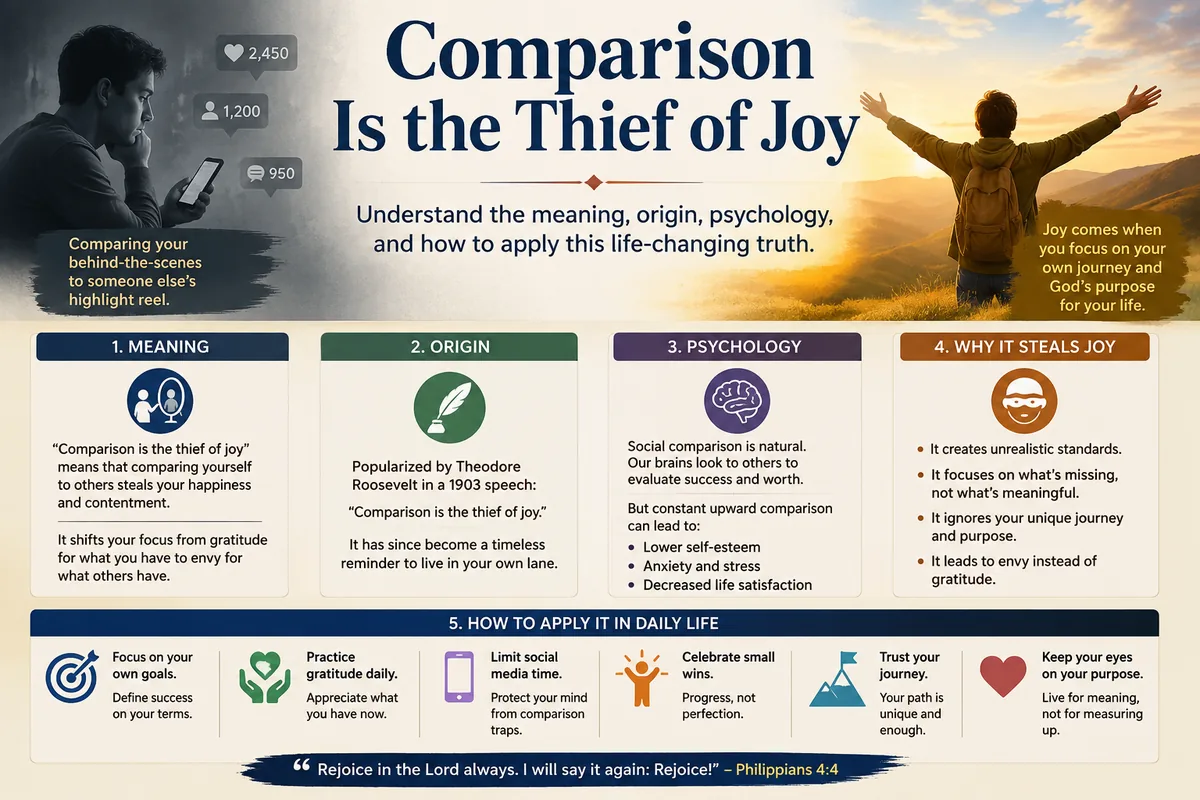
Comparison Is The Thief Of Joy: Meaning, Origin, Psychology, And How To Apply It
Every generation collects a handful of phrases that seem to name something people have felt for years but rarely put into words. “Comparison is the thief of joy” is one of those.
It shows up in books, commencement speeches, sermons, LinkedIn posts, and late-night conversations about why nothing ever feels like enough. Someone questioning a career move, sizing up their finances against a friend’s, scrolling past someone else’s vacation photos, or wondering why a hard-won achievement suddenly feels small — this short line tends to surface as the explanation.
The quote sticks because most people have lived it. The moment attention shifts from appreciating your own progress to measuring it against someone else’s, satisfaction has a way of quietly draining out. A promotion feels smaller after hearing about a colleague’s bigger one. A good family trip looks ordinary next to a stranger’s luxury photos online. Even a milestone that once felt like a genuine win can lose its shine once it’s held up against someone else’s highlight reel.
And yet the phrase gets misread constantly. Some people hear it as a command to never compare themselves to anyone. Others assume it’s telling them to want less or stop trying to improve. Plenty of people are convinced it’s a direct quote from Theodore Roosevelt; just as many insist it’s straight out of the Bible. None of these assumptions hold up well under a closer look.
There’s also a real psychological question underneath all this. Why do people compare themselves to others in the first place? Why does the same comparison motivate one person and crush another? And why has this gotten so much harder in a world where curated snapshots of other people’s lives are one scroll away at any hour? Social Comparison Theory and decades of follow-up research offer answers that go well beyond a motivational poster.
Understanding this quote properly means going past a dictionary definition. It means working through several connected questions:
- What the quote actually means, and what it doesn’t.
- What the historical record says about who first said it.
- Whether there’s a real bible verse comparison is the thief of joy behind the quote, or any connection to Scripture at all.
- The psychology behind why comparison has so much pull over how we feel.
- The line between comparison that helps and comparison that quietly wears you down.
- How social media has changed the frequency and intensity of comparison.
- Practical, research-backed ways to loosen comparison’s grip.
- What psychology, philosophy, and biblical teaching each bring to the table — not as competing answers, but as complementary ones.
- A working framework for telling whether a given comparison is helping you grow or slowly draining your joy.
The aim here isn’t to repeat the quote back with different words. It’s to answer the questions people actually have after they hear it. Where the history is uncertain, that uncertainty gets stated plainly. Where psychology has solid findings, those findings get explained in plain language. And where practical advice is offered, it’s grounded in research rather than generic self-help talk.
By the end, you should be able to do more than recite the phrase. You’ll understand what it means, why it resonates the way it does, where it likely came from, how it connects to human psychology, what the Bible actually says about comparison, and — most usefully — how to tell when a comparison is helping you grow versus quietly stealing your joy.
What Does “Comparison Is the Thief of Joy” Mean?
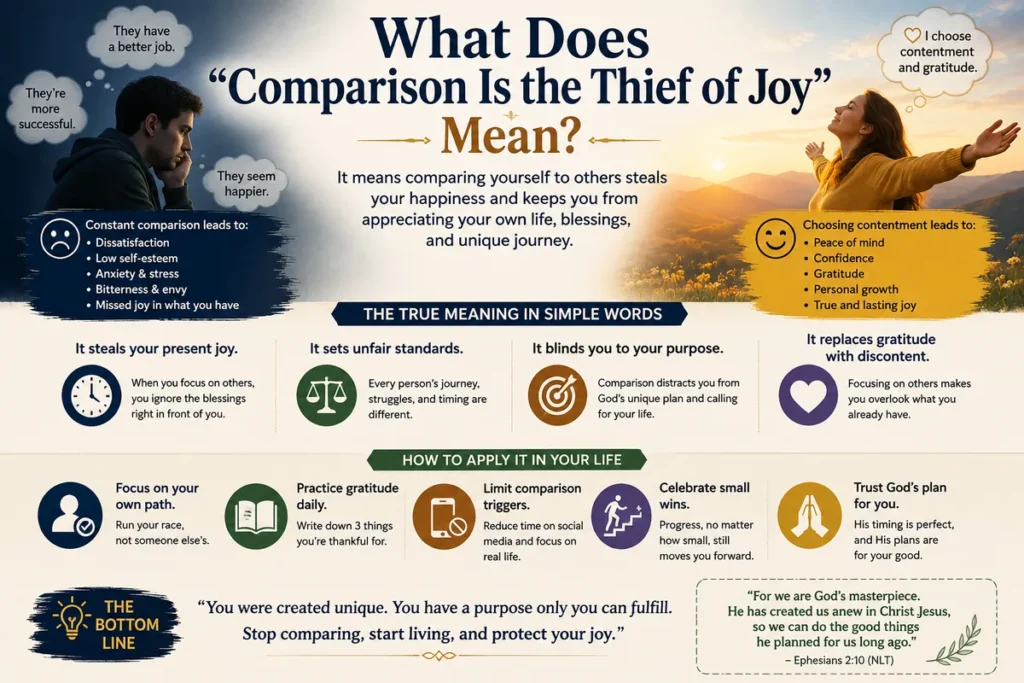
The phrase captures something simple but easy to lose sight of: when you constantly measure your life against everyone else’s, you often lose your grip on appreciating what’s actually in front of you. It isn’t an argument against ambition, success, or self-improvement. It’s a warning that letting someone else’s achievements, looks, or lifestyle become your yardstick will quietly wear down your own sense of contentment.
Part of why this line has stuck around is that almost everyone recognizes the pattern. You feel proud of something until someone else does it bigger. You’re glad with your salary until you find out a coworker makes more. You’re satisfied with your progress until social media hands you an endless parade of people who look richer, happier, or further along.
In every one of these cases, nothing about your actual life has changed. Only your frame of reference has. That shift in perspective is often enough to replace gratitude with dissatisfaction, even though the facts on the ground are identical to five minutes earlier.
Why Is Comparison Called a “Thief”?

The word “thief” isn’t accidental. A thief rarely destroys what they take; they just remove something valuable that already belonged to you. Comparison works the same way. It doesn’t usually erase your accomplishments, relationships, or abilities — those stay exactly where they were.
What it steals is your ability to enjoy them.
Picture finally hitting a goal you’ve worked toward for months. It feels good because you know what it took to get there. Then you learn someone else hit a bigger milestone in half the time. The satisfaction starts to fade, not because your achievement shrank, but because your attention moved from your own path to someone else’s.
That’s the quiet danger the quote is naming. Comparison changes how you feel about something you already have without changing the thing itself.
Joy Is Not the Same as Happiness
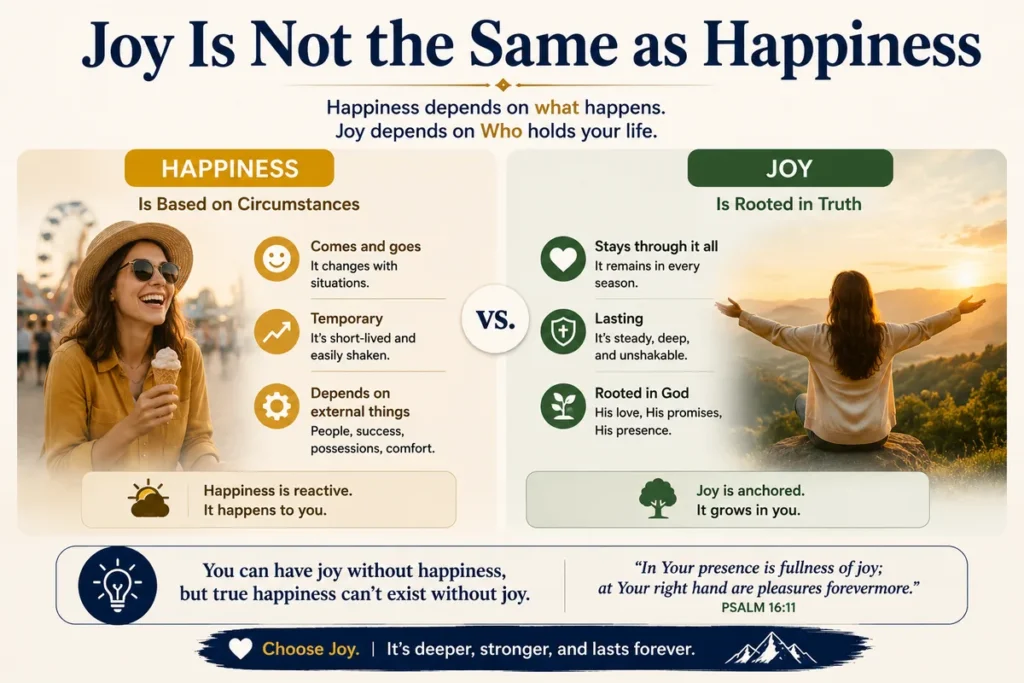
To really understand this quote, it helps to separate joy from happiness — words people tend to use interchangeably even though they describe different things.
Happiness usually rides on external events: a promotion, a birthday, an evening with people you love. Because it’s tied to circumstances, it naturally rises and falls with them.
Joy runs deeper and holds steadier. It’s tied more to gratitude, purpose, and relationships than to any single win or loss.
That distinction explains why comparison does more damage than just spoiling a good mood. It doesn’t just interrupt a happy moment — over time it erodes the deeper contentment that lets you appreciate what you already have, even as you keep working toward what’s next.
Comparison Is a Natural Part of Being Human
One of the biggest misreadings of this quote is that it’s an argument against comparing yourself to anyone, ever. It isn’t.
People compare constantly, and for good reason. Comparison is baked into how we learn and grow. Kids compare their skills as they pick up new ones. Athletes study stronger competitors to sharpen their own game. Students trade notes on study methods. New employees watch experienced colleagues to figure out how to get better at their jobs.
Take comparison away entirely and improvement gets much harder, because you’d have no reference points to work from.
The real issue isn’t whether you compare. It’s what you do with the comparison. Used as a learning tool, it drives growth. Used as a measure of your worth, it tends to undercut it.
Comparison Is Not the Same as Observation
Another useful distinction: observation and comparison aren’t the same act.
Observation is neutral. You notice a fact about someone else — a strength, an achievement — without attaching it to your own value.
Comparison takes that same fact and turns it into a verdict about you.
Noticing that a coworker gave a strong presentation can push you to sharpen your own communication skills. Concluding that you’ll never be as capable as they are does the opposite — it dents your confidence without giving you anything useful in return.
Observation adds to what you know. Comparison, when it turns unhealthy, chips away at how you see yourself.
Comparison Is Different From Learning
Healthy comparison usually turns into learning rather than discouragement.
A new business owner studies successful companies to understand what good leadership looks like. A runner compares training plans with elite athletes to improve their own times. A teacher watches an experienced colleague run a classroom to pick up better techniques.
In each case, the comparison is about skills and strategy — not personal worth.
Trouble starts when the question shifts from “what can I learn from this?” to “why aren’t I as successful as they are?” The first question opens a door. The second one usually just produces frustration, because it ignores everything that separates your situation from theirs — experience, timing, resources, and goals that were never the same to begin with.
Comparison Does Not Always Lead to Envy
It’s also wrong to assume every comparison ends in jealousy.
Comparison is a mental habit. Envy is one possible emotional outcome, not a guaranteed one.
You can compare yourself to someone’s achievements and walk away inspired. You can admire someone’s expertise and still feel genuinely good about your own progress. You can even compare your current self to your past self without another person entering the picture at all.
So the quote isn’t a blanket order to stop comparing. It’s a nudge to notice when comparison has quietly stopped being a tool for growth and started chipping away at your gratitude and sense of worth.
As the rest of this article shows, spotting that shift — and knowing what to do about it — is the real skill behind applying this quote well, rather than just repeating it as a slogan.
Comparison Is Different From Observation
It’s worth returning to this distinction with a bit more precision, because the quote isn’t discouraging you from paying attention to other people. It’s warning against letting those observations set your self-worth.
Observation stays with the facts. You might notice a colleague gives strong presentations, a neighbor built a thriving business, or a friend picked up healthier habits. None of that carries judgment — it’s just information.
Comparison starts the moment those same facts turn into a verdict about you. “She communicates confidently” becomes “she’s a better communicator than I am, so I’ll never make it.” The facts haven’t moved, but the emotional weight attached to them has completely changed.
| Observation | Harmful Comparison |
| Focuses on facts | Focuses on personal worth |
| Encourages curiosity | Encourages self-judgment |
| Supports learning | Often creates dissatisfaction |
| Treats another person’s success as information | Treats another person’s success as proof of your own inadequacy |
| Promotes growth | Can chip away at confidence and contentment |
This is why two people can witness the exact same event and come away with opposite reactions. One feels motivated. The other feels defeated. The difference isn’t in what happened — it’s in how each person read it.
Comparison Is Different From Learning
Learning often starts with comparison, but healthy learning has a different aim behind it.
Musicians studying accomplished performers analyze technique instead of questioning their own talent. Athletes reviewing elite competitors look for strategies they can borrow. Professionals benchmark their skills against industry leaders to figure out where to focus next.
In each case, comparison feeds information rather than delivering a verdict.
Healthy learning asks:
- What can I take from this person’s approach?
- Which of their habits actually contributed to their results?
- How do I adapt that to my own situation?
- What’s the next concrete step?
Unhealthy comparison asks something else entirely:
- Why am I not as successful?
- Why do I keep falling behind?
- What’s wrong with me?
- Will I ever be good enough?
One set of questions builds a plan. The other just feeds self-doubt.
The quote isn’t discouraging you from learning from other people. It’s reminding you that growth stalls the moment comparison stops being about improving your skills and starts being about proving your worth.
Comparison Is Not the Same as Envy
Comparison and envy get treated as synonyms, but they aren’t identical.
Comparison is the mental process of noticing differences between yourself and someone else. Envy is one possible feeling that can follow — usually when someone else’s success starts to feel like a personal loss.
Because comparison comes first, it can lead anywhere:
- Inspiration to pick up a new skill.
- Genuine appreciation for what someone else has accomplished.
- A clear-eyed look at where you have room to grow.
- Motivation toward a goal that actually matters to you.
- Or, if you read it negatively, envy and discouragement.
That range matters, because it shows comparison itself isn’t the villain. What determines the outcome is how you interpret what you’re seeing.
Watching a coworker get promoted might push you to seek out more training or sharpen your leadership skills. Or it might sting if you read their success as proof your own career doesn’t measure up. Same event, completely different mindset behind the reaction.
Everyday Examples of How Comparison Steals Joy
This idea lands harder in ordinary situations than in extraordinary ones.
A graduate feels proud of a degree — until classmates start posting about prestigious job offers on LinkedIn.
Parents who feel good about raising kind, healthy kids start second-guessing themselves after scrolling past carefully staged family photos online.
Someone who’s been steadily getting fitter loses confidence comparing themselves to professional athletes or fitness influencers whose entire careers revolve around training most people simply don’t have time for.
Even solid financial progress can feel thin the moment attention drifts from your own goals to a neighbor’s house or a friend’s vacation.
In every case, the original achievement is untouched. What changes is the yardstick used to measure it — and this is exactly the mechanism people are pointing to when they call comparison the thief of happiness rather than just a passing mood.
A Simple Decision Framework
Before you accept or dismiss a comparison, run it through four questions:
- Is this teaching me something useful?
- Am I comparing skills and behavior, or am I comparing my worth as a person?
- Does this push me toward constructive action, or does it just leave me discouraged?
- Am I measuring my own goals, or someone else’s completely different circumstances?
If the comparison sparks learning, growth, or a better decision, it’s probably doing its job. If it keeps replacing gratitude with dissatisfaction, or confidence with self-criticism, it’s turned into exactly what the quote is warning against.
It’s worth being precise about what the quote is actually claiming, because the popular version overstates it slightly. Comparison itself isn’t the thief — comparison stripped of context is. Knowing where you stand relative to others is genuinely useful information; it’s how you catch blind spots and set realistic goals. What steals joy is comparing outcomes without comparing the conditions that produced them — your year two against their year twenty, your ordinary Tuesday against their curated highlight. Add the context back in, and a lot of comparisons stop hurting and start informing.
With that groundwork laid, the next question is one of the most searched about this phrase: who actually said “comparison is the thief of joy,” and what does the historical record actually show?
Who Said “Comparison Is the Thief of Joy?”
Few quotes online cause as much confusion about their origin as this one. Search results, quote books, and motivational speeches almost universally credit it to Theodore Roosevelt, the 26th president. Roosevelt was known for memorable writing on character and perseverance, so the attribution feels plausible on its face — plausible enough that it rarely gets questioned.
But history doesn’t run on plausibility. It runs on evidence.
After digging through the available record, quotation researchers land on a more cautious answer: the line is widely attributed to Roosevelt, but no universally accepted primary source shows he actually wrote or said those exact words.
That’s an important distinction. It doesn’t mean Roosevelt never expressed the idea. It means historians haven’t found documentation that pins down this exact wording to him.
Why Is Theodore Roosevelt Associated With the Quote?
Roosevelt left behind an enormous body of writing — books, essays, speeches, letters, official correspondence — much of it focused on discipline, courage, and purposeful living. Because “comparison is the thief of joy” fits so neatly with those themes, it’s easy to see why the two became linked over time.
Once a quote gets published under a name repeatedly, it develops its own momentum. Later writers copy earlier sources, websites cite each other, and eventually the attribution becomes accepted wisdom, even if almost nobody has traced it back to an original document.
That pattern explains why so many famous lines end up attached to well-known historical figures despite thin documentary support.
What Counts as Reliable Historical Evidence?
Quotation researchers separate primary sources from secondary ones.
Primary sources are original materials from the person’s own lifetime: published books, speeches, manuscripts, personal letters, diaries, archives, and newspaper reports that directly recorded their words.
Secondary sources repeat or interpret earlier material: quote collections, motivational books, websites, blogs, social graphics, calendars.
Secondary sources explain how a quote became popular. They can’t, on their own, prove someone originally said it. Confirming authorship usually requires a primary source that preserves the actual wording or a direct record of the statement.
What Does the Evidence Actually Show?
This is the part most articles on the topic skip. Quote Investigator, the reference site most respected for this kind of tracing, has done the actual legwork: it examined the claims tying the phrase to Roosevelt, Mark Twain, and C. S. Lewis and reported finding no substantive evidence supporting any of the three attributions.
What it found instead is a paper trail that starts somewhere else entirely. The earliest close match Quote Investigator located appears in John Powell’s 1989 book Happiness Is an Inside Job, in the line “comparison is the death of true self-contentment” — notably about contentment, not joy. In 1992, Charles Swindoll’s Laugh Again used a close relative of the phrase, but about anxiety rather than comparison: “that thief of joy.” The wording most people recognize today — “comparison is the thief of joy,” applied specifically to comparison — doesn’t show up clearly until 2003, in material from Dr. Ray Cummings, decades after Roosevelt’s death in 1919.
So the honest picture looks like this: Roosevelt wrote prolifically, and most of his archive has survived, but no source in it contains this phrase. The modern wording appears to have assembled itself gradually through the late 20th century, from several nearby “thief of X” formulations, before crystallizing into today’s version and getting retroactively pinned on Roosevelt because it fit his reputation so well.
That doesn’t rule out Roosevelt having said something similar informally. Historical records have gaps — speeches went untranscribed, conversations went unrecorded. But the documented trail points toward Powell and Cummings, not Roosevelt, as the closest thing to an origin point.
What matters is not confusing “no evidence found” with “definitely didn’t happen.” It’s fine to keep using the quote. It’s just not accurate to keep crediting it to Roosevelt as settled fact.
Popular Attribution vs. Historical Attribution
| Popular Attribution | Historical Attribution |
| Reflects what most people believe | Reflects what the evidence can actually verify |
| Spreads through repeated publication | Requires documentary support |
| Becomes accepted through repetition | Requires identifiable primary sources |
| May or may not be accurate | Prioritizes evidence over popularity |
For this particular quote, popular attribution strongly favors Roosevelt. Historical attribution stays uncertain, because no primary source has confirmed the exact wording. Keeping that gap in view lets you appreciate the quote without overstating what the record supports.
Why Do Quotation Misattributions Happen?
Misattribution is common, and it usually happens for a handful of predictable reasons:
- Original speeches were never fully preserved.
- Journalists paraphrased instead of quoting directly.
- Later writers simplified or modernized the wording.
- Repeated citations lean on earlier secondary sources rather than originals.
- The internet spreads unsupported attributions faster than anyone can correct them.
Historians treat quotes the way they treat any historical claim — documented evidence outweighs repetition, no matter how many times a line has been shared.
How Should Readers Understand the Attribution?
The fairest way to describe it: the quote is widely attributed to Theodore Roosevelt, the available evidence hasn’t confirmed he used these exact words, and the message holds up regardless of who first said it.
That framing respects both the scholarship and the value of the idea. Uncertainty here isn’t a weakness in the quote — it’s just intellectual honesty about what the historical record can and can’t tell us.
Quote Attribution Timeline
| Period | Historical Development | Level of Confidence |
| Roosevelt’s lifetime (1858–1919) | Roosevelt writes extensively on character and discipline; no primary source contains this exact phrase | Documented writings exist, exact quote unverified |
| Mid-to-late 20th century | Variations of the quote begin appearing in books and speeches, increasingly tied to Roosevelt | Association grows, documentation stays incomplete |
| Early internet era | Quote sites and blogs repeat the Roosevelt attribution, rarely citing a source | Popularity rises, evidence stays thin |
| Social media era | The quote becomes one of the most shared inspirational lines online, almost universally credited to Roosevelt | Popular attribution near-universal, historical certainty unchanged |
| Modern scholarship | Researchers classify the attribution as widely accepted but undocumented | Current position favors caution over certainty |
This timeline says something bigger than just what happened with one quote: popularity and proof aren’t the same thing. A line can become universally recognized under one name while the paper trail stays incomplete. Keeping that in mind helps you read any quote — not just this one — with a little more care.
Why Historical Uncertainty Matters
For a lot of readers, whether Roosevelt actually said this might feel like a footnote. The message holds up either way. Still, getting the history right matters for two reasons.
First, it protects the integrity of historical research itself. Historians don’t assign authorship based on how often a line gets repeated or how well it fits someone’s reputation — they rely on evidence that can be traced and checked. That discipline is what keeps popular belief from quietly replacing documented history.
Second, understanding the uncertainty here sharpens how you evaluate quotes generally. Thousands of sites reproduce famous lines with no citation at all. Once something’s been copied enough times, its attribution starts to look unquestionable, even when every source ultimately traces back to another secondary reference instead of an original document.
“Comparison is the thief of joy” is a textbook case of why that verification matters.
How Quotation Scholars Investigate Authorship
Researchers trying to confirm a quote’s origin usually work through a systematic process rather than trusting popularity:
- Search the person’s published books and essays.
- Review speeches and official transcripts.
- Examine personal letters and correspondence.
- Consult archives and newspaper databases.
- Look for the earliest known appearance of the quote.
- Compare how the wording has shifted over time.
The goal isn’t finding the oldest attribution — it’s finding the earliest evidence that actually connects the quote to its alleged author.
For Roosevelt, that process has produced an enormous paper trail of his writing and speeches. Even with all that documentation, no consensus exists on a source containing this exact phrase.
Could Roosevelt Have Expressed the Same Idea?
Possibly. Roosevelt’s writing consistently pushed personal responsibility, resilience, and focusing on meaningful action over public approval — themes that line up closely with what the quote is saying.
Because of that overlap, some historians think the saying might be a later summary of Roosevelt’s broader philosophy rather than a direct quote. That’s a reasonable theory, but it shouldn’t be presented as settled fact. A paraphrase inspired by someone’s ideas is a different thing from a documented quote they actually spoke or wrote.
Holding that line matters for both historical accuracy and basic intellectual honesty.
What Reliable Sources Agree On
Wording varies across quotation references, but there’s broad agreement on a few points:
- The quote is widely tied to Theodore Roosevelt.
- No universally accepted primary source confirms the exact wording.
- Responsible sources describe it as “widely attributed,” not “definitively proven.”
- Researchers consistently separate popular attribution from documented evidence.
That’s a fair summary of where the scholarship actually stands.
Should the Attribution Affect the Meaning of the Quote?
Not really. The value here comes from the truth the quote expresses, not the fame of whoever supposedly said it. Whether the exact wording traces back to Roosevelt, grew out of his broader ideas, or came from someone else entirely, the core insight still describes something real about human psychology.
The uncertainty affects who gets the credit — not whether the underlying observation is worth taking seriously.
Historical Attribution Timeline
| Time Period | What We Know | Evidence Status |
| 1858–1919: Roosevelt’s lifetime | He publishes extensively on character and perseverance | Well documented, but the exact phrase doesn’t appear |
| During his lifetime | No primary source contains this exact wording | Unverified |
| Mid-20th century | Variations appear in print, increasingly linked to Roosevelt | Association grows, proof stays incomplete |
| Late 20th century | Quote books and speakers widely credit Roosevelt | Popular attribution becomes widespread |
| Internet and social media era | The quote becomes one of Roosevelt’s most-shared sayings, usually uncited | Popularity peaks, historical certainty unchanged |
| Modern scholarship | Researchers describe it as widely attributed, not conclusively authenticated | Caution over certainty |
The bigger lesson here extends past this single quote: repetition isn’t verification. A line can be universally recognized under one name after decades of republishing and still lack the documentation historians need to call it settled.
With authorship covered, the next question worth untangling is whether “comparison is the thief of joy” is actually a bible verse, or whether it just echoes principles Scripture also teaches.
Is “Comparison Is the Thief of Joy” a Bible Verse?
Because this line shows up constantly in Christian books, sermons, and devotionals, plenty of people assume it comes straight from Scripture. It’s one of the most common questions attached to the phrase, and the answer is simple.
No. “Comparison is the thief of joy” is not a Bible verse. It doesn’t appear anywhere in Scripture using this wording. If you’ve searched for a “comparison is the thief of joy bible verse,” you won’t find one — the saying is a modern quote, not a biblical text, even though the underlying idea lines up with several things the Bible teaches.
Why Is It Often Mistaken for a Bible Verse?
A few things feed this misconception.
First, the quote leans on themes central to biblical teaching — contentment, gratitude, humility, trusting God instead of measuring yourself against other people. Because Scripture returns to these ideas so often, it’s an easy leap to assume the wording itself must be biblical too.
Second, pastors and Christian authors often use the quote to open discussions about gratitude or contentment. Repeated use in church settings has strengthened the association between the phrase and the Bible, even though the quote itself doesn’t originate there.
Finally, social media accelerates the confusion. Inspirational graphics frequently pair the quote with Bible imagery or a nearby verse citation, which nudges readers into assuming the quote itself is Scripture.
The result is a common mix-up: the principle is biblical. The specific wording isn’t.
What Does the Bible Actually Teach?
While no bible verse comparison is the thief of joy exists, Scripture does address the attitudes and behaviors unhealthy comparison tends to produce.
Rather than focusing on comparison as a standalone topic, the Bible consistently points toward:
- Contentment instead of chronic dissatisfaction.
- Gratitude instead of envy.
- Humility instead of pride.
- Faithfulness instead of competition.
- Trust in God’s provision instead of measuring your life against someone else’s.
Philippians 4:11–13 records Paul describing how he learned to be content in any circumstance. His focus isn’t comparing his situation to others — it’s finding strength regardless of what those circumstances happen to be.
Hebrews 13:5 tells believers to keep their lives free of the love of money and to be content with what they have, grounded in God’s presence rather than comparisons with anyone else.
Galatians 6:4–5 pushes people toward examining their own work instead of measuring themselves against someone else — honest self-evaluation over the pursuit of superiority.
None of these passages contain the quote. All of them communicate something close to its message.
Scripture Teaches Similar Principles — Not the Same Words
| Modern Quote | Biblical Teaching |
| “Comparison is the thief of joy.” | Scripture doesn’t contain this wording |
| Warns that comparison can destroy contentment | Teaches contentment, gratitude, humility, and stewardship |
| A psychological observation | Spiritual instruction rooted in relationship with God |
| Focused on emotional wellbeing | Focused on both spiritual growth and faithful living |
The distinction matters because biblical authority rests on what Scripture actually says, not on a modern phrase that happens to summarize a biblical idea well. A quote can agree with the Bible without becoming part of it.
Does the Bible Warn Against Comparison?
Yes, though it comes at the subject from a wider spiritual angle. In 2 Corinthians 10:12, Paul criticizes people who measure themselves against one another, calling that kind of self-comparison unwise. The Tenth Commandment’s warning against coveting someone else’s possessions or life also addresses one of comparison’s most common byproducts.
Across Scripture, the recurring concern isn’t comparison itself so much as what tends to follow it: envy, pride, covetousness, dissatisfaction, self-righteousness, and a lack of trust in God’s provision. Rather than telling believers to ignore other people entirely, the Bible repeatedly redirects attention toward faithfully stewarding your own life and staying grateful for what you’ve already received.
Why This Distinction Matters
Some readers might wonder if it really matters whether people mistake this for scripture comparison is the thief of joy or not. It does, for two reasons.
First, accurately naming what’s biblical and what isn’t protects the integrity of Scripture. Adding words to the Bible, even by accident, blurs the line between inspired text and modern commentary on it.
Second, keeping the two separate actually strengthens both. The quote gives a memorable summary of a psychological pattern. Scripture provides the deeper theological framework — contentment, gratitude, identity, trust in God — that the quote only gestures toward.
Understood correctly, they complement each other rather than compete. The quote explains how comparison affects emotional wellbeing. Scripture explains why contentment and gratitude matter within a person’s relationship with God.
Biblical Principles That Reflect the Message
Even though the Bible never uses this phrase, several passages speak directly to the attitudes and behaviors it describes. Rather than treating comparison as an isolated problem, Scripture folds it into a larger conversation about contentment, gratitude, humility, identity, and trust in God.
The emphasis isn’t “never compare yourself to anyone.” It’s redirecting attention away from measuring yourself against other people and toward faithfully using what God has entrusted to you.
Contentment Instead of Constant Comparison
Scripture treats contentment as something learned, not something automatic. In Philippians 4:11–13, Paul says he learned to be content whether he had plenty or very little — not because he had more than others, but because he found strength in every circumstance.
That’s a different mental posture from comparison-driven thinking, which keeps asking:
- Who has more than I do?
- Why does their life look better?
- Am I falling behind?
Biblical contentment asks different questions:
- How can I faithfully use what I’ve been given?
- Am I trusting God in my current circumstances?
- Am I grateful for what today holds?
The focus moves from external measurement to faithful stewardship.
Gratitude Instead of Envy
Gratitude and envy rarely coexist for long. Scripture repeatedly calls believers to give thanks in every circumstance, because gratitude changes how people interpret both their blessings and their struggles.
Comparison tends to magnify what’s missing. Gratitude magnifies what’s already there. That doesn’t mean ignoring hardship — it means recognizing that thankfulness can exist even in difficult seasons, because it’s rooted in God’s faithfulness rather than shifting circumstances.
Faithfulness Instead of Competition
Modern culture often ranks people against each other. Scripture points somewhere else entirely — toward faithfulness in whatever responsibilities you’ve been given, rather than outperforming anyone.
Jesus’ parables about stewardship consistently focus on using your own gifts and resources well, not on comparing your results to someone else’s. That’s part of why comparison becomes spiritually corrosive: spending your energy evaluating someone else’s calling pulls focus away from faithfully pursuing your own.
Identity Instead of Performance
Comparison usually ties your worth to visible achievements — possessions, appearance, recognition. Scripture locates identity somewhere else. For Christians, personal value doesn’t come from outperforming others; it comes from being made in God’s image and, through faith, belonging to Christ.
That difference matters more than it might seem. If your identity depends on performance, comparison becomes almost unavoidable, because someone will always look further ahead. If identity is rooted in God’s love and purpose, achievements stay meaningful without becoming the foundation your worth rests on.
Biblical Teaching Compared With the Modern Quote
| Modern Quote | Biblical Teaching |
| Warns that unhealthy comparison steals joy | Calls believers toward contentment, gratitude, humility, and stewardship |
| Mostly a psychological observation | Spiritual instruction rooted in relationship with God |
| Focused on emotional wellbeing | Focused on spiritual growth, obedience, and trust alongside wellbeing |
| Explains what comparison often does | Explains how believers are called to respond regardless of circumstance |
| Modern quotation | Inspired Scripture |
The overlap explains why so many people assume the quote is biblical. The differences explain why it’s still worth keeping them straight.
Common Misunderstandings
Misconception 1: The quote is somewhere in Scripture. It isn’t. No translation contains the phrase “comparison is the thief of joy.”
Misconception 2: A quote that reflects biblical ideas automatically becomes a Bible verse. A statement can summarize biblical principles accurately without being part of inspired Scripture — plenty of authors have expressed biblical truths in their own words.
Misconception 3: The Bible forbids Christians from ever comparing themselves to anyone. Scripture’s concern isn’t every form of comparison — it’s the pride, envy, and misplaced confidence that unhealthy comparison tends to produce. Believers are encouraged to examine themselves honestly and learn from godly examples without making someone else’s life the measure of their own worth.
The Key Takeaway
The relationship between the quote and the Bible comes down to this: the quote isn’t Scripture, the Bible teaches several principles that support its central idea, and the quote captures one practical consequence of unhealthy comparison while Scripture addresses the deeper spiritual questions of contentment, gratitude, identity, humility, and trust.
That distinction is also why the phrase resonates with religious and non-religious readers alike. The wording is modern, but it’s pointing at questions people have been asking for a very long time.
Why Comparison Affects Happiness and Wellbeing
If “comparison is the thief of joy” describes something nearly everyone has felt, psychology can explain why it happens.
Philosophers and religious thinkers noticed centuries ago that comparing yourself to others shapes contentment. Modern psychology has since studied this directly — how comparison affects emotion, self-esteem, motivation, and overall wellbeing. What that research shows is that comparison isn’t just a bad habit. It’s a basic part of how people make sense of themselves.
The real question isn’t whether people compare themselves to others. It’s how those comparisons end up shaping thought, emotion, and behavior.
Humans Naturally Compare Themselves to Others
Comparison isn’t a modern invention or a personal flaw. From early childhood, people size themselves up against the world around them constantly. Kids compare grades with classmates. Athletes compare themselves to teammates and rivals. Professionals track salaries and promotions against each other. Businesses benchmark against competitors to guide strategy.
These comparisons answer real questions: Am I improving? Am I meeting expectations? What should I work on next? Where do I actually stand?
Without some form of comparison, self-evaluation gets a lot harder. Comparison itself is neutral — it’s a cognitive process that helps people make sense of their experience. The trouble starts when it shifts from evaluating performance to evaluating personal worth.
Social Comparison Theory: Why We Measure Ourselves Against Others
One of the most influential explanations for this comes from psychologist Leon Festinger, who introduced Social Comparison Theory in 1954. Festinger argued that people have a built-in drive to evaluate their own opinions and abilities, and when there’s no objective standard available, they use other people as the reference point instead.
A student judges academic performance against classmates. A new hire estimates their own progress by watching colleagues. Someone starting a fitness routine measures themselves against people at the gym. An entrepreneur compares growth against competitors.
These comparisons help people figure out where they stand, especially when there’s no clear benchmark otherwise. Social Comparison Theory frames this as an adaptive process — it only becomes a problem when comparisons get frequent, distorted, or tightly bound up with self-worth.
Festinger’s original 1954 theory also predicted something that later research has held up well: whether a comparison helps or hurts often comes down to how attainable the gap feels. Upward comparison — sizing yourself up against someone doing better — can motivate real effort when the distance feels closeable. When it doesn’t, the same comparison tends to produce discouragement or envy instead. Downward comparison — measuring yourself against someone doing worse — reliably gives self-evaluation a short-term lift, but leaning on it too often risks complacency or an inflated sense of where you actually stand. Neither direction is automatically good or bad; each carries its own upside and its own failure mode.
Why Comparison Influences Happiness
Comparison carries so much weight because satisfaction is relative more often than it’s absolute. People rarely judge their experiences in a vacuum — they interpret success against a social backdrop almost automatically.
Take two people who each get a raise. Objectively, both are better off financially. But one feels thrilled because the raise beat expectations, while the other feels let down after learning a coworker got a bigger bump. The financial improvement is identical. The emotional experience isn’t even close.
That’s the core mechanism: interpretation shapes happiness as much as the actual event does. Comparison hijacks that interpretation. Instead of asking “how far have I come,” the mind starts asking “how do I stack up against everyone else” — and that shift alone can flatten real appreciation for genuine progress.
Why the Brain Pays Attention to Differences
The brain is wired to notice differences. Evolutionarily, tracking social status and group standing helped people secure resources and protection within a community. That wiring hasn’t gone anywhere, even though what we compare has changed completely.
Instead of hunting skills, people now compare income, education, career progress, appearance, relationships, lifestyle, influence, and possessions. The brain treats these differences as meaningful information even when they have almost nothing to do with actual happiness — which is how people end up spending real mental energy evaluating lives that have nothing in common with their own.
Comparison Changes How We Interpret Success
One of the more striking effects of comparison is that it moves the reference point you use to judge your own success.
Say someone saves for years and finally buys their first home. At first, they feel proud, measuring the purchase against where they started. Then they see bigger homes owned by friends or online, and the reference point shifts. Instead of measuring their own progress, they start measuring someone else’s outcome.
Nothing about the house changed. Only the comparison did.
This is part of why achievements alone don’t guarantee lasting happiness — once the comparison standard moves, satisfaction moves with it. Long-term wellbeing depends less on the achievement itself and more on how it’s interpreted against your own expectations and values.
Understanding this sets up the next distinction worth making: not every comparison hits the same way. Some fuel growth. Others quietly wear down confidence and satisfaction. The difference comes down to which kind of comparison you’re making — and that’s the subject of the next section.
Upward Comparison vs. Downward Comparison
Comparisons don’t all land the same way. One of Social Comparison Theory’s most useful contributions is the split between upward and downward comparison — a distinction that explains why the same habit can spark growth in one moment and anxiety in the next.
What Is Upward Comparison?
Upward comparison happens when you measure yourself against someone you see as better off in some area — career, income, fitness, relationships, skill, whatever it might be.
A recent graduate compares themselves to a seasoned executive. A recreational runner measures their pace against a professional’s. A small business owner sizes themselves up against a global brand.
On its own, upward comparison isn’t good or bad. What matters is how you read the gap.
Read constructively, it can reveal what’s possible, provide a role model, and clarify your own goals. Plenty of high performers deliberately study people ahead of them specifically to get better.
It turns harmful when it shifts from learning into self-judgment — when “what can I learn from their success” becomes “I’ll never get there.” That’s the point where comparison stops supporting growth and starts undercutting confidence.
What Is Downward Comparison?
Downward comparison happens when you measure yourself against someone you see as worse off — fewer resources, less experience, poorer health, fewer opportunities.
This kind of comparison can boost gratitude by reminding you how far you’ve come. Someone recovering from a serious illness might feel that clearly after meeting someone earlier in their own recovery. A professional reflecting on their first year at work might appreciate how much they’ve grown since then.
Downward comparison can genuinely lift mood and reinforce appreciation for your current situation. But it has limits. Leaning on it just to feel superior invites complacency or an unhealthy reliance on external validation. Feeling better only because someone else is struggling isn’t a stable foundation for wellbeing.
Upward and Downward Comparison Compared
| Upward Comparison | Downward Comparison |
| Compares against someone doing better | Compares against someone doing worse |
| Can spark growth and learning | Can boost gratitude and perspective |
| May motivate improvement | May reinforce appreciation for progress |
| Can dent confidence if read negatively | Can breed complacency if overused |
| Best used for learning | Best used for perspective, not superiority |
The healthy move isn’t eliminating either type — it’s noticing when a comparison starts shaping your emotions more than it’s shaping useful action.
Internal Comparison vs. External Comparison
Another distinction worth drawing: internal versus external comparison. It often decides whether a comparison builds you up or wears you down.
Internal Comparison
Internal comparison measures your present self against your past self: Am I improving? Have I picked up new skills? Am I healthier than last year? Am I closer to my own goals?
Because the reference point is your own history, internal comparison encourages steady improvement without requiring anyone else to win or lose. Athletes track personal records instead of only watching competitors. Businesses review year-over-year performance. Students track their own understanding rather than relying purely on class rank.
Internal comparison generally supports growth because it’s built around progress, not perfection.
External Comparison
External comparison measures your life against someone else’s — salary against coworkers, appearance against influencers, parenting against friends, homes against neighbors, career against former classmates.
External comparison isn’t automatically damaging. It becomes a problem when it ignores real differences in background, opportunity, timing, or priorities — comparing your two years of experience to someone’s ten, or comparing an edited social media post to the texture of ordinary daily life. Comparisons like that create expectations that were never realistic to begin with.
Why Internal Comparison Usually Leads to Better Wellbeing
Research in positive psychology keeps landing on the same finding: sustainable growth tracks more closely with mastery than with competition. People who measure themselves against their own past performance notice real improvement more clearly and stay motivated longer.
External comparison, by contrast, creates a moving target. There will always be someone with more experience, more wealth, better health, higher qualifications, a bigger audience, or faster progress. If happiness depends on beating that field, satisfaction becomes almost impossible to sustain, because the standard never stops shifting.
Internal comparison asks: am I becoming a better version of myself? External comparison often asks: am I beating everyone else? The first question supports growth over the long haul. The second can trap people in a competition that never ends, where every achievement gets swallowed almost immediately by the next comparison.
Understanding these different flavors of comparison explains why the same experience affects people so differently. Next: how cognitive distortions, self-worth, and gratitude shape the emotional weight comparison carries — and why identical comparisons can strengthen one person’s confidence while wrecking another’s.
Self-Worth: When Comparison Becomes Personal
A big reason comparison hits so hard is that it often stops being about achievements and becomes a comparison of identity.
There’s a real gap between thinking “she has more experience than I do” and thinking “she’s more valuable than I am.” The first evaluates a circumstance. The second evaluates a person’s worth.
That shift explains why comparison can carry so much emotional weight. Once self-worth ties itself to income, appearance, education, or professional success, confidence becomes hostage to things often outside your control.
Psychologists distinguish between contingent self-worth (built on external validation and achievement) and stable self-worth (grounded in character, relationships, and long-term growth). People whose self-worth leans heavily on the first tend to swing between highs and lows, because their confidence rises and falls with every perceived win or setback. A promotion lifts them; someone else’s bigger success knocks them right back down.
People with a more stable sense of self-worth can celebrate their own wins without letting someone else’s accomplishments shrink them.
The Role of Gratitude in Breaking the Comparison Cycle
Gratitude is closely tied to comparison, and not as a simple opposite. In positive psychology, gratitude means actively recognizing and appreciating the good parts of your life — relationships, opportunities, progress already made.
Comparison and gratitude pull attention in opposite directions. Comparison focuses on what’s missing, what other people have, what hasn’t happened yet. Gratitude focuses on what’s already here — progress made, relationships that matter, strengths you already have.
Neither one changes reality. What changes is how you’re interpreting it.
Research consistently links regular gratitude practice with greater life satisfaction. But gratitude isn’t a cure-all for comparison. “Just be grateful” doesn’t automatically erase feelings of inadequacy or self-doubt. Genuine wellbeing usually needs a mix of self-awareness, realistic thinking, supportive relationships, and consistent habits — gratitude is one useful piece of that, not the whole solution.
How Cognitive Distortions Make Comparison Worse
Comparison often turns harmful because it gets filtered through cognitive distortions — thinking patterns that skew how reality gets read.
Mental filtering happens when you fixate on someone else’s strengths while ignoring your own wins, or overlook the struggles behind their success. You admire someone’s career without seeing the years of setbacks that built it.
All-or-nothing thinking pushes people toward extremes: “if I’m not the best, I’ve failed.” That ignores the reality that most growth happens gradually, not through flawless outcomes.
Catastrophizing blows small differences out of proportion — a colleague’s promotion reads as proof your career has permanently stalled, even when the actual evidence doesn’t support that.
Discounting your own achievements shows up when someone dismisses their own progress because someone else appears to have done more — a graduate writing off their own degree because classmates landed higher-paying jobs.
In each case, the comparison changes how success gets interpreted without changing the success itself. Recognizing these patterns is often the first real step toward breaking the cycle.
Comparison Doesn’t Work the Same Way in Every Culture
Almost everything written about comparison — including most of this article so far — draws on research done with Western, individualist samples, where the usual finding is that low self-esteem predicts a retreat into downward comparison for a quick emotional boost. That pattern doesn’t hold up nearly as cleanly once you look across cultures.
A frequently cited study by psychologists Katherine White and Darrin Lehman compared Asian Canadian and European Canadian participants and found that Asian Canadian participants sought out more social comparisons overall, and specifically more upward comparisons aimed at self-improvement, especially after failure. European Canadian participants leaned more on downward comparison as a way to feel better about themselves in the moment. In other words, in a more collectivist cultural context, “comparing up” wasn’t the threat to self-esteem it tends to be in individualist samples — it functioned more like a tool for figuring out what to fix.
That matters for how you read the rest of this article. “Healthy” and “unhealthy” comparison aren’t fixed categories that work identically for everyone. Cultural background shapes not just how often people compare themselves to others, but which direction of comparison feels motivating versus threatening in the first place.
Why Social Media Intensifies Comparison
Comparison predates the internet by a long way, but modern platforms have changed how often, how broadly, and how intensely people run into it.
People used to compare themselves mostly to family, neighbors, classmates, or local acquaintances. Now a single scrolling session can surface hundreds of curated snapshots — career wins, luxury trips, fitness transformations, engagement photos, expensive homes, business milestones — from people scattered across the globe.
Social media didn’t invent the tendency to compare. It multiplied the opportunities to do it while stripping away most of the context. People end up measuring their full, unfiltered lives against other people’s carefully chosen highlights — an uneven comparison that quietly distorts expectations over time.
Understanding that dynamic matters because it explains why comparison feels more constant today than it did for earlier generations. The next section digs into how social media amplifies it, why the highlight-reel effect is so powerful, and what actually helps.
Is Comparison Always Bad? Healthy vs. Unhealthy Comparison
It would be easy to walk away from everything above thinking comparison itself is the problem. Psychology says otherwise.
Comparison isn’t inherently good or bad. It’s a natural process that either supports growth or undermines wellbeing, depending on why you’re comparing, who you’re comparing yourself to, and how you’re reading the result.
This is one of the biggest gaps in how the quote usually gets discussed. It names something real about unhealthy comparison — it doesn’t claim every comparison is harmful. If people never compared themselves to anyone, learning and personal development would be much harder to come by.
The useful question isn’t “should I compare myself to others.” It’s “is this particular comparison helping me grow, or is it hurting me?”
Healthy Comparison: A Tool for Growth
Healthy comparison is intentional and realistic. It doesn’t decide your worth — it helps you spot opportunities to learn and improve.
An entrepreneur studies a competitor’s marketing to sharpen their own strategy. A student picks up a classmate’s study habits. A runner studies an elite athlete’s training routine, not expecting identical results overnight, but looking to refine their own approach.
In each case, the question isn’t “why are they better than me” — it’s “what can I take from this that actually helps.”
Healthy comparison tends to:
- Spark curiosity instead of insecurity.
- Focus on skills, not identity.
- Account for differences in experience and opportunity.
- Motivate realistic improvement.
- Celebrate progress instead of demanding perfection.
Most importantly, it leaves people feeling more capable — not less valuable.
Unhealthy Comparison: When Self-Worth Becomes the Standard
Unhealthy comparison begins when someone else’s achievements become the main measure of your own value. Instead of learning from them, you start judging yourself against standards you don’t fully control or understand.
A young professional compares their first year to someone’s tenth. A new parent compares an ordinary day to a stranger’s edited photos. Someone just starting a fitness routine compares themselves to a professional athlete.
These comparisons skip over background, resources, timing, and circumstance — which is exactly why they usually land as both painful and inaccurate. Thoughts like “I’m falling behind” or “I’ll never reach that level” rarely reflect reality. They reflect how comparison has distorted perception.
Repeated unhealthy comparison chips away at confidence, weakens gratitude, and makes real accomplishments feel small.
Healthy vs. Unhealthy Comparison
| Healthy Comparison | Unhealthy Comparison |
| Focuses on learning | Focuses on personal worth |
| Motivates improvement | Creates discouragement |
| Encourages curiosity | Encourages self-criticism |
| Accounts for individual circumstances | Ignores differences in opportunity and context |
| Measures progress realistically | Chases unrealistic standards |
| Supports long-term growth | Undermines confidence and contentment |
What determines the outcome isn’t the comparison itself. It’s the interpretation.
Growth vs. Validation
One of the cleanest ways to tell healthy comparison from unhealthy comparison is to check your own motivation.
Healthy comparison chases growth. Unhealthy comparison chases validation. When growth is the goal, someone else’s success becomes proof that improvement is possible. When validation is the goal, that same success can feel like proof your value just dropped.
Picture two employees at the same conference, listening to the same accomplished speaker. One thinks, “their experience gives me ideas I can use over the next few years.” The other thinks, “I’ll never get where they are.” Same talk, same speaker — two completely different outcomes, because each person read the moment differently.
Growth-oriented thinking asks what you can learn and what habits are worth adopting. Validation-oriented thinking asks whether you measure up. One builds momentum. The other tends to create suffering that didn’t need to exist.
Inspiration vs. Envy
The last distinction worth naming is whether comparison produces inspiration or envy. Inspiration expands what feels possible. Envy narrows perspective down to what feels unfair.
When you’re inspired, you admire someone’s achievement while still believing you can keep growing. When envy takes over, attention shifts almost entirely toward the perceived gap — and someone else’s success starts to feel like an insult rather than an example.
This is part of why the quote resonates so widely. Joy is rarely stolen by someone else’s success itself. It’s usually stolen by the meaning we assign to that success.
A Simple Test for Healthy Comparison
Next time you catch yourself comparing your life to someone else’s, ask:
- Am I trying to learn, or trying to measure my worth?
- Does this push me toward action, or leave me discouraged?
- Am I factoring in real differences in circumstance and experience?
- Will this even matter a year from now, or is it just today’s emotional reaction?
If the comparison sparks learning and realistic self-awareness, it’s probably serving you well. If it consistently leaves you feeling inferior or incapable despite genuine progress, it’s crossed into the kind of comparison that quietly steals joy.
That distinction matters even more in a digital environment that hands you nearly unlimited opportunities to compare — the subject of the next section.
A Practical Framework for Recognizing Healthy and Unhealthy Comparison
Since comparison is unavoidable, the goal isn’t eliminating it. It’s recognizing when it’s helping you grow versus quietly wearing you down. One useful way to do that is to evaluate comparison across four dimensions: purpose, focus, emotional impact, and outcome.
| Evaluation Area | Healthy Comparison | Unhealthy Comparison |
| Purpose | Learn, improve, gain perspective | Seek validation or measure self-worth |
| Focus | Skills, habits, knowledge, progress | Status, appearance, possessions, popularity |
| Emotional Impact | Curiosity, motivation, inspiration | Anxiety, envy, frustration, discouragement |
| Long-Term Outcome | Growth and resilience | Reduced confidence, chronic dissatisfaction |
This highlights something important: the same comparison can be healthy for one person and unhealthy for another. What determines that is interpretation, not the event itself. Watching a colleague get promoted might push one employee to develop new skills, while another reads it as proof they’ll never succeed. The event is identical. The response isn’t.
Workplace: Learning From Success Without Measuring Your Worth
The workplace is one of the most common places this plays out. Employees naturally compare salaries, promotions, and recognition — some of that comparison is genuinely useful for evaluating career progress.
Healthy workplace comparison sounds like: “My manager runs meetings well — I should watch how they do it and improve my own presentation skills.” Unhealthy comparison sounds like: “My coworker got promoted before I did, so I must not be good enough” — a conclusion that skips right over differences in tenure, responsibilities, and organizational needs.
A better question: what knowledge or experience can I build to keep growing in my own career? That keeps the focus on improvement instead of competition.
Parenting: Every Family Follows a Different Timeline
Parents compare themselves to friends, relatives, and online influencers constantly. Is my child reading early enough? Is another family handling discipline better? Am I doing enough?
Learning from experienced parents is useful. Unhealthy comparison shows up when someone else’s carefully edited moments become the standard your everyday parenting gets measured against. Kids grow at different rates. Families have different resources, cultures, and support systems. Comparing without accounting for that difference mostly generates pressure, not better parenting.
The healthy question is what might genuinely help my family. The unhealthy one is why doesn’t my family look like theirs.
Relationships: Comparing Lives Instead of Building Them
People compare marriages, dating experiences, affection, travel, and milestones. The problem is that relationships are deeply personal, and what’s visible publicly is a small slice of the whole picture. A smiling vacation photo doesn’t reveal ordinary disagreements, financial pressure, or everyday responsibility.
Comparing your entire relationship to someone else’s highlight reel almost guarantees dissatisfaction. Healthy comparison in this area looks at behaviors — better communication, stronger conflict resolution — rather than appearances and imagined perfection.
Fitness: Comparing Progress, Not Perfection
Fitness is another area where comparison cuts both ways. Plenty of people start exercising because someone else’s transformation inspired them, and that early comparison can genuinely build good habits. Trouble starts when unrealistic expectations replace realistic progress — comparing your first six months to a professional athlete’s years of coaching, genetics, and full-time training.
A more useful comparison: are you stronger than three months ago? Have your energy levels improved? Are your habits healthier than last year? That feedback is far more useful than asking whether someone else got there faster.
Money and Income: Comparing Numbers Without Context
Financial comparison might be the sharpest version of this problem, because income and net worth get reduced to a single number that feels objective — which makes it tempting to treat as the whole story. It rarely is. A friend’s higher salary might come with a much longer commute, no equity, or a cost of living that eats the difference. A sibling’s paid-off house might have come from a down payment you didn’t get. A peer’s investment gains might reflect risk you wouldn’t accept.
Healthy financial comparison asks what specific habit or decision is worth borrowing — a higher retirement contribution rate, a better negotiating approach, a smarter budgeting system. Unhealthy comparison collapses someone else’s entire financial picture into a single number and uses it to judge your own. The number is real. The context behind it almost never makes it into the comparison.
Internal Growth Should Remain the Primary Standard
Across careers, parenting, relationships, and fitness, one pattern shows up again and again: people who measure success primarily against their own progress stay more motivated than people chasing a constant win against everyone else.
That doesn’t mean ignoring good examples or refusing to learn from accomplished people. It means letting comparison answer “what can I improve” and “how have I grown” rather than “am I better than everyone else” or “does their success make mine matter less.” When comparison stays focused on learning, it’s a genuinely useful tool. When it becomes a measure of identity, it starts stealing exactly what the quote is warning about.
That shift matters even more online, where social media has multiplied both the frequency and intensity of comparison — the subject of the next section.
Why Social Media Makes Comparison Harder
People compared themselves to family, neighbors, and coworkers long before smartphones existed. What’s new is the scale, speed, and sheer frequency of it.
Social media turned comparison from something that happened occasionally into something that can happen hundreds of times a day. A few minutes of scrolling can expose you to career wins, vacations, fitness transformations, engagement photos, and financial milestones from people all over the world — a massive expansion of who you’re measuring yourself against. Instead of a small circle of acquaintances, you’re now comparing your life to celebrities, entrepreneurs, influencers, and millions of strangers whose lives look extraordinary from the outside.
Social media didn’t create the tendency to compare. It amplified something that was already there — and that’s no longer just an impression, there’s data behind it now. A 2025 study out of the Université de Montréal, published in Frontiers in Psychology, tracked Instagram and Facebook use among young adults and found that upward comparisons — not screen time on its own — mediated lower self-esteem and higher depressive symptoms; people comparing themselves to accounts they saw as far superior fared worse than those making smaller, more attainable comparisons. Separately, a 2022 survey by the Digital Wellness Lab at Boston Children’s Hospital found that 46% of American teens said social media left them feeling worse about their bodies, against just 14% who said it made them feel better. That’s not a fringe reaction. It’s closer to half.
The “Highlight Reel” Effect
Most people don’t document ordinary moments. Nobody posts about financial stress, relationship conflict, rejected job applications, or self-doubt. They post about promotions, weddings, vacations, and milestones.
That creates a lopsided picture. Scrolling through social media usually means comparing your own behind-the-scenes life to someone else’s carefully chosen highlights — an inherently unfair comparison, since one side shows everyday struggle and the other shows only success.
More Exposure Means More Opportunities to Compare
Earlier generations mostly compared themselves within small social circles. Algorithms now constantly recommend new creators and public figures based on your interests, expanding that circle dramatically. Someone into fitness starts seeing elite athletes daily. An entrepreneur sees stories about rapidly scaling businesses. A traveler scrolls through luxury destinations every day.
Even if each individual comparison has a small emotional effect, repeated exposure throughout the day can gradually shift satisfaction, confidence, and expectations.
Why Social Media Comparisons Feel More Personal
Seeing a famous athlete on TV once a week feels different from following hundreds of people who post regular updates about their own lives. Because these updates show up in your everyday feed, they start to feel closer than they actually are — the mind treats distant acquaintances and total strangers as personal reference points, even when you know almost nothing about their real circumstances.
The Problem of Missing Context
Social media’s biggest weakness as a comparison tool is that it removes context almost entirely. Success is visible. The work behind it usually isn’t.
A marathon finish-line photo says nothing about years of training and injuries. A business growth announcement doesn’t show the financial risk or the failed attempts before it. A vacation photo doesn’t show the months of budgeting that made it possible. Without that context, it’s easy to assume someone else’s highlight is their everyday reality — and that assumption quietly sets unrealistic expectations for what normal life should look like.
The Fear of Falling Behind
Social platforms provide a steady stream of updates about other people’s progress — a promotion here, a new home there, a business launch, a renovation, an international trip. Each one is harmless on its own. Together, they can create the impression that everyone else is moving faster than you are.
In reality, life doesn’t run on a shared schedule. People start careers at different ages. Families grow differently. Businesses develop at different speeds. Comparing without accounting for that mostly generates anxiety instead of useful insight.
Healthy Social Media Use Doesn’t Require Avoiding Technology
The fix isn’t necessarily quitting social media. These platforms offer real value — maintaining relationships, learning new skills, finding communities you’d otherwise never encounter. The real shift is using them intentionally instead of letting them become a constant source of self-evaluation.
Some habits that help: follow accounts that teach or inspire rather than chip away at your confidence, remember that posts show selected moments rather than complete lives, limit passive scrolling, and use social media to connect and create rather than only consume.
Social media isn’t the hero or the villain here. It’s a tool that magnifies a tendency that already exists. Used intentionally, it can educate and connect. Used without awareness, it can turn into another quiet thief of joy.
How Social Media Algorithms Encourage Comparison
Most platforms are built to maximize engagement, which means recommendation systems show you more of whatever you already interact with. Watch a few videos about entrepreneurship and you’ll soon see dozens of stories about fast-growing businesses. Show interest in fitness and elite athletes start dominating your feed.
This creates a feedback loop where your online environment narrows around a single topic, making extraordinary achievements look ordinary simply because you’re seeing them constantly.
The Illusion That Everyone Else Is Succeeding
Repeated exposure produces what researchers sometimes call a frequency illusion — the brain starts treating repeated content as representative of everyday reality. Watch enough young-entrepreneur videos and you might start assuming most people your age run successful businesses. In reality, social media shows a highly filtered sample. People who post frequently are more visible than those who don’t, extraordinary moments get more engagement than ordinary ones, and algorithms reward what’s engaging rather than what’s typical.
Why We Rarely Compare Downward Online
Social media naturally skews toward upward comparison. People share achievements, not disappointments. Businesses announce growth, not failed ideas. Fitness accounts post transformations, not months of slow, unglamorous progress. Because success gets more visibility than struggle, users end up seeing mostly people who appear to be doing better — which increases opportunities for upward comparison while cutting off the ordinary context that would balance it out.
Comparison Fatigue: When the Mind Never Stops Measuring
Occasional comparison rarely does lasting damage. The bigger concern is comparison fatigue — a state where constant exposure to other people’s highlights leaves the mind stuck in a loop of evaluating, ranking, and second-guessing itself.
It usually builds gradually. Someone starts noticing recurring thoughts: I should be further along by now. Everyone else seems more successful. Am I wasting my potential? These thoughts might not show up after every scrolling session, but over weeks and months they can quietly erode confidence and satisfaction — and eventually shift what someone’s actually chasing from their own values to whatever gets the most attention online.
Building Healthier Digital Wellbeing
Since social media is woven into everyday life for most people, the goal isn’t total avoidance — it’s intentional use. Attention is a limited resource, and every account you follow shapes the information your mind processes on repeat. Curating your digital environment matters as much as organizing your physical one.
Some habits worth building: follow people who genuinely teach or inspire rather than trigger constant comparison; unfollow accounts that consistently leave you feeling inadequate; set specific times for social media instead of checking automatically; spend more time creating and connecting than passively consuming; and take real breaks to reconnect with your own goals and relationships.
A Digital Wellbeing Checklist
| Reflection Question | Why It Matters |
| Am I using social media with a purpose, or just out of habit? | Intentional use is less likely to spiral into endless comparison |
| Do the accounts I follow inspire me, or leave me feeling inadequate? | Your digital environment shapes your emotional one |
| Am I comparing my everyday life to someone else’s selected moments? | Online content rarely shows the full picture |
| Did this session motivate me, or just leave me feeling behind? | Healthy comparison encourages growth |
| Would this time be better spent on one of my own goals? | Redirecting attention often brings more lasting satisfaction |
The Most Important Shift
Maybe the most effective change is simply the question you ask yourself. Instead of “why is everyone else ahead of me,” try “am I making meaningful progress toward the life I actually want?”
The first question guarantees endless comparison, because there will always be someone with more resources or a bigger audience. The second brings your attention back to the one life you can actually influence.
Social media can expand knowledge and strengthen relationships when it’s used well. When it becomes the primary way you measure success, it pulls attention toward endless competition instead. Noticing that shift is the first step toward keeping technology on your side.
How to Stop Unhealthy Comparison
Understanding why comparison happens is the easy part. The harder question is how to stop it from running your thoughts and decisions.
There’s no single trick that eliminates comparison for good — it’s a normal part of how people think, so the goal isn’t to stop noticing other people’s lives. It’s to stop those observations from becoming the standard you measure yourself against. Lasting change tends to come from consistent shifts in perspective rather than raw willpower.
Step 1: Become Aware of Your Comparison Triggers
A lot of comparison happens on autopilot. Before you can change the habit, you need to notice when and where it shows up — while scrolling, during a performance review, at family gatherings, in conversations about money.
Ask yourself: when do I compare myself most? Who do I compare myself to? Which parts of life trigger it most often? How do I usually feel afterward?
Just naming the pattern increases awareness. Instead of reacting automatically, you get a chance to respond differently.
Step 2: Compare Yourself With Your Past Self
One of the healthiest moves is changing your reference point. Instead of “how am I doing compared to them,” ask “how am I doing compared to six months ago.”
This is sometimes called self-referenced progress, and it shifts attention from competition to steady improvement. Are your communication skills stronger than last year? Have your financial habits improved? Are you managing stress better? These questions encourage growth without needing anyone else’s success to validate your own.
Step 3: Separate Achievement From Identity
One of comparison’s most damaging effects is letting achievement blur into identity. Failing an exam doesn’t make you a failure. A promotion doesn’t automatically make someone more valuable as a person. Earning less than a colleague doesn’t determine your worth.
Achievements matter. Goals matter. But none of them should become the foundation of who you are. Healthy self-esteem recognizes that people have inherent value that goes beyond job title, income, or public recognition. When identity stops depending on external success, comparison loses a lot of its power.
Step 4: Turn Comparison Into Curiosity
Comparison starts with a simple observation. What determines the emotional outcome is the question that follows.
Instead of “they’re better than I am,” try “what can I learn from them.” That small shift turns comparison from judgment into curiosity. Maybe the successful entrepreneur has strong time-management habits. Maybe the confident speaker has practiced for years. Maybe the healthy lifestyle you admire comes from consistent daily routines rather than special talent.
Curiosity replaces envy with learning — you stop competing with an outcome and start studying the behavior behind it.
Step 5: Practice Gratitude Without Ignoring Ambition
One persistent myth is that gratitude and ambition can’t coexist. They can. Being grateful for today’s progress doesn’t stop you from pursuing tomorrow’s goals.
Healthy ambition sounds like “I want to keep growing.” Healthy gratitude sounds like “I appreciate how far I’ve already come.” These aren’t opposites. The problem shows up only when ambition crowds out appreciation — when every achievement gets swallowed instantly by the next comparison. Regular gratitude interrupts that cycle by giving progress its due before the next goal takes over.
Step 6: Redefine Success According to Your Own Values
Comparison gets its power from borrowing someone else’s definition of success. Society tends to measure success through income, titles, possessions, status, and followers — none of which necessarily reflect what matters to you personally.
For one person, success might mean a meaningful family life. For another, it might mean serving a community, doing creative work, or staying healthy. When success is defined entirely by outside expectations, comparison becomes almost unavoidable, because someone will always seem to have more. When success is defined by your own values, comparison starts to lose its authority.
Instead of asking “am I living someone else’s version of success,” try asking “am I living in a way that reflects my own values and goals.” That shift moves attention off competition and back onto a life you’re actually building on purpose.
Breaking a comparison habit doesn’t happen overnight. It develops through repeated choices — awareness over reaction, learning over judgment, gratitude over dissatisfaction. The next section builds on this with concrete daily habits and common mistakes worth avoiding.
Practical Strategies to Break the Habit of Unhealthy Comparison
Recognizing unhealthy comparison is the first step, but awareness alone rarely changes a long-standing habit. Comparison tends to run automatically, shaped by years of repeated thought patterns. Lasting change means replacing those patterns with healthier ones.
Make Reflection a Daily Practice
Comparison directs attention outward. Regular reflection reverses that. Rather than asking whether you’re ahead of or behind someone else, reflection has you evaluate your own decisions and growth directly.
At the end of the day or week, ask: what did I learn today? What did I handle better than I would have a year ago? What progress am I making toward my own goals? None of these questions need another person’s life as the yardstick. This kind of self-referenced evaluation strengthens self-awareness over time and reduces the pull toward constant external validation.
Clarify Your Personal Values
Comparison is much easier to resist once you know what success actually means to you. Without that clarity, it’s easy to drift into whatever definition society happens to be pushing that week — more money, more travel, a bigger house, a certain body, more followers. When the external standard keeps shifting, comparison never really ends.
Identify what actually matters to you: integrity, family, faith, lifelong learning, service, creativity, health. Values stay stable even when circumstances change. Someone who values lifelong learning can feel successful developing new knowledge, regardless of what anyone else earns. Once your values are clear, you stop borrowing someone else’s priorities to judge your own life.
Practice Gratitude as a Habit, Not an Emotion
Gratitude is often treated as something that only shows up when life is going well. It’s actually a practice, and like any habit, it gets stronger with repetition.
A simple approach: regularly name three things you genuinely appreciate — nothing has to be extraordinary. A good conversation, decent health, progress toward a goal, time with family, a lesson from a hard experience. The point isn’t to ignore problems. It’s to widen your attention beyond what comparison narrows it down to.
Replace Comparison Habits With Growth Habits
Habits usually can’t just be removed — they need to be replaced. If thirty minutes of passive scrolling every evening leaves you discouraged, cutting it out leaves an empty space that’s easier to hold onto if it’s filled with something else: reading, exercise, learning a skill, journaling, time with people who matter, a hobby. These redirect attention toward building your own life instead of watching someone else’s.
Focus on Progress Instead of Perfection
Comparison feeds perfectionism — the sense that every part of life needs to match the highest standard you’ve seen online. In reality, most meaningful improvement is slow. Learning a language takes years. A career builds through consistent effort. Physical health changes over months, not days.
When perfection becomes the bar, even real progress can feel inadequate. A better question: am I slightly better than I was last month? Have my habits improved? Small, consistent improvements usually beat occasional bursts of motivation.
Build an Environment That Supports Healthy Thinking
Behavior is shaped heavily by environment. If everything around you constantly invites comparison, healthy habits get much harder to maintain. Look at what’s actually surrounding you: the accounts you follow, the conversations you’re part of, whose opinions carry weight for you, what you read and watch.
Healthy environments encourage learning and realistic expectations. Unhealthy ones encourage status-seeking and constant self-evaluation. Building a supportive environment doesn’t mean surrounding yourself only with relentlessly positive people — it means choosing influences that push growth instead of constantly reminding you of what you lack.
Remember That Habits Change Through Consistency
The most important principle here: overcoming unhealthy comparison isn’t a single decision, it’s a repeated practice. You’ll notice yourself slipping back into comparison again. That’s not failure — what matters is how quickly you catch it and redirect.
Every time you choose reflection over reaction, or gratitude over dissatisfaction, you reinforce a healthier default. Over weeks and months, those repeated choices become habits of their own. The point was never to stop noticing other people’s success. It’s to make sure that success no longer determines your sense of worth or purpose.
Putting These Strategies Into Practice
Understanding these principles is one thing. Lasting change comes from consistent practice, not occasional motivation.
A familiar pattern plays out for a lot of people: they recognize comparison is dragging them down, decide to stop, feel better for a few days, and then a trigger — a social media post, a coworker’s promotion — pulls them right back into the cycle. That happens because comparison isn’t just a thought. It’s a habit, and habits get weaker through repeated replacement, not sheer decision.
The goal isn’t perfection. It’s catching the pattern faster and recovering more intentionally each time.
An Implementation Plan You Can Start Today
Daily: Notice when comparison starts. Pause before reacting. Ask what you’re actually comparing. Note one thing you’re grateful for or one piece of real progress.
Weekly: Reflect on how you’ve grown over the past week. Revisit a goal tied to your own values. Cut back on content that reliably triggers unhealthy comparison.
Monthly: Measure progress against your own goals, not anyone else’s. Celebrate real improvements, even small ones. Adjust habits that aren’t serving you anymore.
None of these actions look dramatic on their own, but repeated over time they retrain attention away from competition and toward intentional growth.
A Personal Comparison Checklist
| Question | Healthy Response |
| What exactly am I comparing? | Name the specific area instead of a general judgment about your life |
| Do I know the full context of their situation? | Remember you’re rarely seeing the whole story |
| Is this comparison helping me grow or making me feel inadequate? | Keep what encourages growth, challenge what diminishes worth |
| Am I comparing my beginning to their years of experience? | Make sure the comparison is actually fair |
| What can I do instead of continuing to compare? | Redirect toward something within your control |
Common Mistakes People Make
Trying to eliminate every comparison. Since comparison is a natural part of thinking, aiming to never compare yourself to anyone is unrealistic. A more useful goal is managing comparison wisely — the problem was never comparison itself, just letting it determine your worth.
Waiting to feel confident before taking action. Confidence usually follows consistent action, not the other way around. Waiting for comparison to disappear before pursuing a goal just delays progress you could be making now.
Comparing your beginning to someone else’s middle. This might be the most common trap — comparing a first business to an established company, a first year in a career to someone’s twenty, a first attempt at a skill to an expert’s decades of practice. These comparisons skip over the time and failure that came before the visible success. A fair comparison always accounts for the stage of the journey, not just the destination.
Measuring success by visibility. Modern culture rewards what’s easy to display — income, followers, awards. Plenty of meaningful progress stays invisible: patience, integrity, resilience, wisdom, stronger relationships. When visible success becomes the only measure that counts, comparison intensifies. Some of life’s most important progress is hard for anyone else to see.
The Goal Is Progress, Not Freedom From Comparison
The real goal was never to become someone who never compares. It’s becoming someone who notices comparison, evaluates it, and chooses a better response.
Over time, comparison will likely take up less of your attention. Someone else’s success will feel less threatening. Your own progress will get easier to appreciate. Gratitude replaces some of the dissatisfaction. Learning replaces some of the envy. That doesn’t happen because life gets easier or comparison disappears — it happens because you get better at keeping comparison in its place, as information rather than identity. Once that clicks, “comparison is the thief of joy” stops being a quote you repeat and starts being a principle that actually shapes how you live.
How Philosophy, Psychology, and the Bible View Comparison
The idea behind “comparison is the thief of joy” has been explored from multiple angles long before it became a popular quote. Philosophy, psychology, and the Bible approach the subject from very different starting points, but they converge on some remarkably similar conclusions.
The Psychological Perspective: Comparison as a Natural Cognitive Process
Psychology starts from a simple observation: comparison is a normal part of how people think. Rather than treating it as a character flaw, psychologists describe it as a cognitive process people use to evaluate their abilities, beliefs, and social position. Festinger’s Social Comparison Theory frames it this way — people naturally compare themselves to others, especially when there’s no objective standard to lean on instead.
Comparison turns unhealthy when it starts determining self-worth, producing chronic dissatisfaction, reinforcing distorted thinking, or replacing learning with self-criticism. The fix isn’t eliminating comparison — it’s steering it toward personal growth, self-awareness, gratitude, and realistic expectations.
The Philosophical Perspective: Comparison Distracts From a Good Life
Long before modern psychology, philosophers noticed that excessive comparison gets in the way of a good life. Different traditions frame it differently, but a common thread runs through them: peace of mind depends more on governing yourself than on controlling how you stack up against others.
Stoic philosophy is one of the clearest examples. Thinkers like Epictetus, Seneca, and Marcus Aurelius kept returning to a distinction between what’s within your control and what isn’t. Someone else’s wealth, popularity, or achievements sit outside your control. Your own character, choices, and effort don’t.
From that lens, comparison turns harmful the moment attention shifts toward things you can’t control and away from qualities you can actually develop. Instead of “why is their life better than mine,” Stoic thought asks a different question: “am I acting wisely and with self-discipline today?” That question redirects attention from competition to character — and versions of this idea show up across many philosophical traditions beyond Stoicism, with lasting fulfillment tied less to outdoing others and more to living according to enduring principles.
The Biblical Perspective: Comparison Can Distract From Faithful Stewardship
Scripture approaches this from a different foundation entirely — a person’s relationship with God rather than emotional wellbeing or philosophical reasoning. As covered earlier, the Bible never uses this phrase, but it consistently pushes attitudes that naturally reduce unhealthy comparison: contentment, gratitude, humility, trust, stewardship, love for others.
Instead of “why has someone else received more,” the biblical emphasis becomes “how can I faithfully use what I’ve been given” — a shift from competition to stewardship. Human worth, in this view, isn’t grounded in achievement at all. It’s grounded in identity before God, which strips comparison of much of its power to define who you are.
Where These Three Perspectives Agree
| Psychology | Philosophy | Biblical Teaching |
| Comparison is a natural cognitive process | Comparison often distracts from living wisely | Comparison can distract from stewardship and contentment |
| Self-worth shouldn’t depend on external comparison | Character matters more than status | Identity and value come from God, not worldly success |
| Gratitude and self-awareness improve wellbeing | Virtue and self-mastery produce inner peace | Gratitude, humility, and trust cultivate contentment |
| Focus on personal growth | Focus on personal character | Focus on faithful living |
Despite starting from different assumptions, all three point the same direction: away from constant external evaluation, toward internal development.
Where They Differ
| Perspective | Primary Question | Primary Goal |
| Psychology | How does comparison affect thought, emotion, and behavior? | Improve mental and emotional wellbeing |
| Philosophy | How should a wise person live? | Develop virtue and inner peace |
| Bible | How should believers relate to God and others? | Faithful living and spiritual growth |
These differences explain why the same quote lands so differently depending on who’s reading it. A psychologist might see it as a reminder to protect mental wellbeing. A philosopher might read it as a warning against attachment to external success. A Christian reader might understand it as encouragement toward contentment and faithful stewardship rather than coveting someone else’s blessings.
A Unified Lesson
Taken together, these three traditions land on a consistent message. None of them argue that ambition is wrong or that learning from others is bad. What they all warn against is letting someone else’s life become the primary measure of your own.
Psychology reminds you that comparison should support learning, not determine your worth. Philosophy points your energy toward character instead of status. The Bible calls believers toward contentment, gratitude, and faithful stewardship rather than measuring God’s provision against someone else’s circumstances.
Together, they deepen what the quote is actually saying. It isn’t advice to stop looking at other people’s lives — it’s an invitation to redirect attention toward what actually produces lasting fulfillment: continual growth, character, gratitude, and faithfully pursuing the purpose that’s specifically yours.
Stoicism: Focus on What You Can Control
Stoicism gives one of the clearest responses to unhealthy comparison. Developed in ancient Greece and refined in Rome, it teaches that peace of mind depends less on changing your circumstances and more on governing your own thoughts and choices. Nearly two thousand years old, the insight still holds up.
Epictetus, Seneca, and Marcus Aurelius all argued that much of life’s frustration comes from becoming overly attached to things outside your control — other people’s opinions, status, wealth, reputation, and their achievements. What remains within your control are your own judgments, choices, and actions.
That distinction directly challenges unhealthy comparison. If a colleague’s promotion or a stranger’s success sits outside your control, letting it determine your happiness hands over control of your own wellbeing. Stoicism suggests asking instead: am I acting with integrity? Am I developing discipline? Am I responding well to today’s challenges? These questions return responsibility to where it actually belongs.
Psychology: Shift From Evaluation to Growth
Modern psychology arrives at a similar place through a different route. Instead of sorting the world into “controllable” and “uncontrollable,” psychology studies how different thinking patterns shape emotional wellbeing directly.
Research on Social Comparison Theory, self-esteem, and growth mindset consistently shows that people feel better when they focus on self-improvement rather than self-evaluation against others. This explains why two people can watch the same successful person and come away with entirely different emotions — one asking what they can learn, the other asking why they’re falling short. The first question builds momentum. The second usually just erodes confidence. Psychology doesn’t discourage ambition; it just points ambition toward growth instead of comparison.
Scripture: Faithfulness Instead of Measuring Yourself Against Others
The Bible adds a dimension neither psychology nor philosophy fully captures — faithfulness to God rather than self-governance or mental wellbeing alone. Believers are consistently pointed toward the responsibilities and gifts entrusted to them, rather than someone else’s calling: faithfulness over fame, stewardship over status, humility over pride, gratitude over covetousness.
Practically, that reshapes the question from “why has God blessed someone else more” to “am I faithfully using what I’ve been given” — attention moving from comparison to responsibility.
Three Perspectives, One Practical Direction
| Situation | Psychology | Stoicism | Biblical Teaching |
| Someone else gets promoted | Learn from their habits without tying it to your self-worth | Focus on your own character and effort | Continue serving faithfully; steward your own role well |
| Someone appears wealthier | Avoid equating possessions with personal value | Wealth is external, not the measure of a good life | Practice contentment and trust rather than coveting |
| Social media triggers inadequacy | Challenge distorted comparisons and unhelpful thoughts | Don’t let appearances govern your peace of mind | Guard against envy; stay grateful for what you have |
| You admire someone’s achievements | Let admiration fuel your own learning | Develop the virtues that lead to genuine excellence | Celebrate others while pursuing your own calling |
Different assumptions, same conclusion: none of these traditions tie happiness to outperforming other people.
The Shared Principle Behind Lasting Joy
Considered together, a clear pattern emerges. Comparison turns destructive when it makes people base identity on external success, ignore their own progress, chase approval over purpose, or measure life against someone else’s circumstances.
Wellbeing gets more sustainable when people focus on continual growth over constant ranking, appreciate their own journey, build real character, live according to their own values, and can celebrate someone else’s success without treating it as their own failure.
That shared wisdom is a big part of why this quote keeps resonating across cultures and belief systems. Each tradition explains the harm of comparison differently, but they all point toward the same practical conclusion: lasting fulfillment doesn’t come from winning an endless competition. It comes from faithfully building the life, character, and purpose that are actually yours.
Practical Framework: How to Evaluate Any Comparison
After all the psychology, philosophy, and Scripture, one practical question remains: how do you know if a particular comparison is helping or hurting you?
The answer isn’t always obvious. Some comparisons genuinely motivate new skills and wiser decisions. Others quietly drain confidence and make real achievements feel meaningless. Rather than trying to eliminate comparison altogether, it helps to run it through a five-step filter whenever it shows up.
Step 1: Identify What You Are Actually Comparing
Start by slowing down and naming the comparison clearly. People often feel inadequate without pinning down exactly what triggered it. Instead of “their life is better than mine,” ask “what exactly am I comparing?” Career success? Income? Appearance? Relationships?
Being specific matters, because vague comparisons exaggerate the problem. “They’re more successful than I am” is far less useful than “they have fifteen more years of industry experience than I do.” Specific thinking supports realistic evaluation. Vague thinking just fuels emotional reaction.
Step 2: Ask Whether the Comparison Is Fair
Not every comparison deserves equal weight. Ask: do we have similar experience? Are we pursuing similar goals? Have we had comparable opportunities and responsibilities?
Comparing your first year in business to a company with twenty years behind it rarely produces anything useful. Neither does comparing your family finances to someone whose income, location, and obligations look nothing like yours. Healthy comparison needs comparable circumstances — without that, it’s mostly noise.
Step 3: Determine Whether the Comparison Produces Learning or Judgment
This might be the single most important question in the whole framework: does this comparison push me to improve, or does it just make me feel inadequate?
Learning-oriented comparison sounds like “what habits led to their success” or “what could I apply here.” Judgment-oriented comparison sounds like “I’m not good enough” or “I’ll never get there.” One produces action. The other produces self-criticism. Where possible, redirect the comparison toward process instead of outcome — what did this person consistently do that you might actually learn from?
Step 4: Separate What You Can Control From What You Cannot
One of the simplest ways to defuse unhealthy comparison is separating what’s actually within your influence from what isn’t.
You can’t control someone’s talent, upbringing, financial background, genetics, timing, or recognition. You can influence your own effort, habits, learning, consistency, and how you respond to setbacks. The more attention you put on controllable factors, the more useful comparison becomes. The more you fixate on the uncontrollable ones, the more it fuels frustration — a principle that shows up almost identically across psychology, Stoic philosophy, and biblical teaching.
Step 5: Decide Whether the Comparison Deserves Your Attention
The last step is simple: will spending more time on this actually improve my life?
If yes, name one concrete action — learn a skill, adjust a habit, ask a mentor for advice — and turn the comparison into something useful. If no, replaying it further doesn’t accomplish much. The healthiest move is often just acknowledging the thought, letting it pass, and redirecting attention back to your own goals.
The Comparison Evaluation Matrix
| Question | Healthy Response | Warning Sign |
| What am I comparing? | A specific skill, goal, or circumstance | A vague sense that their whole life is better |
| Is the comparison fair? | Similar experience or context | Completely different life stages or timelines |
| Does it encourage learning? | It motivates practical improvement | It increases shame or discouragement |
| Am I focusing on what I can control? | Habits, effort, and growth | Their success or recognition |
| What action will I take? | A concrete next step | Continuing to dwell without changing anything |
If most of your answers land in the warning sign column, the comparison is probably hurting you more than helping.
A Final Question Worth Remembering
When comparison starts eating at your confidence, ask one last question: if I had never seen this other person’s success, would I still be proud of my own progress?
If yes, your accomplishment still has value — it hasn’t shrunk. Only the lens you were viewing it through changed. That’s the deeper meaning behind “comparison is the thief of joy.” Joy rarely gets stolen because your life actually got worse. It fades because you start reading your own story through someone else’s. Catching that shift, and pulling attention back to your own values and progress, is one of the most practical ways to protect both your wellbeing and your growth.
Common Misconceptions About “Comparison Is the Thief of Joy”
This quote’s popularity has come with a fair amount of oversimplification. It’s been stretched into meanings its original message never really supported — which has led some people to reject it outright and others to apply it too broadly. What the quote doesn’t mean matters just as much as what it does.
Misconception 1: The quote means you should never compare yourself to others. This is probably the most common misread. Comparison is a natural part of thinking — it helps people learn skills, track progress, and make better decisions. Students compare study methods. Businesses benchmark against competitors. Athletes study stronger opponents. What the quote actually warns against is comparison that determines your self-worth instead of supporting your growth. A useful gut-check: am I comparing to learn, or comparing to judge myself?
Misconception 2: The quote encourages low ambition. It doesn’t. There’s a real difference between ambition and comparison. Ambition pushes you to develop your abilities and pursue meaningful goals. Comparison turns harmful when hitting those goals stops feeling like enough because satisfaction now depends on beating someone else. Healthy ambition says “I want to be better than I was yesterday.” Unhealthy comparison says “I need to be better than everyone else” — and that second version guarantees an endless competition, because there’s always another person to measure against.
Misconception 3: Successful people never compare themselves to others. They do, just as much as anyone. The difference is how they use it. High performers often study people more experienced than themselves — decision-making, communication, strategy — not to prove their own worth, but to learn. Instead of “why am I not as successful,” they ask “what can I learn from someone who’s already done this.” That reframes comparison as education instead of self-criticism.
Misconception 4: Social media is the problem. The relationship is more complicated than that. Social media didn’t invent the human tendency to compare — people did that long before the internet existed. What it did was massively increase the frequency and visibility of comparison, giving people access to the curated highlights of millions of strangers instead of a small circle of family and neighbors. It amplifies comparison; it doesn’t invent it. That means deleting an app alone won’t fix unhealthy comparison — the underlying thinking pattern still needs work.
Misconception 5: Comparison always leads to envy. Comparison is a mental process. Envy is just one possible emotional response to it. The same event — watching an experienced speaker, say — can produce inspiration in one person and self-doubt in another. The event doesn’t change. The interpretation does.
Misconception 6: Practicing gratitude means you’ll never compare yourself again. Gratitude is one of the most effective tools for reducing unhealthy comparison, but it’s not a permanent fix. Even genuinely grateful people still notice what others have and occasionally feel envy or self-doubt. What gratitude changes is how quickly they recover — it broadens perspective back toward their own blessings and progress instead of letting comparison dominate their thinking.
Misconception 7: Avoiding comparison means ignoring excellence. Often the opposite is true. Excellent examples can be genuinely valuable teachers — the key is what you study. Instead of comparing outcomes, examine the habits, discipline, and consistency that usually stay hidden behind visible success. When excellence becomes a source of learning instead of intimidation, comparison turns from an obstacle into an opportunity.
Myth vs. Reality
| Myth | Reality |
| The quote says never compare yourself to anyone | It warns against unhealthy comparison, not all comparison |
| Ambition contradicts the quote | Healthy ambition focuses on growth, not beating others |
| Successful people never compare themselves | They compare to learn, not to measure their worth |
| Social media created comparison | It amplifies a tendency that already existed |
| Comparison always produces envy | It can lead to learning, motivation, or gratitude depending on interpretation |
| Gratitude eliminates comparison entirely | It reduces comparison’s grip but doesn’t erase it |
| Avoiding comparison means ignoring successful people | Studying excellence for learning is one of the healthiest forms of comparison |
The quote was never a call to stop observing, learning, competing fairly, or chasing excellence. It’s a reminder to keep someone else’s achievements from becoming the measure of your own value. Used for growth, comparison becomes a genuinely good teacher. Used as an identity check, it quietly steals the contentment and confidence no external achievement can permanently replace.
Conclusion: Stop Measuring Your Life by Someone Else’s Journey
This phrase stays popular for a reason beyond how quotable it sounds. It names something almost everyone runs into eventually — in careers, finances, relationships, parenting, health, or a feed full of other people’s highlight reels. The pattern is always roughly the same: satisfaction gets replaced by dissatisfaction, not because life actually got worse, but because the yardstick used to measure it changed.
Comparison itself was never the enemy here. It’s a natural part of being human — it helps people learn, evaluate progress, and make better decisions. Without it, education and personal growth would be much harder to come by. The trouble starts when comparison stops being about learning and starts being about identity — when someone else’s success determines whether you feel successful, when a stranger’s appearance determines how you feel about your own, when someone else’s story quietly erases your appreciation for your own progress.
At that point, comparison stops supporting growth. It starts stealing perspective.
The Most Important Lessons
If there’s one thread running through everything above, it’s this: comparison helps you most when it teaches you something, and hurts you most when it tells you who you are.
That’s why psychology, philosophy, and biblical teaching — coming from completely different starting points — land on such similar conclusions. Psychology backs comparison that supports learning and pushes back on comparison that damages self-worth. Stoic philosophy points energy toward what you can actually control instead of what you can’t. Scripture consistently redirects attention toward gratitude, humility, and faithful stewardship instead of measuring your life against someone else’s. Different language, same underlying wisdom: a meaningful life gets built through intentional growth, not constant comparison.
Remember What Comparison Cannot Show
One of comparison’s biggest blind spots is that it only ever shows part of the picture. You see achievements, rarely the sacrifice behind them. You see promotions, rarely the years of rejection first. You see financial success, rarely the debt or risk underneath it. You see confidence, rarely the private struggle. You see the chosen moment, rarely the ordinary day around it.
This is especially true online, where comparison usually happens between your full, unfiltered reality and someone else’s carefully selected highlight. Missing that context leads to conclusions that usually don’t hold up. The life you envy may carry challenges you can’t see. The person you envy may be comparing themselves to someone else entirely. Keeping that in view helps stop comparison from writing stories reality doesn’t actually support.
A Better Standard for Measuring Progress
Maybe the most valuable shift you can make is changing who — or what — you’re measuring yourself against. Instead of “am I doing better than everyone else,” try: Am I becoming wiser? Am I acting with integrity? Am I learning from my mistakes? Am I closer to the life I actually want to build?
These questions let you make progress without needing anyone else to lose. They swap competition for purpose, and they measure success against values that hold steady even when circumstances shift.
Your Journey Will Never Look Like Someone Else’s
Every life unfolds on its own timeline. People start careers at different ages. Families grow differently. Health, finances, education, and opportunity all shape individual paths in ways that make direct comparison almost meaningless. No two journeys start from the same place or head in exactly the same direction — which is the variable comparison ignores most often.
Your purpose was never to live someone else’s life better than they do. It’s to live your own as faithfully and intentionally as you can.
A Final Reflection
Next time you catch yourself comparing your life to someone else’s, pause before accepting whatever conclusion your mind hands you first. Ask instead: What exactly am I comparing? Do I actually know their full situation? Is this helping me learn, or just making me feel inadequate? What part of this is within my control? What can I actually do today instead of continuing to compare?
These questions won’t make comparison disappear. But they can stop it from becoming the standard you measure your worth by.
Final Thought
The reason this phrase endures — through quotes comparison is the thief of joy shared on social feeds and repeated in sermons alike — is that it names a timeless truth: joy is rarely lost because someone else succeeds. More often, it’s lost when their success gets allowed to redefine the value of your own path.
Learn from the people who inspire you. Celebrate what others achieve. Chase excellence. Stay ambitious. Keep growing. Just don’t let someone else’s timeline convince you that your own progress doesn’t count.
Your life was never a competition against everyone else. It’s the one chance you have to become the best steward of your own gifts, grow according to your own values, and pursue your own purpose with patience, gratitude, and a little perseverance.
When comparison becomes a tool for learning instead of a measure of your identity, it loses its power to steal joy — and your attention comes back to the one life you’re actually responsible for building: your own.