Comparison Is the Thief of Joy Quote: Meaning, Origin, and Who Really Said It
Few modern quotations have spread as widely as “comparison is the thief of joy.” It turns up in graduation speeches, leadership presentations, motivational books, social media captions, workplace discussions, and church sermons alike. Yet for something so often repeated, it leaves many readers with more questions than answers.
Who actually said it? Was it really Theodore Roosevelt? Is it a Bible verse? What does the quote truly mean? And why has such a short sentence stayed relevant across generations?
Those questions deserve more than a brief explanation.
The quote is often presented as a simple motivational saying, but its staying power comes from something more universal. Most people recognize the subtle shift that happens when satisfaction with their own life fades the moment they measure it against someone else’s. A personal success can suddenly feel small after hearing about a colleague’s promotion. A meaningful milestone can seem ordinary after a scroll through carefully curated social media posts. Nothing about the original achievement has changed — only the lens used to evaluate it.
That experience explains why the quotation continues to resonate. It also explains why its popularity has created so much confusion. The phrase is routinely attributed to Theodore Roosevelt without qualification, even though historians have not identified a universally accepted primary source confirming he used those exact words. Others assume it comes directly from the Bible because its message aligns with several biblical principles about contentment and gratitude. Both assumptions deserve careful clarification.
This article answers the questions people most often ask when searching for “comparison is the thief of joy quote.” Rather than exploring the broader psychology of comparison or offering extensive self-improvement advice, it stays focused on the quotation itself — its wording, meaning, historical attribution, cultural significance, and responsible use.
By the end of this guide, you’ll understand:
- The exact wording of the quote and what it communicates.
- Why it is widely associated with Theodore Roosevelt.
- What historical evidence supports — and does not support — that attribution.
- Whether the quote appears anywhere in the Bible.
- How to quote and attribute it accurately in writing, speeches, and presentations.
Where the historical evidence is uncertain, that uncertainty is explained openly rather than replaced with assumptions. Where popular belief differs from documented evidence, the two are clearly distinguished. The goal isn’t simply to repeat a famous quotation — it’s to help you understand it accurately and use it responsibly.
What Is the “Comparison Is the Thief of Joy” Quote?

The quotation is most commonly written as:
“Comparison is the thief of joy.”
Its power lies in its simplicity. In just five words, it captures an experience that people across cultures, professions, and stages of life recognize almost immediately: constantly measuring your life against someone else’s can quietly erode your ability to appreciate your own.
Unlike many motivational sayings, the quote doesn’t argue that ambition is harmful or that people should ignore opportunities for growth. It warns against something narrower: letting another person’s achievements, possessions, appearance, or circumstances become the primary standard by which you evaluate your own life.
Picture finally reaching a goal you’ve worked toward for months. The accomplishment feels rewarding because it reflects your effort and progress. Later that day, you learn someone else achieved something even bigger. Your success hasn’t changed — but your satisfaction starts to fade because your attention has shifted from your own journey to someone else’s.
That subtle shift is exactly what the quotation describes.
The message is less about comparison itself and more about what happens when comparison replaces gratitude, perspective, and appreciation. In that sense, the quote explains a pattern of human behavior rather than issuing an absolute rule.
This distinction matters because many readers mistakenly read the phrase as advice to never compare yourself with anyone. That oversimplifies its meaning. Constructive comparison can encourage learning and improvement; harmful comparison can turn another person’s success into a reason to undervalue your own progress.
Understanding that difference is the foundation for interpreting the quote accurately — and for understanding why it has stayed relevant long after it first entered popular culture.
Why Is Comparison Called a “Thief”?
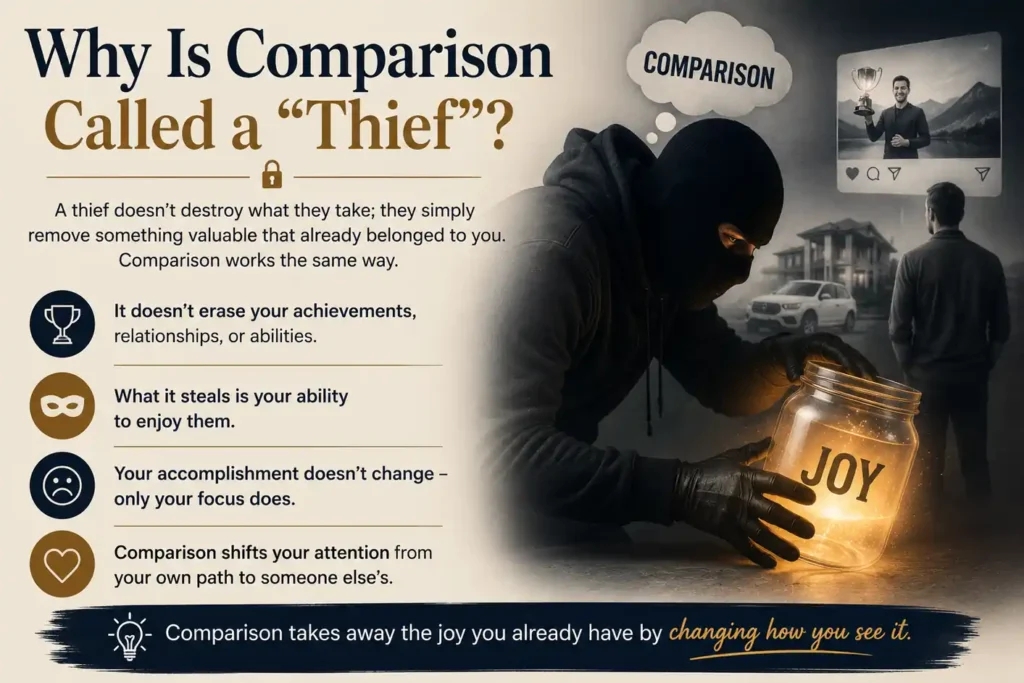
The quotation’s effectiveness comes down to one carefully chosen metaphor: thief.
A thief doesn’t usually destroy what you own. A thief takes something valuable that already belongs to you.
The quote suggests unhealthy comparison works the same way.
When people compare themselves obsessively with others, they rarely lose their actual achievements, relationships, abilities, or opportunities — those remain exactly as they were. What often disappears instead is the ability to appreciate them.
Consider a few examples:
- Someone feels proud after completing a degree until they learn that classmates accepted higher-paying jobs.
- A family enjoys a memorable vacation until social media presents seemingly more luxurious experiences.
- An entrepreneur celebrates steady business growth before shifting focus to competitors expanding faster.
In each case, reality hasn’t changed. Only the frame of reference has.
That’s why the metaphor is so memorable. The quote doesn’t claim comparison steals success, talent, or opportunity. It suggests comparison can quietly steal something less visible but equally valuable: satisfaction with what you already have.
The image of a thief also reflects how gradually this process tends to unfold. People rarely notice the exact moment contentment begins to fade. It disappears little by little as attention becomes increasingly fixed on someone else’s circumstances.
The quotation is a reminder that perspective shapes experience. Two people with identical achievements can feel completely different levels of satisfaction depending on whom they choose to compare themselves with.
Joy Is Not the Same as Happiness
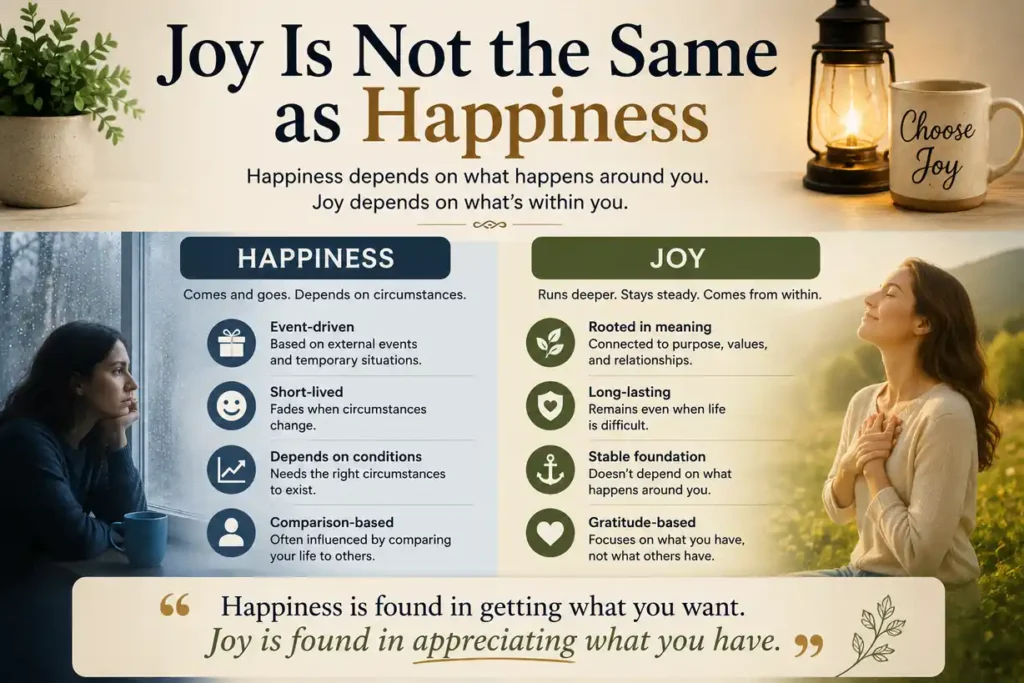
Fully understanding the quotation also means distinguishing between joy and happiness.
Although the words are often used interchangeably, they describe slightly different experiences.
| Joy | Happiness |
| More closely associated with lasting contentment and fulfillment | Often connected to temporary emotions and changing circumstances |
| Can remain present during challenges | Usually rises and falls with external events |
| Rooted in appreciation, purpose, and meaning | Frequently influenced by success, comfort, or positive experiences |
This distinction helps explain why the quotation uses the word joy rather than happiness.
Comparison rarely eliminates every pleasant emotion from life. Instead, it gradually weakens the deeper sense of contentment that allows people to value what they already have while still pursuing future goals.
That word choice is one reason the quote has endured. It describes not merely the loss of a happy moment, but the erosion of a more enduring sense of fulfillment.
The quotation itself is only the beginning of the story. One of the most frequently searched questions isn’t what it means, but who actually said it. Although Theodore Roosevelt’s name is almost always attached to the phrase, the historical evidence is more nuanced than many readers realize. The next section examines that attribution in detail, separating documented evidence from popular belief.
Who Said “Comparison Is the Thief of Joy”?
Few quotations have generated as much attribution confusion as “comparison is the thief of joy.” Search results, motivational books, social media graphics, leadership presentations, and inspirational speeches almost always credit the phrase to Theodore Roosevelt, the 26th President of the United States.
At first glance, the attribution seems entirely believable. Roosevelt was known for his writings on courage, discipline, character, perseverance, and purposeful living, and the message of the quote aligns closely with many of the values he championed throughout his public life.
Historical research, however, requires more than plausibility. It requires evidence.
After examining the available documentation, quotation researchers and historians generally reach a more careful conclusion: the quote is widely attributed to Theodore Roosevelt, but no universally accepted primary source has conclusively demonstrated that he wrote or spoke those exact words.
That distinction matters. It doesn’t mean Roosevelt definitely didn’t say it — it means the historical record, as currently available, doesn’t allow scholars to make that claim with certainty.
Understanding why requires a closer look at how historical quotations are authenticated.
Why Is Theodore Roosevelt Associated With the Quote?
Theodore Roosevelt left behind one of the largest collections of writings of any American president, including books, essays, speeches, personal letters, official correspondence, magazine articles, and public addresses.
Across these works, Roosevelt consistently urged readers to focus on courage, disciplined effort, purposeful action, and personal responsibility rather than public approval or status.
Because “comparison is the thief of joy” expresses a philosophy that closely resembles many of Roosevelt’s broader ideas, later generations naturally connected the quotation with him — and that association grew stronger over time.
One author quoted another. One website cited another website. One speaker repeated another speaker. Eventually, millions of people encountered the quotation already attached to Roosevelt’s name, often without anyone tracing it back to an original document.
This illustrates something important about famous quotations: popularity can spread much faster than historical verification. A statement repeated thousands of times can become accepted as common knowledge even when very few people have examined the documentary evidence behind it.
What Counts as Reliable Historical Evidence?
When historians investigate a famous quotation, they don’t begin by asking whether the statement sounds like something a person would have said. They ask a more precise question: can the quotation be traced to an original, verifiable source?
To answer that, researchers distinguish between primary and secondary sources.
| Primary Sources | Secondary Sources |
| Books written by the individual | Quote collections |
| Original speeches or manuscripts | Motivational books |
| Personal letters | Blogs and websites |
| Diaries and journals | Social media posts |
| Official archives | Inspirational graphics |
| Contemporary newspaper reports recording the person’s words | Modern articles repeating earlier sources |
This distinction matters because primary sources provide the strongest historical evidence. Secondary sources may accurately preserve quotations, but they can also repeat mistakes that originated elsewhere. If hundreds of websites all cite the same unsupported attribution, repetition alone doesn’t turn that attribution into historical proof — which is why professional historians prioritize documentary evidence over popularity.
What Does the Historical Evidence Actually Show?
Despite the quotation’s widespread association with Theodore Roosevelt, researchers have not identified a universally accepted primary document in his known writings containing the exact phrase “comparison is the thief of joy.”
Roosevelt’s speeches, books, essays, and correspondence have been preserved extensively, and historians have examined these materials for decades. Even so, no definitive primary source has emerged that conclusively verifies the exact wording.
That doesn’t prove Roosevelt never expressed the idea. Historical records are rarely complete: some speeches were only partially transcribed, private conversations often went unrecorded, and informal remarks may have disappeared over time. It’s entirely possible that Roosevelt communicated a similar principle using different language, or that the wording evolved through later paraphrasing.
The key point is that possibility shouldn’t be confused with historical certainty. Responsible historical writing distinguishes between what evidence demonstrates and what evidence merely allows as a possibility.
Popular Attribution vs. Historical Attribution
Much of the confusion surrounding this quotation disappears once readers understand the difference between popular attribution and historical attribution.
| Popular Attribution | Historical Attribution |
| Reflects what most people believe | Reflects what documentary evidence supports |
| Often spreads through repeated publication | Requires verifiable primary sources |
| Can become accepted through repetition | Prioritizes evidence over popularity |
| May or may not be historically accurate | Remains cautious when evidence is incomplete |
For this quotation, popular attribution strongly favors Theodore Roosevelt, while historical attribution remains qualified because a universally accepted primary source has not been established. Recognizing this distinction lets readers appreciate the quotation without overstating what the historical record currently supports.
Why Do Famous Quotes Become Misattributed?
Quotation misattribution is surprisingly common. History contains many memorable sayings that gradually became attached to famous individuals despite uncertain origins. Several factors contribute to this pattern.
A famous name adds credibility. People naturally trust quotations associated with respected historical figures. Attaching Roosevelt’s name to a motivational saying gives it immediate authority, making it more likely to be remembered and shared.
Ideas become shorter over time. An author may express a complex philosophy across multiple speeches or books. Later writers often condense those ideas into a shorter, more memorable sentence, and eventually the paraphrase gets mistaken for a direct quotation.
Secondary sources repeat earlier sources. Many quote collections rely on previously published compilations rather than original historical documents. As each publication repeats the attribution, confidence grows — even if no one has verified the original source.
The internet accelerates repetition. Modern digital platforms let quotations spread globally within hours. Once an attribution appears in blogs, social media graphics, presentations, and online quote databases, it becomes increasingly hard to distinguish documented history from repeated tradition.
For that reason, historians evaluate quotations by the same standard they apply to any historical claim: evidence carries more weight than repetition.
How Should You Attribute This Quote?
For most readers, the practical question is simple: if you use this quote in an article, speech, presentation, or social media post, how should you credit it?
The most responsible approach acknowledges both its popularity and its historical uncertainty.
| Situation | Recommended Attribution |
| Academic writing | Mention that the quotation is widely attributed to Theodore Roosevelt, while noting that a definitive primary source has not been established. |
| Professional article or blog | Use “widely attributed to Theodore Roosevelt” rather than presenting the attribution as certain. |
| Speech or presentation | A brief qualification such as “often attributed to Theodore Roosevelt” provides appropriate historical caution. |
| Social media | If space permits, adding “widely attributed” is more accurate than stating Roosevelt’s authorship as unquestioned fact. |
Using qualified language demonstrates careful research without diminishing the value of the quotation itself.
Quote Attribution Timeline
The quotation’s journey from uncertain origin to widespread recognition helps explain why so many people confidently associate it with Theodore Roosevelt.
| Time Period | Historical Development | Evidence Status |
| 1858–1919 (Roosevelt’s lifetime) | Roosevelt publishes extensive works on character, leadership, discipline, and purposeful living. | Well documented, but no universally accepted primary source contains the exact quotation. |
| Mid-20th century | Variations of the quotation begin appearing more frequently in published materials and motivational literature. | Association with Roosevelt becomes increasingly common. |
| Late 20th century | Quote collections and public speakers widely repeat the Roosevelt attribution. | Popular attribution grows faster than documentary evidence. |
| Internet era | Websites, blogs, and quote databases spread the attribution globally. | Popular acceptance becomes widespread, though historical certainty remains unchanged. |
| Modern scholarship | Researchers continue distinguishing between documented evidence and popular belief. | Current scholarly practice favors cautious attribution rather than definitive authorship. |
The timeline highlights a lesson that extends well beyond this single quotation: a statement can become universally associated with a historical figure while the documentary evidence supporting that attribution remains incomplete.
Why Historical Accuracy Matters
Some readers may wonder whether the uncertainty surrounding the quote’s authorship really matters, since the message remains meaningful regardless of who first expressed it. In many respects, that’s true — the wisdom of a quotation doesn’t depend entirely on the fame of its author.
At the same time, responsible scholarship distinguishes between what is widely believed and what can be historically verified. Presenting uncertainty honestly protects the integrity of historical research and encourages readers to evaluate famous quotations with the same care they’d apply to any other historical claim. It’s also a reminder that intellectual honesty isn’t about having absolute answers — it’s about matching our confidence to the strength of the available evidence.
Having examined the question of authorship, another common source of confusion remains. Many people first encounter this quotation in Christian books, sermons, or social media posts and assume it comes directly from Scripture. The next section addresses that question by exploring whether “comparison is the thief of joy” is actually found in the Bible, and why the misconception has become so widespread.
Quote Variations: Which Version Is Correct?
One reason the quotation creates confusion is that it rarely appears in exactly the same form. While the central idea stays consistent, different books, websites, presentations, and social media posts often use slightly different wording. Some versions are minor stylistic variations; others meaningfully shift the original meaning or make the attribution even harder to verify.
Understanding these differences helps readers quote the phrase more accurately and see why historians approach its attribution with caution.
The Most Common Versions
The table below summarizes the versions readers are most likely to encounter.
| Quote Version | How Common Is It? | Editorial Assessment |
| “Comparison is the thief of joy.” | Very common | The most widely recognized and recommended wording. |
| “Comparison is the thief of happiness.” | Occasionally seen | Likely a later variation; less widely accepted. |
| “Comparison steals joy.” | Common on social media | A paraphrase rather than the traditional quotation. |
| “Comparison robs us of joy.” | Occasionally used | An interpretive rewording, not the standard form. |
| “The thief of joy is comparison.” | Rare | Grammatically acceptable but uncommon in published sources. |
Among these, “Comparison is the thief of joy” has become the standard wording used in books, presentations, articles, and leadership discussions. If your goal is to quote the saying in its most familiar form, this version is generally the best choice.
Why Do So Many Versions Exist?
Quotation variations are remarkably common, especially for short sayings that spread through speeches, social media, and motivational literature. Several factors contribute to these changes.
Natural paraphrasing. People often remember the central idea of a quotation more easily than its exact wording. Over time, they unintentionally swap in near synonyms — joy becomes happiness, thief becomes robber, steals becomes robs. The message stays similar, but the quotation itself gradually shifts.
Adaptation for different audiences. Writers and speakers sometimes modify quotations to suit a particular audience. A leadership presenter may choose more conversational language; a devotional writer may emphasize spiritual application; a social media creator may shorten the wording to fit an image or caption. These adaptations can communicate the same idea, but they should be understood as paraphrases rather than the original quotation.
Internet amplification. Digital platforms have dramatically accelerated the spread of quotation variants. Once a modified version appears online, other websites and accounts frequently copy it without checking earlier sources. Over time, multiple versions circulate simultaneously, making it increasingly difficult for readers to know which wording became popular first.
This pattern explains why famous quotations often exist in several forms despite sharing the same underlying message.
Does Changing One Word Change the Meaning?
Sometimes the differences are subtle; in other cases, replacing a single word shifts the emphasis of the quotation.
| Word Choice | Effect on Meaning |
| Joy | Suggests lasting contentment and deeper fulfillment. |
| Happiness | Emphasizes temporary emotional satisfaction or pleasant experiences. |
| Thief | Implies something valuable is quietly taken away over time. |
| Robber | Suggests a more forceful or dramatic loss. |
| Steals | Focuses on the ongoing action of losing contentment. |
| Robs | Creates a stronger emotional image but is less traditional. |
The widespread popularity of “comparison is the thief of joy” is partly due to its concise wording and memorable metaphor. Comparison, thief, and joy combine to create a rhythm that has proven remarkably durable across different audiences and cultures.
Which Version Should You Use?
If you’re writing an article, giving a presentation, preparing a speech, or creating educational content, the safest approach is straightforward: use the version readers are most likely to recognize — “Comparison is the thief of joy.”
If you adapt the wording for stylistic reasons, make it clear you’re paraphrasing the idea rather than quoting the traditional form. Maintaining this distinction is especially important in academic or professional settings, where readers expect quotations to reflect the wording historically associated with the phrase.
How Should You Quote It Correctly?
Quoting responsibly involves more than reproducing the words accurately — it also means presenting the attribution with appropriate historical care. Because the evidence surrounding this quotation isn’t conclusive, how you introduce it matters.
Recommended attribution language
| Situation | Recommended Wording |
| Academic paper | The quotation is widely attributed to Theodore Roosevelt, although a definitive primary source has not been established. |
| Research article | Widely attributed to Theodore Roosevelt. |
| Professional blog | Often attributed to Theodore Roosevelt. |
| Leadership presentation | A quote commonly associated with Theodore Roosevelt. |
| Social media | Widely attributed to Theodore Roosevelt (when space allows). |
This wording accomplishes two things at once: it acknowledges the quotation’s long-standing association with Roosevelt, and it avoids claiming a level of historical certainty the available documentary evidence doesn’t support.
Should You Simply Write “—Theodore Roosevelt”?
For informal contexts, many people do exactly that. If accuracy is your priority, though, a more qualified attribution is preferable.
| Less Precise | More Historically Accurate |
| “Comparison is the thief of joy.” — Theodore Roosevelt | “Comparison is the thief of joy,” widely attributed to Theodore Roosevelt. |
The second version better reflects the current state of historical evidence while still recognizing the quotation’s traditional association with Roosevelt. This small change demonstrates careful scholarship and helps prevent readers from mistaking popular attribution for documented historical fact.
Can You Use the Quote in Academic Writing?
Yes — but context matters. Academic writing places a high value on verifiable sources, so if you reference this quotation in scholarly work, it’s good practice to indicate that it’s widely attributed to Theodore Roosevelt, acknowledge the uncertainty surrounding the attribution where relevant, and avoid presenting Roosevelt’s authorship as conclusively established without supporting documentary evidence. Doing so aligns with the broader principles of responsible historical research discussed above.
A Responsible Quotation Checklist
Before using the quotation in an article, speech, presentation, or publication, run through this simple checklist.
| Check | Why It Matters |
| Use the standard wording: “Comparison is the thief of joy.” | Reflects the most widely recognized version. |
| Verify punctuation before publishing. | Prevents accidental wording changes. |
| Use “widely attributed to Theodore Roosevelt” when appropriate. | Reflects historical uncertainty responsibly. |
| Avoid presenting the quote as a Bible verse. | The quotation does not appear in Scripture. |
| Understand the quotation’s meaning before sharing it. | Prevents the message from being oversimplified or misrepresented. |
Following these practices helps readers share the quotation accurately while respecting both its cultural significance and the limits of the historical evidence.
The wording of the quotation is only one source of confusion. Another common question arises because the phrase frequently appears in sermons, Christian books, and faith-based social media posts. As a result, many people assume it comes directly from the Bible. The next section explores that misconception, explains why it’s so widespread, and distinguishes the modern quotation from the biblical principles it reflects.
Is “Comparison Is the Thief of Joy” a Bible Verse?
Because “comparison is the thief of joy” is frequently quoted in Christian books, devotionals, sermons, Bible studies, and social media posts, many people naturally assume it comes directly from Scripture. It’s one of the most searched questions about the quotation, and the answer is clear: no. “Comparison is the thief of joy” is not a Bible verse, and that exact phrase doesn’t appear anywhere in the Bible.
Although the quotation reflects several biblical principles, its wording is modern rather than scriptural. Understanding this distinction lets readers appreciate both the wisdom of the quotation and the unique authority of Scripture without confusing one for the other. This isn’t just a technical detail — it helps ensure modern quotations are credited appropriately while biblical teaching is represented accurately.
Why Do So Many People Think It Is in the Bible?
The misconception didn’t appear by accident. Several factors have drawn the quotation and Christianity into close association.
It reflects familiar biblical themes. The quote’s message closely resembles teachings found throughout Scripture. The Bible repeatedly encourages believers to cultivate contentment instead of dissatisfaction, gratitude instead of envy, humility instead of pride, faithful stewardship instead of constant comparison, and trust in God rather than measuring life by another person’s circumstances. Because these themes are so prominent, many readers assume the wording itself must come from the Bible too. In reality, the principle is biblical, but the quotation is not.
It is frequently used in Christian teaching. Pastors, Bible teachers, Christian authors, and devotional writers often use the quotation to introduce discussions about contentment, gratitude, or envy. A sermon about contentment might open with “comparison is the thief of joy” before moving into biblical passages that explore those themes. Over time, repeated exposure in Christian settings naturally leads many people to associate the quotation itself with Scripture. A quotation can effectively summarize a biblical idea without becoming part of the biblical text.
Social media blurs the difference. Inspirational graphics frequently pair the quotation with photographs of open Bibles, church imagery, Bible verse references, Christian artwork, and religious hashtags. Some images even place the quotation beside Scripture without clearly identifying which words belong to the Bible and which come from a modern saying. As these images circulate, many readers understandably conclude the entire quotation must be a Bible verse.
What Does the Bible Actually Teach?
Although Scripture never says “comparison is the thief of joy,” it addresses many of the attitudes that unhealthy comparison can produce. Rather than focusing exclusively on comparison, the Bible consistently encourages believers to develop character qualities that naturally counter it: contentment, gratitude, humility, faithful stewardship, and trust in God’s provision. Several passages are especially relevant.
Philippians 4:11–13 — Learning Contentment. In Philippians 4, the Apostle Paul explains that he learned to be content in every circumstance, whether experiencing abundance or need. His contentment wasn’t based on possessing more than other people, but on finding strength through Christ regardless of changing circumstances. This differs significantly from comparison-driven thinking. Comparison asks, “Why does someone else have more? Why am I behind? Why isn’t my life like theirs?” Biblical contentment asks different questions: “Am I faithfully using what God has given me? Am I trusting Him in my present circumstances? Am I grateful for today’s blessings?” The emphasis shifts from external measurement to faithful living.
Hebrews 13:5 — Be Content With What You Have. Hebrews encourages believers to keep their lives free from the love of money and to be content with what they have because of God’s abiding presence. The passage doesn’t prohibit ambition or responsible planning — it redirects attention away from constantly measuring possessions or circumstances against those of others. The underlying principle aligns closely with the message behind the quotation, even though the wording is entirely different.
Galatians 6:4–5 — Examine Your Own Work. Rather than encouraging believers to measure themselves against others, Paul instructs individuals to examine their own work. The emphasis is on honest self-evaluation and personal responsibility, not competition. Healthy reflection asks, “Am I growing?” Unhealthy comparison asks, “Am I better than someone else?” Galatians presents this distinction within a broader discussion of Christian responsibility and faithful living.
2 Corinthians 10:12 — A Direct Warning About Comparison. Perhaps the closest biblical parallel appears here. Paul criticizes people who continually compare themselves with one another, concluding that such behavior lacks wisdom. Unlike the modern quotation, Paul isn’t making a psychological observation — he’s addressing pride, self-promotion, and misguided standards of evaluation within the church. Even so, the passage shows that Scripture recognizes the spiritual dangers that often accompany unhealthy comparison.
Modern Quote vs. Biblical Teaching
The relationship between the quotation and Scripture becomes much clearer side by side.
| Modern Quotation | Biblical Teaching |
| “Comparison is the thief of joy.” | The exact wording does not appear in Scripture. |
| Describes how unhealthy comparison often affects emotional wellbeing. | Teaches contentment, gratitude, humility, faithful stewardship, and trust in God. |
| Expresses a memorable psychological insight. | Provides spiritual instruction rooted in God’s character and purposes. |
| Focuses primarily on human experience. | Addresses both inward attitudes and faithful living before God. |
| Modern quotation. | Inspired biblical text. |
The similarities explain why the quotation resonates with many Christians. The differences explain why it should never be presented as though it were a Bible verse.
Does the Bible Teach That All Comparison Is Wrong?
Not exactly. One of the most common misunderstandings is that Scripture forbids every form of comparison — a much broader claim than the biblical text supports. The Bible’s concern isn’t comparison itself, but the attitudes comparison can produce when it becomes unhealthy: envy, pride, covetousness, resentment, self-righteousness, dissatisfaction, and misplaced confidence.
At the same time, Scripture encourages believers to learn from faithful examples, pursue wisdom, and examine their own lives honestly. The issue isn’t noticing another person’s gifts or achievements — it’s allowing those observations to determine personal worth or replace gratitude with discontent. This balanced understanding closely mirrors the quotation’s deeper meaning while staying faithful to the broader teaching of Scripture.
Common Misconceptions
Several misunderstandings continue to circulate online. Clarifying them helps readers distinguish biblical teaching from popular assumptions.
| Misconception | Reality |
| The quote appears somewhere in the Bible. | It does not appear in any biblical translation. |
| Because it reflects biblical principles, it is Scripture. | A modern quotation can summarize biblical ideas without becoming biblical text. |
| Christians should never compare themselves with anyone. | Scripture warns against sinful comparison but encourages wisdom, self-examination, and learning from godly examples. |
| The quotation has equal authority with Scripture. | The quote may be insightful, but it should never be treated as inspired biblical revelation. |
The Key Takeaway
The relationship between “comparison is the thief of joy” and the Bible is best understood this way: the quotation isn’t found in Scripture, but its central message reflects several biblical principles about contentment, gratitude, humility, and faithful living. The Bible provides a much broader theological framework than the quotation alone.
Understanding this distinction lets readers appreciate the wisdom of the saying while respecting the unique authority of Scripture. It also explains why the quotation continues to resonate with both Christian and non-Christian audiences — its wording may be modern, but it expresses a struggle people across cultures and generations have long recognized.
Having clarified the quotation’s biblical relationship, the next question is one of interpretation rather than attribution: what does “comparison is the thief of joy” actually mean in everyday life, and why has this simple metaphor remained so powerful for so many people?
What Does “Comparison Is the Thief of Joy” Really Mean?
At first glance, “comparison is the thief of joy” seems straightforward. Most people instinctively understand its message because they’ve experienced it firsthand — but its simplicity can also lead to misunderstanding. Some interpret the quote as advice to avoid comparison entirely. Others assume it discourages ambition or suggests people should stop striving for improvement. Neither interpretation captures the quotation’s full meaning.
At its core, the quote warns against letting another person’s life become the primary measure of your own satisfaction. It doesn’t argue that growth is unimportant or that excellence should be avoided — it highlights how easily appreciation for our own progress can disappear when our attention fixes on someone else’s achievements.
The quotation speaks less about comparison itself and more about the emotional consequences of making comparison our standard for contentment.
What Is the Quote Really Warning Against?
The quotation identifies a subtle psychological pattern many people recognize. Imagine someone who has worked for years to build a successful small business. They feel proud of what they’ve accomplished until they learn that another entrepreneur has expanded much faster. Nothing about their own business has changed — their customers haven’t disappeared, their skills remain the same, their progress is still real. What changes is how they interpret their success. Instead of evaluating their journey against their own goals, they begin evaluating it against someone else’s completely different circumstances.
The joy they once felt is gradually replaced by dissatisfaction — not because they lost anything, but because they changed the standard by which they measured it. That’s the “theft” the quotation describes.
The Quote Is About Perspective, Not Possessions
One reason the quotation continues to resonate is that it recognizes something many people overlook: comparison often changes perception before it changes reality.
A person may feel grateful for their home until they visit someone living in a larger house. Someone may appreciate their career until a friend receives a promotion. A student may celebrate excellent exam results until discovering a classmate scored slightly higher. In each situation, external circumstances remain unchanged — the emotional experience shifts because the frame of reference does.
This helps explain why comparison can influence satisfaction so powerfully. Human beings rarely evaluate experiences in complete isolation; we naturally place our achievements, relationships, possessions, and opportunities alongside those of other people. The quotation reminds us that this habit can become destructive when external comparisons begin defining our internal sense of fulfillment.
Why the Word “Joy” Matters
The quotation doesn’t say “comparison is the thief of success,” nor “comparison is the thief of achievement.” It focuses on joy — and that distinction is significant.
People can continue achieving remarkable things while gradually losing the ability to enjoy those achievements. Consider someone who continually reaches ambitious goals. Each accomplishment provides satisfaction — for a short time. Soon another comparison appears, another benchmark emerges, another person seems further ahead. Instead of celebrating progress, attention immediately shifts toward what remains unattained. Eventually success itself becomes difficult to enjoy because every achievement is evaluated relative to someone else’s.
The quotation suggests this cycle quietly erodes one of life’s most valuable experiences: the ability to appreciate meaningful progress.
Is Comparison Always Harmful?
One of the most common misunderstandings surrounding the quotation is that all comparison is unhealthy. The quote itself doesn’t support that conclusion — comparison plays an important role in learning and development. People compare every day when they study successful professionals, learn from experienced mentors, evaluate business performance, improve athletic skills, analyze academic progress, or develop creative abilities. These comparisons provide information, reveal opportunities for improvement, and encourage learning.
Problems arise when comparison changes purpose. Instead of asking “What can I learn from this person?” people begin asking “Why am I not as successful as they are?” The first question promotes growth; the second often produces discouragement because it shifts attention from learning to personal worth. The quotation warns against this second pattern — it doesn’t discourage healthy observation or constructive self-improvement.
Comparison as a Tool vs. Comparison as a Standard
The distinction becomes clearer side by side.
| Comparison as a Tool | Comparison as a Standard |
| Helps identify opportunities to learn | Determines personal worth |
| Encourages curiosity | Encourages self-judgment |
| Focuses on improvement | Focuses on inadequacy |
| Inspires practical action | Creates ongoing dissatisfaction |
| Supports long-term growth | Often diminishes contentment |
This illustrates why two people can encounter exactly the same successful individual yet respond very differently. One leaves inspired; the other leaves discouraged. The external situation is identical — the internal interpretation is not.
Why the Quote Resonates Across Different Stages of Life
Another reason the quotation has remained so influential is its remarkable universality. It applies to situations almost everyone encounters. Students compare grades. Professionals compare promotions. Parents compare milestones. Business owners compare growth. Writers compare audiences. Artists compare recognition. Athletes compare performance. Even retirees may compare lifestyles or financial security.
The circumstances change; the underlying experience remains surprisingly consistent. Because comparison is part of everyday life, readers immediately recognize the truth the quotation expresses. Its enduring popularity comes not from complexity but from accurately describing a common human tendency.
The Metaphor Is More Nuanced Than It First Appears
Another strength of the quotation lies in what it doesn’t say. It doesn’t suggest that comparison destroys joy instantly — the metaphor of a thief implies something quieter. A thief often acts unnoticed, and unhealthy comparison usually develops the same way: gradually. It may begin with occasional curiosity, then occasional dissatisfaction. Over time, appreciation becomes harder to maintain because attention increasingly focuses on what others possess rather than what one has already achieved.
The quotation functions less as a dramatic warning and more as an invitation to examine perspective before contentment quietly slips away.
Why This Message Still Matters Today
Although the quotation is commonly associated with modern social media culture, its relevance extends far beyond digital platforms. People compared themselves long before the internet existed — neighbors compared harvests, merchants compared businesses, scholars compared reputations, artists compared recognition. What has changed isn’t the existence of comparison but its frequency and visibility. Today, people encounter hundreds or even thousands of carefully selected snapshots of other people’s lives every week, and opportunities for comparison have multiplied dramatically as a result.
The quotation continues to resonate because it describes a pattern that has become increasingly visible in contemporary life, even though the underlying human tendency is much older.
The Essential Meaning in One Sentence
If the quotation could be summarized in a single sentence, it would be this: joy is often lost not because our lives become worse, but because we begin measuring them against someone else’s instead of appreciating them on their own terms.
That simple insight explains why the phrase has remained one of the most widely shared modern quotations. Yet understanding what the quote means raises another question: why has this particular wording become so famous while countless other motivational quotations have faded into obscurity? The answer lies in its cultural journey — from historical attribution to widespread adoption in leadership literature, Christian publishing, and the digital age. The next section explores how “comparison is the thief of joy” evolved into one of the most recognizable quotations of the modern era.
Why Has “Comparison Is the Thief of Joy” Become So Famous?
Not every memorable quotation becomes part of everyday language. History is filled with insightful observations that appeared in books, speeches, or essays only to fade from public memory. “Comparison is the thief of joy” has followed a very different path — today it’s quoted by business leaders, educators, coaches, authors, pastors, therapists, athletes, and millions of social media users around the world.
Its widespread popularity raises an interesting question: why has this particular sentence endured while countless other motivational quotes have not? The answer lies in a combination of memorable language, universal human experience, cultural relevance, and repeated use across many different communities.
The Quote Captures a Universal Human Experience
One reason the quotation has remained influential is that it describes an experience nearly everyone recognizes. Regardless of age, profession, culture, or background, people naturally compare aspects of their lives with those of others. Students compare grades. Professionals compare careers. Parents compare milestones. Entrepreneurs compare businesses. Athletes compare performance. Artists compare recognition. These situations may look different on the surface, but they all involve the same underlying question: “How am I doing compared with someone else?”
Because this experience is nearly universal, the quotation feels immediately relatable. Readers often encounter it and think, “I’ve felt exactly that before.” Many famous quotations survive because they sound clever. This one survives because it feels true.
Its Simplicity Makes It Memorable
The quotation contains only five words, yet those five words communicate an idea that might otherwise require several paragraphs to explain. That brevity gives it unusual power — it’s easy to remember, easy to repeat, easy to quote, and easy to apply to many situations.
Communication researchers have long observed that concise statements are more likely to spread because they require little effort to remember or share. The phrase also has a balanced rhythm: Comparison / is / the thief / of joy. The wording flows naturally, making it suitable for speeches, presentations, articles, and conversations. Its structure contributes almost as much to its popularity as its meaning.
The Metaphor Is Instantly Understandable
The quotation doesn’t rely on technical language or abstract philosophy — it uses an everyday image: a thief. Almost everyone understands what a thief does: quietly takes something valuable that already belongs to another person. That metaphor lets readers grasp the message immediately without needing lengthy explanation.
Instead of saying “constant social comparison often diminishes long-term subjective wellbeing,” the quotation simply says “comparison is the thief of joy.” The image is concrete; the message is accessible. That combination helps explain why the phrase has spread far beyond academic discussions or self-help literature.
Why It Resonates in the Digital Age
Although comparison has always been part of human life, the modern world has changed how often people experience it. Previous generations compared themselves mainly with neighbors, classmates, coworkers, family members, and local communities. Today, digital technology has expanded that circle dramatically — people can now compare themselves with thousands of individuals every day through professional networking platforms, photo-sharing apps, online communities, business success stories, travel content, fitness transformations, and lifestyle influencers.
Whether someone actively seeks these comparisons or simply encounters them while browsing online, opportunities for comparison appear far more often than in previous generations. This doesn’t mean the quotation became famous because of social media — rather, social media created an environment where its message feels increasingly relevant. Many readers discover the quote precisely because it explains an experience they encounter online.
How Different Communities Have Adopted the Quote
Another reason for the quotation’s longevity is its remarkable flexibility. Different communities interpret it through their own perspectives while preserving its central message.
| Community | How the Quote Is Commonly Applied |
| Leadership | Encouraging people to focus on long-term growth instead of competing for constant recognition. |
| Education | Helping students value personal progress rather than ranking themselves solely against classmates. |
| Personal development | Promoting gratitude and realistic expectations while pursuing improvement. |
| Business | Emphasizing sustainable progress over unhealthy competition. |
| Christian teaching | Introducing discussions about contentment, gratitude, and faithful stewardship. |
| Mental wellbeing | Illustrating how constant comparison can undermine satisfaction with one’s own life. |
This adaptability lets the quotation stay relevant without being limited to a single audience or profession.
Why It Is Frequently Shared Online
The internet rewards content that’s concise, emotionally meaningful, visually appealing, and easy to understand — this quotation checks every box. Its short length makes it ideal for inspirational graphics, presentation slides, classroom materials, social media captions, printable artwork, journal covers, and posters.
Because it requires little explanation, people often share it without additional context. Ironically, that same simplicity has contributed to some of the misconceptions discussed earlier in this article. When quotations circulate without explanation, readers naturally begin asking who actually said it, whether it’s historically verified, whether it’s from the Bible, and what it exactly means. Those questions have become almost as popular as the quotation itself.
Why Leadership Writers Continue to Use It
Leadership authors and executive coaches frequently reference the quotation because it addresses a common challenge in professional environments. Success is often measured relative to others — promotions, salaries, awards, company growth, influence, recognition. While competition can encourage excellence, it can also make achievement feel temporary, since one milestone quickly gives way to another comparison.
The quotation reminds leaders that sustainable motivation depends on more than constantly outperforming other people. It encourages evaluating progress against meaningful goals rather than endless external benchmarks — a message that stays relevant in workplaces where comparison is often unavoidable.
Why Christian Authors Frequently Reference It
Christian writers also find the quotation useful — not because it’s Scripture, but because it summarizes a principle that aligns with the biblical themes discussed earlier. When introducing topics such as contentment, gratitude, humility, or faithful stewardship, the quotation provides a familiar starting point before exploring the broader teaching of Scripture. Used responsibly, it functions as an illustration rather than a substitute for biblical authority. Its frequent appearance in Christian books and sermons has helped expand its audience far beyond secular leadership or self-improvement literature.
A Timeline of the Quote’s Cultural Growth
Although the precise historical origin remains uncertain, the quotation’s cultural journey is much easier to observe.
| Period | Cultural Development |
| Early association | The quotation becomes increasingly linked with Theodore Roosevelt because its message reflects themes found throughout his writings. |
| Motivational publishing | Leadership books and inspirational collections begin repeating the quotation more widely. |
| Professional development | Speakers, educators, and coaches adopt the phrase because of its simplicity and practical relevance. |
| Internet expansion | Blogs, quote websites, and online collections dramatically increase public awareness. |
| Social media era | The quotation becomes one of the most widely shared inspirational sayings across multiple digital platforms. |
| Present day | The phrase remains a familiar reference point in discussions about wellbeing, leadership, education, faith, and personal growth. |
This timeline illustrates an important distinction: the quotation’s popularity has grown steadily over time, while its historical attribution has remained much more cautious. Popularity and historical certainty don’t always increase together.
Why the Quote Continues to Endure
Many inspirational sayings enjoy brief popularity before gradually disappearing. This one has remained relevant because it addresses a challenge that changes form but never fully disappears. Technologies evolve, careers change, societies develop, and new platforms emerge — yet people keep asking the same fundamental questions: Am I successful enough? Am I keeping up? Why does someone else’s achievement affect how I feel about my own?
The quotation doesn’t solve those questions. It gives them a memorable name. That ability to express a timeless human experience in just a few words explains why “comparison is the thief of joy” continues to be quoted decades after it first entered popular culture.
Its enduring influence also raises another question many readers have never considered: how do historians actually determine whether a famous quotation is authentic? Understanding that process helps explain why responsible scholars remain cautious about definitive attribution, and why documentary evidence matters more than repetition. The next section explores how quotation researchers investigate famous sayings and evaluate historical confidence.
How Historians Verify Famous Quotes
One of the biggest misconceptions about famous quotations is that widespread popularity automatically proves authenticity. In reality, historians use a far more rigorous standard. A quotation may appear in thousands of books, websites, presentations, and social media posts, yet still lack the documentary evidence needed to confirm that a particular historical figure actually said or wrote it.
That’s precisely why “comparison is the thief of joy” continues to be discussed with cautious language rather than absolute certainty. Understanding how quotation verification works explains the debate surrounding this phrase and offers a useful framework for evaluating many other famous quotations encountered online.
Why Historians Don’t Rely on Popularity
Imagine searching the internet and finding hundreds of websites that all attribute the same quotation to Theodore Roosevelt. At first glance, that might seem like overwhelming evidence. Historians, however, ask an important follow-up question: where did those websites get their information? If every website copied the attribution from an earlier secondary source — and none can identify an original document written or spoken by Roosevelt — then the sheer number of repetitions tells us very little about historical authenticity.
In historical research, independent evidence matters far more than repeated claims. A quotation repeated a thousand times without documentary support is still weaker than a single verified primary source. That principle protects history from becoming a collection of assumptions reinforced through repetition.
The Difference Between Primary and Secondary Sources
The foundation of quotation research is understanding the difference between primary and secondary sources.
| Primary Sources | Secondary Sources |
| Original speeches | Quote collections |
| Books written by the individual | Blogs and websites |
| Personal letters | Inspirational articles |
| Diaries and journals | Social media graphics |
| Official manuscripts | Motivational books |
| Contemporary newspaper reports recording the speaker’s words | Modern summaries and compilations |
Primary sources are valued because they originate from the individual or from reliable contemporary records created during their lifetime. Secondary sources help explain how quotations became popular, but they generally can’t establish original authorship on their own — which is why historians keep searching for documentary evidence even when a quotation has become universally recognized.
The Six-Step Process Historians Use
Different researchers may follow slightly different methods, but quotation scholars generally work through a similar investigative process.
Step 1 — Locate the earliest known appearance. Researchers begin by asking what the earliest verifiable record of a quotation is. Finding the oldest documented version often provides important clues about where the quotation originated and whether later versions changed the wording. Earlier evidence generally carries greater historical weight than later repetition.
Step 2 — Search original writings. If a quotation is attributed to a specific individual, historians examine materials that person created — published books, essays, speeches, manuscripts, letters, journals, and archived correspondence. In Roosevelt’s case, this represents an enormous body of material, since he wrote extensively throughout his life. Researchers continue examining these records to determine whether the exact wording appears in an authenticated source.
Step 3 — Compare different versions. Famous quotations often exist in multiple forms, so historians compare wording, punctuation, sentence structure, publication dates, and surrounding context. Small differences sometimes reveal that a modern quotation evolved gradually rather than appearing all at once. Studying these variations helps researchers distinguish original wording from later paraphrases.
Step 4 — Evaluate documentary evidence. Not every historical document carries equal weight. Researchers ask whether a document was written during the person’s lifetime, whether it’s an original manuscript or a later copy, whether it quotes the individual directly or summarizes their ideas, and whether the document itself can be authenticated. The stronger the documentary chain, the greater the confidence historians can place in the attribution.
Step 5 — Trace how the attribution spread. Even when the original wording remains uncertain, historians often investigate how a quotation became associated with a particular person, examining published quote collections, newspaper references, biographies, public speeches, and educational materials. Tracing the quotation’s cultural journey helps explain why certain attributions become widely accepted even when documentary evidence remains incomplete.
Step 6 — Assign an appropriate level of confidence. Historical research rarely deals in absolute certainty. Instead of asking only “Is this quote authentic?” scholars often ask “How confident should we be?” That approach encourages careful scholarship and prevents researchers from claiming more than the evidence supports.
A Historical Confidence Framework
One helpful way to understand quotation research is to think of historical confidence as a spectrum rather than a simple yes-or-no answer.
| Confidence Level | What It Means |
| Documented | Supported by clear primary-source evidence. |
| Highly Probable | Strong supporting evidence exists, though minor uncertainty remains. |
| Widely Attributed | Commonly credited to an individual, but documentary confirmation is incomplete. |
| Uncertain | Available evidence neither confirms nor disproves the attribution. |
| Unsupported | No credible evidence currently supports the claimed authorship. |
Based on the currently available historical record, “comparison is the thief of joy” is generally best understood as widely attributed to Theodore Roosevelt rather than conclusively documented. This wording reflects the balance between cultural acceptance and historical caution.
Applying This Framework to the Quote
The summary below illustrates how quotation scholars typically evaluate the available evidence.
| Question | Current Understanding |
| Is the quotation widely associated with Theodore Roosevelt? | Yes. |
| Has a universally accepted primary source been identified? | No. |
| Does the quotation reflect ideas found throughout Roosevelt’s writings? | Yes, many scholars believe its message aligns closely with his philosophy. |
| Can historians state with certainty that Roosevelt used these exact words? | Not based on currently available documentary evidence. |
This balanced conclusion avoids two common mistakes: declaring Roosevelt’s authorship as unquestionable fact, and claiming he definitely never said it. Responsible historical writing recognizes that the available evidence supports neither extreme.
Why Documentary Evidence Matters
Some readers may wonder whether this level of historical precision is really necessary, since the quotation remains meaningful regardless of its exact origin. That’s true — but documentary evidence serves a broader purpose. It helps preserve the integrity of historical scholarship. If historians accepted repeated claims without verification, countless quotations would gradually become attached to famous individuals simply because the association sounded believable. Evidence-based research prevents that. It’s a reminder that historical accuracy depends not on popularity but on documentation, and the same standards used to evaluate speeches, letters, laws, and historical events also apply to famous quotations.
A Practical Guide for Readers
Most readers aren’t professional historians, but they can still apply a few simple principles when encountering widely shared quotations online. Before sharing a famous quote, ask:
- Can the quotation be traced to an original source?
- Is the attribution described as “widely attributed” rather than unquestionably established?
- Are multiple reputable historical references in agreement?
- Could the wording have evolved through paraphrasing over time?
- Am I sharing the quotation because it’s meaningful — or because I know the attribution is historically accurate?
These questions encourage thoughtful use of quotations without requiring specialized historical training.
Historical Accuracy and Lasting Wisdom
One of the most valuable lessons from studying this quotation is that historical uncertainty doesn’t diminish the value of the underlying message. Whether the exact wording originated with Theodore Roosevelt, developed through later paraphrasing, or emerged from another source entirely, the quotation continues to resonate because it expresses an experience many people recognize.
Historical research answers who most likely said it. Interpretation answers why it continues to matter. Both questions are important, but they serve different purposes — and understanding that distinction lets readers appreciate the quotation with both intellectual honesty and practical wisdom.
Having explored the history behind the phrase, the remaining questions become more practical than historical: how should you use this quotation responsibly in speeches, articles, classrooms, presentations, and everyday communication? The next section provides practical guidance for quoting, citing, and applying the phrase appropriately in different contexts.
How to Use “Comparison Is the Thief of Joy” Responsibly
By this point, the quotation’s history should be much clearer. It’s widely attributed to Theodore Roosevelt. Its exact authorship hasn’t been conclusively verified through a universally accepted primary source. It’s not a Bible verse. And its central message remains meaningful regardless of the uncertainty surrounding its origin.
The remaining question is a practical one: how should you actually use this quotation? Whether you’re writing an article, giving a presentation, delivering a graduation speech, preparing a sermon, or sharing an inspiring message online, using the quote responsibly helps preserve both its meaning and its historical integrity.
When Is This Quote Most Appropriate?
The quotation is especially effective when discussing situations where people evaluate themselves primarily by comparing their lives with others. It works well because it captures a broad human tendency rather than addressing one specific profession, age group, or circumstance — common settings include graduation speeches, leadership presentations, workplace training, coaching sessions, classroom discussions, personal development articles, faith-based reflections, and mental wellbeing conversations. In each setting, the quotation serves as an invitation to reflect on perspective rather than a command to reject ambition or personal growth.
Situations Where the Quote Adds Value
The quotation is most useful when it introduces or reinforces a broader discussion.
| Situation | Why the Quote Fits |
| Graduation speech | Encourages graduates to focus on their own journey rather than comparing careers with classmates. |
| Leadership presentation | Reminds leaders that long-term success is measured by purpose and progress, not constant competition. |
| Workplace training | Opens conversations about healthy motivation, teamwork, and professional development. |
| Classroom discussion | Helps students understand the difference between learning from others and measuring personal worth against them. |
| Personal reflection | Encourages gratitude while continuing to pursue meaningful goals. |
| Faith-based teaching | Illustrates themes of contentment and humility without presenting the quotation as Scripture. |
Its versatility explains why the quotation continues to appear across such a wide variety of settings.
How to Attribute the Quote Correctly
One of the simplest ways to improve historical accuracy is to choose attribution language that reflects the available evidence.
| Context | Recommended Attribution |
| Academic writing | Widely attributed to Theodore Roosevelt; however, a definitive primary source has not been established. |
| Professional article | Widely attributed to Theodore Roosevelt. |
| Business presentation | Often attributed to Theodore Roosevelt. |
| Public speech | A quotation commonly associated with Theodore Roosevelt. |
| Social media | Widely attributed to Theodore Roosevelt (when space allows). |
Each example acknowledges Roosevelt’s long-standing association with the quotation while avoiding stronger claims than the historical evidence currently supports.
How Not to Use the Quote
Responsible use also means recognizing situations where the quotation can be misunderstood or misrepresented. Avoid using it to suggest that ambition is unhealthy, achievement is unimportant, success should never be measured, learning from others is wrong, or all forms of comparison are harmful. Those interpretations extend beyond what the quotation itself communicates. The phrase warns against allowing comparison to determine personal contentment, not against personal growth or excellence. Maintaining that distinction preserves the depth of the quotation instead of reducing it to an oversimplified slogan.
A Better Way to Introduce the Quote
The way a quotation is introduced often influences how readers understand it.
Less helpful: Theodore Roosevelt said, “Comparison is the thief of joy.” This wording presents the attribution as historically certain.
More responsible: The phrase “Comparison is the thief of joy” is widely attributed to Theodore Roosevelt and has become one of the best-known modern quotations about contentment. This version stays accurate while acknowledging the historical uncertainty discussed earlier, and it naturally introduces the broader conversation rather than focusing only on authorship.
Using the Quote in Professional Writing
If you’re including the quotation in an article, blog post, newsletter, or presentation, ask yourself three simple questions before publishing.
1. Does the quote fit the topic? It works best when discussing contentment, gratitude, leadership, personal growth, emotional wellbeing, perspective, or healthy ambition. Using it in unrelated contexts simply because it’s famous can weaken both the article and the quotation.
2. Am I preserving the original meaning? Avoid changing the wording unnecessarily. The standard version remains “Comparison is the thief of joy.” If you paraphrase it, make clear you’re expressing the underlying idea rather than quoting the traditional wording directly.
3. Am I representing the attribution honestly? Whenever attribution is included, use language that reflects the available historical evidence rather than overstating certainty. This small editorial decision demonstrates careful research and builds reader trust.
Can You Use the Quote in a Graduation Speech?
Absolutely. Graduation ceremonies are one of the settings where the quotation is particularly effective because graduates often face immediate comparisons involving career choices, salaries, postgraduate education, professional achievements, and personal milestones. The quotation reminds listeners that meaningful success develops over time and that another person’s path shouldn’t become the sole measure of their own progress. Used this way, the phrase encourages confidence without discouraging ambition.
Can You Use It in Leadership or Business Presentations?
Yes. Leadership literature frequently emphasizes continuous improvement, benchmarking, and learning from successful organizations. The quotation complements these ideas by reminding audiences that healthy competition differs from unhealthy self-evaluation. A leader can study successful competitors without allowing those comparisons to undermine appreciation for genuine progress already achieved — a balanced perspective that’s one reason the quotation continues to appear in executive coaching, management training, and professional development programs.
Can You Use It in Church or Faith-Based Teaching?
Yes — but with one important qualification. Because the quotation isn’t Scripture, it should never be introduced as though it were a Bible verse. Instead, it can be presented honestly as a modern quotation that reflects themes found throughout biblical teaching. For example: “A modern saying, widely attributed to Theodore Roosevelt, observes that ‘comparison is the thief of joy.’ While those words aren’t found in Scripture, they echo biblical themes of contentment, gratitude, and faithful stewardship.” This approach preserves the distinction between biblical authority and modern wisdom while allowing both to contribute appropriately to the discussion.
Responsible Quotation Checklist
Before sharing the quotation publicly, this quick checklist can help ensure it’s used accurately.
| Before You Share | Why It Matters |
| Use the standard wording. | Readers recognize the familiar version. |
| Attribute it responsibly. | Reflects historical evidence honestly. |
| Avoid calling it a Bible verse. | The quotation does not appear in Scripture. |
| Preserve the intended meaning. | Prevents oversimplification or misuse. |
| Consider your audience and context. | Helps the quotation support rather than distract from your message. |
Key Takeaway
The enduring strength of “comparison is the thief of joy” lies not only in its memorable wording but also in its ability to encourage thoughtful reflection across many different contexts. Used responsibly, it can introduce meaningful conversations, encourage healthy perspective, reinforce gratitude, support leadership principles, complement biblical teaching without replacing it, and remind readers that contentment is often shaped by the standards we choose. Understanding how to use the quotation is just as important as understanding who may have said it.
One final step remains before bringing this guide to a close. Many readers still have practical questions about the quotation’s wording, attribution, meaning, and appropriate use. The final section answers the most common misconceptions, addresses frequently asked questions, and concludes with the key insights every reader should remember.
Common Misconceptions About “Comparison Is the Thief of Joy”
The popularity of “comparison is the thief of joy” has helped its message reach millions of people. At the same time, widespread sharing has created several misunderstandings about what the quotation means, who said it, and how it should be interpreted. Clarifying these misconceptions helps readers appreciate the quote more accurately and use it more responsibly.
Misconception 1: Theodore Roosevelt Definitely Said It
This is perhaps the most common assumption surrounding the quotation. Because Roosevelt’s name appears alongside the phrase in countless books, articles, presentations, and social media posts, many readers believe its authorship has been historically proven. The available evidence tells a more nuanced story: the quotation is widely attributed to Theodore Roosevelt, and its message closely aligns with many themes found throughout his writings, but researchers have not identified a universally accepted primary source confirming he used these exact words.
The most historically responsible wording remains: “Comparison is the thief of joy” is widely attributed to Theodore Roosevelt. This acknowledges both its longstanding association with Roosevelt and the current limits of the documentary evidence.
Misconception 2: It Is a Bible Verse
Another widespread misconception is that the quotation comes directly from Scripture. It doesn’t — the exact phrase doesn’t appear in any biblical translation. The confusion is understandable because the quote reflects several biblical principles, including contentment, gratitude, humility, faithful stewardship, and trust in God. These themes are found throughout the Bible, but the wording itself is modern. Recognizing this distinction protects the integrity of Scripture while allowing the quotation to serve as a helpful illustration rather than a biblical citation.
Misconception 3: The Quote Says You Should Never Compare Yourself to Anyone
This interpretation oversimplifies the message. Comparison itself is a natural part of learning — students compare study methods, athletes compare training techniques, professionals compare best practices, businesses compare performance. These forms of comparison encourage improvement. The quotation warns against something different: allowing comparison to become the basis for personal worth or lasting satisfaction. The issue isn’t learning from others; it’s losing appreciation for your own progress because someone else appears to be further ahead.
Misconception 4: The Quote Is Anti-Ambition
Some readers interpret the quotation as criticism of ambition or success, but nothing in the wording supports that conclusion. The phrase doesn’t discourage setting goals, pursuing excellence, building a successful career, developing new skills, or learning from accomplished people. Instead, it reminds us that achievement alone doesn’t guarantee contentment if every accomplishment is immediately measured against someone else’s. Healthy ambition and gratitude can coexist, and the quotation encourages preserving both.
Misconception 5: Every Version of the Quote Is Equally Authentic
As discussed earlier, several variations circulate online, including “Comparison is the thief of happiness,” “Comparison steals joy,” and “Comparison robs us of joy.” These versions communicate similar ideas, but they should generally be understood as later adaptations or paraphrases rather than the traditional wording most commonly associated with the quotation. For clarity and consistency, the standard version remains “Comparison is the thief of joy.”
Frequently Asked Questions
Who said “Comparison is the thief of joy”?
The quotation is widely attributed to Theodore Roosevelt, but historians have not identified a universally accepted primary source confirming that he used those exact words. For that reason, many researchers recommend describing the quotation as widely attributed rather than definitively authenticated.
What does “comparison is the thief of joy” mean?
The quotation suggests that constantly measuring your life against other people’s achievements, possessions, or circumstances can diminish your ability to appreciate your own progress and experiences. Its focus isn’t on avoiding all comparison, but on recognizing when comparison replaces gratitude with dissatisfaction.
Is “comparison is the thief of joy” in the Bible?
No. The quotation doesn’t appear anywhere in Scripture. However, it reflects several biblical principles concerning contentment, gratitude, humility, and trust in God, which explains why it’s frequently used in Christian teaching.
Is comparison always harmful?
No. Comparison can be a valuable learning tool when it helps people develop skills, gain perspective, or identify opportunities for growth. Problems arise when comparison becomes the primary measure of personal worth rather than a source of information or inspiration.
Why is Theodore Roosevelt associated with the quote?
Roosevelt wrote extensively about character, discipline, perseverance, and purposeful living. Because the quotation closely reflects many of those themes, later writers and speakers increasingly connected it with him. Over time, repeated publication strengthened that association, even though definitive documentary evidence for the exact wording has not been established.
Can I use this quote in a speech or article?
Yes. The quotation is widely used in graduation speeches, leadership presentations, educational settings, professional articles, coaching sessions, and personal reflections. When attribution is included, the most historically accurate approach is to describe it as widely attributed to Theodore Roosevelt.
Can I cite Theodore Roosevelt directly?
For informal use, many people do. For academic or professional writing, however, it’s more accurate to write: “Comparison is the thief of joy,” widely attributed to Theodore Roosevelt. This wording reflects the current historical evidence more responsibly.
Why has the quote become so popular?
Several factors have contributed to its enduring popularity: its concise wording, its memorable metaphor, its universal relevance, its application across leadership, education, faith, and personal development, and its widespread sharing through books, presentations, and social media. Its ability to summarize a common human experience in just a few words has made it one of the most recognizable modern quotations.
Quick Reference Summary
| Question | Short Answer |
| What is the quote? | “Comparison is the thief of joy.” |
| Who said it? | Widely attributed to Theodore Roosevelt, though a definitive primary source has not been established. |
| Is it a Bible verse? | No. The wording does not appear in Scripture. |
| What does it mean? | Constantly measuring yourself against others can undermine your ability to appreciate your own life and progress. |
| Should I attribute it to Roosevelt? | Yes, but preferably with the qualification “widely attributed.” |
| Is comparison always harmful? | No. Learning-oriented comparison can be beneficial; unhealthy comparison affects contentment and self-worth. |
| Why is it famous? | Its memorable wording, universal message, and broad use across many fields have made it one of the most shared modern quotations. |
Key Takeaways
Before leaving, remember these five essential points:
- The quotation is most accurately described as being widely attributed to Theodore Roosevelt rather than definitively authenticated.
- It is not a Bible verse, even though it reflects several biblical principles about contentment and gratitude.
- The quote warns against unhealthy comparison — not against ambition, learning, or personal growth.
- Its enduring popularity comes from expressing a timeless human experience in remarkably simple language.
- Using the quotation responsibly means preserving both its intended meaning and its historical context.
The final section brings these ideas together, summarizes the quotation’s lasting significance, and concludes with guidance on when to explore the broader psychological and biblical dimensions of comparison through the companion pillar article.
Conclusion: Understanding the Quote Beyond the Words
Few modern quotations have achieved the lasting influence of “comparison is the thief of joy.” Its enduring popularity isn’t simply the result of memorable wording or repeated sharing — it has remained relevant because it expresses a truth that people continue to experience across different cultures, professions, and stages of life.
Whether someone is comparing careers, finances, academic achievements, relationships, or personal milestones, the quotation describes a subtle shift in perspective that many recognize immediately. Satisfaction often begins to fade not because life has objectively become worse, but because attention has moved from appreciating one’s own progress to measuring it against someone else’s.
That insight explains why the phrase continues to appear in classrooms, boardrooms, leadership books, churches, graduation ceremonies, coaching sessions, and everyday conversations.
At the same time, this article has shown that the quotation deserves to be understood with more care than it often receives online. Historically, it’s widely attributed to Theodore Roosevelt, yet no universally accepted primary source has conclusively verified that he used those exact words. Presenting the attribution with appropriate caution respects both the historical record and the principles of responsible scholarship.
Biblically, the quotation isn’t found in Scripture. However, its emphasis on contentment, gratitude, humility, and resisting unhealthy comparison closely reflects principles the Bible teaches in many passages. Recognizing that distinction preserves the authority of Scripture while allowing the quotation to serve as a helpful modern observation rather than a biblical citation.
Perhaps the quotation’s greatest strength is its balance. It doesn’t discourage ambition. It doesn’t criticize excellence. It doesn’t suggest ignoring the achievements of others. Instead, it reminds us that personal growth becomes healthier when comparison remains a tool for learning rather than a measure of personal worth.
Healthy comparison asks: “What can I learn?” Unhealthy comparison asks: “Why am I not enough?” That difference, though subtle, often determines whether comparison becomes a source of motivation or a quiet thief of contentment.
Final Key Takeaways
If you remember only a few points from this guide, these are the most important:
- “Comparison is the thief of joy” is the most widely recognized version of the quotation.
- The phrase is widely attributed to Theodore Roosevelt, but historians have not identified a universally accepted primary source confirming the exact wording.
- The quotation is not a Bible verse, although it reflects several biblical principles concerning contentment, gratitude, humility, and faithful living.
- Its central message is not that all comparison is harmful, but that unhealthy comparison can gradually diminish appreciation for one’s own life and progress.
- Using the quotation responsibly means preserving both its intended meaning and the historical context surrounding its attribution.
When to Explore the Topic Further
This article has focused intentionally on the quotation itself — its meaning, wording, attribution, historical evidence, cultural significance, and responsible use. If your questions extend beyond the quote to topics such as why people naturally compare themselves with others, the psychology behind comparison, Social Comparison Theory, healthy versus unhealthy comparison, comparison in the age of social media, practical strategies for reducing harmful comparison, or a deeper biblical exploration of comparison, contentment, and identity, those subjects deserve a broader discussion than this quotation alone can provide.
Our companion pillar guide explores those themes in depth, examining the psychological research, historical context, practical applications, and biblical perspectives that help explain why comparison affects people so profoundly and how it can be approached more wisely.
Understanding the quotation is a valuable starting point. Understanding the broader dynamics of comparison helps transform a memorable saying into practical wisdom that can inform everyday decisions, relationships, leadership, and personal growth.
Ultimately, the lasting appeal of “comparison is the thief of joy” lies not in the fame of the person most often associated with it, but in its ability to remind us of something both simple and enduring: contentment becomes much easier to protect when we measure our lives by meaningful progress, faithful stewardship, and lasting purpose — not by the constantly changing standards set by someone else’s journey.