

Comparison Is The Thief Of Joy In The Bible: What Scripture Really Says
If you’ve searched for “comparison is the thief of joy Bible” or wondered whether the line is an actual Bible verse, the answer is simple: it isn’t. The phrase appears nowhere in Scripture.
No major translation — not the KJV, NKJV, ESV, NIV, NASB, CSB, or NLT — contains these exact words. Yet the quotation has become so closely tied to Christian teaching that many believers naturally assume it comes straight from the Bible.
The confusion makes sense. While the wording itself isn’t inspired Scripture, the idea behind it echoes several biblical themes. Throughout both Testaments, God repeatedly calls His people to reject envy, cultivate contentment, practice humility, steward what He has entrusted to them faithfully, and root their identity in Him rather than in comparison with others — themes that align naturally with the notion that unhealthy comparison can rob people of peace and joy.
Understanding this distinction matters for more than historical accuracy. Christians are called to handle God’s Word carefully, and a memorable quotation may summarize biblical truth without ever being mistaken for Scripture itself. Preserving that line protects the Bible’s authority while still allowing us to appreciate insights that point back to it rather than replace it.
This article therefore keeps a deliberately narrow focus. Rather than revisiting the quote’s history, its commonly attributed author, its psychological roots, or the science of social comparison — subjects covered in the broader pillar article — this guide concentrates exclusively on what the Bible actually teaches about comparison. That separation prevents topical overlap while letting each article in the content hub fully answer its own search intent.
By the end, you’ll understand:
- Whether “comparison is the thief of joy” is a Bible verse.
- Which passages of Scripture most closely reflect the idea behind the quote.
- How the Bible distinguishes comparison from envy, coveting, pride, and godly self-examination.
- Whether comparison itself is sinful according to Scripture.
- How biblical examples reveal both the dangers of unhealthy comparison and God’s alternative for His people.
- Practical, Scripture-based ways Christians can respond when comparison becomes a spiritual struggle.
Rather than simply listing verses, this article explains each passage in its biblical context before considering how it applies today. Wherever Scripture speaks directly, we’ll let it speak for itself; where the Bible teaches a principle without using the quotation’s exact wording, we’ll distinguish careful interpretation from explicit biblical teaching. That approach reflects sound interpretation and helps readers build their understanding on the text of Scripture rather than on popular sayings or isolated proof texts.
If your main question concerns the meaning of the quote, its historical origin, Theodore Roosevelt’s connection to it, or the psychology of comparison, those topics live in the companion pillar article. Here, our attention stays fixed on one question set by the editorial blueprint: what does the Bible actually teach about comparison?
Is “Comparison Is the Thief of Joy” a Bible Verse?
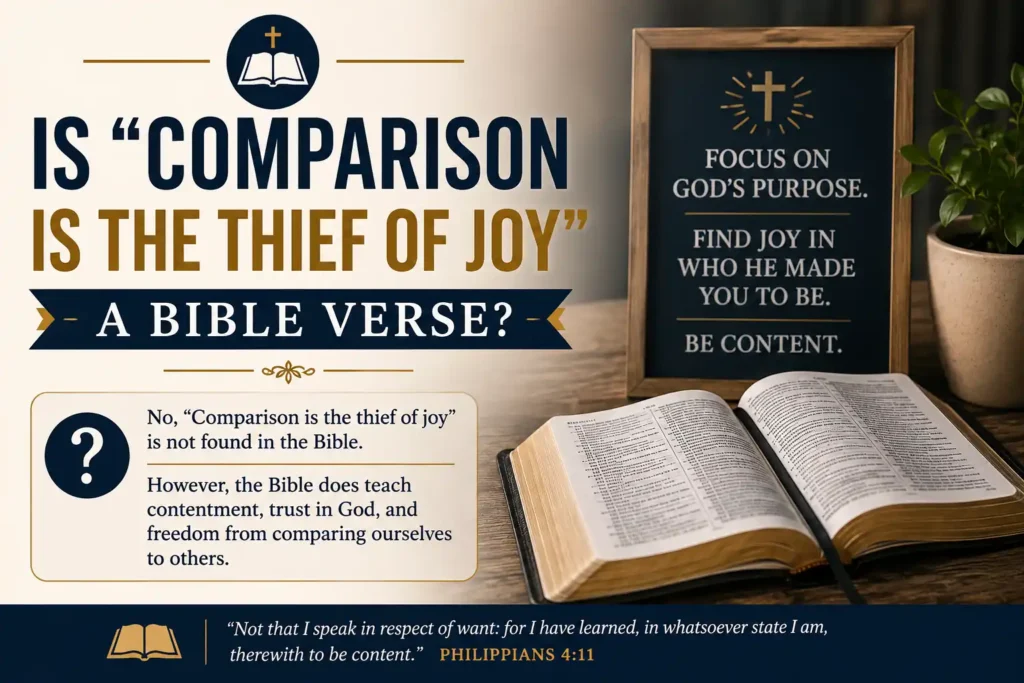
One of the most common questions people ask after encountering the phrase is whether it’s actually found in the Bible. The answer is clear: no. “Comparison is the thief of joy” is not a Bible verse, nor does any biblical translation contain those exact words.
Although the quotation reflects principles Scripture teaches repeatedly, it’s a modern expression rather than inspired biblical text. Recognizing this matters because Christians are called to distinguish carefully between God’s Word and human wisdom, even when both point toward similar truths; confusing the two can unintentionally lend a modern quotation an authority that belongs only to Scripture.
That doesn’t mean the quotation is false. It means the quotation should be evaluated by Scripture rather than treated as Scripture. Viewed through that lens, many of its central ideas align remarkably well with biblical teaching about contentment, envy, gratitude, humility, faithful stewardship, and trusting God instead of measuring ourselves by the lives of others.
Why Do So Many People Think It Is a Bible Verse?

The misunderstanding didn’t arise by accident; several factors have gradually blurred the line between the quotation and biblical teaching.
First, the statement sounds remarkably like biblical wisdom literature. Proverbs, for example, frequently offers concise observations about human behavior and its consequences, and because “comparison is the thief of joy” shares that same memorable, proverb-like structure, many readers naturally assume it belongs somewhere in Scripture.
Second, pastors, Bible teachers, Christian authors, and devotional writers often use the quotation to introduce lessons on contentment, gratitude, or envy. In those settings it functions as an illustration rather than a citation, but repeated exposure within Christian teaching has led many people to assume the words themselves come from the Bible.
Social media has accelerated the confusion further. Inspirational graphics frequently pair the quotation with photographs of open Bibles or church imagery, sometimes alongside an actual verse reference about contentment or envy. Readers remember the association while forgetting that the cited verse isn’t the quotation itself.
The lesson for Bible study is an important one: familiarity does not establish biblical authority. A statement can circulate widely within Christian circles without ever appearing in Scripture.
What Does the Bible Actually Say?
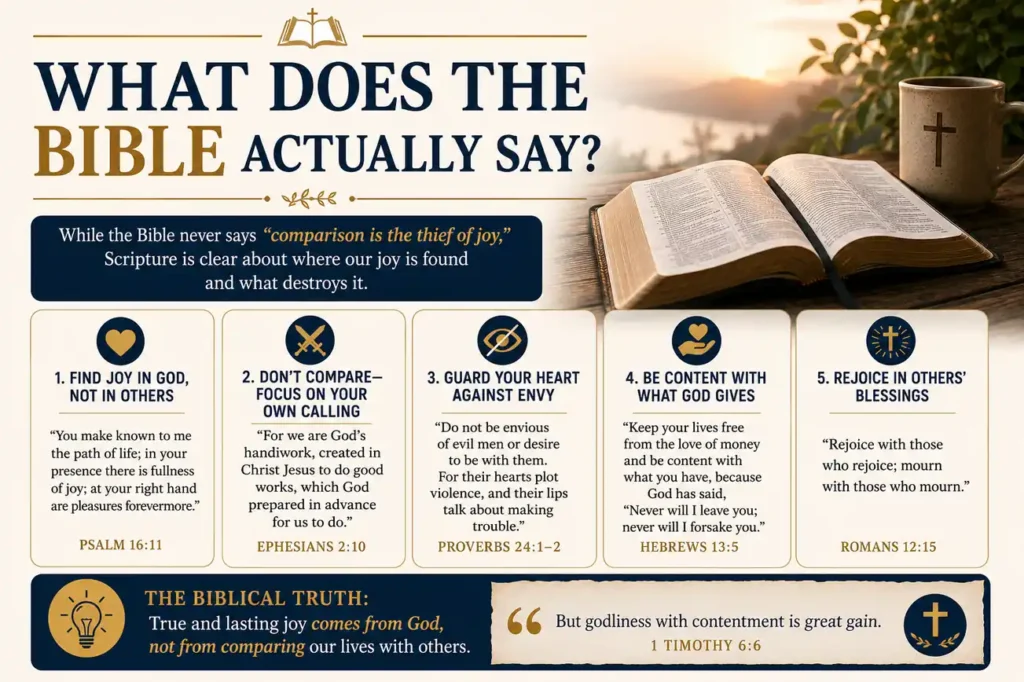
Although Scripture never says, “comparison is the thief of joy,” it repeatedly addresses the attitudes unhealthy comparison often produces. Rather than treating comparison as an isolated behavior, the Bible speaks to the deeper spiritual issues beneath it, including:
- Contentment instead of dissatisfaction.
- Gratitude instead of envy.
- Humility instead of pride.
- Trust in God’s provision instead of coveting another person’s circumstances.
- Faithfulness to one’s own calling instead of competing for status.
This broader perspective is one of the Bible’s great strengths. Instead of merely naming the problem, Scripture points readers toward the heart transformation from which comparison often arises.
Someone who constantly compares their career with a coworker’s may not simply have a comparison problem; they may be wrestling with contentment, identity, ambition, fear, or trust in God’s timing. Comparing possessions, relationships, or achievements often reveals similar questions about where a person finds security and significance — questions the Bible consistently addresses.
Biblical Principle vs. Biblical Quotation
One simple way to understand the relationship between the quotation and Scripture is to distinguish a biblical principle from a biblical quotation. A biblical quotation consists of words that actually appear in the inspired text. A biblical principle is a truth that faithfully summarizes what Scripture teaches, even when those exact words aren’t found in the Bible.
Christians commonly repeat phrases such as “God helps those who help themselves.” Although widely believed to be biblical, that statement appears nowhere in Scripture and, in several respects, doesn’t accurately reflect the Bible’s emphasis on grace. By contrast, “comparison is the thief of joy” isn’t found in the Bible either, yet its underlying observation harmonizes with numerous biblical teachings about envy, gratitude, humility, and contentment.
Understanding this distinction helps Christians appreciate useful summaries of biblical truth without confusing them with God’s inspired Word.
Does the Bible Warn Against Comparison?
Yes — often in a way that runs deeper than people expect. Rather than issuing a universal command never to compare ourselves with others, Scripture repeatedly warns against the spiritual dangers unhealthy comparison creates. The Bible cautions against:
- Envying another person’s success.
- Coveting what God has entrusted to someone else.
- Becoming proud because we believe ourselves superior.
- Measuring our worth by human standards.
- Seeking identity through status, possessions, or recognition instead of through God.
At the same time, Scripture encourages careful self-examination, learning from faithful examples, pursuing spiritual maturity, and rejoicing with those God blesses. These forms of evaluation differ fundamentally from comparison that breeds jealousy, resentment, or insecurity — a distinction that becomes increasingly important as we examine the specific passages people most often associate with this quotation.
Why This Distinction Matters for Christians
Some readers may wonder whether this is simply a matter of semantics. If the quotation expresses a biblical idea, does it really matter whether it’s a Bible verse? The answer is yes, for two reasons.
First, honoring Scripture means representing it accurately. Christians should never attribute words to God that He has not spoken; doing so, even unintentionally, blurs the line between divine revelation and human reflection.
Second, understanding the difference actually strengthens both the quotation and the biblical teaching behind it. The quotation offers a memorable observation about human experience. The Bible goes much deeper: it explains why unhealthy comparison diminishes peace and contentment, what it reveals about the human heart, and how believers are called to respond through faith, gratitude, humility, and trust in God — a richer perspective than even the most insightful modern quotation can offer.
The next section examines the specific Bible passages most closely associated with this idea, exploring what each teaches within its original context before drawing out practical application for Christian life.
Which Bible Verses Teach the Same Principle?
Although the Bible never says, “comparison is the thief of joy,” many passages address the attitudes and spiritual dangers the quotation summarizes. Rather than presenting comparison as an isolated problem, Scripture consistently teaches believers to cultivate contentment, humility, gratitude, faithful stewardship, and trust in God instead of measuring their lives against the success or possessions of others.
Understanding these passages requires more than quoting verses in isolation. Every verse should be read within its historical, literary, and theological context; taken out of context, passages can easily be reduced to motivational slogans, but understood as part of God’s unfolding revelation, they offer a far richer and more balanced perspective. The following passages are among the clearest biblical texts that reflect the principle behind the quotation.
Galatians 6:4–5 — Examine Your Own Work
Perhaps no passage comes closer to addressing unhealthy comparison directly than Paul’s instruction to the churches in Galatia:
“Each one should test their own actions. Then they can take pride in themselves alone, without comparing themselves to someone else.” (Galatians 6:4)
At first glance, Paul appears to discourage comparison altogether. A closer reading reveals a more nuanced teaching.
Historical Context
The churches in Galatia were struggling with legalism, spiritual pride, and competition over religious performance. Certain teachers encouraged believers to measure spiritual maturity by outward observance of the Mosaic Law rather than by faith in Christ. Paul responds by redirecting believers away from evaluating one another and toward honest personal examination before God. Instead of asking, “How do I compare with everyone else?” Paul encourages believers to ask, “Am I faithfully fulfilling the responsibilities God has given me?” The emphasis is accountability, not rivalry.
Theological Significance
Paul does not condemn self-examination — Scripture elsewhere repeatedly encourages believers to evaluate their own hearts, motives, and conduct. The problem arises when self-evaluation curdles into self-elevation or self-condemnation through constant comparison with others. Biblical self-examination produces humility; unhealthy comparison tends to produce either pride or discouragement. Paul therefore redirects attention from competing with fellow believers to faithfully walking with Christ.
Practical Application
This passage invites Christians to shift their standard of evaluation. Instead of asking whether they are more successful or more spiritual than others, or why God has blessed someone else differently, Scripture encourages questions such as: Am I growing in obedience? Am I faithfully using the gifts God has entrusted to me? Am I becoming more like Christ than I was yesterday? Those questions encourage spiritual growth without making another person’s life the measure of your own.
2 Corinthians 10:12 — Comparison Is Not Wise
Another passage frequently connected with this topic appears in Paul’s second letter to the Corinthians:
“When they measure themselves by themselves and compare themselves with themselves, they are not wise.”
Unlike Galatians, Paul speaks even more directly about comparison here.
Historical Context
False teachers had entered Corinth claiming superior authority, spiritual gifts, and impressive credentials, continually comparing themselves with one another to establish status and influence within the church. Rather than defending himself by entering the same competition, Paul rejects the entire system. His concern isn’t merely that comparison hurts feelings — it’s that comparison becomes a false standard for determining spiritual authority. God, not public opinion, is the true measure of faithful ministry.
Why Paul Calls Comparison Foolish
Notice what Paul doesn’t say: he never argues that believers should ignore spiritual growth or refuse to learn from mature Christians. Instead, he criticizes making human comparison the ultimate standard of success. Human comparisons constantly shift; God’s standard does not. Believers who measure success only by visible achievements, popularity, influence, or recognition risk overlooking what God values most — faithfulness.
Practical Application
Modern culture often rewards visibility: social media celebrates followers, businesses celebrate revenue, careers celebrate promotions. The church measures success differently, pointing believers back to faithfulness, obedience, and perseverance rather than comparison-driven competition. For Christians today, this passage is a reminder that God’s evaluation carries infinitely greater weight than human rankings.
Philippians 4:11–13 — Learning Contentment
One of the strongest biblical responses to comparison appears in Paul’s discussion of contentment: “I have learned in whatever situation I am to be content.” That single word — learned — deserves attention. Contentment, for Paul, was not automatic.
Historical Context
Paul wrote Philippians while imprisoned. From a human perspective, his circumstances offered little reason for joy, yet throughout the letter he repeatedly emphasizes rejoicing, gratitude, and confidence in Christ. His joy depended neither on comfort nor on comparing his circumstances with those of others; instead, it rested on God’s sustaining grace.
Theological Insight
Comparison asks, “Why does someone else have more?” Contentment asks, “How can I faithfully trust God with what He has given me today?” Paul doesn’t deny hardship; he simply refuses to let changing circumstances determine his relationship with God — a perspective that directly challenges comparison-driven thinking. Joy that depends on having more than someone else will always remain fragile. Joy that rests in Christ remains secure even when circumstances change.
Hebrews 13:5 — Be Content With What You Have
Another foundational passage instructs believers to “keep your lives free from the love of money and be content with what you have.” The verse is often applied only to financial stewardship, but its reach extends much further.
Comparison frequently centers on possessions, success, lifestyle, or opportunity, and the writer of Hebrews addresses the heart beneath those desires directly. Contentment grows not because believers possess everything they want, but because they trust the God who has promised never to leave nor forsake them. Notice the shift: the world encourages security through acquiring more, while Scripture encourages security through trusting God’s presence. That theological foundation moves the discussion from possessions to worship — contentment ultimately reflects confidence in God’s character rather than satisfaction with circumstances.
James 3:16 — Envy and Disorder
James provides another important perspective: “For where envy and selfish ambition exist, there will be disorder and every vile practice.”
Comparison often begins quietly. Someone notices another person’s success; that observation becomes comparison; comparison develops into envy; envy eventually shapes attitudes, relationships, and decisions. James exposes this progression, treating envy not merely as an emotional struggle but as a spiritual issue capable of disrupting both personal holiness and community life. Healthy admiration motivates growth, while envy seeks what belongs to someone else and grows dissatisfied with God’s own provision — a distinction that helps explain why Scripture repeatedly warns against envy rather than against every form of comparison.
Summary: What These Passages Teach Together
Although each passage addresses a different situation, together they communicate a remarkably consistent biblical message.
| Passage | Primary Teaching | Connection to Comparison |
| Galatians 6:4–5 | Examine your own work faithfully. | Focus on personal stewardship instead of measuring yourself against others. |
| 2 Corinthians 10:12 | Human comparison is an unreliable standard. | God’s evaluation matters more than human rankings. |
| Philippians 4:11–13 | Contentment is learned through Christ. | Joy grows through dependence on Christ rather than comparison. |
| Hebrews 13:5 | Trust God’s provision. | Contentment replaces the desire to measure possessions against others. |
| James 3:16 | Envy produces disorder. | Unhealthy comparison often develops into envy when left unchecked. |
Taken together, these passages reveal that Scripture does far more than discourage unhealthy comparison — it redirects believers toward an entirely different way of living, one rooted in gratitude, faithful stewardship, humble self-examination, trust in God’s provision, and identity in Christ rather than in comparison with others.
Romans 12:15–16 — Reject Pride and Live in Humility
Paul’s instructions to the church in Rome offer another important perspective on comparison, even though the word itself never appears: “Rejoice with those who rejoice; mourn with those who mourn… Do not be proud, but be willing to associate with people of low position. Do not be conceited.” These commands reveal one of the clearest biblical alternatives to unhealthy comparison.
Historical Context
The Roman church consisted of believers from diverse ethnic, cultural, and economic backgrounds. Jewish and Gentile Christians worshipped together while bringing different traditions, experiences, and expectations into the same congregation — diversity that created real opportunities for comparison, competition, and division. Rather than allowing believers to rank themselves by social status, wealth, knowledge, or spiritual maturity, Paul calls the church to genuine humility and mutual love, shifting attention away from self and toward others.
Theological Significance
Comparison often turns another person’s success into a personal evaluation. Paul encourages the opposite response: when a fellow believer experiences God’s blessing, Christians are called to rejoice sincerely rather than quietly resent their success — a command that strikes at the heart of envy. Envy asks, “Why them instead of me?” Biblical love asks, “How can I thank God for what He has done in their life?” Mourning with those who mourn guards against a subtler form of comparison as well: the temptation to view another person’s suffering as evidence of personal superiority or divine favoritism. Christian community flourishes when believers celebrate one another’s victories and bear one another’s burdens instead of competing for status.
Practical Application
When a friend receives a promotion, announces an engagement, welcomes a child, or reaches an important milestone, comparison naturally whispers that their gain somehow diminishes your own life. Romans 12 teaches a radically different response: celebrate God’s goodness wherever you see it. Doing so strengthens relationships and guards your own heart against resentment and pride — learning to rejoice with others is one of the most practical ways Christians overcome unhealthy comparison.
Exodus 20:17 — The Tenth Commandment and Coveting
The Bible’s earliest and perhaps most comprehensive warning related to comparison appears in the Tenth Commandment, where God commands Israel: “You shall not covet your neighbor’s house. You shall not covet your neighbor’s wife, or his servant or maidservant, his ox or donkey, or anything that belongs to your neighbor.” Unlike theft or adultery, coveting begins internally — it is a matter of the heart before it ever becomes visible in outward behavior.
Historical Context
The Ten Commandments established Israel’s covenant relationship with God after the Exodus. While many commandments regulate visible actions, the prohibition against coveting reaches beneath behavior to address inward desire. God was not merely concerned with what His people did; He was concerned with what they wanted — a distinction that remains profoundly relevant today.
Theological Significance
Comparison and coveting are closely related but not identical. Comparison is the act of noticing differences; coveting begins when those differences create a sinful desire to possess what God has entrusted to someone else. A believer may recognize another person’s beautiful home, successful career, or spiritual gifts without sinning — the issue arises when admiration curdles into dissatisfaction with God’s provision or resentment toward another person’s blessings. Coveting ultimately reflects a failure to trust God’s wisdom in distributing gifts, opportunities, and responsibilities according to His sovereign purposes.
Practical Application
Modern culture encourages constant comparison through advertising, entertainment, and social media, with nearly every message implying that happiness depends on acquiring something more. The Tenth Commandment confronts this mindset directly, inviting believers to trade “Why don’t I have what they have?” for “How can I faithfully steward what God has already entrusted to me?” — a shift that transforms comparison into gratitude.
Psalm 73 — When Comparison Becomes a Crisis of Faith
Few passages describe the emotional experience of comparison as honestly as Psalm 73. The psalmist, Asaph, openly admits that he struggled after observing the prosperity of the wicked: “For I envied the arrogant when I saw the prosperity of the wicked.” Unlike many biblical narratives, Scripture records his internal struggle in remarkable detail.
Historical Context
Asaph served as one of Israel’s worship leaders. Despite his position, he found himself questioning why those who ignored God appeared to prosper while the righteous often experienced hardship — demonstrating that comparison isn’t limited to material possessions but can raise difficult spiritual questions. Why do those who reject God sometimes seem to flourish? Why do faithful believers suffer? These questions have challenged God’s people throughout history.
The Turning Point
The psalm changes dramatically when Asaph enters God’s sanctuary. His perspective shifts from temporary appearances to eternal realities, and instead of evaluating life solely through visible success, he begins viewing it through God’s sovereign purposes. This transformation illustrates one of Scripture’s central lessons: comparison narrows our vision to the present moment, while faith broadens our vision to include God’s eternal perspective.
Practical Application
Many believers experience moments like Asaph’s. Watching dishonest businesses prosper, seeing ungodly lifestyles celebrated, or observing seemingly effortless success can produce discouragement. Psalm 73 doesn’t pretend those emotions never exist; instead, it shows how bringing those struggles honestly before God reshapes perspective. Rather than suppressing difficult questions, believers are invited to process them in God’s presence and let His truth redefine success according to eternal rather than temporary standards.
Matthew 20:1–16 — The Parable of the Workers in the Vineyard
Jesus Himself addressed comparison in one of His most memorable parables. In the Parable of the Workers in the Vineyard, laborers hired early in the day receive the same wage as those hired near the end. Those who worked longer immediately begin comparing themselves with the later workers, complaining, “These who were hired last worked only one hour… and you have made them equal to us.”
Theological Significance
The landowner’s response reveals an important biblical principle: the issue was never injustice. The workers received exactly what had been promised, and their dissatisfaction began only after they compared their reward with someone else’s. Nothing about their own blessing had changed — only their perspective changed. Jesus uses the story to show how comparison distorts gratitude; instead of appreciating God’s generosity toward themselves, people become preoccupied with how God has chosen to bless others. The parable also reminds believers that God’s grace is never distributed according to human calculations of merit. He remains sovereign, generous, and perfectly just.
Bringing These Passages Together
Taken as a whole, these Scriptures reveal a consistent pattern. The Bible rarely treats comparison as an isolated behavior; instead, it addresses the deeper spiritual attitudes comparison often exposes. When believers compare themselves with others, Scripture repeatedly redirects them toward truths that cultivate spiritual maturity:
- Evaluate your own faithfulness rather than another person’s achievements.
- Trust God’s wisdom instead of questioning His provision.
- Rejoice in the blessings He gives others.
- Guard your heart against envy and coveting.
- Remember that God’s definition of success is faithfulness, not status.
- Find your identity in Christ rather than in human comparison.
Viewed together, these passages offer something far richer than a collection of inspirational verses. They present a unified biblical theology that moves beyond the modern quotation — for while “comparison is the thief of joy” accurately describes one consequence of unhealthy comparison, Scripture goes further, revealing the heart issues beneath comparison and pointing believers toward the lasting joy found in gratitude, humility, faithful stewardship, and unwavering trust in God’s sovereign goodness.
What Does the Bible Teach About Comparison?
Having established that “comparison is the thief of joy” is not a Bible verse but reflects several biblical principles, we can now ask a deeper question: what does the Bible actually teach about comparison itself? The answer is more nuanced than many people expect.
Scripture never issues a blanket command to “never compare yourself with others,” nor does it suggest every form of comparison is inherently sinful. Instead, the Bible distinguishes between wise evaluation that promotes spiritual growth and self-centered comparison that produces pride, envy, dissatisfaction, or distrust in God — a distinction that matters because the modern quotation often simplifies a subject Scripture treats with remarkable depth.
Rather than focusing merely on the outward act of comparison, the Bible consistently addresses the condition of the heart. God’s concern isn’t whether people notice differences between themselves and others; it’s what those observations produce within them. Do they lead to gratitude or resentment? Humility or pride? Faithfulness or competition? Trust in God’s providence or dissatisfaction with His provision? Throughout both Testaments, the consistent pattern is clear: comparison becomes spiritually dangerous when it shifts attention away from God’s calling for our own lives and toward measuring our worth by another person’s blessings, achievements, or circumstances.
The Bible Does Not Condemn Every Form of Comparison
One of the most common misconceptions is that Christians should never compare anything. Scripture does not teach that; in fact, comparison is sometimes necessary for wisdom, learning, and spiritual maturity.
Believers are encouraged to learn from faithful examples. Paul repeatedly invites churches to imitate mature believers who faithfully follow Christ, and Proverbs urges readers to observe the diligent, the wise, and even the ant to gain practical wisdom — examples that involve careful observation and thoughtful evaluation. Self-examination requires a form of comparison as well. When Paul tells believers to “examine yourselves” (2 Corinthians 13:5), he calls them to compare their lives — not against other people, but against God’s revealed standard.
This is an important distinction. Biblical evaluation asks: Am I growing in holiness? Am I becoming more like Christ? Am I faithfully obeying God’s Word? These questions direct attention upward toward God’s standard rather than sideways toward human competition. Healthy comparison therefore serves discipleship — it encourages learning without threatening identity.
When Comparison Becomes Spiritually Dangerous
The Bible consistently warns against comparison when it changes from evaluation into competition. This usually happens in subtle stages: a believer notices another person’s success; that observation becomes comparison; comparison becomes dissatisfaction; dissatisfaction develops into envy or pride; eventually, trust in God’s wisdom begins to weaken.
This progression appears repeatedly throughout Scripture. Sin rarely begins with dramatic rebellion; more often it begins with ordinary desires that gradually become disordered, and comparison is one of the ways those disordered desires emerge. Instead of thanking God for His unique work in each person’s life, people begin questioning why His blessings appear different. Instead of faithfully stewarding their own calling, they become preoccupied with someone else’s. The problem, then, is not recognizing differences — it’s allowing those differences to redefine contentment, identity, or trust.
God’s Standard Is Faithfulness, Not Comparison
One of Scripture’s most consistent themes is that God evaluates people differently than the world does. Human beings naturally compare visible outcomes; God examines the heart.
Throughout the Bible, faithful people occupy remarkably different circumstances. Abraham possessed tremendous wealth. John the Baptist lived in the wilderness. Joseph governed Egypt. Jeremiah spent much of his ministry rejected. Lydia prospered in business. Paul experienced imprisonment and hardship. Their circumstances varied dramatically; their faithfulness did not.
This diversity demonstrates an important principle: God never calls every believer to identical assignments. He calls each believer to faithful obedience within the calling He has given them. Comparison becomes dangerous because it ignores that reality — instead of asking whether we are faithful to our own calling, we begin evaluating ourselves according to responsibilities God entrusted to someone else. Faithfulness cannot be measured by another person’s assignment. It can only be measured by obedience to God’s will for our own lives.
Comparison Redirects Attention From Stewardship
Another major biblical theme is stewardship. Jesus frequently taught that God’s people are entrusted with different gifts, opportunities, responsibilities, and resources — differences that are intentional, meant not for competition but for faithful stewardship.
When believers compare themselves with others, attention often shifts away from managing God’s gifts wisely toward evaluating who appears more successful, quietly undermining discipleship. Instead of asking, “How can I glorify God with what He has entrusted to me?” comparison encourages questions such as, “Why did God entrust more to someone else?” The first question produces responsibility; the second often produces resentment. Scripture consistently encourages the first.
Comparison vs. Envy, Coveting, Pride, and Contentment
One reason comparison is frequently misunderstood is that the Bible rarely treats it as an isolated issue. Instead, comparison often functions as the doorway through which other attitudes enter the heart. Recognizing these distinctions helps explain why Scripture spends relatively little time discussing comparison itself while repeatedly addressing envy, coveting, pride, gratitude, and contentment. Although these concepts are closely related, they are not interchangeable, and understanding the differences prevents oversimplifying what the Bible teaches.
Comparison vs. Envy
Comparison and envy often appear together, but they are not the same thing. Comparison begins by noticing differences; envy begins by resenting them. A believer may observe another person’s spiritual gifts, career success, or material blessings without sinning — envy develops only when admiration curdles into resentment or dissatisfaction. This distinction explains why Scripture repeatedly condemns envy while allowing believers to appreciate excellence, rejoice in another person’s success, and learn from faithful examples. Envy asks, “Why should they have what I don’t?” Love asks, “How can I thank God for blessing them?” That difference changes the entire spiritual direction of the heart.
Comparison vs. Coveting
Coveting moves one step beyond envy. Where envy resents another person’s blessings, coveting desires to possess them. The Tenth Commandment addresses this directly because coveting questions God’s wisdom in distributing His gifts: comparison notices, envy resents, coveting desires to take. This progression illustrates why Scripture addresses the heart rather than simply external behavior — before outward actions become sinful, inward desires often require God’s transforming grace. Christians should therefore examine not merely whether they compare themselves with others, but what those comparisons awaken within them.
Comparison vs. Pride
Comparison can also produce the opposite problem. Instead of feeling inferior, people sometimes conclude they are superior — this is pride. The Pharisee in Jesus’ parable illustrates this danger perfectly: standing in the temple, he compared himself with the tax collector and concluded that his apparent righteousness made him more acceptable before God. His comparison produced self-exaltation rather than humility.
Ironically, both inferiority and superiority emerge from the same unhealthy habit. One person concludes, “I’m not good enough.” Another concludes, “I’m better than everyone else.” Both have made human comparison the basis of identity, and neither reflects biblical humility, which neither exaggerates nor minimizes one’s value — it simply recognizes that every gift, opportunity, and achievement ultimately comes from God’s grace.
Comparison vs. Contentment
Perhaps the greatest biblical contrast is between comparison and contentment. Comparison continually asks what is missing; contentment gratefully receives what God has provided.
Contentment should never be confused with complacency. Paul remained ambitious in his ministry, working diligently, enduring hardship, and pursuing God’s calling with extraordinary commitment — yet his ambition was rooted in obedience rather than competition. Biblical contentment doesn’t discourage growth; it simply refuses to make another person’s life the measure of your own joy. A content believer may still pursue education, career advancement, financial stewardship, ministry opportunities, or personal development. The difference lies in motivation: growth becomes an act of faithful stewardship instead of an attempt to prove personal worth.
A Biblical Framework for Evaluating Comparison
The Bible provides a practical framework that helps believers evaluate whether comparison is leading them toward spiritual maturity or away from it. Ask yourself these questions whenever comparison arises:
- Does this comparison encourage gratitude or dissatisfaction?
- Does it motivate faithful stewardship or unhealthy competition?
- Does it deepen my trust in God’s wisdom or cause me to question His provision?
- Does it inspire humble growth or inflate my pride?
- Does it help me become more like Christ or distract me from His calling?
If the answers consistently point toward gratitude, humility, obedience, and faithful stewardship, the evaluation is likely serving a healthy purpose. If they consistently reveal envy, resentment, insecurity, pride, or distrust, comparison has become spiritually unhealthy.
Ultimately, the Bible redirects believers away from making other people their standard of measurement and back toward God’s unchanging standard. Rather than asking whether someone else has been given more, achieved more, or accomplished more, Scripture asks a far more important question: are you faithfully using what God has entrusted to you for His glory? That single question transforms comparison from a pursuit of status into an opportunity for faithful discipleship — shifting the focus from competing with others to walking obediently with Christ, and preparing us to examine the many biblical narratives where comparison shaped people’s decisions, relationships, and spiritual lives.
Is Comparison Always Sinful?
After reading passages that warn against envy, pride, coveting, and unhealthy comparison, an important question naturally follows: does the Bible teach that every form of comparison is sinful? The answer is no.
Scripture presents a far more balanced and theologically rich perspective than either extreme. On one hand, the Bible repeatedly warns against comparison that produces envy, pride, discontentment, or distrust in God. On the other, it encourages thoughtful self-examination, learning from faithful examples, pursuing spiritual maturity, and evaluating our lives according to God’s standards.
This distinction prevents two common misunderstandings: believing that all comparison is sinful, and believing that comparison is always harmless. Neither position reflects the full counsel of Scripture. Instead, the Bible teaches that comparison becomes sinful not because we notice differences between people, but because of what those differences produce in our hearts.
The Bible Distinguishes Observation From Sinful Comparison
Human beings naturally notice differences. God created people with different gifts, personalities, responsibilities, opportunities, and callings, and Scripture itself records these differences without suggesting that simply recognizing them is wrong.
The Bible openly acknowledges, for example, that Moses possessed unique leadership gifts, Solomon received extraordinary wisdom, David excelled as both shepherd and king, Daniel demonstrated exceptional integrity, Barnabas was known for encouragement, Paul became a missionary to the Gentiles, and Peter primarily ministered to the Jews. Recognizing these differences isn’t sinful; Scripture records them so believers can better understand God’s diverse work among His people.
The problem begins when observation becomes personal measurement — when “How is God working through this person?” becomes “Why am I not like them?” or “Why am I better than they are?” At that point, the focus shifts from appreciating God’s work to evaluating personal worth through another person’s life.
Healthy Comparison Can Encourage Spiritual Growth
Far from discouraging every comparison, Scripture frequently encourages believers to learn from faithful examples. Paul writes, “Follow my example, as I follow the example of Christ” (1 Corinthians 11:1), and Hebrews likewise encourages believers to remember faithful leaders and imitate their faith.
These passages reveal an important principle: biblical imitation is not competition; its purpose is transformation. When Christians observe mature believers, the goal isn’t to duplicate every detail of another person’s life but to learn attitudes, habits, and patterns of faithfulness that help them grow in their own walk with Christ. Healthy comparison therefore asks questions such as: What can I learn from this person’s faith? Which spiritual disciplines have helped them mature? How can I apply those biblical principles within my own calling? These questions keep the focus on learning rather than measuring personal value — the mature believer becomes a teacher, not a competitor.
Self-Examination Is Encouraged Throughout Scripture
One of the clearest examples of healthy comparison is biblical self-examination. Paul instructs believers to “examine yourselves to see whether you are in the faith” (2 Corinthians 13:5), and Galatians 6 similarly encourages every believer to examine their own work before God.
This evaluation differs fundamentally from comparing ourselves with others. Instead of asking, “Am I more spiritual than someone else?” biblical self-examination asks, “Am I faithfully following Christ?” The standard changes completely: human comparison uses other people as the measuring stick, while biblical self-examination uses God’s Word. This distinction protects believers from both discouragement and pride. If our standard is another person, we will always find someone who appears more successful — or less successful. If our standard is Christ, the goal becomes continual growth in holiness rather than competition.
Jesus Is the Ultimate Standard
Perhaps the greatest theological reason unhealthy comparison becomes dangerous is that it replaces the wrong standard. The New Testament consistently points believers toward Christ as the perfect example — believers are called to grow into His likeness, not to become copies of one another.
This truth provides tremendous freedom. Every Christian has a unique calling, different spiritual gifts, different personalities, different responsibilities, different seasons of life, and different opportunities for ministry, and comparing those callings against one another misunderstands God’s design for His church. Paul explains this beautifully by describing the church as the Body of Christ: just as the eye, hand, foot, and ear have different purposes, believers fulfill different roles within God’s kingdom. The eye should not envy the hand, nor should the hand despise the foot — each part contributes according to God’s wisdom. Comparison forgets this diversity. Faithfulness embraces it.
When Does Comparison Become Sin?
Although comparison itself is not automatically sinful, Scripture reveals several warning signs indicating that it has crossed a spiritual boundary. Comparison becomes sinful when it:
- Produces envy instead of gratitude.
- Leads to pride instead of humility.
- Creates dissatisfaction with God’s provision.
- Distracts us from our own calling.
- Causes resentment toward another person’s blessings.
- Makes human approval more important than God’s approval.
- Questions God’s wisdom in distributing gifts and opportunities.
Each warning concerns the heart. Two believers may observe the same successful missionary: one becomes inspired to deepen their own commitment to Christ, while the other becomes discouraged, feeling inadequate. The outward observation is identical; the inward response determines whether comparison becomes spiritually healthy or spiritually harmful.
Comparison Can Also Become an Idol
Another danger rarely discussed is the possibility that comparison becomes a form of idolatry. Idolatry isn’t limited to worshiping statues — biblically, it occurs whenever something other than God becomes the ultimate source of identity, security, or value.
Comparison can quietly move in this direction. Instead of asking what God desires, people begin asking how they appear relative to everyone else. Success becomes more important than faithfulness; recognition becomes more valuable than obedience; approval becomes more desirable than God’s pleasure. At that point, comparison is no longer simply an emotional struggle — it has become a worship issue, with the heart shifting its attention away from God and toward human status.
A Biblical Decision Framework
Because comparison is not always sinful, believers need wisdom to discern when it’s serving God’s purposes and when it’s becoming spiritually destructive. Before accepting any comparison, prayerfully ask:
- What is my purpose? Am I trying to learn and grow, or measuring my worth against another person?
- What emotions does this comparison produce — gratitude, humility, and faithful stewardship, or envy, insecurity, resentment, or pride?
- What standard am I using — Christ and God’s Word, or another person’s circumstances?
- Does this comparison strengthen my relationship with God, or distract me from the unique calling He has entrusted to me?
- Am I celebrating God’s work in others, or preoccupied with my own standing?
These questions help expose the true spiritual condition behind comparison.
Healthy Comparison vs. Sinful Comparison
| Healthy Comparison | Sinful Comparison |
| Learns from faithful examples | Measures personal worth against others |
| Encourages spiritual growth | Produces envy or pride |
| Uses Christ as the standard | Uses people as the standard |
| Inspires gratitude | Creates dissatisfaction |
| Strengthens faithful stewardship | Distracts from God’s calling |
| Glorifies God | Seeks personal status or validation |
The Bible’s teaching is therefore remarkably balanced. It neither commands believers to ignore everyone around them nor encourages endless comparison; instead, it calls Christians to evaluate everything through the lens of God’s truth. When comparison points us toward Christ, deeper humility, wiser stewardship, and greater faithfulness, it serves a healthy purpose. When it turns our attention toward competition, insecurity, pride, or discontentment, it has moved beyond simple observation and become a spiritual danger requiring repentance and renewed trust in God’s sovereign goodness.
This biblical framework prepares us to examine the lives of men and women throughout Scripture whose stories vividly illustrate both the destructive consequences of unhealthy comparison and the freedom that comes from trusting God’s unique purpose for every believer.
Old Testament Examples of Comparison: Lessons From Biblical Narratives
The Bible does not merely teach principles about comparison through commandments and wisdom literature; it also illustrates those principles through the lives of real people. The Old Testament records numerous accounts in which comparison shaped decisions, relationships, and even the course of Israel’s history.
These narratives reveal that comparison is rarely the root problem. Instead, it often exposes deeper issues already present within the human heart — envy, insecurity, pride, fear, impatience, or a lack of trust in God’s sovereignty. Studying these stories in their historical and theological context gives believers practical wisdom for recognizing similar patterns in their own lives.
Rather than reading these accounts as isolated moral lessons, we should view them as part of God’s unfolding work of redemption. Each narrative ultimately points beyond human failure to God’s faithfulness, reminding us that while comparison frequently leads people away from Him, His grace continually calls them back to trust and obedience.
Cain and Abel: When Comparison Leads to Jealousy
One of Scripture’s earliest examples of destructive comparison appears in Genesis 4. Cain and Abel both approached God with offerings; Abel’s was accepted, while Cain’s was not. Instead of examining his own heart and responding with repentance, Cain immediately focused on his brother.
Historical Context
This account takes place shortly after humanity’s expulsion from the Garden of Eden. Sin had already entered the world, but its devastating effects were only beginning to unfold, and the conflict between Cain and Abel demonstrates how quickly broken relationships with God affect relationships with other people. The text emphasizes God’s gracious warning before Cain acted — He asked, “Why are you angry? Why is your face downcast?” and urged Cain to master the sin seeking to control him. Before judgment came opportunity for repentance.
Theological Lesson
Cain’s greatest problem wasn’t that Abel received God’s favor; it was that he interpreted his brother’s acceptance as a personal defeat rather than examining his own relationship with God. Instead of responding vertically toward God, Cain reacted horizontally toward Abel — a pattern that still appears today. When comparison replaces self-examination, people often blame others rather than allowing God to transform their own hearts.
Practical Application
Whenever another person’s success causes resentment, Genesis 4 invites believers to ask: Am I responding to God or reacting to someone else? Is another person’s blessing exposing an area where God wants to change my own heart? Am I seeking repentance or simply looking for someone to blame? Cain’s story reminds us that comparison becomes spiritually dangerous when another person’s favor matters more to us than our own relationship with God.
Rachel and Leah: Comparison Within the Family
The story of Rachel and Leah demonstrates that comparison often develops most intensely within close relationships. Jacob loved Rachel deeply, while Leah struggled with feeling overlooked; later, Rachel experienced the pain of infertility while Leah bore children. Each sister desired what the other possessed.
Historical Context
Marriage customs in the ancient Near East differed significantly from modern practices. Jacob’s marriages resulted from Laban’s deception, creating a complicated family structure that naturally fostered rivalry and insecurity. Rather than living in contentment, both sisters continually measured their lives against one another: Leah longed for Jacob’s affection, Rachel longed for Leah’s children, and neither found lasting satisfaction through comparison.
Theological Lesson
Their story illustrates an important truth: comparison often convinces people that one missing blessing prevents happiness. Leah believed love would satisfy her; Rachel believed children would satisfy her. Yet both continued struggling, because lasting contentment cannot be built on possessing what someone else has. God alone remains the ultimate source of fulfillment.
Practical Application
Modern comparisons often follow the same pattern. Someone without children envies those with families; parents compare themselves with childless couples who appear to have greater freedom; singles compare themselves with married friends; married couples compare themselves with seemingly perfect families. Comparison continually shifts attention toward what is absent rather than recognizing God’s present faithfulness. Rachel and Leah remind believers that every season of life brings unique blessings and unique challenges, and comparing one season with another rarely produces gratitude.
Joseph and His Brothers: Comparison Produces Resentment
Joseph’s story reveals how comparison can destroy family relationships. Jacob openly favored Joseph, giving him a richly ornamented robe that symbolized special affection, and Joseph’s brothers immediately recognized the difference. Instead of confronting the family dysfunction constructively, resentment gradually grew until it resulted in betrayal.
Historical Context
Favoritism had already appeared repeatedly within Abraham’s family — Isaac favored Esau, Rebekah favored Jacob, Jacob favored Joseph — and the consequences continued across generations. Comparison flourished wherever favoritism remained unchecked.
Theological Lesson
Joseph’s brothers viewed God’s purposes through the lens of comparison rather than providence, believing Joseph’s elevation threatened their own significance. Yet God’s sovereign plan eventually used Joseph to preserve the entire family during famine. What appeared to be unequal blessing became part of God’s redemptive purposes — something the brothers could not see while consumed by comparison.
Practical Application
Believers today often experience similar temptations. When another employee receives recognition, another ministry expands, or another family appears especially blessed, it’s easy to assume their success somehow diminishes our own value. Joseph’s story reminds us that God’s purposes are often far larger than our limited perspective; His blessings unfold according to His sovereign wisdom, not human competition.
Saul and David: Comparison Gives Birth to Pride and Fear
Few biblical accounts portray the destructive effects of comparison more vividly than the relationship between Saul and David. After David defeated Goliath, the women of Israel celebrated: “Saul has slain his thousands, and David his tens of thousands.” Those words changed Saul forever.
Historical Context
Saul had already demonstrated spiritual instability before David’s growing popularity; the song itself didn’t create Saul’s problem — it exposed what already existed within his heart. Instead of rejoicing that Israel had gained a faithful servant, Saul interpreted David’s success as a personal threat.
Theological Lesson
Saul’s downfall illustrates how comparison often transforms another person’s success into perceived personal loss. David’s victories didn’t diminish Saul’s calling, yet Saul believed they did, and from that moment jealousy increasingly governed his decisions. He devoted enormous energy to protecting his position instead of faithfully fulfilling the kingship God had entrusted to him — comparison shifted his focus from stewardship to self-preservation.
Practical Application
Leadership positions frequently present similar temptations. Whether in ministry, business, education, or community service, leaders may begin viewing gifted colleagues as rivals rather than partners. Scripture offers a different vision: God’s kingdom advances through faithful service, not personal competition. Celebrating another believer’s gifts demonstrates confidence in God’s wisdom rather than insecurity about our own calling.
Miriam and Aaron: Comparing Spiritual Roles
Numbers 12 presents another striking example. Miriam and Aaron questioned Moses’ unique leadership, asking, “Has the Lord spoken only through Moses? Hasn’t He also spoken through us?” On the surface this concerns leadership; at a deeper level, it reflects comparison.
Theological Lesson
God had indeed used Miriam and Aaron significantly. Their mistake wasn’t failing to recognize their own gifts — it was refusing to accept that God had entrusted Moses with a unique role. Comparison caused them to challenge God’s sovereign distribution of responsibility. God Himself intervened, affirming Moses’ unique position while reminding Israel that different callings exist according to His purposes, not human preference.
Practical Application
The church today consists of diverse gifts and responsibilities — teachers, pastors, evangelists, administrators, musicians, servants, counselors, and countless others contribute differently to the Body of Christ. Comparison begins whenever believers assume that another person’s visible role is inherently more valuable than their own. Scripture teaches the opposite: every gift finds its significance through faithful service to Christ.
The Old Testament’s Unified Message
Although these narratives span centuries and involve different people, cultures, and circumstances, they reveal remarkably consistent theological themes. Comparison repeatedly produces jealousy instead of gratitude, rivalry instead of unity, pride instead of humility, distrust instead of faith, and self-protection instead of faithful stewardship. By contrast, God’s response consistently redirects His people toward personal repentance, faithful obedience, trust in His sovereign purposes, gratitude for His provision, and contentment within their unique calling.
These stories also remind us that comparison rarely remains private. What begins as an inward attitude often influences families, friendships, leadership, worship, and entire communities. The Old Testament therefore presents comparison not merely as an emotional struggle but as a spiritual issue that shapes both individual faithfulness and relationships with others.
Yet these narratives also point toward hope. Even amid jealousy, rivalry, and failure, God’s purposes continue advancing, and His grace repeatedly overcomes human comparison, preparing the way for the fuller revelation of Christ in the New Testament — where we discover not only additional warnings about comparison but also the perfect example of humility, contentment, and faithful obedience that every believer is called to follow.
New Testament Examples of Comparison: Christ-Centered Lessons for Believers
The New Testament continues the biblical teaching on comparison by moving beyond historical narratives to reveal how Jesus and the apostles addressed the attitudes comparison often produces. Rather than establishing a rule against noticing differences between people, they consistently redirect believers toward humility, faithful discipleship, unity within the church, and complete dependence on God’s grace.
These examples demonstrate that comparison is ultimately a gospel issue. The good news of Jesus Christ frees believers from defining themselves by status, achievements, possessions, or recognition, because their identity is rooted in Christ rather than in comparison with others.
Taken together, these passages show that the Christian life is not a race against other believers but a lifelong journey of faithfulness to the unique calling God has entrusted to each disciple.
The Rich Young Ruler and Peter’s Question
One of the clearest examples of comparison appears near the end of Jesus’ earthly ministry. After the rich young ruler walked away unwilling to surrender his possessions, Peter reminded Jesus that the disciples had left everything to follow Him. Later, following the resurrection, Peter noticed the Apostle John and asked, “Lord, what about him?” (John 21:21) — a brief question that reveals a tendency familiar to every generation.
Historical Context
Jesus had just restored Peter after his threefold denial and foretold the kind of death through which Peter would glorify God. Rather than focusing on his own restored calling, Peter immediately turned his attention toward another disciple. His question was understandable — if Peter’s future involved suffering, what would happen to John? Jesus answered, “If I want him to remain alive until I return, what is that to you? You must follow me.”
Theological Lesson
Jesus didn’t satisfy Peter’s curiosity; instead, He redirected Peter’s attention back to personal discipleship. The implication is profound: God doesn’t reveal another person’s calling so believers can compare it with their own. Each disciple is responsible for faithfully following Christ regardless of how God chooses to lead someone else. Peter’s future would differ from John’s; both would glorify God. Their assignments differed. Their calling to faithful obedience did not.
Practical Application
Modern believers often ask similar questions. Why did God open that opportunity for someone else? Why has another person’s ministry grown more quickly? Why does another family appear to experience fewer hardships? Jesus’ response remains timeless: “What is that to you? You follow me.” The healthiest response to comparison is renewed commitment to personal obedience.
The Parable of the Pharisee and the Tax Collector
Jesus also addressed comparison through one of His most powerful parables. Two men entered the temple to pray. One was a Pharisee; the other was a tax collector. The Pharisee prayed, “God, I thank you that I am not like other people” — a prayer whose foundation rested entirely on comparison.
Historical Context
Pharisees were widely respected for their strict observance of the Law, while tax collectors were commonly viewed as traitors and notorious sinners. Jesus deliberately selected two individuals occupying opposite ends of society’s moral expectations; His audience would naturally expect the Pharisee to receive God’s approval. Instead, Jesus overturned those assumptions.
Theological Lesson
The Pharisee’s problem wasn’t his outward obedience — it was measuring himself against another sinner instead of standing humbly before God. The tax collector offered no comparisons at all, simply praying, “God, have mercy on me, a sinner.” Jesus declared that the tax collector, not the Pharisee, returned home justified. The contrast teaches a vital truth: comparison often creates self-righteousness, while grace produces humility. Whenever believers begin defining their righteousness by another person’s failures, comparison has replaced the gospel.
Practical Application
Christians today may not repeat the Pharisee’s exact words, but similar attitudes can quietly emerge — comparing church attendance, theological knowledge, ministry involvement, generosity, parenting, or moral conduct. Whenever spiritual growth becomes a reason for superiority instead of gratitude, believers repeat the Pharisee’s mistake. The gospel reminds every Christian that salvation rests entirely on God’s grace.
Martha and Mary: Comparing Different Callings
Luke records another account that sheds light on comparison. Jesus visited the home of Martha and Mary; Martha busily prepared to serve their guests while Mary sat listening to Jesus’ teaching. Eventually Martha grew frustrated and asked Jesus, “Lord, don’t you care that my sister has left me to do the work by myself?”
Historical Context
Hospitality held tremendous importance in first-century Jewish culture, and Martha’s desire to serve wasn’t sinful. Her frustration emerged when she compared her responsibilities with Mary’s — instead of focusing on serving Christ joyfully, she became consumed with what another disciple appeared to be doing, or not doing.
Theological Lesson
Jesus gently corrected Martha, not by criticizing service but by addressing her anxious and distracted heart. Mary had chosen what Jesus described as the better portion for that particular moment. The story demonstrates that comparison often blinds believers to God’s present priorities — Martha’s service remained valuable, but comparison prevented her from enjoying it.
Practical Application
Churches today require many different forms of service. Some believers teach, others organize, some lead worship, others quietly care for practical needs behind the scenes. Comparison begins whenever Christians assume another role is inherently more valuable than the one God has entrusted to them — faithful service always matters, whether visible or unseen.
Paul’s Teaching on the Body of Christ
Perhaps the New Testament’s richest theological discussion of comparison appears in Paul’s description of the church as one body with many members. Writing to the Corinthians, Paul explains that believers receive different spiritual gifts according to God’s sovereign wisdom. The eye cannot say to the hand, “I don’t need you,” and neither should the foot conclude, “Because I am not a hand, I do not belong.”
Historical Context
The Corinthian church struggled with division, pride, and competition over spiritual gifts; certain gifts appeared more impressive than others, and some believers began measuring spiritual maturity by visible abilities. Paul responds by rejecting the entire mindset: every gift originates from the same Holy Spirit, and every member contributes to the health of the church.
Theological Lesson
Comparison misunderstands the purpose of spiritual gifts. God never intended believers to compete — He intended them to cooperate. Diversity within the Body of Christ isn’t a weakness; it’s evidence of God’s wisdom. The church needs teachers, servants, administrators, encouragers, evangelists, givers, leaders, and countless other gifts. No single believer possesses everything; no gift exists independently; every member depends on the others. Comparison weakens unity by encouraging competition, while the gospel strengthens unity by celebrating God’s varied work through His people.
Practical Application
Believers should ask, “What role has God entrusted to me?” rather than, “Which role receives the most recognition?” Faithfulness, not visibility, is the biblical measure of successful ministry.
Paul and Contentment in Every Circumstance
Paul’s own life provides one of the strongest New Testament examples of freedom from comparison. Throughout his ministry he experienced imprisonment, persecution, hunger, abundance, hardship, success, rejection, and remarkable opportunities for ministry, yet he repeatedly emphasized contentment. His joy remained rooted not in changing circumstances but in Christ Himself.
Theological Lesson
Paul’s letters reveal that contentment doesn’t require equal circumstances. Different churches faced different challenges; different believers possessed different gifts; different missionaries fulfilled different assignments. Paul accepted these differences without letting them determine his identity. Instead of competing for status, he rejoiced whenever Christ was faithfully proclaimed, even when others received recognition that he did not — an attitude reflecting remarkable spiritual maturity, with confidence resting in God’s purposes rather than public approval.
Practical Application
Modern culture often encourages constant comparison of careers, influence, finances, ministries, education, or accomplishments. Paul demonstrates another way: joy grows not through surpassing others but through remaining faithful wherever God places us.
The New Testament’s Unified Message
Taken together, these New Testament examples reveal a remarkably consistent pattern. Jesus and the apostles never encourage believers to measure their worth by another person’s circumstances; instead, they repeatedly direct attention toward Christ. The New Testament teaches believers to:
- Follow Christ rather than compare callings.
- Celebrate different spiritual gifts within the church.
- Practice humility instead of self-righteousness.
- Find identity in God’s grace rather than personal achievement.
- Pursue faithful obedience instead of recognition.
- Rejoice in God’s work through others without resentment or competition.
The gospel fundamentally changes how Christians view comparison. Because believers have already been accepted through Christ, they no longer need to compete for significance — their value isn’t established by wealth, influence, ministry success, education, possessions, or public recognition. It is established by God’s gracious love demonstrated through Jesus Christ.
That truth transforms comparison from a lifelong pursuit of validation into an opportunity to celebrate God’s diverse work within His people while faithfully fulfilling the unique calling He has given each believer. It also provides the theological foundation for the practical, Scripture-based strategies Christians can use to overcome unhealthy comparison in everyday life.
A Practical Christian Response to Unhealthy Comparison
Understanding what the Bible teaches about comparison is only the beginning. The greater challenge is learning how to respond when comparison becomes part of everyday life.
Most believers know they should avoid envy and cultivate contentment, yet knowing biblical truth and consistently living it are not always the same thing. Comparison often appears unexpectedly — in conversations with friends, while scrolling through social media, during career decisions, in ministry, within families, or even in church. For that reason, Scripture does more than identify the problem; it provides practical habits that reshape the heart over time.
These practices are not techniques for improving self-esteem. They are spiritual disciplines that redirect attention from ourselves to God, and as believers consistently practice them, comparison gradually loses its power because their identity, purpose, and joy become increasingly rooted in Christ.
Begin by Identifying What Comparison Reveals
Comparison is often a symptom rather than the underlying problem. When feelings of jealousy, inadequacy, or resentment arise, Scripture encourages believers to examine the heart honestly before God rather than immediately trying to suppress those emotions. Ask deeper questions: Why does this person’s success affect me so strongly? What desire has this situation exposed? Am I seeking approval from people instead of God? Have I begun measuring my worth by achievements rather than my identity in Christ? Am I dissatisfied with God’s provision?
Prayerful self-examination turns comparison into an opportunity for spiritual growth. Rather than condemning ourselves, we invite God to reveal attitudes that require repentance and renewal — the same posture David modeled when he prayed, “Search me, O God, and know my heart… See if there is any offensive way in me.” Comparison becomes far less dangerous when it consistently drives believers toward honest confession rather than denial.
Remember Your Identity in Christ
Many comparison struggles ultimately become identity struggles. People compare careers because they believe success defines them, appearances because they believe beauty determines their worth, ministries because they believe influence establishes significance. The gospel challenges every one of these assumptions.
Scripture repeatedly teaches that believers receive their identity from Christ, not from performance. Because of Christ, Christians are children of God, adopted into His family, forgiven through His grace, redeemed by His sacrifice, made new creations, members of Christ’s body, and citizens of God’s kingdom. None of these realities depends on comparing ourselves with another person; every believer shares equal standing before God through faith in Jesus Christ.
Remembering this truth changes the foundation of comparison. When identity is secure in Christ, another person’s success no longer threatens our value.
Practice Gratitude Intentionally
Gratitude is one of Scripture’s strongest antidotes to comparison. Comparison naturally focuses attention on what appears to be missing; gratitude redirects attention toward what God has already provided. This doesn’t mean ignoring difficulties or pretending life is perfect — biblical gratitude acknowledges both hardship and God’s faithfulness at the same time.
Paul wrote many of his most joyful words while imprisoned. His circumstances remained difficult; his gratitude remained genuine — a perspective that teaches believers gratitude depends more on God’s character than on changing circumstances.
One practical habit is ending each day by identifying specific evidences of God’s grace — opportunities to serve, encouragement from Scripture, meaningful relationships, daily provision, answered prayer, spiritual growth, or God’s sustaining presence during hardship. These need not be extraordinary. Regular gratitude trains the heart to recognize God’s faithfulness instead of continually searching for reasons to compare.
Focus on Faithfulness Instead of Outcomes
One of comparison’s greatest dangers is shifting attention from obedience to results. The world measures visible success; Scripture consistently measures faithfulness.
This principle appears throughout the Bible. Noah built the ark despite widespread unbelief. Jeremiah faithfully proclaimed God’s message despite little visible response. John the Baptist willingly decreased so Christ would increase. Paul remained faithful whether preaching to thousands or writing letters from prison. None evaluated success by comparison; each sought to remain faithful to God’s calling.
Christians today face the same challenge. Instead of asking, “Am I accomplishing more than others?” Scripture encourages a better question: “Am I being faithful with what God has entrusted to me today?” Faithfulness remains within our responsibility. Outcomes belong to God.
Rejoice When God Blesses Others
Perhaps one of the clearest tests of spiritual maturity is the ability to celebrate another person’s blessings sincerely. This doesn’t come naturally — human nature often assumes that another person’s success somehow reduces our own opportunities. Scripture teaches the opposite: God’s blessings are not limited resources distributed through competition. His grace is abundant.
Learning to rejoice with others reflects confidence in God’s wisdom. When another believer receives an opportunity, experiences answered prayer, or reaches an important milestone, intentionally thank God for His work in their life. Doing so gradually weakens envy while strengthening love, and it also builds healthier Christian communities — churches become places of mutual encouragement rather than quiet competition.
Guard Your Mind Against Unhealthy Influences
Although comparison existed long before modern technology, today’s digital environment presents unique challenges. Social media often highlights carefully selected moments rather than everyday reality; achievements receive attention, ordinary faithfulness rarely does. Without intentional discernment, believers may begin comparing their complete lives with another person’s carefully edited highlights.
Scripture calls Christians to guard their hearts and minds, and that principle applies equally to digital habits. Helpful questions include: Does this activity encourage gratitude or dissatisfaction? Am I leaving this experience feeling closer to God or increasingly discouraged? Is this helping me love others more faithfully? Does it inspire wise stewardship or unhealthy competition? If particular habits consistently nurture envy, wisdom may require changing those habits rather than continually exposing ourselves to unnecessary temptation.
Learn to Rest in God’s Sovereignty
One reason comparison becomes so painful is that it often questions God’s wisdom. Why did He allow someone else to receive certain opportunities? Why does another family appear healthier? Why has one ministry grown while another struggles?
Scripture rarely answers every “why.” Instead, it repeatedly directs believers toward confidence in God’s character — that He is perfectly wise, completely just, entirely loving, faithful to His promises, and sovereign over every circumstance. Trusting these truths doesn’t eliminate every question, but it provides confidence that God’s purposes remain good even when His plans differ from our expectations. Contentment grows where trust deepens.
Build Spiritual Habits That Redirect the Heart
Victory over comparison rarely occurs through a single decision. More often, it develops gradually as believers cultivate habits that continually redirect their attention toward Christ. Healthy spiritual practices include:
- Daily prayer focused on dependence rather than performance.
- Consistent reading of Scripture.
- Corporate worship with God’s people.
- Honest confession of envy or pride.
- Serving others without seeking recognition.
- Practicing generosity.
- Encouraging fellow believers.
- Remembering God’s past faithfulness.
These disciplines do not earn God’s favor. They position believers to experience His transforming grace, and over time they reshape desires, strengthen faith, and weaken the influence of comparison.
A Scripture-Based Decision Guide
When comparison begins influencing your thoughts, pause and work through these questions prayerfully:
- Step 1: Identify the comparison. What exactly am I comparing?
- Step 2: Examine the emotion. Am I experiencing gratitude, admiration, insecurity, resentment, or pride?
- Step 3: Evaluate the standard. Am I measuring myself against Christ or another person?
- Step 4: Remember God’s truth. Which biblical promise speaks to this situation?
- Step 5: Choose faithfulness. What act of obedience has God placed before me today?
Walking through these questions transforms comparison into an opportunity for discipleship rather than discouragement.
A Prayer for Times of Comparison
When comparison becomes difficult to overcome, believers can bring their struggle honestly before God. A simple prayer might be:
Father, thank You for knowing me completely and loving me through Christ. Forgive me for measuring my worth by the lives of others instead of by Your grace. Help me rejoice in the blessings You give others while remaining grateful for Your work in my own life. Teach me to trust Your wisdom, to steward faithfully what You have entrusted to me, and to follow Christ with humility and contentment. Let my joy rest in You rather than in comparison with anyone else. Amen.
Ultimately, the Christian response to comparison isn’t merely trying harder to stop comparing — it is continually returning to the gospel. As believers fix their eyes on Christ, remember their identity in Him, practice gratitude, celebrate God’s work in others, and faithfully pursue their unique calling, comparison gradually loses its ability to steal joy. In its place grows something far deeper and more enduring: the quiet confidence that comes from knowing God’s grace is sufficient, His purposes are wise, and His calling for each believer is perfectly designed according to His sovereign love.
Practical Frameworks for Evaluating Comparison Biblically
Understanding biblical principles becomes far more valuable when believers can apply them in everyday situations. The following frameworks summarize the teaching explored throughout this article and provide practical tools for recognizing unhealthy comparison, responding biblically, and cultivating long-term spiritual maturity.
Rather than replacing careful Bible study, these guides organize Scripture’s teaching into practical reference points that readers can return to whenever comparison becomes a recurring struggle.
Framework 1: The Biblical Comparison Test
Whenever you notice yourself comparing your life with someone else’s, pause and evaluate the situation using these five questions.
| Question | Healthy Response | Warning Sign |
| What am I comparing? | Stewardship, faithfulness, learning | Success, possessions, popularity, appearance |
| What emotion follows? | Gratitude, encouragement, humility | Envy, resentment, insecurity, pride |
| What standard am I using? | Christ and Scripture | Other people |
| Where does this lead? | Spiritual growth | Discouragement or self-exaltation |
| Does this strengthen my trust in God? | Yes | No |
If most of your answers fall into the right-hand column, comparison has likely shifted from healthy observation to a spiritually unhealthy pattern that requires repentance and renewed trust in God.
Framework 2: Healthy Comparison vs. Unhealthy Comparison
Not every comparison produces the same result. Scripture distinguishes between comparison that encourages discipleship and comparison that damages the heart.
| Healthy Comparison | Unhealthy Comparison |
| Learns from faithful believers | Competes against other people |
| Uses Christ as the standard | Uses people as the standard |
| Produces humility | Produces pride |
| Inspires gratitude | Produces envy |
| Encourages faithful stewardship | Creates dissatisfaction |
| Builds unity | Creates rivalry |
| Leads toward worship | Leads toward self-focus |
| Results in obedience | Results in discouragement or resentment |
The goal is not to eliminate every observation of another person’s life. The goal is to ensure that every observation ultimately points us back toward Christ.
Framework 3: What Is Really Happening in My Heart?
Comparison often disguises deeper spiritual issues. The outward struggle may appear obvious, but Scripture repeatedly directs attention toward the condition of the heart. Use the following guide to identify what comparison may actually be revealing.
| If I am thinking… | It may reveal… | Biblical response |
| “I wish I had what they have.” | Coveting | Practice gratitude and contentment. |
| “Why are they more successful?” | Envy | Rejoice in God’s blessings toward others. |
| “I’m better than they are.” | Pride | Remember that every good gift comes from God. |
| “I’ll never be enough.” | Insecurity | Rest in your identity in Christ. |
| “God has been unfair to me.” | Distrust | Remember God’s wisdom and sovereignty. |
| “Everyone else is doing better.” | Discouragement | Focus on your own calling and faithfulness. |
This framework reminds believers that comparison is rarely the deepest issue. It usually exposes something even more important that God desires to transform.
Framework 4: Biblical Responses to Common Comparison Triggers
Comparison often appears in predictable situations. Preparing for those moments helps believers respond with wisdom instead of reacting emotionally.
| Situation | Natural Reaction | Biblical Response |
| Someone receives a promotion | Envy | Celebrate God’s provision and remain faithful in your own work. |
| Another family appears happier | Discouragement | Trust God’s unique plan for your family. |
| Someone has greater financial success | Coveting | Remember that life does not consist in possessions. |
| Another believer has visible ministry success | Competition | Thank God for their faithfulness and continue serving where He has placed you. |
| Someone receives public recognition | Pride or insecurity | Seek God’s approval above human praise. |
| Social media highlights another person’s achievements | Dissatisfaction | Limit unhealthy comparison and focus on God’s daily faithfulness. |
These examples demonstrate how biblical principles apply to ordinary situations that nearly every believer encounters.
Decision Tree: Is This Comparison Helpful or Harmful?
Whenever comparison begins influencing your thinking, work through the following questions.
- Step 1 — Why am I making this comparison? To learn and grow: continue. To measure my value: stop and pray.
- Step 2 — What emotion follows? Gratitude, encouragement, humility: a healthy direction. Envy, pride, resentment, insecurity: repent and renew your thinking.
- Step 3 — What standard am I using? Christ and Scripture: continue pursuing faithful growth. Another person’s circumstances: redirect your attention toward God’s calling.
- Step 4 — What action should I take? Learn from faithful examples, thank God for His blessings, pray for contentment, continue serving faithfully, and celebrate another person’s success.
If the comparison consistently leads toward Christ, humility, and faithful stewardship, it is serving a healthy purpose. If it repeatedly produces dissatisfaction or self-centered thinking, Scripture calls believers to redirect their focus.
Summary Table: What the Bible Teaches About Comparison
The following table brings together the major biblical themes explored throughout this article.
| Biblical Truth | Scripture’s Teaching | Practical Application |
| Comparison itself | Not universally condemned | Evaluate the heart behind it. |
| Envy | Clearly condemned | Rejoice in God’s blessings toward others. |
| Coveting | Forbidden | Trust God’s provision. |
| Pride | Opposed by God | Practice humility. |
| Contentment | Learned through Christ | Be thankful in every circumstance. |
| Self-examination | Encouraged | Compare yourself with God’s Word, not other people. |
| Learning from others | Encouraged | Imitate faith, not lifestyles. |
| Identity | Found in Christ | Rest in God’s grace rather than human achievement. |
Key Biblical Principles at a Glance
Readers looking for a concise summary can remember these core truths:
- The phrase “comparison is the thief of joy” is not a Bible verse.
- The Bible warns against comparison that produces envy, pride, coveting, or discontentment.
- Scripture encourages self-examination according to God’s standards rather than human competition.
- Believers are called to learn from faithful examples without making those people the measure of their worth.
- Contentment grows through trust in God’s wisdom and gratitude for His provision.
- Identity is established through Christ, not through achievements or comparisons with others.
- Faithfulness — not popularity, possessions, or recognition — is God’s measure of success.
Quick Reference Checklist for Everyday Life
When comparison begins influencing your thinking, remember this simple checklist.
- Stop before reacting emotionally.
- Pray honestly about what you are feeling.
- Identify whether the comparison is producing gratitude or envy.
- Remember your identity in Christ.
- Thank God for His provision.
- Celebrate God’s work in others.
- Focus on the responsibilities God has entrusted to you today.
- Continue walking faithfully with Christ.
This practical checklist summarizes the Bible’s consistent response to unhealthy comparison. Rather than becoming trapped in endless evaluation of other people’s lives, believers are repeatedly invited to fix their eyes on Christ, trust God’s sovereign wisdom, and faithfully steward the unique calling He has graciously given them.
Common Misconceptions About “Comparison Is the Thief of Joy” and What the Bible Actually Teaches
Because the phrase “comparison is the thief of joy” is so widely repeated in Christian books, sermons, social media posts, and everyday conversations, several misunderstandings have developed around it. Some arise because the quotation itself is mistaken for Scripture; others occur because people simplify the Bible’s teaching on comparison, reducing a complex theological subject to a single motivational statement.
Clarifying these misconceptions helps readers interpret Scripture more accurately while avoiding both legalism and oversimplification.
Misconception 1: “Comparison Is the Thief of Joy” Is a Bible Verse
This is by far the most common misunderstanding. As discussed earlier, the phrase does not appear in any biblical translation. Although it summarizes principles that align with many biblical passages, it should never be quoted as though it were inspired Scripture.
Why does this distinction matter? Because Christians are called to distinguish between God’s revealed Word and human observations about biblical truth. Helpful quotations may point us toward Scripture; they should never replace it. Whenever using this phrase, it’s more accurate to say: “Although this is not a Bible verse, it reflects several biblical principles regarding contentment, humility, gratitude, and trust in God.” That simple clarification preserves both biblical accuracy and the usefulness of the quotation.
Misconception 2: The Bible Forbids Every Form of Comparison
Some believers conclude that Christians should never compare anything. The Bible does not teach this. Scripture encourages believers to examine themselves, learn from faithful examples, observe wisdom in others, imitate mature disciples, and evaluate doctrine carefully — activities that all involve thoughtful evaluation.
What Scripture condemns is comparison that produces sinful attitudes such as envy, pride, resentment, coveting, or distrust in God’s wisdom. The issue isn’t comparison itself — it’s the direction in which comparison leads the heart.
Misconception 3: Contentment Means Never Wanting to Improve
Another misunderstanding assumes that becoming content means abandoning ambition, personal growth, education, career development, or ministry opportunities. Biblical contentment is not complacency.
Paul remained deeply committed to preaching the gospel. Nehemiah rebuilt Jerusalem’s walls. Daniel served with excellence in government. Priscilla and Aquila faithfully invested in ministry. None lacked ambition; their ambition, however, was directed toward faithful stewardship rather than personal competition. Christians may pursue growth wholeheartedly while remaining content in God’s provision. The difference lies in motivation — growth becomes an act of obedience instead of an attempt to prove personal worth.
Misconception 4: Other People’s Blessings Mean God Has Forgotten Me
Comparison often leads believers to assume that God’s blessings operate like limited resources. If another person receives an opportunity, promotion, answer to prayer, or ministry success, it can feel as though something has been taken from us. Scripture rejects this assumption.
Throughout the Bible, God demonstrates abundant generosity, calling different people to different assignments according to His perfect wisdom. Joseph’s calling differed from Moses’. David’s differed from Jeremiah’s. Peter’s differed from John’s. None of these differences reflected greater or lesser value before God — they reflected different purposes within His redemptive plan. The same remains true today. God’s faithfulness to another believer never diminishes His faithfulness to you.
Misconception 5: Comparison Is Only a Social Media Problem
Modern technology certainly amplifies comparison. Social media allows people to compare careers, relationships, possessions, appearances, ministries, and achievements more frequently than ever before. However, comparison did not begin with smartphones.
Cain compared himself with Abel. Rachel compared herself with Leah. Saul compared himself with David. Martha compared herself with Mary. Peter compared his calling with John’s. The human heart — not technology — is the primary issue. Digital platforms simply provide more opportunities for attitudes Scripture has addressed since the beginning, a truth that keeps believers from treating comparison as merely a technological problem rather than a spiritual one.
Misconception 6: Comparison Only Produces Inferiority
Many discussions assume comparison always makes people feel inadequate. Scripture presents a broader picture. Comparison may produce insecurity, envy, coveting, and discouragement, but it can also produce pride, self-righteousness, arrogance, and contempt for others.
The Pharisee who thanked God that he was “not like other people” illustrates this danger perfectly. Both inferiority and superiority arise when human comparison replaces God’s standard. Biblical humility rejects both extremes.
Frequently Asked Questions
Is “Comparison Is the Thief of Joy” found anywhere in the Bible?
No. The exact phrase does not appear in Scripture or in any major Bible translation. However, many biblical passages teach principles that closely align with the idea, particularly those concerning contentment, envy, humility, gratitude, and trusting God’s provision.
Who originally said “Comparison is the thief of joy”?
The quotation is widely attributed to Theodore Roosevelt, although historians continue discussing the exact wording and documentary evidence behind the attribution. Because this article focuses specifically on biblical teaching, a detailed discussion of the quote’s historical origin is covered in the companion pillar article rather than here.
Does the Bible say comparison is sinful?
Not in those exact words. Scripture does not condemn every form of comparison. Instead, it warns against comparison that produces sinful attitudes such as envy, pride, coveting, resentment, or dissatisfaction with God’s provision. It also encourages healthy self-examination, learning from faithful examples, and pursuing spiritual maturity according to God’s standards.
What Bible verse most closely matches the quotation?
Several passages reflect the principle behind the quotation, among them Galatians 6:4–5, 2 Corinthians 10:12, Philippians 4:11–13, Hebrews 13:5, and James 3:16. Each addresses different aspects of comparison, contentment, humility, or envy, and together they provide a richer biblical understanding than any single verse alone.
Is comparing myself with others always wrong?
No. The Bible encourages learning from mature believers and evaluating your own spiritual growth. Comparison becomes unhealthy when another person’s life becomes the basis for your identity, contentment, or sense of worth. Christians are called to compare themselves with God’s standard rather than with other people.
How can Christians stop comparing themselves with others?
Scripture points believers toward several practical habits: remember your identity in Christ, practice gratitude regularly, pray honestly about feelings of envy or insecurity, focus on faithful stewardship rather than visible success, celebrate God’s work in other people, trust God’s sovereign wisdom, and compare your life with Scripture rather than with another person’s circumstances. These habits gradually reshape the heart and redirect attention toward Christ.
Why does comparison steal joy?
Comparison often shifts attention away from God’s gifts toward what appears to be missing. Instead of appreciating God’s present faithfulness, people become preoccupied with another person’s blessings. The Bible responds by inviting believers to cultivate gratitude, humility, and confidence in God’s perfect wisdom. Joy grows when our identity rests in Christ rather than in constant comparison.
Can comparison ever be spiritually beneficial?
Yes. Comparison can be healthy when it encourages believers to imitate faithful examples, pursue spiritual growth, or evaluate their lives according to God’s Word. The key difference lies in motivation — healthy comparison promotes discipleship, while unhealthy comparison promotes competition.
Final Thoughts Before the Conclusion
Throughout this article, one consistent biblical theme has emerged. Scripture does not simply tell believers to stop comparing themselves with others; instead, it offers something far better. The Bible redirects attention away from competition and toward Christ. It replaces envy with gratitude, pride with humility, coveting with trust, insecurity with identity in Christ, and comparison with faithful stewardship.
This distinction explains why the Bible’s teaching is ultimately far richer than the popular quotation itself. While the saying correctly observes that unhealthy comparison can diminish joy, Scripture reveals both why this happens and how believers can experience something greater — a joy rooted not in circumstances or comparisons, but in God’s unchanging grace, faithful presence, and sovereign purposes.
Conclusion: What the Bible Really Says About Comparison
The phrase “comparison is the thief of joy” has become one of the most recognizable sayings in modern Christian culture. Yet after carefully examining Scripture, one conclusion stands above all the others: the phrase itself is not found in the Bible, but the biblical principles behind it are both profound and remarkably consistent.
Throughout this article, we have seen that the Bible approaches comparison with far greater depth than a single quotation can express. Rather than offering a simple command to “stop comparing yourself with others,” Scripture addresses the deeper spiritual issues that comparison often reveals. It asks not merely whether we compare ourselves with others, but why we do so. Does comparison lead us toward gratitude or envy? Toward humility or pride? Toward faithful stewardship or unhealthy competition? Toward trusting God’s wisdom or questioning His goodness? These are the questions the Bible consistently invites believers to consider.
From Cain’s jealousy of Abel to Saul’s resentment of David, from Rachel and Leah’s rivalry to Peter’s question about John’s future, Scripture repeatedly demonstrates that comparison becomes spiritually dangerous whenever it shifts our attention away from God’s purposes and toward measuring ourselves by someone else’s life.
Yet the Bible does not leave believers there. Again and again, God’s Word redirects His people toward a better way: instead of envy, gratitude; instead of pride, humility; instead of coveting, contentment; instead of insecurity, identity in Christ; instead of competition, faithful stewardship. Instead of defining success by visible achievements, the Bible consistently defines it by faithful obedience to God’s calling — a perspective that changes everything.
A believer no longer needs to prove personal worth through career success, financial prosperity, public recognition, ministry influence, academic achievement, or social status. Those things may differ greatly from one person to another. God’s love does not. Every Christian stands before God on exactly the same foundation — the grace of Jesus Christ. Because our acceptance is rooted in Him, another person’s blessings never diminish our value, another person’s calling never reduces our purpose, and another person’s gifts never lessen the significance of the gifts God has entrusted to us. The gospel frees believers from the exhausting cycle of constant comparison by establishing an identity that neither success nor failure can change.
This truth also transforms how Christians view other people. Instead of competitors, they become fellow members of Christ’s body. Instead of threats, they become opportunities to witness God’s diverse work. Instead of measuring ourselves against their accomplishments, we can genuinely rejoice in God’s faithfulness toward them while remaining grateful for His work in our own lives.
The Bible’s vision is therefore much richer than simply avoiding comparison. It’s about becoming the kind of people who delight in God’s wisdom, trust His sovereign purposes, celebrate His grace wherever it appears, and faithfully steward whatever He has entrusted to them. That perspective leads to lasting joy because it rests on something comparison can never provide — an unchanging relationship with God through Christ.
Key Takeaways
Before closing, remember these central truths:
- “Comparison is the thief of joy” is not a Bible verse.
- The Bible warns against comparison that produces envy, pride, coveting, resentment, or dissatisfaction with God’s provision.
- Scripture encourages healthy self-examination according to God’s standards rather than comparison with other people.
- Believers are called to imitate faithful examples without making them the measure of their identity or worth.
- Contentment is learned through trusting God’s wisdom and faithfully stewarding His gifts.
- Every Christian has a unique calling within the Body of Christ, and faithfulness — not comparison — is God’s measure of success.
- Our identity, joy, and security are ultimately found in Christ rather than in achievements, possessions, recognition, or circumstances.
These truths provide a biblical framework that believers can return to whenever comparison threatens their peace.
Where to Continue Your Study
This article has focused exclusively on what the Bible teaches about comparison, carefully distinguishing biblical principles from the popular quotation itself.
If your questions extend beyond Scripture into areas such as the historical origin of the quotation, whether Theodore Roosevelt actually said it, the psychological foundations of comparison, Social Comparison Theory, the effects of comparison on mental well-being, or philosophical perspectives, those topics are explored separately in the companion pillar article. Together, the two resources provide a complete understanding of both the quotation itself and the Bible’s teaching while maintaining distinct purposes and avoiding unnecessary overlap.
A Final Biblical Encouragement
Comparison has existed since the opening chapters of Genesis, and it continues to challenge believers today. Cultures change, technologies evolve, and circumstances differ, but the human heart remains remarkably similar.
The good news is that God’s answer has never changed. When comparison tempts you to question your worth, remember that you have been created in God’s image and redeemed through Christ. When comparison whispers that someone else’s blessings diminish your own, remember that God’s grace is not limited or scarce. When comparison encourages pride, remember that every good and perfect gift comes from God. When comparison produces discouragement, remember that God has entrusted you with a unique calling that no one else can fulfill in exactly the same way.
Most importantly, remember the invitation found throughout the New Testament: fix your eyes on Christ. The more closely believers follow Him, the less compelling comparison becomes. His grace silences insecurity. His truth humbles pride. His love overcomes envy. His faithfulness produces contentment. His calling gives purpose. And His presence provides a joy that cannot be measured by another person’s circumstances.
May every comparison ultimately become an opportunity — not to measure yourself against others — but to trust God’s wisdom more deeply, to walk more faithfully in the calling He has given you, and to find your lasting joy in the One who never changes.