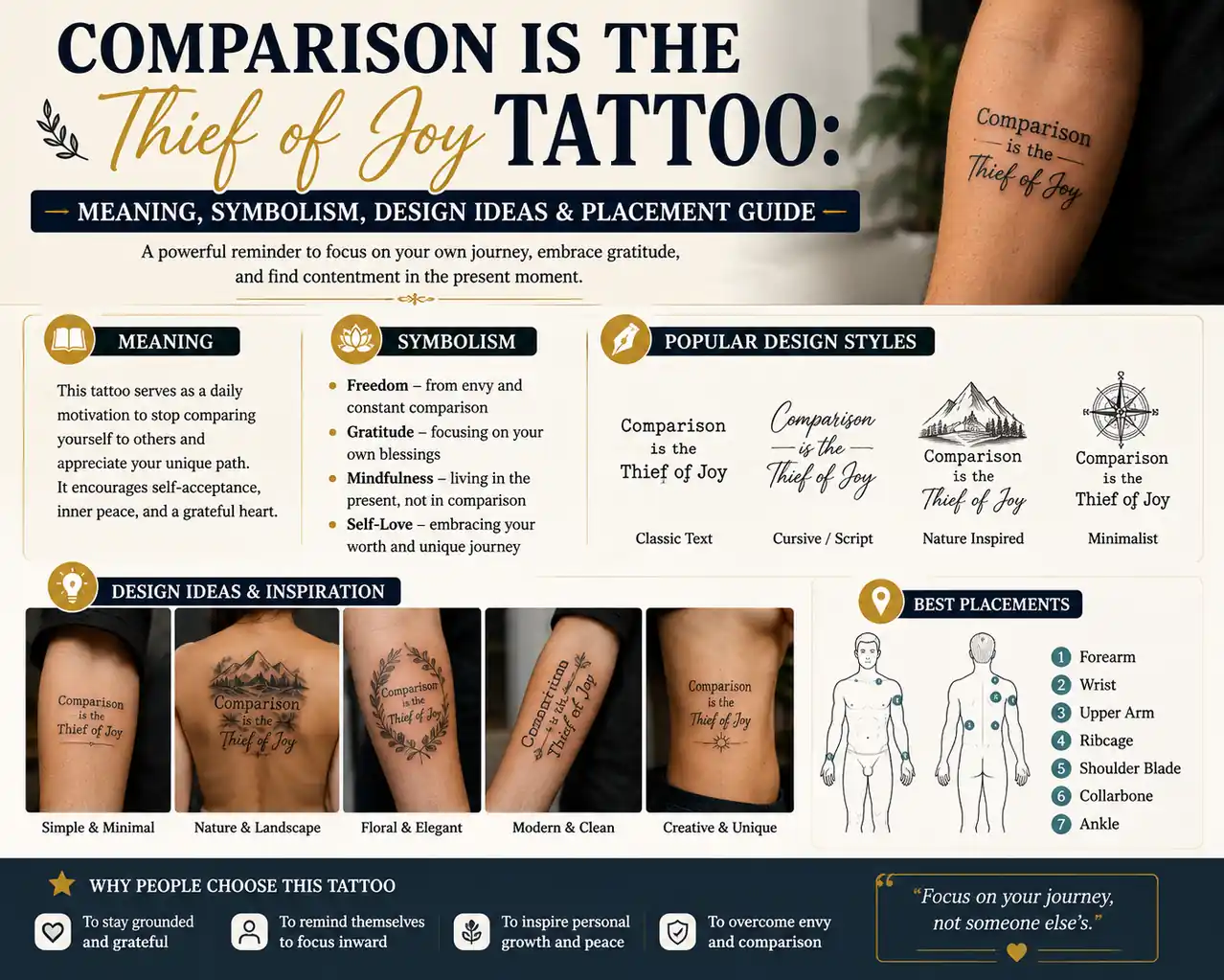
Comparison Is the Thief of Joy Tattoo: Meaning, Symbolism, Design Ideas & Placement Guide
A tattoo often carries more weight than an artistic choice – it can become a permanent marker of a belief, a turning point, or a lesson that continues to shape how someone lives.
Among quote tattoos, “Comparison is the thief of joy” has held its popularity because it names a struggle that feels increasingly familiar in a world built on constant comparison.
For many people, the phrase marks the moment they decided to stop measuring their worth against someone else’s achievements, appearance, possessions, or timeline. Rather than celebrating competition, it points toward a more personal standard: appreciating your own journey without letting another person’s success diminish it.
If you’re considering this quote as a tattoo, your questions probably differ from someone researching the quotation itself. You likely already grasp its general message and instead want to know:
- Does this quote make a meaningful tattoo?
- What does it symbolize?
- Which tattoo styles best express its message?
- Should you choose the full quote or a symbolic interpretation?
- How can you personalize the design without losing its meaning?
This guide focuses on those questions. Rather than exploring the quote’s complete history or philosophical background—better covered elsewhere—it examines how this message translates into thoughtful body art. From symbolism and emotional significance to design considerations and long-term meaning, the goal is to help you decide whether this tattoo genuinely reflects your own story.
What Does a “Comparison Is the Thief of Joy” Tattoo Mean?
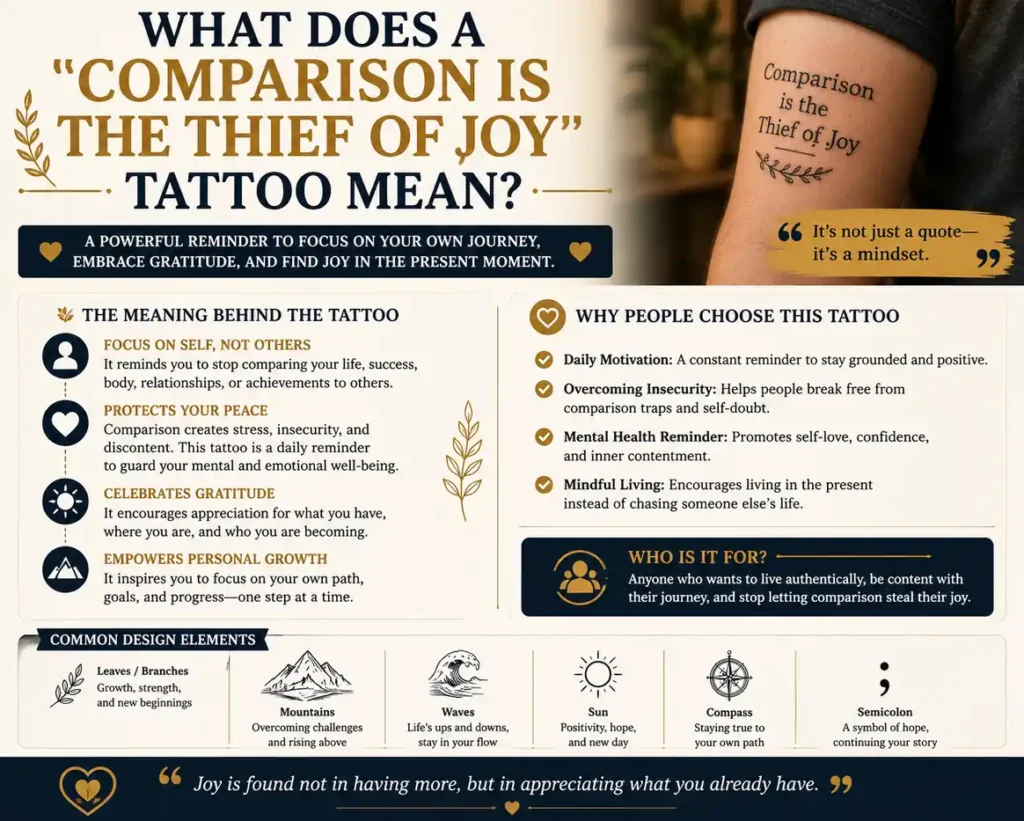
Choosing this quote as a tattoo is rarely about following a trend. For most people, it represents a conscious decision to release unhealthy comparison and place greater value on gratitude, authenticity, and personal growth.
Unlike decorative tattoos chosen primarily for visual appeal, this phrase usually serves as a daily reminder of a mindset the wearer wants to preserve. Its meaning tends to deepen over time, shaped by individual experience rather than the words alone.
A Brief Meaning Behind the Quote
At its heart, the quote suggests that constantly measuring yourself against others prevents you from appreciating your own life. Comparison can sometimes encourage learning and self-improvement, but it turns harmful once another person’s achievements become the standard by which you judge your own worth.
As a tattoo, this message is less about rejecting ambition and more about redefining success. It reminds the wearer to focus on personal progress rather than external validation.
For someone who has struggled with perfectionism, career pressure, social media comparison, or unrealistic expectations, the tattoo can mark a commitment to a healthier perspective—one that values growth over competition and contentment over constant comparison.
Why This Quote Resonates as a Tattoo
Some quotes endure because they capture a universal experience in remarkably few words. This is one of them.
Most people know the moment when an accomplishment suddenly feels smaller after seeing someone else’s success. A promotion may lose its shine after hearing about a colleague’s win. A personal milestone can deflate after scrolling through carefully curated social media posts.
The quote acknowledges that experience without encouraging resignation or lower expectations. It reminds you that your journey deserves to be measured against your own goals, values, and progress—not someone else’s entirely different circumstances.
That makes it especially well suited to a tattoo. Unlike temporary motivation, a tattoo is meant to stay relevant through changing seasons of life. Its message offers perspective whether you’re celebrating success, facing setbacks, or simply navigating an ordinary day.
Why People Choose It as a Permanent Reminder
People rarely arrive at this tattoo for identical reasons, but a few themes surface repeatedly.
Some view it as a reminder to practice gratitude in a culture built on comparison. Others see it as a symbol of recovery from perfectionism, anxiety, or low self-esteem—a marker of deciding to stop chasing impossible standards.
For some, the tattoo represents freedom from seeking approval. Rather than defining success through recognition or status, they choose to live by their own values.
It can also commemorate a significant transition—a career change, personal transformation, recovery journey, or stretch of emotional growth during which the wearer learned that lasting fulfillment comes from authenticity rather than comparison.
Because these motivations run deeply personal, two people with the same tattoo may attach entirely different stories to it. The shared wording becomes a unique reflection of each individual’s experience.
Why This Quote Makes a Meaningful Tattoo
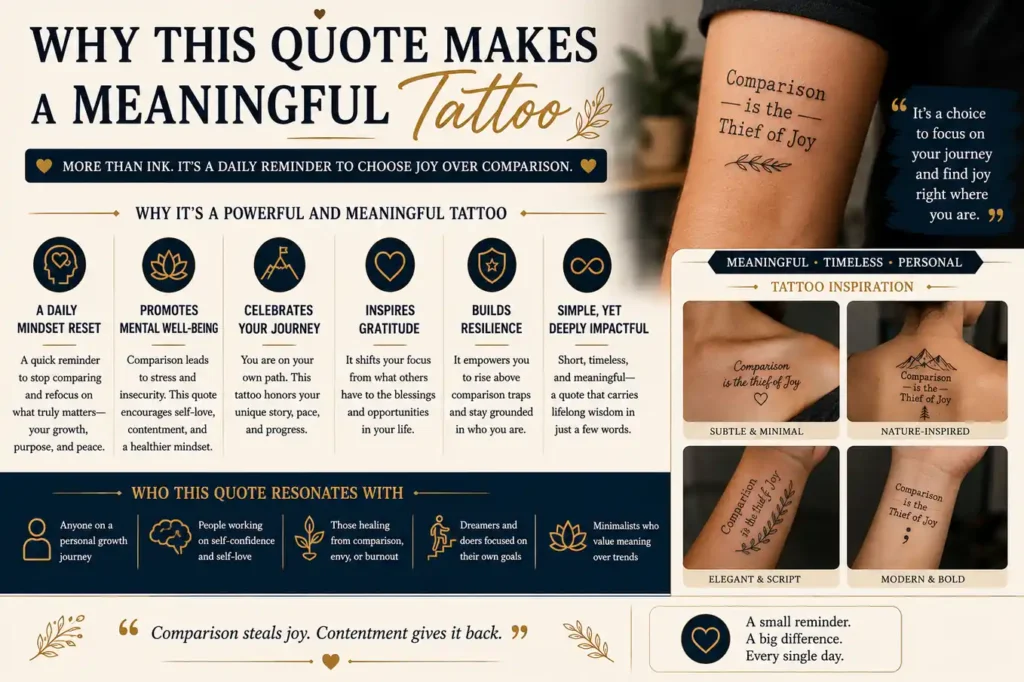
Not every inspirational quote translates well into permanent body art. Some lean on current trends or lose relevance as circumstances change.
This one has endured because it names a principle that stays meaningful across life stages. Whether someone is entering adulthood, building a career, raising a family, or pursuing goals later in life, the temptation to compare rarely disappears.
A tattoo built on this message becomes less about a specific moment and more about an ongoing way of thinking.
A Symbol of Personal Growth Rather Than Perfection
One of the most powerful aspects of this tattoo is that it celebrates progress instead of perfection.
Rather than suggesting life should be free of ambition or challenge, it encourages a healthier relationship with achievement. Success becomes something measured by personal development rather than by outperforming others.
This distinction matters because personal growth is sustainable, while comparison often creates an endless cycle of dissatisfaction. There will always be someone with more experience, greater resources, or different opportunities. Anchoring your identity to those comparisons can put contentment permanently out of reach.
As a tattoo, the quote reminds the wearer that meaningful progress begins by comparing today’s self with yesterday’s—not with someone else’s highlight reel.
From Daily Reminder to Personal Identity
Many meaningful tattoos eventually become more than reminders; they become part of how a person understands themselves.
This quote often follows the same arc. At first, it may offer encouragement during difficult moments. Over time, though, it can come to represent broader values such as authenticity, resilience, gratitude, and emotional independence.
Because tattoos are visible—or intentionally placed where only the wearer sees them—they often shape daily habits in subtle ways. A brief glance at the quote can interrupt a negative thought pattern, prompt reflection, or reinforce a healthier perspective before comparison starts to affect mood or confidence.
In that sense, the tattoo becomes less about remembering the words and more about reinforcing the identity those words represent.
How Tattoo Meaning Differs From Quote Meaning
Understanding the quote is only the beginning. Choosing it as a tattoo adds another layer of significance.
The quote itself communicates an idea about comparison and contentment. A tattoo communicates something about the person who chooses to carry that idea permanently.
That difference matters.
Someone reading the quote in a book may simply agree with its message. Someone wearing it as a tattoo is often expressing a personal commitment to living by that principle.
This shift transforms the phrase from a piece of advice into a statement of identity. Rather than saying, “This is a wise quote,” the tattoo quietly says, “This is a value I want to remember.”
As you continue exploring design styles, symbolism, placement, and personalization, keep that distinction in mind—it will help you choose a tattoo that reflects not only the words themselves but also the story and purpose you want them to represent.
What Does This Tattoo Symbolize?
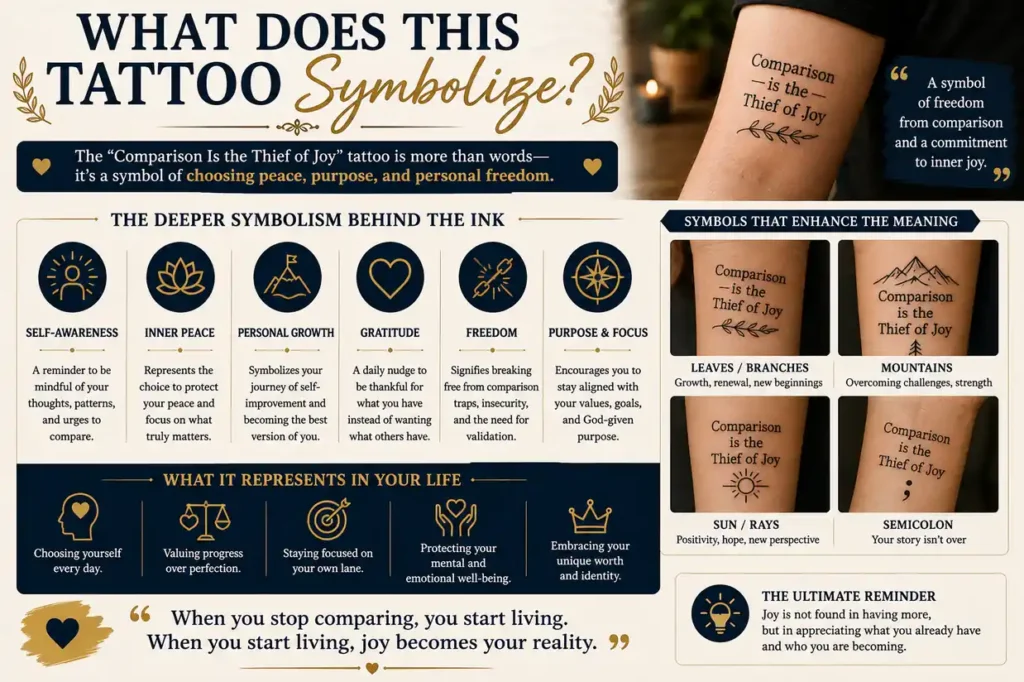
A meaningful tattoo tells a story beyond the words or artwork it displays. While “Comparison is the thief of joy” carries a universal message, the symbolism behind the tattoo becomes deeply personal once someone chooses to wear it permanently.
For one person, it may represent overcoming years of self-doubt. For another, it could mark a commitment to gratitude after recognizing how constant comparison affected their happiness. Others choose it as a reminder to stay focused on their own path instead of chasing someone else’s definition of success.
The strength of this tattoo lies in its flexibility. The message stays the same; the story behind it is uniquely yours.
Gratitude Instead of Comparison
Gratitude is one of the strongest themes associated with this tattoo.
Comparison naturally shifts attention toward what appears to be missing. Whether it’s another person’s career, lifestyle, relationships, or achievements, comparison often encourages us to overlook the progress we’ve already made.
A tattoo bearing this quote can serve as a gentle interruption to that mindset. Each time you notice it, you’re reminded to return your attention to what you’ve built, learned, and experienced instead of focusing on what someone else has.
This symbolism isn’t about pretending life is perfect or ignoring future goals. It reflects the belief that appreciation and ambition can coexist. You can pursue meaningful growth while still recognizing the value of your present circumstances.
For many wearers, this makes the tattoo less about limiting ambition and more about protecting gratitude from being overshadowed by unnecessary comparison.
Contentment Without Complacency
Some people misread the quote as encouragement to stop striving for improvement. In reality, that’s rarely why someone chooses it as a tattoo.
The symbolism is better understood as contentment without complacency.
Contentment means appreciating where you are today. Complacency means losing the desire to grow. The two are not the same.
Someone may continue pursuing professional success, personal fitness, creative goals, or financial stability while still refusing to define their worth by someone else’s accomplishments.
This distinction gives the tattoo a balanced meaning. It celebrates progress while rejecting the endless race of trying to “keep up” with everyone else—a perspective many wearers find especially valuable in a culture where social media often presents carefully edited snapshots of success rather than everyday reality.
Self-Worth Beyond Achievement
Another reason this tattoo resonates: it separates identity from performance.
Modern life often encourages people to measure themselves by visible achievements—promotions, income, possessions, qualifications, public recognition. These accomplishments can certainly matter, but they don’t tell the whole story of a person’s value.
Choosing this quote as a tattoo can represent a conscious decision to build self-worth on a broader foundation.
Instead of asking, “Am I doing better than everyone else?” the tattoo encourages questions such as:
- Am I becoming a better version of myself?
- Am I living according to my values?
- Am I proud of the progress I’ve made?
- Am I growing in ways that matter to me?
This shift in perspective often brings greater peace, because success becomes something you define rather than something constantly measured against other people’s lives.
Emotional Resilience and Inner Peace
Many tattoos commemorate a significant chapter in someone’s life, and this quote often symbolizes resilience after periods of emotional struggle.
Perhaps someone spent years comparing themselves with friends, colleagues, or online influencers. Maybe they struggled with perfectionism or felt trapped by unrealistic expectations. Over time, they learned that lasting confidence came not from becoming “better than” others but from accepting their own journey.
For these individuals, the tattoo becomes more than motivation—it becomes evidence of personal transformation. Rather than representing who they hope to become someday, it reflects lessons already earned through experience.
That emotional depth helps explain why the quote has remained popular despite changing tattoo trends. Its significance grows with the wearer, making it a message that can still feel relevant decades after it’s first inked.
As meaningful as the symbolism is, deciding whether this tattoo truly reflects your own values requires another consideration: who is most likely to connect with this message, and how do you know if it’s the right choice for your personal story? That’s the question we’ll explore next.
Who Is This Tattoo Best Suited For?
A meaningful tattoo should feel personal, not simply popular. While “Comparison is the thief of joy” resonates with many people, its significance depends on how closely the message reflects your own experiences and values.
Rather than asking whether the quote is fashionable, ask whether it represents a lesson you want to carry for years to come.
The following situations illustrate why people often choose this tattoo—and when it may hold the deepest personal meaning.
People Recovering From Constant Comparison
For some, this tattoo marks the end of a long habit of measuring themselves against everyone around them.
Comparison can appear in many areas of life:
- Career progression
- Academic achievements
- Financial success
- Physical appearance
- Relationships
- Social media presence
- Creative accomplishments
Over time, constantly evaluating yourself against others becomes emotionally exhausting. Even genuine achievements may feel less meaningful once immediately compared with someone else’s.
Choosing this quote as a tattoo can symbolize a conscious decision to break that cycle. Instead of letting external comparisons define self-worth, the tattoo serves as a reminder to celebrate personal progress and focus on goals that genuinely matter.
For many wearers, it represents freedom rather than resignation—a commitment to living by their own standards instead of constantly seeking validation through comparison.
Individuals Celebrating Personal Growth
Not every meaningful tattoo comes from a difficult chapter. Sometimes it commemorates how far someone has already come.
Perhaps you’ve learned to appreciate your own journey after years of chasing unrealistic expectations. Maybe you’ve discovered that success feels more fulfilling when measured against your past self instead of someone else’s present circumstances.
In these cases, the tattoo is less about overcoming struggle and more about honoring transformation. Rather than representing what you hope to learn someday, it reflects a lesson you’ve already embraced:
- Progress matters more than perfection.
- Consistency matters more than competition.
- Authenticity matters more than appearances.
As life continues to evolve, the tattoo can remain a quiet reminder of the perspective that helped you grow.
Those Seeking a Daily Mindfulness Reminder
Many people choose tattoos that reinforce habits or values they want to practice every day. This quote naturally fits that purpose.
Placed on the wrist, forearm, or another frequently visible area, it can interrupt automatic comparison before negative thoughts take hold. A brief glance may be enough to change the question you’re asking. Instead of “Why am I behind?” you might ask, “What progress have I made?”
That subtle shift can gradually influence how you approach challenges, celebrate achievements, and respond to other people’s success. For this reason, many wearers see the tattoo less as decoration and more as a form of personal mindfulness—one that quietly reinforces healthier patterns of thinking over time.
When This Quote May Not Reflect Your Personal Story
Although the message is widely admired, it isn’t automatically the right tattoo for everyone. A permanent tattoo should express something that genuinely resonates with your own experiences rather than something that simply sounds inspirational.
Before committing, consider questions such as:
- Does this quote describe a lesson that has shaped my life?
- Will its message remain meaningful to me ten or twenty years from now?
- Am I choosing it because of its popularity or because it reflects my personal values?
- Would I still appreciate this design if no one else ever saw it?
If your answers are rooted in your own journey rather than external trends, you’re far more likely to stay satisfied with your decision over the long term.
If you’re drawn primarily to the phrase because it’s currently popular on social media, or because you’ve seen attractive examples online, it may be worth taking additional time to reflect before making a permanent commitment.
The most meaningful tattoos rarely begin with aesthetics—they begin with authenticity. A beautiful design can certainly enhance the message, but lasting satisfaction usually comes from choosing a tattoo that continues to reflect who you are long after trends have changed.
Now that you’ve explored the emotional meaning behind this quote and considered whether it aligns with your own story, the next step is translating that meaning into a visual design. From minimalist lettering to symbolic artwork and personalized compositions, the following sections will help you choose a style that expresses the message in a way that feels uniquely yours.
Best “Comparison Is the Thief of Joy” Tattoo Design Ideas
Once you’ve decided that the quote reflects your values, the next step is choosing a design that expresses those values visually. This decision involves far more than selecting a font or a body placement. The style of the tattoo shapes how the message feels, how well it ages, and how naturally it becomes part of your personal story.
Rather than searching for the “best” design, think about which design best communicates what the quote means to you. A minimalist composition may suit someone who values quiet reflection, while a larger artistic piece might better represent a transformative chapter in life.
The following design approaches are among the most versatile and timeless options for this quote.
Minimalist Quote Tattoos
Minimalist tattoos remain popular for meaningful quotes because they put the focus entirely on the message.
A clean design typically uses:
- Simple black ink
- Uncomplicated lettering
- Generous spacing
- Little or no additional artwork
The absence of decorative elements lets the words themselves carry the emotional weight.
This style tends to appeal to people who see the tattoo as a private reminder rather than a conversation piece. It feels understated and elegant, and it’s less likely to become visually dated over time.
Minimalist designs also work well on smaller placements such as the wrist, inner forearm, ankle, or collarbone, where subtlety often enhances the overall aesthetic.
Best suited for:
- First-time tattoo recipients
- People who appreciate understated design
- Those wanting a discreet daily reminder
Fine-Line Designs
Fine-line tattoos use exceptionally thin, delicate lines to create a refined appearance.
Paired with an inspirational quote, this style can communicate calmness, simplicity, and quiet confidence. The visual lightness complements the message of letting go rather than striving to impress.
Fine-line tattoos, however, require thoughtful planning. Very small lettering or overly delicate strokes may soften as the tattoo ages, making long quotes harder to read. Choosing an experienced tattoo artist and allowing adequate spacing between letters helps preserve clarity over the years.
If longevity is a priority, discuss minimum letter height and spacing during your consultation—it matters just as much as the font itself.
Handwritten Script Tattoos
Handwritten lettering creates a sense of intimacy that standard fonts often can’t replicate.
Some people choose to reproduce:
- Their own handwriting
- A loved one’s handwriting
- A parent’s handwritten note
- A meaningful journal entry
- Custom calligraphy designed specifically for the tattoo
Because the lettering appears personal rather than generic, it often strengthens the emotional connection to the quote.
This approach works especially well when the tattoo commemorates a significant life transition or honors someone whose advice shaped your perspective on comparison, gratitude, or self-worth. The result feels less like a quotation copied from a book and more like a message written specifically for you.
Bold Typography Designs
Not every meaningful tattoo needs to be delicate.
Bold lettering creates a stronger visual presence and can reflect confidence, resilience, and determination. It also tends to stay legible over time, since thicker lines resist fading better than fine details.
This style works particularly well on larger placements such as:
- Outer forearm
- Upper arm
- Shoulder
- Back
Rather than appearing aggressive, bold typography can communicate conviction—a visible declaration of values the wearer has chosen to live by. It’s an excellent option for those who want the quote to make an immediate visual statement without relying on additional artwork.
Geometric Interpretations
If you appreciate modern design, geometric elements can add structure without overwhelming the quote. Examples include:
- Simple circles representing wholeness
- Clean line work
- Subtle triangles
- Symmetrical framing
- Minimal geometric borders
These additions work best when they support the quote instead of competing with it. A restrained geometric composition often creates a contemporary appearance while preserving the timeless quality of the message itself. The emphasis should stay on readability and symbolism rather than decoration.
Artistic Quote Compositions
Some people prefer to integrate the quote into a larger artistic composition rather than presenting it as text alone. Examples might include:
- Flowing botanical elements
- Soft landscape imagery
- Mountain silhouettes
- Birds in flight
- Abstract brushstroke effects
- Nature-inspired line art
The artwork should reinforce the emotional meaning of the quote rather than distract from it. A mountain, for instance, can represent perseverance and personal growth, while birds may symbolize freedom from limiting beliefs. Botanical elements often communicate renewal or resilience.
Thoughtfully combined, these visual elements turn the tattoo into a personal narrative instead of simply displaying an inspirational sentence.
Full Quote or Symbolic Representation?
One of the first design decisions you’ll face is whether to tattoo the complete quote or express its meaning through symbolism.
There is no universally correct choice. The best option depends on how directly you want the message communicated and how much personal interpretation you want to leave to the viewer.
| Option | Advantages | Things to Consider |
|---|---|---|
| Full quote | Instantly communicates the intended message | Requires more space and careful typography |
| Shortened wording | Simpler layout with a cleaner appearance | May lose some of the quote’s original impact |
| Symbol-only design | Highly personal and visually distinctive | Others may not recognize the intended meaning |
| Text with symbolic imagery | Balances clarity with artistic expression | Requires thoughtful composition to avoid visual clutter |
Using the Complete Quote
The complete wording is the most recognizable version of the tattoo. It clearly communicates your intention without requiring explanation and preserves the original impact of the phrase.
Because the quote runs relatively long, careful planning becomes especially important. Consider letter size, line spacing, placement, and overall proportions. A cramped layout may become difficult to read as the tattoo ages; giving the text adequate space keeps both the message and the design clear for many years.
Shortened Versions
Some people prefer a more subtle interpretation, using only part of the quote or a closely related phrase. A shorter composition fits smaller placements more comfortably and often creates a cleaner visual balance.
If you take this approach, avoid altering the wording in a way that changes the original message—the goal should be simplification, not distortion. A skilled tattoo artist can also help arrange shorter text creatively while maintaining readability.
Symbol-Only Interpretations
Not everyone wants words on their skin. For some, symbols communicate personal values more effectively than text.
Instead of the quote itself, you might choose imagery that evokes its underlying message whenever you see it. The advantage of symbolic tattoos is that they invite personal interpretation while remaining deeply meaningful to the wearer. Because the symbolism is often known only to you, the tattoo can feel even more personal than the words themselves.
Combining Text and Imagery
Many of the most memorable quote tattoos combine lettering with carefully chosen visual elements. The key is restraint—the artwork should support the message, not compete for attention.
Before finalizing a design, ask yourself:
- Does every visual element add meaning?
- Would removing an element make the tattoo stronger?
- Is the quote still the focal point?
- Will the composition remain clear as it ages?
Answering these questions helps ensure the final design feels intentional rather than overly decorative.
With a general design direction in mind, the next step is choosing symbols that deepen the tattoo’s personal significance. The right imagery can transform a meaningful quote into a visual story that reflects your own experiences, values, and journey.
Symbols That Pair Well With This Quote
One of the most effective ways to make a quote tattoo uniquely yours is by pairing it with imagery that reinforces its message. The words already communicate a powerful idea, but carefully chosen symbols can add another layer of meaning without changing the quote itself.
The key is intentionality. Every element should contribute to the story you want the tattoo to tell. Decorative artwork may make a design visually attractive, but symbolic artwork gives it lasting personal significance.
Below are some of the most meaningful symbols people pair with “Comparison is the thief of joy,” and what each one can represent.
Arrows
An arrow is often associated with movement, direction, and resilience. Before an arrow moves forward, it must first be drawn backward—a symbolism many people read as a reminder that setbacks, disappointments, and periods of uncertainty can prepare us for future growth.
Paired with this quote, an arrow can symbolize:
- Leaving unhealthy comparison behind
- Staying focused on your own direction
- Continuing forward despite obstacles
- Pursuing personal goals instead of following someone else’s path
A single minimalist arrow usually complements the quote without overpowering it, making this combination ideal for clean, understated designs.
Mountains
Mountains symbolize challenges, endurance, and long-term growth. Unlike quick success, climbing a mountain requires patience, consistency, and perseverance—symbolism that aligns naturally with a quote about meaningful progress rarely happening by comparing yourself with others.
A mountain design may represent:
- Personal resilience
- Difficult journeys overcome
- Long-term self-improvement
- Trusting your own pace
Simple line-art mountains work particularly well beneath or alongside the quote, creating a balanced composition without distracting from the lettering.
Birds
Birds are commonly associated with freedom. In the context of this quote, they can symbolize freedom from constant comparison, external expectations, fear of judgment, and the need for approval.
A small flock of birds can also represent emotional growth and the ability to move beyond limiting beliefs. Rather than focusing on competition, the imagery suggests openness, possibility, and living according to your own direction.
Butterflies
Butterflies are among the most recognizable symbols of transformation. Their life cycle naturally represents change, growth, and becoming something new.
For someone choosing this quote after overcoming insecurity, perfectionism, or self-doubt, a butterfly can reflect the journey from constant comparison toward greater confidence and self-acceptance—a reminder that meaningful change often happens gradually, and that growth deserves to be appreciated rather than compared.
Lotus Flowers
The lotus carries powerful symbolism across many cultures. Growing through muddy water before blooming above the surface, it’s often associated with inner peace, personal transformation, resilience, and wisdom gained through adversity.
Combined with this quote, the lotus reinforces the idea that difficult experiences can lead to growth without requiring comparison to anyone else’s journey. Its elegant appearance also complements both minimalist and more detailed tattoo styles.
Olive Branches
The olive branch has long represented peace and reconciliation. Within this tattoo’s message, it can symbolize making peace with yourself instead of constantly measuring your life against others.
Some wearers choose olive branches to represent self-acceptance, emotional balance, gratitude, and quiet confidence. Its soft, flowing shape pairs beautifully with handwritten or script lettering, creating a calm and timeless composition.
Compass Designs
A compass symbolizes staying true to your own direction. It reminds the wearer that every person’s path is different and that meaningful progress comes from following your own values rather than someone else’s expectations.
Combined with this quote, a compass reinforces ideas such as living intentionally, defining success personally, remaining focused despite distractions, and trusting your own journey. This symbolism is especially meaningful for people who have experienced major life transitions or chosen unconventional paths.
Sunrise and Horizon Imagery
A sunrise often represents new beginnings and hope. Unlike symbols that focus on struggle, a sunrise emphasizes possibility—a reminder that every day offers another opportunity to choose gratitude over comparison and growth over self-criticism.
Simple horizon lines or subtle rising-sun designs can create a visually balanced tattoo while keeping the quote as the primary focal point.
How Each Symbol Changes the Tattoo’s Meaning
Although every symbol can complement the quote, each one highlights a different aspect of its message. Understanding these subtle differences helps ensure your tattoo reflects your personal story rather than simply following popular design trends.
| Symbol | Primary Meaning | Best For |
|---|---|---|
| Arrow | Moving forward | New beginnings and resilience |
| Mountain | Steady growth | Long-term perseverance |
| Bird | Freedom | Letting go of comparison |
| Butterfly | Transformation | Personal change and healing |
| Lotus | Inner peace | Growth through adversity |
| Olive branch | Contentment | Gratitude and emotional balance |
| Compass | Staying on your path | Authenticity and purpose |
| Sunrise | Hope | Fresh starts and optimism |
None of these symbols changes the quote’s core message—they emphasize different chapters of the same journey. Someone recovering from burnout may naturally connect with a sunrise, while another person celebrating years of personal growth may feel more represented by mountains or a compass.
Choosing imagery that reflects your own experience creates a tattoo with greater emotional depth than selecting artwork based solely on appearance.
Choosing Symbols That Match Your Story
Before deciding on additional imagery, spend time reflecting on why this quote matters to you. Consider questions such as:
- What lesson does this tattoo represent?
- What experience inspired this decision?
- What do I want to remember years from now?
- Which image naturally reminds me of that lesson?
Your answers often reveal which symbols genuinely belong in the design. If the tattoo marks a journey toward gratitude, peaceful botanical elements may feel appropriate. If it celebrates perseverance through difficult seasons, mountains or arrows may better reflect that story. If it represents choosing your own direction despite outside expectations, a compass may communicate that meaning more clearly.
Rather than asking which symbol is most popular, ask which one still feels meaningful when you imagine seeing it decades from now.
Avoiding Decorative Elements That Dilute the Message
One of the most common mistakes with quote tattoos is adding so many decorative features that the original message becomes secondary. A meaningful tattoo doesn’t need every symbol that resonates with you—in many cases, fewer elements create a stronger design.
Before finalizing your concept, review it with these questions in mind:
- Is the quote still the visual focal point?
- Does every symbol contribute to the overall meaning?
- Would removing an element improve clarity?
- Will the design remain readable as it ages?
- Does the artwork support the message rather than compete with it?
Thoughtful simplicity often creates the most timeless tattoos. A carefully chosen symbol paired with clean typography usually carries far greater emotional impact than an overly complex composition filled with unrelated decorative details.
Once you’ve decided on the symbolism that best reflects your story, the next step is equally important: choosing where the tattoo will be placed. Placement affects not only the design’s appearance but also its visibility, readability, longevity, and role in your daily life.
Best Tattoo Placements for “Comparison Is the Thief of Joy”
Where you place a tattoo matters just as much as the design itself. Placement influences how often you see it, how easily others notice it, how well the lettering ages, and whether the message feels like a private reminder or a public expression of your values.
Unlike decorative artwork, quote tattoos rely on readability. Even the most meaningful phrase can lose its impact if placed on an area where the text becomes hard to read over time or doesn’t fit naturally with the body’s shape.
Before deciding on a location, think about how you want the tattoo to function in your daily life. Do you want it to encourage you every morning? Remain mostly private? Or become part of how you present yourself to the world? Your answers will guide the right placement.
Wrist
The wrist is one of the most popular locations for meaningful quotes because it’s easy for the wearer to see throughout the day.
For people choosing this tattoo as a personal reminder, the wrist offers a natural advantage—a quick glance during stressful moments or periods of self-doubt can reinforce the message before negative comparisons take hold.
This placement generally works best with shorter layouts, minimalist typography, fine but readable lettering, and simple symbolic additions. Because space is limited, many people either reduce the font size carefully or pair the full quote with a slightly longer vertical layout that wraps naturally with the wrist’s shape.
Keep in mind that wrist tattoos see regular movement and sun exposure, so choosing a font that stays legible over time matters more here than elsewhere.
Forearm
The forearm is widely considered one of the best placements for quote tattoos. Its relatively flat surface provides room for comfortable letter spacing while keeping the message highly readable.
It also offers flexibility: inner forearm for a more personal reminder, outer forearm for greater visibility, horizontal or vertical layouts, and text combined with subtle symbolic artwork.
Many people appreciate this placement because they can decide when the tattoo is visible simply by adjusting their clothing. For longer quotes such as this one, the forearm often provides the ideal balance between aesthetics and practicality.
Collarbone
Collarbone tattoos have a quiet elegance that suits reflective quotations. The natural curve of the collarbone lets lettering flow gracefully across the body without requiring a large composition.
Many wearers choose this location because the tattoo feels intimate—it isn’t constantly visible, yet it can easily be revealed or covered depending on clothing choices. This placement often appeals to people who see the quote as something deeply personal rather than something meant to attract attention. Because the skin follows a gentle curve, experienced tattoo artists can adjust spacing so the text stays visually balanced.
Shoulder
The shoulder offers considerably more creative freedom. A larger canvas allows the quote to be paired with carefully chosen imagery such as mountains, birds, compass designs, botanical elements, or sunrise illustrations.
This placement works well for people who want the tattoo to become part of a broader artistic composition rather than a simple line of text. It also allows future expansion if additional tattoos are planned. Whether incorporated into a sleeve or kept as an independent piece, the shoulder provides excellent long-term flexibility.
Rib Cage
The ribs are often chosen for tattoos with deeply personal meaning. Because the area is normally concealed, the message becomes something carried primarily for yourself rather than displayed to others.
Many people appreciate the symbolism of keeping an important life lesson close without making it a frequent topic of conversation. The elongated shape of the rib cage also accommodates longer quotes exceptionally well.
Rib tattoos, however, are widely known for being among the more uncomfortable placements during the tattooing process. Pain tolerance varies considerably between individuals, so it’s worth discussing the expected experience with your tattoo artist before making a final decision.
Upper Arm
The upper arm combines practicality with versatility, offering enough room for larger lettering, decorative framing, symbolic artwork, or multi-line compositions.
Because the area experiences relatively little stretching compared with some other body parts, tattoos here often maintain their appearance well over time. It’s also easy to conceal in professional settings while remaining accessible whenever you choose to wear short sleeves. For people wanting a balance between privacy and visibility, the upper arm remains one of the most dependable choices.
Back
The back offers the largest canvas available for quote tattoos. While many people associate large spaces with elaborate artwork, a meaningful quote can also benefit from generous spacing and thoughtful composition.
The back suits larger typography, artistic landscape elements, multiple symbolic illustrations, and highly personalized compositions especially well. Since the tattoo isn’t visible during everyday activities, this placement often emphasizes personal significance over daily visual reminders. Many wearers choose the upper back as a place for life philosophies they wish to carry permanently without necessarily seeing them every day.
Ankle
The ankle provides a discreet location for those who prefer subtle tattoos. A small minimalist version of the quote—or a symbolic interpretation—works particularly well here.
Because available space is limited, many people choose smaller script, simplified layouts, or symbolic imagery instead of the full quote. The ankle tends to suit tattoos intended primarily for personal meaning rather than public visibility. Like the wrist, though, careful attention should go to font size so readability stays strong as the tattoo naturally ages.
Choosing Placement Based on Your Goals
There is no universally “best” placement for this tattoo. The right location depends on what role you want it to play in your life. Instead of asking where the quote looks most attractive, consider where it will best support your intentions.
Visibility vs. Privacy
One of the first decisions involves visibility. Some people want to see the tattoo regularly because it functions as a daily reminder; others prefer a more private location where the meaning stays personal.
| If You Prefer… | Consider These Placements |
|---|---|
| Daily visibility | Wrist, inner forearm |
| Occasional visibility | Outer forearm, shoulder |
| Mostly private | Rib cage, upper back |
| Flexible visibility | Upper arm, collarbone |
Neither approach is better—the decision should reflect how you expect the tattoo to influence your everyday life.
Readability Over Time
Long quotes deserve enough space to remain clear for decades. As tattoos naturally age, extremely small lettering can soften, making individual words harder to distinguish. For this reason, many experienced tattoo artists recommend slightly larger lettering, comfortable spacing, clean typography, and avoiding overly compressed layouts. Choosing a placement with sufficient surface area allows these adjustments without sacrificing the overall design.
Professional Considerations
Although tattoos are increasingly accepted in many workplaces, professional expectations still vary between industries. Before deciding on placement, ask yourself whether you’ll occasionally need to cover the tattoo, whether your profession has appearance guidelines, whether visible tattoos might affect future opportunities, and whether you’re comfortable discussing the tattoo when people ask about it. Considering these practical questions doesn’t diminish the tattoo’s meaning—it simply ensures the placement aligns with your lifestyle.
Personal Significance
Ultimately, the most meaningful placement is often the one that connects naturally with your story. Some people choose the wrist because they want a constant reminder; others select the ribs because the message feels deeply personal. Some prefer the forearm because it balances visibility with practicality, while others see the shoulder as the perfect canvas for combining words with symbolic artwork.
No symbolic rule says one body part carries greater meaning than another. What matters most is choosing a placement that keeps the tattoo readable, visually balanced, and personally significant long after the excitement of getting it has passed.
Now that you’ve explored where the tattoo can be placed, the next important decision is how the words themselves will look. Typography has a profound influence on the tattoo’s personality, affecting everything from emotional tone to long-term readability. Choosing the right font is about far more than aesthetics—it helps ensure the message keeps communicating exactly what you intend for years to come.
Choosing the Right Font for Your “Comparison Is the Thief of Joy” Tattoo
The words of your tattoo carry the message, but the font determines how that message feels.
Typography shapes the personality of a tattoo just as much as the quote itself. A handwritten script creates a very different impression from a bold serif font, even when the words remain identical.
When selecting a font, it’s easy to focus only on appearance. A thoughtful decision, though, should balance three equally important factors: emotional tone, long-term readability, and personal style. A font that looks beautiful on paper but becomes difficult to read after several years may not be the best choice for a lifelong tattoo.
Instead of asking, “Which font is most popular?”, consider asking: “Which font best reflects what this quote means to me?”
Script Fonts
Script fonts are among the most common choices for meaningful quote tattoos. Inspired by cursive handwriting and calligraphy, they create an elegant, flowing appearance that feels personal and expressive.
Script lettering works particularly well for people who see the tattoo as a quiet reminder rather than a bold statement. Its softer visual style naturally complements themes such as gratitude, humility, and reflection.
Advantages: an elegant, timeless appearance; an intimate, personal feel; strong pairing with botanical or minimalist artwork; and a natural fit for smaller placements like the wrist or collarbone.
Things to consider: highly decorative scripts can become difficult to read if the letters are too small or contain excessive flourishes. Ask your tattoo artist to prioritize clarity over ornamentation—a clean script tends to age far better than one filled with elaborate loops and decorative strokes.
Serif Fonts
Serif fonts include small finishing strokes at the ends of letters, giving them a classic and refined appearance. These fonts often communicate stability, wisdom, tradition, and confidence.
If you want the quote to feel thoughtful and enduring rather than decorative, a serif font is an excellent option. Because the lettering is generally more structured than script fonts, serif styles also maintain excellent readability over time. They pair particularly well with minimalist layouts where the words themselves remain the primary visual element.
Sans-Serif Fonts
Sans-serif fonts remove decorative strokes entirely, creating a clean and contemporary appearance. Their simplicity mirrors many of the ideas expressed by the quote itself—rather than drawing attention through elaborate lettering, sans-serif typography communicates confidence through restraint.
Many people choose this style because it feels modern, minimalist, balanced, and easy to read. It also works exceptionally well for geometric tattoo designs where clean lines create visual harmony. For readers who appreciate understated aesthetics, sans-serif lettering often provides the perfect balance between beauty and practicality.
Handwritten Styles
A handwritten tattoo offers something no commercial font can provide: authenticity. Instead of selecting a digital typeface, some people choose handwriting from a personal journal, a handwritten affirmation, a parent’s letter, a spouse’s note, or their own hand.
Although the quote itself may be widely recognized, presenting it in genuine handwriting transforms it into something deeply personal. The message becomes less like a famous quotation and more like a promise written specifically for you.
If you choose this approach, ask your tattoo artist to preserve the natural character of the handwriting while making small adjustments that improve long-term readability.
Custom Lettering
Many experienced tattoo artists design completely original lettering rather than relying on existing fonts. This approach lets every aspect of the typography be tailored specifically to body placement, tattoo size, symbol integration, personal style, and long-term durability.
Custom lettering often produces the most unique result, since no two designs are exactly alike. It usually requires more planning, but it gives you complete control over how the quote is presented. For meaningful tattoos intended to last a lifetime, custom typography is often worth considering.
Typography Decisions That Affect Longevity
A beautiful tattoo should still be beautiful years from now. While tattoo artists cannot prevent the natural aging process, thoughtful typography choices can help preserve readability and visual balance over time.
Many regrets associated with quote tattoos have little to do with the wording itself and much more to do with how the lettering was designed. The following considerations deserve careful attention before your appointment.
Letter spacing. Crowded lettering is one of the most common reasons quote tattoos become difficult to read. When letters sit too closely together, natural aging can gradually reduce the space between them. Generous spacing helps preserve individual letter shapes, word separation, and overall clarity—it may seem unnecessary when the tattoo is fresh, but it’s often the reason the design still looks sharp years later.
Font size. Long quotes naturally tempt people to shrink the font so everything fits within a preferred placement. Unfortunately, extremely small lettering loses definition more quickly over time. A slightly larger font may require a different placement or a longer composition, but it usually produces a far more durable result. When discussing your design with a tattoo artist, ask whether the lettering will stay comfortably readable after ten or twenty years—not just whether it looks good on the day it’s applied.
Fine-line aging. Fine-line tattoos have grown increasingly popular for their delicate appearance, but they require realistic expectations. Thin lines naturally soften over time, particularly in areas exposed to frequent sunlight or constant movement. That doesn’t mean fine-line tattoos should be avoided—it means they should be designed thoughtfully. A skilled tattoo artist can improve longevity by adjusting line thickness, letter spacing, character size, and overall composition. Small changes made before tattooing often have a significant impact years later.
Readability years later. One of the simplest questions you can ask before approving a design is: “Will I still be able to read this comfortably twenty years from now?” That question often changes design decisions. Highly decorative fonts may look impressive initially but grow harder to interpret as details soften. Cleaner typography, adequate spacing, and balanced proportions usually age far more gracefully. Because this tattoo is built around a meaningful message, preserving the readability of the words should always take priority over following temporary typography trends.
Font Comparison at a Glance
| Font Style | Overall Feel | Readability Over Time | Best For |
|---|---|---|---|
| Script | Elegant and personal | Good with clean lettering | Reflective, meaningful tattoos |
| Serif | Classic and timeless | Excellent | Traditional, sophisticated designs |
| Sans-serif | Modern and minimalist | Excellent | Clean contemporary layouts |
| Handwritten | Highly personal | Depends on the original handwriting | Commemorative tattoos |
| Custom lettering | Completely unique | Excellent when professionally designed | Personalized, one-of-a-kind tattoos |
The right font doesn’t simply make a tattoo look attractive—it shapes how the message is experienced every time you see it.
Once you’ve chosen typography that reflects your personality, the next step is making the tattoo truly your own. Thoughtful personalization goes beyond adding decorative artwork; it transforms a meaningful quote into a design that tells your story rather than someone else’s.
How to Personalize Your Tattoo Thoughtfully
A meaningful tattoo should reflect your story, not someone else’s.
It’s easy to find thousands of attractive tattoo designs online, but copying one simply because it looks appealing often leads to disappointment. The tattoos people cherish most are usually those that capture a personal experience, value, or turning point rather than following a popular aesthetic.
“Comparison is the thief of joy” is especially well suited to personalization because its message can represent many different life experiences. For one person, it may symbolize overcoming perfectionism. For another, it may commemorate recovery from burnout, the start of a healthier mindset, or a commitment to living according to personal values instead of external expectations.
Thoughtful personalization doesn’t mean making the design more elaborate. It means making every element intentional.
Adding Important Dates
Sometimes a single date can transform a meaningful quote into a deeply personal milestone. Rather than explaining the significance to everyone who sees the tattoo, a meaningful date quietly preserves an important chapter of your life.
Examples might include the day you made a life-changing decision, a graduation or career milestone, the beginning of a recovery journey, a wedding anniversary, a date marking a fresh start, or a personal achievement that changed your perspective.
There are many subtle ways to incorporate a date into the design. Some people prefer traditional numerals; others choose Roman numerals for a cleaner, more timeless appearance. Whatever format you choose, the date should complement the quote rather than compete with it—smaller lettering positioned beneath or beside the quote usually creates the most balanced composition.
Initials and Coordinates
Another understated way to personalize the tattoo is by incorporating initials or geographic coordinates.
Initials may represent yourself, a parent, a partner, a child, or someone whose guidance shaped your life. Coordinates can commemorate places that shaped your journey, such as your hometown, the place where you experienced a major life change, a meaningful travel destination, or the location where an important decision was made.
These additions stay subtle while giving the tattoo significance that only you fully understand. Unlike decorative artwork chosen purely for aesthetics, initials and coordinates often carry emotional meaning that grows stronger over time.
Personal Symbols
Symbols become most meaningful when they reflect your own experiences instead of simply following popular tattoo trends.
If the quote reminds you to stay focused on your own path, a compass may feel entirely natural. If it represents perseverance through difficult seasons, mountains might better communicate your story. If your greatest lesson has been learning gratitude, botanical elements or olive branches may capture that journey more effectively.
Before adding any symbol, ask yourself: “If someone removed the quote, would this symbol still represent my experience?” If the answer is yes, it’s likely a meaningful addition.
Custom Artistic Elements
Some people prefer to move beyond standard tattoo motifs by collaborating with an artist to create completely original artwork—a landscape inspired by a meaningful location, a favorite flower drawn in a unique style, abstract line work representing personal growth, a subtle visual metaphor connected to your life story, or artwork inspired by your hobbies, profession, or passions.
These custom elements make the tattoo uniquely yours while reducing the likelihood of seeing identical designs elsewhere. Working closely with an experienced tattoo artist often surfaces ideas you may never have considered on your own.
Keeping the Original Meaning Intact
Personalization should strengthen the quote, not replace it. As additional artwork gets added, the original message can surprisingly easily become less clear.
Before approving your final design, step back and ask: Is the quote still the centerpiece? Does every added element reinforce its meaning? Could someone understand the overall message without explanation? Does the tattoo still feel balanced?
If decorative elements begin attracting more attention than the quote itself, simplifying the design may create a more timeless result. Personalization isn’t about adding more—it’s about adding what matters.
Common Personalization Mistakes
Because tattoos are permanent, even small design decisions deserve careful consideration. Many regrets don’t come from choosing the wrong quote—they come from personalizing it without enough planning. Fortunately, most of these mistakes can be avoided with thoughtful preparation.
Adding too many elements. One of the most common mistakes is trying to represent every meaningful experience within a single tattoo—a quote, combined with mountains, plus birds, plus flowers, plus geometric shapes, plus dates, plus several different fonts, can quickly become visually overwhelming. Instead of creating a richer story, excessive detail often makes the design harder to read and less cohesive. A useful guideline: every additional element should answer the question “Why is this here?” If there isn’t a clear answer, it may not need to be included. Minimalism isn’t about removing meaning—it’s about letting the most important meaning stand out.
Following trends instead of personal meaning. Tattoo trends change constantly. Fonts, artistic styles, and popular symbols that dominate social media today may feel dated several years from now. A tattoo based primarily on current trends is more likely to lose emotional relevance than one rooted in personal experience. When reviewing inspiration images online, try to separate design inspiration from personal significance. A beautiful design can certainly inspire ideas, but the final tattoo should reflect your own values, not someone else’s aesthetic preferences. Ask yourself: “Would I still choose this design if it weren’t currently popular?” If the answer is yes, you’re probably making the decision for the right reasons.
Prioritizing aesthetics over message. It’s natural to want an attractive tattoo. With meaningful quote tattoos, though, appearance should support the message rather than overshadow it. Sometimes people choose fonts that are difficult to read because they look artistic. Others select placements that compress long quotes into spaces too small to hold them well. Still others prioritize decorative artwork while reducing the quote to an afterthought. A more balanced approach begins with the message, then chooses typography, placement, and artwork that communicate it clearly. An elegant tattoo isn’t simply beautiful—it’s beautiful because every design decision supports its purpose.
A Personalization Checklist
Before finalizing your design, use this checklist to evaluate whether your tattoo genuinely reflects your story.
| Question | Why It Matters |
|---|---|
| Does this quote reflect my own experience? | Ensures the tattoo has lasting emotional value. |
| Do the added symbols have personal meaning? | Prevents unnecessary decoration. |
| Is the quote still the focal point? | Maintains clarity and visual balance. |
| Will this design still resonate with me years from now? | Encourages long-term thinking. |
| Have I personalized the design thoughtfully rather than simply following trends? | Creates a tattoo that’s genuinely unique. |
If you can answer “yes” to each of these questions, you’re much more likely to end up with a tattoo that remains meaningful long after it has healed.
With the design now reflecting your personal story, the next step is preparing for the tattoo itself. From choosing the right artist to reviewing typography, testing placement, and avoiding common planning mistakes, careful preparation can make the difference between a tattoo you simply like and one you’ll appreciate for decades to come.
Practical Tattoo Planning Before You Commit
Choosing a meaningful quote is only the beginning. The planning process that follows plays a major role in how satisfied you’ll be with your tattoo years from now.
Many tattoo regrets don’t happen because people chose the wrong quote—they happen because they rushed the design process. Small decisions about lettering, placement, sizing, and artist selection can have a lasting impact on how the tattoo looks and feels over time.
Approaching the process thoughtfully gives both you and your tattoo artist the chance to create something visually balanced, technically sound, and personally meaningful.
Choosing the Right Tattoo Artist
The artist you choose matters just as much as the design itself. Every tattoo artist has a unique style and area of expertise—some specialize in bold traditional work, others excel at realism, fine-line tattoos, minimalist lettering, or custom typography.
Because this tattoo relies heavily on clear lettering, it’s worth looking specifically for an artist whose portfolio demonstrates strong text work. As you review portfolios, pay attention to consistent, clean line work, well-balanced lettering, readable healed tattoos, experience with quote tattoos, and designs that stay uncluttered.
Don’t base your decision solely on price or location. A meaningful tattoo intended to last a lifetime deserves an artist whose work consistently reflects quality and precision. Most reputable artists are also happy to explain why they recommend certain font sizes, placements, or layout adjustments—their experience can often improve a design without changing its meaning.
Preparing Reference Images
Reference images help communicate your ideas clearly. Rather than bringing a single tattoo found online, create a small collection that highlights different elements you like—one image might demonstrate a preferred font, another a placement you like, a third a symbolic element such as mountains or botanical artwork.
This approach gives the artist flexibility to create something original instead of reproducing another person’s tattoo. Your reference collection should communicate direction, not provide a blueprint for copying someone else’s design.
Testing Placement
Before committing to a permanent placement, spend some time visualizing how the tattoo will look in everyday life. Many artists recommend temporarily printing or sketching the design on paper and holding it against different parts of the body.
Ask yourself: Can I comfortably read the quote? Does the design follow the body’s natural shape? Does this placement feel personal? Will I still appreciate seeing it here years from now?
Some people even use temporary tattoos or removable transfers to experience the placement for several days before making a final decision. Living with the design—even briefly—can reveal preferences you may not notice during a short consultation.
Reviewing the Final Design
Excitement should never replace careful review. Once your tattoo artist prepares the final artwork, take your time examining every detail.
Look beyond the overall appearance. Carefully review line spacing, letter spacing, font consistency, symbol placement, overall balance, and quote alignment. Don’t hesitate to request adjustments—professional tattoo artists expect revisions during the design process because they want you to feel completely confident before any ink is applied. A few extra minutes of discussion can prevent years of wishing something had been slightly different.
Proofreading Every Word
With quote tattoos, proofreading is one of the most important—and most overlooked—steps. Even a single spelling mistake, missing punctuation mark, or misplaced word can permanently change the design.
Before approving the stencil: read the quote yourself several times, compare it with your original source, ask another trusted person to review it, check capitalization and punctuation, and confirm line breaks exactly as intended.
Don’t rely solely on memory. Taking a few minutes to verify every letter provides peace of mind before making a lifelong commitment.
Long-Term Considerations
A tattoo isn’t designed only for today. The choices you make during planning influence how the design looks five, ten, or twenty years from now. Thinking long-term doesn’t diminish spontaneity—it protects your investment in meaningful body art.
Aging of quote tattoos. All tattoos change gradually with time. Natural aging, sun exposure, skin movement, and individual healing patterns can soften lines over the years. For quote tattoos, readability matters particularly. Design decisions that support longevity include adequate letter spacing, comfortable font size, clear typography, and balanced composition—these adjustments often make a greater difference than choosing the trendiest artistic style. Regular sun protection and proper aftercare also help preserve the tattoo’s appearance over the long term.
Timeless vs. trendy designs. Tattoo styles naturally evolve. A design that dominates social media today may feel strongly associated with a particular era several years from now. Meaningful quote tattoos generally benefit from timeless simplicity. Instead of asking, “Is this design fashionable?” consider asking, “Will this design still represent me decades from now?” Classic typography, thoughtful symbolism, and balanced layouts tend to age more gracefully than designs built around short-lived trends. Because the quote itself carries lasting relevance, letting the design remain equally timeless often creates the strongest result.
Future readability. Long quotes deserve enough visual space to remain clear throughout the years. As tattoos naturally soften, extremely compressed lettering becomes more difficult to distinguish. When reviewing your design, imagine reading it from a comfortable distance—if it already feels crowded before tattooing, it will likely become even more challenging to read later. Choosing slightly larger lettering or a placement with more available space often produces a significantly better long-term outcome.
Lifestyle changes. Life rarely stays the same. Careers evolve, personal interests change, families grow, priorities shift. A meaningful tattoo should continue fitting your life through those changes. Before committing, consider whether you’ll be comfortable with this placement in different professional settings, whether the message reflects values unlikely to change, whether you can imagine appreciating this design decades from now, and whether the tattoo connects to a lasting life lesson rather than a temporary emotion. If the answer is yes, you’re probably choosing a design with enduring significance.
A Final Planning Checklist
Before scheduling your appointment, take a moment to review the essentials.
| Checklist Item | Why It Matters |
|---|---|
| Chosen an artist experienced in lettering | Clear, professional typography is essential for quote tattoos. |
| Selected a placement that balances meaning and readability | Helps the tattoo remain visually effective over time. |
| Chosen a timeless font | Reduces the risk of the design feeling dated. |
| Personalized the tattoo intentionally | Makes the design uniquely meaningful. |
| Reviewed every word carefully | Prevents permanent spelling or formatting mistakes. |
| Considered long-term readability | Protects the tattoo’s appearance for years to come. |
| Reflected on why the quote matters to you | Ensures the tattoo represents a lasting personal value rather than a passing trend. |
By taking time to plan thoughtfully, you’re far more likely to create a tattoo that continues to feel meaningful long after the excitement of getting it has passed.
With the design finalized and practical planning complete, one final step remains: learning from the experiences of others. Understanding the most common mistakes people make with quote tattoos—and how to avoid them—can help ensure your tattoo remains something you’ll be proud to wear for a lifetime.
Mistakes People Regret With Quote Tattoos
A meaningful tattoo is something you’ll hopefully appreciate for decades—not just during the excitement of getting it. While every tattoo tells a personal story, many people share similar regrets when they look back on decisions made too quickly.
Fortunately, most of these regrets are preventable. Understanding the common mistakes people make with quote tattoos can help you approach your own design with greater confidence and make choices that remain satisfying long after the healing process is complete.
Choosing the Wrong Font
Typography may seem like a small design detail, but it has one of the greatest influences on both the appearance and longevity of a quote tattoo.
Many people choose highly decorative fonts because they look elegant in digital mockups. Unfortunately, intricate lettering can become difficult to read as the tattoo naturally softens over time.
Common typography mistakes include fonts that are overly ornate, excessively thin lettering, inconsistent spacing, decorative flourishes that obscure words, and letter sizes too small for the quote’s length. A meaningful quote deserves typography that stays clear for years, not just on the day it’s tattooed. Whenever possible, ask your artist to prioritize readability first and artistic styling second.
Poor Placement Decisions
The right placement should support both the message and the design. One common regret is choosing a location based entirely on appearance without considering how the tattoo will function in everyday life.
Questions worth asking include: Will I enjoy seeing this tattoo every day? Does the placement suit the quote’s length? Will the lettering remain easy to read? Can I comfortably cover or reveal it when I choose?
Placing a long quote in a very small area often forces the lettering to become compressed, reducing both readability and visual balance. Choosing a placement that naturally accommodates the design almost always produces a stronger result.
Designs That Become Difficult to Read
Because this tattoo depends on language rather than imagery alone, readability should always remain a priority. Several factors can reduce clarity over time: tiny lettering, crowded line spacing, complex backgrounds, excessive decorative artwork, and poor contrast between text and surrounding elements.
Remember that the quote itself is the heart of the tattoo. If someone—including you—struggles to read it comfortably after several years, much of its intended impact may be lost. Clean design often creates greater emotional impact than visual complexity.
Forgetting the Tattoo’s Personal Meaning
Perhaps the most significant regret isn’t artistic at all. Sometimes people choose a meaningful quote because it feels inspiring in the moment without asking whether it genuinely reflects their own life. Years later, they may still appreciate the words but feel disconnected from why they chose them.
Before committing, reflect honestly: Does this quote represent a lesson I’ve personally learned? Will it continue reflecting my values as life changes? Am I choosing this because it resonates with me, or because I’ve seen it frequently online?
A tattoo rooted in personal experience usually remains meaningful regardless of changing trends. One chosen primarily because it’s popular often loses emotional significance much more quickly.
A Simple Decision Framework Before Getting This Tattoo
Meaningful decisions rarely benefit from being rushed. If you’re still deciding whether this tattoo is right for you, the following framework can help organize your thoughts before scheduling an appointment. Instead of focusing only on the design, consider the broader purpose behind it.
Questions to ask yourself. Why does this quote matter to me? Which life experience made this message meaningful? Am I celebrating growth, marking a turning point, or reminding myself of a daily habit? Would this quote still resonate with me if no one else ever saw the tattoo? Does the design reflect who I am today while leaving room for who I may become?
There are no universally correct answers—the goal is simply to ensure your decision comes from genuine personal reflection rather than temporary enthusiasm.
Evaluating design options. If you’ve narrowed your ideas to several different concepts, compare them objectively.
| Consideration | Ask Yourself |
|---|---|
| Meaning | Does this design clearly represent why I chose the quote? |
| Readability | Will the text remain easy to read over time? |
| Placement | Does the location suit both the quote and my lifestyle? |
| Symbolism | Do the added elements strengthen the message? |
| Longevity | Will I still appreciate this design years from now? |
Rather than choosing the design that looks most dramatic, choose the one that best communicates your story. Meaning almost always outlasts visual trends.
When to wait before committing. Waiting isn’t a sign of uncertainty—it’s often a sign of thoughtful decision-making. Consider postponing your appointment if you’re still changing the wording frequently, unsure about placement, feeling pressured to get the tattoo quickly, haven’t found an artist whose work matches your vision, or are choosing between several designs without a clear favorite.
Many experienced tattoo artists encourage clients to live with an idea for weeks—or even months—before making it permanent. If the design continues to feel meaningful over time, you’ll likely approach the appointment with much greater confidence.
Signs you’ve found the right design. While no tattoo decision feels exactly the same for everyone, many people describe similar experiences when they’ve found the design that truly fits: the quote consistently feels relevant to your life, the symbolism reflects your personal journey, the design feels balanced rather than crowded, you aren’t choosing it simply because it’s popular, the placement feels intentional, and you can easily imagine appreciating it many years from now.
When those elements come together, the tattoo becomes more than attractive artwork. It becomes a lasting expression of values that continue to guide your life.
Frequently Asked Questions
Is “Comparison Is the Thief of Joy” too long for a tattoo?
Not necessarily. While it’s longer than many quote tattoos, it can work beautifully when paired with the right placement and typography. Areas such as the forearm, rib cage, shoulder, or upper back usually provide enough space for comfortable letter sizing and readability. If you prefer a smaller placement, discuss layout options with your tattoo artist rather than simply reducing the font size.
What font works best for this quote?
There isn’t a single “best” font—the ideal choice depends on the style and feeling you want the tattoo to convey. Script fonts create a soft, personal appearance. Serif fonts offer a timeless, classic look. Sans-serif fonts suit minimalist, modern designs. Custom lettering provides the highest level of personalization. Whichever style you choose, readability should always take priority over decoration.
Can this quote be represented symbolically instead of using text?
Yes. Some people prefer symbols such as a compass, mountain, arrow, bird, or lotus to represent the quote’s message in a more personal way. Others combine a short portion of the quote with symbolic artwork for a balance of clarity and artistic expression.
What is the best placement for this tattoo?
The best placement depends on your goals. If you want a daily reminder, the inner forearm or wrist works well. If you prefer something more private, the rib cage or upper back may be better choices. The most suitable placement is one that balances visibility, readability, personal significance, and your lifestyle.
Can I personalize the quote without changing its meaning?
Absolutely. Thoughtful personalization can make the tattoo more meaningful without altering the quote itself. Dates, initials, meaningful symbols, custom lettering, or artwork connected to your personal story can all strengthen the design while preserving the message. The key is ensuring every added element has a clear purpose.
Will this tattoo still feel meaningful years from now?
Many people choose this quote because its message isn’t tied to a specific trend or life stage. Themes such as gratitude, authenticity, personal growth, and resisting unhealthy comparison remain relevant throughout different seasons of life. Ultimately, long-term meaning depends less on the quote itself and more on whether it genuinely reflects your own values and experiences.
Final Thoughts
Choosing a Tattoo That Reflects Your Journey
A tattoo is one of the few forms of personal expression designed to stay with you throughout life’s many changes. Because of that permanence, the most satisfying designs are rarely those that simply follow current trends—they’re the ones that continue to tell your story years after they were first created.
“Comparison is the thief of joy” has become a popular tattoo not because it’s fashionable, but because it expresses a lesson many people learn through experience. It reminds us that fulfillment rarely comes from measuring ourselves against others. Instead, it grows through gratitude, authenticity, and an appreciation for our own path.
Whether you choose the full quote, pair it with symbolic artwork, or create a completely custom interpretation, the most meaningful design will be the one that reflects your personal journey rather than someone else’s.
Let Meaning Lead Design
As you finalize your ideas, let purpose guide every decision—from typography and placement to symbolism and personalization.
A well-designed tattoo is more than visually appealing. It should still feel true to your values years from now, continue reminding you of the lesson that inspired it, and remain a source of quiet encouragement whenever you see it.
When meaning leads design, the result is more than body art. It becomes a lasting reflection of who you are, what you’ve learned, and the path you’ve chosen to follow.