
Bible Quotes About Apologizing: Scriptures About Saying Sorry and Seeking Forgiveness
Have you ever hurt someone you love and struggled to find the right words to say, “I’m sorry”? Maybe your pride got in the way. Maybe you were afraid the other person would reject your apology. Or perhaps you simply did not know what a biblical apology should look like.
The Bible has a lot to say about apologizing, repentance, forgiveness, humility, reconciliation, and restoring broken relationships. Although Scripture does not always use the modern phrase “say sorry,” it repeatedly teaches us to admit our wrongs, confess our sins, seek forgiveness, make peace, and change our behavior.
A sincere apology can feel uncomfortable. It requires us to put our pride aside and admit that we were wrong. Yet sometimes those few humble words can become the first step toward healing a damaged relationship.
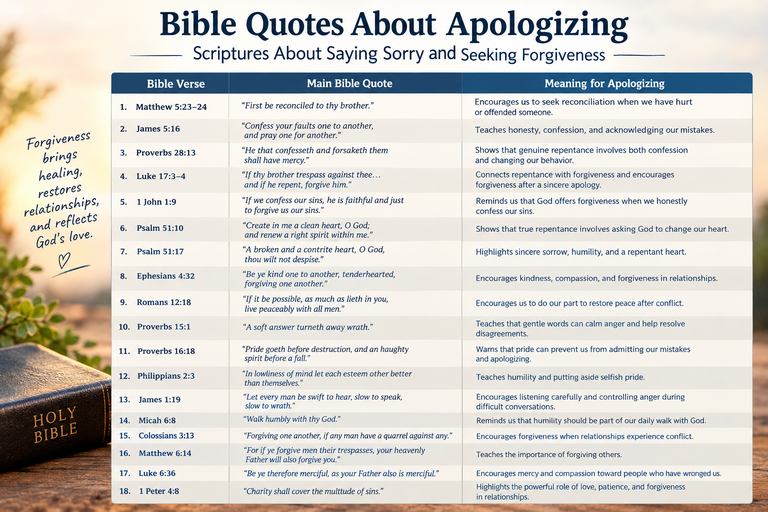
| Bible Verse | Main Bible Quote | Meaning for Apologizing |
|---|---|---|
| Matthew 5:23–24 | “First be reconciled to thy brother.” | Encourages us to seek reconciliation when we have hurt or offended someone. |
| James 5:16 | “Confess your faults one to another, and pray one for another.” | Teaches honesty, confession, and acknowledging our mistakes. |
| Proverbs 28:13 | “He that confesseth and forsaketh them shall have mercy.” | Shows that genuine repentance involves both confession and changing our behavior. |
| Luke 17:3–4 | “If thy brother trespass against thee… and if he repent, forgive him.” | Connects repentance with forgiveness and encourages forgiveness after a sincere apology. |
| 1 John 1:9 | “If we confess our sins, he is faithful and just to forgive us our sins.” | Reminds us that God offers forgiveness when we honestly confess our sins. |
| Psalm 51:10 | “Create in me a clean heart, O God; and renew a right spirit within me.” | Shows that true repentance involves asking God to change our heart. |
| Psalm 51:17 | “A broken and a contrite heart, O God, thou wilt not despise.” | Highlights sincere sorrow, humility, and a repentant heart. |
| Ephesians 4:32 | “Be ye kind one to another, tenderhearted, forgiving one another.” | Encourages kindness, compassion, and forgiveness in relationships. |
| Romans 12:18 | “If it be possible, as much as lieth in you, live peaceably with all men.” | Encourages us to do our part to restore peace after conflict. |
| Proverbs 15:1 | “A soft answer turneth away wrath.” | Teaches that gentle words can calm anger and help resolve disagreements. |
| Proverbs 16:18 | “Pride goeth before destruction, and an haughty spirit before a fall.” | Warns that pride can prevent us from admitting our mistakes and apologizing. |
| Philippians 2:3 | “In lowliness of mind let each esteem other better than themselves.” | Teaches humility and putting aside selfish pride. |
| James 1:19 | “Let every man be swift to hear, slow to speak, slow to wrath.” | Encourages listening carefully and controlling anger during difficult conversations. |
| Micah 6:8 | “Walk humbly with thy God.” | Reminds us that humility should be part of our daily walk with God. |
| Colossians 3:13 | “Forgiving one another, if any man have a quarrel against any.” | Encourages forgiveness when relationships experience conflict. |
| Matthew 6:14 | “For if ye forgive men their trespasses, your heavenly Father will also forgive you.” | Teaches the importance of forgiving others. |
| Luke 6:36 | “Be ye therefore merciful, as your Father also is merciful.” | Encourages mercy and compassion toward people who have wronged us. |
| 1 Peter 4:8 | “Charity shall cover the multitude of sins.” | Highlights the powerful role of love, patience, and forgiveness in relationships. |
In this article, we will explore some of the most meaningful Bible quotes about apologizing, along with Scriptures about saying sorry, asking God for forgiveness, admitting mistakes, forgiving others, and pursuing peace.
What Does the Bible Say About Apologizing?
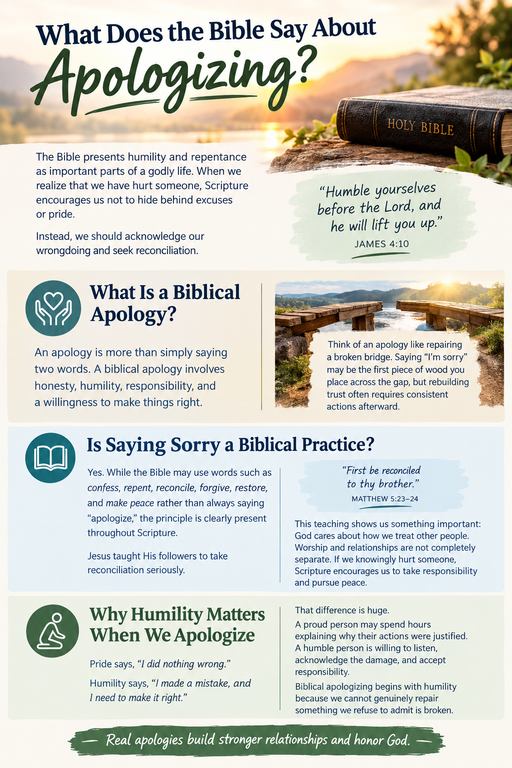
The Bible presents humility and repentance as important parts of a godly life. When we realize that we have hurt someone, Scripture encourages us not to hide behind excuses or pride.
Instead, we should acknowledge our wrongdoing and seek reconciliation.
An apology is more than simply saying two words. A biblical apology involves honesty, humility, responsibility, and a willingness to make things right.
Think of an apology like repairing a broken bridge. Saying “I’m sorry” may be the first piece of wood you place across the gap, but rebuilding trust often requires consistent actions afterward.
Is Saying Sorry a Biblical Practice?
Yes. While the Bible may use words such as confess, repent, reconcile, forgive, restore, and make peace rather than always saying “apologize,” the principle is clearly present throughout Scripture.
Jesus taught His followers to take reconciliation seriously.
In Matthew 5:23–24, Jesus explained that if someone has something against us, we should seek reconciliation before continuing with our religious offering:
“First be reconciled to thy brother.”
This teaching shows us something important: God cares about how we treat other people.
Worship and relationships are not completely separate. If we knowingly hurt someone, Scripture encourages us to take responsibility and pursue peace.
Why Humility Matters When We Apologize
Pride says, “I did nothing wrong.”
Humility says, “I made a mistake, and I need to make it right.”
That difference is huge.
A proud person may spend hours explaining why their actions were justified. A humble person is willing to listen, acknowledge the damage, and accept responsibility.
Biblical apologizing begins with humility because we cannot genuinely repair something we refuse to admit is broken.
Bible Quotes About Saying Sorry
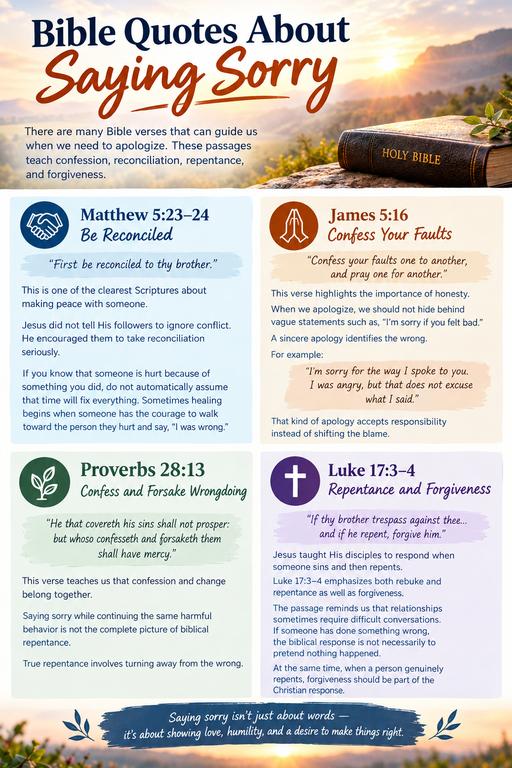
There are many Bible verses that can guide us when we need to apologize. These passages teach confession, reconciliation, repentance, and forgiveness.
Matthew 5:23–24 — Be Reconciled
Jesus said:
“First be reconciled to thy brother.”
This is one of the clearest Scriptures about making peace with someone.
Jesus did not tell His followers to ignore conflict. He encouraged them to take reconciliation seriously.
If you know that someone is hurt because of something you did, do not automatically assume that time will fix everything. Sometimes healing begins when someone has the courage to walk toward the person they hurt and say, “I was wrong.”
James 5:16 — Confess Your Faults
James 5:16 teaches:
“Confess your faults one to another, and pray one for another.”
This verse highlights the importance of honesty.
When we apologize, we should not hide behind vague statements such as, “I’m sorry if you felt bad.”
A sincere apology identifies the wrong.
For example:
“I’m sorry for the way I spoke to you. I was angry, but that does not excuse what I said.”
That kind of apology accepts responsibility instead of shifting the blame.
Proverbs 28:13 — Confess and Forsake Wrongdoing
Proverbs 28:13 says:
“He that covereth his sins shall not prosper: but whoso confesseth and forsaketh them shall have mercy.”
This verse teaches us that confession and change belong together.
Saying sorry while continuing the same harmful behavior is not the complete picture of biblical repentance.
True repentance involves turning away from the wrong.
Luke 17:3–4 — Repentance and Forgiveness
Jesus taught His disciples to respond when someone sins and then repents.
Luke 17:3–4 emphasizes both rebuke and repentance as well as forgiveness.
The passage reminds us that relationships sometimes require difficult conversations. If someone has done something wrong, the biblical response is not necessarily to pretend nothing happened.
At the same time, when a person genuinely repents, forgiveness should be part of the Christian response.
Bible Verses About Asking God for Forgiveness
Sometimes the person we need to apologize to is another human being. Other times, we need to come before God and confess our sins.
The Bible repeatedly assures us that God is merciful toward those who genuinely repent.
1 John 1:9 — Confess Your Sins
One of the most comforting verses about forgiveness is 1 John 1:9:
“If we confess our sins, he is faithful and just to forgive us our sins, and to cleanse us from all unrighteousness.”
Notice the movement in this verse.
We confess.
God forgives.
God cleanses.
This gives believers hope. Our mistakes do not have to become permanent definitions of who we are.
When we sincerely confess our sins to God, we do not need to hide behind excuses.
Psalm 51:10 — Ask God for a Clean Heart
David prayed:
“Create in me a clean heart, O God; and renew a right spirit within me.”
This prayer is powerful because David was not simply asking God to remove the consequences of his actions.
He was asking God to change him from the inside.
That is an important lesson about apologizing. Sometimes we should not only ask, “How can I get out of this situation?”
We should also ask:
“Lord, how can You change my heart so I do not keep repeating this mistake?”
Psalm 51:17 — A Contrite Heart
Psalm 51:17 says:
“A broken and a contrite heart, O God, thou wilt not despise.”
A contrite heart is humble, repentant, and genuinely sorry.
There is a difference between regretting the consequences of our actions and regretting the actions themselves.
For example, someone might say, “I’m sorry because now everyone is angry with me.”
A deeper form of repentance says, “I’m sorry because what I did was wrong, and I understand that it hurt someone.”
That is the kind of heart Scripture encourages.
Psalm 32:5 — Stop Hiding Your Sin
Psalm 32:5 describes David acknowledging his sin rather than continuing to hide it.
The lesson is simple: hiding wrongdoing can become exhausting.
You may be able to hide a mistake from people, but you cannot hide it from God.
Confession brings honesty into the situation.
Bible Quotes About Apologizing to Someone You Hurt
When you have hurt another person, the Bible encourages you to pursue truth, kindness, peace, and reconciliation.
Ephesians 4:25 — Speak Truthfully
Ephesians 4:25 teaches believers to put away falsehood and speak truthfully.
That principle applies directly to apologies.
Do not twist the story to make yourself look innocent.
If you made the mistake, acknowledge it.
Honesty may feel uncomfortable in the moment, but dishonesty usually makes broken relationships even harder to repair.
Ephesians 4:32 — Be Kind and Forgiving
Ephesians 4:32 says:
“And be ye kind one to another, tenderhearted, forgiving one another.”
Kindness and forgiveness are central to healthy Christian relationships.
If you have hurt someone, your apology should not be another opportunity to attack them.
Instead, approach them with gentleness.
Romans 12:18 — Pursue Peace
Romans 12:18 gives practical advice:
“If it be possible, as much as lieth in you, live peaceably with all men.”
This verse recognizes that peace is not always completely within our control.
You can apologize sincerely, but you cannot force another person to accept your apology.
Your responsibility is to do your part.
Proverbs 15:1 — Use Gentle Words
Proverbs 15:1 says:
“A soft answer turneth away wrath.”
When emotions are high, harsh words can turn a small disagreement into a much bigger conflict.
A gentle apology can help lower the temperature of an argument.
Sometimes the difference between another fight and a meaningful conversation is simply the tone in which the words are spoken.
Bible Verses About Humility and Admitting Mistakes
Apologizing requires humility.
That is why several biblical teachings about pride and humility are especially relevant.
Proverbs 16:18 — The Danger of Pride
Proverbs 16:18 warns:
“Pride goeth before destruction, and an haughty spirit before a fall.”
Pride can make apologies extremely difficult.
You may know you were wrong, but your mind starts producing excuses:
“I was tired.”
“They started it.”
“They deserved it.”
“I only said it because they said something first.”
Sometimes those things may provide context, but context is not the same as responsibility.
Philippians 2:3 — Put Others Before Yourself
Philippians 2:3 encourages believers to act with humility and value others.
This does not mean believing that you are worthless.
It means you do not have to win every argument.
Sometimes protecting a relationship matters more than proving that your side of the story is correct.
James 1:19 — Listen Before You Speak
James 1:19 says:
“Let every man be swift to hear, slow to speak, slow to wrath.”
This is excellent advice during an apology.
Listen.
Do not immediately interrupt.
Do not prepare your defense while the other person is talking.
Give them space to explain how your actions affected them.
You may discover that the damage was greater than you originally realized.
Micah 6:8 — Walk Humbly With God
Micah 6:8 teaches believers to:
“walk humbly with thy God.”
Humility should not only appear when we are caught doing something wrong.
It should become part of our everyday character.
A humble person can say:
“I don’t have all the answers.”
“I made a mistake.”
“Please forgive me.”
Those are not signs of weakness. They can be signs of spiritual maturity.
Bible Verses About Forgiving Someone Who Apologizes
Apologizing and forgiving are closely connected.
Sometimes you are the person who needs to say sorry. Other times, you are the person who needs to decide whether to forgive.
Colossians 3:13 — Forgive One Another
Colossians 3:13 says:
“Forgiving one another, if any man have a quarrel against any.”
This verse reminds Christians that forgiveness is part of following Christ.
Forgiveness does not necessarily mean pretending that nothing happened.
It means releasing the desire for personal revenge and choosing mercy.
Matthew 6:14 — Forgive Others
Jesus taught:
“For if ye forgive men their trespasses, your heavenly Father will also forgive you.”
Forgiveness can be difficult, especially when the wound is deep.
But Scripture repeatedly calls believers toward forgiveness.
Luke 6:36 — Show Mercy
Luke 6:36 says:
“Be ye therefore merciful, as your Father also is merciful.”
Mercy means responding with compassion rather than simply giving someone the punishment you believe they deserve.
When someone offers a sincere apology, mercy can create room for healing.
1 Peter 4:8 — Love Covers Many Offenses
1 Peter 4:8 teaches:
“Charity shall cover the multitude of sins.”
This does not mean ignoring serious wrongdoing or hiding abuse.
Rather, it points toward the powerful role love plays in relationships.
Love helps us choose patience, grace, and forgiveness instead of constantly keeping score.
How to Apologize According to the Bible
So what does a biblical apology actually look like?
It is not complicated, but it does require sincerity.
Admit What You Did
Start with the truth.
Say what you did wrong.
Instead of:
“I’m sorry about everything.”
Try:
“I’m sorry that I spoke harshly to you.”
Specific apologies are often more meaningful because they show that you understand the problem.
Take Responsibility Without Excuses
An explanation can be useful, but excuses can destroy an apology.
Compare these two statements:
“I’m sorry I yelled at you, but you made me angry.”
and:
“I’m sorry I yelled at you. I was angry, but I should have handled my emotions differently.”
The second statement takes responsibility.
Ask for Forgiveness
If appropriate, say:
“Please forgive me.”
These words require humility.
You are not demanding forgiveness. You are asking for it.
The other person may need time before they are ready to respond.
Make Things Right
Sometimes an apology needs action.
If you broke something, replace it.
If you damaged someone’s reputation, correct the false information.
If you betrayed someone’s trust, become trustworthy again.
If you caused financial harm, do what you reasonably can to repair it.
Words matter, but actions give words credibility.
Change Your Behavior
This may be the most important part.
Imagine someone says:
“I’m sorry for lying.”
Then they lie again tomorrow.
And again next week.
Eventually, the words lose their meaning.
A biblical apology should move toward transformation.
You may not become perfect overnight, but you should be moving in a different direction.
Short Bible Quotes About Apologizing
If you are looking for short Scriptures to reflect on when you need to apologize, these passages are especially meaningful:
- Matthew 5:24: “First be reconciled to thy brother.”
- James 5:16: “Confess your faults one to another.”
- 1 John 1:9: “If we confess our sins, he is faithful and just to forgive us.”
- Proverbs 28:13: “He that confesseth and forsaketh them shall have mercy.”
- Ephesians 4:32: “Be ye kind one to another.”
- Romans 12:18: “Live peaceably with all men.”
- Proverbs 15:1: “A soft answer turneth away wrath.”
- Colossians 3:13: “Forgiving one another.”
- Psalm 51:10: “Create in me a clean heart, O God.”
- Micah 6:8: “Walk humbly with thy God.”
These verses can serve as reminders when pride makes it difficult to take the first step.
Bible Quotes About Saying Sorry to Someone You Love
Apologizing to someone you love can be especially difficult.
Why?
Because the relationship matters so much.
When you hurt a spouse, parent, child, sibling, friend, or someone close to you, you may fear that admitting your mistake will make things worse.
But refusing to apologize can create a wall between two people.
The Bible’s teachings about kindness, humility, truth, patience, and forgiveness provide a better path.
A simple apology might sound like this:
“I’m sorry for what I said. I know my words hurt you. I was wrong, and I don’t want to treat you that way. Please forgive me. I will work on responding differently next time.”
That is much stronger than simply saying, “Sorry.”
Why?
Because it acknowledges the action, recognizes the impact, accepts responsibility, asks for forgiveness, and expresses a desire to change.
Bible Verses About Apologizing After an Argument
Arguments happen.
Even people who deeply love each other will sometimes disagree.
The question is not whether conflict will happen. The question is how we handle it.
James 1:19 reminds us to be “swift to hear, slow to speak, slow to wrath.”
That is excellent advice after an argument.
Before apologizing, take a moment to calm down. Pray. Think about what you said. Consider whether your behavior reflected the kind of person you want to be.
Then approach the conversation with humility.
You do not have to apologize for things you did not do simply to end an argument. Biblical humility does not mean accepting false blame.
But if you know you crossed a line, admit it.
Sometimes the most powerful sentence after an argument is:
“I still believe we disagree about this, but I’m sorry for the way I spoke to you.”
That separates the disagreement from the disrespect.
You can disagree with someone and still treat them with dignity.
Bible Quotes About Forgiveness and Reconciliation
Forgiveness is one of the central themes of Christian faith.
The Bible teaches believers to forgive because God has shown forgiveness toward us.
But reconciliation can sometimes take time.
Forgiveness and restored trust are related, but they are not always identical.
If someone apologizes sincerely, forgiveness may be offered while boundaries are still maintained.
For example, if a person repeatedly breaks your trust, you can forgive them without immediately giving them the same level of access to your life.
Forgiveness does not require foolishness.
Biblical forgiveness is not permission for continued harm.
Instead, it is a decision to release hatred, revenge, and bitterness while allowing wisdom to guide the relationship going forward.
What If Someone Does Not Accept Your Apology?
This is one of the hardest situations.
You finally gather the courage to apologize, but the other person does not forgive you.
What should you do?
First, make sure your apology was genuine.
Did you clearly acknowledge what you did?
Did you avoid excuses?
Did you ask for forgiveness?
Are you willing to change?
If the answer is yes, then remember Romans 12:18:
“If it be possible, as much as lieth in you, live peaceably with all men.”
The phrase “as much as lieth in you” is important.
You are responsible for your actions, not someone else’s response.
You cannot force another person to forgive you.
Sometimes people need time.
Sometimes the relationship may never return to exactly what it was before.
But you can still choose to live honestly, humbly, and peacefully.
How Prayer Can Help Before You Apologize
Before you apologize, pray.
It may sound simple, but prayer can change your attitude.
Ask God to help you see the situation honestly.
Ask:
“Was I wrong?”
“Did my words hurt someone?”
“Am I making excuses?”
“What do I need to change?”
“Give me the humility to admit my mistake.”
Psalm 51 is an excellent example of a prayer of repentance.
Prayer can also help calm anger.
Sometimes we want to apologize only after the other person apologizes first.
But humility asks a different question:
“What is my responsibility in this situation?”
That question can change everything.
What Makes a Biblical Apology Different?
A biblical apology is different from a casual “sorry” because it involves the heart.
A Biblical Apology Is Honest
You do not hide the truth.
A Biblical Apology Is Humble
You do not need to win the argument.
A Biblical Apology Takes Responsibility
You acknowledge your actions.
A Biblical Apology Seeks Reconciliation
You genuinely desire peace where possible.
A Biblical Apology Produces Change
You work to avoid repeating the same behavior.
This is why biblical repentance is more than an emotional moment.
It is a change of direction.
Imagine driving down the wrong road. Saying, “I’m sorry,” while continuing in the same direction does not solve the problem.
You need to turn around.
That is what genuine repentance looks like.
When Saying Sorry Is Not Enough
There are times when words alone cannot repair the damage.
Suppose you repeatedly broke someone’s trust. Saying “sorry” once may not rebuild that trust immediately.
You may need patience.
You may need consistent honesty.
You may need to accept consequences.
You may need to give the other person space.
You may need to prove through your actions that the apology was genuine.
This is not punishment. It is part of rebuilding credibility.
A cracked relationship can sometimes be repaired, but restoration usually takes more than one conversation.
Why Apologizing Is a Sign of Strength
Some people believe apologizing makes them weak.
The Bible presents humility very differently.
It takes courage to admit that you were wrong.
Anyone can defend themselves.
It takes maturity to say:
“I was wrong.”
“I hurt you.”
“I should have handled that differently.”
“Please forgive me.”
A sincere apology does not reduce your worth.
Instead, it demonstrates that your pride does not control you.
Humility is not weakness.
It is strength under control.
How to Know If Your Apology Is Sincere
Ask yourself a few questions.
Am I Apologizing Because I Feel Guilty?
Guilt can motivate an apology, but sincere repentance goes deeper.
Am I Trying to Escape Consequences?
If your only goal is to make the problem disappear, you may not be ready to apologize sincerely.
Do I Understand What I Did Wrong?
If you cannot identify the behavior, take time to reflect.
Am I Willing to Change?
A sincere apology should create a desire for better behavior.
Am I Willing to Give the Other Person Time?
You cannot control how quickly someone heals.
These questions can help you move from a superficial apology toward genuine repentance.
A Simple Biblical Apology You Can Use
If you are struggling to find the right words, keep your apology simple.
You might say:
“I’m sorry for what I did. I realize that my words/actions hurt you, and I take responsibility for that. I should have handled the situation differently. I’m not going to make excuses. Please forgive me. I want to learn from this and do better.”
The exact words do not have to be perfect.
What matters is the heart behind them.
Bible Quotes About Apologizing: Final Thoughts
The Bible gives us a powerful message about apologizing.
We are called to humility.
We are called to confess wrongdoing.
We are called to seek peace.
We are called to forgive.
And we are called to change.
Matthew 5:24 reminds us to pursue reconciliation. James 5:16 teaches us about confession. Proverbs 28:13 connects confession with forsaking wrongdoing. First John 1:9 reminds us of God’s forgiveness when we confess our sins.
Together, these Scriptures show that apologizing is not simply about saying the right words.
It is about having the right heart.
Sometimes you may be the person who needs to say, “I’m sorry.”
Sometimes you may be the person who needs to say, “I forgive you.”
And sometimes you may need to do both.
If pride is keeping you from apologizing, remember that humility opens doors that pride keeps locked.
If guilt is keeping you from approaching God, remember the promise that those who confess their sins can receive forgiveness.
And if someone has hurt you and sincerely asks for forgiveness, remember the biblical call to show mercy.
A sincere apology can be the beginning of restoration. It may not erase the past, but it can change what happens next.
Frequently Asked Questions About Bible Quotes About Apologizing
What Is a Good Bible Verse About Apologizing?
Matthew 5:23–24 is one of the clearest passages about reconciliation. Jesus taught His followers to seek peace and be reconciled with someone who has something against them.
James 5:16 is also helpful because it says, “Confess your faults one to another.”
Together, these verses show the importance of acknowledging wrongdoing and seeking reconciliation.
Does the Bible Say We Should Apologize When We Hurt Someone?
Yes. While the Bible does not always use the modern word “apologize,” it repeatedly teaches confession, repentance, reconciliation, humility, and making peace.
Matthew 5:24 specifically teaches believers to be reconciled with others.
If you have genuinely hurt someone, taking responsibility and seeking reconciliation is consistent with biblical teaching.
What Bible Verse Says to Confess Your Faults?
James 5:16 says:
“Confess your faults one to another, and pray one for another.”
The verse connects confession with prayer and healing.
It reminds us that admitting our wrongs is not something Christians should always avoid.
What Does the Bible Say About Saying Sorry but Repeating the Same Mistake?
The Bible connects genuine repentance with turning away from wrongdoing.
Proverbs 28:13 teaches that the person who confesses and forsakes their sins will receive mercy.
This means a sincere apology should be accompanied by a desire to change.
Nobody becomes perfect instantly, but repeatedly choosing the same harmful behavior without any effort to change can make an apology meaningless.
What Bible Verse Is Good for Asking God for Forgiveness?
First John 1:9 is one of the strongest verses:
“If we confess our sins, he is faithful and just to forgive us our sins.”
Psalm 51 is also an excellent passage for personal prayer and repentance, especially Psalm 51:10:
“Create in me a clean heart, O God.”
Should I Apologize Even If the Other Person Also Hurt Me?
If you did something wrong, you can take responsibility for your part without pretending the other person’s actions were acceptable.
You do not have to wait for someone else to apologize before admitting your own mistake.
A mature approach might be:
“I know you hurt me too, and I want to talk about that. But I also realize that I was wrong for what I said, and I’m sorry.”
This allows you to acknowledge your responsibility without ignoring legitimate issues.
What Does the Bible Say About Forgiving Someone Who Apologizes?
The Bible repeatedly encourages forgiveness.
Colossians 3:13 teaches believers to forgive one another, while Ephesians 4:32 encourages kindness, compassion, and forgiveness.
Forgiveness does not always mean instantly restoring complete trust.
Depending on the situation, trust may need to be rebuilt gradually.
Is Apologizing a Sign of Weakness According to the Bible?
No.
Biblical humility is a strength, not a weakness.
Admitting that you were wrong requires courage.
Proverbs 16:18 warns about the dangers of pride, while Philippians 2:3 encourages humility.
A person who can honestly admit a mistake demonstrates maturity and self-control.
What Should I Say When Apologizing to Someone I Hurt?
Keep your apology honest and specific.
You can say:
“I’m sorry for what I did. I realize that I hurt you, and I take responsibility for my actions. I should have handled the situation differently. Please forgive me. I want to learn from this and do better.”
Avoid adding “but” immediately after your apology because it can make the apology sound like an excuse.
What If Someone Refuses to Forgive Me After I Apologize?
Do what you can to make peace, but remember that you cannot control another person’s response.
Romans 12:18 says:
“If it be possible, as much as lieth in you, live peaceably with all men.”
Give the person time if necessary.
Continue demonstrating genuine change through your actions.
Your responsibility is to sincerely repent, apologize, and pursue peace—not to force someone else to forgive before they are ready.