
Quotes From Bible About Being Strong: Strength
There are seasons when being strong feels almost impossible. You may be facing a difficult decision, carrying a responsibility that feels too heavy, dealing with fear, or simply trying to keep going when your strength seems to be running out. In those moments, the Bible does more than tell you to be strong—it shows you where true strength comes from.
These quotes from the Bible about being strong reveal a consistent message: God strengthens His people, gives courage when they are afraid, renews those who are weary, and remains present through trouble and in hard times. Some passages call us to be strong and courageous, while others remind us that God’s power is especially evident when we recognize our own weakness. Together, they offer real encouragement for whatever season you are walking through.
The Scriptures below are arranged around that central truth. As you read them, look not only for words that encourage you, but for what each passage teaches about depending on God when you do not feel strong enough on your own.
Quick Answer: Bible Verses About Being Strong at a Glance
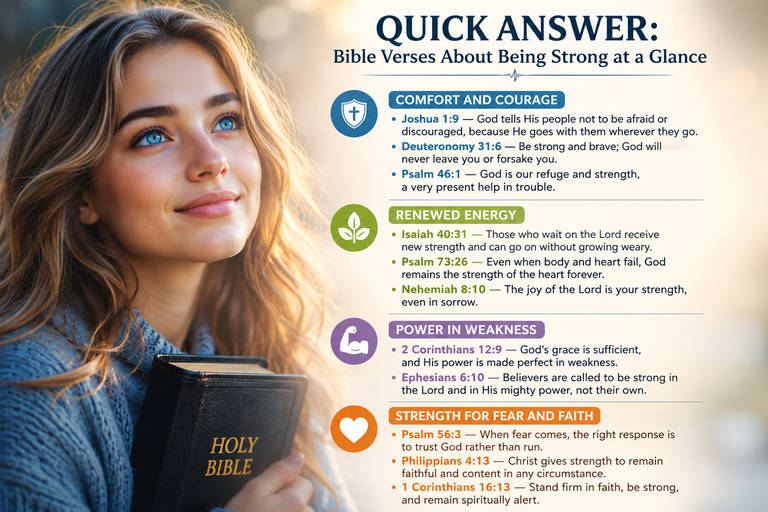
If you only have a minute, here is a fast, theme-grouped summary of the verses covered in this article. Each one is explained in more depth below.
Comfort and Courage
- Joshua 1:9 — God tells His people not to be afraid or discouraged, because He goes with them wherever they go.
- Deuteronomy 31:6 — Be strong and brave; God will never leave you or forsake you.
- Psalm 46:1 — God is our refuge and strength, a very present help in trouble.
Renewed Energy
- Isaiah 40:31 — Those who wait on the Lord receive new strength and can go on without growing weary.
- Psalm 73:26 — Even when body and heart fail, God remains the strength of the heart forever.
- Nehemiah 8:10 — The joy of the Lord is your strength, even in sorrow.
Power in Weakness
- 2 Corinthians 12:9 — God’s grace is sufficient, and His power is made perfect in weakness.
- Ephesians 6:10 — Believers are called to be strong in the Lord and in His mighty power, not their own.
Strength for Fear and Faith
- Psalm 56:3 — When fear comes, the right response is to trust God rather than run.
- Philippians 4:13 — Christ gives strength to remain faithful and content in any circumstance.
- 1 Corinthians 16:13 — Stand firm in faith, be strong, and remain spiritually alert.
Want the full picture with context and application for each passage? Keep reading below for all 30 Scriptures, organized by the specific situation you may be facing.
Key Takeaways
- Strength comes from God, not self-reliance. Scripture repeatedly points away from willpower and toward dependence on God as the true source of strength.
- Courage does not mean the absence of fear. Biblical courage is choosing to trust God even while fear is present.
- Weakness is not disqualifying. Paul’s own life shows that God’s power is often most visible in human limitation, not in spite of it.
- Strength often looks like perseverance. Waiting on the Lord, staying steadfast, and taking the next faithful step are all forms of biblical strength.
- You are not meant to carry it alone. From Joshua to Paul, every example of strength in Scripture is rooted in God’s presence, not personal effort.
The Most Powerful Quotes From the Bible About Being Strong
1. Joshua 1:9 — Be Strong and Courageous
“Be strong and of a good courage; be not afraid, neither be thou dismayed: for the LORD thy God is with thee whithersoever thou goest.” — Joshua 1:9, KJV
Joshua received these words at a moment when he had a tremendous responsibility before him. Moses had died, and Joshua was now responsible for leading Israel into the Promised Land. The task ahead involved uncertainty, opposition, and challenges that Joshua could not overcome through confidence in himself alone.
That makes God’s command to “be strong” especially meaningful. The foundation of Joshua’s courage was not his own ability. God gave him a reason to be courageous: “the LORD thy God is with thee.”
This is one of the clearest Bible quotes about being strong because it connects courage directly to God’s presence. You may not know everything that lies ahead, but you do not have to face it alone.
When to remember this verse: When you are afraid of the future, facing a major responsibility, starting something unfamiliar, or wondering whether you have what it takes.
2. Isaiah 41:10 — God Will Strengthen and Help You
“Fear thou not; for I am with thee: be not dismayed; for I am thy God.” — Isaiah 41:10, KJV
God continues: “I will strengthen thee; yea, I will help thee; yea, I will uphold thee with the right hand of my righteousness.”
Isaiah 41:10 is powerful because God does not merely command His people to become stronger. He promises to strengthen, help, and uphold them.
The verse addresses fear and discouragement by pointing to God’s character and presence. The answer to weakness is not simply greater determination. God Himself is the source of the help His people need.
If you feel overwhelmed by something you cannot control, this passage gives you a different way to look at your situation. You may still have a difficult road ahead, but you can face it knowing that God is not asking you to carry it entirely by yourself.
When to remember this verse: When you feel overwhelmed, helpless, discouraged, or afraid that you cannot handle what is ahead.
3. Philippians 4:13 — Christ Gives You Strength
“I can do all things through Christ which strengtheneth me.” — Philippians 4:13, KJV
Philippians 4:13 is one of the most widely quoted Bible verses about strength, but its context makes the verse even more meaningful.
Paul was not saying that Christ would enable him to accomplish every imaginable goal. In the surrounding verses, Paul explains that he had learned how to live with plenty and with very little, with abundance and with need. His strength came from Christ, enabling him to remain faithful and content regardless of his circumstances.
That means Philippians 4:13 is ultimately about Christ giving you strength to endure and remain faithful, rather than promising unlimited success.
When circumstances change, your source of strength does not have to change with them. You can have abundance without placing your confidence in it, and you can experience hardship without believing that hardship has the final word.
When to remember this verse: When circumstances are changing, when you are facing hardship, or when you need strength to remain faithful rather than simply escape difficulty.
4. Isaiah 40:31 — God Renews the Strength of the Weary
“But they that wait upon the LORD shall renew their strength; they shall mount up with wings as eagles.” — Isaiah 40:31, KJV
Sometimes the problem is not fear. You are simply exhausted.
Isaiah speaks directly to weary people and points them toward the Lord. The passage acknowledges that even strong and capable people eventually become tired. Human strength has limits.
But those who wait upon the Lord are promised renewed strength.
Waiting on God does not mean doing nothing or abandoning responsibility. It means placing your hope and confidence in Him rather than believing everything depends on your own energy and ability.
If you have been carrying something for a long time, Isaiah 40:31 reminds you that exhaustion does not mean God has abandoned you. There is a strength that comes from depending on Him.
When to remember this verse: When you are emotionally, physically, or spiritually exhausted and need renewed strength to continue.
5. Psalm 46:1 — God Is Your Refuge and Strength
“God is our refuge and strength, a very present help in trouble.” — Psalm 46:1, KJV
Psalm 46 does not begin by pretending that trouble does not exist. The verses that follow describe an unstable world—mountains moving, waters roaring, and the earth shaking.
Yet the psalmist says, “God is our refuge and strength.”
That distinction matters. Biblical faith does not require you to deny that life can become frightening or painful. Instead, it gives you somewhere to turn when circumstances become overwhelming.
God is described as a refuge—a place of safety—and as strength—a source of endurance and stability.
When everything around you feels uncertain, Psalm 46:1 reminds you that God remains a secure place to turn.
When to remember this verse: During crisis, hardship, uncertainty, loss, or any season when life feels unstable.
6. 2 Corinthians 12:9–10 — God’s Power in Weakness
“My grace is sufficient for thee: for my strength is made perfect in weakness.” — 2 Corinthians 12:9, KJV
Paul’s words introduce one of the Bible’s most important lessons about strength.
Paul had pleaded with God concerning his “thorn in the flesh,” asking for it to be removed. Instead of giving Paul the outcome he requested, God answered with a promise of sufficient grace.
Paul eventually understood that his weakness could become a place where Christ’s power was displayed.
This does not mean suffering or weakness is automatically good. It means that your limitations do not prevent God from working. You do not need to pretend that you have unlimited strength before you can depend on Him.
Paul could therefore say: “For when I am weak, then am I strong.” — 2 Corinthians 12:10, KJV
The strength here is not self-confidence. It is dependence on God’s grace.
When to remember this verse: When you feel inadequate, limited, exhausted, or unable to solve a problem through your own ability.
7. Deuteronomy 31:6 — Be Strong Because God Is With You
“Be strong and of a good courage, fear not, nor be afraid of them: for the LORD thy God, he it is that doth go with thee.” — Deuteronomy 31:6, KJV
Moses spoke these words to Israel as they prepared to move forward without him. They were about to enter a new stage of their journey, and they would face opposition and uncertainty.
The command to be strong was therefore connected to a promise: God would go with them.
This is a recurring pattern throughout Scripture. Courage is not based on having complete control over the future. It is based on knowing the One who goes with you into it.
If you are entering a new season, changing jobs, taking on responsibility, facing a difficult conversation, or simply uncertain about what comes next, this passage gives you a firm foundation for courage.
When to remember this verse: When you are entering an unfamiliar season or facing something that feels bigger than you.
8. Ephesians 6:10 — Be Strong in the Lord
“Finally, my brethren, be strong in the Lord, and in the power of his might.” — Ephesians 6:10, KJV
Paul’s instruction is striking because he does not simply say, “Be strong.”
He says: “Be strong in the Lord.”
The distinction is important. The following verses introduce the armor of God and describe the believer’s need to stand firm against spiritual opposition.
Christian strength is therefore not simply emotional toughness or determination. It involves relying on God’s truth, righteousness, faith, salvation, Word, and prayer.
The command is not to fight spiritual battles using nothing but your own willpower. It is to stand in the strength God provides.
When to remember this verse: When you are facing temptation, spiritual discouragement, attacks on your faith, or a season in which you need to stand firm.
9. Psalm 73:26 — God Is the Strength of Your Heart
“My flesh and my heart faileth: but God is the strength of my heart, and my portion for ever.” — Psalm 73:26, KJV
This verse gives us a remarkably honest picture of human weakness.
The psalmist does not claim that his body and heart will never fail. He acknowledges the opposite: they can fail.
But he immediately identifies something greater than his own limitations: “God is the strength of my heart.”
This is a powerful reminder that your weakness does not have to determine your final source of confidence. Your physical energy can decline. Your emotions can fluctuate. Your plans can change. But God remains.
The word “portion” also communicates the idea of an inheritance or share. The psalmist’s ultimate security is found not in temporary circumstances but in God Himself.
When to remember this verse: When you feel emotionally drained, physically weak, discouraged, or aware of your own limitations.
10. Nehemiah 8:10 — The Joy of the Lord Is Your Strength
“Do not grieve, for the joy of the LORD is your strength.” — Nehemiah 8:10
The words “the joy of the LORD is your strength” are often quoted by themselves, but their context makes them richer.
The people of Israel had gathered to hear God’s Law being read and explained. Their response included sorrow and weeping as they recognized what they had heard. Nehemiah and the other leaders encouraged them not to remain in grief because the day was holy.
The passage connects strength with joy in God, not merely with positive thinking.
There are moments when conviction, sorrow, or difficult circumstances can become overwhelming. Yet God’s goodness gives His people a reason to rejoice even while they are taking their spiritual lives seriously.
The joy spoken of here is not shallow happiness. It is confidence in God’s goodness.
When to remember this verse: When sadness or discouragement is draining your strength and you need to remember God’s goodness.
11. Psalm 28:7 — The Lord Is My Strength and Shield
“The LORD is my strength and my shield; my heart trusted in him, and I am helped.” — Psalm 28:7, KJV
David brings together three ideas in this verse: God is his strength, God is his shield, and trusting God brings help.
The picture is both inward and outward. God strengthens the heart while also providing protection.
Notice the connection between strength and trust. David’s confidence does not come from believing that he is invulnerable. His confidence comes from knowing whom he can trust.
When you do not know what will happen next, trusting God may not immediately change your circumstances, but it can change where you place your confidence.
When to remember this verse: When you need God’s protection, feel vulnerable, or are struggling to trust Him with an uncertain situation.
12. Habakkuk 3:19 — The Lord Gives Me Strength
“The LORD God is my strength, and he will make my feet like hinds’ feet.” — Habakkuk 3:19, KJV
Habakkuk’s declaration is particularly powerful because it comes after he describes circumstances that are far from comfortable.
Earlier in the chapter, he considers the possibility that crops may fail and the normal sources of food and security may disappear. Yet he chooses to rejoice in God.
His confidence does not depend on everything around him going well.
Instead, he declares: “The LORD God is my strength.”
This is a mature picture of biblical strength. Sometimes faith does not mean that the difficult situation immediately changes. Sometimes it means that God gives you the strength and stability to walk through it.
When to remember this verse: When circumstances are difficult and you need strength to keep moving forward even before you see the outcome you want.
What These Bible Quotes Teach Us About Strength

These passages come from different books, different situations, and different people, but together they reveal a remarkably consistent biblical picture of strength.
Biblical Strength Comes From God
One of the clearest patterns is that Scripture repeatedly points away from self-reliance and toward God.
Psalm 28:7 says: “The LORD is my strength and my shield.” Isaiah 41:10 says: “I will strengthen thee; yea, I will help thee.” Ephesians 6:10 says: “Be strong in the Lord.” Philippians 4:13 points to Christ as the One who strengthens Paul.
The message is not that believers should become completely independent and strong enough to handle everything alone. Biblical strength begins by recognizing that God is the ultimate source of the strength we need.
That changes the question we ask when life becomes difficult. Instead of only asking, “How can I become strong enough for this?” Scripture teaches us to ask, “How can I trust God and depend on His strength in this?”
Courage Is Rooted in God’s Presence
Joshua 1:9 and Deuteronomy 31:6 reveal another important pattern.
God tells His people to be strong and courageous, but He does not leave the command standing by itself.
The reason for courage is God’s presence: “The LORD thy God is with thee.”
That means biblical courage is not pretending that danger does not exist. Joshua had real responsibilities. Israel faced real opposition. The future contained genuine uncertainty.
Yet God’s presence was greater than the uncertainty.
This is why a person can be afraid and still act courageously. Courage does not require you to feel no fear; it requires you to decide where you will place your trust when fear comes.
God’s Strength Is Available in Weakness
Perhaps the most surprising theme is found in 2 Corinthians 12:9–10.
The Bible can command us to be strong while also acknowledging that we will sometimes be profoundly weak.
Those ideas are not contradictory.
Biblical strength is not the ability to say, “I don’t need anyone.” It is the willingness to say, “I need God.”
Paul discovered that God’s grace was sufficient even when his weakness remained. Isaiah tells the weary that God gives power to those who have no strength. Psalm 73 acknowledges that human flesh and heart can fail while declaring that God remains the strength of the heart.
So if you are reading these verses because you feel weak, do not assume that your weakness means you have failed.
Sometimes recognizing your limits is precisely what teaches you to depend more deeply on the God who gives strength.
The Bible speaks about strength in many different circumstances. Sometimes you need strength because life has become difficult. Sometimes you need courage because you are afraid of what lies ahead. And sometimes the deepest problem is that you simply feel too weak to continue.
The Scriptures in this section meet those different situations directly. Rather than asking you to ignore what you are going through, they show how God’s presence, grace, promises, and faithfulness can give you strength in hard times and real encouragement in the middle of them.
Bible Quotes About Being Strong When Life Is Hard
Hard seasons can make you wonder how much longer you can keep going. Scripture does not minimize those seasons. Instead, it repeatedly points believers toward God as a refuge, a source of help, and a reason to keep trusting Him.
Psalm 46:1–3 — God Is Present in Trouble
“God is our refuge and strength, a very present help in trouble.” — Psalm 46:1, KJV
Psalm 46 begins with a picture of extreme instability. The earth gives way, mountains fall into the sea, and the waters roar. Yet the psalmist responds to this chaos with confidence in God.
The important phrase is “very present help in trouble.” God is not described as someone who is useful only after the trouble has passed. He is present in the trouble.
That distinction can matter when your circumstances do not change immediately. You may still have difficult responsibilities, painful uncertainty, or problems that cannot be solved overnight. But Psalm 46 reminds you that trouble does not mean you have been left without help.
The strength offered by this passage is not a promise that life will always be calm. It is the assurance that God remains a refuge when life is not calm.
When to remember this verse: When your circumstances feel chaotic, unstable, or beyond your ability to control.
Isaiah 41:10 — Do Not Fear When You Feel Overwhelmed
“Fear thou not; for I am with thee: be not dismayed; for I am thy God.” — Isaiah 41:10, KJV
God’s words in this passage address two common responses to overwhelming circumstances: fear and discouragement.
But notice how God responds. He does not simply say, “Be stronger.”
He gives reasons: “I am with thee.” “I am thy God.” “I will strengthen thee.” “I will help thee.” “I will uphold thee.”
The emphasis is on what God will do. When your own resources feel inadequate, this passage directs your attention away from measuring your strength and toward trusting God’s.
That can change how you face a difficult day. You may still have a problem to solve, a responsibility to carry, or a painful situation to endure, but you can approach it knowing that your strength does not have to come entirely from yourself.
When to remember this verse: When you feel overwhelmed, discouraged, helpless, or afraid that you cannot handle what is happening.
Nahum 1:7 — God Is a Stronghold in Trouble
“The LORD is good, a strong hold in the day of trouble; and he knoweth them that trust in him.” — Nahum 1:7, KJV
Nahum 1:7 combines three reassuring truths: God is good, God is a stronghold, and God knows those who trust Him.
A stronghold was a place of protection and security. In a dangerous situation, people could retreat to a fortified place for safety.
The picture communicates something important about God’s character. When trouble arrives, the believer does not have to search for security in temporary things that can disappear. God Himself is presented as a dependable refuge.
The verse also says that He “knoweth” those who trust Him. This is more personal than simply knowing that God exists. It reminds us that God is attentive to His people.
When to remember this verse: When you need reassurance that God is both good and trustworthy during a difficult season.
Romans 8:35–39 — Nothing Can Separate You From God’s Love
“Who shall separate us from the love of Christ?” — Romans 8:35, KJV
Paul then considers an entire range of painful circumstances, including tribulation, distress, persecution, famine, nakedness, peril, and persecution.
His conclusion is remarkable: “Nay, in all these things we are more than conquerors through him that loved us.” — Romans 8:37, KJV
Paul’s point is not that Christians will never experience suffering. In fact, the passage openly acknowledges that they can.
The strength comes from knowing that suffering cannot separate believers from Christ’s love.
Paul ends by declaring that neither death nor life, things present nor things to come, nor anything else in creation can separate God’s people from His love in Christ.
When hardship makes you question whether God is still with you, Romans 8 points to something circumstances cannot take away: God’s love remains secure.
When to remember this verse: When suffering makes you feel abandoned, defeated, or uncertain about God’s love.
1 Peter 5:10 — God Strengthens You After Suffering
“But the God of all grace… after that ye have suffered a while, make you perfect, stablish, strengthen, settle you.” — 1 Peter 5:10, KJV
Peter does something important here: he acknowledges suffering without pretending that it is easy.
Yet suffering is not presented as the end of the story.
Peter describes God as the God of all grace, and he says that God will ultimately strengthen, establish, and settle His people.
This does not mean every painful circumstance will immediately disappear. Instead, the verse points toward God’s work of strengthening His people through and beyond suffering.
If you are in a season that seems to be changing you, exhausting you, or testing your faith, this passage gives you a reason to look beyond the present moment.
When to remember this verse: When a difficult season has lasted longer than you expected and you need hope that God is still working in you.
Bible Quotes About Being Strong and Courageous
Strength and courage are closely connected throughout Scripture. The Bible does not describe courage as pretending that danger, uncertainty, or fear does not exist. Instead, courage often means moving forward in faith because you know God is with you.
Joshua 1:9 — Courage for an Uncertain Future
“Be strong and of a good courage; be not afraid, neither be thou dismayed.” — Joshua 1:9, KJV
Joshua 1:9 is perhaps the clearest biblical command to be strong and courageous.
Joshua was stepping into a leadership role after Moses. He was not being told to become fearless because the future would be easy. He was being called to move forward while trusting God’s presence.
The command is followed by the reason: “For the LORD thy God is with thee whithersoever thou goest.”
That is the foundation of biblical courage.
You may not know what tomorrow will bring. You may not feel prepared for the responsibility in front of you. But courage does not require complete knowledge of the future. It requires confidence in the God who goes with you.
When to remember this verse: When you are facing an uncertain future, major decision, new responsibility, or intimidating challenge.
Deuteronomy 31:6 — God Will Never Leave You
“Be strong and of a good courage, fear not, nor be afraid of them: for the LORD thy God, he it is that doth go with thee.” — Deuteronomy 31:6, KJV
Moses spoke these words to Israel as they prepared to enter the land God had promised them.
The people were facing something larger than themselves. Their courage was not based on the absence of opposition. It was based on God’s faithfulness.
The verse continues with one of Scripture’s most reassuring promises: “He will not fail thee, nor forsake thee.”
That promise addresses one of the deepest sources of fear: the feeling that you have to face everything alone.
When you feel isolated in a difficult situation, remember what this passage emphasizes. God’s presence does not depend on how strong you feel.
When to remember this verse: When you feel alone, abandoned, intimidated, or afraid to move into a new season.
Joshua 1:7 — Courage to Obey God
“Only be thou strong and very courageous, that thou mayest observe to do according to all the law.” — Joshua 1:7, KJV
Joshua 1:7 adds an important dimension to the idea of strength.
Joshua’s courage was not simply about facing enemies or overcoming obstacles. God connected his strength and courage with obedience.
In other words, biblical courage includes the willingness to do what God has commanded even when doing so is difficult.
That matters because sometimes the hardest form of strength is not confronting an external enemy. It is remaining faithful when compromise would be easier.
A strong Christian life therefore involves more than confidence. It involves faithful obedience when obedience costs something.
When to remember this verse: When you are under pressure to compromise your convictions or when doing the right thing feels difficult.
1 Chronicles 28:20 — Be Strong and Do the Work
“Be strong and of good courage, and do it: fear not, nor be dismayed.” — 1 Chronicles 28:20, KJV
David gave this encouragement to Solomon concerning the work of building the temple.
There is something practical about the command: “Be strong… and do it.”
Sometimes strength is not an emotional experience. You may not suddenly feel brave or motivated. Sometimes strength means taking the next faithful step and doing the work in front of you.
Solomon had a major task ahead, but David reminded him that fear and discouragement did not have to stop him.
This can speak to ordinary responsibilities as well. There are times when the most courageous thing you can do is simply continue with the work God has placed before you.
When to remember this verse: When a responsibility feels overwhelming and discouragement is tempting you to stop.
1 Corinthians 16:13 — Stand Firm in Faith
“Watch ye, stand fast in the faith, quit you like men, be strong.” — 1 Corinthians 16:13, KJV
Paul’s instruction to the Corinthian believers contains several active commands: watch, stand firm, be strong.
The emphasis is on spiritual alertness and perseverance. Christian strength includes remaining grounded in faith when circumstances or pressures attempt to pull you away.
The phrase translated “be strong” carries the idea of acting with strength and courage. It is not simply an instruction to feel confident.
Sometimes strength means refusing to abandon what you know to be true simply because following it has become difficult.
When to remember this verse: When your faith is being tested or you are under pressure to give up your convictions.
Psalm 27:14 — Wait for the Lord and Take Courage
“Wait on the LORD: be of good courage, and he shall strengthen thine heart.” — Psalm 27:14, KJV
Psalm 27 connects waiting, courage, and strength.
That combination is important because waiting can be one of the hardest forms of faith.
You may pray for an answer and not receive it immediately. You may want circumstances to change while nothing seems to happen. You may know what you hope God will do without knowing when He will do it.
David’s instruction is not to give up while waiting. It is: “Wait on the LORD.”
Then comes the promise: “He shall strengthen thine heart.”
Sometimes God gives strength not by making the waiting disappear, but by strengthening your heart so that you can remain faithful during it.
When to remember this verse: When you are waiting for an answer, breakthrough, change, or direction and are struggling to remain hopeful.
Bible Quotes About Being Strong When You Feel Weak
There is a difference between being tired for a moment and reaching a point where you genuinely feel that you have nothing left.
The Bible speaks directly to those moments. Rather than shaming weakness, Scripture repeatedly directs weak and weary people toward the God who gives strength.
2 Corinthians 12:9–10 — Strength Through God’s Grace
“My grace is sufficient for thee: for my strength is made perfect in weakness.” — 2 Corinthians 12:9, KJV
Paul’s experience gives us one of Scripture’s clearest pictures of strength in weakness.
He had asked God repeatedly for his difficulty to be removed. Instead, God answered by assuring him that His grace was sufficient.
Paul therefore learned to see weakness differently.
He did not have to pretend that his limitation was not real. He could acknowledge it while depending more deeply on Christ.
That is why he could write: “For when I am weak, then am I strong.”
The strength here is not physical superiority or personal toughness. It is Christ’s power resting upon someone who recognizes his dependence on Him.
When to remember this verse: When you feel inadequate, limited, incapable, or frustrated by something you cannot change.
Isaiah 40:29 — God Gives Power to the Weak
“He giveth power to the faint; and to them that have no might he increaseth strength.” — Isaiah 40:29, KJV
This verse speaks directly to people who have reached their limits.
God does not reserve His strength for people who already have everything under control. Isaiah says that He gives power to the faint and increases strength for those who have no might.
That is an encouraging truth when you feel like you have nothing left to offer.
Your lack of strength does not make you invisible to God. It is precisely the kind of condition in which Scripture tells us to look to Him.
When to remember this verse: When you are exhausted, depleted, or convinced that you no longer have enough strength for what lies ahead.
Psalm 73:26 — God Is the Strength of Your Heart
“My flesh and my heart faileth: but God is the strength of my heart, and my portion for ever.” — Psalm 73:26, KJV
The psalmist acknowledges that both body and heart can fail.
That makes this verse especially relatable. There are times when physical tiredness and emotional discouragement arrive together.
But the verse does not end with human weakness. It ends with God.
“God is the strength of my heart.”
The psalmist’s confidence is ultimately anchored in God’s permanence rather than his own changing condition.
When your emotions are unreliable and your energy is limited, you can still turn toward the God who does not change.
When to remember this verse: When your emotional or physical strength is failing and you need something more dependable than your own feelings.
Psalm 119:28 — Strengthen Me According to Your Word
“My soul melteth for heaviness: strengthen thou me according unto thy word.” — Psalm 119:28, KJV
This is one of the most direct prayers for strength in Scripture.
The psalmist does not hide his emotional condition. His soul is weighed down by sorrow.
And what does he ask for? Not simply a change in circumstances.
He asks: “Strengthen thou me according unto thy word.”
That phrase is important because it connects strength with God’s revealed truth. When sorrow becomes heavy, the psalmist turns toward what God has said.
There may be moments when your emotions tell you that everything is hopeless. Scripture gives you a place to stand when those emotions become overwhelming.
When to remember this verse: When sorrow is weighing heavily on you and you need God’s Word to steady your heart.
Psalm 138:3 — God Strengthens the Soul
“In the day when I cried thou answeredst me, and strengthenedst me with strength in my soul.” — Psalm 138:3, KJV
Not every kind of weakness is physical.
Sometimes your body is functioning, but inwardly you feel exhausted, discouraged, or empty.
David speaks of God answering his cry and strengthening him “with strength in my soul.”
This reminds us that biblical strength includes inner renewal. You may still have the same responsibilities when you finish praying, but God can strengthen the person who must carry them.
The verse also begins with a simple action: “I cried.” David brought his need to God rather than hiding it.
When to remember this verse: When you are inwardly exhausted, discouraged, emotionally drained, or in need of renewed spiritual strength.
Habakkuk 3:19 — God Gives Strength to Keep Going
“The LORD God is my strength, and he will make my feet like hinds’ feet.” — Habakkuk 3:19, KJV
Habakkuk’s declaration becomes especially powerful when you read it alongside the difficult circumstances described earlier in the chapter.
He considers the possibility that the fig tree may not blossom, the vines may produce no fruit, and the fields may yield no food. Yet he chooses to rejoice in God.
His strength is therefore not dependent on everything going well.
He says: “The LORD God is my strength.”
The picture of sure-footed feet suggests the ability to move confidently through difficult terrain. The point is not that God promises an easy path. It is that He can give you strength to walk the difficult path.
That is sometimes exactly what we need. Not an immediate escape. Not an instant solution. But enough strength to keep going with God.
When to remember this verse: When circumstances remain difficult and you need strength to continue faithfully without yet knowing how the situation will end.
Fear can make you hesitate, faith can become difficult to maintain, and prolonged hardship can leave you wondering whether you have enough strength to continue. Scripture speaks to all three situations.
The Bible does not tell us that strong believers never experience fear, doubt, exhaustion, or discouragement. Instead, it repeatedly shows us what to do when those things arise: trust God, stand firm in faith, remember His promises, and continue faithfully.
Bible Quotes About Being Strong When You Are Afraid
Fear is one of the most common reasons people look for Bible verses about being strong. Scripture responds to fear not by pretending that danger is imaginary, but by reminding us that God is greater than the circumstances we face.
Psalm 56:3 — When I Am Afraid, I Will Trust in You
“What time I am afraid, I will trust in thee.” — Psalm 56:3, KJV
This may be one of the simplest prayers for courage in the entire Bible.
David does not say, “I will never be afraid.” Instead, he acknowledges the reality of fear and describes what he will do when fear comes: “I will trust in thee.”
That distinction is important. Faith does not require you to pretend that frightening circumstances do not exist. You can recognize the danger, acknowledge the uncertainty, and still choose to place your trust in God.
David’s response gives us a practical pattern for fearful moments: fear can become a reason to turn toward God rather than a reason to run away from Him.
When to remember this verse: When fear is immediate, when you are worried about what might happen, or when anxiety is making it difficult to know what to do next.
Psalm 27:1 — Whom Shall I Fear?
“The LORD is my light and my salvation; whom shall I fear? the LORD is the strength of my life; of whom shall I be afraid?” — Psalm 27:1, KJV
David begins with God’s character before talking about his own fear.
God is his light, his salvation, and his strength.
Then David asks, “Whom shall I fear?”
He is not claiming that life contains no threats. The rest of Psalm 27 makes it clear that David knew what opposition and danger felt like. His confidence comes from seeing those threats in light of who God is.
When fear becomes larger than everything else in your mind, this verse helps redirect your attention. The question is no longer only, “How serious is my problem?” It becomes, “Who is God in the middle of my problem?”
When to remember this verse: When fear has become overwhelming and you need to refocus your heart on God’s power and protection.
Isaiah 41:10 — God Is With You
“Fear thou not; for I am with thee; be not dismayed; for I am thy God.” — Isaiah 41:10, KJV
God’s answer to fear in this passage begins with His presence: “I am with thee.”
Then He gives a series of promises: “I will strengthen thee.” “I will help thee.” “I will uphold thee.”
This is why Isaiah 41:10 is more than a motivational statement. God does not merely tell His people to stop being afraid. He gives them reasons to trust Him.
If fear is telling you that you are alone, this verse answers with God’s presence. If fear is telling you that you are too weak, God says He will strengthen you. If fear is telling you that you are going to fall, God promises to uphold you.
When to remember this verse: When fear is connected to feeling alone, overwhelmed, or unable to handle what is happening.
2 Timothy 1:7 — God Gives Power, Love, and a Sound Mind
“For God hath not given us the spirit of fear; but of power, and of love, and of a sound mind.” — 2 Timothy 1:7, KJV
Paul wrote these words to Timothy, encouraging him to remain faithful despite the difficulties associated with his calling and ministry.
The contrast is striking: fear versus power, love, and a sound mind.
The verse does not mean that Christians will never experience the emotion of fear. Instead, fear should not become the force that determines how we respond to God’s calling.
God provides power to act, love to serve others, and sound judgment to respond wisely.
That gives this verse a practical dimension. Being strong does not mean reacting aggressively or recklessly. Sometimes strength means remaining calm, loving, wise, and faithful when fear is pushing you toward the opposite response.
When to remember this verse: When fear is making you hesitate, when you feel intimidated, or when you need courage to fulfill a responsibility God has placed before you.
Psalm 23:4 — You Do Not Have to Fear the Valley
“Yea, though I walk through the valley of the shadow of death, I will fear no evil: for thou art with me.” — Psalm 23:4, KJV
The strength of Psalm 23:4 comes from its setting.
David does not say that the valley does not exist. He says: “Though I walk through the valley…”
The valley is real. The danger is real. Yet David refuses to let fear have the final word because of one central truth: “Thou art with me.”
God’s presence changes the way David walks through the valley.
The verse also uses the language of movement. David is walking through the valley. The difficult place is not necessarily the final destination.
If you are currently walking through a painful season, this verse offers comfort without pretending that the valley is easy.
When to remember this verse: During grief, uncertainty, serious hardship, or any season when you feel as though you are walking through a dark place.
Bible Quotes About Being Strong in Your Faith
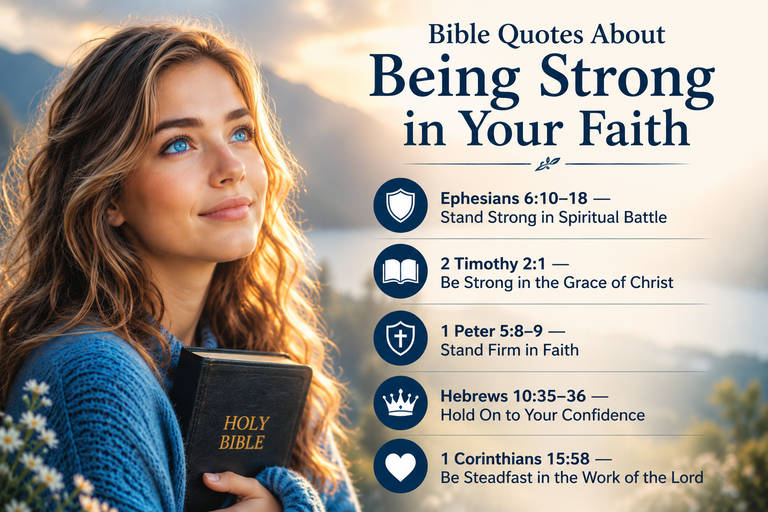
There is another kind of strength that Scripture emphasizes: the strength required to remain faithful when your beliefs, character, or commitment are being tested.
Christian strength is not simply about feeling emotionally confident. It includes standing firm in what you believe and continuing to follow Christ when doing so becomes difficult.
Ephesians 6:10–18 — Stand Strong in Spiritual Battle
“Finally, my brethren, be strong in the Lord, and in the power of his might.” — Ephesians 6:10, KJV
Paul immediately follows this command with the instruction to put on the whole armour of God.
He describes the belt of truth, the breastplate of righteousness, the preparation of the gospel of peace, the shield of faith, the helmet of salvation, the sword of the Spirit, and prayer.
The picture is not of a Christian becoming strong through personal determination. The believer stands by using what God provides.
This makes Ephesians 6 especially important when thinking about spiritual strength. The Christian life involves opposition, temptation, deception, and discouragement, but Scripture gives believers resources with which to stand.
The goal is not simply to feel powerful. The goal is to remain standing and faithful.
When to remember this verse: When you are facing temptation, spiritual discouragement, attacks on your faith, or pressure to abandon what you believe.
2 Timothy 2:1 — Be Strong in the Grace of Christ
“Thou therefore, my son, be strong in the grace that is in Christ Jesus.” — 2 Timothy 2:1, KJV
Paul gives Timothy an instruction that contains an important qualification: “Be strong in the grace.”
That tells us something about the nature of Christian strength.
Paul does not tell Timothy to become strong through pride, self-sufficiency, or confidence in his own abilities. His strength is to be found in the grace that is in Christ Jesus.
Grace means that our relationship with God is not ultimately built on our ability to perform perfectly.
That is encouraging when you feel inadequate. Your faith does not depend on becoming strong enough that you never need God’s help. You are called to become strong in His grace.
When to remember this verse: When you feel inadequate in your Christian life, ministry, responsibilities, or calling.
1 Peter 5:8–9 — Stand Firm in Faith
“Be sober, be vigilant… whom resist stedfast in the faith.” — 1 Peter 5:8–9, KJV
Peter tells believers to be alert because they face spiritual opposition.
But his instruction is not simply to become frightened by the enemy.
He says to resist steadfastly in the faith.
That word picture emphasizes stability. A strong believer is not someone who never experiences pressure. A strong believer is someone who refuses to be easily moved away from faithfulness.
Peter also reminds his readers that they are not alone in experiencing trials. Other believers are facing difficulties as well.
Sometimes that realization matters. A difficult season does not necessarily mean that your faith has failed. It can be part of the ordinary struggle of following Christ in a broken world.
When to remember this verse: When temptation is strong, when your faith is under pressure, or when you need encouragement to remain spiritually alert.
Hebrews 10:35–36 — Hold On to Your Confidence
“Cast not away therefore your confidence, which hath great recompence of reward.” — Hebrews 10:35, KJV
The writer of Hebrews connects confidence with endurance.
The following verse says: “For ye have need of patience.”
This is important because faith sometimes requires waiting.
You may know what God has promised without knowing when you will see the outcome. You may be doing what is right without seeing immediate results.
In those moments, strength can look like refusing to throw away your confidence simply because the waiting has become difficult.
The passage does not promise instant results. Instead, it calls believers to continue faithfully.
When to remember this verse: When you have been waiting a long time, when your faith feels tested, or when you are tempted to abandon hope.
1 Corinthians 15:58 — Be Steadfast in the Work of the Lord
“Therefore, my beloved brethren, be ye stedfast, unmoveable, always abounding in the work of the Lord.” — 1 Corinthians 15:58, KJV
Paul’s instruction comes after his teaching about the resurrection. Because the resurrection gives Christian hope a lasting foundation, believers have a reason to remain faithful.
The key words are steadfast and unmoveable.
This is another picture of biblical strength. Sometimes strength does not look dramatic. It looks like consistency.
You keep praying. You keep serving. You keep doing what is right. You keep trusting God. You keep showing up faithfully even when you cannot yet see the full results.
Paul gives a reason for that perseverance: “Your labour is not in vain in the Lord.”
Faithful work done for God is never meaningless, even when its results are not immediately visible.
When to remember this verse: When you are discouraged by slow progress or wondering whether your faithful efforts matter.
Bible Quotes About Being Strong When You Want to Give Up
There are moments when fear is not the main problem. You are simply tired of continuing.
Perhaps you have prayed for the same situation for months. Perhaps you have been doing the right thing without seeing the outcome you hoped for. Perhaps repeated disappointment has made you wonder whether it is worth continuing.
Scripture speaks directly to that kind of weariness.
Galatians 6:9 — Do Not Grow Weary in Doing Good
“And let us not be weary in well doing: for in due season we shall reap, if we faint not.” — Galatians 6:9, KJV
Galatians 6:9 recognizes something very human: doing good can become tiring.
The command is not simply “work harder.” It is: do not become weary in doing good.
Why? Because there is a season for reaping.
The verse acknowledges that faithfulness and visible results do not always arrive at the same time. You may plant today and wait a long time before seeing the harvest.
That makes this an especially valuable Scripture when you feel like giving up because your efforts seem unnoticed or unproductive.
Faithfulness sometimes means continuing to do what is right while trusting God with the timing.
When to remember this verse: When you are tired of doing good, discouraged by slow results, or tempted to quit something you believe God has called you to continue.
Hebrews 10:35–36 — Do Not Throw Away Your Confidence
“Cast not away therefore your confidence, which hath great recompence of reward.” — Hebrews 10:35, KJV
When you have waited for something for a long time, it can become tempting to conclude that your hope was misplaced.
Hebrews gives another response: do not throw away your confidence.
Then it immediately emphasizes endurance.
This means that biblical perseverance is not blind stubbornness. It is continuing to trust God when the timing is not yet what you expected.
You may not have control over when circumstances change, but you can choose whether to continue walking faithfully.
When to remember this verse: When disappointment has made you question whether continuing to trust God is worthwhile.
James 1:2–4 — Let Perseverance Finish Its Work
“Knowing this, that the trying of your faith worketh patience.” — James 1:3, KJV
James presents trials from a perspective that can be difficult to accept: testing can produce endurance.
He is not saying that suffering itself is pleasant. Instead, he explains that trials can become part of God’s work in developing spiritual maturity.
The process takes time.
That is why James says: “Let patience have her perfect work.”
When you want to escape every difficult experience immediately, this passage encourages you to consider what God may be producing in you through perseverance.
Sometimes strength is not simply the ability to survive a trial. It is becoming more mature and steadfast through it.
When to remember this verse: When a difficult experience is testing your faith and you are struggling to understand why the process is taking so long.
Romans 5:3–5 — Suffering Produces Endurance and Hope
“Tribulation worketh patience; and patience, experience; and experience, hope.” — Romans 5:3–4, KJV
Paul describes a progression: suffering, then endurance, then character, then hope.
That does not mean every painful experience automatically produces maturity. Rather, Paul describes what God can produce in believers as they persevere through suffering.
The final destination is hope.
And this hope is not described as empty optimism. Paul connects it to God’s love being poured into believers’ hearts through the Holy Spirit.
So even when suffering feels like it is taking something from you, God can use the experience to develop qualities that remain valuable long after the immediate circumstances have changed.
When to remember this verse: When hardship is testing your patience and you need to remember that endurance can produce lasting spiritual growth.
1 Corinthians 15:58 — Your Work Is Not in Vain
“Therefore, my beloved brethren, be ye stedfast, unmoveable, always abounding in the work of the Lord.” — 1 Corinthians 15:58, KJV
When you are tired, one of the hardest questions can be: does any of this actually matter?
Paul answers with certainty: “Your labour is not in vain in the Lord.”
The verse is connected to the hope of resurrection. Because Christ has defeated death, the work believers do for Him has eternal significance.
That gives ordinary faithfulness a much larger perspective. The prayer nobody sees. The service nobody applauds. The good decision that costs you something. The encouragement you give when you are tired yourself.
The work done faithfully for God is not wasted.
When to remember this verse: When you feel unnoticed, discouraged, or tempted to believe that your faithful efforts have no lasting value.
Philippians 3:13–14 — Keep Pressing Forward
“Forgetting those things which are behind, and reaching forth unto those things which are before, I press toward the mark.” — Philippians 3:13–14, KJV
Paul describes his Christian life using the language of forward movement.
He does not claim to have already arrived at perfection. Instead, he continues pressing toward the goal.
That is important when your past is discouraging you.
Sometimes you cannot move forward because you are constantly measuring today against yesterday—past failures, missed opportunities, disappointments, or things you wish had happened differently.
Paul’s example points toward another way.
Learn from the past, but do not allow it to become the place where you permanently live. Keep moving toward what God has placed before you.
When to remember this verse: When past failures, regrets, or disappointments are making it difficult to continue forward in faith.
Short Bible Quotes About Being Strong
Sometimes you do not need a long explanation. You simply need a few words from Scripture that you can remember throughout the day.
The following short passages are especially useful for prayer, memorization, encouragement, or sharing with someone who needs strength.
Short Quotes for Strength and Courage
“Be strong and of a good courage.” — Joshua 1:9
“Be strong and of a good courage, fear not.” — Deuteronomy 31:6
“Be strong in the Lord, and in the power of his might.” — Ephesians 6:10
“The LORD is my strength and my shield.” — Psalm 28:7
“The LORD God is my strength.” — Habakkuk 3:19
These short passages share a common message: strength is closely connected with God’s presence, power, and faithfulness.
If you need one short verse to carry with you into a difficult day, Joshua 1:9 is especially fitting because it joins courage with the assurance that God is with you.
Short Quotes for Hard Times
“God is our refuge and strength.” — Psalm 46:1
“The LORD is good, a strong hold in the day of trouble.” — Nahum 1:7
“I will strengthen thee; yea, I will help thee.” — Isaiah 41:10
“He giveth power to the faint.” — Isaiah 40:29
“He shall strengthen thine heart.” — Psalm 27:14
These are especially appropriate when you are not looking for a command to be courageous but for a reminder of what God promises to do for those who trust Him.
Short Quotes When You Feel Weak
“My grace is sufficient for thee.” — 2 Corinthians 12:9
“For when I am weak, then am I strong.” — 2 Corinthians 12:10
“God is the strength of my heart.” — Psalm 73:26
“Strengthen thou me according unto thy word.” — Psalm 119:28
“Strengthenedst me with strength in my soul.” — Psalm 138:3
These verses are particularly meaningful when you have reached the limits of your own strength.
Their message is not that you must somehow convince yourself that you are powerful enough. Instead, they invite you to recognize your need and turn toward the God who gives strength.
When you feel weak, you do not have to pretend to be strong before coming to God.
After looking at these passages across different situations, one truth becomes clear: the Bible’s definition of strength is different from the world’s idea of strength.
The world often associates strength with independence, confidence, control, and the ability to handle everything without help. Scripture presents something deeper. Biblical strength is closely connected to trust, dependence, courage, perseverance, God’s presence, and grace.
That is why the Bible can tell us to be strong while also telling us that God’s power is made perfect in weakness. These ideas are not opposites. Together, they show us where genuine strength comes from.
What Does the Bible Really Mean by Being Strong?
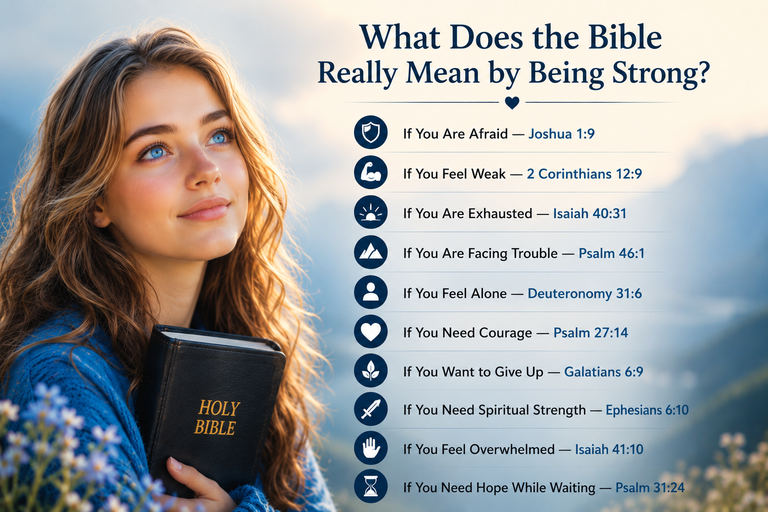
When Scripture tells believers to be strong, it is not simply giving them a motivational command. Across the Bible, strength is repeatedly connected to God Himself.
Joshua was told to be strong because God was with him. Isaiah told weary people that God gives power to the weak. Paul learned that Christ’s power was made perfect in weakness. Ephesians tells believers to be strong in the Lord.
Taken together, these passages give us a fuller picture of biblical strength.
Biblical Strength Is Not Self-Reliance
One of the biggest differences between biblical strength and worldly strength is the question of where the strength comes from.
Self-reliance says: “I have to be strong enough to handle this myself.”
Biblical faith says: “God is my strength, so I can face this by depending on Him.”
Psalm 28:7 says: “The LORD is my strength and my shield.” The psalmist does not describe God as merely someone who occasionally provides extra assistance. He calls the Lord his strength.
That distinction matters when life becomes difficult. If your confidence depends entirely on your own ability, a major failure, illness, disappointment, loss, or unexpected responsibility can leave you feeling as though everything has collapsed.
But when God is your source of strength, your limitations do not have to become the end of your hope.
This does not mean that you stop working, planning, asking for help, or taking responsibility. It means that you stop treating yourself as the ultimate source of everything you need.
God Is the Source of Our Strength
This theme appears throughout the passages in this article.
Isaiah 40:29 says: “He giveth power to the faint; and to them that have no might he increaseth strength.”
Isaiah 41:10 says: “I will strengthen thee; yea, I will help thee.”
Philippians 4:13 points to Christ as the One who strengthens Paul.
Ephesians 6:10 says: “Be strong in the Lord, and in the power of his might.”
The repeated pattern is difficult to miss: God provides what His people need to endure and remain faithful.
This can change the way you pray when you are facing something difficult.
Instead of praying only, “God, make this problem disappear,” you can also pray: “God, give me the strength, wisdom, courage, and faith to remain faithful while I walk through this.”
Sometimes the answer to a difficult season is not an immediate change in circumstances. Sometimes God strengthens the person who is walking through those circumstances.
Being Strong Requires Courage and Faith
The Bible frequently places strength and courage together.
Joshua 1:9 says: “Be strong and of a good courage.” Deuteronomy 31:6 gives the same kind of command.
But biblical courage is not the same as feeling fearless.
David could say, “What time I am afraid, I will trust in thee” (Psalm 56:3). Notice that David acknowledges fear before describing his response to it.
That means courage can exist while fear is present.
You may be nervous about a decision and still make the right decision. You may be afraid of what tomorrow will bring and still trust God. You may feel inadequate for a responsibility and still take the next faithful step. You may not feel strong, but you can choose where to place your confidence.
Biblical courage is therefore not pretending that danger, uncertainty, or difficulty does not exist. It is trusting God enough to remain faithful in the middle of those things.
Biblical Strength Includes Perseverance
Strength in Scripture is not always dramatic.
Sometimes it looks like continuing.
Galatians 6:9 says: “Let us not be weary in well doing.” Hebrews 10:36 says: “For ye have need of patience.” 1 Corinthians 15:58 calls believers to be “stedfast, unmoveable.”
These passages show that strength includes the ability to remain faithful over time.
Anyone can feel motivated for a day. Biblical perseverance is different. It is continuing to pray when the answer has not come, continuing to do what is right when nobody notices, continuing to trust God when circumstances are confusing, and continuing to serve when you are tired.
Sometimes the strongest thing you can do is simply take the next faithful step.
Does Being Strong Mean You Should Never Be Weak?
No. One of the Bible’s most important lessons about strength is that being strong does not mean pretending you have no weaknesses.
In fact, some of the clearest teaching about God’s strength comes from people who openly acknowledged how weak they were.
Why Paul Called Weakness a Place of Strength
Paul describes a persistent difficulty that he called a “thorn in the flesh.” He pleaded with God three times that it might depart from him.
God’s answer was: “My grace is sufficient for thee: for my strength is made perfect in weakness.” — 2 Corinthians 12:9
Paul’s response is remarkable.
Instead of concluding that his weakness made him useless, he began to understand that his weakness could become a place where Christ’s power was displayed.
He therefore says: “For when I am weak, then am I strong.” — 2 Corinthians 12:10
Paul was not celebrating suffering simply because suffering is pleasant. He was recognizing that human limitation can expose our need for God’s power.
That is an important distinction.
Weakness is not the goal. Dependence on God is.
God’s Grace Is Sufficient in Weakness
When you feel weak, you may naturally think: “I need to become stronger before I can move forward.”
Scripture offers another possibility.
You can move forward while depending on God’s grace.
Paul wanted his difficulty removed. Instead, God assured him that His grace was sufficient.
That means God’s grace is not merely something we need after we have failed. It is the provision we need because we are creatures with limitations.
There will be situations you cannot control. There will be questions you cannot answer. There will be responsibilities for which you do not feel completely prepared. There will be moments when your emotional or physical strength reaches its limit.
Those moments do not place you outside God’s care.
They can become opportunities to discover more deeply what it means to depend on His grace.
Depending on God Is Not Failure
Our culture can make dependence sound like weakness.
But Scripture repeatedly presents dependence on God as an essential part of faith.
Jesus taught His followers to pray for daily bread. David repeatedly cried out to God. Paul depended on Christ’s grace. The Psalms repeatedly describe God as refuge, rock, shield, strength, and helper.
So asking God for strength is not an admission that your faith is failing.
It is an expression of faith.
You are essentially saying: “I recognize that I cannot carry everything in my own strength, so I am turning to the One who can sustain me.”
That is not failure. That is dependence.
Which Bible Verse Should You Read When You Need Strength?
Sometimes you do not need to read an entire collection of Scriptures. You need one passage that speaks directly to what you are experiencing right now.
Use this guide to find a starting point.
If You Are Afraid — Joshua 1:9
“Be strong and of a good courage; be not afraid.”
Joshua 1:9 is especially appropriate when fear is connected to an uncertain future or a major responsibility. The verse does not merely say “don’t be afraid.” It gives a reason for courage: God is with you.
If You Feel Weak — 2 Corinthians 12:9
“My grace is sufficient for thee: for my strength is made perfect in weakness.”
Turn to this passage when your problem is not simply fear but the realization that your own strength has reached its limit. It reminds you that God’s grace does not depend on you being strong first.
If You Are Exhausted — Isaiah 40:31
“They that wait upon the LORD shall renew their strength.”
Isaiah 40:31 is especially fitting when you are worn down after carrying something for a long time. It points you toward waiting on and hoping in God rather than relying entirely on your depleted resources.
If You Are Facing Trouble — Psalm 46:1
“God is our refuge and strength, a very present help in trouble.”
When circumstances feel chaotic or threatening, Psalm 46 reminds you that God is not distant from trouble. He is described as a present help in it.
If You Feel Alone — Deuteronomy 31:6
“He will not leave thee, nor forsake thee.”
When loneliness makes a difficult situation feel even heavier, this promise can redirect your attention toward God’s presence. You may not have every person you wish you had beside you, but Scripture repeatedly assures God’s people that He does not abandon them.
If You Need Courage — Psalm 27:14
“Wait on the LORD: be of good courage, and he shall strengthen thine heart.”
This is particularly meaningful when courage is needed during a season of waiting. The verse connects patience with inner strength.
If You Want to Give Up — Galatians 6:9
“Let us not be weary in well doing.”
If you are tired of doing what is right without seeing results, Galatians 6:9 reminds you that faithfulness has a season of harvest. Do not assume that a lack of immediate results means your work has been meaningless.
If You Need Spiritual Strength — Ephesians 6:10
“Be strong in the Lord, and in the power of his might.”
When the struggle is spiritual—temptation, discouragement, pressure, or opposition—Ephesians 6 directs you toward God’s strength and the spiritual armor He provides.
If You Feel Overwhelmed — Isaiah 41:10
“I will strengthen thee; yea, I will help thee; yea, I will uphold thee.”
This is an especially appropriate passage when several problems seem to be arriving at once. Instead of focusing only on whether you are strong enough, focus on God’s promise to strengthen, help, and uphold you.
If You Need Hope While Waiting — Psalm 31:24
“Be of good courage, and he shall strengthen your heart, all ye that hope in the LORD.”
Psalm 31:24 is a fitting reminder when you cannot yet see how your situation will resolve. Hope in God can give courage while you wait for the next chapter.
How Can You Find Strength in God According to the Bible?
The Bible does not present strength as something we simply switch on when life becomes difficult. It shows us a pattern of dependence that can shape how we respond to hardship.
Trust God When You Are Afraid
Psalm 56:3 gives a simple response: “What time I am afraid, I will trust in thee.”
You do not have to deny fear before you can trust God.
When fear appears, deliberately turn your attention toward God’s character and promises. Ask yourself not only what you are afraid of, but who God is in the middle of that fear.
Trust grows when you repeatedly choose to place your confidence in Him.
Remember That God Is With You
Joshua 1:9 and Deuteronomy 31:6 connect courage with God’s presence.
When you feel alone in a difficult situation, remember this truth.
God’s presence is not dependent on your emotional state. You may not always feel His presence strongly, but Scripture gives you a reason to trust that He remains with His people.
Sometimes remembering that changes how you approach the next step.
Bring Your Weakness to God
Paul did not hide his weakness from God.
He prayed about it.
When you are exhausted, discouraged, or aware of your limitations, you can bring those things honestly to God.
You do not have to make your prayer sound impressive.
A simple prayer such as “Lord, I need Your strength today” can express genuine dependence.
Wait on the Lord
Isaiah 40:31 and Psalm 27:14 both connect waiting with renewed strength and courage.
Waiting is difficult because we naturally want immediate answers.
But Scripture repeatedly teaches believers to place their hope in God while they wait.
Waiting can become a period in which trust deepens, priorities become clearer, and dependence on God becomes more than an idea.
Stay Grounded in God’s Word
Psalm 119:28 contains a direct prayer: “Strengthen thou me according unto thy word.”
The psalmist connects God’s Word with inner strength.
When circumstances make you question everything, Scripture gives you a stable reference point. It reminds you of God’s character, His promises, His commands, and His faithfulness.
This is one reason strength from Scripture is different from temporary motivational encouragement. God’s Word directs your attention beyond your changing emotions.
Stand Firm in Faith
Ephesians 6:10–18 and 1 Peter 5:8–9 both emphasize standing firm.
There will be moments when being strong means refusing to abandon your faith because of pressure.
Standing firm may involve continuing to pray, resisting temptation, choosing integrity, forgiving someone, refusing bitterness, or continuing to trust God when circumstances seem to argue against hope.
Faithfulness is itself a form of strength.
Keep Doing What Is Good
Galatians 6:9 tells believers not to become weary in doing good.
You may not always see immediate results from doing what is right.
That does not make faithfulness pointless.
Keep serving. Keep encouraging. Keep obeying. Keep loving. Keep doing what Scripture calls you to do.
God sees what people do not see, and Scripture reminds believers that faithful work is not ultimately wasted.
Depend on God’s Grace
Finally, return to the lesson Paul learned in 2 Corinthians 12: “My grace is sufficient for thee.”
You do not have to prove that you are strong enough before you can come to God.
You can come because you are weak. You can ask for help because you need help. You can acknowledge that you do not know what to do.
And you can trust that God’s grace is sufficient for the situation in which you find yourself.
That may be the deepest lesson these Bible quotes about being strong teach us: true biblical strength is not independence from God; it is deeper dependence on Him.
Frequently Asked Questions About Bible Quotes About Being Strong
What Is the Most Powerful Bible Quote About Being Strong?
One of the most powerful Bible quotes about being strong is Joshua 1:9: “Be strong and of a good courage; be not afraid, neither be thou dismayed: for the LORD thy God is with thee whithersoever thou goest.” — Joshua 1:9, KJV
This verse is especially powerful because it connects courage with God’s presence. Joshua was facing a major responsibility and an uncertain future, but God reminded him that he would not face it alone.
If you need one verse to remember when you feel afraid or uncertain, Joshua 1:9 is an excellent place to begin.
What Is a Good Bible Verse About Being Strong?
Isaiah 41:10 is one of the clearest Bible verses about receiving strength from God: “I will strengthen thee; yea, I will help thee; yea, I will uphold thee with the right hand of my righteousness.” — Isaiah 41:10, KJV
Rather than simply telling you to become stronger, God promises to strengthen, help, and uphold His people.
This makes the verse especially comforting when you feel overwhelmed or inadequate.
What Bible Verse Says to Stay Strong?
Several passages encourage believers to remain strong and steadfast. One of the clearest is 1 Corinthians 16:13: “Watch ye, stand fast in the faith, quit you like men, be strong.” — 1 Corinthians 16:13, KJV
The verse combines spiritual alertness, faith, perseverance, and strength.
Another fitting passage is Ephesians 6:10: “Be strong in the Lord, and in the power of his might.”
Together, these verses show that staying strong in the biblical sense means remaining grounded in faith and depending on God’s strength.
What Bible Verse Gives Strength in Hard Times?
Psalm 46:1 is one of the strongest passages to turn to during difficult circumstances: “God is our refuge and strength, a very present help in trouble.” — Psalm 46:1, KJV
The verse does not promise that trouble will never come. Instead, it assures us that God is present when trouble does come.
If your circumstances feel unstable or frightening, Psalm 46 reminds you that you have a refuge in God.
What Bible Verse Is Good When You Feel Weak?
2 Corinthians 12:9 is particularly meaningful when you feel weak: “My grace is sufficient for thee: for my strength is made perfect in weakness.” — 2 Corinthians 12:9, KJV
Paul learned that his weakness did not prevent Christ from working through him. God’s grace was sufficient even when Paul’s own strength was not.
This verse reminds us that we do not have to hide our weaknesses from God. We can bring them to Him and depend on His grace.
What Bible Verse Helps With Fear?
Psalm 56:3 gives one of the simplest responses to fear: “What time I am afraid, I will trust in thee.” — Psalm 56:3, KJV
Notice that David does not say he will never be afraid. He says that when he is afraid, he will trust God.
That makes this a practical verse for fearful moments. You can acknowledge the fear while deliberately choosing to place your confidence in God.
What Bible Verse Says to Be Strong and Courageous?
Joshua 1:9 is perhaps the most direct answer: “Be strong and of a good courage; be not afraid, neither be thou dismayed.”
The command is followed by the reason for courage: “For the LORD thy God is with thee whithersoever thou goest.”
Deuteronomy 31:6 gives a similar message, telling God’s people to be strong and courageous because the Lord goes with them and will not leave or forsake them.
What Is a Short Bible Verse for Strength?
There are many short Bible verses that can be memorized easily. Some of the most useful include: “The LORD is my strength and my shield” (Psalm 28:7), “The LORD God is my strength” (Habakkuk 3:19), “God is our refuge and strength” (Psalm 46:1), “Be strong in the Lord” (Ephesians 6:10), and “My grace is sufficient for thee” (2 Corinthians 12:9).
For a short verse specifically focused on courage, “Be strong and of a good courage” (Joshua 1:9) is especially memorable.
Why Is Psalm 109 So Powerful (and Is It About Strength)?
Psalm 109 is not primarily a passage about strength in the same way as Joshua 1:9 or Isaiah 41:10. It is one of the Bible’s imprecatory psalms—a category in which David brings raw, honest anguish and requests for justice directly to God rather than acting on them himself.
What makes Psalm 109 powerful is the model it offers for handling betrayal and injustice: instead of retaliating, David takes his pain to God in prayer and ultimately turns toward praise, declaring in verse 30 that he will greatly praise the Lord with his mouth. Read alongside verses about being strong, it shows that part of biblical strength is refusing to handle deep hurt on your own and bringing even your hardest emotions to God instead.
What Does the Bible Say About Being Strong?
The Bible teaches that true strength ultimately comes from God rather than self-reliance.
Scripture repeatedly describes God as the strength of His people. Isaiah 40:29 says that God gives power to the weak. Psalm 73:26 says that God is the strength of the heart. Ephesians 6:10 tells believers to be strong in the Lord, and 2 Corinthians 12:9 explains that God’s power is made perfect in weakness.
The Bible also connects strength with courage, faith, endurance, obedience, and perseverance.
So being strong according to Scripture does not mean never feeling afraid, tired, or weak. It means continuing to trust God and remain faithful even when your own strength is limited.
A Prayer for Strength Based on Scripture
A Prayer for Strength, Courage, and Endurance
If you are facing a difficult season right now, you can use the following prayer as a starting point. It draws on the themes found throughout the Scriptures in this article.
Heavenly Father,
I come to You because I need Your strength. You know the burdens I am carrying, the fears I am facing, and the things that have left me weary.
Your Word tells me not to be afraid because You are with me. So when fear rises in my heart, help me trust You instead of allowing fear to control me.
Lord, strengthen me when I feel weak. Give me the courage to face what is in front of me and the wisdom to know what steps I should take. When I cannot see the way forward, remind me that You are still with me.
Teach me to wait on You when I want immediate answers. Give me patience when the road is longer than I expected. Help me continue doing what is right even when I do not see the results I hoped for.
When I feel inadequate, remind me that Your grace is sufficient. When I am exhausted, renew my strength. When I am discouraged, strengthen my heart according to Your Word.
Help me stand firm in faith and depend on Your power rather than relying only on myself. Give me strength to persevere, courage to obey, and faith to trust You with what I cannot control.
Thank You for being my refuge, my strength, my help, and my hope.
In Jesus’ name, Amen.
Final Encouragement: You Do Not Have to Be Strong Alone
If you came to these quotes from the Bible about being strong because you are facing something difficult, remember this: God does not ask you to carry your entire life in your own strength.
The Scriptures we have explored point to the same source again and again.
God strengthens the weary. God helps the fearful. God upholds the weak. God gives courage to those facing uncertainty. God provides grace when our own ability reaches its limit. And God remains faithful when the road becomes difficult.
You may not feel strong today. You may still have questions. Your circumstances may not have changed yet.
But your lack of strength does not mean that you have been forgotten.
Isaiah 41:10 gives this promise: “Fear thou not; for I am with thee: be not dismayed; for I am thy God.”
And Joshua 1:9 reminds you: “Be strong and of a good courage… for the LORD thy God is with thee whithersoever thou goest.”
So take the next step. Trust God with the step after that.
When you are weak, ask Him for strength. When you are afraid, trust Him. When you are weary, wait on Him. When you are tempted to give up, remember that faithful work is not in vain.
You do not have to be strong alone. The God who calls you to be strong is also the God who promises to strengthen you.