
Positive Affirmations for Anxiety Morning Calm Your Day
There’s a particular kind of dread that some of us know all too well — that moment when you wake up, and before you’ve even fully opened your eyes, the weight of the day is already pressing down on your chest. Your mind races through everything that could go wrong. Your body tenses. And the first thought of the morning isn’t “good morning” — it’s “here we go again.”
If that sounds familiar, you’re far from alone. Morning anxiety is one of the most common experiences among people who struggle with anxious thinking, and it can set the tone for the entire day in ways that feel almost impossible to interrupt. Almost — but not quite.
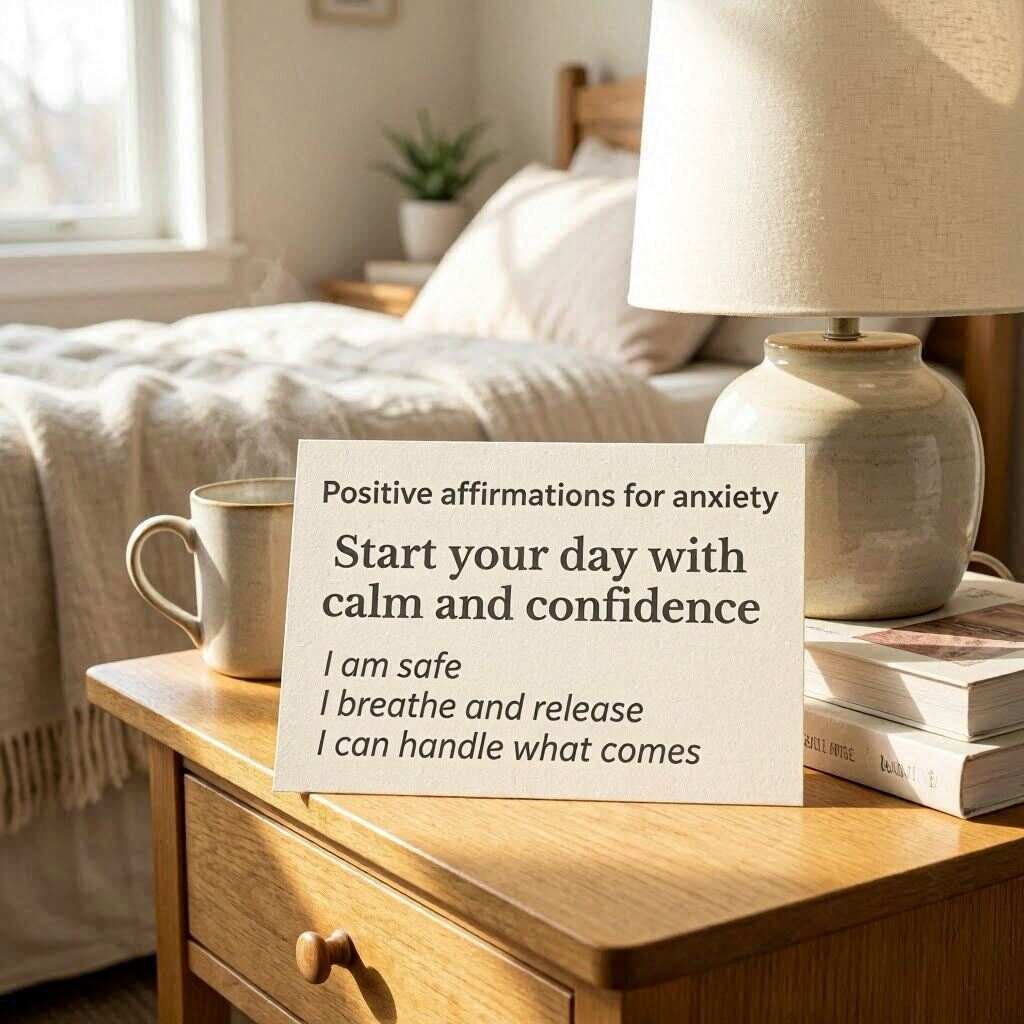
Positive affirmations for anxiety are one of the most accessible, research-supported, and genuinely effective tools for shifting that early-morning mental state. They cost nothing. They take minutes. And when practised consistently, they can fundamentally rewire the way your brain greets the day.
In this guide, we’re going to explore exactly why mornings are so often the hardest part of the day for anxious minds, how affirmations work on a neurological level, and — most importantly — give you a comprehensive bank of morning affirmations you can start using right now. Let’s begin.
Why Mornings Can Trigger Anxiety
Have you ever noticed that anxiety often feels worst in the first hour after waking? There’s actually a physiological reason for this, and understanding it can take away some of its power.
When you wake up, your body naturally produces a surge of cortisol — the primary stress hormone — as part of what’s known as the Cortisol Awakening Response (CAR). This is a completely normal biological mechanism designed to mobilise energy and prepare your body for the day ahead. But in people who are already dealing with anxiety, this cortisol spike can feel like being hit with a wave of dread before you’ve even had the chance to think a coherent thought.
Add to this the fact that mornings represent a threshold — you’re standing at the edge of everything the day might bring. Meetings, social interactions, deadlines, difficult conversations — they all exist as possibilities on the morning horizon, and an anxious brain doesn’t distinguish well between things that might happen and things that definitely will. It treats them all as threats.
Then there’s the sleep factor. If anxiety disrupted your sleep, you wake up already depleted, which makes your emotional regulation system — based largely in the prefrontal cortex — less effective. You’re literally less equipped to handle anxious thoughts in the morning than you will be later in the day.
Understanding all of this doesn’t make morning anxiety disappear, but it does reveal something important: the morning is both the most vulnerable time for anxious minds and the highest-leverage moment to intervene with a positive practice. What you feed your mind in those first waking minutes has an outsized effect on your mental state for the hours that follow.
What Are Positive Affirmations?
At their simplest, positive affirmations are short, intentional statements that you repeat to yourself — out loud or internally — with the goal of reinforcing a belief, calming a fear, or redirecting the narrative your mind is running. Think of them as a mental counterweight to the negative self-talk that anxiety loves to generate.
They’re not about pretending everything is fine. They’re not toxic positivity dressed up in feel-good language. The best affirmations are grounded, honest, and compassionate — they acknowledge reality while gently steering the mind toward a more resourceful and calmer perspective.
The difference between an affirmation and wishful thinking is specificity and believability. “Everything is perfect and nothing bad will ever happen” is not an affirmation — it’s a fantasy, and your brain knows it. But “I have navigated hard days before, and I have what it takes to handle today” — that’s a statement your mind can actually accept, and that’s where the real work begins.
The Science Behind Affirmations and Anxiety Relief
Before we dive into the actual affirmations, it’s worth spending a moment on why they work, because understanding the mechanism makes you more likely to stick with the practice.
The concept of neuroplasticity — the brain’s ability to form new neural pathways in response to repeated thoughts and experiences — underpins the entire science of affirmations. Every time you think a thought, the neural pathway associated with that thought gets a little stronger. Think a thought enough times and it becomes default. This is true for negative, anxious thoughts, but it’s equally true for calm, confident ones.
Self-affirmation theory, developed by psychologist Claude Steele, suggests that affirming our core values and capabilities reduces the psychological threat response — effectively turning down the volume on the alarm signals that anxiety generates. Multiple studies using fMRI brain imaging have shown that practising self-affirmations activates the brain’s reward centres and reduces activity in the amygdala, the region most associated with the fear and stress response.
In more everyday terms: repeating positive affirmations isn’t magical thinking. It’s mental training. Just like physical exercise builds muscle over time, a consistent affirmation practice literally reshapes the neural architecture of your mind toward greater calm and resilience.
How to Use Morning Affirmations Effectively
Setting the Scene: Creating a Morning Ritual
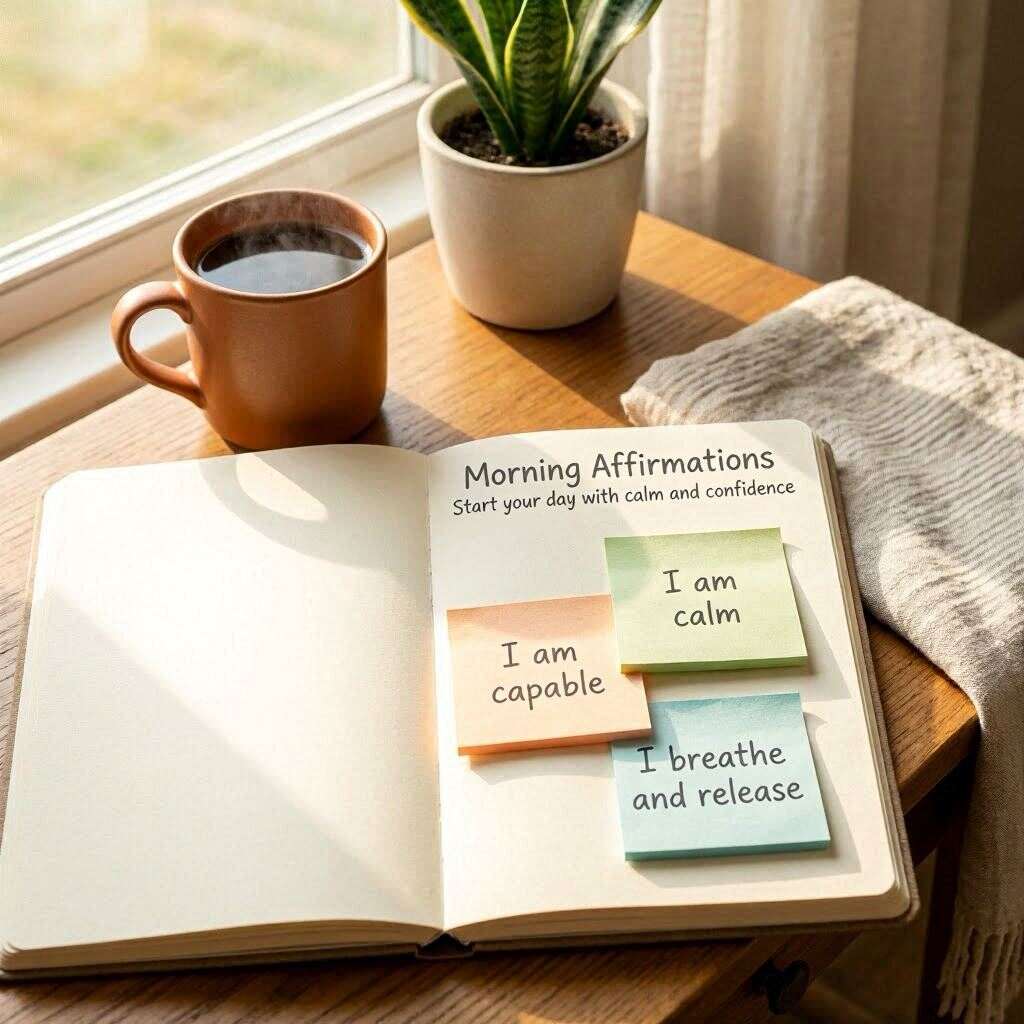
Affirmations work best when they’re embedded in a deliberate practice rather than just thought about randomly. Before you reach for your phone, before you check your emails, carve out even five minutes of intentional morning space. This might look like sitting up in bed, going to a quiet corner of your home, or sitting by a window with a warm drink. The physical environment signals to your nervous system that this is a moment of calm — and that signal matters.
Saying Affirmations Out Loud vs. Writing Them Down
Both approaches have merit, and the best answer is whichever you’ll actually do consistently. Speaking affirmations aloud engages your auditory processing and creates a multi-sensory experience that can reinforce the message more powerfully than internal repetition. Writing them in a journal adds a kinetic, tactile dimension and creates a record you can return to on harder days. Many people find a combination — writing first, then reading aloud — produces the strongest effect.
How Long Should Your Affirmation Practice Take?
Five to ten minutes is genuinely sufficient, particularly when you’re starting out. The quality of presence you bring to those minutes matters far more than the quantity. Ten distracted minutes of affirmations while half-thinking about your to-do list are worth considerably less than three minutes of slow, deliberate, fully-attended repetition.
Positive Affirmations for General Morning Anxiety
These are your all-purpose, foundational affirmations — the ones to reach for when anxiety shows up but you can’t quite put your finger on why.
- “I am safe in this moment. Right here, right now, I am okay.”
- “I release yesterday and welcome today with an open mind.”
- “My anxiety does not define me. I am bigger than my fear.”
- “I choose to meet today with curiosity rather than dread.”
- “Each breath I take calms my mind and steadies my heart.”
- “I don’t need to have everything figured out to begin.”
- “Today is a new day. It does not carry the weight of all my previous worries.”
- “I am allowed to take things one moment at a time.”
- “I have survived every difficult morning so far. I will survive this one too.”
- “Anxiety is a feeling, not a forecast. It tells me I care, not that I am in danger.”
Read these slowly. Breathe between them. Let each one land rather than rushing through them like a checklist.
Affirmations for Overthinking and Racing Thoughts
Overthinking is anxiety’s favourite sport — looping through worst-case scenarios, replaying conversations, catastrophising outcomes that haven’t happened and likely never will. These affirmations are designed specifically to interrupt that loop.
- “I notice my thoughts without becoming them. I am the observer, not the storm.”
- “Not every thought deserves my attention or belief.”
- “I bring my focus back to what is real, what is here, what is now.”
- “I cannot think my way out of every problem before it arrives. I trust myself to handle things as they come.”
- “My mind is allowed to rest. I do not have to solve everything this morning.”
- “Overthinking is not planning. I choose to let my thoughts settle like water after a storm.”
- “I release the need to control what I cannot control.”
- “This thought is not a fact. I am allowed to question it.”
The metaphor of the settling water is a particularly useful one to hold onto. A glass of stirred-up muddy water doesn’t become clear through more stirring — it becomes clear when you set it down and let it settle. Your mind works the same way.
Affirmations for Social Anxiety in the Morning
For those whose morning dread is particularly focused on the social interactions the day holds — the meetings, the conversations, the moments of being seen and evaluated — these affirmations speak directly to that fear.
- “I am worthy of connection. I belong in the spaces I enter today.”
- “Other people are more focused on themselves than on judging me.”
- “I don’t have to be perfect in my interactions — I just have to be present.”
- “My presence adds value to the people around me.”
- “I can be anxious and still show up. Courage is not the absence of fear.”
- “I have handled social situations before, and I carry that capability with me today.”
- “I am allowed to take up space. My voice matters.”
- “It is okay if not everyone likes me. I like myself, and that is enough to build from.”
Social anxiety often feeds on the belief that we are being scrutinised far more intensely than we actually are — a cognitive distortion psychologists call the spotlight effect. These affirmations gently challenge that assumption.
Affirmations for Work and Performance Anxiety
Deadlines. Presentations. Difficult conversations with colleagues or managers. Performance anxiety can make the mere thought of a workday feel mountainous. These affirmations are for the mornings when your inbox already feels like an avalanche before you’ve opened it.
- “I am competent, prepared, and capable of doing what is required of me today.”
- “I do not need to be the best — I need to show up and do my best.”
- “Mistakes are not disasters. They are how I grow.”
- “I have handled difficult work situations before. I can handle this one.”
- “My worth as a person is entirely separate from my productivity today.”
- “I approach my work with focus, not fear.”
- “I am allowed to ask for help. Doing so is a sign of strength, not weakness.”
- “One task at a time. That is all that is required.”
That last one is deceptively powerful. Anxiety about work almost always involves projecting yourself into the entire weight of the day simultaneously. Reminding yourself that you only ever need to do one thing at a time breaks the psychological logjam.
Affirmations for Physical Symptoms of Anxiety
Anxiety doesn’t just live in the mind — it announces itself in the body. Racing heart, tight chest, shallow breathing, nausea, shaking hands. These physical symptoms can themselves become a source of secondary anxiety, creating a feedback loop that amplifies the original fear. These affirmations address the body directly.
- “My body is doing its job. These sensations are uncomfortable, not dangerous.”
- “I breathe in calm, and I breathe out tension.”
- “My heart rate will settle. My body knows how to find its way back to balance.”
- “I am not having a crisis. I am having a feeling. Feelings pass.”
- “I treat my body with kindness and patience this morning.”
- “Each slow, deep breath is an act of care for myself.”
- “I have felt this before and I have been okay. I will be okay now.”
Pairing these affirmations with slow, diaphragmatic breathing — in for four counts, hold for four, out for six — amplifies their effect dramatically. The longer exhale activates the parasympathetic nervous system and physically reduces the cortisol spike.
Affirmations for Self-Worth and Inner Confidence
Anxiety has a cruel habit of attacking self-worth. It whispers that you’re not enough — not capable enough, not likeable enough, not together enough. These affirmations build the foundation that anxiety most relentlessly tries to erode.
- “I am enough, exactly as I am, in this moment.”
- “My value is not conditional on my performance, my appearance, or anyone’s approval.”
- “I trust myself. I have good instincts, and I know how to navigate my own life.”
- “I am deserving of love, peace, and good things — not because I’ve earned them, but because I exist.”
- “I am doing the best I can, and my best is genuinely good enough.”
- “I forgive myself for yesterday’s imperfections and give myself permission to begin again.”
- “I am resilient. I have come through hard things before, and that strength lives in me still.”
Combining Affirmations with Other Morning Wellness Habits
Affirmations are powerful on their own, but they become even more effective when they’re part of a broader morning wellness routine. Think of it like compound interest — each positive habit reinforces the others.
Morning movement — even ten minutes of gentle stretching, yoga, or a short walk — reduces cortisol levels physically and creates a sense of agency in the body that complements the mental work of affirmations. Hydration matters more than most people realise; dehydration amplifies stress responses, so drinking a full glass of water before coffee can make a noticeable difference.
Journalling alongside affirmations allows you to process anxious thoughts rather than just override them. Write the worry out — give it space on the page — then follow it with your affirmations. This two-step process acknowledges the anxiety rather than dismissing it, which tends to be more effective than pure suppression.
Limiting phone and social media in the first 30 minutes after waking is, frankly, one of the single highest-impact changes you can make. You are training your attention, and what you point it at first thing in the morning shapes the rest of your mental day profoundly.
What to Do When Affirmations Don’t Feel True Yet
Here’s something honest that most affirmation guides skip over: when you first start, affirmations can feel awkward, hollow, or even slightly ridiculous. You say “I am calm and confident” while your heart is racing and your palms are sweating, and some part of you wants to laugh at the absurdity of it.
This is normal. And here’s the important reframe: you don’t have to believe an affirmation for it to begin working. The goal in the early stages is not emotional truth — it’s neural repetition. You’re creating a pathway, not immediately walking down it.
If an affirmation feels too far from your current reality, try softening it with a bridging phrase. Instead of “I am calm,” try “I am becoming calmer.” Instead of “I am confident,” try “I am learning to trust myself.” These slight adjustments make the statement more believable and therefore more likely to be absorbed rather than rejected by your existing belief system.
Think of it like training wheels. You don’t need to believe you can balance immediately — you just need to keep pedalling. The balance follows.
Building a Long-Term Affirmation Practice
Consistency is everything. A single morning of affirmations is a nice experience. Thirty mornings of affirmations is the beginning of genuine change. Three months of daily practice is when you start noticing that your default mental tone has shifted — that calm is becoming more automatic, and anxiety less dominant.
Set a realistic intention — five minutes every morning for thirty days. Put it in your calendar. Tell someone about it if accountability helps you. Track it in a habit app or a simple paper journal.
Vary your affirmations over time. As you grow, different affirmations will resonate differently. What you need in a period of work stress may differ from what you need during a social challenge or a period of grief. Let the practice be responsive to your actual life rather than static.
Common Mistakes to Avoid with Morning Affirmations
Rushing through them. Affirmations repeated at speed while mentally already out the door have very little impact. Slow down. Mean each word.
Using affirmations you don’t believe even a little. Start with statements that feel possible, not just aspirational. Build from there.
Expecting immediate results. If you started a new exercise programme, you wouldn’t expect visible muscle definition after day two. The same patience applies here.
Only using affirmations when you’re in crisis. Affirmations work best as a daily preventative practice, not just an emergency measure when anxiety spikes. Building the pathway during calm periods means it’s more accessible when things get hard.
Treating affirmations as a replacement for professional support. Affirmations are a valuable tool, but they work best alongside, not instead of, therapy, medication (where prescribed), or other professional mental health support for those dealing with significant anxiety.
Conclusion
Morning anxiety can feel like a tide that comes in whether you want it or not. But what you do in those first waking moments — the thoughts you choose to nurture, the words you offer yourself, the tone you set for the hours ahead — these things are genuinely within your power. Positive affirmations are not a magic cure. They are a practice, a discipline, a daily act of choosing something different from the fearful narrative that anxiety tries to write for you.
Start small. Choose three or four affirmations that feel true enough to hold. Say them slowly, with breath, with kindness. And show up for yourself tomorrow morning and do it again. Over time, those small daily acts of self-compassion accumulate into something remarkable: a quieter mind, a calmer morning, and a life lived a little less in the grip of fear.
You deserve that. And it begins, simply, with the words you say to yourself when you first open your eyes.
FAQs
1. How long does it take for morning affirmations to reduce anxiety? Most people begin to notice a subtle shift in their morning mental state within two to four weeks of consistent daily practice. Significant changes to baseline anxiety levels typically take two to three months of regular use.
2. Should I say affirmations before or after getting out of bed? Either works. Many people find that saying affirmations while still in bed, before the day’s demands intrude, is particularly effective. Others prefer to be seated or standing. Experiment and find what feels most grounded for you.
3. How many affirmations should I use each morning? Anywhere from five to fifteen is a practical range. Fewer affirmations said slowly and with attention will outperform a long list rushed through without presence.
4. Can affirmations help with panic attacks? Yes, though in the moment of a panic attack, very simple, grounding affirmations work best — “I am safe,” “This will pass,” “I am breathing” — rather than longer statements. Practising affirmations daily during calmer periods makes them more accessible during acute anxiety.
5. Is it better to memorise affirmations or read them? Both work. Reading from a card, journal, or phone screen removes the cognitive load of memorisation and allows more focus on the meaning of each statement. As you settle into a routine, you’ll naturally memorise your favourites.
6. Can children use morning affirmations for anxiety? Absolutely. Children respond particularly well to simple, warm, and age-appropriate affirmations. “I am brave,” “I am loved,” “Today will be okay” are excellent starting points for younger children.
7. What’s the difference between affirmations and mantras? Mantras originate in meditative and spiritual traditions — often single words or sacred phrases repeated rhythmically to quiet the mind. Affirmations are generally longer, more personal statements focused on specific beliefs or qualities. Both have value and can complement each other.
8. Do I need to believe my affirmations for them to work? Not immediately. The neural repetition begins building the pathway even before full emotional belief follows. Using bridging language like “I am becoming…” or “I am learning to…” can help close the gap between where you are and where you want to be.
9. Can I use the same affirmations every day? Yes, and many people find that a consistent set of core affirmations provides a stable, familiar foundation. You can also rotate affirmations seasonally or in response to specific life challenges.
10. Are morning affirmations a substitute for therapy or medication for anxiety? No. Affirmations are a powerful complementary tool, but for significant or clinical anxiety, they work best as part of a broader approach that may include cognitive behavioural therapy (CBT), medication prescribed by a qualified professional, and other evidence-based interventions. If your anxiety is significantly impacting your daily life, please speak to your GP or a mental health professional.