
Bible Verses About Praise: Scriptures For Praising God
We write and study Scripture together as part of putting together BookmarkStatus’s Bible verse guides — reading each passage in its fuller chapter and context before it goes on the page, not just pulling a line out because it sounds nice.

I come back to Psalm 34:1 more than almost any other verse — “I will bless the Lord at all times.” Not because praising God is always easy, but because on the days it isn’t easy, that verse is the one that reminds me praise was never supposed to depend on how the day is going. That’s really what this whole list is about: reasons to praise God that hold up whether life feels good or hard right now.
The Bible is filled with calls to praise God for who He is, what He has done, and His unfailing faithfulness. Some of the clearest Bible verses about praise are found in the Psalms, but praise is a major theme throughout the Old and New Testaments — declaring God’s greatness, remembering His works, thanking Him for His goodness, worshiping Him with others, and continuing to trust Him when life is difficult.
Below you’ll find a quick-reference list first, then a deeper look at what the Bible actually teaches about praise, verse by verse, with context and application.
Quick List: 15 Bible Verses About Praise

- Psalm 150:6 — “Let everything that has breath praise the Lord!”
- Psalm 100:4 — “Enter his gates with thanksgiving; go into his courts with praise.”
- Psalm 34:1 — “I will bless the Lord at all times; his praise shall continually be in my mouth.”
- Psalm 145:3 — “Great is the Lord, and greatly to be praised; and his greatness is unsearchable.”
- Hebrews 13:15 — “Let us offer to God a sacrifice of praise… the fruit of lips that openly profess his name.”
- Psalm 103:1 — “Bless the Lord, O my soul, and all that is within me, bless his holy name.”
- Psalm 100:5 — “For the Lord is good; his steadfast love endures forever.”
- 1 Chronicles 16:34 — “Give thanks to the Lord, for he is good; his love endures forever.”
- Psalm 147:1 — “It is good to sing praises to our God… praise is fitting.”
- Psalm 63:4 — “So I will bless you as long as I live.”
- Psalm 95:6 — “Oh come, let us worship and bow down; let us kneel before the Lord, our Maker!”
- 1 Peter 2:9 — believers are called to “proclaim the excellencies of him who called you out of darkness.”
- Psalm 42:11 — “Why are you cast down, O my soul?… hope in God.”
- Habakkuk 3:18 — “Yet I will rejoice in the Lord; I will take joy in the God of my salvation.”
- Revelation 5:12 — “Worthy is the Lamb… to receive power and wealth and wisdom.”
What Does the Bible Say About Praise?
Biblical praise is a response to God’s character and works. We praise Him because He is worthy, holy, good, faithful, merciful, powerful, and great — and because of what He has done in creation, salvation, deliverance, and the lives of His people.
The Psalms repeatedly invite God’s people to praise Him, but Scripture doesn’t present praise as something reserved for moments when everything is going well. David praised God while facing enemies. Job worshiped after devastating loss. Habakkuk chose to rejoice while anticipating severe hardship. Paul and Silas sang hymns to God from inside a prison cell.
That gives biblical praise a deeper meaning than simply expressing positive emotion. It’s a deliberate acknowledgment of God’s worth, even when our circumstances are changing.
What Is Biblical Praise?
In Scripture, praise means openly recognizing and declaring God’s greatness, goodness, faithfulness, holiness, mercy, and mighty works — through voices, songs, prayers, thanksgiving, testimony, gatherings, and even the way we live.
Psalm 150 gives one of the clearest pictures. It calls God’s people to praise Him for His mighty deeds and excellent greatness, describing instruments, singing, and joyful expression, then closes with a sweeping command:
“Let everything that has breath praise the Lord!”
So praise isn’t limited to a musical style or a church service. It happens when a believer remembers God’s faithfulness, tells someone what God has done, thanks Him for His goodness, or deliberately turns attention toward His character in the middle of uncertainty.
Praise, Thanksgiving, and Worship: What’s the Difference?
These three ideas overlap constantly in Scripture, but each highlights something slightly different.
| Response | Main emphasis | Example |
|---|---|---|
| Praise | Declaring God’s greatness, character, and works | Psalm 145:3 |
| Thanksgiving | Expressing gratitude for what God has done or given | Psalm 100:4 |
| Worship | Reverently responding to God’s worth with devotion and submission | Psalm 95:6 |
| Glorifying God | Giving God the honor and recognition due to Him | Psalm 29:2 |
Praise vs. thanksgiving: Praise focuses on who God is (“Great is the Lord,” Psalm 145:3). Thanksgiving focuses on gratitude for what He’s done (“Enter his gates with thanksgiving,” Psalm 100:4). That distinction matters because it means we can praise God simply for His character, even before we’ve identified a specific blessing.
Praise vs. worship: Worship is the broader category. Psalm 95:6 — “let us kneel before the Lord, our Maker” — involves reverence, humility, and submission. Praise is one important expression within worship, not a separate thing from it.
Why Should We Praise God?
- Because He is worthy. Psalm 145:3 declares Him “greatly to be praised” — a worth that doesn’t depend on our circumstances.
- Because He is good. Psalm 100:5 ties praise directly to His goodness and steadfast love.
- Because He is faithful. Scripture repeatedly points back to a faithfulness that “continues from generation to generation” — praise becomes an act of remembering.
- Because of His mighty works. Psalm 150:2 calls people to praise Him “according to his excellent greatness” — creation, deliverance, provision, and forgiveness all qualify.
- Because of salvation. Exodus 15 records Israel singing after God delivered them from Pharaoh; in the New Testament, believers are called a people meant to proclaim God’s excellencies because He “called [them] out of darkness into his marvelous light” (1 Peter 2:9).
12 Bible Verses About Praise — With Context and Meaning
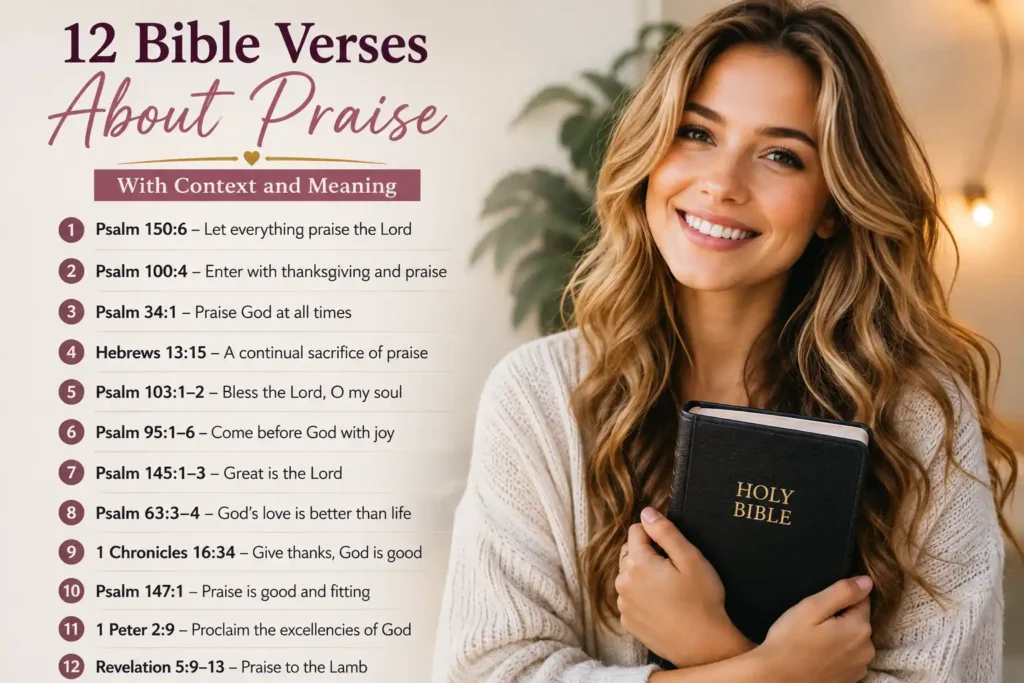
1. Psalm 150:6 — Let Everything That Has Breath Praise the Lord
“Let everything that has breath praise the Lord! Praise the Lord!” (Psalm 150:6)
Psalm 150 closes the entire book of Psalms, and it does it with one of the broadest statements in Scripture about who praise is for: not a select group, but everything that has breath. It also anchors praise to a reason — God’s “mighty deeds” and “excellent greatness” — rather than treating it as a feeling that shows up on its own.
Use it when: you want one short verse to carry through the day. Praise doesn’t have to wait for an answered prayer or a good mood.
2. Psalm 100:4 — Enter His Gates With Thanksgiving
“Enter his gates with thanksgiving; go into his courts with praise! Give thanks to him; bless his name!” (Psalm 100:4)
Psalm 100 opens by calling the whole earth to serve the Lord with gladness, then reminds His people that He made them and they belong to Him. The invitation to enter “with thanksgiving” sits inside that larger relationship — and verse 5 tells you why: “the Lord is good; his steadfast love endures forever.”
Use it when: starting prayer. Instead of leading with requests, lead with gratitude for who God already is.
3. Psalm 34:1 — Praise God at All Times
“I will bless the Lord at all times; his praise shall continually be in my mouth.” (Psalm 34:1)
This Psalm’s heading connects it to a period when David was in real danger. He isn’t describing praise from a comfortable life — he’s making a deliberate commitment to keep recognizing God’s goodness regardless of what’s happening around him.
Use it when: you’re going through uncertainty or fear. You don’t have to deny what’s hard while still choosing to praise.
4. Hebrews 13:15 — A Continual Sacrifice of Praise
“Through him then let us continually offer up a sacrifice of praise to God, that is, the fruit of lips that acknowledge his name.” (Hebrews 13:15)
The word sacrifice matters here. Praise isn’t always effortless. There are seasons when it flows naturally, and seasons when it takes real faith to say something true about God when you don’t feel like saying it.
Use it when: praise feels like work, not celebration. A simple prayer — “God, I don’t understand this, but I know You’re faithful” — is still praise, not pretending.
5. Psalm 103:1–2 — Bless the Lord, O My Soul
“Bless the Lord, O my soul, and all that is within me, bless his holy name! Bless the Lord, O my soul, and forget not all his benefits.” (Psalm 103:1–2)
David speaks directly to his own soul instead of waiting for a spontaneous feeling of worship. The rest of the Psalm lists reasons — forgiveness, healing, redemption, steadfast love — that he refuses to let himself forget.
Use it when: discouragement is crowding out memory. Make your own list of what God has done, the way David did.
6. Psalm 95:1–6 — Come Before God With Joyful Praise
“Oh come, let us sing to the Lord; let us make a joyful noise to the rock of our salvation!” (Psalm 95:1)
This Psalm moves from joyful singing to reverent bowing — it holds celebration and reverence together, calling God the “rock of our salvation,” the Creator and the shepherd of His people.
Use it when: you want a passage that leads naturally from praise into worship, alone or with a group.
7. Psalm 145:1–3 — Great Is the Lord
“I will extol you, my God and King, and bless your name forever and ever… Great is the Lord, and greatly to be praised, and his greatness is unsearchable.” (Psalm 145:1,3)
Rather than naming one blessing, David spends the whole Psalm describing God’s greatness, compassion, faithfulness, and kingdom — and notes that this kind of praise is meant to be passed to the next generation.
Use it when: your prayers have become all requests. Turn Psalm 145’s descriptions of God into your own words first.
8. Psalm 63:3–4 — God’s Love Is Better Than Life
“Because your steadfast love is better than life, my lips will praise you. So I will bless you as long as I live.” (Psalm 63:3–4)
Written from the wilderness, David’s praise here is rooted in relationship, not comfort. He isn’t praising God for a good outcome; he’s praising Him because God’s love outweighs everything he might gain or lose.
Use it when: you notice your praise only shows up after good news. Ask: would God still be worthy of praise if the outcome I wanted never came?
9. 1 Chronicles 16:34 — Give Thanks Because God Is Good
“Oh give thanks to the Lord, for he is good; for his mercy endures forever.” (1 Chronicles 16:34)
This appears in a song sung during the ark’s return to Jerusalem — and the reason for thanks is refreshingly simple: God is good, and His mercy doesn’t run out.
Use it when: you need the shortest possible starting point for prayer.
10. Psalm 147:1 — Praise Is Good and Fitting
“Praise the Lord! For it is good to sing praises to our God; for it is pleasant, and a song of praise is fitting.” (Psalm 147:1)
The Psalm connects this call to praise with God’s compassionate work — healing the brokenhearted, gathering the outcast, providing for creation. Praise here isn’t abstract; it’s tied to a God who is actively caring for people.
Use it when: discouragement has you focused only on what’s broken. Read Psalm 147 and look for evidence of God’s care around you.
11. 1 Peter 2:9 — Proclaim the Excellencies of God
“You are a chosen race, a royal priesthood, a holy nation… that you may proclaim the excellencies of him who called you out of darkness into his marvelous light.” (1 Peter 2:9)
Peter reframes praise as proclamation, not just private feeling. Believers are called to talk about what God has done — a missionary dimension to praise most lists skip.
Use it when: you want to encourage someone else. Simply saying, “God has been faithful to me in this,” is an act of praise.
12. Revelation 5:9–13 — Praise to the Lamb
“Worthy are you… for you were slain, and by your blood you ransomed people for God.” (Revelation 5:9)
This heavenly scene shows the ultimate destination of praise: every creature in heaven and on earth honoring the Lamb because of His redemptive sacrifice, not merely His power.
Use it when: you want perspective. Scripture’s story ends with universal recognition of God’s worth — your current situation isn’t the final chapter.
What These Verses Teach Us About Praise
- Praise is centered on God’s character, not just His gifts (Psalm 145, Psalm 63).
- Praise remembers. Psalm 103 tells the soul “forget not all his benefits” — memory fuels praise.
- Praise can be continual, not confined to good moods (Psalm 34:1, Hebrews 13:15).
- Praise can be sacrificial. Hebrews 13:15 calls it a “sacrifice” precisely because it sometimes costs something emotionally.
- Praise can be public. 1 Peter 2:9 and the Psalms both describe proclaiming God’s works to others.
- Praise points beyond us. “Not to us, O Lord, not to us, but to your name give glory” (Psalm 115:1).
Can You Praise God When You’re Hurting?
Yes — and Scripture is specific about what that does and doesn’t mean. Biblical praise during suffering does not mean pretending pain doesn’t exist, refusing to grieve, calling suffering itself good, or forcing yourself to feel happy.
- Psalm 42:11 — the psalmist openly names his discouragement (“Why are you cast down, O my soul?”) and still tells himself to hope in God. Honest distress and hope in God coexist in the same verse.
- Habakkuk 3:17–18 — the prophet lists total agricultural and economic collapse — no fig, no fruit, no flock — and follows it with “yet I will rejoice in the Lord.” He doesn’t deny the loss; he places his joy somewhere the loss can’t reach.
- Job 1:20–21 — after devastating losses, Job tears his robe, mourns deeply, and falls down to worship. Grief and worship exist together, not one after the other.
- Acts 16:25 — Paul and Silas sing hymns from inside a prison cell, before their circumstances change, not after.
The common thread: praise doesn’t require the absence of pain. It means pain doesn’t get the final word about who God is.
People in the Bible Who Praised God
- David praised God in danger and after deliverance (Psalm 34:1) — his praise wasn’t the product of an easy life.
- Moses and Israel sang after the Red Sea deliverance (Exodus 15:2), directing attention to the Deliverer, not just the deliverance.
- Hannah praised God’s holiness and sovereignty after her prayer was answered (1 Samuel 2) — moving past the gift to the character of the Giver.
- Job worshiped in the middle of grief (Job 1:20–21), showing that mourning and worship aren’t mutually exclusive.
- Mary praised God’s mercy and faithfulness after learning she would bear Jesus (Luke 1:46–55), tying her own life to God’s larger promises.
- Paul and Silas sang hymns while imprisoned (Acts 16:25) — praise before rescue, not only after it.
- Nebuchadnezzar praised “the King of heaven” after being humbled (Daniel 4:37), acknowledging God’s authority over human pride.
The Best Psalms of Praise
| Psalm | Best for | Why read it |
|---|---|---|
| Psalm 150 | Pure praise | Universal call for everything that has breath to praise God |
| Psalm 100 | Thanksgiving | Celebrates God’s goodness, love, and faithfulness |
| Psalm 103 | Remembering God’s goodness | Recalls forgiveness, mercy, compassion, and benefits |
| Psalm 145 | God’s greatness | Focuses on greatness, goodness, compassion, and kingdom |
| Psalm 95 | Worship | Calls God’s people to sing, give thanks, bow, and worship |
| Psalm 98 | Praise for salvation | Celebrates God’s marvelous, saving works |
| Psalm 147 | God’s care | Praises healing, provision, and creation |
| Psalm 148 | Creation praising God | Calls heavens, earth, and all creatures to praise |
| Psalm 34 | Praise during difficulty | David praising while reflecting on real danger |
| Psalm 63 | Seeking God in hardship | Connects praise with longing for God’s presence |
Short Bible Verses About Praise (KJV & Modern)
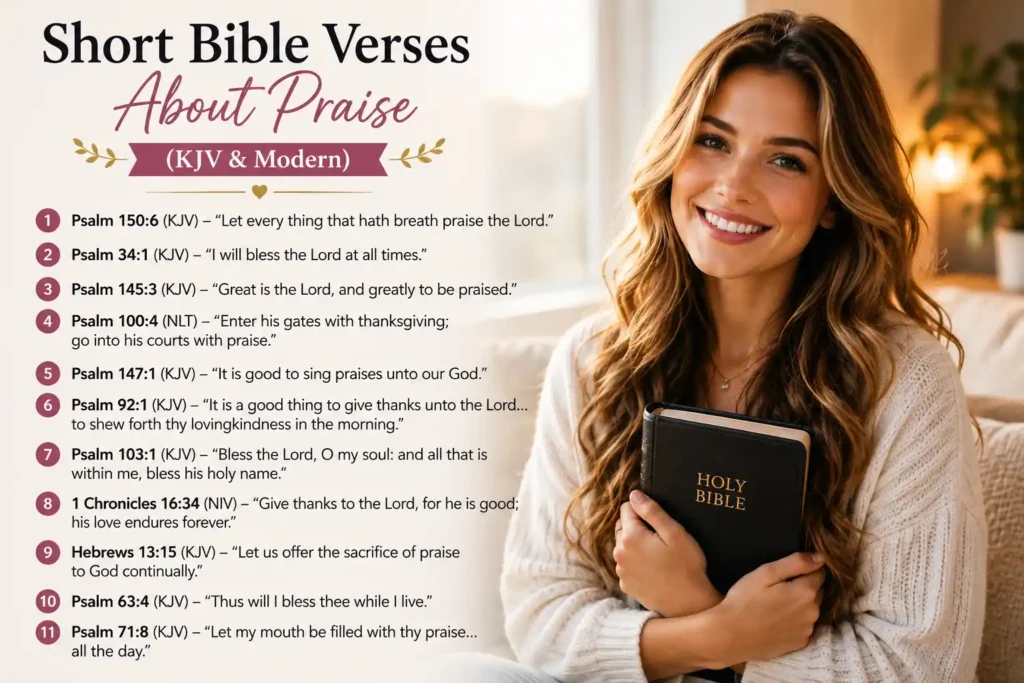
- Psalm 150:6 (KJV) — “Let every thing that hath breath praise the Lord.”
- Psalm 34:1 (KJV) — “I will bless the Lord at all times.”
- Psalm 145:3 (KJV) — “Great is the Lord, and greatly to be praised.”
- Psalm 100:4 (NLT) — “Enter his gates with thanksgiving; go into his courts with praise.”
- Psalm 147:1 (KJV) — “It is good to sing praises unto our God.”
- Psalm 92:1 (KJV) — “It is a good thing to give thanks unto the Lord… to shew forth thy lovingkindness in the morning.”
- Psalm 103:1 (KJV) — “Bless the Lord, O my soul: and all that is within me, bless his holy name.”
- 1 Chronicles 16:34 (NIV) — “Give thanks to the Lord, for he is good; his love endures forever.”
- Hebrews 13:15 (KJV) — “Let us offer the sacrifice of praise to God continually.”
- Psalm 63:4 (KJV) — “Thus will I bless thee while I live.”
- Psalm 71:8 (KJV) — “Let my mouth be filled with thy praise… all the day.”
If your normal reading translation is the KJV, these carry a distinctive, memorable cadence for memorization and devotional use — but it’s worth cross-checking a modern translation (NIV, NLT, ESV) for clarity when studying a passage in depth.
How to Practice Praise — Including When You Don’t Feel Like It
- Begin the day with praise before requests — Psalm 92:1–2 ties morning specifically to declaring God’s steadfast love.
- Speak it out loud — Psalm 63:5, “my mouth shall praise thee with joyful lips.” You don’t need to sing well for it to count.
- Give thanks before you ask for anything — Psalm 100:4’s pattern.
- Praise with other people — Psalm 95 opens as a communal invitation, and Acts 2:46–47 shows the early church praising together.
- Remember on purpose — Psalm 105:5, “remember his marvellous works.” Keep a running list of answered prayers or moments of provision.
- Tell someone — Psalm 105:1 calls God’s people to “make known his deeds.” Testimony is praise.
- Let your life reflect it — 1 Corinthians 10:31, “do all to the glory of God.” Praise isn’t limited to words.
Try this today: Pick one verse from the Quick List above and read it slowly three times — once as a statement of fact, once as a prayer, once out loud to someone else. That’s the simplest version of “verse of the day” you can build into an ordinary morning, no app required.
Frequently Asked Questions About Bible Verses on Praise
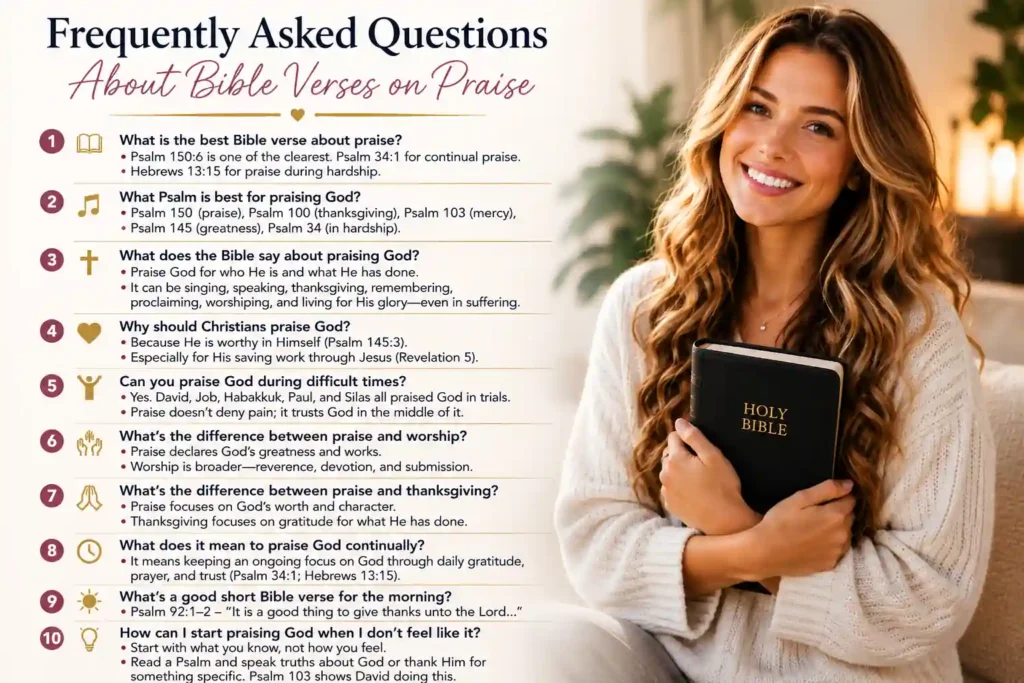
What is the best Bible verse about praise?
Psalm 150:6 — “Let everything that has breath praise the Lord!” — is one of the clearest, since it gives both the command and the reason (God’s “mighty acts and excellent greatness”). For continual praise, Psalm 34:1 is especially meaningful. For praise during hardship, Hebrews 13:15 stands out because it names praise as a sacrifice offered through Christ.
What Psalm is best for praising God?
Psalm 150 is the clearest Psalm devoted entirely to praise. Psalm 100 (thanksgiving), Psalm 103 (remembering God’s mercy), Psalm 145 (God’s greatness), and Psalm 34 (praise through difficulty) are also excellent starting points depending on your situation.
What does the Bible say about praising God?
The Bible commands God’s people to praise Him because He is worthy and because of His character and works — His greatness, holiness, goodness, mercy, faithfulness, and power, along with His creation, salvation, deliverance, and forgiveness. Praise can involve singing, speaking, thanksgiving, remembering, proclaiming, worshiping with others, and living in a way that honors Him — and Scripture shows it’s possible even during suffering.
Why should Christians praise God?
Because He is worthy in Himself, not only because He gives good things (Psalm 145:3). For Christians specifically, God’s saving work through Jesus Christ is a central reason for praise — Revelation 5 pictures heaven and all creation praising God and the Lamb together.
Can you praise God during difficult times?
Yes. David praised God while in danger, Job worshiped while grieving devastating losses, Habakkuk chose to rejoice despite total agricultural failure, and Paul and Silas sang hymns while imprisoned. None of this requires pretending suffering doesn’t hurt — Scripture is full of honest lament alongside praise.
What’s the difference between praise and worship?
Praise typically emphasizes declaring God’s greatness, goodness, and works. Worship is broader — reverence, devotion, humility, and submission. Psalm 95 shows both together: it opens by calling people to sing and give thanks, then moves to bowing and kneeling.
What’s the difference between praise and thanksgiving?
Praise focuses on God’s worth and character (“God, You are holy and great”). Thanksgiving focuses on gratitude for something specific He’s done (“God, thank You for Your forgiveness”). Psalm 100:4 puts both side by side: “Enter his gates with thanksgiving… into his courts with praise.”
What does it mean to praise God continually?
It doesn’t mean literally singing or speaking about God every second. It means maintaining an ongoing orientation toward Him — repeatedly recognizing His worth and faithfulness through ordinary moments of gratitude, prayer, and trust (Psalm 34:1, Hebrews 13:15).
What’s a good short Bible verse for praising God in the morning?
Psalm 92:1–2 — “It is a good thing to give thanks unto the Lord… to shew forth thy lovingkindness in the morning.”
How can I start praising God when I don’t feel like it?
Start with what you know, not what you feel. Read a short Psalm (100, 103, 145, or 150) and name specific truths about God — He is good, faithful, holy, merciful, worthy — or remember something specific He’s done and thank Him for it. Psalm 103 shows David doing exactly this: talking to his own soul before his emotions caught up.
Final Encouragement
The circumstances change. God’s character doesn’t. That’s the thread running through every one of these passages — from Moses’ song after the Red Sea, to David’s Psalms, to Job’s worship in grief, to Paul and Silas singing in a cell, to the picture in Revelation of every creature praising God and the Lamb together.
If you’re not sure where to start: read Psalm 150 and praise Him for His greatness. Read Psalm 100 and thank Him for His goodness. Read Psalm 103 and remember His mercy. Read Psalm 34 when you’re afraid. And when you don’t have your own words, let Scripture give you the words.
“Let everything that has breath praise the Lord! Praise the Lord!” — Psalm 150:6