
Is Gap Insurance Worth It for a Used Car?
Gap insurance is worth it on a used car if your loan balance is higher than the vehicle’s current market value. That situation — called being “underwater” or having negative equity — is common when you made a small down payment, chose a loan longer than 60 months, or rolled unpaid debt from a previous car into your new loan. If any of those apply to you, gap coverage can protect you from owing thousands of dollars on a car that no longer exists.
If you put 15–20% down, chose a short loan term, and financed a vehicle with stable resale value, you probably don’t need it — or won’t need it for long.
That’s the short version. The rest of this guide gives you the exact numbers to figure out which camp you’re in, shows you how to avoid paying five times too much, and answers every question you’re likely to have along the way — including what to do when your car is actually totaled.
Am I underwater on my loan?
Enter your loan details and current vehicle value. We’ll calculate your exact gap exposure and LTV ratio.
Should I buy gap insurance?
Answer 5 quick questions. We’ll assess your risk profile and give you a personalised recommendation.
How much should gap insurance cost you?
Enter your loan amount and term to see real cost estimates across every provider type — and your potential savings.
The hidden cost of dealership financing
When dealerships roll gap insurance into your loan, you pay interest on the premium for the full loan term. Here’s what that looks like in practice.
Gap insurance claim checklist
Check off each step as you complete it. Use this after a total loss — whether from a collision, theft, flood, or fire.
- Step 1 — ImmediatelyFile your primary auto insurance claimCall your main insurer (GEICO, State Farm, Progressive, etc.) and report the total loss. Get a claim number. Do this before contacting your gap provider.
- Step 1 cont.File a police report if theft or hit-and-runYour gap provider will require the police report number. File within 24 hours of the incident.
- Step 2 — Within 1 weekGet the ACV settlement figure in writingAsk your primary insurer for a written statement showing the vehicle’s actual cash value, your deductible, and the net payout to your lender. You need this document.
- Step 2 cont.Challenge the ACV if you think it’s too lowCompare your insurer’s value to KBB and Edmunds private-party pricing. If the ACV seems low, submit comparable local listings to dispute it — a higher ACV means a smaller gap you’re responsible for.
- Step 3 — Gather documentsGet your loan payoff statement from your lenderAsk for the “payoff amount” dated as close as possible to the loss date. Call your lender directly — this is different from your regular account balance.
- Step 3 cont.Locate your original loan agreement and gap policyFind your financing paperwork and the gap coverage certificate. The certificate will have your gap provider’s contact number and your policy/certificate number.
- Step 3 cont.Copy your insurance declarations pageThis is the summary page showing your coverage types, limits, and deductible. Your gap provider needs this to verify comprehensive/collision coverage was active.
- Step 3 cont.Gather your bill of sale / purchase agreementThe original purchase contract from the dealership or private seller. Shows the purchase price, which the gap provider uses to verify coverage eligibility.
- Step 4 — File the gap claimContact your gap provider directlyCall the number on your gap coverage certificate — not the dealership. Tell them you have a total loss and need to file a gap claim. They’ll confirm what documents to submit.
- Step 4 cont.Keep making loan payments while the claim processesGap insurance pays the deficiency balance — it does not pause your obligations. Missing payments during the 2–4 week processing window can trigger late fees and credit damage.
- Step 5 — After payoutGet written loan satisfaction from your lenderOnce the gap payout is applied, ask your lender to confirm in writing that the loan is fully paid off. File this permanently. Errors happen — this protects you from future collections on a debt you’ve cleared.
- Step 5 cont.File a state insurance complaint if the claim is wrongly deniedIf your gap claim is denied and you believe it shouldn’t be, file a complaint with your state’s Department of Insurance. Common wrongful denials involve rolled-in negative equity exclusions that weren’t clearly disclosed at purchase.
What is gap insurance and how does it work?
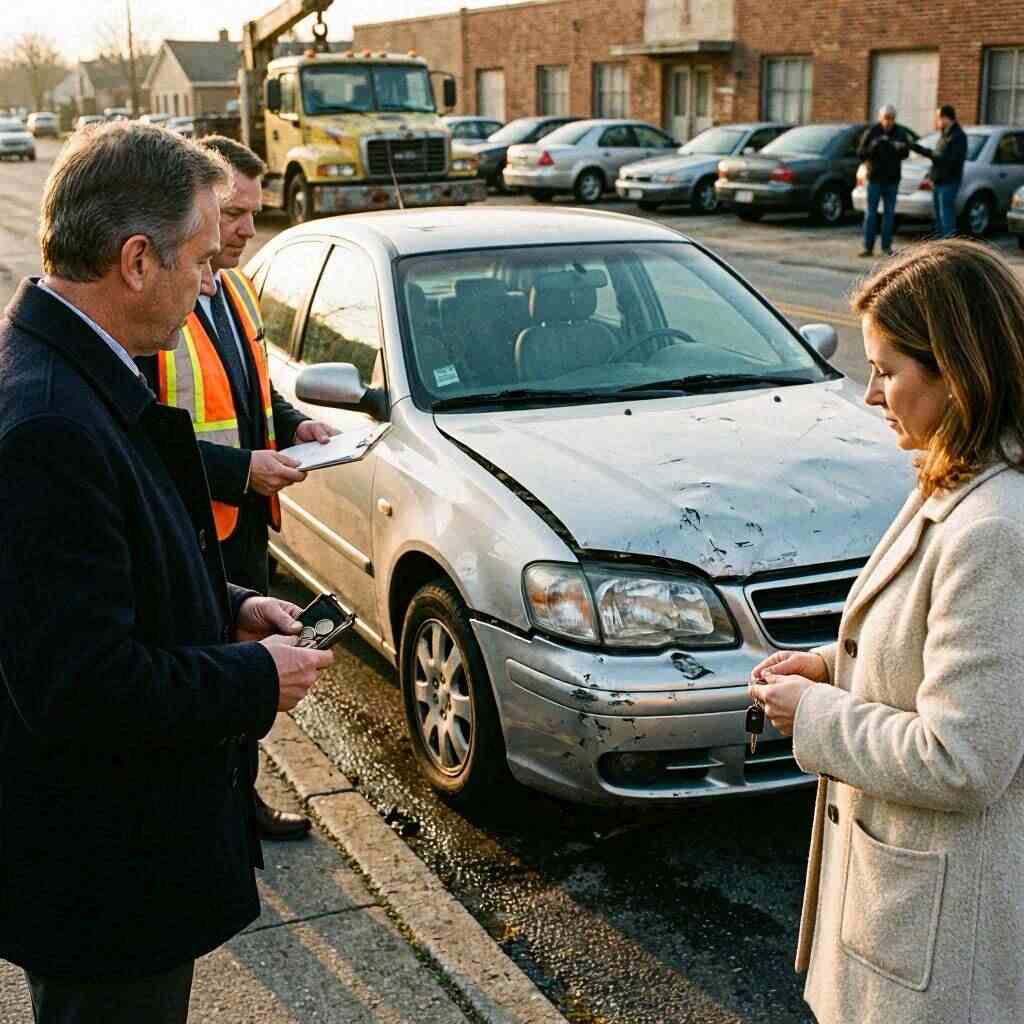
Gap insurance — officially called Guaranteed Asset Protection insurance — covers the difference between what your auto insurer pays after a total loss and what you still owe your lender.
Here’s why that matters: your car insurance company pays based on your car’s current market value, not the balance on your loan. Those two numbers are often very different. When your car is worth less than what you owe, that difference is called a loan deficiency balance — and you’re personally responsible for it, even though the car is gone.

A simple example with the deductible included:
Your used SUV gets totaled. You owe $21,000 on the loan. Your insurer determines the actual cash value (ACV) is $18,000. Your collision deductible is $500.
- Your insurer pays: $18,000 − $500 deductible = $17,500 to your lender
- Amount still owed: $21,000 − $17,500 = $3,500 loan deficiency
- Without gap insurance: you pay $3,500 out of pocket for a car you no longer own
- With gap insurance: your gap policy covers the $3,500 — you only pay your $500 deductible
Important: Gap insurance does not cover your deductible. Your collision or comprehensive insurance pays the ACV minus your deductible; gap insurance covers the remaining loan balance above that. Many people are surprised by this — so factor your deductible into your math.
Gap insurance only activates after a total loss — a collision beyond economical repair, theft, flood, hurricane, or wildfire damage. It does not cover engine failure, mechanical breakdowns, or routine repairs. For mechanical protection, you’d need a separate extended warranty.
Can you get gap insurance on a used car?
Yes — but with conditions. Not every insurer offers gap coverage on used vehicles, and those that do often have eligibility rules.
Gap insurance is most commonly associated with new cars because new vehicles lose roughly 20% of their value in the first year, creating an almost instant equity gap. Used cars depreciate more slowly — about 10–15% annually according to MoneyGeek’s analysis of industry data — which means the risk is lower but still very real, especially with longer loan terms.
Most insurers will cover a used car for gap insurance if:
- The vehicle is less than 3 years old at the time of purchase (this is the most common cutoff)
- The mileage is under a set limit — typically 100,000–150,000 miles, though this varies by provider
- You are the financed owner (gap coverage generally isn’t available if you own the vehicle outright)
Some lenders and credit unions are more flexible on vehicle age, so it’s worth checking even if your car is older. We cover the specific limits by provider type in the age and mileage section below.
When gap insurance is worth it on a used car
Not everyone needs this coverage. But certain financing setups create real financial exposure — and if you recognise yourself in any of the situations below, gap insurance deserves serious consideration.
You made a small or zero down payment
Zero-down financing is appealing. You drive home without touching your savings. But when you finance 100% of a used car’s purchase price — and then add taxes, registration, and dealer fees to the loan — you can be thousands of dollars underwater before you’ve made a single payment.
Consider this: you buy a used Honda CR-V for $24,000 with nothing down. After taxes and fees, your loan is $26,500. The car’s Kelley Blue Book private-party value the day you drive off the lot? About $22,000. You’re already $4,500 underwater.
A 5% down payment or less creates the same problem. The general rule of thumb is that if your down payment was less than 10–15% of the vehicle’s purchase price, gap coverage is worth buying at least for the first 12–24 months.
You chose a loan term longer than 60 months
Longer loan terms keep monthly payments manageable but stretch out the period during which you owe more than the car is worth. The reason is simple: in the early months of any amortised loan, most of your payment goes toward interest rather than paying down the principal.
On a 72-month loan at 9% interest, it can take 18–24 months before the loan balance drops below the car’s market value. On an 84-month loan, that crossover point can push to 30–36 months. During that entire window, you’re financially exposed.
According to Experian’s State of the Automotive Finance Market, over 44% of US auto loan originations now exceed 60 months — which means a large portion of used car buyers are in this situation without realising it.
You rolled negative equity from a previous vehicle
This is one of the most common — and least talked about — paths to needing gap insurance.
Say you owed $7,000 on your old car when you traded it in, but it was only worth $5,000. The dealer rolled that $2,000 shortfall into your new loan. Your new loan now starts $2,000 above the car’s actual value before depreciation has even touched it.
One important note: some gap policies cover this rolled-in negative equity, while others explicitly exclude pre-existing debt. Always ask your provider directly: “Does this policy cover negative equity that was rolled in from a trade-in?” Get the answer in writing.
You’re financing a high-depreciation vehicle
Not all used cars lose value at the same rate. Some vehicles hold their value unusually well. Others drop quickly and keep dropping. High-depreciation categories where gap insurance is especially worth considering:
- Luxury sedans (BMW 5 Series, Mercedes E-Class, Cadillac CT5) — prestige fades faster than payments do
- Used electric vehicles — rapidly evolving technology and manufacturer discounts on new EVs have created volatile resale values for used models; some used EV models have lost 30–40% of their value within 18 months of original purchase
- Large SUVs with high base prices — high initial value means a larger dollar-amount depreciation drop
- Vehicles with below-average reliability ratings — poor reliability drives resale values down faster
If you’re financing a used Tesla Model 3, Chevy Bolt, or similar EV over 60+ months, check Edmunds’ True Cost to Own depreciation projections before deciding. The gap between loan balance and market value can be substantial and long-lasting.
Your loan-to-value ratio is above 100%
The loan-to-value ratio (LTV) is the single most useful number for this decision. Divide your total loan balance by the vehicle’s current market value. Here’s how to read the result:
| LTV ratio | Gap insurance verdict |
|---|---|
| Below 90% | Usually not needed |
| 90–100% | Consider for first 12 months |
| 100–110% | Worth buying for 12–24 months |
| Above 110% | Strong case — buy it |
If your total financed amount (including taxes, fees, and any rolled-in debt) is $30,000 on a vehicle worth $26,000 on KBB, you’re sitting at 115% LTV. That’s a meaningful gap.
When gap insurance is NOT worth it on a used car
Understanding when to skip it can save you real money. Here are the situations where gap coverage provides little to no benefit.
You made a substantial down payment
A 15–20% or larger down payment creates an immediate equity cushion. On a $20,000 vehicle with a $4,000 down payment, your loan starts at $16,000 — and the car would have to depreciate by 20% before you’d be underwater. With typical used-car depreciation rates of 10–15% annually, that cushion may never fully disappear, especially if you’re also paying down principal consistently.
You chose a short loan term
A 36-month loan builds equity fast. More of each payment goes toward principal, the loan balance drops quickly, and the crossover point — where the car’s value exceeds what you owe — can arrive within the first year. If your loan term is 36–48 months with a reasonable down payment, gap insurance likely isn’t worth buying for long, if at all.
You’re buying a vehicle with strong resale value
Some used vehicles are famous for holding their value — the Toyota Tacoma, Honda Civic, Toyota 4Runner, Jeep Wrangler, and Subaru Outback are classic examples. When a vehicle retains value unusually well, the equity “gap” closes faster, and gap coverage becomes unnecessary sooner.
Your loan balance is already below market value
This is the clearest “no” of all. If you look up your vehicle’s KBB or Edmunds private-party value today and it’s higher than your loan payoff balance, you’re not underwater. Gap insurance protects against a gap that doesn’t exist for you. Cancel it if you have it, stop paying for it, and reinvest that premium.
How to calculate your gap risk in 3 minutes
You don’t need a spreadsheet. Here’s a quick process to figure out where you stand right now.
Step 1: Get your loan payoff balance
Call your lender or log into your account online. Ask for the “payoff amount” — this is the exact amount needed to close your loan today. It’s usually slightly higher than your current statement balance because of accrued interest.
Step 2: Get your vehicle’s current market value
Go to Kelley Blue Book (kbb.com) or Edmunds (edmunds.com) and get the “private party value” for your exact vehicle — year, make, model, mileage, trim, and condition. Private party value is the most accurate proxy for actual cash value.
Step 3: Calculate your position
Loan payoff balance − Vehicle market value = Your gap exposure
If the result is a positive number, you’re underwater and have potential gap exposure. If the result is zero or negative, you have equity — no gap exists.
Step 4: Decide based on LTV
Loan payoff balance ÷ Vehicle market value × 100 = LTV%
Use the LTV table from the previous section to decide whether gap coverage makes sense for your situation.
Repeat this check annually. Most drivers with 72–84 month loans should reach the crossover point between 18–36 months, depending on the vehicle and down payment. Once your value exceeds your balance, gap insurance is no longer necessary.
Gap insurance vs. loan/lease payoff coverage: what’s the difference?
These two products sound identical but they’re not — and confusing them can leave you short in a claim.
Traditional gap insurance pays the full difference between your insurance settlement (ACV minus your deductible) and your remaining loan payoff balance, regardless of how large that gap is.
Loan/lease payoff coverage — offered by insurers like Progressive and State Farm — is similar but has a critical limitation: the payout is typically capped at 25% of your vehicle’s actual cash value. The exact cap varies by state and insurer.
Here’s why that cap matters:
Your used truck’s ACV is $20,000. Your loan balance is $29,000. The gap is $9,000. A loan/lease payoff policy capped at 25% of ACV would pay a maximum of $5,000 (25% of $20,000), leaving you with a $4,000 shortfall.
Traditional gap insurance would cover the full $9,000.
When loan/lease payoff is sufficient: If your gap exposure is modest — say, a $2,000–$3,000 difference due to a moderate down payment and a standard loan term — the 25% cap is unlikely to matter. Most claims fall within that range.
When you need true gap insurance: If you rolled in significant negative equity, financed a high-depreciation vehicle, or have a loan that started well above market value, verify that the payout cap won’t leave you exposed before you buy a loan/lease payoff product.
| Feature | True gap insurance | Loan/lease payoff |
|---|---|---|
| Covers full loan deficiency | Yes | Only up to ~25% of ACV |
| Available from insurers | Some | Progressive, State Farm, others |
| Available at dealerships | Yes | Rarely |
| Available from credit unions | Yes | Sometimes |
| Annual cost (insurer) | $40–$60 | Similar |
| Best for | High negative equity situations | Moderate exposure |
Always ask your specific insurer for their payout structure in writing before assuming both products are equivalent.
Gap insurance age and mileage limits on used cars
This is one of the most searched questions about gap insurance — and one that most articles ignore. If you’re buying an older or high-mileage vehicle, here’s what you need to know before you assume coverage is available.
Common eligibility rules by provider type
Auto insurers (GEICO, Progressive, State Farm, Allstate): Most major insurers limit gap or loan/lease payoff coverage to vehicles that are 3 years old or newer. Some cap it at 5 years. Mileage limits typically range from 100,000 to 150,000 miles, though a few won’t publish a firm mileage cutoff and evaluate on a case-by-case basis.
Dealership finance offices: Dealerships often have more flexible age and mileage rules because the coverage is usually underwritten by a third-party GAP provider, not the dealer itself. Some dealership gap products cover vehicles up to 10 years old with no mileage limit — but these products also tend to cost significantly more.
Credit unions: Credit unions vary widely. Some mirror insurer rules (3 years, 100k miles); others are more generous with member lending relationships. If your credit union is also your lender, ask them directly — they may cover your specific vehicle even if other providers won’t.
What to do if your vehicle is too old or has too many miles:
If you can’t get gap insurance through your insurer or credit union, ask the dealership’s finance office whether their GAP provider has different eligibility criteria. If no coverage is available at all, your best protective option is to accelerate loan paydown — making extra principal payments early in the loan reduces your gap exposure faster than any insurance product can.
Does gap insurance make sense on a high-mileage used car?
Yes, in the right circumstances. A 90,000-mile vehicle financed with zero down payment and an 84-month loan is still financially exposed if it gets totaled. Mileage alone doesn’t determine gap risk — your loan-to-value ratio does. However, higher mileage does mean faster depreciation, which means the vehicle’s value may fall more quickly than a lower-mileage equivalent. That cuts both ways: it increases your gap exposure (bad) but also means the car’s value may approach your loan balance faster (good).
Run the LTV calculation regardless of mileage. The numbers tell you what you need to know.
What if my lender requires gap insurance?
Some lenders — particularly on high-risk loans with low down payments or high loan-to-value ratios — either require gap insurance or strongly encourage it as a condition of financing.
Here’s what most borrowers don’t realise: even if your lender requires gap coverage, you are not required to buy it from the dealership. The CFPB has stated that consumers have the right to purchase optional add-on insurance products independently rather than through the dealership finance office.
How to handle a lender-required gap situation
- Ask for written confirmation that gap coverage is required (not just recommended) and what the minimum coverage requirements are — some lenders only require that a gap product exists, not that it meets a specific cost threshold.
- Call your insurer first. Tell them your lender requires gap or loan/lease payoff coverage. Ask whether their product meets standard lender requirements. In most cases it does — because lenders want the loan protected, not a specific brand of coverage.
- Try your credit union. If you’re financing through a bank or dealership, check whether your credit union offers gap coverage that would satisfy the lender’s requirement at a lower cost.
- Negotiate if you must use the dealership. If dealership gap is the only option that satisfies the lender’s requirement, negotiate the price. It’s listed as a fixed item, but it’s not. Ask what the total cost is (not the monthly payment impact) and whether there’s a less expensive equivalent product.
- Never let “the lender requires it” become “you must pay whatever we’re charging.” Those are two different things.
Where to buy gap insurance — and how not to overpay
The price difference between where you buy gap insurance can be staggering. The coverage is essentially identical. The markup is not.
What gap insurance actually costs in 2026
| Provider type | Typical cost | How it’s charged | Notes |
|---|---|---|---|
| Auto insurer (GEICO, Progressive, State Farm) | $20–$60/year | Added to monthly premium | Cheapest option for most buyers |
| Credit union | $200–$500 one-time | Upfront or rolled into loan | Often includes deductible assistance |
| Bank lender | $300–$700 | Loan add-on | Mid-range; check if deductible help is included |
| Dealership finance office | $500–$1,500 | Added to loan balance | Most expensive; you pay interest on the premium |
| Online-only gap providers | $100–$300 | Annual or monthly | Good value; verify coverage terms carefully |
The simplest way to say it: gap insurance through your insurer typically costs less than $5 a month. The same coverage at a dealership can cost $900 rolled into your loan — on which you then pay interest for 72 months. You could end up paying over $1,300 total for a product your insurer would have charged $180 for.
How dealership gap insurance markups work
The finance office buys gap coverage at a wholesale cost of roughly $200–$300, then marks it up to $700–$1,500 for retail. The finance manager earns a commission on the sale. Because it’s bundled into a loan that already has a monthly payment, buyers often agree without fully processing the total cost.
The fact that it’s financed makes it even more expensive. A $900 gap premium rolled into a 72-month loan at 9% interest doesn’t cost $900 — it costs closer to $1,350 once you account for all the interest paid on it.
The smart buying sequence
- Before you leave for the dealership, call your current auto insurer and ask: “Do you offer gap or loan/lease payoff coverage? What does it cost per month, and can I add it within 30 days of purchase?”
- At the dealership, when gap insurance is offered, say: “I’m going to check with my insurer first. Can I add this within 30 days if I decide I want it?” In most states, you can.
- If your insurer’s product has a payout cap (like Progressive’s 25% limit) and your loan-to-value situation is high-risk, also get a quote from a credit union or standalone GAP provider for comparison.
- If you do buy at the dealership, ask for the total cost — not the monthly payment impact — and ask whether there’s a less expensive product available. Dealers sometimes have multiple gap tiers.
How to file a gap insurance claim step by step
This section is for anyone who has already bought gap insurance and is now dealing with a total loss. Here’s exactly what to do, in order.
Step 1: File your primary insurance claim first
Gap insurance doesn’t work alone. It only activates after your primary auto insurer has processed the claim and paid their settlement. Call your primary insurer (the company that holds your collision or comprehensive policy) immediately after the total loss event.
Tell them the vehicle has been totaled and ask them to open a total loss claim. They will send an adjuster to assess the vehicle or use market data to determine the actual cash value.
Step 2: Get the ACV settlement in writing
Before your primary insurer closes the claim, ask them for a written statement that shows:
- The vehicle’s determined actual cash value
- Your deductible amount
- The net settlement amount being paid to your lender
You will need this document when you file your gap claim.
Step 3: Contact your gap insurance provider
Your gap provider is whoever sold you the policy — your insurer, credit union, bank, or the dealership’s GAP company. Contact them directly (not the dealership if you bought it through the finance office — call the actual GAP underwriter, whose contact info should be on your coverage certificate).
Tell them: “I have a total loss claim and I need to file a gap insurance claim.” They will give you a list of required documents.
Typical documents required for a gap claim:
- Copy of your primary insurance settlement statement
- Loan payoff statement from your lender (dated as close to the loss date as possible)
- Copy of your original loan agreement
- Police report (if theft or accident)
- Copy of your insurance declarations page
- Bill of sale or purchase agreement for the vehicle
Step 4: Submit documents and wait for the gap payout
Processing times vary. Simple claims with complete documentation typically resolve in 2–4 weeks. Complex claims — particularly those involving rolled-in negative equity or disputes about the ACV determination — can take 4–8 weeks.
During this period, you are still responsible for making your loan payments. Gap insurance pays the deficiency balance; it doesn’t pause your payment obligations while the claim is processed.
Step 5: Confirm the final payoff to your lender
Once gap insurance pays, ask your lender to send written confirmation that your loan is fully satisfied. Keep this documentation permanently. Lenders occasionally make errors in applying gap payouts, and having written confirmation protects you from future collection activity on a debt you’ve already cleared.
What can go wrong — and how to handle it
Claim denied due to coverage exclusion: Some gap policies exclude negative equity rolled in from a previous vehicle. Read your coverage certificate carefully before assuming the full gap is covered. If you believe a denial is incorrect, file a formal dispute with your state’s insurance commissioner.
ACV dispute: If you believe your primary insurer undervalued your vehicle’s ACV, you can dispute it — and you should before filing the gap claim, because a higher ACV means a smaller gap payout needed. Provide comparable vehicle listings from local markets to support a higher valuation.
Gap payout doesn’t cover the full balance: If your gap product was a loan/lease payoff policy with a payout cap, the cap may not cover the entire deficiency. You’ll be responsible for the remainder. This is why understanding the product you bought before a claim matters.
What happens to your credit if you skip gap insurance and can’t pay the deficiency
This is one of the most underappreciated risks of going without gap coverage — and the numbers are more serious than most guides explain.
When a vehicle is totaled and the insurance settlement falls short of the loan balance, your lender expects the deficiency balance to be paid. This isn’t optional. If you can’t pay:
Within 30–90 days: Your lender will mark the account as delinquent. Each 30-day late payment is reported to the credit bureaus and can drop your score by 60–110 points depending on your credit profile.
After 90–180 days: The account is typically charged off — meaning the lender writes it off as a loss and either pursues it directly or sells it to a collections agency. A charge-off shows on your credit report as a serious derogatory mark.
Long-term impact: A collections account or charge-off related to an auto loan deficiency can remain on your credit report for up to 7 years. During that time, it affects your ability to finance another vehicle, rent an apartment, or qualify for other credit.
The real cost of a $4,000 deficiency balance you can’t pay:
- Immediate credit score drop: 60–110+ points
- Potential inability to finance a replacement vehicle at a reasonable rate
- Collections calls for 1–3 years
- Derogatory mark visible to lenders for 7 years
- Legal judgment and wage garnishment if the lender sues (this happens more than people expect)
For most borrowers, the gap between “what insurance pays” and “what I owe” could easily be $2,000–$8,000. Gap insurance for the same coverage period would have cost $60–$180 through their insurer. The math is not subtle.
Where to buy gap insurance and when to cancel it
How to cancel gap insurance and get a refund
Gap insurance is temporary protection — you only need it while you’re underwater on your loan. Once your vehicle’s market value exceeds your loan balance, there’s no gap to cover. At that point, you should cancel and request a prorated refund.
Situations that trigger a cancellation and refund:
- Your loan balance has dropped below the vehicle’s market value
- You’ve paid off the loan early
- You’ve refinanced your auto loan (the original gap policy becomes void — always request a refund)
- You’ve traded in the vehicle or sold it
- You’ve decided to buy equivalent coverage elsewhere
How to cancel:
Contact the gap insurance provider directly — this is the insurer, credit union, or GAP underwriting company, not the dealership. The dealership may assist, but the refund comes from the provider.
Request a “prorated refund” or “unearned premium refund.” Provide your policy number, the date you want cancellation to take effect, and documentation of why (e.g., refinance agreement, payoff confirmation, or your current loan balance vs. KBB value).
Refund amounts vary but can range from $100 to $600 depending on how much coverage time remains. Many borrowers leave this money unclaimed after refinancing because they didn’t know they were entitled to it. Don’t leave it on the table.
Important: Many states give you the right to cancel gap insurance purchased at the dealership. If the dealer or their finance company is slow to process your refund, contact your state’s Department of Insurance or the CFPB.
Real-world scenarios: when gap insurance saves you (and when it doesn’t)
Scenario 1: First-time buyer in Atlanta — gap insurance saves $5,200
A 27-year-old buys a used Toyota Camry for $27,000 with zero down. After taxes, fees, and dealer add-ons, the loan is $30,800 at 8.9% over 84 months.
Six months later, a freeway collision totals the car. Insurance settlement based on KBB ACV: $24,500. The buyer’s $500 deductible means the insurer pays $24,000 to the lender. Remaining loan balance: $29,200.
Without gap insurance: $5,200 out of pocket for a car they no longer own.
Gap insurance through their insurer: $48/year, totaling $24 paid over 6 months.
This is the exact scenario gap insurance is designed for — and the math is brutal without it.
Scenario 2: Texas buyer with rolled negative equity — gap exposure of $10,500+
A buyer in Dallas trades in a pickup truck with $7,000 still owed on it. The truck is worth only $5,000 at trade-in. The $2,000 shortfall gets rolled into a new used truck loan of $32,000. Total financed: $34,000. The new truck’s actual market value at purchase: $28,500.
Day one loan-to-value ratio: 119%. Gap exposure before a single payment is made: $5,500. After 12 months of an 84-month loan at 9.5%, the gap has grown to over $10,500 because depreciation has outpaced principal paydown.
Gap insurance is not optional in this situation — it’s a financial necessity.
Scenario 3: Seattle buyer with strong down payment — gap insurance unnecessary
A Seattle driver buys a used Subaru Outback for $19,000 with a $5,700 down payment (30%) and a 36-month loan at 5.5%.
From month one, the LTV ratio is approximately 71%. The loan balance falls quickly, and within 14 months the vehicle’s Edmunds value exceeds the remaining loan balance. Gap insurance would have been low-value from the start and completely unnecessary by the end of year one.
This buyer’s $5,700 down payment did more to protect them than any insurance product could.
Scenario 4: Used EV buyer in California — gap insurance essential
A buyer finances a used Tesla Model 3 (2022) for $28,000 over 72 months with $1,400 down (5%). Tesla’s rapid depreciation curve — driven partly by Elon Musk’s repeated price cuts on new models — has pushed used EV resale values down 30–40% within 18 months.
At the 12-month mark, the vehicle’s ACV may be closer to $18,000 while the loan balance is still near $25,500. Gap exposure: $7,500+.
For used EV buyers on long loan terms, gap insurance isn’t just worth considering — it’s one of the most critical financial protections available until the depreciation curve stabilises.
Frequently asked questions
Is gap insurance worth it on a used car?
Gap insurance is worth it on a used car when your loan balance exceeds the vehicle’s market value — a situation that’s common with low down payments, loan terms over 60 months, or negative equity rolled in from a previous trade-in. If your loan-to-value ratio is above 100%, gap coverage protects you from a loan deficiency balance you’d otherwise pay out of pocket if the car were totaled or stolen. If you have equity in the vehicle from the start, gap insurance provides little value.
Can you get gap insurance after buying a used car?
Yes. Most major auto insurers — including Progressive, GEICO, State Farm, and Allstate — allow you to add gap or loan/lease payoff coverage after the vehicle purchase, typically within 30 days. Credit unions are often more flexible and may allow it at any point during the loan term. Buying through your insurer after the fact almost always costs significantly less than accepting dealership gap financing — often $400–$800 less over the life of the loan.
What is the mileage limit for gap insurance on a used car?
Most major auto insurers limit gap coverage to vehicles with fewer than 100,000–150,000 miles. Some also cap the vehicle age at 3–5 years. Dealership gap products (underwritten by third-party GAP companies) often have more flexible mileage and age rules, though they cost more. If your vehicle exceeds insurer mileage limits, check with your credit union and then the dealership’s GAP provider before assuming coverage isn’t available.
Does gap insurance cover a used car that’s stolen?
Yes. If your vehicle is stolen and your primary insurer declares it a total loss (typically after 30 days with no recovery), gap insurance covers the difference between the insurance settlement and your remaining loan balance. The process works identically to a collision total loss — your primary insurer pays ACV minus deductible, and gap covers the remaining loan deficiency.
What’s the difference between gap insurance and loan/lease payoff coverage?
Traditional gap insurance covers the full difference between your loan balance and your insurance settlement, regardless of size. Loan/lease payoff coverage — offered by insurers like Progressive — is similar but capped at approximately 25% of your vehicle’s ACV. For most moderate-exposure situations, the cap doesn’t matter. But if you rolled in significant negative equity or have a high LTV ratio, the cap may leave you with a remaining shortfall. Always confirm the payout structure before purchasing.
How do I file a gap insurance claim?
File your primary auto insurance claim first and get a written ACV settlement. Then contact your gap provider directly with the settlement documentation, your loan payoff statement, your original loan agreement, and any police or incident report. Gap claims typically resolve in 2–4 weeks with complete documentation. Continue making loan payments during processing — gap insurance pays the deficiency balance but doesn’t pause your payment obligations.
How long should I keep gap insurance on a used car?
Keep gap insurance until your vehicle’s current market value (from KBB or Edmunds private-party pricing) exceeds your loan payoff balance. For buyers with 72–84 month loans and small down payments, that crossover typically happens between 18 and 36 months. For buyers with 36-month loans and 15%+ down payments, it may happen within the first year. Check annually — and cancel as soon as you have equity. There’s no benefit to paying for protection against a gap that no longer exists.
Is gap insurance required by law in any US state?
No US federal or state law requires gap insurance on used vehicles. Some lenders strongly recommend or informally require it for high-risk financing structures, but “lender requirement” is not the same as legal requirement — and you don’t have to buy it from the dealership even if your lender requires it. Always ask for written confirmation from the lender that gap insurance is mandatory (not just recommended) before purchasing dealership coverage.
Can I get a refund when I cancel gap insurance?
Yes. Most gap policies entitle you to a prorated refund based on remaining coverage time. This applies when you refinance, pay off the loan early, trade in the vehicle, or determine that gap coverage is no longer needed. Contact the gap provider directly — not the dealership — to initiate cancellation and request your refund. Refunds can range from $100 to $600 depending on when you cancel. Many borrowers who refinance forget to claim this refund, leaving hundreds of dollars uncollected.
What happens if my car is totaled and I have no gap insurance?
If your vehicle is totaled and your insurance settlement is less than your loan balance, you are personally responsible for the difference — the loan deficiency balance. Using the example of a $21,000 loan balance with an $18,000 ACV settlement and a $500 deductible, you’d owe $3,500 on a car you no longer own. Failing to pay this can trigger delinquency reporting, a charge-off, collections activity, and a credit score drop of 60–110+ points that stays on your report for up to 7 years. If you genuinely cannot pay the deficiency, contact your lender immediately to discuss hardship options or a settlement before it goes to collections.
Does gap insurance cover mechanical problems or engine failure?
No. Gap insurance covers only the financial difference between your loan balance and your insurer’s total loss payout after a qualifying event (collision, theft, flood, fire, etc.). It does not cover repairs, engine failure, transmission problems, or any other mechanical issue. For mechanical coverage, you’d need an extended warranty or vehicle service contract — a completely separate product.
The bottom line: is gap insurance worth it for your used car?
If you’re reading this and trying to make a decision right now, here’s the shortest path to an answer.
Check your loan-to-value ratio. Divide your loan payoff balance by your vehicle’s KBB private-party value. If the result is above 100%, you have gap exposure. If it’s below 90%, you likely don’t.
Consider your loan term. A loan longer than 60 months with a down payment under 15% is the profile that benefits most from gap coverage — especially in the first 12–24 months.
Buy it from your insurer, not the dealership. The coverage is equivalent. The price difference is not. Your insurer will add it for less than $5 a month in most cases. The dealership will charge $700–$1,500 and finance the premium at interest.
Treat it as temporary. Check your equity position every 12 months. The moment your car’s value exceeds your loan balance, cancel the coverage and pocket the prorated refund. Gap insurance is a short-term safety net, not a permanent line item.
And if you’re one of the many Americans who bought a used car, financed it over 72+ months with little down, and never thought about this before — now you know exactly where you stand. That’s worth more than any insurance product.
The information in this guide is for educational purposes. Specific coverage terms, eligibility requirements, and pricing vary by insurer, state, and individual loan structure. Consult a licensed insurance professional or financial advisor before making coverage decisions.