
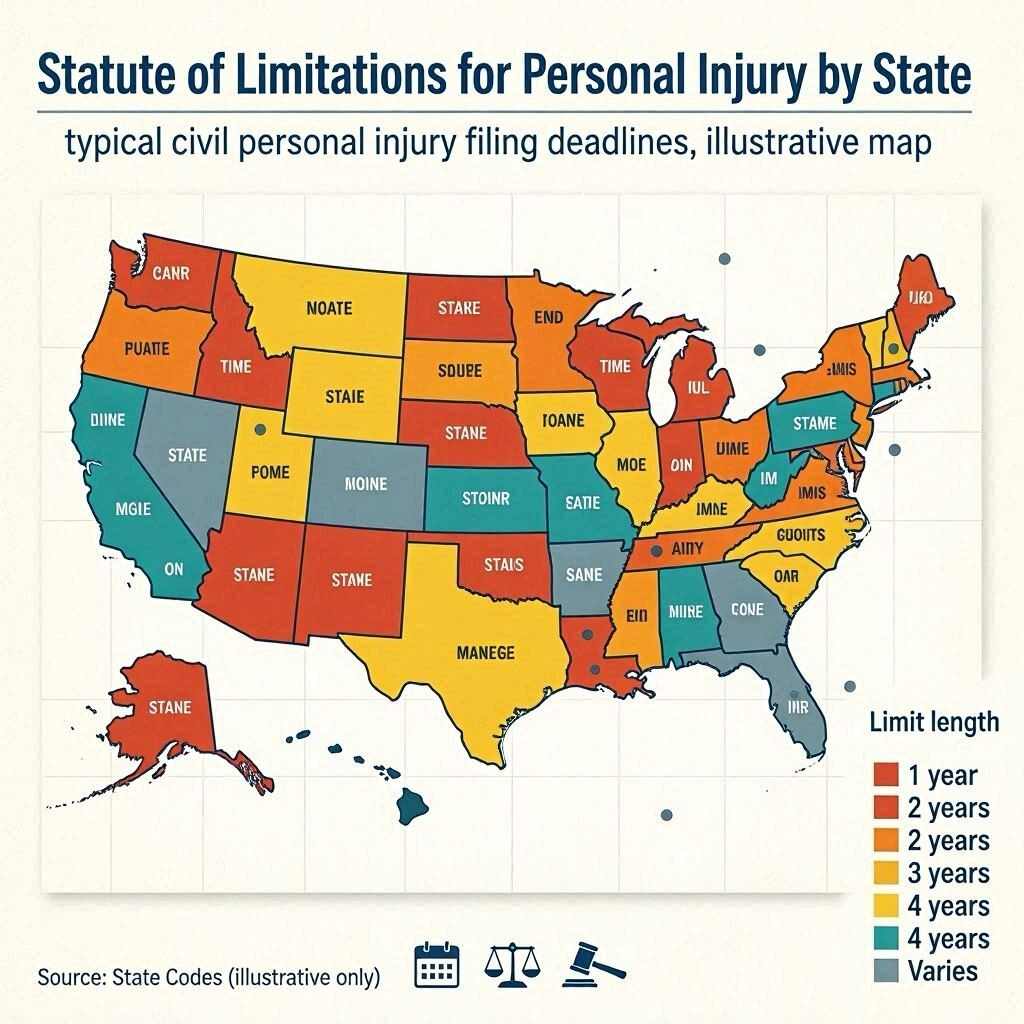
Statute Of Limitations Personal Injury By State
QUICK ANSWER
Most states allow 2–3 years from the injury date to file a personal injury lawsuit. Tennessee, Kentucky, and Louisiana allow only 1 year — the shortest in the country. Maine and Minnesota allow up to 6 years. Florida shortened its deadline from 4 to 2 years in 2023. Missing the deadline permanently bars your claim regardless of evidence strength, injury severity, or ongoing insurance negotiations. Government claims and medical malpractice often carry shorter, separate deadlines.
⚠️ Think You Already Missed Your Deadline?
Do not assume it’s too late. Several exceptions may still apply to your situation:
- Minor victim: If you were under 18 at the time of injury, many states toll the clock until age 18.
- Discovery rule: If you only recently discovered the injury (malpractice, toxic exposure), the clock may not have started yet.
- Fraudulent concealment: If the defendant actively hid information from you, the statute may be tolled.
- Mental incapacity: Documented inability to manage your own legal affairs may pause the deadline.
- Defendant left the state: Many states toll the clock while the defendant was absent from the jurisdiction.
- Sexual abuse (childhood): Many states now have extended or eliminated deadlines for childhood sexual abuse victims.
Contact a personal injury attorney immediately — even if you believe the deadline has passed.
What Is the Statute of Limitations for Personal Injury?
The statute of limitations for personal injury is the legal deadline by which you must file a lawsuit after suffering an injury caused by someone else’s negligence. Once the deadline passes, the defendant files a motion to dismiss — and courts grant it almost without exception. Your evidence, your injuries, and your legal argument become irrelevant the moment the clock expires.
Here’s what most people misunderstand: the statute applies to lawsuits, not insurance claims. You can still speak with an insurer after the deadline passes. But without the threat of a lawsuit, your negotiating leverage evaporates entirely. Insurance companies know your deadline — often better than you do.
⚠ IMPORTANT DISTINCTION
Insurance claim reporting deadlines and lawsuit filing deadlines are completely separate obligations running on different tracks simultaneously. Missing either can permanently damage your claim. Never assume that active settlement negotiations pause your legal filing deadline — in virtually every state, they do not.
Why Do States Have Different Filing Deadlines?
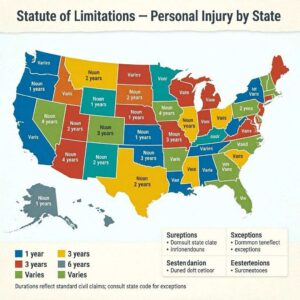
Under America’s federalist system, each state establishes its own civil laws. Tennessee gives injury victims one year. Maine gives six. That enormous range reflects different policy balances between protecting injured victims and preventing decades-old litigation — shaped by insurance industry lobbying, court system capacity, and legal tradition unique to each state.
Tool #1: Personal Injury Deadline Calculator
Enter your accident date and state to get your exact filing deadline, days remaining, and a colour-coded urgency rating. This covers standard statutes only — exceptions such as minor tolling, discovery rule, or government notice windows may change your result.
📅 Calculate Your Filing Deadline
Fill in all three fields for your personalised deadline.
Tool #2: State Instant Lookup
Type any state name below to instantly see that state’s complete deadline card — general personal injury, medical malpractice, wrongful death, government notice, and statute citation.
Tool #3: “Which Deadline Applies to Me?” Wizard
Answer four quick questions and the wizard identifies which type of statute applies to your situation — and what to verify with an attorney.
Question 1 of 4
Who caused your injury?
Statute Of Limitations Personal Injury By State: All 50 States
Complete reference table with statutory citations. Use the State Instant Lookup tool above for a quick card view of any individual state.
States With 1-Year Deadlines — Act Immediately
CRITICAL URGENCY
These states give the least time in America. Between medical treatment, insurance negotiations, evidence gathering, and attorney preparation, one year disappears faster than most people expect.
| State | General PI | Med. Malpractice | Govt Notice | Statute Citation | Key Notes |
|---|---|---|---|---|---|
| Tennessee | 1 year | 1 year | 90 days | Tenn. Code Ann. § 28-3-104 | Among strictest in US. All activity — investigation, treatment, filing — must occur within 12 months. |
| Kentucky | 1 year | 1 year | 90 days | Ky. Rev. Stat. Ann. § 413.140 | Strict procedural enforcement. No exceptions for insurance negotiations. |
| Louisiana | 1 year | 3 years (with repose) | 1 year | La. Civ. Code Ann. art. 3492 | Civil law system; called “prescriptive period.” Stops running when lawsuit filed. |
States With 2-Year Deadlines
MOST COMMON DEADLINE
Two years is the most prevalent deadline across America. Medical records, expert retention, and case preparation consume months. The practical window is far shorter than the legal one.
| State | General PI | Med. Malpractice | Govt Notice | Statute Citation | Key Notes |
|---|---|---|---|---|---|
| Alabama | 2 years | 2 years | 6 months | Ala. Code § 6-2-38 | Medical malpractice: 4-year repose. |
| Alaska | 2 years | 2 years | 120 days | Alaska Stat. § 09.10.070 | Standard two-year model. |
| Arizona | 2 years | 2 years | 180 days | Ariz. Rev. Stat. § 12-542 | Discovery rule exceptions recognized. |
| California | 2 years | 3 yrs / 1 yr from discovery | 6 months | Cal. Code Civ. Proc. § 335.1 | Childhood sexual abuse: no deadline for post-2024 incidents. |
| Colorado | 2 years | 2 years | 182 days | Colo. Rev. Stat. § 13-80-102 | Colorado Governmental Immunity Act for state claims. |
| Connecticut | 2 years | 2 years | 6 months | Conn. Gen. Stat. § 52-584 | Statute of repose for malpractice cases. |
| Delaware | 2 years | 2 years | 180 days | Del. Code Ann. tit. 10, § 8119 | Standard two-year model. |
| Florida | 2 years | 2 years | 3-year tort window | Fla. Stat. § 95.11(3)(a) | Shortened from 4 years in 2023 (H.B. 837). Sexual battery against minors: no deadline. |
| Georgia | 2 years | 2 years | Ante litem notice | O.C.G.A. § 9-3-33 | Ante litem notice required before suing government entities. |
| Hawaii | 2 years | 2 years | 6 months | Haw. Rev. Stat. § 657-7 | Government tort rules apply. Discovery rule recognized. |
| Idaho | 2 years | 2 years | 180 days | Idaho Code § 5-219 | Discovery rule limited in application. |
| Illinois | 2 years | 2 years | 1 year | 735 Ill. Comp. Stat. 5/13-202 | Childhood sexual abuse: no statute of limitations. |
| Indiana | 2 years | 2 years | 270 days | Ind. Code § 34-11-2-4 | Indiana Tort Claims Act governs government claims. |
| Iowa | 2 years | 2 years | 60 days | Iowa Code § 614.1(2) | Very short 60-day government notice window. |
| Kansas | 2 years | 2 years | 120 days | Kan. Stat. Ann. § 60-513 | Standard notice requirements. |
| Nevada | 2 years | 3 years | 6 months | Nev. Rev. Stat. § 11.190(4)(e) | Malpractice: 3-year repose. Discovery rule applies. |
| New Jersey | 2 years | 2 years | 90 days | N.J. Stat. Ann. § 2A:14-2 | Discovery rule important. Tort Claims Act for government. |
| Ohio | 2 years | 1 year | 2 years | Ohio Rev. Code Ann. § 2305.10 | Malpractice SOL shorter than general PI. 4-year repose regardless of discovery. |
| Oklahoma | 2 years | 2 years | 1 year | Okla. Stat. tit. 12, § 95 | Malpractice: affidavit of merit required. |
| Oregon | 2 years | 2 years | 180 days | Or. Rev. Stat. § 12.110 | Oregon Tort Claims Act for government. |
| Pennsylvania | 2 years | 2 years | 6 months | 42 Pa. Cons. Stat. § 5524 | Malpractice requires certificate of merit. |
| Texas | 2 years | 2 years | 6 months | Tex. Civ. Prac. & Rem. Code § 16.003 | Sexual abuse: 30 years from victim’s 18th birthday. |
| Virginia | 2 years | 2 years | 6 months | Va. Code Ann. § 8.01-243 | Virginia Tort Claims Act for government defendants. |
| West Virginia | 2 years | 2 years | 1 year | W. Va. Code § 55-2-12 | Medical malpractice: pre-suit notice required. |
States With 3–6 Year Deadlines
LONGER WINDOW — HIDDEN TRAPS
More time does not mean better evidence. Security footage overwrites within 30–90 days. A longer deadline is not the same as a stronger claim.
| State | General PI | Med. Malpractice | Govt Notice | Statute Citation | Key Notes |
|---|---|---|---|---|---|
| Arkansas | 3 years | 2 years | 1 year | Ark. Code Ann. § 16-56-105 | General claim longer than malpractice — verify type. |
| Maine | 6 years | 3 years | 60 days | Me. Rev. Stat. tit. 14, § 752 | Longest general deadline in US. Very short 60-day government notice window. |
| Maryland | 3 years | 5 years (with repose) | 1 year | Md. Code Ann., Cts. & Jud. Proc. § 5-101 | Unusually long malpractice window. Health Claims Act procedures apply. |
| Massachusetts | 3 years | 3 years | 90-day presentment | Mass. Gen. Laws ch. 260, § 2A | Presentment requirement is strict and separate from the filing deadline. |
| Michigan | 3 years | 2 years | 6 months | Mich. Comp. Laws § 600.5805 | Auto accidents may differ under Michigan no-fault law. |
| Minnesota | 6 years | 4 years | 180 days | Minn. Stat. § 541.05 | Longest general deadline alongside Maine. Malpractice: 4-year repose. |
| Mississippi | 3 years | 2 years | 90 days | Miss. Code Ann. § 15-1-49 | General longer than malpractice. |
| Missouri | 5 years | 2 years | 90 days | Mo. Rev. Stat. § 516.120 | Longer general; much shorter malpractice — a common trap. |
| Montana | 3 years | 3 years | 6 months | Mont. Code Ann. § 27-2-204 | Discovery rule recognized. |
| Nebraska | 4 years | 2 years | 2 years | Neb. Rev. Stat. § 25-207 | Long general, short malpractice. Product liability: 4 years. |
| New Hampshire | 3 years | 2 years | 180 days | N.H. Rev. Stat. Ann. § 508:4 | General longer than malpractice. |
| New Mexico | 3 years | 3 years | 90 days | N.M. Stat. Ann. § 37-1-8 | Tort Claims Act for government entities. |
| New York | 3 years | 2.5 years | 90 days | N.Y. C.P.L.R. § 214 | NYC: strict 90-day municipal notice. Sexual abuse against minors: file until age 55. |
| North Carolina | 3 years | 3 years | 90 days | N.C. Gen. Stat. § 1-52 | Slightly longer windows overall. |
| North Dakota | 6 years | 2 years | 90 days | N.D. Cent. Code § 28-01-16 | Malpractice much shorter than general — verify carefully. |
| Rhode Island | 3 years | 3 years | 90 days | R.I. Gen. Laws § 9-1-14 | Tolling for minority, mental incompetence, or financial incapacity. |
| South Carolina | 3 years | 3 years | 1 year | S.C. Code Ann. § 15-3-530 | Government claims under SC Tort Claims Act. |
| South Dakota | 3 years | 2 years | 120 days | S.D. Codified Laws § 15-2-14 | General longer than malpractice. |
| Utah | 4 years | 2 years | 1 year | Utah Code Ann. § 78B-2-307 | General longer; malpractice shorter — verify type. |
| Vermont | 3 years | 3 years | 90 days | Vt. Stat. Ann. tit. 12, § 512 | Standard longer window. |
| Washington | 3 years | 3 years | Tort Claims Act | Wash. Rev. Code § 4.16.080 | Childhood sexual abuse: 3 years from discovery. |
| Wisconsin | 3 years | 3 years | 120 days | Wis. Stat. § 893.54 | Wisconsin Tort Claims Act for government. |
| Wyoming | 4 years | 2 years | 1 year | Wyo. Stat. Ann. § 1-3-106 | Discovery rule applies in some circumstances. |
When the Statute of Limitations Clock Starts
The filing deadline does not always begin on the accident date. Getting this wrong is one of the most costly mistakes injury victims make.
Standard Rule: Date of Injury
In most straightforward accidents — car crashes, slip-and-falls, construction injuries — the statute begins on the day the injury occurred.
The Discovery Rule
Some injuries emerge gradually. Medical malpractice, toxic chemical exposure, and defective product injuries may cause symptoms months or years after the initial harm. The discovery rule delays the statute’s start until the injury is “reasonably discoverable” — the point a reasonable person knew or should have known they were harmed.
The Continuous Treatment Doctrine (Malpractice)
In many states, when a patient continues receiving treatment from the same provider for the same condition, the malpractice statute does not begin running until that treatment relationship ends. States including New York, Connecticut, and Ohio recognize this doctrine.
Statute of Repose vs. Statute of Limitations
A statute of limitations typically starts when injury is discovered and can be tolled by exceptions. A statute of repose imposes an absolute deadline from a specific event regardless of when the injury was discovered. Once a statute of repose expires, no exceptions apply.
KEY TAKEAWAY
Never assume the clock starts when your symptoms appear. In many states, it starts on the accident date itself — regardless of when you felt the full impact or received a diagnosis.
Exceptions That Change Your Statute of Limitations Deadline
- Minor victim tolling: Many states pause the statute until the injured child turns 18.
- Discovery rule: Starts the clock when injury is reasonably discoverable. Most commonly applied to malpractice, toxic exposure, and defective product claims.
- Continuous treatment: In malpractice cases, many states toll the statute while the same provider continues treating the same condition.
- Fraudulent concealment: If the defendant actively concealed the injury or their liability, many states toll the statute for the duration of that concealment.
- Mental incapacity: Documented inability to manage one’s legal affairs may pause the clock. Courts interpret “incapacity” narrowly.
- Defendant left the state: Most states toll the statute while the defendant is absent from the state after the injury.
- Statute of repose: An absolute cutoff from a specific event date that cannot be tolled.
- Government defendant: Claims against government entities require separate, shorter notice — often 90–180 days.
Specific Claim Types With Different Deadlines
Car Accidents and Rideshare Claims
Most states apply their standard negligence deadline to car accident injuries. Rideshare accidents (Uber, Lyft) may involve multiple simultaneous insurance policies. No-fault states (Florida, Michigan, New York, New Jersey) require injured parties to first file with their own insurer before pursuing a tort claim, with separate procedural deadlines at each step.
Medical Malpractice
Beyond the standard filing deadline, most states require:
- Certificate or affidavit of merit — a written statement from a qualified medical expert
- Statute of repose — an absolute outer deadline (commonly 4–7 years from the date of treatment)
- Continuous treatment exception — the clock pauses while the same provider treats the same condition
- Foreign object exception — clock starts from discovery when surgical objects are left in a patient
Wrongful Death Claims
Wrongful death claims operate under entirely separate statutes. The critical distinction: the clock typically begins on the date of death — not the date of the original injury. States distinguish between the wrongful death action (family’s losses) and the survival action (deceased’s own claim), which can carry different deadlines within the same state.
Workers’ Compensation vs. Personal Injury Deadlines
CRITICAL DISTINCTION
Workers’ compensation provides benefits regardless of fault but limits your total recovery. A personal injury lawsuit against a third party (not your employer) can include pain and suffering. These are separate claims with separate deadlines — filing one does NOT protect the other.
- California: Notify employer within 30 days; file formal claim within 1 year (Lab. Code § 5405)
- Texas: Notify employer within 30 days; file with DWC within 1 year (Tex. Lab. Code § 409.003)
- New York: Notify employer within 30 days; file claim within 2 years (N.Y. Workers’ Comp. Law § 28)
- Florida: Report injury within 30 days; file petition within 2 years (Fla. Stat. § 440.19)
- Illinois: Notify employer within 45 days; file within 3 years (820 Ill. Comp. Stat. 305/6)
Sexual Abuse and Childhood Sexual Abuse Deadlines
- California: No deadline for childhood sexual abuse on or after Jan 1, 2024. (Cal. Code Civ. Proc. § 340.1)
- New York: File until age 55, or within 5 years of any related criminal conviction. (N.Y. C.P.L.R. § 208-b)
- Texas: 30 years from the victim’s 18th birthday. (Tex. Civ. Prac. & Rem. Code § 16.0045)
- Florida: No statute of limitations for sexual battery against minors (“Donna’s Law”, Fla. Stat. § 95.11)
- Illinois: No statute of limitations for childhood sexual abuse civil claims. (735 Ill. Comp. Stat. 5/13-202.2)
- Washington: 3 years from discovery of the abuse. (Wash. Rev. Code § 4.16.340)
Government Claims — Shorter Deadlines That Catch Victims Off Guard
Any accident involving a government vehicle, government property, or public facility operates under different procedural rules — almost always shorter than standard civil deadlines.
Federal Claims — FTCA
Under the Federal Tort Claims Act (28 U.S.C. § 2675), injuries caused by federal employees or agencies require filing an administrative claim within 2 years of the incident.
State Government Claims
State agencies typically require formal written notice within 6 months or less before any lawsuit can proceed.
Municipal Claims (City and County)
City and county claims carry the strictest deadlines. New York City requires a notice of claim within 90 days.
SAMPLE GOVERNMENT DEADLINES
New York City: 90 days • California state agencies: 6 months • Texas state agencies: 6 months • Federal (FTCA): 2 years (administrative) • Chicago/Cook County: 1 year • Phoenix/Maricopa County: 180 days. These run simultaneously with — and are often shorter than — the standard personal injury window.
Recent State Law Changes (2022–2025)
- Florida (2023): General negligence deadline shortened from 4 years to 2 years via H.B. 837, signed March 2023. Affects all claims filed on or after March 24, 2023.
- California (2024): Childhood sexual abuse deadline eliminated entirely for incidents occurring on or after January 1, 2024.
- New York (2022–2023): Adult Survivors Act opened a one-year lookback window for previously expired sexual abuse claims. Window closed November 2023.
- Texas (2023): Extended childhood sexual abuse window to 30 years from victim’s 18th birthday.
- Illinois (2023): Confirmed no statute of limitations for childhood sexual abuse civil claims.
- Trend watch (2024–2026): Insurance-backed legislation shortening general negligence deadlines is active in multiple state legislatures.
How Statute Of Limitations Rules Affect Settlement Negotiations
The Insurance Company Clock Advantage
Insurance adjusters know your filing deadline — often better than you do. As it approaches, an insurer may slow negotiations intentionally, make lowball offers knowing your options narrow, and continue friendly communication without ever mentioning the expiring deadline. In most states, insurers have no legal obligation to warn you.
Filing a Lawsuit Doesn’t End Settlement Discussions
Experienced attorneys routinely file lawsuits not because settlement failed, but specifically to preserve legal rights while negotiations continue. Settlement discussions can — and frequently do — continue successfully after a lawsuit is filed.
Comparative Negligence and the Filing Deadline Connection
Comparative negligence only becomes relevant inside an active lawsuit. If the statute expires before you file, comparative negligence never comes into play — the defendant wins on procedural grounds regardless.
Common Mistakes That Kill Valid Personal Injury Claims
1. Trusting Insurance Adjusters to Monitor Your Deadline
Insurance adjusters work for the insurance company — not for you. They may continue settlement discussions past your filing deadline without ever mentioning the expiration. They have no legal obligation to warn you.
2. Assuming Insurance Negotiations Pause the Deadline
In virtually every state, active insurance negotiation does not pause the statute of limitations. The legal obligation continues unless a formal court filing or a specific written tolling agreement exists.
3. Waiting for Maximum Medical Improvement Before Consulting an Attorney
Some victims wait until treatment is complete before contacting an attorney — emotionally understandable, legally catastrophic. The statute began running on the accident date.
4. Assuming the Digital Evidence Will Still Be There
Security footage from gas stations, parking garages, and retail stores overwrites automatically within 30–90 days. GPS data from commercial vehicles may disappear within days absent a formal litigation hold letter.
5. Not Verifying Government Claim Notice Requirements
A city bus injury, county vehicle crash, or USPS truck accident each triggers separate, shorter notice requirements. Missing the government notice window permanently bars the claim.
6. Assuming a Universal Two-Year Rule Applies
Deadlines range from one to six years. Medical malpractice, wrongful death, government claims, workers’ compensation, and product liability frequently follow completely different timelines than standard negligence cases in the same state.
How to Calculate Your Personal Injury Filing Deadline
Use the Deadline Calculator tool at the top of this article for your personalised result. Manually, follow these four steps:
- Step 1 — Document the injury date immediately. Record exact date, time, and location; photographs; witness contact information; police or EMS report numbers; initial medical records.
- Step 2 — Identify the controlling state. Use the state where the accident occurred — not where you live.
- Step 3 — Check for applicable exceptions. Minor victim tolling, discovery rule, government defendant, continuous treatment, mental incapacity, fraudulent concealment, or statute of repose.
- Step 4 — Calculate government notice deadlines separately. If any government entity may be involved, treat the government notice window (often 90–180 days) as your effective deadline.
Frequently Asked Questions
What is the statute of limitations for personal injury by state?
Most states allow 2–3 years. Tennessee, Kentucky, and Louisiana allow only 1 year. Maine and Minnesota allow up to 6 years. The exact deadline depends on your state, the type of injury, and who the defendant is.
What happens if you miss the statute of limitations?
Your claim is permanently barred. The defendant files a motion to dismiss and courts almost always grant it — even with strong evidence. Limited exceptions may apply: minor victims, fraudulent concealment, documented mental incapacity, or delayed discovery. Courts grant these sparingly.
Does filing an insurance claim pause the statute of limitations?
No. In most states, filing an insurance claim or negotiating with an insurer does not pause the lawsuit filing deadline. Unless the parties execute a formal written tolling agreement, the deadline keeps running. Only a formal court filing reliably preserves your right to sue.
Which state has the shortest personal injury statute of limitations?
Tennessee, Kentucky, and Louisiana — all 1 year from the injury date. Tennessee’s one-year statute creates particular urgency because all investigation, treatment, negotiation, and filing must occur within 12 months.
What is the difference between workers’ compensation and a personal injury lawsuit?
Workers’ compensation pays benefits regardless of fault but limits your recovery. A personal injury lawsuit against a third party can include pain and suffering. The two have completely separate deadlines — filing one does not protect the other.
Are wrongful death statutes different from regular personal injury statutes?
Yes. The wrongful death clock typically begins on the date of death, not the original injury date. Wrongful death and survival actions can carry different deadlines within the same state.
What is the discovery rule in personal injury law?
The discovery rule delays the statute’s start until you knew or reasonably should have known you were harmed. Many states limit it through statutes of repose — absolute cutoffs from a specific event date regardless of when the injury was discovered.
How do government injury claims differ from standard personal injury lawsuits?
Government claims require formal written notice within 90–180 days in most states — far shorter than the standard 2–3 year window. Missing the government notice window permanently bars your claim.
Is the statute of limitations different for sexual abuse victims?
Yes — many states have dramatically extended or eliminated deadlines, particularly for childhood sexual abuse. California eliminated the deadline entirely for post-2024 incidents. Survivors should consult an attorney regardless of when the abuse occurred — the law may have changed in their favour.
Which state gives the most time to file a personal injury lawsuit?
Maine and Minnesota — both allow up to 6 years for general personal injury claims, the longest in the United States.
Legal Disclaimer: This article is for general informational purposes only and does not constitute legal advice. Laws vary by state and change frequently. Always consult a licensed personal injury attorney in your jurisdiction to understand the specific deadlines and requirements that apply to your situation.