

Bible Quotes Before Surgery: Verses for Peace and Healing
Surgery has a way of surfacing questions no one can fully answer in advance: Will everything go well? Will I be safe on the table? How do I get through the fear between now and the recovery room? Scripture never mentions modern surgery by name — there are no verses about anesthesia or operating rooms — but it speaks at length to the fear, suffering, uncertainty, healing, courage, prayer, and trust that surround any difficult medical experience. The passages below give you language for turning those concerns toward God before an operation. They are offered for spiritual encouragement, not as promises of a particular medical outcome or a substitute for professional medical care.
Quick Answer: What Is a Good Bible Verse Before Surgery?
Some of the most comforting Bible verses to read before surgery are Isaiah 41:10, Philippians 4:6–7, Psalm 23:4, Joshua 1:9, and Psalm 56:3. Together they meet several of the emotions people commonly bring to God before an operation: fear, anxiety, uncertainty, the need for courage, and the simple desire to remember that God is present.
If you want just one verse, Isaiah 41:10 is an especially strong choice:
“Fear thou not; for I am with thee: be not dismayed; for I am thy God: I will strengthen thee; yea, I will help thee.” — Isaiah 41:10 (KJV)
The verse names the fear directly and answers it with God’s presence, strength, and help in the same breath. For someone approaching surgery, the message is simple: you don’t have to face an uncertain moment as though you’re facing it alone.
Five Bible Verses to Read Before Surgery
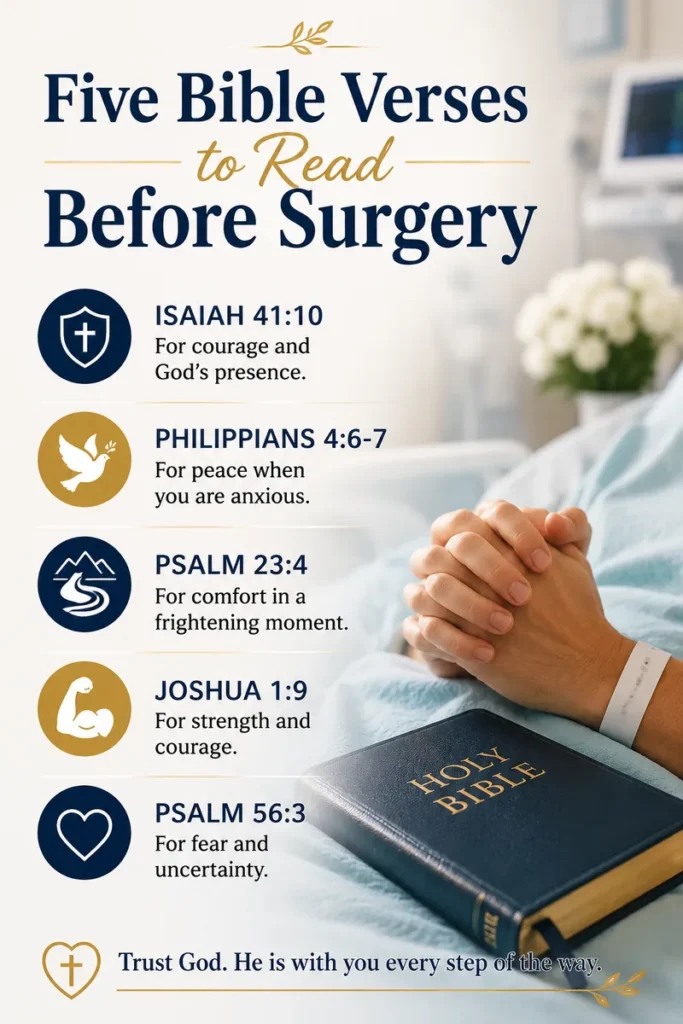
Isaiah 41:10 — For courage and God’s presence. This passage speaks directly to fear and reassures God’s people that He is with them, will strengthen them, and will help them. It fits especially well when anxiety is centered on what lies ahead.
Philippians 4:6–7 — For peace when you are anxious. Paul urges believers to bring their requests to God through prayer and thanksgiving. The promise isn’t that circumstances will change on cue — it’s that the peace of God will guard the heart and mind.
Psalm 23:4 — For comfort in a frightening moment. David walks through “the valley of the shadow of death” without fearing evil, because God is present. It’s especially meaningful when someone needs reassurance that God stays close through a difficult experience, not just after it.
Joshua 1:9 — For strength and courage. God commands Joshua to be strong and courageous and reminds him that the Lord goes with him wherever he goes — words that can steady someone walking into a hospital or operating room.
Psalm 56:3 — For fear and uncertainty. A short verse with a simple response to fear: trust in God. Its brevity makes it easy to remember, repeat, or pray quietly while waiting for surgery.
There is no single Bible verse written specifically for modern surgery. Scripture doesn’t describe medical procedures, anesthesia, surgeons, or operating rooms — instead, Christians apply its passages about God’s presence, prayer, courage, trust, suffering, healing, and peace to the experience of facing surgery.
That distinction matters. These verses can offer real spiritual encouragement and give you words to pray, but they shouldn’t be presented as guarantees that a particular operation will turn out a particular way. You can pray sincerely for successful surgery, wisdom for the medical team, healing, and recovery — and still entrust the outcome to God.
Which Bible Verse Should You Read Before Surgery?

The right verse depends on what you need most in the moment. If your mind is racing, Philippians 4:6–7 points you toward prayer and God’s peace. If you’re afraid, Psalm 56:3 offers a simple response: trust in God. If you need courage, Isaiah 41:10 reminds you that God is with you and will help you. Use the sections below to find the Scripture that speaks directly to what you’re carrying right now.
If You Need Peace
Philippians 4:6–7
“Be careful for nothing; but in every thing by prayer and supplication with thanksgiving let your requests be made known unto God.” — Philippians 4:6 (KJV)
When anxiety starts running the show, this passage redirects you toward prayer instead of letting worry take over. Paul connects prayer and thanksgiving with a peace of God that guards the heart and mind. Before surgery, you can use these verses to bring your fears, questions, and requests honestly before God.
Simple prayer: “Lord, I bring my fears and concerns to You. Guard my heart and mind with Your peace as I prepare for surgery.”
If You Are Afraid
Psalm 56:3
“What time I am afraid, I will trust in thee.” — Psalm 56:3 (KJV)
One of the shortest, most memorable verses for facing fear. Notice what David doesn’t do: he doesn’t pretend the fear away. He names it, then turns toward trust. That combination is exactly what makes this verse fit a frightening moment so well.
Simple prayer: “God, I am afraid, but I choose to trust You. Help me stay close to You through this.”
If You Need Courage
Isaiah 41:10
“Fear thou not; for I am with thee: be not dismayed; for I am thy God.” — Isaiah 41:10 (KJV)
Isaiah 41:10 gathers several encouragements into one verse: God’s presence, God’s strength, God’s help, and a direct command not to fear. The point isn’t that the hard circumstance disappears — it’s that God’s presence doesn’t depend on the circumstance being easy.
Simple prayer: “Lord, give me courage for what lies ahead and help me remember that You are with me.”
If You Are Struggling to Trust God
Proverbs 3:5–6
“Trust in the LORD with all thine heart; and lean not unto thine own understanding.” — Proverbs 3:5 (KJV)
Surgery involves uncertainty you can’t fully control or understand, and Proverbs 3:5–6 speaks straight into that. It doesn’t promise that you’ll know how things unfold. It calls you to acknowledge God and entrust your way to Him anyway.
Simple prayer: “Father, I don’t know everything that will happen, but I choose to trust You. Guide me through this.”
If You Need Comfort
Psalm 23:4
“Yea, though I walk through the valley of the shadow of death, I will fear no evil: for thou art with me.” — Psalm 23:4 (KJV)
Psalm 23 never promises that God’s people will avoid dark or difficult places — its comfort is that God stays present inside them. For someone facing surgery, that’s the distinction worth holding onto: faith doesn’t require pretending the situation is easy, only remembering that God hasn’t left.
Simple prayer: “Lord, stay close to me through this and comfort me with the assurance of Your presence.”
If You Are Praying for Protection
Psalm 91
Psalm 91 is one of Scripture’s best-known passages about refuge, God’s care, and dwelling under the protection of the Most High. It’s meaningful to read before surgery when you’re praying for God’s care over yourself or someone you love.
At the same time, Psalm 91 shouldn’t be read as a guarantee that a medical procedure will carry no complications. Its value here is as a prayerful expression of trust in God as refuge and protector.
Simple prayer: “Lord, I place myself in Your care. Be my refuge and give me peace as I entrust this surgery to You.”
If You Are Praying for Healing
James 5:14–15
James addresses sickness directly and calls believers to respond with prayer, which makes the passage especially relevant when someone is asking God for healing and strength during illness.
Approach it as an invitation to pray faithfully, not as a formula that guarantees a particular medical result. Christians can ask God for healing while continuing to receive appropriate medical care and trusting Him with the outcome.
Simple prayer: “Lord, I ask You for healing, strength, and mercy. Give wisdom to those caring for me and help me trust You throughout my recovery.”
If You Are Waiting for Help
Psalm 121:1–8
Psalm 121 keeps turning the reader’s attention back to God’s help and keeping care. It asks where help comes from and answers by pointing to the Lord, the Maker of heaven and earth.
That makes it fitting for the hours before surgery, whether you’re waiting at home, in a hospital room, or for the procedure to begin. It’s a reminder that your ultimate hope isn’t limited to what you can see or control.
Simple prayer: “Lord, I look to You for help. Watch over me and give me peace while I wait.”
If You Are Praying for a Loved One
Isaiah 41:10
When someone you love is undergoing surgery, Isaiah 41:10 gives you words to pray over them. Its emphasis on God’s presence, strength, help, and sustaining care speaks naturally to the concerns of a family member or friend who is waiting and praying.
You can pray the verse over the person having surgery without treating it as a promise of a particular medical outcome — instead, as a prayer that God will strengthen, help, and sustain them.
Simple prayer: “Lord, be with the person I love as they undergo surgery. Give them courage, surround them with Your care, and strengthen them through every stage of this experience.”
If You Want a Very Short Verse
Psalm 56:3
“What time I am afraid, I will trust in thee.” — Psalm 56:3 (KJV)
If you can only carry one short Scripture into surgery, this is an easy one to keep close. It acknowledges fear without letting fear have the final word. Repeat it quietly while you wait, pray it with a loved one, or keep it on your phone.
Simple prayer: “When I am afraid, Lord, help me trust You.”
Find the Right Bible Verse for Your Situation
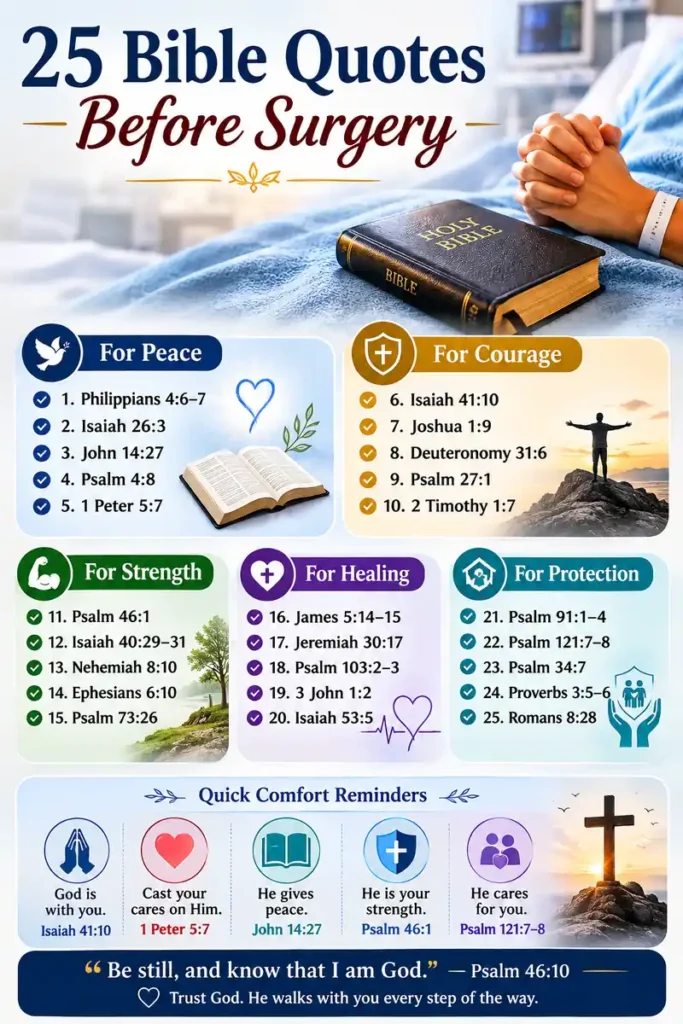
You don’t need to read every passage on this page. Start with whichever one matches what you’re feeling or praying for right now — peace, courage, comfort, healing, or simply the reminder that God is near.
| What you need | Best starting Scripture |
| Peace | Philippians 4:6–7 |
| Courage | Isaiah 41:10 |
| Help | Psalm 121:1–2 |
| Comfort | Psalm 23:4 |
| Trust | Proverbs 3:5–6 |
| Fear | Psalm 56:3 |
| Strength | Isaiah 40:29 |
| Protection | Psalm 91 |
| Healing | James 5:14–15 |
| Recovery | Psalm 41:3 |
| God’s presence | Deuteronomy 31:8 |
| A friend | Isaiah 41:10 |
| A child | Psalm 121:7–8 |
| A short verse | Psalm 56:3 |
If you’re not sure where to start, Isaiah 41:10 is a strong entry point because it brings several themes together at once: fear, God’s presence, strength, and help. If anxiety is the main thing you’re carrying, go to Philippians 4:6–7. If you want one short line to repeat to yourself, Psalm 56:3 is hard to beat.
This table is more than a list of keywords — it answers the question most people actually have walking into this page: Which Bible verse should I read right now?
25 Bible Quotes Before Surgery
Scripture contains no verses written specifically about modern surgery, but it offers many passages for fear, uncertainty, suffering, prayer, trust, and hope. The 25 Scriptures below are grouped by the spiritual need they address before an operation. Each one is read in its biblical context first, then applied to the experience of facing surgery — rather than simply listed.
Bible Verses for Peace Before Surgery
Philippians 4:6–7 — Peace When You Are Anxious
“Be careful for nothing; but in every thing by prayer and supplication with thanksgiving let your requests be made known unto God.” — Philippians 4:6 (KJV)
Context: Paul writes to believers about how to respond to anxiety and difficult circumstances, directing them toward prayer, supplication, and thanksgiving instead of worry.
Meaning: The passage doesn’t promise that every difficult circumstance changes immediately. Its promise is that God’s peace can guard the believer’s heart and mind in Christ Jesus.
Why it fits before surgery: When your thoughts keep circling the operation, this passage gives you something to do with those fears: bring them honestly to God in prayer.
Prayer: “Lord, I bring my fears and requests before You. Guard my heart and mind with Your peace as I prepare for surgery.”
Isaiah 26:3 — Peace for a Mind That Trusts God
“Thou wilt keep him in perfect peace, whose mind is stayed on thee: because he trusteth in thee.” — Isaiah 26:3 (KJV)
Context: Isaiah 26 is a song of trust and confidence in God, contrasting reliance on Him with dependence on human strength and earthly security.
Meaning: The verse ties peace to a mind fixed on God, not to the absence of hard circumstances.
Why it fits before surgery: It’s easy for the mind to loop through every possible outcome before an operation. This verse points your attention back to God instead.
Prayer: “Father, keep my mind fixed on You when fear and uncertainty try to overwhelm me. Help me trust You.”
John 14:27 — Christ’s Peace in a Troubled Heart
“Peace I leave with you, my peace I give unto you: not as the world giveth, give I unto you.” — John 14:27 (KJV)
Context: Jesus spoke these words to His disciples as He prepared them for His departure, knowing they would face uncertainty and distress.
Meaning: Jesus distinguishes His peace from the security the world offers — a peace that doesn’t depend on having control over circumstances.
Why it fits before surgery: You may not be able to control every detail of the operation. John 14:27 is a reminder that peace doesn’t require knowing exactly what happens next.
Prayer: “Jesus, give me the peace You promised. Quiet my troubled heart and help me rest in You.”
Psalm 4:8 — Rest Without Fear
“I will both lay me down in peace, and sleep: for thou, LORD, only makest me dwell in safety.” — Psalm 4:8 (KJV)
Context: Psalm 4 is a prayer of confidence in God during distress, contrasting anxiety with the confidence that God hears those who call on Him.
Meaning: David’s rest comes from confidence in God’s care, not from circumstances being fully secure.
Why it fits before surgery: If your operation is the next morning and sleep won’t come, Psalm 4:8 offers a short prayer of trust and rest.
Prayer: “Lord, help me rest tonight. I cannot control everything tomorrow will bring, but I place myself in Your care.”
1 Peter 5:7 — Give Your Anxiety to God
“Casting all your care upon him; for he careth for you.” — 1 Peter 5:7 (KJV)
Context: Peter calls believers to humble themselves before God and trust Him with their concerns, within a broader call to humility and dependence on God.
Meaning: The verse invites believers to place their cares before God because He cares personally for them.
Why it fits before surgery: You don’t have to hide your fears from God. Name them in prayer and place them, consciously, in His care.
Prayer: “Lord, I give You the fears I am carrying. Thank You that You care for me and hear my prayers.”
Bible Verses for Courage Before Surgery
Isaiah 41:10 — God Is With You
“Fear thou not; for I am with thee: be not dismayed; for I am thy God.” — Isaiah 41:10 (KJV)
Context: Isaiah 41 repeatedly contrasts human weakness with God’s strength and help. In verse 10, God tells His people not to fear because He is with them and will strengthen and help them.
Meaning: The heart of the verse is presence, not the absence of difficulty. The reason for courage isn’t that hard circumstances are impossible — it’s that God Himself is with His people.
Why it fits before surgery: If fear is heavy, this verse gives you a simple truth to hold: you’re not required to face this moment as though God is absent.
Prayer: “Lord, I am afraid, but I know You are with me. Give me courage, strength, and peace as I face this surgery.”
Joshua 1:9 — Be Strong and Courageous
“Have not I commanded thee? Be strong and of a good courage; be not afraid, neither be thou dismayed: for the LORD thy God is with thee whithersoever thou goest.” — Joshua 1:9 (KJV)
Context: God spoke these words to Joshua as he prepared to lead Israel after Moses’ death, facing real responsibility and an uncertain future.
Meaning: Biblical courage isn’t the absence of difficulty. Joshua was told to move forward faithfully while trusting God’s presence.
Why it fits before surgery: This verse can help someone who needs courage to take the next step rather than let fear take over.
Prayer: “God, give me courage for the next step. Help me remember that Your presence is greater than my fear.”
Deuteronomy 31:6 — God Will Not Forsake You
“Be strong and of a good courage, fear not, nor be afraid of them: for the LORD thy God, he it is that doth go with thee; he will not fail thee, nor forsake thee.” — Deuteronomy 31:6 (KJV)
Context: Moses spoke these words to Israel as they prepared to enter the Promised Land, assuring them God would go with them and not abandon them.
Meaning: The encouragement rests on God’s faithfulness and presence, not on the absence of challenges.
Why it fits before surgery: When you feel alone or vulnerable before an operation, this passage points you toward God’s faithfulness.
Prayer: “Lord, when I feel vulnerable, remind me that You do not abandon Your people. Stay close to me through this.”
Isaiah 40:29 — Strength for the Weary
“He giveth power to the faint; and to them that have no might he increaseth strength.” — Isaiah 40:29 (KJV)
Context: Isaiah 40 contrasts human weakness with God’s everlasting strength, describing Him as the One who renews the strength of those who wait on Him.
Meaning: Human weakness doesn’t mean God is weak. The passage points exhausted people toward His limitless strength.
Why it fits before surgery: Fear, waiting, illness, and uncertainty can wear a person down emotionally and physically. This verse offers permission to ask God for strength when your own runs out.
Prayer: “Lord, I feel weak and tired. Give me the strength I need for today and help me depend on You.”
Psalm 34:4 — God Hears When You Are Afraid
“I sought the LORD, and he heard me, and delivered me from all my fears.” — Psalm 34:4 (KJV)
Context: Psalm 34 is a testimony of seeking the Lord in distress, with David describing his turn toward God and his praise for God’s care.
Meaning: The verse emphasizes seeking God in fear rather than sitting alone with it.
Why it fits before surgery: If fear is dominating your thoughts, this short passage gives you a simple prayer: seek God, speak honestly to Him, and remember that He hears.
Prayer: “Lord, I seek You in my fear. Hear me, strengthen me, and help me walk through this moment with faith.”
Bible Verses for Trusting God Before Surgery
Proverbs 3:5–6 — Trust Beyond What You Understand
“Trust in the LORD with all thine heart; and lean not unto thine own understanding.” — Proverbs 3:5 (KJV)
Context: Part of the wisdom teaching in the opening chapters of Proverbs, where a father instructs his son to pursue wisdom and live in faithful dependence on God.
Meaning: Trusting God doesn’t mean refusing to think, ask questions, or use wisdom — it means recognizing the limits of human understanding and acknowledging God in every part of life.
Why it fits before surgery: You may have questions you can’t answer and outcomes you can’t predict. This verse gives you a framework for entrusting what you can’t fully understand to God.
Prayer: “Lord, I do not understand everything that lies ahead. Help me trust You while using wisdom and following the guidance of those caring for me.”
Psalm 56:3 — “When I Am Afraid, I Will Trust”
“What time I am afraid, I will trust in thee.” — Psalm 56:3 (KJV)
Context: Psalm 56 is David’s prayer while facing danger. Rather than denying his fear, he describes his decision to put his trust in God.
Meaning: The honesty here is the strength of the verse. David doesn’t say, “I will never be afraid.” He says what he will do when he is.
Why it fits before surgery: That makes it especially useful when fear feels unavoidable — you can acknowledge it without letting it have the last word.
Prayer: “Lord, I am afraid, and I bring that fear to You. Help me trust You one moment at a time.”
Psalm 37:5 — Commit Your Way to the Lord
“Commit thy way unto the LORD; trust also in him; and he shall bring it to pass.” — Psalm 37:5 (KJV)
Context: Psalm 37 teaches believers how to respond when circumstances seem uncertain, repeatedly calling God’s people to trust, wait, and commit their way to Him.
Meaning: To commit your way to the Lord is to entrust your path to Him rather than trying to control every outcome.
Why it fits before surgery: You can prepare carefully, ask good questions, and follow medical guidance while still recognizing you can’t control every result.
Prayer: “Father, I commit my way to You. Help me do what is wise and responsible while trusting You with what I cannot control.”
Psalm 62:5–8 — Wait Quietly for God
“My soul, wait thou only upon God; for my expectation is from him.” — Psalm 62:5 (KJV)
Context: Psalm 62 repeatedly describes God as a rock, salvation, defense, and refuge, calling the psalmist and others to wait for God and pour out their hearts before Him.
Meaning: Biblical waiting isn’t hopeless inactivity — it’s an expression of confidence that your ultimate hope rests in God.
Why it fits before surgery: Waiting for an operation can feel especially hard because there’s little you can actively do. Psalm 62 gives you language for waiting without giving in to despair.
Prayer: “Lord, help me wait with hope rather than fear. I pour out my heart to You because You are my refuge.”
Romans 8:38–39 — Nothing Can Separate Us From God’s Love
“For I am persuaded, that neither death, nor life… shall be able to separate us from the love of God, which is in Christ Jesus our Lord.” — Romans 8:38–39 (KJV)
Context: Paul closes Romans 8 with a declaration that no created thing can separate believers from God’s love in Christ.
Meaning: Paul’s confidence reaches beyond any particular circumstance — God’s love doesn’t depend on life unfolding the way we expect.
Why it fits before surgery: When fear centers on uncertainty, this passage shifts your attention from predicting every outcome to resting in God’s enduring love.
Prayer: “Lord Jesus, when I am uncertain about what lies ahead, remind me that Your love does not leave me.”
Bible Verses for God’s Presence and Protection
Psalm 23:4 — God Is With You in the Dark Valley
“Yea, though I walk through the valley of the shadow of death, I will fear no evil: for thou art with me.” — Psalm 23:4 (KJV)
Context: Psalm 23 presents the Lord as a shepherd who leads, provides for, and cares for His sheep. Verse 4 moves into the image of a dark valley, but the focus stays on the Shepherd’s presence.
Meaning: The verse doesn’t claim believers will avoid dark places. Its comfort is in the words “thou art with me.”
Why it fits before surgery: If surgery feels like an uncertain valley, this passage is a reminder that God’s presence isn’t limited to easy circumstances.
Prayer: “Good Shepherd, walk with me through this valley. Help me remember that I am not alone.”
Psalm 91:1–2 — God as Refuge
“He that dwelleth in the secret place of the most High shall abide under the shadow of the Almighty.” — Psalm 91:1 (KJV)
Context: Psalm 91 is a poetic declaration of trust in God as refuge and protector.
Meaning: The psalm invites believers to find refuge in God. It shouldn’t be read as a guarantee that Christians will never experience illness, suffering, or danger.
Why it fits before surgery: When you’re praying for God’s protection, Psalm 91 gives you the language for placing yourself under His care.
Prayer: “Almighty God, You are my refuge. I place myself in Your care and ask You to sustain me through this surgery.”
Psalm 121:7–8 — God Watches Over You
“The LORD shall preserve thee from all evil: he shall preserve thy soul. The LORD shall preserve thy going out and thy coming in from this time forth, and even for evermore.” — Psalm 121:7–8 (KJV)
Context: Psalm 121 is a song of confidence in God’s keeping care, repeatedly emphasizing that the Lord watches over His people.
Meaning: The emphasis is on God’s ongoing care over the person’s life and movements.
Why it fits before surgery: Especially meaningful when traveling to a hospital, waiting for a procedure, or praying for a loved one’s care.
Prayer: “Lord, watch over me as I go into surgery and as I come through recovery. Help me rest in Your care.”
Psalm 46:1 — God Is Our Refuge and Strength
“God is our refuge and strength, a very present help in trouble.” — Psalm 46:1 (KJV)
Context: Psalm 46 portrays God as a secure refuge amid upheaval, repeatedly calling His people to recognize His presence and power.
Meaning: God isn’t a distant source of help — He’s described as a “very present help” in trouble.
Why it fits before surgery: When things feel overwhelming, this verse gives you three simple truths: God is your refuge, God is your strength, and God is present.
Prayer: “God, be my refuge and strength today. Help me remember that You are present even when I feel overwhelmed.”
2 Corinthians 1:3–4 — The God of All Comfort
“The God of all comfort; who comforteth us in all our tribulation.” — 2 Corinthians 1:3–4 (KJV)
Context: Paul opens 2 Corinthians praising God as the Father of mercies and the God of all comfort, describing how God’s comfort enables believers to comfort others.
Meaning: Christian comfort is something received from God in the midst of affliction — not necessarily the removal of every hard circumstance.
Why it fits before surgery: Fitting for someone who needs emotional and spiritual comfort before a difficult procedure, or for a family member waiting and praying.
Prayer: “Father of mercies, comfort me in this difficult time and help me receive Your care rather than being consumed by fear.”
Bible Verses for Healing and Recovery
James 5:14–15 — Prayer for Someone Who Is Sick
“Is any sick among you? let him call for the elders of the church; and let them pray over him.” — James 5:14 (KJV)
Context: James gives instructions for believers who are sick and calls for prayer by the church’s elders, placing sickness within the life of Christian community.
Meaning: James presents prayer as an important response to sickness and points believers toward God through the faith community.
Why it fits before surgery: Of all the passages here, this one speaks most directly to responding to sickness with prayer — meaningful when asking God for healing before or after surgery.
Prayer: “Lord, I ask You for mercy, healing, and strength. Give wisdom and skill to those caring for me, and sustain me through recovery.”
Psalm 30:2 — Crying to God for Healing
“O LORD my God, I cried unto thee, and thou hast healed me.” — Psalm 30:2 (KJV)
Context: A song of thanksgiving in which David remembers God’s deliverance and turns his experience into praise.
Meaning: Voice given to someone who has experienced God’s deliverance and responds with gratitude.
Why it fits before surgery: Use it as a prayer when asking God for healing and looking to Him with hope.
Prayer: “Lord, I cry to You for mercy and healing. Sustain me through this procedure and help me respond with gratitude for Your care.”
Psalm 41:3 — God’s Sustaining Care
“The LORD will strengthen him upon the bed of languishing: thou wilt make all his bed in his sickness.” — Psalm 41:3 (KJV)
Context: Psalm 41 describes God’s concern for the vulnerable and afflicted; verse 3 speaks of His sustaining care toward someone who is sick.
Meaning: God is portrayed as attentive to the person suffering and in need of strength.
Why it fits before surgery: A meaningful passage to pray during illness and recovery, especially when physical weakness makes ordinary things difficult.
Prayer: “Lord, strengthen me when I am weak. Sustain me through this illness and give me patience and hope during recovery.”
Jeremiah 17:14 — A Direct Prayer for Healing
“Heal me, O LORD, and I shall be healed; save me, and I shall be saved: for thou art my praise.” — Jeremiah 17:14 (KJV)
Context: Part of Jeremiah’s reflections on trust, sin, the human heart, and dependence on God, verse 14 is his direct appeal to the Lord for healing and salvation.
Meaning: A personal prayer addressed straight to God — language for someone who wants to ask for healing rather than hide that desire.
Why it fits before surgery: If you want a Scripture that becomes a direct prayer for healing, this is about as straightforward as it gets.
Prayer: “Lord, I ask You for healing and mercy. Be with me through this surgery and help me trust You with my whole heart.”
Psalm 147:3 — God Heals the Brokenhearted
“He healeth the broken in heart, and bindeth up their wounds.” — Psalm 147:3 (KJV)
Context: Psalm 147 is a hymn of praise for God’s power, restoration, and care; verse 3 describes His attention to those who are brokenhearted and wounded.
Meaning: The verse speaks first to God’s compassionate care for wounded, broken people — not a guarantee of a particular physical healing.
Why it fits before surgery: Surgery involves emotional as well as physical vulnerability. This verse is a reminder that God cares about the whole person, not just the procedure.
Prayer: “Lord, care for me in every part of this experience. Heal what is wounded, strengthen what is weak, and help me rest in Your compassion.”
Why These Bible Verses Can Help Before Surgery
A Bible verse can comfort you without promising a particular medical outcome. The most useful way to read Scripture before surgery is to understand what a passage means in its own setting, then consider how its message speaks to the fear, uncertainty, hope, or need for prayer you’re actually experiencing.
That’s why the verses above aren’t presented as a simple stack of quotations. Each major passage is worked through four questions:
Scripture. Start with the words themselves — the foundation, not a modern gloss on what we wish the verse said.
What This Passage Means. Read it in its biblical context: What was the writer saying? Who was being addressed? A verse about healing, protection, or God’s plans shouldn’t automatically be treated as a direct promise about a modern medical procedure.
Why It Can Help Before Surgery. Then comes application. A passage may not have been written about surgery, yet its biblical message can still speak to someone facing one. Philippians 4:6–7 wasn’t written about an operating room, but its teaching about bringing anxiety to God through prayer is exactly relevant to someone worried about an upcoming procedure.
A Short Prayer Based on the Verse. Finally, turn the Scripture into prayer instead of simply reading it and moving on:
“Lord, I am afraid, but I choose to trust You. Give me courage and help me remember that You are with me.”
Some verses get an added Context Note, because they’re frequently used as universal promises of physical healing, protection, or a particular outcome. That’s especially true of Isaiah 53:5, Jeremiah 30:17, Exodus 15:26, Psalm 91, Mark 11:24, and Jeremiah 29:11 — covered in the next section. The goal isn’t to weaken the encouragement these Scriptures offer. It’s to handle the Bible carefully while still letting its real message of faith, hope, prayer, comfort, and trust speak to someone facing surgery.
A Better Way to Read Scripture Before Surgery
You don’t need to read dozens of verses at once. Choose the one that matches what you’re experiencing, read it slowly, consider what it means, and turn its message into a personal prayer.
If you’re afraid, start with Psalm 56:3. If you need courage, start with Isaiah 41:10. If anxiety is overwhelming you, start with Philippians 4:6–7. If you’re struggling to trust what you can’t control, start with Proverbs 3:5–6. And if you just need to remember that God is present in a hard moment, Psalm 23:4 gives you words to hold onto.
Scripture before surgery isn’t meant to make fear disappear by pretending nothing difficult can happen. It’s meant to help you bring that fear, uncertainty, hope, and prayer before God.
What Does the Bible Say About Surgery?
The Bible gives no instructions about modern surgery, operating rooms, anesthesia, or surgical procedures — so no passage can accurately be called “the Bible verse about surgery” in a literal sense.
What Scripture does offer is a much broader framework for facing sickness and suffering: prayer, trust in God, courage in fearful circumstances, wisdom, God’s presence, compassion, healing, and hope. Those biblical themes speak meaningfully to someone preparing for an operation.
That distinction matters. When a Bible verse is used before surgery, it should be presented for what it actually teaches, then thoughtfully applied to the experience of surgery. A verse about God’s protection, for example, can encourage trust without becoming a guarantee that no medical complication will occur.
Does the Bible Specifically Mention Modern Surgery?
No. Modern surgery as we know it isn’t discussed in the Bible.
Scripture was written in ancient historical settings, using the medical knowledge and circumstances of those times. It does, however, contain many accounts and teachings about sickness, suffering, healing, prayer, physicians, human weakness, and dependence on God.
For someone facing surgery, the honest question is: What does this passage actually teach, and how can that biblical truth help me face surgery? — which is different from claiming the passage was originally written about an operating room.
Philippians 4:6–7 doesn’t mention surgery, but it teaches believers to bring their anxieties and requests to God in prayer. Psalm 23 doesn’t describe a hospital or medical procedure, but its picture of God’s presence in a dark valley speaks powerfully to someone walking through a frightening experience.
The goal isn’t to manufacture a “surgery verse.” It’s to apply genuine biblical truths faithfully to a modern situation.
How Should Christians Understand Bible Verses About Healing?
Healing runs throughout Scripture as a major theme. The Bible contains prayers for healing, accounts of God healing people, teachings about caring for the sick, and passages that encourage believers to depend on God in suffering.
Christians can sincerely pray for healing before and after surgery — for mercy, strength, wisdom for medical professionals, a successful procedure, and a good recovery.
At the same time, Scripture shouldn’t be treated as a medical formula where quoting or believing a particular verse guarantees a specific surgical result. A person can have genuine faith and still experience pain, complications, a longer recovery, or an outcome different from what was hoped for. Biblical faith is trust in God, not a technique for controlling circumstances.
The passages below show why context matters.
Isaiah 53:5 — What Does “By His Wounds We Are Healed” Mean?
Isaiah 53:5 is one of the most frequently quoted healing passages:
“But he was wounded for our transgressions, he was bruised for our iniquities: the chastisement of our peace was upon him; and with his stripes we are healed.” — Isaiah 53:5 (KJV)
The surrounding passage is the famous description of the suffering servant. Isaiah 52:13–53:12 presents a servant who is rejected, suffers, dies, and bears the consequences of others’ sins, ultimately connecting that suffering to the restoration and forgiveness of God’s people. The New Testament applies this passage to Jesus.
That context matters when applying Isaiah 53:5 to surgery. “Healed” shouldn’t be reduced to a promise that every physical illness will be cured whenever someone believes strongly enough. Christians have historically understood this passage in relation to the servant’s suffering for sin. Before surgery, it can certainly be used in prayer — as a reminder of Christ’s suffering and saving work, and as a basis for asking God for healing and mercy — but not as a guarantee that a particular operation will produce a particular physical outcome.
Jeremiah 30:17 — Restoration and Its Original Context
“For I will restore health unto thee, and I will heal thee of thy wounds, saith the LORD.” — Jeremiah 30:17 (KJV)
This verse is often quoted as a direct promise of physical healing for an individual facing illness, but its immediate setting is broader. Jeremiah 30 belongs to the section of the book announcing restoration for Israel and Judah after judgment and exile — part of the larger movement from judgment toward hope for God’s covenant people.
That doesn’t make the verse irrelevant to someone facing surgery; its message of God’s restorative care can offer genuine hope and become part of a prayer for healing. But it’s more accurate to say the passage expresses hope in God’s restoring and healing power than to say God has promised your surgery will definitely heal you. The first respects the passage’s context. The second turns a promise concerning Israel’s restoration into an unconditional medical guarantee for every modern reader.
Exodus 15:26 — The Covenant Context
“For I am the LORD that healeth thee.” — Exodus 15:26 (KJV)
This verse comes shortly after Israel’s deliverance from Egypt and crossing of the Red Sea, as God leads Israel through the wilderness — part of His covenant relationship with the nation, developed further in Exodus 19–24.
For that reason, Exodus 15:26 shouldn’t be reduced to if you obey God, you won’t get sick. That oversimplifies the passage and ignores its covenant setting. For a Christian preparing for surgery, the verse still points to an important truth: God is the source of healing and worthy of trust. It can be prayed with that in mind, while recognizing that Scripture doesn’t promise every believer immunity from disease or medical problems.
Mark 11:24 — Faith and Prayer Without Promising a Specific Surgical Outcome
“Therefore I say unto you, What things soever ye desire, when ye pray, believe that ye receive them, and ye shall have them.” — Mark 11:24 (KJV)
At first glance, this can sound like a promise that anything requested with enough faith must happen exactly as asked — which is why it needs careful treatment here. Jesus’ statement sits within a larger teaching on faith, prayer, and forgiveness. It certainly encourages confident prayer; it’s appropriate to ask God sincerely for healing, wisdom, protection, and a successful operation.
But it shouldn’t become a formula — if I believe strongly enough, God must make my surgery successful — which turns faith into a mechanism for controlling God’s response. A more careful application: pray boldly, trust God sincerely, and leave the outcome in His hands. That lets Mark 11:24 encourage genuine faith without placing an impossible burden on someone whose surgery doesn’t go as hoped.
Psalm 91 — Protection Without a Guarantee Against Every Complication
Psalm 91 is one of the most natural passages to turn to when praying for protection before surgery.
“He that dwelleth in the secret place of the most High shall abide under the shadow of the Almighty.” — Psalm 91:1 (KJV)
The psalm portrays God as refuge, shelter, and protector in deliberately strong, poetic language — meaningful for someone preparing for an operation, who can pray its themes of refuge and protection and entrust themselves to God.
It shouldn’t, however, be read as a guarantee that a Christian will experience no complications, pain, illness, or physical danger. The Christian response isn’t nothing bad can happen to me because I read Psalm 91 — it’s God is my refuge, and I place myself in His care. That distinction preserves both the comfort of the psalm and the integrity of its message.
Jeremiah 29:11 — Hope in Context
“For I know the thoughts that I think toward you, saith the LORD, thoughts of peace, and not of evil, to give you an expected end.” — Jeremiah 29:11 (KJV)
A powerful verse of hope — and one of the passages most often detached from its original setting. God’s words were addressed to the Jewish exiles in Babylon; the surrounding passage describes their life in exile and God’s promise of eventual restoration, continuing in verses 12–14 with prayer, seeking God, and return from captivity.
Jeremiah 29:11 shouldn’t become a guarantee that every Christian will get the particular outcome they want from surgery. Used carefully, it can still encourage someone before an operation: God’s purposes aren’t exhausted by the immediate circumstances, and Scripture gives believers reason to place their hope in Him — without promising that your surgery will have the outcome you want because God has a good plan for you.
James 5:14–15 — A Particularly Direct Passage About Sickness and Prayer
James 5:14–15 is one of the most directly relevant passages for someone seeking Scripture about illness and prayer:
“Is any sick among you? let him call for the elders of the church; and let them pray over him, anointing him with oil in the name of the Lord.” — James 5:14 (KJV)
The sick person is told to call the elders of the church, who pray and anoint with oil; verse 15 continues with the prayer of faith and the Lord raising up the sick person.
That makes James 5:14–15 especially fitting for a Christian preparing for or recovering from surgery — unlike passages that only apply indirectly, this text addresses sickness explicitly within the believing community and calls people to prayer. At the same time, it shouldn’t be used to imply that someone who isn’t healed simply lacked enough faith. Scripture sets suffering and sickness within a much larger biblical story, and a person’s medical outcome shouldn’t be used as a measurement of spiritual faithfulness. A thoughtful prayer drawn from James 5 might ask: “Lord, have mercy on me, give wisdom to those caring for me, strengthen my body, and grant healing according to Your will.”
Bible Verses About Doctors, Medicine, and Trusting God Before Surgery
One question sits underneath many others as surgery approaches: Does trusting my surgeon mean I’m not trusting God? Some Christians feel a quiet tension here, as though relying on medicine is a smaller kind of faith than relying on prayer alone. Scripture doesn’t set up that contest. It treats medical skill and God’s healing as working together rather than competing.
Colossians 4:14 — A Physician Among the Apostles
“Luke, the beloved physician, and Demas, greet you.” — Colossians 4:14 (KJV)
Context: Paul closes his letter to the Colossians with greetings from his companions, identifying Luke — the writer of the Gospel of Luke and the Book of Acts — by his profession.
Meaning: Luke’s medical training isn’t treated as a spiritual liability. Paul calls him “the beloved physician,” a title of affection and respect, not caution.
Why it fits before surgery: If you’ve ever wondered whether choosing surgery reflects a lack of faith, this verse is a quiet answer: one of the New Testament’s own writers practiced medicine, and it never reads as being in tension with his faith.
Prayer: “Lord, thank You for the skill and training of the people caring for me. Help me trust You and trust their expertise without treating them as opposites.”
Exodus 15:26 — God as Healer
Exodus 15:26 introduces God as the One who heals His people — read in full above, in its covenant context. It’s worth returning to here for a narrower point: the verse establishes healing as something that flows from God, without ruling out the means He uses to bring it, including medical care.
Why it fits before surgery: You can ask God to work through the surgeon’s hands, the medical team’s judgment, and the treatment itself, rather than treating prayer and medicine as two separate lanes.
2 Chronicles 16:12 — A Caution Worth Reading Carefully
“And Asa in the thirty and ninth year of his reign was diseased in his feet, until his disease was exceeding great: yet in his disease he sought not to the LORD, but to the physicians.” — 2 Chronicles 16:12 (KJV)
Context: King Asa, once known for his trust in God, is described late in life as seeking help only from physicians and not from the Lord.
Meaning: The problem in this account isn’t that Asa consulted physicians — Scripture nowhere condemns seeking medical help. The problem is that he sought them instead of God, at a point in his life marked by a broader turning away from the Lord.
Why it fits before surgery: This verse is sometimes used to suggest that trusting doctors is unfaithful. Read in context, it teaches something narrower and more useful: bring both your prayers and your medical care to God, rather than letting either one crowd out the other.
Prayer: “Lord, I bring this surgery to You in prayer, and I also trust the medical care You’ve provided. Help me hold both together instead of choosing one over the other.”
The pattern across Scripture is consistent: God is named as healer, medical skill is treated with respect rather than suspicion, and the caution isn’t against doctors — it’s against forgetting God while receiving their care. You don’t have to decide between praying and following your surgeon’s instructions. Scripture gives you room to do both.
Bible Verses for Surgery Anxiety and Fear
Fear before surgery shows up in different forms. You may be afraid of the procedure itself, worried about the outcome, unable to stop imagining what could go wrong, or simply worn down by waiting. Scripture doesn’t ask you to pretend you’re not afraid — it gives you words for bringing fear to God and choosing trust in the middle of it.
When You Are Afraid of Surgery
Psalm 56:3
“What time I am afraid, I will trust in thee.” — Psalm 56:3 (KJV)
This short verse is powerful because David doesn’t deny the reality of fear. He says “when I am afraid,” then names his response: “I will trust in thee.” If the thought of surgery itself frightens you, make this verse a simple prayer. You don’t have to convince yourself you’re fearless — just acknowledge the fear before God and deliberately place your trust in Him.
Pray: “Lord, I am afraid of what is ahead, but I choose to trust You. Stay close to me and give me courage.”
When You Fear the Outcome
Proverbs 3:5–6
“Trust in the LORD with all thine heart; and lean not unto thine own understanding.” — Proverbs 3:5 (KJV)
One of the hardest parts of surgery is not knowing exactly how things will turn out. Proverbs 3:5–6 speaks directly to the limits of human understanding and calls God’s people to trust Him rather than relying entirely on what they can see or predict — which doesn’t mean ignoring medical information or refusing to make informed decisions. You can ask questions, follow your healthcare team’s advice, and prepare responsibly while recognizing the final outcome isn’t completely within your control.
Pray: “Father, I do not know exactly what the future holds. Help me trust You while I do what I can wisely and faithfully.”
When You Feel Out of Control
Philippians 4:6–7
“But in every thing by prayer and supplication with thanksgiving let your requests be made known unto God.” — Philippians 4:6 (KJV)
Surgery has a particular way of producing helplessness. Once you’ve arrived at the hospital, many decisions rest in the hands of medical professionals. Philippians 4:6–7 gives you something you can still do: pray. Paul doesn’t tell believers to ignore their concerns — he tells them to bring those concerns to God, then points to His peace guarding the heart and mind. Prayer doesn’t require knowing what happens next. It means not carrying your uncertainty alone.
Pray: “Lord, there are things I cannot control. I place my concerns and requests in Your hands and ask You to guard my heart with Your peace.”
When You Need Courage
Isaiah 41:10
“Fear thou not; for I am with thee: be not dismayed; for I am thy God.” — Isaiah 41:10 (KJV)
Return to this verse when fear is making you feel weak. Its encouragement rests on God’s presence and help: “I am with thee,” “I am thy God,” “I will strengthen thee,” “I will help thee.” It doesn’t require you to feel courageous before you act — it gives you a reason to take the next step in confidence. Read it slowly before leaving for the hospital, repeat it while you wait, or ask someone you trust to pray it over you.
Pray: “Lord, give me courage for this moment. When I feel weak, remind me that You are with me and that I do not have to face this alone.”
When You Cannot Stop Thinking About What Could Go Wrong
1 Peter 5:7
“Casting all your care upon him; for he careth for you.” — 1 Peter 5:7 (KJV)
Anxiety keeps sending the mind toward imagined outcomes — what if something goes wrong, what if it takes longer than expected, what if recovery is hard. 1 Peter 5:7 offers a simple response: cast your cares on God because He cares for you. That doesn’t make every anxious thought vanish immediately, but it gives you permission to notice those thoughts and repeatedly hand them back to God instead of letting them dominate.
Pray: “God, You know every possibility I am worrying about. I give these fears to You because You care for me. Help me stay in the present moment and trust You.”
When You Are Waiting for Surgery
Psalm 62:5–8
“My soul, wait thou only upon God; for my expectation is from him.” — Psalm 62:5 (KJV)
Waiting can be harder than the procedure itself — waiting for the surgery date, sitting in a hospital room, waiting for news. Psalm 62 repeatedly directs the reader toward God as refuge and encourages pouring out the heart before Him, making it a good companion for the waiting period. Instead of letting every passing thought raise your anxiety, use the wait as an opportunity to pray honestly and place your hope in God.
Pray: “Lord, I am waiting, and I do not know exactly what will happen. Help me wait with hope rather than fear. You are my refuge, so I pour out my heart to You.”
When You Need to Remember That God Is Present
Psalm 23:4
“Yea, though I walk through the valley of the shadow of death, I will fear no evil: for thou art with me.” — Psalm 23:4 (KJV)
Psalm 23 doesn’t promise God’s people will avoid difficult places — its comfort is the Shepherd’s presence in the valley. That makes it especially meaningful when surgery feels unfamiliar or frightening. The reassurance isn’t that there’s nothing to fear; it’s that God is with you in the middle of the difficult experience. If anxiety is strong, read the verse slowly and sit with three words: “thou art with me.”
Pray: “Lord, walk with me through this difficult moment. When fear becomes strong, remind me that Your presence is with me.”
Bible Verses for Every Stage of Surgery
The Scripture that helps you can change as the day unfolds. The night before, you may need peace and rest. On the way to the hospital, you may need courage. While waiting, you may need help staying calm. After surgery, your focus may shift toward gratitude, strength, and recovery. You don’t need every verse at every stage — choose whatever speaks most directly to what you’re experiencing.
The Night Before Surgery
The night before an operation can be filled with questions. These passages help quiet your thoughts, entrust the next day to God, and rest.
Proverbs 3:5–6 — Trust when you do not know what tomorrow holds. Use this passage when your mind keeps trying to predict everything that might happen. It’s a reminder that you can trust God even when you don’t understand the future.
Psalm 4:8 — Rest in God’s care. If sleep won’t come, let Psalm 4:8 become a simple bedtime prayer, turning your attention from tomorrow’s uncertainties to God’s care tonight.
Philippians 4:6–7 — Bring your anxiety to God. Instead of replaying every possible scenario, use this passage as an invitation to pray specifically — about your fears, the procedure, the medical team, and your recovery.
A simple prayer for the night before: “Lord, I place tomorrow in Your hands. Give me peace tonight, help me rest, and guide everyone involved in my care.”
On the Way to the Hospital
As you travel to the hospital, emotions can intensify simply because the surgery is getting closer. These passages emphasize God’s presence and help.
Isaiah 41:10 — Remember that God is with you. Read it slowly and hold onto the center of it: “I am with thee.” Repeat the verse quietly as you travel.
Psalm 121:1–2 — Look to God for help. The psalm answers its own question immediately: “My help cometh from the LORD, which made heaven and earth.” Fitting to pray when you’re physically on your way and emotionally looking for reassurance.
A simple prayer on the way: “Lord, be with me as I go to the hospital. Give me courage, peace, and confidence in Your care.”
While Waiting Before Surgery
Waiting creates its own kind of anxiety, even after every preparation is finished.
Psalm 46:1 — God is present in trouble. Three things to remember while you wait: God is your refuge, God is your strength, and God is present.
Psalm 56:3 — Trust God when fear rises. Repeat this whenever anxiety returns — its simplicity makes it especially useful in a waiting room.
John 14:27 — Receive Christ’s peace. Jesus spoke these words to His disciples as He prepared them for His departure — a reminder that Christian peace is rooted in Christ, not in having complete control over circumstances.
A simple prayer while waiting: “Lord, calm my heart while I wait. Be my refuge and strength, and give me the peace of Christ.”
Just Before Going Into the Operating Room
This may be the most emotionally intense moment. If you have only a few seconds, choose a short passage you can remember easily.
Isaiah 41:10 — For courage. You don’t need the whole passage if there’s no time — just its center: God is with you.
Psalm 23:4 — For God’s presence. “For thou art with me” is short enough to repeat silently, and the image of the Shepherd remaining present in the valley can be especially comforting when you’re about to enter an unfamiliar, vulnerable situation.
A simple prayer: “Lord, I am placing myself in Your care. Give me courage, stay close to me, and help me trust You now.”
While Family Members Are Waiting
Surgery is hard on the family and friends waiting for news, too. These passages give them words for prayer.
Psalm 121:7–8 — Pray for God’s keeping care. Family members can use this to pray for the person in surgery and to remember God’s continuing care.
Philippians 4:6–7 — Give the anxiety to God. Family members carry their own uncertainty because they can’t control what’s happening in the operating room. This passage offers a way to bring those fears before God instead of letting worry dominate the wait.
A simple prayer for the family: “Lord, watch over the person we love. Give wisdom and skill to everyone caring for them, and give our family peace while we wait.”
After Surgery
Once the procedure is finished, the emotional focus often shifts — relief, fatigue, pain, uncertainty about recovery, or gratitude that it’s over.
Psalm 30:2 — A prayer for healing. Use this as a prayer of gratitude and continued dependence on God during the healing process.
Psalm 41:3 — Strength during sickness. Recovery takes patience, especially when strength doesn’t return right away. This passage points to God’s sustaining care during weakness.
Psalm 147:3 — God’s care for the wounded. A reminder of God’s compassionate care for those who are wounded and hurting, meaningful during the physical and emotional vulnerability that can follow surgery.
A simple prayer after surgery: “Lord, thank You for bringing me through this moment. Give me strength for recovery, patience in the healing process, and peace for each day ahead.”
During Recovery
Recovery can be harder than expected — physical weakness, discomfort, restrictions, and uncertainty about when normal activities return can test patience.
2 Corinthians 12:9 — God’s grace in weakness. Paul’s words are a reminder that weakness doesn’t mean abandonment. Dependence on God often becomes most visible when personal strength is limited.
Romans 15:13 — Hope and peace. A fitting prayer for a long or uncertain recovery, pointing toward hope, peace, and the work of God’s Spirit rather than only the immediate difficulty.
Psalm 103:2–4 — Remember God’s benefits. Psalm 103 calls the worshiper to remember God’s goodness — forgiveness, healing, redemption, steadfast love — encouraging gratitude while continuing to ask God for strength.
A simple prayer for recovery: “God of hope, give me patience and strength as I recover. Help me notice each step forward, remain thankful for Your care, and trust You when recovery feels slow.”
Bible Verses for Someone Having Surgery
When someone you love is going into surgery, a short Bible verse can say more than “good luck” — comfort, courage, hope, and the reminder that they’re being prayed for. The best choice depends on your relationship with them and what they may need most: peace, strength, trust, comfort, or reassurance that God is near.
Short Bible Verse to Send Before Surgery
If you need something brief enough for a text, card, or note:
Isaiah 41:10 — “Fear thou not; for I am with thee: be not dismayed; for I am thy God.” (KJV)
Psalm 56:3 — “What time I am afraid, I will trust in thee.” (KJV)
Psalm 23:4 — “For thou art with me.” (KJV)
Joshua 1:9 — “Be strong and of a good courage; be not afraid.” (KJV)
Philippians 4:7 — “And the peace of God, which passeth all understanding, shall keep your hearts and minds through Christ Jesus.” (KJV)
If you want the shortest, easiest verse to send, Psalm 56:3 does a lot with a little — the message lands immediately: fear may be present, but trust in God remains possible.
Bible Verse Before Surgery for a Friend
Choose a verse that communicates both personal care and confidence in God’s presence.
- Isaiah 41:10 — For courage. Send this when your friend is nervous and needs reassurance that they’re not facing the experience alone.
- Philippians 4:6–7 — For peace. Especially fitting if your friend has told you they’re anxious — it points them toward bringing their concerns to God in prayer.
- Psalm 121:7–8 — For God’s keeping care. Meaningful when you want to pray for God’s care over your friend’s journey to the hospital, surgery, and recovery.
- Psalm 56:3 — For fear. A particularly good choice when your friend has openly said they’re afraid.
- Psalm 23:4 — For God’s presence. Sometimes a simple reminder that God remains present is more comforting than a long message.
A short message you could send with one of these verses: “Praying for you before your surgery. May God give you peace, courage, and strength, and remind you that you are not alone.”
Bible Verse for a Loved One Having Surgery
When someone close to you is having surgery, Isaiah 41:10 is a strong passage to pray over them: “Fear thou not; for I am with thee: be not dismayed; for I am thy God.” The focus on God’s presence, strength, and help is especially meaningful when you can’t physically be with the person or control what happens during the procedure.
You might also choose Psalm 121:7–8 if your main prayer is for God’s keeping care, or Philippians 4:6–7 if you’re both struggling with anxiety.
A short prayer for a loved one: “Lord, please be close to the person I love as they go through surgery. Give them courage and peace, guide those caring for them, and strengthen them throughout recovery.”
Bible Verses for a Parent Having Surgery
When a parent is undergoing surgery, the fear can feel especially personal — the vulnerability of someone who has cared for you your whole life. Psalm 23:4 is a meaningful choice here: “Yea, though I walk through the valley of the shadow of death, I will fear no evil: for thou art with me.”
You might also choose Isaiah 41:10 for strength and courage, Psalm 121:7–8 for God’s keeping care, Philippians 4:6–7 for peace during the waiting, or Psalm 46:1 for help in trouble. Rather than sending several at once, pick the one that best expresses your prayer for your parent.
A short prayer: “Father, please watch over my parent through this surgery. Give them strength and peace, guide the medical team, and help me trust You while I wait.”
Bible Verses for a Spouse Having Surgery
When your husband or wife is undergoing surgery, the uncertainty affects you too. Deuteronomy 31:8 offers a fitting reassurance: “And the LORD, he it is that doth go before thee; he will be with thee, he will not fail thee, neither forsake thee.”
Other fitting choices: Isaiah 41:10 when your spouse needs courage, John 14:27 when they need peace, Psalm 23:4 when they need comfort, and Psalm 121:7–8 when you’re praying for God’s care. A verse can also become something you pray together before the procedure, even if it’s only a few sentences.
A short prayer: “Lord, stay close to my spouse through this surgery. Give them peace and courage, guide everyone involved in their care, and give us both strength for the days ahead.”
Bible Verses for a Teenager Having Surgery
A teenager may understand the seriousness of surgery while still carrying fears they don’t easily put into words. Joshua 1:9 is a strong choice: “Be strong and of a good courage; be not afraid, neither be thou dismayed: for the LORD thy God is with thee whithersoever thou goest.”
You could also share Psalm 56:3 (“When I am afraid, I will trust in thee”), Isaiah 41:10 for strength and God’s presence, Philippians 4:6–7 for anxiety and peace, or John 14:27 for Christ’s peace. With a teenager, it can mean more to explain why you chose the verse than to simply send a quotation — something like, “I chose this because I know you may be nervous, but I want you to remember that you don’t have to face tomorrow alone. I’m praying for you, and God is with you.”
A short prayer: “Lord, give this teenager courage and peace as surgery approaches. Help them trust You, calm their fears, and surround them with people who care for them.”
Bible Verses for a Child Having Surgery
When a child is preparing for surgery, parents often want simple words that carry one message: God is near, and the child doesn’t have to face this alone. These passages can be read aloud, prayed together, or written on a card for the child to keep close. For a young child, you don’t need to explain every detail — choose one short thought, repeat it calmly, and let them know you’re praying for them.
Psalm 121:7–8 — God’s Care Over the Child
“The LORD shall preserve thee from all evil: he shall preserve thy soul. The LORD shall preserve thy going out and thy coming in.” — Psalm 121:7–8 (KJV)
A beautiful passage to read when a child is leaving home for the hospital or preparing for a procedure. Its repeated emphasis on God’s keeping care can reassure both child and parent. For a younger child, simplify it: “God is watching over you.” The passage doesn’t mean a child will never experience pain or difficulty — it gives parents words for placing their child in God’s care.
Simple prayer: “Dear God, please stay close to my child. Watch over them, give them courage, and help them feel safe and loved.”
Isaiah 41:10 — Courage and God’s Presence
“Fear thou not; for I am with thee; be not dismayed; for I am thy God.” — Isaiah 41:10 (KJV)
A child may not understand everything about surgery, but they can understand the reassurance that God is with them. Try repeating just the opening words together — “Fear thou not; for I am with thee” — since repetition makes the verse easier for a child to remember and return to whenever they feel afraid.
Simple prayer: “God, please give me courage. Help me remember that You are with me and that I am not alone.”
Psalm 23:4 — Comfort
“Yea, though I walk through the valley of the shadow of death, I will fear no evil: for thou art with me.” — Psalm 23:4 (KJV)
Psalm 23 comforts because it presents God as a shepherd who stays with His people through difficult places. For a child, the essential part may just be “thou art with me.” Younger children often respond better to the picture of God as a loving Shepherd than to the phrase “shadow of death,” so lead with the image rather than the wording.
Simple prayer: “Lord, please comfort my child and stay close to them. Help them feel Your love and care.”
Psalm 56:3 — When the Child Is Afraid
“What time I am afraid, I will trust in thee.” — Psalm 56:3 (KJV)
One of the easiest verses for a child to remember. It doesn’t claim a faithful person never feels afraid — it gives a simple response to fear: trust God. Teach a child to say it whenever they feel nervous, especially while waiting for surgery or before a procedure.
Simple prayer: “Dear God, when I feel afraid, help me trust You. Please give me peace and stay close to me.”
Psalm 139:13–16 — God’s Knowledge and Care
“For thou hast possessed my reins: thou hast covered me in my mother’s womb.” — Psalm 139:13 (KJV)
Psalm 139 celebrates God’s intimate knowledge of the person He created, reflecting on His knowledge of the psalmist’s life before birth and throughout his existence. For a child facing surgery, it’s a comforting reminder that they’re known by God and precious to Him — explain it simply: “God knows you completely, and He cares about you.” Especially fitting when you want to remind a child that God’s care extends beyond the hospital room.
Simple prayer: “God, thank You for making me and knowing me. Please stay with me, help me, and give me peace.”
A Short Prayer for a Child Before Surgery
A child doesn’t need a long or complicated prayer. A few simple sentences are often easier to understand and remember:
Dear God, Please stay close to me today. Help me not to be afraid. Give the doctors and nurses wisdom and skill. Help my family stay calm and give me peace. Please take care of me and help me get better. Thank You for loving me and being with me. Amen.
Parents can also invite the child to name one thing they’re thankful for and one thing they’re worried about — a simple way to keep the prayer honest and give the child room to say what they’re actually feeling. Most importantly, a child doesn’t need to understand every theological detail to pray. A calm voice, a familiar Bible verse, a parent’s presence, and a simple reminder — “God is with you, and we are praying for you” — may be all the child needs in that moment.
Bible Verses Before Surgery KJV
If you’re specifically looking for Bible verses before surgery in the King James Version, the passages below cover peace, courage, healing, strength, and God’s protection. The KJV wording is preserved in every quotation; the explanations around it are written to help you apply each passage prayerfully before surgery.
There’s no single KJV verse written specifically about modern surgery. These passages address the spiritual concerns that typically accompany an operation: fear, uncertainty, weakness, sickness, prayer, trust, and the need to remember God’s presence.
Short KJV Verses for Surgery
If you want something short enough to memorize, text, or repeat quietly before surgery:
- Psalm 56:3 — “What time I am afraid, I will trust in thee.” (KJV)
- Isaiah 41:10 — “Fear thou not; for I am with thee.” (KJV)
- Psalm 23:4 — “For thou art with me.” (KJV)
- John 14:27 — “Peace I leave with you, my peace I give unto you.” (KJV)
- Psalm 46:1 — “God is our refuge and strength, a very present help in trouble.” (KJV)
- 1 Peter 5:7 — “Casting all your care upon him; for he careth for you.” (KJV)
- Joshua 1:9 — “Be strong and of a good courage; be not afraid.” (KJV)
- Psalm 121:2 — “My help cometh from the LORD, which made heaven and earth.” (KJV)
- Philippians 4:13 — “I can do all things through Christ which strengtheneth me.” (KJV)
- Psalm 121:8 — “The LORD shall preserve thy going out and thy coming in from this time forth, and even for evermore.” (KJV)
For the shortest verse to carry into surgery, Psalm 56:3 does the job well: it acknowledges fear while immediately turning the heart toward trust in God.
KJV Verses for Peace
Philippians 4:6–7 — “Be careful for nothing; but in every thing by prayer and supplication with thanksgiving let your requests be made known unto God… And the peace of God, which passeth all understanding, shall keep your hearts and minds through Christ Jesus.” (KJV)
One of the strongest passages to read when surgery-related anxiety is crowding your thoughts. Paul directs believers to bring their concerns to God through prayer, then points them toward His peace — not a promise that every circumstance changes as we wish, but that God’s peace can guard the heart and mind.
Prayer: “Lord, I bring my fears and requests to You. Give me Your peace and guard my heart and mind as I prepare for surgery.”
Isaiah 26:3 — “Thou wilt keep him in perfect peace, whose mind is stayed on thee: because he trusteth in thee.” (KJV)
This verse ties peace to a mind fixed on God and trusting Him. When your thoughts keep returning to the surgery, let it redirect your attention back to Him.
Prayer: “Father, keep my mind focused on You and help me trust You when uncertainty makes me anxious.”
John 14:27 — “Peace I leave with you, my peace I give unto you.” (KJV)
Jesus spoke these words to His disciples in a season of impending uncertainty. His peace is different from the security the world offers — a reminder that peace doesn’t require complete control over circumstances.
Prayer: “Jesus, give me Your peace and calm my troubled heart as I face this surgery.”
KJV Verses for Healing
James 5:14–15 — “Is any sick among you? let him call for the elders of the church; and let them pray over him… And the prayer of faith shall save the sick, and the Lord shall raise him up.” (KJV)
James addresses sickness directly and calls the Christian community to prayer, making it especially relevant when preparing for surgery or recovering afterward. It’s right to pray for healing here — just without turning the passage into a formula guaranteeing a particular result. Prayer can be offered with faith while the outcome stays entrusted to God.
Prayer: “Lord, I ask You for healing and strength. Give wisdom to those caring for me and sustain me throughout this illness and recovery.”
Psalm 30:2 — “O LORD my God, I cried unto thee, and thou hast healed me.” (KJV)
A song of thanksgiving remembering God’s deliverance — useful as a prayer when asking God for healing and mercy.
Prayer: “Lord, I cry to You for healing. Please strengthen me and help me trust Your care.”
Jeremiah 17:14 — “Heal me, O LORD, and I shall be healed; save me, and I shall be saved: for thou art my praise.” (KJV)
One of the clearest examples in Scripture of a direct prayer for healing — words for asking God openly while keeping your hope focused on Him.
Prayer: “Lord, I ask You for healing and mercy. Help me place my hope in You throughout this surgery.”
Psalm 41:3 — “The LORD will strengthen him upon the bed of languishing: thou wilt make all his bed in his sickness.” (KJV)
Emphasizes God’s sustaining care for someone who is sick, meaningful during recovery when weakness can linger after the procedure itself is over.
Prayer: “Lord, strengthen me when I am weak and sustain me throughout my recovery.”
KJV Verses for Strength
Isaiah 41:10 — “Fear thou not; for I am with thee: be not dismayed; for I am thy God.” (KJV)
One of the strongest choices for courage before surgery, connecting courage directly with God’s presence and help.
Prayer: “Lord, give me strength and courage. Help me remember that You are with me.”
Joshua 1:9 — “Be strong and of a good courage; be not afraid, neither be thou dismayed: for the LORD thy God is with thee whithersoever thou goest.” (KJV)
God spoke these words to Joshua as he faced a major responsibility and an uncertain future — a reminder that courage doesn’t mean feeling no fear. It means moving forward while trusting God.
Prayer: “Lord, give me courage for the next step and help me remember that You are with me wherever I go.”
Isaiah 40:29 — “He giveth power to the faint; and to them that have no might he increaseth strength.” (KJV)
Especially fitting when illness or anxiety has left you feeling physically or emotionally exhausted.
Prayer: “God, I feel weak. Give me the strength I need for today and help me depend upon You.”
Deuteronomy 31:6 — “Be strong and of a good courage, fear not, nor be afraid of them: for the LORD thy God, he it is that doth go with thee.” (KJV)
Encourages God’s people to be strong because God goes with them and won’t abandon them.
Prayer: “Lord, strengthen me when I feel vulnerable and remind me that You will not forsake me.”
KJV Verses for Protection
Psalm 91:1–2 — “He that dwelleth in the secret place of the most High shall abide under the shadow of the Almighty… I will say of the LORD, He is my refuge and my fortress: my God; in him will I trust.” (KJV)
One of the most common passages Christians turn to for God’s protection, with strong imagery of refuge and fortress that fits someone who feels vulnerable before surgery. It shouldn’t, though, be read as a promise that a Christian will never experience illness, complications, pain, or suffering — better understood as an invitation to take refuge in God and trust His care.
Prayer: “Lord, You are my refuge and fortress. I place myself in Your care and ask You to sustain me through this surgery.”
Psalm 121:7–8 — “The LORD shall preserve thee from all evil: he shall preserve thy soul… The LORD shall preserve thy going out and thy coming in from this time forth, and even for evermore.” (KJV)
Emphasizes God’s ongoing care over His people — fitting to pray before traveling to the hospital, while waiting for surgery, or when asking God to watch over someone you love.
Prayer: “Lord, watch over me as I go into surgery and throughout my recovery. Help me rest in Your care.”
Psalm 46:1 — “God is our refuge and strength, a very present help in trouble.” (KJV)
Combines three ideas in one short verse: God is a refuge, God gives strength, and God is present in trouble — useful when fear makes the situation feel overwhelming.
Prayer: “God, be my refuge and strength today. Help me remember that You are present with me.”
How to Use These KJV Verses Before Surgery
You don’t need to memorize an entire chapter or read every verse here — just choose one or two that match what you need most.
- For fear: Psalm 56:3
- For courage: Isaiah 41:10
- For peace: Philippians 4:6–7
- For trust: Proverbs 3:5–6
- For healing: James 5:14–15
- For strength: Isaiah 40:29
- For protection: Psalm 91
- For God’s presence: Psalm 23:4
- For help: Psalm 121:1–2
Read the passage slowly, think about its meaning in context, and turn its message into a personal prayer. Write a short verse like Psalm 56:3 or Isaiah 41:10 on a note, or save it on your phone, so you can return to it whenever anxiety rises. Most importantly, let the KJV wording remain the Scripture itself — any modern explanation or application should be clearly separate from the biblical text, not blended into it.
What Psalm Should I Read Before Surgery?
If you want to read a Psalm before surgery, Psalm 23 is a strong choice for comfort, Psalm 91 for refuge and protection, Psalm 121 for God’s keeping care, Psalm 46 for help in trouble, Psalm 56 for fear, and Psalm 4 for peace and rest.
There’s no officially designated “Psalm for surgery” in the Bible. These Psalms fit the experience of facing surgery because they speak to God’s presence, fear, protection, help, trust, peace, and rest — choose whichever matches what you’re feeling or praying for.
Psalm 23 — Best for Comfort. “Yea, though I walk through the valley of the shadow of death, I will fear no evil: for thou art with me” (Psalm 23:4, KJV). Its most comforting message before surgery may be the simple assurance that God’s presence stays with His people even through a dark or difficult place. If you’re afraid of the hospital, the procedure, or what lies ahead, Psalm 23 shifts your focus from facing it alone to facing it with God. Best for: comfort, God’s presence, fear of the unknown. Short prayer: “Lord, be my Shepherd through this difficult moment. Stay close to me and give me peace.”
Psalm 91 — Best for Refuge and Protection. “He that dwelleth in the secret place of the most High shall abide under the shadow of the Almighty” (Psalm 91:1, KJV). One of the Bible’s most familiar passages about God’s protection, with powerful imagery of shelter, refuge, and fortress — meaningful when you’re praying for God’s care before an operation, though it shouldn’t be treated as a guarantee against complications or a particular medical outcome. Best for: refuge, protection, vulnerability, trust in God’s care. Short prayer: “Almighty God, You are my refuge and fortress. I place myself in Your care and ask You to sustain me.”
Psalm 121 — Best for God’s Keeping Care. “My help cometh from the LORD, which made heaven and earth” (Psalm 121:2, KJV). Repeatedly emphasizes God’s watchful care, asking where help comes from and pointing the answer toward the Lord — and closing with the same theme extended to “thy going out and thy coming in.” Especially suitable when you’re traveling to the hospital, waiting for surgery, or praying for someone you love. Best for: help, God’s keeping care, travel to the hospital, waiting. Short prayer: “Lord, You are my help. Watch over me as I go into surgery and throughout my recovery.”
Psalm 46 — Best for Help in Trouble. “God is our refuge and strength, a very present help in trouble” (Psalm 46:1, KJV). If surgery has left you feeling vulnerable or overwhelmed, this opening verse gives you three truths to hold onto — refuge when you’re afraid, strength when you feel weak. The psalm later adds, “Be still, and know that I am God” (Psalm 46:10, KJV), a simple prayer when your thoughts are racing. Best for: trouble, uncertainty, weakness, overwhelming circumstances. Short prayer: “Lord, be my refuge and strength. Help me be still and remember that You are with me.”
Psalm 56 — Best for Fear. “What time I am afraid, I will trust in thee” (Psalm 56:3, KJV). If you want a Psalm that speaks directly to fear, this is an excellent choice. Its memorable third verse doesn’t pretend fear away — David says “when I am afraid,” then names his response: “I will trust in thee.” Especially fitting when you’re nervous about the operation itself, worried about the outcome, or caught in repeated anxious thoughts. Best for: fear, anxiety, uncertainty, courage to trust. Short prayer: “Lord, I am afraid, but I choose to trust You. Help me take the next step with faith.”
Psalm 4 — Best for Peace and Rest. “I will both lay me down in peace, and sleep: for thou, LORD, only makest me dwell in safety” (Psalm 4:8, KJV). Especially meaningful the night before surgery, when anxiety makes rest hard to find. A prayer of confidence in God during distress, closing with the psalmist’s ability to lie down and sleep because of that confidence. If you’re lying awake thinking about tomorrow’s procedure, read this slowly before bed. Best for: sleep, rest, peace, nighttime anxiety. Short prayer: “Lord, help me rest tonight. I place tomorrow in Your hands and trust You with what I cannot control.”
Which Psalm Is Best for Surgery?
There’s no single “best” Psalm for every person or every operation — the right choice depends on what you need spiritually at that moment.
| If you need… | Consider reading… |
| Comfort | Psalm 23 |
| Protection and refuge | Psalm 91 |
| God’s keeping care | Psalm 121 |
| Help in trouble | Psalm 46 |
| Help with fear | Psalm 56 |
| Peace and rest | Psalm 4 |
If you’re unsure where to start, Psalm 23 is an accessible entry point because it combines God’s guidance, care, presence, and comfort. If fear is your strongest emotion, start with Psalm 56. If you’re praying specifically about protection, Psalm 91 may be the passage you want.
But keep the important distinction in view: the Bible doesn’t designate any particular Psalm as “the Psalm for surgery.” These Psalms are recommended because their themes speak meaningfully to the experience of preparing for an operation — their purpose is to help you pray, trust God, find comfort, and remember His presence, not to guarantee a particular medical outcome.
Bible Verses and Prayers for a Successful Surgery
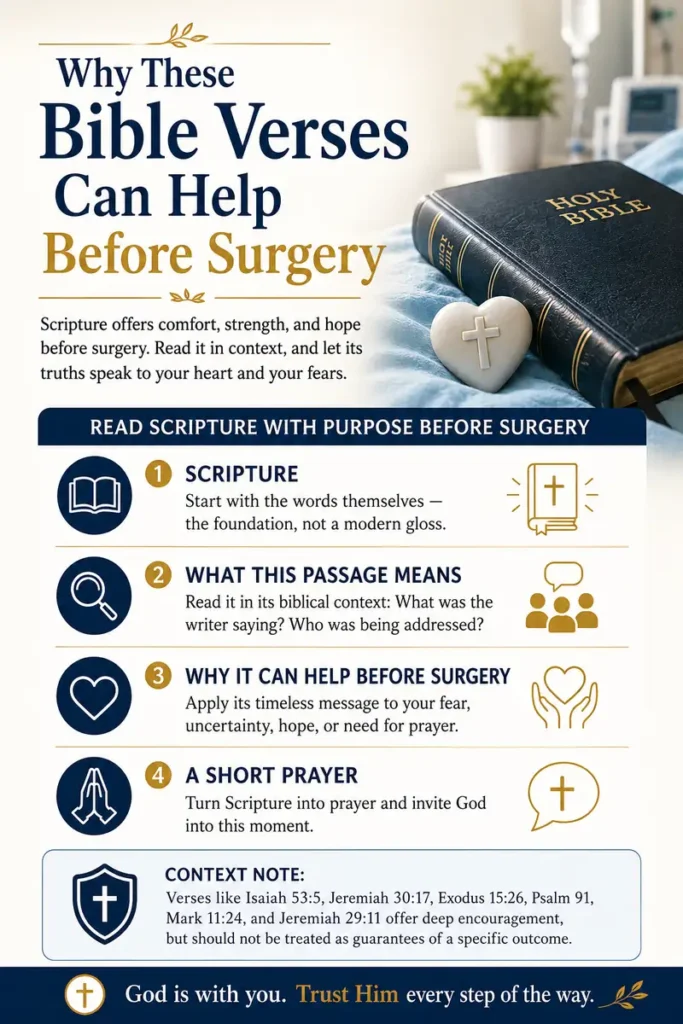
As surgery approaches, it’s natural to pray that everything goes well. Christians can ask God for a successful procedure, wisdom for the medical team, protection throughout the operation, healing afterward, and a smooth recovery.
Scripture encourages believers to bring their requests to God. At the same time, Christian prayer isn’t a way of guaranteeing a particular medical outcome. You can pray specifically and confidently while entrusting the result to God’s wisdom and care.
Can You Pray for Surgery to Go Well?
Yes. You can pray for your surgery to go well.
You can ask God to give the surgeon and medical team wisdom, skill, and careful judgment; to guide everyone involved in the procedure; to give you peace and courage beforehand; to protect you throughout the operation and recovery; to give your body strength and promote healing; to help the procedure accomplish its intended purpose; to give your family peace while they wait; and to help you trust Him with the outcome, even when you can’t control what happens.
Prayer for a successful surgery is entirely consistent with bringing your concerns and desires before God. What matters is not turning a prayer or Bible verse into a guarantee — Scripture doesn’t teach that quoting a particular passage ensures a specific result. A person can pray faithfully for successful surgery while recognizing the outcome ultimately remains in God’s hands.
That distinction can actually make prayer more honest. You don’t have to hide what you want from God. You can say, “Lord, please let this surgery go well,” while also saying, “Help me trust You with whatever happens.”
Scriptures to Pray for a Successful Surgery
Proverbs 3:5–6 — Trust God With What You Cannot Control. “Trust in the LORD with all thine heart; and lean not unto thine own understanding” (Proverbs 3:5, KJV). Surgery involves plenty you can’t fully predict or control. Use this passage to pray for wisdom, peace, and confidence as you prepare. Prayer: “Lord, I trust You with what I cannot understand or control. Guide me through this surgery and help me make wise decisions.”
James 1:5 — Ask God for Wisdom. “If any of you lack wisdom, let him ask of God, that giveth to all men liberally, and upbraideth not; and it shall be given him” (James 1:5, KJV). Especially useful when praying for wisdom — for the surgeon, anesthesiologist, nurses, other healthcare professionals, and yourself as you make decisions about your care. Prayer: “God, please give wisdom to everyone involved in my care. Give the medical team clear judgment, steady hands, and wisdom throughout the procedure.”
Psalm 121:7–8 — Pray for God’s Keeping Care. “The LORD shall preserve thee from all evil: he shall preserve thy soul… The LORD shall preserve thy going out and thy coming in from this time forth, and even for evermore” (Psalm 121:7–8, KJV). A natural passage for praying over the entire journey — not just the operation, but the trip to the hospital, the procedure, and the return home. Not a guarantee that nothing difficult will happen, but language for placing yourself under God’s continuing care. Prayer: “Lord, watch over me throughout this entire journey. Be with me as I go into surgery, during the procedure, and throughout my recovery.”
Isaiah 41:10 — Pray for Courage and Strength. “Fear thou not; for I am with thee: be not dismayed; for I am thy God” (Isaiah 41:10, KJV). If fear is making it hard to think about surgery calmly, this verse can become a prayer for courage — grounded not in the claim that nothing difficult can happen, but in the assurance that God is with His people. Prayer: “Lord, take away my fear and give me courage. Strengthen me and remind me that You are with me throughout this surgery.”
Philippians 4:6–7 — Pray Instead of Carrying Anxiety Alone. “Be careful for nothing; but in every thing by prayer and supplication with thanksgiving let your requests be made known unto God” (Philippians 4:6, KJV). Particularly relevant when your mind is filled with questions about the operation. This doesn’t mean prayer guarantees a particular surgical outcome — it means anxiety can be brought honestly before God. Prayer: “Lord, I bring my concerns about this surgery to You. Give me Your peace, guard my mind, and help me trust You with the outcome.”
A Short Prayer for Successful Surgery
You can pray this before leaving home, while traveling to the hospital, in the waiting room, or immediately before the procedure:
Heavenly Father, I place this surgery in Your hands. Please guide the surgeon, doctors, nurses, and everyone involved in my care. Give them wisdom, skill, steady hands, and clear judgment. Please give me peace and courage as I face this procedure. Protect me throughout the surgery, help my body heal, and give me strength during recovery. I ask You to let the surgery go well and to help me receive the care I need. When I am afraid, remind me that You are with me. I cannot control everything that will happen, so I entrust the outcome to You. Help me trust You before, during, and after the surgery. In Jesus’ name, Amen.
Bible Verses to Pray for the Surgeon and Medical Team
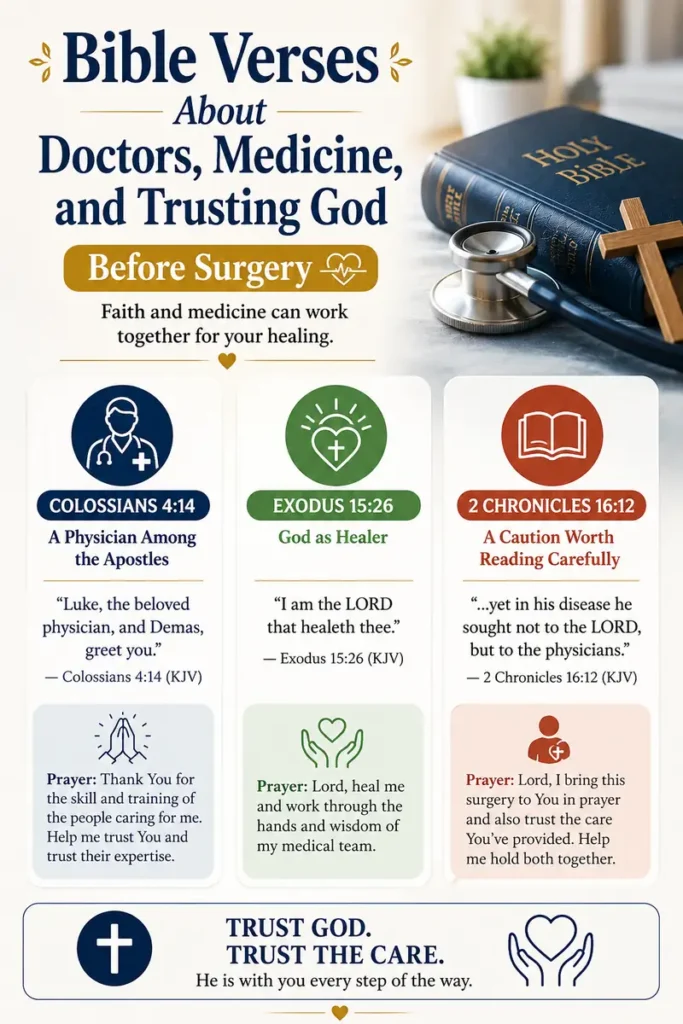
Before surgery, it’s natural to focus almost entirely on the person having the operation. But another meaningful way to pray is to remember the people who will care for them: the surgeon, anesthesiologist, nurses, technicians, and other medical professionals.
Scripture gives Christians a basis for praying for wisdom, understanding, help, and good judgment. These prayers don’t replace medical expertise or treatment — they let you ask God to guide people who are already using their training, knowledge, and professional skill to provide care.
James 1:5 — Pray for Wisdom. “If any of you lack wisdom, let him ask of God, that giveth to all men liberally, and upbraideth not; and it shall be given him” (KJV). A natural passage to pray for a medical team facing decisions during surgery — wisdom for the surgeon, anesthesiologist, nurses, and everyone involved in the patient’s care, and for yourself when discussing treatment options. Prayer: “Lord, give wisdom to everyone involved in this surgery. Help them make careful decisions and respond wisely to everything that arises.”
Proverbs 2:6 — God Gives Wisdom. “For the LORD giveth wisdom: out of his mouth cometh knowledge and understanding” (KJV). Presents wisdom as something that ultimately comes from God, connected with knowledge and understanding — a simple prayer for the medical team’s judgment and expertise, not asking God to replace their training but to guide how they use it. Prayer: “Father, give wisdom, knowledge, and understanding to the medical team caring for this patient. Guide their decisions and help them work with clarity and care.”
Psalm 121:1–2 — Help Comes From the Lord. “I will lift up mine eyes unto the hills, from whence cometh my help. My help cometh from the LORD, which made heaven and earth” (KJV). Useful before surgery because the patient and family depend on many people during the procedure — this passage lets you recognize the help the medical team provides while ultimately placing your trust in God. Prayer: “Lord, we look to You for help. Please guide everyone caring for this patient and give them wisdom, skill, and compassion.”
Prayer for the Surgeon
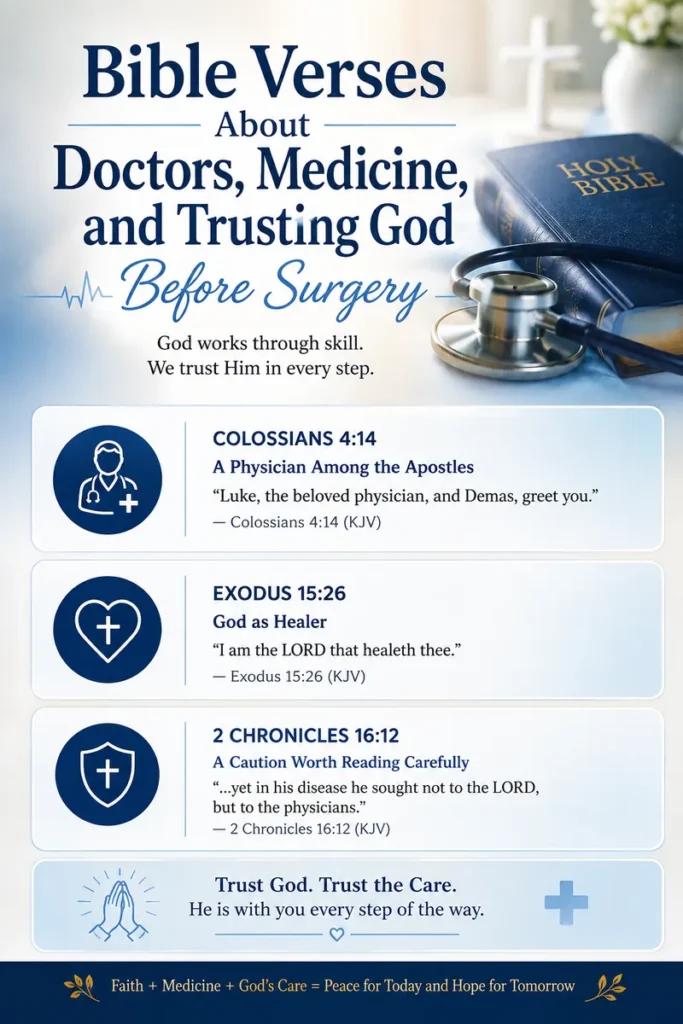
A surgeon carries significant responsibility during an operation. Pray specifically for wisdom, concentration, technical skill, careful judgment, and the ability to respond well if circumstances change.
Lord, please guide the surgeon throughout this operation. Give them wisdom, concentration, steady hands, and clear judgment. Help them use their training and experience carefully and effectively. If unexpected circumstances arise, give them the wisdom to respond appropriately. Surround the entire surgical team with Your care. Amen.
This prayer doesn’t assume a particular outcome is guaranteed — it simply asks God to guide and strengthen the professional responsible for the procedure.
Prayer for the Anesthesiologist
Lord, please give the anesthesiologist wisdom, careful judgment, and constant attentiveness throughout the surgery. Guide their decisions and help them communicate clearly with the rest of the medical team. Give them calmness and confidence as they care for the patient. Amen.
Prayer for Nurses and Medical Staff
Surgery involves far more than the person performing the operation. Nurses, technicians, assistants, and other healthcare professionals contribute to the patient’s care before, during, and after the procedure.
Lord, please strengthen and guide every nurse, technician, assistant, and healthcare professional caring for this patient. Give them patience, attentiveness, compassion, and wisdom. Help them notice what needs attention and communicate clearly with one another. Thank You for the people who are serving and caring for this patient. Amen.
Prayer for Good Communication and Care
Good care depends on communication among the patient, family, surgeon, anesthesiologist, nurses, and the rest of the healthcare team. Pray specifically for clarity and understanding.
Father, please help everyone involved in this patient’s care communicate clearly and respectfully. Give the medical team understanding and good judgment, and help the patient and family understand the information they are given. Give everyone the patience to ask questions, listen carefully, and make thoughtful decisions. Please guide the entire care team from preparation through surgery and recovery. Amen.
Praying for the Medical Team Does Not Replace Medical Care
Prayer and professional medical care aren’t competing choices. A Christian can pray for God’s guidance and still value the training, experience, technology, procedures, and professional judgment of the healthcare team — these prayers are spiritual expressions of trust and dependence on God, not medical instructions.
If you’re preparing for surgery, keep following the instructions your healthcare professionals give you, ask questions when you need clarification, and discuss medical concerns directly with your care team. The purpose of these prayers is simple: to ask God to give wisdom, strength, attentiveness, compassion, and good judgment to the people caring for you or someone you love.
Short Prayers Before Surgery
Sometimes the most helpful prayer before surgery isn’t a long one. A few sincere sentences can express fear, ask for God’s help, pray for the medical team, and place the outcome in God’s hands. Pray these yourself, read them with someone who’s having surgery, or adapt them to your own circumstances.
A 2-Sentence Prayer Before Surgery: “Heavenly Father, please be with me as I prepare for surgery, giving me peace, courage, and confidence in Your presence. Guide the medical team, protect me throughout the procedure, and help me trust You with the outcome. Amen.”
A Short Prayer for Peace: “Lord, my heart is anxious as I prepare for surgery. Please quiet my fears, give me Your peace, and help me rest in Your care. Amen.”
A Prayer for Courage: “Father, give me courage as I face this surgery. When I feel afraid, remind me that You are with me and give me strength for each step ahead. Amen.”
A Prayer for Successful Surgery: “Lord, I ask You to let this surgery go well. Give the surgeon and medical team wisdom and skill, guide every part of the procedure, and help me trust You with the result. Amen.”
A Prayer for Healing: “Merciful God, I ask You for healing and strength. Please care for my body, guide those providing my treatment, and help me place my hope and trust in You. Amen.”
A Prayer for Recovery: “Lord, please give me strength and patience throughout my recovery. Help my body heal, give me peace when progress feels slow, and help me be thankful for each step forward. Amen.”
A Prayer for the Surgeon: “God, please give the surgeon wisdom, concentration, steady hands, and good judgment throughout the operation. Guide their decisions and help them use their training and skill with care. Amen.”
A Prayer for the Medical Team: “Lord, guide everyone involved in this patient’s care. Give the doctors, nurses, anesthesiologists, technicians, and other staff wisdom, attentiveness, compassion, and clear communication. Amen.”
A Prayer for a Friend Having Surgery: “Lord, please be with my friend as they go through surgery. Give them peace and courage, guide the medical team caring for them, and strengthen them through the procedure and recovery. Amen.”
A Prayer for a Child Having Surgery: “Dear God, please stay close to this child today. Take away their fear, give them courage, guide the doctors and nurses, and help them feel safe, loved, and cared for. Amen.”
A Prayer for the Family Waiting: “Father, please give this family peace while they wait. Watch over the person having surgery, guide everyone caring for them, and give the family strength and hope as they trust You. Amen.”
A Simple Way to Pray Before Surgery
You don’t need special words. A simple prayer can follow four ideas: tell God what you’re afraid of, ask for the help you need, pray for the people providing care, and entrust the outcome to God.
“Lord, I am afraid. Please give me peace, guide the medical team, help me through this surgery, and give me strength for recovery. I place myself in Your hands. Amen.”
Scripture encourages believers to bring their requests to God honestly and specifically. Prayer before surgery can hold both faith and vulnerability together — you can ask God sincerely for healing and a successful procedure while also acknowledging that you can’t control every outcome.
A Simple 3-Verse Scripture Plan Before Surgery
You don’t need to read dozens of Bible verses before surgery. If you want a simple plan, choose three passages and read one at each stage of the journey: the night before, trust God with what you can’t control; on the way to the hospital, ask God for courage; before surgery, bring your fears and requests to God and receive His peace.
The Night Before — Proverbs 3:5–6
Focus: Trust
“Trust in the LORD with all thine heart; and lean not unto thine own understanding.” — Proverbs 3:5 (KJV)
The night before surgery, your mind may fill with questions about what tomorrow will bring. Start here, because it calls you to trust God even when you can’t understand or control everything. Read the passage slowly, identify what you’re most tempted to worry about, and consciously place those concerns before God.
Pray: “Lord, I do not know everything that tomorrow will bring. Help me trust You with what I cannot understand or control.”
On the Way to the Hospital — Isaiah 41:10
Focus: Courage
“Fear thou not; for I am with thee: be not dismayed; for I am thy God.” — Isaiah 41:10 (KJV)
As surgery gets closer, fear may grow stronger. This verse gives you a simple truth to carry: God is with you. It also speaks about His strength and help — repeat it quietly as you travel or wait to enter the hospital, focusing especially on the words “I am with thee.”
Pray: “Father, give me courage as I go to the hospital. When I feel afraid, remind me that You are with me.”
Before Surgery — Philippians 4:6–7
Focus: Peace
“But in every thing by prayer and supplication with thanksgiving let your requests be made known unto God.” — Philippians 4:6 (KJV)
Immediately before surgery, use this passage to bring everything still troubling you to God — for yourself, the surgeon, the anesthesiologist, nurses, and everyone involved in your care. Ask for healing, protection, wisdom, and a successful procedure. Then let “the peace of God, which passeth all understanding” guard your heart and mind.
Pray: “Lord, I give You my fears, requests, and hopes. Give me Your peace, guard my heart and mind, and help me trust You as I go into surgery.”
How to Pray These Three Verses
Turn the three verses into a simple sequence rather than just reading them:
- Read — take in the Scripture slowly, more than once if you can.
- Reflect — ask yourself what you’re feeling, what you’re afraid of, what you’re trying to control.
- Pray — turn the verse’s central message into your own words.
- Entrust — ask sincerely for a successful procedure, healing, protection, wisdom, and a good recovery, then acknowledge that you can’t control every outcome and place yourself in God’s care.
- Repeat — return to the same verse when anxiety rises rather than searching for a new one each time.
| When | Scripture | Focus |
| Night before surgery | Proverbs 3:5–6 | Trust |
| On the way to the hospital | Isaiah 41:10 | Courage |
| Before surgery | Philippians 4:6–7 | Peace |
Together, these three passages create a simple spiritual rhythm for the day: trust what you can’t control, find courage in God’s presence, and bring your anxiety to God in prayer.
A 7-Day Bible Reading Plan Before Surgery
If you have a week before surgery, you don’t need to read a large number of passages every day. A focused plan lets you approach the operation one day at a time, moving through a deliberate progression: trust → fear → courage → God’s presence → peace → God’s care → Christ’s peace.
| Time | Scripture | Focus |
| 7 days before | Proverbs 3:5–6 | Trust |
| 6 days before | Psalm 56:3 | Fear |
| 5 days before | Isaiah 41:10 | Courage |
| 4 days before | Psalm 23:4 | God’s presence |
| 3 days before | Philippians 4:6–7 | Peace |
| 2 days before | Psalm 121:7–8 | God’s care |
| Surgery morning | John 14:27 | Christ’s peace |
7 Days Before — Trust (Proverbs 3:5–6). Begin the week by acknowledging that you can’t know or control everything about the days ahead. Practical step: Write down one thing about the surgery you can’t control and consciously place it in God’s hands. Prayer: “Lord, help me trust You with what I cannot understand or control.”
6 Days Before — Fear (Psalm 56:3). Instead of pretending you’re not afraid, name the fear honestly — the verse gives you a simple response when it appears: trust God. Practical step: Each time the same fear returns, repeat Psalm 56:3 instead of letting the thought spiral. Prayer: “Lord, You know what I am afraid of. Help me bring that fear to You and trust You.”
5 Days Before — Courage (Isaiah 41:10). The focus shifts from recognizing fear to remembering God’s presence and strength. Practical step: Memorize one short phrase — “I am with thee” — and repeat it whenever you think about the surgery. Prayer: “Father, give me courage and remind me that I do not face this experience alone.”
4 Days Before — God’s Presence (Psalm 23:4). God’s presence isn’t limited to comfortable circumstances; the Shepherd stays with His people even in the valley. Practical step: Read Psalm 23 slowly and focus on the image of God accompanying you through difficult places. Prayer: “Lord, stay close to me in every stage of this journey. Help me remember that You are with me.”
3 Days Before — Peace (Philippians 4:6–7). Concerns about the surgery may be getting more specific by now — turn them into prayer instead of carrying them silently. Practical step: List your main concerns and pray through each one: peace before the procedure, wisdom for the medical team, courage during the operation, healing and recovery, strength for your family, wisdom for decisions that need to be made. Prayer: “Lord, I bring every concern to You. Guard my heart and mind with Your peace.”
2 Days Before — God’s Care (Psalm 121:7–8). As surgery gets closer, this Psalm is a reminder of God’s continuing care over the entire journey. Practical step: If you have time, read verses 1–8 rather than stopping at 7–8, and notice how the psalm keeps directing attention back to God as the source of help. Prayer: “Lord, watch over me as I prepare for surgery. Care for me throughout the procedure and recovery.”
Surgery Morning — Christ’s Peace (John 14:27). You may not have the time or emotional energy for extended Bible study this morning — this is a moment for a simple reminder of Christ’s peace. Practical step: Read the verse slowly before leaving for the hospital or while waiting for the procedure, and repeat “my peace I give unto you” when anxiety rises. Prayer: “Jesus, give me Your peace this morning. Help me trust You and remain calm as I prepare for surgery.”
How to Use the 7-Day Plan
Keep the routine simple — you don’t need to spend an hour studying Scripture each day.
- Read the day’s passage slowly, once or twice.
- Identify the focus — what you most need from God that day: trust, courage, peace, or the assurance of His presence.
- Pray specifically about the actual concerns you’re carrying — successful surgery, healing, wisdom for the medical team, protection, recovery.
- Carry one phrase from the day’s passage with you.
- Don’t treat the plan as a formula. Completing seven readings doesn’t guarantee a particular outcome — the point is a simple rhythm of Scripture and prayer as surgery approaches.
- Adjust it to your schedule. If surgery is only three days away, don’t start over — just choose the passages that speak most directly to what you need today.
How to Use Bible Verses Before Surgery
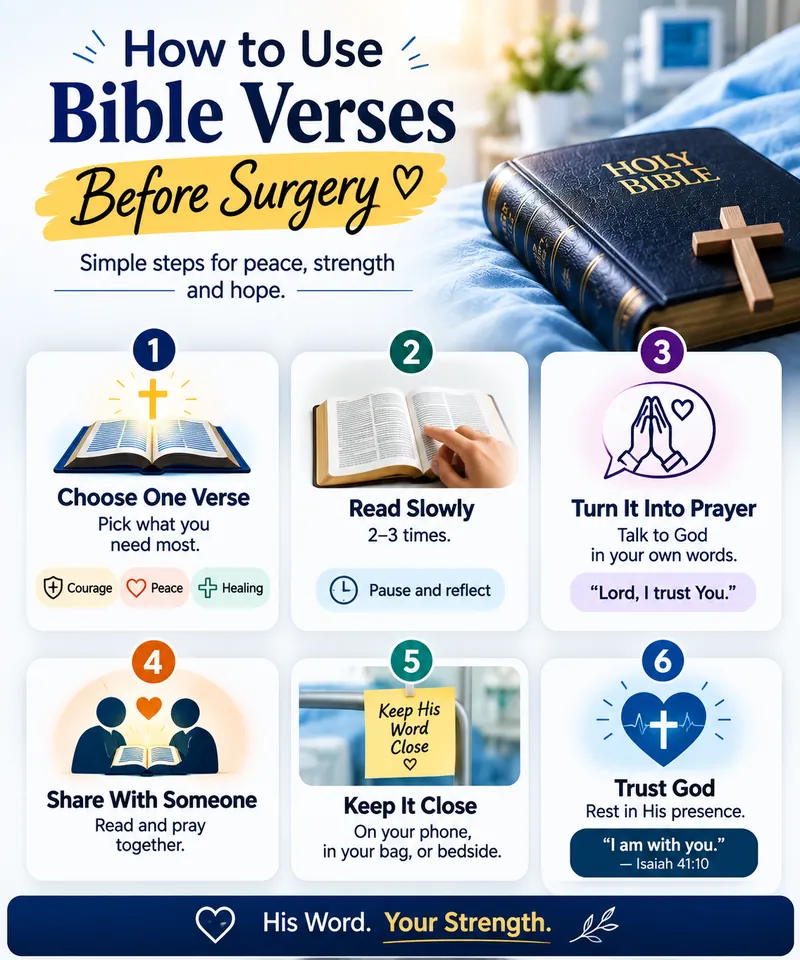
You don’t need to read every passage in this article before surgery. Scripture is often most meaningful when you slow down, choose a passage that speaks to what you’re experiencing, and use it as a starting point for prayer — read privately, share a verse with someone you love, or pray through the passage together.
Choose One Verse Instead of Trying to Read Everything
There’s no need to turn this into a Bible-reading assignment. If you’re anxious, choose a verse about peace. If you’re afraid, choose one about courage or trust. If you’re praying for healing, choose a passage that helps you express that request to God.
- Fear: Psalm 56:3
- Courage: Isaiah 41:10
- Peace: Philippians 4:6–7
- Trust: Proverbs 3:5–6
- Comfort: Psalm 23:4
- Protection: Psalm 91
- Healing: James 5:14–15
One verse you genuinely understand and pray through can mean more than rushing through dozens.
Read the Passage Slowly
Read the verse or passage slowly, two or three times, rather than rushing through the words. Pay attention to what stands out. Ask yourself what the passage actually says about God, what concern you’re bringing to Him right now, whether there’s a phrase you can carry with you while you wait, and how you might turn it into a prayer.
Reading Psalm 56:3 — “What time I am afraid, I will trust in thee” — you might pause on the two ideas inside it: “I am afraid” and “I will trust.” You don’t have to deny the first to practice the second.
Turn the Verse Into a Prayer
One of the simplest ways to use Scripture before surgery is to turn its central message into your own prayer.
Isaiah 41:10 becomes: “Lord, I am afraid, but You have reminded me that You are with me. Give me strength and help me through this surgery.” Philippians 4:6–7 becomes: “Lord, I bring my worries to You. Please guard my heart and mind with Your peace.” That lets Scripture become something you actively pray, not just something you read.
Save It on Your Phone
Choose one or two verses and keep them somewhere you can easily reach — a saved note, a screenshot, a phone reminder, a lock-screen message, a text to yourself, or a Bible app open to the passage. This matters most when anxiety returns while you’re waiting for surgery — a short verse like Psalm 56:3 or Isaiah 41:10 can be read again without searching through the whole Bible.
Share It With Someone You Trust
You don’t have to face the emotional side of surgery alone. Send a meaningful verse to a family member, friend, or pastor, along with something as simple as: “This verse is helping me as I prepare for surgery. Would you pray for me?” Sharing Scripture also gives the person supporting you something specific to pray about.
Pray With Family or Friends
If you have family members or close friends who share your faith, consider praying together before surgery. Keep it simple: read one passage, briefly say what you’re asking God for, and pray together — for peace for the patient, courage before the procedure, wisdom for the medical team, successful surgery, healing and recovery, strength for family members, or peace while waiting for news. The prayer doesn’t need to be long or elaborate. A few sincere words are enough.
Keep Medical Decisions With Your Healthcare Team
Bible verses and prayer offer spiritual comfort, but they shouldn’t replace professional medical care or medical decision-making. Take questions about the surgery, anesthesia, medications, risks, preparation, recovery, or alternatives to your qualified healthcare professionals, and follow their instructions.
You can pray for wisdom while also asking your healthcare team questions. You can pray for healing while also receiving appropriate treatment. You can pray for the surgeon while recognizing the surgeon’s training and professional expertise. And you can trust God without assuming that a particular Bible verse guarantees a particular medical outcome. A healthy approach lets Scripture guide your faith and prayer while your healthcare team guides your medical care — the purpose of these verses is not to tell you what medical decision to make, but to help you face an uncertain experience with prayer, courage, peace, and trust.
What These Bible Verses Can—and Cannot—Promise
Bible verses can offer genuine comfort before surgery, but they’re most meaningful when understood for what they actually say. Scripture can point you toward God’s presence, give you words for prayer, strengthen your trust, and encourage hope. It shouldn’t be turned into a formula that guarantees a particular medical outcome — and that distinction doesn’t make prayer less meaningful. It makes the way we use Scripture more honest and more faithful to its message.
Scripture Can Point You to God’s Presence
Many of the most comforting passages before surgery focus on the fact that God is with His people. Isaiah 41:10 says, “Fear thou not; for I am with thee.” Psalm 23:4 says, “For thou art with me.” Neither requires you to believe that difficult circumstances can’t happen — their encouragement comes from God’s presence in the middle of them. Before surgery, that’s worth remembering: you can face an uncertain moment while trusting that God is not absent from it.
Scripture Can Help You Pray Through Fear
The Bible doesn’t treat fear as something that must always be hidden or denied. Psalm 56:3 says, “What time I am afraid, I will trust in thee” — notice the progression: David acknowledges fear, then turns toward trust. Philippians 4:6 similarly encourages believers to bring their concerns to God through prayer and supplication.
That gives you permission to be honest with God before surgery: I am afraid. I do not know what will happen. I am worried about the outcome. Please help me. Faith doesn’t require pretending those feelings aren’t real — Scripture gives you a way to bring them into prayer instead.
Scripture Can Encourage Trust and Hope
Proverbs 3:5–6 encourages believers to trust God even when they don’t understand everything happening around them. Trust doesn’t mean knowing exactly how the surgery will turn out — it means recognizing the limits of your own understanding and continuing to place your confidence in God. Psalm 62 adds to this, encouraging believers to wait on God and make Him their refuge.
Before surgery, hope can mean more than expecting a particular result. It can mean placing your future, your fears, and your uncertainty in God’s hands.
Prayer Can Include Requests for Healing
Christians don’t need to hesitate before asking God for healing. Scripture contains direct prayers for it — “Heal me, O LORD, and I shall be healed” (Jeremiah 17:14, KJV) — and James 5:14–15 specifically calls for prayer when someone is sick. You can sincerely pray for healing, a successful procedure, wisdom for the medical team, protection throughout the surgery, strength during recovery, relief from pain, and peace for yourself and your family. There’s no need to keep your prayer vague out of fear of asking for too much.
At the same time, Christian prayer can hold both request and surrender together: “Lord, please heal me and let this surgery go well. Help me trust You with the outcome.” That lets you express what you genuinely want without claiming to know in advance exactly what God will do.
Scripture Does Not Give a Guaranteed Surgical Outcome
This is one of the most important distinctions in using Bible verses before surgery. A passage about healing doesn’t automatically mean a particular person will receive immediate physical healing. A passage about protection doesn’t mean complications are impossible. A passage about God’s plans doesn’t guarantee a desired outcome. And strong faith doesn’t give a person control over the medical result.
Psalm 91 can encourage someone to take refuge in God, but shouldn’t be presented as a guarantee that nothing painful or medically difficult can happen. Mark 11:24 encourages faith-filled prayer, but shouldn’t be turned into a formula claiming that sufficient belief forces a particular outcome.
This distinction also protects people from a harmful conclusion after an unexpected result: If my surgery did not go as I prayed, my faith must have been weak. That’s not a conclusion anyone should place on someone who is already suffering. A person’s medical outcome shouldn’t be used to measure the strength or sincerity of their faith.
Faith Does Not Mean You Must Pretend You Are Not Afraid
One of the most comforting things about the Bible is that it never presents faithful people as people who never feel fear. The Psalms are full of prayers from people who are distressed, uncertain, overwhelmed, and crying out to God. David can say, “What time I am afraid, I will trust in thee” (Psalm 56:3, KJV) — not “if I trust God, I will never feel afraid,” but “when I am afraid, I will trust in thee.” That difference matters.
You can have faith and still feel nervous before surgery. You can trust God and still have questions. You can pray for healing and still feel uncertain about the outcome. You can believe God is present and still wish the situation were different. None of those feelings mean your faith has failed. Biblical trust isn’t the requirement to manufacture a fearless emotional state — it’s the decision to turn toward God even when fear is present.
A Balanced Way to Approach Surgery With Scripture
Pray for what you want — ask God sincerely for a successful surgery, healing, protection, wisdom, and recovery. Acknowledge what you feel — you don’t need to hide fear, sadness, or uncertainty from God. Trust God’s presence — difficult circumstances don’t mean God has abandoned you. Use Scripture according to its meaning — read passages in context rather than treating individual verses as guarantees. Value medical care — prayer and professional medical care don’t compete; you can pray for the medical team while relying on their training and expertise. And entrust the outcome to God — faith doesn’t mean knowing exactly what will happen, only continuing to trust Him when the outcome isn’t fully within your control.
Ultimately, these Bible verses aren’t meant to promise that surgery will unfold exactly as hoped. They can help you pray honestly, face fear with courage, remember God’s presence, and place an uncertain future in His hands.
A Note About Prayer, Scripture, and Medical Care
The Bible verses and prayers in this guide are offered for spiritual encouragement and support as you prepare for surgery. They are not medical advice and should not replace professional medical care.
Follow the instructions provided by your surgeon and healthcare team, and speak with qualified medical professionals about questions or concerns related to your surgery, treatment, medications, risks, or recovery. You can pray for healing, wisdom, protection, and a successful surgery while also receiving appropriate medical care — prayer and professional healthcare can be practiced together.
Quick Answers About Bible Verses Before Surgery
If you’re looking for a quick Scripture recommendation before surgery, start with the passage that matches what you need most — peace, courage, trust, healing, or God’s presence. There’s no single Bible verse specifically written about modern surgery, but many passages speak directly to the fears and spiritual needs that surround an operation.
What is the best Bible verse before surgery? Isaiah 41:10 is one of the strongest choices for a general Bible verse before surgery: “Fear thou not; for I am with thee: be not dismayed; for I am thy God” (KJV). It addresses fear, God’s presence, strength, and help — a strong starting point if you want one verse to read before entering the hospital or operating room.
What is a good short Bible verse for surgery? Psalm 56:3 is one of the best short verses to remember: “What time I am afraid, I will trust in thee” (KJV). Brief enough to memorize, and it addresses being afraid while choosing to trust God in the same breath.
What Bible verse is good for surgery anxiety? Philippians 4:6–7 is especially fitting because it tells believers to bring their requests and concerns to God through prayer and points toward His peace guarding the heart and mind. A shorter option is Psalm 56:3.
What Bible verse is good for healing after surgery? James 5:14–15 is one of the most directly relevant passages because it specifically addresses sickness and prayer. Psalm 41:3 is also meaningful during recovery because it speaks about God’s sustaining care for someone who is sick. You can pray for healing while entrusting the recovery process to God and following your healthcare team’s guidance.
What Psalm is good before surgery? There’s no officially designated “Psalm for surgery,” but several apply well: Psalm 23 for comfort and God’s presence, Psalm 91 for refuge and protection, Psalm 121 for God’s keeping care and help, Psalm 46 for strength and help in trouble, Psalm 56 for fear and trust, and Psalm 4 for peace and rest. If you’re unsure where to start, Psalm 23 is a strong choice for comfort, while Psalm 56 is especially suitable if fear is your main concern.
Is there a Bible verse for successful surgery? There’s no Bible verse specifically promising that a modern surgical procedure will be successful. However, you can pray for a successful surgery using passages such as Proverbs 3:5–6, James 1:5, Isaiah 41:10, Psalm 121:7–8, and Philippians 4:6–7 — asking God for wisdom for the medical team, protection, healing, and a good recovery while entrusting the final outcome to Him.
What Bible verse can I send to a friend before surgery? Isaiah 41:10 is a strong choice: “Fear thou not; for I am with thee” (KJV). You could also send Psalm 56:3 if your friend is afraid, Philippians 4:6–7 if they’re anxious, or Psalm 23:4 if they need comfort. A simple message: “Praying for you before your surgery. May God give you peace and courage and remind you that He is with you.”
What Scripture is good for a child having surgery? Psalm 121:7–8 is a comforting choice because it emphasizes God’s care and keeping: “The LORD shall preserve thy going out and thy coming in” (KJV). Isaiah 41:10 is another good choice for God’s presence and courage. For a very young child, Psalm 23:4 can be simplified to its reassuring phrase: “For thou art with me.” The best verse for a child is often one that can be explained simply and repeated calmly.
What is a good KJV Bible verse before surgery? Isaiah 41:10 (KJV) is an excellent general choice: “Fear thou not; for I am with thee: be not dismayed; for I am thy God.” For a short KJV verse, choose Psalm 56:3: “What time I am afraid, I will trust in thee.” For peace, Philippians 4:6–7 is strong; for healing, James 5:14–15 is particularly relevant; for protection, Psalm 91 can be read as a prayer of refuge and trust. These are KJV passages applied to the experience of surgery — none was originally written as a modern surgical instruction or guarantee.
Frequently Asked Questions About Bible Quotes Before Surgery
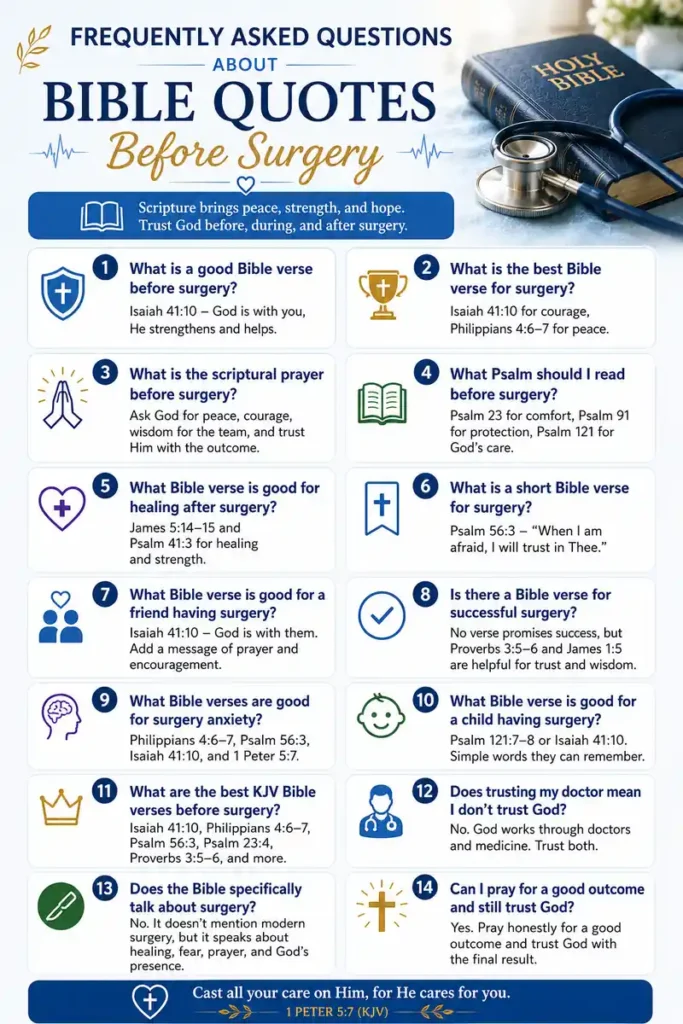
What is a good Bible verse before surgery? Isaiah 41:10 is a strong choice: “Fear thou not; for I am with thee: be not dismayed; for I am thy God” (KJV). It addresses fear, God’s presence, strength, and help, making it appropriate for someone preparing for an uncertain medical experience.
What is the best Bible verse for surgery? There’s no single Bible verse specifically designated for surgery. Isaiah 41:10 is an excellent general choice, Philippians 4:6–7 is particularly good for anxiety, and Psalm 23:4 is strong for comfort and God’s presence. The best passage depends on what you need most at that moment.
What is the scriptural prayer before surgery? A simple Scripture-based prayer: “Heavenly Father, please be with me as I prepare for surgery. Give me peace, courage, and strength, guide the medical team with wisdom and skill, and help me trust You with the outcome. Please care for me throughout the procedure and recovery. In Jesus’ name, Amen.” Philippians 4:6–7 is a fitting biblical foundation for this kind of prayer because it encourages believers to bring their requests to God.
What Psalm should I read before surgery? There’s no officially designated Psalm for surgery, but several fit different needs: Psalm 23 for comfort and God’s presence, Psalm 91 for refuge and protection, Psalm 121 for God’s keeping care, Psalm 46 for help and strength in trouble, Psalm 56 for fear and trust, and Psalm 4 for peace and rest. If you want one Psalm to start with, Psalm 23 is a particularly accessible choice for comfort.
What Bible verse is good for healing after surgery? James 5:14–15 is one of the most directly relevant passages because it addresses sickness and prayer. Psalm 41:3 is also meaningful during recovery because it speaks about God’s sustaining care for someone who is sick. These passages can be used to pray for healing and strength without treating them as guarantees of a particular medical outcome.
What is a short Bible verse for surgery? Psalm 56:3 is one of the best short choices: “What time I am afraid, I will trust in thee” (KJV) — brief, easy to remember, and it directly addresses the experience of fear. Another short option: “For thou art with me” (Psalm 23:4, KJV).
What Bible verse is good for a friend having surgery? Isaiah 41:10 is an excellent verse to send to a friend: “Fear thou not; for I am with thee” (KJV). You could also choose Philippians 4:6–7 for anxiety, Psalm 56:3 for fear, or Psalm 121:7–8 when praying for God’s care. A simple message to accompany the verse: “Praying for you before your surgery. May God give you peace, courage, and strength, and remind you that He is with you.”
Is there a Bible verse for successful surgery? There’s no Bible verse specifically promising that a modern surgery will be successful, but Christians can certainly pray for a successful procedure. Useful passages include Proverbs 3:5–6 for trust, James 1:5 for wisdom, Isaiah 41:10 for courage, and Philippians 4:6–7 for peace. You can ask God for a good outcome, wisdom for the medical team, protection, healing, and recovery while entrusting the final outcome to Him.
What Bible verses are good for surgery anxiety? Several passages fit especially well: Psalm 56:3 when you’re afraid, Philippians 4:6–7 when anxiety is overwhelming, Isaiah 41:10 when you need courage, 1 Peter 5:7 when you can’t stop worrying, Psalm 62:5–8 while waiting, John 14:27 when you need peace, and Psalm 23:4 when you need to remember God’s presence. If anxiety is your main concern, Philippians 4:6–7 is particularly useful because it explicitly directs you to bring your concerns to God through prayer.
What Bible verse is good for a child having surgery? Psalm 121:7–8 is a comforting choice because it speaks about God’s keeping care: “The LORD shall preserve thy going out and thy coming in” (KJV). Isaiah 41:10 is another good choice for courage and God’s presence. For a younger child, Psalm 23:4 can be reduced to a simple phrase: “For thou art with me.” Choose a verse the child can understand, remember, and repeat without feeling overwhelmed.
What are the best KJV Bible verses before surgery? Some of the most useful KJV passages include Isaiah 41:10 for courage and God’s presence, Philippians 4:6–7 for peace and prayer, Psalm 56:3 for fear and trust, Psalm 23:4 for comfort, Proverbs 3:5–6 for trusting God, Psalm 91:1–2 for refuge, Psalm 121:7–8 for God’s keeping care, James 5:14–15 for sickness and prayer, Isaiah 40:29 for strength, and John 14:27 for Christ’s peace. If you want one short KJV verse, Psalm 56:3 is especially easy to memorize.
Does trusting my doctor mean I don’t trust God? No. Scripture treats medical skill and God’s healing as working together rather than competing. Luke, who wrote two New Testament books, was himself a physician (Colossians 4:14), and God is repeatedly named as the source of healing without ruling out the means He uses to bring it. The caution in passages like 2 Chronicles 16:12 is against seeking physicians instead of God, not against seeking medical care at all.
Does the Bible specifically talk about surgery? No. The Bible doesn’t discuss modern surgery, operating rooms, anesthesia, or contemporary surgical procedures. It does address sickness, healing, suffering, fear, prayer, wisdom, God’s presence, and dependence on God — themes that can be applied to the experience of facing surgery, though they shouldn’t be presented as though they were originally written about modern operations. This distinction matters most when interpreting verses about healing and protection: Scripture can encourage prayer and trust without guaranteeing a particular medical outcome.
Final Encouragement Before Surgery
As surgery approaches, you may not know exactly what the next few hours or days will bring. You may feel calm one moment and afraid the next, and you don’t have to have every answer before you walk into the hospital.
Bring your fears to God. Ask for wisdom for the medical team, strength for yourself, healing and recovery, and peace for the people who love you. You can pray honestly for the outcome you hope for while still placing the things you cannot control in God’s hands.
Faith doesn’t require you to pretend you’re not afraid. You can be afraid and still trust God. You can have questions and still pray. You can face uncertainty while remembering that God’s presence doesn’t depend on your ability to predict what happens next.
Let these words from Isaiah be your final reminder:
“Fear thou not; for I am with thee: be not dismayed; for I am thy God.” — Isaiah 41:10 (KJV)
Whatever emotions you carry into this moment, you do not have to carry them alone.
A Short Prayer Before Surgery
Heavenly Father, Please be with me as I face this surgery. Give me peace when I am anxious, courage when I am afraid, and strength for each step ahead. Give wisdom and skill to everyone caring for me, and please guide me through the procedure and recovery. I ask You for healing and a good outcome, while placing what I cannot control in Your hands. Help me remember that You are with me. In Jesus’ name, Amen.