
Bible Quotes About Drama: What the Bible Says About Conflict & Gossip
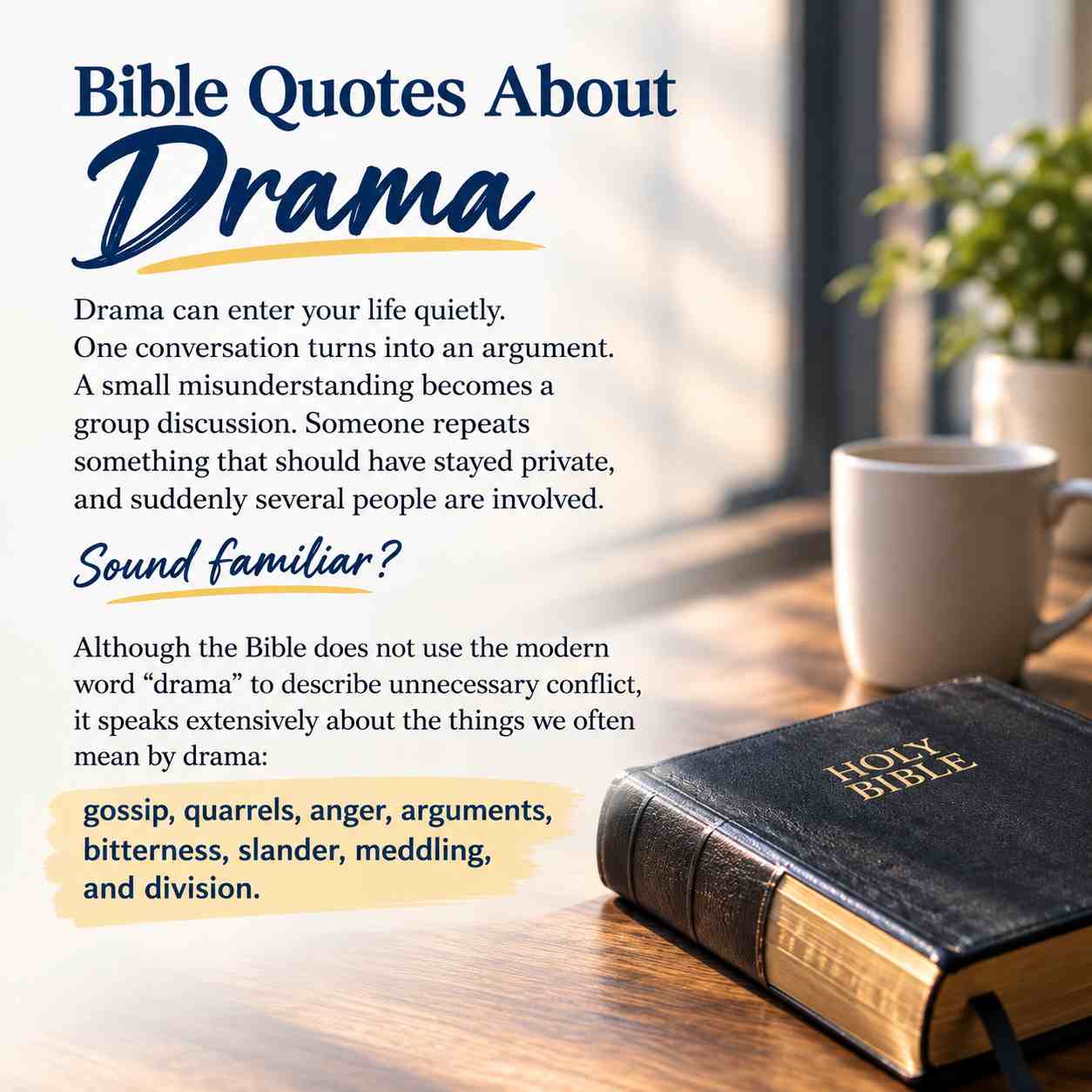
Drama can enter your life quietly. One conversation turns into an argument. A small misunderstanding becomes a group discussion. Someone repeats something that should have stayed private, and suddenly several people are involved.
Sound familiar?
Although the Bible does not use the modern word “drama” to describe unnecessary conflict, it speaks extensively about the things we often mean by drama: gossip, quarrels, anger, arguments, bitterness, slander, meddling, and division.
The good news is that Scripture also provides a better path. Instead of feeding conflict, we can pursue wisdom. Instead of answering anger with anger, we can choose gentleness. Instead of spreading gossip, we can protect someone’s privacy. And instead of trying to win every argument, we can sometimes choose peace.
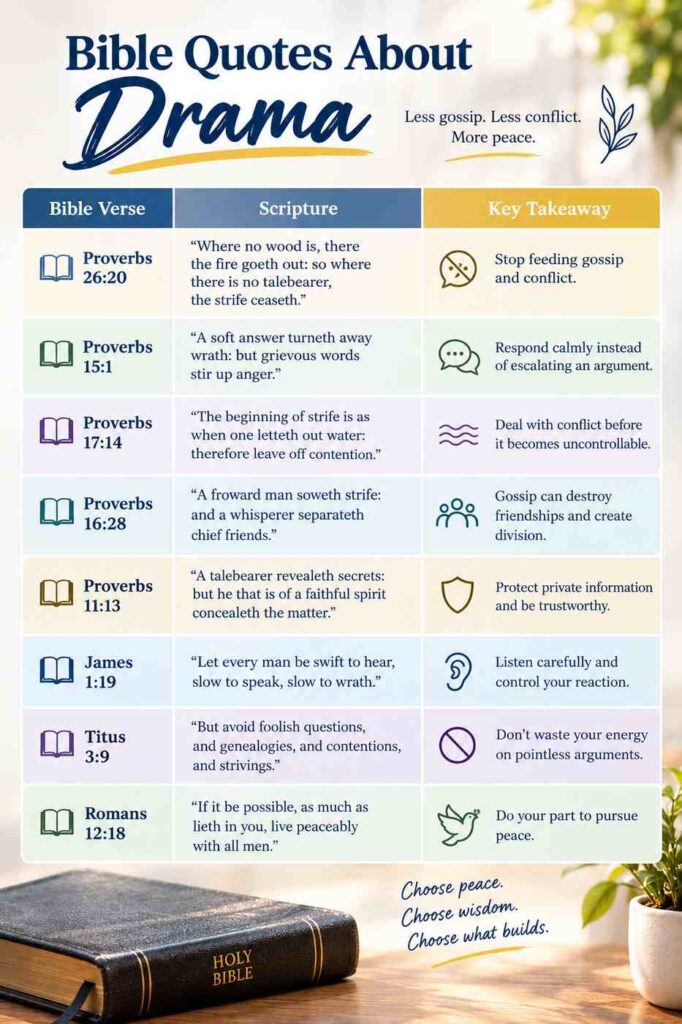
| Bible Verse | Quote | Key Lesson |
|---|---|---|
| Proverbs 26:20 | “Where no wood is, there the fire goeth out: so where there is no talebearer, the strife ceaseth.” | Stop feeding gossip and conflict. |
| Proverbs 15:1 | “A soft answer turneth away wrath: but grievous words stir up anger.” | Respond calmly instead of escalating an argument. |
| Proverbs 17:14 | “The beginning of strife is as when one letteth out water: therefore leave off contention.” | Deal with conflict before it becomes uncontrollable. |
| Proverbs 16:28 | “A froward man soweth strife: and a whisperer separateth chief friends.” | Gossip can destroy friendships and create division. |
| Proverbs 11:13 | “A talebearer revealeth secrets: but he that is of a faithful spirit concealeth the matter.” | Protect private information and be trustworthy. |
| James 1:19 | “Let every man be swift to hear, slow to speak, slow to wrath.” | Listen carefully and control your reaction. |
| Titus 3:9 | “But avoid foolish questions, and genealogies, and contentions, and strivings.” | Don’t waste your energy on pointless arguments. |
| Romans 12:18 | “If it be possible, as much as lieth in you, live peaceably with all men.” | Do your part to pursue peace. |
| Matthew 5:9 | “Blessed are the peacemakers: for they shall be called the children of God.” | Choose to create peace rather than conflict. |
| Ephesians 4:31 | “Let all bitterness, and wrath, and anger, and clamour, and evil speaking, be put away from you.” | Let go of attitudes that fuel drama. |
| Colossians 3:13 | “Forbearing one another, and forgiving one another, if any man have a quarrel against any.” | Practice patience and forgiveness after conflict. |
| Proverbs 10:12 | “Hatred stirreth up strifes: but love covereth all sins.” | Love can prevent minor offenses from becoming major conflicts. |
| Proverbs 22:3 | “A prudent man foreseeth the evil, and hideth himself.” | Wisdom sometimes means stepping away from harmful situations. |
| Proverbs 20:3 | “It is an honour for a man to cease from strife.” | Walking away from unnecessary conflict can be wise. |
| Psalm 34:14 | “Depart from evil, and do good; seek peace, and pursue it.” | Don’t merely avoid drama—actively pursue peace. |
| Philippians 2:14 | “Do all things without murmurings and disputings.” | Avoid constant complaining and arguing. |
| Ephesians 4:32 | “And be ye kind one to another, tenderhearted, forgiving one another.” | Kindness and forgiveness can replace resentment. |
| Proverbs 14:29 | “He that is slow to wrath is of great understanding.” | Self-control is a sign of wisdom. |
| Proverbs 18:8 | “The words of a talebearer are as wounds.” | Gossip can cause deep emotional harm. |
| Proverbs 26:17 | “He that passeth by, and meddleth with strife belonging not to him…” | Stay out of conflicts that do not concern you. |
Here are some of the most meaningful Bible quotes about drama, along with practical lessons for dealing with conflict in everyday life.
What Does the Bible Say About Drama?
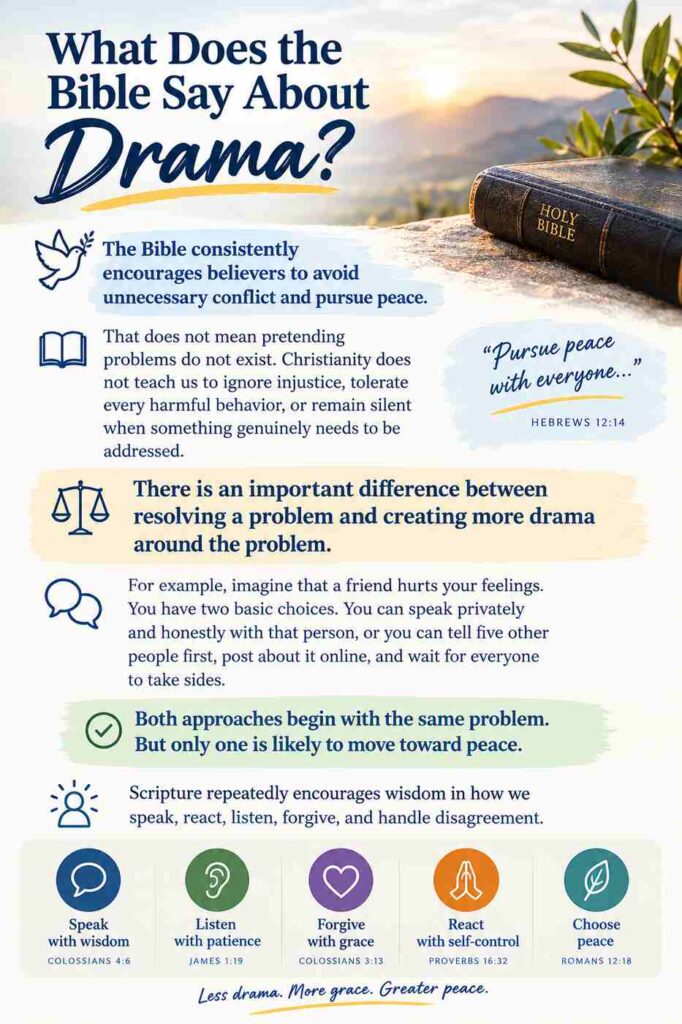
The Bible consistently encourages believers to avoid unnecessary conflict and pursue peace.
That does not mean pretending problems do not exist. Christianity does not teach us to ignore injustice, tolerate every harmful behavior, or remain silent when something genuinely needs to be addressed.
There is an important difference between resolving a problem and creating more drama around the problem.
For example, imagine that a friend hurts your feelings. You have two basic choices. You can speak privately and honestly with that person, or you can tell five other people first, post about it online, and wait for everyone to take sides.
Both approaches begin with the same problem. But only one is likely to move toward peace.
Scripture repeatedly encourages wisdom in how we speak, react, listen, forgive, and handle disagreement.
Does the Bible Use the Word “Drama”?
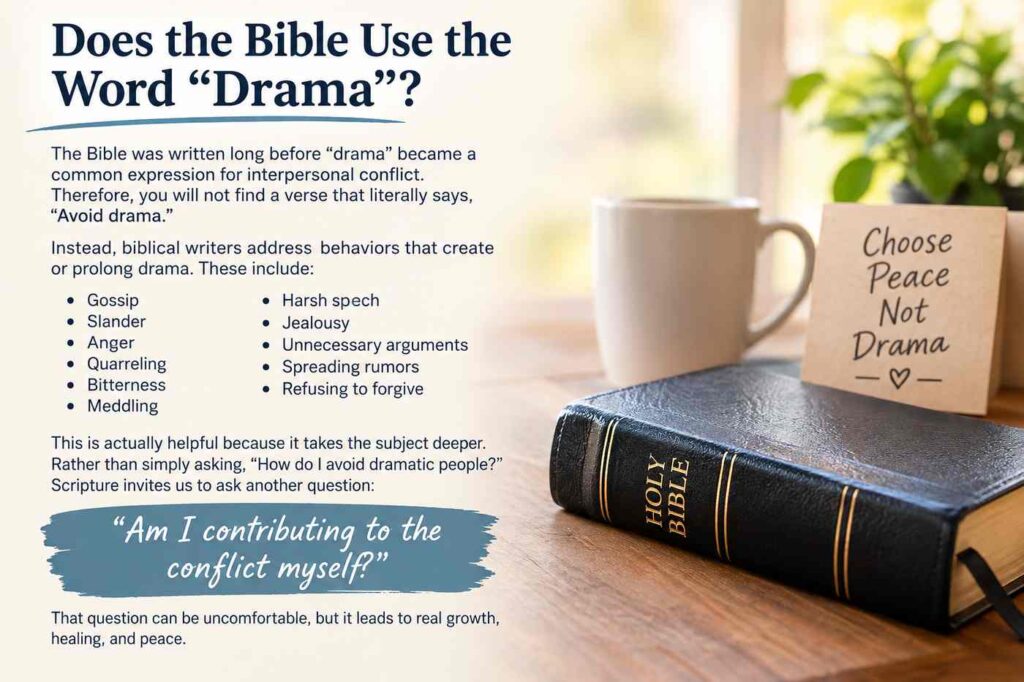
The Bible was written long before “drama” became a common expression for interpersonal conflict. Therefore, you will not find a verse that literally says, “Avoid drama.”
Instead, biblical writers address behaviors that create or prolong drama.
These include:
- Gossip
- Slander
- Anger
- Quarreling
- Bitterness
- Meddling
- Harsh speech
- Jealousy
- Unnecessary arguments
- Spreading rumors
- Refusing to forgive
This is actually helpful because it takes the subject deeper.
Rather than simply asking, “How do I avoid dramatic people?” Scripture invites us to ask another question:
“Am I contributing to the conflict myself?”
That question can be uncomfortable, but it can also be transformative.
Bible Verses About Avoiding Drama
Proverbs 26:20 — Stop Feeding the Fire
“Where no wood is, there the fire goeth out: so where there is no talebearer, the strife ceaseth.” — Proverbs 26:20, KJV
Think about a fire. It needs fuel to keep burning.
Conflict can work in much the same way.
A disagreement may begin with one small incident, but gossip, accusations, screenshots, angry messages, and repeated conversations can keep it alive.
Proverbs gives us a simple picture: remove the fuel, and the fire eventually goes out.
This does not mean every problem disappears by ignoring it. Serious matters may require direct conversation or appropriate action. But unnecessary conflict often survives because people continue feeding it.
Sometimes peace begins with refusing to repeat the story.
Proverbs 15:1 — Answer Anger With Gentleness
“A soft answer turneth away wrath: but grievous words stir up anger.” — Proverbs 15:1, KJV
Have you ever noticed how quickly one harsh sentence can change an entire conversation?
Someone says something offensive. You respond more aggressively. They become defensive. You become even more frustrated. Ten minutes later, you’re arguing about things neither of you intended to discuss.
Proverbs presents another approach: a soft answer.
Gentleness is not weakness. You can be firm without being hostile. You can disagree without insulting someone. You can establish boundaries without turning the conversation into a battle.
The next time a conversation becomes heated, pause before responding.
Ask yourself: Will my next sentence calm this situation or add fuel to it?
Proverbs 17:14 — Know When to Walk Away
“The beginning of strife is as when one letteth out water: therefore leave off contention, before it be meddled with.” — Proverbs 17:14, KJV
Once water escapes through a broken barrier, it can be difficult to control.
Arguments can be similar.
A disagreement that could have been resolved in five minutes can become a three-hour battle when pride enters the conversation.
This verse encourages wisdom at the beginning of conflict. Do not wait until an argument has become uncontrollable before deciding that enough is enough.
Sometimes the wise response is to pause, step away, pray, and return to the conversation later.
Bible Quotes About Gossip and Drama
Gossip is one of the easiest ways for drama to spread.
A person tells you something about someone else. You tell another person. They add their interpretation. Someone else hears a different version. Before long, the original story has changed completely.
The Bible repeatedly warns about this pattern.
Proverbs 16:28 — Gossip Can Divide Friends
“A froward man soweth strife: and a whisperer separateth chief friends.” — Proverbs 16:28, KJV
Words can build bridges, but they can also destroy them.
A “whisperer” in Proverbs represents someone who spreads information in a way that creates division. The warning is especially relevant because gossip rarely stays between two people.
It travels.
One careless conversation can damage a friendship that took years to build.
Before repeating something about another person, ask:
Is this true? Is it necessary? Is it mine to tell?
If the answer is no, silence may be the wiser choice.
Proverbs 11:13 — Keep Confidential Matters Private
“A talebearer revealeth secrets: but he that is of a faithful spirit concealeth the matter.” — Proverbs 11:13, KJV
Trust is fragile.
When someone tells you something privately, they may be trusting you with something they are not ready for everyone else to know.
A faithful person does not turn another person’s vulnerable moment into entertainment.
This principle applies to friendships, marriages, families, workplaces, churches, and online conversations.
Not every piece of information you know needs to become information everyone else knows.
Bible Verses About Arguments and Conflict
Conflict is part of human relationships. Even sincere, loving people can disagree.
The biblical goal is not necessarily to eliminate every disagreement. Instead, Scripture teaches us to handle disagreement with wisdom.
James 1:19–20 — Be Slow to Speak and Angry
“Let every man be swift to hear, slow to speak, slow to wrath.” — James 1:19, KJV
This may be one of the most practical principles for dealing with drama.
Notice the order:
Listen first. Speak slowly. Control anger.
Our natural reaction is often the opposite. We want to defend ourselves immediately. We want to explain our side. We want the other person to know exactly why they are wrong.
But listening can change the entire conversation.
You might discover that you misunderstood what the person meant. Or perhaps you will realize that the problem is smaller than it initially appeared.
James reminds us that uncontrolled human anger does not produce the righteousness God desires.
Titus 3:9 — Avoid Pointless Arguments
“But avoid foolish questions, and genealogies, and contentions, and strivings about the law; for they are unprofitable and vain.” — Titus 3:9, KJV
Not every argument deserves your energy.
Have you ever entered a discussion online that you knew was going nowhere but continued anyway?
You write one comment. Someone responds. You answer again. They reply again. Suddenly half an hour has disappeared.
Titus gives us permission to recognize that some arguments are simply unprofitable.
Wisdom includes knowing not only how to speak but also when not to continue speaking.
Bible Quotes About People Who Create Drama
It is tempting to divide people into two groups: peaceful people and dramatic people.
But Scripture encourages self-examination.
Before labeling someone else as the problem, ask whether your own words, reactions, pride, anger, or gossip are contributing to the situation.
Proverbs 20:3 says:
“It is an honour for a man to cease from strife: but every fool will be meddling.”
There is wisdom in refusing to become involved in every dispute.
You do not have to attend every argument to which you are invited.
Someone else may be angry. You do not have to become angry.
Someone else may be gossiping. You do not have to participate.
Someone else may want an argument. You do not have to accept the invitation.
Bible Verses About Staying Out of Other People’s Drama
Sometimes drama has nothing to do with you until you decide to enter it.
Two friends are arguing. Someone asks you to choose a side. Another person gives you their version of events. Soon, you are emotionally invested in a conflict that began before you were even involved.
Proverbs 26:17 offers a vivid warning:
“He that passeth by, and meddleth with strife belonging not to him, is like one that taketh a dog by the ears.”
The picture is memorable for a reason.
Why grab a dog by the ears when you do not need to?
Likewise, why insert yourself into every conflict around you?
There are situations where helping is appropriate. But unnecessary involvement can make matters worse.
Bible Quotes About Drama in Friendships
Friendships can become complicated when communication breaks down.
Maybe someone feels ignored. Perhaps a message was misunderstood. Maybe another friend repeated something that was supposed to remain private.
Instead of immediately assuming the worst, biblical wisdom encourages direct and thoughtful communication.
Proverbs 17:9 says:
“He that covereth a transgression seeketh love; but he that repeateth a matter separateth very friends.”
This does not mean hiding serious wrongdoing. Rather, it highlights the destructive effect of repeatedly bringing up offenses.
Healthy friendship requires knowing when to address a problem and when to stop reopening it.
Bible Verses About Drama in Relationships
Romantic relationships can experience conflict just like any other relationship.
Arguments may involve communication, expectations, jealousy, money, family, boundaries, or misunderstandings.
The biblical principles remain relevant: speak truthfully, listen carefully, avoid harshness, forgive where appropriate, and pursue peace.
Colossians 3:13 says:
“Forbearing one another, and forgiving one another, if any man have a quarrel against any.”
Forgiveness does not mean every relationship must remain exactly as it was.
Sometimes reconciliation requires changed behavior, honest conversations, or appropriate boundaries. But holding onto resentment indefinitely can keep you emotionally tied to an old conflict.
Bible Quotes About Drama in the Family
Family disagreements can hurt more deeply than ordinary conflicts because family relationships often carry years of history.
One argument can bring ten old arguments back to the surface.
Someone says, “You always do this.”
Another responds, “And you did that five years ago.”
Suddenly the original issue has disappeared beneath layers of old resentment.
Ephesians 4:31 gives believers a different direction:
“Let all bitterness, and wrath, and anger, and clamour, and evil speaking, be put away from you, with all malice.”
The verse challenges us to deal with the attitudes that keep conflict alive.
You cannot control every family member. But you can decide what you bring into the conversation.
Bible Verses About Drama at Work
Workplaces can have their own form of drama.
Office gossip, personal disagreements, competition, rumors, complaints, and misunderstandings can make an otherwise manageable job emotionally exhausting.
While Scripture was not written specifically as a modern workplace manual, its principles about speech, integrity, peace, and self-control apply.
Proverbs 10:12 says:
“Hatred stirreth up strifes: but love covereth all sins.”
A wise employee does not need to participate in every workplace conversation.
You can remain professional. You can communicate clearly. You can refuse gossip. You can address genuine problems through appropriate channels rather than turning them into personal battles.
Bible Quotes About Choosing Peace
Romans 12:18 — Live Peaceably With Others
“If it be possible, as much as lieth in you, live peaceably with all men.” — Romans 12:18, KJV
This verse contains an important phrase: “If it be possible.”
Why?
Because peace does not depend entirely on one person.
You can communicate respectfully and someone else may still choose hostility. You can apologize and another person may refuse to forgive. You can try to resolve a disagreement and someone may continue the conflict.
Your responsibility is to do what is within your control.
That means pursuing peace without believing you can control everyone else’s response.
Matthew 5:9 — Be a Peacemaker
“Blessed are the peacemakers: for they shall be called the children of God.” — Matthew 5:9, KJV
Jesus calls His followers to be peacemakers.
Notice that a peacemaker is different from someone who simply avoids difficult conversations.
Sometimes peace requires an honest conversation.
Sometimes it requires an apology.
Sometimes it requires forgiveness.
Sometimes it requires creating distance from a destructive situation.
The goal is not to avoid truth. The goal is to pursue peace without abandoning wisdom.
Bible Verses About Anger and Drama
Anger can turn a small disagreement into a major conflict.
Proverbs 29:11 says:
“A fool uttereth all his mind: but a wise man keepeth it in till afterwards.”
The principle is not that you should never express your feelings.
Healthy communication matters.
The warning is against uncontrolled expression. You do not have to say everything you feel at the exact moment you feel it.
Sometimes waiting gives you enough distance to turn an emotional reaction into a thoughtful response.
That pause can change everything.
Bible Quotes About Forgiveness After Conflict
Drama often survives because people continue carrying old offenses.
Colossians 3:13 encourages forgiveness, while Ephesians 4:32 says:
“And be ye kind one to another, tenderhearted, forgiving one another, even as God for Christ’s sake hath forgiven you.”
Forgiveness is not the same as saying that harmful behavior was acceptable.
It does not automatically restore trust.
It does not require you to ignore repeated wrongdoing.
Instead, forgiveness releases the desire to keep punishing someone emotionally for what happened.
Sometimes forgiveness is the first step toward peace, even when the relationship itself needs new boundaries.
Bible Verses About Setting Boundaries Without Drama
The Bible encourages peace, but peace does not mean allowing everyone unlimited access to your life.
Proverbs 22:3 says:
“A prudent man foreseeth the evil, and hideth himself: but the simple pass on, and are punished.”
Wisdom includes recognizing unhealthy situations before they become worse.
If someone repeatedly brings gossip, conflict, manipulation, or unnecessary arguments into your life, you may need to create distance.
A boundary can be simple:
“I don’t want to discuss that person.”
“I would rather talk about this privately.”
“I don’t want to continue this conversation while we’re angry.”
“I am willing to discuss the problem, but not through insults.”
Boundaries do not need to be dramatic. In fact, the healthiest boundaries are often calm and clear.
How to Respond to Drama According to the Bible
When you find yourself surrounded by conflict, try slowing everything down.
First, listen.
Do you actually know what happened?
Second, examine yourself.
Did you contribute to the problem?
Third, control your words.
Will repeating the story help anyone?
Fourth, decide whether the issue needs to be addressed.
Not every disagreement requires a response.
Fifth, communicate directly when appropriate.
Talking to the person involved is often better than discussing them with everyone else.
Sixth, forgive where forgiveness is appropriate.
Do not allow old resentment to control your present.
Seventh, establish boundaries when necessary.
Peace sometimes requires distance.
Finally, leave the outcome with God.
You cannot control what everyone says about you. You can control whether you respond with wisdom.
What the Bible Teaches Us About Gossip
Gossip is particularly dangerous because it can disguise itself as concern.
“I am only telling you because I care.”
“Don’t tell anyone I told you.”
“I just thought you should know.”
Sometimes genuine concern exists. But sometimes information is being passed along simply because people enjoy discussing someone else’s problems.
Proverbs 18:8 says:
“The words of a talebearer are as wounds, and they go down into the innermost parts of the belly.”
Words can leave deeper wounds than we realize.
A rumor may take seconds to spread and years to repair.
That is why biblical wisdom repeatedly places such importance on speech.
Before you repeat something, consider whether your words will heal, clarify, or unnecessarily hurt.
Short Bible Quotes About Drama
If you are looking for short Bible verses to remember when dealing with unnecessary conflict, these are especially useful:
“A soft answer turneth away wrath.” — Proverbs 15:1
“Seek peace, and pursue it.” — Psalm 34:14
“Blessed are the peacemakers.” — Matthew 5:9
“Be swift to hear, slow to speak, slow to wrath.” — James 1:19
“Live peaceably with all men.” — Romans 12:18
“The beginning of strife is as when one letteth out water.” — Proverbs 17:14
“Where no wood is, there the fire goeth out.” — Proverbs 26:20
“He that is slow to wrath is of great understanding.” — Proverbs 14:29
“Hatred stirreth up strifes.” — Proverbs 10:12
“Do all things without murmurings and disputings.” — Philippians 2:14
These verses offer a simple theme: do not give unnecessary conflict more fuel than it needs.
Bible Quotes About Drama and Peace
One of the strongest themes running through these Scriptures is the contrast between conflict and peace.
Drama wants a reaction.
Wisdom pauses.
Drama spreads the story.
Wisdom protects what should remain private.
Drama keeps score.
Forgiveness releases the debt.
Drama asks, “Who is going to win?”
Peace asks, “How can this situation be made right?”
That does not mean Christians should become passive. There are moments when truth needs to be spoken and injustice needs to be confronted. But even difficult conversations can be handled with honesty, courage, and self-control.
The Bible’s teaching on drama ultimately reaches beyond simply avoiding troublesome people. It challenges us to become people whose own words and actions do not unnecessarily create conflict.
Conclusion
The Bible may not use the modern phrase “drama,” but it has plenty to say about the behaviors behind it. Proverbs warns against gossip and quarrels. James encourages us to be slow to speak and slow to anger. Paul teaches believers to pursue peace, avoid pointless arguments, forgive one another, and put away bitterness. Jesus calls His followers to be peacemakers. When drama enters your life, you do not always have to answer it with another reaction. Sometimes the wisest response is a calm conversation, sometimes forgiveness, sometimes a firm boundary, and sometimes simply refusing to add another piece of wood to the fire. The goal is not to win every argument or control every person around you. It is to walk with enough wisdom and self-control that unnecessary conflict does not control your life.
Frequently Asked Questions About Bible Quotes About Drama
Does the Bible say to avoid drama?
The Bible does not use the modern term “drama” in this sense, but it repeatedly warns against gossip, quarrels, anger, unnecessary arguments, and behavior that creates division. Proverbs 26:20 gives a particularly useful principle: when the “wood” is removed, the fire goes out.
What Bible verse is good for staying out of drama?
Proverbs 26:17 is especially relevant to staying out of other people’s conflicts. It compares meddling in another person’s strife to grabbing a dog by the ears. The verse encourages wisdom about getting involved in disputes that do not belong to you.
What does Proverbs say about drama?
Proverbs addresses many behaviors associated with drama, including gossip, anger, arguments, meddling, harsh speech, and stirring up conflict. Proverbs 15:1, 16:28, 17:14, and 26:20 are particularly relevant.
Does the Bible say anything about gossip?
Yes. The Bible repeatedly warns about gossip and revealing private information. Proverbs 11:13 says that a trustworthy person does not unnecessarily reveal secrets, while Proverbs 16:28 warns that a whisperer can separate close friends.
How should Christians respond to people who create drama?
Christians are encouraged to respond with wisdom, gentleness, patience, and self-control. Romans 12:18 encourages believers to live peacefully with others as far as it depends on them. Appropriate boundaries may also be necessary.
What does the Bible say about unnecessary arguments?
Titus 3:9 tells believers to avoid foolish disputes and contentions because they can be unprofitable. This does not mean avoiding every difficult conversation; rather, it encourages us to recognize when an argument is producing nothing useful.
What does the Bible say about being a peacemaker?
Jesus says in Matthew 5:9, “Blessed are the peacemakers.” Biblical peacemaking involves actively pursuing reconciliation and peace rather than unnecessarily increasing hostility.
Can you forgive someone without becoming close to them again?
Forgiveness and restored trust are not necessarily identical. Scripture encourages forgiveness, but wisdom can also involve appropriate boundaries. A person can choose not to hold onto bitterness while still recognizing that a relationship may require distance or changed expectations.
Should Christians confront people who cause conflict?
Some problems need to be addressed directly, especially when avoiding the issue would make matters worse. However, confrontation should be thoughtful rather than fueled by anger. James 1:19 encourages believers to be quick to listen, slow to speak, and slow to anger.
What is the best Bible verse for avoiding conflict?
There is no single verse that covers every situation, but Romans 12:18 provides a broad principle: “If it be possible, as much as lieth in you, live peaceably with all men.” Proverbs 15:1 is also practical because it highlights the value of a gentle response when emotions are rising.