
Bible Quotes for Leadership: Inspiring Wisdom for Godly Leaders
Leadership is more than having authority, giving instructions, or being the person everyone looks to when something needs to get done. Real leadership carries responsibility. It influences people, shapes decisions, builds culture, and often determines whether a group moves forward or remains stuck.
That is one reason the Bible has so much to say about leadership.
From Moses and Joshua to David, Nehemiah, the apostles, and ultimately Jesus Christ, Scripture presents leadership as something closely connected with character, humility, wisdom, courage, faith, and service. The biblical picture of a leader is not simply someone standing at the front. It is someone willing to serve faithfully while carrying responsibility for others.
If you are searching for Bible quotes for leadership, you may be looking for words to encourage a pastor, manager, teacher, parent, ministry leader, business owner, church volunteer, or someone beginning a new leadership role. You may also want a Scripture-based quote for a social media post, leadership presentation, devotional, or personal reflection.
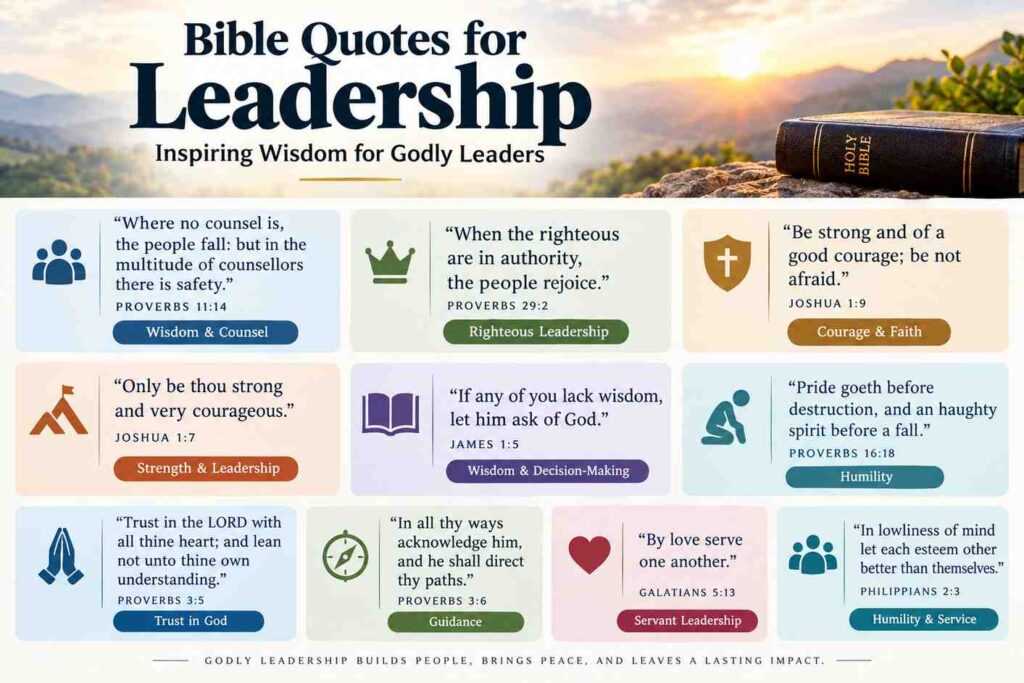
| Bible Quote / Verse | Bible Reference | Leadership Theme |
|---|---|---|
| “Where no counsel is, the people fall: but in the multitude of counsellors there is safety.” | Proverbs 11:14 | Wisdom & Counsel |
| “When the righteous are in authority, the people rejoice.” | Proverbs 29:2 | Righteous Leadership |
| “Be strong and of a good courage; be not afraid.” | Joshua 1:9 | Courage & Faith |
| “Only be thou strong and very courageous.” | Joshua 1:7 | Strength & Leadership |
| “If any of you lack wisdom, let him ask of God.” | James 1:5 | Wisdom & Decision-Making |
| “Pride goeth before destruction, and an haughty spirit before a fall.” | Proverbs 16:18 | Humility |
| “Trust in the LORD with all thine heart; and lean not unto thine own understanding.” | Proverbs 3:5 | Trust in God |
| “In all thy ways acknowledge him, and he shall direct thy paths.” | Proverbs 3:6 | Guidance |
| “By love serve one another.” | Galatians 5:13 | Servant Leadership |
| “In lowliness of mind let each esteem other better than themselves.” | Philippians 2:3 | Humility & Service |
| “Fear thou not; for I am with thee: be not dismayed; for I am thy God.” | Isaiah 41:10 | Strength & Encouragement |
| “Without counsel purposes are disappointed: but in the multitude of counsellors they are established.” | Proverbs 15:22 | Wise Decisions |
| “The integrity of his heart; and guided them by the skilfulness of his hands.” | Psalm 78:72 | Integrity & Skill |
| “He that is faithful in that which is least is faithful also in much.” | Luke 16:10 | Responsibility |
| “Let all things be done decently and in order.” | 1 Corinthians 14:40 | Order & Responsibility |
| “And whosoever will be chief among you, let him be your servant.” | Matthew 20:27 | Servant Leadership |
| “But he that is greatest among you shall be your servant.” | Matthew 23:11 | Humility & Service |
| “Let no man seek his own, but every man another’s wealth.” | 1 Corinthians 10:24 | Selfless Leadership |
| “A good name is rather to be chosen than great riches.” | Proverbs 22:1 | Character & Reputation |
| “Commit thy works unto the LORD, and thy thoughts shall be established.” | Proverbs 16:3 | God-Centered Leadership |
Whatever brought you here, these biblical principles offer plenty to think about.
“True leadership begins with a heart willing to serve before it seeks to lead.”
This is an original Bible-inspired leadership quote based on the biblical principle that authority should be connected with service rather than pride.
What Does the Bible Say About Leadership?
The Bible does not present leadership as a position of privilege alone. It repeatedly connects leadership with responsibility.
A leader affects other people. Therefore, the character of the leader matters.
Proverbs 11:14 teaches:
“Where no counsel is, the people fall: but in the multitude of counsellors there is safety.” — Proverbs 11:14, KJV
This verse highlights the importance of wise counsel. A good leader does not assume that having authority means having every answer. Sometimes the wisest thing a leader can do is listen.
The Bible also emphasizes righteousness and justice in leadership. Proverbs 29:2 says:
“When the righteous are in authority, the people rejoice.” — Proverbs 29:2, KJV
Biblical leadership therefore involves more than achieving goals. It involves how those goals are pursued and how people are treated along the way.
Why Biblical Leadership Is Different
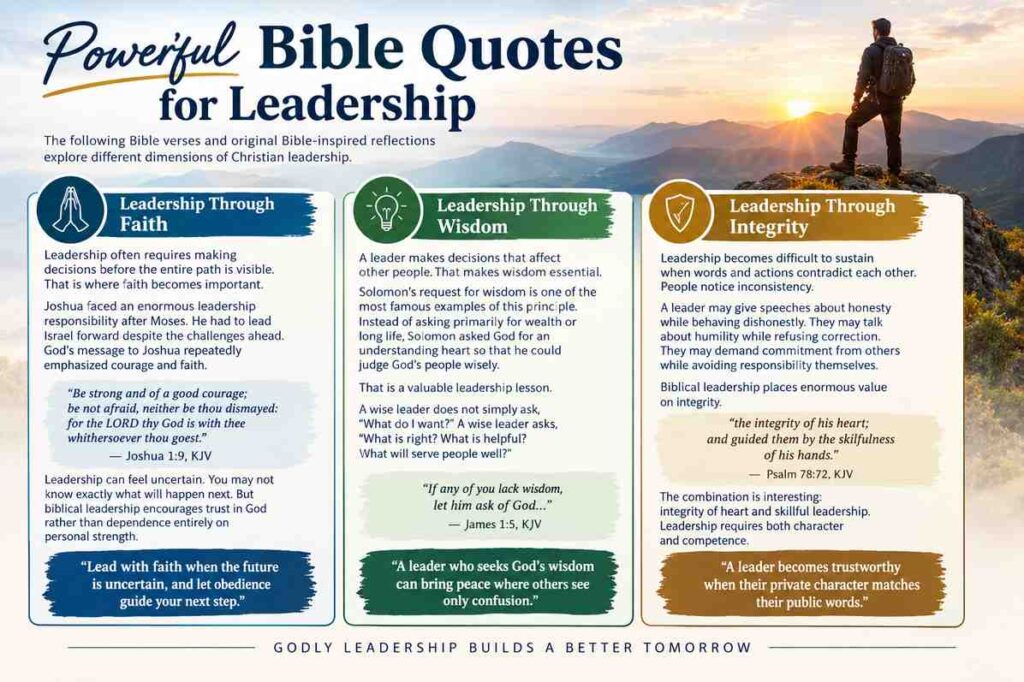
Modern leadership discussions often focus on productivity, influence, strategy, communication, and performance. Those things certainly matter. But biblical leadership begins somewhere deeper: character.
A person can be highly successful and still lead poorly if pride, dishonesty, selfishness, or arrogance controls their decisions.
Biblical leadership asks different questions:
- Am I serving people or simply controlling them?
- Am I willing to listen?
- Do my actions match my words?
- Do I seek wisdom before making important decisions?
- Do I treat people fairly?
- Can I remain humble when things go well?
- Can I remain faithful when things become difficult?
That is why biblical leadership is less like holding a crown and more like carrying a responsibility.
Leadership Begins With Service
One of the clearest principles of Christian leadership is servant leadership.
Jesus challenged the world’s normal understanding of greatness. In Mark 10:43–44, He taught that whoever wants to become great should become a servant.
This changes the entire meaning of leadership.
A leader does not simply ask, “What can these people do for me?”
A servant leader also asks, “What can I do to help these people succeed?”
That distinction is powerful.
“The leader who serves with love leaves a deeper legacy than the leader who commands with power.”
This original leadership reflection is inspired by Christ’s teaching about serving others.
Humility Is a Foundation of Leadership
Leadership can easily feed pride.
People listen to you. They may respect your decisions. They may ask for your advice. Over time, authority can quietly become ego if a leader is not careful.
The Bible repeatedly presents humility as a virtue.
Proverbs 16:18 warns:
“Pride goeth before destruction, and an haughty spirit before a fall.” — Proverbs 16:18, KJV
Humility does not mean weakness. A humble leader can still be confident, decisive, and courageous.
Humility simply recognizes that leadership is not about becoming more important than everyone else.
“Courage leads; humility guides.”
That short Bible-inspired quote works especially well for leadership graphics, presentations, and social media captions.
Powerful Bible Quotes for Leadership
The following Bible verses and original Bible-inspired reflections explore different dimensions of Christian leadership.
Leadership Through Faith
Leadership often requires making decisions before the entire path is visible.
That is where faith becomes important.
Joshua faced an enormous leadership responsibility after Moses. He had to lead Israel forward despite the challenges ahead. God’s message to Joshua repeatedly emphasized courage and faith.
Joshua 1:9 says:
“Be strong and of a good courage; be not afraid, neither be thou dismayed: for the LORD thy God is with thee whithersoever thou goest.” — Joshua 1:9, KJV
Leadership can feel uncertain. You may not know exactly what will happen next. But biblical leadership encourages trust in God rather than dependence entirely on personal strength.
“Lead with faith when the future is uncertain, and let obedience guide your next step.”
That principle is relevant to leadership in churches, families, organizations, workplaces, and communities.
Leadership Through Wisdom
A leader makes decisions that affect other people. That makes wisdom essential.
Solomon’s request for wisdom is one of the most famous examples of this principle.
Instead of asking primarily for wealth or long life, Solomon asked God for an understanding heart so that he could judge God’s people wisely.
That is a valuable leadership lesson.
A wise leader does not simply ask, “What do I want?”
A wise leader asks, “What is right? What is helpful? What will serve people well?”
James 1:5 offers another important principle:
“If any of you lack wisdom, let him ask of God…” — James 1:5, KJV
“A leader who seeks God’s wisdom can bring peace where others see only confusion.”
Leadership Through Integrity
Leadership becomes difficult to sustain when words and actions contradict each other.
People notice inconsistency.
A leader may give speeches about honesty while behaving dishonestly. They may talk about humility while refusing correction. They may demand commitment from others while avoiding responsibility themselves.
Biblical leadership places enormous value on integrity.
Psalm 78:72 describes David as someone who led with:
“the integrity of his heart; and guided them by the skilfulness of his hands.” — Psalm 78:72, KJV
The combination is interesting: integrity of heart and skillful leadership.
Leadership requires both character and competence.
“A leader becomes trustworthy when their private character matches their public words.”
Leadership Through Courage
Leadership frequently requires courage.
Sometimes a leader has to make an unpopular decision. Sometimes they have to defend what is right. Sometimes they must keep moving even when others are afraid.
Biblical courage is not the absence of fear. It is faithfulness despite fear.
Joshua 1:7 says:
“Only be thou strong and very courageous…” — Joshua 1:7, KJV
A courageous leader does not pretend that challenges do not exist. Instead, they face those challenges with faith.
Bible Quotes About Serving Others
The biblical model of leadership is deeply connected with service.
Jesus demonstrated this principle throughout His ministry. He taught, healed, encouraged, corrected, fed, and cared for people.
One of the strongest examples appears in John 13, where Jesus washed His disciples’ feet.
The action was striking because foot washing was associated with humble service. Jesus used the moment to teach His followers that they should serve one another.
That creates a powerful picture of leadership.
“Leadership is not measured by how many people follow you, but by how faithfully you guide those entrusted to you.”
Another original Bible-inspired quote says:
“Great leadership is stewardship: what God places in your hands should be used to serve others.”
This idea can apply to almost every form of leadership.
A pastor stewards a congregation.
A teacher stewards influence over students.
A parent stewards responsibility for a family.
A manager stewards a team.
A community leader stewards public trust.
In every case, leadership becomes more meaningful when it is treated as a responsibility rather than merely a privilege.
Bible Quotes About Wisdom and Decision-Making
Every leader eventually reaches a difficult decision.
Sometimes the options are clear. Sometimes they are not.
Proverbs provides extensive wisdom about seeking counsel, thinking carefully, and avoiding impulsive decisions.
Proverbs 15:22 says:
“Without counsel purposes are disappointed: but in the multitude of counsellors they are established.” — Proverbs 15:22, KJV
That does not mean a leader should allow everyone else to make every decision.
It means wise leaders understand the value of perspective.
Someone else may notice something you missed.
Someone with different experience may see a problem from another angle.
Someone with expertise may help you avoid a costly mistake.
“A wise leader listens carefully, speaks truthfully, and acts with humility.”
That is especially important when the decision affects many people.
Bible Quotes About Humility in Leadership
Humility is one of the most repeated themes associated with godly leadership.
Philippians 2:3 teaches believers to act:
“in lowliness of mind let each esteem other better than themselves.” — Philippians 2:3, KJV
Biblical humility does not require a leader to believe they are worthless. Instead, it encourages them not to make themselves the center of everything.
A humble leader can accept correction.
A humble leader can admit a mistake.
A humble leader can recognize another person’s contribution.
A humble leader can celebrate someone else’s success without feeling threatened.
“Leadership without humility becomes pride, but leadership rooted in service becomes a blessing.”
Bible Quotes About Courage and Strength
There are seasons when leadership becomes exhausting.
A project fails.
A team struggles.
People disagree.
A plan changes.
Criticism arrives.
A leader may wonder whether continuing is worth it.
Scripture repeatedly encourages God’s people to remain courageous and faithful.
Isaiah 41:10 offers a powerful reminder:
“Fear thou not; for I am with thee…” — Isaiah 41:10, KJV
The biblical approach to courage is not simply “be strong because you are strong.”
It is often, “Be courageous because God is with you.”
That distinction matters.
“When leadership feels heavy, seek God’s strength rather than relying only on your own.”
Bible Quotes About Leading by Example
People learn from what leaders do, not merely from what leaders say.
A leader can deliver an impressive speech about patience, but if they constantly lose their temper, the speech loses credibility.
A leader can talk about honesty but manipulate facts when convenient.
A leader can demand hard work while avoiding difficult responsibilities.
Biblical leadership challenges us to live the message.
Paul encouraged Timothy to become an example to believers in conduct, love, faith, and purity.
That principle applies far beyond ministry.
“The leader’s character speaks long after their words have been forgotten.”
Leading by example does not mean being perfect. It means being authentic, accountable, and willing to practice the principles you expect from others.
Bible Quotes About Responsibility and Stewardship
Leadership is stewardship.
That word is important because stewardship changes how we think about authority.
If something belongs entirely to you, you may feel free to use it however you wish.
But if something has been entrusted to you, your responsibility changes.
Biblical leadership often carries this sense of being entrusted with something valuable.
Leaders are responsible for people, opportunities, resources, decisions, and influence.
Jesus’ parable of the talents in Matthew 25 emphasizes faithful stewardship. The servants are evaluated based on how they handled what had been entrusted to them.
This creates an important leadership question:
What are you doing with the influence you have today?
“Leadership is an opportunity to turn influence into service and authority into responsibility.”
Bible Quotes for Christian Leaders
Christian leadership can take many forms.
You might lead a church ministry, Bible study, youth group, worship team, nonprofit organization, workplace, classroom, or family.
The context changes, but biblical principles remain remarkably relevant.
Christian leaders can benefit from remembering:
- Lead with love.
- Seek wisdom.
- Practice humility.
- Tell the truth.
- Serve others.
- Accept accountability.
- Remain faithful.
- Pray for guidance.
- Encourage people.
- Treat others with dignity.
Galatians 5:13 gives a concise principle:
“by love serve one another.” — Galatians 5:13, KJV
That sentence could almost serve as a leadership philosophy by itself.
Short Bible Quotes for Leadership
Sometimes you need something short enough for a graphic, caption, presentation, or leadership card.
Here are original Bible-inspired leadership quotes:
- “Lead with faith, serve with humility.”
- “Let character lead before authority.”
- “Serve first, lead second.”
- “Seek God’s wisdom before making decisions.”
- “Courage leads; humility guides.”
- “Faithful leadership begins with a faithful heart.”
- “Influence becomes meaningful when it serves others.”
- “Lead people with truth and love.”
- “A humble heart makes a strong leader.”
- “Let your leadership reflect your faith.”
These short statements can work particularly well for Christian leadership graphics and inspirational social media posts.
Bible-Inspired Leadership Quotes for Encouragement
Sometimes a leader does not need another strategy.
They need encouragement.
Leadership can be lonely because everyone may see the decisions, but few people see the emotional weight behind them.
A leader may smile in front of the team while privately wondering whether they are doing enough.
Biblical encouragement reminds leaders that faithfulness matters even when results are not immediately visible.
“A godly leader does not chase recognition; they pursue faithfulness.”
Another useful reflection is:
“Faithful leadership is not about being noticed by everyone; it is about being faithful with what God has placed before you.”
And when leadership becomes difficult:
“Do not measure your leadership only by today’s results; measure it also by the character you build along the way.”
These thoughts can encourage leaders to focus on long-term faithfulness rather than immediate applause.
Leadership Lessons From Biblical Leaders
The Bible contains many stories of people who carried significant leadership responsibilities.
Their experiences were not identical. Some succeeded brilliantly in certain areas and struggled badly in others. That is part of what makes their stories so valuable.
Moses and Courageous Leadership
Moses did not begin his leadership journey feeling completely confident.
He questioned whether he was capable of confronting Pharaoh and leading Israel.
Yet God equipped him for an enormous responsibility.
Moses’ story reminds us that leadership does not always begin with self-confidence.
Sometimes it begins with obedience.
A person may think, “I am not ready.”
God may be teaching them, “You do not have to do this entirely in your own strength.”
Joshua and Faith-Filled Leadership
Joshua inherited an enormous responsibility after Moses.
Imagine stepping into the role of a leader after someone as significant as Moses.
Yet God repeatedly encouraged Joshua to be strong and courageous.
Joshua’s story highlights the importance of continuity, courage, obedience, and faith.
Leadership sometimes means continuing a mission that began before you arrived.
David and Leadership Through Dependence on God
David’s leadership story includes victory, failure, courage, worship, conflict, and repentance.
He was not a flawless leader.
That itself offers an important lesson.
Biblical leadership does not require pretending to be perfect. It requires a heart willing to return to God, acknowledge failure, and continue seeking His direction.
Psalm 78:72 presents David as one who led with integrity and skill.
That combination remains valuable today.
Nehemiah and Purpose-Driven Leadership
Nehemiah provides a fascinating example of organized leadership.
He saw a problem, prayed about it, developed a plan, gathered people, faced opposition, and continued the work.
His story demonstrates that prayer and practical action do not have to compete.
A leader can pray deeply and plan carefully.
A leader can trust God while still doing the work.
Jesus and Servant Leadership
Jesus provides the central Christian model of leadership.
He did not simply teach His followers to serve. He demonstrated service.
His leadership involved compassion, truth, sacrifice, patience, courage, and love.
The image of Jesus washing His disciples’ feet remains one of the clearest pictures of servant leadership in Scripture.
For Christian leaders, this raises an important question:
If Jesus used His position to serve others, how should we use the influence we have been given?
How to Apply Biblical Leadership Principles Today
Biblical leadership principles are not limited to ancient settings.
You can apply them in everyday life.
Start with listening.
Before making a decision that affects others, hear them.
Then seek wisdom.
Pray about important decisions rather than treating prayer as an afterthought.
Practice integrity.
Do what you said you would do.
Admit mistakes when you make them.
Serve people.
Ask how you can help your team grow instead of focusing exclusively on what they can accomplish for you.
Encourage others.
A leader’s words can either drain a person’s confidence or strengthen it.
Finally, remain teachable.
Leadership does not mean you have stopped learning.
Bible Quotes for Leaders Facing Difficult Decisions
Difficult decisions are part of leadership.
Sometimes there is no perfect option.
You may have to choose between two imperfect solutions. You may have limited information. People may disagree with you.
During these moments, biblical wisdom encourages patience, prayer, counsel, and discernment.
Proverbs 3:5–6 says:
“Trust in the LORD with all thine heart; and lean not unto thine own understanding. In all thy ways acknowledge him…” — Proverbs 3:5–6, KJV
This does not mean leaders should stop thinking.
Instead, it reminds them not to treat their own understanding as the final source of wisdom.
“Seek God’s wisdom before making decisions, especially when your own understanding feels incomplete.”
That is a simple but powerful leadership habit.
Bible Quotes for Encouraging a Leadership Team
Leadership is rarely a one-person project.
Even strong leaders need people around them.
A leadership team needs encouragement, trust, communication, and shared purpose.
Romans 12:10 encourages believers to show genuine care and honor toward one another.
That principle can shape healthy teams.
Instead of competing for recognition, team members can celebrate each other’s contributions.
Instead of hiding mistakes, they can learn from them.
Instead of allowing disagreements to become personal conflicts, they can return to shared values.
“A strong leader does not create followers who depend on them for everything; they develop people who can faithfully carry responsibility themselves.”
That is one of the most important differences between control and leadership.
How Prayer Strengthens Christian Leadership
Prayer changes the posture of a leader.
It reminds you that you are not ultimately in control of everything.
That can be humbling.
A Christian leader can pray for wisdom before making decisions, patience when dealing with difficult people, courage during opposition, compassion toward those who struggle, and discernment when the right path is unclear.
Nehemiah’s story repeatedly connects leadership with prayer.
Before action came dependence on God.
Prayer does not replace responsibility.
It strengthens the heart behind responsibility.
“When leadership feels heavy, seek God’s strength rather than relying only on your own.”
That principle is useful whether you are leading five people or five thousand.
Conclusion
Bible quotes for leadership offer far more than inspirational words. They present a way of thinking about influence, responsibility, character, service, wisdom, and faith.
The biblical model of leadership is not centered solely on power or position. It points toward serving others, seeking wisdom, practicing humility, demonstrating courage, maintaining integrity, and trusting God.
The stories of Moses, Joshua, David, Nehemiah, and Jesus remind us that leadership can be challenging. Leaders face uncertainty, opposition, responsibility, and sometimes failure. Yet Scripture repeatedly points them back toward faithfulness.
If you are leading today, remember this:
“True leadership begins with a heart willing to serve before it seeks to lead.”
Lead with wisdom. Serve with humility. Speak with truth. Act with courage. And remember that the influence you have been given is an opportunity to make a difference in the lives of others.
Frequently Asked Questions About Bible Quotes for Leadership
What is a good Bible quote for leadership?
One powerful Scripture for leadership is Joshua 1:9, which encourages strength and courage while reminding Joshua that God is with him. It is particularly meaningful for leaders facing uncertainty, responsibility, or a new season.
What does the Bible say about being a good leader?
The Bible connects good leadership with qualities such as wisdom, humility, integrity, courage, justice, compassion, and service. Biblical leaders are encouraged to care about the people they lead rather than focusing only on authority or personal recognition.
What is the best Bible verse about servant leadership?
Mark 10:43–44 is especially relevant because Jesus teaches that greatness is connected with serving others. John 13 is also important because Jesus demonstrates humble service by washing His disciples’ feet.
What Bible verse encourages leaders to be strong?
Joshua 1:9 is one of the most commonly used Scriptures for encouraging courage in leadership. It calls Joshua to be strong and courageous while reminding him of God’s presence.
What Bible verse is about leadership and wisdom?
Proverbs 15:22 is highly relevant because it emphasizes the value of counsel when making plans. James 1:5 is also useful because it encourages people who lack wisdom to ask God for it.
What does the Bible say about humility in leadership?
The Bible repeatedly connects humility with wisdom and healthy relationships. Philippians 2:3 encourages believers to practice humility and consider the interests of others rather than acting from selfish ambition.
How can Bible verses help Christian leaders?
Bible verses can give Christian leaders principles for handling responsibility, making decisions, dealing with challenges, encouraging others, and maintaining the right attitude. They can also provide spiritual encouragement during difficult seasons.
What is a short Bible-inspired quote for leadership?
A short original quote is: “Lead with faith, serve with humility.” It summarizes two important biblical leadership principles: trusting God and serving others.
Who is the greatest example of leadership in the Bible?
For Christians, Jesus is the central example of leadership. His leadership combined truth, compassion, humility, courage, sacrifice, and service. His washing of the disciples’ feet provides a particularly strong example of servant leadership.
What makes biblical leadership different from ordinary leadership?
Biblical leadership places strong emphasis on character and service alongside ability and results. Rather than viewing leadership primarily as power over others, Scripture presents influence as a responsibility that should be exercised with humility, wisdom, justice, love, and faithfulness.