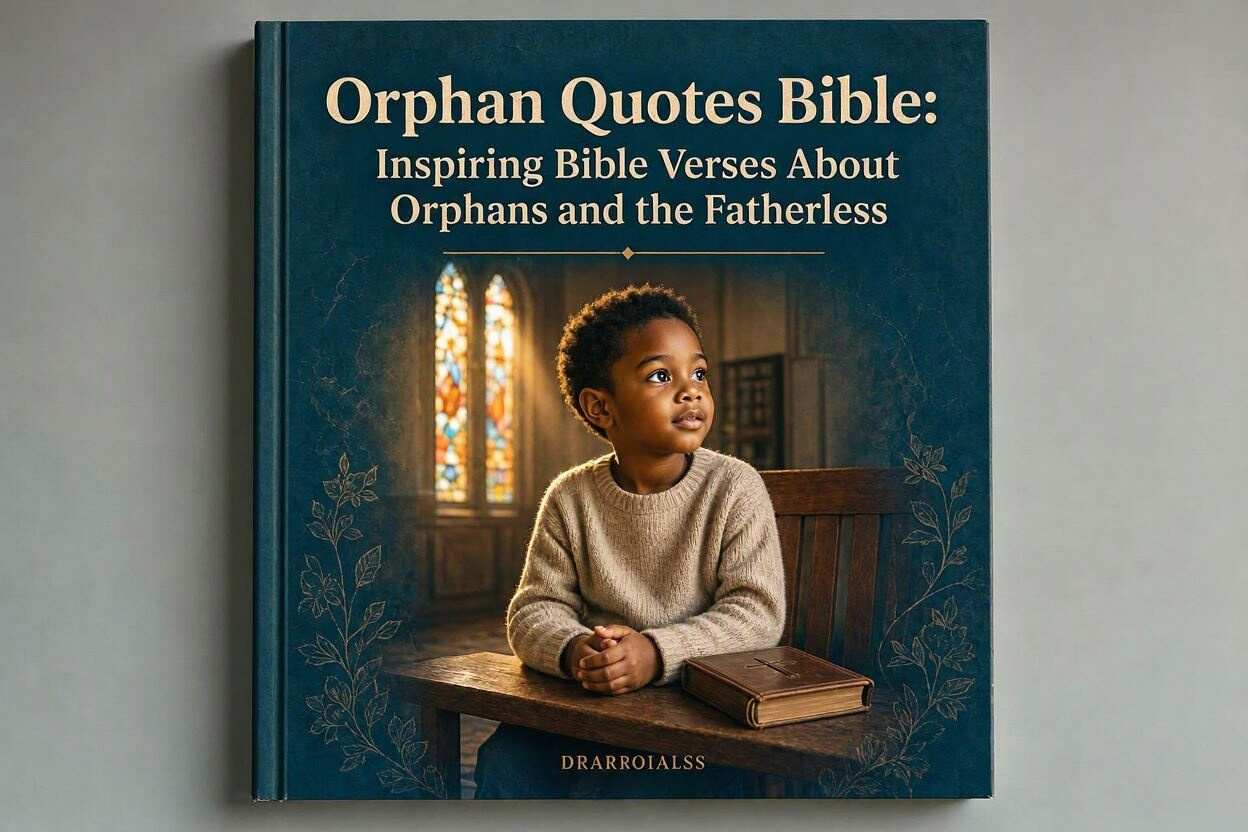
Orphan Quotes Bible: Inspiring Bible Verses About Orphans and the Fatherless
When a child loses a parent, the world can suddenly feel much bigger and much lonelier. Questions that once seemed simple can become difficult. Where will I belong? Who will protect me? Who will stand beside me? Who will love me when life becomes hard?
The Bible does not ignore those questions.
In fact, Scripture speaks about orphans and the fatherless repeatedly, often placing them alongside widows, strangers, the poor, and other vulnerable people. Rather than treating them as forgotten members of society, the Bible presents them as people whom God sees, protects, and cares about deeply.
That is why searching for orphan quotes Bible can lead to some of the most comforting and challenging verses in Scripture.
Psalm 68:5 describes God as a “father of the fatherless.” James 1:27 teaches believers to care for the fatherless as part of genuine faith. Other passages call God’s people to defend, protect, and provide justice for those who may not have anyone powerful speaking on their behalf.
These aren’t merely nice words for a greeting card. They form a consistent biblical message.
God sees the fatherless, and He calls His people to see them too.
Let’s explore these powerful Bible verses and discover what they can teach us about God’s heart, compassion, justice, and hope.
What Does the Bible Say About Orphans?
The Bible frequently uses the word “fatherless” rather than the modern word “orphan.” In biblical society, losing a father could leave a child especially vulnerable because fathers often provided economic security, legal protection, family leadership, and social support.
That vulnerability explains why Scripture repeatedly commands God’s people to care for the fatherless.
The Bible doesn’t simply say, “Feel sorry for them.”
Instead, it uses strong action words:
- Defend them.
- Help them.
- Do justice for them.
- Do not oppress them.
- Care for them.
- Speak for those who cannot speak for themselves.
There is a beautiful lesson here.
God’s concern for orphans is not passive. It is active.
He doesn’t merely notice suffering from a distance. Scripture describes Him as a defender of vulnerable people and calls His followers to reflect that same character.
Why Are Orphans Mentioned So Often in the Bible?
To understand these verses, we need to understand the world in which they were written.
In ancient Israel, a child who lost a father could face serious challenges. There were no modern social welfare systems in the form we know today. Family relationships were extremely important for survival and protection.
An orphan could therefore become an easy target for exploitation.
Imagine standing at a crossroads without a sign, a map, or anyone to guide you. That is somewhat like the vulnerability faced by many fatherless children in ancient societies. They needed people who would step forward and provide protection.
God’s law repeatedly instructed His people not to take advantage of them.
This tells us something important about God’s character.
He pays attention to people whom society might overlook.
That principle still matters.
Children without parental support need safe homes, stable relationships, education, emotional support, and people who will advocate for their well-being.
The Bible’s message challenges us to notice them rather than allowing them to disappear into the background.
God as a Father to the Fatherless
One of the most powerful themes in the Bible is that God identifies Himself as a Father to those who are fatherless.
That idea doesn’t mean the pain of losing a parent magically disappears.
Grief is real.
Loneliness is real.
Missing someone you love is real.
But Scripture offers another truth alongside that pain: God’s presence and care are not limited by human circumstances.
A person may lose an earthly father and still be seen by a heavenly Father.
That is why Psalm 68:5 has become such an important verse for people looking for orphan quotes Bible.
Psalm 68:5 — God Cares for the Fatherless
“A father of the fatherless, and a judge of the widows, is God in his holy habitation.”
— Psalm 68:5, KJV
This may be one of the most comforting Bible verses about orphans.
Notice the description of God.
He is called “a father of the fatherless.”
The verse doesn’t describe God as distant or unconcerned. It uses the language of family, care, protection, and relationship.
For someone who has lost a parent, this can be an incredibly meaningful reminder.
Your loss matters.
Your loneliness matters.
Your story matters.
And according to Scripture, you are not invisible to God.
The verse also describes God as a judge for widows, reinforcing the idea that God cares about people who may lack earthly protection.
James 1:27 — Caring for Orphans Is Pure Religion
James 1:27 is another foundational verse when discussing orphan quotes Bible.
“Pure religion and undefiled before God and the Father is this, To visit the fatherless and widows in their affliction…”
— James 1:27, KJV
This verse takes the subject in an interesting direction.
Instead of only telling us what God does for orphans, James tells believers what they should do.
He connects genuine religious faith with practical care.
Think about it this way: if faith is a tree, good actions are some of its fruit.
You cannot see the roots underground, but you can see the fruit above the ground.
James teaches that authentic faith should produce compassion.
Caring for the fatherless isn’t simply an extra activity for people with spare time. It is presented as an important expression of Christian faith.
Deuteronomy 10:18 — God Defends the Fatherless
Deuteronomy 10:18 says:
“He doth execute the judgment of the fatherless and widow, and loveth the stranger…”
This verse reveals several aspects of God’s character.
God is concerned about justice.
He cares for the vulnerable.
He loves the stranger.
He does not measure people’s value according to their social influence.
That last point is worth thinking about.
Human society can sometimes pay more attention to people with money, power, popularity, or influence. Scripture turns that idea upside down.
God specifically highlights people who may have less social power.
The fatherless matter to Him.
The widow matters to Him.
The stranger matters to Him.
The poor matter to Him.
This theme appears throughout the Bible.
Psalm 82:3 — Defend the Fatherless
Psalm 82:3 gives a direct command:
“Defend the poor and fatherless: do justice to the afflicted and needy.”
What an active verse.
It doesn’t say simply to notice the fatherless.
It says defend them.
That word changes the whole conversation.
If someone is vulnerable, compassion may require action.
Maybe that means protecting a child from mistreatment.
Maybe it means providing education.
Maybe it means supporting a trustworthy organization.
Maybe it means becoming a stable and encouraging presence.
Maybe it means simply listening.
The exact action can differ, but the principle remains:
People who are vulnerable should not be ignored.
Psalm 146:9 — God Watches Over the Fatherless
Psalm 146:9 says:
“The LORD preserveth the strangers; he relieveth the fatherless and widow…”
Again, the Bible presents God as someone who helps vulnerable people.
The word picture is reassuring.
Imagine a storm beginning while you’re far from home. You look around and wonder who will help you.
Then someone arrives with shelter, guidance, and protection.
That is the kind of image these verses can create for someone experiencing loneliness.
God is portrayed as one who does not overlook the vulnerable.
Exodus 22:22–24 — Do Not Mistreat Orphans
Exodus contains a serious warning concerning widows and fatherless children.
The passage teaches God’s people not to afflict or exploit them.
Why such a strong warning?
Because vulnerable people can easily become victims when others use their power selfishly.
A child without parents may not have someone immediately available to defend them.
The biblical command therefore establishes a protective principle.
Never use someone’s vulnerability as an opportunity for exploitation.
That lesson remains relevant today.
Children deserve safety.
They deserve dignity.
They deserve protection.
They deserve adults who will put their interests ahead of selfish gain.
Zechariah 7:10 — Do Not Oppress the Fatherless
Zechariah 7:10 gives another powerful command:
“And oppress not the widow, nor the fatherless, the stranger, nor the poor…”
The pattern is unmistakable.
Again and again, Scripture places the fatherless among people who need special protection.
This is not accidental repetition.
The Bible is emphasizing something important.
A society reveals something about its character through the way it treats vulnerable people.
If the powerful protect only themselves, injustice grows.
If people use their strength to protect those with less power, compassion grows.
The Bible consistently calls God’s people toward the second approach.
Jeremiah 7:6 — Protect the Vulnerable
Jeremiah also warns God’s people not to oppress the vulnerable.
The surrounding teaching emphasizes justice, repentance, and proper treatment of others.
This gives us another important lesson about orphan-related Bible verses.
God’s concern isn’t limited to private feelings.
It includes public behavior.
How do we treat people?
How do we use authority?
Do we take advantage of those who cannot fight back?
Do we speak for people who have been ignored?
These are spiritual questions as much as social ones.
Proverbs 31:8–9 — Speak for Those Without a Voice
Proverbs 31:8–9 says:
“Open thy mouth for the dumb…”
and continues by calling people to judge righteously and defend those in need.
This principle fits naturally with the biblical message about orphans.
Children often depend on adults to advocate for them.
A child may not know how to explain mistreatment.
A child may be afraid to speak.
A child may not know where to seek help.
That is why responsible adults matter.
Sometimes love isn’t simply saying, “I care about you.”
Sometimes love means saying:
“I will speak up for you.”
Bible Quotes About God’s Love for Orphans
When you collect these passages together, a beautiful picture emerges.
God is repeatedly shown as:
- A Father to the fatherless.
- A defender of vulnerable people.
- A provider of justice.
- A protector of those who need help.
- A God who sees people others may overlook.
This doesn’t mean every difficult circumstance immediately changes.
The Bible does not promise a life without grief.
Instead, it gives a foundation for hope.
God’s character remains trustworthy even when circumstances are painful.
Short Orphan Quotes From the Bible
If you’re looking for short orphan quotes Bible passages for an article, social media graphic, church presentation, or personal encouragement, these are especially meaningful.
| Bible Verse | Short Quote | Main Message |
|---|---|---|
| Psalm 68:5 | “A father of the fatherless” | God cares for the fatherless |
| Psalm 82:3 | “Defend the poor and fatherless” | Protect vulnerable people |
| Psalm 146:9 | “He relieveth the fatherless” | God provides help |
| James 1:27 | “Visit the fatherless” | Show practical compassion |
| Deuteronomy 10:18 | “He doth execute the judgment of the fatherless” | God cares about justice |
| Zechariah 7:10 | “Oppress not… the fatherless” | Do not exploit vulnerable people |
| Exodus 22:22 | “Ye shall not afflict… fatherless child” | Protect children from harm |
| Proverbs 31:9 | “Judge righteously” | Stand up for others |
These short passages can also serve as starting points for deeper Bible study.
Bible Verses About Feeling Alone
Although not every Bible verse about loneliness specifically mentions orphans, many passages can bring comfort to someone who feels abandoned.
One of the strongest themes throughout Scripture is that God remains present with those who seek Him.
This is important because losing a parent can affect much more than family structure.
It can affect identity.
It can affect confidence.
It can affect a person’s sense of belonging.
That is why the Bible’s description of God as a Father to the fatherless can be so meaningful.
The message isn’t, “You shouldn’t feel sad.”
Rather, it is:
“Your sadness does not mean you have been forgotten.”
What the Bible Teaches Us About Caring for Orphans
The Bible gives us several clear principles.
God Sees People Others Overlook
A person doesn’t become less valuable because fewer people notice them.
God’s attention is not controlled by popularity.
Vulnerable People Need Protection
The Bible repeatedly tells God’s people not to exploit the fatherless.
Protection is a form of love.
Justice Matters
Caring for orphans isn’t only about giving material things.
It also means ensuring that vulnerable people receive fair treatment.
Compassion Requires Action
James 1:27 makes this especially clear.
Real compassion moves beyond words.
Every Child Has Dignity
A child shouldn’t be defined by the circumstances surrounding their family.
Their circumstances may be difficult, but their worth remains.
How Christians Can Show Love to Orphans Today
The biblical message should eventually move from our minds to our hands.
So what can Christians actually do?
Support Children and Families
Practical support can include food, clothing, school supplies, educational opportunities, and safe housing.
Support Responsible Organizations
People can support reputable charities and organizations that work with vulnerable children.
Before giving, it is wise to research how an organization operates and how it protects children.
Consider Foster Care or Adoption
For some families, fostering or adoption may be a meaningful way to provide a stable home.
These decisions require serious preparation and should never be treated casually.
A child needs more than a temporary emotional decision. They need consistency and commitment.
Volunteer
Not everyone can adopt or foster.
But many people can volunteer.
You might tutor a child, support a community program, help provide meals, or assist an organization serving vulnerable families.
Small acts can become significant when they are repeated consistently.
Pray
Prayer is another biblical response.
Pray for children who have lost parents.
Pray for caregivers.
Pray for families experiencing hardship.
Pray for organizations working with vulnerable children.
And pray that your own heart remains sensitive to people who need help.
Finding Hope After Losing a Parent
Losing a parent can change your life in ways that are difficult to explain.
Sometimes grief arrives loudly.
Sometimes it arrives quietly.
It might appear during a birthday, a graduation, a wedding, a holiday, or even an ordinary afternoon when you suddenly wish you could hear that person’s voice.
Bible verses cannot erase memories or instantly remove grief.
But they can provide something grief desperately needs: hope.
Psalm 68:5 reminds the fatherless that God is described as their Father.
Psalm 146:9 reminds readers that God helps the fatherless.
These passages can become quiet reminders that earthly loss does not mean spiritual abandonment.
You may still have difficult days.
You may still ask questions.
You may still miss your parent.
But you don’t have to interpret those feelings as proof that God has forgotten you.
Lessons We Can Learn From Bible Verses About Orphans
The Bible’s teaching about orphans isn’t only for orphans.
It teaches everyone something.
Lesson One: Notice the Vulnerable
Look beyond your own circle.
Who around you might be struggling quietly?
Lesson Two: Don’t Exploit Weakness
Power should be used responsibly.
If someone depends on you, your responsibility becomes greater, not smaller.
Lesson Three: Speak Up
Silence isn’t always kindness.
Sometimes the loving thing is to speak when someone cannot speak for themselves.
Lesson Four: Love Must Become Practical
A kind sentence can help.
But consistent action can change someone’s circumstances.
Lesson Five: God Values People Differently Than Society Often Does
The Bible repeatedly highlights people who had little worldly power.
That tells us something important about God’s priorities.
Orphan Quotes Bible for Encouragement and Reflection
Here are several short, original reflections inspired by the biblical themes above:
“The loss of an earthly parent does not make you invisible to your heavenly Father.”
“God sees the child whom the world may overlook.”
“The fatherless are not forgotten in the heart of God.”
“Where human protection is missing, Scripture points us toward God’s care.”
“True compassion does more than feel; it acts.”
“Defending the vulnerable is one way we reflect God’s character.”
“A child should never have to earn the right to be loved.”
“God’s care is not measured by the size of a family but by the depth of His love.”
These are reflections rather than direct Bible quotations, so they should not be presented as Scripture.
Why Psalm 68:5 Is So Meaningful
Among all the verses discussed here, Psalm 68:5 stands out because of its simple but powerful description of God.
“A father of the fatherless.”
Those words are short.
But think about everything contained in them.
A father can represent protection.
A father can represent guidance.
A father can represent provision.
A father can represent belonging.
A father can represent love.
The verse places these ideas within the character of God.
For someone searching for an orphan Bible quote, this is one of the most natural passages to begin with.
Why James 1:27 Is So Important
Psalm 68:5 tells us something about God’s character.
James 1:27 tells us something about ours.
That’s why these two passages work so well together.
Psalm 68:5 says God is a Father to the fatherless.
James 1:27 says believers should care for the fatherless.
In other words:
God cares, and His people are called to care too.
This creates a powerful picture of Christian compassion.
We aren’t called simply to talk about love.
We’re called to demonstrate it.
Conclusion
The Bible contains a remarkably consistent message about orphans and the fatherless.
From Psalm 68:5, which describes God as a Father to the fatherless, to James 1:27, which connects genuine faith with caring for the fatherless, Scripture repeatedly reminds us that vulnerable children matter deeply to God.
Other passages call believers to defend, protect, support, and speak up for those who may not have anyone else to advocate for them.
If you are searching for orphan quotes Bible, perhaps the most important message isn’t simply a particular quotation.
It is the truth behind all these verses:
The fatherless are seen by God.
Their pain is not invisible.
Their value is not reduced by their circumstances.
Their future is not determined solely by what they have lost.
And for everyone else, these Scriptures carry a challenge: don’t look away from vulnerable people. Notice them. Protect them. Encourage them. Help them. Speak for them.
Sometimes God’s love reaches someone through a Bible verse.
Sometimes it reaches them through a person.
And sometimes, we’re called to be that person.
Frequently Asked Questions
What is the best Bible verse about orphans?
Psalm 68:5 is one of the most meaningful verses because it describes God as “a father of the fatherless.” It emphasizes God’s care and protection for people who have lost parental support.
Does the Bible say God is a Father to orphans?
Yes. Psalm 68:5 specifically describes God as “a father of the fatherless.” This is one of the clearest biblical expressions of God’s special concern for the fatherless.
What does James 1:27 say about orphans?
James 1:27 teaches that caring for the fatherless and widows is part of what Scripture describes as pure and undefiled religion. The verse emphasizes practical compassion rather than faith that exists only in words.
Which Psalm talks about the fatherless?
Several Psalms mention the fatherless. Psalm 68:5 describes God as a Father to the fatherless, while Psalm 82:3 calls people to defend them. Psalm 146:9 also speaks about God’s care for the fatherless.
What does God say about protecting orphans?
Throughout Scripture, God commands His people not to oppress or mistreat the fatherless. Passages such as Exodus 22:22–24, Zechariah 7:10, and Psalm 82:3 emphasize protection, justice, and compassion.
Why does the Bible care about the fatherless?
In biblical societies, children without fathers could be particularly vulnerable to poverty, exploitation, and injustice. Scripture therefore repeatedly commands God’s people to protect and care for them.
How can Christians help orphans?
Christians can help through prayer, financial support, volunteering, mentoring, supporting responsible organizations, foster care, adoption where appropriate, and providing practical support to vulnerable children and families.
Is there a Bible verse for someone who lost a parent?
Psalm 68:5 can be especially comforting because it describes God as a Father to the fatherless. Other passages about God’s presence, protection, and care can also provide encouragement during grief.
What does “fatherless” mean in the Bible?
The biblical term generally refers to a child who has lost a father or lacks normal paternal protection. In Scripture, the fatherless are frequently included among vulnerable people who deserve justice and care.
What is a comforting Bible quote for an orphan?
One of the most comforting is Psalm 68:5: “A father of the fatherless… is God.” The verse offers a powerful reminder that losing an earthly parent does not mean being forgotten by God.