Forgiveness In The Bible: Understanding God’s Grace, Human Forgiveness, And The Path To Restoration
Forgiveness is one of the Bible’s most profound and transformative themes. From the opening chapters of Genesis to the closing vision of Revelation, Scripture tells the story of a holy God pursuing sinful people, offering reconciliation where separation once existed, and restoring what human rebellion had broken. Every major stage of the biblical narrative—creation, the fall, God’s covenant with Israel, the ministry of Jesus Christ, and the hope of a new creation—is connected by God’s desire to forgive, redeem, and restore.
Yet despite its central importance, forgiveness remains one of the most misunderstood teachings in the Bible.
Many people equate forgiveness with forgetting painful memories, excusing harmful behavior, or pretending injustice never happened. Others assume forgiveness automatically requires rebuilding trust, restoring broken relationships, or erasing every consequence of wrongdoing. Some wonder whether God forgives every sin, whether repentance is always necessary, or whether Christians must keep forgiving someone who repeatedly causes harm.
These aren’t merely theological questions. They arise from real life.
A husband trying to rebuild a marriage after betrayal. A daughter carrying years of resentment toward an absent parent. A church member struggling to forgive spiritual abuse. A believer wondering whether God can truly forgive sins that still produce shame. A Christian wrestling with Jesus’ command to forgive “seventy times seven.”
Behind almost every search about biblical forgiveness is a person seeking more than definitions—someone looking for understanding, hope, wisdom, and often healing.
Unfortunately, many resources answer only part of the question. Some offer long collections of Bible verses with little explanation of their context. Others approach forgiveness almost entirely from a devotional or counseling angle without showing how the teaching fits into the Bible’s larger story. Many explain that Christians should forgive but spend little time explaining why, how, or what forgiveness actually means according to Scripture. As a result, readers often finish with more verses—but not necessarily with greater understanding.
This guide takes a different approach. Rather than presenting forgiveness as a collection of isolated passages, it explores forgiveness as one of the Bible’s unifying themes. It traces how God’s revelation of forgiveness develops across Scripture, examines key passages in their historical and literary context, explains how forgiveness relates to grace, mercy, repentance, justice, and reconciliation, and shows how these truths apply to the complexities of modern life.
If you’re looking for a quicker way to study the Bible’s most important passages on forgiveness before diving into this complete guide, explore our 50+ Bible Verses About Forgiveness, where Scripture is organized by themes such as God’s forgiveness, forgiving others, repentance, grace, healing, and reconciliation.
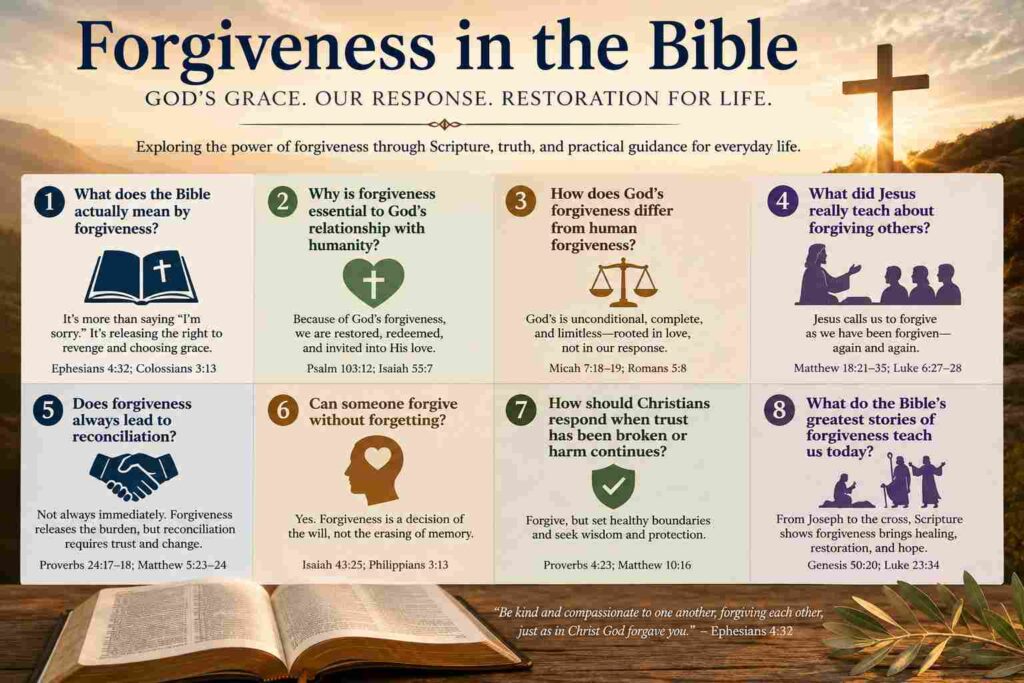
Throughout, we’ll move past simply asking, “What verses talk about forgiveness?” and toward deeper questions such as:
- What does the Bible actually mean by forgiveness?
- Why is forgiveness essential to God’s relationship with humanity?
- How does God’s forgiveness differ from human forgiveness?
- What did Jesus really teach about forgiving others?
- Does forgiveness always lead to reconciliation?
- Can someone forgive without forgetting?
- How should Christians respond when trust has been broken or harm continues?
- What do the Bible’s greatest stories of forgiveness teach us today?
Answering these questions takes more than quoting individual verses. Every passage of Scripture was written within a historical setting, a literary context, and an unfolding story of redemption. Understanding that context lets readers appreciate not just what the Bible says about forgiveness, but why it says it and how each passage contributes to Scripture’s unified message.
This whole-Bible perspective matters because forgiveness isn’t an isolated doctrine. It’s woven into God’s holiness, His justice, His mercy, His grace, His covenant faithfulness, His plan of salvation, and ultimately, the person and work of Jesus Christ. Remove forgiveness from Scripture, and the Bible’s story no longer holds together.
From the moment sin entered the world in Genesis, humanity’s greatest need became restoration to God. Every covenant, every sacrifice, every prophetic promise, and every act of divine mercy points toward that reality. Seen through this lens, forgiveness becomes far more than a moral command—it becomes the heartbeat of God’s redemptive plan.
By the end of this guide, you won’t simply know more Bible verses about forgiveness. You’ll understand how forgiveness fits into Scripture’s grand narrative, why it stands at the center of the gospel, how it shapes Christian relationships, and how its principles apply wisely to situations that are often painful, complicated, and deeply personal.
Whether you’re studying Scripture, preparing a Bible study, seeking answers after personal hurt, or simply wanting a deeper understanding of God’s Word, this guide aims to provide a comprehensive, context-rich, and biblically faithful foundation for understanding forgiveness.
What Is Forgiveness in the Bible?
Before exploring God’s forgiveness, Jesus’ teaching, repentance, reconciliation, or practical application, we need to answer the most fundamental question: what does the Bible actually mean when it speaks about forgiveness?
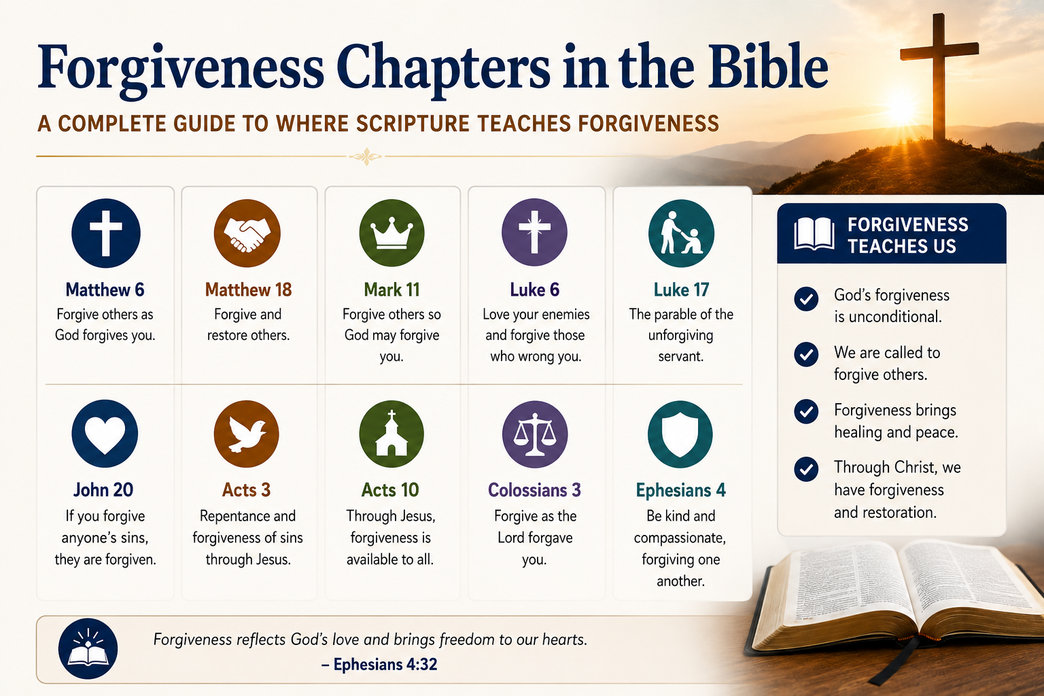
Once you understand the biblical meaning of forgiveness, the next step is seeing how this theme unfolds across entire books of Scripture. Our guide to Forgiveness Chapters in the Bible highlights the key chapters that develop God’s message of forgiveness from Genesis to Revelation.
At first glance, the answer seems obvious. Most people would describe forgiveness as letting go of anger or choosing not to hold someone’s wrongdoing against them. These ideas capture part of the biblical picture, but not its full depth. In Scripture, forgiveness is far more than an emotional response or an interpersonal virtue—it’s a theological reality rooted in the very character of God.
Understanding that foundation matters because every later discussion about forgiving others, receiving God’s forgiveness, repentance, reconciliation, justice, and mercy depends on getting the definition right from the start. Misunderstand forgiveness here, and many of the Bible’s most important passages will be misread later.
Forgiveness Begins with God’s Character, Not Human Experience
One of the first things readers notice when studying forgiveness throughout the Bible is that Scripture never begins with human relationships. It begins with God Himself.
Modern discussions often approach forgiveness through the lens of psychology, emotional healing, conflict resolution, or personal well-being. These perspectives can offer real insight, but the Bible takes a different starting point: Scripture first reveals who God is, and only then explains how His people should live.
This pattern recurs throughout the Bible. Before God gives commandments, He reveals His character. Before He calls people to forgive, He demonstrates forgiveness Himself. Before believers are instructed to extend mercy, they’re shown the immeasurable mercy God has already extended to them.
That order matters. The Christian understanding of forgiveness doesn’t originate with human wisdom or social ethics—it originates with the character of God. Throughout both the Old and New Testaments, God consistently reveals Himself as:
- Holy and perfectly just.
- Merciful toward sinners.
- Gracious beyond human deserving.
- Patient despite repeated rebellion.
- Faithful to His covenant promises.
- Ready to forgive those who genuinely turn to Him.
These attributes don’t compete with one another; they work together harmoniously. God doesn’t become less holy in order to be forgiving, nor does His justice prevent Him from showing mercy. Instead, Scripture presents forgiveness as one of the most beautiful expressions of His perfectly balanced character.
This immediately sets the Bible’s teaching apart from many modern assumptions. Forgiveness isn’t primarily a psychological technique. It’s first and foremost a revelation of who God is.
The Biblical Meaning of Forgiveness
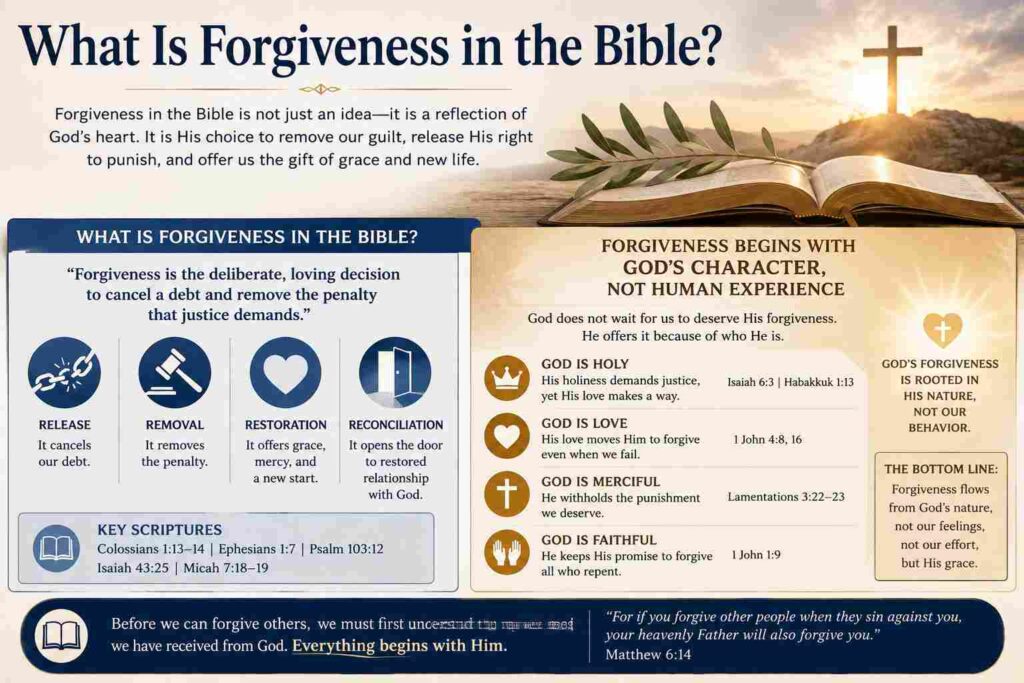
Once we understand that forgiveness begins with God’s character, the next step is understanding what the Bible actually means by the word forgiveness. It sounds like a simple question, but it’s one of the most important in the entire discussion.
Many modern definitions are shaped by personal experience, cultural values, or popular sayings. Some define forgiveness as “letting go.” Others call it “moving on” or “finding inner peace.” These ideas may describe some of forgiveness’s results, but they don’t fully capture what Scripture teaches.
The Bible presents forgiveness as something far richer: a moral, relational, and spiritual reality that addresses the deepest problem in human existence—sin’s separation from God—and lays the foundation for restored relationships, both between God and humanity and, ultimately, between people themselves.
To appreciate this fully, it helps to look at how the Bible itself talks about forgiveness.
What Does the Word “Forgiveness” Mean in the Bible?
One of Scripture’s remarkable features is that it rarely defines forgiveness through abstract philosophical language. Instead, the Bible explains forgiveness through vivid pictures, historical events, covenant relationships, and carefully chosen words that reveal different dimensions of God’s redemptive work.
Both the Old Testament (written primarily in Hebrew) and the New Testament (written in Greek) use several related terms for forgiveness, each contributing something unique to our understanding.
Forgiveness in the Old Testament: The Hebrew Perspective
The Old Testament uses several Hebrew words connected with forgiveness, but one of the most significant is סָלַח (salach). Unlike many Hebrew words that describe human actions, salach is used almost exclusively for God’s forgiveness—a reminder that forgiveness ultimately originates with God rather than with people.
When Moses interceded for Israel after their rebellion in the wilderness, he prayed, “Please pardon the iniquity of this people according to the greatness of your steadfast love…” (Numbers 14:19). The word translated “pardon” comes from salach. The emphasis isn’t on God overlooking sin; it highlights His gracious willingness to remove guilt and restore covenant fellowship despite Israel’s repeated failures.
Another important Hebrew verb is נָשָׂא (nasa), which literally means “to lift,” “carry,” or “take away.” Applied to forgiveness, it paints a striking picture: sin as a crushing burden, and forgiveness as God lifting that burden off the sinner. This imagery appears throughout the Psalms and the prophetic writings, emphasizing that forgiveness isn’t merely a legal declaration but the removal of something that separates people from God.
A third important image comes from the Hebrew verb כָּפַר (kaphar), often translated “to make atonement” or “to cover.” Within Israel’s sacrificial system, this word described God’s provision for dealing with sin within the covenant relationship. Rather than suggesting sin simply vanished, it pointed toward God’s gracious provision for restoring fellowship while maintaining His holiness.
Together, these Hebrew terms reveal a consistent pattern: forgiveness is always God’s initiative. He removes guilt. He bears away sin. He restores covenant relationship. He provides the means by which restoration becomes possible. Already, the Old Testament moves far beyond the modern idea of forgiveness as simply “letting things go.”
Forgiveness in the New Testament: The Greek Perspective
The New Testament builds on this Old Testament foundation while revealing forgiveness more fully through the life and work of Jesus Christ.
One of the primary Greek words translated “forgive” is ἀφίημι (aphiēmi), meaning to release, send away, let go, dismiss, or cancel an obligation. This word appears often in the Gospels when Jesus forgives sins, and its imagery is powerful: rather than clinging to guilt, forgiveness releases it; rather than holding a debt indefinitely, forgiveness cancels it. This explains why Jesus sometimes described forgiveness using the language of debts, especially in the Lord’s Prayer. Debt gave His audience a familiar picture of something owed that couldn’t easily be repaid—forgiveness, then, was the gracious cancellation of an obligation the offender could never satisfy through personal effort alone.
Another important Greek noun is ἄφεσις (aphesis), often translated “forgiveness,” “release,” or “remission.” This term appears throughout the New Testament when describing the forgiveness of sins accomplished through Christ. The emphasis isn’t merely emotional relief—it describes liberation. The guilty are released. The burden is removed. The relationship is restored.
These Greek terms complement the Old Testament rather than replacing it. Together they reveal forgiveness as the removal of guilt, the cancellation of debt, the release from condemnation, the restoration of relationship, and the gracious initiative of God.
A Word Study Is Helpful—but Context Matters Even More
Studying Hebrew and Greek words enriches our understanding, but biblical word studies should never be separated from context. Words take their meaning from the passages in which they appear. The Greek word aphiēmi, for instance, can describe releasing a debt, leaving a fishing net behind, dismissing a crowd, or forgiving sins—the surrounding context determines which meaning the author intends.
The same principle applies throughout Scripture. Simply defining biblical words is never enough. Readers must also ask: Who is speaking? Who is being addressed? What historical situation prompted these words? How does this passage contribute to the Bible’s larger story of redemption?
We’ll answer those questions whenever we examine major passages on forgiveness throughout this guide. Doing so helps avoid one of the most common mistakes in Bible study: building entire doctrines from isolated word definitions rather than Scripture’s full context.
Forgiveness Is Always Relational
One of the clearest themes running through both Testaments is that forgiveness is fundamentally relational. Modern discussions often describe forgiveness primarily as something we do for ourselves. The Bible recognizes the personal freedom forgiveness brings, but its primary concern is much larger: forgiveness exists because relationships have been broken.
In Scripture, every act of forgiveness addresses one or both of two relationships: the relationship between God and humanity, and the relationships people have with one another. This distinction explains why forgiveness occupies such a central place throughout the Bible. Sin is never portrayed merely as breaking an abstract rule—it’s breaking relationship.
David recognized this after his sin with Bathsheba. Though his actions harmed many people, he confessed before God, “Against you, you only, have I sinned and done what is evil in your sight…” (Psalm 51:4). David wasn’t denying the harm done to Bathsheba or Uriah; he was acknowledging that every sin has a vertical dimension because it violates God’s holy character.
This helps explain why the Bible consistently places God’s forgiveness at the center of its teaching. Human forgiveness reflects divine forgiveness because every broken human relationship exists within humanity’s larger relationship with God.
Forgiveness Is More Than Canceling Guilt
Another important observation emerges when we read Scripture carefully: forgiveness is never presented as merely the cancellation of guilt. It also points toward restoration. Throughout the Bible, God’s purpose isn’t simply to declare guilty people innocent and leave them unchanged—it’s to restore fellowship.
This theme appears again and again. Adam and Eve hide from God after sin enters the world, and God seeks them. Israel repeatedly breaks covenant, and God repeatedly calls them back. The prophets invite people to return to the Lord. Jesus welcomes sinners into restored fellowship. The apostles proclaim reconciliation through Christ.
In every case, forgiveness serves a larger purpose: it removes the barrier so relationship can be renewed. This distinction matters because it keeps forgiveness from becoming merely a legal transaction. Biblically, forgiveness is deeply personal—it restores what sin has broken.
How Sin, Grace, Mercy, and Forgiveness Work Together
Understanding forgiveness becomes much easier when we see how it relates to several other foundational biblical concepts. These ideas are inseparable throughout Scripture.
| Biblical Concept | What It Means | Relationship to Forgiveness |
| Sin | Humanity’s rebellion against God’s holy character that breaks fellowship with Him. | Creates the need for forgiveness. |
| Grace | God’s undeserved favor toward those who cannot earn His acceptance. | Explains why forgiveness is given freely rather than earned. |
| Mercy | God’s compassion in withholding the judgment sinners deserve. | Demonstrates God’s loving response to guilty people. |
| Forgiveness | God’s gracious removal of guilt and restoration of fellowship. | Removes the barrier created by sin. |
| Reconciliation | The restoration of a broken relationship. | Represents the ultimate purpose toward which forgiveness points. |
This progression can be visualized simply:
Sin → Grace → Mercy → Forgiveness → Reconciliation → Restored Fellowship
Notice that forgiveness is neither the beginning nor the end of God’s redemptive work—it stands at the center. Sin creates separation. Grace initiates God’s response. Mercy withholds deserved judgment. Forgiveness removes guilt. Reconciliation restores relationship.
This framework guides everything that follows in this article, because every major biblical passage about forgiveness fits somewhere within this larger story.
The Four Types of Forgiveness in the Bible
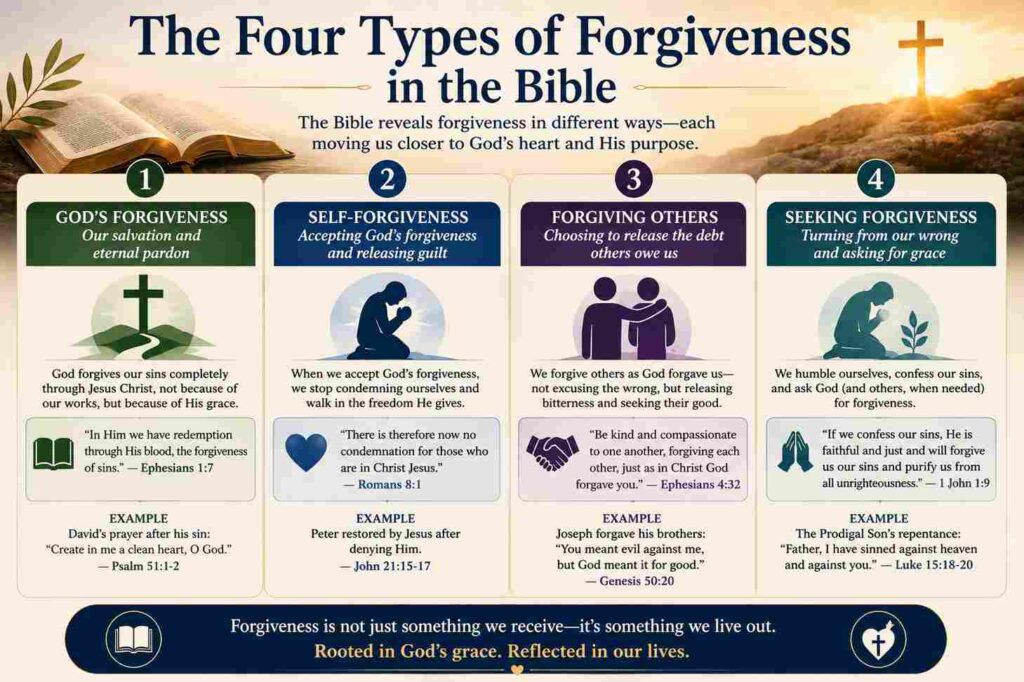
Once the basic definition is in place, it helps to notice that Scripture doesn’t describe forgiveness as a single, uniform act. It appears in at least four distinct—though related—forms, each addressing a different relationship touched by sin.
| Type of Forgiveness | What It Involves | Biblical Example |
| Divine forgiveness | God forgiving humanity’s sin through Christ, removing guilt and restoring fellowship with Himself. | “I will forgive their iniquity” (Jeremiah 31:34); the cross and resurrection of Christ. |
| Interpersonal forgiveness | Believers releasing personal offenses committed against them by other people. | Joseph forgiving his brothers; Jesus praying for those who crucified Him. |
| Corporate or national forgiveness | God’s forgiveness extended to a covenant community or nation because of its collective sin and repentance. | Israel’s repeated cycles of national rebellion, judgment, and restoration throughout the Prophets. |
| Forgiveness of oneself | Accepting God’s verdict of forgiveness rather than continuing to live under self-imposed guilt and condemnation. | Paul’s freedom from his past persecution of the church (1 Timothy 1:12–16). |
These categories aren’t rigid boxes—they overlap constantly throughout Scripture. David’s sin against Bathsheba required both divine forgiveness and, eventually, a kind of peace with himself. Israel’s national forgiveness always depended on individual hearts turning back to God. Still, distinguishing between these four expressions of forgiveness helps readers apply the right biblical principles to the right situation, rather than assuming every forgiveness question works exactly the same way.
With forgiveness understood as part of this theological framework rather than an isolated concept, we’re ready for the next essential question: how does the Bible progressively reveal God’s forgiving character from Genesis to Revelation, and what does that reveal about His unchanging plan of redemption?
Forgiveness in the Bible: A Story That Unfolds from Genesis to Revelation
One of the most remarkable features of the Bible is its unity. Though it consists of 66 books written over roughly 1,500 years by more than 40 human authors, it tells one continuous story. Different writers, historical periods, literary genres, and audiences all contribute to a single redemptive narrative centered on God’s relationship with humanity.
Forgiveness is one of the clearest examples of that unity. It doesn’t suddenly appear in the New Testament, and it isn’t confined to a handful of famous passages. Instead, forgiveness develops progressively across Scripture, revealing more of God’s redemptive purpose at each stage of biblical history. Every covenant, every act of mercy, every prophetic promise, and every teaching of Jesus builds on what came before.
Understanding this progression matters because many misunderstandings arise when individual verses are separated from the Bible’s larger story. Rather than asking, “Which verse talks about forgiveness?” the better question is, “How does the entire Bible reveal God’s plan of forgiveness?” Answering that lets us see not only what forgiveness means, but why it occupies such a central place in God’s relationship with humanity.
If you’d like to study this biblical journey chapter by chapter instead of all at once, our Forgiveness Chapters in the Bible guide walks through the major chapters where God’s plan of forgiveness is progressively revealed throughout Scripture.
Progressive Revelation: Why Forgiveness Becomes Clearer Throughout Scripture
Before tracing forgiveness through the Bible, it’s worth understanding a principle theologians call progressive revelation. The phrase sounds technical, but the idea is simple.
Progressive revelation doesn’t mean God changes His character, revises His moral standards, or introduces contradictory truths. It means God gradually reveals more of His redemptive plan throughout history.
Picture standing outside just before sunrise. At first, only faint light appears on the horizon. As dawn progresses, more details come into view—trees, mountains, roads, buildings—until the full landscape is illuminated. The landscape hasn’t changed. Only the amount of light has increased.
The Bible unfolds in a similar way. Genesis introduces humanity’s need for redemption. The Law explains God’s holiness. Israel’s history demonstrates humanity’s repeated failure. The prophets announce future hope. Jesus fulfills those promises. The apostles explain their significance. Revelation reveals God’s completed restoration. Each stage brings greater clarity while remaining perfectly consistent with what came before.
This principle guards readers against a common misunderstanding—that the Old Testament presents one kind of God while the New Testament presents another. Scripture teaches the opposite. The same holy, merciful, gracious, and faithful God is revealed from beginning to end. What changes isn’t His character; what changes is the fullness of His revelation.
A Timeline of Forgiveness Across the Bible
Understanding forgiveness becomes much easier when viewed within the Bible’s overall storyline. The following timeline summarizes how God’s revelation of forgiveness unfolds throughout redemptive history.
| Biblical Era | Key Events | What This Stage Reveals About Forgiveness |
| Creation (Genesis 1–2) | God creates humanity in perfect fellowship with Himself. | Forgiveness is not yet necessary because sin has not entered creation. |
| The Fall (Genesis 3) | Adam and Eve rebel against God’s command. | Sin creates separation from God, introducing humanity’s need for forgiveness and restoration. |
| The Patriarchs (Genesis 12–50) | Abraham, Isaac, Jacob, and Joseph. | God’s covenant faithfulness continues despite repeated human failure, revealing His patient and forgiving character. |
| The Mosaic Covenant (Exodus–Deuteronomy) | The Law, priesthood, sacrifices, and covenant worship. | God’s holiness is emphasized while sacrifices illustrate humanity’s continual need for forgiveness. |
| Israel’s History and the Prophets | Israel repeatedly breaks covenant. | The prophets proclaim both God’s justice and His willingness to forgive those who genuinely return to Him. |
| The Ministry of Jesus Christ | Jesus teaches, heals, forgives sins, and proclaims God’s Kingdom. | Forgiveness is fully revealed through Christ’s words, actions, and saving mission. |
| The Cross and Resurrection | Jesus dies and rises again. | God’s justice and mercy meet perfectly as forgiveness is accomplished through Christ. |
| The Church (Acts–Jude) | The gospel spreads throughout the world. | Believers proclaim God’s forgiveness and extend forgiveness to others. |
| The New Creation (Revelation) | God’s redemptive plan reaches completion. | Sin, guilt, death, and separation are removed forever as God’s people dwell with Him eternally. |
This timeline reveals something remarkable: forgiveness isn’t an isolated doctrine added midway through the Bible. It’s one of the primary threads holding the entire biblical story together.
Genesis: Where the Need for Forgiveness Begins
Every discussion about forgiveness must begin where the Bible begins. Genesis opens with a world untouched by sin. Humanity enjoys perfect fellowship with God. Adam and Eve experience no shame, no guilt separating them from their Creator. Relationships are marked by trust, harmony, and life. That harmony changes dramatically in Genesis 3.
Historical Context. The opening chapters of Genesis establish the Bible’s foundation. Before introducing Israel, the Law, or even Abraham, Scripture explains humanity’s universal condition. Every later doctrine—including forgiveness—depends on understanding what happened in Eden.
Literary Context. Genesis 1–2 describe God’s perfect creation. Genesis 3 introduces the conflict that drives the rest of the biblical narrative. Without Genesis 3, there would be no need for covenants, sacrifices, prophets, the Messiah, or redemption.
What Happened in the Fall? When Adam and Eve disobeyed God’s command, the immediate consequences were relational. They experienced shame. They hid from God’s presence. Fear replaced trust. Blame replaced unity. Death entered creation. Most significantly, fellowship with God was broken.
Interestingly, Genesis 3 never uses the word forgiveness, yet the need for it is unmistakable. From this point forward, every major movement of Scripture addresses the problem introduced in Eden. The Bible, then, isn’t simply a story about human failure—it’s the story of God’s determination to restore what humanity destroyed through sin.
God’s First Response Was Pursuit, Not Abandonment. One detail in Genesis 3 is easily overlooked. After Adam and Eve sinned, God sought them. The famous question, “Where are you?” (Genesis 3:9), wasn’t asked because God lacked information—it was an invitation. Even after humanity rebelled, God initiated the relationship.
This pattern repeats throughout the Bible. Before people seek God, God seeks them. Before people cry out for mercy, God provides a way of restoration. Before humanity can repair what sin has broken, God begins His redemptive plan. This is the first glimpse of the forgiving character that unfolds throughout the rest of Scripture.
The First Promise of Redemption. Although Genesis 3 records humanity’s fall, it also contains the Bible’s first promise of hope. Within God’s judgment of the serpent lies the promise that the offspring of the woman would one day defeat evil (Genesis 3:15). Christians have historically understood this verse as the first announcement of God’s redemptive plan—a promise that ultimately points to Jesus Christ.
Whether readers interpret the verse this way or simply as the beginning of God’s plan to overcome evil, one truth is clear: judgment is not God’s final word. Hope appears immediately. Even in humanity’s darkest moment, God begins revealing His purpose to restore what has been lost. This combination of justice and mercy becomes one of the defining characteristics of the entire Bible. God never ignores sin, and He never abandons sinners. Instead, He begins a redemption story that unfolds across the rest of Scripture.
Key Insights from Genesis
| Genesis Teaches | Why It Matters for Forgiveness |
| Humanity was created for fellowship with God. | Forgiveness ultimately aims to restore that fellowship. |
| Sin entered through human rebellion. | Forgiveness exists because real separation occurred. |
| God pursued sinners after the Fall. | Forgiveness begins with God’s initiative rather than human effort. |
| Justice and mercy appear together from the beginning. | God’s holiness and compassion are never in conflict. |
| Redemption begins immediately after sin enters creation. | Forgiveness is central to God’s redemptive plan from the earliest chapters of Scripture. |
Genesis establishes the foundation on which the rest of the Bible builds. From here, every covenant, act of mercy, sacrifice, and prophetic promise expands the same story: God’s unwavering commitment to forgive, restore, and reconcile sinful humanity to Himself.
The next stage of that story appears in the lives of the patriarchs—Abraham, Isaac, Jacob, and Joseph—where God’s covenant faithfulness repeatedly triumphs over human failure, revealing that forgiveness is rooted not in human worthiness but in God’s unchanging promises.
God’s Covenant Faithfulness: Forgiveness Before the Law
After humanity’s rebellion in Genesis 3, the Bible could have become a story of judgment. Instead, it becomes a story of covenant.
This is one of the Bible’s most important transitions. Rather than abandoning humanity because of sin, God begins establishing covenants—solemn, binding relationships through which He accomplishes His redemptive purposes. These covenants become the framework through which readers learn that forgiveness isn’t merely God’s reaction to human failure but part of His eternal plan to restore His creation.
The lives of Abraham, Isaac, Jacob, and Joseph illustrate this truth repeatedly. They weren’t perfect people—they were recipients of extraordinary grace.
Why the Patriarchs Matter
Some readers skip quickly from Genesis 3 to the New Testament when studying forgiveness. Doing so overlooks an essential stage in God’s revelation. The patriarchs demonstrate that God’s forgiveness is rooted in His faithfulness, not human perfection. Again and again, God’s chosen people fail, yet God’s covenant purposes continue. This pattern prepares readers for everything that follows in Scripture.
Abraham: A Covenant Built on Grace
Historical Context. Around two thousand years before Christ, God called Abram (later renamed Abraham) to leave his homeland and journey to a land God would show him (Genesis 12). This call marked the beginning of God’s covenant relationship with a people through whom “all the families of the earth” would eventually be blessed.
Literary Context. Genesis 12–25 shifts the Bible’s focus from humanity in general to one covenant family. Instead of asking how God will deal with all sinful humanity at once, the narrative begins tracing His redemptive plan through Abraham and his descendants.
Abraham’s Failures. Abraham is often remembered as the father of faith, yet Scripture presents him honestly. Twice he let fear lead him into deception, telling foreign rulers that Sarah was his sister rather than his wife (Genesis 12; Genesis 20). He also struggled to trust God’s timing regarding His promise of a son.
These failures matter. The Bible doesn’t hide the weaknesses of its heroes—it highlights them to emphasize God’s faithfulness. God didn’t abandon Abraham because of these failures. He corrected him. He remained faithful to His covenant. He continued His promises. The lesson is clear: God’s covenant rests on His faithfulness, not human perfection. Forgiveness throughout Scripture is built on that same foundation.
Jacob: A Life Transformed by Grace
Jacob’s very name became associated with deception. He manipulated his brother Esau. He deceived his father Isaac. He relied on cleverness instead of trusting God. Yet the biblical narrative refuses to let Jacob’s failures define his entire story. Instead, readers watch God patiently transform him over many years.
This gradual transformation matters. Modern readers sometimes expect spiritual change to happen instantly; Jacob reminds us that God’s work often unfolds over a lifetime. Forgiveness begins restoration. Transformation continues afterward. This distinction remains important throughout Scripture—God’s forgiveness is never intended to leave people unchanged. It initiates a lifelong process of spiritual renewal.
Joseph: One of the Bible’s Greatest Pictures of Forgiveness
Among all the patriarchs, Joseph provides the clearest Old Testament picture of forgiveness in action. His story occupies thirteen chapters (Genesis 37–50), making it one of the longest continuous narratives devoted to a single individual—a length that alone signals its importance.
Historical Context. Joseph was the favored son of Jacob. His brothers, consumed with jealousy, threw him into a pit, sold him into slavery, and convinced their father he had been killed by a wild animal. Joseph’s journey eventually brought him to Egypt, where years later he rose from prisoner to governor under Pharaoh. When famine struck the region, the very brothers who had betrayed him unknowingly came before him seeking food. The stage was set for revenge. Instead, Scripture records one of history’s greatest acts of forgiveness.
Joseph’s Forgiveness Was Neither Naïve Nor Immediate. This detail deserves careful attention because it’s often overlooked. Joseph didn’t immediately reveal his identity when his brothers arrived in Egypt. Instead, he observed them. He questioned them. He tested them. He watched how they treated Benjamin. Why? Because reconciliation requires wisdom. Joseph had already chosen forgiveness, but before restoring family fellowship, he wanted to know whether genuine change had taken place.
Eventually Judah offered himself in Benjamin’s place. The brothers demonstrated a humility that had been absent years earlier. Only then did Joseph reveal himself.
This sequence matters enormously. It shows that Joseph distinguished between forgiving, testing character, rebuilding trust, and restoring relationship. Modern discussions often collapse these into a single step. The Bible does not.
Genesis 50:20 — One of the Bible’s Greatest Statements About Forgiveness. When Joseph finally addressed his brothers, he spoke words that have encouraged believers for centuries: “As for you, you meant evil against me, but God meant it for good…” (Genesis 50:20).
This verse is frequently quoted, but its context deserves equal attention. Joseph doesn’t say their actions weren’t wrong, that it didn’t hurt him, or that they should pretend it never happened. Instead, he clearly names their actions as evil. Only after acknowledging the reality of their sin does he affirm God’s greater purpose.
This distinction is foundational. God’s sovereignty doesn’t redefine evil as good—rather, it demonstrates His ability to accomplish good despite human evil. Joseph’s forgiveness rests on confidence in God’s providence, not denial of human wrongdoing.
Lessons Joseph’s Story Teaches About Forgiveness
| Joseph’s Actions | What They Teach About Forgiveness |
| He acknowledged his brothers’ sin honestly. | Forgiveness never requires denying reality. |
| He refused revenge despite possessing complete authority. | Forgiveness releases personal vengeance to God. |
| He recognized God’s providence over human evil. | God can redeem circumstances without approving sin. |
| He carefully observed whether his brothers had changed. | Wisdom accompanies forgiveness. |
| He restored the relationship after genuine transformation became evident. | Reconciliation often follows forgiveness but should not be confused with it. |
Joseph’s story also corrects another common misconception: that forgiveness requires forgetting the past. Joseph remembered every detail. His forgiveness was genuine precisely because he remembered what had happened. Memory didn’t prevent forgiveness. Bitterness would have.
The Patriarchs Reveal an Important Pattern
Studied together, Abraham, Jacob, and Joseph reveal a consistent pattern.
| Patriarch | Human Failure | God’s Response | Lesson About Forgiveness |
| Abraham | Fear and deception | God remained faithful to His covenant promises. | Forgiveness rests upon God’s faithfulness, not human perfection. |
| Jacob | Deception, manipulation, self-reliance | God patiently transformed his character over time. | Forgiveness begins restoration, which continues through lifelong transformation. |
| Joseph | Betrayed by those closest to him | God worked through suffering to accomplish redemption. | Forgiveness trusts God’s sovereignty without denying injustice. |
These narratives prepare readers for the next major stage of biblical history. Until now, forgiveness has primarily been demonstrated through God’s covenant dealings with individuals and families. With the Exodus and the giving of the Law, Scripture begins explaining how a holy God could dwell among a sinful people—introducing one of the Bible’s most significant developments: the relationship between God’s holiness, the sacrificial system, repentance, and forgiveness, themes that ultimately point forward to Jesus Christ.
The Law, Sacrifices, and the Meaning of Forgiveness
As the biblical story moves from the patriarchs to the nation of Israel, many readers hit one of the Bible’s greatest challenges. The Old Testament suddenly fills with laws, priests, sacrifices, offerings, rituals, and ceremonies. At first glance, these practices can feel distant from modern life and even unrelated to forgiveness. Yet they’re essential to understanding it.
Without the Law and the sacrificial system, many of the New Testament’s teachings about Jesus, redemption, atonement, grace, and forgiveness lose much of their meaning. Far from an interruption in the Bible’s story, the Law reveals why forgiveness is necessary, why sin is so serious, and why humanity could never save itself.
Why Did God Give the Law?
Before discussing sacrifices, we need to understand the Law’s purpose. A common misconception is that God gave the Law so people could earn His acceptance through perfect obedience. The Bible presents a different picture.
Israel was already God’s covenant people before receiving the Law at Mount Sinai. God first redeemed them from slavery in Egypt; only afterward did He give them His commandments. This order is significant—redemption came before instruction, relationship preceded responsibility. The Law was never a ladder by which sinful people climbed their way to God. Instead, it served several purposes: it revealed God’s holy character, showed Israel what covenant faithfulness looked like, exposed humanity’s inability to meet God’s perfect standard consistently, and pointed beyond itself to humanity’s need for a greater redemption.
The Apostle Paul later summarizes this beautifully, describing the Law as revealing sin rather than removing it (Romans 3:20).
Historical Context: Israel at Mount Sinai. After delivering Israel from Egyptian slavery through the Exodus, God brought the nation to Mount Sinai and established a covenant unlike any other in Israel’s history. The people were no longer merely descendants of Abraham—they were becoming God’s covenant nation. The Law governed every aspect of life: worship, justice, family, community, morality, leadership, and national identity. Within this covenant framework, forgiveness became part of Israel’s relationship with a holy God.
Debt Forgiveness in the Bible: The Sabbath Year and Jubilee
Before turning to sacrifices, it’s worth pausing on a form of forgiveness the Law commanded quite literally: the cancellation of financial debt.
Deuteronomy 15 instructs Israel to release every debt owed by a fellow Israelite every seven years, at the end of the Sabbath cycle. Leviticus 25 goes further, establishing the Year of Jubilee every fiftieth year, when land was returned to its original family, debts were canceled, and those forced into servitude because of debt were set free. Centuries later, Nehemiah confronted wealthy Israelites who were charging interest on loans to their own impoverished countrymen, insisting that debts, fields, and interest be restored immediately (Nehemiah 5:10–12).
These laws weren’t merely economic policy. They were a visible, recurring picture of spiritual truth: God’s people were never meant to hold one another in permanent bondage over what could not be repaid. Just as God had graciously released Israel from slavery in Egypt, Israel was to release its own debtors. This is precisely the imagery Jesus later draws on in the Lord’s Prayer and the Parable of the Unforgiving Servant, where sin is described using the language of debt (Matthew 6:12; Matthew 18:23–35). The Sabbath year and Jubilee provided the cultural backdrop that made those later teachings immediately understandable to a Jewish audience—literal debt forgiveness modeled spiritual forgiveness long before Jesus made the connection explicit.
God’s Holiness Changes Everything
One word dominates the Law more than many readers realize: holiness.
To modern readers, holiness is often associated simply with moral goodness. Biblically, it carries a much richer meaning. God is perfectly pure, perfectly righteous, completely set apart from sin. His holiness isn’t merely one attribute among many—it defines everything about Him.
This raises an unavoidable question: how can sinful people live in relationship with a perfectly holy God? The Law doesn’t ignore this problem, nor does it solve it permanently. Instead, it continually reminds Israel that fellowship with God requires dealing seriously with sin. This is where the sacrificial system enters the story.
The Sacrificial System Was Never About Earning Forgiveness
One of the most common misunderstandings about the Old Testament is that sacrifices somehow purchased God’s forgiveness. The Bible never teaches this. Instead, sacrifices functioned within God’s covenant relationship as visible reminders of several foundational truths: sin has real consequences, fellowship with God cannot ignore sin, and God Himself provides the means through which sinful people may continue living in covenant relationship with Him.
Every sacrifice pointed beyond itself. It taught, reminded, and anticipated. It revealed that forgiveness was never inexpensive—it always involved God’s gracious provision. The writer of Hebrews later explains that the sacrifices themselves weren’t the final solution; they pointed forward to something greater that God Himself would accomplish.
The Day of Atonement: Israel’s Most Powerful Picture of Forgiveness
Among all Israel’s annual festivals, none illustrates forgiveness more vividly than the Day of Atonement described in Leviticus 16. Understanding this event provides one of the clearest windows into the Bible’s theology of forgiveness.
Historical Context. The Day of Atonement occurred once each year. On that day, the high priest entered the Most Holy Place—the innermost part of the tabernacle, and later the temple—to make atonement for the sins of the nation. No ordinary Israelite entered this sacred place; its very structure reminded God’s people that sin separated humanity from God’s holy presence.
Two Goats—One Powerful Message. Leviticus 16 centers on two goats, each illustrating a different aspect of God’s dealing with sin.
| Symbol | What Happened | What It Taught |
| The First Goat | Offered as a sin offering before God. | Sin requires atonement because God’s holiness cannot ignore evil. |
| The Scapegoat | The high priest confessed Israel’s sins over it before sending it into the wilderness. | God removes the guilt of forgiven sin, symbolically carrying it away from His people. |
These two actions work together. One addresses God’s holiness; the other illustrates the removal of guilt. Together they provide one of the Old Testament’s richest pictures of forgiveness.
Notice what the ceremony doesn’t communicate. It doesn’t suggest sin is insignificant, nor does it imply forgiveness is automatic. Instead, it reveals both the seriousness of sin and God’s gracious desire to restore fellowship with His covenant people.
The Language of Cleansing
Another recurring image throughout the Law is cleansing. Modern readers sometimes mistake ceremonial cleansing for mere physical hygiene, but its primary purpose was theological. Through repeated rituals, Israel learned that sin contaminates and holiness restores.
This imagery becomes especially important later in the Psalms and Prophets. David prayed, “Wash me thoroughly from my iniquity, and cleanse me from my sin” (Psalm 51:2). He wasn’t asking for physical washing—he was drawing on imagery deeply rooted in Israel’s worship. The New Testament likewise speaks frequently about cleansing from sin, showing the continuity between the Old and New Testaments. The picture remains the same: sin stains, God cleanses, forgiveness restores.
Repentance Was Always More Important Than Ritual
One of the greatest mistakes readers make is assuming Israel’s sacrifices operated automatically. The prophets repeatedly challenged this misunderstanding. People sometimes continued offering sacrifices while living in rebellion against God, and the prophets declared that ritual without repentance was meaningless. Isaiah condemned worship that lacked justice and obedience. Hosea proclaimed God’s desire for steadfast love rather than empty sacrifice. Micah famously summarized true covenant faithfulness by calling God’s people to do justice, love mercy, and walk humbly with God.
These prophetic messages reveal an essential principle: God never desired empty religious performance. He desired transformed hearts. The sacrificial system was always intended to point people toward repentance rather than replace it.
What the Law Teaches About Forgiveness
| The Law Reveals | Why It Matters |
| God’s holiness | Forgiveness never minimizes sin. |
| Humanity’s inability to achieve perfect righteousness | Forgiveness must come through God’s provision rather than human effort. |
| The seriousness of sin | Sin damages fellowship with God and cannot simply be ignored. |
| God’s gracious provision through covenant worship | God Himself provides the means by which fellowship may continue. |
| The need for something greater | The entire sacrificial system points beyond itself to God’s ultimate plan of redemption. |
Looking Beyond the Sacrifices
By the end of the Pentateuch, readers should recognize an important tension. The sacrificial system teaches profound truths about God’s holiness and forgiveness, yet it also leaves questions unanswered. Why must sacrifices continue year after year? Why does Israel repeatedly fall into the same sins? Can animal sacrifices permanently remove humanity’s guilt?
The Old Testament itself begins pointing beyond these questions. The prophets look ahead to a future covenant, a future cleansing, a future outpouring of God’s Spirit, a future Servant who would accomplish what repeated sacrifices could only foreshadow. Those promises prepare readers for the next major stage of the Bible’s unfolding story of forgiveness, where the prophets announce not merely God’s willingness to forgive, but His promise to bring about a new and lasting work of redemption that transforms hearts as well as restores relationships.
The Prophets: Forgiveness Promised for a New Covenant
As Israel’s history unfolds, a tragic pattern emerges. God delivers His people. They worship Him faithfully for a time. Gradually they drift toward idolatry, injustice, and covenant unfaithfulness. God raises prophets to call them back. Some repent. Many refuse. The cycle repeats.
At first glance, these books may seem to focus primarily on judgment—and indeed, the prophets often spoke difficult words because Israel had persistently broken its covenant with God. But judgment was never their final message. Again and again they proclaimed one astonishing truth: the God who judges sin is also the God who invites sinners home.
Understanding this balance is essential for understanding biblical forgiveness. The prophets don’t present a God whose anger eventually gives way to mercy—they present a God whose holiness and mercy have always existed together.
Why God Sent the Prophets
Historical Context. The prophetic books span several centuries of Israel’s history. Some prophets ministered before the Assyrian exile, others warned Judah before the Babylonian captivity, and still others spoke after the people returned from exile. Although their historical settings differed, their message followed a remarkably consistent pattern: they confronted sin, exposed injustice, warned of coming judgment, and then pointed people toward repentance, restoration, and hope. God’s warnings were never meant merely to announce punishment—they were invitations to return.
Literary Context. The prophetic books shouldn’t be read simply as collections of predictions about the future. They’re covenant documents. The prophets acted like covenant prosecutors, reminding Israel of God’s promises, exposing the nation’s covenant failures, and calling God’s people back to faithful relationship with Him.
Within this framework, forgiveness becomes one of the prophets’ central themes, often summarized in four movements: God is holy; Israel has sinned; judgment is coming; God still desires restoration for those who return to Him. That fourth point is frequently overlooked. Without it, readers misunderstand both the prophets and God’s character.
Isaiah: God’s Invitation to Return
Among the prophets, Isaiah offers one of the Bible’s clearest invitations to forgiveness:
“Seek the Lord while he may be found; call upon him while he is near; let the wicked forsake his way… let him return to the Lord, that he may have compassion on him… for he will abundantly pardon.” (Isaiah 55:6–7)
Historical Context. Isaiah ministered during a period of political instability and growing spiritual decline in Judah. The nation had become increasingly proud, unjust, and spiritually compromised. Judgment was approaching. Yet Isaiah’s message consistently combined warning with hope.
What Isaiah Reveals About Forgiveness. Several observations stand out. First, forgiveness is connected with returning to God—Isaiah doesn’t describe forgiveness as ignoring sin, but calls people to abandon sinful ways and seek the Lord. Second, God’s willingness to forgive exceeds human expectations; the phrase “abundantly pardon” communicates generosity rather than reluctance. God isn’t portrayed as a reluctant judge searching for reasons to reject sinners, but as a compassionate Father inviting them home. Third, forgiveness flows from God’s character—the invitation exists because of who God is, not because Israel deserves another chance. This emphasis anticipates the New Testament’s teaching on grace.
Jeremiah: The Promise of a New Covenant
Jeremiah ministered during one of the darkest periods in Judah’s history. Jerusalem would soon fall. The temple would be destroyed. The people would be carried into exile. Yet it’s precisely during this bleak period that Jeremiah announces one of Scripture’s greatest promises. Speaking of a future covenant, God declares: “For I will forgive their iniquity, and I will remember their sin no more” (Jeremiah 31:34).
Historical Context. Judah had repeatedly violated the Mosaic Covenant. External reforms had failed to transform the nation’s heart. The problem was no longer merely political—it was spiritual.
Why This Promise Matters. Notice what Jeremiah does not say. He doesn’t suggest God literally forgets human sin—Scripture consistently teaches that God is all-knowing. Instead, “remember no more” is covenant language. It means God no longer holds forgiven sin against His covenant people. The relationship is restored; the offense no longer defines it. This distinction matters enormously: biblical forgiveness is not divine amnesia. It’s divine reconciliation.
Jeremiah also introduces another revolutionary promise—that God will write His law on people’s hearts rather than merely on stone tablets, anticipating a future transformation that external sacrifices alone could never accomplish. Forgiveness won’t merely restore relationship; it will accompany inward renewal.
Ezekiel: God Desires Repentance, Not Destruction
Another prophet who deepens the Bible’s understanding of forgiveness is Ezekiel. Writing to people already living in exile, he repeatedly emphasizes God’s desire for repentance. One of his clearest statements appears in Ezekiel 18, where God asks, “Have I any pleasure in the death of the wicked… and not rather that he should turn from his way and live?”
This question reveals God’s heart. Judgment is sometimes necessary, but it’s never God’s delight—His desire is that sinners turn back to Him and experience life. This corrects a common misunderstanding of the God of the Old Testament as eager to punish. Ezekiel presents the opposite picture: God repeatedly invites repentance because His desire is restoration.
Hosea: The Heartbreak of Divine Love
If Jeremiah emphasizes covenant renewal and Ezekiel highlights repentance, Hosea reveals something equally profound: the emotional cost of covenant unfaithfulness.
God commands Hosea to marry Gomer, whose repeated unfaithfulness becomes a living illustration of Israel’s spiritual adultery. The book is heartbreaking, yet also astonishingly hopeful. Despite Israel’s continual rebellion, God continues calling His people back. Hosea records one of Scripture’s most moving invitations: “Return, O Israel, to the Lord your God…” The message is clear—God’s covenant love persists even after repeated rejection. This doesn’t eliminate justice; it demonstrates that mercy remains available because of God’s faithful love rather than Israel’s deserving.
The Prophets Point Beyond Themselves
As readers move through Isaiah, Jeremiah, Ezekiel, Hosea, Joel, Micah, and the other prophetic books, an important realization emerges. The prophets continually call people to repentance, yet Israel continues to fail. Sacrifices continue. Exile comes. People return. Sin returns. The cycle remains unbroken.
This creates growing anticipation. Surely God’s final answer must involve something greater than repeated calls to repentance. The prophets themselves begin announcing that future hope: a New Covenant, a new heart, God’s Spirit dwelling within His people, complete cleansing, lasting forgiveness, and a coming Servant through whom God’s redemptive purposes will be fulfilled. In other words, the prophets prepare readers not merely for another prophet—they prepare readers for Jesus Christ.
What the Prophets Teach About Forgiveness
| The Prophets Teach | Why It Matters |
| God remains faithful despite Israel’s repeated failures. | Forgiveness is grounded in God’s covenant faithfulness rather than human consistency. |
| Repentance is essential. | Forgiveness never minimizes the seriousness of sin. |
| Ritual without transformed hearts is insufficient. | God desires genuine relationship rather than empty religious performance. |
| God’s mercy is greater than Israel’s repeated rebellion. | Forgiveness reflects God’s compassionate character. |
| A New Covenant is coming. | The prophets anticipate a greater work of redemption that external sacrifices could never accomplish. |
A Bridge to the New Testament
By the time the Old Testament closes, readers have learned several foundational truths. They know God is holy. They know humanity is sinful. They understand the purpose of the Law. They’ve witnessed the limitations of repeated sacrifices. They’ve heard the prophets promise a new covenant, a transformed heart, and lasting forgiveness. Yet one question remains unanswered: how will God accomplish all of this?
The prophets announce God’s promise. The New Testament reveals God’s answer. When Jesus steps onto the stage of history proclaiming, “Repent, for the kingdom of heaven is at hand,” He isn’t introducing a new message—He’s declaring that everything the Law anticipated and everything the prophets promised is now beginning to reach its fulfillment.
Understanding this continuity changes how we read the Gospels. Jesus isn’t simply another teacher discussing forgiveness. He’s the fulfillment of the Bible’s entire story of forgiveness.
Jesus Christ: The Fulfillment of God’s Plan of Forgiveness
Everything the Old Testament has been building toward reaches its climax in the person of Jesus Christ. From Genesis onward, the Bible has raised a series of questions: How can a perfectly holy God forgive guilty sinners without compromising His justice? How can broken fellowship between God and humanity be permanently restored? Why did the sacrificial system have to continue generation after generation? What did the prophets mean when they spoke of a New Covenant, a new heart, and complete forgiveness?
The New Testament answers every one of these questions through Jesus. This is why understanding Jesus’ ministry requires understanding the Old Testament that came before it. The Gospels don’t begin a new story—they continue the story God had been telling from the very beginning.
Why the Arrival of Jesus Changed Everything
When Jesus began His public ministry, the Jewish people had lived for centuries under Roman rule. The last Old Testament prophet, Malachi, had ministered roughly four hundred years earlier. Many Jews expected God to send the promised Messiah, most anticipating a political deliverer who would restore Israel’s national independence.
Instead, Jesus announced something far greater. His first recorded message in Mark’s Gospel is remarkably simple: “The time is fulfilled, and the kingdom of God is at hand; repent and believe in the gospel” (Mark 1:15). These words echo everything the prophets had proclaimed. The kingdom had arrived. The promised age of redemption had begun. The invitation remained the same: return to God, believe His message, receive His mercy.
Historical Context. Jesus ministered during the Second Temple period. The Jewish people faithfully observed the Law, offered sacrifices, celebrated Israel’s festivals, and anticipated God’s coming kingdom. Yet many religious leaders had gradually emphasized external obedience while neglecting the deeper transformation the prophets continually called for. Against this background, Jesus’ teaching was both familiar and revolutionary—it agreed completely with the Old Testament, while also revealing Himself as the One through whom God’s promises would finally be fulfilled.
Jesus Did Not Replace the Old Testament
One of the greatest misunderstandings about Christianity is the belief that Jesus rejected the Old Testament. He repeatedly taught the opposite. In the Sermon on the Mount, Jesus declared: “Do not think that I have come to abolish the Law or the Prophets; I have not come to abolish them but to fulfill them” (Matthew 5:17).
Literary Context. These words appear near the beginning of Jesus’ most famous sermon. Many listeners wondered whether His teaching contradicted Moses; Jesus answered that concern immediately. He wasn’t replacing God’s previous revelation—He was bringing it to completion.
This statement becomes one of the most important interpretive keys for understanding biblical forgiveness. Jesus fulfills the promises made in Genesis, the covenant hopes announced to Abraham, the sacrificial imagery established through Moses, the prophetic expectation of a New Covenant, and the longing for lasting forgiveness. Rather than introducing forgiveness as a new doctrine, Jesus reveals its fullest meaning.
Jesus Demonstrated Forgiveness Before Explaining It
One striking feature of the Gospels is that Jesus often demonstrated forgiveness before He explained it. His actions consistently revealed God’s character. He welcomed tax collectors whom society despised. He ate with sinners. He touched people considered ceremonially unclean. He restored those who had been rejected. Again and again, His ministry illustrated the mercy the prophets had promised.
Yet these acts never suggested sin was unimportant. Instead, Jesus showed that God’s holiness and God’s compassion always work together. This balance distinguished Him from both extremes of His day—some religious leaders emphasized holiness while neglecting mercy, others wanted mercy without repentance. Jesus perfectly united both.
The Healing of the Paralytic: Forgiveness Comes Before Physical Healing
One of the clearest examples appears in Mark 2.
Historical Context. A paralyzed man was brought to Jesus by four friends who lowered him through the roof because the crowd prevented them from entering the house. Everyone expected Jesus to heal the man’s body. Instead, Jesus said something astonishing: “Son, your sins are forgiven.” Immediately the religious leaders accused Him internally of blasphemy—because they understood exactly what He was claiming. Only God could forgive sins. Jesus then healed the man physically to demonstrate that He possessed authority to forgive spiritually.
Why This Story Matters. Notice the order. Jesus addressed the man’s greatest need first—not paralysis, not social isolation, not physical suffering. His greatest need was reconciliation with God. This story teaches an essential biblical principle: physical, emotional, and relational healing are all valuable, but humanity’s deepest need has always been forgiveness of sin. Everything else flows from restored fellowship with God.
The Woman Known as a Sinner: Forgiveness Produces Love
Another remarkable example appears in Luke 7. A woman described simply as “a sinner” entered the home of Simon the Pharisee while Jesus was eating. She washed Jesus’ feet with her tears, wiped them with her hair, and anointed them with perfume. Simon questioned why Jesus would allow such a woman to touch Him.
Jesus responded with a short parable about two debtors—one owed a small debt, the other an enormous one. Both debts were canceled. Jesus then asked which debtor would love the creditor more. The answer was obvious: the one forgiven more. Jesus concluded that her many sins had been forgiven, as her great love had shown.
What Jesus Was Teaching. This passage is often misunderstood. Jesus wasn’t teaching that the woman’s love earned her forgiveness—rather, her love demonstrated that she understood the greatness of the forgiveness she’d already received. The sequence matters: forgiveness produces grateful love; it doesn’t result from it. That same principle continues throughout the New Testament. The more deeply believers understand God’s mercy toward them, the more naturally they extend mercy toward others.
Jesus Revealed God’s Heart Toward Repentant Sinners
Throughout the Gospels, Jesus consistently welcomed those who genuinely sought God. Notice the pattern: the proud often resisted Him, the self-righteous frequently opposed Him, but the humble found mercy, the broken found hope, and the repentant found forgiveness.
This pattern fulfilled what the prophets had proclaimed centuries earlier. God had always desired restored relationship; Jesus simply revealed that desire more clearly than ever before. Whether speaking with Nicodemus, Zacchaeus, the Samaritan woman, blind Bartimaeus, or countless unnamed individuals, Jesus demonstrated the same truth: no one was beyond God’s mercy who genuinely came to Him in repentance and faith.
A Comparison of Jesus’ Encounters with Forgiveness
| Person | Their Situation | Jesus’ Response | Lesson About Forgiveness |
| The Paralytic (Mark 2) | Physical suffering and spiritual need | Forgave sins before healing the body. | Spiritual restoration is humanity’s greatest need. |
| The Woman in Luke 7 | Deep awareness of personal sin | Publicly affirmed God’s forgiveness. | Gratitude flows from receiving mercy. |
| Zacchaeus (Luke 19) | Corrupt tax collector seeking Jesus | Welcomed him before his life changed. | Grace initiates transformation. |
| The Woman Caught in Adultery (John 8) | Public accusation and condemnation | Extended mercy while calling for a changed life. | Forgiveness never excuses sin but always offers hope. |
| The Thief on the Cross (Luke 23) | Guilty criminal facing death | Promised paradise to the repentant thief. | God’s forgiveness remains available until life’s final moments. |
Each encounter reveals another aspect of God’s forgiving heart—different people, different circumstances, one consistent Savior.
Everything Jesus taught about forgiveness ultimately points toward one event: the cross. Throughout Scripture, two realities have remained equally true—God is perfectly holy, and God is abundantly merciful. The cross is where those truths meet perfectly. The sacrifices pointed toward it. The prophets anticipated it. Jesus repeatedly predicted it. The apostles later explained its significance. Without the cross, forgiveness would remain only a promise. Through the cross, it becomes God’s completed work of redemption.
The Cross: Where God’s Justice and Mercy Meet
If the Bible’s story of forgiveness has been moving toward a single moment since Genesis, that moment is the cross of Jesus Christ. Everything before it points toward it; everything after it looks back to it. The sacrifices under the Mosaic Covenant, the promises of the prophets, the teaching of Jesus, and the preaching of the apostles all converge at Calvary. This is because the cross answers the greatest theological question raised throughout Scripture: how can a perfectly holy God forgive guilty sinners without compromising His justice? The Bible’s answer isn’t a philosophical argument—it’s the person and work of Jesus Christ.
Why Forgiveness Required More Than Mercy Alone
Many people assume that because God is loving, He can simply choose to forgive. The Bible certainly affirms God’s love, but it also insists He is perfectly holy and perfectly just. Throughout Scripture, these attributes never compete—they work together.
Consider a human courtroom. If a judge knowingly declared every guilty criminal innocent simply out of compassion, society wouldn’t praise his mercy—it would question his justice. A good judge doesn’t ignore wrongdoing; he deals with it according to justice. The Bible presents God as the perfectly righteous Judge. Because He is holy, He cannot simply pretend sin doesn’t exist. Because He is loving, He desires to forgive. The cross reveals how both truths remain perfectly intact.
As Paul writes, God acts “so that He might be just and the justifier of the one who has faith in Jesus” (Romans 3:26). This verse captures one of Christian theology’s central truths: God remains perfectly just while also justifying sinners through Christ. He doesn’t abandon justice to show mercy—He fulfills justice while extending mercy.
Historical Context: Crucifixion Under Roman Rule. Jesus was crucified during the governorship of Pontius Pilate, the Roman prefect of Judea. Crucifixion was one of the Roman Empire’s most severe forms of execution—intentionally public, humiliating, and agonizing. Reserved primarily for rebels, slaves, and enemies of Rome, it was designed not only to execute but also to discourage rebellion through fear. For Jesus’ first-century followers, the cross wasn’t yet a religious symbol; it represented shame, suffering, and apparent defeat. This historical reality makes the New Testament’s message even more remarkable—the very instrument that symbolized humiliation became the central symbol of God’s victory over sin.
Literary Context: The Gospels Build Toward the Cross. Although each Gospel emphasizes different aspects of Jesus’ ministry, all four devote a significant portion of their narrative to His final week in Jerusalem. This emphasis is intentional. Matthew, Mark, Luke, and John don’t present the crucifixion as an unfortunate ending to an otherwise successful ministry—they present it as the climax of God’s redemptive plan. Jesus predicts it repeatedly. His disciples struggle to understand it. The religious leaders unknowingly help fulfill it. The Old Testament foreshadows it. The resurrection confirms its significance. Forgiveness is not merely one topic among many in the New Testament—it’s inseparable from the cross.
Jesus as the Fulfillment of the Sacrificial System
Earlier in this guide, we explored the purpose of Israel’s sacrifices: they reminded God’s people of the seriousness of sin, illustrated the need for atonement, and pointed toward God’s provision. Yet they were never presented as the final solution.
The New Testament explains that Jesus fulfills everything those sacrifices anticipated. Instead of repeated sacrifices offered year after year, Christ offered Himself once for all. Instead of symbolic cleansing, He accomplished the reality to which the symbols pointed. Instead of temporary reminders of sin, He secured lasting forgiveness. The New Testament never dismisses the sacrificial system as meaningless—it explains its ultimate purpose. The sacrifices were signs. Christ is their fulfillment.
Justice and Mercy Meet at the Cross
Throughout the Bible, readers encounter two truths that might initially appear difficult to reconcile: God hates sin, and God loves sinners. The cross demonstrates that these truths aren’t contradictory.
At Calvary, God’s holiness is fully upheld, sin is treated with complete seriousness, justice is not ignored, mercy is freely extended, and grace is offered to those who could never earn it. This is why the cross stands at the center of biblical forgiveness. Without it, forgiveness might appear arbitrary. With it, forgiveness is revealed as both perfectly just and perfectly gracious. Rather than asking believers to choose between God’s justice and His love, Scripture presents the cross as the place where both are displayed most fully.
The Resurrection Completes the Message of Forgiveness
The Bible never separates the cross from the resurrection. Had Jesus remained in the tomb, His death would have appeared to many as another tragic execution. The resurrection changes everything—it confirms that Jesus is who He claimed to be, demonstrates God’s victory over sin and death, validates the promises Jesus made throughout His ministry, and assures believers that forgiveness is not merely hoped for but accomplished. The cross addresses sin; the resurrection announces victory. Together they reveal God’s completed work of redemption.
The Apostles’ Understanding of Forgiveness
After Jesus’ resurrection, the apostles consistently proclaimed forgiveness as one of the gospel’s central themes. Whether preaching in Jerusalem, Antioch, Athens, or Rome, they emphasized that forgiveness of sins is found through Jesus Christ. Yet notice how they explain it—not merely as relief from guilt or improved emotional well-being, but as reconciliation with God, freedom from condemnation, entrance into God’s family, the beginning of new life, and the foundation for Christian living. This broader perspective reflects everything the Old Testament anticipated. The apostles didn’t invent a new theology; they explained the meaning of God’s redemptive work that had unfolded throughout Scripture.
A Whole-Bible View of the Cross and Forgiveness
| Biblical Theme | Old Testament Foundation | Fulfillment in Christ |
| Human Sin | Introduced in Genesis 3. | Christ addresses humanity’s deepest problem. |
| God’s Holiness | Revealed through the Law and covenant. | Fully upheld through Christ’s sacrificial work. |
| Sacrifices | Temporary signs pointing toward redemption. | Fulfilled in Jesus’ once-for-all sacrifice. |
| Prophetic Promises | New Covenant, new heart, lasting forgiveness. | Fulfilled through Christ and the gift of the Holy Spirit. |
| Forgiveness | Promised throughout Israel’s history. | Accomplished through Jesus’ death and resurrection. |
| Reconciliation | God’s desire to restore fellowship. | Made possible through union with Christ. |
This framework reveals the remarkable unity of Scripture. From Genesis to Revelation, the Bible tells one coherent story—every covenant, every sacrifice, every prophecy, every act of mercy, every promise of restoration, every teaching about forgiveness ultimately finds its fulfillment in Jesus Christ.
Why the Cross Changes How Christians Forgive Others
Understanding the cross does more than explain how God forgives—it transforms why Christians forgive. Believers don’t forgive merely because forgiveness is morally admirable. They forgive because they’ve personally experienced God’s extraordinary mercy. This is why the New Testament repeatedly connects God’s forgiveness with human forgiveness: God has forgiven you, therefore forgive one another. The motivation isn’t fear. It’s gratitude. Forgiveness becomes an act of worship—a visible reflection of the mercy believers have already received through Christ.
This naturally leads to one of the New Testament’s most practical questions: if Christians have been forgiven so completely by God, what does that forgiveness look like in everyday relationships? To answer that, we return to Jesus’ own teaching and examine how He instructed His followers to forgive—not occasionally, not reluctantly, but as people whose lives have been transformed by the gospel.
What Jesus Taught About Forgiveness
By the time Jesus began His public ministry, the Jewish people already understood that God was merciful, that repentance mattered, and that forgiveness was woven throughout Israel’s Scriptures. Yet Jesus transformed their understanding in two remarkable ways: He revealed the full depth of God’s forgiving heart, and He raised the standard for how His followers were to forgive one another.
His teaching went far beyond legal obedience—it addressed the condition of the human heart. For Jesus, forgiveness wasn’t simply an occasional act performed under exceptional circumstances. It was to become a defining characteristic of every disciple. This explains why forgiveness appears throughout His sermons, parables, miracles, private conversations, and ultimately His own death on the cross. To understand biblical forgiveness fully, we must therefore understand not only what Jesus said, but why He said it, to whom He was speaking, and how His teaching fits within God’s larger plan of redemption.
To read the individual passages behind Jesus’ teaching, visit our 50+ Bible Verses About Forgiveness, where His most important teachings, promises, and commands about forgiveness are gathered in one place for easy study.
Forgiveness Begins with God’s Forgiveness
One of the most consistent patterns in Jesus’ teaching is that human forgiveness always flows from divine forgiveness. Modern discussions often reverse that order, beginning with interpersonal conflict and then asking how forgiveness might improve relationships or emotional well-being. Jesus begins elsewhere—He begins with God.
Until a person understands the immeasurable mercy God has shown toward sinners, they’ll never fully grasp why Christians are called to forgive others. This principle appears repeatedly throughout Jesus’ teaching, whether He’s speaking privately with His disciples or publicly before large crowds: God’s forgiveness is the foundation for every act of human forgiveness. That truth reaches one of its clearest expressions in the prayer Christians have repeated for nearly two thousand years.
The Lord’s Prayer: Forgiveness at the Center of Discipleship
Historical Context. The Lord’s Prayer appears within the Sermon on the Mount (Matthew 6), where Jesus teaches His disciples what life in God’s Kingdom looks like. Unlike many religious leaders of His day, Jesus didn’t merely teach external religious practices—He addressed motives, desires, attitudes, and the condition of the heart. Prayer became one of the places where this inward transformation was most clearly expressed.
Literary Context. The prayer follows Jesus’ warning against religious hypocrisy. Instead of praying publicly for recognition, His followers were to pray sincerely before their heavenly Father. Within that model prayer appears one of the Bible’s most significant petitions concerning forgiveness. Jesus teaches His disciples to pray, “Forgive us our debts, as we also have forgiven our debtors” (Matthew 6:12).
Luke’s parallel account uses the word sins, while Matthew uses debts. Neither contradicts the other. In Jewish thought, debt often functioned as a powerful metaphor for sin because both describe an obligation that cannot easily be repaid.
Why Jesus Used the Language of Debt. Debt was something every listener understood. A financial debt created an obligation; until it was repaid—or graciously canceled—the debtor remained bound. Jesus uses this familiar experience to explain humanity’s relationship with God. Sin creates a moral debt that human effort can never fully repay. Forgiveness is God’s gracious cancellation of that debt.
This metaphor communicates several important truths at once: sin has real consequences, humanity cannot erase its own guilt, forgiveness is an act of grace rather than earned achievement, and restored relationship becomes possible because God cancels what sinners could never repay. This imagery also explains why Jesus frequently connected forgiveness with generosity, mercy, and compassion throughout His ministry. As noted earlier, Israel’s Sabbath-year and Jubilee laws had already trained God’s people to think of forgiveness in exactly these terms—cancellation of a debt that could never be repaid—long before Jesus applied that picture to sin itself.
Does Matthew 6 Teach That We Earn God’s Forgiveness? Immediately after teaching the Lord’s Prayer, Jesus adds: “For if you forgive others their trespasses, your heavenly Father will also forgive you, but if you do not forgive others their trespasses, neither will your Father forgive your trespasses” (Matthew 6:14–15).
These verses have troubled many readers. At first glance, they seem to suggest God’s forgiveness depends on human performance—but that interpretation conflicts with the broader witness of Scripture, where forgiveness consistently originates in God’s grace. Jesus’ point is different. A person who has genuinely experienced God’s forgiveness will gradually become someone who forgives others. Persistent unwillingness to forgive may reveal that God’s grace has never truly transformed the heart. In other words, forgiving others doesn’t earn God’s forgiveness—it demonstrates that God’s forgiveness has taken root within us. This interpretation fits consistently with the rest of Jesus’ teaching and the apostolic writings that follow.
The Parable of the Unforgiving Servant (Matthew 18)
If the Lord’s Prayer introduces the principle, the Parable of the Unforgiving Servant illustrates it dramatically.
Historical Context. Matthew 18 records Jesus teaching His disciples about life within the community of believers. The chapter addresses humility, caring for vulnerable people, correcting sin, restoring relationships, and practicing forgiveness. Just before the parable, Peter asks Jesus a practical question: “Lord, how often will my brother sin against me, and I forgive him? As many as seven times?”
Peter probably expected praise. Many Jewish teachers encouraged forgiving three times, so by suggesting seven, he may have believed he was already demonstrating exceptional generosity. Jesus’ answer shattered every expectation: “I do not say to you seven times, but seventy-seven times” (some translations render this “seventy times seven”).
What Does “Seventy Times Seven” Mean? This statement is often misunderstood. Some readers try to calculate the exact number—was Jesus teaching 77 times, or 490? That entirely misses His point. Jesus wasn’t establishing a mathematical limit; He was eliminating the idea of keeping score altogether.
His listeners would likely have recognized echoes of Genesis 4, where Lamech boasted of unlimited revenge. Jesus deliberately reverses that mindset—where sinful humanity multiplies retaliation, God’s Kingdom multiplies mercy. The command therefore describes the disciple’s attitude rather than a numerical requirement. Followers of Christ aren’t called to maintain a ledger recording offenses until a certain number is reached. They’re called to cultivate hearts shaped continually by God’s mercy.
The Parable Explained. To reinforce His teaching, Jesus tells a story. A servant owes his king an unimaginably large debt—so large that repayment is impossible. Unable to pay, he begs for mercy, and the king compassionately cancels the entire debt. Moments later, that same servant encounters another servant who owes him a comparatively tiny amount. Instead of showing the mercy he himself received, he demands immediate payment and has the man imprisoned. When the king hears what happened, he condemns the servant’s hypocrisy.
Why This Parable Matters. The contrast is intentional. The first debt represents humanity’s immeasurable debt before God; the second represents the real—but comparatively smaller—offenses committed against us by others. Jesus isn’t minimizing human suffering; some offenses are devastating. Rather, He’s magnifying God’s mercy. No human offense compares with the infinite grace God extends to guilty sinners. The lesson is unmistakable: people who have truly grasped the greatness of God’s forgiveness cannot remain unchanged in how they forgive others.
Visual: Scale Comparison
God’s Forgiveness → Infinite Debt Canceled ↓ Human Forgiveness → Real Offenses Released Because We Have Received Greater Mercy
This comparison helps readers understand that Jesus’ point rests on proportion, not on denying the seriousness of human pain.
Principles Jesus Establishes About Forgiveness
| Jesus’ Teaching | What It Reveals |
| The Lord’s Prayer | God’s forgiveness is the foundation for forgiving others. |
| Forgiveness as debt cancellation | Sin creates a debt that only God’s grace can remove. |
| Matthew 6:14–15 | A forgiving heart reflects a transformed life, not a way of earning salvation. |
| Seventy times seven | Forgiveness is a continual disposition, not a numerical calculation. |
| The Unforgiving Servant | Those who understand God’s mercy extend mercy to others. |
These teachings establish the theological foundation for Christian forgiveness. Yet Jesus did more than teach it through prayers and parables—He demonstrated it repeatedly through His interactions with sinners, religious leaders, the marginalized, His disciples, and ultimately even those who crucified Him. Those encounters show what forgiveness looks like lived out in the real world and offer some of Scripture’s clearest examples of God’s character.
Jesus Demonstrated Forgiveness Before He Explained It
One of the most remarkable features of the Gospels is that Jesus didn’t merely teach forgiveness in abstract terms—He embodied it in His relationships with ordinary people. Every encounter revealed something about the heart of God. This matters because theology is best understood not only through propositions but through lives transformed by God’s grace.
When we study the people Jesus forgave, we discover that forgiveness in the Bible is neither random nor sentimental. It’s purposeful. It restores dignity without ignoring truth. It welcomes sinners without celebrating sin. It offers hope while still calling people to repentance. Each encounter reveals another dimension of God’s forgiving character.
The Woman Caught in Adultery: Grace Without Compromising Truth
One of the most discussed passages about forgiveness appears in John 8:1–11. Although scholars note that this passage has a unique textual history within the manuscript tradition, it has long been received by the Christian church as a powerful illustration of Jesus’ character, and its theological themes align consistently with His ministry throughout the Gospels.
Historical Context. The religious leaders brought a woman caught in adultery before Jesus. Their stated concern was obedience to the Law of Moses; their actual purpose was different. John tells us they wanted to trap Jesus. If He ignored the Law, they could accuse Him of rejecting Moses. If He approved her execution, they could portray Him as inconsistent with His message of mercy. Either response seemed to place Him in an impossible position.
Literary Context. This event occurs amid increasing opposition to Jesus in Jerusalem. Throughout John’s Gospel, conflict between Jesus and the religious authorities steadily intensifies, and the woman becomes the means through which those leaders attempt to discredit Him. Jesus, however, redirects attention away from political manipulation and toward the deeper issue of universal human sinfulness.
“Let Him Who Is Without Sin…” Rather than immediately answering their accusation, Jesus stooped and wrote on the ground. The Gospel never tells us what He wrote; many theories have circulated throughout church history, but Scripture itself remains silent, so responsible interpretation avoids speculation. After a period of silence, Jesus spoke: “Let him who is without sin among you be the first to throw a stone at her” (John 8:7).
This statement doesn’t deny the seriousness of adultery, nor does it abolish God’s moral standards. Instead, it exposes the hypocrisy of those who sought justice without examining their own guilt before God. One by one, the accusers left—the oldest departing first—until only Jesus and the woman remained.
“Neither Do I Condemn You.” Jesus then asked, “Woman, where are they? Has no one condemned you?” She replied, “No one, Lord.” Jesus answered, “Neither do I condemn you; go, and from now on sin no more” (John 8:10–11).
These final words summarize the balance that characterizes Jesus’ entire ministry. He extends mercy. He refuses to join the self-righteous condemnation surrounding her. Yet He also calls her toward transformed living. He doesn’t say adultery is acceptable, that nothing wrong occurred, or that she should continue living exactly as before. Instead, He combines grace with truth, mercy with holiness, compassion with repentance. This balance remains one of the Bible’s clearest models of forgiveness.
Zacchaeus: Forgiveness That Produces Transformation
Another powerful example appears in Luke 19. Unlike the woman caught in adultery, Zacchaeus isn’t publicly accused before Jesus—he actively seeks Him.
Historical Context. Zacchaeus served as a chief tax collector in Jericho. Tax collectors worked within the Roman taxation system and were widely viewed by fellow Jews as dishonest collaborators with the occupying empire; many accumulated considerable wealth through excessive taxation, making them among the most socially despised people in first-century Jewish society.
Literary Context. Luke consistently emphasizes Jesus’ concern for those society considered outsiders. Throughout the Gospel, Jesus welcomes people often excluded by respectable religious society, and Zacchaeus fits perfectly within this larger theme.
Jesus Initiates the Relationship. Unable to see Jesus because of the crowd, Zacchaeus climbed a sycamore tree. When Jesus reached the place, He looked up and said, “Zacchaeus, hurry and come down, for I must stay at your house today” (Luke 19:5). Notice something remarkable: before Zacchaeus confesses, before he promises restitution, before his life visibly changes, Jesus invites Himself into Zacchaeus’ home. Grace comes first. Transformation follows. This order is crucial—the Gospel never teaches that people transform themselves in order to become worthy of God’s acceptance. Rather, God’s gracious initiative begins the process of transformation.
Evidence of Genuine Repentance. Following his encounter with Jesus, Zacchaeus voluntarily announced that he would give half his possessions to the poor, and that if he had defrauded anyone, he would restore four times the amount. These actions didn’t purchase forgiveness—they demonstrated that forgiveness had already begun changing his heart. Jesus concluded, “Today salvation has come to this house…” Again, the biblical pattern holds: grace produces repentance, repentance produces transformed living, and transformation becomes evidence—not the cause—of God’s saving work.
Peter: Forgiveness After Failure
Perhaps no disciple illustrates God’s restoring grace more beautifully than Peter. He loved Jesus deeply. He also failed Him publicly. On the night of Jesus’ arrest, Peter denied knowing Him three separate times—only hours after confidently declaring he would never abandon his Lord. Yet fear overcame courage. The rooster crowed. Peter remembered Jesus’ prediction and went away weeping bitterly.
Why Peter’s Story Matters. Many believers identify with Peter. They sincerely desire to follow Christ, yet they stumble. They fail. They regret words spoken or actions taken. Peter demonstrates that failure doesn’t have to become the final chapter.
Following the resurrection, Jesus met Peter beside the Sea of Galilee. Three times Jesus asked, “Do you love Me?” Three times Peter answered. Three times Jesus recommissioned him. The parallel is unmistakable—Peter had denied Jesus three times; now Jesus publicly restored him. This conversation is about far more than correcting Peter’s past. It reveals that God’s forgiveness restores people to meaningful service. Peter wasn’t merely forgiven—he was entrusted with responsibility.
This truth encourages every believer who wonders whether past failures permanently disqualify them from serving God. The New Testament’s answer is clear: forgiveness restores not only relationship but also purpose.
The Thief on the Cross: Forgiveness Available Until the End
One of the clearest demonstrations of God’s grace occurs during Jesus’ own crucifixion. Beside Him hung two criminals. One mocked Him. The other recognized his own guilt, confessed that he deserved his punishment, and turned toward Jesus with remarkable humility, simply praying, “Jesus, remember me when you come into your kingdom” (Luke 23:42). Jesus replied, “Truly, I say to you, today you will be with me in paradise” (Luke 23:43).
This brief exchange reveals several profound truths. The man could perform no good works. He couldn’t undo his crimes, make restitution, or begin a lifetime of faithful discipleship. His hope rested entirely on Christ. Jesus responded with assurance rather than hesitation.
This encounter has encouraged Christians for centuries because it shows that God’s mercy remains available to genuinely repentant sinners until life’s final moments. At the same time, it should never be misread as encouraging delay. The thief didn’t presume upon God’s grace—he responded in faith at the first opportunity he truly recognized who Jesus was.
A Pattern Emerges Across the Gospels
| Person | Their Need | Jesus’ Response | What We Learn About Forgiveness |
| Woman caught in adultery | Public shame and guilt | Extended mercy while calling for a transformed life | Forgiveness never minimizes sin but always offers hope. |
| Zacchaeus | Greed and social rejection | Grace preceded visible transformation | God’s mercy initiates repentance rather than rewarding it. |
| Peter | Personal failure and denial | Restored both relationship and calling | Forgiveness renews purpose, not merely removes guilt. |
| The repentant thief | Guilty sinner facing death | Promised immediate fellowship with Him | God’s forgiveness is available to all who genuinely turn to Christ in faith. |
Although each story is unique, all reveal the same Savior. Jesus never ignored sin. He never lowered God’s standards. He never confused mercy with moral compromise. Yet He consistently welcomed those who came to Him in humility, repentance, and faith. His life demonstrated what the prophets had promised: God delights not in condemning sinners but in restoring them.
Everything Jesus taught about forgiveness—and every act of mercy He extended throughout His ministry—ultimately pointed toward one climactic moment. As Roman soldiers nailed Him to the cross, mocked by religious leaders, abandoned by most of His disciples, and surrounded by those demanding His death, Jesus prayed words that have echoed throughout Christian history: “Father, forgive them, for they know not what they do” (Luke 23:34). These words weren’t spoken from comfort—they were spoken from the cross, representing the highest expression of the forgiveness Jesus had been teaching all along.
Jesus’ Prayer from the Cross: The Highest Expression of Forgiveness
Every teaching Jesus gave about forgiveness ultimately pointed toward one defining moment. Not a sermon. Not a parable. Not even a miracle. It pointed toward the cross. There, while enduring unimaginable physical suffering, public humiliation, and complete rejection, Jesus demonstrated forgiveness in its purest and most costly form.
Luke records one of the most extraordinary prayers in all of Scripture: “Father, forgive them, for they know not what they do” (Luke 23:34). These words have been quoted for centuries, yet their full significance is often overlooked. To appreciate what Jesus was doing, we need to understand the historical setting, the people standing around the cross, and how this prayer fits into the Bible’s larger story of redemption.
Historical Context: Who Was Jesus Praying For?
Jesus spoke these words while Roman soldiers were carrying out His execution. Around Him stood a diverse crowd. Roman soldiers mocked Him. Religious leaders ridiculed Him. Some in the crowd demanded His death. Many of His closest disciples had fled; only a few faithful followers remained nearby.
The physical agony alone was beyond imagination—Roman crucifixion was intentionally designed to maximize pain, humiliation, and public shame. Yet amid all this suffering, Jesus didn’t pray for revenge. He didn’t ask the Father to destroy His enemies. He didn’t call for immediate judgment. Instead, His first recorded words from the cross were a prayer for forgiveness. This alone distinguishes Jesus from every ordinary human response to injustice.
Literary Context: The Climax of Luke’s Gospel
Throughout Luke’s Gospel, Jesus consistently demonstrates compassion toward sinners, outcasts, and those rejected by society. He forgives the paralytic. He welcomes Zacchaeus. He restores Peter. He receives the repentant thief. His prayer from the cross isn’t an isolated event—it’s the culmination of everything His ministry had been revealing about God’s character. From the beginning of His ministry to its final moments before death, Jesus consistently showed that God’s desire is not the destruction of sinners but their redemption.
“They Know Not What They Do”
This phrase deserves careful attention. Jesus doesn’t say those crucifying Him were innocent—throughout the New Testament, those responsible for His death are still called to repentance. Nor does He suggest that ignorance removes all moral responsibility. Instead, His words recognize that many participating in His crucifixion didn’t fully understand the significance of what they were doing. The Roman soldiers were carrying out imperial orders. Many in the crowd misunderstood Jesus’ identity. Even His disciples failed to grasp the necessity of His suffering before the resurrection. Their ignorance didn’t eliminate guilt, but it revealed humanity’s spiritual blindness. This prayer becomes another expression of God’s mercy toward people who desperately need forgiveness.
Mercy Before Judgment
One of the Bible’s recurring themes is that God patiently offers opportunities for repentance before executing final judgment. Jesus’ prayer reflects that same pattern—rather than demanding immediate justice, He intercedes for His enemies.
This prayer would soon find remarkable fulfillment. Only weeks later, at Pentecost, Peter preached to many people living in Jerusalem, including individuals who had called for Jesus’ crucifixion. Instead of announcing that forgiveness was no longer available to them, Peter proclaimed, “Repent therefore, and turn back, that your sins may be blotted out…” (Acts 3:19). The very people who had rejected Jesus were now invited to receive the forgiveness He had prayed for. This demonstrates that Jesus’ prayer wasn’t merely an emotional expression of compassion—it reflected God’s continuing invitation to repentance.
Forgiveness Does Not Deny Justice
Some readers mistakenly conclude that Jesus’ prayer means justice no longer matters. The New Testament teaches the opposite. Jesus prayed for forgiveness, yet He also repeatedly warned about future judgment. The apostles continued calling people to repentance. The Bible consistently teaches that God is both perfectly merciful and perfectly just—these truths are never presented as opposites.
Forgiveness releases personal vengeance. Justice belongs to God. This distinction explains why Christians can forgive while still affirming accountability, legal responsibility, and the pursuit of justice where appropriate. Forgiveness changes the believer’s heart toward the offender. It doesn’t redefine evil as good.
The Cross Reveals What Forgiveness Truly Costs
One of the greatest misconceptions about forgiveness is that it’s “free.” The Bible certainly teaches that forgiveness is freely offered to sinners, but it never teaches that forgiveness is cheap. The cross reminds us that forgiveness is extraordinarily costly.
Human forgiveness often requires surrendering resentment, releasing the desire for revenge, enduring painful memories, and choosing mercy over retaliation. Divine forgiveness required infinitely more. Throughout Scripture, forgiveness always carries a cost—under the Old Covenant, sacrifices reminded Israel that sin couldn’t simply be ignored. At the cross, Jesus willingly bore that cost Himself. This is why Christians throughout history have described the cross as the greatest demonstration of both God’s justice and God’s love. Justice wasn’t abandoned. Love wasn’t diminished. Both were perfectly revealed.
The Cross Changes the Believer’s Motivation
The New Testament never commands Christians to forgive merely because forgiveness is psychologically healthy, nor does it present forgiveness simply as a strategy for improving relationships. Instead, it continually points believers back to the cross. Paul writes: “Be kind to one another, tenderhearted, forgiving one another, as God in Christ forgave you” (Ephesians 4:32).
Notice the direction. The command isn’t “Forgive so that God will forgive you.” Rather, it’s “Forgive because God has already forgiven you in Christ.” This changes everything. Christian forgiveness isn’t primarily driven by obligation—it’s motivated by gratitude. Believers extend mercy because they themselves have received immeasurable mercy. The cross therefore becomes the model, motivation, and measure of Christian forgiveness.
What the Cross Teaches About Forgiveness
| Truth Revealed at the Cross | Why It Matters |
| Sin is profoundly serious. | Forgiveness never minimizes evil or injustice. |
| God’s love is immeasurable. | Mercy originates in God’s character rather than human worthiness. |
| Justice and mercy meet perfectly. | God remains righteous while forgiving sinners. |
| Forgiveness is costly. | Grace is free to receive but was never cheap to provide. |
| Christ’s example becomes the pattern for believers. | Christians forgive because they have first been forgiven. |
By this point in Scripture’s story, the foundation is firmly established. We’ve seen humanity’s need for forgiveness in Genesis, God’s covenant faithfulness through Israel’s history, the purpose of the Law and sacrifices, the prophets’ promise of a New Covenant, the fulfillment of those promises in Jesus Christ, and the cross as the supreme revelation of God’s forgiving love. The Bible now turns to an equally practical question: how should people who have received God’s forgiveness treat one another?
Forgiving Others: The New Testament Pattern for Everyday Christian Living
Everything we’ve explored so far leads to one practical question. If God has forgiven us so completely through Jesus Christ, how should that forgiveness shape the way we treat other people?
The New Testament never treats this as an optional aspect of Christian maturity. It presents forgiveness as one of the clearest evidences that a person’s life has been transformed by the gospel. This doesn’t mean Christians never struggle to forgive, nor does it suggest forgiveness is easy. The New Testament was written to real churches filled with real people experiencing disagreements, betrayal, persecution, misunderstandings, personality conflicts, and deep personal wounds. The apostles understood that forgiveness would be tested most severely not in theory but in everyday relationships. That’s why their letters repeatedly return to this subject—not offering abstract principles, but explaining why believers forgive, what forgiveness looks like, and how God’s grace enables people to do what often feels impossible.
Paul’s Teaching: Forgiveness Flows from the Gospel
Among the New Testament writers, the Apostle Paul speaks about forgiveness more frequently than anyone else. This isn’t surprising—Paul never viewed forgiveness as merely one Christian virtue among many. He saw it as a direct consequence of the gospel itself. For Paul, every relationship between believers should reflect the relationship God has already established with them through Christ.
Historical Context. Paul wrote to churches scattered throughout the Roman Empire—congregations that included Jews and Gentiles, wealthy and poor, slaves and free citizens, men and women from vastly different cultural backgrounds. Conflict was inevitable. Some believers had difficult pasts. Others brought long-standing prejudices into the church. Some struggled with pride; others wrestled with resentment. Paul understood that forgiveness was essential for preserving the unity of Christ’s body. Without it, churches would eventually become divided communities instead of visible demonstrations of God’s grace.
Ephesians 4:32 — The Foundation of Christian Forgiveness
One of the clearest New Testament commands appears near the end of Ephesians 4: “Be kind to one another, tenderhearted, forgiving one another, as God in Christ forgave you” (Ephesians 4:32). Although this verse is frequently quoted, its surrounding context deserves equal attention.
Literary Context. Beginning in Ephesians 4, Paul shifts from explaining what God has accomplished through Christ to describing how believers should live because of that reality. He addresses unity, humility, truthfulness, anger, honesty, speech, kindness, compassion, and forgiveness. Forgiveness therefore appears within a larger discussion about living as God’s renewed people—it isn’t an isolated command, but part of the believer’s new identity.
Three Commands That Belong Together. Notice how Paul structures the verse. He doesn’t command forgiveness alone; he links three qualities together.
| Command | Meaning | Why It Matters |
| Be kind | Choose actions that reflect God’s goodness toward others. | Kindness softens relationships before conflict grows. |
| Be tenderhearted | Cultivate compassion rather than emotional hardness. | Compassion prepares the heart to forgive. |
| Forgive one another | Release personal resentment because God has forgiven you. | Forgiveness reflects the gospel itself. |
These commands build on one another. Kindness influences behavior. Compassion shapes attitude. Forgiveness restores relationships. Together they describe the character God desires to produce within His people.
“As God in Christ Forgave You.” Everything in this verse depends on the final phrase. Paul doesn’t simply command believers to forgive because forgiveness is morally admirable—he points them back to Christ. This phrase contains one of the New Testament’s greatest theological truths: the standard for Christian forgiveness isn’t human generosity. It’s God’s grace.
Believers forgive because Christ forgave them, because they didn’t earn that forgiveness, because mercy was extended while they were still sinners, and because the gospel has fundamentally changed their identity. This changes the motivation completely. Christian forgiveness isn’t rooted in the offender’s worthiness—it’s rooted in God’s mercy.
Colossians 3:13 — Forgiveness Preserves Christian Community
Paul repeats the same principle while writing to the believers in Colossae: “Bearing with one another and, if one has a complaint against another, forgiving each other; as the Lord has forgiven you, so you also must forgive” (Colossians 3:13).
Historical Context. The church at Colossae faced false teaching and cultural pressures that threatened its spiritual health. Yet Paul understood that theological accuracy alone wasn’t enough—healthy doctrine must produce transformed relationships.
Why “Bearing With One Another” Comes First. Notice the sequence. Before Paul commands forgiveness, he speaks about bearing with one another—a phrase that recognizes something realistic about Christian life. Believers remain imperfect. They misunderstand one another. They make mistakes. Different personalities create friction. Immature believers sometimes require extraordinary patience.
Paul isn’t describing serious abuse or persistent unrepentant sin here. Rather, he addresses the ordinary frustrations that arise whenever imperfect people live and serve together. Patience often prevents minor offenses from becoming major divisions. Forgiveness restores relationships when those offenses do occur.
Forgiveness Protects Unity
When Ephesians and Colossians are read together, a clear pattern emerges. Paul consistently connects forgiveness with the health of the Christian community. Without forgiveness, resentment grows, divisions deepen, trust disappears, unity weakens, and the church’s witness suffers. With forgiveness, conflicts can be addressed honestly, relationships can heal, unity is preserved, and Christ’s character becomes visible. Forgiveness therefore serves both personal and communal purposes—it blesses individuals and strengthens the entire body of Christ.
Visual: Gospel Flow
God’s Grace ↓ Forgiveness Received Through Christ ↓ Heart Transformed by the Holy Spirit ↓ Kindness → Compassion → Forgiveness ↓ Healthy Christian Relationships
Peter’s Teaching: Forgiveness in the Midst of Suffering
Paul often wrote to churches struggling with internal conflict. Peter frequently addressed believers facing external persecution—a difference that makes his teaching especially valuable.
Historical Context. Many of Peter’s readers were experiencing rejection, discrimination, and suffering because of their faith in Christ. Some had lost social standing; others endured hostility from neighbors or governing authorities. Under such circumstances, resentment would have been understandable. Instead, Peter repeatedly points believers toward Christ’s example. Rather than encouraging retaliation, he urges humility, compassion, and love. His message demonstrates that forgiveness isn’t reserved for peaceful circumstances—it’s most clearly displayed during hardship.
Peter understood this personally. Having experienced both personal failure and Christ’s restoration, he knew forgiveness from both sides—he had been forgiven, and he had learned to forgive. His letters carry a unique pastoral depth that prepares us for one of the New Testament’s most practical questions: what does forgiveness actually look like when Christians face repeated offenses, broken trust, persecution, and everyday conflict?
Practicing Biblical Forgiveness in Everyday Life
Understanding the theology of forgiveness is essential. Knowing how to practice it is equally important—and this is where many Christians struggle. They understand that God forgives. They believe Jesus commands forgiveness. They agree with the teachings of Paul and Peter. Yet when they encounter betrayal, rejection, slander, broken trust, or years of unresolved hurt, they often ask: What does forgiveness actually look like? Where do I begin? Can I forgive someone who has never apologized? What if I still feel angry? How do I know whether I’ve truly forgiven?
These questions aren’t signs of weak faith. They reflect the reality that forgiveness is one of the most difficult acts of Christian obedience. The Bible never ignores that difficulty—instead, it provides practical wisdom that lets believers apply God’s truth faithfully without confusing forgiveness with other important biblical concepts.
Forgiveness Is a Decision Before It Becomes a Feeling
One of the most damaging misconceptions about forgiveness is the belief that a person must first feel forgiving before choosing to forgive. Scripture consistently presents the opposite pattern.
Feelings matter. God created human emotions, and the Bible never encourages people to suppress grief, deny pain, or pretend suffering never happened. The Psalms are filled with honest expressions of sorrow, disappointment, fear, and even anger. Yet throughout Scripture, obedience is never made dependent on emotions. Forgiveness begins as a decision of faith. Emotional healing often follows much later.
David’s Example. King David offers an excellent example. After experiencing betrayal, injustice, persecution, and personal failure, he repeatedly brought his emotions before God rather than allowing them to control his actions. Many Psalms begin with anguish and end with trust. David didn’t deny his feelings—he submitted them to God. This pattern remains valuable for believers today. Forgiveness doesn’t require pretending painful emotions disappear overnight; it means choosing to entrust those emotions to God instead of letting them produce bitterness or revenge.
A Biblical Process for Practicing Forgiveness
Although every situation is unique, Scripture consistently points toward several practical steps that help believers respond faithfully. These shouldn’t be understood as rigid formulas—they summarize biblical principles found throughout both Testaments.
Step 1 — Acknowledge the Wrong Honestly. Forgiveness begins with truth. The Bible never encourages people to minimize sin. Joseph openly acknowledged his brothers’ evil. David confessed his own sin honestly. Jesus called sin by its proper name. Pretending nothing happened isn’t forgiveness—it’s denial. Healthy forgiveness begins by recognizing that a genuine offense has occurred. Only real wrongs require forgiveness.
Step 2 — Bring the Hurt Before God. Throughout Scripture, God’s people consistently bring their pain to Him before attempting to resolve it themselves. David did this repeatedly. The prophets did this. Jesus Himself prayed in Gethsemane before the cross. Prayer changes the direction of the struggle—instead of carrying resentment alone, believers place their pain before the One who understands injustice perfectly. Prayer doesn’t erase suffering immediately, but it prevents suffering from becoming the master of the heart.
Step 3 — Remember the Gospel. One reason the New Testament continually points believers back to Christ is that remembering God’s forgiveness changes how we view other people. This doesn’t make their sin less serious—it reminds us that every Christian stands before God only because of grace. Paul’s repeated phrase, “as God in Christ forgave you,” is not simply a theological statement; it’s practical guidance. Remembering God’s mercy softens hearts that might otherwise become hardened by resentment.
Step 4 — Choose to Release Personal Revenge. Perhaps the clearest practical definition of forgiveness found throughout Scripture is this: forgiveness releases the desire for personal revenge. This doesn’t mean abandoning justice—it means refusing to become judge, jury, and executioner. Paul summarizes this beautifully in Romans 12: “Beloved, never avenge yourselves, but leave it to the wrath of God…” (Romans 12:19). Paul doesn’t say evil should never be addressed; he teaches that personal vengeance belongs to God, not to the believer. This distinction protects forgiveness from becoming passive acceptance of wrongdoing while also preventing bitterness from controlling the heart.
Step 5 — Pursue Wisdom Moving Forward. Once forgiveness has been extended, another question naturally arises: what happens next? The answer depends on the circumstances. Sometimes reconciliation follows quickly. Sometimes rebuilding trust takes years. Sometimes boundaries remain necessary. Sometimes restoration is impossible because the offender refuses repentance. The Bible recognizes all of these possibilities. Forgiveness is constant. Future relational decisions require wisdom.
Visual: Process Flow
Offense Occurs → Acknowledge the Wrong Honestly → Bring the Hurt to God → Remember God’s Grace → Choose Forgiveness → Exercise Wisdom Regarding Reconciliation, Trust, and Boundaries
This process shows that forgiveness is neither impulsive nor passive. It’s a thoughtful, God-centered response shaped by truth and grace.
Forgiveness Is Often a Journey Rather Than a Single Moment
Many believers become discouraged because painful memories return even after they’ve sincerely chosen to forgive. They assume this means they’ve failed. The Bible suggests otherwise.
Scripture never promises that emotional healing occurs instantly. Years passed between Joseph’s betrayal and his reunion with his brothers. David spent long seasons waiting for God to act. Peter likely carried deep sorrow over denying Jesus even after being restored. Forgiveness is often described in Scripture as a continuing posture of the heart rather than a single emotional experience. This explains why Jesus spoke of forgiving repeatedly—not because believers repeatedly cancel the same debt before God, but because painful memories sometimes require renewed surrender to God’s grace. This is particularly true after deep wounds. Forgiveness may involve returning to God many times before complete emotional healing occurs. That doesn’t indicate failure—it often reflects faithful perseverance.
What Forgiveness Does—and Does Not—Require
One reason Christians struggle with forgiveness is that they confuse it with responsibilities God never places on them. The following comparison helps clarify these distinctions.
| Forgiveness Requires | Forgiveness Does Not Require |
| Acknowledging that real sin occurred. | Pretending nothing happened. |
| Releasing personal revenge. | Eliminating appropriate consequences. |
| Extending mercy because of God’s grace. | Calling evil good. |
| Obeying Christ’s command. | Trusting immediately. |
| Seeking peace where possible. | Remaining in dangerous or abusive situations. |
| Leaving ultimate justice to God. | Ignoring wisdom or accountability. |
This distinction is one of the most important practical lessons the Bible teaches. Many people reject forgiveness because they mistakenly believe it requires actions Scripture never commands. Understanding the difference allows believers to obey God faithfully while also exercising discernment.
Signs That Forgiveness Is Growing
Because forgiveness is often a process, many Christians wonder how they can recognize genuine spiritual progress. Although only God perfectly knows the heart, Scripture suggests several indicators. A forgiving heart gradually becomes less interested in revenge. Prayer becomes easier than resentment. Compassion slowly begins replacing hatred. The offense no longer dominates every thought. The believer becomes increasingly willing to entrust justice to God rather than insisting on personal retaliation.
None of these changes happen at exactly the same pace for every person—healing differs according to circumstances. The important question isn’t whether every painful memory has disappeared, but whether God’s grace is gradually reshaping the heart. That transformation is one of the clearest evidences that biblical forgiveness is becoming reality rather than remaining merely a theological idea.
Practicing Forgiveness Requires Both Grace and Wisdom
Throughout this guide, one pattern has appeared repeatedly: the Bible never separates mercy from truth, and it never separates forgiveness from wisdom. Joseph forgave, yet tested his brothers’ character. David received forgiveness, yet still experienced consequences. Jesus forgave sinners while calling them to repentance. Paul commanded forgiveness while also instructing churches to practice accountability.
This balance protects believers from two opposite errors. On one side lies bitterness, revenge, and unforgiveness. On the other lies naïveté that ignores wisdom, justice, and healthy boundaries. Biblical forgiveness rejects both extremes—it reflects the very character of God: holy, truthful, compassionate, gracious, and perfectly wise.
This naturally leads to one of the most misunderstood aspects of biblical forgiveness. Many people continue to confuse forgiveness with reconciliation, trust, forgetting, and the removal of consequences.
Common Misunderstandings About Biblical Forgiveness
Few biblical teachings are quoted more often than forgiveness. Ironically, few are misunderstood more frequently. Much of the confusion doesn’t come from Scripture itself but from assumptions that have gradually become part of popular Christian language. Phrases like “forgive and forget,” “if you’ve forgiven, you must trust again,” or “forgiveness means pretending nothing happened” are often repeated as though they were biblical commands. Most are not.
These misunderstandings have caused unnecessary guilt, prolonged suffering, and confusion for many sincere believers. Some have remained in destructive relationships because they believed forgiveness required it. Others have struggled with shame because painful memories remained after they’d genuinely forgiven. Still others have rejected forgiveness altogether because they thought it meant excusing evil.
The Bible presents a far wiser and more balanced picture. Understanding what forgiveness is not is just as important as understanding what it is.
Why Correct Understanding Matters
Imagine a physician giving the correct medicine with the wrong dosage. The medicine itself is good; the incorrect application causes harm. Something similar can happen with forgiveness. The command to forgive is unquestionably biblical. Misunderstanding how that command should be applied often produces unnecessary suffering.
Throughout Scripture, God never asks His people to ignore wisdom in order to demonstrate forgiveness. Neither does He confuse mercy with moral compromise. Instead, the Bible consistently balances grace with truth, forgiveness with justice, mercy with holiness, and compassion with discernment. Recognizing these balances protects believers from applying forgiveness in ways God never intended.
Misunderstanding #1: “Forgive and Forget”
Perhaps no phrase is associated with forgiveness more frequently than “forgive and forget.” Many Christians sincerely believe this comes directly from the Bible. It doesn’t. No verse in Scripture commands believers to forget offenses in order to forgive them. This doesn’t mean the phrase is entirely without value—over time, painful memories often lose their emotional control over a believer’s heart. But that’s different from literal forgetting.
What the Bible Actually Shows. Consider Joseph. He remembered exactly what his brothers had done: being thrown into a pit, being sold into slavery, being separated from his father, years of unjust suffering. His memory remained remarkably clear, yet he genuinely forgave. The same pattern appears elsewhere. David remembered Saul’s persecution. Paul remembered persecuting the church before his conversion. Peter never forgot denying Jesus. Memory itself was never the problem. Bitterness was.
Why God Says, “I Will Remember Their Sins No More.” Some readers point to Jeremiah 31:34 or Hebrews 8:12: “I will remember their sins no more.” This language deserves careful interpretation. God is omniscient—He doesn’t literally lose information. Throughout the Old Testament, the expression “remember” often refers to covenant action rather than mental recollection. When Genesis says God “remembered Noah,” for instance, it doesn’t imply God had forgotten Noah’s existence; it means He acted according to His covenant purposes.
Likewise, when God promises to remember forgiven sins no more, He’s declaring that those sins no longer stand against His covenant people. He chooses not to treat them according to their forgiven guilt. This is covenant language, not divine amnesia. The implication for believers is important: forgiveness doesn’t require erasing memory. It requires refusing to use remembered offenses as justification for ongoing revenge or bitterness.
Misunderstanding #2: Forgiveness Means Trust Must Immediately Return
Another widespread misunderstanding assumes forgiveness automatically restores trust. The Bible consistently distinguishes these two ideas. Forgiveness is commanded. Trust is earned.
This distinction appears repeatedly throughout Scripture. Joseph forgave his brothers, yet carefully observed them before restoring family fellowship. Jesus forgave Peter; Peter was restored after honest conversation and renewed commitment. Paul even warned churches about individuals whose conduct required careful discernment. None of these examples suggest immediate, unquestioning trust.
Trust Is Built Through Faithfulness. Throughout the Bible, trust develops gradually. It grows through demonstrated integrity. Repentance may begin rebuilding trust; consistency strengthens it; time confirms it. This is true in every human relationship—parents rebuild trust with children, spouses rebuild trust after betrayal, church leaders rebuild trust after failure, business partners rebuild trust after dishonesty. Forgiveness opens the possibility of restoration. Faithfulness rebuilds confidence. Confusing these two ideas often creates unrealistic expectations.
Forgiveness vs. Trust
| Forgiveness | Trust |
| Commanded by God. | Earned over time. |
| Begins in the heart of the offended person. | Depends upon the offender’s demonstrated character. |
| May occur immediately. | Often develops gradually. |
| Releases personal vengeance. | Restores confidence through consistent faithfulness. |
| Reflects God’s grace. | Reflects observed reliability. |
This comparison resolves one of the most common practical questions believers ask.
Misunderstanding #3: Forgiveness and Reconciliation Are Identical
Closely related to trust is another common misunderstanding. Many people use the words forgiveness and reconciliation as though they mean exactly the same thing. The Bible does not. Understanding their difference may be one of the most practically helpful lessons in this entire guide.
Forgiveness Is One-Sided. Forgiveness is something an offended person can choose before God. It doesn’t require another person’s cooperation. The offender may deny wrongdoing, refuse to apologize, reject responsibility, or disappear entirely—the believer may still choose forgiveness. Why? Because forgiveness is fundamentally an act of obedience toward God. It releases personal vengeance regardless of another person’s response.
Reconciliation Is Two-Sided. Reconciliation is different. It restores a damaged relationship, and that restoration normally requires truth, repentance, confession, willingness from both parties, and rebuilt trust. Without these elements, complete reconciliation is often impossible. This distinction appears repeatedly throughout Scripture. God always stands ready to forgive; yet restored fellowship consistently involves repentance and faith. The same pattern frequently applies in human relationships.
Comparison Framework
| Forgiveness | Reconciliation |
| Required of every believer. | Encouraged whenever biblically possible. |
| Depends upon one person’s obedience to God. | Usually requires participation from both people. |
| Releases bitterness. | Restores relationship. |
| Can occur even when the offender refuses to change. | Usually requires repentance and renewed trust. |
| Reflects God’s mercy. | Reflects God’s desire for restored fellowship. |
Recognizing this distinction frees believers from unnecessary guilt. You may forgive someone even when reconciliation is impossible.
Misunderstanding #4: Forgiveness Removes Every Consequence
Another misunderstanding assumes genuine forgiveness eliminates every consequence of wrongdoing. The Bible repeatedly disproves this idea. David is perhaps the clearest example. After confessing his sin with Bathsheba, Nathan assured him that God had forgiven him. Yet the consequences of David’s actions continued throughout his family. Forgiveness restored David’s relationship with God—it didn’t erase history.
The same principle appears elsewhere. A repentant thief may still serve a prison sentence. A dishonest employee may still lose employment. A reckless driver may still face legal responsibility. Forgiveness addresses guilt before God; consequences often continue within earthly life. Recognizing this distinction protects believers from expecting forgiveness to accomplish something God never promised.
Misunderstanding #5: Forgiveness Means Accepting Ongoing Harm
Perhaps the most harmful misunderstanding of all is the belief that Christians must remain in dangerous or abusive situations because they’ve forgiven. Nothing in Scripture teaches this.
In fact, the Bible consistently values wisdom, justice, accountability, and the protection of the vulnerable. Jesus withdrew from crowds seeking to kill Him before His appointed time. Paul appealed to his legal rights as a Roman citizen. The early church practiced discipline toward persistently unrepentant members. These examples demonstrate that forgiveness never eliminates wisdom. A believer may forgive while also establishing healthy boundaries, involving church leadership, reporting criminal behavior, protecting children, seeking legal intervention, and declining to place themselves in situations of continued abuse. Forgiveness changes the heart. Wisdom governs future decisions. The two are partners, not enemies.
A Decision Framework for Difficult Situations
When believers face painful circumstances, asking the right questions often brings clarity. Instead of immediately asking, “Should I go back?” or “Should everything return to normal?” Scripture encourages deeper questions.
| Question | Biblical Principle |
| Has genuine wrongdoing occurred? | Forgiveness addresses real sin. |
| Have I released personal revenge to God? | Revenge belongs to the Lord. |
| Has the offender demonstrated repentance? | Repentance often opens the way toward restoration. |
| Is reconciliation presently wise? | Restoration requires truth and mutual participation. |
| Can trust reasonably be rebuilt? | Trust grows through demonstrated faithfulness. |
| Are boundaries necessary? | Wisdom is part of faithful Christian living. |
Every question reflects biblical principles already established throughout Scripture. Forgiveness is always encouraged. Future relational decisions require wisdom.
Why These Distinctions Matter
Understanding these differences transforms how believers practice forgiveness. Instead of feeling trapped between bitterness and unhealthy restoration, Scripture offers a balanced path. Believers are free to forgive wholeheartedly, seek reconciliation where appropriate, rebuild trust carefully, establish wise boundaries, pursue justice when necessary, and entrust ultimate judgment to God.
This balanced understanding reflects the life and teaching of Jesus Himself. He consistently extended mercy. He consistently spoke truth. He consistently called sinners to repentance. He consistently demonstrated wisdom. As followers of Christ, believers are called to do the same.
What Sin Has No Forgiveness in the Bible?
Given how completely Scripture presents God’s willingness to forgive, one question naturally troubles many readers: is there a sin so serious that even God won’t forgive it?
Jesus addresses this directly. Warning the religious leaders who had just attributed His Spirit-empowered work to Satan, He says that “whoever blasphemes against the Holy Spirit never has forgiveness” (Mark 3:29), and that this sin “will not be forgiven, either in this age or in the age to come” (Matthew 12:32).
What Is Blasphemy Against the Holy Spirit? Christians have long debated the precise definition, but the immediate context matters enormously. The religious leaders had witnessed unmistakable evidence of God’s work through Jesus and deliberately attributed it to demonic power instead. This wasn’t confusion or doubt—it was willful, hardened rejection of the Spirit’s testimony about who Jesus is.
Most careful readers of Scripture conclude that this “unforgivable sin” isn’t a single spoken phrase or momentary lapse that permanently seals a person’s fate. It describes a settled, final rejection of the only means by which anyone can be forgiven—repentance and faith prompted by the Holy Spirit. In other words, the sin is unforgivable not because God’s mercy has limits, but because the sinner has permanently refused the one path to receiving it. Someone anxious that they may have already committed this sin has, by that very concern, demonstrated they haven’t—hardened rejection does not produce worry about having rejected God.
A Related Passage: The “Sin Unto Death.” First John 5:16–17 mentions a “sin that leads to death,” which some readers associate with the unforgivable sin. Most interpreters understand this as referring to a specific, ongoing situation among John’s readers rather than establishing a universal category of unforgivable sins believers should fear committing today.
What This Means Practically. Throughout this guide, Scripture has repeatedly shown that God’s mercy is available to anyone who genuinely turns to Him—murderers, adulterers, deniers, persecutors of the church. The “unforgivable sin” is the single exception, and it describes final, willful hostility toward God, not any specific list of behaviors, addictions, or past failures. A person who is troubled by their sin and wants to know whether they can be forgiven has already shown, by that very concern, that they have not committed it.
With these misconceptions clarified, we’re ready to explore some of the Bible’s most powerful narratives of forgiveness—stories that move beyond theological principles and show forgiveness lived out in the lives of real people: Joseph, David, the Prodigal Son, Stephen, and ultimately Jesus Himself.
Biblical Stories That Teach Forgiveness
The Bible doesn’t teach forgiveness through commands alone. It teaches through people. Long before systematic theology existed, God revealed His character through the lives of ordinary men and women who experienced extraordinary failure, suffering, betrayal, restoration, and grace.
These narratives are more than inspiring stories—they’re theological case studies. Each answers questions readers continue to ask today: What does forgiveness look like after betrayal? Can forgiveness exist when consequences remain? Is reconciliation always possible? What happens when repentance is absent? How does God respond to those who genuinely return to Him?
Studying these stories together reveals something remarkable: there’s no single formula for forgiveness. Every situation is different—the offenses differ, the relationships differ, the outcomes differ. Yet God’s character remains constant. Justice never disappears. Mercy never fails. Grace always seeks restoration.
Rather than reading these narratives independently, we should view them as complementary pieces of one larger picture. Each contributes something unique to the Bible’s theology of forgiveness.
Biblical Story Comparison
| Biblical Account | Main Theme | Primary Lesson | Repentance Present? | Reconciliation Achieved? |
| Joseph and his brothers | Betrayal | Forgiveness trusts God’s sovereignty | Yes | Yes |
| David after Bathsheba | Personal sin | Forgiveness does not remove consequences | Yes | Fellowship with God restored |
| The Prodigal Son | Repentance | God’s mercy welcomes those who return | Yes | Yes |
| Stephen | Persecution | Forgiveness is possible without reconciliation | Not recorded | No |
| Jesus on the Cross | Ultimate sacrifice | Mercy triumphs over personal revenge | Future opportunity | Available through faith |
One immediate observation stands out: none of these stories portray forgiveness as simplistic. Instead, they reveal its depth, wisdom, and transformative power.
Joseph: Forgiveness After Deep Betrayal
If one Old Testament narrative deserves to be called the Bible’s greatest human example of forgiveness, it’s Joseph’s story. His life demonstrates nearly every dimension of biblical forgiveness: betrayal, suffering, waiting, divine providence, wisdom, reconciliation, and restoration.
Historical Context. Joseph lived during the patriarchal period, centuries before the giving of the Mosaic Law. His account spans Genesis 37–50 and occupies more chapters than the life of Abraham—a literary emphasis that signals its theological importance.
Joseph’s brothers envied him because their father loved him deeply and because of the dreams God had given him. Jealousy eventually became hatred. Hatred became violence. Violence became betrayal. His own brothers threw him into a pit, sold him to traveling merchants, deceived their father into believing he had been killed, and continued that deception for years. Humanly speaking, Joseph lost almost everything: his family, his home, his freedom, his reputation.
Years later, after imprisonment and remarkable providence, God elevated Joseph to become governor over Egypt. When famine struck, the same brothers who had betrayed him unknowingly appeared before the man they had once sold into slavery. The roles had completely reversed. Joseph possessed absolute authority; his brothers were completely helpless. If revenge had ever seemed justified, this was the moment.
Joseph Did Not Ignore the Wrong. Many modern discussions unintentionally weaken Joseph’s example by suggesting he simply overlooked what happened. Genesis records something very different. Joseph remembered everything—the pit, the slavery, the prison, the years separated from his father. Forgiveness didn’t erase memory. Neither did it redefine evil.
When Joseph finally spoke openly to his brothers, he plainly acknowledged, “You meant evil against me…” (Genesis 50:20). Notice the clarity. Joseph never minimizes their actions—he calls them exactly what they were: evil. This observation is crucial. Biblical forgiveness never depends on pretending sin was insignificant. Truth always comes before restoration.
Why Joseph Tested His Brothers. One of the most misunderstood parts of Joseph’s story occurs before he revealed his identity. Many readers wonder why he appeared so severe. Why did he accuse them of being spies? Why did he imprison Simeon temporarily? Why hide his silver cup in Benjamin’s sack?
Read carefully, an important pattern emerges. Joseph wasn’t seeking revenge—he was discerning character. Years earlier his brothers had sacrificed one favored son for their own advantage. Now Joseph watched carefully to see how they treated Benjamin, another favored son. Would history repeat itself, or had they changed? Eventually Judah offered himself as Benjamin’s substitute—a moment that revealed genuine transformation. Only then did Joseph openly embrace reconciliation.
This sequence teaches one of the Bible’s most practical lessons: forgiveness may be immediate, while reconciliation wisely considers evidence of genuine change. Joseph models both grace and discernment.
Genesis 50:20 — One Verse, Two Perspectives. Joseph’s famous statement deserves closer examination: “You meant evil against me, but God meant it for good.” This sentence contains two truths that remain perfectly balanced.
| Human Perspective | Divine Perspective |
| The brothers acted with evil intentions. | God sovereignly accomplished good despite their evil. |
| Human responsibility remains real. | Divine providence remains supreme. |
Joseph doesn’t suggest evil somehow became good. Rather, he demonstrates one of Scripture’s greatest themes: God is able to redeem what He does not approve. This principle appears repeatedly throughout the Bible—the greatest example, of course, being the cross itself. Human beings intended Jesus’ crucifixion for evil; God accomplished salvation through that very event. Joseph’s story therefore foreshadows Christ in remarkable ways.
Practical Lessons from Joseph’s Story
| Joseph’s Example | Modern Application |
| He acknowledged the offense honestly. | Forgiveness begins with truth, not denial. |
| He refused revenge. | Personal vengeance belongs to God. |
| He trusted God’s providence. | God remains at work even in unjust circumstances. |
| He exercised discernment before reconciliation. | Wisdom should accompany forgiveness. |
| He restored relationship after genuine change became evident. | Reconciliation often follows repentance and rebuilt trust. |
Joseph’s life demonstrates that forgiveness is neither emotional weakness nor passive resignation. It’s courageous faith rooted in confidence that God remains sovereign even when human actions are profoundly sinful.
David: Forgiveness Does Not Remove Consequences
If Joseph teaches believers how to forgive others, David teaches believers how to receive God’s forgiveness after personal failure. His story reminds readers that even those described as people after God’s own heart remain capable of grievous sin.
Historical Context. During the height of his reign, David committed adultery with Bathsheba. In an attempt to conceal the resulting pregnancy, he orchestrated the death of her husband, Uriah. The king who had once trusted God against Goliath now abused his authority for selfish purposes.
For nearly a year, David remained spiritually silent. Then God sent the prophet Nathan. Rather than accusing David directly, Nathan told a parable about a wealthy man stealing a poor man’s only lamb. David reacted with righteous anger. Only then did Nathan declare, “You are the man” (2 Samuel 12:7). The confrontation exposed David’s guilt completely.
Genuine Repentance. Unlike Saul before him, David didn’t attempt to justify himself. He confessed. Psalm 51 records one of the most profound prayers of repentance in all of Scripture. Notice where David places his confidence—not in his kingship, not in previous victories, not in personal merit. He appeals solely to God’s character: “Have mercy on me, O God, according to your steadfast love; according to your abundant mercy…” (Psalm 51:1). David understood something every believer must eventually learn: forgiveness is never earned. It is received.
Forgiveness and Consequences. David’s story also corrects one of Christianity’s most persistent misunderstandings. God forgave David—Nathan declared it plainly. Yet David still experienced painful consequences. Violence entered his household. Family relationships fractured. His kingdom endured turmoil.
This demonstrates a principle repeated throughout Scripture: forgiveness restores fellowship with God, but it doesn’t always remove the earthly consequences of sin. That distinction is neither harsh nor unfair—it reflects the moral reality of living in God’s world. Actions often produce lasting effects. God’s forgiveness removes guilt. It doesn’t always erase history.
Lessons from David’s Story. David’s life reminds readers that no sin places a genuinely repentant person beyond God’s mercy, that confession should replace self-justification, that forgiveness restores relationship with God, and that spiritual restoration and earthly consequences aren’t the same thing.
These truths prepare us for one of Jesus’ greatest parables—a story revealing not only the nature of repentance but the extraordinary heart of the Father who delights in welcoming repentant sinners home.
The Prodigal Son: A Portrait of the Father’s Forgiving Heart
Among all the parables Jesus told, none has shaped the Christian understanding of forgiveness more profoundly than the Parable of the Prodigal Son. It’s often called the greatest short story ever told—a fitting description, because this parable does far more than teach about a wayward son. Its primary purpose is to reveal the heart of God.
For many readers, this story becomes the clearest picture of what divine forgiveness actually looks like. It shows that forgiveness isn’t merely the cancellation of guilt—it’s God’s joyful desire to restore broken relationship.
Historical Context
Jesus told this parable during a period of increasing criticism from the Pharisees and scribes. Luke introduces the setting by explaining that tax collectors and sinners were gathering around Jesus to hear Him teach. The religious leaders responded by complaining, “This man receives sinners and eats with them” (Luke 15:2)—a criticism that revealed a fundamental misunderstanding of God’s character. They viewed closeness with sinners as compromising holiness.
Jesus responded with three connected parables: the Lost Sheep, the Lost Coin, and finally the Lost Son. Each story increases in emotional intensity; each emphasizes God’s joy over restored relationship. The Parable of the Prodigal Son serves as the climax of Luke 15.
Literary Context
The parable shouldn’t be read merely as advice for rebellious children. It addresses a much deeper theological question: what is God’s attitude toward repentant sinners? Everything in the story points toward answering that question. The younger son represents those who openly rebel against God. The older brother represents those who believe their outward obedience makes them more deserving of God’s favor. The father represents God Himself. Understanding these roles transforms the way the entire story is read—the central character isn’t the younger son. It’s the father.
The Younger Son: Humanity’s Desire for Independence
The younger son’s request would have shocked Jesus’ original audience. He asked for his inheritance while his father was still alive. In the ancient Near East, such a request effectively communicated, “I wish you were already dead.” It was an act of profound dishonor. The father divided his property anyway.
The son traveled to a distant country and squandered everything through reckless living. Eventually famine struck. His wealth disappeared. His friends vanished. His independence collapsed. Reduced to feeding pigs—a humiliating occupation for a Jewish audience—he reached the lowest point of his life. Only then did he begin to think clearly.
Luke writes, “He came to himself” (Luke 15:17). This simple phrase beautifully describes genuine repentance—more than feeling guilty, it’s seeing reality clearly. The younger son finally recognized his own sin, his father’s goodness, and his desperate need to return.
The Father’s Response Changes Everything
Many readers expect the father to demand explanations. Perhaps a period of probation. Maybe repayment. Instead, Jesus describes something entirely unexpected. While the son was “still a long way off,” the father saw him—a detail that suggests the father had been watching, waiting, hoping, expecting.
Before the son reached the house, the father ran toward him. For modern readers, this may seem ordinary. For Jesus’ audience, it was astonishing. In first-century Jewish culture, dignified older men didn’t run publicly—running required gathering one’s robes and exposing the legs, something considered undignified. Yet the father willingly accepted personal embarrassment in order to welcome his returning son. This action reveals something profound about God’s character: His mercy is not reluctant. He delights in restoring those who genuinely return to Him.
Grace Interrupts the Son’s Speech
The son had carefully prepared his confession, intending to say: “Father, I have sinned against heaven and before you. I am no longer worthy to be called your son. Treat me as one of your hired servants.” He managed to confess his sin and acknowledge his unworthiness, but before he could ask to become a servant, the father interrupted him. Immediately he commanded the best robe, a ring, sandals, and a celebration.
Each gift carried symbolic significance.
| Gift | Meaning |
| The Best Robe | Restored honor within the family. |
| The Ring | Renewed family authority and belonging. |
| Sandals | Sons wore sandals; servants often did not. |
| The Feast | Public celebration of restored relationship. |
The father restored the son completely—not because the son earned restoration, but because restoration had always been the father’s desire.
What the Father Did Not Do
Sometimes the most powerful lessons come from observing what Jesus intentionally leaves out of the story. The father doesn’t remind the son of every past failure, demand repayment before acceptance, require years of proving himself, compare him with the older brother, or question whether his repentance is sincere.
This doesn’t mean repentance is unimportant—the son’s return demonstrates genuine humility. Rather, Jesus emphasizes that God’s grace always exceeds human expectations. Forgiveness is generous because God is generous.
The Older Brother: Another Kind of Lostness
Many readers assume the parable ends once the younger son returns. Jesus continues because another person still needs restoration. The older brother refuses to join the celebration. Outwardly, he appears faithful—he has remained home, he has worked diligently. Yet his conversation with the father reveals resentment, pride, and self-righteousness. His complaint is revealing: rather than rejoicing over his brother’s restoration, he focuses on perceived unfairness.
The father’s response exposes another important truth. People may be far from God through open rebellion. Others may be far from Him through pride. Both need grace. This completes the theological picture—the parable isn’t simply about forgiving obvious sinners. It’s about revealing God’s welcoming heart toward everyone who genuinely turns to Him.
Lessons the Prodigal Son Teaches About Forgiveness
| Truth | What the Parable Reveals |
| Repentance begins with honest recognition of sin. | The younger son “came to himself” before returning. |
| God’s mercy precedes human deserving. | The father ran before hearing the complete confession. |
| Forgiveness restores relationship rather than merely canceling guilt. | The son was restored as a son, not accepted merely as a servant. |
| God’s grace exceeds human expectations. | The father celebrated instead of merely tolerating his son’s return. |
| Self-righteousness can be as spiritually dangerous as open rebellion. | The older brother also needed the father’s grace. |
Stephen: Forgiveness When Reconciliation Is Impossible
Joseph teaches forgiveness after betrayal. David teaches forgiveness after personal failure. The Prodigal Son teaches God’s delight in restoring repentant sinners. Stephen teaches something different: that forgiveness is possible even when reconciliation never occurs.
Historical Context. Stephen was one of the first deacons appointed in the early church (Acts 6). Filled with wisdom and the Holy Spirit, he boldly proclaimed Christ before the Jewish council. His testimony angered many religious leaders, and eventually they dragged him outside the city and stoned him to death.
Unlike Joseph or the Prodigal Son, Stephen never lived to experience restored relationships. There was no opportunity for reconciliation. Yet even in his final moments, his response reflected the character of Christ. Kneeling as the stones struck him, Stephen prayed, “Lord, do not hold this sin against them” (Acts 7:60). These words intentionally echo Jesus’ prayer from the cross. Stephen had learned forgiveness not merely as a doctrine but as a way of life.
His story reminds believers that forgiveness doesn’t depend on the offender’s response. Sometimes reconciliation is impossible. Forgiveness remains possible because it is first an act of obedience toward God.
Stephen’s prayer also points forward to one of the Bible’s most remarkable examples of God’s redeeming grace. Among those witnessing Stephen’s execution stood a young Pharisee named Saul. Years later, that same man—transformed by an encounter with the risen Christ—would become the Apostle Paul, one of Christianity’s greatest missionaries and the New Testament writer who would most frequently urge believers to forgive one another as God in Christ forgave them.
The story of Stephen reminds us that believers rarely know how God may use acts of forgiveness within His larger redemptive purposes.
In the next section, we turn from these biblical narratives to one of the most practical parts of this guide: how to apply biblical forgiveness in difficult real-life situations, including repeated offenses, broken trust, abuse, unanswered apologies, and the wisdom required to forgive faithfully without misunderstanding what Scripture actually commands.
Applying Biblical Forgiveness to Difficult Real-Life Situations
By this point, we’ve explored what forgiveness means, how it develops throughout Scripture, how Jesus fulfilled God’s plan of redemption, and how biblical figures lived out forgiveness in very different circumstances. Yet many readers still carry practical questions—not because they doubt what the Bible says, but because applying biblical forgiveness in painful, complicated situations is often far more difficult than understanding it intellectually.
Questions like these continue to arise: What if the person never apologizes? Can I forgive someone who continues hurting me? Should I reconcile with someone who refuses to change? What if the relationship involved abuse? Does forgiving someone mean I should trust them again? Can I forgive while legal consequences still exist?
These aren’t modern questions alone. Although the Bible doesn’t describe every contemporary situation, it provides principles that help believers respond wisely, compassionately, and faithfully. The goal isn’t to create simplistic answers for complex circumstances, but to apply enduring biblical truth with humility and discernment.
When the Offender Never Apologizes
One of the most common questions Christians ask is whether forgiveness is possible without an apology. Scripture indicates that it is. This distinction becomes clear when we remember that forgiveness and reconciliation aren’t identical.
Forgiveness is an act of obedience before God—something an offended person can choose regardless of another person’s response. Reconciliation, however, usually requires participation from both people. The offender may never admit wrongdoing. They may deny what happened. They may refuse every opportunity for restoration. Yet the believer is still called to release personal vengeance into God’s hands.
This is precisely what Stephen demonstrated while being stoned. There’s no evidence that those executing him repented at that moment; nevertheless, Stephen prayed, “Lord, do not hold this sin against them” (Acts 7:60). Stephen’s forgiveness didn’t depend on receiving an apology—it depended on his trust in God. Likewise, Jesus prayed for those crucifying Him before any public repentance occurred.
These examples teach an important principle: another person’s refusal to repent doesn’t remove the believer’s responsibility to cultivate a forgiving heart.
When Someone Repeatedly Hurts You
Another difficult question concerns repeated offenses. Some readers assume Jesus’ command to forgive “seventy times seven” means Christians should simply tolerate ongoing harmful behavior. That’s not what Jesus teaches. His command addresses the attitude of the heart rather than eliminating wisdom. Repeated forgiveness doesn’t require repeated exposure to preventable harm.
Throughout Scripture, wisdom consistently accompanies mercy. Joseph forgave, and he also tested character. Paul forgave, and he also warned churches about false teachers and divisive individuals. Jesus forgave, and He also confronted hypocrisy and withdrew from those seeking to kill Him before His appointed time.
These examples reveal an important balance. Christians should maintain hearts free from bitterness. They should also exercise discernment regarding future interactions. Forgiveness never requires abandoning wisdom.
When Abuse Has Occurred
Among the most sensitive questions surrounding forgiveness is abuse. Whether emotional, physical, sexual, spiritual, or psychological, abuse creates profound wounds that require extraordinary care.
The Bible consistently values justice, truth, and the protection of vulnerable people. Nothing in Scripture suggests that forgiving an abuser requires remaining in an unsafe environment. Likewise, forgiveness doesn’t prohibit reporting criminal behavior, seeking protection, involving church leadership appropriately, or pursuing legal intervention where necessary. These actions may actually reflect biblical wisdom rather than a lack of forgiveness. The command to forgive never removes the responsibility to protect life or prevent continued harm.
Christians should therefore reject two equally dangerous extremes: one that encourages bitterness, and one that encourages silence in situations where protection and accountability are urgently needed. Biblical forgiveness embraces neither. It combines mercy with wisdom, grace with truth, compassion with justice.
Forgiveness and Safety
| Situation | Biblical Response |
| Personal offense | Extend forgiveness and pursue peace where possible. |
| Ongoing manipulation | Forgive while establishing healthy boundaries. |
| Criminal wrongdoing | Forgive personally while allowing lawful justice to proceed. |
| Abuse or danger | Seek protection, involve appropriate authorities when necessary, and continue cultivating a forgiving heart before God. |
| Unrepentant offender | Forgive personally; reconciliation may not presently be possible. |
This framework helps readers distinguish forgiveness from decisions about future safety and accountability.
When Trust Has Been Broken
Broken trust often follows betrayal. Whether involving marriage, friendship, family, church leadership, or business relationships, trust rarely returns immediately. Scripture recognizes this reality. Joseph didn’t immediately restore family relationships. Peter underwent public restoration before resuming leadership. Church elders were expected to demonstrate consistent character over time.
In every case, trust developed gradually. Forgiveness therefore opens the possibility of restored relationship; trust grows through demonstrated faithfulness. This distinction frees believers from unrealistic expectations. A person may sincerely forgive while wisely allowing trust to rebuild slowly through observable change.
Forgiveness in a Relationship: Marriage, Family, and Friendship
Many of the hardest forgiveness questions arise inside close relationships—a marriage strained by betrayal, a parent and adult child estranged for years, a friendship broken by careless words. Scripture doesn’t treat these relationships as exceptions to the principles already established; it applies them directly.
Paul instructs husbands and wives to extend the same patience and grace toward each other that Christ has extended toward the church (Ephesians 5:21–33), and his broader command to forgive “as the Lord has forgiven you” (Colossians 3:13) was written to entire households, not just individuals in isolation. Proverbs adds a practical relational principle: “Whoever covers an offense seeks love, but he who repeats a matter separates friends” (Proverbs 17:9)—a reminder that constantly revisiting old grievances damages intimacy, while grace-filled forgiveness protects it. Paul’s description of love in 1 Corinthians 13 similarly notes that love “is not irritable or resentful” and “keeps no record of wrongs,” language that speaks directly to marriages and friendships strained by repeated small offenses.
At the same time, everything already established about wisdom still applies inside relationships. Forgiving a spouse doesn’t require pretending infidelity didn’t happen; forgiving a parent doesn’t require exposing oneself to renewed harm; forgiving a friend doesn’t require restoring the relationship to exactly what it was before. Because relational forgiveness carries its own unique dynamics—shared history, ongoing proximity, children, finances, and daily life—it deserves fuller treatment than a single section can offer, which is why it’s worth exploring as its own dedicated topic.
When You Continue Remembering the Pain
Many Christians become discouraged because painful memories remain long after they’ve chosen to forgive. They begin questioning themselves: “If I were truly forgiven—or if I had truly forgiven—wouldn’t I stop remembering?”
The Bible never makes that promise. Joseph remembered. David remembered. Peter remembered. Even after resurrection, Jesus retained the scars of crucifixion. Scripture consistently distinguishes between remembering and remaining controlled by resentment. Healing often unfolds gradually; painful memories may continue for years.
The important question is no longer “Do I remember?” but “What happens in my heart when I remember?” Has bitterness begun giving way to compassion? Has revenge gradually been surrendered to God? Has prayer begun replacing hatred? These are more reliable indicators of forgiveness than the disappearance of memory.
When You Need to Forgive Yourself
Another deeply personal question many believers ask is whether they should forgive themselves. Interestingly, Scripture never directly commands people to “forgive yourself.” Instead, the Bible consistently points believers toward receiving God’s forgiveness and embracing the new identity He gives in Christ.
People often struggle to forgive themselves because they continue measuring themselves by past failures rather than God’s completed work. The Apostle Paul understood this struggle. Before becoming Christianity’s greatest missionary, he had persecuted the church. He never denied that history—he remembered it. Yet he also declared that Christ came into the world to save sinners, including himself. Rather than remaining imprisoned by past guilt, Paul devoted his life to serving the very Savior he had once opposed.
Biblically speaking, lasting freedom comes not primarily from learning to forgive oneself but from believing what God says about those He has forgiven. When God declares a repentant believer forgiven through Christ, continuing to live under endless self-condemnation often reflects difficulty accepting God’s verdict rather than the absence of God’s grace.
Several passages speak directly into this struggle. Romans 8:1 declares that “there is now no condemnation for those who are in Christ Jesus.” First John 1:9 promises cleansing “from all unrighteousness” to those who confess. Philippians 3:13 shows Paul’s own posture toward his past—“forgetting what lies behind and straining forward to what lies ahead”—not denial of his history, but refusal to let it define his present identity. Isaiah 43:25 similarly roots the removal of guilt in God’s own initiative: “I am he who blots out your transgressions for my own sake.” Taken together, these verses reframe the question. The issue is rarely whether God has truly forgiven someone; it’s whether that person is willing to agree with Him.
A Practical Evaluation Framework
When facing a difficult forgiveness situation, believers may find it helpful to ask several biblical questions before deciding how to move forward:
- Have I honestly acknowledged the wrong that occurred?
- Have I brought my hurt before God in prayer?
- Am I seeking personal revenge, or have I surrendered justice to God?
- Has genuine repentance been demonstrated?
- Is reconciliation presently wise?
- Can trust reasonably be rebuilt?
- Are healthy boundaries necessary?
- Does continuing contact create ongoing harm?
- Have I sought wise biblical counsel if the situation is unusually complex?
These questions don’t replace Scripture. They help believers apply biblical principles thoughtfully rather than reacting emotionally.
Applying Forgiveness with Wisdom
One of the greatest strengths of the Bible’s teaching on forgiveness is its realism. Scripture never assumes every conflict ends happily. Joseph experienced reconciliation. Stephen did not. David received forgiveness while living with lasting consequences. Paul reconciled with many people while warning churches about others who remained spiritually dangerous.
The Bible therefore refuses simplistic solutions. Instead, it consistently calls believers to imitate God’s character: to forgive generously, pursue peace whenever possible, exercise wisdom continually, uphold justice without embracing revenge, and extend mercy without abandoning truth. This balanced approach allows Christians to navigate even the most difficult circumstances faithfully.
At this point, we’ve followed forgiveness from Genesis through the Gospels and into the practical life of the New Testament church—revealed through covenant, sacrifice, prophecy, the life and death of Christ, apostolic teaching, and real human experience. One final question remains: what does the entire Bible teach when all these passages are read together?
Key Biblical Truths About Forgiveness
After tracing forgiveness from Genesis to Revelation, one truth becomes unmistakably clear: forgiveness is not a secondary theme in the Bible. It’s one of Scripture’s central themes.
From humanity’s first act of rebellion in the Garden of Eden to the promise of a restored creation in Revelation, the Bible tells one unified story of a holy God making a way to restore sinful people to Himself. Every covenant, every sacrifice, every prophet, every promise, every act of mercy, every teaching of Jesus, every letter of the apostles contributes to this single unfolding narrative. Forgiveness is therefore not merely something God does—it reveals who God is.
Understanding these overarching truths helps readers see individual passages within the larger framework of God’s redemptive plan.
1. Forgiveness Begins with God’s Character
One of the clearest lessons from Scripture is that forgiveness originates in God. It doesn’t begin with human effort, and it doesn’t arise because people deserve another opportunity. It flows from God’s own character.
Throughout the Bible, God consistently reveals Himself as holy, righteous, just, compassionate, gracious, patient, and abounding in steadfast love. These attributes never compete with one another. His holiness explains why sin matters; His mercy explains why forgiveness remains possible. This balance appears throughout both Testaments: God judged sin in the days of Noah, yet He preserved Noah’s family. God disciplined Israel repeatedly, yet He continually called them back. Jesus confronted hypocrisy, yet He welcomed repentant sinners. The cross ultimately reveals these truths together more clearly than any other event in history.
Forgiveness, therefore, should never be understood merely as an emotional response. It’s rooted in God’s eternal character.
2. Sin Is Serious, but God’s Grace Is Greater
Another consistent biblical theme is the seriousness of sin. Modern culture sometimes treats wrongdoing lightly; Scripture never does. Sin damages our relationship with God, our relationships with others, our own hearts, and ultimately the entire created order. This explains why forgiveness is necessary in the first place.
At the same time, the Bible never presents sin as greater than God’s grace. Again and again, Scripture places human failure alongside divine mercy. Adam and Eve sinned; God promised redemption. Israel rebelled; God pursued restoration. David fell; God forgave. Peter denied Christ; Jesus restored him. Paul persecuted the church; Christ transformed him.
These stories teach an enduring truth: no matter how serious sin becomes, God’s grace remains greater for those who genuinely turn to Him in repentance and faith. As Paul later writes, “Where sin increased, grace abounded all the more” (Romans 5:20). This verse should never be interpreted as permission to continue sinning—rather, it celebrates the immeasurable greatness of God’s redeeming mercy.
3. Forgiveness Is Made Possible Through Jesus Christ
Everything in the Bible ultimately points toward Christ. Without Jesus, forgiveness would remain only a promise. Through His death and resurrection, forgiveness becomes the completed work of God.
The New Testament consistently explains that Jesus fulfilled the sacrificial system, the promises of the prophets, the hope of the covenants, and humanity’s deepest need for reconciliation with God. This means biblical forgiveness isn’t based on personal goodness, religious achievement, moral improvement, or accumulated good works. It rests entirely on God’s gracious provision through Christ. This truth distinguishes Christianity from every attempt to earn acceptance before God—forgiveness is received by grace through faith, not achieved through human merit.
4. Forgiven People Become Forgiving People
Perhaps the New Testament’s most practical lesson is that receiving forgiveness changes how believers relate to others. Throughout Paul’s letters, the pattern remains consistent: God forgave you, therefore forgive one another. This isn’t merely a command—it’s evidence of spiritual transformation.
The more deeply believers understand the magnitude of God’s mercy toward them, the more naturally they become people characterized by patience, compassion, humility, kindness, and forgiveness. This doesn’t make forgiveness effortless. Rather, it changes its motivation. Christians forgive not because offenders deserve it—they forgive because they themselves have received undeserved mercy.
5. Forgiveness Does Not Eliminate Wisdom
One of the most important practical lessons discovered throughout Scripture is that forgiveness never requires abandoning discernment. Joseph forgave, and he still tested his brothers. David forgave Saul repeatedly, and he still fled from danger. Jesus forgave sinners, and He still confronted hypocrisy. Paul commanded forgiveness, and he also warned churches about false teachers.
These examples demonstrate that biblical forgiveness always works together with wisdom. Believers are called to forgive sincerely, pursue peace where possible, establish healthy boundaries when necessary, protect vulnerable people, support justice, and entrust ultimate judgment to God. This balanced approach reflects God’s own character: perfect mercy, perfect holiness, perfect wisdom.
Summary Framework
| Biblical Truth | What Scripture Teaches |
| Forgiveness begins with God. | It flows from His holy and gracious character. |
| Sin is serious. | Forgiveness never minimizes evil. |
| Christ makes forgiveness possible. | The cross fulfills God’s redemptive plan. |
| Forgiveness transforms believers. | Those who receive grace extend grace. |
| Wisdom remains necessary. | Forgiveness and discernment work together. |
How Forgiveness Transforms Every Relationship
Because forgiveness originates with God, its influence extends into every area of life.
Our Relationship with God. Forgiveness removes the barrier created by sin and restores fellowship with the Creator. Instead of standing condemned, believers are welcomed as children of God through Christ.
Our Relationship with Others. Families heal. Friendships can be restored. Churches remain united. Communities experience peace. Although reconciliation isn’t always possible, forgiveness prevents bitterness from controlling the heart.
Our Relationship with Ourselves. Many believers struggle with lingering guilt long after God has forgiven them. The gospel reminds Christians that their identity is no longer defined by past failures. Those who belong to Christ are called to live in the freedom of God’s grace rather than continual self-condemnation.
Our Witness to the World. Perhaps nothing distinguishes Christianity more clearly than forgiveness. Jesus declared that His followers would be recognized by their love. Throughout church history, believers have demonstrated that love most powerfully when extending forgiveness in situations where the world expected revenge. This doesn’t remove justice—it demonstrates confidence that ultimate justice belongs to God.
Common Themes Running Through the Entire Bible
Looking across all sixty-six books reveals remarkable consistency. The Bible repeatedly emphasizes God’s desire to restore rather than destroy, the necessity of repentance, the seriousness of sin, the greatness of divine mercy, the centrality of Jesus Christ, the transforming power of grace, the believer’s responsibility to forgive others, the importance of wisdom alongside forgiveness, and the future hope of complete restoration in God’s eternal kingdom.
These themes appear in different ways throughout Scripture, yet together they form one coherent theology of forgiveness.
Final Reflection
Forgiveness in the Bible is far more than a collection of inspiring verses or moral commands. It’s the thread that connects the Bible’s entire story. It begins with humanity’s fall into sin. It unfolds through God’s covenants with His people. It’s illustrated by patriarchs, kings, prophets, and ordinary believers. It reaches its fulfillment in Jesus Christ—whose life, death, and resurrection provide the foundation for the forgiveness of sins. It continues through the New Testament as believers are called to extend the same grace they’ve received.
Ultimately, biblical forgiveness points beyond this present world. The Bible closes not with broken relationships but with the promise of complete restoration, where God dwells with His people, sin is finally defeated, and every effect of the fall is removed forever.
Until that day, Christians are called to live as people shaped by the gospel—people who pursue truth without hatred, justice without revenge, mercy without compromise, and forgiveness that reflects the heart of the God who first forgave them.
The Power of Forgiveness in the Bible
Scripture doesn’t present forgiveness merely as a moral obligation—it presents it as one of the most powerful forces in the biblical story, capable of doing what human effort alone cannot.
- It restores what sin destroys. Forgiveness is the mechanism by which broken fellowship with God, and with other people, becomes whole again.
- It breaks cycles of vengeance. From Lamech’s boast of unlimited revenge in Genesis 4 to Jesus’ teaching on turning the other cheek, forgiveness interrupts the natural human instinct to escalate conflict.
- It frees the forgiver, not just the forgiven. Refusing to forgive keeps the offended person tethered to the offense; releasing it to God, as Joseph and Stephen did, frees them to move forward.
- It transforms character over time. Zacchaeus, Peter, and Paul were all changed by receiving mercy they hadn’t earned—forgiveness doesn’t just erase the past, it reshapes the future.
- It testifies to the gospel. Few things distinguish Christian community from the surrounding world as clearly as believers extending mercy where the world expects retaliation.
- It anticipates eternity. Every act of forgiveness in this life is a small preview of the complete restoration Scripture promises when God’s kingdom is fully realized.
This power doesn’t come from human willpower. It flows directly from the forgiveness believers have already received through Christ—which is why Scripture so often frames the command to forgive others as an overflow of gratitude rather than a rule to be gritted through.
Forgiveness and Repentance in the Bible
Forgiveness and repentance appear together so often in Scripture that it’s worth pausing to define exactly how they relate.
Repentance is a genuine turning away from sin—a change of mind and direction, not merely regret over getting caught. Forgiveness is the response to that turning: God’s gracious removal of guilt, or a person’s release of resentment toward an offender.
| Repentance | Forgiveness |
| Belongs to the offender. | Belongs to the offended party (or, in the case of divine forgiveness, to God). |
| Involves confession, sorrow over sin, and a changed direction. | Involves releasing guilt or personal vengeance. |
| Is the ordinary condition for full reconciliation with God (Luke 13:3; Acts 3:19). | Can sometimes be extended even without repentance (Luke 23:34; Acts 7:60). |
| Is something only the wrongdoer can do. | Is something the offended person can choose regardless of the wrongdoer’s response. |
This distinction resolves a common tension. God’s forgiveness is offered freely to all, yet Scripture consistently ties the full experience of that forgiveness to repentance—“repent therefore, and turn back, that your sins may be blotted out” (Acts 3:19). Between people, believers are called to maintain a forgiving heart even when repentance never comes, while reconciliation and rebuilt trust normally still depend on it. Forgiveness and repentance work together throughout Scripture without ever becoming identical.
Prayer for Forgiveness in the Bible: Asking God for Mercy
Because forgiveness begins with God, Scripture gives believers clear patterns for how to actually ask for it.
David’s Prayer of Repentance (Psalm 51). After his sin with Bathsheba, David’s prayer models honest confession: he doesn’t minimize his guilt, bargain, or make excuses. He simply appeals to God’s steadfast love and asks to be cleansed (Psalm 51:1–2, 10).
The Tax Collector’s Prayer (Luke 18:9–14). In one of Jesus’ shorter parables, a tax collector stands at a distance and prays simply, “God, be merciful to me, a sinner.” Jesus says this man—not the self-righteous Pharisee praying beside him—went home justified. The prayer’s brevity and humility, not its eloquence, is the point.
The Lord’s Prayer (Matthew 6:12). Jesus teaches His disciples to ask God for forgiveness as part of ordinary, regular prayer—not as a one-time crisis request, but as a rhythm of dependent living.
1 John 1:9. Written to believers, this verse promises that “if we confess our sins, he is faithful and just to forgive us our sins and to cleanse us from all unrighteousness.” Confession here isn’t a formula that manipulates God—it’s the honest acknowledgment that His grace already invites.
| Passage | Type of Prayer | What It Teaches |
| Psalm 51 | Personal confession after a specific sin | Honest confession appeals to God’s character, not personal merit. |
| Luke 18:9–14 | A simple prayer for mercy | Humility matters more than eloquence. |
| Matthew 6:9–13 | A model prayer for daily use | Asking forgiveness is meant to be a regular rhythm, not a rare emergency. |
| 1 John 1:9 | A promise to believers | God’s forgiveness is available every time His people bring Him honest confession. |
Whatever the specific words, the biblical pattern is consistent: honest acknowledgment of sin, appeal to God’s mercy rather than personal worthiness, and confidence that God delights to forgive those who sincerely ask. This subject is rich enough to merit its own deeper study, including how corporate prayers of confession (such as Nehemiah 9 and Daniel 9) apply the same pattern to entire communities.
Key Bible Chapters About Forgiveness
Readers researching forgiveness often want to know which chapters to read first. While forgiveness touches nearly every book of the Bible, the following chapters offer the most concentrated, foundational teaching.
| Chapter | Why It Matters |
| Genesis 50 | Joseph’s forgiveness of his brothers after years of betrayal. |
| Leviticus 16 | The Day of Atonement—Israel’s clearest sacrificial picture of forgiveness. |
| Numbers 14 | Moses intercedes for Israel; God’s willingness to pardon a rebellious people. |
| Psalm 51 | David’s prayer of repentance after his sin with Bathsheba. |
| Psalm 103 | A hymn celebrating the extent and nature of God’s forgiving love. |
| Isaiah 55 | God’s invitation to the wicked to return and receive abundant pardon. |
| Jeremiah 31 | The promise of a New Covenant marked by complete, lasting forgiveness. |
| Ezekiel 18 | God’s declared desire for repentance rather than the death of the wicked. |
| Matthew 6 | The Lord’s Prayer and its teaching on forgiving others. |
| Matthew 18 | Peter’s question and the Parable of the Unforgiving Servant. |
| Luke 15 | The Parables of the Lost Sheep, Lost Coin, and Prodigal Son. |
| Luke 23 | Jesus’ prayer of forgiveness from the cross. |
| John 8 | The woman caught in adultery. |
| Acts 7 | Stephen’s forgiveness of those stoning him to death. |
| Romans 5 | Grace abounding over sin through the work of Christ. |
| Ephesians 4 | The command to forgive one another as God in Christ forgave you. |
| Colossians 3 | Bearing with one another and forgiving as the Lord forgave. |
| 1 John 1 | The promise that confession brings faithful, certain forgiveness. |
Each of these chapters deserves careful reading in its own right—this list is meant as a starting map, not a substitute for studying them directly in context.
Key Bible Verses, Passages, and Quotes About Forgiveness
The verses below are among the most frequently searched and quoted passages about forgiveness. Rather than listing them without context—one of the very problems this guide set out to avoid—each is paired with its central theme and why it matters within the Bible’s larger story.
| Scripture | Theme | Why It Matters |
| Psalm 103:12 | The completeness of God’s forgiveness | Pictures forgiven sin as removed as far as east is from west. |
| Isaiah 1:18 | God’s invitation to reason together | Offers cleansing even for sin described as deeply stained. |
| Isaiah 55:6–7 | God’s abundant pardon | Connects forgiveness with genuinely returning to the Lord. |
| Jeremiah 31:34 | The New Covenant promise | Anticipates forgiveness that is complete and lasting. |
| Matthew 6:12, 14–15 | The Lord’s Prayer | Ties receiving God’s forgiveness to a forgiving heart toward others. |
| Matthew 18:21–22 | Seventy times seven | Forgiveness as a continual disposition, not a numerical limit. |
| Luke 6:37 | A general command to forgive | Links judging others with the forgiveness we hope to receive. |
| Luke 23:34 | Jesus’ prayer from the cross | The highest expression of forgiveness toward those causing harm. |
| Romans 5:20 | Grace greater than sin | Sin is serious, but God’s grace exceeds it. |
| Ephesians 4:32 | The foundation of Christian forgiveness | Forgive because God, in Christ, has already forgiven you. |
| Colossians 3:13 | Forgiveness within community | Bear with one another and forgive as the Lord forgave you. |
| 1 John 1:9 | Confession and cleansing | God’s forgiveness is available whenever believers confess honestly. |
This table only scratches the surface of Scripture’s teaching—it’s a starting reference, not an exhaustive concordance, and each passage rewards deeper study in its own historical and literary setting.
Forgiveness in the Bible: KJV Wording and Language
Many readers who grew up with the King James Version encounter forgiveness through slightly different vocabulary than modern translations use, which can occasionally create confusion.
The KJV frequently renders sin-related words as “trespasses,” “transgressions,” or “iniquity,” and speaks of forgiveness using words like “remit,” “pardon,” and “forgive.” Matthew 6:12 in the KJV reads “forgive us our debts,” matching the Greek’s financial imagery discussed earlier in this guide, while some modern translations render the same verse with the more general word “sins.” Colossians 1:14 in the KJV speaks of “redemption” and “the forgiveness of sins,” and Acts 3:19 uses the phrase “that your sins may be blotted out”—vivid language for the same covenant idea of sins no longer being held against a person.
None of these translation differences represent a different theology. The underlying Hebrew and Greek words are the same words already explored earlier in this guide—salach, nasa, kaphar, aphiēmi, and aphesis—simply rendered into the English of 1611 rather than contemporary usage. Readers comparing the KJV with modern translations side by side will generally find the meaning identical, even when the specific English word choice differs. Because this comparison raises enough specific questions to merit its own focused study, a deeper look at KJV forgiveness language and how it lines up against modern renderings is worth exploring separately.
10 Reasons Forgiveness Matters in the Bible
Pulling together everything this guide has covered, here are ten reasons Scripture treats forgiveness as essential rather than optional:
- It reveals God’s character. Forgiveness flows from who God is—holy, gracious, and merciful all at once.
- It solves humanity’s deepest problem. Sin separates people from God; forgiveness is the only remedy Scripture offers.
- It’s the foundation of the gospel. Without forgiveness, the cross and resurrection would have no saving significance.
- It restores broken relationships. Forgiveness doesn’t just cancel debt—it reopens the possibility of fellowship.
- It’s commanded, not optional. Jesus ties forgiving others directly to the authenticity of a transformed heart.
- It breaks destructive cycles. Unforgiveness left unchecked produces bitterness, division, and repeated harm.
- It’s evidence of genuine faith. A forgiving heart is one of the New Testament’s clearest marks of someone shaped by grace.
- It protects community and unity. Paul repeatedly ties forgiveness to the health of the church as a whole.
- It doesn’t eliminate justice. Forgiveness releases personal vengeance while trusting God to handle ultimate justice.
- It points toward final restoration. Every act of forgiveness anticipates the day when sin, guilt, and separation are removed forever.
Together, these ten reasons summarize why forgiveness sits at the very center of biblical faith rather than at its margins.
Frequently Misquoted or Misunderstood Bible Teachings About Forgiveness
Because forgiveness is such a central biblical theme, it’s also one of the most frequently misunderstood. Certain phrases are repeated so often in sermons, books, social media posts, and everyday conversation that they’re assumed to be direct quotations from Scripture. Some reflect biblical principles. Others don’t appear in the Bible at all. Distinguishing between biblical teaching and popular assumptions helps readers interpret Scripture more accurately and apply it more wisely.
“God Helps Those Who Help Themselves.” This statement is often mistaken for a Bible verse. It isn’t found anywhere in Scripture. In fact, the Bible consistently presents the opposite pattern—God repeatedly helps people precisely because they cannot save themselves. Israel couldn’t free itself from Egypt. David couldn’t overcome Goliath through human strength alone. The prophets repeatedly reminded God’s people of their dependence on Him. Most importantly, humanity cannot earn forgiveness through personal effort. Salvation and forgiveness are presented throughout the New Testament as gifts of God’s grace rather than rewards for human achievement.
“Forgive and Forget.” As discussed earlier, this familiar phrase isn’t found in Scripture. The Bible commands forgiveness; it never commands believers to erase memories. Joseph remembered. David remembered. Peter remembered. Paul remembered persecuting the church. What changed wasn’t their memory—it was their relationship to those memories. Instead of allowing remembered offenses to produce hatred or revenge, they entrusted justice to God. Biblical forgiveness transforms the heart rather than deleting the past.
“Time Heals All Wounds.” Time alone doesn’t heal spiritual wounds. Unresolved bitterness may deepen over time rather than disappear. Throughout Scripture, healing occurs as people bring their pain before God, embrace His truth, and respond in faith. Joseph’s healing was connected with God’s providence. David’s restoration followed confession. Peter’s healing came through Christ’s restoration. Time may assist healing, but Scripture consistently presents God’s grace as its true source.
“Forgiveness Means There Was No Real Harm.” This idea directly contradicts the Bible. Joseph openly called his brothers’ actions evil. David acknowledged the seriousness of his own sin. Jesus never suggested that betrayal, injustice, or violence were insignificant. Forgiveness addresses real evil. It never pretends evil was good. Recognizing the seriousness of an offense is often the first step toward genuine forgiveness.
Frequently Asked Questions About Forgiveness in the Bible
How many times does the Bible mention forgiveness? Different Bible translations use different English words and translation choices, so there’s no single universally accepted number. Words such as forgive, forgiven, forgiveness, pardoned, remission, and related Hebrew and Greek terms are translated differently across versions. Rather than focusing on a specific count, the Bible consistently presents forgiveness as one of its major theological themes from Genesis through Revelation.
Does the Bible teach “forgive and forget”? No. That exact phrase doesn’t appear in Scripture. The Bible teaches believers to forgive because God has forgiven them. It doesn’t require them to erase memories or pretend painful events never happened.
What did Jesus mean by “seventy times seven”? Jesus wasn’t establishing a numerical limit. He was teaching that His followers should develop a lifestyle characterized by continual forgiveness rather than keeping a record of offenses. The emphasis is on the attitude of the heart, not mathematical calculation.
Does forgiveness require reconciliation? Not always. Forgiveness is something one person can extend before God. Reconciliation normally requires repentance, honesty, and willingness from both parties. Scripture encourages reconciliation whenever it’s biblically wise and possible, but it doesn’t teach that every forgiven relationship will be fully restored.
Can God forgive any sin? Scripture consistently teaches that God’s mercy is available to all who genuinely repent and place their faith in Christ. The New Testament also records Jesus’ warning about blasphemy against the Holy Spirit, a passage that has been discussed throughout Christian history and should be interpreted carefully within its immediate context rather than in isolation.
Can I forgive someone who never apologizes? Yes. Biblically, forgiveness doesn’t depend on another person’s response. Stephen prayed for those who were killing him. Jesus prayed for those who crucified Him. While reconciliation usually requires participation from both people, forgiveness can still be extended even when an apology never comes.
Why is forgiveness so difficult? The Bible recognizes that forgiveness often follows deep betrayal, injustice, grief, and loss. Forgiveness is difficult because sin causes genuine harm. Yet Scripture repeatedly points believers back to God’s grace, reminding them that the strength to forgive flows from remembering how greatly they themselves have been forgiven through Christ.
By understanding forgiveness within the whole story of Scripture—not merely as an isolated command but as the heart of God’s redemptive plan—readers gain a richer, more balanced, and more practical understanding of one of the Bible’s most transformative teachings.
Conclusion: The Bible’s Unified Message of Forgiveness
From the opening chapters of Genesis to the closing vision in Revelation, the Bible tells one continuous story. It begins with humanity’s rebellion against God. It ends with God’s promise of a restored creation where sin, death, and separation will exist no more. Running through that entire story is one unifying theme: God’s desire to forgive, redeem, and restore His people.
Forgiveness is therefore not confined to a handful of well-known verses or a few isolated teachings of Jesus. It’s woven into every major stage of biblical history. In Genesis, God responds to humanity’s fall with the promise of redemption. In the covenant with Abraham, forgiveness is rooted in God’s faithfulness rather than human perfection. Through the Law, Israel learns that God’s holiness cannot ignore sin and that forgiveness requires God’s gracious provision. The prophets repeatedly call God’s people to repentance while announcing a coming New Covenant in which forgiveness would be complete and lasting.
The Gospels reveal that promise fulfilled in Jesus Christ. His life demonstrates God’s compassion. His teaching explains the nature of forgiveness. His death secures forgiveness. His resurrection confirms the victory over sin and death. The New Testament letters then show believers how God’s forgiveness should transform every aspect of daily life—from families and friendships to churches and communities.
When the Bible is read as one unified story, several enduring truths emerge. God is perfectly holy. Humanity is universally sinful. Forgiveness is impossible through human effort alone. God Himself provides the way of forgiveness through Jesus Christ. Those who receive God’s mercy are called to extend that same mercy toward others. Forgiveness restores relationship with God, shapes relationships with people, and points forward to the complete restoration God has promised in His eternal kingdom.
If you’d like to continue exploring this theme in greater depth, our Forgiveness Chapters in the Bible guide walks through the key chapters where God’s plan of forgiveness unfolds across Scripture, while our 50+ Bible Verses About Forgiveness provides a carefully organized collection of the Bible’s most meaningful passages for study, teaching, memorization, and personal reflection.
At the same time, Scripture presents forgiveness with remarkable balance. It never asks believers to deny evil. It never encourages ignoring justice. It never teaches that forgiveness automatically restores trust or removes every consequence of sin. Instead, the Bible consistently combines grace with truth, mercy with wisdom, compassion with holiness, and forgiveness with discernment. This balanced understanding protects readers from many of the misconceptions that often surround forgiveness.
Ultimately, the Bible invites every reader to respond personally to God’s offer of forgiveness. Whether someone identifies more closely with Adam hiding in the garden, Joseph forgiving those who betrayed him, David seeking mercy after failure, the prodigal son returning home, Peter weeping after denial, or the repentant thief looking to Christ in his final hours, the message remains the same. God’s invitation is rooted in His unchanging character. He is “gracious and merciful, slow to anger, and abounding in steadfast love.”
For Christians, forgiveness is far more than an ethical principle. It’s the heart of the gospel. It’s the reason Christ came into the world. It’s the foundation of reconciliation with God. And it becomes the pattern by which believers are called to live until the day when God’s work of redemption is finally complete.
As the Apostle Paul reminds believers, “Be kind to one another, tenderhearted, forgiving one another, as God in Christ forgave you” (Ephesians 4:32). That single verse captures the Bible’s entire message about forgiveness. God forgives. God restores. God transforms. And those who have experienced His grace are called to become people whose lives reflect that same grace to the world around them.