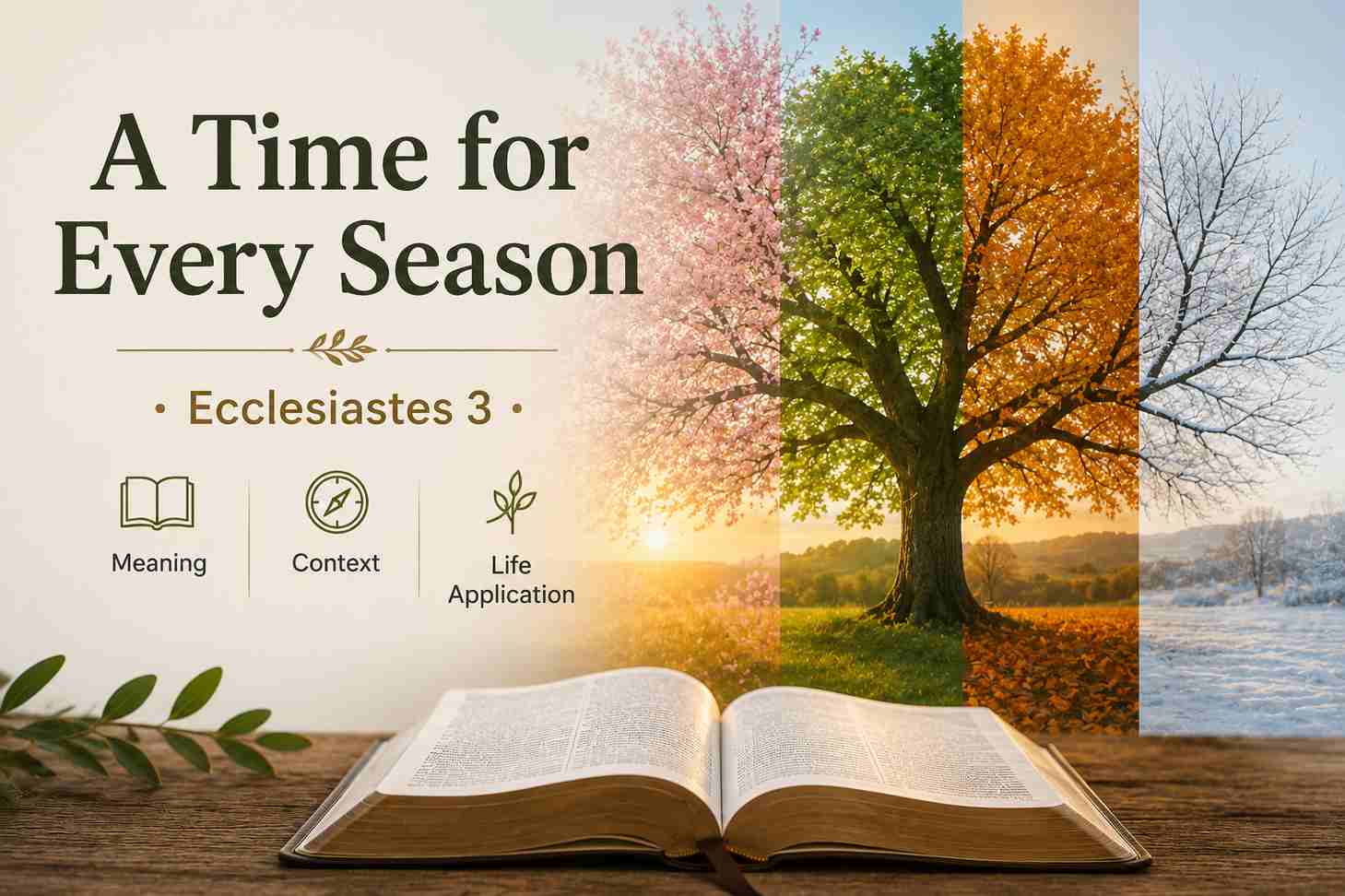
A Time For Every Season Bible Verse: Meaning, Context & Life Application (Ecclesiastes 3)
If you’ve ever heard someone say, “There’s a time for everything” or “To everything there is a season,” they’re quoting one of the most recognizable passages in the Bible: Ecclesiastes 3:1.
The verse has offered comfort for generations because it names something every reader already knows from experience — life moves in seasons. Joy, sorrow, growth, waiting, loss, celebration: each has its place within a larger order that we don’t fully control.
In the New International Version (NIV), Ecclesiastes 3:1 reads:
“There is a time for everything, and a season for every activity under the heavens.”
The King James Version (KJV) renders the same idea in more traditional language:
“To every thing there is a season, and a time to every purpose under the heaven.”
The wording shifts slightly between translations, but the core message doesn’t: human life unfolds in seasons, and God is sovereign over time.
That said, this verse is usually quoted in isolation — as a comforting one-liner rather than the opening line of a much longer argument. Ecclesiastes 3 is actually a tightly structured poem that walks through contrasting human experiences, from birth and death to mourning and dancing, to make a specific point: every stage of life has its proper time. Understanding that fuller context is what makes the passage worth returning to.
Key takeaway: Ecclesiastes 3:1 isn’t a stand-alone motivational quote about life’s ups and downs. It’s the opening statement of a sustained reflection on God’s ordering of human life — and on the limits of what people can control.
Read the Full Passage of Ecclesiastes 3:1–8
Stopping at verse 1 gives an incomplete picture. The famous line about “a time for everything” introduces a poetic list of fourteen contrasting pairs that together describe the full range of human experience. Reading the passage in full reveals its rhythm and purpose.
Modern Translation (NIV)
There is a time for everything, and a season for every activity under the heavens:
a time to be born and a time to die, a time to plant and a time to uproot, a time to kill and a time to heal, a time to tear down and a time to build, a time to weep and a time to laugh, a time to mourn and a time to dance, a time to scatter stones and a time to gather them, a time to embrace and a time to refrain from embracing, a time to search and a time to give up, a time to keep and a time to throw away, a time to tear and a time to mend, a time to be silent and a time to speak, a time to love and a time to hate, a time for war and a time for peace.
King James Version (KJV)
To every thing there is a season, and a time to every purpose under the heaven:
A time to be born, and a time to die; a time to plant, and a time to pluck up that which is planted; a time to kill, and a time to heal; a time to break down, and a time to build up; a time to weep, and a time to laugh; a time to mourn, and a time to dance; a time to cast away stones, and a time to gather stones together; a time to embrace, and a time to refrain from embracing; a time to get, and a time to lose; a time to keep, and a time to cast away; a time to rend, and a time to sew; a time to keep silence, and a time to speak; a time to love, and a time to hate; a time of war, and a time of peace.
Why Reading the Entire Passage Matters
Most readers stop at verse 1 because it’s the most quotable line. But verses 2–8 are where the Teacher actually explains what that opening statement means.
| Life Experience | Opposite Experience |
|---|---|
| Birth | Death |
| Planting | Uprooting |
| Killing | Healing |
| Tearing Down | Building Up |
| Weeping | Laughing |
| Mourning | Dancing |
| Scattering Stones | Gathering Stones |
| Embracing | Refraining from Embracing |
| Searching | Giving Up |
| Keeping | Throwing Away |
| Tearing | Mending |
| Silence | Speaking |
| Love | Hate |
| War | Peace |
Taken together, these fourteen pairs cover nearly every category of human experience. The poem isn’t claiming every season feels equally good — it’s acknowledging that life includes both celebration and sorrow, gain and loss, beginnings and endings, without pretending any of it away. That honesty is a large part of why Ecclesiastes still resonates: it recognizes hardship rather than denying it, while insisting that every season still fits within God’s ordering of time.
What Does “A Time for Every Season” Mean?
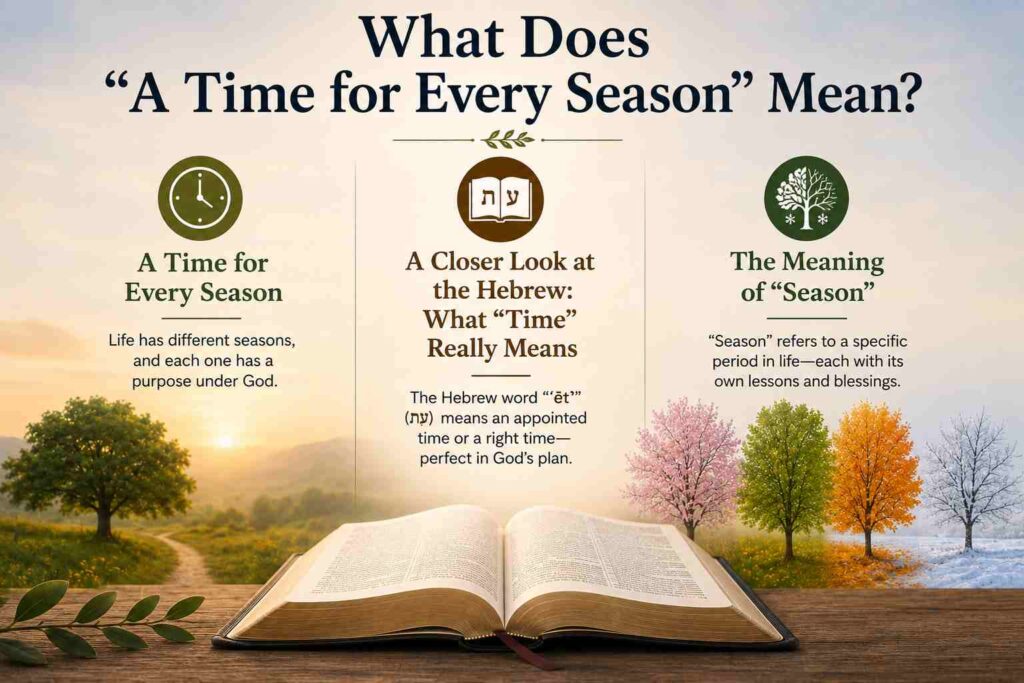
People often quote this phrase during moments of transition, treating it as shorthand for “everything happens for a reason.” But Ecclesiastes 3 is making a more specific argument, and it helps to look at the key terms individually — starting with the original language behind them.
A Closer Look at the Hebrew: What “Time” Really Means
The Hebrew word translated “time” throughout this passage is et (עֵת). It’s a striking detail once you notice it: et appears twenty-eight times across verses 2–8 — once for each half of all fourteen pairs. The repetition isn’t accidental; it’s the structural backbone of the poem.
Et doesn’t primarily mean clock time. Hebrew has other words for that. It means a fitting or appointed moment — the right time for something, rather than a measured duration. That’s why, centuries later, translators of the Greek Septuagint reached for kairos rather than chronos when rendering this passage. Chronos is time you count; kairos is time you recognize — the opportune moment, the season that calls for a particular response. Ecclesiastes 3 is a kairos passage from the first word to the last.
This word study matters for how the whole chapter is read. The poem isn’t cataloging a fixed schedule of events the way a calendar would. It’s naming twenty-eight recurring, appointed moments that make up the shape of a human life, and inviting readers to recognize which one they’re standing in right now.
The Meaning of “Season”
In everyday English, season usually means spring, summer, autumn, or winter. In Ecclesiastes 3, it means something closer to an appointed period or fitting occasion — a phase of life rather than a point on the calendar. That includes things like:
- childhood and old age
- beginnings and endings
- celebration and grief
- work and rest
- peace and conflict
The passage is making the point that life isn’t static. Circumstances shift, relationships change, responsibilities change, and even our emotional state moves through phases. The poem’s wide range of pairings exists precisely to capture that — every stage of life has a place within the larger rhythm.
The Meaning of “Time”
As the word study above shows, the repeated phrase “a time…” isn’t primarily about clock time. It’s about appropriateness — the idea that certain actions belong to certain moments. There’s a proper time to celebrate success and a proper time to mourn loss; a time to speak boldly and moments when wisdom calls for silence instead.
The poem is really an argument for discernment over impulsiveness. Wisdom means recognizing what the present season actually calls for, rather than reacting the same way regardless of circumstance.
The Meaning of “Purpose Under Heaven”
The KJV reads “a time to every purpose under the heaven”; modern translations often render this as “a season for every activity under the heavens.” Both point to the same idea.
“Under heaven” (or “under the heavens”) is a phrase Ecclesiastes uses throughout to describe life as it’s actually lived in this world — human existence within God’s created order. The verse isn’t declaring that every event is good or morally right. It’s acknowledging that life’s realities unfold within God’s sovereign oversight, even when people can’t fully see why.
Why These Words Matter Together
Put together, Ecclesiastes 3:1 teaches something more layered than simple optimism:
- Life unfolds in changing seasons.
- Human beings can’t control every circumstance.
- Wisdom means recognizing the right response for the season at hand.
- God remains sovereign over the flow of history.
That combination brings balance to both extremes. During joyful seasons, it encourages gratitude without pride. During painful ones, it offers hope without minimizing the difficulty. Ecclesiastes isn’t promising an easy life — it’s acknowledging life’s complexity while pointing readers toward trust in God’s wisdom.
Reflection: Everyone experiences seasons they’d like to keep forever and seasons they wish would end immediately. Ecclesiastes doesn’t deny either reality. Instead, it invites us to see life’s changing moments as part of a larger story — one God sees more completely than we do.
Understanding Ecclesiastes 3 in Its Biblical Context
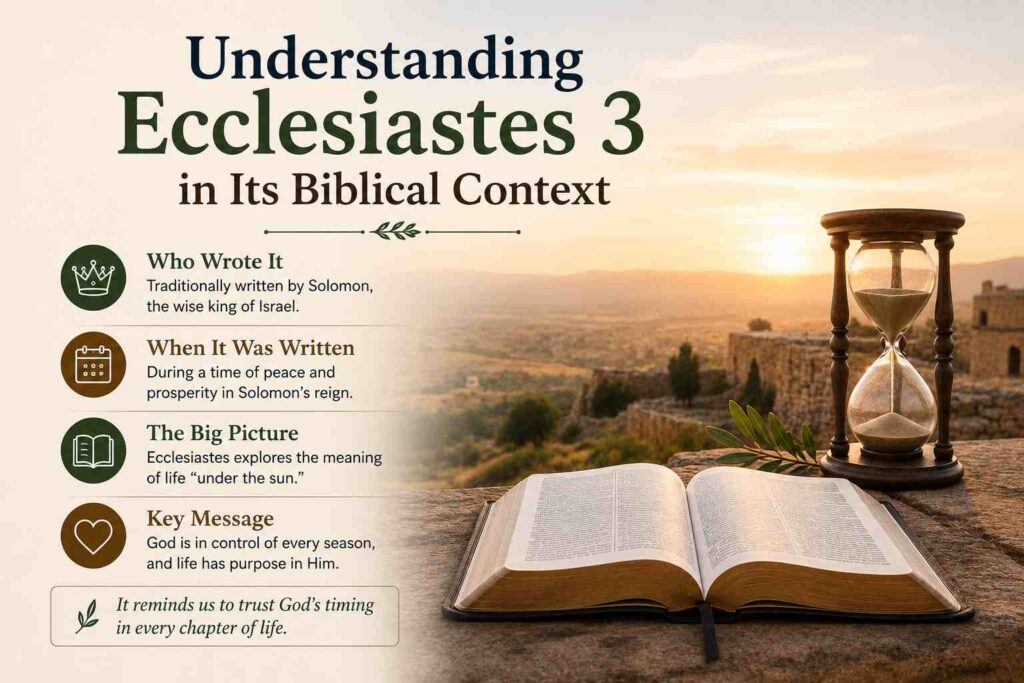
The words “there is a time for everything” are frequently quoted on their own, and they do offer real comfort that way. But they were never meant to stand apart from the rest of the book. Knowing who wrote Ecclesiastes, why, and how chapter 3 fits into its larger argument turns this passage from an inspiring quote into something with genuine theological depth.
Who Wrote Ecclesiastes?
Ecclesiastes identifies its speaker as “the Teacher” (Hebrew: Qoheleth) — a title that means something like “one who gathers people together to teach wisdom.” Many Jewish and Christian readers have traditionally identified this figure as Solomon, since the book describes its speaker as the son of David, king in Jerusalem, exceptionally wise, and immensely wealthy.
Some modern scholars instead read Qoheleth as a literary voice rather than a claim of Solomonic authorship. Both readings agree on the more important point: Ecclesiastes belongs to Israel’s Wisdom Literature, and it explores life’s deepest questions through the observations of a wise teacher. For most readers, that purpose — helping people pursue wisdom while acknowledging God’s ultimate authority — matters more than settling the authorship question.
Qoheleth, sometimes translated Teacher, Preacher, or Assembler, refers to the speaker who reflects on life, wisdom, work, and humanity’s relationship with God throughout the book.
What Is Wisdom Literature?
Ecclesiastes belongs to a group of biblical books known as Wisdom Literature, alongside Proverbs, Job, and selected Psalms. Rather than recording history or delivering prophetic messages, these books wrestle with practical questions: Why do good people suffer? What gives life meaning? How should we respond when life feels unfair? What does genuine wisdom actually look like?
Ecclesiastes approaches these questions with unusual honesty. Instead of offering tidy answers, it acknowledges life’s uncertainties while consistently pointing readers back toward reverence for God. That’s why chapter 3 doesn’t promise that every experience will be pleasant — it recognizes that every human life includes both joy and pain.
The Historical Setting
Ecclesiastes reflects a world where wisdom, wealth, political power, and personal achievement were highly prized. The Teacher tests nearly every avenue people pursue in search of lasting satisfaction — wisdom, pleasure, work, wealth, success, possessions, influence — and repeatedly concludes that none of them fully satisfies. That doesn’t mean they’re worthless; it means they’re temporary.
Chapter 3 fits naturally into that argument. It reminds readers that every human activity exists within the limits of time. No one, however successful, controls birth, death, aging, changing circumstances, or the passage of time itself. Only God stands above time.
Why Context Changes Interpretation
Quoting only verse 1 can leave the impression that everything happening in life is automatically good. The fuller context shows something more balanced: the poem names joy and grief, peace and conflict, beginnings and endings — not because they’re equally desirable, but because they’re undeniably part of life in a fallen world.
The passage encourages humility. We can’t arrange every season according to our own plans. Wisdom means recognizing that God’s perspective is bigger than ours — which sets up one of the book’s central themes: life becomes more meaningful when we trust God rather than try to control everything ourselves.
Why Does Ecclesiastes List Opposite Life Events?
At first read, the long list in verses 2–8 might look like a loose collection of statements. It’s actually one of the more carefully constructed poems in the Bible, and each pair contributes to a single, larger picture of human experience.
The Fourteen Contrasting Pairs
The poem contains fourteen pairs — twenty-eight statements in total, matching the twenty-eight uses of et noted earlier. They aren’t meant to catalog every possible event; they represent the completeness of life.
| Time For… | Time For… |
|---|---|
| Being born | Dying |
| Planting | Uprooting |
| Killing | Healing |
| Tearing down | Building |
| Weeping | Laughing |
| Mourning | Dancing |
| Scattering stones | Gathering stones |
| Embracing | Refraining from embracing |
| Searching | Giving up |
| Keeping | Throwing away |
| Tearing | Mending |
| Silence | Speaking |
| Loving | Hating |
| War | Peace |
The underlying point: human life includes experiences largely beyond our control. No one stays permanently in a season of celebration, and no one stays forever in a season of sorrow. Seasons change — and the poem states that plainly.
Understanding Hebrew Parallelism
Part of what makes this passage so memorable is its structure. Ecclesiastes uses parallelism, a hallmark of Hebrew poetry that places related or contrasting ideas side by side instead of relying on rhyme. Birth is set against death, weeping against laughter, war against peace — extremes used to represent everything that falls between them.
This is why the poem doesn’t need to list every individual life event to make its point. Every stage of life belongs somewhere within the rhythm the poem establishes.
Why Fourteen Pairs?
The text doesn’t explain the number itself, and most interpreters don’t treat it as symbolically significant. What the complete series does create is a sense of wholeness — moving from birth to peace, the poem touches nearly every major category of human experience. The emphasis is completeness, not arithmetic: the Teacher is illustrating that every part of life unfolds within time’s boundaries.
Is God Approving Every Action?
One line causes more hesitation than any other: “a time to kill and a time to heal.” Some readers assume the verse is endorsing every action it names. It isn’t. Ecclesiastes is describing life, not issuing commands.
Saying there is “a time to mourn” doesn’t instruct people to stay sad. Saying there is “a time for war” doesn’t encourage war. Saying there is “a time to hate” doesn’t override the Bible’s clear teaching to love others. The Teacher is acknowledging that these realities exist within human history — conflict alongside peace, loss alongside restoration — without endorsing every action he names.
Description vs. prescription: Ecclesiastes 3 describes the changing experiences of life. It doesn’t instruct believers to pursue every action listed. Keeping that distinction in mind prevents a lot of common misreadings.
What the Contrasting Pairs Teach Us
Read together, the fourteen pairs point to a few consistent truths:
- Life is constantly changing. No season, joyful or painful, lasts forever.
- Human control has limits. Wise decisions matter, but they can’t determine every circumstance.
- Wisdom requires discernment. Knowing the right response depends on recognizing the season you’re actually in.
- God remains constant even when life changes. Circumstances shift; His character doesn’t.
That last point is a large part of why the passage still offers hope. Ecclesiastes doesn’t promise an easy life — it reminds readers that changing seasons are simply normal, and that God’s wisdom reaches further than human understanding ever will.
What Does Ecclesiastes 3:11 Add to the Passage?
The poem in verses 1–8 paints a picture of life’s changing seasons, but the argument doesn’t stop there. Verse 11 is arguably the most important line in the chapter, because it explains why the list matters in the first place. Without it, a reader could walk away thinking life is just an endless cycle of change with no deeper purpose.
In the NIV, Ecclesiastes 3:11 reads:
“He has made everything beautiful in its time. He has also set eternity in the human heart; yet no one can fathom what God has done from beginning to end.”
The KJV renders it:
“He hath made every thing beautiful in his time: also he hath set the world in their heart, so that no man can find out the work that God maketh from the beginning to the end.”
Despite the wording differences, both translations land on the same two ideas: God works according to His own perfect timing, and human beings can’t fully grasp everything He’s doing.
“Beautiful in Its Time”
This phrase is easy to misread. It doesn’t mean every event is pleasant, painless, or enjoyable — Ecclesiastes has already named death, mourning, war, loss, and hardship as part of life. The Hebrew word behind “beautiful” carries the sense of fitting or suitable as much as it does aesthetic beauty — closer to “appropriate in its time” than “pretty.” Instead, the verse teaches that God understands how every season fits into His larger purposes, even when we can’t yet see the full picture.
Think of a puzzle spread across a table. A single piece tells you almost nothing; only once every piece is placed does the image become clear. Ecclesiastes suggests that people experience life one piece at a time, while God sees the finished picture from beginning to end. That perspective doesn’t erase pain in the moment, but it does offer humility — a painful season may not make sense today, and years later, some people do recognize how it shaped their character, deepened their faith, or prepared them for what came next. The verse doesn’t guarantee that every hardship becomes understandable in this life. It assures readers that God’s wisdom extends beyond human understanding regardless.
Key insight: “Beautiful in its time” is a statement about God’s perfect timing and complete perspective — not a claim that every event feels beautiful when it happens.
“He Has Set Eternity in the Human Heart”
The second half of the verse is just as significant. Ecclesiastes says God has placed eternity in the human heart — an idea that points to a longing for something beyond temporary experience. People ask questions that go far past daily survival: Why am I here? What gives life meaning? Is there something beyond this world? Why do we long for lasting purpose?
That instinct toward permanence, in a world where everything changes, is what the verse is naming. And yet it immediately balances that longing: “…yet no one can fathom what God has done from beginning to end.” People desire complete understanding but can’t fully grasp God’s entire plan. That tension — the longing for permanence alongside the limits of human understanding — sits at the heart of Ecclesiastes.
Why Verse 11 Changes How We Read the Whole Chapter
Connecting verse 11 to verses 1–8 makes the chapter far richer. The earlier verses describe the changing seasons of life; verse 11 explains that God oversees those seasons, that His timing is perfect, that human understanding is limited, and that life ultimately points beyond its own temporary circumstances. Instead of reading life as random, Ecclesiastes invites readers to trust God’s wisdom precisely where their own understanding runs out.
Translation Comparison
The core message of Ecclesiastes 3 holds steady across major English translations, but wording differences can shape how a phrase lands for a given reader. Comparing them side by side helps clarify meaning without suggesting the translations disagree on substance.
KJV vs. NIV
| KJV | NIV |
|---|---|
| “To every thing there is a season” | “There is a time for everything” |
| “A time to every purpose” | “A season for every activity” |
| “Under the heaven” | “Under the heavens” |
The KJV leans toward purpose; the NIV leans toward activity. These aren’t competing readings — they’re complementary emphases within the same teaching: every aspect of human life unfolds within God’s ordering of time. Readers drawn to historic language tend to prefer the KJV; those wanting contemporary readability often find the NIV easier to follow.
ESV vs. NKJV
The English Standard Version (ESV) and New King James Version (NKJV) sit between traditional and modern English. The ESV stays close to the original wording while using modern grammar; the NKJV preserves much of the KJV’s literary character while updating archaic phrasing that can trip up contemporary readers.
Across all four translations, the shared themes hold: life unfolds in seasons, every activity has an appointed time, God remains sovereign, and human understanding has limits. Those shared themes matter more than the wording differences between them.
Catholic Translation Notes
Readers sometimes look specifically for a Catholic rendering of this passage. Catholic translations include Ecclesiastes as part of the Old Testament and present the chapter with only modest wording variations from Protestant translations. Whichever tradition a translation comes from, the central teaching stays consistent: life moves through changing seasons, God governs time, and wisdom means trusting His purposes.
For personal study, the most useful translation is usually whichever one you can read closely and understand well while staying faithful to the original text — KJV for classic literary style, NKJV for traditional wording in updated language, ESV for a close and highly readable rendering, and NIV for contemporary clarity.
Common Misunderstandings About This Passage
Because Ecclesiastes 3 is so often quoted in isolation, a handful of misconceptions have become common. Knowing what the passage doesn’t teach is just as useful as knowing what it does.
Does God Cause Every Event?
Some readers assume that because Ecclesiastes lists every season of life, God must directly cause each individual event. The text itself doesn’t make that claim. It affirms God’s sovereign rule over time while acknowledging both joyful and painful experiences — the focus is on God’s authority over time generally, not on assigning a specific cause to every event that happens.
Is This Verse About Fate?
Another common misreading treats Ecclesiastes as teaching fatalism — the idea that choices don’t matter because everything is already determined. That’s not the book’s message. Scripture consistently calls people to pursue wisdom, make righteous decisions, love God, care for others, and act responsibly. Ecclesiastes acknowledges that people can’t control every circumstance, but it never suggests that wise choices are pointless. It holds two truths together: God remains sovereign, and people remain responsible for how they respond to the seasons they’re given.
Does “Season” Mean Weather?
Many modern readers naturally connect season to spring, summer, autumn, and winter. In Ecclesiastes 3, the word points instead to appointed times or fitting occasions in life — a season of beginning, of waiting, of grieving, of rebuilding, of celebration. These overlap and don’t follow a predictable calendar. The passage is speaking about life’s changing circumstances, not the weather.
Does the Passage Promise Quick Resolution?
Because Ecclesiastes emphasizes God’s timing, some readers expect fast answers to difficult seasons. The text makes no such promise — it teaches patience instead. God’s timing often differs from human expectations; some questions go unanswered for years, and others may never be fully resolved in this life. Ecclesiastes asks readers to trust God even without complete understanding, which requires humility but offers lasting hope in return.
Common mistakes to avoid:
- Reading only verse 1 without verses 2–11
- Treating the poem as commands rather than observations
- Assuming every listed event reflects God’s approval
- Interpreting “season” as weather alone
- Expecting immediate explanations for every hardship
How Christians Can Apply Ecclesiastes 3 Today
Part of why this chapter has stayed relevant for thousands of years is that its subject matter never goes out of date. Every generation experiences the same realities the poem names: beginnings and endings, joy and sorrow, success and disappointment, certainty and uncertainty. The passage doesn’t offer a formula for avoiding these challenges — it offers a way of thinking through them wisely, by treating life’s changing seasons as normal rather than as something to resist.
During Seasons of Waiting
Waiting is one of life’s hardest experiences — for healing, employment, marriage, reconciliation, answered prayer, direction, or simple relief from hardship. It’s frustrating precisely because we want immediate solutions, and Ecclesiastes reminds us that God’s timetable isn’t always ours. That doesn’t make waiting easy or every delay enjoyable. It does mean some outcomes genuinely can’t be forced.
Healthy waiting looks like continuing to pray, making wise decisions in the meantime, staying faithful in daily responsibilities, and trusting God even while the future stays unclear. Waiting is not the same as giving up — it’s an active expression of faith that God’s wisdom exceeds our own.
Ask yourself: What can I faithfully do today while trusting God with tomorrow? That question shifts the focus from controlling the future to living wisely in the present.
During Seasons of Loss
Ecclesiastes never pretends grief is easy. It names death, mourning, tears, endings, and painful transitions directly — which is part of why so many people return to this passage during funerals, memorial services, and their own seasons of sorrow. There genuinely is “a time to mourn,” and grief reflects something real: that something valuable — a loved one, a friendship, health, a job, a lifelong dream — has been lost.
Christians don’t need to feel pressured to hide sadness. Ecclesiastes gives permission to grieve while still trusting God. Hope and sorrow can coexist; faith doesn’t erase tears, but it does offer confidence that God remains present even in the darkest seasons.
During Seasons of Success
Good seasons require their own kind of wisdom. When life is going well, it’s tempting to credit success entirely to personal ability or planning. Ecclesiastes points elsewhere: every season of blessing should produce gratitude, humility, generosity, and worship. Recognizing God’s provision guards against pride and prepares believers for the inevitable next change, since the poem is clear that earthly circumstances are never permanent. Success is best enjoyed with thankfulness rather than treated as guaranteed.
During Seasons of Change
Life rarely stays still for long. Major transitions — graduating, starting a career, marrying, becoming a parent, relocating, retiring, caring for aging parents, adjusting after unexpected change — bring both excitement and uncertainty. Ecclesiastes treats change itself as part of God’s created order, and rather than fearing every transition, believers can meet new seasons with a few grounding questions: What responsibilities has God given me now? What opportunities exist in this season? What should I let go of? What should I embrace?
When facing a major transition:
- Pray for wisdom before making significant decisions
- Accept that every season carries different responsibilities
- Learn from previous experiences
- Seek wise counsel when appropriate
- Trust God even when the next step isn’t fully visible
Making Wise Decisions in Every Season
One of the book’s central lessons is that wisdom isn’t just knowing what’s right in the abstract — it’s recognizing what’s appropriate now. There’s a time to speak and a time to remain silent; a time to hold on and a time to let go. Telling the difference takes humility, prayer, and spiritual maturity, and the New Testament reinforces the same principle by urging believers to seek God’s wisdom rather than lean solely on their own understanding.
Ecclesiastes doesn’t hand readers a decision-making formula, but it does offer a workable framework:
| Principle | Practical Application |
|---|---|
| Recognize the season | Honestly assess your current circumstances instead of wishing they were different. |
| Seek God’s wisdom | Pray and study Scripture before making important decisions. |
| Accept your limits | Remember that no one can control every outcome. |
| Respond faithfully | Focus on obedience rather than certainty about the future. |
| Trust God’s timing | Believe that God sees the complete picture even when you cannot. |
That framework doesn’t remove uncertainty — it offers stability inside it. Ultimately, Ecclesiastes calls believers to respond faithfully to the season they’re actually in, rather than becoming consumed by seasons they can’t yet see.
Bible Verses Related to God’s Timing
Ecclesiastes 3 is one of Scripture’s clearest statements on time and seasons, but it isn’t the only passage speaking to God’s wisdom and timing. Reading it alongside related verses places it within the Bible’s larger story, with each passage adding a slightly different angle on the same foundational truth: God’s purposes are trustworthy, even when His timing is hard to understand.
Romans 8:28 reminds believers that God works through every circumstance for His purposes. Where Ecclesiastes observes life’s changing seasons, Romans emphasizes God’s ongoing, active work within them — together, the two encourage trust across both joyful and difficult seasons.
Proverbs 3:5–6 calls readers to trust the Lord, avoid leaning entirely on their own understanding, and acknowledge God in every area of life. This pairs naturally with Ecclesiastes: where Ecclesiastes teaches that humans can’t fully grasp God’s plan, Proverbs encourages trusting Him anyway.
James 4:13–15 warns against boasting about future plans, since life is uncertain, and encourages believers to hold their plans loosely, acknowledging God’s will. This echoes Ecclesiastes’ repeated reminder that people don’t control every aspect of life — wisdom means planning responsibly while recognizing God’s ultimate authority.
Psalm 31:14–15 captures the same idea in a single line: “My times are in your hands.” Rather than fearing changing seasons, believers can entrust their lives to God’s care — not a promise of freedom from hardship, but an expression of confidence that God stays present through every circumstance.
| Passage | Main Emphasis |
|---|---|
| Ecclesiastes 3 | Life unfolds in changing seasons under God’s sovereign timing. |
| Romans 8:28 | God works through every circumstance for His purposes. |
| Proverbs 3:5–6 | Trust God rather than relying solely on your own understanding. |
| James 4:13–15 | Hold your plans with humility because life is uncertain. |
| Psalm 31:14–15 | Place your times confidently in God’s hands. |
Together, these passages reinforce a balanced picture: life changes, people can’t control everything, wisdom requires humility, and God remains faithful. The comfort they offer isn’t that every circumstance gets explained — it’s that they consistently point toward the unchanging character of God in the middle of life’s ever-changing seasons.
Frequently Asked Questions
Is “a time for every season” about weather or life? It’s about life. In Ecclesiastes 3, “season” refers to the different stages and experiences people go through — birth and death, mourning and celebration, work and rest, speaking and silence, peace and conflict — not the four seasons of the calendar year.
Does God approve every event listed in Ecclesiastes 3? No. The poem describes life; it doesn’t command or endorse every action it names. The Teacher observes that human life includes war, grief, death, loss, and conflict — acknowledging these realities isn’t the same as approving them. Reading Ecclesiastes alongside the rest of Scripture makes that distinction clear.
Why does Ecclesiastes mention “a time to kill”? It’s one of fourteen contrasting pairs illustrating the breadth of human experience, not an instruction to kill. Ecclesiastes is poetry, and its pairs work together to portray life’s complexity rather than issue ethical commands — the broader biblical context should always guide how individual phrases like this one are read.
What does the Hebrew word for “time” actually mean? The Hebrew is et — a word for a fitting or appointed moment rather than measured, ticking time. It’s closer to what the New Testament later calls kairos (an opportune moment) than chronos (the clock). That’s part of why the passage reads less like a schedule and more like an invitation to recognize what a given moment calls for.
Which Bible translation is best for Ecclesiastes 3? There’s no single best option for every reader. KJV suits readers who appreciate traditional, classic English; NKJV offers that same style with more accessible wording; ESV stays close to the original text while remaining highly readable; NIV offers clear, contemporary English. Comparing two or more translations side by side often deepens understanding of the passage.
How can I apply Ecclesiastes 3 during difficult seasons? Start by accepting that every season is temporary, trusting God when His timing doesn’t match your expectations, seeking wisdom before big decisions, allowing yourself to grieve during loss, staying grateful during blessing, and remembering that God’s perspective is larger than your own. Application isn’t about controlling your circumstances — it’s about responding faithfully within them.
What other Bible verses teach about God’s timing? Romans 8:28, Proverbs 3:5–6, James 4:13–15, and Psalm 31:14–15 all complement Ecclesiastes 3 in different ways. Together they reinforce the same truth: life’s seasons keep changing, but God’s character and faithfulness don’t.
Conclusion
The words “to everything there is a season, and a time to every purpose under heaven” have endured for centuries because they speak to something every person lives through: constant change. Ecclesiastes 3 names the seasons of joy and sorrow, beginning and ending, celebration and grief — and rather than denying any of it, faces all of it honestly.
But the chapter offers more than a poetic observation about life’s ups and downs. Read in full, it teaches that God remains sovereign over time even when life feels uncertain; that human understanding is limited while God’s wisdom is complete; that every season has its place within His larger purposes; and that wisdom means responding faithfully to the season we’re in today.
Perhaps the deepest comfort in Ecclesiastes 3 isn’t a promise that every question gets answered. It’s the reminder that God sees the whole story from beginning to end, even when we can only see the chapter we’re currently living. Whatever season you’re in right now — waiting, celebration, grief, rebuilding, or unexpected change — this passage invites you to trust that God’s timing is wiser than your own.
Life’s seasons will keep changing. God’s faithfulness won’t.