The Seven “I AM” Statements Of Jesus: Meaning, Bible Verses, And Why They Matter
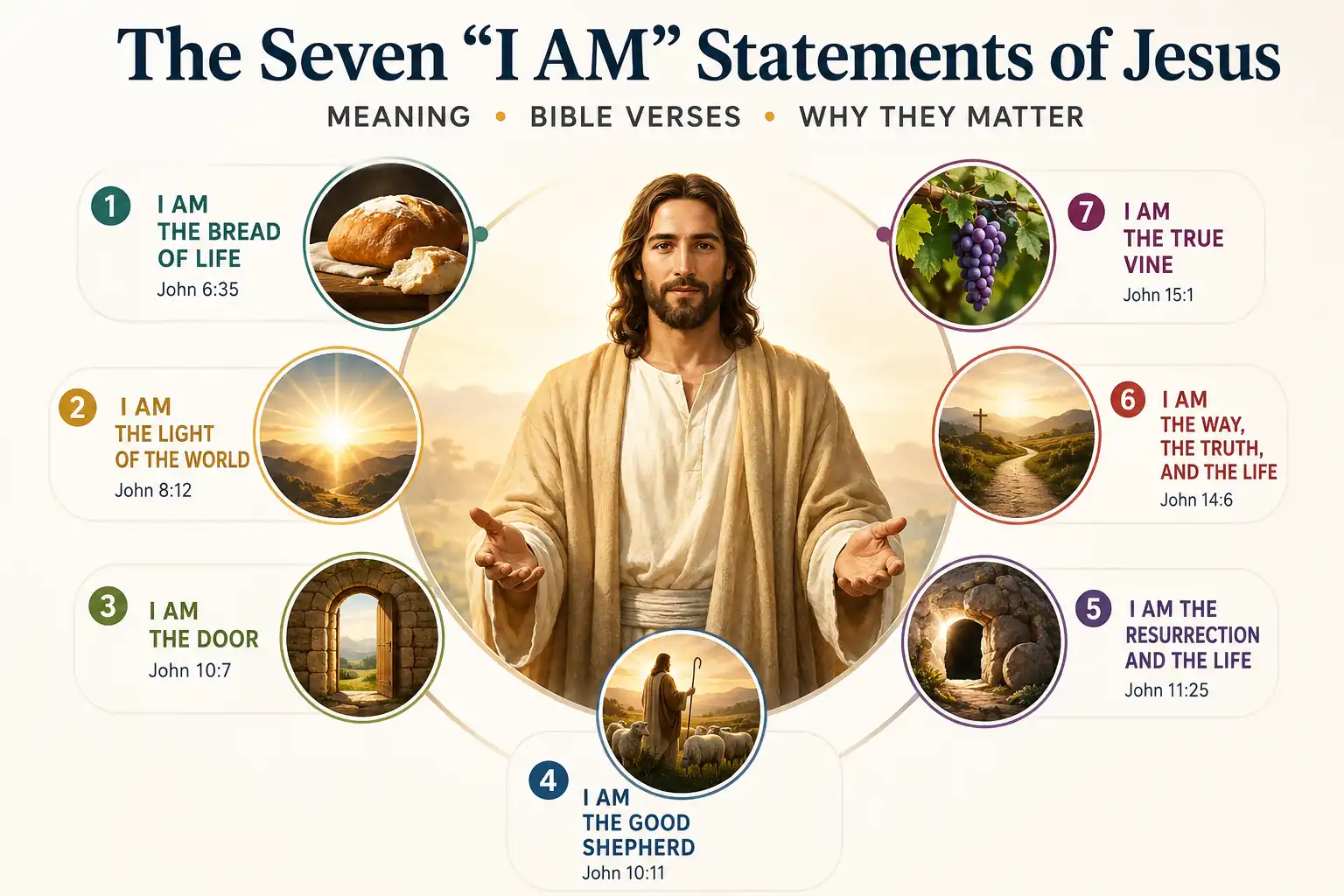
The Seven “I AM” Statements are among the most striking declarations in the entire Bible. Found only in the Gospel of John, they reveal who Jesus is, why He came, and how He fulfills God’s plan of salvation. Rather than simply describing what He did, Jesus reached for images His listeners already understood — bread, light, a shepherd, a vine — and used them to explain something much harder to put into words: His own identity.
These passages raise questions that readers keep coming back to. Why did Jesus keep saying, “I am”? What did those two words mean to the people standing in front of Him? How do they connect to God’s own words at the burning bush, “I AM WHO I AM,” in Exodus? And why does John record these sayings when Matthew, Mark, and Luke do not?
This guide walks through each of the Seven “I AM” Statements — their context, their roots in the Old Testament, and the truths they were meant to communicate. Along the way, we’ll also untangle a few commonly misquoted verses, including “I am the Alpha and the Omega,” “I am always with you,” and the popular but incorrect phrase “I am the way, the truth and the light.”
Whether you’re opening John’s Gospel for the first time, preparing a small-group lesson, or simply want a clearer picture of Jesus’ words, this guide will show how the seven statements work together as one unified portrait of who He is.
What Are the Seven “I AM” Statements of Jesus?
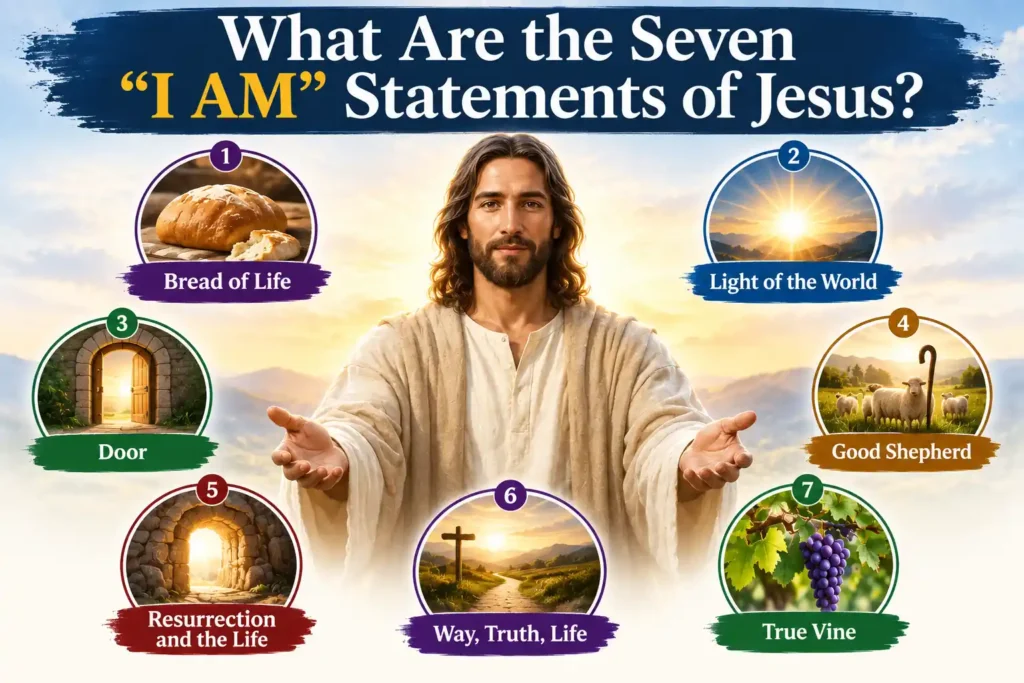
The Seven “I AM” Statements are seven metaphorical declarations Jesus makes in the Gospel of John. In each one, He follows the words “I am” with an image — bread, light, a door, a shepherd, a resurrection, a way, a vine — that reveals something about His character, His mission, and His relationship to the people who follow Him.
They aren’t scattered, offhand remarks. Across John’s Gospel, they form a deliberately arranged portrait of Jesus, and each one is anchored to a specific setting — often a miracle or a major festival — that shapes its meaning. Because the images were familiar to His original audience, Jesus was able to explain profound spiritual realities in terms anyone could picture.
The seven statements also build on one another. Read in sequence, they move from meeting basic human needs to revealing Jesus as the source of spiritual life, guidance, protection, resurrection, truth, and lasting fruitfulness.
There’s a second layer of meaning as well. For Jesus’ Jewish listeners, the phrase “I am” itself carried weight — it echoed God’s self-revelation to Moses in Exodus 3:14. That echo helps explain why some who heard Jesus responded with amazement, while others accused Him of blasphemy, a tension the article revisits below.
The Seven “I AM” Statements at a Glance
| Statement | Scripture | Main Symbol | Core Message |
| I am the Bread of Life | John 6:35 | Bread | Jesus satisfies humanity’s deepest spiritual hunger. |
| I am the Light of the World | John 8:12 | Light | Jesus brings truth, guidance, and spiritual life. |
| I am the Door | John 10:7 | Door | Jesus is the entrance to salvation and security. |
| I am the Good Shepherd | John 10:11 | Shepherd | Jesus leads and sacrifices Himself for His people. |
| I am the Resurrection and the Life | John 11:25 | Resurrection | Jesus holds authority over life and death. |
| I am the Way, the Truth, and the Life | John 14:6 | Way | Jesus is the only way to the Father. |
| I am the True Vine | John 15:1 | Vine | Spiritual life and fruitfulness come through remaining in Christ. |
Each statement highlights a different facet of who Jesus is, but they’re meant to be read as a set. Like tiles in a mosaic, no single piece tells the whole story — together, they do.
Key Takeaway: The Seven “I AM” Statements aren’t inspirational one-liners. They’re deliberate declarations that reveal Jesus’ identity and mission through images rooted in everyday life and the Old Testament.
Why Did Jesus Say “I AM”?
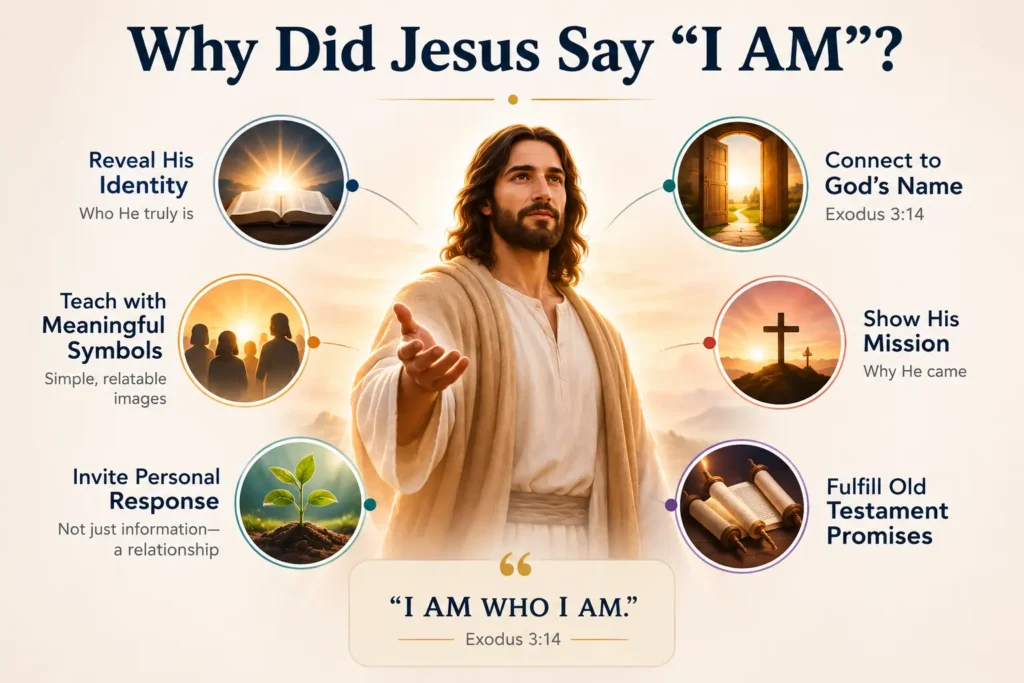
To modern ears, “I am” can sound like ordinary grammar. To Jesus’ first-century Jewish audience, it recalled one of the most important moments in Israel’s history: God’s revelation to Moses at the burning bush.
Jesus didn’t simply say, “I teach the truth” or “I give life.” He said, “I am,” and then pointed to an image of Himself. That pattern wasn’t incidental — each statement revealed not just what Jesus does, but who He is.
These declarations did several things at once. They identified Jesus as the fulfillment of Old Testament hope. They explained His mission in language people already understood. They invited a personal response rather than passive admiration. And, taken together across the Gospel, they built a progressively clearer picture of His divine identity.
The images themselves were chosen with care. Hungry crowds understood bread. Farmers understood vines. Shepherds understood what it costs to protect a flock. Travelers understood the value of the right path. Jesus reached for what His audience already knew — and then pointed past it. Bread spoils, lamplight fades, shepherds die, and vines wither, but Jesus presented Himself as the lasting reality behind every one of those symbols.
Historical Context
Many of the seven statements were spoken at major Jewish festivals or immediately after a significant miracle, and that timing shapes their meaning. Jesus called Himself the Bread of Life right after feeding a crowd of thousands. He declared Himself the Light of the World during a festival marked by enormous ceremonial lamps. He identified Himself as the Resurrection and the Life just before raising Lazarus from the dead. None of this is accidental — John consistently pairs Jesus’ actions with His teaching so that each explains the other.
Bible Study Tip: Don’t stop at the verse itself. Read the entire chapter — or even the chapters before and after — to see why Jesus chose those particular words at that particular moment.
The Connection to Exodus 3:14
The theological foundation for all seven statements reaches back to one of the most significant moments in the Old Testament. When Moses asked God at the burning bush what name he should give the Israelites, God answered:
“I AM WHO I AM.” — Exodus 3:14
That answer revealed something essential about God’s nature: He is self-existent and eternal. Unlike human beings, whose existence depends on someone or something else, God simply is — with no beginning, no end, and no higher authority. For Jewish readers, the name carried deep reverence, tied to God’s covenant faithfulness throughout Israel’s history.
When Jesus repeatedly used the phrase “I am” in John’s Gospel, many in His audience recognized the echo. The Seven “I AM” Statements are metaphorical on the surface, but they also contribute to John’s larger portrait of Jesus’ divine identity — which is part of why some religious leaders reacted so strongly. They understood that Jesus’ words reached beyond moral teaching and touched on the identity of God Himself.
It’s worth distinguishing between the biblical text and later theological interpretation here. John’s narrative emphasizes Jesus’ unique relationship with the Father, and Christian theology has historically read these statements as significant expressions of His divine identity — but the Gospel text itself presents them first as a narrative, not a doctrinal formula.
Old Testament Connections
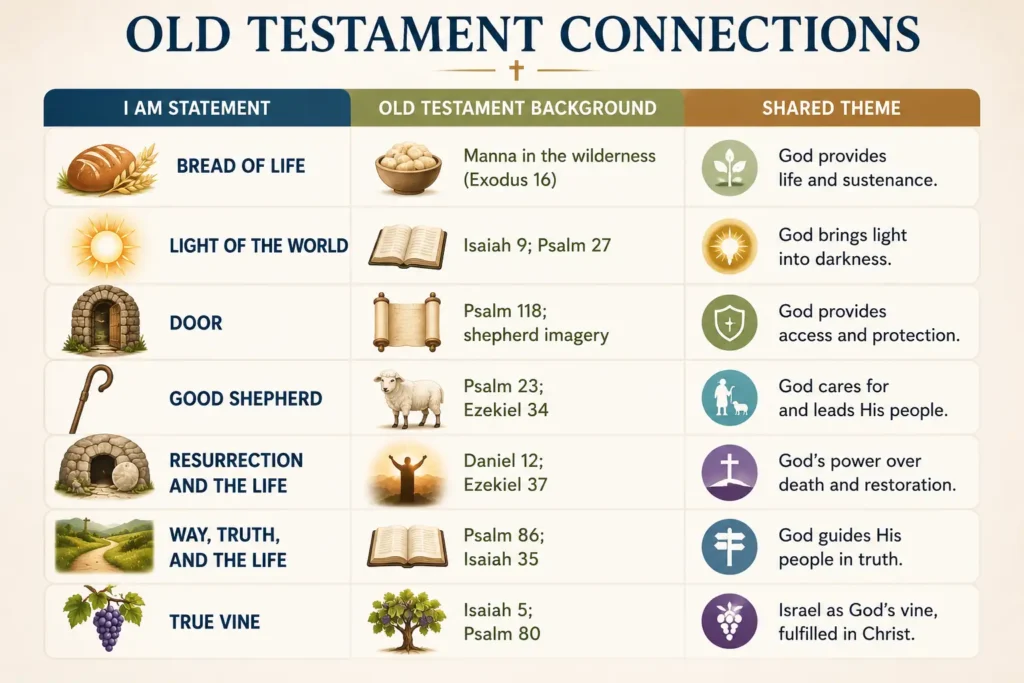
| I AM Statement | Old Testament Background | Shared Theme |
| Bread of Life | Manna in the wilderness (Exodus 16) | God provides life and sustenance. |
| Light of the World | Isaiah 9; Psalm 27 | God brings light into darkness. |
| Door | Psalm 118; shepherd imagery | God provides access and protection. |
| Good Shepherd | Psalm 23; Ezekiel 34 | God cares for and leads His people. |
| Resurrection and the Life | Daniel 12; Ezekiel 37 | God’s power over death and restoration. |
| Way, Truth, and the Life | Psalm 86; Isaiah 35 | God guides His people in truth. |
| True Vine | Isaiah 5; Psalm 80 | Israel as God’s vine, fulfilled in Christ. |
Why John’s Gospel Records These Statements
Unlike Matthew, Mark, and Luke, John writes with a stated purpose. Near the end of his Gospel, he explains exactly why he chose the material he did:
“…these are written that you may believe that Jesus is the Messiah, the Son of God, and that by believing you may have life in his name.” — John 20:31
That purpose shapes the whole Gospel. John selects specific miracles — often called the Signs — and pairs each one with teaching that unpacks its meaning. The feeding of the five thousand sets up “I am the Bread of Life.” The healing of the man born blind reinforces “I am the Light of the World.” The raising of Lazarus demonstrates “I am the Resurrection and the Life.”
Rather than stringing together disconnected stories, John builds a narrative in which Jesus’ actions and words continually explain each other. By the time readers reach the final statement — “I am the True Vine” — they’ve watched a progressive revelation of Jesus’ identity unfold through both miracle and teaching. That structure is a big part of why these seven statements remain so central to Bible study: they’re not isolated verses, but carefully placed declarations that build toward a single conclusion.
The Seven “I AM” Statements Explained
Each of the seven metaphors reveals a different facet of Jesus’ identity while building on the one before it. Together they form a unified portrait of who Jesus is, why He came, and what He offers to those who believe in Him. Each statement stands on its own, but it’s best understood in its original setting — John places every one of them alongside an event, conversation, or miracle that explains its meaning.
I Am the Bread of Life (John 6:35)
“I am the bread of life. Whoever comes to me shall not hunger, and whoever believes in me shall never thirst.” — John 6:35
Historical Setting
Jesus spoke these words shortly after one of His best-known miracles — feeding five thousand people with five loaves and two fish (John 6:1–15), with twelve baskets left over. The miracle drew crowds hoping for more free food, but Jesus redirected their attention from a full stomach to something more lasting.
What Does “Bread of Life” Mean?
Bread was one of the most basic foods in the ancient world — a daily symbol of survival and God’s provision. When Jesus called Himself the Bread of Life, He wasn’t talking about physical hunger. He was naming a deeper need — one that food, wealth, success, or possessions can’t touch. Just as bread sustains the body, Jesus alone sustains the soul.
Old Testament Background
The statement echoes Israel’s experience in the wilderness, when God supplied manna every morning (Exodus 16) — just enough for each day, a daily reminder of His faithfulness. Jesus’ listeners made the connection themselves, even bringing up Moses in conversation with Him (John 6:30–31). Jesus corrected the assumption: it was God, not Moses, who sent the bread from heaven — and God was now offering something greater still. Manna sustained physical life for a day. Jesus offers eternal life.
Audience Reaction
Many people followed Jesus because of the miracle, but His teaching didn’t match their expectations. Some took His words literally instead of spiritually; others found the teaching too hard to accept and stopped following Him altogether (John 6:66). It’s a pattern that shows up again and again in John’s Gospel: miracles drew the crowds, but Jesus’ words exposed what was really in their hearts.
Practical Lesson
People naturally look for satisfaction in achievement, relationships, wealth, comfort, or recognition. Each may meet a real, temporary need — but none of them can reach the deepest hunger a person carries. Jesus teaches that lasting fulfillment isn’t found in what we accumulate, but in who we know.
Historical Context: Bread symbolized daily survival in first-century Judea. Calling Himself the Bread of Life told His audience that He is as essential to spiritual life as bread is to physical life.
I Am the Light of the World (John 8:12)
“I am the light of the world. Whoever follows me will not walk in darkness, but will have the light of life.” — John 8:12
Historical Setting
Jesus made this declaration during, or shortly after, the Feast of Tabernacles — one of Israel’s major festivals. Massive lamps were lit in the Temple courts during the celebration, recalling the pillar of fire that had guided Israel through the wilderness. Against that backdrop, Jesus’ audience understood immediately that He was making a bold claim.
What Does “Light of the World” Mean?
Scripture regularly uses light to represent truth, holiness, God’s presence, guidance, hope, and life — with darkness standing for sin, ignorance, separation from God, and spiritual blindness. By calling Himself the Light of the World, Jesus was claiming to reveal God’s truth and to provide the guidance people need to walk out of spiritual darkness and into life.
Old Testament Background
Isaiah had prophesied, “The people walking in darkness have seen a great light” (Isaiah 9:2), and Psalm 27 opens with the words, “The Lord is my light and my salvation.” John builds directly on this imagery: Jesus is introduced as the true light in the Gospel’s opening chapter, and John 8 picks the theme back up.
Audience Reaction
Not everyone accepted the claim. Some questioned Jesus’ authority; others challenged His testimony outright, and the exchange that followed became one of the longest theological debates recorded in John’s Gospel. As with the Bread of Life, the statement divided His listeners — some believed, others rejected Him.
Practical Lesson
Physical light lets people see where they’re walking. Spiritual light, in this metaphor, helps people understand God’s character, their own condition, and the path toward eternal life. Following Christ means choosing to walk in that light rather than in darkness.
Bible Study Tip: Watch how often John’s Gospel returns to the contrast between light and darkness. The theme runs from the opening chapter all the way through the resurrection narrative.
I Am the Door (John 10:7)
“I am the door. If anyone enters by me, he will be saved and will go in and out and find pasture.” — John 10:9
Historical Setting
This statement follows directly on the healing of the man born blind (John 9). The contrast is deliberate: religious leaders rejected the healed man, while Jesus welcomed him. From there, John moves into Jesus’ teaching about shepherds, sheep, and the sheepfold.
Understanding Ancient Sheepfolds
It helps to set aside the image of a wooden barn door. First-century sheepfolds were often simple stone enclosures with a single narrow opening, and at night the shepherd himself would lie across that gap. In effect, the shepherd became the door — no sheep could leave, and no predator could get in, without going through him first. That background makes Jesus’ metaphor far more vivid than it first appears.
What Does “The Door” Mean?
As the Door, Jesus presents Himself as the entrance to salvation, the provider of safety, and the way into God’s care and abundant life. Rather than describing many possible paths, the image points to a single, secure entrance.
Old Testament Connections
The Psalms repeatedly portray God as the protector of His people and describe entering His protection. Jesus now presents Himself as the means through which that protection is actually experienced.
Practical Lesson
A door isn’t valuable because people admire it — it’s valuable because it provides access. In the same way, Jesus’ invitation calls for a response, not just observation. The image asks readers not merely to learn about Christ, but to trust Him.
Did You Know?: Shepherds in the ancient Near East often knew every sheep individually, and sheep recognized their shepherd’s voice, staying wary of strangers. That detail makes Jesus’ illustration far more meaningful to His original audience than it might seem to modern readers.
I Am the Good Shepherd (John 10:11)
“I am the good shepherd. The good shepherd lays down his life for the sheep.” — John 10:11
Where the previous statement presents Jesus as the Door, this one shifts the focus to His relationship with those who follow Him. The two images work together: the Door emphasizes access and protection, while the Good Shepherd emphasizes care, leadership, sacrifice, and personal relationship.
Shepherd Imagery in the Old Testament
Shepherd imagery runs throughout Scripture. David wrote, “The Lord is my shepherd; I shall not want” (Psalm 23), while Ezekiel criticized Israel’s unfaithful leaders for acting like selfish shepherds who neglected their flock, promising that God Himself would seek out His sheep and care for them (Ezekiel 34). Against that backdrop, Jesus’ declaration carried real weight — He was presenting Himself as the faithful shepherd Israel had long been waiting for.
What Makes the Shepherd “Good”?
In John’s Gospel, goodness shows up in action. Jesus contrasts Himself with hired hands who abandon the flock at the first sign of danger — the Good Shepherd stays, protects, and guides, and ultimately lays down His life for the sheep. The statement foreshadows the sacrifice Jesus would later make on the cross.
Audience Reaction
As with the earlier statements, this one divided its hearers. Some recognized wisdom and compassion in Jesus’ words; others rejected the claim outright. John repeatedly makes the point that Jesus’ identity demanded a response — neutrality was rarely an option.
Practical Lesson
The Good Shepherd reminds readers that Jesus’ leadership is personal, not distant. He knows His followers, guides them, protects them, and sacrifices for them — and unlike earthly leaders, He remains faithful.
Key Takeaway: The Good Shepherd does more than show the way — He walks with His flock, protects them, and ultimately gives His life for them.
I Am the Resurrection and the Life (John 11:25)
“I am the resurrection and the life. Whoever believes in me, though he die, yet shall he live.” — John 11:25
The fifth statement arrives at one of the most emotional moments in John’s Gospel. Unlike the earlier declarations, tied to bread, light, or shepherds, this one is spoken into grief. Jesus didn’t make it in a classroom or a public debate — He spoke it to a grieving family, just before raising Lazarus from the dead.
Historical Setting
Lazarus, the brother of Martha and Mary, had died in Bethany, just outside Jerusalem, and had been in the tomb four days by the time Jesus arrived. Following Jewish custom, family, friends, and mourners had gathered to comfort the sisters. When Martha met Jesus, she voiced both sorrow and faith: “Lord, if you had been here, my brother would not have died.” She believed Jesus could have healed Lazarus before his death, but struggled to understand the delay. Jesus answered with one of His most profound declarations — not a promise of resurrection someday, but a claim to be its very source.
What Does “Resurrection and the Life” Mean?
Resurrection means being raised from death. Life, throughout John’s Gospel, means more than physical existence — it means eternal life, life in relationship with God. Together, the two ideas teach that Jesus holds authority over both physical death and eternal destiny. He offers eternal life to those who believe, and death does not get the final word. John doesn’t leave this as an abstract claim — Jesus demonstrates the authority behind it by calling Lazarus out of the tomb.
Old Testament Background
Hope in resurrection surfaces in several Old Testament passages — Daniel 12 speaks of the dead awakening, and Ezekiel 37’s vision of dry bones pictures God’s restoring power. These passages differ in context, but together they build Israel’s growing expectation that God has authority over death itself. Jesus now places Himself at the center of that hope.
Audience Reaction
The raising of Lazarus became a turning point in John’s Gospel. Many who witnessed it believed in Jesus; others reported it to the religious leaders, and rather than reducing opposition, the miracle intensified it. John presents the event as both a revelation of Jesus’ power and a catalyst that pushes the narrative toward the cross.
Practical Lesson
Everyone eventually faces questions about death, grief, and hope, and Jesus’ statement speaks directly into that reality. Rather than minimizing sorrow, He offers hope that reaches beyond it. For Christians, resurrection isn’t simply a future event to anticipate — it’s grounded in the person of Jesus Himself.
Historical Context: In John’s Gospel, the raising of Lazarus is the last and greatest of Jesus’ public signs before His journey to the cross — it demonstrates in action what He had already declared in words.
I Am the Way, the Truth, and the Life (John 14:6)
“I am the way, and the truth, and the life. No one comes to the Father except through me.” — John 14:6
Of the seven statements, this one is the most widely quoted and discussed, and it remains one of the most frequently searched Bible verses today. Unlike the earlier declarations, spoken before crowds, these words were said privately to the disciples during the Last Supper, shortly before Jesus’ arrest.
Historical Setting
John 13–17 records Jesus’ farewell conversation with His disciples. Knowing His crucifixion was near, He prepared them for His departure, reassuring them that He was going to prepare a place for them. Thomas asked the practical question on everyone’s mind — “Lord, we do not know where you are going. How can we know the way?” Jesus answered not with directions, but by pointing to Himself.
What Does “The Way” Mean?
In Scripture, “way” often describes a path or a manner of life. Here, Jesus teaches that access to the Father is found through Him — not as one guide among many, but as the way itself, emphasizing relationship over a mere set of instructions.
What Does “The Truth” Mean?
Truth in John’s Gospel means more than factual accuracy — it describes ultimate reality as revealed by God. Jesus consistently reveals the Father’s character through His words and actions, so calling Himself the Truth means He perfectly reveals who God is and what God intends.
What Does “The Life” Mean?
Life is one of John’s central themes, already introduced through the Bread of Life and the Resurrection and the Life. Here it reaches its fullest expression: life in Christ includes both present spiritual vitality and the promise of eternal life.
Why These Three Images Together?
Each image answers a different human need. The Way answers the need for direction. The Truth answers the need for certainty. The Life answers the need for lasting hope. Together, they present a complete picture of Jesus’ saving work.
Audience Reaction
Unlike the earlier statements, this one was spoken in a private moment, to disciples who needed reassurance before Jesus’ departure. Later Christian readers have understood it as central to John’s presentation of Jesus’ unique role in revealing the Father.
Practical Lesson
The verse invites more than admiration for Jesus’ teaching — it invites personal trust. Its emphasis is relational: knowing the Father is inseparable from knowing Christ.
Bible Study Tip: Read John 13–17 as a single unit. The surrounding conversation supplies the context that makes this statement land the way it was meant to.
Is It “The Way, the Truth and the Light”?
A common online search asks for the Bible quote “I am the way, the truth and the light.” That wording, however, doesn’t appear in Scripture. John 14:6 actually reads, “I am the way, and the truth, and the life.” The confusion is understandable, since Jesus also declared, “I am the light of the world” (John 8:12) — two separate statements that get merged over time into a phrase that sounds familiar but isn’t biblical. When quoting Scripture, it’s always worth checking the actual text rather than relying on memory or a half-remembered internet quote.
Common Mistake: Combining “Light of the World” with “Way, Truth, and Life” creates a phrase that sounds familiar but doesn’t appear anywhere in the Bible.
I Am the True Vine (John 15:1)
“I am the true vine, and my Father is the vinedresser.” — John 15:1
The final metaphorical statement continues Jesus’ farewell conversation with His disciples. Having just described Himself as the Way, the Truth, and the Life, He turns to another image drawn from everyday life in ancient Israel: a vineyard.
Historical Setting
Vineyards were common throughout Judea and Galilee, and most of Jesus’ listeners would have understood how grapevines grew, how branches depended on the vine, and why careful pruning mattered for healthy fruit. Jesus used that everyday picture to explain His relationship with His followers.
What Does “True Vine” Mean?
Israel is repeatedly compared to a vine planted by God in the Old Testament — Isaiah 5 describes Israel as God’s vineyard, and Psalm 80 uses the same image to speak of His people. Despite God’s care, Israel often failed to produce the fruit expected of a covenant people. When Jesus calls Himself the True Vine, He presents Himself as the faithful fulfillment of what Israel was always meant to be — the genuine source of spiritual life.
What Does It Mean to “Abide”?
One of the key words in John 15 is “abide” — to remain, continue, or stay closely connected. Branches don’t produce fruit by trying harder; they bear fruit because they stay connected to the vine. In the same way, Jesus teaches that spiritual growth comes from an ongoing relationship with Him, not from effort alone.
The Role of the Father
Jesus describes the Father as the gardener, or vinedresser, who removes dead branches and prunes healthy ones so they bear even more fruit — an image of care and purposeful cultivation, not punishment.
Practical Lesson
The True Vine reminds readers that lasting spiritual fruit can’t be separated from a relationship with Christ. Growth isn’t just a matter of knowledge — it depends on staying connected to the source of life.
Key Takeaway: Just as branches depend entirely on the vine for nourishment, believers depend on Christ for spiritual growth, endurance, and fruitfulness.
Comparing the Seven I AM Statements
| Statement | Reference | Setting | Symbol | OT Connection | Practical Lesson |
| Bread of Life | John 6:35 | Feeding of the 5,000 | Bread | Manna (Exodus 16) | Satisfies spiritual hunger. |
| Light of the World | John 8:12 | Feast of Tabernacles | Light | Isaiah 9; Psalm 27 | Guides out of darkness. |
| Door | John 10:7 | Shepherd discourse | Door | Shepherd imagery | Provides access and security. |
| Good Shepherd | John 10:11 | Shepherd discourse | Shepherd | Psalm 23; Ezekiel 34 | Leads and sacrifices for His people. |
| Resurrection and the Life | John 11:25 | Raising of Lazarus | Resurrection | Daniel 12; Ezekiel 37 | Authority over life and death. |
| Way, Truth, and the Life | John 14:6 | Farewell discourse | Way | Psalm 86; Isaiah 35 | Reveals the way to the Father. |
| True Vine | John 15:1 | Farewell discourse | Vine | Isaiah 5; Psalm 80 | Fruit through remaining in Christ. |
Timeline of the Seven I AM Statements
One distinctive feature of John’s Gospel is that the seven statements aren’t grouped in a single chapter. Instead, they appear at carefully chosen moments across Jesus’ public ministry, each one building on what came before — moving from meeting humanity’s deepest needs to revealing Jesus as the complete source of spiritual life and communion with God.
Chronological Progression
| Order | Statement | Scripture | Setting | Ministry Stage |
| 1 | Bread of Life | John 6:35 | Feeding of the 5,000 | Early–Middle Ministry |
| 2 | Light of the World | John 8:12 | Feast of Tabernacles | Middle Ministry |
| 3 | Door | John 10:7 | Shepherd discourse | Middle Ministry |
| 4 | Good Shepherd | John 10:11 | Shepherd discourse | Middle Ministry |
| 5 | Resurrection and the Life | John 11:25 | Raising of Lazarus | Final Public Ministry |
| 6 | Way, Truth, and the Life | John 14:6 | Upper Room Discourse | Final Week |
| 7 | True Vine | John 15:1 | Farewell Discourse | Final Week |
A Progressive Revelation
Read together, the seven statements reveal a thoughtful progression. Jesus first meets humanity’s most basic needs — bread for hunger, light for darkness. He then explains humanity’s relationship to Him: the Door people enter through, the Good Shepherd who cares for them. From there, He addresses humanity’s greatest fear, death itself. And finally, on His last evening with the disciples, He prepares them for life after His departure — the Way to the Father, and the True Vine through whom they remain spiritually alive and fruitful. That arc is one more sign that John’s Gospel is carefully structured, not randomly assembled.
Did You Know?: Many Bible scholars note that John’s Gospel pairs Jesus’ miraculous “Signs” with His “I AM” statements: the miracles demonstrate His power, and the statements explain the meaning behind it.
How the Seven I AM Statements Reveal Jesus’ Identity
Read individually, each statement teaches an important spiritual truth. Read together, they build a remarkably complete picture of who Jesus is — each one adding a dimension rather than repeating the same idea seven different ways.
Jesus Is the Source of Spiritual Life
The Bread of Life teaches that true spiritual satisfaction comes through Christ; the True Vine teaches that spiritual growth continues only by remaining connected to Him. Together, they present Jesus as both the beginning and the ongoing source of spiritual nourishment.
Jesus Reveals God’s Truth
As the Light of the World, Jesus exposes spiritual darkness and provides guidance. As the Truth, He perfectly reveals God’s character and purposes. John’s Gospel doesn’t just present Jesus teaching truth — it presents Him embodying it.
Jesus Provides Salvation
The Door illustrates access; the Way illustrates direction. Both metaphors point to Jesus as the means through which people enter into relationship with the Father.
Jesus Cares Personally for His People
The Good Shepherd emphasizes a deeply personal relationship. Unlike distant rulers or hired workers, the shepherd knows each sheep individually — He leads, protects, and sacrifices Himself for them, complementing the image of the Door by showing not just how people enter God’s care, but how they’re guided afterward.
Jesus Has Authority Over Death
“I am the Resurrection and the Life” reaches beyond earthly existence altogether. John presents Jesus as holding authority over humanity’s greatest enemy, and the raising of Lazarus demonstrates that authority before Jesus’ own resurrection.
A Unified Portrait
Taken together, the seven statements present Jesus as the giver of life, the source of truth, the light that overcomes darkness, the protector of God’s people, the shepherd who sacrifices Himself, the conqueror of death, and the source of lasting spiritual fruitfulness. Rather than describing seven isolated qualities, these metaphors work together to reveal one consistent identity.
Key Takeaway: The Seven “I AM” Statements are best understood as one unified testimony. Each contributes to John’s larger purpose of helping readers recognize who Jesus is and believe in Him.
Commonly Confused “I AM” Verses
Part of why people search for the Seven “I AM” Statements is that several other well-known sayings of Jesus also begin with the words “I am.” Some are closely related to the seven; others belong to entirely different contexts. Knowing the difference makes for more accurate reading.
Official vs. Commonly Confused “I AM” Sayings
| Saying | One of the Seven? | Book | Purpose |
| I am the Bread of Life | Yes | John | Spiritual nourishment |
| I am the Light of the World | Yes | John | Truth and guidance |
| I am the Door | Yes | John | Access and salvation |
| I am the Good Shepherd | Yes | John | Care and sacrifice |
| I am the Resurrection and the Life | Yes | John | Victory over death |
| I am the Way, the Truth, and the Life | Yes | John | Relationship with the Father |
| I am the True Vine | Yes | John | Spiritual growth |
| I am the Alpha and the Omega | No | Revelation | Christ’s eternal sovereignty |
| I am always with you | No | Matthew | Promise of Christ’s presence |
| I am the way, the truth and the light | No | Not found in Scripture | Common misquotation |
Is “I Am the Alpha and the Omega” One of the Seven I AM Statements?
No. Although “I am the Alpha and the Omega” is one of the Bible’s best-known declarations about Christ, it isn’t one of the Seven “I AM” Statements recorded in John’s Gospel. The title appears instead in the Book of Revelation, where Alpha and Omega — the first and last letters of the Greek alphabet — symbolize completeness, eternity, and God’s sovereign rule over history.
The confusion is understandable for a few reasons: both John’s Gospel and Revelation are traditionally linked to the apostle John, both emphasize Jesus’ divine identity, and the phrase begins with “I am,” leading many readers to assume it belongs with the metaphorical seven. But the Seven “I AM” Statements use familiar, everyday images — bread, light, shepherd, vine — to explain Jesus’ relationship with humanity, while Alpha and Omega is a title emphasizing His eternal nature, not a metaphor from that same series. Both themes matter; they simply belong to different literary contexts.
Common Mistake: Listing “Alpha and Omega” as an eighth I AM Statement. It’s an important biblical title, but it isn’t one of the seven metaphorical declarations found in John’s Gospel.
Is “I Am Always With You” an I AM Statement?
Another frequent question asks whether Jesus’ promise, “I am with you always, to the end of the age,” belongs among the Seven “I AM” Statements. It doesn’t. Those words appear in Matthew 28:20, as the closing line of the Great Commission, spoken after His resurrection when Jesus instructed the disciples to make disciples of all nations.
Because the sentence begins with “I am” in English translations, it’s sometimes grouped with the seven. But the context is different: the Seven “I AM” Statements are symbolic declarations recorded in John’s Gospel, while Matthew 28 records a promise of Christ’s ongoing presence with His followers. Both passages reveal something true about Jesus, but they serve different purposes. Reading each in its original context — rather than combining unrelated sayings into one category — helps readers appreciate what each passage is actually saying.
Did Jesus Say “I Am the Way, the Truth and the Light”?
This is one of the most common Bible quotation errors online. The correct wording, from John 14:6, is “I am the way, and the truth, and the life” — the phrase “the way, the truth and the light” does not appear in Scripture. The mix-up usually happens because readers combine two genuine but separate statements: “I am the Light of the World” (John 8:12) and “I am the Way, and the Truth, and the Life” (John 14:6). Both describe Jesus, but they were spoken in different settings for different reasons. Checking the passage directly, rather than relying on a familiar-sounding phrase, keeps the meaning intact.
How to Study the Seven I AM Statements
Reading the Seven “I AM” Statements is valuable on its own, but studying them carefully deepens your understanding of Jesus’ identity and the message of John’s Gospel. Treat them as connected parts of a larger narrative rather than isolated quotations — a study that doesn’t require advanced theological training, just careful reading, attention to context, and good questions.
A Simple Bible Study Method
1. Read the surrounding chapter. Understanding what happened before and after the statement often explains why Jesus spoke those words.
2. Identify the audience. Who was Jesus speaking to? What questions or concerns did they bring? How did they respond?
3. Look for the symbolism. Consider why Jesus chose an image like bread, light, a shepherd, or a vine, and how it connects to the Old Testament.
4. Find Old Testament connections. Compare related passages to see how Jesus fulfills earlier biblical themes.
5. Observe the practical lesson. What does the statement teach about Jesus, about God’s character, and about the life of a believer?
6. Record your observations. Writing down key insights, questions, or cross-references helps the understanding stick.
Bible Study Tip: Resist the urge to rush through all seven statements in one sitting. Spending time with each one lets you appreciate its historical setting, symbolism, and theological depth.
Bible Study Checklist
- Did I read the surrounding chapter?
- Do I understand the historical setting?
- Who was Jesus speaking to?
- What symbol did Jesus use?
- Is there an Old Testament connection?
- How did the audience respond?
- What does this reveal about Jesus?
- What practical lesson can I take away?
Recommended Reading Order
Although the seven statements are often listed together, reading them in the order they appear in John’s Gospel helps you follow the development of Jesus’ ministry:
1. John 6 — I Am the Bread of Life
2. John 8 — I Am the Light of the World
3. John 10 — I Am the Door
4. John 10 — I Am the Good Shepherd
5. John 11 — I Am the Resurrection and the Life
6. John 14 — I Am the Way, the Truth, and the Life
7. John 15 — I Am the True Vine
Rather than reading only the highlighted verse, read the whole chapter each time. John consistently ties Jesus’ teaching to the surrounding events — read the feeding of the five thousand before the Bread of Life, the raising of Lazarus before the Resurrection and the Life, and the entire farewell discourse (John 13–17) for the final two statements. That context is what makes each declaration easier to understand.
Cross-References Worth Reading
| I AM Statement | Primary Passage | Helpful Cross-References |
| Bread of Life | John 6 | Exodus 16; Deuteronomy 8:3 |
| Light of the World | John 8 | Isaiah 9:2; Psalm 27:1 |
| Door | John 10 | Psalm 118:19–20 |
| Good Shepherd | John 10 | Psalm 23; Ezekiel 34 |
| Resurrection and the Life | John 11 | Daniel 12:2; Ezekiel 37 |
| Way, Truth, and the Life | John 14 | Isaiah 35; Psalm 86 |
| True Vine | John 15 | Isaiah 5; Psalm 80 |
Reading these passages alongside each statement highlights how consistently John’s Gospel presents Jesus as the fulfillment of longstanding biblical themes.
Conclusion
The Seven “I AM” Statements are far more than memorable quotations — together, they form one of the clearest presentations of Jesus’ identity in the New Testament. Each reveals a different facet of who He is: the Bread of Life who satisfies spiritual hunger, the Light of the World who overcomes darkness, the Door who provides access to salvation, the Good Shepherd who cares for His people, the Resurrection and the Life who holds authority over death, the Way, the Truth, and the Life who reveals the Father, and the True Vine through whom believers bear lasting fruit.
Seen together, these statements deliver a unified message rather than seven unrelated teachings. John’s Gospel arranges them carefully to help readers understand Jesus’ mission and respond to His invitation. They’re also a reminder that Scripture is best read in context — knowing the historical setting, Old Testament background, and literary purpose behind each statement prevents misunderstanding and reveals just how rich John’s narrative really is.
Whether you’re just beginning your study of the Bible or returning to familiar passages, spending time with the Seven “I AM” Statements can deepen your understanding of Jesus’ words and their place in the larger story of Scripture.
Frequently Asked Questions
Why are there exactly seven I AM Statements?
John’s Gospel records seven major metaphorical “I AM” declarations. The Gospel doesn’t explicitly explain the number, but readers often note that John organizes his material with intention throughout — including seven major signs. Together, the seven statements present a comprehensive picture of Jesus’ identity and mission.
Why are the Seven I AM Statements found only in John’s Gospel?
Each Gospel has its own purpose and audience. John explains that he selected specific events and teachings so readers would believe Jesus is the Messiah and have life through Him (John 20:31) — the Seven “I AM” Statements are part of that theological focus.
Which I AM Statement came first?
“I am the Bread of Life” (John 6:35) is the first metaphorical statement recorded in John’s Gospel, spoken after the feeding of the five thousand.
Which I AM Statement is the most important?
Scripture doesn’t rank one statement above the others. Each contributes a unique perspective on Jesus’ identity, and together they give a fuller understanding than any single statement could on its own.
Are the Seven I AM Statements literal or metaphorical?
They’re metaphorical. Jesus used familiar images — bread, light, a shepherd, a vine — to communicate spiritual truths about His identity and mission.
How do the Seven I AM Statements relate to Jesus’ miracles?
John often pairs Jesus’ teaching with His miracles — the feeding of the five thousand sets up the Bread of Life, and the raising of Lazarus illustrates the Resurrection and the Life. The miracles demonstrate Jesus’ power; the statements explain its significance.
Is “I am the Alpha and the Omega” one of the Seven I AM Statements?
No. “Alpha and Omega” is a title found in the Book of Revelation. It emphasizes Christ’s eternal nature and sovereignty, but it isn’t one of the seven metaphorical statements recorded in John’s Gospel.
Did Jesus say, “I am the way, the truth and the light”?
No. The correct wording in John 14:6 is “I am the way, and the truth, and the life.” The phrase “the way, the truth and the light” combines two separate biblical statements and doesn’t appear as a direct quotation in Scripture.
Is “I am always with you” one of the Seven I AM Statements?
No. Jesus’ promise, “I am with you always, to the end of the age,” appears in Matthew 28:20 as part of the Great Commission. It’s an important promise, but it isn’t one of the Seven “I AM” Statements found in John’s Gospel.
What do the Seven I AM Statements reveal about Jesus?
Taken together, they present Jesus as the source of spiritual life, truth, guidance, salvation, resurrection, and lasting fruitfulness. Rather than focusing on a single aspect of His ministry, they collectively reveal His identity and invite readers to trust Him and understand His mission more fully.