Bible Quotes on Palm Sunday: Guide, Meaning, Timeline & Prophecy
Palm Sunday marks the beginning of Holy Week and commemorates Jesus Christ’s triumphal entry into Jerusalem before His crucifixion and resurrection. The event is recorded in all four Gospels—Matthew, Mark, Luke, and John—making it one of the few moments in Jesus’ ministry described from four complementary perspectives. Read together, the accounts do more than repeat a familiar story; they build a fuller picture of why the crowds reacted the way they did and why the day still matters to Christians today.
For many readers, the first question is simple: where can I find Palm Sunday in the Bible? The answer is found in four passages, each offering a slightly different vantage point on the same afternoon.
| Gospel | Palm Sunday Passage | Reading Time | Best For |
| Matthew | Matthew 21:1–11 | About 5 minutes | Understanding prophecy fulfillment |
| Mark | Mark 11:1–11 | About 4 minutes | A concise overview |
| Luke | Luke 19:28–44 | About 6 minutes | Understanding Jesus’ compassion and kingship |
| John | John 12:12–19 | About 4 minutes | Seeing the crowd’s response and palm branches |
If you’re new to the Bible, reading all four accounts provides the fullest picture, since each Gospel writer emphasizes different details while describing the same historical event.
Palm Sunday at a Glance
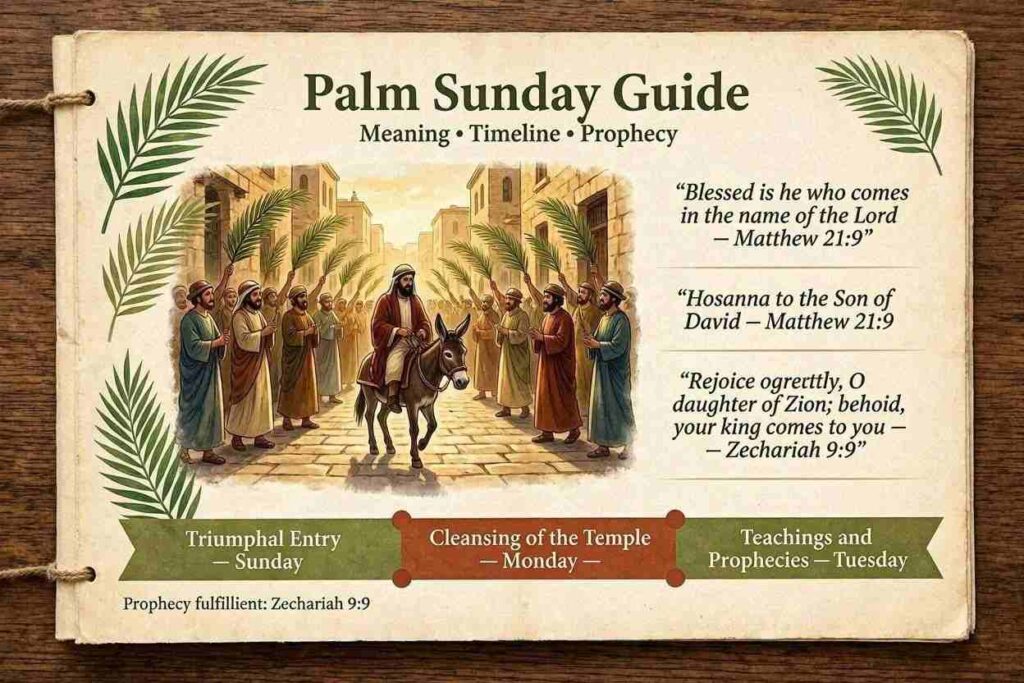
| Topic | Quick Answer |
| What is Palm Sunday? | The day Jesus entered Jerusalem before His crucifixion. |
| Where is it recorded? | Matthew 21, Mark 11, Luke 19, John 12. |
| Why is it important? | It begins Holy Week and fulfills Old Testament prophecy. |
| Main symbol | Palm branches welcoming Jesus as King. |
| Main prophecy | Zechariah 9:9. |
| Main shout | “Hosanna!” |
| What comes next? | The events of Holy Week leading to Good Friday and Easter Sunday. |
What Is Palm Sunday?
Palm Sunday is the Christian observance that remembers Jesus Christ’s triumphal entry into Jerusalem, where crowds welcomed Him with palm branches and cries of “Hosanna.” The event marks the beginning of Holy Week and leads directly to the events of Good Friday and Easter Sunday.
Unlike traditions that developed centuries later, Palm Sunday is firmly rooted in Scripture. Each Gospel records the event from its own perspective, giving readers a richer understanding when the accounts are read side by side rather than in isolation.
Why Is It Called Palm Sunday?
The name comes from the crowd’s response as Jesus entered Jerusalem. According to John’s Gospel, many people took palm branches and went out to meet Him, shouting words of praise and recognition toward the one they believed was Israel’s promised King.
Palm branches were widely recognized in the ancient world as symbols of victory, celebration, and honor. By laying branches before Jesus, the crowd publicly welcomed Him in a manner usually reserved for a returning king or conqueror.
Why Do Christians Celebrate Palm Sunday?
Palm Sunday is more than a remembrance of a single afternoon. It marks the beginning of the final week of Jesus’ earthly ministry before His crucifixion and resurrection, and it sets the emotional and theological tone for everything that follows.
Christians observe Palm Sunday because it:
- Begins Holy Week.
- Remembers Jesus’ public arrival in Jerusalem.
- Celebrates the fulfillment of Old Testament prophecy.
- Reveals Jesus as the promised Messiah.
- Points directly toward Good Friday and Easter.
For many churches, Palm Sunday also serves as a time to prepare spiritually for the events that follow during Holy Week, shifting the congregation’s focus from celebration toward the deeper meaning of the cross.
Palm Sunday in the Timeline of Holy Week
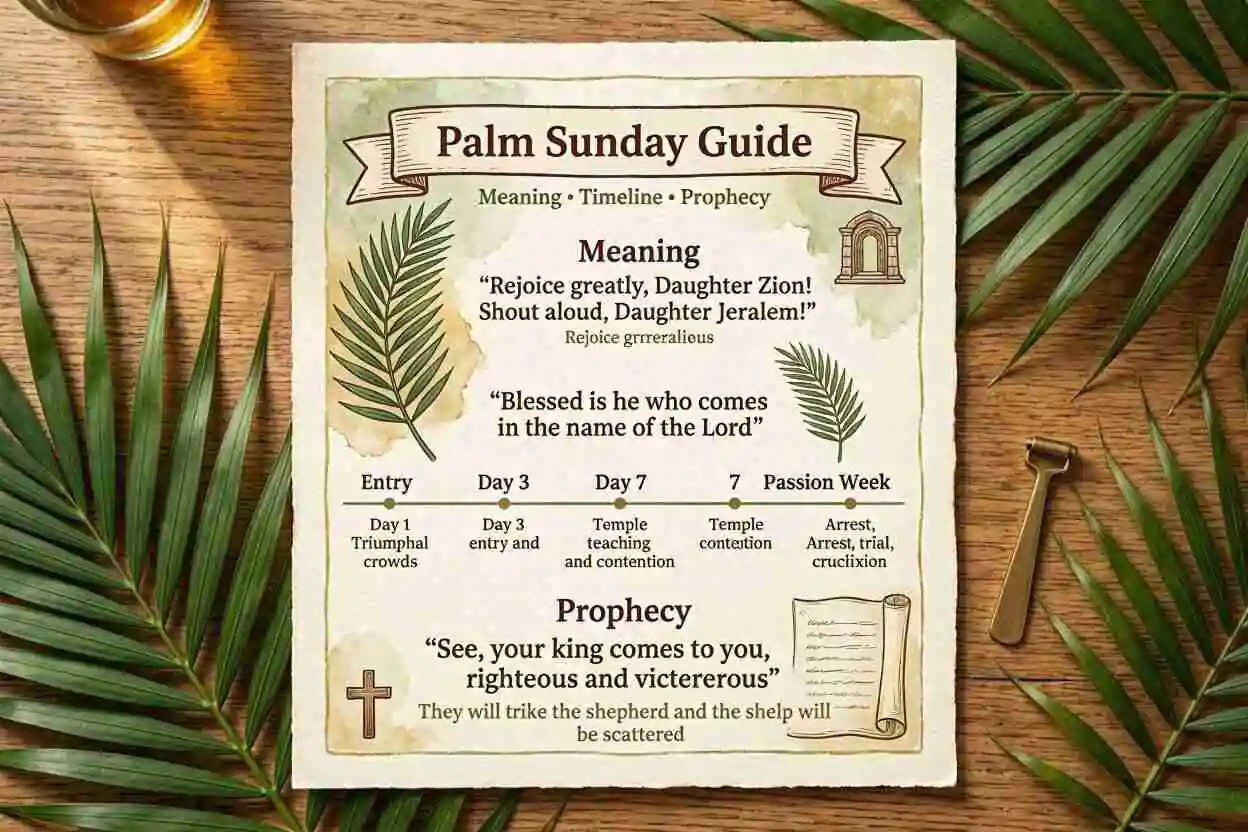
One common point of confusion is how Palm Sunday fits into the larger story of Easter. Seeing it as the starting point of an eight-day sequence helps explain why it holds such significance in the Christian calendar.
| Day | Major Event |
| Palm Sunday | Jesus enters Jerusalem. |
| Holy Monday | Jesus clears the temple. |
| Holy Tuesday | Jesus teaches in the temple. |
| Spy Wednesday | Judas agrees to betray Jesus. |
| Maundy Thursday | Last Supper. |
| Good Friday | Crucifixion of Jesus. |
| Holy Saturday | Jesus rests in the tomb. |
| Easter Sunday | Resurrection of Jesus Christ. |
Palm Sunday Is Both a Biblical Event and a Christian Celebration
Some people wonder whether Palm Sunday is simply a church tradition. The honest answer is both yes and no. The event itself is recorded in Scripture and forms part of the Gospel narrative. The annual observance, however, developed within the church as believers chose to remember and reflect on this event each year.
Recognizing this distinction helps separate the biblical account from later church traditions while still appreciating how Christians have commemorated Palm Sunday throughout history.
Which Gospel Should You Read First?
If your goal is different from the next reader’s, the best starting point may vary too.
| If You Want To… | Start With… | Why |
| Understand the complete story | Matthew 21 | Strong balance of narrative and prophecy |
| Read a shorter account | Mark 11 | Concise and easy to follow |
| Focus on Jesus’ compassion | Luke 19 | Includes Jesus weeping over Jerusalem |
| Learn about the palm branches | John 12 | Emphasizes the crowd’s welcome and public recognition |
If you have time, read all four accounts in sequence. Together they provide the fullest biblical picture and help you see how each Gospel contributes unique details without contradicting the others.
Quick Summary
- Palm Sunday is recorded in all four Gospels.
- It marks the beginning of Holy Week.
- Jesus entered Jerusalem riding a donkey, fulfilling prophecy.
- Crowds welcomed Him with palm branches and cries of “Hosanna.”
- The event points forward to Good Friday and ultimately to Easter Sunday.
Historical Background: Why Palm Sunday Happened During Passover
HISTORICAL CONTEXT
Palm Sunday did not happen in a quiet corner of the ancient world. It happened in a city swollen with visitors, watched closely by an occupying army, and charged with generations of hope for a promised deliverer. Understanding that setting explains why a single procession into Jerusalem could provoke such a strong public reaction.
A City Filled With Pilgrims
Jesus entered Jerusalem in the days leading up to Passover, one of the most significant festivals on the Jewish calendar. Passover commemorated Israel’s deliverance from slavery in Egypt, and Jewish law required observant Jews to travel to Jerusalem to keep the feast whenever possible. Historians generally describe first-century Jerusalem’s normal population as modest by ancient standards, but during Passover week that number swelled dramatically as pilgrims arrived from across Judea, Galilee, and the wider Jewish diaspora. Many scholars estimate that the pilgrim population during the festival may have rivaled or exceeded the city’s everyday residents, though exact figures from antiquity are difficult to verify with precision.
This crowding matters for understanding Palm Sunday. Jesus was not entering an ordinary city on an ordinary day. He was arriving at the height of Jerusalem’s most crowded and most emotionally charged season, when national memory, religious devotion, and political anticipation were all running high at once.
Roman Occupation and Political Tension
By the time of Jesus’ ministry, Judea had been under Roman authority for decades. Rome permitted a measure of local religious and civil administration, but ultimate political and military power rested with Roman governors and the soldiers stationed to keep order. Passover was widely regarded as a season of heightened risk for unrest, since the festival’s themes of liberation from oppression resonated uncomfortably with a population living under foreign rule. Many historians note that Roman authorities typically increased their military presence in Jerusalem during major festivals as a precaution against uprisings.
Against that backdrop, a crowd publicly hailing anyone as “King” carried real political weight. It was not merely a religious gesture. It was the kind of scene that Roman officials and the Jerusalem religious establishment alike would have watched with concern, since any suggestion of an alternative king could be read as a challenge to both Roman rule and the existing temple leadership’s uneasy peace with it.
Messianic Expectations Ran High
Centuries of prophetic writing had shaped a widespread hope among first-century Jews that God would send a deliverer, often expected to be a king in the line of David, who would restore Israel’s fortunes. Traditional Jewish interpretation of these promises varied, and not everyone expected the same kind of Messiah. Many, however, hoped for a figure who would address the very real experience of foreign occupation, whether through political leadership, military victory, or divine intervention.
The raising of Lazarus shortly before Palm Sunday, recorded in John’s Gospel, appears to have intensified public interest in Jesus specifically. Word of that event, combined with reports of Jesus’ earlier miracles and teaching throughout Galilee and Judea, meant that by the time He approached Jerusalem, expectations surrounding Him were already unusually high. A crowd primed by both festival excitement and messianic hope was, in a very real sense, ready to respond the moment Jesus appeared on the road from the Mount of Olives.
Why This Context Matters for Reading Palm Sunday
Placing Palm Sunday against this backdrop helps explain several details that can otherwise seem puzzling. It explains why such a large crowd was available to greet Jesus on short notice. It explains why the Gospel writers took care to connect Jesus’ actions to Old Testament prophecy, since readers familiar with those expectations would immediately understand the claim being made. And it explains why religious leaders reacted with concern rather than celebration, since a public acclamation of kingship during a festival already considered politically sensitive was the kind of event that could draw unwanted Roman attention to the whole city.
None of this changes the biblical narrative itself. It simply fills in the world the narrative assumes its first readers already understood, and it gives modern readers a clearer sense of why Jesus’ arrival landed with such force.
Why Did the Crowd Change?
HISTORICAL CONTEXT AND BIBLICAL NARRATIVE
One of the most common questions readers bring to Palm Sunday is also one of the hardest to sit with: how could the same city that shouted “Hosanna” on Sunday call for crucifixion within the week? Scripture does not offer a single tidy explanation, but the surrounding context, read carefully, offers real insight without requiring speculation about specific individuals’ motives.
The first thing worth noting is that “the crowd” was not necessarily one uniform group. Jerusalem during Passover held pilgrims from many regions, residents of the city, religious leaders, and Jesus’ own traveling followers. The Gospel accounts suggest that the group welcoming Jesus on Palm Sunday and the group calling for His crucifixion before Pilate later that week were not necessarily made up of identical individuals, even though both scenes took place in or near the same city within the same festival period.
A second factor is the gap between expectation and mission. As the historical background above notes, many people hoped for a Messiah who would deliver Israel from Roman occupation, whether through political authority or military action. Jesus’ triumphal entry, riding a donkey rather than a warhorse, already signaled something different from a conquering king, though the crowd’s celebration suggests many did not yet grasp the distinction. As the week unfolded and it became clear that Jesus was not moving toward a political uprising or a direct confrontation with Rome, the disappointment felt by those who had hoped for immediate deliverance may have curdled into disillusionment for some.
Religious leadership also played a documented role. The Gospels describe growing tension between Jesus and the temple authorities throughout the week following His entry, including His actions in the temple courts and His public teaching that directly challenged their standing. Matthew’s Gospel specifically records religious leaders working to turn public sentiment against Jesus in the days before His arrest. Whatever their motivations, deliberate opposition from established leadership had genuine influence over public opinion in a way that a single crowd’s initial enthusiasm could not fully withstand.
It is also worth resisting the temptation to flatten the story into a simple narrative of fickle crowds. The Gospels themselves do not claim that every person who waved a palm branch later called for crucifixion, nor do they claim the opposite. What the accounts do show consistently is a widening gap between what many hoped Jesus would do and what He actually came to do. That gap, more than any single event, explains why celebration could give way to rejection within days. Rather than reading Palm Sunday’s welcome as insincere, it may be more accurate to read it as a hope aimed at the wrong kind of kingdom, one Holy Week would go on to redefine entirely.
Understanding this shift adds weight to the rest of the Palm Sunday story. It is not simply a triumphant prelude to tragedy. It is the opening scene of a week in which Jesus’ identity as King is publicly proclaimed, publicly misunderstood, and ultimately demonstrated in a way no one in the crowd was expecting.
Key Bible Quotes and Verses About Palm Sunday
The primary Bible passages about Palm Sunday are found in Matthew 21:1–11, Mark 11:1–11, Luke 19:28–44, and John 12:12–19. Together, these four Gospel accounts tell the complete story of Jesus’ triumphal entry into Jerusalem, with each writer highlighting unique details that deepen our understanding of this pivotal moment.
Many articles list only one or two passages. Reading all four accounts provides a richer picture, since the Gospel writers complement one another rather than repeat the exact same details.
Complete List of Palm Sunday Bible Verses
The following table serves as a quick reference to every major Scripture passage connected with Palm Sunday.
| Bible Passage | Gospel | Main Focus | Best For | Approx. Reading Time |
| Matthew 21:1–11 | Matthew | Fulfillment of prophecy and Jesus as the promised King | Bible study, sermons, understanding prophecy | 5 minutes |
| Mark 11:1–11 | Mark | Concise account of the Triumphal Entry | Quick reading, personal devotion | 4 minutes |
| Luke 19:28–44 | Luke | Jesus’ kingship and His compassion for Jerusalem | Reflection, Bible study, Holy Week preparation | 6 minutes |
| John 12:12–19 | John | Palm branches, public recognition, and growing belief in Jesus | Understanding symbolism and Palm Sunday traditions | 4 minutes |
Decision Guide: Which Gospel Should You Read?
Not every reader has the same goal. If you’re wondering where to begin, this guide can help.
| Your Goal | Recommended Passage | Why It Fits |
| Learn the complete Palm Sunday story | Matthew 21:1–11 | Balances narrative, prophecy, and crowd response |
| Read a shorter account | Mark 11:1–11 | Straightforward and concise |
| Understand Jesus’ heart for Jerusalem | Luke 19:28–44 | Includes Jesus weeping over the city |
| Learn why palm branches matter | John 12:12–19 | Gives special attention to the crowd’s welcome |
| Study fulfilled prophecy | Matthew 21:1–11 with Zechariah 9:9 | Shows the direct connection between prophecy and fulfillment |
If time allows, read all four passages in order. Each Gospel contributes details the others omit, creating a fuller and more balanced understanding than any single account offers alone.
Palm Sunday Bible Verses in Full (KJV)
Summaries are useful, but many readers searching for Palm Sunday Bible quotes want the actual verse text. The passages below are quoted from the King James Version, which is in the public domain, so the wording can be reproduced here in full.
| Passage | Verse Text (KJV) |
| Zechariah 9:9 | “Rejoice greatly, O daughter of Zion; shout, O daughter of Jerusalem: behold, thy King cometh unto thee: he is just, and having salvation; lowly, and riding upon an ass, and upon a colt the foal of an ass.” |
| Psalm 118:25–26 | “Save now, I beseech thee, O LORD: O LORD, I beseech thee, send now prosperity. Blessed be he that cometh in the name of the LORD.” |
| Matthew 21:5 | “Tell ye the daughter of Sion, Behold, thy King cometh unto thee, meek, and sitting upon an ass, and a colt the foal of an ass.” |
| Matthew 21:9 | “Hosanna to the Son of David: Blessed is he that cometh in the name of the Lord; Hosanna in the highest.” |
| Mark 11:9–10 | “Hosanna; Blessed is he that cometh in the name of the Lord: Blessed be the kingdom of our father David, that cometh in the name of the Lord: Hosanna in the highest.” |
| Luke 19:38 | “Blessed be the King that cometh in the name of the Lord: peace in heaven, and glory in the highest.” |
| John 12:13 | “Took branches of palm trees, and went forth to meet him, and cried, Hosanna: Blessed is the King of Israel that cometh in the name of the Lord.” |
Modern translations such as the ESV, NIV, and NLT render these same verses in more contemporary language, which some readers find easier to follow aloud in a worship setting. The meaning across translations is consistent even where the exact wording differs.
Matthew 21:1–11 — Palm Sunday and the Fulfillment of Prophecy
Matthew’s account places special emphasis on the fulfillment of Old Testament prophecy. Before Jesus enters Jerusalem, He instructs two disciples to bring a donkey and its colt. Matthew then explicitly connects this event to the prophecy found in Zechariah 9:9, pausing his narrative to make the connection unmistakable to his readers.
Key Themes
- Jesus intentionally fulfills prophecy.
- Jesus enters Jerusalem as the promised Messiah.
- The crowd publicly recognizes Him.
- The city reacts with amazement.
Choose Matthew if you want to understand why Palm Sunday was not a random event but the fulfillment of a plan announced centuries earlier. This account is especially useful for Bible study, church teaching, Holy Week preparation, and understanding how prophecy connects the Old and New Testaments.
Mark 11:1–11 — A Clear and Concise Account
Mark presents the Triumphal Entry in a direct, fast-moving narrative. Rather than dwelling on prophecy, Mark emphasizes the sequence of events as Jesus approaches Jerusalem: preparation for the journey, the disciples’ obedience, public celebration, and Jesus’ arrival at the temple.
Mark’s concise style makes this account an excellent choice for daily Bible reading, personal devotion, first-time readers, and families reading together, since it delivers the essential story without requiring extended background knowledge.
Luke 19:28–44 — The King Who Wept
Luke includes one of the most distinctive moments in the Palm Sunday story. After entering Jerusalem, Jesus weeps over the city because its people failed to recognize the significance of His coming. This detail reminds readers that Palm Sunday is not only a celebration; it is also a moment filled with compassion, sorrow, and urgency.
Unique Details Found in Luke
- Jesus weeps over Jerusalem.
- The Pharisees object to the crowd’s praise.
- Jesus explains that if the people remained silent, “the stones would cry out.”
- Greater emphasis on peace and salvation.
Luke shows that Jesus was not entering Jerusalem to claim political power. He entered as the promised King whose mission would ultimately lead to the cross, which makes this account especially valuable for reflection, Holy Week devotions, and group Bible discussion.
John 12:12–19 — Palm Branches and Public Recognition
John’s account is the source of many traditions associated with Palm Sunday because it specifically mentions the palm branches carried by the crowd. John also connects the growing excitement surrounding Jesus to the raising of Lazarus, explaining why such large crowds gathered to welcome Him.
Key Themes
- Palm branches symbolize honor and celebration.
- Crowds recognize Jesus publicly.
- The miracle of Lazarus influences public opinion.
- The Pharisees become increasingly concerned.
This account is best for understanding Palm Sunday traditions, learning about biblical symbolism, and connecting Jesus’ miracles to the events of Holy Week.
Side-by-Side Gospel Overview
| Gospel | Main Emphasis | Unique Detail | Best Audience |
| Matthew | Fulfilled prophecy | Quotes Zechariah directly | Bible students |
| Mark | Chronological narrative | Concise presentation | New readers |
| Luke | Compassion and kingship | Jesus weeps over Jerusalem | Devotional readers |
| John | Public recognition | Palm branches and Lazarus connection | Symbolism study |
Rather than contradicting one another, these accounts function much like four honest witnesses describing the same afternoon from different vantage points, each selecting details that support the purpose of his Gospel while faithfully recording the same historical event.
Common Mistake to Avoid
Some readers believe that because the Gospel accounts include different details, they must conflict with one another. A better way to understand them is as complementary accounts: Matthew emphasizes fulfilled prophecy, Mark focuses on the sequence of events, Luke highlights Jesus’ compassion, and John explains why the crowds were especially enthusiastic. Reading them together provides a fuller picture than reading any single account in isolation.
Quick Reference Box: Essential Palm Sunday Passages
| Purpose | Passage |
| Complete overview | Matthew 21:1–11 |
| Short reading | Mark 11:1–11 |
| Reflection | Luke 19:28–44 |
| Symbolism | John 12:12–19 |
| Prophecy | Zechariah 9:9 |
| Messianic praise | Psalm 118:25–26 |
Key Takeaways
- All four Gospels record Palm Sunday, making it one of the most widely attested events in Jesus’ ministry.
- Each account contributes unique details that enrich the overall narrative.
- Matthew is ideal for studying prophecy, Mark for a concise overview, Luke for reflection on Jesus’ compassion, and John for understanding the symbolism of palm branches and public recognition.
- Reading the Gospel accounts alongside Zechariah 9:9 and Psalm 118:25–26 reveals how Palm Sunday connects Old Testament promises with their New Testament fulfillment.
Comparing the Four Gospel Accounts of Palm Sunday
Although Matthew, Mark, Luke, and John all describe Jesus’ triumphal entry into Jerusalem, each Gospel emphasizes different details. Rather than contradicting one another, the four accounts work together to provide a fuller understanding of Palm Sunday, revealing its historical, prophetic, and spiritual significance.
One of the biggest misconceptions about Palm Sunday is that the Gospel accounts must match word for word. Ancient biographical writing was not built around that expectation the way modern journalism often is. First-century biographers regularly selected, arranged, and emphasized material according to the purpose of their work rather than attempting an exhaustive, chronologically uniform record. Each Gospel writer selected details that best served the purpose of his book while faithfully recording the same historical event, much the way two respected historians today might write different but equally accurate accounts of the same event, each shaped by what they considered most significant for their audience.
If you read only one Gospel, you’ll understand Palm Sunday. If you read all four together, you’ll understand why Palm Sunday matters.
Palm Sunday Gospel Comparison at a Glance
| Feature | Matthew 21:1–11 | Mark 11:1–11 | Luke 19:28–44 | John 12:12–19 |
| Records the Triumphal Entry | Yes | Yes | Yes | Yes |
| Jesus rides a donkey | Yes | Yes | Yes | Yes |
| Mentions a colt specifically | Yes | Yes | Yes | No |
| References two animals (donkey and colt) | Yes | No | No | No |
| Crowds praise Jesus | Yes | Yes | Yes | Yes |
| Palm branches mentioned | No | No | No | Yes |
| Cloaks spread on the road | Yes | Yes | Yes | No |
| Quotes Zechariah’s prophecy directly | Yes | No | No | Refers to fulfillment |
| “Hosanna” recorded | Yes | Yes | No (uses “peace”) | Yes |
| Jesus weeps over Jerusalem | No | No | Yes | No |
| “Blessed is the King of Israel” recorded | No | No | No | Yes |
| Temple visit included | Yes | Yes | Afterward | Focus shifts to public response |
| Connection to Lazarus | No | No | No | Yes |
| Pharisees object to the crowd | Briefly implied | No | Yes, directly | Yes, directly |
| City described as “stirred” or moved | Yes | No | No | No |
| Disciples sent to retrieve the animal(s) | Yes | Yes | Yes | No |
| Explicit mention of Bethphage | Yes | Yes | Yes | No |
| Explicit mention of Mount of Olives | Yes | Yes | Yes | No |
| Owner’s response to disciples addressed | Yes | Yes | Yes | No |
| Crowd identifies Jesus as “the prophet” | Yes | No | No | No |
| Emphasis on kingship language | Strong | Moderate | Strong | Strong |
Read all four accounts if you can. Each contributes details the others omit, creating a richer and more balanced understanding of the event than any single Gospel provides alone.
Matthew’s Account: Jesus the Promised King
Matthew presents Palm Sunday as the fulfillment of Old Testament prophecy, emphasizing that Jesus is the long-awaited Messiah promised in Scripture. Matthew immediately connects Jesus’ instructions about the donkey with Zechariah 9:9, presenting this not as coincidence but as deliberate fulfillment.
Matthew is the only Gospel writer who explicitly pauses the narrative to explain that Jesus’ actions fulfilled Old Testament prophecy, which makes his account particularly valuable for readers who want to understand how the Old and New Testaments connect. Choose Matthew if you want to study prophecy, prepare a sermon, understand Jesus as the Messiah, or explore Old Testament connections.
Mark’s Account: The Servant King
Mark presents the Palm Sunday story with remarkable simplicity and momentum, focusing on the events themselves rather than lengthy explanation. His writing style reflects the overall character of his Gospel: fast-moving, practical, and action-oriented.
One interesting detail is that Mark records Jesus entering the temple, looking around, and then leaving because it was already late in the day. This small, almost understated moment prepares readers for the cleansing of the temple that follows and reminds us that even seemingly ordinary details fit into a larger unfolding plan. Mark’s concise style is especially suitable for new believers, daily devotions, family Bible reading, and Holy Week reading plans.
Luke’s Account: The Compassionate King
Luke emphasizes Jesus’ compassion, peace, and sorrow for Jerusalem, making his account emotionally distinctive among the four Gospels. Luke includes several details that appear nowhere else.
Jesus Weeps Over Jerusalem
Perhaps Luke’s most memorable contribution is Jesus weeping over the city. Instead of celebrating His arrival as a victorious political leader, Jesus grieves because many people fail to recognize the significance of His coming. This moment reminds readers that Palm Sunday is not only about celebration but also about God’s desire for repentance and peace.
“If They Keep Quiet…”
When the Pharisees ask Jesus to silence the crowd, He replies that if the people remained silent, the stones would cry out. This statement highlights that Jesus’ identity, in Luke’s telling, could not remain hidden even if human voices fell silent.
Luke presents Jesus as King, Savior, and compassionate Redeemer, encouraging readers to look beyond outward celebration and consider the deeper spiritual meaning of Palm Sunday.
John’s Account: Public Recognition of the Messiah
John focuses on why such large crowds welcomed Jesus and why palm branches became central to the Palm Sunday story. Unlike the other Gospel writers, John explains that many people had witnessed, or heard about, the raising of Lazarus. Because of this miracle, expectations surrounding Jesus were especially high.
Why Palm Branches Matter
John is the only Gospel writer who specifically mentions palm branches. These branches symbolized victory, celebration, honor, and royal welcome. The crowd was not merely greeting a respected teacher; they were publicly welcoming the King they believed God had promised.
John also records growing concern among the Pharisees, who observe that the whole world seemed to be following Jesus, a statement that illustrates His rapidly increasing public influence shortly before His arrest.
Why the Gospel Accounts Include Different Details
A common question readers ask is why every Gospel doesn’t include exactly the same information if the event really happened as described. The answer lies in the purpose of each Gospel and its intended audience. Matthew wrote with special attention to Jewish readers familiar with the prophets. Mark wrote for a broader audience needing a clear, fast-moving account. Luke wrote with particular sensitivity to Gentile readers and themes of compassion and salvation. John wrote to build belief in Jesus as the Messiah and Son of God.
Think of four witnesses standing at different points along the same road during the same procession. Every account is genuine. Every account captures something the others miss. Together they provide a far richer picture than any single vantage point could offer on its own, which is precisely how historians generally treat multiple independent accounts of any significant ancient event.
Comparison of Each Gospel’s Emphasis
| Gospel | Primary Emphasis | Main Audience | Unique Contribution |
| Matthew | Fulfilled prophecy | Jewish readers | Jesus fulfills Old Testament promises |
| Mark | Action and chronology | Broad Christian audience | Concise historical narrative |
| Luke | Compassion and salvation | Gentile audience | Jesus weeps over Jerusalem |
| John | Belief in Jesus as Messiah | Universal audience | Palm branches and Lazarus connection |
Detail Level by Gospel
| Gospel | Level of Narrative Detail | Why |
| Matthew | Very High | Includes prophecy citation, two animals, and extended crowd response |
| Mark | Moderate | Concise, action-focused account with fewer explanatory asides |
| Luke | Very High | Adds Jesus weeping, Pharisee objection, and extended theological reflection |
| John | High | Adds palm branches, Lazarus connection, and Pharisee commentary |
Which Gospel Should You Read First?
| If You Want To… | Read… | Reason |
| Understand prophecy | Matthew | Strongest prophetic emphasis |
| Finish in a few minutes | Mark | Shortest account |
| Reflect on Jesus’ compassion | Luke | Emotional depth |
| Learn Palm Sunday traditions | John | Palm branches explained |
| Study everything | All four | Complete understanding |
Start with Matthew if you’re unfamiliar with Palm Sunday, then continue with Mark, Luke, and John. This progression naturally builds from prophecy to historical narrative, compassionate reflection, and symbolic understanding.
Common Mistakes When Comparing the Gospels
Mistake 1: Reading Only One Gospel
Better approach: compare all four accounts to see the fuller picture each writer contributes.
Mistake 2: Assuming Differences Equal Contradictions
Better approach: ask what unique perspective each writer contributes rather than assuming a discrepancy.
Mistake 3: Ignoring the Intended Audience of Each Gospel
Better approach: remember that each writer emphasized different truths for different readers, which shapes what he chose to include.
Mistake 4: Studying Palm Sunday Without the Old Testament
Better approach: read Zechariah 9:9 and Psalm 118 alongside the Gospel accounts to see the prophecy being fulfilled in real time.
Mistake 5: Assuming Matthew’s Two Animals Is an Error
Matthew mentions both a donkey and its colt, while Mark, Luke, and John mention only the colt. This is best understood as Matthew including an additional detail rather than the other writers contradicting him; ancient narrators frequently focused on the animal actually ridden (the colt) without denying that a second animal accompanied it. Many commentators view Matthew’s inclusion of both animals as an intentional link back to the specific wording of Zechariah 9:9.
How to Study Palm Sunday
- Read Mark for a clear overview of the basic events.
- Compare Matthew to see how the event fulfills prophecy.
- Read Luke to reflect on Jesus’ compassion for Jerusalem.
- Finish with John to understand the palm branches and public recognition.
- Review Zechariah 9 and Psalm 118 to see the Old Testament roots of the story.
- Reflect on how the crowd’s expectations compare with Jesus’ actual mission.
Palm Sunday Timeline
Palm Sunday is not an isolated event; it marks the beginning of Holy Week and sets in motion the final events of Jesus’ earthly ministry, leading to His crucifixion, burial, and resurrection. Understanding the timeline helps readers see how each event builds upon the one before it.
Holy Week Timeline
| Day | Event | Why It Matters |
| Palm Sunday | Jesus enters Jerusalem | Publicly identifies Jesus as the promised King and fulfills Zechariah 9:9 |
| Holy Monday | Cleansing of the Temple | Confronts corrupted worship practices and asserts Jesus’ authority over the temple |
| Holy Tuesday | Teaching in the Temple | Jesus debates religious leaders and prepares His disciples for what is coming |
| Spy Wednesday | Judas agrees to betray Jesus | Marks the point at which the plot against Jesus becomes formalized |
| Maundy Thursday | Last Supper and Gethsemane | Jesus institutes the Lord’s Supper and prays before His arrest |
| Good Friday | Crucifixion | Jesus dies, which Christians understand as atonement for sin |
| Holy Saturday | Jesus rests in the tomb | A day of waiting that precedes the resurrection |
| Easter Sunday | Resurrection | Jesus rises from the dead, fulfilling His promises and validating His identity |
Before Palm Sunday
The triumphal entry did not happen suddenly. Several events prepared the way: Jesus ministered throughout Galilee and Judea, traveled toward Jerusalem for Passover, raised Lazarus (which increased public interest in Him), and arrived as crowds were already gathering in Jerusalem ahead of the festival. Together, these events created the setting for Palm Sunday.
The Triumphal Entry: Step-by-Step
- Jesus approaches Bethphage and Bethany near the Mount of Olives.
- He sends two disciples to bring a colt.
- The disciples obey His instructions.
- People spread cloaks along the road.
- Others wave palm branches.
- The crowd shouts praises, including “Hosanna!”
- Jesus enters Jerusalem peacefully on a donkey.
- He visits the temple, completing the day’s events.
After Palm Sunday
Palm Sunday begins a week of increasing tension. Following His arrival, Jesus cleanses the temple, religious leaders challenge His authority, Judas agrees to betray Him, Jesus celebrates the Last Supper with His disciples, He is arrested, tried, and crucified, and three days later He rises from the dead. Understanding this sequence helps explain why Palm Sunday cannot be fully appreciated apart from Easter.
Key Takeaways
- The four Gospel accounts complement rather than contradict one another.
- Each Gospel highlights different aspects of Jesus’ identity and mission.
- Palm Sunday begins Holy Week and prepares readers for the events of Good Friday and Easter.
- Reading the accounts alongside the Holy Week timeline provides a complete picture of one of the most significant weeks in the Bible.
What Do the Symbols of Palm Sunday Mean?
The symbols of Palm Sunday were not random details; they carried historical, cultural, and biblical meaning that people of Jesus’ time would have recognized immediately. Understanding these symbols helps explain why the triumphal entry was such a significant event and why it marked the beginning of Holy Week.
Modern readers often see palm branches, a donkey, or the crowd’s shouts as simple elements of a story. First-century Jews would have recognized them as meaningful signs connected to kingship, peace, victory, worship, and the long-awaited Messiah.
Palm Sunday Symbols at a Glance
| Symbol | Biblical Meaning | Historical Context | Modern Significance |
| Palm Branches | Victory and honor | Used to welcome kings and celebrate victories | Reminds believers to honor Jesus as King in worship |
| Donkey | Peaceful kingship | Kings rode donkeys during peaceful occasions | Illustrates that Christ’s kingdom advances through humility, not force |
| Hosanna | “Save us, please” | A prayer drawn from Psalm 118 | Connects worship with a genuine longing for salvation |
| Cloaks on the Road | Respect and submission | A royal welcome for a king | Models humility and honor before Christ |
| Mount of Olives | Messianic expectation | Significant location in Jewish prophecy | Marks the starting point of Jesus’ journey into Jerusalem |
| Jerusalem | Center of worship | Israel’s holy city | The setting for the final week of Jesus’ earthly ministry |
Palm Branches: A Symbol of Victory and Honor
Palm branches represented celebration, victory, and public honor. By waving palm branches before Jesus, the crowd was welcoming Him as a king rather than merely greeting a respected teacher. John’s Gospel is the only account that specifically mentions palm branches, and this detail has shaped Christian Palm Sunday traditions for centuries.
In the ancient Near East, palm branches were associated with victory after battle, celebration, national identity, and royal welcome, drawing on a long tradition reflected elsewhere in Jewish festival life. The people spreading palm branches before Jesus expressed hope that He was the long-awaited Messiah who would deliver Israel. Some readers assume palm branches were chosen simply because they happened to be nearby, but the historical context suggests something more deliberate: they were symbols of celebration and honor, making them especially appropriate for welcoming a king.
Palm branches remind believers that worship involves recognizing Jesus’ rightful place as King, even when His kingdom does not match human expectations.
The Donkey: A King Who Came in Peace
Jesus intentionally rode into Jerusalem on a donkey to fulfill prophecy and demonstrate the nature of His kingdom. This was not an incidental transportation choice; it communicated a deliberate message.
In the ancient world, horses often symbolized war, while donkeys commonly represented peace. A conquering military ruler would typically enter a city riding a warhorse. Jesus deliberately chose a donkey, illustrating that His kingdom would not be established through military force.
Prophetic Significance
Jesus’ actions fulfilled the prophecy found in Zechariah 9:9, which described Israel’s future king as righteous, victorious, humble, and riding on a donkey. The triumphal entry demonstrated that Jesus met these expectations precisely, in a way that would have been unmistakable to anyone familiar with the prophecy.
The donkey reminds believers that God’s kingdom often advances through humility, obedience, and peace rather than displays of earthly power.
Hosanna: More Than a Shout of Praise
The word “Hosanna” originally meant “Save us, please.” Over time, it also became an expression of joyful praise directed toward God and the promised Messiah. Many Christians use “Hosanna” as a worship word today, but its biblical roots reveal an even richer meaning.
The expression comes from Psalm 118 and combines a plea for salvation with joyful praise. When the crowd shouted “Hosanna,” they were not merely cheering; they were recognizing Jesus as the One who could bring God’s salvation. A common misunderstanding is that “Hosanna” means only “Praise the Lord.” While praise certainly became associated with the word over time, its original meaning includes a heartfelt request for God’s saving help.
Cloaks Spread Along the Road
Another detail often overlooked is the crowd placing their cloaks on the road before Jesus. In biblical culture, laying garments before someone was an act of honor, respect, loyalty, and recognition of authority. The people treated Jesus as a king worthy of public honor, which reminds readers that genuine worship involves humility and a willingness to honor Christ above personal comfort or status.
The Mount of Olives
Jesus approached Jerusalem from the Mount of Olives, a location already rich with biblical significance. The Mount of Olives overlooks Jerusalem, appears throughout biblical history, is connected with several prophetic passages, and became the setting for other important moments during Jesus’ final week. Beginning the triumphal entry from this location reinforced the significance of the event for anyone familiar with the geography and history it evoked.
Jerusalem: The Destination That Changed History
Jerusalem was more than the destination of a journey. It was Israel’s religious center, home of the temple, the city where Passover pilgrims gathered, and the place where Jesus would soon be crucified and resurrected. The triumphal entry announced that the final stage of Jesus’ earthly ministry had begun.
Symbol Comparison Table
| Symbol | Represents | Old Testament Connection | New Testament Fulfillment |
| Donkey | Peaceful King | Zechariah 9:9 | Jesus enters Jerusalem |
| Palm Branches | Victory and honor | Festival celebrations | Crowd welcomes Jesus |
| Hosanna | Prayer for salvation | Psalm 118 | Crowd proclaims Jesus |
| Cloaks | Royal honor | Welcoming kings | People honor Christ |
| Mount of Olives | Messianic expectation | Prophetic significance | Jesus begins triumphal entry |
Common Misunderstandings About Palm Sunday Symbols
| Misunderstanding | Biblical Explanation |
| Palm branches were decorative. | They symbolized victory and honor. |
| The donkey was chosen randomly. | It fulfilled prophecy and symbolized peaceful kingship. |
| Hosanna only means praise. | It originally meant “Save us, please.” |
| The crowd fully understood Jesus’ mission. | Many expected a political deliverer rather than a suffering Messiah. |
| Palm Sunday was only a celebration. | It also marked the beginning of Jesus’ journey toward the cross. |
Quick Summary
Palm Sunday’s symbols reveal Jesus as the humble yet victorious King. Palm branches expressed honor, the donkey fulfilled prophecy and symbolized peace, “Hosanna” proclaimed both praise and a plea for salvation, and the road covered with cloaks reflected the crowd’s recognition of His authority. Together, these symbols transform Palm Sunday from a simple procession into a declaration of Jesus’ identity and mission.
Old Testament Prophecies Fulfilled on Palm Sunday
Palm Sunday is one of the clearest examples of Old Testament prophecy being fulfilled in the life of Jesus. The triumphal entry was not an unexpected event; it unfolded in ways that reflected promises recorded centuries earlier, strengthening the connection between the Old and New Testaments.
Zechariah 9:9 — The King’s Arrival
DIRECT PROPHECY
Among all the prophecies associated with Palm Sunday, Zechariah 9:9 is the most significant. The prophet describes a future king who is righteous, victorious, humble, and riding on a donkey. When Jesus entered Jerusalem in this manner, He intentionally fulfilled this prophecy. This was not merely symbolic; it publicly identified Jesus as the promised Messiah in a way many people in the crowd would have recognized immediately.
Psalm 118 — “Blessed Is He Who Comes”
DIRECT PROPHECY
The crowd’s words also echo Psalm 118, connecting Jesus with a psalm traditionally associated with worship, thanksgiving, and God’s deliverance. The accompanying cry of “Hosanna” further strengthened these messianic expectations, tying the crowd’s spontaneous praise directly back to established temple worship language.
Other Messianic Themes Reflected on Palm Sunday
MESSIANIC THEME
Although Zechariah 9:9 and Psalm 118 are the clearest direct connections, Palm Sunday also reflects broader biblical themes found throughout the prophets, including Isaiah’s descriptions of a coming servant-king and the wider prophetic hope for a ruler who would bring justice without relying on military conquest. These themes unite the Old Testament promises with the events of Holy Week: God’s promised King, peace rather than military conquest, humility instead of earthly power, public recognition of the Messiah, and the beginning of God’s plan leading to the cross and resurrection.
It is worth distinguishing between passages that Matthew and the other Gospel writers cite as direct fulfillment and broader messianic themes that later Christian interpretation has connected to Palm Sunday. Zechariah 9:9 stands in the first category; the wider prophetic hope for a peaceful, righteous king belongs more properly to the second, as a theme rather than a specific one-to-one prediction.
Old Testament Study Guide
| Passage | Why Read It |
| Zechariah 9:9 | The direct prophecy Matthew cites as fulfilled by Jesus riding a donkey into Jerusalem. |
| Psalm 118:25–26 | The source of the crowd’s “Hosanna” and “Blessed is he who comes” language. |
| Isaiah 9:6–7 and 11:1–5 | Broader messianic passages describing a righteous, peace-bringing ruler. |
| Daniel 9:24–26 | A prophetic passage some traditions connect to the timing of the Messiah’s appearance, though interpretations vary among scholars. |
Reading Zechariah and Psalm 118 alongside the Gospel accounts is the most direct way to see fulfillment in action. Isaiah and Daniel are worth including for readers who want broader context, though it helps to hold their connection to Palm Sunday specifically with a bit more interpretive caution than the two central passages above.
Prophecy Fulfillment Matrix
| Old Testament Passage | New Testament Fulfillment | Theme | Category |
| Zechariah 9:9 | Jesus rides a donkey into Jerusalem | Peaceful kingship | Direct prophecy |
| Psalm 118:25–26 | Crowd cries “Hosanna” and blesses Jesus | Salvation and worship | Direct prophecy |
| Isaiah 9:6–7 | A promised ruler characterized by peace and justice | Kingdom imagery | Messianic theme |
| Isaiah 11:1–5 | A righteous branch who judges with fairness | Righteous kingship | Messianic theme |
| Messianic hope across the prophets | Public welcome of Jesus as King | The promised King arrives | Broader biblical context |
Why Prophecy Strengthens the Palm Sunday Story
The fulfillment of prophecy shows that Palm Sunday was not an isolated event but part of a larger biblical narrative. It demonstrates continuity between the Old and New Testaments, Jesus’ deliberate fulfillment of Scripture, God’s unfolding plan of redemption, and the significance of Holy Week within the broader story of salvation.
Common Misunderstandings About Palm Sunday Prophecy
| Misunderstanding | Clarification |
| Prophecy is only about predicting the future. | Biblical prophecy also reveals God’s purposes and character. |
| Palm Sunday fulfills only one prophecy. | Several passages and themes contribute to its significance. |
| Jesus accidentally fulfilled prophecy. | The Gospel accounts present His actions as intentional and meaningful. |
| Prophecy ends with Palm Sunday. | It continues through the events of Holy Week, Good Friday, and Easter. |
Practical Reflection
DEVOTIONAL REFLECTION
Studying Palm Sunday alongside the Old Testament encourages readers to see Scripture as one connected story rather than separate books. The promises recorded centuries before Jesus’ birth find remarkable fulfillment in His life, ministry, death, and resurrection. Rather than reading Palm Sunday in isolation, consider reading Zechariah 9, Psalm 118, Matthew 21, Mark 11, Luke 19, and John 12 together. These passages provide a deeper appreciation of how Palm Sunday fits into God’s redemptive plan.
Key Takeaways
- Zechariah 9:9 is the central prophecy fulfilled on Palm Sunday.
- Psalm 118 explains the crowd’s cry of “Hosanna” and their recognition of Jesus.
- The triumphal entry reveals Jesus as the promised Messiah who came in humility and peace.
- Palm Sunday connects the promises of the Old Testament with the events of Holy Week and ultimately the resurrection of Jesus Christ.
Palm Sunday Explained for Children
Palm Sunday is the day Jesus rode into the city of Jerusalem on a donkey, and a big crowd of people were so happy to see Him that they waved palm branches and put their coats on the road, kind of like rolling out a red carpet for a king. The people shouted “Hosanna,” which means “please save us,” because they believed Jesus was the King God had promised to send. Jesus was a different kind of King, though. Instead of riding a big war horse like other kings, He rode a gentle donkey, which showed everyone that He came in peace, not to fight.
A simple memory verse for children is Matthew 21:9: “Hosanna to the Son of David! Blessed is he who comes in the name of the Lord!”
A simple activity: cut palm-leaf shapes out of green paper, write “Hosanna” on one side, and wave them together while retelling the story as a family or class, just as the crowd waved real branches that day.
A simple discussion question for kids: why do you think the people were so happy to see Jesus, and how can we show Jesus that we’re happy He is our King too?
Reading Plans and Study Guidance
Palm Sunday can be studied in five minutes or over an entire afternoon, depending on your goals. The guidance below is organized by how much time you have and who you’re reading with.
Suggested Reading Order for Studying Every Passage
Readers who want to study Palm Sunday in full generally find the following sequence easiest to follow: begin with Mark for the plain narrative, move to Matthew to see the prophecy connection, read Luke for the emotional and theological depth, finish with John for the palm branches and public recognition, and close by reading Zechariah 9 and Psalm 118 to see the Old Testament roots of what you’ve just read. This order builds understanding gradually, moving from the basic story to its deeper prophetic and theological significance.
Reading Plans by Time Available
| Time Available | Suggested Passages | Purpose |
| 5 minutes | Mark 11:1–11 | A quick, complete overview of the core events |
| 10 minutes | Matthew 21:1–11 plus Zechariah 9:9 | Understand the story and its prophetic fulfillment together |
| 15 minutes | Luke 19:28–44 plus John 12:12–19 | Explore the emotional depth and symbolic detail of the event |
| 30 minutes | All four Gospel accounts plus Zechariah 9 and Psalm 118 | A complete study covering narrative, prophecy, and reflection |
If You’re Reading the Bible for the First Time
New readers often feel unsure where to start. A simple path through Palm Sunday looks like this: start with Mark to get comfortable with the basic story, then read Matthew to see how it connects to earlier Scripture, then Luke to notice Jesus’ emotional response to the city, and finally John to understand the palm branches and the crowd’s excitement. Close by pausing to reflect on what stood out to you most.
Best Passage For Your Purpose
| Reader | Best Passage | Why |
| Children | Mark 11:1–11 | Short, simple, and easy to retell |
| Families | Matthew 21:1–11 | Balances story and meaning for group discussion |
| New Believers | Mark 11:1–11 | Clear and accessible without heavy background knowledge |
| Bible Study Groups | All four Gospels plus Zechariah 9 | Encourages comparison, discussion, and deeper study |
| Pastors and Teachers | Matthew 21:1–11 with Zechariah 9:9 | Strong prophetic emphasis suited to teaching and preaching |
| Personal Devotion | Luke 19:28–44 | Reflective tone well suited to quiet reading |
Suggested Church Reading Order
Congregations planning a Palm Sunday service often find the following structure helpful for a Scripture reading sequence: open with a short reading from Psalm 118:19–26, follow with the Old Testament prophecy in Zechariah 9:9, read the Gospel account of the triumphal entry (Matthew 21 or Luke 19 work well for public reading), and close with a brief reflection connecting the day’s celebration to the larger journey of Holy Week toward the cross and resurrection.
A Note on Bible Translations
Palm Sunday passages read slightly differently across major English translations, though the central meaning remains consistent. More formal translations such as the ESV or NKJV preserve close wording to the original languages and work well for study. More readable translations such as the NIV or NLT often work well for group settings, children, and first-time readers. Whichever translation you use, the essential details of the story, the donkey, the palm branches, the cries of “Hosanna,” and the prophecy being fulfilled, remain the same.
Palm Sunday 2026: Date, Liturgical Color, and Traditions Around the World
Palm Sunday’s date moves every year because it is fixed to Easter rather than to the calendar month. For readers planning a service, a sermon, or a family reading around a specific year, it helps to know the date, the color associated with the day, and how the observance varies across Christian traditions.
When Is Palm Sunday in 2026?
In Western Christianity (Catholic and most Protestant churches), Palm Sunday 2026 falls on March 29, one week before Easter Sunday on April 5. Orthodox Christian churches, which calculate the date using a different calendar, observe Palm Sunday on April 5, 2026, with Orthodox Easter following on April 12. This gap between Western and Orthodox dates happens most years and is a common source of confusion for readers researching the date online.
What Color Is Worn on Palm Sunday?
In the Catholic Church, the liturgical color for Palm Sunday is red, symbolizing both the triumphal entry and the Passion narrative read later in the same service. Some other liturgical traditions use violet or purple during this point in Lent, since Palm Sunday sits at the close of the penitential season leading into Holy Week. The color can vary by denomination and even by parish custom, so it is worth checking with a specific church for its practice.
How Palm Sunday Is Observed Around the World
Palm Sunday traditions share a common core, blessing branches, processing into the church, and reading the Passion narrative, but the details differ by region and denomination.
- Catholic and Anglican parishes typically bless palm fronds or palm crosses, then process into the sanctuary while singing hymns before the Passion reading.
- In parts of Eastern Europe and Slavic Orthodox tradition, where palm trees are not native, willow branches are blessed instead, and the day is sometimes called “Willow Sunday.”
- Mediterranean and Latin American communities often use olive branches alongside or instead of palms, reflecting locally available plants.
- Many congregations fold last year’s blessed palms into ash for the following year’s Ash Wednesday service, visually connecting the two observances.
Despite these regional differences, the underlying focus stays consistent across denominations: remembering Jesus’ arrival in Jerusalem and preparing spiritually for the events of Holy Week.
Frequently Asked Questions About Palm Sunday
What is Palm Sunday in the Bible?
Palm Sunday is the day Christians remember Jesus’ triumphal entry into Jerusalem before His crucifixion. According to the four Gospels, Jesus rode into the city on a donkey while crowds welcomed Him by spreading cloaks on the road and praising Him with cries of “Hosanna.” This event marks the beginning of Holy Week and points toward Good Friday and Easter Sunday.
Why is it called Palm Sunday?
It is called Palm Sunday because the Gospel of John records that people took palm branches and went out to meet Jesus as He entered Jerusalem. Palm branches symbolized victory, celebration, and honor, making them an appropriate way to welcome the promised King.
Which Bible verses tell the Palm Sunday story?
The four primary Palm Sunday passages are Matthew 21:1–11, Mark 11:1–11, Luke 19:28–44, and John 12:12–19. Important Old Testament passages include Zechariah 9:9 and Psalm 118:25–26. Reading these passages together provides the fullest understanding of Palm Sunday.
What does “Hosanna” mean?
The word Hosanna originally meant “Save us, please” or “Please save us now.” Over time, it also became an expression of joyful praise directed toward God and the Messiah. When the crowd shouted “Hosanna” during Jesus’ triumphal entry, they were expressing both hope for salvation and recognition of Jesus as the promised King.
Why did Jesus ride a donkey instead of a horse?
Jesus deliberately chose a donkey to fulfill Zechariah 9:9 and to demonstrate the nature of His kingdom. In biblical culture, a horse often represented military conquest, while a donkey represented humility and peace. His choice showed that He came to bring peace and salvation rather than establish an earthly kingdom through force.
Why does Matthew mention two animals when the other Gospels mention only one?
Matthew records both a donkey and its colt, while Mark, Luke, and John mention only the colt Jesus actually rode. Most commentators understand this as Matthew including an additional detail rather than the Gospels contradicting one another; the colt remains the animal Jesus rides in every account. Many scholars connect Matthew’s inclusion of both animals to the specific parallel phrasing found in Zechariah 9:9.
Why were people waving palm branches?
Palm branches symbolized victory, celebration, joy, and royal honor. By waving palm branches, the crowd publicly welcomed Jesus as the Messiah and King they had been waiting for.
Did the people fully understand who Jesus was?
Not completely. Many people believed Jesus was the promised Messiah, but many expected Him to become a political leader who would free Israel from Roman rule. Instead, Jesus came to establish God’s kingdom through His death and resurrection. This difference between the crowd’s expectations and Jesus’ mission becomes increasingly clear during Holy Week.
Why did the crowd later reject Jesus?
The Gospels suggest several contributing factors rather than a single cause: the crowd calling for crucifixion later that week was not necessarily identical to the crowd that welcomed Jesus on Palm Sunday, many people’s hopes for a political deliverer were disappointed as it became clear Jesus was not moving toward a military uprising, and religious leaders actively worked to turn public opinion against Him in the days before His arrest. Rather than reading Palm Sunday’s welcome as insincere, it is often understood as hope aimed at the wrong kind of kingdom.
Why are there four Gospel accounts instead of one?
Matthew, Mark, Luke, and John each wrote for different audiences and with different emphases, much like four faithful witnesses describing the same event from different vantage points. Ancient biographical writing did not aim for word-for-word uniformity the way modern reporting sometimes does; each writer selected the details most relevant to his purpose. Read together, the four accounts complement rather than contradict one another.
Why is Palm Sunday important to Christians today?
Palm Sunday reminds Christians that Jesus fulfilled God’s promises, that He is the humble King, that Holy Week begins with hope, and that the path to resurrection first passes through the cross. It encourages believers to worship Jesus not only during celebrations but also through faithful obedience.
How is Palm Sunday celebrated today?
Many churches observe Palm Sunday by reading the Gospel accounts, distributing palm branches, singing hymns of praise, beginning Holy Week services, and reflecting on Jesus’ journey toward the cross. Some congregations also hold processions that symbolize the triumphal entry into Jerusalem.
What happened after Palm Sunday?
Palm Sunday began a week that included the cleansing of the temple, Jesus’ teaching in Jerusalem, Judas’ betrayal, the Last Supper, Jesus’ arrest, His crucifixion on Good Friday, and His resurrection on Easter Sunday. Understanding these events together provides the full meaning of Holy Week.
Reflecting on Palm Sunday Today
DEVOTIONAL REFLECTION
Palm Sunday is more than a historical event remembered once each year. It invites believers to consider how they respond to Jesus as King in their own lives. The crowds welcomed Him with celebration, yet many later struggled to accept His mission because it differed from their expectations. That contrast encourages honest self-reflection today.
Rather than asking only “what happened on Palm Sunday,” it can be worth asking a second question: how do I respond to Jesus’ kingship in my daily life?
Personal Reflection Questions
Spend a few quiet moments considering these questions:
- What does Jesus’ humility teach me about leadership and service?
- Do I trust God’s plan even when it looks different from my expectations?
- How can I honor Christ in my everyday decisions?
- What areas of my life need greater obedience?
- How does Palm Sunday prepare my heart for Good Friday and Easter?
There are no perfect answers here. The goal is thoughtful reflection that deepens your relationship with God.
Family Discussion Ideas
Palm Sunday can also become a meaningful family tradition. Parents and grandparents might ask why Jesus chose a donkey, what “Hosanna” means, why people spread cloaks on the road, why the same week included both celebration and the cross, and what it means to follow Jesus today. Reading one Gospel account together and discussing these questions can help children and adults alike understand the significance of Holy Week.
Bible Study Discussion Questions
For small groups or church classes:
- What unique detail stood out to you in each Gospel?
- Why is Zechariah 9:9 important to understanding Palm Sunday?
- What expectations did the crowd have of Jesus?
- How did Jesus redefine what it means to be King?
- What lessons from Palm Sunday remain relevant for Christians today?
These questions encourage observation, interpretation, and practical application.
A Simple Prayer for Palm Sunday
Heavenly Father, thank You for sending Jesus, the humble and faithful King. Help us welcome Him not only with words of praise but also through lives of obedience, humility, and love. As we remember the beginning of Holy Week, prepare our hearts to understand the depth of Christ’s sacrifice and the hope of His resurrection. Guide us to follow Him each day with faith and gratitude. Amen.
Key Lessons from Palm Sunday
| Lesson | Why It Matters |
| Jesus fulfills God’s promises | Strengthens confidence in Scripture. |
| True greatness is marked by humility | Challenges worldly ideas of power. |
| Worship should be sincere | Genuine faith goes beyond outward celebration. |
| God’s plans often exceed human expectations | Encourages trust even when circumstances are difficult. |
| Holy Week leads from sacrifice to victory | Palm Sunday points toward Easter hope. |
Continue Your Holy Week Study
Palm Sunday is the opening scene of Holy Week, not the whole story. Readers who want to follow the full narrative through to Easter may find it helpful to continue in this order: Palm Sunday, the cleansing of the temple on Holy Monday, Jesus’ teaching in the temple on Holy Tuesday, the plot against Jesus on Spy Wednesday, the Last Supper on Maundy Thursday, the crucifixion on Good Friday, the waiting of Holy Saturday, and finally the resurrection on Easter Sunday. Reading each day’s events in sequence, alongside the Old Testament passages that inform them, offers the fullest picture of why Christians consider this the most significant week in the Bible.
Conclusion
Palm Sunday marks one of the most significant moments in the Bible. As Jesus entered Jerusalem riding on a donkey, He fulfilled ancient prophecies, accepted the praise of the crowds, and revealed Himself as the humble King who came to bring peace and salvation.
The four Gospel accounts, Matthew, Mark, Luke, and John, each contribute valuable perspectives, helping readers understand the historical event, its prophetic significance, and its spiritual meaning. When read alongside passages such as Zechariah 9:9 and Psalm 118:25–26, and against the backdrop of first-century Jerusalem at Passover, Palm Sunday becomes a powerful reminder that God’s promises unfold faithfully throughout Scripture, even when the people receiving them do not yet fully understand what they are witnessing.
Whether you’re preparing for Holy Week, studying the Bible in depth, teaching others, or seeking personal encouragement, Palm Sunday invites you to move beyond the celebration of one day and reflect on the entire journey that leads to the cross and, ultimately, to the hope of the resurrection. As Christians continue to remember Palm Sunday each year, its message remains timeless: Jesus is the promised King who entered Jerusalem in humility, fulfilled God’s redemptive plan, and offers lasting hope to all who follow Him.
Quick Reference Summary
| Topic | Key Takeaway |
| Main Event | Jesus’ triumphal entry into Jerusalem |
| Primary Bible Passages | Matthew 21:1–11, Mark 11:1–11, Luke 19:28–44, John 12:12–19 |
| Key Prophecies | Zechariah 9:9; Psalm 118:25–26 |
| Major Symbols | Palm branches, donkey, cloaks, Hosanna |
| Central Theme | Jesus is the humble, promised King |
| Place in Holy Week | Opening event leading to Good Friday and Easter |