
Marine Corps Quotes: Verified, Contextualized, and Worth Knowing
Most people who go looking for marine corps quotes already know what they don’t want — a recycled list of lines lifted from gym walls and motivational posters, stripped of the people who said them and the circumstances that made the words matter. The problem is that most quote collections online are exactly that: unattributed, decontextualized, and assembled without any apparent understanding of what the Marine Corps actually is or who built its culture.
This guide is different. You’ll find famous US Marine Corps quotes from the Corps’ most significant voices, verified historical context for every major attribution, leadership lessons drawn from real decisions under real pressure, marine corps motivational quotes organized by theme and meaning, the complete truth behind the Eleanor Roosevelt Marine Corps quote, and a practical section of short Marine quotes for tattoos and engravings — with attribution confidence ratings for each.
United States marine corps quotes carry weight because the institution demands weight. That weight deserves honest handling.
Marine Corps Quote Quick Reference Index
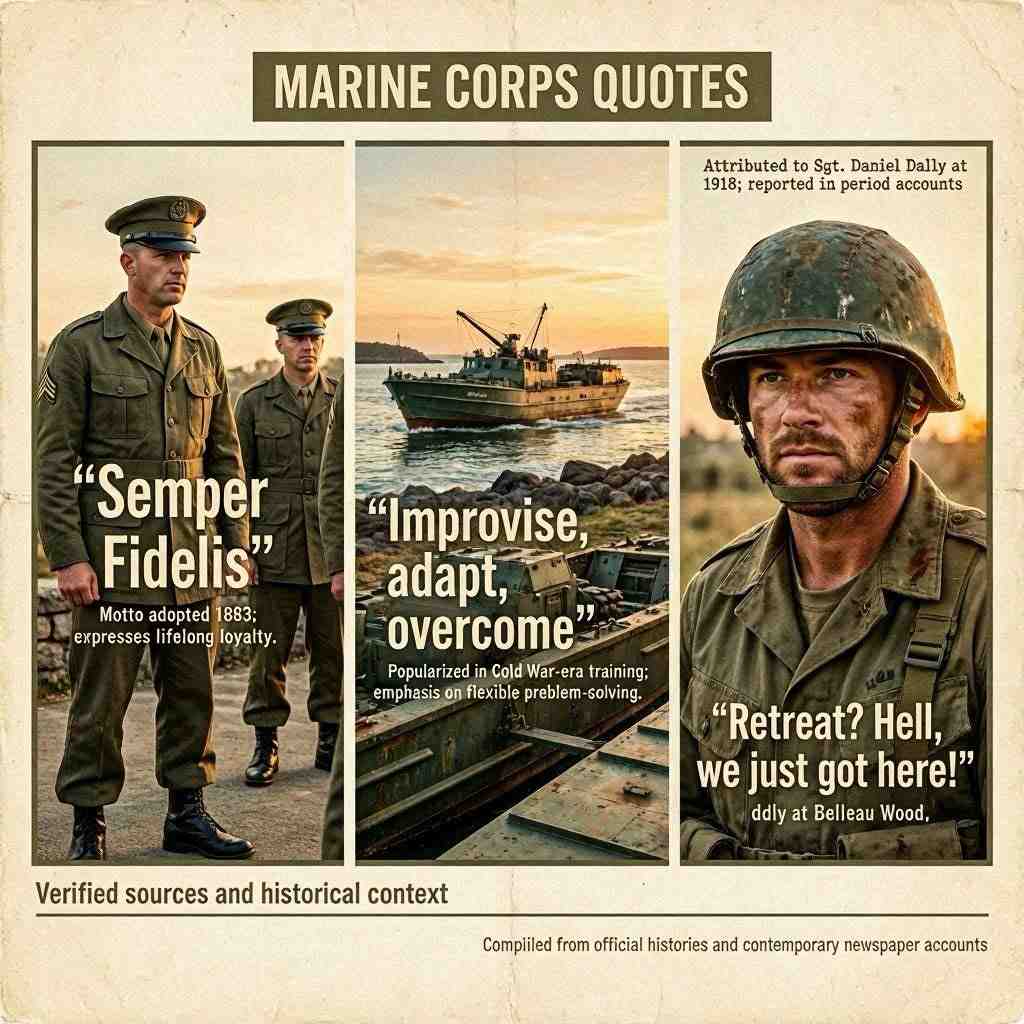
| Category | Representative Quote | Primary Theme |
|---|---|---|
| Courage Under Fire | “We’re surrounded. That simplifies our problem.” | Composure under pressure |
| Leadership | “The relation between officers and enlisted men…” | Developing people |
| Discipline | “Be polite, be professional…” | Preparedness |
| Brotherhood | “Once a Marine, Always a Marine.” | Lifelong identity |
| Resilience | “Pain is weakness leaving the body.” | Endurance |
| Institutional Pride | “The Few. The Proud.” | Service and standards |
| Adaptability | “Improvise, Adapt, Overcome.” | Problem-solving |
| Honor and Loyalty | “Semper Fidelis.” | Faithfulness |
The Most Famous US Marine Corps Quotes in History
The most famous US Marine Corps quotes endure not because they were eloquent but because they were accurate. These were not speeches written for posterity. They were said in the field, under fire, or in the hard years between wars when the Corps was building the culture that would define it for a century.
Chesty Puller: The Most Quoted Marine in History
Lieutenant General Lewis “Chesty” Puller is the most decorated Marine in the history of the Corps — five Navy Crosses, a legend forged across three wars, and a character that every biography of the period struggles to fully contain. He is also the most prolific source of authentic Marine Corps quotations, which is not a coincidence. Puller had a gift for saying in eight words what took everyone else a paragraph — and he usually said it when the situation was worst.
“We’re surrounded. That simplifies our problem.”
This is Puller at Chosin Reservoir, November–December 1950, when his regiment was encircled by Chinese forces in temperatures well below zero. The quote is real, verified across multiple contemporary accounts, and it is frequently misread as defiant bravado. It wasn’t. Puller had been encircled before — in Nicaragua, on Guadalcanal — and he had developed a specific cognitive discipline around it: when surrounded, the direction of the enemy stops being a variable. Every direction is the right direction. The quote is a tactical assessment, not a motivational catchphrase, and that distinction is exactly what makes it useful to leaders far outside military contexts. Reframing the situation before attempting to solve it is something Puller did as a reflex, built over two decades of combat.
“Take me to the Brig. I want to see the real Marines.”
Puller said this — or something close to it — during a garrison visit, implying that Marines confined to the brig were more likely to be fighters than the spit-polished escorts walking him around. The exact wording varies across biographical accounts, but the sentiment is thoroughly documented and entirely consistent with his recorded views on institutional Marine culture versus combat culture. Puller was never comfortable with the peacetime Corps. He trusted the Marines who had been broken and kept going over the ones who had never been tested.
“They can’t get away from us now.”
A Chosin variant, sometimes quoted separately, sometimes as part of the same engagement. The logic is identical: encirclement presented as advantage. Multiple biographical sources confirm the sentiment, with slight wording differences across accounts.
“Old breed? New breed? There’s not a damn bit of difference so long as it’s the Marine breed.”
Puller said this late in his career, and it is the most institutional thing he ever put into words. The Corps perpetuates itself through culture, not through individuals. What a Marine is doesn’t change when the generation changes. This is the belief that holds the institution together across the gaps between wars.
| Quote | Historical Context | Leadership Lesson | Modern Relevance |
|---|---|---|---|
| “We’re surrounded. That simplifies our problem.” | Chosin Reservoir, 1950 | Reframe adversity before attempting to solve it | Crisis leadership — interpret the situation before reacting to it |
| “Take me to the Brig.” | Garrison culture | Value substance and tested character over appearance | Talent evaluation — who has been tested, not just polished |
| “They can’t get away from us now.” | Encirclement operations | Maintain offensive initiative regardless of defensive circumstances | Competitive pressure — turn constraints into advantages |
| “There’s not a damn bit of difference so long as it’s the Marine breed.” | Post-war Corps identity | Culture outlasts individuals | Organizational leadership — build institutions, not personalities |
Dan Daly: Two Medals of Honor, One Legendary Sentence
Sergeant Major Dan Daly won the Medal of Honor twice — in China during the Boxer Rebellion in 1900 and in Haiti in 1915. He is one of only two Marines ever to achieve that distinction. At Belleau Wood in June 1918, when his company was pinned in a wheat field against fortified German positions, Daly reportedly turned to his men and said:
“Come on, you sons of bitches, do you want to live forever?”
The attribution has some wording debate — a slightly different version has been attributed to a different NCO in the same engagement — but the battle and the moment are real. Belleau Wood is where the German military reportedly first called American Marines Teufelshunde, Devil Dogs, a name the Corps has worn since. Whether Daly’s exact words were precisely these or a close variant, the charge they preceded was real, and the battle turned. What the quote actually demonstrates is something the Marine Corps has always valued more than tactical elegance: a noncommissioned officer willing to lead from the front at the moment when it would cost the most.
John Lejeune and the Foundation of Marine Leadership
Major General John Lejeune, the 13th Commandant of the Marine Corps, is not the most-searched Marine in this cluster and not the most quoted on motivational sites. He is, however, responsible for the most institutionally significant words in Marine Corps leadership history.
“The relation between officers and enlisted men should in no sense be that of superior and inferior nor that of master and servant, but rather that of teacher and scholar.”
This statement, from Marine Corps Order No. 47 issued in 1921, is the philosophical foundation of how the Corps develops its people. It explicitly rejects the authority-first model most military organizations default to, replacing it with a development model. An officer’s job is not to command obedience — it is to produce competence. The statement explains something that newcomers to Marine culture often find disorienting: the genuine mutual respect between Marine officers and enlisted personnel that has no clean equivalent in other branches. Lejeune named the principle that everyone in the Corps practices but rarely articulates.
Quotes About the Marine Corps From Those Who Witnessed It
Some of the most authoritative quotes about the Marine Corps come from people who were never Marines — presidents, Allied commanders, and military historians who observed the Corps from the outside and were moved to say something specific about what they saw. These external perspectives carry a different kind of weight than internal Corps quotations. They describe effect rather than identity.
Ronald Reagan (1985): “Some people spend an entire lifetime wondering if they made a difference in the world. But the Marines don’t have that problem.”
Reagan said this in a documented address in 1985. What makes it unusually precise for a presidential military quote is that it locates the Corps’ meaning in the individual Marine’s experience rather than in institutional prestige. It’s not a claim about the organization’s greatness. It’s a claim about what the organization does to the people inside it — they never have to wonder.
Douglas MacArthur (Korean War era): “I have just returned from visiting the Marines at the front, and there is not a finer fighting organization in the world.”
MacArthur’s relationship with the Marine Corps was complicated. He and the Corps had genuine institutional friction across decades of service, and he was not someone who extended compliments easily — certainly not to rival services. The statement is documented from the Korean War period, and its weight comes precisely from its source. This is not a friendly endorsement. It is a professional assessment from a man who had every reason to be critical.
Winston Churchill: “The United States Marine Corps has a great reputation as a fighting force, and this reputation has been well deserved.”
Churchill had watched Marine operations in the Pacific with considerable interest throughout World War II. His statement is consistent with his documented wartime correspondence and with the British military’s general assessment of Marine performance in island combat. It is, characteristically for Churchill, measured rather than effusive — which is how the British military establishment generally expressed its highest regard.
| Observer | Core Observation | Why It Matters |
|---|---|---|
| Ronald Reagan | Marines never wonder if they made a difference | Public recognition from an American president — frames individual meaning, not institutional prestige |
| Douglas MacArthur | No finer fighting organization in the world | Military credibility — from a rival and critic, which makes it more credible |
| Winston Churchill | Reputation has been well deserved | International recognition — Allied confirmation of Pacific performance |
Marine Corps Motivational Quotes and the Ethos Behind Them
Marine Corps motivational quotes are not motivational in the way that most motivational content is motivational. They do not tell you to believe in yourself or pursue your passion. They describe a relationship with difficulty, suffering, and standards that is — to be direct about it — foreign to most civilian experience. Understanding that distinction is what separates a genuine Marine Corps quote from a military-flavored inspirational poster.
The Pain and Discipline Cluster
“Pain is weakness leaving the body.”
This phrase is everywhere now — gym walls, athletic programs, corporate training rooms. It genuinely comes from Marine Corps training culture, though no single original speaker can be definitively identified. Its function inside boot camp is psychological: it reframes physical discomfort as a productive process rather than a signal to stop. The honest note most articles skip is that this is a mental discipline statement, not a physiology claim. Pain is not literally weakness leaving the body. Marines understand the distinction — the civilian motivational industry sometimes doesn’t. What the phrase actually teaches is that discomfort during training is the cost of competence during operations.
“The more you sweat in peace, the less you bleed in war.”
Variants of this appear in Roman military writing, predating by centuries any American military context. In Marine Corps culture it functions as institutional justification for training intensity — the difficulty of boot camp and pre-deployment exercises is the price of survival when the conditions are real. It is a cost-benefit statement, not a slogan.
“Every Marine is, first and foremost, a rifleman.”
This is doctrinal, appearing in formal Marine Corps order. Every Marine, regardless of military occupational specialty, qualifies annually with a rifle. A Marine lawyer, a Marine cook, and a Marine infantry officer all share a baseline combat competency that has no direct equivalent in other branches of the U.S. military. The statement is not aspirational — it describes an actual institutional requirement that produces the cultural cohesion Marines are known for.
“Improvise, Adapt, Overcome.”
The phrase became a cultural cliché after the 1986 Clint Eastwood film Heartbreak Ridge, but the underlying concept is real Marine Corps doctrine predating the film by decades. Marine small-unit leaders are explicitly trained to act without waiting for orders when communications fail. The phrase accurately captures that institutional expectation, even if its Hollywood version simplifies it considerably.
Marine Corps Inspirational Quotes on Identity and Brotherhood
“Once a Marine, Always a Marine.”
The phrase is attributed to Master Gunnery Sergeant Bill Paxton, early 20th century. It describes something veterans consistently report as true across decades of post-service life: the Marine Corps identity is not a job title. It does not wash off when the uniform comes off. People who served in the Army or Navy frequently describe their service in past tense. Marines almost universally do not.
“The Few. The Proud.”
This has been the Marine Corps’ recruiting tagline since 1977, and it is one of the most effective institutional brand statements in American history — not because of clever copywriting but because it is statistically accurate. The Marine Corps is the smallest branch of the U.S. military and maintains the most demanding entry standards. The claim is not aspirational. It is a description.
“No better friend, no worse enemy.”
Most closely associated with General Mattis, though variants appear earlier in Marine culture. The phrase articulates a moral framework: good faith is met with maximum cooperation; bad faith is met with maximum force. It is a clarity of position that runs counter to the institutional ambiguity most large organizations prefer, which explains in part why it circulates so widely outside military contexts.
Four Themes Behind Marine Motivation
| Theme | Representative Quote | What It Actually Teaches |
|---|---|---|
| Hardship as transformation | “Pain is weakness leaving the body.” | Discomfort in training is the cost of competence in operations |
| Identity permanence | “Once a Marine, Always a Marine.” | The Corps produces an identity, not just a job history |
| Universal readiness | “Every Marine is a rifleman.” | Shared baseline competency creates shared culture |
| Adaptive initiative | “Improvise, Adapt, Overcome.” | Act without orders when orders aren’t available |
General James Mattis: Leadership Through Candor
James Mattis is the Marine figure who generates the most sustained search interest outside veteran communities, and for a specific reason: his quotations are practically useful to people who lead organizations and never wore a uniform. Where Puller’s quotes describe what it feels like to be tested under fire, Mattis’s quotes describe a philosophy of leadership that translates directly into boardrooms, coaching staffs, and management teams.
“Be polite, be professional, but have a plan to kill everybody you meet.”
This is authentic Mattis, and it is almost universally quoted out of context in ways that make it sound dangerous. The full context is a pre-deployment briefing: Marines were being sent into a volatile environment where the person handing you tea in the afternoon might be the person shooting at you by evening. The instruction was about maintaining professional composure — genuine courtesy, not performed courtesy — while keeping tactical readiness intact underneath it. It is a discipline statement. The civilian translation is something like: stay professional in every room while remaining fully prepared for the room to change.
“The most important six inches on the battlefield is between your ears.”
This is the Mattis quote with the longest shelf life outside military circles, and the reason is straightforward: it’s true across almost every competitive domain. Physical preparation matters, resources matter, numbers matter — and all of it can be undone by a mind that freezes or panics or catastrophizes under pressure. Mattis built an entire leadership philosophy around the premise that mental preparation precedes all other preparation.
“I come in peace. I didn’t bring artillery. But I’m pleading with you, with tears in my eyes: If you f*** with me, I’ll kill you all.”
Mattis said this in 2003 to Iraqi leaders in Fallujah. The quote is documented by those present at the meeting. In context, it was a deliberate piece of coercive diplomacy — establishing trust and threat simultaneously, so the audience understood both that cooperation was genuinely valued and that resistance would be genuinely catastrophic. It worked. The immediate outcome of that meeting was de-escalation.
| Quote | Leadership Principle | Real-World Application |
|---|---|---|
| “Be polite, be professional, but have a plan…” | Maintain composure without dropping readiness | Stay genuinely courteous in high-stakes rooms while remaining fully prepared for the situation to shift |
| “Six inches between your ears” | Mental preparation precedes all other preparation | Train the mind for pressure before the pressure arrives — not during |
| “I come in peace…” | Communicate both value and consequence simultaneously | In negotiation, make the benefit of cooperation and the cost of refusal equally clear |
| “Study history” | Learn from predecessors — don’t start from scratch | Every problem has been encountered before; find who solved it and how |
What makes Mattis worth studying as a leadership model is not the quotations themselves but the architecture behind them. He has written and spoken extensively about the obligation of leaders to read — to treat military history and strategic literature as operational tools rather than academic exercises. His personal library on deployment to Iraq reportedly ran to hundreds of volumes. The “warrior monk” characterization stuck because it was accurate: Mattis combined the preparation of a scholar with the decisiveness of a combat commander, and he was explicit that the second required the first.
The Eleanor Roosevelt Marine Corps Quote: A Full Attribution Analysis
No Marine Corps quote generates more search traffic with less honest handling than the statement attributed to Eleanor Roosevelt. It deserves a complete analysis — not because the words are in doubt, but because the attribution question is genuinely interesting and almost never properly answered by anyone claiming to cover it.
What the Quote Says
The version most commonly attributed to Roosevelt reads:
“The Marines I have seen around the world have the cleanest bodies, the filthiest minds, the highest morale, and the lowest morals of any group of people I have ever seen. Thank God for the United States Marine Corps!”
What the Historical Record Actually Shows
The attribution is plausible but not definitively verified. Here is what is actually known:
Roosevelt traveled extensively during and after World War II, visiting troops in the Pacific and meeting military personnel across multiple theaters. She wrote prolifically — a daily newspaper column (My Day), personal correspondence, and public addresses. The quote does not appear in her collected writings, her My Day columns, or in transcripts of documented public remarks.
The absence of a written record does not disprove the statement. Roosevelt made countless informal remarks in conversations, troop visits, and private settings that were never formally recorded. Multiple people have claimed to have heard versions of it in different settings across different decades.
The rhetorical structure of the statement is also genuinely consistent with her documented voice. Roosevelt was known for layered irony — the technique of appearing to criticize something while actually celebrating it. “The filthiest minds… Thank God for them” is exactly the construction she used in documented statements about working-class and military men. The praise is embedded inside the apparent criticism. That is a specific stylistic characteristic, not a generic observation.
The Myth vs. Reality Assessment
| Claim | Assessment |
|---|---|
| Roosevelt said this in a formal speech | No formal speech record exists |
| The quote is entirely fabricated | Implausible — the style fits, the access existed, multiple people report it |
| The Marine Corps officially verified it | They use it; no verification claim on record |
| Absence of written record proves she didn’t say it | Incorrect — informal remarks routinely go unrecorded |
| The quote accurately reflects her rhetorical style | Yes — layered irony was characteristic of her documented writing |
Why This Attribution Question Matters
The Eleanor Roosevelt eleanor roosevelt marine corps quote question is a reliability test for any Marine Corps quote resource. Any site that presents the attribution as definitively verified is telling you something about its editorial standards. Any site that dismisses the quote entirely without acknowledging the contextual plausibility is being equally imprecise.
The honest position: she may have said it, the construction suits her, and the quote has been in circulation long enough within Marine culture that it belongs to the institution regardless of whether the original attribution can be proven. That is a different claim than “Eleanor Roosevelt said this.” Both claims deserve to be stated separately, not conflated.
Short Marine Quotes for Tattoos and Engravings
Readers searching for short Marine quotes for tattoos are making a permanent decision, which makes attribution accuracy more important here than anywhere else in a Marine Corps quote article. The Marine veteran community notices misattributions. A quote from an internet collection with no verified source will be recognized as such — permanently, on your skin.
Best Marine Quotes by Use
For Identity:
- Semper Fidelis — the official Corps motto, two words containing an entire institutional philosophy
- Once a Marine, Always a Marine — verified attribution, permanent meaning, universally recognized
- The Few. The Proud. — documented origin (1977), institutional identity
For Resilience:
- Pain is weakness leaving the body — Corps training culture, no single attributed speaker, but culturally authentic
- Adapt. Improvise. Overcome. — doctrinal in origin, broadly recognized
For Character:
- No better friend, no worse enemy — strong Mattis association, earlier cultural roots
- Every Marine is a rifleman — doctrinal, identity-defining
For Memorial Use:
- Swift, Silent, Deadly — Marine Recon motto
- Death Before Dishonor — cross-cultural military sentiment with deep Marine roots
| Quote | Word Count | Attribution Confidence | Best Use |
|---|---|---|---|
| Semper Fidelis | 2 | Official motto — verified | Universal |
| Once a Marine, Always a Marine | 6 | Verified — MGySgt Bill Paxton | Identity |
| The Few. The Proud. | 4 | Documented — USMC 1977 | Pride |
| No better friend, no worse enemy | 6 | Strong — Mattis / Marine culture | Character |
| Pain is weakness leaving the body | 6 | Cultural — no single speaker | Resilience |
| Every Marine is a rifleman | 5 | Doctrinal — verified | Institutional identity |
Before committing to any permanent inscription, verify attribution through the Marine Corps Heritage Foundation, official USMC publications, or recognized biographies. Do not rely on quote aggregator sites — including this one — as the final word on attribution.
Frequently Asked Questions About Marine Corps Quotes
What is the most famous Marine Corps quote?
By weight of historical context and attribution confidence, Chesty Puller’s “We’re surrounded. That simplifies our problem.” is the strongest candidate. It was said during a genuine crisis — the Chosin Reservoir encirclement in 1950 — verified across multiple contemporary accounts, and it reflects a principle of tactical and psychological thinking developed over two decades of combat. The circumstances that produced it give it a gravity that no retrospectively composed statement can match.
Did Eleanor Roosevelt actually say the famous Marine Corps quote about filthy minds and high morale?
Possibly, but no definitive proof exists. The quote does not appear in her documented written record, but Roosevelt made many informal remarks never recorded in writing. The rhetorical structure — layered irony that appears to criticize while actually celebrating — is consistent with her documented style. The Marine Corps uses the quote without claiming to have verified its origin. The most accurate position: plausible but unverified, not fabricated.
What are the best short Marine quotes for tattoos?
The most defensible choices for permanent use are Semper Fidelis (official motto, verified), Once a Marine, Always a Marine (verified attribution to MGySgt Bill Paxton), and No better friend, no worse enemy (strongly associated with General Mattis). All three have solid attribution, compressed meaning, and immediate recognition in veteran communities. Avoid quotes that exist only on internet lists without primary source verification.
What does Semper Fidelis mean?
Semper Fidelis is Latin for “Always Faithful.” It became the official motto of the United States Marine Corps in 1883 under Commandant Charles McCawley. The phrase expresses fidelity to country, to the Corps, and to fellow Marines simultaneously — not as an aspiration but as a description of what Marines are expected to already be.
Why are Marine Corps quotes so popular outside the military?
The Corps has been solving a specific human problem for over two centuries: how do you get people to do very hard things under very bad conditions, and keep going when stopping would be easier? The solutions it developed — mental reframing under pressure, preparation before crisis, directness as a form of respect, shared hardship as a source of cohesion — apply across almost any domain where performance under pressure matters. The quotes endure because they describe those solutions accurately.
What Marine Corps Quotes Reveal About Leadership and Character
The lasting relevance of marine corps quotes outside military culture is not accidental, and it is not sentimentality about the military. These quotations survive because they describe something real about how people perform under pressure — and because the Marine Corps has been stress-testing those descriptions in actual conditions for longer than most modern institutions have existed.
Puller’s Chosin quotes describe cognitive reframing: when the situation seems worst, find the information in it that changes your orientation toward it. Mattis’s quotes describe the architecture of preparation: know more than your adversary, remain composed when composure is hardest, and treat directness as a form of respect rather than aggression. Lejeune’s institutional writing describes the development model that makes all of it sustainable: leaders are teachers, and organizations that treat them as anything else stop producing leaders.
The best quotes from the Marine Corps are not great writing. They are not eloquent. They are precise. They say something specific about what it is like to do something very hard and keep going, and they say it in a form small enough to carry with you. That is why they keep circulating — and why quotes from the marine corps get searched for, shared, tattooed, engraved, and passed forward long after the battles that produced them are finished.
If this guide helped you find what you were looking for, the Marine Corps Heritage Foundation maintains primary source documentation on the Corps’ most significant figures and moments — the right next stop for anyone who wants to go deeper than a quote collection.