Path Quotes Bible: Inspiring Bible Verses About the Right Path
Life can feel like a long road with unexpected turns. Some days the direction seems obvious, while on other days you may wonder, “Am I really on the right path?” That is one reason Bible verses about paths, ways, roads, and direction are so meaningful.

The Bible repeatedly uses the picture of a path to describe our choices, character, faith, relationship with God, and journey through life. A path can represent where we are going, but it can also represent how we are getting there.
| Bible Verse | Path Quote | Meaning / Message |
|---|---|---|
| Psalm 119:105 | “Thy word is a lamp unto my feet, and a light unto my path.” | God’s Word provides guidance and light when the way ahead is uncertain. |
| Proverbs 3:5–6 | “Trust in the LORD with all thine heart… and he shall direct thy paths.” | Trust God instead of depending entirely on your own understanding. |
| Psalm 16:11 | “Thou wilt shew me the path of life.” | God can lead us toward true life, joy, and His presence. |
| Proverbs 4:18 | “The path of the just is as the shining light.” | The journey of righteousness can become increasingly clear and fruitful. |
| Isaiah 30:21 | “This is the way, walk ye in it.” | God provides direction and calls us to follow the way He shows us. |
| Psalm 25:4–5 | “Shew me thy ways, O LORD; teach me thy paths.” | A prayer asking God for wisdom, guidance, and direction. |
| Matthew 7:14 | “Narrow is the way, which leadeth unto life.” | Following God’s way may require commitment, discipline, and faithfulness. |
| John 14:6 | “I am the way, the truth, and the life.” | Jesus identifies Himself as the way to God and the source of truth and life. |
| Psalm 23:3 | “He leadeth me in the paths of righteousness.” | God acts like a shepherd, guiding His people toward righteousness. |
| Jeremiah 6:16 | “Ask for the old paths, where is the good way, and walk therein.” | We are encouraged to seek proven, faithful ways rather than blindly following every new direction. |
If you are searching for path quotes Bible verses, you will find a rich collection of Scriptures about trusting God, seeking His direction, walking in wisdom, and remaining faithful even when the road ahead is unclear.
These verses can encourage you when you feel lost, strengthen you when the journey becomes difficult, and remind you that you do not have to understand every step before taking the next one.
What Does “Path” Mean in the Bible?
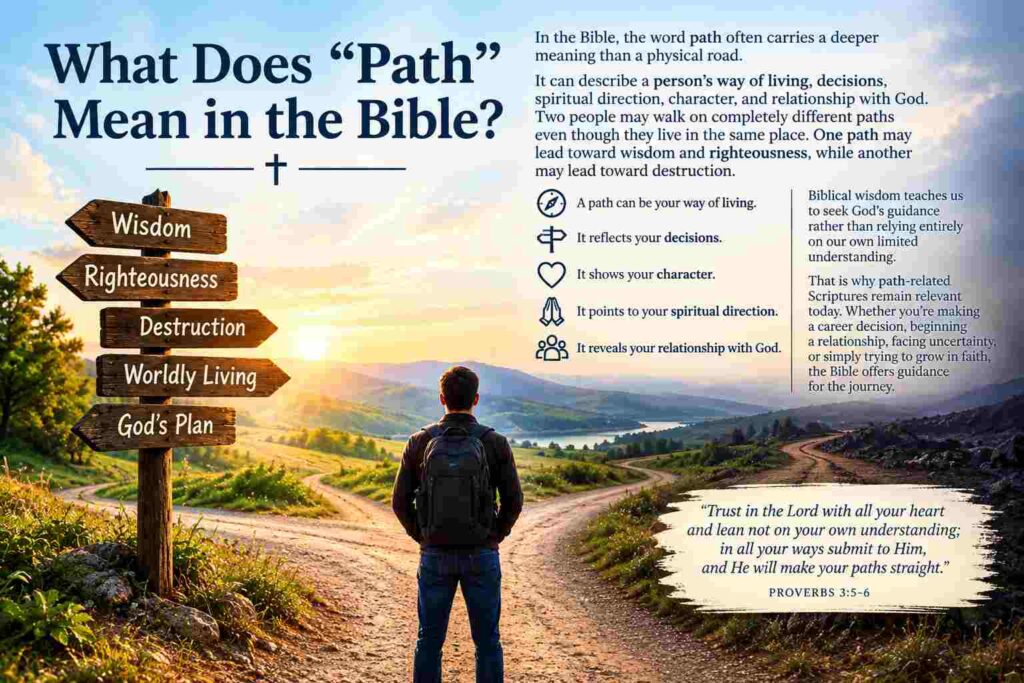
In the Bible, the word path often carries a deeper meaning than a physical road.
It can describe a person’s way of living, decisions, spiritual direction, character, and relationship with God. Two people may walk on completely different paths even though they live in the same place. One path may lead toward wisdom and righteousness, while another may lead toward destruction.
The image is simple but powerful. Think about standing at a crossroads. Several roads stretch into the distance. You can see only a small portion of each one. Which way should you go?
Biblical wisdom teaches us to seek God’s guidance rather than relying entirely on our own limited understanding.
That is why path-related Scriptures remain relevant today. Whether you’re making a career decision, beginning a relationship, facing uncertainty, or simply trying to grow in faith, the Bible offers guidance for the journey.
Why the Bible Uses the Image of a Path

A path suggests movement and direction.
You don’t simply stand on a path forever. You walk it. Step by step, decision by decision, you move toward somewhere.
This makes the metaphor especially useful for describing faith.
Christian life isn’t presented merely as something you believe intellectually. Scripture often describes it as something you walk out through obedience, trust, wisdom, love, patience, and perseverance.
A path also reminds us that we don’t always see the entire journey.
You might see the next few steps without seeing the destination. And sometimes that’s exactly what faith looks like: taking the next faithful step without having a complete map.
Psalm 119:105 — God’s Word as a Light to Your Path
One of the most famous Bible verses about a path is Psalm 119:105:
“Thy word is a lamp unto my feet, and a light unto my path.”
This verse offers a beautiful picture of God’s Word as a source of guidance.
Notice the imagery. A lamp doesn’t necessarily illuminate an entire journey at once. It gives enough light to help you take the next step.
That can be reassuring when you are facing uncertainty.
You may want God to reveal your entire future immediately. But sometimes Scripture gives you something more practical: enough wisdom and light for today’s step.
When you don’t know what comes next, return to God’s Word. Let it shape your values, decisions, priorities, and direction.
Proverbs 3:5–6 — Trust God to Direct Your Path
Proverbs 3:5–6 is another foundational passage for anyone searching for Bible quotes about paths:
“Trust in the LORD with all thine heart; and lean not unto thine own understanding.”
The passage continues by encouraging believers to acknowledge God, with the promise that He will direct their paths.
The message is straightforward: trust before you understand.
That’s not always easy.
Human beings naturally want explanations. We want to know why something happened, where we’re going, and what will happen next. But faith sometimes asks us to trust God even when the road is unclear.
This verse doesn’t suggest abandoning wisdom or common sense. Instead, it challenges us not to make our own understanding the highest authority.
When God’s direction and your assumptions seem to conflict, humility matters.
Psalm 16:11 — The Path of Life
Psalm 16:11 contains another beautiful expression:
“Thou wilt shew me the path of life.”
The verse connects God’s presence with the path of life.
This is more than a request for directions. It is an expression of confidence that God knows where true life is found.
The world can offer countless definitions of success. More money. More recognition. More possessions. More influence.
But Scripture repeatedly redirects our attention toward something deeper.
The right path isn’t necessarily the easiest path. It isn’t always the most popular path either.
Sometimes the faithful path requires patience, sacrifice, forgiveness, courage, or obedience.
Yet Psalm 16 points toward the confidence that God can lead us toward genuine life and lasting joy.
Proverbs 4:18 — The Path of the Righteous
Proverbs 4:18 compares the path of righteous people to increasing light:
“The path of the just is as the shining light, that shineth more and more unto the perfect day.”
What a hopeful image.
Imagine the early morning. At first, everything is dim. Then the horizon begins to brighten. Gradually, the darkness gives way to daylight.
The Christian journey can sometimes feel like that.
You may not have everything figured out today. You may still be learning, growing, correcting mistakes, and developing wisdom.
Growth is often gradual.
This verse reminds us that walking faithfully with God can bring increasing clarity. You don’t have to become perfect overnight. Keep walking.
Isaiah 30:21 — God Shows You the Way
Isaiah 30:21 gives a powerful picture of receiving direction:
“This is the way, walk ye in it.”
The words capture something many people deeply desire: clarity.
Imagine being uncertain about which direction to take and hearing a clear instruction telling you which way to go.
Although life doesn’t always provide such obvious answers, the principle remains valuable. God’s guidance calls us not only to hear, but also to walk.
Knowing the right thing and doing the right thing are different.
A person can know what Scripture teaches about forgiveness but still refuse to forgive. Someone can know the importance of honesty but still choose deception.
Biblical guidance becomes meaningful when it changes the way we walk.
Psalm 25:4–5 — Asking God to Teach Your Path
Psalm 25 expresses a humble prayer:
“Shew me thy ways, O LORD; teach me thy paths.”
This is an excellent prayer for anyone who doesn’t know what to do next.
It doesn’t say, “God, give me everything I want.”
Instead, the prayer asks God to teach.
That’s an important distinction.
Sometimes we approach prayer with a decision already made. We simply want God to approve it.
But genuine spiritual guidance requires openness. We can say, in effect, “Lord, show me Your way, even if it isn’t the way I originally planned.”
That attitude creates room for wisdom, correction, and growth.
Matthew 7:13–14 — The Narrow Path
Jesus used the image of a narrow way in Matthew 7:13–14.
He contrasts a broad way leading toward destruction with a narrow way leading toward life.
The picture is striking because the broad road is easier to imagine. Many people can travel it. It requires little resistance.
The narrow path, however, suggests intentionality.
Following Christ isn’t always about choosing whatever is easiest, most comfortable, or most popular. Sometimes it means choosing truth when lies are easier, integrity when compromise is profitable, and obedience when disobedience appears more convenient.
The narrow path isn’t valuable because it is difficult for difficulty’s sake.
It is valuable because it leads toward life.
John 14:6 — Jesus Is the Way
John 14:6 contains one of the central statements of Christian faith:
“I am the way, the truth, and the life.”
Here, Jesus doesn’t merely say that He can provide directions.
He identifies Himself as the Way.
That changes the meaning of biblical path quotes. Christianity isn’t ultimately about finding a perfect life strategy. It is about knowing and following Christ.
When your circumstances are confusing, your relationship with Jesus becomes the central reference point.
The question isn’t simply, “Which option gives me the easiest life?”
A deeper question is:
“Which way helps me faithfully follow Christ?”
Psalm 23:3 — God Leads You in Right Paths
Psalm 23 is filled with comforting imagery of God’s care and leadership.
Verse 3 speaks of God restoring the soul and leading His people in paths of righteousness.
The shepherd metaphor is important.
Sheep are not famous for navigating difficult terrain independently. They need a shepherd.
Likewise, Scripture presents human beings as people who need guidance.
There is humility in admitting that.
You don’t have to know everything. You don’t have to predict every obstacle. You can trust the Shepherd to lead while you continue walking.
Jeremiah 6:16 — Finding the Ancient Paths
Jeremiah 6:16 encourages people to stop, examine the roads before them, and seek the ancient paths.
This verse offers an important lesson for modern life: not every new road is a better road.
Our culture changes rapidly. Trends come and go. Ideas become popular and disappear. Technology transforms the way we communicate and work.
But wisdom doesn’t become obsolete simply because something newer appears.
The ancient paths represent tested ways of faithfulness and obedience.
Before rushing forward, sometimes we need to pause and ask:
What does God say?
What has proven true?
Where does wisdom lead?
Bible Quotes About Choosing the Right Path
Choosing a path is ultimately about making choices.
Every day contains countless decisions. Some appear enormous; others seem insignificant.
Yet small decisions can shape a life.
The Bible repeatedly encourages wisdom, self-control, righteousness, humility, and obedience. These qualities help establish a healthy spiritual direction.
A right path doesn’t mean you’ll never make mistakes.
It means you’re willing to recognize mistakes, turn around, learn, and continue walking toward God.
When You Feel Lost
Feeling lost doesn’t necessarily mean you’ve failed.
Sometimes uncertainty is simply part of the journey.
When you feel lost, Scriptures about God’s guidance can remind you that your confusion isn’t greater than God’s wisdom.
Psalm 25 is especially meaningful here because it turns uncertainty into prayer: asking God to teach, guide, and lead.
Instead of allowing confusion to paralyze you, use it as an invitation to seek God.
When You Need Direction
When you’re standing at a major crossroads, Proverbs 3:5–6 is worth remembering.
Don’t make fear your compass.
Don’t let pressure become your map.
And don’t assume that what looks successful from the outside must be right for you.
Seek wisdom. Pray. Study Scripture. Consider consequences. Listen carefully.
Then take the next responsible step.
When You Are Facing a Difficult Season
A difficult road can make you question whether you’re going in the right direction.
But difficulty doesn’t automatically mean you’ve chosen the wrong path.
Sometimes the right path contains challenges.
Think of a mountain trail. The steepest section may be exhausting, but it doesn’t mean the trail is wrong. It may simply mean you’re climbing.
Faith requires perseverance.
Romans 5:3–4 connects suffering with endurance, character, and hope. The journey can shape you even when you wish the road were easier.
When You Are Starting a New Chapter
New chapters can be exciting and frightening at the same time.
A new job, new responsibility, new season, or major life change can leave you wondering what lies ahead.
This is where Psalm 119:105 becomes especially meaningful.
You don’t need to see the whole road.
You need enough light for the next step.
Take that step faithfully.
Then take another.
Short Path Quotes From the Bible
If you’re looking for short Bible-inspired path quotes for captions, notes, or personal encouragement, consider these:
- “He shall direct thy paths.” — Proverbs 3:6
- “A lamp unto my feet.” — Psalm 119:105
- “A light unto my path.” — Psalm 119:105
- “The path of life.” — Psalm 16:11
- “Teach me thy paths.” — Psalm 25:4
- “This is the way, walk ye in it.” — Isaiah 30:21
- “The path of the just.” — Proverbs 4:18
- “I am the way.” — John 14:6
- “The way which leadeth unto life.” — Matthew 7:14
- “He leadeth me in the paths of righteousness.” — Psalm 23:3
These short phrases can work particularly well when you want something meaningful without using a long passage.
Path Quotes Bible Verses for Encouragement
Sometimes you don’t need a complicated answer. You simply need a reminder that you can keep going.
Psalm 119:105 encourages you to trust God’s Word for light.
Proverbs 3:5–6 reminds you that God’s understanding is greater than yours.
Psalm 16:11 reminds you that God can show you the path of life.
Proverbs 4:18 reminds you that growth can happen gradually.
Isaiah 30:21 reminds you to listen for God’s direction.
Together, these Scriptures create a powerful message:
You may not know the entire road, but you can still walk forward in faith.
That’s an important truth when life feels uncertain.
Path Quotes Bible Verses for Strength and Faith
Strength isn’t always about feeling fearless.
Sometimes strength means continuing despite fear.
Faith doesn’t mean you have every answer. Sometimes faith means trusting God while questions remain.
The biblical picture of a path captures this beautifully.
A traveler doesn’t need to know every mile before beginning a journey. They need a destination, a trustworthy guide, and the courage to take the next step.
That is why Scripture repeatedly points believers toward trust.
When circumstances change, God’s character remains steady.
When plans fail, His wisdom remains greater.
When the road becomes dark, His Word can still provide light.
Path Quotes Bible Verses for Daily Life
You don’t have to wait for a major crisis to think about your spiritual path.
These verses can shape ordinary decisions too.
Before speaking, ask whether your words are wise.
Before making a decision, consider whether your motives are healthy.
Before following the crowd, ask whether the direction is consistent with your values.
Before giving up, remember that growth can take time.
Before assuming you know everything, remember Proverbs’ call to trust God rather than leaning completely on your own understanding.
In other words, your path is formed one step at a time.
Daily habits become character.
Character influences decisions.
Decisions shape direction.
Direction eventually shapes a life.
How to Apply Biblical Guidance to Your Path
Reading Bible verses about paths is encouraging, but how do you actually use them?
Start with prayer.
Ask God for wisdom rather than simply asking Him to bless your existing plans.
Then spend time in Scripture.
Don’t look for a verse that merely confirms what you already want. Look for principles that challenge, correct, and guide you.
Next, examine your motives.
Two people can make the same decision for completely different reasons. One may act from love and wisdom; another may act from pride or fear.
It’s also wise to seek godly counsel. Proverbs repeatedly emphasizes wisdom and counsel. Trusted, mature people can sometimes see things we cannot see ourselves.
Finally, practice patience.
Not every answer arrives immediately.
Sometimes the next step becomes clear only after you have faithfully handled the step already in front of you.
Let Scripture Be Your Compass
A compass doesn’t remove the journey.
It gives you direction.
In a similar way, God’s Word doesn’t promise that life will always be easy. It provides a framework for knowing what is true, wise, righteous, and faithful.
When emotions pull you in different directions, Scripture can bring you back to what matters.
Take One Step at a Time
If you’re overwhelmed by the future, stop trying to live tomorrow today.
Ask yourself:
What is the faithful thing I can do today?
Maybe it’s apologizing.
Maybe it’s praying.
Maybe it’s making a difficult but honest decision.
Maybe it’s waiting.
Maybe it’s beginning something you’ve been avoiding.
You don’t have to run the entire race in one afternoon.
Walk the path one step at a time.
Remember That God Can Redirect You
One wrong turn doesn’t have to become your final destination.
People make mistakes.
They choose poorly.
They become distracted.
They sometimes wander.
The biblical story repeatedly shows God calling people back.
If you’ve realized that you’re on the wrong path, don’t let shame convince you that returning is impossible.
Turn around.
Seek God.
Learn from what happened.
Then keep walking.
Frequently Asked Questions About Path Quotes Bible
1. What is the most popular Bible verse about a path?
Psalm 119:105 is among the most widely recognized: “Thy word is a lamp unto my feet, and a light unto my path.” It beautifully describes God’s Word as a source of guidance and direction.
2. What Bible verse says God will direct your path?
Proverbs 3:5–6 teaches believers to trust in the Lord rather than relying completely on their own understanding and says that He will direct their paths.
3. What does the Bible say about finding your path?
Several passages connect finding the right path with trusting God, seeking His wisdom, following His Word, and walking in righteousness. Psalm 25:4–5 is especially relevant because it asks God to show and teach His paths.
4. What is a good Bible verse when you feel lost?
Psalm 25:4–5 is a strong choice because it expresses a direct prayer for God’s guidance. Psalm 119:105 is also comforting when you need direction.
5. What Bible verse talks about the path of life?
Psalm 16:11 says, “Thou wilt shew me the path of life.” The verse connects God’s guidance with life, joy, and His presence.
6. What does the narrow path mean in the Bible?
In Matthew 7:13–14, Jesus describes a narrow way that leads to life. The imagery emphasizes the intentional and sometimes difficult nature of following God’s way rather than simply choosing the easiest or most popular direction.
7. What does “Jesus is the way” mean?
John 14:6 records Jesus saying that He is “the way, the truth, and the life.” In Christian theology, this means Jesus is not merely a teacher who gives directions; He is central to reconciliation with God and eternal life.
8. Can Bible path quotes help when making a difficult decision?
Yes. They can provide biblical principles for thinking about decisions. Verses such as Proverbs 3:5–6 encourage trust and humility, while Psalm 25:4–5 encourages actively seeking God’s guidance.
9. What is a short Bible quote about direction?
One of the shortest and most memorable is from Proverbs 3:6: “He shall direct thy paths.” It works well as a personal reminder, journal entry, or faith-based caption.
10. What is the best Bible verse about God’s guidance?
There isn’t one verse that is best for every situation, but Proverbs 3:5–6, Psalm 119:105, Psalm 25:4–5, and Isaiah 30:21 are particularly powerful passages about trusting and seeking God’s direction.
Conclusion
The Bible’s path imagery reminds us that life is a journey, not a single decision. There will be crossroads, unexpected turns, steep climbs, and seasons when the road ahead seems completely hidden. Yet Scripture repeatedly points us back to the same foundation: trust God, seek His wisdom, follow His Word, and keep walking faithfully.
Psalm 119:105 reminds us that God’s Word can be a lamp for our feet and a light for our path. Proverbs 3:5–6 teaches us to trust God beyond our limited understanding. Psalm 16:11 points toward the path of life, while John 14:6 places Jesus Himself at the center of the Christian journey.
So, if you’re wondering which way to go, remember this: you may not be able to see the whole path, but you can still take the next faithful step.