
Bible Verses About Anxiety: Scriptures for Peace & Hope
Anxiety doesn’t wait for a good reason. It can show up over something real — a diagnosis, a job loss, a fight you can’t undo — or it can show up over nothing you can name, just a tight chest and a mind that won’t sit still. Scripture doesn’t pretend this away. From the Psalms to Paul’s prison letters, the Bible is full of people who were afraid, overwhelmed, or worried sick, and who brought exactly that to God instead of hiding it from Him.
This guide pulls together 50 of those passages and groups them by what you’re actually feeling — fear, worry, stress, racing thoughts, nighttime dread, social anxiety — so you’re not stuck skimming a long list looking for the one that fits. Read one verse. Sit with it. Let it become a prayer instead of just a quote.
What Is the Best Bible Verse for Anxiety?
If you only read one verse today, make it Philippians 4:6–7:
“Be careful for nothing; but in every thing by prayer and supplication with thanksgiving let your requests be made known unto God. And the peace of God, which passeth all understanding, shall keep your hearts and minds through Christ Jesus.” — Philippians 4:6–7, KJV
Paul isn’t telling anxious people to simply stop worrying — he’s telling them where to take it. Pray. Say thank you even in the middle of the mess. Be specific about what’s actually wrong. What follows isn’t a promise that the circumstance disappears; it’s a promise that God’s peace stands guard over your heart and mind while the circumstance is still there. In the NIV, that same peace is described as guarding you “in Christ Jesus” — the wording changes slightly by translation, but the promise doesn’t.
Paul wrote this from a Roman prison, to a church dealing with real conflict and real hardship. Nobody wrote this from a hammock.
Bible Verses for Different Anxiety Situations
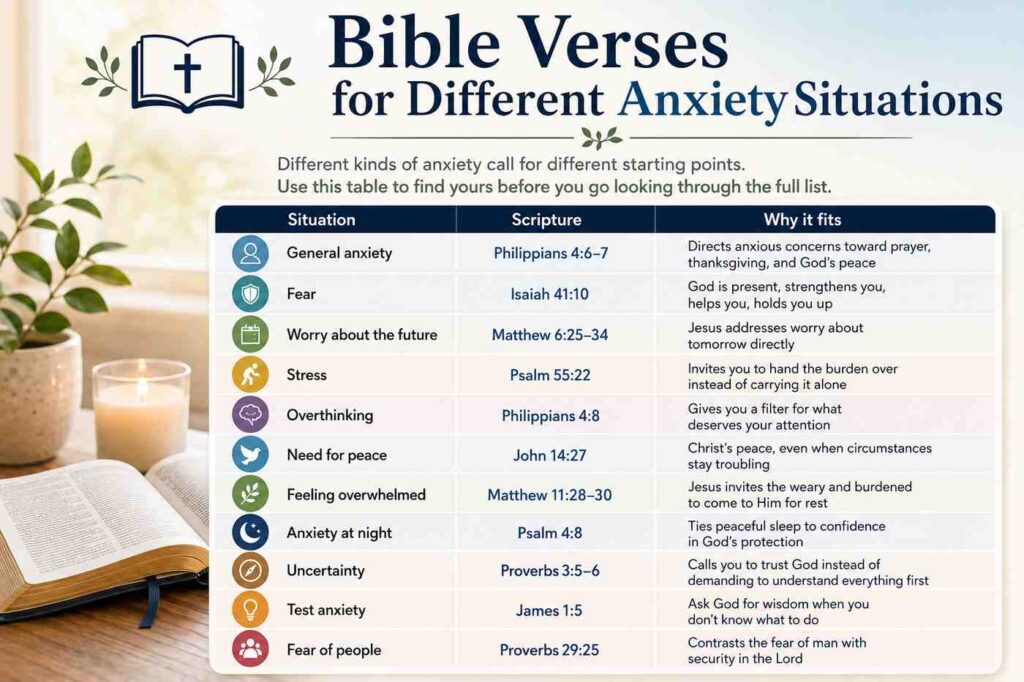
Different kinds of anxiety call for different starting points. Use this table to find yours before you go looking through the full list.
| Situation | Scripture | Why it fits |
|---|---|---|
| General anxiety | Philippians 4:6–7 | Directs anxious concerns toward prayer, thanksgiving, and God’s peace |
| Fear | Isaiah 41:10 | God is present, strengthens you, helps you, holds you up |
| Worry about the future | Matthew 6:25–34 | Jesus addresses worry about tomorrow directly |
| Stress | Psalm 55:22 | Invites you to hand the burden over instead of carrying it alone |
| Overthinking | Philippians 4:8 | Gives you a filter for what deserves your attention |
| Need for peace | John 14:27 | Christ’s peace, even when circumstances stay troubling |
| Feeling overwhelmed | Matthew 11:28–30 | Jesus invites the weary and burdened to come to Him for rest |
| Anxiety at night | Psalm 4:8 | Ties peaceful sleep to confidence in God’s protection |
| Uncertainty | Proverbs 3:5–6 | Calls you to trust God instead of demanding to understand everything first |
| Test anxiety | James 1:5 | Ask God for wisdom when you don’t know what to do |
| Fear of people | Proverbs 29:25 | Contrasts the fear of man with security in the Lord |
Start with whichever line names your actual situation, not the most famous verse on the list. If you’re afraid, go to a presence verse. If your mind won’t stop running scenarios about tomorrow, go to Matthew 6. If you’re just exhausted from carrying everything yourself, Psalm 55:22 says exactly that — hand it over.
50 Bible Verses About Anxiety
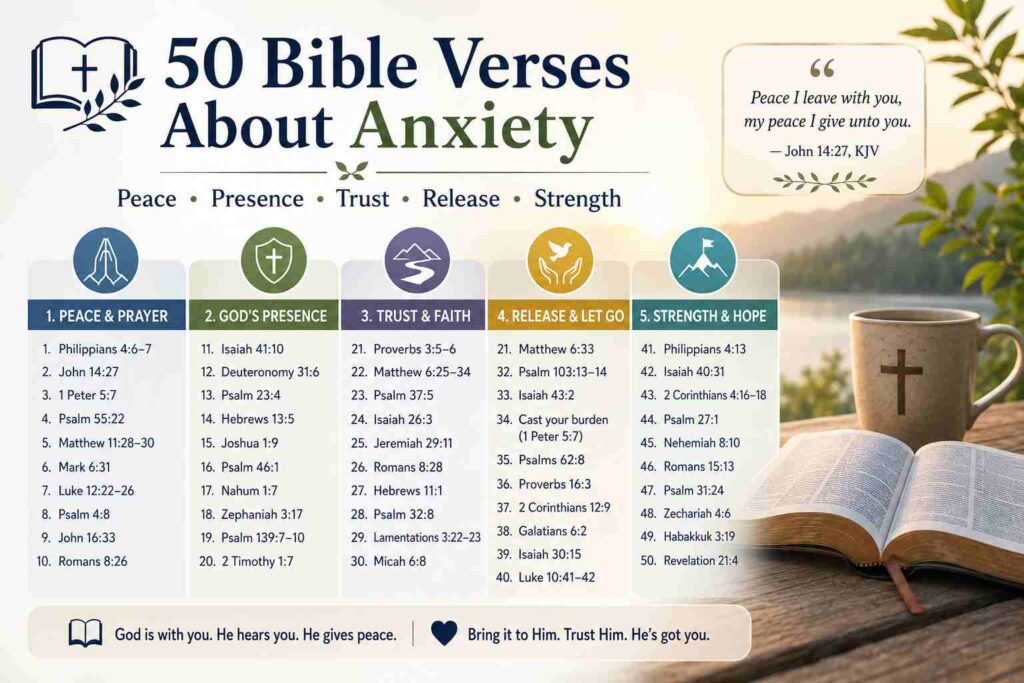
Scripture keeps coming back to the same handful of moves: bring the worry to God in prayer, receive His peace, remember He’s present, trust Him when you can’t see what’s ahead, and put down burdens you were never meant to carry solo. The verses below are grouped around those five moves.
Bible Verses About Peace and Prayer
Philippians 4:6–7 — Pray Instead of Carrying It Alone
Paul wrote this to Christians in real trouble, and his answer wasn’t “calm down.” It was: bring the specific thing to God, ask for what you need, say thank you while you’re asking. Then comes the promise most people remember — a peace that doesn’t make logical sense given the circumstances, standing guard over your heart and mind. For someone drowning in anxious thoughts, that’s the whole pattern: stop carrying it silently, hand it over instead.
John 14:27 — Christ’s Peace for a Troubled Heart
“Peace I leave with you, my peace I give unto you.” — John 14:27, KJV
Jesus said this to His disciples right before things got genuinely terrifying for them — His arrest, His death, their own scattering. He didn’t promise the storm would skip them. He gave them His peace to carry through it. That’s the distinction worth sitting with: Christian peace isn’t the absence of trouble. It’s confidence inside the trouble.
1 Peter 5:7 — Give Your Cares to God
“Casting all your care upon him; for he careth for you.” — 1 Peter 5:7, KJV
“Cast” is an active word, not a passive one — you’re not waiting for the worry to fade, you’re throwing it, deliberately, onto someone stronger than you. The reason Peter gives isn’t “because worrying is pointless.” It’s “because He cares for you.” The whole command rests on God’s character, not on your ability to calm down.
Isaiah 26:3 — Peace for a Mind Fixed on God
“Thou wilt keep him in perfect peace, whose mind is stayed on thee: because he trusteth in thee” (Isaiah 26:3, KJV). This isn’t about wishing anxious thoughts away. It’s about where your mind keeps returning — back to who God is, again and again, every time it drifts.
Psalm 55:22 — Release the Burden You’re Carrying
“Cast thy burden upon the LORD, and he shall sustain thee” (Psalm 55:22, KJV). David wrote this from betrayal and real distress, not from a peaceful season. The instruction to hand the burden over comes from inside the suffering, which is exactly why it still holds up for someone carrying real weight today.
Psalm 94:19 — Comfort When Worries Multiply
“In the multitude of my thoughts within me thy comforts delight my soul” (Psalm 94:19, KJV). The psalmist doesn’t deny that his mind is crowded — he says so outright — and still finds God’s comfort breaking through the noise. Scripture makes room for a busy, anxious mind while still pointing it somewhere.
Matthew 11:28–30 — Rest for the Weary and Burdened
Jesus doesn’t limit this invitation to people who have their lives sorted out. He’s calling the weary and the burdened — which, if you’re anxious and exhausted at the same time, is exactly where you are.
Bible Verses About Strength and God’s Presence
Anxiety gets louder when you feel like you’re facing something alone. These verses push back on that specific lie.
Isaiah 41:10 — God Is With You
“Fear thou not; for I am with thee: be not dismayed; for I am thy God.” — Isaiah 41:10, KJV
The comfort here doesn’t come from a promise that nothing bad will happen. It comes first: “I am with thee.” Then strength, then help, then support. When anxiety makes the problem feel bigger than you, this verse redirects your eyes from the size of the problem to the size of the God who’s with you in it.
Joshua 1:9 — Courage When You Are Afraid
God said this to Joshua right as he was about to take over for Moses and lead a nation into unknown territory — about as legitimate a reason for anxiety as it gets. “Be strong and of a good courage; be not afraid, neither be thou dismayed: for the LORD thy God is with thee whithersoever thou goest” (Joshua 1:9, KJV). The courage isn’t manufactured from nothing. It’s grounded in “wherever you go.”
Psalm 23:4 — God’s Presence in the Darkest Valley
David doesn’t describe a life with no valleys. He describes walking through one and not being alone in it: “though I walk through the valley of the shadow of death, I will fear no evil: for thou art with me” (Psalm 23:4, KJV).
Psalm 46:1–3 — God Is a Refuge in Trouble
God is described here as “a very present help in trouble,” and the imagery gets dramatic fast — the earth shaking, waters roaring — but the point underneath it is availability, not drama for its own sake.
Deuteronomy 31:8 — God Goes Before You
Moses tells Israel that God goes ahead of them and won’t abandon them. For anxiety tied to an unfamiliar future, that ordering matters — God isn’t scrambling to catch up with you, He’s already there.
Psalm 34:4 — God Hears the Fearful
“I sought the LORD, and he heard me, and delivered me from all my fears” (Psalm 34:4, KJV). David’s pattern here is simple: fear became a reason to seek God, not a reason to pull away from Him.
Bible Verses About Trust and Letting Go
Anxiety wants certainty before it will let you feel safe. Scripture keeps asking you to trust without it.
Matthew 6:25–34 — Do Not Worry About Tomorrow
Jesus points to birds that get fed and flowers that get dressed better than kings, and asks — if God cares that much about a wildflower, what does that say about His care for you? This isn’t permission to skip planning or ignore responsibilities. It’s a direct challenge to the specific habit of living out tomorrow’s problems today, before they’ve even arrived. “Sufficient unto the day is the evil thereof” (Matthew 6:34, KJV) — today has enough going on without borrowing from tomorrow too.
Proverbs 3:5–6 — Trust God When You Cannot See the Way
“Trust in the LORD with all thine heart; and lean not unto thine own understanding” (Proverbs 3:5, KJV). Anxiety often demands full understanding before it’ll release its grip. Proverbs offers a different route — trusting God even when your own picture of the situation is incomplete.
Psalm 37:5 — Commit Your Way to the Lord
“Commit thy way unto the LORD; trust also in him; and he shall bring it to pass” (Psalm 37:5, KJV). Committing your way to God is handing Him the steering wheel on an outcome you badly want to control yourself.
Psalm 62:8 — Pour Out Your Heart Before God
“Trust in him at all times; ye people, pour out your heart before him: God is a refuge for us” (Psalm 62:8, KJV). You don’t need to sanitize your prayers first. Pour it out honestly — that’s the instruction, not a workaround.
Nahum 1:7 — The Lord Knows Those Who Trust Him
“The LORD is good, a strong hold in the day of trouble; and he knoweth them that trust in him” (Nahum 1:7, KJV). Even inside a book largely about judgment, there’s this: God is aware of the people who trust Him.
Bible Verses About Fear and Anxiety
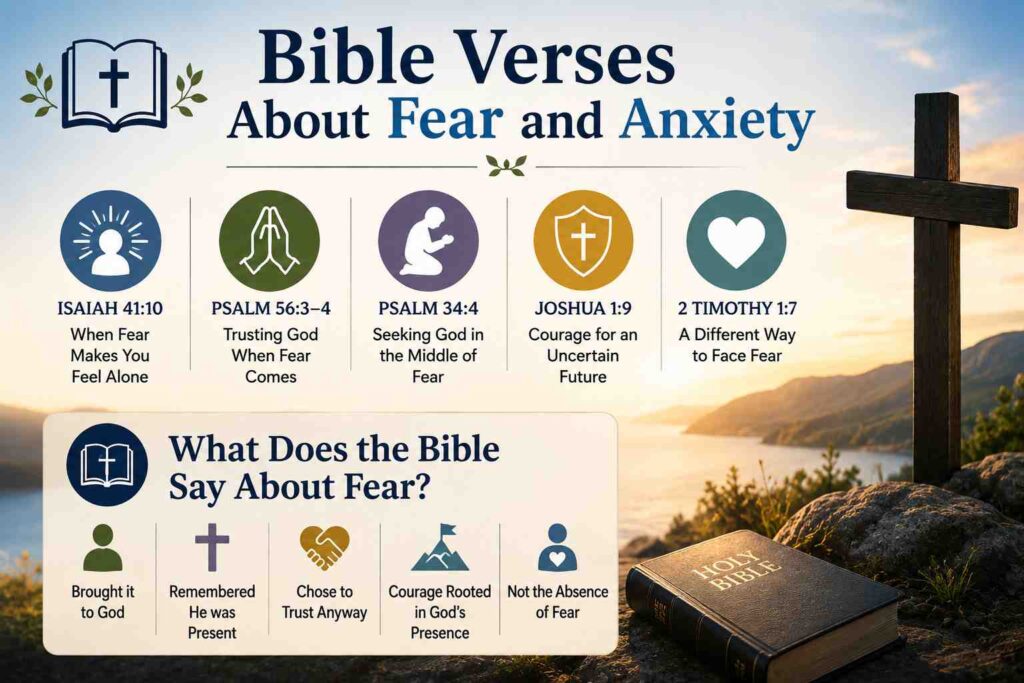
Fear and anxiety overlap but aren’t identical — fear usually points at something specific, while anxiety can hang around even when there’s no clear threat in sight. Scripture speaks to both.
Isaiah 41:10 — When Fear Makes You Feel Alone
Covered above — worth repeating here because fear so often starts with a sense of isolation, and this verse answers that directly.
Psalm 56:3–4 — Trusting God When Fear Comes
“What time I am afraid, I will trust in thee” (Psalm 56:3, KJV). David isn’t claiming he never gets scared. He’s naming what he does with it: he chooses to trust. That’s a relief if you’ve ever felt guilty for simply being afraid — Scripture doesn’t ask you to stop feeling it, just to point it somewhere.
Psalm 34:4 — Seeking God in the Middle of Fear
Already covered above. Worth noting again: the emphasis isn’t on suppressing fear, it’s on where you bring it.
Joshua 1:9 — Courage for an Uncertain Future
Also covered above, and just as relevant here — courage rooted in God’s presence rather than in having every detail figured out.
2 Timothy 1:7 — A Different Way to Face Fear
“For God hath not given us the spirit of fear; but of power, and of love, and of a sound mind” (2 Timothy 1:7, KJV). Paul is writing to Timothy, who was young, likely intimidated, and facing real opposition. This verse names what fear tries to take — power, love, a clear head — and says those belong to you instead.
What Does the Bible Say About Fear?
The Bible never treats fear as automatic proof of weak faith. David was afraid. Joshua faced a genuinely uncertain future. The pattern that keeps showing up isn’t “never be afraid” — it’s what people did with the fear once it arrived: brought it to God, remembered He was present, chose to trust anyway. Biblical courage isn’t the absence of fear. It’s knowing where to take it.
Bible Verses About Worry and Anxiety
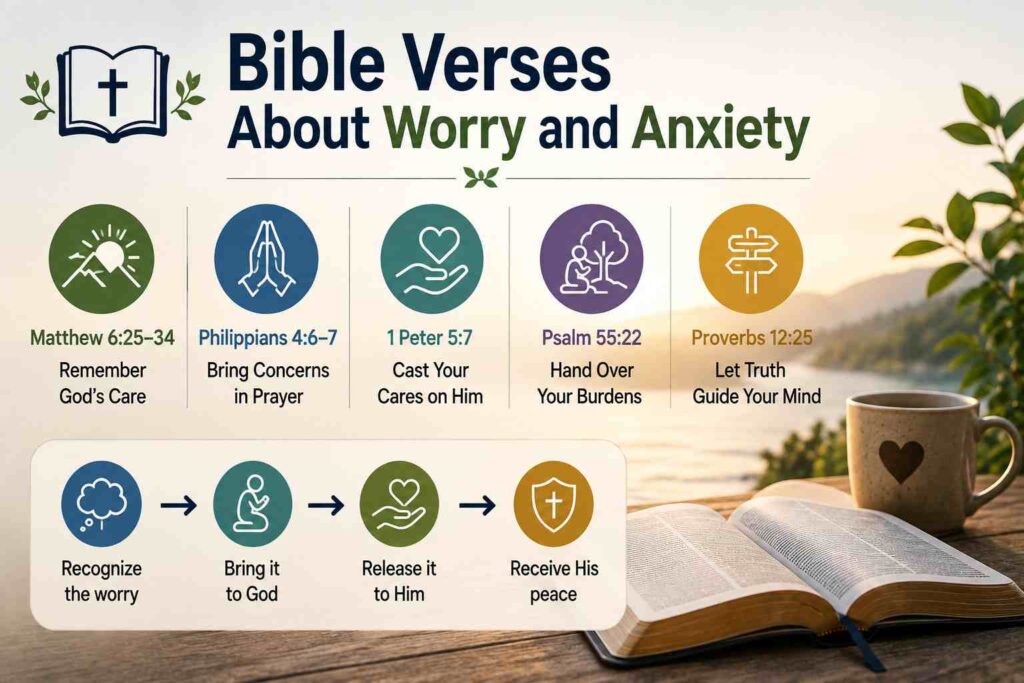
Worry has a different shape than sudden fear — it’s less about something happening right now and more about the mind rehearsing what might happen later. Matthew 6:25–34, Philippians 4:6–7, 1 Peter 5:7, Psalm 55:22, and Proverbs 12:25 all speak into this from slightly different angles: remember God’s care, name the specific concern, hand over the burden, let truth redirect the spiral.
What Does Jesus Say About Worry?
Matthew 6:25–34 is the most direct teaching on worry in the Gospels, and it deserves to be read in full rather than reduced to the one line everyone quotes. Jesus argues from the birds — fed without farming — and the flowers — dressed better than Solomon without spinning a single thread — to the obvious conclusion: if God cares that much about things that don’t even pray to Him, how much more does He care about you?
This isn’t a call to stop planning or stop caring about your responsibilities. It’s a challenge to the specific habit of pre-living tomorrow’s disasters today. When your mind keeps circling “what if it all goes wrong,” Matthew 6 pulls it back to what’s actually in front of you right now.
Bible Verses About Stress and Anxiety
Stress usually isn’t one thing — it’s several things stacked on top of each other until the weight feels permanent. Psalm 55:22 says cast the burden on the Lord. Matthew 11:28–30 has Jesus inviting the exhausted to come find rest. Psalm 46 calls God a refuge and strength in trouble. Philippians 4:6–7 points every anxious concern toward prayer.
None of this promises pressure disappears. What it promises is that you don’t have to carry it as if everything depends on you. When you’re running on empty, Matthew 11 offers rest. When the weight feels too heavy, Psalm 55:22 gives you permission to put it down. When the ground feels unstable, Psalm 46 names where refuge actually is. And when the thoughts won’t stop multiplying, Philippians 4:6–7 gives you something concrete to do with them: pray, specifically, with thanks.
The movement runs: burden → surrender → dependence → rest. Not instant relief — a direction to walk in.
Bible Verses for Anxiety and Overthinking
Overthinking has its own particular exhaustion. The same question loops — what if I made the wrong call, what if it goes badly, what happens tomorrow — and there’s no answer available yet, so the loop just keeps running. Scripture doesn’t tell you to shut your brain off. It gives you a way to redirect it.
Philippians 4:8 is the clearest tool here — Paul names exactly what deserves your sustained attention: what’s true, honest, just, pure, lovely, worth praising. Isaiah 26:3 ties peace to a mind that keeps returning to God. Proverbs 3:5–6 reminds you that you don’t need to understand the whole path before trusting the One who does. 2 Corinthians 10:5 talks about bringing thoughts into obedience to Christ. Matthew 6:34 pulls attention back to today instead of tomorrow’s imagined version of events.
What Does the Bible Say About Overthinking?
Scripture doesn’t use the word “overthinking,” but it has plenty to say about troubled thoughts and where to send them. Not every thought that shows up deserves to be believed or repeated. Philippians 4:8 works as a filter: is what you’re dwelling on actually true, actually good, actually worth the space it’s taking up? And trust interrupts the loop from a different angle — you don’t have to solve every uncertainty yourself before you’re allowed to stop thinking about it.
Bible Verses for Calming Anxiety
Sometimes you don’t need the theology first. You need a verse that meets you exactly where you are.
For immediate peace — Philippians 4:6–7. Bring the request to God through prayer and thanksgiving; let His peace guard what your own effort can’t.
For fear — Isaiah 41:10. “Fear thou not; for I am with thee.” Start with who’s present, not with how bad the situation is.
For racing thoughts — Isaiah 26:3. A mind that keeps returning to God finds peace not by force, but by repetition.
For heavy burdens — Psalm 55:22. Name the specific thing weighing on you and put it into God’s hands instead of assuming you have to hold it yourself.
For exhaustion — Matthew 11:28–30. Jesus isn’t asking you to try harder. He’s asking you to come and rest.
Bible Verses About Anxiety Attacks and Panic
Scripture doesn’t use the clinical term “panic attack,” but it’s full of intense fear, trembling, and people who felt like they might come apart. Psalm 56:3 gives a short answer: “What time I am afraid, I will trust in thee.” Psalm 34:4 has David seeking God in the middle of fear. Psalm 46:1 calls God “a very present help in trouble.” None of these promise the fear vanishes on contact. What they offer is more basic — a reason to turn toward God instead of white-knuckling it alone.
What Does the Bible Say About Panic and Intense Fear?
When fear turns intense, Scripture points toward God’s presence, not toward shame for feeling this way. Pray honestly. Read one short passage slowly. Return to what’s actually true about God. Philippians 4:6–7, Isaiah 41:10, Psalm 56:3–4, and Psalm 46 are all reasonable places to start.
These verses aren’t a medical treatment for panic attacks, and they were never meant to replace one. If panic is recurring, disrupting your daily life, or getting harder to manage on your own, talking to a qualified professional is a sound and reasonable next step alongside prayer — not a sign that your faith has failed somewhere.
Bible Verses for Anxiety at Night

Nighttime has a way of turning manageable worries into loud ones. Fewer distractions, tomorrow looming — the volume goes up. Psalm 4:8 puts it plainly: “I will both lay me down in peace, and sleep: for thou, LORD, only makest me dwell in safety.” Psalm 91 and Psalm 121 both center on God’s protection; Psalm 63 pictures seeking Him even through the night watches; Philippians 4:6–7 still applies here — bring the specific worry to Him before you try to sleep on top of it.
Pick one. Read it slowly. Name the actual worry keeping you up, hand it over, and let your attention settle back on the promise instead of the problem.
Bible Verses About Social Anxiety
Social anxiety is often fear of judgment or rejection wearing a different name. Proverbs 29:25 names the trap directly: “The fear of man bringeth a snare.” Galatians 1:10 asks a pointed question — are you trying to please people, or serve Christ? Neither verse says relationships don’t matter. They challenge the specific fear that hands other people’s opinions control over your sense of safety. Isaiah 41:10 fits here too, because its core promise — you’re not facing this alone — applies just as much to a room full of people as it does to any other kind of fear.
Bible Verses About Test Anxiety
Test anxiety has a way of scrambling your memory right when you need it most. James 1:5 tells anyone who lacks wisdom to simply ask God for it. Proverbs 3:5–6 calls you to trust instead of relying purely on your own preparation. Isaiah 41:10 offers courage when the nerves take over. Philippians 4:13 can remind you where your strength actually comes from — though it’s worth saying plainly that this verse isn’t a promise of a particular grade.
A short prayer before a test: Lord, give me wisdom, calm my anxious thoughts, help me remember what I’ve studied, and give me strength to do the work in front of me. Help me trust You with the result, not just the preparation.
Bible Verses About Anxiety and Depression
Anxiety and depression often show up together — worry braided with sadness, exhaustion, and a hope that’s gotten hard to see. The Bible doesn’t reduce any of that to a faith problem. It contains people who were genuinely distressed, discouraged, and afraid, and who kept seeking God through it rather than in spite of it.
Psalm 42 gives words to a soul that feels cast down, asking the question directly — “why art thou cast down, O my soul?” — while still turning back toward hope. Psalm 34:18 offers something quieter: “The LORD is nigh unto them that are of a broken heart.” Nearness, not distance, is the promise. Psalm 55 sits inside real distress and still lands on casting the burden on the Lord. Psalm 94:19 speaks straight to a mind full of multiplying thoughts. Romans 15:13 ties God to hope, joy, and peace; Isaiah 40:31 promises renewed strength to those who wait on Him.
Can Bible Verses Help When You Feel Depressed?
Bible verses can offer real comfort, hope, and language for honest prayer — a way to bring pain into the open instead of hiding it behind a performance of faith. But depression can also be a serious condition that affects mood, sleep, concentration, and daily functioning, and persistent or severe symptoms aren’t something to simply pray away. If that’s where you are, professional support and Scripture aren’t competing options — they can work alongside each other.
Bible Verses About Anxiety in the KJV
If you’re specifically looking for the King James wording, these are the passages worth memorizing: Philippians 4:6–7, 1 Peter 5:7, Isaiah 41:10, Psalm 56:3, Psalm 34:4, John 14:27, Matthew 6:34, Psalm 55:22, Proverbs 3:5–6, Isaiah 26:3, Psalm 4:8, and Joshua 1:9. Other translations phrase these differently — the NIV renders 1 Peter 5:7 as “Cast all your anxiety on him because he cares for you,” for instance — but the KJV’s older cadence is part of why these particular lines have stuck in people’s memory for centuries.
Short KJV Verses to Memorize
- Psalm 56:3: “What time I am afraid, I will trust in thee.”
- 1 Peter 5:7: “Casting all your care upon him; for he careth for you.”
- John 14:27: “Peace I leave with you, my peace I give unto you.”
- Isaiah 41:10: “Fear thou not; for I am with thee.”
- Psalm 4:8: “I will both lay me down in peace, and sleep.”
- Proverbs 3:5: “Trust in the LORD with all thine heart.”
- Joshua 1:9: “Be strong and of a good courage; be not afraid.”
Pick one. A short verse you actually understand and return to beats a long list you never revisit.
Bible Verses About Anxiety in the Old Testament
Psalms. Psalm 23:4 puts God’s presence right in the middle of the darkest valley. Psalm 34:4 has David seeking God amid fear. Psalm 55:22 tells you to cast your burden on the Lord. Psalm 94:19 speaks to a mind crowded with troubling thoughts. Psalm 4:8 ties trust in God to actual, peaceful sleep.
Isaiah. Isaiah 41:10 tells God’s people not to fear because He’s with them and will strengthen them. Isaiah 26:3 ties peace to a mind fixed on God. Isaiah 40:31 promises renewed strength to those who wait on the Lord.
Proverbs. Proverbs 3:5–6 calls you to trust God instead of leaning entirely on your own understanding. Proverbs 12:25 admits plainly that a heavy heart weighs a person down — and points toward the relief a good word can bring.
Joshua, Deuteronomy, and beyond. Joshua 1:9 links courage to God’s presence. Deuteronomy 31:8 assures Israel that God goes ahead of them and won’t leave them. Psalm 46:1 calls God a refuge and a very present help in trouble.
What Does Philippians Say About Anxiety?
Philippians 4:6–8 is more than “don’t worry” repeated three ways. Paul lays out an actual sequence — from anxious concern, to prayer, to God’s peace, to a disciplined way of thinking. He wrote this while under hardship himself, which is worth remembering before treating it as easy advice from someone comfortable.
Philippians 4:6 — Bring your requests to God. “Be careful for nothing; but in every thing by prayer and supplication with thanksgiving let your requests be made known unto God.” Paul doesn’t limit this to spiritual concerns. “Everything” means everything — bring the specific, unglamorous thing that’s actually bothering you. Thanksgiving matters here too; it shifts your posture even while the problem is still unsolved.
Philippians 4:7 — God’s peace guards your heart and mind. “And the peace of God, which passeth all understanding, shall keep your hearts and minds through Christ Jesus.” This peace doesn’t require knowing how things turn out. It guards you while the outcome is still unknown.
Philippians 4:8 — Redirect your thoughts. Paul shifts from prayer to the thought life itself: “Whatsoever things are true… honest… just… pure… lovely… [and] of good report… think on these things.” This isn’t pretending the hard thing isn’t real. It’s deciding what earns your continued attention once you’ve already prayed about it.
Put together, the sequence runs: anxiety → prayer → thanksgiving → specific request → God’s peace → disciplined thought. It handles both the burden and the thought pattern that keeps dragging you back to it.
What Does the Bible Say About Anxiety?
The Bible doesn’t pretend fear and distress aren’t real. David wrote about both constantly. Elijah hit a genuine wall of discouragement after a period of intense ministry. Jesus’ own disciples were frightened in storms and unsure what came next. None of that disqualifies anyone from faith — it’s simply what the honest record looks like.
Scripture points anxiety toward God, not away from it. Prayer gives it somewhere to go (Philippians 4:6–7). Trust means leaning on God’s character when you can’t control or fully understand the outcome (Proverbs 3:5–6). Surrender means admitting some burdens weren’t built to be solved through sheer effort (Psalm 55:22). And God’s presence is the ground courage stands on — Isaiah 41:10 doesn’t promise nothing hard will happen; it starts with “I am with thee.”
Biblical peace isn’t a problem-free life. Jesus talked about peace in John 14:27 while preparing His disciples for something genuinely awful. Philippians 4:6–7 promises peace in the middle of real, unresolved concerns. That means peace and a hard decision can coexist. Peace doesn’t necessarily remove the problem — it changes where your confidence sits while you face it.
Feeling anxious doesn’t mean you lack faith. This is worth saying plainly, because a lot of well-meaning advice implies otherwise. Faith was never about feeling nothing. It looks more like bringing what you actually feel into God’s presence instead of performing calm you don’t have. Instead of only asking “why am I still anxious,” Scripture invites a better question: where can I take this?
How to Use Bible Verses When You Feel Anxious
- Name what’s actually troubling you. Vague anxiety is harder to pray about than a specific fear. Get concrete.
- Choose one Scripture. Don’t hunt for the perfect verse across twenty tabs. Pick one that fits and start there.
- Read it slowly. More than once. Notice individual words before deciding what you want the passage to mean.
- Notice what it says about God. Present? Caring? Strong? A refuge? Anxiety inflates the problem — Scripture redirects attention to who’s actually bigger.
- Turn it into prayer. If the verse says bring your requests to God, name your actual request.
- Give God the specific burden. Not “help with my anxiety” in general — “I’m afraid of what happens with this specific situation, and I can’t control the outcome. I’m placing it in Your hands.”
- Return to the passage when the worry comes back. It coming back isn’t proof the first prayer failed. It’s just how minds work — return again.
- Get support when you need it. Prayer and Scripture matter, but persistent or severe anxiety may call for more. A counselor, a pastor, or someone you trust is a reasonable next step, not a failure.
A Short Prayer for Anxiety
Lord, You know exactly what I’m carrying right now. When fear makes the future feel uncertain, remind me that You’re with me. Give me peace when my mind won’t settle, strength when I’m running on empty, and wisdom when I don’t know what to do. Help me trust You with what I can’t control, and put down the burdens I’ve been trying to carry alone. Teach me to come back to Your promises when the worry comes back too. Give me courage for what’s in front of me today, and grace not to carry tomorrow’s troubles before they’ve even arrived. Thank You for caring for me, hearing me, and staying faithful even when I’m afraid. Amen.
A Prayer Based on Philippians 4:6–7
Father, I’m bringing my worries and requests to You instead of carrying them by myself. Thank You for Your goodness and for how You’ve sustained me before. You already know what’s troubling my heart, and I’m placing it in Your hands. Give me wisdom for what I need to do and peace for what I can’t control. Guard my heart and mind through Christ Jesus, and help me focus on what’s true instead of letting fear run the show. Teach me to trust You one day at a time. Amen.
Frequently Asked Questions About Bible Verses About Anxiety
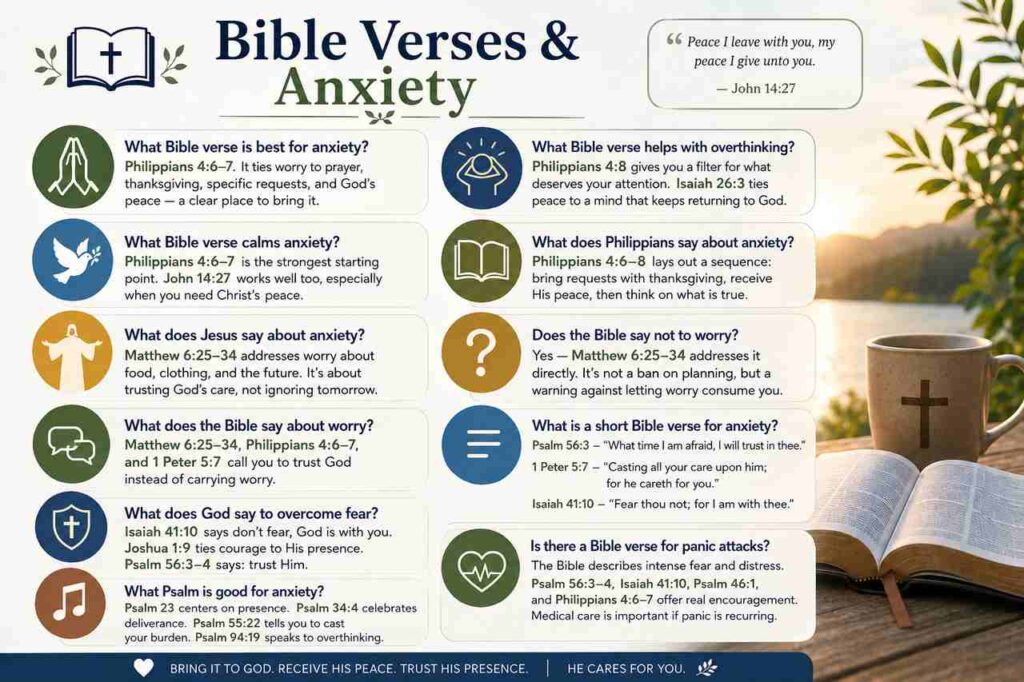
What Bible verse is best for anxiety? Philippians 4:6–7. It ties worry to prayer, thanksgiving, specific requests, and God’s peace — not a promise that the circumstance instantly changes, but a clear place to bring it.
What Bible verse calms anxiety? Philippians 4:6–7 is the strongest starting point. John 14:27 works well too, especially when you need reassurance that Christ’s peace holds even while circumstances stay troubling.
What does Jesus say about anxiety? In Matthew 6:25–34, Jesus addresses worry about food, clothing, and the future directly, pointing to God’s care for creation as evidence of His greater care for people. It’s not a call to stop planning — it’s a call to stop pre-living tomorrow’s problems today.
What does the Bible say about worry? Matthew 6:25–34 teaches trust instead of consuming worry about tomorrow. Philippians 4:6–7 points anxious concerns toward prayer and thanksgiving. 1 Peter 5:7 says to cast your cares on God because He cares for you.
What does God say to overcome fear? Isaiah 41:10 says don’t fear, because God is with you. Joshua 1:9 ties courage to His presence. Psalm 56:3–4 gives the simplest response of all: trust Him when you’re afraid.
What Psalm is good for anxiety? Several work well depending on what you need. Psalm 23 centers on presence. Psalm 34:4 describes God delivering David from his fears. Psalm 55:22 tells you to cast your burden on Him. Psalm 94:19 speaks to a mind full of multiplying thoughts.
Is there a Bible verse for panic attacks? The Bible doesn’t use that exact clinical term, but it describes intense fear and distress at length. Psalm 56:3–4, Isaiah 41:10, Psalm 46:1, and Philippians 4:6–7 all offer real spiritual encouragement in frightening moments — though none of them replace medical care if panic is a recurring issue.
What Bible verse helps with overthinking? Philippians 4:8 gives you a filter for what deserves your attention. Isaiah 26:3 ties peace to a mind that keeps returning to God.
What does Philippians say about anxiety? Philippians 4:6–8 lays out a sequence: bring your requests to God with thanksgiving, receive His peace, then deliberately redirect your thoughts toward what’s true and worth dwelling on.
Does the Bible say not to worry? Yes — Matthew 6:25–34 addresses it directly, particularly worry about the future. It’s not a ban on planning. It’s a warning against letting imagined tomorrow-problems consume today.
What is a short Bible verse for anxiety? Psalm 56:3 — “What time I am afraid, I will trust in thee.” 1 Peter 5:7 — “Casting all your care upon him; for he careth for you.” Isaiah 41:10 — “Fear thou not; for I am with thee.” Pick whichever one matches what you’re facing right now.
More Scriptures for Anxiety, Fear, and Worry
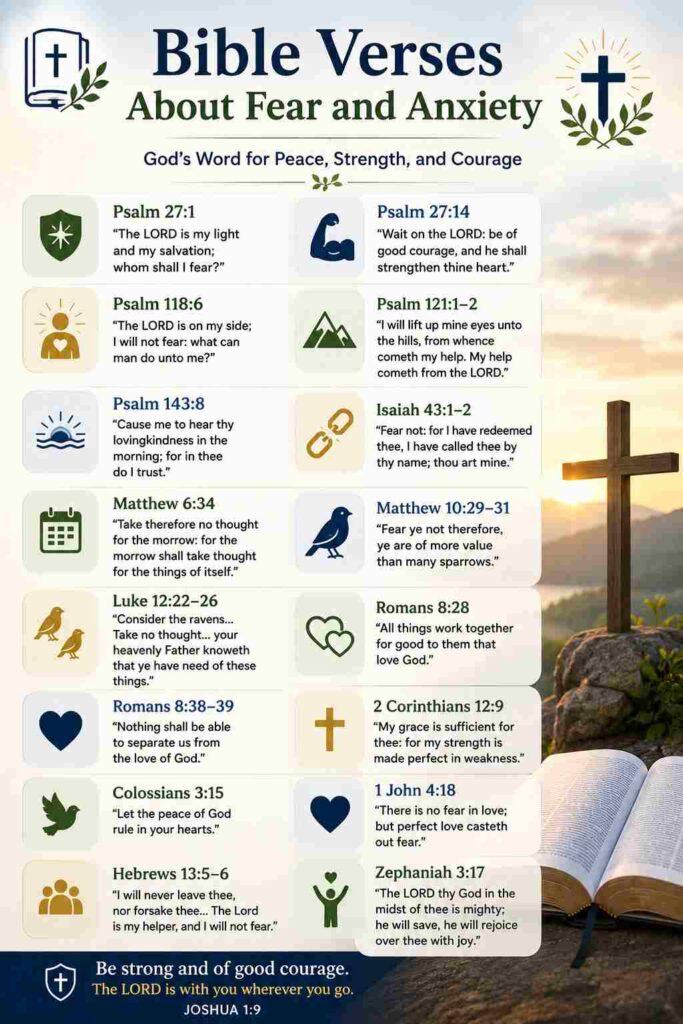
A few more worth having on hand, in addition to the passages already covered above:
- Psalm 27:1 — “The LORD is my light and my salvation; whom shall I fear?”
- Psalm 27:14 — “Wait on the LORD: be of good courage, and he shall strengthen thine heart.”
- Psalm 118:6 — “The LORD is on my side; I will not fear: what can man do unto me?”
- Psalm 121:1–2 — “I will lift up mine eyes unto the hills, from whence cometh my help. My help cometh from the LORD.”
- Psalm 143:8 — “Cause me to hear thy lovingkindness in the morning; for in thee do I trust.”
- Isaiah 43:1–2 — “Fear not: for I have redeemed thee, I have called thee by thy name; thou art mine.”
- Matthew 6:34 — “Take therefore no thought for the morrow: for the morrow shall take thought for the things of itself.”
- Matthew 10:29–31 — “Fear ye not therefore, ye are of more value than many sparrows.”
- Luke 12:22–26 — Jesus’ teaching on the ravens and the futility of worry adding a single hour to your life.
- Romans 8:28 — “All things work together for good to them that love God.”
- Romans 8:38–39 — nothing “shall be able to separate us from the love of God.”
- 2 Corinthians 12:9 — “My grace is sufficient for thee: for my strength is made perfect in weakness.”
- Colossians 3:15 — “Let the peace of God rule in your hearts.”
- 1 John 4:18 — “There is no fear in love; but perfect love casteth out fear.”
- Hebrews 13:5–6 — “I will never leave thee, nor forsake thee… The Lord is my helper, and I will not fear.”
- Zephaniah 3:17 — “The LORD thy God in the midst of thee is mighty; he will save, he will rejoice over thee with joy.”
These aren’t meant to be read all at once. Save this list, come back to it, and let one verse at a time do its work.
Final Encouragement When You Feel Anxious
You don’t need to understand tomorrow to trust God today. Scripture is full of people who brought their fear, grief, and uncertainty straight into God’s presence instead of hiding it from Him. When anxiety comes back, come back to Scripture. When fear rises, pray. When you can’t control the outcome, hand it to the God who does.
Let His presence be more than something you read about. Bring Him the specific thing you’re carrying, one concern at a time, and let Scripture remind you of what’s still true when your feelings aren’t settled.
“Fear thou not; for I am with thee: be not dismayed; for I am thy God.” — Isaiah 41:10, KJV