Bible Verse Of The Day: Meaning, Context, Prayer & Verses For Every Season
Starting your day with a single verse of Scripture is a small habit with an outsized effect on the rest of your day. Whether you open your Bible first thing in the morning, on a lunch break, or right before bed, a Bible Verse of the Day gives you one clear passage to sit with, pray through, and carry into whatever the day brings.
Reading the verse itself is only step one. Every passage was written by a real author, to a real audience, in a real moment in history — and understanding that background is what turns a nice thought into a truth you can actually live by. That’s the gap this guide is built to close.
Below you’ll find a curated library of verses organized by the situations people search for most, along with their meaning and biblical context, how to apply each one practically, a short prayer you can pray right now, related passages worth cross-referencing, and answers to the questions readers ask most about daily Scripture reading.
Bible Verses of the Day by Theme
Rather than pointing you to a single verse and leaving the rest to guesswork, this library groups genuine Scripture passages — full text, not just a reference — under the ten themes readers turn to a daily verse for most. Read the one that matches where you are today, then use the context and application sections further down to go deeper.
Faith
Hebrews 11:1 (KJV)
“Now faith is the substance of things hoped for, the evidence of things not seen.”
Faith isn’t a leap in the dark — it’s confidence built on God’s proven character, even before the outcome is visible. This verse is a good anchor whenever you’re asked to trust before you can see.
Proverbs 3:5-6 (KJV)
“Trust in the LORD with all thine heart; and lean not unto thine own understanding. In all thy ways acknowledge him, and he shall direct thy paths.”
Faith is tested most in decisions, not in dramatic moments. This verse reframes trust as a daily posture — acknowledging God in ordinary choices, not just crisis ones.
Mark 9:24 (KJV)
“And straightway the father of the child cried out, and said with tears, Lord, I believe; help thou mine unbelief.”
Even the disciples’ contemporaries wrestled with doubt while still believing. This verse gives permission to hold faith and honest uncertainty in the same breath.
Hope
Romans 15:13 (KJV)
“Now the God of hope fill you with all joy and peace in believing, that ye may abound in hope, through the power of the Holy Ghost.”
Hope here isn’t generated by circumstances — it’s supplied by the Holy Spirit. That’s why this verse works even when nothing around you has changed yet.
Isaiah 40:31 (KJV)
“But they that wait upon the LORD shall renew their strength; they shall mount up with wings as eagles; they shall run, and not be weary; and they shall walk, and not faint.”
Waiting isn’t passive in Scripture — it’s an active posture of trust that God rewards with renewed strength, whether the season calls for soaring, running, or simply walking.
Lamentations 3:22-23 (KJV)
“It is of the LORD’s mercies that we are not consumed, because his compassions fail not. They are new every morning: great is thy faithfulness.”
Written in the middle of national devastation, this verse is proof that hope and honest grief can coexist — God’s mercy resets daily, no matter how the day before went.
Peace
Philippians 4:6-7 (KJV)
“Be careful for nothing; but in every thing by prayer and supplication with thanksgiving let your requests be made known unto God. And the peace of God, which passeth all understanding, shall keep your hearts and minds through Christ Jesus.”
Peace here is a direct trade for anxiety — brought to God specifically, in prayer, rather than managed alone. It’s one of the most-searched anxiety verses for a reason.
John 14:27 (KJV)
“Peace I leave with you, my peace I give unto you: not as the world giveth, give I unto you. Let not your heart be troubled, neither let it be afraid.”
Jesus draws a clear line between the world’s version of peace, which depends on circumstances, and His, which doesn’t. That distinction is the whole verse.
Isaiah 26:3 (KJV)
“Thou wilt keep him in perfect peace, whose mind is stayed on thee: because he trusteth in thee.”
Peace is tied directly to where the mind stays fixed. This verse works well as a short, repeatable phrase during an anxious afternoon.
Strength
Isaiah 41:10 (KJV)
“Fear thou not; for I am with thee: be not dismayed; for I am thy God: I will strengthen thee; yea, I will help thee; yea, I will uphold thee with the right hand of my righteousness.”
This verse promises presence first and strength second — the strength flows from not being alone, which is often the actual fear underneath the fear.
Philippians 4:13 (KJV)
“I can do all things through Christ which strengtheneth me.”
Written by Paul from a prison cell, this verse was never about achievement — it was about contentment and endurance in genuinely hard circumstances.
Psalm 46:1 (KJV)
“God is our refuge and strength, a very present help in trouble.”
Refuge implies you’re already in the storm, not waiting for one. This verse meets people mid-crisis rather than before it.
Love
1 Corinthians 13:4-5 (KJV)
“Charity suffereth long, and is kind; charity envieth not; charity vaunteth not itself, is not puffed up, doth not behave itself unseemly, seeketh not her own, is not easily provoked, thinketh no evil.”
This passage defines love by behavior, not feeling — patience, kindness, and restraint — which makes it as useful for a hard relationship as for a wedding reading.
John 15:12 (KJV)
“This is my commandment, That ye love one another, as I have loved you.”
Love here is a command, not a suggestion, and the standard is Christ’s own — patient, sacrificial, and not conditional on how someone treats you back.
1 John 4:19 (KJV)
“We love him, because he first loved us.”
Every act of love flows from having already been loved first. That order matters when love feels hard to generate on your own.
Grace
Ephesians 2:8-9 (KJV)
“For by grace are ye saved through faith; and that not of yourselves: it is the gift of God: Not of works, lest any man should boast.”
Grace is defined here in the negative as much as the positive — not earned, not a reward for effort, simply received.
2 Corinthians 12:9 (KJV)
“And he said unto me, My grace is sufficient for thee: for my strength is made perfect in weakness. Most gladly therefore will I rather glory in my infirmities, that the power of Christ may rest upon me.”
Paul asked for his weakness to be removed and was given grace instead — a reminder that grace often shows up as sufficiency in a hard season, not an exit from it.
Titus 2:11 (KJV)
“For the grace of God that bringeth salvation hath appeared to all men.”
Grace isn’t selective in its offer, even when it’s costly to receive. This verse works well as a short daily anchor on God’s character.
Anxiety & Fear
Matthew 6:34 (KJV)
“Take therefore no thought for the morrow: for the morrow shall take thought for the things of itself. Sufficient unto the day is the evil thereof.”
Jesus narrows the scope of worry to today only — tomorrow’s problems are, deliberately, someone else’s job to carry.
1 Peter 5:7 (KJV)
“Casting all your care upon him; for he careth for you.”
The verb is active — casting, not carrying. It’s a physical image of transferring weight, not just a feeling of being cared for.
Joshua 1:9 (KJV)
“Have not I commanded thee? Be strong and of a good courage; be not afraid, neither be thou dismayed: for the LORD thy God is with thee whithersoever thou goest.”
Courage here is commanded, not merely encouraged — because it’s paired with a promise of presence, not a promise that the road ahead will be easy.
Difficult Times & Grief
Psalm 34:18 (KJV)
“The LORD is nigh unto them that are of a broken heart; and saveth such as be of a contrite spirit.”
God’s nearness in this verse is specifically tied to brokenness, not despite it — grief doesn’t push God away.
Romans 8:28 (KJV)
“And we know that all things work together for good to them that love God, to them who are the called according to his purpose.”
This is a promise about purpose over time, not an explanation for why a specific hardship happened — an important distinction when using it to comfort someone.
Matthew 11:28 (KJV)
“Come unto me, all ye that labour and are heavy laden, and I will give you rest.”
The invitation is addressed to weariness specifically, not to those who have it together — which is why it’s one of the most-quoted verses for exhaustion and grief alike.
Wisdom & Decisions
James 1:5 (KJV)
“If any of you lack wisdom, let him ask of God, that giveth to all men liberally, and upbraideth not; and it shall be given him.”
Wisdom is framed as something freely asked for, not something you’re expected to already possess before making a hard call.
Psalm 119:105 (KJV)
“Thy word is a lamp unto my feet, and a light unto my path.”
A lamp illuminates the next step, not the whole road — useful when a decision feels too big to see all the way through.
Proverbs 16:9 (KJV)
“A man’s heart deviseth his way: but the LORD directeth his steps.”
This verse holds planning and trust together — you still plan, but the outcome isn’t entirely in your hands.
Forgiveness & Relationships
Colossians 3:13 (KJV)
“Forbearing one another, and forgiving one another, if any man have a quarrel against any: even as Christ forgave you, forgive ye.”
The standard for forgiving others is set by how much you’ve already been forgiven — which reframes a hard relationship as an act of gratitude, not just willpower.
Ephesians 4:32 (KJV)
“And be ye kind one to another, tenderhearted, forgiving one another, even as God for Christ’s sake hath forgiven you.”
Kindness and forgiveness are paired here as a single instruction, not two separate virtues — one rarely holds without the other.
Proverbs 17:17 (KJV)
“A friend loveth at all times, and a brother is born for adversity.”
Real friendship is defined by consistency through hardship, not by how a relationship feels on easy days.
What Does a Bible Verse of the Day Actually Mean?
It’s natural to read a verse and ask, “What does this say?” But the more useful question is, “What was God communicating through this passage — and to whom?” That shift is what separates surface-level reading from genuine understanding.
Every verse sits inside a paragraph, a chapter, and a book, written by a specific author for a specific audience long before it reached you. That historical distance doesn’t make the verse less relevant — it’s actually the key to applying it correctly.
Three Truths Behind Nearly Every Daily Verse
God Is Faithful. From the Old Testament through the New, God consistently keeps His promises. Circumstances shift; His character doesn’t.
Faith Requires Trust. Biblical faith isn’t blind optimism — it’s confident reliance on a God whose character and Word have already proven trustworthy.
God’s Word Shapes Daily Living. Scripture was never meant to simply inform you — every verse, in some way, invites a response of obedience, not just agreement.
Why a Daily Verse Matters
Life doesn’t stay the same from one day to the next. Some mornings begin with gratitude; others begin with grief, anxiety, or a difficult decision looming overhead. A single verse, read at the right moment, can provide comfort after a loss, offer wisdom before a hard decision, encourage perseverance through a hard season, and redirect your attention from fear toward God’s promises.
Understanding the Biblical Context
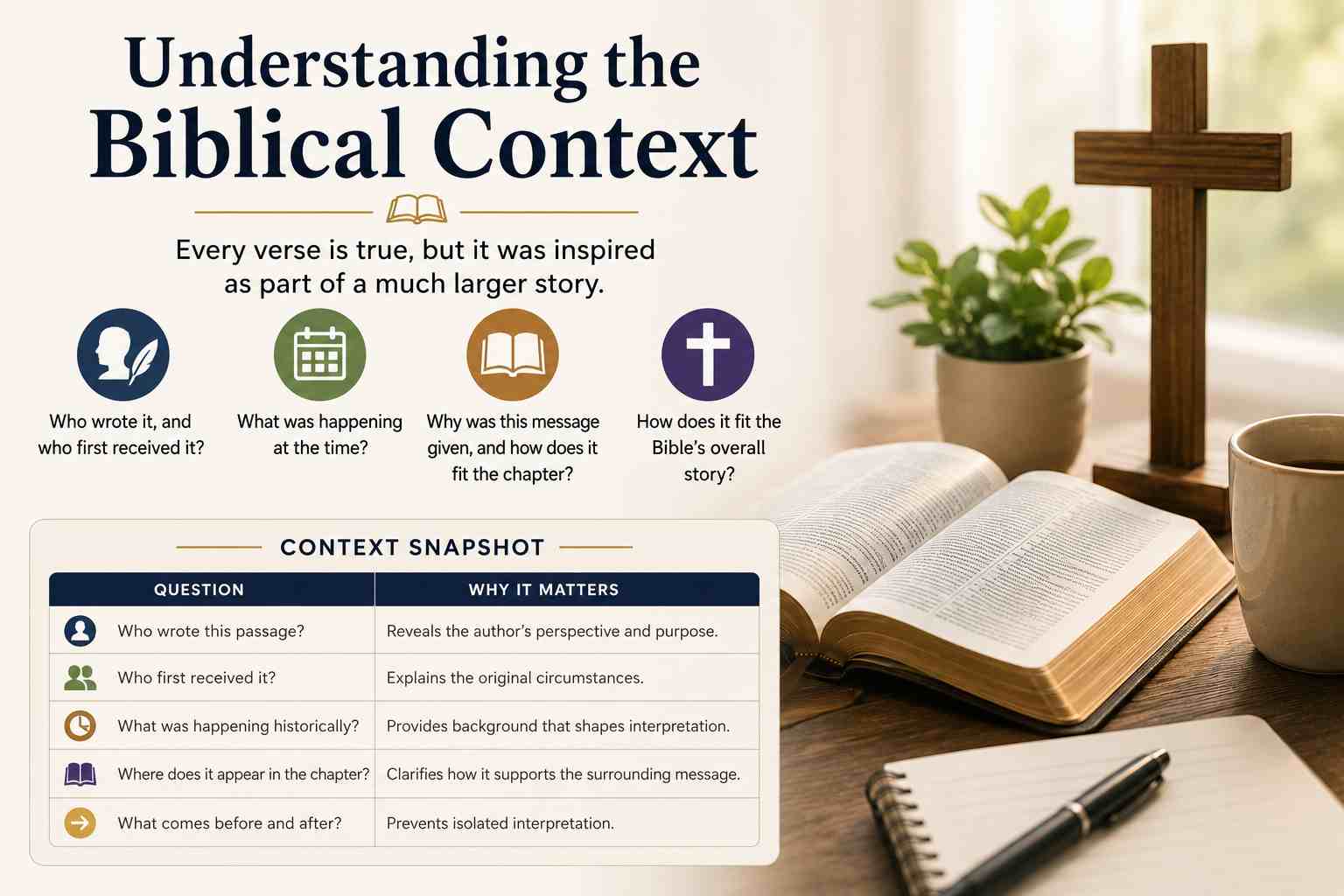
One of the easiest mistakes to make with any verse is treating it like a standalone quote. Every verse is true on its own, but God inspired each one as part of a much larger story. A few questions worth asking before you move to application:
- Who wrote this passage, and who first received it?
- What was happening at the time it was written?
- Why was this message given, and how does it fit the surrounding chapter?
- How does it contribute to the Bible’s overall story?
Context Snapshot
| Question | Why It Matters |
| Who wrote this passage? | Reveals the author’s perspective and purpose. |
| Who first received it? | Explains the original circumstances. |
| What was happening historically? | Provides background that shapes interpretation. |
| Where does it appear in the chapter? | Clarifies how it supports the surrounding message. |
| What comes before and after? | Prevents isolated interpretation. |
Knowing the author often explains the tone: a verse written in the middle of persecution tends to emphasize perseverance, while one written in worship leans toward praise and gratitude. And every book still feeds into the Bible’s single, unified story — Genesis lays out creation and covenant, Psalms teaches worship and honest lament, Proverbs offers practical wisdom, and the Gospels present Jesus as the fulfillment of it all.
How to Apply a Bible Verse in Daily Life
Reading Scripture is valuable. Understanding it is better. But the Bible was ultimately given to change how you live, not just add to what you know. The real question isn’t “What does this verse say?” — it’s “How should this shape what I do today?”
Personal Reflection
- What does this verse reveal about God’s character?
- Is there a promise here I should trust, or a command I should obey?
- Is there an attitude I need to change, or something I need to confess?
Where Application Shows Up
At Home: more patience with family, kinder words, quicker forgiveness, or simply checking in on someone who’s struggling.
At Work or School: working with integrity, serving without being asked, and treating people around you with basic respect.
During Difficult Times: returning to the same promise more than once during the day, rather than reading it once and moving on.
In Relationships: listening before responding, forgiving something that’s still stinging, or praying for someone you disagree with.
Common Mistakes to Avoid
- Reading only the comforting verses and skipping the ones that challenge or correct
- Jumping to application before understanding what the passage meant to its original audience
- Expecting an instant answer, when some truths take months or years to take root
- Treating faith as a Sunday-only category instead of something that touches work, money, and relationships
A Simple Action Plan
- Read the verse again slowly, and notice which word or phrase stands out.
- Pray about it, asking God to help you understand and obey what you’ve read.
- Choose one specific, realistic application you can point to at the end of the day.
- Share it with someone if it genuinely encouraged you.
- Return to the verse later today and notice how it’s shown up.
A Prayer Based on Today’s Bible Verse
Reading naturally leads to prayer. God’s Word reveals His character and His promises, and it opens the door to a real conversation with Him — not just information you’ve absorbed. The prayer below is a starting point; adjust it to fit the verse you’ve chosen above and whatever you’re carrying into this moment.
Heavenly Father,
Thank You for speaking through Your Word, and for the wisdom, faithfulness, and love it reveals on every page. As I reflect on this verse, help me understand not just what it says, but what You want to teach me through it.
Strengthen my faith when I face uncertainty. Fill my heart with peace when fear tries to take over, and remind me that Your promises stay trustworthy regardless of my circumstances.
Help me reflect the character of Jesus Christ in what I say and do today — loving others patiently, forgiving generously, and serving without needing recognition. In Jesus’ name, Amen.
Let Your Prayer Focus on One Theme
- Faith — ask God to strengthen your trust in Him
- Peace — pray for calm during an anxious moment
- Strength — ask for endurance to stay faithful
- Forgiveness — confess where needed, and extend it to someone else
Reflection Questions & Journaling
- What does today’s verse teach me about God — His faithfulness, holiness, love, or justice?
- Is there a promise here I should trust today, in light of my actual circumstances?
- Is there someone — a family member, friend, or coworker — who could use this encouragement too?
Journaling Prompts
- Today God reminded me that…
- One truth I need to remember is…
- One action I will take today is…
A daily verse also works well as a family or small-group conversation starter — ask what stood out most, what it teaches about God, and how everyone could apply it this week.
Bible Translation Comparison
A common question after finding a verse is which translation to actually read. The Bible was originally written in Hebrew, Aramaic, and Greek, and every modern translation carries that original meaning into today’s language — some staying closer to the original wording, others prioritizing clear, contemporary phrasing.
| Translation | Best For | Reading Style |
| KJV | Traditional reading and memorization | Formal, classic English |
| NKJV | Traditional wording with modern updates | Formal yet accessible |
| NIV | Daily devotion, church reading, general study | Balanced and easy to understand |
| ESV | In-depth Bible study | More literal |
| NLT | New believers and devotional reading | Clear, conversational language |
There’s no single “correct” translation for everyone. The verses in this guide use the King James Version, which is in the public domain — if you’d like these paired with NIV, ESV, or NLT wording, note that those translations require licensing for reproduction.
How to Build a Daily Bible Reading Habit
Start Small. Ten to fifteen focused minutes a day, done consistently, will outperform an ambitious plan that fizzles out in a week.
Read the Context. Asking who wrote it and what happens just before and after it protects you from misreading Scripture.
Pray Before Reading. A short prayer before you open your Bible sets your heart to receive what you’re about to read.
Memorize Key Verses. Start with one verse a week — repeat it through the day, write it on a card, and pray through it.
Keep a Bible Journal. Even a few sentences a day help you track what God is teaching you over time.
Daily Reading Checklist
- Did I read today’s Scripture carefully and understand its context?
- Did I learn something about God and pray about what I read?
- Did I identify one practical application, and will I return to this verse later today?
Frequently Asked Questions About the Bible Verse of the Day
What is the Bible Verse of the Day?
It’s a Scripture passage selected to encourage daily reflection, prayer, and growth. It’s meant to complement regular Bible study, not replace it.
Is the verse on this page different every day?
This page works as a curated verse library organized by theme, so you can return to it any day and find a passage that fits your situation, rather than relying on a single verse that changes on a schedule.
Why is a particular verse chosen as the daily verse?
Different publishers use different methods — a yearly devotional calendar, a reading plan, or seasonal themes. What matters more than the selection method is how faithfully you engage with whatever verse you land on.
Should I read more than one verse each day?
In most cases, yes. A single verse is a strong starting point, but Scripture is best understood in its larger context, so reading the surrounding chapter will almost always deepen your understanding.
Which Bible translation is best for daily reading?
It depends on your goal. The NIV balances readability and accuracy, the ESV suits closer study, the NLT uses clear modern language, and the KJV remains valued for its literary style. Consistency matters more than finding a “perfect” version.
Can I pray using today’s Bible verse?
Yes — after reading, thank God for what the passage reveals, ask for wisdom, confess where you’re falling short, and pray for anyone else who might need that same encouragement.
How can I remember a Bible verse?
Regular repetition is what makes it stick: write it down, place it somewhere you’ll see it, read it a few times, and talk about it with someone else.
Continue Your Bible Journey
A daily verse is a meaningful habit, but it’s meant to be a doorway, not a destination. Explore more themed collections to go deeper on the areas that matter most to you right now:
- Bible Quotes About Faith: The Complete Scripture Guide
- Bible Quotes About Strength: Hope for Hard Times
- Grace Quotes: Inspiring Sayings About Kindness & Faith
- 45 Bible Verses on Identity: Discover Who God Says You Are
- Bible Quotes About Springtime: Inspiring Scriptures About Renewal, Hope, and New Life
- Bible Quotes About Life: Powerful Scriptures for Purpose, Strength & Faith
- Quotes for Praying: The Complete Verified Collection
- Quotes About Fear: To Overcome Anxiety, Uncertainty, and Fear
Conclusion
The Bible Verse of the Day is more than a daily inspirational quote — it’s an invitation to actually encounter God’s Word, understand what it means, and let it shape how you live. Whatever season you’re in — seeking wisdom, strength, peace, hope, or forgiveness — Scripture remains a trustworthy guide. Choose a verse from the themes above, take a moment to explore its context, pray through its message, and take one practical step in response today.