
How to Write a Business Plan Step by Step
Most businesses don’t fail from lack of ambition. They fail because the founder never fully pressure-tested the core assumptions — about the customer, the margin structure, the cost of acquiring someone who’s never heard of them. A business plan, at its best, is the tool that forces that pressure-testing before it gets expensive.
The discipline of writing one tends to surface problems that feel invisible in the middle of building something but look obvious in hindsight: a target market too narrow to support the model, pricing that doesn’t survive realistic acquisition costs, a niche where three better-funded competitors already operate. Far better to find those things at the planning stage than six months after launch.
That’s the part most guides don’t emphasize enough. The plan’s most underrated function isn’t what it communicates to investors — it’s what it reveals to the founder.
A solid plan answers a handful of practical questions before anything else:
- Who is the customer, specifically?
- Why would they choose this over what already exists?
- How will the business make money, and how much?
- What will it actually cost to operate?
- Is the idea realistic at the scale being imagined?
For some entrepreneurs, the finished plan will go to investors or lenders. For others, it’s an internal roadmap that keeps things focused through the chaotic early stages. Either way, the process of building it tends to reveal more about a business idea than almost anything else — which is reason enough to take it seriously regardless of audience.
The challenge is that most guidance on this topic is either overly corporate or frustratingly generic. Standard templates get recycled without explaining what actually matters: what investors skim first, how detailed each section realistically needs to be, and what separates a plan that earns attention from one that gets politely set aside.
A strong business plan doesn’t need to sound like it came from a Fortune 500 boardroom. It needs to be clear, credible, and specific enough that a stranger could read it and immediately understand the opportunity.
How to Write a Business Plan: The Steps at a Glance
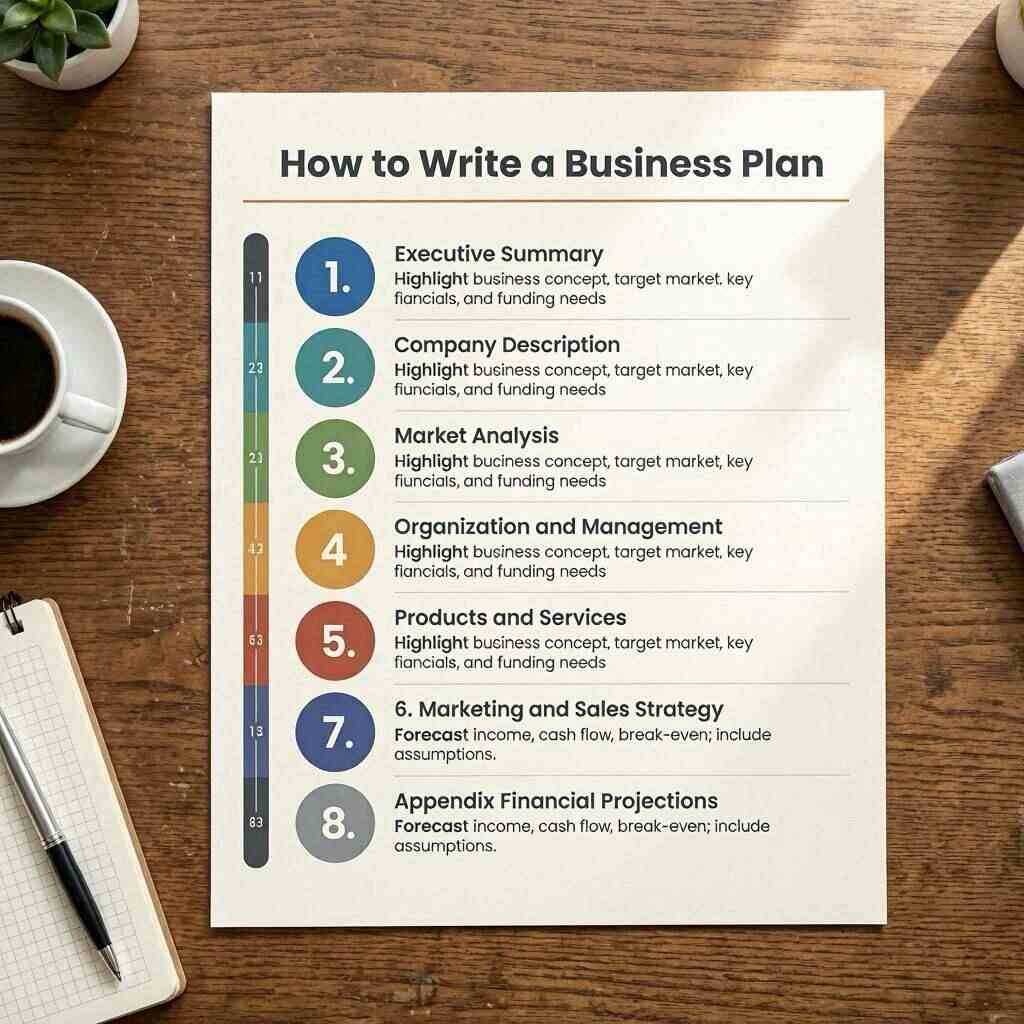
Before diving into each section in depth, here’s the complete sequence:
- Write the executive summary (but draft it last)
- Describe your company, structure, and mission
- Conduct market analysis and competitor research
- Define your products or services and pricing
- Build your marketing and sales strategy
- Outline your operations plan
- Develop your financial projections
- Add a funding request if you’re seeking capital
Each step builds on the previous one. Founders who jump straight to financials before clarifying their audience and competitive positioning almost always end up revising everything later anyway.
What Is a Business Plan and Why Does It Matter?
A business plan is a structured document that explains what your business does, who it serves, how it makes money, and how it plans to operate and grow. At its core, it connects strategy with execution.
A well-written plan helps founders organize their thinking, gives investors and lenders a clear picture of the opportunity, and gives teams something concrete to align around. But its most undervalued function happens before anyone else reads it: forcing the founder to confront assumptions that might otherwise go untested until they become expensive.
Going through the process, a founder might discover that the target market is too narrow to support the business model, that customer acquisition costs make the pricing unsustainable, or that three well-funded competitors already occupy the niche. That’s valuable information — far better to surface it during planning than after launch.
Traditional vs. Lean Business Plans
Not every business plan needs to be a 40-page document.
| Traditional Business Plan | Lean Business Plan |
|---|---|
| Detailed and formal | Short and flexible |
| Common for investors and banks | Common for startups and internal planning |
| Includes full financials and market analysis | Focuses on core business model |
| Longer preparation time | Faster to create and update |
| Better for funding applications | Better for testing ideas quickly |
A lean plan works well when validating a startup idea, launching a side hustle, or testing product-market fit before committing to full documentation. A traditional plan is typically necessary for SBA loans, investor funding rounds, or large-scale expansion.
One misconception worth addressing directly: longer doesn’t mean more credible. Many experienced investors would rather read a tight, well-reasoned 15-page plan than a padded 40-page document full of vague market claims. Volume signals effort. Clarity signals thinking.
Before You Start Writing, Gather These Essentials
Business plans become genuinely difficult when founders try to write them before doing the groundwork. The sections that feel hardest — market analysis, financial projections, competitive positioning — are usually hard because the underlying research hasn’t been done yet.
Before writing a single sentence, get clear on four things.
1. Your Core Business Idea
You should be able to explain your business in two or three sentences, and those sentences should do real work.
Weak:
“We’re building an app that connects people.”
Stronger:
“We provide affordable meal-prep subscriptions for busy professionals in suburban Texas who want healthier weekday lunches without cooking daily. Plans start at $79/week and include refrigerated delivery twice weekly.”
The second version defines the product, the audience, the pricing direction, the lifestyle problem, and the geographic focus — all in two sentences. That specificity makes every subsequent section easier to write and far more credible to read.
If you can’t get there yet, spend more time on the idea before spending time on the document.
2. Your Target Customer
This is where a surprising number of business plans fall apart. Founders either describe their audience too broadly — “millennials,” “small business owners,” “health-conscious consumers” — or they describe anyone who might theoretically benefit from the product rather than who will actually buy it.
Specificity doesn’t narrow the opportunity. It sharpens the strategy.
Weak:
“Our target audience is young adults.”
Stronger:
“Our primary audience is working professionals between 28 and 42 in mid-size US cities who earn $65,000+ annually, prioritize convenience over cost, and currently spend $12–18 per lunch on delivery apps.”
The second version is actually useful. It suggests a price point, a competitive set, a marketing channel, and a customer acquisition story. The first version tells investors almost nothing.
3. Your Competitors
Every business has competition, including indirect competition. Claiming otherwise is one of the fastest ways to lose credibility with experienced investors or lenders.
A local coffee shop competes with chain cafes, convenience stores, home espresso machines, energy drinks, and delivery apps. The question isn’t whether competition exists — it’s whether you understand where you fit relative to it.
Strong competitor research looks at pricing, customer reviews, brand positioning, operational weaknesses, and underserved customer needs. The goal isn’t to argue that competitors are inferior. It’s to explain specifically why your business deserves space in the market and which customers you’re best positioned to serve — and why those customers would actually switch.
4. Your Revenue Model
Many startup plans are vague about exactly how money enters the business. Before writing, you should know what customers are paying for, how often they buy, the average transaction value, expected margins, and whether revenue is recurring or one-time.
The revenue model is where disconnects between financial logic and business reality show up most visibly — and experienced reviewers notice them immediately.
Step 1: Write the Executive Summary
The executive summary is usually the first thing readers see, but most experienced founders write it last. It summarizes everything else, and it’s genuinely difficult to summarize what you haven’t written yet.
It should answer, quickly and without padding:
- What does this business do?
- Who does it serve?
- Why does it matter?
- How does it make money?
- What’s the growth potential?
- What funding is needed, if any?
Many investors read only this section initially and decide based on it whether the rest of the plan deserves their attention. That makes it both the highest-stakes section and the one most commonly written poorly — either too long, too vague, or too enthusiastic without the substance to back it up.
What to include:
- Business overview (two to three sentences)
- Market opportunity
- Product or service description
- Competitive advantage
- Revenue model
- Financial highlights
- Funding request, if applicable
Strong executive summary example:
BrightPath Learning is an online tutoring platform that helps high school students improve SAT scores through personalized AI-assisted study plans and live coaching sessions. The company targets middle-income families looking for affordable alternatives to private tutoring, which averages $100–$150 per hour in most US markets. Revenue comes from monthly subscription plans ranging from $49 to $199. BrightPath is seeking $250,000 in seed funding to scale marketing, expand its tutor network, and accelerate platform development. The company has 180 active subscribers after six months with a monthly churn rate under 4%.
What makes this work: a specific audience, a clear competitive framing against expensive private tutoring, a straightforward business model, real traction data, and a funding request tied to concrete uses. It doesn’t make claims it can’t support.
Common mistakes to avoid:
Founders often write executive summaries that read like company histories — long explanations of how the idea developed rather than why the opportunity is real. Investors care about the opportunity and the plan. The origin story is mostly irrelevant.
Vague superlatives — “best-in-class solution,” “unlimited market potential,” “revolutionary approach” — do the opposite of what founders intend. They reduce credibility. Specific, conservative claims almost always land better because they signal the founder actually understands the business.
Step 2: Describe Your Company
This section establishes the identity and structure of the business. It should answer: What does the company do? Why does it exist? What problem does it solve? How is it legally structured?
Mission Statement
A useful mission statement is specific and grounded — not inspirational wallpaper.
Weak:
“To change the world through innovation and connection.”
Stronger:
“To provide affordable cybersecurity tools for small businesses that can’t afford enterprise-level protection — without requiring technical staff to manage them.”
The second version is specific enough to define a customer, a competitive gap, and a design constraint. Readers immediately understand what the company is trying to do and for whom.
Business Structure
Explain whether the business is an LLC, S-corp, C-corp, partnership, or sole proprietorship. Legal structure affects taxes, liability, ownership distribution, and fundraising mechanics — and lenders or investors will want to see that this has been decided deliberately. A business planning to raise venture capital but structured as a sole proprietorship signals that foundational decisions still haven’t been made.
Business Model
Explain how the business generates revenue — and why that model is sustainable. Common structures include subscription, e-commerce, consulting, SaaS, advertising, licensing, and marketplace models. Strong plans don’t just name the revenue model; they explain the unit economics behind it. How much does it cost to acquire a customer? What’s the average lifetime value? How many customers are needed before the business covers its operating costs?
Step 3: Conduct Market Analysis
This is where many business plans fall short — and where the most meaningful differentiation is possible. Generic statements like “the industry is growing rapidly” or “there is a large untapped market” are essentially noise. They tell readers nothing that a thirty-second search couldn’t produce.
Strong market analysis demonstrates that the founder actually understands the industry, the customer, the competitive landscape, and where the business fits within all three.
Understand the Industry
Research the overall market size, growth trends, customer behavior patterns, regulatory environment, pricing norms, and any emerging technologies reshaping how the industry works. The goal isn’t to cite an impressively large number — it’s to demonstrate that you understand how the market actually functions.
A founder launching a fitness app shouldn’t just reference the size of the wellness industry. They should understand subscription churn patterns in fitness apps, the challenge of sustained engagement after month three, how wearable integration affects retention, and which acquisition channels have proven most cost-effective for direct-to-consumer fitness products. That level of specificity signals real research rather than optimistic wordsmithing.
TAM, SAM, and SOM
Investors often look for founders who understand the distinction between total addressable market (TAM), serviceable addressable market (SAM), and serviceable obtainable market (SOM).
TAM is the entire market if every possible customer bought your product. SAM is the portion your business model can realistically serve. SOM is what you can actually capture in the near term given your resources, competition, and go-to-market approach.
Many first-time founders lead with a massive TAM figure without acknowledging that capturing even 1% of it would require resources that don’t yet exist. Working through all three forces more honest thinking about realistic growth — and experienced reviewers notice when founders have done that thinking versus when they’ve skipped it.
Identify Your Target Audience
The most useful customer profiles don’t just describe demographics — they describe behavior. Specifically: what does this person do today to solve the problem you’re addressing, and why is that solution inadequate?
A meal-prep subscription targeting busy urban professionals earning $65,000+ is more useful as a planning tool when you know they currently spend $14–18 per day on delivery apps, want to eat better but won’t cook on weeknights, and have tried meal-kit services before but quit because the prep time wasn’t worth it. That behavioral detail shapes pricing, messaging, product design, and acquisition strategy in ways that demographic data alone doesn’t.
Conduct Competitor Analysis
| Competitor | Strength | Weakness | Opportunity |
|---|---|---|---|
| Brand A | Strong brand recognition | High pricing ($200+/mo) | Comparable quality at $79–$99 |
| Brand B | Fast fulfillment | No customization options | Personalized plans |
| Brand C | Large subscriber base | Weak customer support (2.8 stars avg) | Better service experience |
Strong competitor analysis identifies specific weaknesses in how existing players serve the market — not vague claims that competitors are worse. Citing actual review patterns, pricing gaps, or service limitations builds the kind of credibility that generic comparisons don’t.
One thing most competitor analyses miss: the distinction between a differentiated position and a defensible one. Being different doesn’t protect you if a better-resourced competitor can replicate it in six months. The most durable competitive positions are built on something structural — proprietary data, switching costs, network effects, a customer relationship that compounds over time, or deep expertise in a niche that larger players find uneconomical to serve.
Market Positioning
Positioning explains why customers choose you instead of existing alternatives. The most durable positioning isn’t usually “cheaper” or “better quality” standing alone — it’s a specific combination of attributes that serves a particular customer better than anything currently available. The strongest positioning statement identifies a genuinely underserved customer and explains precisely why existing options fail them.
Step 4: Define Your Products or Services
Many founders overcomplicate this section by leading with technical features rather than customer outcomes — a common instinct when you’re close to what you’ve built, but it works against you here.
Customers buy solutions. They don’t buy specifications.
Weak:
“Our platform uses AI-driven data processing algorithms and a proprietary neural recommendation engine.”
Stronger:
“Our platform helps small business owners track invoices, flag overdue payments, and generate monthly P&L summaries automatically — without requiring any accounting knowledge.”
The second version connects directly to what the customer gains. Technical architecture belongs in an appendix or investor data room, not the main narrative.
Differentiation
Possible differentiators include pricing, niche specialization, delivery speed, technology, customer experience, expertise, or simply serving a segment that larger competitors have chosen to ignore. The key is specificity — “better customer service” without explaining what that looks like operationally doesn’t actually differentiate anything. What specifically will your service experience include that competitors currently don’t offer?
Pricing Strategy
Explain your pricing structure, target margins, and how your pricing compares to the competitive landscape. If your pricing sits meaningfully higher or lower than the market norm, explain why — and what that implies for customer acquisition costs and margin sustainability over time.
Step 5: Create a Marketing and Sales Strategy
Marketing sections are frequently the weakest part of a business plan — lists of channel names without any logic connecting them to the customer profile, the acquisition economics, or the actual competitive environment.
“We’ll grow through social media and word of mouth” isn’t a marketing strategy. It’s a hope with a deadline.
Customer Acquisition Channels
The channel strategy should follow logically from the customer profile, not from what the founder personally uses or finds familiar. A B2B cybersecurity company and a consumer meal-prep service require entirely different acquisition approaches.
For each planned channel, explain:
- Why this channel specifically reaches your customer
- What the estimated customer acquisition cost (CAC) looks like
- What the conversion path from first exposure to purchase actually involves
One of the most consistent credibility problems in marketing sections is assuming unrealistically cheap customer acquisition. If your financial projections assume a $5 CAC for a product in a category where paid social typically runs $40–$80, experienced reviewers will notice — and it will raise questions about every other assumption in the plan.
The Sales Funnel
Explaining how leads become customers — not just where traffic originates — signals that the founder has thought through the full customer journey.
Example funnel for a SaaS business:
- User discovers content through organic search
- Downloads a free resource, joins email list
- Receives a 7-day educational email sequence
- Converts on a free trial offer
- Upgrades to paid plan after 14 days
That specificity demonstrates strategic thinking beyond the top-of-funnel question.
Content Marketing and SEO
For businesses investing in content or organic search, “we’ll blog regularly” isn’t a strategy. Explain what problems your content will solve, at what stage of the buying journey, and how that connects to conversion. The strongest content strategies aren’t built around topics the founder wants to write about — they’re built around the questions customers are already searching for when they realize they have the problem your business solves.
Step 6: Build Your Operations Plan
Operations sections are easy to underwrite, and that’s a mistake. Operational weaknesses are among the most common reasons early businesses fail to scale — a product that can’t be consistently delivered at quality, at the right cost, and at growing volume will underperform regardless of how strong the market opportunity looks on paper.
Daily Operations
Explain the core workflow: how the product is made or delivered, how customer support is handled, how quality is maintained, and how the business functions day-to-day. Even digital businesses with no physical product have operational complexity worth documenting.
Staffing and Team Structure
Outline the current team, planned hires, and contractor relationships. Include realistic hiring timelines, not just org chart aspirations — investors evaluate whether the team structure actually supports the growth being projected. A plan that shows 10x revenue growth with no corresponding hiring plan, or with hiring that assumes roles can be filled in two weeks when the market for that talent takes three to four months, is a visible gap.
Suppliers, Logistics, and Fulfillment
For businesses selling physical products, cover supplier relationships, manufacturing approach, shipping logistics, and inventory management. Supply chain fragility became a heightened concern for investors after years of global disruptions, and experienced lenders will ask about it directly. Address concentration risk explicitly: what happens if your primary supplier can’t deliver?
Technology Stack
Mention the core tools powering operations — CRM, accounting software, automation platforms, analytics systems. Demonstrating that you’ve thought about operational infrastructure signals organizational maturity, and it often separates scalable businesses from ones that grow into chaos.
Step 7: Write the Financial Plan
This is where most founders feel their confidence drop — and where the most credibility is either earned or lost.
Financial projections don’t need to be perfect. Investors and lenders know they’re estimates. What they’re actually evaluating is whether the logic behind the numbers holds up — whether the assumptions are grounded, the expense categories are realistic, and the founder understands the financial dynamics of what they’re building.
Startup Costs
List every expense expected before the business generates meaningful revenue.
| Expense | Estimated Cost |
|---|---|
| Website Development | $4,000 |
| Initial Inventory | $12,000 |
| Marketing Launch | $6,000 |
| Legal and Licensing | $2,500 |
| Software Tools | $1,200 |
| Total | $25,700 |
The specificity matters. A single line item labeled “marketing: $20,000” tells investors nothing about how that money will be deployed or what results are expected from it.
Revenue Projections
Weak:
“We expect $10 million in revenue in year one.”
Stronger:
“We project 500 active monthly subscribers by month 12, at an average subscription value of $49, generating approximately $24,500 in monthly recurring revenue. This assumes a month-one launch with 40 subscribers and growth of roughly 15% month-over-month, driven primarily by paid social and referral programs.”
The second version shows how the number was constructed, what growth rate it implies, and what’s driving it. That transparency is what investors are actually looking for — evidence of a thinking process, not just an output.
A useful benchmark: if your projections aren’t grounded in comparable companies at a similar stage, find some. What did a business with your model, your market size, and your starting resources actually look like in its first 18 months? That reference point is more persuasive than any growth formula you can apply in isolation.
Unit Economics: The Numbers Investors Actually Scrutinize
Most business plan guides skip this section entirely, which creates a significant differentiation opportunity for founders who include it.
Unit economics refer to the revenue and cost associated with a single customer — the building block from which everything else scales.
Customer Acquisition Cost (CAC): The average cost to acquire one paying customer, calculated as total sales and marketing spend divided by new customers acquired in the same period.
Customer Lifetime Value (LTV): How much a customer spends over their entire relationship with the business — typically calculated as average purchase value × purchase frequency × average customer lifespan.
A sustainable model has LTV that meaningfully exceeds CAC, generally at a ratio of 3:1 or higher for most investor-backed businesses. If your projections imply spending $80 to acquire a customer with an expected LTV of $95, the unit economics are fragile — and anyone who’s reviewed business plans before will catch it.
Payback period — how long it takes to recover the cost of acquiring a customer through the revenue they generate — is equally important and equally ignored in most plans. A business with a 3:1 LTV:CAC ratio but a 30-month payback period has a cash flow problem that won’t show up in headline metrics. Investors who focus on capital efficiency will ask about this even if you don’t raise it, so addressing it proactively signals sophistication.
Runway
Runway is how long the business can operate on its current cash before running out, calculated by dividing cash reserves by monthly net burn (expenses minus revenue).
For early-stage businesses seeking funding, investors want to see that the capital requested provides enough runway — typically 18 to 24 months — to reach meaningful milestones. A plan that requests $300,000 against $35,000 in monthly burn provides roughly eight to nine months of runway, which most investors consider insufficient to reach a fundable next stage.
Cash Flow Forecast
Many businesses that look profitable on paper still fail from cash flow problems — they’ll eventually earn enough, but can’t cover near-term obligations while waiting for revenue to materialize. Cash flow forecasting tracks when money actually enters and leaves the business, not just when it’s recognized on a P&L.
This section helps identify seasonal vulnerabilities, funding gaps during growth phases, and the realistic timeline to self-sufficiency.
Break-Even Analysis
Break-even analysis answers a simple but important question: how much revenue does the business need before it covers its operating costs?
Break-Even Point = Fixed Costs ÷ (Price – Variable Cost Per Unit)
If a business carries $10,000 in monthly fixed costs, sells a product at $50, and spends $20 per unit to produce it, it needs to sell roughly 334 units per month to break even. Presenting this calculation — even roughly — signals that the founder understands the financial structure of their own business. Skipping it is a noticeable omission.
What Investors Are Actually Asking While Reading This Section
The unstated questions behind most investor scrutiny of financial plans:
- Are the growth assumptions grounded in something real, or essentially arbitrary?
- Do the cost projections reflect what this type of business actually costs to operate?
- Does the founder understand what drives unit economics in this specific industry?
- Is this revenue model sustainable at scale, or does it depend on conditions that won’t hold?
Weak assumptions destroy trust faster than imperfect formatting.
Step 8: Add a Funding Request (If Needed)
If you’re seeking outside capital, this section should explain exactly how much you need, specifically how it will be used, and what the business will look like as a result. Vague requests — “we’re seeking investment to grow the business” — suggest the funding decision itself hasn’t been thought through.
Example funding use breakdown:
| Use of Funds | Allocation |
|---|---|
| Product Development | 35% |
| Marketing and Customer Acquisition | 30% |
| Hiring | 20% |
| Operations and Infrastructure | 15% |
What Banks Want vs. What Investors Want vs. What Accelerators Want
These are meaningfully different audiences, and a plan optimized for one often doesn’t work well for the others.
| Banks | Investors | Accelerators |
|---|---|---|
| Stable, predictable repayment ability | High growth potential and scalability | Strong founding team and learning velocity |
| Conservative revenue assumptions | Evidence of market demand and momentum | Early traction, even if small |
| Collateral and financial history | Founder capability and differentiation | Coachability and execution speed |
| Risk reduction | Market opportunity size | Clarity of vision, not just market size |
Banks are evaluating whether the business can reliably service debt. Investors are evaluating whether the business can return their capital many times over. Accelerators are often betting on the team’s capacity to iterate quickly — a strong founding story and clear customer insight can matter more to them than a polished financial model. Conflating these audiences in a single document tends to weaken the pitch for all of them.
Business Plan Mistakes That Hurt Credibility
Unrealistic Financial Projections
Projecting $5 million in year-one revenue for a business with no existing customers and no paid marketing budget signals inexperience or wishful thinking — and experienced reviewers can tell the difference. Conservative projections with clear reasoning almost always read as more trustworthy than optimistic ones without it.
Claiming No Competition Exists
This almost always signals insufficient research rather than a genuinely uncontested market. Every business competes for customer attention, money, and behavioral change. The relevant question is whether you understand how customers currently solve the problem you’re addressing, and why they’d switch to something new.
Vague Target Audience
“Our customers are people who care about health” isn’t an audience definition. It offers nothing useful for marketing decisions, pricing, channel selection, or product development. The more precisely the audience is defined, the more credible the entire plan becomes — because specificity suggests the founder has actually spoken with potential customers rather than theorizing about them.
Writing for Yourself Instead of the Reader
Some founders produce plans filled with internal shorthand, undefined acronyms, and assumptions that feel obvious to them but land as confusing to anyone else. A well-written plan explains the opportunity clearly enough that someone unfamiliar with the industry — an investor reviewing a crowded inbox, a banker processing loan applications — can understand it immediately.
What Makes a Business Plan Feel Amateur
The details that most consistently signal inexperience:
- Market size claims pulled from a single research report without further context
- Financial projections that conveniently reach profitability in month 12 regardless of business model
- A competitor analysis that lists only obvious names without identifying real positioning gaps
- Operations sections that assume costs and processes without any stated basis
- A marketing strategy built entirely on channels the founder personally uses
- Revenue assumptions that aren’t benchmarked against anything comparable at the same stage
How Long Should a Business Plan Be?
| Business Type | Typical Length |
|---|---|
| Lean startup plan | 1–5 pages |
| Small business plan | 10–20 pages |
| Investor-focused plan | 15–30 pages |
| SBA loan plan | Often 20+ pages |
Length should follow necessity, not ambition. A 30-page plan doesn’t signal more seriousness than a 15-page one — it signals either that more ground genuinely needed covering, or that the editing wasn’t thorough enough.
Can You Use AI to Help Write a Business Plan?
Yes — and used well, AI tools meaningfully speed up the process. They’re useful for generating outlines, improving sentence clarity, summarizing research, and working through structural organization.
The risk isn’t using AI. It’s outsourcing the thinking to it.
Experienced investors and lenders have become increasingly perceptive about plans built primarily by AI — not because of any specific phrase, but because they feel generic in a particular way. The market logic sounds plausible but doesn’t trace back to anything specific. The financial assumptions are optimistic without a stated basis. The competitive analysis names competitors without demonstrating real understanding of the dynamics between them. The confidence intervals are round numbers.
What those plans share is borrowed structure without original reasoning. The market claims come from everywhere and nowhere. The unit economics look like defaults rather than derivations.
The sections that require genuine business understanding — market assumptions, unit economics, competitive positioning, customer acquisition logic — are precisely where AI-generated content tends to be weakest. They’re also the sections that matter most.
How to Use AI Without Producing an AI-Generated Plan
Start with rough notes about what you actually know: your customers, your competitors, your costs, your market assumptions and where they came from. Use AI to help structure, sharpen, and refine that content into something readable. The result will be noticeably more specific and credible than a plan generated from scratch using a generic prompt — because the underlying thinking is real.
Business Plan Checklist Before You Finish
Before submitting or sharing the plan, verify:
- The business model is clear enough for an outsider to understand without assistance
- The target customer is defined specifically, not broadly
- Competitors are identified honestly, with real positioning gaps explained
- Financial projections show visible logic, not just output numbers
- Revenue assumptions are benchmarked against comparable businesses at a similar stage
- The customer acquisition strategy is realistic and channel-specific
- Operations are planned in enough detail to suggest genuine scalability
- Hiring timelines are realistic, not aspirational
- Every major claim has something concrete behind it
- The plan reads comfortably without requiring specialized industry knowledge
- Likely investor or lender concerns are addressed before they’re asked
If sections feel vague, they almost always need more research rather than better wording.
Final Thoughts
Writing a business plan is less about producing a polished document and more about forcing the kind of strategic clarity that most early-stage businesses operate without.
The process tends to surface things founders would rather not confront: market assumptions that don’t hold up under scrutiny, pricing that doesn’t produce sustainable margins, acquisition costs that make the whole model fragile. That friction is actually the point. It’s far cheaper to discover those problems at the planning stage than after the business has launched and spent months operating under flawed assumptions.
The strongest business plans are rarely the longest or most elaborately formatted. They’re the clearest — explaining who the customer is, why the business exists, how money moves through the model, and why the opportunity is realistic, without overstating any of it.
That combination of specificity, honesty, and operational realism is what makes a plan worth reading. And increasingly, it’s what separates plans that earn serious attention from those that get filed away.
FAQs
Do small businesses really need a business plan?
Even businesses not seeking outside funding benefit from a structured plan. It clarifies target customers, pricing logic, operating costs, and revenue expectations in ways that reduce the kind of guesswork that leads to undercapitalization or poor market timing.
How long does it usually take to write a business plan?
A lean plan can be completed in a few days with basic research already done. A detailed investor or SBA plan typically takes several weeks, particularly when financial modeling and primary market research are involved.
What is the most important section of a business plan?
The executive summary has the highest stakes because it controls first impressions. But the financial section — specifically the unit economics and the logic behind the projections — is where credibility is most concretely built or lost.
Can I write a business plan without financial experience?
The key is showing your reasoning, not demonstrating accounting expertise. A clear explanation of how costs and revenue were estimated, grounded in realistic assumptions, is more valuable than a sophisticated-looking model built on implausible inputs.
What do investors usually read first?
Most investors read the executive summary and, if interested, move directly to the financial model and market analysis. Many skim the operations section initially and return to it only if the business model looks compelling.
Is a one-page business plan enough?
For early validation or internal planning, yes. For SBA loans, investor funding rounds, or bank financing, more detailed documentation is expected.
How often should a business plan be updated?
At minimum annually, and whenever a significant change occurs — new market conditions, pricing shifts, expansion plans, or a change in funding strategy.
What financial statements should be included?
Standard inclusions are profit and loss projections, a cash flow forecast, a break-even analysis, and a startup cost summary. Lenders typically expect more documentation and historical financial detail than early-stage investors do.
What is the biggest mistake new founders make?
Building financial projections that look like goals rather than analysis. When every number trends optimistically and nothing is explained, experienced reviewers don’t see ambition — they see a founder who hasn’t done the work yet.