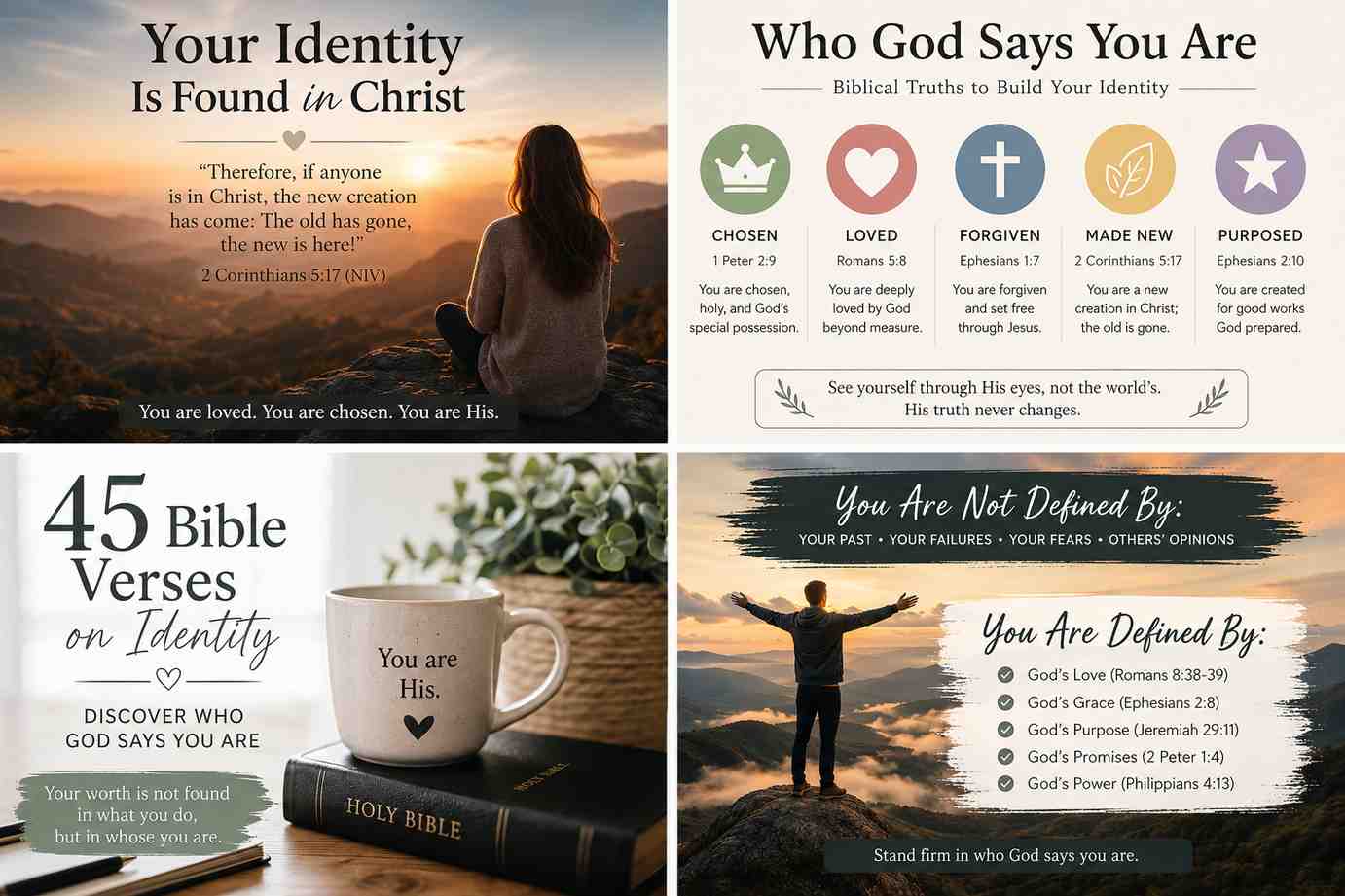
45 Bible Verses on Identity: Discover Who God Says You Are
Have you ever wondered, Who am I, really? Maybe you’ve felt weighed down by failure, compared yourself to others, or questioned your purpose. In moments like these, it’s easy to let circumstances, opinions, or emotions define your identity. The Bible offers a different perspective—one that is rooted not in changing feelings or achievements but in God’s unchanging truth.
Scripture teaches that your identity is far more than your career, appearance, accomplishments, or past mistakes. From the opening chapters of Genesis to the letters of the New Testament, the Bible consistently reveals that human identity begins with God. He created people in His image, loves them deeply, and, through Jesus Christ, offers believers a new identity founded on grace rather than performance.
This guide explores what the Bible says about identity through carefully selected passages, biblical context, and practical application. Instead of presenting a simple list of verses, you’ll discover how different Scriptures work together to answer important questions such as:
- What does the Bible say about our identity?
- What does it mean to have an identity in Christ?
- How does God define our worth and purpose?
- Which Bible verses bring comfort during seasons of doubt, rejection, or insecurity?
- How can these truths shape everyday life?
You’ll also see how key themes—including God’s love, adoption into His family, purpose, belonging, and spiritual transformation—connect throughout the Bible. Along the way, we’ll look at examples from both the Old and New Testaments, explain commonly misunderstood passages, and provide practical ways to apply these truths in your daily walk with God.
Whether you’re studying the Bible for personal growth, preparing a lesson for a small group, searching for encouragement during a difficult season, or simply wanting to know who God says you are, this guide is designed to help you understand biblical identity with greater clarity and confidence.
The journey begins with one foundational question: What does the Bible actually say about our identity?
A note on Bible translations: unless otherwise noted, all Scripture quotations in this guide are from the New International Version (NIV).
What Does the Bible Say About Our Identity?
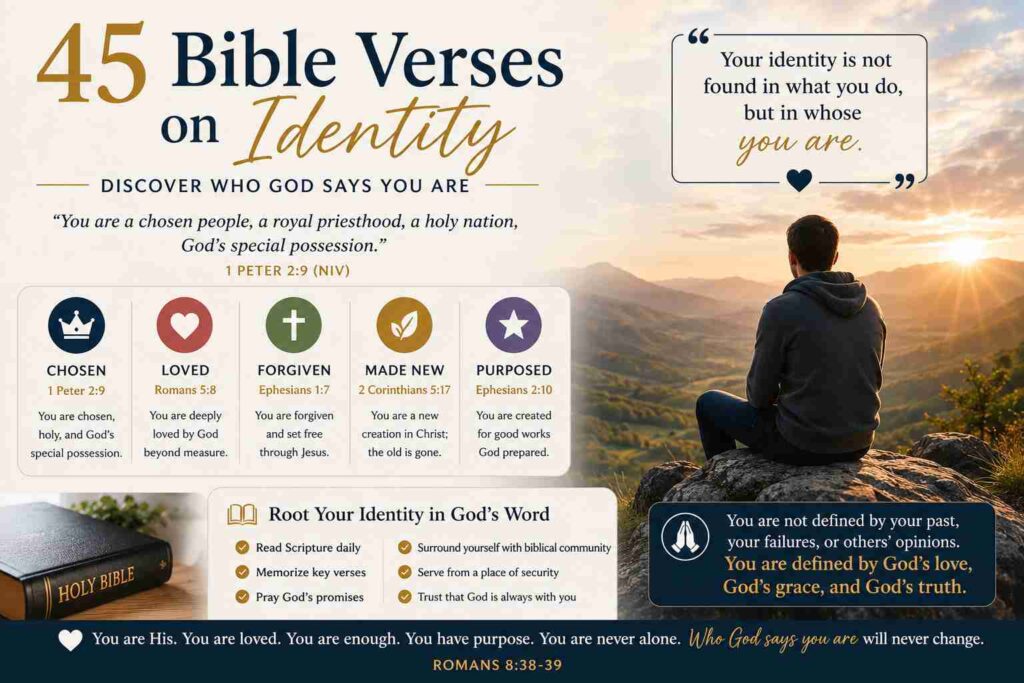
The Bible teaches that our identity begins with who God is and what He has done, not with who we think we are or what others say about us. According to Scripture, every person is created in God’s image, giving every human life inherent dignity and value. For those who place their faith in Jesus Christ, identity goes even deeper—they become children of God, forgiven, adopted into His family, and made new through His grace.
Unlike identities built on success, appearance, relationships, or social status, biblical identity is rooted in God’s unchanging character. Circumstances may change, emotions may fluctuate, and people may disappoint us, but God’s truth about His people remains constant.
At its heart, biblical identity answers questions such as:
- Who created me?
- Why am I valuable?
- Where do I belong?
- What is my purpose?
- How should I live because of who I am in Christ?
Understanding these answers is not simply a theological exercise. It influences the way we make decisions, respond to challenges, treat other people, and view ourselves during seasons of success and failure.
Key Truth: Biblical identity is not something we invent—it is something we discover through God’s Word.
What Is Biblical Identity?
Biblical identity is the understanding of who you are according to God’s truth rather than according to culture, personal achievements, emotions, or the opinions of others. It begins with the reality that God intentionally created humanity in His image and reveals its fullest meaning through Jesus Christ.
From the opening chapter of Genesis, the Bible establishes that people possess value because they are created by God:
“So God created mankind in his own image, in the image of God he created them; male and female he created them.” — Genesis 1:27 (NIV)
This verse reminds us that every person has inherent dignity. Our worth is not earned through accomplishments, popularity, intelligence, wealth, or appearance. Instead, it is rooted in the God who created us.
The New Testament expands this foundation by showing what happens when someone trusts in Jesus Christ. Believers receive a new identity—not because they become perfect overnight, but because of God’s grace.
One of the clearest examples is found in 2 Corinthians:
“Therefore, if anyone is in Christ, the new creation has come: The old has gone, the new is here!” — 2 Corinthians 5:17 (NIV)
This does not mean a person’s personality disappears. Rather, their relationship with God changes completely. Through Christ, believers are forgiven, reconciled to God, and invited into a new way of living.
Biblical identity therefore rests on two foundational truths:
- God created you with purpose and value.
- Through Jesus Christ, God offers believers a new identity founded on grace rather than performance.
These truths distinguish biblical identity from many modern ideas about self-worth. While society often encourages people to define themselves by achievements, possessions, appearance, or public approval, Scripture points to a more secure foundation—God’s unchanging love and His promises.
The table below highlights this difference.
| Worldly Identity | Biblical Identity |
| Based on achievements | Based on God’s grace |
| Changes with success or failure | Remains secure in God’s promises |
| Shaped by other people’s opinions | Defined by God’s Word |
| Often rooted in comparison | Rooted in belonging to God |
| Focuses on personal performance | Focuses on God’s work through Christ |
This distinction matters because every person builds their life on some understanding of identity. When identity depends on changing circumstances, confidence rises and falls with them. When identity is rooted in God’s truth, it provides stability even during disappointment, uncertainty, or suffering.
As the rest of this guide will show, the Bible repeatedly returns to this central message: God’s declaration about who you are carries greater authority than your past, your fears, your failures, or the opinions of others. From Genesis to Revelation, Scripture consistently points believers toward an identity that is secure, purposeful, and grounded in God’s faithful character.
Why Identity Matters to Every Christian
Understanding your identity is far more than knowing a few encouraging Bible verses. According to Scripture, your identity shapes how you think, how you respond to life’s challenges, how you relate to God, and how you treat others. When you know who God says you are, your decisions begin to flow from truth rather than fear, comparison, or insecurity.
Many of life’s struggles are ultimately identity struggles. People often ask themselves questions like:
- Am I valuable?
- Do I have a purpose?
- Am I loved?
- Can God still use me after I fail?
- Where do I belong?
The Bible doesn’t ignore these questions. Instead, it answers them by pointing us back to God. Rather than telling us to create our own identity, Scripture invites us to receive the identity God gives.
Identity Shapes Your View of Yourself
If you believe your value depends on your achievements, you’ll constantly feel pressure to perform.
If you believe your identity depends on other people’s opinions, criticism and rejection can easily shake your confidence.
If you believe your identity depends on your past, guilt and regret may continue to define your future.
Biblical identity offers a different foundation.
Instead of asking, “What have I accomplished?” Scripture asks, “What has God done for you?”
Instead of asking, “What do people think about me?” it asks, “What does God say about you?”
That shift changes everything.
Identity Shapes Your Relationship with God
Throughout the Bible, God doesn’t simply call people to obey Him—He first reminds them who they are.
For believers, this includes truths such as:
- You are created in God’s image.
- You are deeply loved by God.
- You are forgiven through Jesus Christ.
- You are adopted into God’s family.
- You are a new creation in Christ.
- You are called to live for God’s glory.
Notice that these truths describe who believers are before describing what believers should do.
This pattern appears repeatedly throughout the New Testament.
For example, the Apostle Paul often begins his letters by reminding Christians of their identity before instructing them how to live. Understanding who they are provides the foundation for how they should act.
Identity Influences Everyday Decisions
Our beliefs about ourselves influence countless everyday choices.
Someone who believes they are worthless may struggle to accept God’s forgiveness.
Someone who believes they are alone may forget God’s promise to be present.
Someone who believes failure defines them may hesitate to serve God again.
Someone who understands their identity in Christ approaches these situations differently because they rely on God’s truth rather than temporary emotions.
Biblical identity affects areas such as:
- How you handle criticism.
- How you respond to temptation.
- How you forgive others.
- How you face disappointment.
- How you pursue God’s purpose.
- How you treat people made in God’s image.
- How you persevere through suffering.
Identity Provides Stability During Difficult Seasons
Life changes quickly. Jobs change. Relationships change. Health changes. Emotions change. Even personal goals and circumstances can change unexpectedly.
If identity is built on those things, it will constantly shift.
God’s character, however, does not change.
Because biblical identity is rooted in God’s faithfulness rather than human circumstances, it provides stability during seasons of uncertainty.
This is why many Christians return to Scripture during times of anxiety, loneliness, rejection, grief, failure, uncertainty, or identity confusion.
God’s Word reminds them that His promises remain true even when their feelings do not.
Key Truth: Feelings describe our experience, but they do not determine our identity. God’s Word remains the final authority.
Identity Leads to Purpose
One of the most common questions people ask is: “Why am I here?”
The Bible connects purpose directly to identity.
Rather than discovering purpose first, believers discover who they are in Christ, and purpose naturally flows from that identity.
Because God calls believers His children, they are invited to reflect His character.
Because they are recipients of His grace, they are called to extend grace to others.
Because they belong to Christ, they are called to serve Him faithfully.
Identity becomes the foundation for calling, service, and spiritual growth.
Biblical Identity Is a Lifelong Journey
Understanding biblical identity is not something accomplished in a single Bible study or sermon. It is a lifelong process of learning to replace false beliefs with God’s truth.
As Christians grow in faith, they increasingly recognize that their identity is not defined by past mistakes, personal success, public opinion, possessions, appearance, or circumstances.
Instead, they learn to anchor their lives in what God has already declared through His Word.
This growing understanding transforms not only the way believers think about themselves but also how they worship, serve, forgive, love, and live.
In the next section, we’ll explore one of the Bible’s most important teachings on this subject: what it truly means to have an identity in Christ and how everything changes after salvation.
Identity in Christ: What Changes After Salvation?
One of the most life-changing truths in the Bible is that becoming a Christian is not simply about adopting a new set of beliefs or trying to become a better person. Scripture teaches that salvation brings a completely new relationship with God—and with that relationship comes a new identity.
Many people define themselves by their past, their failures, their achievements, or the labels others have given them. The Bible offers a different perspective. Through faith in Jesus Christ, believers receive an identity that is based not on what they have done but on what Christ has done for them.
This new identity doesn’t erase a person’s personality or life experiences. Instead, it changes their spiritual standing before God and gives them a new foundation from which to live.
What Does “Identity in Christ” Mean?
The phrase “identity in Christ” describes who believers are because of their relationship with Jesus. It refers to the new position, privileges, and purpose God gives to those who trust in Christ for salvation.
Rather than being defined by sin, guilt, fear, or failure, believers are described throughout the New Testament as:
- Children of God
- Forgiven
- Redeemed
- Chosen
- Accepted
- Loved
- Citizens of God’s kingdom
- New creations
One of the clearest passages is found in Paul’s second letter to the Corinthians:
“Therefore, if anyone is in Christ, the new creation has come: The old has gone, the new is here!” — 2 Corinthians 5:17 (NIV)
Understanding the Context
Paul wrote this letter to the church in Corinth, encouraging believers to understand the transforming power of the gospel. His point was not that Christians instantly become perfect, but that they begin a completely new life because of Christ’s work.
The phrase “in Christ” appears many times throughout Paul’s letters. It describes a believer’s spiritual union with Jesus—a relationship in which Christ’s death, resurrection, and righteousness become the foundation of the believer’s new life.
Why This Verse Matters
This passage teaches several important truths:
- Your past no longer has the final word.
- God gives you a new beginning.
- Your identity is based on God’s grace, not your performance.
- Spiritual transformation begins the moment you trust in Christ.
Practical Application
Imagine someone who has spent years believing they will never change because of past mistakes. This verse reminds them that God does not define them by their failures. Instead, He offers a new beginning through Christ.
The same principle applies to anyone struggling with guilt, shame, or insecurity. While growth takes time, identity changes immediately because it is rooted in God’s work rather than human effort.
Key Truth: Identity in Christ is a gift received through faith, not a reward earned through good works.
How God Gives Believers a New Identity
The Bible presents a clear progression of how believers receive their identity. It is entirely God’s initiative, accomplished through His grace.
1. God Created You
Every person’s story begins with creation.
Before discussing salvation, the Bible establishes that every human being is created intentionally by God and bears His image.
This means every person possesses inherent dignity and worth.
2. God Offers Salvation Through Jesus Christ
Humanity’s relationship with God was broken by sin.
Instead of leaving people separated from Him, God sent His Son, Jesus Christ, to provide forgiveness and reconciliation through His death and resurrection.
Salvation is therefore the doorway into a new identity.
3. God Adopts Believers into His Family
One of Scripture’s most beautiful pictures of identity is adoption.
Paul writes:
“So in Christ Jesus you are all children of God through faith.” — Galatians 3:26 (NIV)
Adoption means believers are no longer spiritual outsiders. They become members of God’s family. This changes the way they relate to God—not merely as Creator, but as Father.
Why Adoption Matters
Adoption provides:
- Belonging
- Security
- Relationship
- Inheritance
- Family
Instead of asking, “Do I belong?” believers can rest in God’s promise that they have been welcomed into His family through Christ.
4. God Gives a New Purpose
Identity always leads to purpose.
God does not simply save believers from sin. He also calls them to live for His glory.
Paul explains this in Ephesians:
“For we are God’s handiwork, created in Christ Jesus to do good works, which God prepared in advance for us to do.” — Ephesians 2:10 (NIV)
Notice the order. First: God declares who believers are. Then: He calls them to live according to that identity.
Purpose flows from identity—not the other way around.
Identity Before and After Salvation
One of the easiest ways to understand biblical identity is to compare a person’s spiritual position before and after trusting in Christ.
| Before Salvation | After Salvation |
| Separated from God | Reconciled to God |
| Defined by sin | Forgiven through Christ |
| Spiritually lost | Child of God |
| Without lasting hope | Given living hope |
| Spiritually dead | Made alive in Christ |
| Outside God’s family | Adopted into God’s family |
| Seeking purpose | Living with God’s purpose |
This comparison highlights an important biblical principle: salvation changes a believer’s relationship with God before it changes their behavior.
That does not mean Christians immediately become perfect. Instead, they begin a lifelong process of spiritual growth, learning to live according to the identity God has already given them.
Identity Is Received, Not Achieved
Many people believe they must earn God’s acceptance through religious activities, good behavior, or personal effort.
The gospel teaches the opposite. God’s acceptance comes first. Obedience follows.
This distinction protects Christians from two common errors:
Performance-Based Identity
Some people believe: “If I do enough good things, God will love me.”
The Bible teaches that God’s love is demonstrated through Christ, not earned through personal achievement.
Failure-Based Identity
Others believe: “Because I failed, God cannot use me anymore.”
Scripture repeatedly shows that God restored people such as Peter, David, and Paul after significant failures.
Their identity rested on God’s grace rather than their past.
Identity in Christ vs. Self-Esteem
Modern culture often encourages people to build confidence by believing more strongly in themselves.
The Bible encourages something different. Rather than placing confidence in human ability, Scripture directs believers to place their confidence in God’s character and His promises.
The difference is significant.
| Self-Esteem | Identity in Christ |
| Focuses primarily on self | Focuses on God’s work |
| Often depends on success | Depends on God’s grace |
| Can change with circumstances | Remains secure in Christ |
| Built through achievement | Received through faith |
| Looks inward for worth | Looks to God for worth |
Biblical identity does not teach people to think more highly of themselves than they should. Instead, it teaches them to see themselves as God sees them—created in His image, deeply loved, redeemed through Christ, and called to live for His glory.
This perspective produces humility and confidence at the same time. Humility comes from recognizing that salvation is a gift of grace. Confidence comes from knowing that God’s promises do not depend on human performance.
Key Truth: Christians do not become secure because they are strong enough. They become secure because Christ is faithful.
Understanding identity in Christ lays the foundation for the rest of this guide. Now that we’ve seen how God gives believers a new identity, the next step is to explore the specific Bible verses that reveal what God says about His people and how those truths apply to every area of life.
Bible Verses About Identity Explained by Theme
Knowing that your identity comes from God is encouraging, but Scripture goes a step further. Throughout both the Old and New Testaments, God repeatedly reminds His people who they are—not merely through commands, but through promises, relationships, and descriptions of His love and grace.
Rather than presenting these passages as one long list, this guide groups them by theme so you can better understand how each verse contributes to the Bible’s teaching on identity. Each section explains the verse’s original context, why it matters, and how it can be applied today.
Verses About Being God’s Child
One of the greatest identity truths in the Bible is that believers are not merely followers of God—they are His children. This relationship is at the heart of the Christian faith. It transforms how believers view themselves, approach God, and relate to others.
Being called a child of God speaks of love, belonging, inheritance, protection, and relationship. It reminds Christians that their identity is rooted in God’s family rather than in worldly status or personal achievement.
1. John 1:12
“Yet to all who did receive him, to those who believed in his name, he gave the right to become children of God.” (NIV)
Context: The opening chapter of John’s Gospel introduces Jesus as the eternal Word who came into the world. Although many rejected Him, John emphasizes that everyone who receives Christ through faith is welcomed into God’s family.
Why This Verse Matters: This verse teaches that becoming God’s child is not based on nationality, family background, religious performance, or good deeds. It is a gift received through faith in Jesus Christ. Your identity as God’s child is therefore founded on His grace rather than your achievements.
Practical Application: Many people wonder whether they truly belong or whether God accepts them. John 1:12 offers reassurance that every believer has been welcomed into God’s family. When feelings of rejection arise, this verse reminds Christians that their acceptance rests on Christ, not on changing emotions.
2. Galatians 3:26
“So in Christ Jesus you are all children of God through faith.” (NIV)
Context: Paul wrote to believers in Galatia who were being told they needed to follow additional religious laws to be fully accepted by God. Paul firmly corrected this misunderstanding by explaining that faith in Christ—not human effort—makes believers God’s children.
Why This Verse Matters: Identity is not earned through religious performance. It is received through faith. This truth protects believers from believing they must continually prove themselves to God.
Practical Application: If you ever feel that God loves you only when you perform well spiritually, remember that your position as His child began with His grace. Spiritual growth is important, but it flows from your relationship with God rather than creating it.
3. Romans 8:14–17
“For those who are led by the Spirit of God are the children of God.” (Romans 8:14, NIV)
Context: Romans 8 is one of the New Testament’s richest chapters on assurance, hope, and life in the Spirit. Paul explains that believers are no longer slaves to fear but members of God’s family. He continues by describing Christians as heirs of God and co-heirs with Christ, emphasizing both their present relationship with God and their future inheritance.
Why This Verse Matters: This passage introduces several powerful identity truths: you belong to God’s family, you no longer need to live in fear, you have an eternal inheritance, and God’s Spirit confirms your relationship with Him. These truths provide security that is based on God’s promises rather than personal feelings.
Practical Application: During seasons of uncertainty, remember that children do not earn membership in their family every day—they belong because of their relationship. Likewise, believers are invited to live with confidence because they belong to God.
4. 1 John 3:1
“See what great love the Father has lavished on us, that we should be called children of God! And that is what we are!” (NIV)
Context: John wrote this letter to encourage believers to remain faithful and to recognize the depth of God’s love. Rather than treating adoption as merely symbolic, John celebrates it as a present reality.
Why This Verse Matters: Notice John’s emphasis: “That is what we are.” He does not describe being God’s child as something believers hope to become someday. Instead, it is a present identity granted through God’s love.
Practical Application: People often define themselves by labels given by others—successful, unsuccessful, popular, overlooked, accepted, rejected. John reminds believers that God’s declaration carries greater authority than any human label.
5. Galatians 4:4–7
“So you are no longer a slave, but God’s child; and since you are his child, God has made you also an heir.” (NIV)
Context: Paul explains that Christ came so believers could receive adoption into God’s family. The passage contrasts slavery under sin with the freedom and security found in belonging to God.
Why This Verse Matters: This passage highlights one of the Bible’s greatest identity transformations. Before Christ: spiritual separation, slavery to sin, fear. After Christ: adoption, freedom, inheritance, relationship with the Father.
Practical Application: Many believers continue living as though they must earn God’s acceptance. This passage encourages Christians to approach God with the confidence of beloved children rather than fearful servants.
6. Ephesians 1:4–5
“For he chose us in him before the creation of the world… In love he predestined us for adoption to sonship through Jesus Christ.” (NIV)
Context: Paul begins his letter to the Ephesians by praising God for the spiritual blessings believers have received in Christ. Adoption is presented as one of those blessings, revealing God’s loving initiative in bringing people into His family.
Why This Verse Matters: Adoption is more than a theological concept—it is a declaration of belonging. Believers are not distant followers who occasionally approach God; they are welcomed into His household through Christ.
Practical Application: When feelings of loneliness or rejection arise, this passage reminds Christians that their deepest identity is found in belonging to God’s family. Earthly relationships may change, but God’s invitation into His family remains secure.
What These Verses Teach About Being God’s Child
Although each passage approaches the topic from a different angle, together they paint a unified picture of biblical identity.
| Truth | What It Means for Believers |
| God adopts believers | You belong to God’s family. |
| Faith unites you with Christ | Your identity is received, not earned. |
| God’s love defines you | Your worth comes from His grace. |
| You are an heir with Christ | You have an eternal hope and inheritance. |
| The Holy Spirit confirms your identity | You do not walk through life alone. |
These truths answer one of humanity’s deepest questions: “Where do I belong?”
According to Scripture, believers belong to God—not because of personal merit, but because of His grace through Jesus Christ.
Key Takeaway: Your greatest identity is not found in your profession, accomplishments, reputation, or past. According to the Bible, if you are in Christ, you are a beloved child of God. That relationship becomes the foundation for every other aspect of your identity.
Next: Verses About God’s Love, where we’ll explore how Scripture reveals God’s steadfast love and how that love shapes our identity, worth, and confidence.
Verses About God’s Love
Understanding that you are God’s child naturally leads to another life-changing truth: you are deeply loved by God.
The Bible does not present God’s love as something believers must earn. Instead, it reveals His love as the foundation of His relationship with His people. Before Scripture calls believers to obedience, service, or spiritual growth, it repeatedly reminds them that they are loved.
This truth is especially important because many people base their worth on acceptance from others. When relationships fail, expectations are unmet, or life becomes difficult, they begin to question whether they are valuable or even lovable.
God’s love provides a far more secure foundation. It does not depend on success, popularity, appearance, or personal achievements. Instead, it flows from God’s own character.
The following passages reveal what God’s love says about your identity.
1. Romans 5:8
“But God demonstrates his own love for us in this: While we were still sinners, Christ died for us.” (NIV)
Context: Paul wrote Romans to explain the gospel in detail. In this section, he emphasizes that God’s love was demonstrated long before people deserved it. Rather than waiting for humanity to become worthy, God acted first through Jesus Christ.
Why This Verse Matters: This verse teaches that God’s love is initiated by Him, not earned by us. Many people believe they must become “good enough” before God will love them. Romans 5:8 turns that idea upside down.
Practical Application: When guilt makes you question whether God still loves you, remember that His love was demonstrated before you ever deserved it. Your identity rests on God’s grace, not your perfection.
2. Jeremiah 31:3
“I have loved you with an everlasting love; I have drawn you with unfailing kindness.” (NIV)
Context: The prophet Jeremiah ministered during one of Israel’s darkest periods. Even while announcing judgment for the nation’s disobedience, he also proclaimed God’s enduring covenant love and His promise of restoration.
Why This Verse Matters: God’s love is described as everlasting. Unlike human affection, which may change with circumstances, God’s covenant love remains faithful.
Practical Application: When relationships disappoint or circumstances make you feel forgotten, this verse reminds you that God’s love is not temporary. His commitment to His people does not depend on changing emotions.
3. John 3:16
“For God so loved the world that he gave his one and only Son, that whoever believes in him shall not perish but have eternal life.” (NIV)
Context: Jesus spoke these words while explaining God’s plan of salvation. This verse summarizes the heart of the gospel by revealing both God’s love and His provision through Christ.
Why This Verse Matters: John 3:16 shows that God’s love is active rather than merely emotional. Love moved God to give His Son so that people could receive eternal life.
Practical Application: Whenever you wonder how much God loves you, look to the cross. Scripture consistently points believers to Christ’s sacrifice as the greatest demonstration of divine love.
4. Zephaniah 3:17
“The Lord your God is with you… He will take great delight in you; in his love he will no longer rebuke you, but will rejoice over you with singing.” (NIV)
Context: Zephaniah prophesied during a period when Judah faced judgment because of persistent sin. Yet his book ends with a beautiful picture of God’s restoration and joyful presence among His people.
Why This Verse Matters: This passage reveals a deeply personal aspect of God’s love. It portrays God as One who delights in His redeemed people and rejoices over them.
Practical Application: Many people assume God is always disappointed with them. This verse reminds believers that God’s relationship with His redeemed people is characterized by delight, compassion, and faithful presence.
5. 1 John 4:9–10
“This is how God showed his love among us: He sent his one and only Son into the world that we might live through him.” (NIV)
Context: John explains that God’s love is most clearly seen through Jesus Christ. Christians love because God loved them first.
Why This Verse Matters: This passage teaches two important truths: God’s love is demonstrated through action, and God’s love becomes the model for Christian relationships. Identity is therefore connected not only to receiving God’s love but also to reflecting it toward others.
Practical Application: Understanding God’s love changes the way believers interact with family, friends, neighbors, and even those who are difficult to love. Secure people are often better able to extend grace because they know they have already received it.
6. Romans 8:38–39
“For I am convinced that neither death nor life… nor anything else in all creation, will be able to separate us from the love of God that is in Christ Jesus our Lord.” (NIV)
Context: Romans 8 concludes with one of the strongest declarations of assurance in the New Testament. After explaining life in the Spirit, Paul celebrates the security believers have in Christ.
Why This Verse Matters: Paul lists every imaginable power—life, death, angels, rulers, present circumstances, future events—and declares that none of them can separate believers from God’s love in Christ. This is one of Scripture’s strongest foundations for assurance.
Practical Application: During seasons of grief, uncertainty, or suffering, this passage reminds Christians that circumstances may change, but God’s love remains constant.
What These Verses Teach About God’s Love
Although these passages were written in different historical settings, they consistently reveal the same truth: God’s love is the foundation of the believer’s identity.
| Truth | Identity Lesson |
| God’s love comes first | You do not earn His love. |
| God’s love is everlasting | Your identity is secure in His faithfulness. |
| God’s love is demonstrated through Christ | The cross is the greatest evidence of your value to God. |
| God’s love remains during hardship | Circumstances cannot cancel God’s promises. |
| God’s love transforms believers | Those who receive God’s love are called to reflect it to others. |
Together, these verses answer another important question many people ask: “Does God really love me?”
The Bible’s answer is not based on changing emotions or favorable circumstances. It points instead to God’s character and the work of Jesus Christ. His love is steadfast, sacrificial, and faithful—and that love gives believers confidence to live as His children.
Key Takeaway: Your identity is not built on how loved you feel from one day to the next. It is built on the unchanging love God has already demonstrated through Jesus Christ. Understanding that truth brings security, hope, and confidence that no earthly relationship can fully provide.
Next: Verses About Purpose, where we’ll explore how the Bible connects identity with calling and why discovering who you are in Christ always leads to understanding why God created you.
Verses About Purpose
One of the most common questions people ask is, “Why am I here?”
Some look for the answer in careers, relationships, achievements, or personal ambitions. While these things can be meaningful, the Bible teaches that our ultimate purpose begins with our identity in God. We don’t discover our purpose first and then earn our identity. Instead, we first understand who we are in Christ, and from that secure foundation, we learn why God created and called us.
This is an important distinction because purpose without identity often leads to pressure, while purpose rooted in identity produces peace and confidence.
The following Scriptures show how God connects identity with calling, service, and faithful living. If you’re wrestling with a specific decision, our guide to finding your purpose according to Scripture walks through that process in more depth.
1. Ephesians 2:10
“For we are God’s handiwork, created in Christ Jesus to do good works, which God prepared in advance for us to do.” (NIV)
Context: After explaining that salvation is a gift of grace rather than something earned through works (Ephesians 2:8–9), Paul immediately explains that believers are created for a purpose. Notice the order: saved by grace, given a new identity, called to good works. Good works are the result of salvation—not the cause of it.
Why This Verse Matters: The word translated “handiwork” (or “workmanship” in some translations) emphasizes that believers are God’s intentional creation. Just as an artist carefully crafts a masterpiece, God is actively shaping His people for His purposes. This verse reminds Christians that their lives are not accidental or meaningless.
Practical Application: When you feel uncertain about your purpose, begin by remembering who you are in Christ. Instead of asking, “What impressive thing should I accomplish?” ask, “How can I faithfully serve God where He has placed me today?” Purpose is often revealed through daily faithfulness rather than dramatic moments.
2. Matthew 5:14–16
“You are the light of the world. A town built on a hill cannot be hidden.” (NIV)
Context: Jesus spoke these words during the Sermon on the Mount, where He described the character and mission of His followers. He did not tell His disciples to become light through their own effort. Instead, He declared that they already were the light of the world because of their relationship with Him.
Why This Verse Matters: Identity comes before mission. Because believers belong to Christ, they are called to reflect His truth, love, and righteousness in the world around them. Light does not draw attention to itself—it points people toward what they otherwise could not see.
Practical Application: Living as the “light of the world” may involve showing kindness to others, living with integrity, speaking truth with compassion, serving people in need, and reflecting Christ in everyday relationships. Purpose is often expressed through ordinary acts of faithfulness.
3. Jeremiah 29:11
“‘For I know the plans I have for you,’ declares the Lord, ‘plans to prosper you and not to harm you, plans to give you hope and a future.’” (NIV)
Context: This is one of the Bible’s most frequently quoted verses, but it is also one of the most commonly misunderstood. God originally spoke these words to the Israelites during their exile in Babylon. Rather than promising immediate success, God assured His people that He had not forgotten His covenant promises.
Why This Verse Matters: The passage reveals God’s faithfulness even during difficult seasons. Although this promise was first given to Israel, it reminds believers today that God’s purposes are trustworthy even when His plans unfold differently than expected.
Practical Application: When life feels uncertain, remember that purpose is not always immediately visible. God often works patiently over time, shaping His people through circumstances that may not make sense at first.
4. Colossians 3:23–24
“Whatever you do, work at it with all your heart, as working for the Lord, not for human masters.” (NIV)
Context: Paul instructed believers to honor Christ in every area of life, including their daily work and responsibilities.
Why This Verse Matters: Purpose is not limited to church ministry or public leadership. Whether someone is a teacher, parent, student, business owner, healthcare worker, or volunteer, every task can become an act of worship when done for God’s glory.
Practical Application: Many people believe they must find an extraordinary calling before they can live with purpose. Scripture teaches something different: faithfulness in ordinary responsibilities is also part of God’s purpose.
5. Proverbs 3:5–6
“Trust in the Lord with all your heart and lean not on your own understanding; in all your ways submit to him, and he will make your paths straight.” (NIV)
Context: The Book of Proverbs offers practical wisdom for everyday living. These verses encourage believers to rely on God’s wisdom instead of depending solely on their own understanding.
Why This Verse Matters: Purpose is discovered through trusting God, not merely through careful planning. While wise planning is valuable, believers are called to submit their decisions to God’s guidance.
Practical Application: When facing major decisions about work, relationships, education, or ministry, prayerfully seek God’s wisdom rather than relying only on personal preferences or cultural expectations.
6. 1 Peter 2:9
“But you are a chosen people, a royal priesthood, a holy nation, God’s special possession, that you may declare the praises of him who called you out of darkness into his wonderful light.” (NIV)
Context: Peter wrote to Christians who were experiencing hardship and social pressure because of their faith. Instead of focusing on their difficulties, he reminded them of who they were in God’s eyes.
Why This Verse Matters: Notice how Peter connects identity with purpose. Believers are chosen by God, set apart for Him, called to reflect His character, and invited to proclaim His greatness. Purpose naturally flows from identity.
Practical Application: Rather than asking, “How can I become important?” believers can ask, “How can my life point others to God today?” Purpose becomes less about personal recognition and more about faithful service.
What These Verses Teach About Purpose
Together, these passages reveal several important truths.
| Truth | Purpose Lesson |
| God created you intentionally | Your life has meaning because God designed it. |
| Identity comes before purpose | Knowing who you are in Christ shapes what you do. |
| Good works follow salvation | Purpose is the fruit of God’s grace, not the way to earn it. |
| Every believer has a calling | Faithfulness matters in both ordinary and extraordinary moments. |
| Purpose points people toward God | The ultimate goal is to glorify Him through your life. |
Many people spend years searching for purpose while overlooking the foundation Scripture provides.
The Bible consistently teaches this order: God creates you. God redeems you. God gives you a new identity. God calls you to live according to that identity.
When identity comes first, purpose becomes an expression of gratitude rather than a burden to prove your worth.
Key Takeaway: Your purpose is not something you invent—it is something you discover as you grow in your relationship with God. Knowing who you are in Christ provides the confidence to live faithfully, serve others, and reflect God’s character wherever He has placed you.
Next: Verses About Worth, where we’ll explore what the Bible says about your value, why you are “fearfully and wonderfully made,” and how Scripture answers questions about self-worth, acceptance, and significance.
Verses About Worth
Many people spend years searching for validation. They hope that success, relationships, education, appearance, or financial security will finally convince them that they are valuable. Yet even after achieving personal goals, feelings of insecurity often remain.
The Bible addresses this struggle from a completely different perspective.
Instead of asking, “What have I done to become valuable?” Scripture asks, “What does God say about the people He created and redeemed?”
Biblical worth is not based on popularity, accomplishments, or comparison with others. It begins with God’s character, His creative work, and His love demonstrated through Jesus Christ.
If you’ve ever wondered, Am I enough? Does my life matter? Am I valuable to God? — these passages provide God’s answer.
1. Psalm 139:13–14
“For you created my inmost being; you knit me together in my mother’s womb. I praise you because I am fearfully and wonderfully made.” (NIV)
Context: Psalm 139 is one of David’s most personal songs of worship. Throughout the psalm, David reflects on God’s complete knowledge of every part of his life. Rather than seeing himself as an accident, David recognizes God’s intentional care in creating him.
What Does “Fearfully and Wonderfully Made” Mean? This phrase does not mean people are perfect or without flaws. Instead, it emphasizes God’s wisdom, power, and intentional design. David is praising the Creator rather than praising himself.
Why This Verse Matters: It teaches that God intentionally created every person, human life has inherent dignity, every person reflects God’s creative wisdom, and our value begins with our Creator.
Practical Application: When you struggle with comparison or feel that you don’t measure up to others, Psalm 139 redirects your attention to the God who created you.
2. Isaiah 43:1
“Fear not, for I have redeemed you; I have summoned you by name; you are mine.” (NIV)
Context: Isaiah originally addressed God’s covenant people during a period of uncertainty and exile. Israel feared abandonment. God responded with reassurance.
Why This Verse Matters: Three identity statements stand out: I have redeemed you, I have called you by name, you are mine. These are deeply relational statements. God is declaring covenant love, protection, and belonging.
Practical Application: Many believers struggle with loneliness or rejection. This verse reminds them that God’s relationship with His people is personal. Being known by name reflects intimacy rather than distance.
Key Truth: Your deepest identity is not found in what you possess—it is found in belonging to God.
3. Ephesians 2:10
“For we are God’s handiwork…” (NIV)
Context: Earlier we explored this verse in connection with purpose. Here it highlights another important truth. The Greek word translated “handiwork” (poiēma) refers to something skillfully made. It communicates intentional craftsmanship.
Why This Verse Matters: Believers are not random products of chance. They are God’s workmanship. This truth provides value before discussing achievements or service.
Practical Application: Many people believe they must accomplish something extraordinary before their lives matter. Scripture teaches the opposite: your value begins with who made you.
4. Luke 12:6–7
“Indeed, the very hairs of your head are all numbered. Don’t be afraid; you are worth more than many sparrows.” (NIV)
Context: Jesus was teaching His disciples about fear, worry, and trusting God’s care. He pointed to ordinary sparrows—small birds often overlooked by society. If God notices even them, how much more does He care for people created in His image?
Why This Verse Matters: Jesus emphasizes God’s intimate knowledge. Nothing about your life escapes His attention.
Practical Application: When you feel unnoticed or insignificant, remember that God knows every detail of your life. His care extends to even the smallest parts of your journey.
5. Romans 8:1
“Therefore, there is now no condemnation for those who are in Christ Jesus.” (NIV)
Context: After describing humanity’s struggle with sin, Paul announces one of Christianity’s greatest promises. Those who belong to Christ are no longer condemned.
Why This Verse Matters: Many people define themselves by past mistakes, failures, guilt, and shame. Paul points believers toward a new identity. Condemnation no longer defines those who are in Christ. Grace does.
Practical Application: Feeling guilty about past failures is common. Living permanently defined by them is not what Scripture teaches. This verse encourages believers to embrace forgiveness while continuing to pursue spiritual growth.
6. 2 Corinthians 5:17
“Therefore, if anyone is in Christ, the new creation has come…” (NIV)
Context: Earlier we discussed this passage as part of identity in Christ. It also reveals the believer’s value. God considered humanity worth redeeming. Through Christ, He creates something new.
Why This Verse Matters: Your identity is not permanently tied to your past. God specializes in restoration. The gospel is not simply about improving people. It is about making them new.
Practical Application: If you feel trapped by past failures, remember that God’s grace provides a fresh beginning. While memories may remain, your identity is no longer controlled by them.
What These Verses Teach About Worth
Together, these passages provide a biblical foundation for understanding human value.
| Truth | What It Means |
| God intentionally created you | Your life has inherent value. |
| God knows you personally | You are not forgotten or overlooked. |
| God redeemed you through Christ | Your worth is demonstrated at the cross. |
| God calls you His own | You belong to Him. |
| God removes condemnation | Your past does not define your future. |
| God is continually transforming believers | Your identity is rooted in grace, not perfection. |
Biblical Worth vs. Worldly Self-Worth
One of the greatest differences between biblical teaching and popular culture is the source of worth.
| Worldly Self-Worth | Biblical Worth |
| Earned through success | Received from God |
| Changes with performance | Rooted in God’s character |
| Depends on comparison | Independent of comparison |
| Often temporary | Eternal |
| Focuses on personal achievement | Focuses on God’s grace |
This comparison helps answer a common question: Does the Bible teach that I am enough?
The biblical answer is nuanced. Scripture does not teach that people are “enough” because of their own strength or goodness. Instead, it teaches that believers are deeply loved, intentionally created, fully known, and completely accepted because of God’s grace through Jesus Christ.
That perspective produces humility instead of pride and confidence instead of insecurity.
Key Takeaway: Your worth is not measured by what you accomplish or what others think of you. According to Scripture, your value begins with the God who created you, redeemed you through Christ, and continues to transform you into His likeness.
Understanding your worth naturally leads to another important question: What does God say to His people during seasons of fear, discouragement, loneliness, or uncertainty?
In the next section, we’ll explore Bible verses about encouragement, discovering how God’s promises provide hope, strength, and confidence when life becomes difficult.
Verses About Encouragement
Life is full of seasons that test our faith. Even those who trust God experience disappointment, uncertainty, grief, fear, loneliness, and failure. The Bible never suggests that believers are immune to these struggles. Instead, it repeatedly reminds them that God’s presence, promises, and power remain constant.
Understanding your identity in Christ becomes especially important during difficult times. When emotions are overwhelming, Scripture redirects your focus from changing circumstances to God’s unchanging character.
The following passages show how God encourages His people and why those promises become part of a believer’s identity.
1. Joshua 1:9
“Have I not commanded you? Be strong and courageous. Do not be afraid; do not be discouraged, for the Lord your God will be with you wherever you go.” (NIV)
Context: These words were spoken to Joshua after the death of Moses. Joshua had been chosen to lead the Israelites into the Promised Land—a responsibility that must have felt overwhelming. Rather than promising an easy journey, God promised His presence.
Why This Verse Matters: Joshua’s courage was not meant to come from self-confidence. It came from confidence in God. Biblical encouragement is rooted in God’s faithfulness, not human strength.
Practical Application: When facing a difficult decision, a new job, a health challenge, or an uncertain future, remember that courage grows from trusting God, not from having every answer.
2. Isaiah 41:10
“So do not fear, for I am with you; do not be dismayed, for I am your God.” (NIV)
Context: Isaiah delivered this promise to Israel during a time of uncertainty and hardship. God’s people feared the future, yet He reminded them that His presence had not changed.
Why This Verse Matters: Notice what God emphasizes. He explains why they need not fear: I am with you, I am your God, I will strengthen you, I will help you, I will uphold you.
Practical Application: Fear often causes people to imagine the worst possible outcome. This verse redirects attention toward God’s constant presence and faithful care.
3. Deuteronomy 31:8
“The Lord himself goes before you and will be with you; he will never leave you nor forsake you.” (NIV)
Context: Near the end of his life, Moses encouraged Joshua and the Israelites as they prepared to enter the Promised Land without him. Although their leader would soon be gone, God assured them that His presence would remain.
Why This Verse Matters: One of humanity’s deepest fears is abandonment. This promise reminds believers that God’s faithfulness does not depend on changing circumstances or human leaders.
Practical Application: Whether facing a career change, personal loss, or an unfamiliar season of life, Christians can move forward knowing that God has already gone before them.
4. Philippians 4:13
“I can do all this through him who gives me strength.” (NIV)
Context: This verse is often quoted as a promise of unlimited success, but its original context tells a richer story. Paul wrote these words while explaining that he had learned to be content in every circumstance—whether living in abundance or experiencing need. His confidence came from Christ’s strength, not favorable circumstances.
Why This Verse Matters: Paul is not saying believers can accomplish anything they imagine. Instead, he teaches that Christ gives strength to remain faithful regardless of circumstances.
Practical Application: This verse encourages Christians who feel overwhelmed, exhausted, or discouraged. God may not remove every difficulty, but He promises strength to remain faithful through them.
Key Truth: God’s strength enables perseverance, not necessarily an easy life.
5. Psalm 46:1
“God is our refuge and strength, an ever-present help in trouble.” (NIV)
Context: The psalmist celebrates God’s protection during times of chaos and uncertainty. Rather than pretending hardship does not exist, the psalm acknowledges it while pointing believers toward God’s dependable care.
Why This Verse Matters: The verse identifies three important truths about God: He is a refuge, He is strength, He is always present.
Practical Application: When life feels overwhelming, remember that God’s role is not merely to observe your struggles but to be your refuge within them.
6. Matthew 11:28–30
“Come to me, all you who are weary and burdened, and I will give you rest.” (NIV)
Context: Jesus invited people who were burdened by sin, legalism, and life’s hardships to find rest in Him. His invitation was deeply personal.
Why This Verse Matters: Identity in Christ includes the freedom to bring burdens honestly before God. Believers are not expected to carry life’s weight alone.
Practical Application: Many people try to prove their worth by constantly striving. Jesus offers something different: rest that comes from relationship with Him.
7. 2 Timothy 1:7
“For the Spirit God gave us does not make us timid, but gives us power, love and self-discipline.” (NIV)
Context: Paul wrote this letter while encouraging Timothy, a young church leader facing opposition and uncertainty. Rather than focusing on Timothy’s weaknesses, Paul reminded him of God’s empowering presence.
Why This Verse Matters: Fear does not define the believer’s identity. God’s Spirit equips Christians with power, love, and self-control.
Practical Application: Whenever fear discourages you from serving God or following His calling, remember that He equips those He calls.
What These Verses Teach About Encouragement
Together, these passages reveal several consistent themes.
| Truth | Encouragement for Believers |
| God is always present | You never face life’s challenges alone. |
| God’s strength is sufficient | You do not rely solely on your own ability. |
| God’s promises remain true | Circumstances do not change His faithfulness. |
| Rest is found in Christ | Your identity is not built on constant striving. |
| Courage grows from faith | Confidence comes from trusting God rather than yourself. |
How Encouragement Strengthens Your Identity
Encouragement in Scripture is much more than positive thinking.
Biblical encouragement reminds believers of truths that never change: you are loved by God, you belong to His family, you have been forgiven through Christ, you are strengthened by His Spirit, you are never abandoned, and your future is secure in Him.
When these truths become deeply rooted in the heart, they shape the way Christians respond to fear, disappointment, rejection, and uncertainty.
Rather than allowing circumstances to determine identity, believers learn to let God’s Word define who they are. If encouragement is what you need most right now, our companion guide to Bible verses about hope builds on many of these same promises.
Key Takeaway: Biblical encouragement is not based on wishful thinking or temporary emotions. It is rooted in God’s unchanging promises. Because your identity is secure in Christ, you can face life’s challenges with hope, courage, and confidence—even when the path ahead is uncertain.
So far, we’ve explored what the Bible says about being God’s child, God’s love, purpose, worth, and encouragement. Together, these themes form the heart of biblical identity.
The next section moves deeper by exploring the Old Testament foundations of identity, showing that God’s plan for human identity did not begin in the New Testament but stretches from Creation through the covenants to their fulfillment in Jesus Christ.
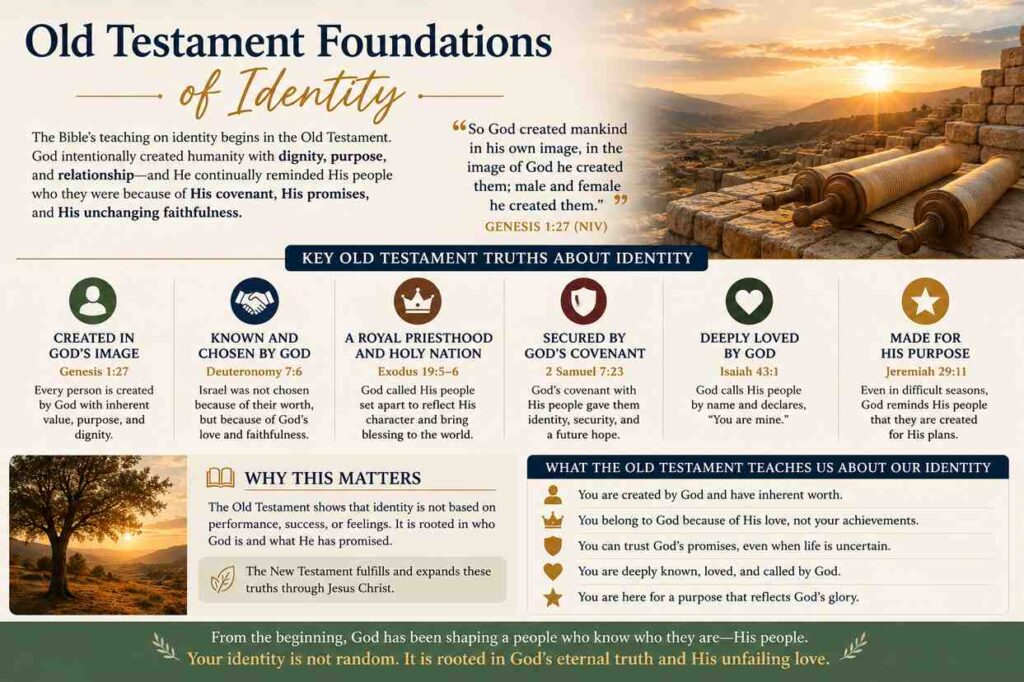
Old Testament Foundations of Identity
When many people think about identity in Christ, they naturally turn to the New Testament. While that is appropriate, the Bible’s teaching on identity begins much earlier.
From the opening chapter of Genesis, Scripture reveals that God intentionally created humanity with dignity, purpose, and relationship. Throughout the Old Testament, God continually reminded His people who they were—not because of their achievements, but because of His covenant, His promises, and His faithfulness.
Understanding these foundations helps us see that the New Testament does not introduce a completely new idea of identity. Instead, it fulfills and expands what God had been revealing from the very beginning.
Created in the Image of God
“So God created mankind in his own image, in the image of God he created them; male and female he created them.” (Genesis 1:27, NIV)
Context: Genesis opens with the account of creation. Unlike the rest of creation, humanity receives a unique description: people are made in the image of God. This truth appears before sin entered the world, nations were formed, Israel existed, or the church began. In other words, human identity begins with creation itself.
What Does “Image of God” Mean? Being created in God’s image does not mean people physically resemble God. Instead, it means human beings uniquely reflect aspects of His character and are created to represent Him on earth. Being made in God’s image means people possess inherent dignity, moral responsibility, the ability to know and worship God, the capacity for relationships, and a unique role within creation.
Why This Matters for Identity: Many modern ideas about identity begin with personal feelings. The Bible begins with God’s creative work. Your value does not begin when someone appreciates you. It begins because God intentionally created you. This truth protects believers from defining themselves solely by appearance, intelligence, income, social status, success, or failure. Every human life possesses dignity because every person bears the Creator’s image.
The Fall Changed Humanity—but Not God’s Purpose
Genesis 3 records humanity’s rebellion against God. Sin damaged every part of creation. Relationships were broken. Death entered the world. Shame replaced innocence. Fear replaced trust.
Although sin affected humanity deeply, it did not erase the image of God. People still possess God-given value, even though they now live in a fallen world.
This distinction is important. The Bible never teaches that people become worthless because of sin. Instead, it teaches that people need redemption because they remain valuable to the God who created them. This explains why the gospel focuses on restoration rather than replacement. God is redeeming what sin has damaged.
God’s Covenant People
Throughout the Old Testament, God repeatedly reminded Israel that their identity came from their relationship with Him rather than from their own strength.
For example, God chose Abraham and promised to bless the nations through his descendants. Later, He formed Israel into a covenant people. This identity was based on God’s promises, not Israel’s perfection.
Again and again, the Old Testament reminds readers that Israel’s relationship with God rested on His faithfulness. When Israel obeyed, God remained faithful. When Israel failed, God remained faithful. When Israel wandered, God continued calling them back.
This pattern teaches an important lesson: identity rooted in God’s covenant is more secure than identity rooted in human performance.
Abraham: Identity Through God’s Promise
Abraham did not become significant because he possessed extraordinary abilities. His identity changed because God called him.
God promised to bless him, make him into a great nation, and bless all nations through him.
Abraham’s life illustrates that identity begins with God’s initiative rather than human achievement. Even when Abraham experienced doubt and failure, God’s covenant promises continued.
Moses: Identity Through God’s Calling
When God called Moses at the burning bush, Moses immediately focused on his weaknesses. He questioned his ability to speak. He questioned whether people would follow him. He questioned whether he was the right person.
God’s response was not to convince Moses that he was naturally capable. Instead, God reminded Moses of His own presence.
The lesson is timeless. God’s calling depends more on His faithfulness than on human confidence.
Israel’s Identity as God’s People
Throughout books such as Exodus, Deuteronomy, and Isaiah, God repeatedly refers to Israel as His people, His treasured possession, His chosen nation, and His inheritance.
These descriptions were never intended to encourage pride. Instead, they reminded Israel that they belonged to God and were called to reflect His character among the nations. Their mission flowed from their identity.
Old Testament Identity Points Forward to Christ
Although the Old Testament establishes humanity’s identity through creation and covenant, it also reveals humanity’s ongoing need for redemption. The prophets looked forward to a day when God would establish a new covenant. That promise finds its fulfillment in Jesus Christ.
The New Testament does not abandon the Old Testament understanding of identity. Instead, it completes it. The pattern becomes clear: humanity created in God’s image, humanity separated by sin, God establishes His covenant, God promises redemption, Jesus fulfills those promises, believers receive a new identity in Christ.
This continuity helps readers understand that God’s plan has always been centered on restoring people into a right relationship with Himself.
Old Testament and New Testament Identity at a Glance
| Old Testament Foundation | New Testament Fulfillment |
| Created in God’s image | New creation in Christ |
| Covenant with God’s people | New Covenant through Jesus |
| God’s promises | Fulfilled in Christ |
| Israel as God’s people | Believers adopted into God’s family |
| Hope of redemption | Redemption accomplished through Christ |
This comparison shows that the Bible presents one unfolding story rather than two separate messages.
The identity believers enjoy today is firmly rooted in God’s work throughout all of Scripture.
Key Lessons from the Old Testament
The Old Testament teaches several enduring truths about identity: every person is created in God’s image, human dignity comes from the Creator, sin damages identity but does not erase human value, God’s promises are more reliable than human performance, identity is rooted in relationship with God, and God’s plan of redemption has always pointed toward Christ.
These truths prepare readers to understand why the New Testament speaks so confidently about adoption, grace, redemption, and new life in Christ.
Key Takeaway: Biblical identity did not begin with the New Testament. From Creation onward, God has consistently revealed that people find their true identity in relationship with Him. Through Jesus Christ, the promises and patterns established in the Old Testament reach their complete fulfillment.
While biblical doctrine provides the foundation for identity, Scripture also tells the stories of ordinary people who struggled with fear, insecurity, failure, and uncertainty. Their experiences remind us that identity struggles are not new—and that God’s faithfulness has always been greater than human weakness.
Next: Biblical People Who Struggled With Identity, where we’ll discover how God transformed the lives of Moses, Gideon, Jacob, Esther, Peter, Paul, and others, and what their stories teach us about finding our identity in Him.
Biblical People Who Struggled With Identity
One of the most encouraging aspects of the Bible is that it doesn’t hide the weaknesses of its heroes. The men and women God used most powerfully often struggled with fear, insecurity, failure, or uncertainty before they fully embraced His calling.
Their stories remind us that identity struggles are not a modern problem. Throughout history, God’s people have wrestled with questions like: Am I capable? Can God really use me? Do I belong? Am I too broken? Does my past define my future?
Again and again, God’s response was not to magnify their weaknesses but to remind them of His presence, His promises, and His purpose.
These biblical accounts demonstrate that true identity is discovered not by looking inward but by trusting God’s Word.
Moses: Identity Despite Inadequacy
The Struggle: When God called Moses to lead Israel out of Egypt, Moses immediately focused on his limitations. He questioned his ability, his authority, his speaking skills, and whether people would believe him. Instead of seeing God’s calling, Moses saw his own inadequacy.
God’s Response: God did not reassure Moses by listing his strengths. Instead, He repeatedly pointed Moses back to Himself. God promised: “I will be with you.” “I will teach you what to say.” “I am the God of your fathers.”
Identity Lesson: Moses teaches us that our identity is not based on natural ability. It is based on God’s presence.
Modern Application: Many Christians hesitate to serve because they feel unqualified. Moses reminds us that God often calls ordinary people who depend on Him rather than extraordinary people who depend on themselves.
Gideon: Identity Despite Fear
The Struggle: When the angel of the Lord appeared to Gideon, Israel was living under Midianite oppression. Gideon saw himself as weak, insignificant, and from the least important family. He even questioned whether God was truly with Israel.
God’s Response: Before Gideon believed it, God addressed him as: “The Lord is with you, mighty warrior.” (Judges 6:12, NIV). God spoke to Gideon according to who he would become through God’s power—not according to how Gideon currently viewed himself.
Identity Lesson: God’s calling often precedes our confidence. He sees His purposes before we do.
Modern Application: Fear does not disqualify someone from being used by God. When believers focus on God’s strength instead of their own weaknesses, courage begins to grow.
Jacob: Identity Through Transformation
The Struggle: Jacob spent much of his early life trying to secure blessing through deception. Even his name reflected his past, often associated with grasping or deceiving. His identity became tied to striving and manipulation.
God’s Response: After wrestling with God, Jacob received a new name: Israel. This new name symbolized transformation. God was not simply changing Jacob’s circumstances. He was changing Jacob’s identity.
Identity Lesson: God is able to transform both character and direction. Past failures do not have to determine future identity.
Modern Application: Many believers carry labels from earlier seasons of life. Jacob’s story reminds us that God’s grace can rewrite those labels.
Esther: Identity Through Purpose
The Struggle: Esther found herself in an unexpected position as queen during a national crisis. She feared speaking to the king because doing so could cost her life.
God’s Response: Although the Book of Esther never directly records God speaking, Mordecai encouraged Esther with words that continue to inspire believers today: “And who knows but that you have come to your royal position for such a time as this?” (Esther 4:14, NIV)
Identity Lesson: Identity and purpose are closely connected. God often places His people exactly where they can faithfully serve Him.
Modern Application: Sometimes purpose is found not by searching for extraordinary opportunities but by being faithful where God has already placed us.
Peter: Identity After Failure
The Struggle: Peter confidently promised he would never deny Jesus. Yet on the night of Jesus’ arrest, fear overwhelmed him, and he denied knowing Christ three times. From a human perspective, Peter’s failure seemed devastating.
God’s Response: After His resurrection, Jesus did not permanently define Peter by that failure. Instead, He restored him. Jesus asked Peter three times, “Do you love me?” Then He entrusted Peter with caring for His people.
Identity Lesson: Failure does not cancel God’s grace. The gospel is filled with restoration.
Modern Application: Many Christians believe one serious mistake permanently disqualifies them from serving God. Peter’s story reminds us that repentance opens the door to restoration.
Paul: Identity Through Grace
The Struggle: Before becoming the Apostle Paul, Saul actively persecuted Christians. If anyone seemed permanently defined by his past, it was him.
God’s Response: On the road to Damascus, Jesus transformed Saul’s life completely. Instead of remaining a persecutor, Paul became one of Christianity’s greatest missionaries. Throughout his letters, Paul consistently emphasized that his identity rested in God’s grace rather than his own accomplishments.
Identity Lesson: No past is beyond God’s ability to redeem. Grace is greater than guilt.
Modern Application: Many believers wonder whether God can still use them because of previous mistakes. Paul’s life provides one of Scripture’s clearest answers: God specializes in transforming lives for His glory.
David: Identity After Sin
The Struggle: King David experienced remarkable victories, but he also committed serious sins, including adultery and arranging the death of Uriah. These failures brought painful consequences.
God’s Response: When confronted by the prophet Nathan, David repented sincerely. Psalm 51 records his heartfelt prayer for mercy and restoration. Although David experienced discipline, God did not abandon His covenant promises.
Identity Lesson: Repentance restores fellowship with God. While sin has consequences, God’s grace offers forgiveness to those who turn back to Him.
Modern Application: David’s story reminds believers not to ignore sin—but also not to believe that failure places them beyond God’s mercy.
Comparison of Biblical Identity Journeys
| Person | Identity Struggle | God’s Response | Identity Lesson |
| Moses | Inadequacy | God’s presence | God equips those He calls. |
| Gideon | Fear and insecurity | God’s promise | God’s view is greater than self-doubt. |
| Jacob | Deception and striving | New name | God transforms identity. |
| Esther | Fear of responsibility | Divine purpose | Identity leads to courageous action. |
| Peter | Failure | Restoration | Grace is greater than failure. |
| Paul | Guilty past | Redemption | No one is beyond God’s grace. |
| David | Sin and regret | Forgiveness | Repentance leads to restoration. |
What These Stories Teach About Identity
Although these individuals lived in different times and circumstances, their stories reveal several consistent truths.
1. God Sees Beyond Present Weakness. People often focused on their limitations. God focused on His purpose.
2. Identity Is Rooted in God’s Calling. None of these individuals built their identity through personal achievement. God established their identity before accomplishing great things through them.
3. Failure Does Not Have the Final Word. Peter denied Jesus. David committed serious sin. Paul persecuted Christians. Yet God restored and used each of them. Grace consistently proved greater than failure.
4. God’s Presence Produces Confidence. The recurring message throughout these stories is not “You are strong enough.” Instead, it is “God is with you.” That truth transformed fearful people into faithful servants.
Key Takeaway
The lives of Moses, Gideon, Jacob, Esther, David, Peter, and Paul remind us that God’s people have always wrestled with questions of identity. Their stories show that lasting confidence is not found in natural ability, a perfect past, or personal success. It is found in trusting God’s promises, accepting His grace, and believing what He says is true.
Whether you identify with Moses’ insecurity, Gideon’s fear, Peter’s failure, or Paul’s past, the same God who transformed their lives continues to shape the identity of everyone who places their faith in Him.
Understanding biblical identity is more than knowing these stories—it changes the way we live every day. In the next section, we’ll explore how biblical identity shapes everyday decisions, relationships, purpose, and spiritual growth, helping us move from understanding God’s truth to living it faithfully.
How Biblical Identity Changes Everyday Life
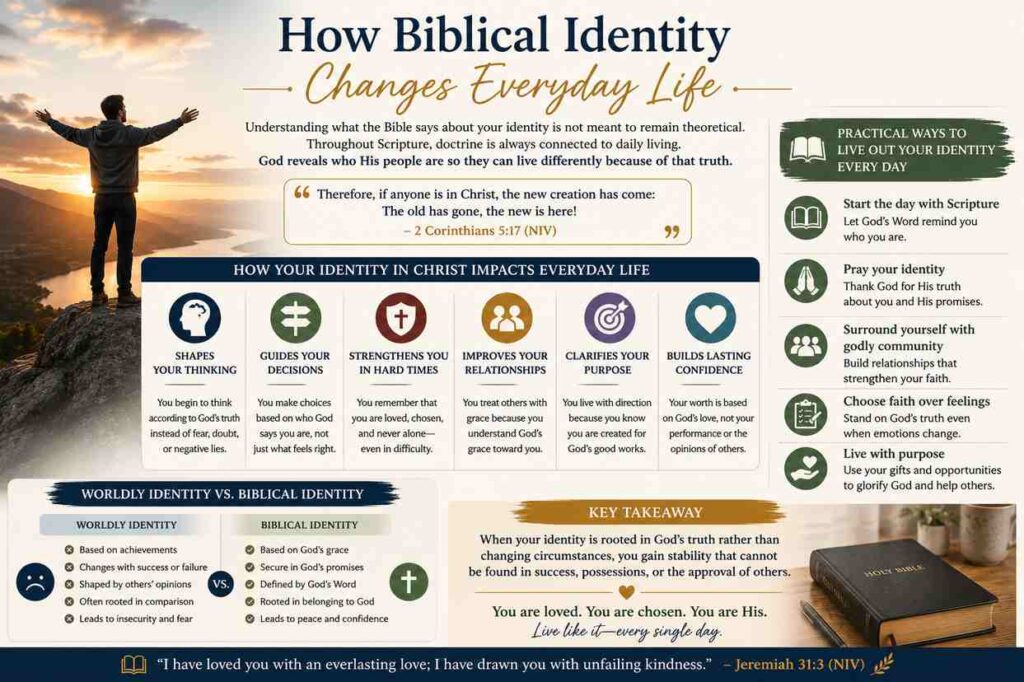
Understanding what the Bible says about your identity is not meant to remain theoretical. Throughout Scripture, doctrine is always connected to daily living. God reveals who His people are so they can live differently because of that truth.
Knowing your identity in Christ influences the way you think, make decisions, respond to hardship, build relationships, and pursue your purpose. It becomes the foundation for every area of life.
When identity is rooted in God’s truth rather than changing circumstances, Christians gain stability that cannot be found in success, possessions, or the approval of others.
Identity and Daily Decisions
Every day, people make countless decisions. Some are small, like how to spend your time or respond to criticism. Others are life-changing, like which career to pursue or how to handle conflict.
The Bible teaches that these decisions should flow from identity. Rather than asking, “What will make me look successful?” believers are encouraged to ask, “What reflects who God says I am?”
This shift changes the motivation behind everyday choices.
Someone whose identity depends on approval may constantly seek praise from others. Someone whose identity is rooted in Christ can serve faithfully even when no one notices. Someone whose identity depends on success may compromise biblical principles to achieve personal goals. Someone whose identity is rooted in God’s truth can remain faithful because their worth is already secure.
Living According to Your Identity
When believers understand they are God’s children, they begin to treat others with compassion, forgive more freely, pursue integrity, resist temptation, serve with humility, and seek God’s wisdom.
These actions are not attempts to earn God’s acceptance. They are the natural fruit of already belonging to Him.
Identity During Anxiety, Rejection, and Failure
Every believer experiences seasons of discouragement. Even faithful Christians sometimes struggle with anxiety, loneliness, rejection, disappointment, grief, uncertainty, or failure.
The Bible does not deny these realities. Instead, it reminds believers that difficult emotions do not define who they are.
When You Feel Rejected
Rejection often causes people to question their value. Whether it comes through broken relationships, criticism, or disappointment, rejection can become a powerful source of identity if left unchecked.
Scripture responds with a different message. Believers are chosen, loved, accepted, and adopted by God. While human relationships may change, God’s commitment to His people remains constant.
This truth allows Christians to grieve painful experiences without allowing them to determine their identity.
When Anxiety Feels Overwhelming
Anxiety often focuses attention on uncertain circumstances. Biblical identity redirects attention toward God’s unchanging character.
Instead of asking, “What if everything goes wrong?” faith asks, “Who is God in the middle of this situation?”
Passages such as Isaiah 41:10 and Philippians 4 remind believers that God’s presence and peace remain available even during difficult seasons. Identity rooted in God’s promises produces stability that circumstances cannot provide.
When You Fail
Failure has a way of convincing people that one mistake defines their entire future. The Bible repeatedly challenges this belief. Peter denied Jesus. David committed serious sins. Jonah ran from God’s calling. Yet God restored each of them after genuine repentance.
This does not minimize the seriousness of sin. Rather, it magnifies the greatness of God’s grace. Believers should take sin seriously while also remembering that forgiveness and restoration remain available through Christ. Failure may become part of your story, but it does not have to become your identity.
When You Feel Alone
Loneliness is one of the most common human experiences. Even faithful believers sometimes feel isolated.
Throughout Scripture, however, God repeatedly reminds His people: “I am with you.” “I will never leave you.” “Do not fear.”
These promises do not guarantee that life will always be easy. They do guarantee that God’s presence remains constant. Knowing that you belong to God provides confidence even when circumstances feel uncertain.
Living Like a Child of God
Understanding biblical identity should produce visible change. The New Testament consistently teaches that believers should live in a way that reflects who they already are in Christ. That includes growing in:
Love — Because God first loved us, Christians are called to love others with patience, compassion, and forgiveness.
Holiness — Believers are called to pursue lives that honor God—not to earn salvation, but because they belong to Him.
Humility — Biblical identity removes both pride and insecurity. Christians recognize that every spiritual blessing comes through God’s grace.
Service — Jesus taught that greatness in God’s kingdom is demonstrated through serving others. Secure identity allows believers to serve without constantly seeking recognition.
Hope — Christians face uncertainty differently because their hope extends beyond present circumstances. Their confidence rests in God’s promises rather than temporary success.
Practical Ways to Strengthen Your Identity Every Day
Growing in biblical identity is a lifelong process. The following habits help believers continually renew their minds with God’s truth.
1. Read Scripture Regularly. Spend consistent time reading passages that reveal God’s character and His promises. The more believers understand God’s Word, the more their thinking begins to align with His truth. Practical ideas: read a short passage each morning, keep a journal of verses about identity, highlight promises that remind you of God’s faithfulness, and revisit passages during difficult seasons.
2. Pray Honestly. Bring fears, doubts, and questions before God. Prayer is not pretending everything is fine. It is learning to trust the Father who already knows every concern.
3. Memorize Identity Verses. Keeping key Scriptures in your heart makes it easier to remember God’s truth during difficult moments. Consider beginning with John 1:12, Romans 8:1, Romans 8:38–39, Ephesians 2:10, 2 Corinthians 5:17, 1 Peter 2:9, and Psalm 139:13–14.
4. Replace Lies with Truth. Many identity struggles begin with false beliefs.
| Lie | Truth |
| I am defined by my failures. | In Christ there is forgiveness and new life. |
| I am alone. | God promises never to leave His people. |
| I have no purpose. | God created believers for good works prepared in advance. |
5. Stay Connected to Other Believers. Christian growth was never intended to happen in isolation. The encouragement, wisdom, and accountability of fellow believers help reinforce biblical identity and provide support during difficult seasons.
Signs You Are Growing in Biblical Identity
Spiritual growth does not happen overnight, but over time believers often notice changes such as less dependence on other people’s approval, greater confidence in God’s promises, increased peace during uncertainty, greater willingness to forgive, stronger desire to serve others, deeper trust in God’s faithfulness, and growing humility alongside growing confidence.
These changes are evidence of God’s ongoing work through the Holy Spirit.
Key Takeaways
- Identity shapes everyday decisions.
- God’s truth is more reliable than changing emotions.
- Failure does not cancel God’s grace.
- Christians can face anxiety and rejection with hope because they belong to God.
- Spiritual growth involves continually replacing false beliefs with biblical truth.
- Living according to your identity means reflecting God’s character in everyday life.
Key Takeaway: Biblical identity is not merely something believers understand—it is something they live. As Christians continually remember who God says they are, their decisions, relationships, attitudes, and priorities begin to reflect that truth. Identity becomes the foundation from which faithful living naturally grows.
While biblical identity provides confidence and hope, every believer still experiences seasons of hardship. The next section explores Identity During Difficult Seasons, examining how God’s promises speak into rejection, loneliness, fear, anxiety, and personal failure, and why our identity remains secure even when life feels uncertain.
Identity During Difficult Seasons
Life rarely unfolds exactly as we expect.
There are seasons filled with joy and celebration, but there are also seasons marked by disappointment, uncertainty, grief, failure, loneliness, and unanswered questions. During these difficult moments, it’s easy to let circumstances redefine who we are.
Someone who loses a job may begin to believe they are a failure. Someone who experiences rejection may wonder if they are unlovable. Someone facing prolonged suffering may question whether God has forgotten them.
The Bible acknowledges these struggles honestly. It never tells believers to ignore pain or pretend everything is fine. Instead, it continually points them back to an identity that remains secure because it is rooted in God’s unchanging character rather than changing circumstances.
The following Scriptures reveal how biblical identity brings hope during life’s hardest seasons.
When You Feel Rejected
Rejection is one of the deepest emotional wounds people experience. It may come through broken relationships, family conflict, betrayal, criticism, loneliness, or feeling overlooked. Human rejection often causes people to question their worth. God responds differently.
Isaiah 43:1
“But now, this is what the Lord says… Fear not, for I have redeemed you; I have summoned you by name; you are mine.” (NIV)
God originally spoke these words to Israel during exile. Although His people were experiencing hardship and uncertainty, He reminded them that they still belonged to Him.
Notice the progression: I have redeemed you, I have called you, you belong to me. Their difficult circumstances had not changed God’s relationship with them.
Rejection by people is painful. But it never changes God’s declaration about those who belong to Him. If you are in Christ, your identity rests on God’s acceptance rather than human approval.
When You Feel Like You Are Not Enough
Many people quietly believe: “I’m not smart enough.” “I’m not successful enough.” “I’m not spiritual enough.” “I’m not good enough.”
The world often encourages people to overcome these thoughts by trying harder. The Bible points somewhere else. It points to God’s grace.
2 Corinthians 12:9
“My grace is sufficient for you, for my power is made perfect in weakness.” (NIV)
Paul prayed repeatedly for God to remove what he called a “thorn in the flesh.” Instead of removing the difficulty immediately, God reminded Paul that His grace was sufficient.
God’s grace is enough because Christ is enough. Believers do not become accepted because they become perfect. They are accepted because of Jesus.
Rather than measuring yourself against other people, learn to measure your identity by God’s promises. Weakness does not disqualify believers from God’s love. Often it becomes the place where His strength is most clearly seen.
When You Feel Alone
Loneliness affects people of every age. Someone may be surrounded by others and still feel isolated. The Bible repeatedly reminds believers that God’s presence is constant.
Deuteronomy 31:8
“The Lord himself goes before you and will be with you; he will never leave you nor forsake you.” (NIV)
Moses spoke these words as Israel prepared to enter the Promised Land without him. Although their human leader would soon be gone, God’s presence would remain.
God’s faithfulness is not dependent upon visible circumstances. His presence continues even when His people cannot immediately see what He is doing.
Loneliness may describe how you feel. It does not describe your identity. Believers never walk through life abandoned by God.
When Fear Takes Over
Fear often grows whenever the future seems uncertain. Questions begin to multiply: “What if I fail?” “What if everything goes wrong?” “What if I can’t handle this?”
Scripture repeatedly redirects believers from fear toward trust.
Isaiah 41:10
“So do not fear, for I am with you; do not be dismayed, for I am your God.” (NIV)
Notice that God’s command is followed by His promise. He explains why: I am with you, I am your God, I will strengthen you, I will help you, I will uphold you.
Identity grows stronger when believers remember who God is.
When You Fail
Failure has convinced many people that they no longer have value. Peter denied Jesus. David committed serious sin. Jonah ran from God’s calling. Mark abandoned Paul during missionary work. Yet none of these failures became the final chapter. God restored each one after repentance.
Romans 8:1
“Therefore, there is now no condemnation for those who are in Christ Jesus.” (NIV)
This verse does not say believers never sin. It says condemnation no longer defines those who belong to Christ. Grace does.
Healthy repentance acknowledges sin. Biblical identity refuses to let sin permanently define the believer. Forgiveness does not erase every consequence. But it restores relationship with God.
When You Compare Yourself With Others
Comparison has become increasingly common. People compare careers, appearance, families, ministries, achievements, possessions, and influence. Comparison often produces either pride or insecurity. Neither reflects biblical identity.
Galatians 6:4–5
Paul encourages believers to examine their own work rather than constantly comparing themselves with others.
God has uniquely gifted every believer. Your calling is not identical to someone else’s. Your identity should not depend on another person’s success.
Celebrate God’s work in others while remaining faithful to the work He has entrusted to you.
God’s Promises Remain Constant
One of Scripture’s greatest encouragements is this: circumstances change, God does not. People change, God does not. Feelings change, God does not.
This truth appears throughout the Bible. Because identity is rooted in God’s character, believers can experience stability even when life feels uncertain.
Identity Truths for Difficult Days
When life becomes overwhelming, return to these biblical reminders.
| Struggle | Biblical Truth |
| Rejection | You are accepted by God. |
| Fear | God is with you. |
| Failure | Grace is greater than your past. |
| Loneliness | God never abandons His people. |
| Anxiety | God’s peace is available through Christ. |
| Comparison | Your value comes from God, not from others. |
| Uncertainty | God’s purposes remain trustworthy. |
Remember These Promises
During difficult seasons, believers may not always understand what God is doing. But they can remember what God has already said. He says: You are loved. You are forgiven. You are My child. You belong to Me. I will never leave you. My grace is sufficient. Nothing can separate you from My love.
These promises do not remove every hardship. They provide a secure foundation while walking through it.
Key Takeaway: Difficult seasons can influence your emotions, but they do not change your identity in Christ. When life feels uncertain, God’s promises remain steady. Returning to His Word allows believers to anchor their identity in His unchanging truth rather than in temporary circumstances.
While difficult seasons often cause people to question their identity, misunderstandings about biblical identity can also create confusion. In the next section, we’ll examine common misconceptions about biblical identity, clarifying what Scripture teaches—and what it does not teach—about who we are in Christ.
Common Misunderstandings About Biblical Identity
As conversations about identity have become more common, many ideas from popular culture have become mixed with biblical teaching. Some of these ideas sound encouraging at first, but they do not accurately reflect what Scripture says.
Understanding the difference between biblical truth and common misconceptions helps believers build their lives on a solid foundation. Rather than relying on popular opinions or personal feelings, Christians are called to let God’s Word shape their understanding of identity.
Let’s look at several of the most common misunderstandings.
Misunderstanding #1: “My Identity Is Based on My Feelings”
Many people believe that identity changes whenever feelings change. If they feel confident, they believe they have value. If they feel discouraged, they conclude they have lost their worth.
What the Bible Teaches: The Bible recognizes that emotions are real, but it never presents them as the ultimate source of truth. Throughout Scripture, faithful believers experienced fear, grief, discouragement, doubt, loneliness, and disappointment. Yet God’s declaration about them remained unchanged. David sometimes felt abandoned. Elijah became discouraged. Jeremiah wept. Even Jesus experienced deep sorrow before His crucifixion. Their emotions were genuine, but their identity remained rooted in God’s truth.
Practical Application: Feelings are important because they reveal what we are experiencing. They are not reliable enough to determine who we are. When emotions and Scripture seem to conflict, believers are encouraged to trust God’s Word rather than temporary feelings.
Identity Principle: Feelings may describe your condition, but they do not define your identity.
Misunderstanding #2: “I Must Earn God’s Acceptance”
Many people quietly believe: “If I pray enough… if I serve enough… if I avoid enough mistakes… then God will finally accept me.” This mindset creates a performance-based identity.
What the Bible Teaches: The gospel teaches the opposite. Salvation is a gift of grace received through faith. Good works are the result of salvation—not the reason God accepts believers. Paul writes: “For it is by grace you have been saved, through faith… not by works, so that no one can boast.” (Ephesians 2:8–9, NIV)
Practical Application: Obedience matters deeply. But Christians obey because they already belong to God. They do not obey in order to earn a place in His family. Grace comes first. Transformation follows.
Misunderstanding #3: “My Past Defines My Future”
Many believers struggle with guilt long after receiving God’s forgiveness. Past failures become permanent labels. They begin saying things like: “I’m the person who failed.” “I’m too broken.” “God can’t use me anymore.”
What the Bible Teaches: Scripture repeatedly shows God restoring people after failure. Consider: Peter denied Jesus. David committed serious sin. Jonah ran from God. Paul persecuted Christians. None of these stories ended with failure. God’s grace transformed each life. One of the clearest promises appears in 2 Corinthians: “If anyone is in Christ, the new creation has come…” (2 Corinthians 5:17, NIV)
Practical Application: Repentance means honestly acknowledging sin. Forgiveness means refusing to let sin permanently define your identity. Believers should remember their past with humility—not live imprisoned by it.
Misunderstanding #4: “Biblical Identity Means Thinking Highly of Yourself”
Some people confuse biblical identity with self-confidence or self-promotion. They assume Christianity teaches people to continually focus on their own greatness.
What the Bible Teaches: Biblical identity produces both humility and confidence. Humility recognizes that salvation is entirely God’s gift. Confidence rests in God’s promises rather than personal achievements. Christians neither exaggerate their importance nor deny their value. Instead, they understand themselves through God’s perspective.
Practical Application: Healthy biblical confidence says: “I am valuable because God created and redeemed me.” It does not say: “I am valuable because I am better than others.” This distinction protects believers from both pride and insecurity.
Misunderstanding #5: “Identity Means I Can Live However I Want”
Some people misunderstand grace. They assume that because Christians are forgiven, obedience no longer matters.
What the Bible Teaches: The New Testament consistently connects identity with transformation. Believers are called to love others, pursue holiness, forgive, serve, and reflect Christ. These actions do not create identity. They demonstrate it. Jesus Himself said: “If you love me, keep my commands.” (John 14:15, NIV)
Practical Application: Grace is never permission to ignore God’s instructions. Instead, grace empowers believers to live according to the new identity they have received.
Misunderstanding #6: “My Identity Depends on Other People’s Opinions”
Modern culture places enormous emphasis on public approval. Many people measure their worth by social media engagement, career success, relationships, popularity, or recognition.
What the Bible Teaches: Scripture consistently points believers toward God’s evaluation rather than human opinion. Paul writes in Galatians 1:10 that seeking the approval of people cannot be the primary goal of Christ’s followers. Jesus Himself experienced rejection despite living a perfectly faithful life. Approval from others is therefore not a reliable measure of identity.
Practical Application: Constructive feedback is valuable. Wise counsel is important. But neither praise nor criticism should become the foundation of who you are. God’s declaration remains the believer’s ultimate source of identity.
Biblical Identity vs. Common Misconceptions
| Common Belief | Biblical Truth |
| My feelings define me. | God’s Word defines me. |
| I must earn God’s love. | God’s love is given through grace. |
| My failures define my future. | God’s grace offers forgiveness and restoration. |
| Confidence comes from myself. | Confidence comes from God’s faithfulness. |
| Grace removes the need for obedience. | Grace produces joyful obedience. |
| Other people’s opinions determine my worth. | God’s declaration determines my identity. |
Building Your Identity on Truth
False beliefs often develop gradually. They may come from painful experiences, cultural messages, personal failures, unhealthy comparisons, or misunderstanding Scripture.
Renewing the mind is an ongoing process. Paul encourages believers: “Do not conform to the pattern of this world, but be transformed by the renewing of your mind.” (Romans 12:2, NIV)
This transformation happens as believers continually replace false ideas with God’s truth. Over time, biblical identity becomes less about simply knowing verses and more about believing them deeply enough that they shape everyday life.
Key Takeaways
- Identity is based on God’s truth, not changing emotions.
- God’s acceptance is received through grace, not earned by performance.
- Past failures do not cancel God’s purposes.
- Biblical confidence is rooted in Christ rather than self-importance.
- Grace leads to transformation, not spiritual complacency.
- God’s opinion carries greater authority than public approval.
Key Takeaway: Lasting confidence comes from believing what God says rather than what circumstances, emotions, or other people say. When believers build their identity on Scripture instead of shifting cultural messages, they experience greater peace, purpose, and spiritual stability.
Understanding what biblical identity is not helps us interpret Scripture more accurately. In the next section, we’ll examine Bible verses that are frequently misunderstood or taken out of context, learning how to read them responsibly while appreciating the rich truths they communicate about our identity in Christ.
Frequently Misused Identity Verses
The Bible contains many verses that bring comfort and hope, but some are frequently quoted without considering their original context. When passages are taken out of context, readers may unintentionally misunderstand what God is communicating.
Reading Scripture responsibly does not make these verses less encouraging—it actually makes them richer. Understanding who originally received the message, why it was written, and how it fits into God’s overall plan allows believers to apply it with greater confidence and accuracy.
The following passages are among the most commonly referenced in discussions about identity.
Jeremiah 29:11
“‘For I know the plans I have for you,’ declares the Lord, ‘plans to prosper you and not to harm you, plans to give you hope and a future.’” (NIV)
How It Is Often Misunderstood: Many people quote this verse as a promise that God will always provide immediate success, financial prosperity, or an easy life.
The Original Context: God spoke these words through the prophet Jeremiah to the Jewish exiles living in Babylon. They had lost their homeland and were wondering whether God had abandoned them. Rather than promising an immediate return, God instructed them to faithfully live in Babylon because the exile would continue for many years. The promise pointed to God’s long-term covenant faithfulness.
What It Teaches About Identity: Although the verse was originally addressed to Israel, it reveals an enduring truth about God’s character. God remains faithful to His promises even when His people experience hardship. Believers today can trust that God’s purposes are ultimately good, even when they cannot immediately understand His plans.
Identity Application: Your identity is not determined by today’s circumstances. It rests in the God who remains faithful throughout every season.
Philippians 4:13
“I can do all this through him who gives me strength.” (NIV)
How It Is Often Misunderstood: This verse is frequently used to suggest that Christians can accomplish any personal ambition if they simply have enough faith.
The Original Context: Paul wrote these words while describing contentment. He had experienced abundance, poverty, freedom, imprisonment, comfort, and hardship. His point was not unlimited achievement. His point was faithful endurance. Christ strengthened him to remain faithful in every circumstance.
What It Teaches About Identity: Believers are not promised unlimited success. They are promised Christ’s strength for faithful living.
Identity Application: Whether life is easy or difficult, your confidence comes from Christ’s presence rather than favorable circumstances.
Psalm 139:14
“I am fearfully and wonderfully made.” (NIV)
How It Is Often Misunderstood: This verse is sometimes presented only as a statement about self-esteem or physical appearance.
The Original Context: David is worshipping God for His creative wisdom. The focus is not on human greatness. It is on God’s greatness as Creator.
What It Teaches About Identity: Human value comes from being intentionally created by God. The verse encourages gratitude and worship rather than self-centered confidence.
Identity Application: Recognizing God’s creative work helps believers appreciate their value without becoming prideful.
Matthew 5:14
“You are the light of the world.” (NIV)
How It Is Often Misunderstood: Some interpret this verse as encouraging personal fame or influence.
The Original Context: Jesus was teaching His disciples during the Sermon on the Mount. He described how His followers should live in ways that reflect God’s character. Light exists to illuminate something else. Likewise, Christians are called to point others toward Christ rather than themselves.
What It Teaches About Identity: Believers receive a mission because of who they are in Christ. Their lives should reflect God’s truth and goodness.
Identity Application: Living as “the light of the world” means faithfully representing Christ in everyday life rather than seeking personal recognition.
Isaiah 43:1
“Fear not, for I have redeemed you; I have summoned you by name; you are mine.” (NIV)
How It Is Often Misunderstood: Some readers assume every promise made to ancient Israel automatically applies directly to every individual today without considering the historical setting.
The Original Context: God was speaking to Israel during exile, reminding His covenant people that He had not abandoned them despite their difficult circumstances.
What It Teaches About Identity: Although the original audience was Israel, the passage reveals God’s covenant faithfulness and His desire to redeem His people. These truths help believers better understand God’s consistent character throughout Scripture.
Identity Application: When read within the larger biblical story, this verse reminds Christians that God remains faithful to those who belong to Him.
Romans 8:28
“And we know that in all things God works for the good of those who love him, who have been called according to his purpose.” (NIV)
How It Is Often Misunderstood: Some interpret this verse to mean that every event in life will immediately feel good or produce visible blessings.
The Original Context: Romans 8 discusses suffering, hope, and future glory. Paul acknowledges that believers experience hardship. His emphasis is that God is sovereign enough to accomplish His purposes even through suffering.
What It Teaches About Identity: Christians are not defined by temporary hardships. God continues working in their lives even when circumstances appear confusing.
Identity Application: Faith trusts God’s character even before His purposes become fully visible.
Reading Identity Verses Responsibly
When studying passages about identity, it is helpful to ask several simple questions.
1. Who Was the Original Audience? Understanding whether a passage was written to Israel, Jesus’ disciples, or the early church helps readers appreciate its original meaning.
2. What Was Happening Historically? Historical context explains why certain promises, commands, or encouragements were given.
3. What Does the Passage Reveal About God? Identity begins with God’s character. Before asking what a verse says about us, first ask what it teaches about God.
4. How Does This Fit Within the Entire Bible? Individual verses should always be understood within the broader story of Scripture. The Bible consistently points toward God’s plan of redemption through Jesus Christ.
Comparison Table
| Verse | Common Misunderstanding | Biblical Context | Identity Truth |
| Jeremiah 29:11 | Guaranteed immediate success | Promise to Israel during exile | God remains faithful to His purposes. |
| Philippians 4:13 | Unlimited personal achievement | Strength for faithful endurance | Christ empowers believers through every circumstance. |
| Psalm 139:14 | Primarily about self-esteem | Worship of the Creator | Human value comes from God’s design. |
| Matthew 5:14 | Personal fame | Mission of Christ’s followers | Believers reflect God’s light. |
| Isaiah 43:1 | Universal promise without context | Covenant promise to Israel | God’s faithfulness defines His people. |
| Romans 8:28 | Everything will feel good | God’s sovereign work through suffering | Identity rests in God’s purposes. |
Why Context Matters
Reading Scripture in context protects believers from two common mistakes. First, it prevents unrealistic expectations about what God has promised. Second, it reveals the deeper richness of His Word.
When verses are understood within the larger biblical story, they provide stronger—not weaker—encouragement. Rather than relying on isolated quotations, believers learn to trust God’s complete revelation.
Key Takeaway: Bible verses about identity become even more meaningful when read in context. Understanding the original audience, historical setting, and purpose of each passage helps believers apply God’s truth faithfully while building an identity rooted in the whole counsel of Scripture.
Understanding biblical identity is only the beginning. The next step is learning how to live out that identity every day. In the following section, we’ll explore practical habits that help believers move from simply knowing God’s promises to confidently living according to them.
Practical Ways to Live Out Your Identity in Christ
Understanding what the Bible says about your identity is only the beginning. Scripture consistently calls believers to live according to who they already are in Christ. This transformation doesn’t happen overnight. It is a lifelong process of learning to replace worldly thinking with God’s truth.
Just as a tree grows stronger through deep roots, Christians grow spiritually as they continually anchor their identity in God’s Word rather than in changing circumstances.
The following practices can help you move from simply knowing biblical truths to living them every day.
1. Spend Time in God’s Word Every Day
Your understanding of identity will never become stronger than your understanding of God. The Bible continually reminds believers who God is, what He has done, and who they are because of Him. Regular Bible reading helps replace false beliefs with biblical truth.
Practical ideas: read a short passage each morning, keep a journal of verses about identity, highlight promises that remind you of God’s faithfulness, and revisit passages during difficult seasons.
If you’re beginning an identity study, consider spending time in Genesis 1–3, Psalm 139, Isaiah 43, John 1, Romans 8, Ephesians 1–2, Galatians 3–4, Colossians 3, 1 Peter 2, and 1 John 3. The goal is not simply to read more but to allow God’s truth to shape your thinking.
2. Replace Lies with Biblical Truth
Everyone develops beliefs about themselves. Some are true. Others are not. The Bible encourages believers to identify false beliefs and replace them with God’s truth.
| Common Lie | Biblical Truth |
| I am defined by my failures. | In Christ I am forgiven and made new (2 Corinthians 5:17). |
| I am alone. | God promises never to leave His people (Deuteronomy 31:8). |
| I have no purpose. | God created me for good works (Ephesians 2:10). |
| I must earn God’s love. | Salvation is by grace through faith (Ephesians 2:8–9). |
| My worth depends on other people’s opinions. | My value comes from being created and redeemed by God. |
Over time, repeatedly replacing false beliefs with Scripture renews the mind and strengthens biblical identity.
3. Memorize Key Identity Verses
Throughout history, God’s people have hidden His Word in their hearts. Memorizing Scripture makes it easier to remember God’s promises when circumstances become difficult.
Consider beginning with these passages: John 1:12, Romans 8:1, Romans 8:38–39, Ephesians 2:10, 2 Corinthians 5:17, Galatians 3:26, Isaiah 43:1, Psalm 139:13–14, and 1 Peter 2:9.
You don’t need to memorize dozens of verses immediately. Learning even one verse each week can provide lasting encouragement.
4. Pray from Your Identity
Prayer becomes more meaningful when believers approach God as His children rather than as strangers trying to earn His attention. Jesus taught His followers to pray, “Our Father in heaven…” (Matthew 6:9, NIV). That simple phrase reflects relationship. Instead of praying from fear, believers are invited to pray from belonging.
Instead of saying “God, please love me,” remember what Scripture says: “Father, thank You that You already love me through Christ.” Instead of saying “God, please accept me,” pray: “Thank You that I belong to You because of Jesus.” Identity changes the tone of prayer.
5. Surround Yourself with Biblical Community
The Christian life was never intended to be lived alone. Throughout the New Testament, believers encouraged one another, prayed together, and reminded each other of God’s promises.
Healthy Christian community helps believers stay grounded in Scripture, receive encouragement, grow spiritually, remain accountable, and persevere during difficult seasons.
6. Serve Others from Security, Not for Significance
One subtle danger is serving in order to prove our value. The gospel offers a different motivation. Christians serve because they are already loved—not in order to become lovable.
Jesus modeled this perfectly. He washed His disciples’ feet, welcomed the overlooked, and demonstrated that true greatness is expressed through humble service. When identity is secure, service becomes joyful, generosity becomes natural, and recognition becomes less important.
7. Measure Growth by Faithfulness, Not Comparison
Comparison has always been a temptation. Today, social media makes it even easier to compare our lives with carefully selected moments from others.
The Bible encourages a different approach. Instead of asking, “Am I doing better than everyone else?” believers can ask, “Am I growing in faithfulness to God?” Spiritual maturity is measured by increasing trust, obedience, humility, and love—not by popularity or public recognition.
8. Remember That Growth Takes Time
One of the greatest encouragements for Christians is knowing that spiritual growth is a process. Even the apostles continued learning, growing, and depending on God’s grace.
Believers will still make mistakes, experience doubt, struggle with temptation, and need God’s forgiveness. None of these realities cancel their identity in Christ. God patiently continues His work. Paul expressed this confidence beautifully: “He who began a good work in you will carry it on to completion until the day of Christ Jesus.” (Philippians 1:6, NIV)
Identity is secure even while growth continues.
Daily Identity Checklist
When facing a difficult day, remind yourself of these biblical truths:
- I am created in God’s image.
- I am deeply loved by God.
- I am forgiven through Jesus Christ.
- I belong to God’s family.
- I have purpose because God created me intentionally.
- I am never alone because God is with me.
- My past does not define me.
- God’s grace is sufficient.
- Nothing can separate me from God’s love.
Keeping these truths visible—in a journal, on a phone wallpaper, or as memory cards—can help redirect your thoughts toward God’s promises.
Signs You Are Growing in Your Identity
As believers mature in their faith, they often notice changes such as less dependence on other people’s approval, greater confidence in God’s promises, more peace during uncertainty, increased willingness to forgive, greater compassion toward others, more contentment with God’s calling, deeper trust in God’s timing, and greater humility and gratitude.
These changes do not happen instantly. They are evidence of the Holy Spirit’s ongoing work.
Key Takeaways
Living out your identity in Christ is not about trying harder to become someone new. It is about learning to believe and live according to what God has already declared to be true.
As you continue reading Scripture, praying, serving others, and walking with other believers, your confidence will become less dependent on changing emotions and more firmly rooted in God’s unchanging promises.
Your identity is not something you must create. It is a gift you receive through Christ and grow into throughout your life.
Key Takeaway: The more believers anchor their lives in God’s truth, the more their thoughts, decisions, relationships, and daily actions begin to reflect their identity in Christ. Spiritual maturity is not about achieving perfection but about faithfully growing into the person God has already declared you to be.
To make these truths easy to revisit, the next section provides a Quick Reference Guide that organizes key Bible verses by topic—love, worth, purpose, courage, belonging, forgiveness, and hope—so you can quickly find Scripture for specific situations and continue growing in your understanding of biblical identity.
Bible Verses by Category (Quick Reference)
Sometimes you don’t have time to read an entire Bible study. You simply need a verse that speaks directly to what you’re experiencing. The reference guide below groups key Scriptures by topic, making it easier to return to God’s Word whenever you need encouragement, direction, or reassurance.
Tip: Instead of reading only one verse, consider reading the entire chapter to understand its context and discover how it fits within God’s larger message.
Identity in Christ
| Bible Verse | Main Truth |
| 2 Corinthians 5:17 | You are a new creation in Christ. |
| Galatians 3:26 | You are God’s child through faith. |
| Romans 8:14–17 | You are adopted into God’s family and are an heir with Christ. |
| 1 Peter 2:9 | You are chosen, holy, and God’s special possession. |
| Colossians 3:3 | Your life is hidden with Christ in God. |
Best for: Identity confusion, spiritual growth, assurance of salvation.
God’s Love
| Bible Verse | Main Truth |
| Romans 5:8 | God’s love was demonstrated through Christ. |
| John 3:16 | God’s love provides eternal life through Jesus. |
| Jeremiah 31:3 | God’s love is everlasting. |
| Romans 8:38–39 | Nothing can separate believers from God’s love. |
| 1 John 4:9–10 | God’s love is shown through Christ’s sacrifice. |
Best for: Rejection, loneliness, doubt, assurance.
Worth and Value
| Bible Verse | Main Truth |
| Psalm 139:13–14 | You are fearfully and wonderfully made. |
| Genesis 1:27 | You are created in God’s image. |
| Luke 12:6–7 | God knows and values you personally. |
| Isaiah 43:1 | God calls you by name—you belong to Him. |
| Ephesians 2:10 | You are God’s workmanship. |
Best for: Low self-esteem, comparison, insecurity.
Purpose
| Bible Verse | Main Truth |
| Ephesians 2:10 | God prepared good works for believers. |
| Matthew 5:14–16 | You are called to be the light of the world. |
| Proverbs 3:5–6 | Trust God to direct your path. |
| 1 Peter 2:9 | Your life should declare God’s greatness. |
| Colossians 3:23–24 | Work wholeheartedly for the Lord. |
Best for: Career decisions, calling, direction, motivation.
Courage and Strength
| Bible Verse | Main Truth |
| Joshua 1:9 | God is with you wherever you go. |
| Isaiah 41:10 | God strengthens and helps His people. |
| Philippians 4:13 | Christ gives strength for every circumstance. |
| Psalm 46:1 | God is our refuge and strength. |
| 2 Timothy 1:7 | God gives power, love, and self-control. |
Best for: Fear, difficult decisions, uncertainty.
Peace During Anxiety
| Bible Verse | Main Truth |
| Philippians 4:6–7 | Pray instead of worrying. |
| Matthew 11:28–30 | Jesus gives rest to the weary. |
| John 14:27 | Christ gives lasting peace. |
| Isaiah 26:3 | God gives perfect peace to those who trust Him. |
| Psalm 55:22 | Cast your burdens on the Lord. |
Best for: Anxiety, stress, overwhelming circumstances.
Forgiveness and New Beginnings
| Bible Verse | Main Truth |
| Romans 8:1 | There is no condemnation in Christ. |
| 1 John 1:9 | God forgives those who confess their sins. |
| Psalm 103:12 | God removes our sins completely. |
| Isaiah 1:18 | God cleanses sinners completely. |
| 2 Corinthians 5:17 | Christ makes believers new. |
Best for: Guilt, shame, regret, fresh starts.
Hope for the Future
| Bible Verse | Main Truth |
| Jeremiah 29:11 | God remains faithful to His purposes. |
| Romans 8:28 | God works through every circumstance. |
| Hebrews 10:23 | God always keeps His promises. |
| Lamentations 3:22–23 | God’s mercies are new every morning. |
| Revelation 21:4 | God will one day remove all suffering. |
Best for: Discouragement, grief, uncertainty.
Top 10 Memory Verses About Identity
If you’re just beginning to memorize Scripture, these passages provide an excellent foundation.
- Genesis 1:27
- Psalm 139:13–14
- John 1:12
- Romans 8:1
- Romans 8:38–39
- 2 Corinthians 5:17
- Galatians 3:26
- Ephesians 2:10
- 1 Peter 2:9
- Isaiah 43:1
Together, these verses summarize the Bible’s teaching that believers are created by God, loved by Him, redeemed through Christ, and called to live with purpose.
Continue Growing in Your Identity
Reading encouraging verses is valuable, but lasting spiritual growth comes from regularly spending time with God’s Word and allowing it to shape the way you think and live.
Biblical identity isn’t learned in a single day. It develops as believers continue walking with Christ and growing in their understanding of His character.
Here are several practical ways to continue that journey.
Read Entire Bible Passages, Not Just Individual Verses. Individual verses are powerful, but reading the surrounding chapter provides valuable context. For example: read Romans 8 to understand assurance in Christ, read Ephesians 1–2 to explore adoption, grace, and purpose, read 1 Peter 2 to understand your calling as God’s people, read John 15 to learn about abiding in Christ, and read Psalm 139 to appreciate God’s complete knowledge and care. Context always enriches understanding.
Study One Identity Theme Each Week. Instead of trying to learn everything at once, focus on one biblical theme: Week 1 – God’s Love, Week 2 – Identity in Christ, Week 3 – Purpose, Week 4 – Forgiveness, Week 5 – Hope, Week 6 – Courage. Meditating on one theme at a time allows biblical truth to become deeply rooted.
Keep an Identity Journal. Many believers find it helpful to write down what Scripture says about them, in sections such as: Who God says I am, Promises God has made, Prayers, Lessons I’m learning, and Ways God has been faithful. Reviewing these entries during difficult seasons can provide powerful encouragement.
Pray Scripture. Instead of only reading verses, turn them into personal prayers. After reading Psalm 139, pray: “Father, thank You for creating me intentionally and knowing every part of my life.” After reading Romans 8:38–39: “Lord, thank You that nothing can separate me from Your love.” Praying Scripture helps move biblical truth from the mind into the heart.
Discuss Scripture with Other Believers. Growth often happens in community. Consider discussing identity passages with a Bible study group, trusted Christian friends, a mentor, or your local church. Hearing how others have experienced God’s faithfulness often strengthens your own faith.
Reflection Questions
Before moving on, take a few moments to reflect on these questions.
- Which Bible verse in this guide encouraged you the most?
- What has most influenced the way you view yourself?
- Are there false beliefs you’ve been believing about your identity?
- Which promises of God do you need to remember this week?
- How would your daily decisions change if you consistently viewed yourself as God’s child?
- Which identity truth do you want to memorize first?
- How can you encourage someone else using these Scriptures?
These questions are not a test. They are an invitation to let God’s Word shape your heart more deeply.
Practical Next Steps
If you want these truths to become part of everyday life, consider this simple seven-day plan.
Day 1 — Read Genesis 1 and thank God for creating you in His image.
Day 2 — Read Psalm 139 and reflect on God’s personal care.
Day 3 — Read John 1 and consider what it means to become God’s child.
Day 4 — Read Romans 8 and write down every identity statement you find.
Day 5 — Read Ephesians 1–2 and highlight every spiritual blessing mentioned.
Day 6 — Read 1 Peter 2 and reflect on your calling as God’s chosen people.
Day 7 — Review your favorite verses from this guide and choose one to memorize for the coming week.
Over time, these small habits can reshape the way you think, pray, and respond to life’s challenges.
Key Takeaway: Growing in your identity in Christ is not about learning one new fact. It is about allowing God’s truth to transform your perspective day after day. As you continue reading Scripture, praying, and walking with other believers, your confidence will become increasingly rooted in who God says you are rather than in the changing circumstances of life.
Frequently Asked Questions About Biblical Identity
What does the Bible say about our identity?
The Bible teaches that our identity begins with God, not with our achievements, emotions, or the opinions of others. Every person is created in God’s image (Genesis 1:27), giving each individual inherent dignity and value. Through faith in Jesus Christ, believers receive a new identity as forgiven, adopted children of God who are called to live according to His purposes.
Rather than defining themselves by success, failure, appearance, or social status, Christians are encouraged to find their identity in God’s unchanging character and His promises.
What does Galatians 4:7 say about your identity?
Galatians 4:7 says:
“So you are no longer a slave, but God’s child; and since you are his child, God has made you also an heir.” (NIV)
This verse teaches that believers are no longer spiritually separated from God. Through Jesus Christ they become members of God’s family and heirs to His promises.
Identity is therefore based on relationship with God rather than religious performance.
Who in the Bible struggled with identity?
Several biblical figures experienced identity struggles before learning to trust God’s calling.
| Person | Identity Struggle | God’s Response |
| Moses | Felt inadequate | God promised His presence. |
| Gideon | Felt weak and insignificant | God called him a mighty warrior. |
| Jacob | Defined by deception | God gave him a new name. |
| Esther | Feared her responsibility | God used her for His purpose. |
| Peter | Defined himself by failure | Jesus restored and recommissioned him. |
| Paul | Carried guilt from his past | Christ transformed him into an apostle. |
| David | Experienced failure and repentance | God extended forgiveness and remained faithful to His covenant. |
Their stories demonstrate that God often transforms ordinary people who trust Him despite their weaknesses.
How does God give us our identity?
According to Scripture, God establishes identity through several foundational truths. He creates people in His image, demonstrates His love through Jesus Christ, forgives those who trust in Christ, adopts believers into His family, gives the Holy Spirit, and calls His people to live according to His purposes.
Identity is therefore received through God’s grace rather than earned through personal achievement.
Does the Bible say, “You are enough”?
The exact phrase “You are enough” does not appear in the Bible.
However, Scripture teaches something even more encouraging. Rather than saying believers are sufficient because of their own strength, the Bible teaches that God’s grace is sufficient and that believers are fully loved, accepted, and redeemed through Jesus Christ. Christian confidence rests in Christ rather than in self-sufficiency.
What Bible verse says, “You are wonderfully made”?
The most well-known passage is Psalm 139:13–14:
“I praise you because I am fearfully and wonderfully made.” (NIV)
David’s focus is not self-praise but worship of God as the Creator. The verse reminds believers that every human life has value because it was intentionally created by God.
What Bible verse says, “You are the light of the world”?
Jesus told His followers:
“You are the light of the world. A town built on a hill cannot be hidden.” (Matthew 5:14, NIV)
This statement appears in the Sermon on the Mount. Jesus teaches that His followers should reflect God’s truth through their character, actions, and witness.
What Bible verse says, “You are mine”?
One of the clearest examples appears in Isaiah 43:1:
“Fear not, for I have redeemed you; I have summoned you by name; you are mine.” (NIV)
Originally spoken to Israel during exile, this verse highlights God’s covenant faithfulness and reminds believers of His personal care for His people.
What Bible verse teaches that God loves me?
Several passages clearly express God’s love. Among the best known are John 3:16, Romans 5:8, Romans 8:38–39, Jeremiah 31:3, and 1 John 4:9–10.
Together these passages reveal that God’s love is sacrificial, faithful, and unchanging.
What Bible verse teaches that I am not alone?
God repeatedly promises His presence. Some of the strongest passages include Deuteronomy 31:8, Joshua 1:9, Isaiah 41:10, Matthew 28:20, and Hebrews 13:5.
These verses remind believers that God’s presence remains constant even during difficult seasons.
Why is it important to know your identity in Christ?
Knowing your identity in Christ influences every part of the Christian life. It affects how you view yourself, how you respond to failure, how you handle fear, how you relate to others, how you make decisions, and how you understand God’s purpose.
When identity is rooted in Scripture rather than changing emotions or circumstances, believers gain lasting confidence, hope, and stability.
Key Takeaways
Throughout this guide, we’ve seen that the Bible presents identity as something God gives—not something people must create for themselves.
From Genesis to Revelation, Scripture consistently points to several foundational truths:
- Every person is created in God’s image and therefore possesses inherent dignity and value.
- Sin damages humanity’s relationship with God but does not erase His love or His purpose.
- Through Jesus Christ, believers receive forgiveness, adoption, and a completely new identity.
- God’s love, not personal achievement, becomes the foundation of lasting confidence.
- Purpose naturally flows from identity. Christians serve God because they belong to Him—not to earn His acceptance.
- Even during fear, failure, rejection, or uncertainty, God’s promises remain unchanged.
- Spiritual growth is a lifelong journey of learning to believe and live according to God’s truth.
These truths remind us that biblical identity is not about building self-confidence through positive thinking. It is about trusting God’s declaration over every competing voice.
Final Encouragement
Questions about identity are among the most important questions anyone can ask.
The world often encourages people to discover themselves by looking inward, comparing themselves with others, or defining themselves by success, relationships, or personal achievements. The Bible points in a different direction. It invites us to look first to the God who created us, knows us completely, and demonstrated His love through Jesus Christ.
If you are struggling with insecurity, fear, loneliness, or uncertainty, remember that your circumstances do not have the final word. God’s Word does.
When you begin to see yourself through the lens of Scripture, you discover a secure foundation that does not rise and fall with emotions or circumstances. You learn that your worth comes from being created in God’s image, your acceptance comes through Christ, and your purpose flows from belonging to Him.
Keep returning to God’s Word. Continue praying, growing in faith, and walking alongside other believers. Over time, these truths will move from being ideas you understand to convictions that shape the way you think, speak, and live.
Whatever season of life you are in today, God’s invitation remains the same: come to Him, trust His promises, and allow His truth—not the changing opinions of the world—to define who you are.
Because when God declares who you are, His Word is the only identity that will never change.