Understanding Liability: Who is Actually at Fault in a Multi-Vehicle Collision?
Many multi-vehicle collision participants feel as though fault is obvious, someone hit you, so they should pay, right? Unfortunately, insurance adjusters and attorneys don’t operate on that same simplistic assumption. They re-engineer the crash, apply the laws of physics and negligence, then determine fault based on percentage points. Fault is your word against their insured’s word; so unless there were independent witnesses or camera evidence mentioned at the scene, their story will be favored.
The First Impact Rule and Why it Matters
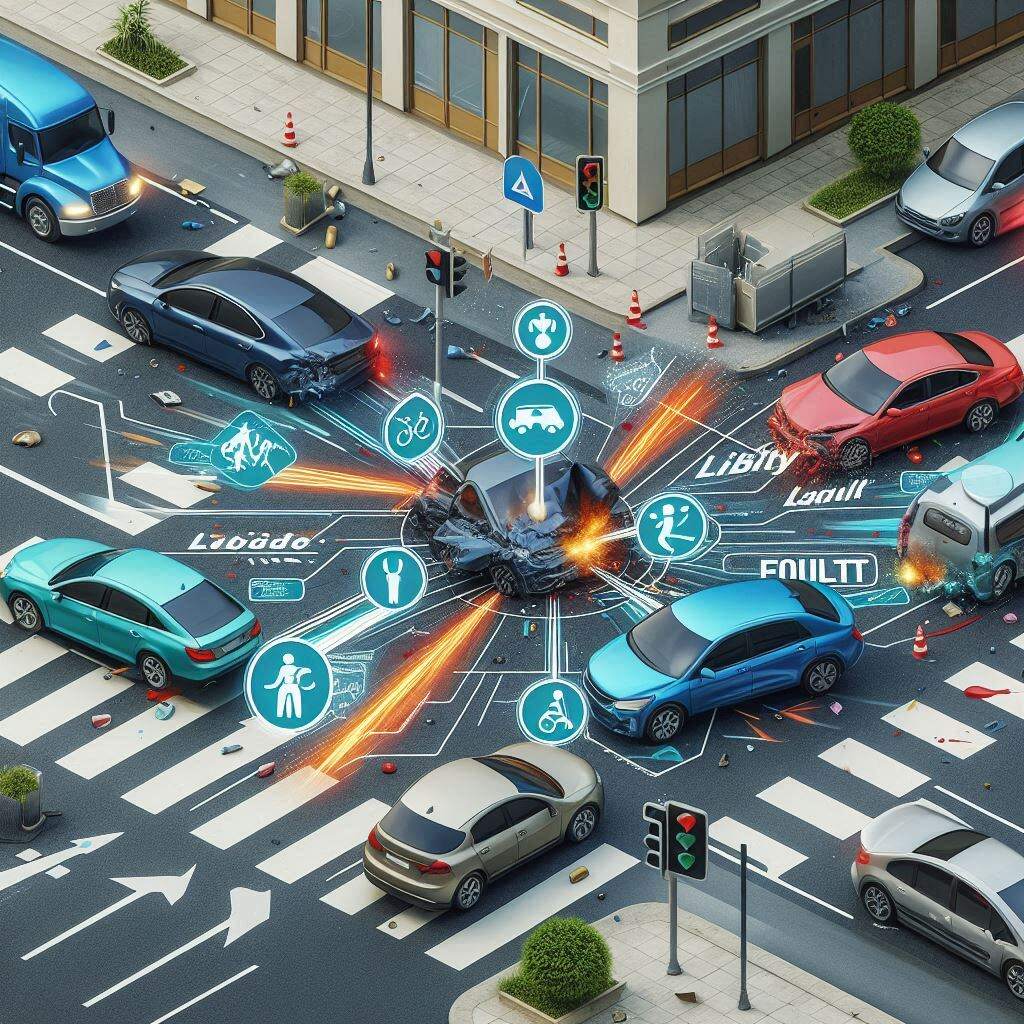
When a three-or-more car collision occurs, the first point of impact is key. The driver who caused this impact is considered the at-fault party for the entire accident sequence.
For instance, in a highway pile-up scenario: Driver A hits the back of Driver B, propelling B into Driver C. If Driver B did nothing to cause the crash with Driver C, and B was stopped or almost stopped at the time of the impact from A, then B didn’t cause the crash with C, that was all Driver A. The court will determine proximate cause and will want to know not just who was involved, but what conduct set the collision in motion.
This matters because the first-impact rule directly determines what share of each claim is borne by each insurance company. Rear-end crashes account for an estimated 25-30% of all multi-vehicle accidents (Australian Bureau of Statistics), and a significant number of those are “concertina” crashes where middle drivers are wrongly blamed for collisions they had no part in.
When Fault is Shared, Not Assigned
Not every accident has a single bad actor. Comparative fault systems exist because many real-world accidents involve multiple bad decisions occurring simultaneously.
Let’s say Driver A is speeding. Driver B makes an improper lane change. They crash and also hit a third vehicle. Both A and B violated their duty of care. If one breach contributed to the accident more than the other, a court may decide that Driver A is 60% responsible and Driver B is 40% responsible. That determines what each owes, including to Driver C, who did everything right.
If all three drivers had been seriously injured, there would likely be a Driver C lawsuit against both A and B, since each of them hit C. In some jurisdictions, any one of the drivers can be on the hook to a victim for the victim’s full damages, leaving the drivers to fight over shares among themselves. This is why it’s important to contest your share of the liability even if the other driver appears to be clearly in the wrong.
Evidence That Overrides Memory
Driver accounts of multi-vehicle crashes are almost always unreliable, not because people lie, but because a collision lasting under two seconds produces fragmented, adrenaline-distorted recollection. Drivers consistently misremember the sequence of impacts, and in a three-car crash, sequence is everything.
Dashcam footage has become the most reliable way to establish a timeline that holds up. It fixes the position of each vehicle, shows brake lights and turning signals, and captures time-stamped movement data that no eyewitness can dispute. Police traffic reports matter too, but they’re reconstructed after the fact from physical evidence and driver statement, both of which can be challenged.
Third-party witness statements collected immediately at the scene carry weight precisely because they’re captured before memory degrades. Someone standing on a footpath who saw the full event, with no stake in the outcome, often becomes the most valuable piece of evidence in a disputed liability case.
Property Damage vs. Personal Injury Claims
Liability isn’t necessarily the same between property and personal injury claims stemming from the same car crash. This is often overlooked.
A driver might be found 30% liable for property damage but 60% liable for a personal injury claim related to the same event. This happens because the legal tests differ. Property damage is typically assessed on negligence and physical causation. Personal injury involves additional considerations, pre-existing conditions, the injured party’s behavior at the moment of impact, and in some cases, what medical treatment was or wasn’t sought afterward.
In complex settlements involving multiple parties, these claims are often negotiated separately, and accepting a property damage settlement with certain fault admissions can create problems for a separate personal injury claim if you’re not careful.
If you’re in Western Australia and dealing with overlapping claims across multiple insurers, a car accidents lawyer perth can map the liability questions for each claim type before you make admissions or accept terms that compromise your position.
Vicarious Liability and Commercial Drivers
If any driver driving was doing so as part of their employment, a delivery driver, a tradesperson, someone driving a company car, their employer could be held legally responsible under what’s known as vicarious liability. This introduces another player, and perhaps another insurance policy, to the negotiation and greatly alters the picture.
Don’t be satisfied that the obvious candidates are all there are. Leave no stone unturned in asking if any vehicle was on the road in the course of business.
Multi-vehicle collisions are not resolved by establishing who “caused” them in common parlance. They are untangled by looking at the actions of each driver, determining the sequence of causation, and the apportioning of contributory responsibility. Understanding that process will help you to protect your interests from the moment the dust settles.