
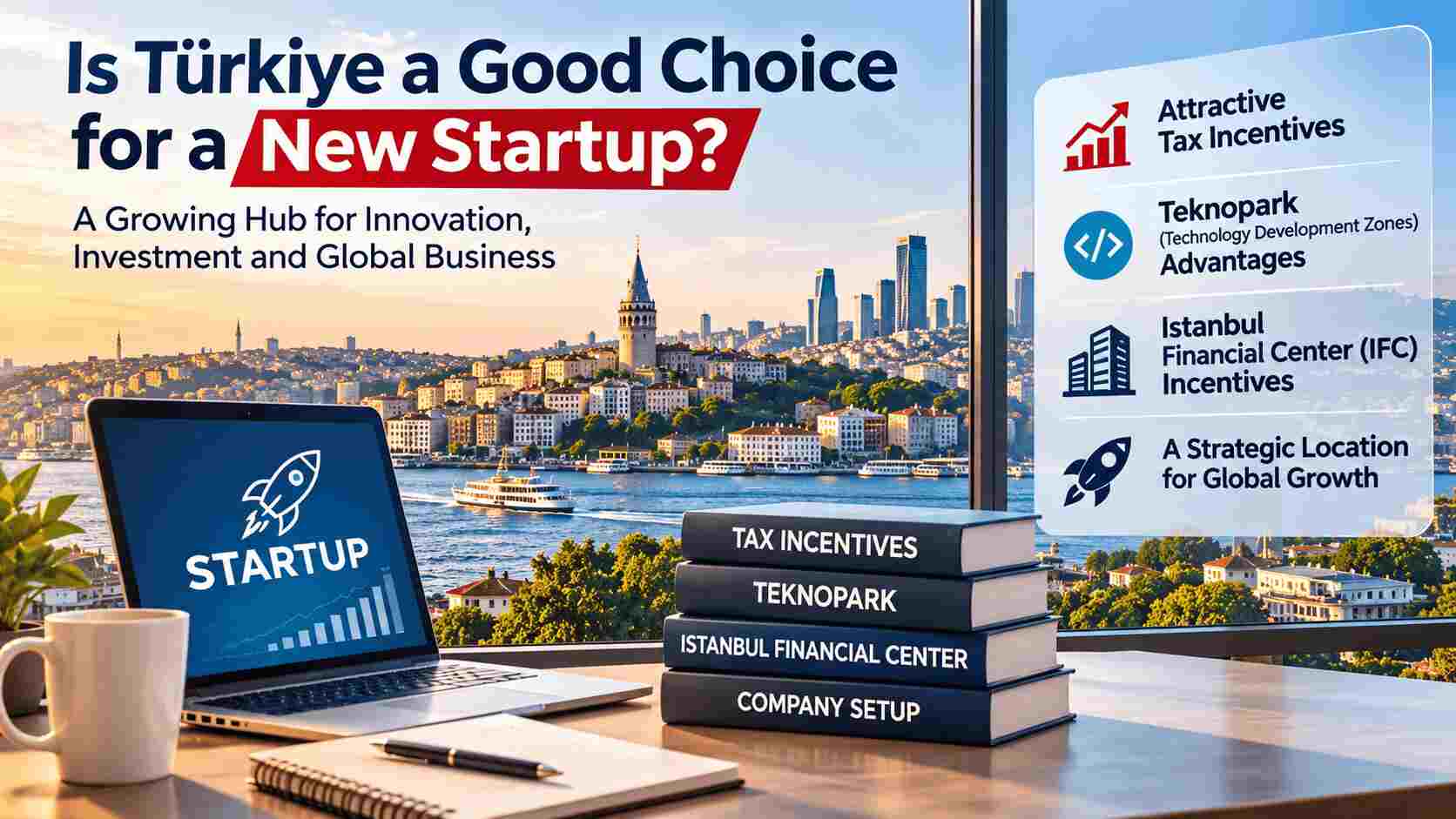
Is Türkiye a Good Choice for a New Startup?
A practical overview for founders considering Türkiye as a launchpad for growth
Introduction
Choosing where to launch a startup is strategic. Founders weigh customer access, talent, suppliers, capital, operating costs and regulation. Türkiye may suit businesses serving a substantial domestic market while building links across Europe, the Middle East and Central Asia. It is not a universal fit: the decision depends on sector, funding needs, regulatory exposure and target customers.
A market with regional reach
Türkiye’s location and transport links can help companies coordinate business across several regions. Istanbul is a major commercial centre, while other cities have strengths in manufacturing, technology, logistics, tourism and specialised services. Validate demand and supply-chain fit rather than assuming location alone creates customers.
A developing startup ecosystem
Türkiye has a network of founders, accelerators, technoparks, angel investors and venture funds. Technology ventures—including software, fintech, gaming, AI and healthtech—may find relevant talent and ecosystem partners. Public programmes and private investment may be available, but eligibility and funding are not guaranteed; treat them as potential upside, not the core business plan.
Talent and operating model
Türkiye offers a sizeable workforce and technical and commercial talent. Assess whether you can recruit and retain the specific skills required at a sustainable cost. Budget for salaries, employer social security contributions, office or remote-work arrangements, accounting, tax compliance and sector-specific licences.
Company formation and legal structure
Foreign investors can generally establish companies under the same principal framework as domestic investors. Limited liability companies (LLCs) and joint stock companies (JSCs) are common, but differ in capital requirements, governance and suitability for investment plans. Choose a structure after considering ownership, liability, financing, licensing and future fundraising.
Founders comparing structures and incorporation steps can review this guide to company registration in Turkey for an overview of the process and key considerations.
Tax incentives and investment support
Türkiye offers several incentive frameworks, but there is no single automatic tax holiday for every new startup. Eligibility typically depends on the activity, location, investment type, required approvals and compliance with programme conditions.
Depending on the project, the general investment incentive system may provide measures such as VAT or customs-duty exemptions for eligible investment equipment, tax reductions, employer social security premium support, interest support or land allocation. The applicable package and minimum investment conditions should be checked before the company commits to the investment.
Technoparks and R&D incentives
Technology Development Zones (often called technoparks) are designed for eligible technology, software, R&D and design activities. Qualifying profits from approved activities may benefit from income or corporate tax exemptions, while qualifying application-software sales may benefit from VAT exemption. Eligible personnel and employers may also access payroll-related or social security support under the relevant rules.
These incentives are activity- and compliance-based: simply registering a company in a technopark does not make all revenue, products or employees eligible. The work must meet the statutory and zone requirements, and companies should maintain project, time, payroll and accounting records. Current legislation provides certain technopark tax benefits through 31 December 2028, subject to applicable conditions and any subsequent amendments.
Istanbul Financial Center (IFC) incentives
For qualifying financial businesses and other eligible participants, the Istanbul Financial Center (İFM) offers a separate incentive framework. Depending on participant category and activity, benefits may include deductions for qualifying financial-service export earnings, relief for certain international trade income, personal income-tax exemptions for eligible employees, and stamp-duty or fee exemptions on qualifying transactions and office leases.
The IFC framework is not a general startup tax regime. Access depends on participant status, the nature of the activity, required authorizations and detailed statutory conditions. A company should confirm its eligibility and the treatment of each revenue stream before relying on an IFC incentive in its financial model.
What founders should evaluate before launching
- Customer validation: confirm a reachable customer segment and test willingness to pay.
- Regulatory requirements: check licensing, data protection, consumer rules and sector-specific obligations.
- Funding plan: model runway and identify credible capital sources without relying on unconfirmed support.
- Tax and compliance: plan for bookkeeping, tax filings, payroll and social security obligations.
- Incentive eligibility: assess whether the business activity, location, investment and workforce meet programme criteria; do not assume incentives apply automatically.
- Cross-border structure: assess where customers, intellectual property, investors and management will be located.
Potential challenges
Plan for foreign-exchange exposure, inflation-related cost changes, administrative requirements and potentially lengthy fundraising. Some industries require permits. Foreign founders should distinguish company ownership from permission to reside or work in Türkiye: incorporation alone does not automatically grant immigration or work status.
So, is Türkiye the right choice?
Türkiye can be a strong base for a startup with a clear market opportunity, disciplined financial plan and a reason to locate operations or customers in the country. Its incentive frameworks can improve the economics of qualifying technology, R&D, investment or financial activities, but should be treated as conditional benefits—not as a substitute for customer demand or sound unit economics. Compare Türkiye with realistic alternatives against the startup’s own operating and growth needs.
Conclusion
For founders considering a launch in Türkiye, the opportunity is worth evaluating—but approach it with market research, careful structuring and a credible compliance plan. A&M Consulting Co. supports international entrepreneurs with company registration and business-related tax and compliance matters in Türkiye.