
OneWorldColumn.org: What Is It, What Does It Publish, and Is It Worth Visiting?
The internet has become one of the first places people visit when they need information about parenting, education, family relationships, and everyday challenges. From raising young children to managing work responsibilities, people regularly search for practical advice that can help them make better decisions.
During these searches, websites with unfamiliar names sometimes appear. One example is OneWorldColumn.org.
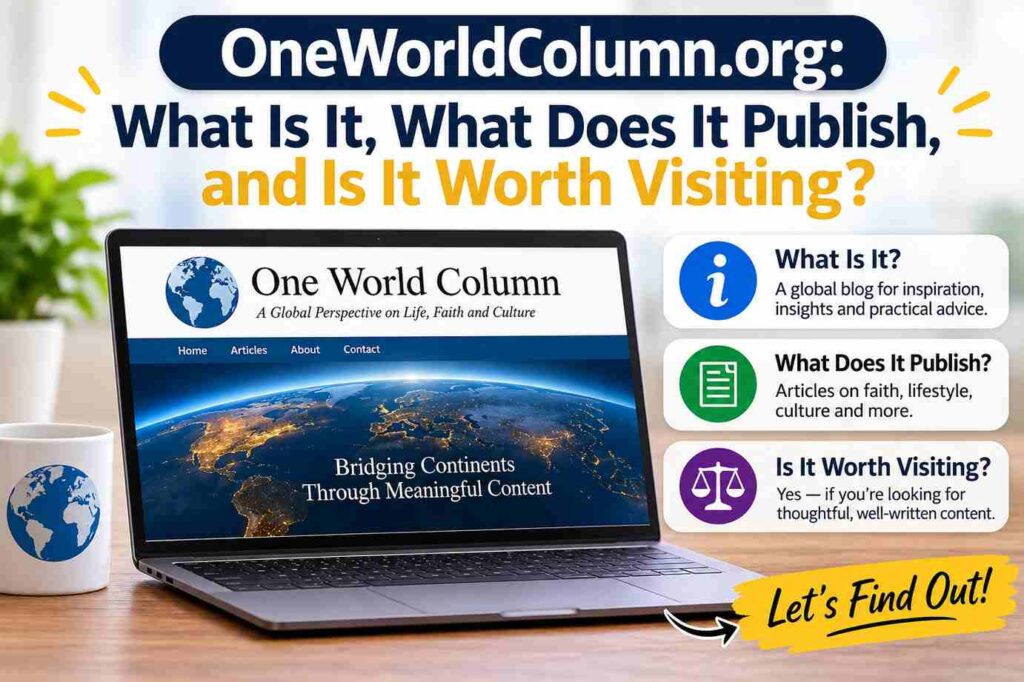
OneWorldColumn.org: Key Things to Know
| What You Want to Know | Details |
|---|---|
| What is OneWorldColumn.org? | OneWorldColumn.org is an online content platform focused on parenting, family life, child development, and work-life balance. |
| What is its main purpose? | The website aims to provide practical information, parenting guidance, and ideas to help families manage everyday challenges. |
| What topics does it cover? | Its content includes child development, parenting tips, family relationships, work-life balance, and parenting in the digital age. |
| Does it provide parenting advice? | Yes. It covers subjects such as positive parenting, childcare, children’s learning, and managing common parenting challenges. |
| Does it discuss child development? | Yes. Its child development content explores children’s growth, learning, well-being, and the role of parents and educators. |
| What is the history of One World Column? | The original One World Column project dates back to 2004 and was associated with discussions about peace, environmental protection, human rights, and international affairs. |
| Is the current website connected to the original project? | The name has a historical association with the earlier publication, but the available information does not establish that the current website has the same owners or editorial team. |
| Who was associated with the original publication? | Historical records associate the original project with Rupert Read, Marguerite Finn, and Jacqui McCarney, along with other contributors. |
| Who can benefit from the website? | Parents, guardians, educators, and general readers interested in family life and children’s development may find its content relevant. |
| Is OneWorldColumn.org reliable? | Readers should assess individual articles by checking their authors, publication dates, references, and supporting evidence before relying on important information. |
| Can students use it for research? | It may provide general background information, but academic work should also use peer-reviewed studies, official reports, and recognized educational sources. |
| What makes the website useful? | Its parenting-focused content offers readers an opportunity to explore family-related topics and discover practical ideas for everyday situations. |
But what exactly is OneWorldColumn.org? Is it a parenting resource, an online magazine, an informational publication, or something connected to an older project with a similar name?
These questions are worth exploring because a website’s name does not always tell visitors what they will find inside it. In fact, the name OneWorldColumn.org also has a historical association with an earlier publication that discussed international affairs, peace, environmental issues, and social justice.
This article explores the website’s apparent current focus, the history behind the One World Column name, its potential usefulness, and the things readers should consider before relying on information they find online.
What Is OneWorldColumn.org?
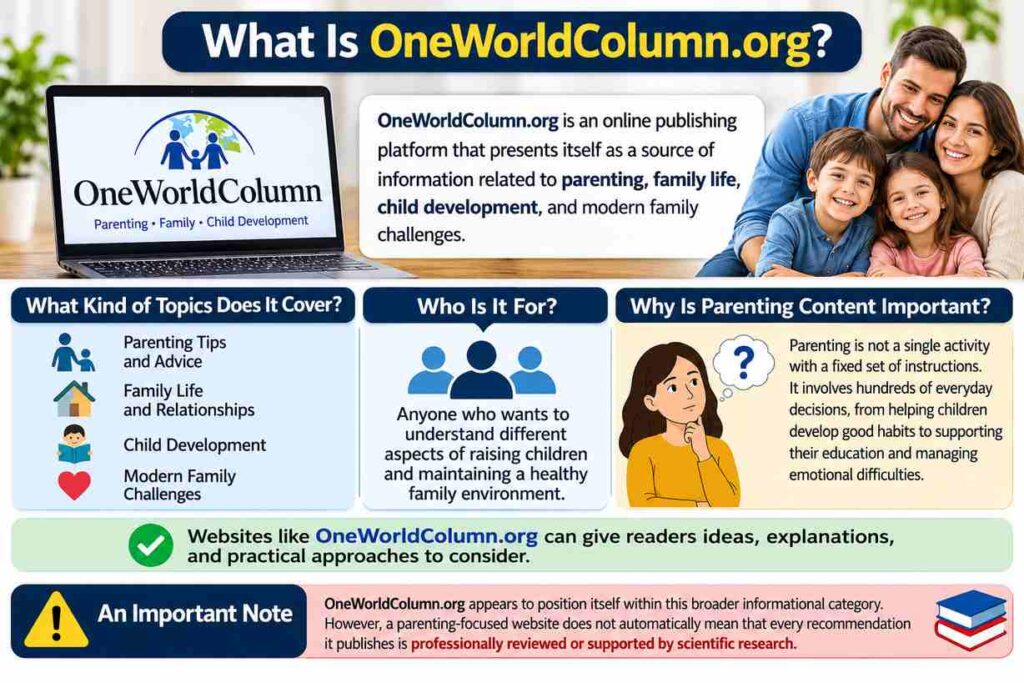
OneWorldColumn.org is an online publishing platform that presents itself as a source of information related to parenting, family life, child development, and modern family challenges.
Its general subject matter is relevant to people who want to understand different aspects of raising children and maintaining a healthy family environment.
Parenting is not a single activity with a fixed set of instructions. It involves hundreds of everyday decisions, from helping children develop good habits to supporting their education and managing emotional difficulties. Websites covering these subjects can give readers ideas, explanations, and practical approaches to consider.
OneWorldColumn.org appears to position itself within this broader informational category.
However, visitors should distinguish between a website’s general subject matter and the quality of its individual articles. A parenting-focused website does not automatically mean that every recommendation it publishes is professionally reviewed or supported by scientific research.
The Website’s Main Purpose
The apparent purpose of OneWorldColumn.org is to provide readers with accessible information about family-related subjects.
Rather than focusing on only one narrow topic, its content areas appear to cover different parts of everyday family life.
These may include:
- Parenting techniques and everyday guidance.
- Children’s learning and development.
- Family relationships and communication.
- Education and childhood experiences.
- Modern challenges faced by parents.
- Maintaining balance between professional and family responsibilities.
The general idea is to make information about parenting and family life easier for ordinary readers to understand.
For example, a parent who struggles to balance professional responsibilities with spending time with children may look for practical suggestions. Another reader may want to understand how communication influences a child’s confidence.
These are the types of questions that family-oriented publications attempt to address.
Who Is the Website Intended For?
OneWorldColumn.org may be relevant to several groups of readers.
Parents and guardians: People raising children may find general discussions about parenting methods, communication, education, and family relationships useful.
New parents: Individuals experiencing parenthood for the first time often have questions about routines, responsibilities, and childhood development.
Teachers and educators: Educational discussions can provide additional perspectives on children’s learning environments and relationships between schools and families.
Students: People studying family life, education, or social issues may find general information that helps them explore particular subjects.
General readers: Anyone interested in family relationships and modern parenting discussions may find the subject matter relevant.
The usefulness of the website for any particular reader will depend on its available articles, the accuracy of their information, and how closely they match the reader’s needs.
What Type of Content Does OneWorldColumn.org Publish?
Understanding a website becomes easier when its content is divided into recognizable categories.
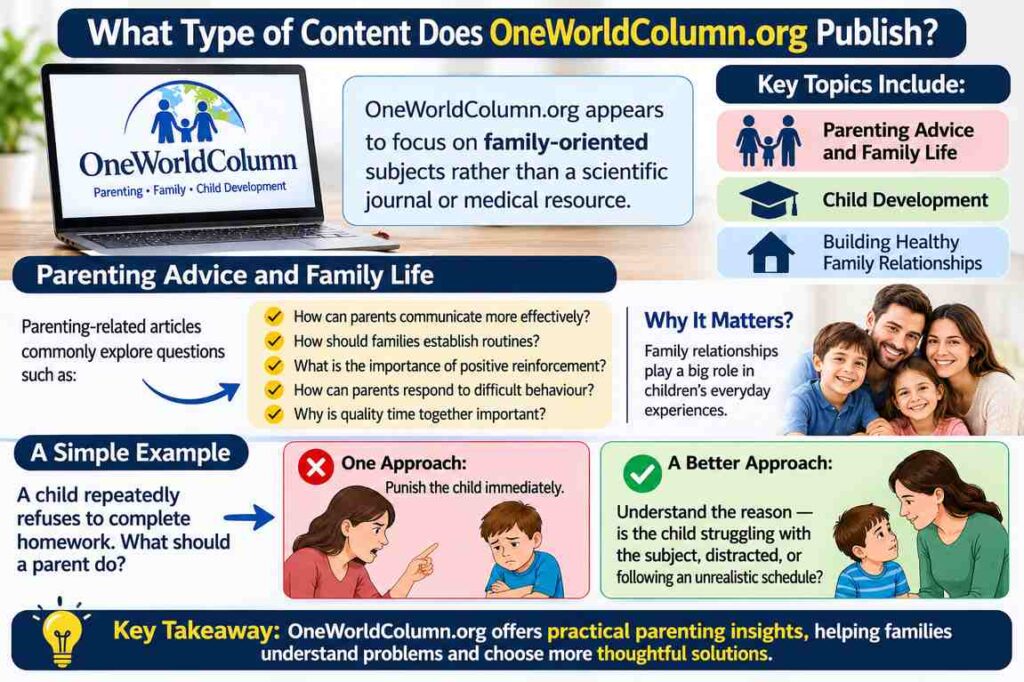
OneWorldColumn.org appears to focus on family-oriented subjects rather than operating as a specialist scientific journal or a professional medical resource.
The following topics help explain the general subject areas associated with its current presentation.
Parenting Advice and Family Life
Parenting is one of the most demanding responsibilities people experience. It requires patience, consistency, communication, and an understanding that children develop at different rates.
Parenting-related articles commonly explore questions such as:
- How can parents communicate more effectively with children?
- How should families establish household routines?
- What is the importance of positive reinforcement?
- How can parents respond to difficult behaviour?
- Why is spending quality time together important?
These subjects are relevant because family relationships influence children’s everyday experiences.
Consider a simple example.
A child repeatedly refuses to complete homework. One response might be to punish the child immediately. Another approach would be to understand whether the child is struggling with the subject, experiencing distractions, or following an unrealistic study schedule.
Understanding the reason behind a problem can help parents choose a more appropriate response.
This is the type of practical thinking that readers generally look for in parenting content.
Child Development and Education
Child development involves physical, emotional, social, and cognitive changes that occur as children grow.
Education is closely connected to this process because children learn through classrooms, family interactions, play, observation, and everyday experiences.
A useful educational article might discuss:
- The importance of early childhood learning.
- How children develop communication skills.
- The role of parents in supporting education.
- Different approaches to encouraging curiosity.
- The importance of age-appropriate learning activities.
For example, children often learn new concepts more effectively when they can connect information with real-life experiences.
A child learning basic mathematics might understand addition more easily through counting toys, fruits, or other familiar objects than by memorising numbers without context.
This illustrates why practical learning methods are frequently discussed in parenting and educational resources.
Why Early Learning Matters
Early experiences can influence how children approach learning, communication, and relationships.
However, every child develops differently. Parents should avoid comparing children’s progress too rigidly or expecting identical results at the same age.
Educational advice is most useful when it recognizes individual differences and encourages supportive learning environments.
Modern Parenting Challenges
Parenting today involves challenges that can look very different from those experienced by previous generations.
Technology, social media, changing work arrangements, academic expectations, and busy schedules all influence family life.
Parents may have to think about questions such as:
- How much screen time is appropriate?
- How can children develop healthy technology habits?
- What is the effect of social media on family communication?
- How can parents protect children’s online privacy?
- How should families manage academic pressure?
For example, smartphones and tablets can provide access to educational videos, learning applications, and communication tools. At the same time, excessive or poorly managed screen use can interfere with sleep, physical activity, and face-to-face interaction.
The challenge is not necessarily to eliminate technology. It is to establish sensible boundaries and understand how digital activities fit into a child’s daily routine.
Content discussing these issues can help families think more carefully about their choices.
Work-Life Balance and Family Well-Being
Many parents have to manage employment, household responsibilities, childcare, and personal commitments simultaneously.
This can create pressure, especially when professional schedules leave limited time for family activities.
Work-life balance is therefore an important subject for modern families.
Some practical approaches include:
- Establishing predictable family routines.
- Setting reasonable boundaries around working hours.
- Planning dedicated time for children.
- Sharing household responsibilities.
- Communicating expectations between family members.
- Avoiding unnecessary commitments where possible.
Imagine a parent who regularly arrives home late because of professional responsibilities. Even when that parent wants to spend more time with their children, maintaining a consistent routine may be difficult.
A practical family schedule can help identify opportunities for meaningful interaction without requiring unrealistic lifestyle changes.
The important point is that family well-being is not simply about spending every available hour together. It is also about the quality of communication, emotional support, and consistency within the household.
The History Behind the One World Column Name
One of the most interesting aspects of the OneWorldColumn.org name is its association with an earlier publication known as One World Column.
This historical background matters because the original project had a different editorial identity from the parenting-focused presentation associated with the current website.
Readers searching for the name may therefore encounter information about two different publishing contexts.
The Original One World Column Project
The historical One World Column project began in 2004 and was associated with a group of writers and contributors interested in international and social issues.
Its editorial focus included subjects that extended beyond everyday family life.
The project discussed questions about how societies interact, how international decisions affect ordinary people, and how global challenges influence communities around the world.
Its subject matter included peace, international relations, environmental protection, human rights, social justice, and sustainable development.
These were important public-interest topics, particularly during a period when debates about globalisation, international conflict, and environmental responsibility were attracting considerable attention.
The original project should therefore be understood within its historical publishing context rather than automatically treated as identical to the current website.
The Main Topics Covered by the Historical Publication
The original One World Column addressed several broad subjects.
Peace and Anti-War Issues
Peace and international conflict were among the themes associated with the historical publication.
Discussions of this kind explored the consequences of armed conflicts, the importance of diplomacy, and the responsibilities of governments and international institutions.
The subject remains relevant because conflicts can affect millions of people through displacement, economic disruption, political instability, and humanitarian emergencies.
Environmental Protection and Sustainability
Environmental issues were another important area.
Topics such as climate change, resource consumption, environmental responsibility, and sustainable development were part of wider discussions about the future of the planet.
Sustainability is particularly important because environmental decisions made today can influence the living conditions of future generations.
Human Rights and Social Justice
Human rights discussions examine the freedoms and protections that individuals should receive regardless of their background or circumstances.
Social justice, meanwhile, considers whether people have fair access to opportunities, resources, and essential services.
These subjects are connected to issues such as discrimination, poverty, inequality, education, and public participation.
International Development and Globalisation
The historical publication also addressed international development and globalisation.
Globalisation describes the growing connections between countries through trade, communication, technology, migration, and cultural exchange.
International development focuses on improving living standards, reducing poverty, strengthening institutions, and expanding opportunities.
These subjects help explain why decisions made in one part of the world can have consequences elsewhere.
People Associated With the Original Project
Historical information about One World Column associates the project with Rupert Read, Marguerite Finn, and Jacqui McCarney.
The wider contributor group included individuals such as Andrew Boswell, Juliette Harkin, Ian Sinclair, Liam Carroll, and Lee Marsden.
Their association belongs to the historical publication and should not automatically be interpreted as evidence that they manage, write for, or are connected to the current parenting-focused website.
This distinction is important when researching websites with older publishing histories.
A name can remain associated with an earlier project even when the website’s current presentation, editorial direction, or content has changed.
Is OneWorldColumn.org Connected to the Original One World Column?
This is an important question for anyone researching the website.
The name OneWorldColumn.org has a historical association with the earlier One World Column project. However, the existence of that historical connection does not, by itself, establish that the current website has the same owners, editorial team, contributors, or mission.
The current presentation appears to focus on parenting and family-related information, while the historical publication was associated with international affairs, peace, sustainability, and social justice.
These are substantially different editorial directions.
There are several possible reasons why a website’s content may change over time. A domain may be repurposed, a publishing project may undergo a change in ownership, or a new editorial team may choose a different subject area.
However, without reliable documentation, it would be inappropriate to claim exactly what happened to the domain or who is responsible for its current operation.
Why the Difference Matters
Imagine finding an old article about international relations associated with a publication called One World Column. You then visit OneWorldColumn.org and discover parenting-related material.
Without understanding the historical background, you might assume that the website has always covered parenting.
Alternatively, you might assume that the current website continues the original publication’s work.
Neither conclusion should be accepted without checking the available evidence.
A sensible approach is to distinguish between:
- The historical One World Column project.
- The current presentation of OneWorldColumn.org.
- The people associated with the historical project.
- The people responsible for current website content.
This avoids confusion and makes research more accurate.
Who Should Read OneWorldColumn.org?
The website’s apparent family-oriented subject matter may interest readers looking for general information about parenting and modern family life.
However, different audiences have different information needs.
Parents Looking for Everyday Guidance
Parents may be interested in discussions about communication, children’s habits, family routines, and educational support.
For example, a parent dealing with a child’s reluctance to study may want to explore ways to encourage motivation and create a more supportive learning environment.
General articles can introduce useful ideas, but parents should adapt suggestions to their children’s individual circumstances.
People Interested in Child Education
Teachers, students, and parents may want to understand how learning environments influence children’s development.
Topics such as early education, communication, and family involvement can provide useful starting points for further reading.
Readers working on academic assignments should still look for research papers, books, official educational publications, and other credible references.
Readers Exploring Modern Family Challenges
Modern family life involves several interconnected issues.
Technology use, professional commitments, financial pressure, and changing social expectations can influence how families organize their daily routines.
Readers interested in these subjects may find general family-oriented articles relevant.
Students Conducting Background Research
Students exploring parenting, education, or social topics may use online publications to understand common discussions and identify questions worth investigating.
However, a general article should not automatically be treated as an academic source.
For university assignments and research papers, it is better to support important arguments with peer-reviewed research, official statistics, and recognized institutional publications.
How to Evaluate the Information Published on OneWorldColumn.org
Finding an article online is easy. Determining whether its information is accurate is a different matter.
This is especially important when the subject involves children’s health, education, emotional development, or family decisions.
Readers should develop the habit of evaluating individual articles rather than judging an entire website based only on its appearance.
Check the Author’s Background
The first thing to examine is the person responsible for the article.
Does the website identify the author? Is there an author biography? Does that person have relevant experience or qualifications?
For example, an article discussing childhood nutrition would be more convincing if it were written or reviewed by someone with appropriate professional knowledge.
A general writer can explain common topics, but specialized health recommendations require stronger expertise.
What If No Author Is Identified?
An article without a named author is not automatically incorrect.
However, the absence of author information makes it more difficult to evaluate the writer’s background and accountability.
Readers should be particularly careful when anonymous articles make strong claims about medical, psychological, or developmental issues.
Look for Publication and Update Dates
Information can become outdated.
This is particularly relevant to topics involving technology, education policies, child safety, and medical recommendations.
An article written several years ago may still contain useful general information, but its recommendations might not reflect current research or guidance.
Check whether the article displays:
- Its original publication date.
- The date of its most recent update.
- Information about significant revisions.
- References to current evidence where relevant.
An updated date is useful, but it should not be treated as proof that an article has been thoroughly reviewed.
Examine Supporting Evidence
Reliable informational content should explain the reasoning behind important claims.
For example, an article might state that a particular parenting technique improves children’s behaviour.
A stronger article would explain why the approach may work, identify relevant research, and discuss situations where the technique might not be suitable.
Readers should be cautious when an article relies entirely on broad statements such as:
- Every child responds in the same way.
- This method always works.
- All parents should follow one particular approach.
- One simple technique can solve every family problem.
Human development is complex, and responsible guidance should recognize that different circumstances require different responses.
Compare Important Claims With Reliable Sources
For important decisions, compare online advice with information from established institutions and qualified professionals.
Depending on the subject, useful reference points may include:
- UNICEF publications.
- World Health Organization guidance.
- Government education departments.
- Recognized universities.
- Peer-reviewed academic research.
- Qualified medical and child-development professionals.
For example, if an article makes a claim about childhood development, readers can check whether that claim is consistent with established research.
This simple habit reduces the risk of accepting inaccurate information.
Potential Benefits of Reading OneWorldColumn.org
A family-oriented website can offer several potential benefits when its content is accurate, understandable, and relevant to the reader.
Accessible Information
Not everyone wants to begin with a lengthy academic paper.
Some readers prefer a simple explanation before exploring a subject in greater depth.
General informational articles can introduce basic concepts in language that is easier to understand.
Ideas for Everyday Family Situations
Parents frequently face ordinary situations that require patience and practical thinking.
Examples include helping children establish routines, managing homework schedules, encouraging communication, and balancing household responsibilities.
Reading different perspectives may help parents consider approaches they had not previously thought about.
Awareness of Modern Parenting Topics
Family life continues to change as technology, education systems, and social expectations evolve.
Articles discussing digital habits, online safety, and work-life balance can help readers recognize issues that deserve attention.
A Starting Point for Further Research
A general article can introduce a subject and help readers identify more specific questions.
For example, someone reading about children’s learning may become interested in educational psychology, early childhood development, or the influence of family environments.
The website can serve as an initial point of exploration, provided readers verify important claims through stronger sources.
Things to Consider Before Trusting Online Parenting Advice
Parenting advice is not always universal.
A technique that works well in one household may not produce the same result in another.
Children have different personalities, learning needs, environments, and developmental experiences. Parents also face different financial, cultural, and professional circumstances.
This is why readers should avoid treating online recommendations as fixed instructions.
General Advice Is Not Professional Diagnosis
An online article cannot assess a child’s individual medical or psychological condition.
If a child experiences persistent developmental difficulties, serious emotional distress, or concerning physical symptoms, parents should seek appropriate professional guidance.
General information can help people understand a topic, but it should not replace an assessment by a qualified professional.
Be Careful With Absolute Statements
Articles that promise guaranteed results deserve closer examination.
Parenting involves many variables, and no single technique can solve every challenge.
A responsible article should explain the conditions in which a recommendation may be useful and acknowledge its limitations.
Check Whether Recommendations Are Practical
Some online advice sounds impressive but may be difficult to apply in real life.
For example, recommending that parents spend several hours every day on a particular activity may not be realistic for families with demanding work schedules.
Useful guidance should consider ordinary limitations and provide practical alternatives.
Protect Children’s Privacy
Parents should also be careful when reading or participating in online communities.
Sharing children’s photographs, personal details, school information, or sensitive family experiences can create privacy risks.
Before submitting information to any website, understand its privacy policy and how it handles personal data.
OneWorldColumn.org Compared With Other Parenting Resources
OneWorldColumn.org belongs to a broader category of websites that discuss family life and parenting.
However, different types of resources serve different purposes.
The following comparison explains how general parenting websites differ from more specialized sources.
| Resource type | Main focus | Best use |
|---|---|---|
| General parenting websites | Everyday parenting and family discussions | Exploring common family challenges |
| Medical institutions | Child health and medical guidance | Understanding health-related questions |
| Educational institutions | Learning and childhood education | Researching educational subjects |
| Academic journals | Scientific studies and research findings | Supporting academic arguments |
| Government resources | Official policies and public information | Checking regulations and formal guidance |
| Child-development organizations | Development, protection, and well-being | Exploring specialized child-related subjects |
The important point is that these resources are not interchangeable.
A general parenting article may explain how parents can encourage healthy study habits. An academic research paper may examine the relationship between family involvement and educational performance.
Both can be useful, but they serve different purposes.
Why Using Multiple Sources Is Better
Relying on only one website can limit a reader’s understanding.
Different publications may approach the same issue from different perspectives.
For example, a discussion about children’s screen time might involve educational benefits, sleep habits, physical activity, online safety, and family communication.
Reading multiple reliable sources can provide a more balanced understanding than relying on a single article.
Is OneWorldColumn.org Useful for Parents and Families?
The website’s apparent focus on parenting and family-related subjects makes it potentially relevant to readers interested in everyday family challenges.
However, its usefulness should be judged through the quality of the content available rather than the website’s name or general subject category.
A useful article should explain its topic clearly, provide practical information, identify important limitations, and support significant claims with appropriate evidence.
For example, an article about improving communication between parents and children should offer understandable suggestions rather than simply telling parents to communicate better.
Likewise, an article discussing child development should avoid presenting individual experiences as universal scientific facts.
Readers should also consider their purpose.
Someone looking for general ideas about family routines may benefit from an accessible article. A student writing an academic research paper will need stronger evidence. A parent facing a medical concern should consult an appropriate healthcare professional.
In other words, the website may be a starting point for learning, but the suitability of its information depends on the subject and the quality of the individual article.
Conclusion
OneWorldColumn.org is a name that carries both a current publishing identity and a historical association.
Its current presentation appears to focus on parenting, family life, child development, education, and modern challenges faced by families. These subjects are relevant to parents, guardians, educators, and readers interested in everyday family relationships.
At the same time, the name One World Column has a separate historical background. The original project, which began in 2004, was associated with discussions about peace, international relations, environmental protection, human rights, social justice, and global development.
Understanding this distinction helps prevent confusion between the historical publication and the website’s current editorial direction.
Ultimately, readers should evaluate OneWorldColumn.org by examining its actual articles, author information, publication dates, supporting evidence, and editorial transparency. Its content may provide useful general information, but important decisions about children’s health, development, and education should always be supported by reliable evidence and qualified professional guidance.
Frequently Asked Questions About OneWorldColumn.org
1. What is OneWorldColumn.org?
OneWorldColumn.org is an online publishing website that currently presents itself as a source of parenting and family-related information. Its apparent subject areas include child development, education, parenting advice, family relationships, and modern family challenges.
2. What is the main purpose of OneWorldColumn.org?
Its apparent purpose is to provide accessible information about parenting and family life. The website’s subject matter is relevant to readers who want to explore everyday parenting responsibilities, children’s learning, and family well-being.
3. Is OneWorldColumn.org a parenting website?
Yes, its current presentation appears to be focused on parenting and family-related topics. However, readers should examine its individual articles to understand the actual content and determine whether it meets their information needs.
4. Is OneWorldColumn.org the same as One World Column?
The names have a historical association, but the current website’s editorial focus appears different from that of the original One World Column project. The historical publication discussed international affairs, peace, sustainability, and social justice, while the current website appears to focus on parenting and family subjects.
5. What was the original One World Column project about?
The original One World Column was associated with international and social issues. Its subject areas included peace, anti-war discussions, environmental protection, sustainability, human rights, social justice, international development, and globalisation.
6. Who was associated with the original One World Column?
Historical information associates the original project with Rupert Read, Marguerite Finn, and Jacqui McCarney. Other contributors included Andrew Boswell, Juliette Harkin, Ian Sinclair, Liam Carroll, and Lee Marsden.
7. Does OneWorldColumn.org provide parenting advice?
Its current presentation suggests that parenting advice and family-related information are among its main subject areas. The usefulness of any specific recommendation depends on the quality of the article and the evidence supporting it.
8. Can students use OneWorldColumn.org for research?
Students may use relevant articles for general background information and to identify research questions. However, academic assignments should rely on appropriate scholarly publications, peer-reviewed research, official reports, and other credible references.
9. Is the information on OneWorldColumn.org reliable?
Reliability should be assessed article by article. Readers should examine the author’s qualifications, publication date, supporting evidence, references, and consistency with established sources before accepting important claims.
10. Should parents follow all the advice published online?
No. Online articles can introduce useful ideas, but parenting recommendations are not universally suitable. Parents should consider their children’s individual needs, verify important information, and seek professional guidance for medical, developmental, or serious behavioural concerns.