
Sexist Quotes from the Bible: Understanding Controversial Passages About Women
The Bible contains many passages about women, marriage, family, authority, and gender roles. Some of those passages are deeply respected by Christians, while others have become the subject of serious debate. To modern readers, certain verses can sound restrictive, unequal, or even sexist.
But what exactly should we make of these passages?
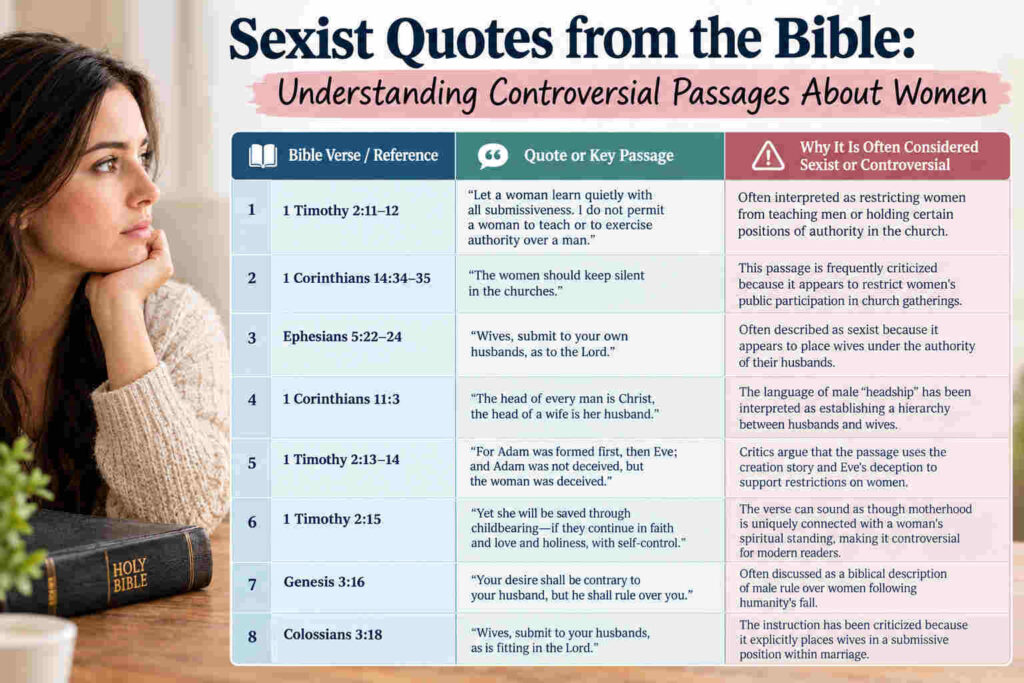
| Bible Verse / Reference | Quote or Key Passage | Why It Is Often Considered Sexist or Controversial |
|---|---|---|
| 1 Timothy 2:11–12 | “Let a woman learn quietly with all submissiveness. I do not permit a woman to teach or to exercise authority over a man.” | Often interpreted as restricting women from teaching men or holding certain positions of authority in the church. |
| 1 Corinthians 14:34–35 | “The women should keep silent in the churches.” | This passage is frequently criticized because it appears to restrict women’s public participation in church gatherings. |
| Ephesians 5:22–24 | “Wives, submit to your own husbands, as to the Lord.” | Often described as sexist because it appears to place wives under the authority of their husbands. |
| 1 Corinthians 11:3 | “The head of every man is Christ, the head of a wife is her husband.” | The language of male “headship” has been interpreted as establishing a hierarchy between husbands and wives. |
| 1 Timothy 2:13–14 | “For Adam was formed first, then Eve; and Adam was not deceived, but the woman was deceived.” | Critics argue that the passage uses the creation story and Eve’s deception to support restrictions on women. |
| 1 Timothy 2:15 | “Yet she will be saved through childbearing—if they continue in faith and love and holiness, with self-control.” | The verse can sound as though motherhood is uniquely connected with a woman’s spiritual standing, making it controversial for modern readers. |
| Genesis 3:16 | “Your desire shall be contrary to your husband, but he shall rule over you.” | Often discussed as a biblical description of male rule over women following humanity’s fall. |
| Colossians 3:18 | “Wives, submit to your husbands, as is fitting in the Lord.” | The instruction has been criticized because it explicitly places wives in a submissive position within marriage. |
| Titus 2:4–5 | Older women are instructed to teach younger women to “love their husbands and children” and fulfill responsibilities at home. | Some readers view the passage as reinforcing traditional domestic roles for women. |
| 1 Peter 3:1 | “Wives, be subject to your own husbands.” | This instruction has generated debate about whether biblical marriage requires women to accept male authority. |
| 1 Corinthians 11:7 | “Woman is the glory of man.” | The statement is controversial because it can appear to define woman’s identity in relation to man. |
| 1 Corinthians 11:8–9 | “Man was not made from woman, but woman from man.” | Critics argue that the creation-order argument can be interpreted as placing women in a secondary position. |
Should we simply label them sexist and move on? Should we ignore them because they are uncomfortable? Or should we slow down and examine what they actually say, the culture in which they were written, and the different ways Christians have interpreted them?
That is where the conversation becomes much more interesting.
A difficult verse deserves context, not concealment.
In this article, we will look at several Bible passages that are frequently described as sexist or patriarchal. We will quote or summarize the controversial language, explain why modern readers may find it troubling, and then consider the historical and theological context surrounding it.
It is also important to make one distinction from the beginning: the passages discussed here are biblical texts, while the explanatory statements in this article are original commentary, not additional Bible verses.
What Does “Sexist” Mean in a Biblical Context?
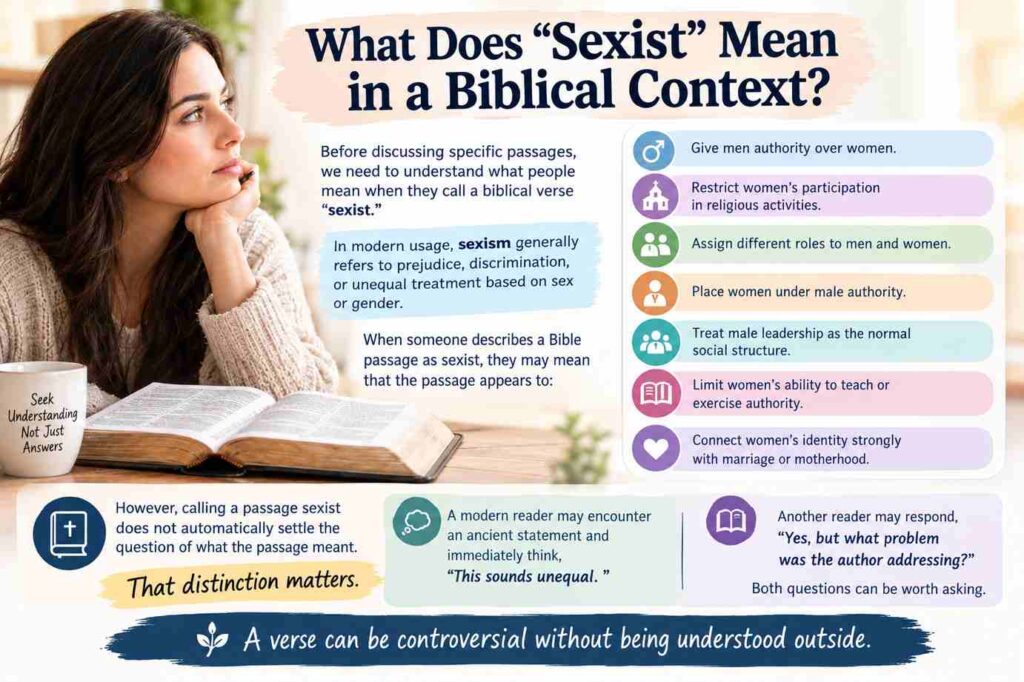
Before discussing specific passages, we need to understand what people mean when they call a biblical verse “sexist.”
In modern usage, sexism generally refers to prejudice, discrimination, or unequal treatment based on sex or gender.
When someone describes a Bible passage as sexist, they may mean that the passage appears to:
- Give men authority over women.
- Restrict women’s participation in religious activities.
- Assign different roles to men and women.
- Place women under male authority.
- Treat male leadership as the normal social structure.
- Limit women’s ability to teach or exercise authority.
- Connect women’s identity strongly with marriage or motherhood.
However, calling a passage sexist does not automatically settle the question of what the passage meant.
That distinction matters.
A modern reader may encounter an ancient statement and immediately think, “This sounds unequal.” Another reader may respond, “Yes, but what problem was the author addressing?”
Both questions can be worth asking.
A verse can be controversial without being understood outside its historical context.
Should We Read Ancient Biblical Passages Through a Modern Lens?
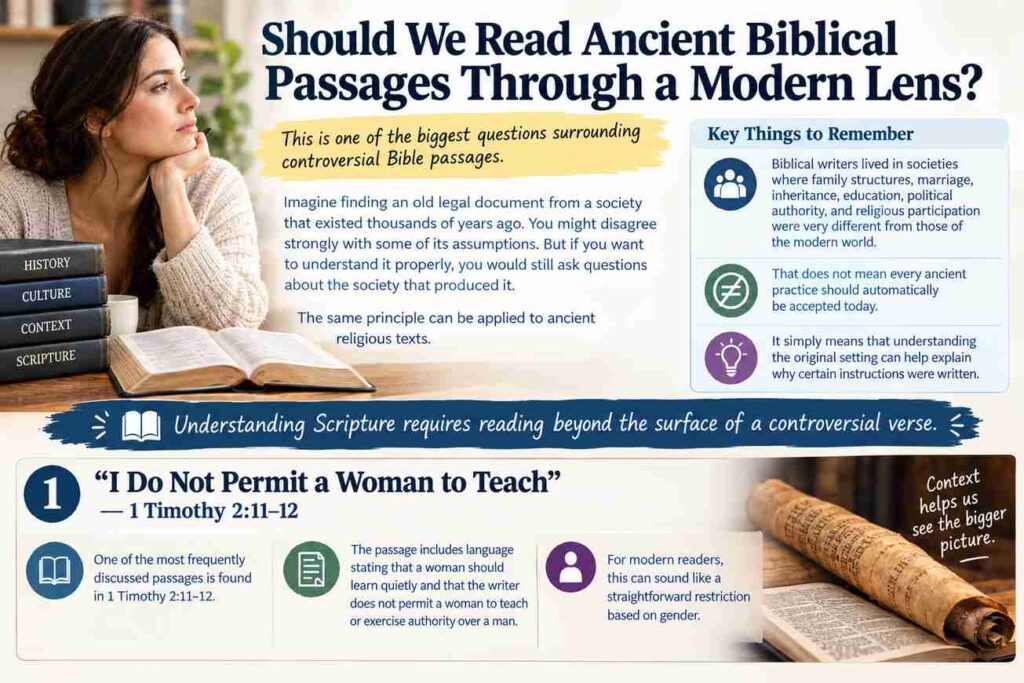
This is one of the biggest questions surrounding controversial Bible passages.
Imagine finding an old legal document from a society that existed thousands of years ago. You might disagree strongly with some of its assumptions. But if you want to understand it properly, you would still ask questions about the society that produced it.
The same principle can be applied to ancient religious texts.
Biblical writers lived in societies where family structures, marriage, inheritance, education, political authority, and religious participation were very different from those of the modern world.
That does not mean every ancient practice should automatically be accepted today.
It simply means that understanding the original setting can help explain why certain instructions were written.
Understanding Scripture requires reading beyond the surface of a controversial verse.
1. “I Do Not Permit a Woman to Teach” — 1 Timothy 2:11–12
One of the most frequently discussed passages is found in 1 Timothy 2:11–12.
The passage includes language stating that a woman should learn quietly and that the writer does not permit a woman to teach or exercise authority over a man.
For modern readers, this can sound like a straightforward restriction based on gender.
Why Does This Passage Sound Sexist?
The concern is easy to understand.
If the passage is interpreted as a universal rule that women can never teach men or exercise religious authority, then women and men are being given different opportunities based solely on sex.
That is why this passage appears frequently in discussions about sexism and Christianity.
But interpretation becomes complicated because Christians disagree about whether Paul was giving a universal rule or addressing a specific situation in the early church.
Some traditions interpret the passage as establishing distinct roles for men and women.
Others argue that the instructions were connected to particular circumstances, false teaching, education, church order, or cultural expectations in the ancient world.
Why Context Matters
The surrounding letter discusses problems within the early Christian community, including teaching, doctrine, worship, and church leadership.
So an important question is:
Was Paul establishing a permanent rule for every Christian community, or was he addressing a specific problem in a particular setting?
Christians have answered that question differently for centuries.
2. “Wives, Submit to Your Own Husbands” — Ephesians 5:22–24
Another famous passage comes from Ephesians 5:22–24, where wives are instructed to submit to their husbands.
This is one of the verses most commonly raised in conversations about biblical patriarchy.
To a modern reader, the language can immediately sound unequal.
Why Is This Passage Controversial?
The obvious concern is power.
If a husband has authority over his wife simply because he is male, critics argue that the relationship creates an unequal structure.
This becomes particularly concerning when such a passage is interpreted to mean that a woman must obey her husband regardless of his behavior.
However, the broader section of Ephesians 5 also places substantial responsibility on husbands.
Husbands are instructed to love their wives sacrificially, with the comparison being made to Christ’s love for the church.
That creates an important interpretive question.
Is the passage describing male privilege, or is it describing a gendered model of marriage in which authority is accompanied by serious responsibility?
Different Christian traditions reach different conclusions.
Submission Does Not Mean Abuse
Whatever theological position someone takes, this passage should not be used to justify abuse, coercion, violence, or the denial of a woman’s basic dignity.
A theological discussion about marriage should never become an excuse for mistreatment.
3. “Women Should Remain Silent” — 1 Corinthians 14:34–35
Few biblical passages sound more startling to modern readers than 1 Corinthians 14:34–35, where women are told to remain silent in the churches.
At first glance, the instruction seems absolute.
Why would women be told to remain silent?
The Apparent Contradiction
The discussion becomes more complicated when we consider that another passage in the same letter, 1 Corinthians 11:5, refers to women praying and prophesying.
That creates an important interpretive problem.
If women were completely forbidden from speaking publicly in every religious setting, why does Paul discuss women praying and prophesying?
Because of this tension, scholars and Christian traditions have proposed different interpretations.
Some understand the silence instruction as referring to a particular type of speaking, such as questioning, judging prophecies, or disruptive speech.
Others understand it as a broader restriction on women’s public authority.
Still others question how the passage should be interpreted in relation to the wider letter.
The important lesson is simple:
A controversial passage should not be isolated from the rest of the text.
4. “The Head of Every Woman Is Man” — 1 Corinthians 11:3
Another passage frequently discussed is 1 Corinthians 11:3, which describes a relationship between God, Christ, man, and woman using the language of “head.”
The interpretation of this passage depends heavily on what “head” means in context.
Does it mean authority?
Source?
Leadership?
Something else?
Different interpreters have reached different conclusions.
Why Modern Readers Question It
If “head” is understood primarily as authority, the verse appears to establish a hierarchy between men and women.
If it is understood differently, the passage may communicate relationship and order without necessarily implying that women are inferior.
This illustrates a broader problem in discussions about biblical sexism:
Translation and interpretation matter.
Sometimes the controversy is not simply about what the original text says, but about how a particular translation and theological tradition understands that text.
5. “Adam Was Formed First, Then Eve” — 1 Timothy 2:13–14
The discussion in 1 Timothy continues by referring to the creation of Adam and Eve.
The argument points to Adam being formed first and Eve afterward, followed by a reference to Eve being deceived.
Modern readers may find this reasoning difficult because it appears to connect the order of creation and Eve’s deception with restrictions on women.
Why Is This Difficult for Modern Readers?
The concern is that Eve’s actions in Genesis could be interpreted as a reason why women should have less authority.
That interpretation has historically contributed to ideas about female weakness, dependence, or spiritual unreliability.
But it is important to distinguish between:
- What Genesis actually narrates.
- How Paul interprets Genesis.
- How later Christians interpreted Paul’s words.
- How those interpretations were applied socially.
These are related, but they are not identical.
6. “She Shall Be Saved Through Childbearing” — 1 Timothy 2:15
Another difficult verse appears immediately afterward.
1 Timothy 2:15 contains the statement that a woman will be saved through childbearing if she continues in faith, love, holiness, and self-control.
Read without context, the verse can sound as though motherhood is presented as a woman’s route to salvation.
That creates obvious theological and social questions.
What about women who cannot have children?
What about unmarried women?
What about women who choose not to have children?
And does the verse actually mean that childbirth earns salvation?
Most Christian theology does not understand salvation as something a woman earns simply by becoming a mother.
That is why this verse requires careful interpretation.
It is a good example of why reading one sentence in isolation can produce a very different impression from reading it within its wider theological context.
7. Women and the Question of Authority in the Church
Many controversial Bible passages about women ultimately lead to one major question:
Can women hold authority in Christian churches?
Christian denominations answer this differently.
Some traditions ordain women as pastors, priests, ministers, bishops, or other forms of church leadership.
Other traditions restrict certain leadership roles to men.
Both sides often appeal to Scripture.
This means the debate is not simply about whether someone “believes the Bible.”
Rather, it often concerns how particular passages should be interpreted in relation to one another.
That is an important distinction.
8. Why These Passages Can Sound Sexist Today
Why do these verses create such a strong reaction among modern readers?
One reason is that modern societies have developed different ideas about equality, education, employment, marriage, political participation, and personal autonomy.
Today, women commonly serve as:
- Teachers
- Engineers
- Doctors
- Scientists
- Judges
- Business leaders
- Politicians
- Researchers
- Military officers
- Religious leaders in some traditions
Therefore, a statement restricting women from teaching or exercising authority can sound dramatically different to a modern audience than it might have sounded in an ancient society.
Ancient gender roles should not be confused automatically with timeless human worth.
9. Were These Commands Universal or Specific to Their Time?
This is perhaps the central interpretive question.
When Paul gives instructions concerning women, was he describing:
- A universal command for all generations?
- A church practice appropriate to the first century?
- A response to a particular local problem?
- A principle that must be applied differently today?
There is no single answer accepted by all Christians.
Complementarian traditions generally emphasize permanent distinctions between male and female roles.
Egalitarian traditions generally argue that men and women share equal authority and leadership potential.
Other Christians take positions somewhere between these approaches.
The debate continues because the biblical texts themselves are being interpreted through different theological frameworks.
10. The Historical Culture Behind Biblical Gender Roles
To understand biblical gender passages, we also need to understand the ancient world.
Many biblical societies were strongly patriarchal.
Family identity was commonly connected to male heads of households. Women often had fewer educational, legal, economic, and political opportunities than men.
Marriage was also structured differently from modern relationships.
This historical reality does not automatically make every biblical instruction acceptable by modern standards.
But it helps us understand why certain assumptions appear repeatedly in ancient literature.
Think of it like reading an old map.
The map tells you where people believed places were located at that time. You can study it without assuming that every detail represents the geography of today.
Historical context works similarly.
11. Does the Bible Treat Women Only as Subordinate?
This is where the discussion becomes much more complicated.
If someone only collects restrictive passages about women, they can create a picture of the Bible that leaves out important examples of women exercising influence.
The Bible also contains stories of women who demonstrate courage, wisdom, leadership, faith, hospitality, influence, and initiative.
So the statement that “the Bible only portrays women as passive and subordinate” would be an oversimplification.
The Bible’s conversation about women is more complicated than a list of restrictive verses.
12. Women as Leaders, Witnesses, and Influential Figures
Consider Deborah, who appears in Judges as a prophet and judge of Israel.
Her story is particularly important because she is presented as a woman exercising significant leadership.
Then there is Huldah, a prophet consulted during the religious reforms described in 2 Kings.
The New Testament also includes women who played significant roles in the early Christian movement.
These examples complicate a simplistic reading of biblical gender roles.
If every woman in Scripture were portrayed as silent, powerless, and irrelevant, the interpretation would be much easier.
But that is not what we find.
13. Women Who Played Important Roles in the Bible
Several women stand out across biblical narratives.
Deborah
Deborah served as a judge and prophet in Israel. Her story challenges the idea that biblical women were universally excluded from positions of influence.
Ruth
Ruth’s story emphasizes loyalty, courage, commitment, and faithfulness. Her actions significantly shape the story of her family and descendants.
Esther
Esther becomes central to the survival of her people. Her courage and strategic decision-making make her one of the Bible’s best-known female figures.
Mary
Mary, the mother of Jesus, occupies an especially important place in the New Testament narrative and Christian tradition.
Mary Magdalene
Mary Magdalene is presented as an important follower of Jesus and a witness to the resurrection in the Gospel accounts.
These stories matter when discussing biblical views of women because they demonstrate that the Bible contains more than gender restrictions.
14. The Difference Between Biblical Text and Later Interpretation
This distinction is extremely important.
A biblical verse is one thing.
The way people interpret and apply that verse centuries later is another.
For example, a particular passage may have been used historically to argue that women should not receive formal education.
But that social conclusion may go beyond the literal wording of the biblical passage.
Likewise, a verse about wives and husbands may have been used to justify forms of male domination that the text itself does not explicitly endorse.
This is why the history of interpretation matters.
Ancient culture shaped biblical language, but interpretation determines how that language is applied today.
15. Why Context Matters When Reading Controversial Verses
Context acts like the frame around a painting.
Without the frame, you may still see the picture, but you can miss how its parts relate to each other.
When studying a difficult Bible verse, ask:
- Who wrote it?
- Who was the intended audience?
- What problem was being addressed?
- What comes before and after the verse?
- What was the cultural setting?
- How is the same topic discussed elsewhere?
- How have different Christian traditions interpreted it?
- Is the passage descriptive or prescriptive?
- Is the instruction universal or situational?
These questions do not automatically solve every disagreement.
But they make the discussion more responsible.
16. Can Christians Criticize Difficult Passages While Respecting Scripture?
Yes, people can engage critically with difficult biblical passages without pretending those passages do not exist.
In fact, honest discussion can be healthier than avoidance.
A person might say:
“I find this passage morally difficult.”
That is a legitimate starting point for discussion.
Another person might respond:
“I understand the difficulty, but I interpret the passage differently because of its historical and theological context.”
That can also be legitimate.
The goal does not have to be winning an argument.
Sometimes the goal is simply understanding why intelligent and sincere readers reach different conclusions.
17. How Different Christian Traditions Interpret These Verses
Christianity does not have a single universal interpretation of gender roles.
Complementarian Interpretation
Complementarian Christians generally believe men and women have equal value before God but different roles in marriage and church leadership.
They may interpret passages about male headship and women’s teaching roles as continuing principles.
Egalitarian Interpretation
Egalitarian Christians generally emphasize the equal spiritual and leadership potential of men and women.
They may interpret restrictive passages as culturally specific, situational, or limited in scope.
Other Interpretations
Some Christians combine elements of both approaches.
They may believe certain gender distinctions exist in marriage while allowing women broad leadership in professional, social, or religious contexts.
This diversity is one reason the subject cannot be reduced to a simple “the Bible says women are inferior” argument.
18. How to Read Sexist-Looking Bible Verses Responsibly
If you are studying controversial Bible verses yourself, here is a useful approach.
Start With the Exact Text
Do not rely entirely on memes, social media graphics, or quotations without references.
Find the actual passage.
Read the Surrounding Chapter
A single sentence can be misleading when separated from the discussion surrounding it.
Read the paragraph, chapter, and where possible, the whole letter or book.
Compare Translations
Different English translations sometimes use noticeably different wording.
Comparing several reputable translations can reveal interpretive differences.
Study the Historical Setting
Ask what was happening in the society and religious community when the passage was written.
Consider Multiple Interpretations
Do not study only sources that agree with your existing opinion.
Read serious arguments from different perspectives.
Separate Description From Prescription
A biblical story describing something does not necessarily mean the Bible commands everyone to do the same thing.
That distinction is crucial.
19. Are These Actually “Sexist Quotes” or Controversial Biblical Passages?
This is an important wording issue for anyone writing about this subject.
Calling them “sexist quotes from the Bible” reflects a particular modern interpretation.
A more neutral description might be:
- Controversial Bible verses about women
- Difficult Bible passages about gender
- Bible verses about women’s roles
- Biblical passages often described as sexist
- Bible verses about male authority and female submission
Why does this matter?
Because the label “sexist” is an interpretation, while the biblical quotation is the source material.
A responsible article should make that distinction clear.
Calling a biblical passage sexist does not automatically settle the question of what the passage meant in its original historical and cultural setting.
20. What Can We Learn From These Difficult Passages?
Even when readers strongly disagree about interpretation, these passages raise valuable questions.
They make us think about:
- Gender and authority
- Marriage
- Leadership
- Culture
- Religious tradition
- Translation
- Historical interpretation
- Equality
- Power
- The relationship between ancient texts and modern values
Perhaps the biggest lesson is that difficult texts deserve serious engagement.
We should not be afraid of complicated passages.
Instead, we should ask better questions about them.
Conclusion
The phrase “sexist quotes from the Bible” usually refers to biblical passages that modern readers believe restrict women, place them under male authority, or assign them different roles from men. Passages such as 1 Timothy 2:11–15, Ephesians 5:22–24, and 1 Corinthians 14:34–35 are among the most frequently discussed examples.
Yet the subject is more complicated than simply collecting controversial verses.
The Bible was written within ancient cultures that had very different social structures from modern societies. At the same time, Scripture contains women such as Deborah, Esther, Ruth, Huldah, Mary, and Mary Magdalene, whose stories demonstrate courage, influence, faith, leadership, and importance.
That tension is precisely why these passages continue to generate discussion.
A difficult verse deserves context, not concealment.
Whether someone ultimately accepts a traditional interpretation, an egalitarian interpretation, or something in between, the most responsible approach is to read the passages carefully, examine their historical setting, consider the surrounding context, and recognize that Christians have not always agreed about their meaning.
The goal should not simply be to find verses that confirm what we already believe. The better goal is to understand the text honestly—even when the answers are complicated.
Frequently Asked Questions About Sexist Quotes from the Bible
1. What are some Bible verses commonly called sexist?
Commonly discussed passages include 1 Timothy 2:11–12, 1 Corinthians 14:34–35, Ephesians 5:22–24, and 1 Corinthians 11:3. These passages are controversial because they discuss women’s teaching, silence, submission, or male authority.
2. Does the Bible explicitly say that women are inferior to men?
The Bible contains passages that establish different roles or forms of authority between men and women, but saying that the Bible simply teaches that women are inferior is an oversimplification. Other biblical passages present women as important leaders, witnesses, prophets, and influential figures.
3. Is “wives submit to your husbands” a sexist Bible verse?
Many modern readers consider Ephesians 5:22–24 sexist because it places wives in a submissive relationship to their husbands. However, Christians disagree about how the passage should be understood, particularly because the surrounding passage also places strong responsibilities on husbands.
4. Why does the Bible tell women to remain silent?
1 Corinthians 14:34–35 contains an instruction for women to remain silent in church. However, its interpretation is debated because 1 Corinthians also discusses women praying and prophesying. Some interpreters therefore understand the silence instruction as addressing a particular situation rather than imposing an absolute ban on women speaking.
5. Does the Bible prohibit women from becoming pastors?
Christian traditions disagree. Some interpret passages such as 1 Timothy 2:11–12 as restricting women from certain teaching and leadership roles in churches. Other traditions believe those passages addressed specific first-century circumstances and do not prohibit women from pastoral leadership today.
6. Were women treated differently in biblical times?
Yes. Ancient societies generally had social, legal, economic, and family structures that differed considerably from modern societies. Understanding those historical conditions can help readers understand why certain biblical instructions about gender appear as they do.
7. Are all Bible verses about women negative?
No. The Bible contains many positive accounts of women. Deborah is presented as a judge and prophet, Esther plays a crucial role in protecting her people, Ruth is portrayed as loyal and courageous, and several women play significant roles in the New Testament.
8. Does historical context excuse a controversial Bible verse?
Historical context does not necessarily tell someone what they should believe morally. Instead, it helps explain what a passage may have meant to its original audience and why it was written. Readers can still disagree with a passage while understanding its historical background.
9. Why do Christians interpret these verses differently?
Christians use different approaches to biblical interpretation. Some emphasize continuing gender distinctions, while others emphasize equality and argue that certain restrictions were connected to specific historical circumstances. Translation and cultural assumptions can also influence interpretation.
10. What is the best way to study controversial Bible verses about women?
Start with the complete passage rather than an isolated quotation. Read its surrounding context, compare translations, examine the historical setting, consider the original audience, and study interpretations from different Christian traditions. This approach provides a much stronger foundation than relying on a list of controversial quotations alone.