
Bible Quotes About Fate: What Does the Bible Say About Destiny and God’s Plan?
What does the Bible say about fate?
It is a question many people ask when life takes an unexpected turn.
Sometimes we look at a difficult situation and wonder, “Was this meant to happen?” Other times, we experience an unexpected blessing and think, “Was this part of God’s plan all along?”
The Bible does not usually describe life in terms of an impersonal force called “fate.” Instead, Scripture repeatedly talks about God’s sovereignty, His plans, His purpose, His guidance, human choices, and His knowledge of the future.
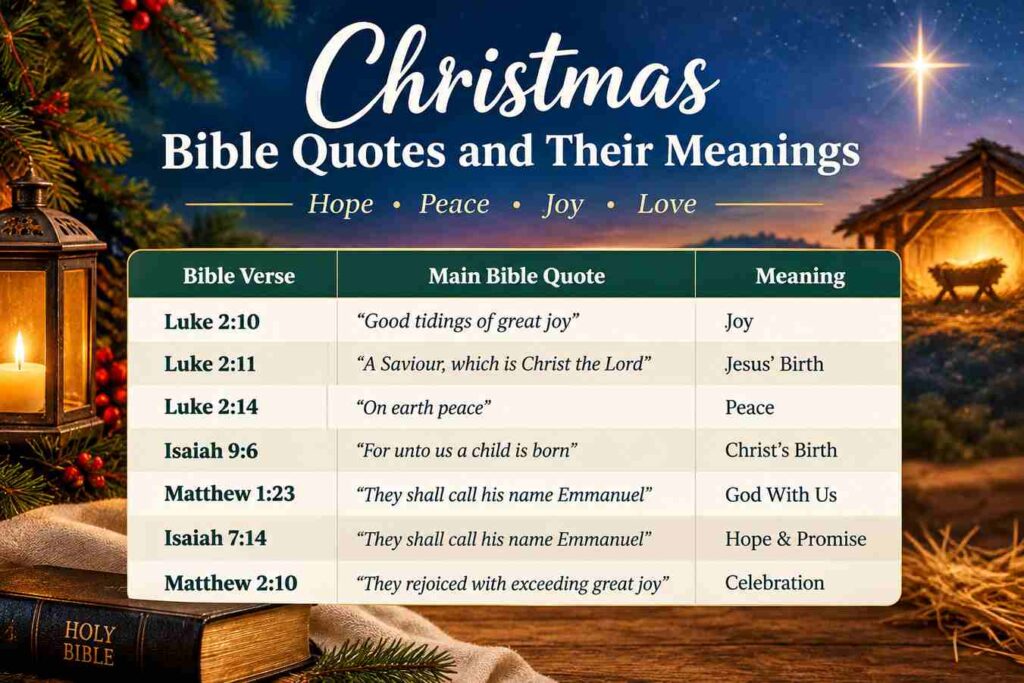
| Bible Verse | Important Christmas Quote | Christmas Theme |
|---|---|---|
| Luke 2:10 | “Good tidings of great joy” | Joy |
| Luke 2:11 | “A Saviour, which is Christ the Lord” | Jesus’ Birth |
| Luke 2:14 | “On earth peace” | Peace |
| Isaiah 9:6 | “For unto us a child is born” | Christ’s Birth |
| Matthew 1:23 | “They shall call his name Emmanuel” | God With Us |
| Isaiah 7:14 | “They shall call his name Emmanuel” | Hope & Promise |
| Matthew 2:10 | “They rejoiced with exceeding great joy” | Celebration |
| Matthew 2:11 | “They fell down, and worshipped him” | Worship |
| John 1:14 | “The Word was made flesh” | Incarnation |
| Galatians 4:4 | “God sent forth his Son” | God’s Gift |
| 2 Corinthians 9:15 | “Thanks be unto God for his unspeakable gift” | Gratitude |
| John 3:16 | “For God so loved the world” | God’s Love |
| Micah 5:2 | “Out of thee shall he come forth unto me that is to be ruler in Israel” | Prophecy |
| Psalm 96:11 | “Let the heavens rejoice” | Celebration & Worship |
| Isaiah 9:6 | “The Prince of Peace” | Peace |
| Luke 2:7 | “She brought forth her firstborn son” | Birth of Jesus |
That distinction matters.
Biblical faith is not simply about believing that an invisible force controls every event. It is about trusting God even when we cannot see what is ahead.
The Bible contains many powerful passages that can help us think about destiny, purpose, choices, timing, and the future. Verses such as Proverbs 16:9, Jeremiah 29:11, Romans 8:28, James 4:15, and Psalm 37:23 remind us that although people make plans, God remains sovereign over our lives.
In this article, we will explore some of the most meaningful Bible quotes about fate, what they actually mean, and how they can encourage you when your future feels uncertain.
What Does the Bible Say About Fate?
The modern idea of fate often suggests that everything happens because of an unavoidable force beyond human control.
In this view, people may believe that certain events are simply “destined” to happen regardless of what they do.
The Bible presents a more personal picture.
Rather than focusing on fate as a mysterious power, Scripture points us toward God.
God knows the future. God has purposes. God guides people. God can work through circumstances. At the same time, Scripture also repeatedly calls people to make decisions, obey God, seek wisdom, repent, believe, and choose between different paths.
That means biblical teaching about the future contains both divine sovereignty and human responsibility.
A useful verse is Proverbs 16:9:
“A man’s heart deviseth his way: but the LORD directeth his steps.”
This verse beautifully captures the tension.
We make plans.
We choose a direction.
We take steps.
Yet God remains involved in the journey.
Think of it like traveling with a map. You may choose the road you want to take, but God sees the entire landscape in a way you cannot. What looks like a dead end to you may become part of a larger journey.
Fate vs. God’s Plan in the Bible

There is an important difference between saying, “Fate controls my life,” and saying, “I trust God with my life.”
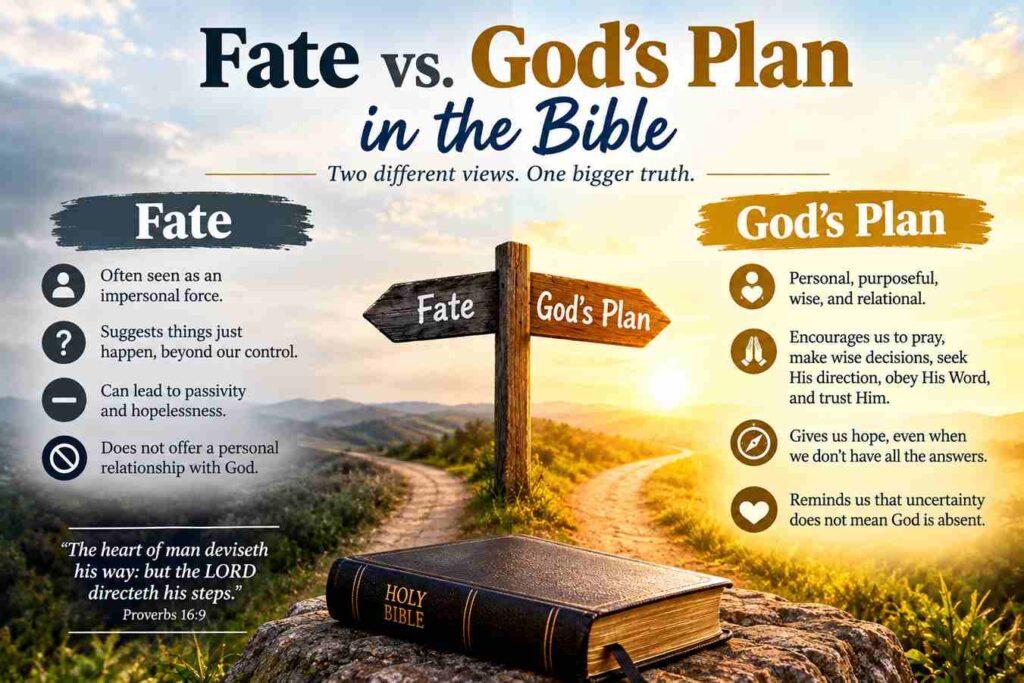
Fate is often understood as an impersonal force.
God, however, is presented in Scripture as personal, purposeful, wise, and relational.
The Bible does not encourage us to sit passively and say, “Whatever happens, happens.”
Instead, we are encouraged to pray, make wise decisions, seek God’s direction, obey His Word, and trust Him with the results.
This is one reason Bible verses about fate can be better understood as Bible verses about God’s plan and purpose.
We may not understand why something happened.
We may not know what tomorrow holds.
But biblical faith says that uncertainty does not mean God is absent.
Proverbs 16:9 — God Directs Our Steps
One of the most famous Bible quotes about fate and God’s direction is found in Proverbs 16:9.
“A man’s heart deviseth his way: but the LORD directeth his steps.”
This verse begins with human planning.
We make goals.
We choose careers.
We decide where to live.
We make relationships.
We plan marriages, businesses, journeys, and futures.
There is nothing inherently wrong with planning.
But the second half of the verse reminds us that our plans are not the entire story.
God directs our steps.
What Does Proverbs 16:9 Mean?
The verse does not mean that people should stop planning.
Instead, it teaches humility.
You may have a carefully designed plan for your life, but circumstances can change quickly.
A job opportunity may disappear.
A relationship may end.
A door you expected to open may remain closed.
Something completely unexpected may happen.
When that occurs, Proverbs 16:9 reminds us that our limited perspective is not the same as God’s perspective.
Sometimes what we call a “detour” becomes part of a greater journey.
Jeremiah 29:11 — God Has Plans for His People
Jeremiah 29:11 is one of the most quoted passages when people discuss destiny, purpose, and the future.
“For I know the thoughts that I think toward you, saith the LORD…”
The verse continues with the familiar promise of peace and hope.
This passage can be deeply encouraging when we are worried about what comes next.
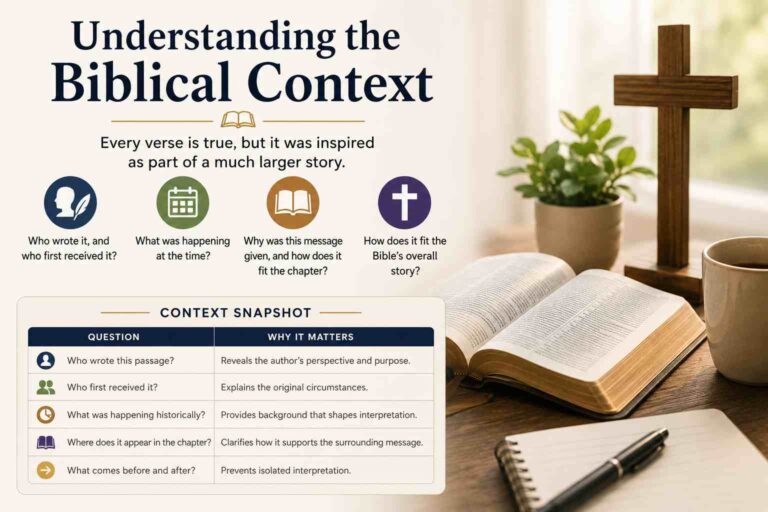
However, it is important to understand its context.
Jeremiah was speaking to Israelites living in exile in Babylon. The promise was connected to God’s purposes for His people during a difficult historical period.
The passage therefore should not be treated as a guarantee that every individual will experience a trouble-free life.
Instead, it reminds us of something broader and deeply meaningful:
God can have a purpose even when His people are living through difficult seasons.
A Lesson About Waiting
Sometimes we want God’s plan immediately.
We want answers today.
We want to know where we will be five years from now.
But Scripture often teaches God’s people to wait.
Waiting can feel frustrating, but it can also develop patience, wisdom, endurance, and faith.
Proverbs 19:21 — God’s Purpose Will Stand
Proverbs 19:21 gives another powerful perspective on human plans and God’s purpose:
“There are many devices in a man’s heart; nevertheless the counsel of the LORD, that shall stand.”
In simple terms, people can have many plans.
We can imagine dozens of possible futures.
But God’s ultimate purpose is greater than our limited understanding.
Why This Verse Matters
Have you ever planned something carefully only to see everything change?
Most of us have.
Life rarely follows a perfectly straight line.
That does not necessarily mean your life has lost its purpose.
Sometimes the path changes while the purpose remains.
This verse encourages us not to place our entire sense of security in our own plans.
Proverbs 16:33 — Is Everything Determined by Chance?
Another fascinating passage is Proverbs 16:33:
“The lot is cast into the lap; but the whole disposing thereof is of the LORD.”
In ancient biblical settings, casting lots was sometimes used in decision-making.
From a modern perspective, this can sound like gambling or random chance.
But the proverb makes a striking point: even when something appears random from a human perspective, God is not limited by what appears to be chance.
Does This Mean Nothing Is Random?
This verse should not be used to encourage superstition.
The broader biblical message is that God is sovereign.
Humans do not see the whole picture.
We may call something coincidence because we cannot explain how events connect. Scripture repeatedly reminds believers that God sees beyond human understanding.
Romans 8:28 — God Can Work Through Every Circumstance
Romans 8:28 is another important verse when discussing fate:
“And we know that all things work together for good to them that love God…”
This verse does not say that every individual event is pleasant.
It does not say that suffering is good.
It does not say that every tragedy should be welcomed.
Instead, it points toward God’s ability to work through circumstances for a greater purpose.
That is an important distinction.
God Can Bring Purpose From Pain
Imagine a piece of broken pottery.
The broken pieces may look meaningless when viewed separately.
But an artist may be able to create something beautiful from them.
Likewise, Scripture teaches that God can work through circumstances that we do not understand.
A painful season may eventually produce compassion.
A disappointment may redirect someone’s priorities.
A difficult experience may teach patience.
A closed door may lead to another opportunity.
This does not mean every painful event was good.
It means God is not powerless in the presence of difficulty.
Psalm 37:23 — God Guides Our Steps
Psalm 37:23 says:
“The steps of a good man are ordered by the LORD…”
This verse presents life as a journey made up of individual steps.
Notice the imagery.
It does not say we understand the entire road.
It speaks about steps.
One step.
Then another.
Then another.
That can be comforting when the future feels overwhelming.
You may not know what the next ten years look like.
But you can ask:
What is the faithful step I should take today?
Sometimes that is enough.
Ecclesiastes 3:1 — A Time and Season for Everything
Ecclesiastes 3:1 is one of Scripture’s best-known passages about timing:
“To every thing there is a season, and a time to every purpose under the heaven.”
Life has seasons.
Some seasons are joyful.
Some are painful.
Some are filled with growth.
Others feel quiet and uncertain.
The Bible recognizes that life changes.
Learning to Accept Life’s Seasons
One of the hardest lessons is accepting that not every season will last forever.
A difficult season can change.
A successful season can change too.
Relationships change.
Jobs change.
Families change.
Circumstances change.
Ecclesiastes teaches us to recognize that life has different seasons rather than expecting every chapter to look the same.
James 4:15 — Trusting God With the Future
James 4:15 gives a beautiful attitude toward the future:
“If the Lord will, we shall live, and do this, or that.”
This statement teaches humility.
We make plans, but we do not control tomorrow.
That is not a reason for fear.
It is a reason for dependence on God.
Planning Without Pretending to Control Everything
There is nothing wrong with making plans.
The problem comes when we assume that our plans are guaranteed.
You can make a five-year plan while still saying, in your heart, “If God allows.”
That attitude creates flexibility.
If circumstances change, your faith does not have to collapse.
Isaiah 46:10 — God’s Purpose Cannot Be Overturned
Isaiah 46:10 contains a powerful statement about God’s sovereignty:
“My counsel shall stand, and I will do all my pleasure.”
The passage emphasizes God’s unique ability to declare what will happen and accomplish His purpose.
For believers, this can provide stability.
Human plans can fail.
Governments change.
Economies change.
People change.
Circumstances change.
But Scripture presents God’s ultimate purpose as enduring.
This is very different from trusting in fate.
Fate is impersonal.
Biblical trust is directed toward God.
Psalm 139:16 — God Knows Our Days
Psalm 139:16 is frequently included in discussions about destiny and God’s knowledge:
“Thine eyes did see my substance, yet being unperfect…”
The verse continues by describing the days written in God’s book.
The broader Psalm celebrates God’s intimate knowledge of a person’s life.
This does not mean we should become obsessed with trying to discover every detail of our future.
Instead, it invites trust.
God knows what we do not know.
That can be a source of peace.
You Do Not Need to Know Everything
Think about driving at night.
Your headlights only illuminate part of the road.
You cannot see the entire journey.
But you do not need to.
You only need enough light for the next stretch.
Faith can work similarly.
God may not reveal the entire future.
He may simply give you enough wisdom for the next step.
Ephesians 1:11 — God’s Sovereign Purpose
Ephesians 1:11 speaks about God’s purpose and His sovereignty:
“…according to the purpose of him who worketh all things after the counsel of his own will.”
This is one of the stronger passages for understanding God’s authority over His purposes.
It reminds Christians that history is not ultimately meaningless.
God’s purposes are larger than individual circumstances.
At the same time, different Christian traditions interpret passages concerning predestination and God’s sovereignty in different ways.
That is why it is important to read individual verses within their wider biblical context.
Does the Bible Teach That Everything Is Predestined?
This is where the subject becomes more complex.
The Bible contains passages about God’s foreknowledge, election, predestination, sovereignty, and purpose.
It also contains passages that clearly call people to choose, believe, obey, repent, and respond.
Because of this, Christians have developed different theological understandings of how God’s sovereignty relates to human freedom.
It is not accurate to reduce the entire biblical teaching to a simple statement such as “everything is fate.”
God’s Sovereignty
Scripture repeatedly presents God as sovereign.
He is not surprised by the future.
His purposes cannot simply be defeated by human limitations.
This gives believers confidence that their lives are not ultimately meaningless.
Human Responsibility and Choice
At the same time, Scripture repeatedly presents human beings as responsible for their decisions.
For example, Deuteronomy 30:19 says:
“I have set before you life and death, blessing and cursing: therefore choose life…”
Joshua 24:15 similarly presents a choice regarding whom people will serve.
These passages demonstrate why the biblical concept of fate should not be confused with passive fatalism.
Bible Quotes About Fate and Free Will
The relationship between God’s sovereignty and human choice has been discussed by Christians for centuries.
Several verses are particularly relevant.
Deuteronomy 30:19 emphasizes choosing.
Joshua 24:15 calls people to make a decision.
Proverbs 1:29-31 describes consequences associated with rejecting wisdom.
Galatians 6:7 teaches that people reap what they sow.
These passages show that biblical teaching takes human decisions seriously.
Your choices matter.
Your actions matter.
Your response to God matters.
At the same time, Scripture teaches that God remains sovereign.
This creates a picture that is more profound than simple fate.
Bible Verses About Destiny and Purpose
If you’re looking for Bible quotes about destiny, several passages can help.
Ephesians 2:10
Ephesians 2:10 describes believers as God’s workmanship, created for good works.
This emphasizes purpose.
Your life is not presented as meaningless or accidental.
Romans 12:2
Romans 12:2 encourages believers to be transformed and to discern God’s will.
This highlights the importance of spiritual growth and understanding God’s purposes.
Psalm 32:8
Psalm 32:8 contains God’s promise:
“I will instruct thee and teach thee in the way which thou shalt go…”
This is a beautiful picture of divine guidance.
Proverbs 3:5-6
One of the most beloved passages says:
“Trust in the LORD with all thine heart; and lean not unto thine own understanding.”
It continues by encouraging believers to acknowledge God in their ways.
This passage is especially meaningful when the future makes no sense.
Bible Quotes About Fate and the Future
The future can be frightening because it is invisible.
We cannot see tomorrow.
We can prepare for it, but we cannot completely control it.
Jesus addressed this anxiety in Matthew 6:34:
“Take therefore no thought for the morrow…”
The surrounding passage encourages believers not to be consumed by anxiety about tomorrow.
This does not mean we should ignore responsibilities.
It means we should not allow fear of the future to dominate our lives.
God Is Already in Tomorrow
A simple but powerful thought is this:
You may not know tomorrow, but God does.
That is one of the central ideas behind trusting God with the future.
You do not need to possess complete knowledge before you can have peace.
Bible Verses for When You Feel Your Life Is Out of Control
Sometimes the question about fate is really a question about fear.
We may ask, “What is going to happen to me?” because we feel powerless.
During those moments, several biblical passages can provide encouragement.
Psalm 46:1 describes God as a refuge and strength.
Isaiah 41:10 tells God’s people not to fear because He is with them.
Philippians 4:6-7 encourages believers to bring their concerns to God in prayer.
1 Peter 5:7 encourages believers to cast their cares upon God.
These verses shift our attention away from trying to control every future event and toward trusting God in the middle of uncertainty.
What Should Christians Believe About Fate?
A biblical approach to fate can be summarized in several ideas.
First, God is sovereign.
Second, God has purposes.
Third, people make meaningful choices.
Fourth, the future is not fully visible to us.
Fifth, God calls His people to trust Him rather than live in fear.
The Bible does not encourage believers to obsess over trying to discover a predetermined future.
Instead, Scripture repeatedly directs people toward faithfulness in the present.
That is important.
Sometimes we become so focused on finding “God’s plan for my entire life” that we forget to live faithfully today.
Perhaps the better question is:
What does God want me to do with the day He has given me?
How to Trust God When You Do Not Know Your Future
Trusting God does not mean pretending that uncertainty is easy.
You may still feel nervous.
You may still have questions.
You may still wonder why something happened.
Faith does not require you to have every answer.
Pray About Your Decisions
When you have an important choice, bring it to God.
Ask for wisdom.
James 1:5 encourages those who lack wisdom to ask God.
Use Biblical Wisdom
Prayer does not eliminate the need for wisdom.
Study Scripture.
Consider consequences.
Seek trustworthy counsel.
Think carefully.
Make responsible decisions.
Accept That Some Answers May Come Later
Not every question receives an immediate answer.
Sometimes understanding comes months or years later.
Sometimes we may never understand everything that happened.
Faith means trusting God even when the explanation remains incomplete.
Focus on the Next Step
You do not have to solve your entire future today.
Focus on the next faithful step.
That might mean forgiving someone.
Applying for a job.
Taking care of your family.
Praying.
Studying.
Serving others.
Leaving an unhealthy situation.
Or simply getting through a difficult day.
Small steps can still be meaningful.
Is Your Life Controlled by Fate or Guided by God?
This question gets to the heart of the subject.
The Bible’s answer is not simply, “Everything is random.”
Nor does Scripture encourage the idea that humans are meaningless puppets with no responsibility.
Instead, Scripture presents a God who is sovereign and people who are accountable for their choices.
That combination can be difficult to understand completely.
But perhaps that is part of the point.
If we could fully understand every mystery about God’s sovereignty, time, eternity, and human choice, our understanding would be enormous indeed.
Instead, Scripture calls us to trust God.
You can make plans while trusting Him.
You can work hard while depending on Him.
You can make decisions while praying for wisdom.
You can face uncertainty without believing that your life is controlled by blind fate.
Why Bible Quotes About Fate Can Give You Hope
The biggest value of these verses is not merely that they answer an intellectual question.
They can also change how we respond to uncertainty.
Imagine standing at the edge of a road covered in fog.
You cannot see the entire route.
Would you rather believe the road has no direction at all?
Or would you rather trust someone who knows the road even when you cannot see it?
For Christians, biblical faith points toward the second perspective.
God’s people may not understand every event.
But they can trust God’s character.
That is why passages about God’s plans, purposes, guidance, and sovereignty remain so meaningful.
Bible Quotes About Fate for Difficult Times
When life feels completely unpredictable, these verses can become reminders to keep going.
Proverbs 16:9 — God directs our steps.
Jeremiah 29:11 — God has purposes for His people.
Romans 8:28 — God can work through circumstances.
Psalm 37:23 — God orders the steps of His people.
James 4:15 — The future should be placed in God’s hands.
Isaiah 46:10 — God’s counsel stands.
Proverbs 3:5-6 — Trust God rather than relying entirely on your own understanding.
Ecclesiastes 3:1 — Life contains different seasons.
Together, these passages create a powerful biblical message:
You do not have to understand the entire journey to trust the One who does.
Conclusion: What Does the Bible Really Say About Fate?
The Bible offers a richer perspective than the simple idea of fate.
Scripture teaches that God knows the future, has purposes, guides His people, and remains sovereign over His creation. At the same time, the Bible repeatedly calls human beings to make choices, seek wisdom, obey God, and take responsibility for their actions.
So when you search for Bible quotes about fate, it may be more helpful to look at the broader biblical themes of God’s plan, divine providence, destiny, purpose, guidance, sovereignty, and human responsibility.
Proverbs 16:9 reminds us that we can make plans while God directs our steps.
James 4:15 reminds us to hold our future with humility.
Romans 8:28 reminds us that God can work through circumstances.
Ecclesiastes 3:1 reminds us that life has seasons.
And Proverbs 3:5-6 reminds us to trust God even when our understanding is limited.
You may not know what tomorrow holds.
You may not understand why certain doors closed.
You may not know how every piece of your story will fit together.
But you can still move forward.
Make wise plans. Pray for guidance. Make responsible choices. Learn from the past. Live faithfully in the present. And when the future is beyond your control, place it in God’s hands.
Frequently Asked Questions About Bible Quotes About Fate
1. Does the Bible believe in fate?
The Bible does not generally present fate as an impersonal force controlling human lives. Instead, Scripture emphasizes God’s sovereignty, purpose, providence, and knowledge of the future while also recognizing human decisions and responsibility.
2. What is the best Bible verse about fate?
Proverbs 16:9 is one of the most relevant verses because it says, “A man’s heart deviseth his way: but the LORD directeth his steps.” It captures the biblical relationship between human planning and God’s direction.
3. Does the Bible say that everything happens for a reason?
The Bible teaches that God can work through circumstances for His purposes. Romans 8:28 says that all things work together for good for those who love God. However, this does not mean that every painful event is itself good or that Scripture describes every tragedy as something desirable.
4. What Bible verse talks about God’s plan for our lives?
Jeremiah 29:11 is commonly associated with God’s plans and future purposes. Ephesians 2:10 also speaks about believers being created for good works.
5. Does God control everything that happens?
The Bible strongly teaches God’s sovereignty. However, Christian traditions differ in how they explain the relationship between God’s sovereignty, human freedom, responsibility, and the occurrence of evil and suffering. Several biblical passages need to be considered together.
6. Does the Bible teach free will?
The Bible repeatedly presents people as making meaningful choices and being responsible for their actions. Passages such as Deuteronomy 30:19 and Joshua 24:15 explicitly call people to choose. Christians differ, however, on how human freedom relates to God’s sovereignty.
7. What does Proverbs 16:9 say about destiny?
Proverbs 16:9 says that people make plans while the Lord directs their steps. The verse encourages people to plan while recognizing that God ultimately has authority over the direction of their lives.
8. What Bible verse says God knows the future?
Several passages describe God’s knowledge and authority concerning the future. Isaiah 46:10 is particularly relevant because it speaks about God declaring the end from the beginning and His counsel standing.
9. What does the Bible say when you are worried about your future?
Scripture repeatedly encourages trust rather than anxiety. Matthew 6:34 teaches people not to be consumed by tomorrow, while Proverbs 3:5-6 encourages believers to trust God rather than relying entirely on their own understanding.
10. How can I trust God when I do not understand my destiny?
Start with the next step rather than demanding a complete picture of the future. Pray for wisdom, study Scripture, make responsible decisions, seek good counsel, and remember that not understanding God’s entire plan does not mean that your life has no purpose.