
Best Bible Verses From Psalms: Powerful and Encouraging
If you are looking for the best Bible verses from Psalms, you are looking at one of the richest collections of Scripture for finding words about faith, fear, hope, love, strength, protection, guidance, praise, forgiveness, and God’s presence.
The Book of Psalms contains 150 individual Psalms, and each one speaks to life from a different angle. Some are songs of praise. Others are honest prayers from people who were afraid, grieving, confused, or under pressure. Some teach wisdom, while others celebrate God’s faithfulness and mercy.
This guide brings together 50+ of the most meaningful and widely loved Bible verses from Psalms, while also explaining the context and purpose behind many of them. You will find Psalms for strength and courage, encouragement, God’s love, protection, help, praise, guidance, prayer, and difficult seasons of life.
You will also find a detailed explanation of Psalm 23, an explanation of Psalm 90:12 and Psalm 90:17, a guide to choosing Psalms for different situations, and answers to common questions about the Book of Psalms.
The 50+ Best Bible Verses from Psalms

If you want a quick collection of the best Psalm verses, start here. These passages represent some of the most memorable themes in the Psalter.
| # | Psalm | Verse / Passage | Main Theme |
|---|---|---|---|
| 1 | Psalm 1:1–2 | Delight in God’s instruction | Wisdom |
| 2 | Psalm 19:14 | Words and thoughts pleasing to God | Faithfulness |
| 3 | Psalm 23:1 | “The LORD is my shepherd” | God’s care |
| 4 | Psalm 23:4 | “Thou art with me” | God’s presence |
| 5 | Psalm 23:6 | Goodness and mercy | God’s faithfulness |
| 6 | Psalm 27:1 | “Whom shall I fear?” | Courage |
| 7 | Psalm 27:14 | “Wait on the LORD” | Patience |
| 8 | Psalm 34:8 | “Taste and see” | God’s goodness |
| 9 | Psalm 34:18 | God near the brokenhearted | Comfort |
| 10 | Psalm 37:4 | Delight yourself in God | Trust |
| 11 | Psalm 40:1 | Waiting patiently for God | Hope |
| 12 | Psalm 42:11 | Hope when discouraged | Encouragement |
| 13 | Psalm 46:1 | God as refuge and strength | Strength |
| 14 | Psalm 46:10 | “Be still” | Peace |
| 15 | Psalm 51:10 | “Create in me a clean heart” | Repentance |
| 16 | Psalm 55:22 | Cast your burden on God | Help |
| 17 | Psalm 56:3 | Trusting God when afraid | Courage |
| 18 | Psalm 63:3 | God’s lovingkindness | Love |
| 19 | Psalm 73:26 | God as strength | Strength |
| 20 | Psalm 84:11 | God as sun and shield | Protection |
| 21 | Psalm 90:12 | Numbering our days | Wisdom |
| 22 | Psalm 90:17 | Establish the work of our hands | Purpose |
| 23 | Psalm 91:1 | Dwelling under God’s protection | Safety |
| 24 | Psalm 91:2 | God as refuge and fortress | Protection |
| 25 | Psalm 100:4 | Entering with thanksgiving | Praise |
| 26 | Psalm 103:2 | Remembering God’s benefits | Gratitude |
| 27 | Psalm 103:8 | God’s mercy and grace | God’s character |
| 28 | Psalm 103:13 | God’s compassion | Comfort |
| 29 | Psalm 118:24 | “This is the day” | Joy |
| 30 | Psalm 119:105 | God’s Word as a lamp | Guidance |
| 31 | Psalm 121:1–2 | “My help cometh from the LORD” | Help |
| 32 | Psalm 121:7–8 | God watches over His people | Protection |
| 33 | Psalm 127:3 | Children as a heritage | Family |
| 34 | Psalm 130:5 | Waiting and hoping in God | Hope |
| 35 | Psalm 138:3 | Strength for the soul | Inner strength |
| 36 | Psalm 139:13–14 | Wonderfully made | Identity |
| 37 | Psalm 139:23–24 | Asking God to search the heart | Self-examination |
| 38 | Psalm 143:10 | God’s Spirit leading | Guidance |
| 39 | Psalm 147:3 | Healing the brokenhearted | Comfort |
| 40 | Psalm 150:6 | “Let every thing that hath breath praise” | Worship |
| 41 | Psalm 4:8 | Resting safely | Peace |
| 42 | Psalm 18:1 | Loving the LORD | Love |
| 43 | Psalm 28:7 | God as strength and shield | Protection |
| 44 | Psalm 32:1 | Forgiveness | Mercy |
| 45 | Psalm 34:4 | Deliverance from fear | Courage |
| 46 | Psalm 37:5 | Commit your way to God | Trust |
| 47 | Psalm 62:5–6 | Hope in God alone | Stability |
| 48 | Psalm 86:7 | Calling on God in trouble | Prayer |
| 49 | Psalm 103:11 | Greatness of God’s mercy | God’s love |
| 50 | Psalm 116:1–2 | God hears prayer | Prayer |
| 51 | Psalm 145:18 | God near those who call | God’s presence |
| 52 | Psalm 147:11 | Hope in God’s mercy | Trust |
These are not necessarily the “best” Psalms in an objective sense. Rather, they are some of the most useful and beloved passages for different needs. The right Psalm for you may depend on what you are experiencing today.
What Kind of Book Is Psalms?

Before choosing individual Psalm verses, it helps to understand what the Book of Psalms actually contains.
The 150 Psalms are not all written in the same style or for the same purpose. They include several major types of biblical poetry.
Psalms of Praise
These celebrate who God is and what He has done.
Examples include Psalm 8, Psalm 100, Psalm 145, and Psalms 146–150.
Psalms of Lament
These express grief, fear, confusion, complaint, or a desperate need for God.
Examples include Psalm 13, Psalm 22, Psalm 42, Psalm 44, and Psalm 88.
Lament is important because the Psalms show that honest sorrow can be brought directly to God.
Thanksgiving Psalms
These respond to God’s help or deliverance with gratitude.
Examples include Psalm 30, Psalm 34, and Psalm 116.
Wisdom Psalms
These teach readers how to live wisely and faithfully.
Examples include Psalm 1, Psalm 37, Psalm 73, and Psalm 119.
Royal and Messianic Psalms
Some Psalms focus on Israel’s king, God’s covenant promises, or God’s rule. Several are also interpreted in the New Testament in connection with Jesus.
Examples include Psalm 2, Psalm 22, Psalm 45, Psalm 72, and Psalm 110.
Psalms of Trust
These emphasize confidence in God even when circumstances are difficult.
Examples include Psalm 23, Psalm 27, Psalm 46, Psalm 91, and Psalm 121.
Imprecatory Psalms
Some Psalms contain strong prayers asking God to judge or defeat wickedness.
Examples include Psalm 35, Psalm 69, and Psalm 137.
Understanding these different forms helps explain why Psalms can sound joyful in one chapter and deeply sorrowful in another. The book gives language for the full range of human experience before God.
Psalm 23: The Most Beloved Psalm for God’s Care
Psalm 23 is one of the most famous and most loved Psalms in the Bible.
Its opening words are:
“The LORD is my shepherd; I shall not want.” — Psalm 23:1, KJV
The central image is that of God as a shepherd who cares for His sheep. The Psalm speaks about provision, guidance, restoration, protection, God’s presence, and confidence in His goodness.
Psalm 23 Explained Verse by Verse
Psalm 23:1 — “The LORD Is My Shepherd”
David describes his relationship with God through the image of a shepherd.
Sheep depend upon their shepherd for direction, protection, and provision. By calling the LORD his shepherd, David expresses personal trust in God’s care.
The verse is especially meaningful when you feel uncertain about the future.
Main idea: God cares for His people and leads them.
Psalm 23:2 — “He Maketh Me to Lie Down in Green Pastures”
The picture is one of rest and provision.
Green pastures represent a place where the sheep can feed safely. David portrays God as a Shepherd who provides what His people need rather than leaving them without care.
Main idea: God provides rest and nourishment.
Psalm 23:2 — “He Leadeth Me Beside the Still Waters”
The shepherd continues to lead.
The image of still waters communicates peaceful provision and reinforces the theme of God’s careful guidance.
Main idea: God leads His people toward what sustains them.
Psalm 23:3 — “He Restoreth My Soul”
David moves from physical imagery to the condition of his inner life.
The shepherd does not merely provide food and water. He restores.
Main idea: God can renew a weary and discouraged soul.
Psalm 23:3 — “He Leadeth Me in the Paths of Righteousness”
God’s guidance is not simply about comfort.
The Shepherd leads David in righteous paths. Biblical guidance includes how a person lives, not merely where that person goes.
Main idea: God’s guidance should shape our character and choices.
Psalm 23:4 — “Though I Walk Through the Valley”
This is one of the most important truths in Psalm 23.
David does not say that God’s people will never experience dark valleys.
He says:
“I will fear no evil: for thou art with me.” — Psalm 23:4, KJV
The comfort is therefore not a promise that every difficult circumstance will disappear immediately. It is the assurance of God’s presence in the middle of difficulty.
Main idea: We can face dark seasons without being abandoned by God.
Psalm 23:5 — “Thou Preparest a Table Before Me”
The imagery changes from shepherd and sheep to a host and guest.
God provides for David even in the presence of enemies. The emphasis is on God’s ability to sustain His servant despite opposition.
Psalm 23:6 — “Surely Goodness and Mercy Shall Follow Me”
The Psalm ends with confidence rather than fear.
David looks beyond the immediate valley toward God’s continuing goodness and his relationship with God.
What Is the Meaning of Psalm 23?
The central message of Psalm 23 is trust in God as the faithful Shepherd.
It speaks to the need for:
- guidance
- rest
- provision
- courage
- protection
- God’s presence
- restoration
- hope
That is why Psalm 23 remains one of the most meaningful passages for people experiencing uncertainty, grief, fear, or major life changes.
Best Psalms for Strength and Courage
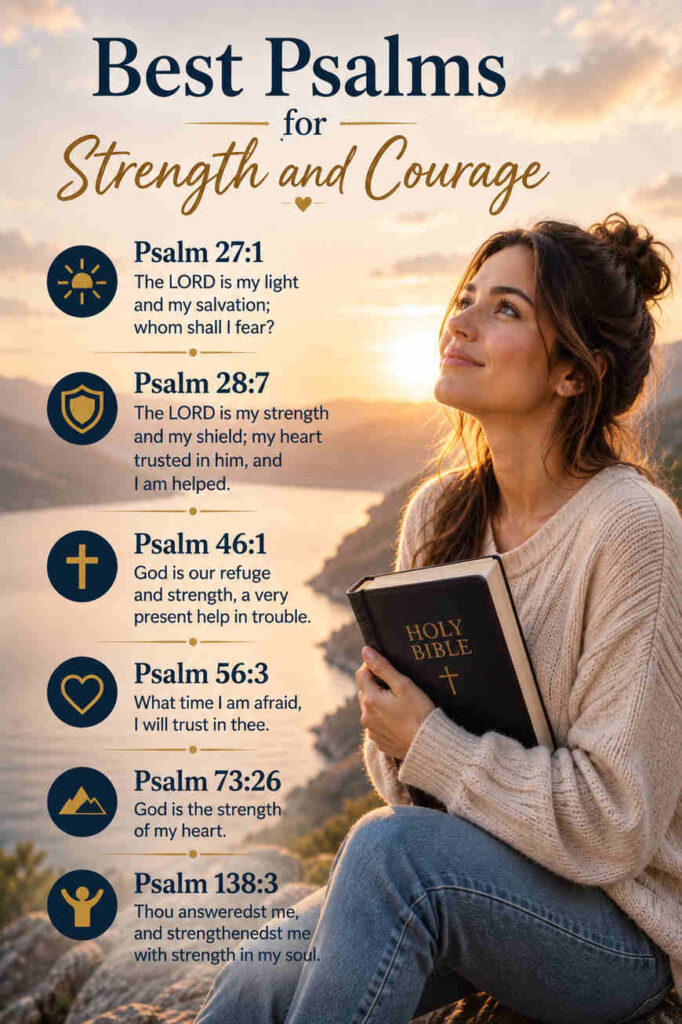
When you need strength, the Psalms do not pretend that fear or trouble do not exist. Instead, they repeatedly redirect the reader toward God.
Psalm 27:1
“The LORD is my light and my salvation; whom shall I fear?”
David does not deny danger. He responds to danger by remembering who God is.
Best for: fear, courage, uncertainty, and difficult circumstances.
Psalm 28:7
“The LORD is my strength and my shield; my heart trusted in him, and I am helped.”
The two images are important.
God is both strength and shield—the One who sustains and protects.
Best for: asking God for strength and protection.
Psalm 46:1
“God is our refuge and strength, a very present help in trouble.”
This is one of the strongest Psalms for difficult circumstances.
God is not described merely as a historical source of help. He is presented as a present help in trouble.
Best for: crisis, fear, uncertainty, and hardship.
Psalm 56:3
“What time I am afraid, I will trust in thee.”
This short verse is powerful because it does not pretend fear will never occur.
The pattern is:
fear → trust.
Best for: fear, uncertainty, and courage.
Psalm 73:26
Psalm 73 recognizes human weakness while affirming that God remains the strength of the heart.
Best for: seasons when you feel emotionally or spiritually exhausted.
Psalm 138:3
“In the day when I cried thou answeredst me, and strengthenedst me with strength in my soul.”
This verse is especially valuable because it focuses on strength within the soul.
Sometimes the prayer is not simply, “Change my circumstances,” but, “Give me strength to continue.”
Encouraging Psalms for Difficult Seasons
The most encouraging Psalms often acknowledge pain rather than ignoring it.
Psalm 30:5
“Weeping may endure for a night, but joy cometh in the morning.”
The verse contrasts temporary sorrow with renewed joy. It should not be read as a guarantee that every problem will be solved overnight.
Instead, it points toward hope beyond the present season.
Psalm 34:17–18
Psalm 34 speaks directly to people who are brokenhearted.
“The LORD is nigh unto them that are of a broken heart.”
The Psalm does not tell hurting people to pretend they are fine. It points them toward a God who is near.
Psalm 42:11
“Why art thou cast down, O my soul?”
Psalm 42 is particularly valuable because the writer honestly acknowledges discouragement.
The psalmist then calls himself back toward hope in God.
This makes Psalm 42 useful when faith and discouragement seem to exist at the same time.
Psalm 55:22
“Cast thy burden upon the LORD, and he shall sustain thee.”
The instruction is simple: bring the burden to God rather than carrying it alone.
Psalm 62:5–6
Psalm 62 encourages the soul to wait quietly for God because true hope comes from Him.
Best for: discouragement, waiting, uncertainty, and emotional exhaustion.
Famous and Popular Psalm Verses
If you are looking for famous Psalms Bible verses, these are among the passages many readers recognize immediately:
- Psalm 23:1 — The LORD is my shepherd.
- Psalm 23:4 — God is with me in the valley.
- Psalm 27:1 — The LORD is my light and salvation.
- Psalm 34:8 — Taste and see that the LORD is good.
- Psalm 34:18 — God is near the brokenhearted.
- Psalm 37:4 — Delight yourself in the LORD.
- Psalm 46:1 — God is our refuge and strength.
- Psalm 46:10 — Be still and know that He is God.
- Psalm 51:10 — Create in me a clean heart.
- Psalm 55:22 — Cast your burden upon the LORD.
- Psalm 56:3 — Trust God when you are afraid.
- Psalm 91:1 — Dwell under the shadow of the Almighty.
- Psalm 100:4 — Enter God’s gates with thanksgiving.
- Psalm 103:2 — Bless the LORD and remember His benefits.
- Psalm 118:24 — This is the day the LORD has made.
- Psalm 119:105 — God’s Word is a lamp.
- Psalm 121:2 — My help comes from the LORD.
- Psalm 139:14 — Fearfully and wonderfully made.
- Psalm 147:3 — God heals the brokenhearted.
- Psalm 150:6 — Let everything that has breath praise the LORD.
These passages are popular because they address universal needs: fear, hope, strength, love, guidance, protection, forgiveness, gratitude, and worship.
Psalms About God’s Love
The Psalms contain some of Scripture’s most beautiful language about God’s steadfast love and mercy.
Psalm 18:1
“I will love thee, O LORD, my strength.”
This is a direct expression of love for God.
David connects his love for God with God’s role as his strength.
Psalm 36:7
“How excellent is thy lovingkindness, O God!”
The verse describes God’s steadfast love as precious and protective.
Psalm 63:3
“Because thy lovingkindness is better than life, my lips shall praise thee.”
David’s experience of God’s love leads naturally to praise.
Psalm 103:8
“The LORD is merciful and gracious, slow to anger, and plenteous in mercy.”
This verse describes God’s character: mercy, grace, patience, and compassion.
Psalm 103:11
Psalm 103 uses the distance between heaven and earth as an image for the greatness of God’s mercy toward those who fear Him.
Psalm 136
Psalm 136 repeatedly returns to God’s enduring mercy. The repetition makes the entire Psalm useful for meditation on God’s faithfulness.
Psalms About Loving God
If you want Psalms that express love and longing for God, begin with:
- Psalm 18
- Psalm 31
- Psalm 63
- Psalm 84
- Psalm 116
- Psalm 119
Psalm 63 is particularly personal because David expresses a deep longing for God’s presence.
Powerful Psalms for Protection and Help
When people search for Psalms about protection, Psalm 91 and Psalm 121 are natural starting points.
Psalm 91
Psalm 91 begins:
“He that dwelleth in the secret place of the most High shall abide under the shadow of the Almighty.”
The Psalm uses images such as refuge, fortress, shadow, and shelter.
It should not be treated as a magical formula that guarantees nothing painful will ever happen. Its deeper message is confidence in God amid danger.
Psalm 121
Psalm 121 directs attention toward the source of help:
“My help cometh from the LORD, which made heaven and earth.”
It also emphasizes God’s continual watchfulness.
“He that keepeth thee will not slumber.”
Best for: protection, travel, uncertainty, and asking God to watch over someone.
Psalm 4:8
“I will both lay me down in peace, and sleep: for thou, LORD, only makest me dwell in safety.”
This is a particularly beautiful short Psalm verse for nighttime prayer.
Psalm 40:1–2
Psalm 40 describes waiting patiently for God and being lifted from a difficult place.
It is especially meaningful when help seems delayed.
Psalm 70:1
Psalm 70 is a brief and urgent prayer asking God to come quickly to the psalmist’s aid.
Psalm 86:7
“In the day of my trouble I will call upon thee: for thou wilt answer me.”
The verse provides a simple pattern for prayer:
trouble → call upon God → trust Him.
Beautiful Psalms to Read for Peace, Hope, and Reflection
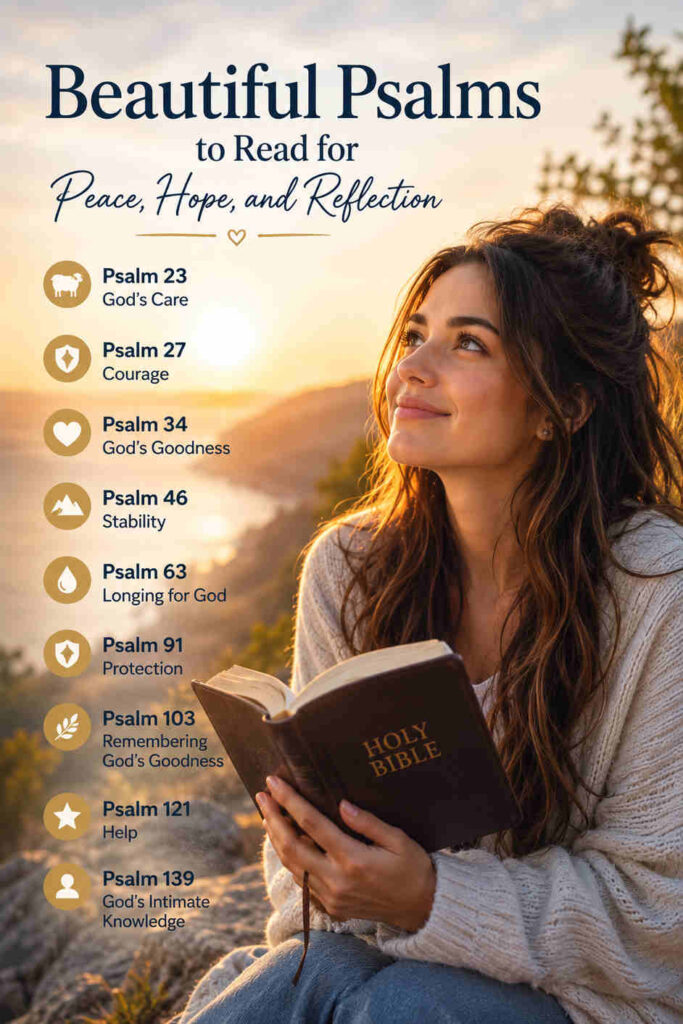
Sometimes you do not need a single quote. You need an entire Psalm.
Psalm 23 — God’s Care
Read Psalm 23 when you need to remember that God is your Shepherd.
Psalm 27 — Courage
Read Psalm 27 when fear or uncertainty is dominating your thoughts.
Psalm 34 — God’s Goodness
Read Psalm 34 when you need encouragement or comfort.
Psalm 46 — Stability
Read Psalm 46 when life feels chaotic or uncertain.
Psalm 63 — Longing for God
Read Psalm 63 when you feel spiritually dry or want to deepen your desire for God.
Psalm 91 — Protection
Read Psalm 91 when you are reflecting on God’s protection and refuge.
Psalm 103 — Remembering God’s Goodness
Read Psalm 103 when you need to remember God’s mercy and faithfulness.
Psalm 121 — Help
Read Psalm 121 when you need reassurance that God watches over you.
Psalm 139 — God’s Intimate Knowledge
Read Psalm 139 when you want to reflect on being completely known by God.
Psalms for Strength, Encouragement, and Courage
If you specifically want Psalms of strength and courage, these are excellent choices:
- Psalm 27 — confidence when facing fear
- Psalm 28 — God as strength and shield
- Psalm 31 — trust when surrounded by trouble
- Psalm 46 — God as refuge and strength
- Psalm 56 — trusting God when afraid
- Psalm 61 — asking God to lead you to a secure place
- Psalm 62 — waiting quietly for God
- Psalm 73 — trusting God when life seems unfair
- Psalm 91 — confidence in God’s protection
- Psalm 121 — looking to God for help
- Psalm 138 — strength for the soul
These passages cover both external circumstances and inner strength.
Psalms About Praise and Worship
The Psalms are not only prayers for help. They are also songs of praise.
Psalm 95
Psalm 95 calls God’s people to come before Him with thanksgiving and worship.
Psalm 96
Psalm 96 focuses on declaring God’s glory and proclaiming His greatness.
Psalm 100
Psalm 100 is one of the best-known Psalms of joyful thanksgiving.
“Make a joyful noise unto the LORD, all ye lands.”
Psalm 103
Psalm 103 begins:
“Bless the LORD, O my soul: and all that is within me, bless his holy name.”
The Psalm then calls the reader to remember God’s forgiveness, mercy, compassion, and other benefits.
Psalm 150
Psalm 150 brings the Psalter to its conclusion with an extensive call to praise God.
“Let every thing that hath breath praise the LORD. Praise ye the LORD.”
For Psalms about praising God, consider Psalm 95, Psalm 96, Psalm 98, Psalm 100, Psalm 103, Psalm 145, Psalm 146, Psalm 147, Psalm 148, Psalm 149, and Psalm 150.
Psalms About Life, Wisdom, and Guidance
The Psalms also provide wisdom for everyday decisions and the direction of life.
Psalm 1
Psalm 1 contrasts two ways of living.
The person who delights in God’s instruction is compared to a tree planted by streams of water.
It is an excellent Psalm to read when thinking about the direction and foundation of your life.
Psalm 37
Psalm 37 deals with a difficult question: why do wicked people sometimes appear to prosper?
The Psalm repeatedly encourages the reader to trust God rather than become consumed by comparison.
Psalm 119
Psalm 119 repeatedly celebrates God’s Word as a source of wisdom and direction.
Its famous verse says:
“Thy word is a lamp unto my feet, and a light unto my path.”
This makes Psalm 119 particularly meaningful when you need guidance.
Psalm 90 Explained: Numbering Our Days and Finding Purpose
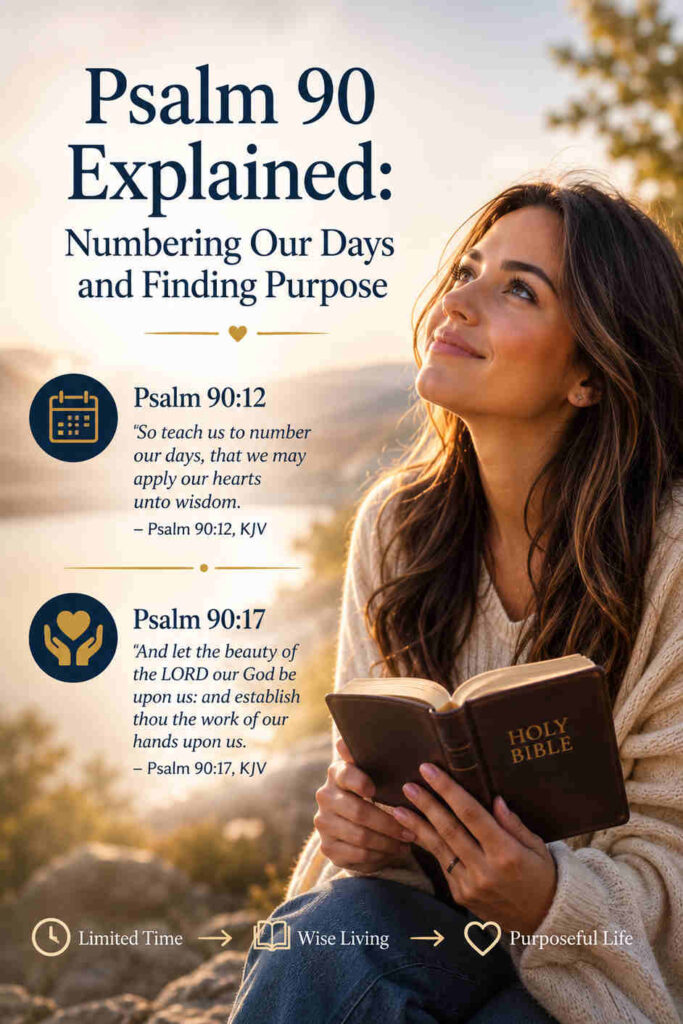
Psalm 90 is traditionally associated with Moses and has a distinctive emphasis on the contrast between God’s eternity and human mortality.
The Psalm reflects on the brevity of life and then turns that realization into prayer.
Psalm 90:12 Meaning
“So teach us to number our days, that we may apply our hearts unto wisdom.” — Psalm 90:12, KJV
To “number our days” is not simply to count them.
The prayer asks God to help us recognize that our lives are limited so that we can live wisely.
The verse therefore connects three ideas:
limited time → wise living → purposeful life.
This makes Psalm 90:12 meaningful when you are thinking about:
- your priorities
- how you spend your time
- important decisions
- your purpose
- the brevity of life
- living wisely
Psalm 90:17 Meaning
Psalm 90 ends with a prayer for God’s favor and meaningful work:
“And let the beauty of the LORD our God be upon us: and establish thou the work of our hands upon us.” — Psalm 90:17, KJV
After reflecting on mortality, the Psalm does not end in hopelessness.
Instead, it asks God to establish the work of His people.
The message is powerful:
Our lives are temporary, but we can still ask God to give purpose and lasting value to what we do.
Psalm 90:12 and Psalm 90:17 therefore work beautifully together. First, ask God for wisdom because life is short. Then ask Him to establish the work of your hands.
Psalms About the Holy Spirit
Several passages in Psalms refer directly to God’s Spirit.
Psalm 51:11
“Take not thy holy spirit from me.”
David’s prayer comes in the context of confession and repentance. He is asking God not to abandon him.
Psalm 104:30
Psalm 104 connects God’s Spirit with the giving and renewal of life in creation.
Psalm 139:7
“Whither shall I go from thy spirit?”
The verse emphasizes the inescapable presence of God’s Spirit.
Psalm 143:10
Psalm 143 asks God to let His good Spirit lead the psalmist on level ground.
Together, these passages can be used when reflecting on God’s presence, spiritual renewal, creation, and guidance.
Psalm Verses for Women
The Psalms are not restricted to one audience, but several passages are particularly meaningful for women seeking comfort, identity, strength, and a deeper relationship with God.
Psalm 139:13–14
These verses describe being formed and known by God and are often used when reflecting on identity and human worth.
Psalm 46:5
This verse emphasizes God’s presence in the midst of His people.
Psalm 71:5–6
Psalm 71 reflects on trusting God throughout life, including from the earliest stages of life.
Psalm 34:4–5
These verses speak about seeking God and being delivered from fear.
Psalm 62:8
“Trust in him at all times; ye people, pour out your heart before him.”
This is especially valuable as a reminder that honest emotion can be brought to God in prayer.
These are not exclusively “women’s verses.” The Psalms speak to all believers. They are simply passages that can be especially meaningful in women’s devotional reading.
Psalms to Pray for Other People
The Psalms can also become prayers for friends, family members, churches, communities, and people facing difficult circumstances.
Psalm 20
A natural Psalm to use when praying for someone facing an important challenge.
Psalm 67
Useful when praying for God’s blessing and for His ways to be known.
Psalm 121
A fitting passage when praying for someone’s protection or journey.
Psalm 122
A Psalm that can guide prayer for peace.
Psalm 128
A Psalm associated with blessing, reverence for God, and family life.
You do not have to repeat a Psalm word for word. You can take its themes and turn them into a personal prayer.
For example:
“Lord, be my friend’s refuge and strength. Give them wisdom, protect them in their difficulty, and help them trust You.”
Short Psalm Verses to Remember
If you want short Psalm verses that are easy to memorize, these are excellent choices:
“The LORD is my shepherd.” — Psalm 23:1
“Whom shall I fear?” — Psalm 27:1
“O taste and see that the LORD is good.” — Psalm 34:8
“God is our refuge and strength.” — Psalm 46:1
“Be still, and know that I am God.” — Psalm 46:10
“What time I am afraid, I will trust in thee.” — Psalm 56:3
“Cast thy burden upon the LORD.” — Psalm 55:22
“This is the day which the LORD hath made.” — Psalm 118:24
“Thy word is a lamp unto my feet.” — Psalm 119:105
“My help cometh from the LORD.” — Psalm 121:2
These short Psalm quotes work well for memorization, prayer, journaling, daily Scripture reading, and encouragement.
The Best Psalms to Read for Different Situations
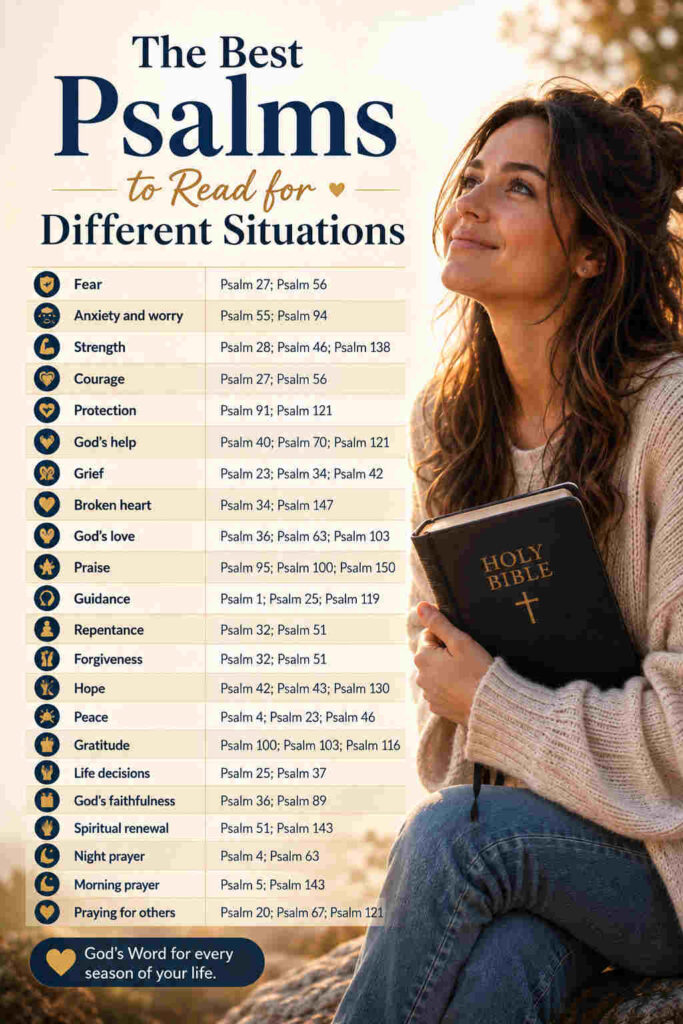
Rather than asking only which Psalm is the best, consider which Psalm fits what you are facing.
| Situation | Psalms to Read |
|---|---|
| Fear | Psalm 27; Psalm 56 |
| Anxiety and worry | Psalm 55; Psalm 94 |
| Strength | Psalm 28; Psalm 46; Psalm 138 |
| Courage | Psalm 27; Psalm 56 |
| Protection | Psalm 91; Psalm 121 |
| God’s help | Psalm 40; Psalm 70; Psalm 121 |
| Grief | Psalm 23; Psalm 34; Psalm 42 |
| Broken heart | Psalm 34; Psalm 147 |
| God’s love | Psalm 36; Psalm 63; Psalm 103 |
| Praise | Psalm 95; Psalm 100; Psalm 150 |
| Guidance | Psalm 1; Psalm 25; Psalm 119 |
| Repentance | Psalm 32; Psalm 51 |
| Forgiveness | Psalm 32; Psalm 51 |
| Hope | Psalm 42; Psalm 43; Psalm 130 |
| Peace | Psalm 4; Psalm 23; Psalm 46 |
| Gratitude | Psalm 100; Psalm 103; Psalm 116 |
| Life decisions | Psalm 25; Psalm 37 |
| God’s faithfulness | Psalm 36; Psalm 89 |
| Spiritual renewal | Psalm 51; Psalm 143 |
| Night prayer | Psalm 4; Psalm 63 |
| Morning prayer | Psalm 5; Psalm 143 |
| Praying for others | Psalm 20; Psalm 67; Psalm 121 |
The advantage of this approach is that you are not choosing a verse simply because it is popular. You are choosing Scripture that speaks to your actual situation.
The Most Popular Psalms to Read
If you want a broader list of popular Psalms from the Bible, begin with these:
- Psalm 1
- Psalm 19
- Psalm 23
- Psalm 27
- Psalm 34
- Psalm 37
- Psalm 40
- Psalm 42
- Psalm 46
- Psalm 51
- Psalm 63
- Psalm 84
- Psalm 90
- Psalm 91
- Psalm 100
- Psalm 103
- Psalm 118
- Psalm 119
- Psalm 121
- Psalm 139
- Psalm 150
This is not a ranking of which Psalms are objectively “best.” It is a practical reading list covering many of the subjects people commonly seek: comfort, strength, protection, love, praise, guidance, repentance, wisdom, hope, and God’s presence.
The Best Psalms Chapters to Read
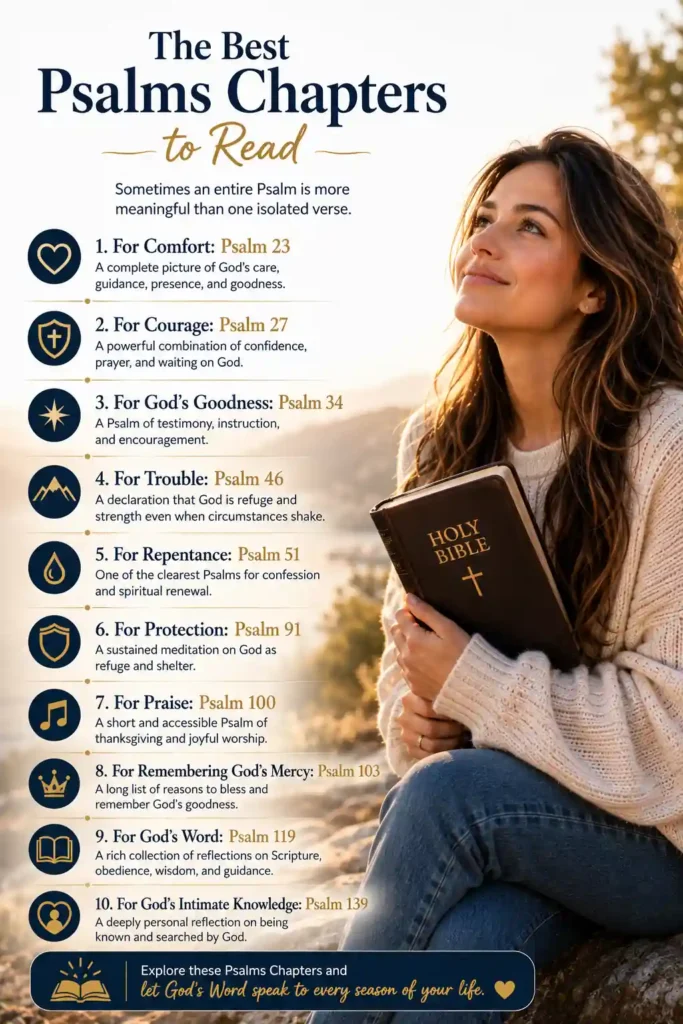
Sometimes an entire Psalm is more meaningful than one isolated verse.
For Comfort: Psalm 23
A complete picture of God’s care, guidance, presence, and goodness.
For Courage: Psalm 27
A powerful combination of confidence, prayer, and waiting on God.
For God’s Goodness: Psalm 34
A Psalm of testimony, instruction, and encouragement.
For Trouble: Psalm 46
A declaration that God is refuge and strength even when circumstances shake.
For Repentance: Psalm 51
One of the clearest Psalms for confession and spiritual renewal.
For Protection: Psalm 91
A sustained meditation on God as refuge and shelter.
For Praise: Psalm 100
A short and accessible Psalm of thanksgiving and joyful worship.
For Remembering God’s Mercy: Psalm 103
A long list of reasons to bless and remember God’s goodness.
For God’s Word: Psalm 119
A rich collection of reflections on Scripture, obedience, wisdom, and guidance.
For God’s Intimate Knowledge: Psalm 139
A deeply personal reflection on being known and searched by God.
Psalms Jesus Quoted and Psalms Connected to Jesus
The Psalms are also important for understanding how the New Testament presents Jesus.
The New Testament connects several Psalms with Jesus, His ministry, His suffering, His kingship, and His resurrection.
Important examples include:
- Psalm 22 — connected with Jesus’ crucifixion
- Psalm 31:5 — echoed in Jesus’ words recorded in Luke
- Psalm 35 — associated with opposition to God’s anointed
- Psalm 69 — frequently applied to events surrounding Jesus
- Psalm 110 — extensively used in the New Testament
- Psalm 118 — connected with Jesus’ triumphal entry and resurrection themes
Psalm 22 is particularly significant because Jesus’ cry from the cross begins with its opening words:
“My God, my God, why hast thou forsaken me?”
Reading these Psalms in context is important. A verse can have significance in its original Psalm while also being interpreted by the New Testament in relation to Christ.
How Many Verses Are in Psalms?
The Book of Psalms contains 150 individual Psalms.
Using traditional English verse numbering, there are 2,461 verses in the Psalter. Verse numbering can vary somewhat between Bible traditions because of differences in how certain passages are divided.
Some useful facts:
- 150 individual Psalms
- Psalm 119 is the longest chapter in the Bible
- Psalm 117 is the shortest chapter in the Bible
- Psalm 23 has 6 verses
- Psalm 90 has 17 verses
- Psalm 150 has 6 verses
Because the Psalms cover so many subjects, there is no single “best Psalm” for every reader or every situation.
How to Choose the Right Psalm
If you are not sure what to read, begin with your present need.
If You Are Afraid
Read Psalm 27 or Psalm 56.
If You Feel Overwhelmed
Read Psalm 55.
If You Need Protection
Read Psalm 91 or Psalm 121.
If You Are Grieving
Read Psalm 23, Psalm 34, or Psalm 42.
If You Need Strength
Read Psalm 46 or Psalm 138.
If You Need Forgiveness
Read Psalm 51.
If You Need Guidance
Read Psalm 25 or Psalm 119.
If You Want to Praise God
Read Psalm 100 or Psalm 150.
If You Need to Remember God’s Goodness
Read Psalm 103.
If You Are Thinking About Your Purpose and Time
Read Psalm 90.
If You Feel Spiritually Distant
Read Psalm 42 or Psalm 63.
The best Psalm is often not the one with the highest popularity. It is the one that helps you bring your actual situation honestly before God.
How to Pray the Psalms
You do not need complicated words to pray Scripture.
A simple approach is enough.
1. Read the Psalm Slowly
Pay attention to repeated words, emotions, requests, and descriptions of God.
2. Understand the Context
Ask:
- Who is speaking?
- What is happening?
- What is the writer asking God to do?
- What does the Psalm reveal about God?
3. Turn the Themes Into Your Own Prayer
After reading Psalm 23, for example, you might pray:
“Lord, You are my Shepherd. Lead me when I do not know which way to go. Give me rest when I am exhausted, and stay with me when I am afraid.”
4. Respond With Trust
Many Psalms move from trouble toward remembrance of God’s character.
Let that movement shape your own prayer.
Frequently Asked Questions About the Best Bible Verses from Psalms
What Is the Most Famous Psalm?
Psalm 23 is widely regarded as one of the most famous and beloved Psalms. Its opening picture of the LORD as a shepherd has made it especially familiar in worship, prayer, funerals, and personal devotion.
What Are the Best Psalms to Read?
Start with Psalm 23 for God’s care, Psalm 27 for courage, Psalm 34 for encouragement, Psalm 46 for strength, Psalm 51 for repentance, Psalm 91 for protection, Psalm 100 for praise, Psalm 103 for God’s mercy, Psalm 121 for help, and Psalm 139 for God’s intimate knowledge.
What Is the Best Psalm for Strength?
Psalm 46 is one of the clearest choices because it describes God as “our refuge and strength.” Psalm 27, Psalm 28, Psalm 56, Psalm 73, and Psalm 138 are also excellent for strength and courage.
What Is the Best Psalm for Courage?
Psalm 27:1 is an excellent choice:
“The LORD is my light and my salvation; whom shall I fear?”
Psalm 56:3 is another short and memorable passage about trusting God when afraid.
What Is the Best Psalm for God’s Help?
Psalm 121 is one of the clearest choices. Psalm 121:2 says:
“My help cometh from the LORD, which made heaven and earth.”
What Psalm Is About God’s Love?
Psalm 63, Psalm 103, and Psalm 136 are excellent Psalms for reflecting on God’s steadfast love and mercy. Psalm 18:1 also directly expresses love for God.
What Are Some Psalms About Love?
Psalm 18:1 expresses love for God, Psalm 63 speaks about God’s lovingkindness, Psalm 103 describes His mercy, and Psalm 136 repeatedly celebrates His enduring mercy.
What Are the Most Popular Psalms?
Psalm 23, Psalm 27, Psalm 34, Psalm 37, Psalm 46, Psalm 51, Psalm 91, Psalm 100, Psalm 103, Psalm 118, Psalm 119, Psalm 121, Psalm 139, and Psalm 150 are among the most widely recognized Psalms.
What Is Psalm 23 About?
Psalm 23 presents God as a Shepherd who provides, guides, restores, protects, and remains present with His people. Its central message is trust in God’s care even when life passes through dark valleys.
What Is the Meaning of Psalm 23?
Psalm 23 teaches that God can be trusted as the faithful Shepherd. He provides what His people need, leads them in righteous paths, remains with them in danger, and continues to show goodness and mercy.
How Many Verses Are in the Book of Psalms?
There are 150 individual Psalms and, using traditional English verse numbering, 2,461 verses in total.
What Is a Good Short Psalm Verse?
Psalm 56:3 is an excellent short verse:
“What time I am afraid, I will trust in thee.”
Psalm 121:2 is another:
“My help cometh from the LORD.”
What Are the Best Psalms for Protection?
Psalm 91 and Psalm 121 are two of the best-known Psalms for protection. Psalm 23 and Psalm 4 also provide powerful language about God’s presence and safety.
What Are the Best Psalms for Encouragement?
Psalm 23, Psalm 27, Psalm 34, Psalm 42, Psalm 46, Psalm 55, Psalm 56, Psalm 62, and Psalm 121 are excellent choices when you need encouragement.
What Are the Best Psalms to Pray for Others?
Psalm 20, Psalm 67, and Psalm 121 can all be incorporated into prayer for other people. You can also use the themes of Psalm 23, Psalm 91, and Psalm 103 when praying for someone’s care, protection, or spiritual well-being.
What Are the Most Beautiful Psalms?
Beauty is subjective, but Psalm 23, Psalm 27, Psalm 63, Psalm 84, Psalm 103, Psalm 121, and Psalm 139 are especially rich in imagery and devotion.
What Psalms Mention the Holy Spirit?
Psalm 51:11, Psalm 104:30, Psalm 139:7, and Psalm 143:10 refer directly to God’s Spirit, including themes of His presence, life-giving work, and guidance.
What Are Good Psalm Verses for Women?
Psalm 139:13–14, Psalm 46:5, Psalm 71:5–6, Psalm 34:4–5, and Psalm 62:8 can be especially meaningful for women seeking Scripture about identity, comfort, strength, and bringing their hearts honestly before God.
What Is Psalm 90:12 About?
Psalm 90:12 is a prayer asking God to teach us to recognize the limited nature of human life so that we may live wisely.
What Is Psalm 90:17 About?
Psalm 90:17 asks God to establish the work of His people’s hands. It is a prayer for God’s favor, purpose, and lasting value in the work we do.
What Is Psalm 90 About as a Whole?
Psalm 90 contrasts God’s eternity with human mortality, reflects on the brevity of life, and then turns that realization into a prayer for wisdom and meaningful work.
Final Encouragement: Start With the Psalm You Need Today
The Book of Psalms is much more than a collection of famous Bible quotes.
It is a collection of prayers, songs, laments, confessions, praises, questions, declarations of faith, and expressions of hope.
That is why the Psalms can meet you in so many different circumstances.
If you are afraid, read Psalm 27.
If you need rest, read Psalm 23.
If you need strength, read Psalm 46.
If you are brokenhearted, read Psalm 34.
If you need protection, read Psalm 91.
If you need help, read Psalm 121.
If you need forgiveness, read Psalm 51.
If you need to remember God’s goodness, read Psalm 103.
If you need wisdom about your limited time, read Psalm 90.
And if you simply want to praise God, turn to Psalm 100 or Psalm 150.
You do not have to read all 150 Psalms at once. Start with the one that speaks to your present season. Read it slowly. Consider its context. Turn its words into prayer. Then allow its message to direct your attention back to God.
The best Psalm is not necessarily the one that is most famous.
It is often the one that helps you seek God faithfully in the situation you are actually facing.