

Travel Verses In The Bible: Safe Journeys and God’s Guidance
Travel can be exciting, but it rarely arrives without a little uncertainty attached. A long drive, a flight, an unfamiliar country, a child leaving home for the first time — any of these can turn our thoughts toward safety, direction, and whether God is really with us once we step outside the routine we know.
Scripture never files its material under a heading called “travel verses,” yet journeys run through almost every major storyline it tells. Abraham left his homeland on the strength of a promise, not a map. Israel crossed a wilderness under God’s visible leading. Jesus and His disciples moved constantly between towns. Paul logged more travel miles than nearly any other figure in the Bible — and endured storms, danger, and shipwreck doing it.
That history gives us something sturdier than a stack of protection verses. Scripture speaks to safe journeys, God’s presence, guidance, anxiety, changing plans, mission, pilgrimage, and the discipline of trusting God when the road ahead is genuinely unclear.
The passages below are sorted by what they actually say, not by whether they merely contain the word “go.” Each one is explained in its original context, then connected to the traveler’s situation it fits best — so you can choose Scripture with confidence rather than guesswork.
What Does the Bible Actually Say About Travel?
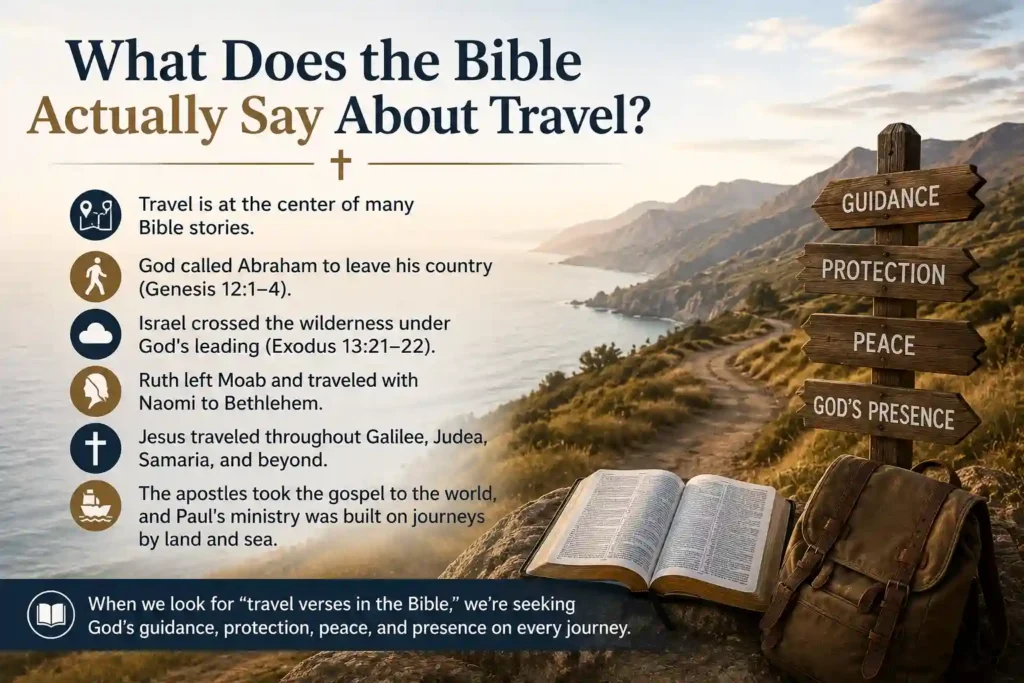
Travel is not a footnote in the Bible. Movement from one place to another sits at the center of many of its defining stories.
God called Abraham to leave his country and go to a land he had not yet seen (Genesis 12:1–4). Israel crossed the wilderness under God’s direct leading (Exodus 13:21–22). Ruth left Moab and traveled with Naomi to Bethlehem. Jesus moved constantly through Galilee, Judea, Samaria, and the regions beyond. The apostles carried the gospel by traveling to reach people, and Paul’s ministry was built almost entirely on journeys by land and sea.
So when someone searches for “travel verses in the Bible,” they’re really asking about several related but distinct kinds of Scripture.
Travel Is Part of the Bible’s Story
Some passages are literally about journeys. Ezra 8:21–23 describes a community preparing to travel and seeking God for protection before they set out. James 4:13–15 addresses people making plans to go to a specific city. Acts records missionary journeys, redirected plans, storms, and a shipwreck in detail.
Other passages borrow journey language to teach something larger. Psalm 121 carries strong pilgrimage associations while ultimately teaching a broader truth: God’s continual keeping of His people.
Scripture, then, offers two related resources: narratives and passages about actual journeys, and broader texts that can be faithfully applied to the experience of traveling. Knowing which is which keeps the article — and your prayer life — honest.
Literal Travel Verses vs. Verses Applied to Travel
A useful way to read travel Scripture is to sort passages into categories:
| Classification | What it means | Examples |
| Explicit travel | The immediate context involves a journey or going somewhere | Ezra 8:21–23; James 4:13–15; Acts 27 |
| Journey or pilgrimage | Travel or pilgrimage imagery sits at the center of the passage | Psalm 121; Psalm 84:5 |
| God’s presence while going | Scripture emphasizes God’s presence, leading, or keeping | Genesis 28:15; Deuteronomy 31:8; Exodus 33:14 |
| Protection and peace applied to travel | The passage is broader in scope but naturally fits travelers | Psalm 91; Philippians 4:6–7 |
| Spiritual journey | Travel language mainly pictures faith or life with God | Hebrews 11:8–16; Psalm 119:105 |
These categories describe how each passage functions in this guide — not a claim that it was originally composed for modern travelers. That distinction matters, because not every verse containing the word “path,” “way,” or “go” is a travel passage in any meaningful sense.
Does the Bible Promise Every Journey Will Be Safe?
No. Scripture consistently invites believers to trust God, seek His wisdom, pray for protection, and rest in His presence — but it never promises that faithful Christians will travel without incident.
Paul’s own record settles the question. He lists dangers he faced on his journeys, including hazards at sea and in the wilderness (2 Corinthians 11:26), and Acts 27 puts him through a violent storm and a shipwreck.
That doesn’t make travel Scripture less useful — it makes it more honest. Biblical confidence runs deeper than the hope that nothing difficult will happen. The consistent message is that God can be trusted in the journey, including when it goes nothing like planned.
The Best Bible Verses for Travel at a Glance

If you need a passage right now, start here. The “best” verse depends less on popularity and more on what you’re actually facing.
| Need | Best passage | Why it fits |
| Overall travel | Psalm 121:1–8 | Strong journey imagery paired with God’s continual keeping |
| Safe journey | Ezra 8:21–23 | God’s people explicitly seek Him for a safe journey |
| Protection | Psalm 91:1–16 | Portrays God as refuge and protector |
| God’s presence | Genesis 28:15 | God promises to be with Jacob, keep him, and bring him home |
| Guidance | Proverbs 3:5–6 | Calls believers to trust God for direction |
| Travel plans | James 4:13–15 | Directly addresses planning a future journey |
| Changing plans | Proverbs 16:9 | Human planning held alongside God’s direction |
| Travel anxiety | Philippians 4:6–7 | Connects anxiety, prayer, thanksgiving, and peace |
| Traveling abroad | Psalm 139:9–10 | God’s presence reaches even the far side of the sea |
| Mission travel | Matthew 28:18–20 | Jesus commands His followers to go and promises His presence |
| A Psalm for travel | Psalm 121 | Its “going out and coming in” language makes it the natural choice |
| Short travel verse | Psalm 121:8 | A compact line about God’s care over departure and return |
If you only take one passage with you, make it Psalm 121. If your specific concern is praying for a safe journey, give extra weight to Ezra 8:21–23 — it’s the rare passage that shows God’s people actually doing that.
Bible Verses for Safe Travel and Protection
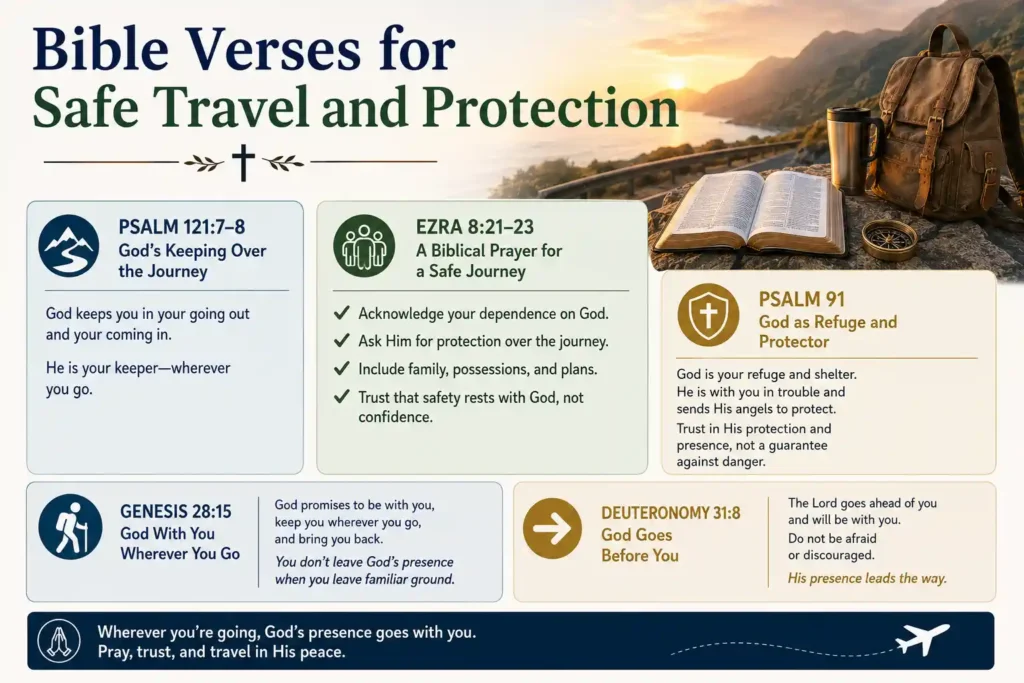
Psalm 121:7–8 — God’s Keeping Over the Journey
Psalm 121 is the passage most closely tied to travel in Christian devotional use, and for good reason. It belongs to the Songs of Ascents (Psalms 120–134), a collection long associated with pilgrimage and the ascent toward Jerusalem.
Its closing verses describe God keeping His people in their going out and their coming in — language that fits someone leaving home, starting a road trip, boarding a flight, or praying over a loved one’s safe return.
But the psalm’s message runs wider than transportation safety. Its real emphasis is God’s unbroken watchfulness. The traveler isn’t being told that nothing can go wrong; the deeper claim is that God is the keeper of His people wherever they go.
Ezra 8:21–23 — A Biblical Prayer for a Safe Journey
Ezra 8 offers one of the most directly relevant passages available to anyone searching Scripture before a trip.
Ezra was leading a group of exiles back toward Jerusalem. Before departure, he called the people to fast and seek God for protection over the journey — for themselves, their children, and everything they carried.
What makes this different from a general protection verse applied after the fact is simple: a real community was actually preparing to travel, and they deliberately sought God about that specific journey.
The passage offers a workable model for pre-travel prayer:
- Acknowledge your dependence on God rather than your own preparation.
- Ask Him directly for protection over the journey ahead.
- Bring your family and responsibilities into the prayer by name.
- Recognize that a safe journey ultimately rests on God, not on confidence alone.
Ezra 8 doesn’t promise that prayer guarantees an incident-free trip. It shows the posture of people who hand a journey over to God before they take the first step.
Psalm 91 — God as Refuge and Protector
Psalm 91 is one of the most frequently quoted passages whenever fear of danger enters the conversation.
Its central image is God as refuge and shelter — care over those who trust Him, presence in trouble, protection pictured through the imagery of angels. That imagery belongs to a larger poetic portrait of God as refuge; it isn’t a formula that renders harm impossible.
Travel exposes people to unfamiliar risk, so Psalm 91 naturally comes to mind before a trip. It can anchor a traveler’s confidence in the right place.
Still, it deserves careful handling. It shouldn’t be treated as though reciting it prevents an accident, a delayed diagnosis, or any other tragedy. Faithful people in Scripture suffer — the appropriate application here is trust in God’s protection and presence, not a guarantee against danger.
Genesis 28:15 — God With You Wherever You Go
As Jacob leaves home, God makes him a striking promise: He will be with him, keep him wherever he goes, and eventually bring him back.
Few passages speak as directly to someone stepping into unfamiliar circumstances. It applies naturally to leaving home, relocating, studying or working abroad, traveling alone, or simply hoping to return safely from an uncertain trip.
The point isn’t “nothing bad will happen.” It’s “you don’t leave God’s presence when you leave familiar ground.”
Deuteronomy 31:8 — God Goes Before You
Moses tells Israel that the Lord goes ahead of them and will be with them, and urges them not to be afraid or discouraged.
Travelers often treat the road ahead as something they alone must figure out. This verse redirects that instinct toward God’s presence and guidance — especially fitting when the destination is unfamiliar or the traveler feels genuinely unsure of what’s coming.
Bible Verses for Guidance and Travel Plans
Travel isn’t only a safety question. It’s a string of decisions. Where should I go? Should my plans change? What happens when the itinerary falls apart or the opportunity I expected disappears?
Scripture has more to say about these questions than most travel guides acknowledge.
Proverbs 3:5–6 — Trust God for Direction
Proverbs 3:5–6 calls believers to trust the Lord rather than lean entirely on their own understanding, and to acknowledge Him in every decision.
This is one of the most practically useful verses for travel planning because it addresses the attitude behind the decision, not the decision itself. It doesn’t ask Christians to stop planning, checking routes, or booking transportation. It asks them to recognize the limits of their own view and hold their plans open to God.
Genesis 24:12–14 — Prayer for Guidance on a Journey
Genesis 24 gives another unusually direct example of prayer offered mid-journey. Abraham’s servant, sent to find a wife for Isaac, asks God for clear guidance about how the mission will unfold.
The passage widens what “seeking God during travel” can mean. A journey isn’t only about physical safety — it can involve decisions, uncertainty, and responsibilities that call for wisdom. Read alongside Proverbs 3:5–6, it gives you language for a different kind of prayer: asking for God’s direction when you don’t yet know how the trip or its purpose will turn out.
Proverbs 16:9 — When Your Plans Change
Proverbs 16:9 offers a simple but far-reaching picture: people plan their course, but God establishes their steps.
That makes it especially fitting when a trip doesn’t go the way you expected. A delayed flight, a missed connection, a closed road, or a shifted itinerary can be frustrating precisely because travel tends to give us the illusion of control.
This verse offers a different posture: plan carefully, but hold the plan loosely enough to trust God when it changes.
James 4:13–15 — Planning a Journey Under God’s Will
James 4 contains one of Scripture’s clearest pictures of people describing a future trip as though its outcome were already secured — they say they’ll go to a certain city, stay a year, do business, and turn a profit.
The problem isn’t the planning. It’s the assumption that the future is fully within human control.
James calls his readers back to humility: acknowledge God’s will inside the plan. For a modern traveler, that distinction is practical, not abstract. Booking a trip and building an itinerary are reasonable steps; assuming the itinerary is guaranteed is not.
A Christian approach to travel can hold both at once — careful preparation and real humility: “This is my plan, and I entrust the outcome to God.”
Acts 16:6–10 — When God Redirects the Journey
Paul and his companions run into restrictions on where they can go, then receive a vision that redirects their mission toward Macedonia.
It’s a missionary journey rather than a vacation, but it offers a genuinely useful picture of redirected plans. Sometimes a closed door is nothing more than logistics. Sometimes it leads somewhere you didn’t expect. Either way, the passage encourages attentiveness rather than the assumption that every disruption is a failure.
For any traveler, the takeaway holds: a changed route isn’t automatically a wasted one.
Bible Verses for God’s Presence Wherever You Go
Sometimes the deepest concern about travel isn’t danger — it’s loneliness. You’re far from home, surrounded by unfamiliar faces, unable to speak the local language, or simply missing the people you love.
Scripture speaks to that concern just as directly as it speaks to safety.
Genesis 28:15 — You Do Not Leave God Behind
Jacob is leaving home for an uncertain future when God assures him of His presence and His keeping. Few passages speak as clearly to someone who feels that distance from home means distance from God. It doesn’t.
Exodus 33:14 — God’s Presence and Rest
When Moses hesitates about moving forward, God answers with His presence — going with His people and giving them rest.
This adds a dimension that protection verses can miss. Sometimes what a traveler needs most isn’t another assurance about avoiding danger, but the simple confirmation that God is accompanying them — through exhaustion, unfamiliar surroundings, cultural adjustment, or long stretches away from home.
Psalm 139:9–10 — Even Across the Sea
Psalm 139 pictures reaching the far side of the sea and still finding God there — language that fits international and long-distance travel especially well.
The distance may be enormous, but God’s presence isn’t bound by geography. The psalm ties distance directly to God’s continuing guidance and support. For anyone traveling to another country, it offers a clear reminder: a new country is not a place where God has stopped being present.
Joshua 1:9 — Courage When the Destination Feels Unfamiliar
God commands Joshua to be strong and courageous because the Lord is with him wherever he goes. Its original setting concerns Joshua’s leadership of Israel rather than vacation travel, so it shouldn’t be marketed as a travel-specific verse. But its emphasis on courage and God’s presence applies naturally to anyone facing unfamiliar ground.
Bible Verses for Specific Travel Situations
General categories like protection and guidance cover most of what a traveler needs, but a few situations deserve their own word.
Traveling Alone
Solo travel carries its own emotional weight — navigating an unfamiliar place with no one to share the decision-making, no one to notice if something goes wrong, and often, no one to talk to at the end of the day.
Psalm 139:7–10 speaks directly into that isolation: there is nowhere you can go that places you outside God’s presence, not even the far side of the sea. Genesis 28:15 adds the promise of God’s company through the specific stretch of unfamiliar territory ahead. Neither verse erases the practical loneliness of solo travel, but both reframe it — you are unaccompanied by people, not by God.
Traveling With Children
Family travel adds a second layer of concern: it’s no longer only your own safety and judgment in view, but someone else’s.
Psalm 121:7–8 fits naturally here, since its language of “going out and coming in” covers the whole household, not one traveler. Deuteronomy 31:8 — God going before His people — gives a parent language for the specific fear of leading a child into the unknown. A short, practical habit: pray Psalm 121 aloud as a family before departure. It gives children a memorable, repeatable way to connect travel with trust rather than fear.
What Does “Traveling Mercies” Mean?
“Traveling mercies” is a familiar Christian expression used when asking God to watch over someone during a journey.
The phrase is common in Christian speech, but it isn’t itself a biblical verse or a formal phrase drawn from Scripture. When Christians pray for traveling mercies, they’re generally asking God for protection, guidance, wisdom, peace, and a safe arrival — all in one shorthand request.
Several passages support that prayer directly, especially Ezra 8:21–23 and Psalm 121. The distinction worth keeping is between a Christian expression and the actual wording of Scripture. “May God grant you traveling mercies” is a meaningful prayer; the Bible’s teaching is found in the passages behind it.
Bible Verses for Travel Anxiety, Fear and Uncertainty
Travel anxiety shows up in different forms: fear of flying, fear of an accident, worry about family members left behind, discomfort with an unfamiliar destination, or simply the loss of control that travel forces on us.
Scripture doesn’t shame people for feeling afraid. It repeatedly points anxious people toward trust, prayer, God’s presence, and peace instead.
Philippians 4:6–7 — Turn Anxiety Into Prayer
Philippians 4:6–7 may be the strongest single passage for someone anxious before a trip. Paul connects anxiety directly to bringing concerns to God through prayer and thanksgiving, with God’s peace guarding the believer’s heart and mind as the result.
That doesn’t mean the nervousness vanishes instantly. It means the anxiety has somewhere to go. Before a flight, for example, you can name the specific fear to God instead of rehearsing the worst-case outcome on a loop.
John 14:27 — Receive Christ’s Peace
Jesus tells His disciples that He gives them peace and tells them not to let their hearts be troubled or afraid — especially fitting when travel anxiety is less about the destination and more about an internal, hard-to-name fear.
The point isn’t pretending danger doesn’t exist. It’s that fear doesn’t have to run the journey.
Matthew 6:25–34 — Do Not Live Under Tomorrow’s Burden
Jesus’ teaching on worry confronts the habit of living inside every possible future outcome: What if the flight is delayed? What if I get lost? What if I can’t handle it? He redirects that attention toward trusting God rather than rehearsing an uncertain future.
Isaiah 41:10 and 2 Timothy 1:7 — Courage Instead of Fear
Isaiah 41:10 rests on God’s help and strengthening presence. 2 Timothy 1:7 contrasts a spirit of fear with power, love, and self-control. Neither passage is specifically about airports or highways — they’re broader texts that apply meaningfully whenever fear becomes the central issue, and that distinction is worth preserving rather than blurring.
What Does Jesus Say About Traveling?
Jesus never issued a modern travel-safety checklist, but His teaching contains real principles about going, mission, anxiety, dependence, and presence.
His direct instructions about travel were primarily tied to mission and discipleship, while His teaching on anxiety and His promise of presence give broader principles that also speak to ordinary travel.
Jesus Sent His Disciples to Go
In Matthew 10 and Luke 10, Jesus sends His disciples into towns with specific instructions. These passages show that biblical travel can involve dependence, hospitality, service, peace, and mission — not just reaching a destination.
Luke 10 is especially interesting because Jesus gives practical instructions to people already going from place to place, tied to a larger purpose: announcing God’s kingdom and serving the people they meet along the way.
Jesus and the Great Commission
In Matthew 28:18–20, Jesus commands His followers to make disciples among the nations and closes with the assurance that He is with them. This is chiefly a mission passage rather than vacation travel, but it directly answers the question of what Jesus says about *going*: Go, make disciples, and remember His authority and presence. For missionaries and Christians traveling for service, it’s one of the most important New Testament travel passages available.
Jesus’ Teaching About Fear and Worry
Jesus also addresses anxiety and worry repeatedly, particularly in Matthew 6 and Luke 12. The real challenge in travel is often not the journey itself but what happens inside us when we can’t control what’s ahead — and Jesus’ teaching consistently redirects that impulse toward trust.
Biblical Journeys: What We Learn From People Who Actually Traveled
Scripture doesn’t only offer abstract advice for travelers. Its central figures actually travel.
Abraham: Going Without Knowing the Destination
Abraham’s call in Genesis 12 required leaving his country and family behind and going where God would lead. Hebrews 11:8 makes the point explicit: Abraham went by faith without knowing the destination in advance — a journey that speaks directly to anyone facing an uncertain future. Biblical faith doesn’t always come with a complete map before the first step.
Israel: Being Led Through the Wilderness
Exodus 13:21–22 describes God leading Israel with a pillar of cloud by day and fire by night. The wilderness journey illustrates both guidance and dependence — the people didn’t choose a route and assume they knew what lay ahead. For today’s traveler, it’s a reminder that uncertainty doesn’t mean God has stepped away from the journey.
Paul: Faithful Travel Involved Real Danger
Paul provides an essential corrective to overly simple ideas about travel protection. In 2 Corinthians 11:26, he lists the dangers connected with his journeys, including hazards on the road, in the wilderness, and at sea. Paul was faithful, and his travels were still uncomfortable and often unsafe — proof that Christian trust should never be reduced to the belief that genuine faith makes hardship impossible.
Paul at Sea: Faith During a Dangerous Voyage
Acts 27 is one of Scripture’s most vivid travel narratives. Paul’s sea voyage turns dangerous: a violent storm develops, the ship is eventually wrecked, and the travelers reach land only after a genuinely life-threatening ordeal. Yet God’s purposes are not defeated.
The story offers a mature picture of travel faith: danger can be real, wise action still matters, circumstances can turn frightening, and God can remain faithful straight through the crisis. That’s a sturdier biblical foundation for travel than treating a verse like a protective charm.
Travel as Pilgrimage, Mission and Spiritual Formation
Travel in Scripture isn’t only about getting from one location to another.
Psalm 84:5 speaks of those whose hearts are set on pilgrimage, and the Songs of Ascents give travel a prominent place in Israel’s worship tradition. That history helps explain why Psalm 121 feels so naturally tied to travel — the journey itself became an occasion to remember dependence on God.
Travel can also become an occasion for Christian mission. Jesus sent His followers to other people and places, and Acts traces the gospel’s movement across regions and cultures. For Christians traveling among unfamiliar people, that mission dimension carries an ethical weight too: travel shouldn’t be reduced to what we can consume or experience. It can involve humility, hospitality, service, and simple respect for the people we meet.
Travel can also cultivate attention and gratitude. Seeing unfamiliar landscapes, people, and cultures can prompt Christians toward humility and wonder rather than mere consumption.
The balance matters here. Scripture doesn’t command Christians to travel for adventure, nor does it treat every trip as a spiritual event. But it offers a framework in which movement, uncertainty, hospitality, mission, and wonder can all become occasions for faithfulness.
How to Choose the Right Bible Verse for Your Trip
Rather than choosing a verse because it happens to contain the word “go,” choose one according to what you actually need.
| Travel situation | Start with | Why |
| You want prayer for safe travel | Ezra 8:21–23 | A direct biblical example of seeking God for a safe journey |
| You want an overall travel passage | Psalm 121 | Journey imagery combined with God’s continual keeping |
| You are afraid of flying | Philippians 4:6–7 | Turns anxiety into prayer |
| You are traveling alone | Psalm 139:9–10 | God’s presence is not limited by distance |
| You are going somewhere unfamiliar | Genesis 28:15 | God’s presence and keeping wherever you go |
| Your child is traveling | Psalm 121:8 | A natural passage for entrusting someone’s going and coming to God |
| You need direction | Proverbs 3:5–6 | Trust and guidance |
| Your plans keep changing | James 4:13–15; Proverbs 16:9 | Human planning held alongside dependence on God |
| You are traveling internationally | Psalm 139:9–10 | God’s presence remains constant across geography |
| You are sending a loved one away | Psalm 121 | A strong passage for God’s keeping |
| You are going on a mission trip | Matthew 28:18–20 | Going, discipleship, and Christ’s presence |
| You want a Psalm | Psalm 121 | Strong journey and pilgrimage associations |
| You want something short | Psalm 121:8 | Concise language about going out and coming in |
You can also choose according to when you need the Scripture.
- Before leaving: Ezra 8:21–23, Genesis 24:12–14, and James 4:13–15.
- During the journey: Psalm 121 and Psalm 139:9–10.
- When you are afraid: Philippians 4:6–7, John 14:27, or Joshua 1:9.
- When plans change: Proverbs 16:9, James 4:13–15, and Acts 16:6–10.
- When you are returning: Psalm 121:8 and the promise of Genesis 28:15.
The best verse, in other words, isn’t necessarily the most famous one. It’s the passage that speaks most honestly to what you’re actually facing.
What to Pray Before Traveling
A useful travel prayer doesn’t need to be elaborate. More importantly, Scripture shouldn’t be treated like a formula that guarantees a particular outcome.
A simple biblical pattern looks like this:
- Praise: acknowledge God as the one who watches over and sustains you.
- Surrender: place your plans and your destination in His hands.
- Protection: ask God to protect you, your companions, and others affected by the journey.
- Wisdom: ask for good judgment, patience, and alertness along the way.
- Peace: bring your fears honestly to God instead of burying them.
- Thanksgiving: thank God for His presence, whether the journey turns out easy or hard.
Ezra 8 supplies the biblical model for seeking God before departure, Genesis 24 shows a traveler seeking guidance mid-journey, and Psalm 121 gives you language for remembering God’s keeping throughout.
A Five-Moment Prayer Rhythm for Departure Day
Most travel-prayer advice offers a single prayer and stops there. It’s more useful to tie a short prayer rhythm to the actual timeline of a trip, so Scripture becomes something you return to rather than something you read once and forget.
- The night before — surrender: Read Psalm 121:7–8 aloud. Hand the plans, the packing, and the parts you can’t control over to God, and let that be the last thought before sleep.
- The morning of departure — trust: Pray Proverbs 3:5–6 over the day. Name anything you’re tempted to manage through worry instead of trust.
- At the point of departure — protection: Pray Ezra 8:21–23 in your own words, asking God’s protection over yourself, your companions, and anyone left behind who is worried about you.
- Mid-journey, when fear rises — peace: Turn to Philippians 4:6–7. Name the specific fear rather than a vague sense of unease, and hand it over deliberately.
- On arrival — thanksgiving: Close the rhythm with gratitude, using Psalm 121:8 to acknowledge that God’s keeping covered the whole journey, going out and coming in.
None of this is a guarantee against delays, turbulence, or a difficult trip. It’s a way of keeping Scripture attached to the actual shape of a journey instead of confined to a single prayer said once at the gate.
The goal isn’t to persuade God to make the trip risk-free. It’s to begin — and continue — the journey with dependence rather than false control.
Short Bible Verses for Travel
If you need a short Scripture to memorize, text to someone, print on a travel card, or keep on your phone, these are strong choices:
| Use | Passage | Why it fits |
| Shortest travel-specific choice | Psalm 121:8 | Directly speaks of going out and coming in |
| For courage | Joshua 1:9 | God’s presence gives courage |
| For God’s presence | Genesis 28:15 | God is with you wherever you go |
| For guidance | Proverbs 3:5–6 | Trust God for direction |
| For peace | John 14:27 | Christ’s peace addresses fear |
| For God’s help | Isaiah 41:10 | Encourages trust rather than fear |
| For fearful circumstances | Psalm 23:4 | God’s presence remains even in dark valleys |
For the shortest travel-specific option, Psalm 121:8 is hard to beat — it names departure and return in a single line.
FAQ: Travel Verses in the Bible
What is a good Bible verse for traveling?
Psalm 121:1–8 is one of the strongest overall choices, thanks to its journey and pilgrimage associations and its emphasis on God’s continual keeping. For a passage that specifically shows people praying for a safe journey, Ezra 8:21–23 is especially relevant.
What Psalm is for safe travel?
Psalm 121 is the Psalm most closely associated with travel and safe journeys. Its language about going out and coming in fits travelers well, though its broader message is God’s continual care rather than a guarantee against every danger.
What does Jesus say about travelers?
Jesus sent His disciples to travel from place to place in Matthew 10 and Luke 10, tying their journeys to mission, dependence, hospitality, and proclaiming God’s kingdom. In Matthew 28:18–20, He commands His followers to go and make disciples while assuring them of His continuing presence. He also repeatedly teaches His followers not to be ruled by fear and anxiety.
What should I pray for safe travel?
You can pray for protection, wisdom, alertness, peace, good decisions, and God’s presence. Ezra 8:21–23 provides a direct biblical model for seeking God before a journey, and Psalm 121 works well as a prayer of remembrance for His keeping.
Is there a Bible verse for traveling abroad?
Yes. Psalm 139:9–10 fits international travel especially well, since it speaks of reaching the far side of the sea while remaining within God’s presence and guidance. Genesis 28:15 applies just as directly when leaving familiar surroundings, since God promises to be with Jacob wherever he goes.
Does the Bible promise safe travel?
The Bible encourages believers to pray for protection and trust God’s care, but it does not promise that every faithful person’s journey will be free from accidents, storms, suffering, or other difficulty. Paul’s journeys and the shipwreck in Acts 27 make that clear. Christian confidence rests in God’s faithfulness and presence, not in the assumption that nothing difficult can happen.
Conclusion
The Bible’s teaching on travel is far richer than a list of verses asking God to keep travelers safe.
Scripture shows people leaving home, entering unfamiliar places, making plans, changing direction, facing danger, serving others, traveling for the gospel, and returning home. Through all of it, the Bible keeps pointing toward trust, wisdom, prayer, God’s presence, and dependence on Him.
If you want one passage to carry with you, start with Psalm 121. If you’re specifically praying for a safe journey, read Ezra 8:21–23. If your plans feel uncertain, turn to James 4:13–15. If you’re anxious, Philippians 4:6–7 gives you a way to bring that fear to God. And if you’re traveling somewhere unfamiliar, Genesis 28:15 and Psalm 139:9–10 are there to remind you that distance never places you outside God’s presence.
The deepest encouragement Scripture offers a traveler isn’t that every road will be smooth. It’s that you can entrust the road, the destination, the uncertainty, and yourself to God.