Forgiveness Chapters In The Bible: Guide To Where Scripture Teaches Forgiveness
Forgiveness is one of the Bible’s most important and recurring themes, yet many people searching for it aren’t looking for a theological explanation—they’re looking for a place to begin reading.
You may be asking questions such as:
- Which chapter in the Bible talks about forgiveness?
- Where should I start reading if I need God’s forgiveness?
- What chapter teaches forgiving others?
- Which Bible passage is best for repentance or reconciliation?
These are practical questions, and they deserve practical answers.
The Bible doesn’t contain a single chapter that explains every aspect of forgiveness. Instead, forgiveness is woven throughout Scripture. Some chapters reveal God’s willingness to pardon repentant sinners, others teach believers how to forgive those who have hurt them, and many demonstrate forgiveness through powerful stories of restoration, mercy, and reconciliation.
Because each chapter highlights a different aspect of forgiveness, choosing the right passage depends on what you’re seeking. Someone carrying guilt after personal failure may benefit from a different chapter than someone struggling to forgive another person. A Bible study leader may want a broad overview of key passages, while a new believer may simply need a clear place to begin.
This guide is designed as a Scripture navigation resource, not a comprehensive theological handbook. Its purpose is to help you quickly locate the Bible chapters where forgiveness is most clearly taught, understand why each chapter matters, and choose the passages that best fit your current situation or study goals.
If you’re looking for a deeper explanation of what forgiveness means in the Bible—including its relationship to God’s grace, mercy, justice, repentance, reconciliation, and the Bible’s overarching story of redemption—our companion pillar guide explores those topics in depth. Here, the emphasis is different: rather than explaining every doctrine surrounding forgiveness, this article helps you find where Scripture teaches it most clearly.
Whether you’re preparing a Bible study, planning a devotional, seeking encouragement after failure, helping someone through a difficult season, or simply exploring what God’s Word says, the chapters below provide an excellent starting point.
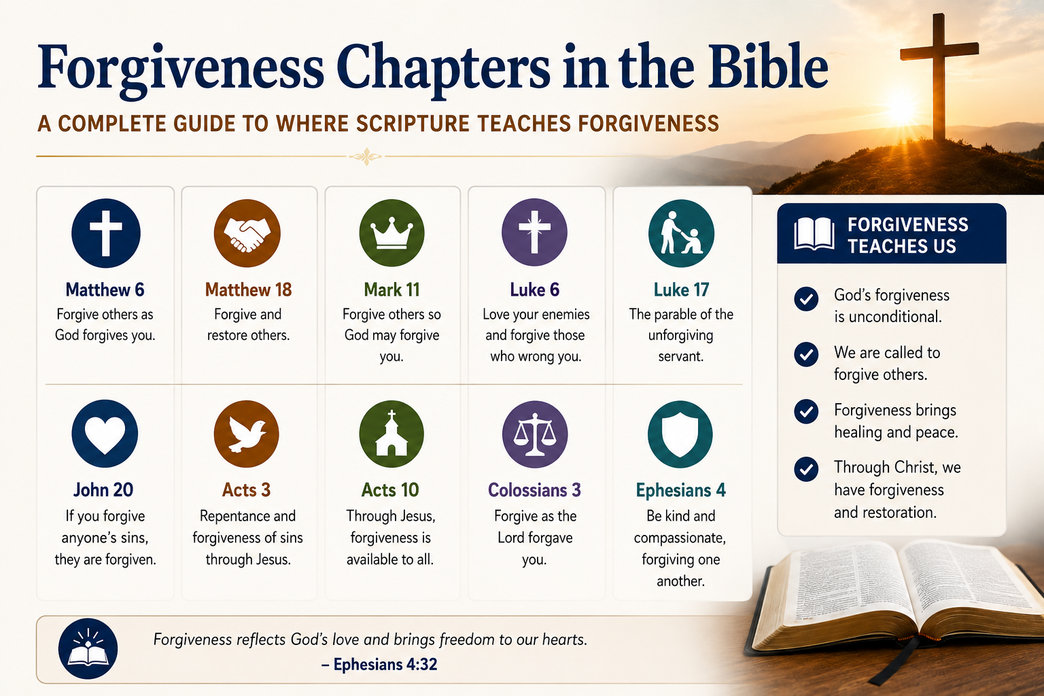
Forgiveness Chapters in the Bible at a Glance
If you’re looking for the most important Bible chapters about forgiveness, this quick-reference guide helps you identify where to begin. Each chapter emphasizes a different aspect of forgiveness, making it easier to choose the one that best matches your current need.
| Testament | Chapter | Primary Focus | Best For |
| Old Testament | Genesis 45 | Joseph forgives his brothers | Restoring broken family relationships |
| Old Testament | Psalm 32 | Joy after confession | Finding peace after repentance |
| Old Testament | Psalm 51 | David’s prayer of repentance | Seeking God’s forgiveness |
| Old Testament | Psalm 103 | God’s compassion and mercy | Remembering God’s unfailing love |
| Old Testament | Isaiah 55 | God’s invitation to return | Hope after failure |
| Old Testament | Micah 7 | God delights in mercy | Understanding God’s forgiving nature |
| Old Testament | Joel 2 | Repentance and restoration | Returning to God wholeheartedly |
| Old Testament | Daniel 9 | National confession | Prayers of repentance |
| New Testament | Matthew 6 | The Lord’s Prayer | Forgiveness in everyday prayer |
| New Testament | Matthew 18 | Forgiving others | Healing personal relationships |
| New Testament | Luke 15 | The Prodigal Son | Understanding God’s welcoming forgiveness |
| New Testament | Luke 23 | Jesus forgives from the cross | Extending mercy to others |
| New Testament | John 8 | Woman caught in adultery | Grace and new beginnings |
| New Testament | Romans 8 | Freedom from condemnation | Assurance after repentance |
| New Testament | 2 Corinthians 5 | Ministry of reconciliation | Restoring relationships |
| New Testament | Ephesians 4 | Forgiving one another | Everyday Christian living |
| New Testament | Colossians 3 | Compassion and forgiveness | Building healthy relationships |
| New Testament | 1 John 1 | Confession and cleansing | Ongoing fellowship with God |
| New Testament | Philemon | Reconciliation | Forgiveness within the Christian community |
One point becomes clear from this overview: there isn’t a single “forgiveness chapter” that covers every aspect of the subject. Instead, each passage contributes a unique perspective. Some emphasize God’s mercy toward repentant sinners, while others focus on reconciliation, confession, restoration, or the believer’s responsibility to forgive others.
Choosing the right chapter therefore depends less on finding the “best” passage and more on identifying the question you’re trying to answer. The sections that follow will help you do exactly that by explaining what makes each chapter distinctive and when it’s most helpful to read.
Old Testament vs. New Testament: How They Present Forgiveness
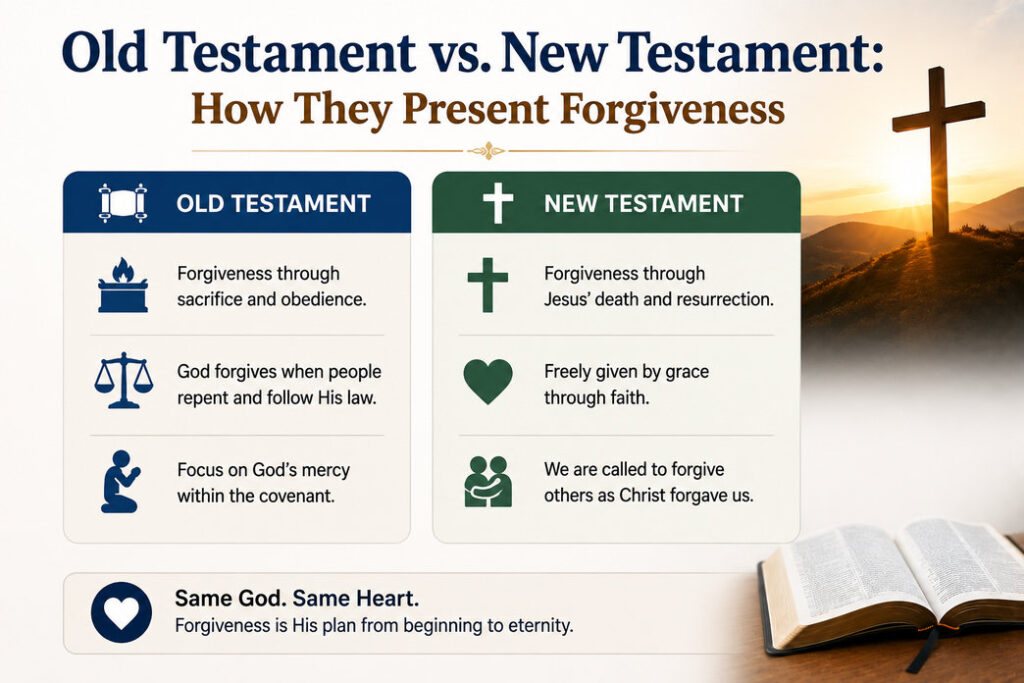
Although forgiveness is a consistent theme throughout the Bible, the Old and New Testaments emphasize it in complementary ways. Understanding these differences helps readers select chapters that best match their current questions or study goals.
Rather than presenting two different views of forgiveness, the two Testaments reveal one unified message that unfolds across God’s plan of redemption. The Old Testament lays the foundation by revealing God’s holy character, covenant faithfulness, and repeated willingness to forgive those who return to Him. The New Testament builds on that foundation by revealing forgiveness through the life, ministry, death, and resurrection of Jesus Christ, while teaching believers how forgiven people should live.
| Old Testament | New Testament |
| Reveals God’s mercy through Israel’s history, worship, and prophetic writings. | Reveals forgiveness through the life, teachings, death, and resurrection of Jesus Christ. |
| Frequently emphasizes repentance, confession, covenant faithfulness, and God’s willingness to forgive those who return to Him. | Focuses on God’s grace in Christ and teaches believers to forgive one another as they have been forgiven. |
| Includes historical narratives, Psalms of repentance, prophetic invitations, and national prayers for forgiveness. | Includes Jesus’ parables, practical instruction for Christian living, and the apostles’ teaching on reconciliation and restored relationships. |
| Establishes the biblical foundation for understanding God’s forgiving character. | Demonstrates how that forgiveness is fulfilled through Christ and lived out within the Christian community. |
Reading chapters from both Testaments provides the fullest picture of biblical forgiveness. The Old Testament helps readers appreciate God’s enduring mercy across generations, while the New Testament shows how that same mercy reaches its fullest expression in Jesus and continues to shape the lives of His followers.
If you’re beginning a study on forgiveness, consider reading passages from both sections of Scripture rather than limiting yourself to one Testament. Doing so highlights the remarkable continuity of the Bible’s message and shows that forgiveness has always been central to God’s relationship with His people.
Timeline of Key Forgiveness Chapters in the Bible
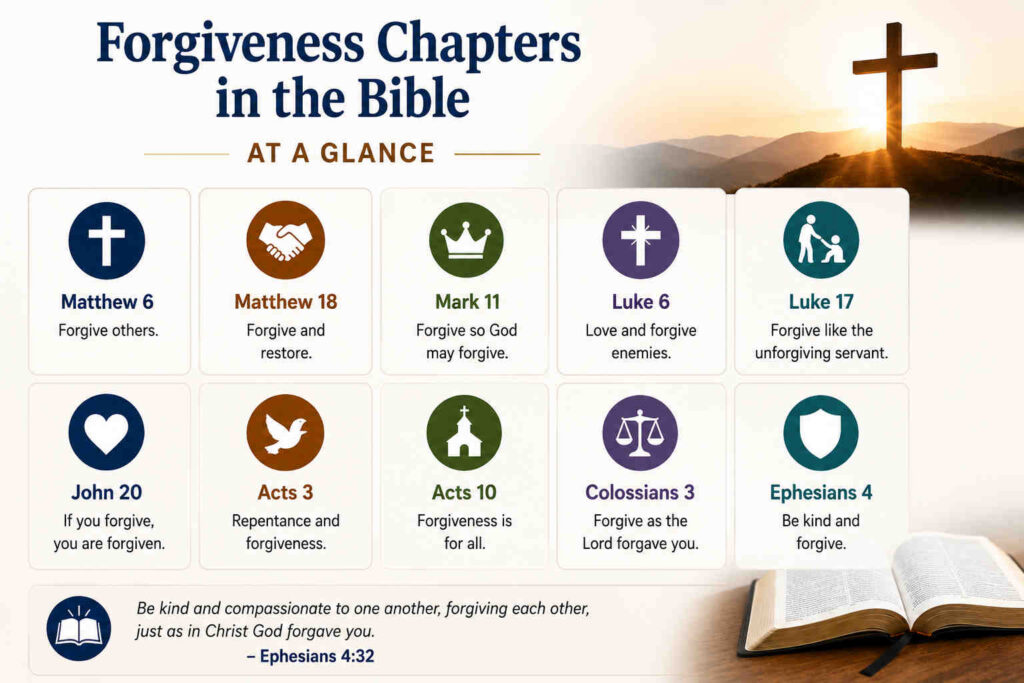
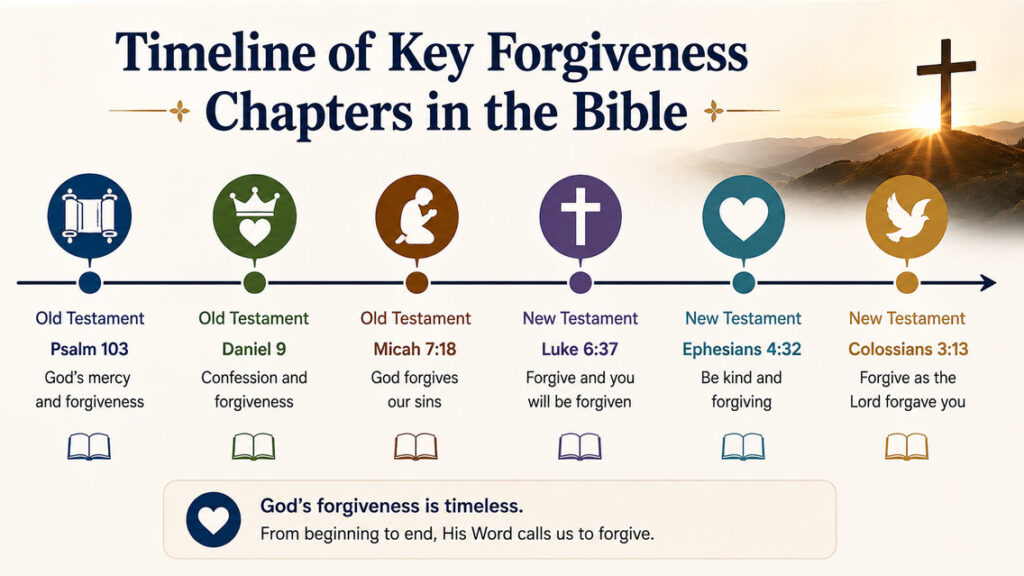
One of the easiest ways to understand the Bible’s teaching on forgiveness is to see how it unfolds throughout biblical history. Rather than appearing in only one book or period, forgiveness develops across the entire storyline of Scripture—from the patriarchs, through Israel’s worship and prophetic ministry, to the teachings of Jesus and the letters of the apostles.
The timeline below highlights some of the Bible’s most significant forgiveness chapters and explains why each one occupies an important place in the larger biblical narrative.
| Biblical Period | Key Chapter | Primary Theme | Why This Chapter Matters |
| Patriarchs | Genesis 45 | Reconciliation | Joseph forgives the brothers who sold him into slavery, demonstrating that forgiveness can restore even deeply broken relationships. |
| Israel’s Worship | Psalm 32 | Joy after forgiveness | David celebrates the blessing and peace that follow honest confession and God’s forgiveness. |
| Israel’s Worship | Psalm 51 | Genuine repentance | David’s prayer after his sin with Bathsheba remains Scripture’s classic model of confession and spiritual restoration. |
| Israel’s Worship | Psalm 103 | God’s compassion | A hymn praising God’s mercy, compassion, and willingness to remove sin completely. |
| The Prophets | Isaiah 55 | God’s invitation | God invites people to return to Him, promising abundant pardon for those who sincerely seek Him. |
| The Prophets | Micah 7 | God’s delight in mercy | Micah celebrates God’s incomparable willingness to forgive and remain faithful to His covenant promises. |
| Jesus’ Ministry | Matthew 18 | Forgiving others | Jesus answers Peter’s question about forgiveness and teaches the Parable of the Unforgiving Servant, making this Scripture’s most complete chapter on interpersonal forgiveness. |
| Jesus’ Ministry | Luke 15 | God’s welcoming love | Through the Parable of the Prodigal Son, Jesus illustrates the Father’s joy in restoring repentant sinners. |
| The Crucifixion | Luke 23 | Mercy toward enemies | Even while suffering on the cross, Jesus prays for those responsible for His crucifixion, providing history’s greatest example of extending mercy. |
| The Early Church | Romans 8 | Assurance | Paul reminds believers that there is no condemnation for those who are in Christ Jesus, offering confidence after repentance. |
| The Early Church | Ephesians 4 | Christian relationships | Paul teaches believers to forgive one another because God has forgiven them in Christ. |
| The General Epistles | 1 John 1 | Confession and cleansing | John assures believers that God faithfully forgives and cleanses those who confess their sins. |
What This Timeline Reveals
Viewed together, these chapters show that forgiveness is not confined to a single book, prophet, apostle, or historical period. It forms one continuous thread running throughout the Bible.
The Old Testament primarily emphasizes God’s mercy, sincere repentance, covenant faithfulness, and restored fellowship with His people. The New Testament builds on that foundation by revealing forgiveness through Jesus Christ and showing how those who have received God’s grace are called to extend that same grace to others.
Taken as a whole, these chapters demonstrate that the Bible doesn’t point readers to one definitive “forgiveness chapter.” Instead, it presents a unified message through history, poetry, prophecy, Gospel narratives, and apostolic teaching. Each passage contributes a unique angle, helping readers understand forgiveness from a different vantage point while reinforcing the same overarching truth: God delights in restoring broken relationships.
That naturally leads to another common question. If forgiveness appears throughout Scripture rather than in one place, is there actually a single book of the Bible devoted to forgiveness? The answer helps readers navigate Scripture more effectively and choose the best place to continue their study.
One of the most common questions people ask is, “Is there a book of forgiveness in the Bible?” The short answer is no.
Unlike books that focus primarily on a single topic or individual, the Bible does not include one dedicated “Book of Forgiveness.” Instead, forgiveness is a unifying theme woven throughout Scripture. It appears in historical narratives, songs of worship, prophetic messages, the teachings of Jesus, and the letters of the apostles. Each section contributes a different perspective, creating a richer and more complete picture when read together.
This is one reason the Bible’s teaching on forgiveness feels so profound. Rather than presenting forgiveness as a single lesson confined to one book, Scripture demonstrates how forgiveness operates in real life—through broken families, repentant kings, rebellious nations, restored friendships, transformed communities, and ultimately through the saving work of Jesus Christ.
Understanding this helps set realistic expectations. If you’re searching for one chapter or one book that explains everything about forgiveness, you won’t find it. Instead, you’ll discover that different books answer different questions. Some emphasize God’s willingness to forgive, others focus on repentance, reconciliation, mercy, or forgiving others. Reading these books together provides a more balanced understanding than relying on a single passage.
Did You Know? There isn’t a biblical book called Forgiveness. Instead, forgiveness serves as one of the Bible’s major themes, connecting the story of redemption from Genesis to Revelation. Studying several books together offers a clearer and more complete understanding than reading only one chapter in isolation.
The following books place special emphasis on forgiveness and are excellent starting points for deeper study.
| Book | Primary Forgiveness Theme | Why Read It? |
| Genesis | Reconciliation after betrayal | Shows forgiveness through Joseph’s restoration with his brothers while highlighting God’s providence during human suffering. |
| Psalms | Repentance, confession, and mercy | Contains heartfelt prayers expressing both the burden of sin and the joy of God’s forgiveness. |
| Isaiah | God’s invitation to return | Repeatedly calls God’s people to repentance while emphasizing His abundant mercy and willingness to pardon. |
| Micah | God’s compassionate character | Celebrates God’s delight in showing mercy and removing the guilt of His people. |
| Matthew | Forgiving others | Records Jesus’ most extensive teaching on forgiveness, including the Lord’s Prayer and the Parable of the Unforgiving Servant. |
| Luke | God’s welcoming forgiveness | Highlights God’s compassion through memorable parables such as the Prodigal Son and records Jesus forgiving even while on the cross. |
| Romans | Freedom from condemnation | Explains the assurance believers have after receiving God’s forgiveness through Jesus Christ. |
| Ephesians | Forgiveness in Christian relationships | Encourages believers to forgive one another because they have already been forgiven by God in Christ. |
| Colossians | Compassion and Christian character | Shows forgiveness as an essential characteristic of mature Christian living. |
| 1 John | Confession and cleansing | Reassures believers that God faithfully forgives and cleanses those who confess their sins. |
| Philemon | Reconciliation | Demonstrates forgiveness and restored relationships through a deeply personal letter addressing conflict within the Christian community. |
Although each of these books emphasizes forgiveness, they approach the subject from different angles. Genesis illustrates forgiveness through historical narrative, Psalms gives voice to personal confession and worship, Isaiah repeatedly calls God’s people back with promises of mercy, the Gospels reveal forgiveness through Jesus’ life and ministry, and the New Testament letters explain how forgiven people are called to live in relationship with God and with one another.
Recognizing these differences makes it much easier to choose passages that match your current purpose.
If your goal is to understand God’s mercy, begin with Isaiah, Luke, or Psalm 103. If you’re studying repentance, start with Psalm 51, Joel 2, or Daniel 9. If your focus is forgiving others, Matthew 18, Ephesians 4, and Colossians 3 provide some of Scripture’s clearest instruction. And if you’re looking for assurance after confession, Romans 8 and 1 John 1 are excellent places to begin.
This variety is one of Scripture’s greatest strengths. Rather than presenting forgiveness from only one perspective, the Bible explores it through history, poetry, prophecy, biography, parables, letters, and pastoral instruction. Together, these books provide a comprehensive picture that no single chapter could accomplish on its own.
Understanding where forgiveness appears throughout the Bible is only the first step. The next question is where that theme first begins to emerge. The Old Testament contains many of Scripture’s foundational forgiveness passages, beginning with Joseph’s remarkable act of reconciliation in Genesis and continuing through David’s prayers of repentance, the prophets’ invitations to return to God, and God’s repeated demonstrations of mercy toward His covenant people.
Best Old Testament Chapters About Forgiveness
The Old Testament lays the foundation for the Bible’s teaching on forgiveness. Although many readers naturally associate forgiveness with the New Testament and the ministry of Jesus, God’s mercy, compassion, and willingness to restore His people are evident from the earliest pages of Scripture.
These chapters approach forgiveness from different angles. Some recount remarkable stories of reconciliation after profound betrayal, others preserve heartfelt prayers of confession and repentance, and several record God’s repeated invitations for His people to return to Him. Together, they reveal that forgiveness is not an isolated doctrine but a recurring theme woven throughout Israel’s history, worship, wisdom literature, and prophetic writings.
If you’re wondering where to begin your Old Testament study, the chapters below provide some of the clearest and most influential passages on biblical forgiveness.
| Chapter | Primary Theme | Best For |
| Genesis 45 | Reconciliation after betrayal | Restoring broken relationships |
| Psalm 32 | Joy of forgiven sin | Finding peace after confession |
| Psalm 51 | Genuine repentance | Seeking God’s forgiveness |
| Psalm 103 | God’s mercy and compassion | Encouragement and assurance |
| Isaiah 55 | God’s invitation to return | Hope after failure |
Genesis 45: Joseph Forgives His Brothers
Historical setting: After years of slavery, false accusation, and imprisonment in Egypt, Joseph rises to become one of Pharaoh’s highest officials. During a devastating famine, the very brothers who sold him into slavery unknowingly come to Egypt seeking food, setting the stage for one of Scripture’s most powerful acts of reconciliation.
Main forgiveness theme: Reconciliation after betrayal.
Genesis 45 records one of the Bible’s clearest demonstrations of forgiveness following deep personal injustice. Instead of seeking revenge against those who caused him years of suffering, Joseph reveals his identity with compassion and chooses restoration over retaliation.
What makes this chapter especially significant is that Joseph neither minimizes the wrong committed against him nor ignores its painful consequences. His brothers’ actions were real and deeply harmful. Yet Joseph also recognizes God’s sovereign hand at work through circumstances that others intended for evil. His forgiveness grows out of trust in God’s providence rather than denial of human wrongdoing.
The chapter illustrates that forgiveness and wisdom can coexist. Joseph tested his brothers over several encounters before revealing himself, showing that reconciliation often follows evidence of genuine change and repentance. This detail reminds readers that while forgiveness can be freely extended, rebuilding trust may take time.
Key verses: Genesis 45:4–8
Why read this chapter? Read Genesis 45 if you are:
- seeking biblical wisdom for restoring broken family relationships
- studying reconciliation after betrayal
- exploring how God can work through painful circumstances for His greater purposes
- looking for one of Scripture’s finest examples of extending grace without ignoring truth
Psalm 32: The Joy of Forgiven Sin
Historical setting: Traditionally attributed to King David, Psalm 32 reflects the peace and freedom that follow sincere confession and restored fellowship with God. Many scholars associate it with the same events surrounding David’s sin with Bathsheba, though the psalm itself focuses less on the specific offense and more on the blessing of forgiveness.
Main forgiveness theme: The joy and peace that accompany God’s forgiveness.
Unlike historical narratives, Psalm 32 invites readers into the personal experience of someone who has moved from hidden guilt to restored fellowship with God. David vividly contrasts the emotional weight of concealing sin with the freedom that comes through honest confession.
Rather than describing forgiveness merely as the removal of punishment, the psalm emphasizes the restoration of peace, joy, and spiritual well-being. David explains that refusing to acknowledge sin drained his strength, while confessing it brought immediate relief through God’s gracious forgiveness.
This chapter also highlights an important biblical principle: confession is not about informing God of something He does not know. It represents humble agreement with God about the reality of sin and a willingness to seek His mercy.
For centuries, Psalm 32 has encouraged believers because it honestly acknowledges both the seriousness of sin and the hope available through God’s forgiveness.
Key verses: Psalm 32:1–5
Why read this chapter? Psalm 32 is especially helpful if you want to:
- understand the blessing of confessed sin
- find reassurance after repentance
- prepare a devotional on forgiveness
- reflect on the peace that accompanies restored fellowship with God
Psalm 51: David’s Prayer of Repentance
Historical setting: Psalm 51 was written after the prophet Nathan confronted King David regarding his sin involving Bathsheba and the death of Uriah. It remains one of the Bible’s most profound expressions of repentance.
Main forgiveness theme: Genuine repentance and spiritual renewal.
Few chapters in Scripture portray repentance with the honesty and humility found in Psalm 51. David makes no attempt to excuse his actions, shift responsibility, or lessen the seriousness of his sin. Instead, he openly acknowledges his guilt and appeals entirely to God’s steadfast love and abundant mercy.
The psalm demonstrates that biblical repentance is more than expressing regret over consequences. David longs for inward transformation, asking God to create in him a clean heart and renew a steadfast spirit. His prayer reveals that true repentance seeks restored fellowship with God as much as forgiveness itself.
Because of its transparency and depth, Psalm 51 has served for centuries as a model prayer for believers seeking restoration after failure. It reminds readers that God’s mercy remains available to those who approach Him with sincere humility.
Key verses: Psalm 51:1–12
Why read this chapter? Psalm 51 is an excellent choice if you are:
- seeking God’s forgiveness after personal failure
- studying biblical repentance
- preparing a Bible study on confession
- looking for words to guide your own prayer of repentance
Psalm 103: Remembering God’s Compassion
Historical setting: Another psalm traditionally attributed to David, Psalm 103 is a hymn of praise celebrating God’s steadfast love, mercy, and compassion toward His people.
Main forgiveness theme: God’s compassionate and forgiving character.
Where Psalm 51 focuses on human repentance, Psalm 103 shifts attention to the character of God. Rather than dwelling on human failure, David celebrates God’s patience, compassion, and faithful love, encouraging readers to remember His countless benefits.
One of the chapter’s best-known images declares that God removes transgressions “as far as the east is from the west,” illustrating the completeness of His forgiveness. The psalm also describes God as a compassionate Father who understands human weakness, balancing His holiness with remarkable mercy.
Rather than inviting readers to remain focused on past failures, Psalm 103 directs their attention toward worship and gratitude for God’s enduring faithfulness.
Key verses: Psalm 103:8–13, 17–18
Why read this chapter? Read Psalm 103 if you want to:
- meditate on God’s mercy and compassion
- strengthen your assurance of His forgiveness
- prepare a devotional centered on God’s character
- cultivate gratitude through worship
Isaiah 55: God’s Invitation to Return
Historical setting: Isaiah ministered during a turbulent period in Judah’s history, calling God’s people to trust Him while proclaiming both judgment and future restoration. Chapter 55 concludes this section with one of Scripture’s clearest invitations to receive God’s mercy.
Main forgiveness theme: God’s gracious invitation to repent and receive abundant pardon.
Isaiah 55 extends a hopeful invitation to all who have wandered from God. Rather than portraying Him as reluctant to forgive, the prophet urges people to seek the Lord while He may be found and assures them that He will abundantly pardon those who genuinely return to Him.
The chapter emphasizes that God’s mercy surpasses human expectations. His thoughts and ways are higher than ours, and His willingness to forgive reflects His perfect grace rather than human standards of fairness or merit.
Isaiah also reminds readers that God’s Word accomplishes its purpose, giving confidence that His promises of forgiveness and restoration are trustworthy.
Key verses: Isaiah 55:6–9
Why read this chapter? Isaiah 55 is especially valuable if you are:
- looking for hope after spiritual failure
- studying God’s invitations throughout Scripture
- encouraging someone who feels distant from God
- exploring the relationship between repentance and God’s mercy
Micah 7: God’s Delight in Showing Mercy
Historical setting: The prophet Micah ministered during a period of widespread injustice, idolatry, and spiritual decline in Judah. Although much of his book contains warnings of coming judgment, it concludes with one of the Old Testament’s most encouraging declarations about God’s mercy and covenant faithfulness.
Main forgiveness theme: God’s unmatched willingness to forgive.
Micah 7 reminds readers that forgiveness flows from God’s character. Rather than portraying Him as reluctant to pardon, the prophet celebrates Him as a God who delights in showing mercy. This chapter emphasizes that forgiveness is not simply the removal of guilt but an expression of God’s steadfast love and His commitment to keep His covenant promises.
One of the chapter’s most memorable images declares that God casts His people’s sins “into the depths of the sea.” This vivid picture illustrates the completeness of divine forgiveness and reassures readers that God does not cling to the sins He has chosen to forgive.
Micah also balances justice with mercy. God’s forgiveness never ignores sin, but His compassion triumphs as He restores those who return to Him in faith.
Key verses: Micah 7:18–20
Why read this chapter? Read Micah 7 if you want to:
- understand God’s forgiving character
- study one of the Bible’s clearest descriptions of divine mercy
- gain encouragement after spiritual failure
- reflect on God’s covenant faithfulness throughout Scripture
Joel 2: Repentance That Leads to Restoration
Historical setting: Joel prophesied after a devastating locust plague that had left Judah facing both physical hardship and spiritual reflection. Using this national crisis as a wake-up call, he urged God’s people to return wholeheartedly to the Lord.
Main forgiveness theme: Wholehearted repentance and God’s readiness to restore.
Joel 2 emphasizes that genuine repentance is far more than outward religious activity. God calls His people to “rend your hearts and not your garments,” highlighting the importance of sincere inward transformation rather than external displays alone.
At the heart of the chapter stands one of the Bible’s most beautiful descriptions of God’s character: He is “gracious and compassionate, slow to anger and abounding in steadfast love.” Joel reminds readers that God’s willingness to forgive is rooted in His unchanging nature rather than human worthiness.
Although the chapter begins with warnings of judgment, its overall message points toward hope. God invites His people to return, promising restoration for those who genuinely seek Him. This balance of repentance and mercy makes Joel 2 especially valuable for readers who need both conviction and encouragement.
Key verses: Joel 2:12–13
Why read this chapter? Choose Joel 2 if you are:
- returning to God after a season of spiritual drift
- studying biblical repentance
- preparing a devotional on restoration
- looking for a passage that combines conviction with hope
Daniel 9: A Prayer of Confession for God’s People
Historical setting: Daniel offered this remarkable prayer while the Jewish people were living in exile. Reflecting on Israel’s long history of disobedience, he confessed not only his nation’s sins but also appealed to God’s mercy and covenant faithfulness.
Main forgiveness theme: Humble confession before a merciful God.
Daniel 9 stands apart because it models confession on both a personal and corporate level. Although Daniel himself was known for his faithfulness, he identified with his people and humbly acknowledged their collective failures before God.
Rather than appealing to Israel’s righteousness, Daniel bases his entire prayer on God’s compassion. Again and again, he acknowledges God’s justice while pleading for mercy. His example demonstrates that true confession begins with humility and confidence in God’s gracious character.
While Daniel 9 also contains important prophetic material later in the chapter, its opening prayer remains one of Scripture’s finest examples of reverent confession and dependence upon God’s forgiveness.
Key verses: Daniel 9:4–9, 17–19
Why read this chapter? Read Daniel 9 if you want to:
- study one of the Bible’s greatest prayers of confession
- prepare for corporate or congregational prayer
- understand how God’s people sought forgiveness during national crisis
- explore the relationship between humility and divine mercy
Old Testament Forgiveness Chapters Compared
Although each of these chapters centers on forgiveness, they approach the subject from different perspectives. Comparing them side by side makes it easier to identify the chapter that best matches your current devotional, teaching, or Bible study objective.
| Chapter | Primary Focus | Historical Setting | Best For |
| Genesis 45 | Reconciliation | Joseph reunites with his brothers in Egypt | Healing broken family relationships and studying reconciliation |
| Psalm 32 | Joy after forgiveness | David reflects on confessed sin | Finding peace, assurance, and restored fellowship with God |
| Psalm 51 | Genuine repentance | David’s confession after his sin with Bathsheba | Personal confession, repentance, and spiritual renewal |
| Psalm 103 | God’s mercy | A psalm celebrating God’s compassion and steadfast love | Worship, encouragement, and assurance of God’s forgiveness |
| Isaiah 55 | Invitation to return | Isaiah calls God’s people back to the Lord | Hope after failure and renewed commitment to God |
| Micah 7 | God’s forgiving character | Micah concludes his prophecy by praising God’s mercy | Understanding God’s compassion and covenant faithfulness |
| Joel 2 | National repentance | Judah responds to crisis by returning to God | Wholehearted repentance and spiritual restoration |
| Daniel 9 | Prayer of confession | Daniel prays during Israel’s exile | Studying confession, intercession, and dependence on God’s mercy |
Which Old Testament Chapter Should You Read First?
If you’re unsure where to begin, let your current situation guide your choice.
| If you want to… | Start with… |
| Seek God’s forgiveness after personal failure | Psalm 51 |
| Experience the joy that follows confession | Psalm 32 |
| Learn about reconciliation after betrayal | Genesis 45 |
| Reflect on God’s compassion and steadfast love | Psalm 103 |
| Return to God after drifting spiritually | Isaiah 55 |
| Understand God’s delight in forgiving | Micah 7 |
| Study repentance as a community | Joel 2 |
| Learn from one of Scripture’s greatest prayers of confession | Daniel 9 |
Taken together, these Old Testament chapters reveal a consistent message: God’s mercy is not limited to one generation, one leader, or one circumstance. Whether through Joseph’s reconciliation with his brothers, David’s heartfelt repentance, the prophets’ invitations to return, or Daniel’s humble confession, Scripture repeatedly points readers toward a God who is ready to forgive those who sincerely seek Him.
The New Testament builds on this foundation by revealing forgiveness through the life, teachings, sacrificial death, and resurrection of Jesus Christ. It also explains how those who have received God’s forgiveness are called to extend that same grace to others, making its chapters some of the most widely read and frequently quoted passages on forgiveness in all of Scripture.
Best New Testament Chapters About Forgiveness
The New Testament brings the Bible’s teaching on forgiveness into even sharper focus. While the Old Testament reveals God’s forgiving character through Israel’s history, worship, and prophetic writings, the New Testament shows that same mercy fully displayed through Jesus Christ and explains how forgiveness transforms the lives and relationships of His followers.
Some chapters record Jesus’ direct teaching on forgiving others. Others illustrate God’s grace through memorable parables and historical events. The apostolic letters then explain how forgiveness should shape Christian living, church relationships, and daily discipleship.
If you’re searching for Bible chapters that most clearly emphasize forgiveness, these passages provide an excellent place to begin.
| Chapter | Primary Focus | Best For |
| Matthew 18 | Forgiving others | Restoring personal relationships |
| Matthew 6 | The Lord’s Prayer | Daily prayer and forgiveness |
| Luke 15 | God’s welcoming forgiveness | Understanding God’s grace |
| Luke 23 | Jesus forgives from the cross | Extending mercy to others |
| John 8 | Grace and restoration | Hope after personal failure |
| Romans 8 | Freedom from condemnation | Assurance after repentance |
Matthew 18: Jesus’ Greatest Teaching on Forgiving Others
Historical setting: During His ministry in Galilee, Jesus’ disciples frequently asked questions about life in God’s kingdom. In Matthew 18, Peter asks one of the Bible’s best-known questions about forgiveness: “Lord, how many times shall I forgive my brother or sister who sins against me? Up to seven times?”
Main forgiveness theme: Forgiving others without keeping score.
Matthew 18 is widely regarded as the Bible’s most comprehensive chapter on interpersonal forgiveness because it combines Jesus’ direct teaching with the Parable of the Unforgiving Servant. Together, these passages reveal that those who have received God’s mercy are called to extend that same mercy to others.
Peter likely believed he was being generous by suggesting forgiveness seven times. Jesus’ reply shifts the conversation away from counting offenses and toward cultivating a consistently forgiving heart. His response teaches that forgiveness is not measured by numbers but by a transformed attitude shaped by God’s grace.
The Parable of the Unforgiving Servant reinforces this lesson by contrasting a servant who receives extraordinary mercy from his king but refuses to show even a small measure of compassion to a fellow servant. Jesus uses this striking contrast to demonstrate that God’s forgiveness should profoundly influence how believers treat others.
This chapter also addresses accountability within Christian relationships. While it emphasizes forgiveness, it does not ignore repentance, reconciliation, or wise conflict resolution within the community of believers.
Key verses: Matthew 18:21–35
Why read this chapter? Read Matthew 18 if you are:
- struggling to forgive someone who has hurt you
- leading a Bible study on forgiveness
- exploring Jesus’ clearest teaching on interpersonal forgiveness
- seeking biblical guidance for restoring relationships within the church or family
Matthew 6: Forgiveness in the Lord’s Prayer
Historical setting: Matthew 6 forms part of the Sermon on the Mount, where Jesus teaches His followers about life in God’s kingdom, including prayer, generosity, fasting, and wholehearted devotion to God.
Main forgiveness theme: Forgiveness as a regular part of every believer’s relationship with God.
Within the Lord’s Prayer, Jesus teaches His disciples to pray, “Forgive us our debts, as we also have forgiven our debtors.” By including forgiveness in this model prayer, He demonstrates that confession and forgiveness are not occasional experiences but ongoing realities in the Christian life.
Immediately after presenting the prayer, Jesus expands on this theme by emphasizing the importance of maintaining a forgiving attitude toward others. His teaching highlights the close relationship between receiving God’s mercy and extending mercy to those around us.
Rather than presenting forgiveness as merely an emotional response, Matthew 6 places it within daily fellowship with God. Just as believers continually depend on God for daily provision, they also continually depend upon His forgiveness while reflecting that same grace in their relationships.
Key verses: Matthew 6:9–15
Why read this chapter? Choose Matthew 6 if you want to:
- understand forgiveness within the Lord’s Prayer
- study Jesus’ teaching on daily spiritual life
- explore the connection between prayer and forgiveness
- develop a devotional practice centered on God’s grace
Luke 15: The Prodigal Son and God’s Welcoming Forgiveness
Historical setting: Jesus told the parables recorded in Luke 15 after religious leaders criticized Him for welcoming tax collectors and sinners. In response, He shared three parables—the Lost Sheep, the Lost Coin, and the Prodigal Son—to reveal God’s joy in restoring those who return to Him.
Main forgiveness theme: God’s welcoming love toward repentant sinners.
Although all three parables emphasize God’s pursuit of the lost, the Parable of the Prodigal Son has become Scripture’s most beloved illustration of divine forgiveness. Rather than focusing primarily on the son’s failures, the story highlights the father’s compassion, eager welcome, and joyful restoration.
The father’s response overturns expectations. Instead of rejection or humiliation, he runs to meet his returning son, embraces him, and restores him to the family before the son can finish his prepared speech. This vivid picture demonstrates that God’s forgiveness flows from His gracious character rather than from human merit.
The chapter also introduces the older brother, whose resentment contrasts sharply with the father’s mercy. His attitude reminds readers that understanding God’s forgiveness involves not only receiving grace but also rejoicing when others receive it.
Luke 15 therefore portrays forgiveness as joyful restoration rather than reluctant acceptance.
Key verses: Luke 15:11–32
Why read this chapter? Read Luke 15 if you are:
- seeking reassurance of God’s love after failure
- studying one of Jesus’ most famous parables
- preparing a devotional on God’s grace
- wanting to understand the joy that accompanies repentance and restoration
Luke 23: Jesus Forgives from the Cross
Historical setting: Luke 23 records the crucifixion of Jesus. As He endured unimaginable suffering, rejection, and mockery, Jesus demonstrated the very forgiveness He had taught throughout His ministry.
Main forgiveness theme: Extending mercy even in the face of profound injustice.
Among Jesus’ final recorded words is His prayer, “Father, forgive them, for they do not know what they are doing.” Spoken while His execution was taking place, these words remain one of the Bible’s most extraordinary demonstrations of compassion.
This chapter illustrates that forgiveness does not depend on comfortable circumstances. Jesus extended mercy while enduring the greatest injustice in human history, and His example has inspired believers for centuries to pursue forgiveness even when doing so is costly and difficult.
Luke 23 also records Jesus’ promise to the repentant criminal crucified beside Him, revealing that God’s grace remains available even in life’s final moments. Together, these events emphasize both God’s willingness to forgive and the hope offered through Christ.
Key verses: Luke 23:34, 39–43
Why read this chapter? Read Luke 23 if you want to:
- reflect on Jesus’ ultimate example of forgiveness
- study forgiveness in the context of suffering
- understand Christ’s compassion toward sinners
- prepare a Good Friday or Easter Bible study focused on grace
John 8: Grace and a New Beginning
Historical setting: In John 8, religious leaders bring before Jesus a woman caught in adultery, hoping to trap Him between the demands of the Law and Roman authority.
Main forgiveness theme: Grace that calls people toward transformed living.
This account has long been treasured because it beautifully balances truth and mercy. Rather than ignoring sin or condemning the woman without hope, Jesus exposes the hypocrisy of her accusers before addressing her directly with compassion.
His words, “Neither do I condemn you; go, and from now on sin no more,” demonstrate that biblical forgiveness never minimizes wrongdoing. Instead, forgiveness offers both mercy and the invitation to pursue a changed life.
The chapter reminds readers that God’s grace is not permission to continue in sin but an opportunity to begin again through His mercy.
Key verses: John 8:1–11
Why read this chapter? John 8 is especially meaningful if you are:
- seeking hope after personal failure
- studying the relationship between grace and truth
- exploring Jesus’ compassionate ministry
- looking for encouragement that forgiveness leads toward transformation
Romans 8: Freedom from Condemnation
Historical setting: Paul wrote the Epistle to the Romans to explain the gospel and its implications for believers. After describing humanity’s universal need for salvation and God’s provision through Jesus Christ, Romans 8 presents the assurance available to those who belong to Christ.
Main forgiveness theme: Assurance after receiving God’s forgiveness.
Romans 8 does not focus on the act of confession itself but on the confidence believers can have after God has forgiven them. The chapter opens with one of the New Testament’s most reassuring declarations: “There is therefore now no condemnation for those who are in Christ Jesus.”
For many Christians, lingering guilt can remain even after sincere repentance. Romans 8 addresses that struggle by reminding believers that forgiveness is grounded in Christ’s completed work rather than human performance. Because of Jesus’ death and resurrection, those who trust in Him are no longer defined by their past failures.
The chapter also explains that the Holy Spirit enables believers to live transformed lives. Forgiveness is not simply freedom from guilt—it also marks the beginning of a new life empowered by God’s Spirit.
Toward the end of the chapter, Paul celebrates the unshakable love of God, assuring believers that nothing can separate them from Christ. This makes Romans 8 one of Scripture’s strongest passages for anyone seeking confidence in God’s forgiveness.
Key verses: Romans 8:1–4, 31–39
Why read this chapter? Read Romans 8 if you want to:
- overcome feelings of guilt after repentance
- understand the assurance believers have in Christ
- study life in the Holy Spirit
- find encouragement in God’s unfailing love
2 Corinthians 5: The Ministry of Reconciliation
Historical setting: In his second letter to the church in Corinth, Paul explains the transforming power of the gospel and the mission entrusted to every believer.
Main forgiveness theme: Reconciliation with God and reconciliation with others.
Although the word forgiveness appears less frequently in this chapter than in some others, reconciliation stands at its heart. Paul explains that through Christ, God has reconciled the world to Himself and entrusted believers with the message of reconciliation.
This chapter reminds readers that forgiveness is never merely personal. Those who have experienced God’s grace become ambassadors of that grace, called to encourage peace, restoration, and reconciliation wherever possible.
One of the chapter’s most significant truths is that God does not count believers’ sins against them because of Christ. This declaration highlights the gospel’s transformative power and points to restored fellowship with God as the ultimate purpose of forgiveness.
Key verses: 2 Corinthians 5:17–21
Why read this chapter? Choose 2 Corinthians 5 if you want to:
- understand reconciliation within the gospel
- study the relationship between forgiveness and Christian mission
- prepare a lesson on becoming an ambassador for Christ
- explore how forgiveness restores broken relationships with God
Ephesians 4: Forgiving One Another
Historical setting: Paul wrote Ephesians to encourage believers to live in a manner worthy of their calling in Christ. After explaining the blessings of salvation, he turns to practical instruction for everyday Christian living.
Main forgiveness theme: Forgiveness as an essential characteristic of Christian relationships.
Ephesians 4 emphasizes that forgiveness should shape the daily life of every believer. Paul encourages Christians to replace bitterness, anger, harsh speech, and resentment with kindness, compassion, and forgiveness.
His instruction reaches its climax in one of the New Testament’s most quoted commands: “Be kind and compassionate to one another, forgiving each other, just as in Christ God forgave you.”
This verse establishes the foundation for Christian forgiveness. Believers forgive not because others always deserve it, but because they themselves have first received God’s forgiveness through Christ.
The chapter also highlights the importance of preserving unity within the church. Forgiveness becomes one of the practical ways believers demonstrate Christlike character and maintain healthy relationships within the body of Christ.
Key verses: Ephesians 4:31–32
Why read this chapter? Read Ephesians 4 if you want to:
- strengthen Christian relationships
- study practical forgiveness in everyday life
- understand how grace transforms behavior
- prepare teaching on unity within the church
Colossians 3: Compassion, Grace, and Forgiveness
Historical setting: Paul wrote to the believers in Colossae to encourage them to live according to their new identity in Christ rather than according to their former way of life.
Main forgiveness theme: Forgiveness as part of Christian character.
Colossians 3 describes the attitudes and behaviors that should distinguish followers of Christ. Alongside compassion, humility, patience, gentleness, and love, Paul includes forgiveness as an essential mark of spiritual maturity.
Rather than treating forgiveness as an occasional response to conflict, Paul presents it as a lifestyle rooted in the gospel. Because believers have received undeserved grace from God, they are called to extend that same grace to others.
The chapter concludes by encouraging Christians to let Christ’s peace rule in their hearts and to allow His Word to dwell richly among them. Forgiveness, therefore, becomes part of a broader pattern of Christ-centered living rather than an isolated command.
Key verses: Colossians 3:12–15
Why read this chapter? Choose Colossians 3 if you want to:
- cultivate Christlike character
- study forgiveness within Christian discipleship
- strengthen family and church relationships
- understand how forgiveness fits into daily spiritual growth
1 John 1: Confession and Cleansing
Historical setting: The Apostle John wrote to strengthen believers in their assurance of salvation while encouraging them to walk faithfully with God.
Main forgiveness theme: Ongoing confession and restored fellowship with God.
First John acknowledges that believers continue to struggle with sin, but it also offers remarkable encouragement. Rather than leading Christians into despair, the chapter points them toward God’s faithfulness.
John writes that if we confess our sins, God is faithful and just to forgive us our sins and to cleanse us from all unrighteousness.
This promise reassures believers that confession remains an important part of maintaining close fellowship with God. The emphasis is not on repeatedly earning forgiveness but on living honestly before the God who continually extends grace.
The chapter also warns against denying sin altogether. Genuine fellowship with God involves walking in the light, acknowledging our need for His mercy, and trusting His promise to forgive.
Key verses: 1 John 1:5–10
Why read this chapter? Read 1 John 1 if you want to:
- understand the role of confession in the Christian life
- find assurance of God’s faithfulness
- study forgiveness within ongoing discipleship
- prepare a devotional on walking in the light
Philemon: Forgiveness and Reconciliation in Action
Historical setting: Paul’s brief letter to Philemon concerns Onesimus, a servant who had become a believer through Paul’s ministry. Paul writes to encourage Philemon to receive Onesimus back, not merely as a servant, but as a beloved brother in Christ.
Main forgiveness theme: Restoring relationships through Christian love.
Unlike many passages that teach forgiveness directly, Philemon demonstrates it through a real-life situation. Paul appeals with wisdom, humility, and love rather than issuing a command, illustrating how the gospel transforms personal relationships.
The letter emphasizes reconciliation, dignity, and mutual respect within the Christian community. It shows that forgiveness is not simply an abstract doctrine but a practical expression of the new life believers share in Christ.
Although short, Philemon provides one of the New Testament’s clearest examples of forgiveness leading toward restored fellowship and renewed relationships.
Key verses: Philemon 8–21
Why read this book? Read Philemon if you want to:
- study forgiveness in a real-life biblical relationship
- understand reconciliation within the early church
- explore how the gospel transforms personal conflicts
- see forgiveness applied with wisdom, grace, and love
New Testament Forgiveness Chapters Compared
Although each of these New Testament passages addresses forgiveness, they do so from different perspectives. Some emphasize God’s willingness to forgive, while others focus on extending forgiveness to others, living as forgiven people, or experiencing reconciliation through Christ. Understanding these distinctions makes it easier to choose the chapter that best fits your current study or devotional purpose.
| Chapter | Primary Focus | Historical Setting | Best For |
| Matthew 18 | Forgiving others | Jesus teaches His disciples about life in God’s kingdom | Restoring broken relationships and studying interpersonal forgiveness |
| Matthew 6 | The Lord’s Prayer | The Sermon on the Mount | Daily prayer, confession, and forgiveness |
| Luke 15 | God’s welcoming forgiveness | Jesus responds to criticism from religious leaders | Understanding God’s grace toward repentant sinners |
| Luke 23 | Mercy at the cross | Jesus’ crucifixion | Learning forgiveness through Christ’s example |
| John 8 | Grace and restoration | Jesus confronts the woman’s accusers | Hope after failure and balancing grace with truth |
| Romans 8 | Assurance after forgiveness | Paul’s teaching on life in the Spirit | Freedom from guilt and confidence in Christ |
| 2 Corinthians 5 | Reconciliation | Paul’s ministry to the Corinthian church | Understanding reconciliation and the gospel |
| Ephesians 4 | Christian relationships | Practical instruction for believers | Everyday forgiveness within families and churches |
| Colossians 3 | Christlike character | Paul’s guidance for Christian living | Developing compassion, patience, and forgiveness |
| 1 John 1 | Confession and cleansing | John’s encouragement to believers | Ongoing fellowship with God through confession |
| Philemon | Practical reconciliation | Paul’s appeal for Onesimus | Applying forgiveness to real-life relationships |
Which New Testament Chapter Should You Read First?
If you’re unsure where to begin, this guide can help you quickly identify the chapter that best matches your current situation.
| If you want to… | Start with… |
| Learn Jesus’ clearest teaching on forgiving others | Matthew 18 |
| Study forgiveness through daily prayer | Matthew 6 |
| Understand God’s love for repentant sinners | Luke 15 |
| Reflect on Jesus’ forgiveness at the cross | Luke 23 |
| Find hope after personal failure | John 8 |
| Overcome guilt and condemnation | Romans 8 |
| Study reconciliation through the gospel | 2 Corinthians 5 |
| Improve Christian relationships | Ephesians 4 |
| Grow in Christlike character | Colossians 3 |
| Understand confession and ongoing forgiveness | 1 John 1 |
| See forgiveness lived out in a personal relationship | Philemon |
Together, these chapters reveal that forgiveness is far more than a single doctrine or isolated command. It is woven throughout the New Testament as both a gift received from God and a way of life practiced by those who follow Christ. Jesus demonstrates forgiveness through His teaching and example, while the apostles explain how God’s grace transforms believers into people who extend mercy, pursue reconciliation, and reflect Christ’s love in everyday relationships.
Best Bible Chapters for Different Forgiveness Needs
Not every reader approaches the Bible with the same question. Some are searching for comfort after personal failure. Others want guidance on forgiving someone who has deeply hurt them. Pastors, teachers, and Bible study leaders may be looking for passages that explain forgiveness clearly, while new believers may simply wonder where to begin.
Because each chapter emphasizes a different aspect of forgiveness, choosing the right passage often depends on your current need.
The recommendations below provide a practical starting point.
| Situation | Recommended Chapter | Why It Helps |
| I need God’s forgiveness after sin | Psalm 51 | David’s heartfelt prayer demonstrates genuine repentance and reliance on God’s mercy. |
| I want reassurance that God has forgiven me | Romans 8 | Paul explains the assurance believers have through Christ and the freedom from condemnation. |
| I’m struggling to forgive someone | Matthew 18 | Jesus teaches why forgiven people should extend forgiveness to others. |
| I need hope after making serious mistakes | Luke 15 | The Prodigal Son illustrates God’s joyful welcome toward those who return to Him. |
| My family relationship is broken | Genesis 45 | Joseph’s reconciliation with his brothers provides a powerful example of forgiveness after betrayal. |
| I want to understand God’s mercy | Psalm 103 | Celebrates God’s compassion, patience, and steadfast love. |
| I’m looking for a prayer of confession | Daniel 9 | Offers one of Scripture’s most profound examples of humble confession and dependence on God’s mercy. |
| I want encouragement after spiritual failure | Isaiah 55 | Reminds readers that God abundantly pardons those who sincerely seek Him. |
| I need to strengthen relationships in my church | Ephesians 4 | Shows how forgiveness preserves unity and reflects God’s grace. |
| I want to understand reconciliation | 2 Corinthians 5 | Explains how God reconciles people to Himself through Christ and calls believers to share that message. |
While every chapter listed in this guide contributes to the Bible’s teaching on forgiveness, beginning with the one that speaks most directly to your current circumstances can make your study more meaningful and personally relevant.
A Simple Reading Plan for Studying Forgiveness
If you’re new to studying forgiveness in the Bible, reading every passage at once can feel overwhelming. Instead, consider following a structured reading path that gradually introduces the Bible’s major themes.
Five-Day Introduction to Forgiveness
Day 1 — Psalm 51 Discover what genuine repentance looks like through David’s honest confession and his appeal for God’s mercy.
Day 2 — Genesis 45 See how forgiveness can restore relationships even after years of pain and betrayal.
Day 3 — Matthew 18 Learn Jesus’ clearest teaching on forgiving others and the importance of extending the mercy we have received.
Day 4 — Luke 15 Reflect on God’s welcoming love through the Parable of the Prodigal Son and the joy of restoration.
Day 5 — Romans 8 Finish by reading Paul’s powerful assurance that those who are in Christ are no longer condemned and can live with confidence in God’s grace.
This five-day journey introduces the Bible’s major forgiveness themes in a logical progression:
- repentance
- reconciliation
- forgiving others
- God’s welcoming mercy
- assurance after forgiveness
For readers who want to explore further, continue with Psalm 103, Isaiah 55, Ephesians 4, Colossians 3, and 1 John 1 to gain a broader understanding of how forgiveness shapes both our relationship with God and our relationships with others.
Frequently Asked Questions About Forgiveness Chapters in the Bible
What chapter in the Bible talks about forgiveness the most? If you’re looking for one chapter that focuses most extensively on forgiving others, Matthew 18 is the strongest choice. It combines Peter’s question about how often to forgive with Jesus’ answer and the Parable of the Unforgiving Servant, making it Scripture’s most complete teaching on interpersonal forgiveness.
If your focus is receiving God’s forgiveness, Psalm 51, Luke 15, and Romans 8 are among the most significant chapters to read.
What is the best Bible chapter to read when asking God for forgiveness? Many believers begin with Psalm 51 because it records David’s sincere prayer of repentance after his confrontation with the prophet Nathan. It expresses humility, confession, and a desire for spiritual renewal.
Other excellent chapters include:
- Psalm 32 for the joy that follows forgiveness.
- Isaiah 55 for God’s invitation to return.
- 1 John 1 for God’s promise to forgive those who confess their sins.
- Romans 8 for assurance after receiving God’s forgiveness.
Which chapter teaches Christians to forgive others? Several chapters address this subject, but each emphasizes a different aspect.
- Matthew 18 explains why believers should forgive repeatedly and wholeheartedly.
- Matthew 6 connects forgiveness with daily prayer through the Lord’s Prayer.
- Ephesians 4 teaches Christians to forgive one another because God has forgiven them in Christ.
- Colossians 3 presents forgiveness as an essential characteristic of Christian maturity.
Reading these chapters together provides a balanced understanding of how forgiveness shapes Christian relationships.
Which Psalm is best for forgiveness? Two Psalms are especially helpful. Psalm 51 emphasizes repentance, confession, and God’s mercy after personal failure. Psalm 32 celebrates the peace, joy, and freedom that come after receiving God’s forgiveness.
For readers who want to focus on God’s compassionate character, Psalm 103 is another excellent choice because it celebrates His steadfast love and complete forgiveness.
Is there a single book of the Bible about forgiveness? No. The Bible does not contain one dedicated “Book of Forgiveness.” Instead, forgiveness appears throughout many books, each contributing a unique perspective. For example:
- Genesis highlights reconciliation after betrayal.
- Psalms emphasizes repentance, confession, and worship.
- Isaiah focuses on God’s invitation to return.
- Matthew records Jesus’ teaching on forgiving others.
- Luke highlights God’s welcoming grace.
- Romans explains assurance after forgiveness.
- Ephesians and Colossians show how forgiveness should shape Christian living.
Together, these books provide a comprehensive understanding of biblical forgiveness.
Which Gospel emphasizes forgiveness the most? All four Gospels record Jesus’ teaching about forgiveness, but Luke places particular emphasis on God’s compassion toward sinners. Luke includes:
- the Parable of the Prodigal Son (Luke 15),
- Jesus’ forgiveness from the cross (Luke 23),
- the account of Zacchaeus,
- the repentant criminal,
- and numerous stories that highlight God’s mercy toward those who turn to Him.
Matthew, however, contains Jesus’ most detailed teaching on forgiving others in Matthew 18 and includes the Lord’s Prayer in Matthew 6. Reading both Gospels provides a well-rounded picture of forgiveness.
Which Bible chapter is best for family reconciliation? Genesis 45 is one of Scripture’s strongest examples of reconciliation within a family. Joseph forgives the brothers who sold him into slavery years earlier and chooses restoration rather than revenge. The chapter demonstrates how forgiveness can open the door to healing while also recognizing God’s providence through difficult circumstances.
Which chapter helps when I feel guilty? If you’re struggling with guilt after confessing your sins, consider reading these chapters:
- Psalm 51 — Honest repentance.
- Psalm 32 — Joy after forgiveness.
- Romans 8 — Freedom from condemnation.
- 1 John 1 — God’s faithfulness to forgive.
- Psalm 103 — God’s compassion and steadfast love.
Together, these passages move readers from confession to confidence in God’s mercy.
Final Thoughts
Forgiveness is not confined to one chapter, one book, or even one section of the Bible. It is a theme woven throughout Scripture, appearing in historical narratives, worship songs, prophetic messages, the teachings of Jesus, and the letters of the apostles. Each passage adds another dimension to our understanding, showing that forgiveness is central to God’s relationship with humanity and to the lives of those who follow Him.
The chapters in this guide are designed to help you navigate that rich biblical landscape. Rather than searching endlessly through individual verses, you now have a curated roadmap to some of Scripture’s most significant passages on forgiveness. Whether you’re seeking God’s mercy after personal failure, learning how to forgive someone who has hurt you, preparing a Bible study, or simply wanting to deepen your understanding of God’s Word, these chapters provide reliable places to begin.
If you’re new to studying this topic, start with a few foundational passages such as Psalm 51, Genesis 45, Matthew 18, Luke 15, and Romans 8. Together they introduce the Bible’s major themes of repentance, reconciliation, God’s grace, forgiving others, and the assurance available through Christ. From there, you can continue exploring the additional chapters recommended throughout this guide to develop a broader understanding of how forgiveness unfolds across Scripture.
Remember that each chapter serves a different purpose. Some emphasize confession, others restoration. Some reveal God’s mercy, while others teach believers how to extend that same mercy in their own relationships. Reading them together provides a fuller picture than relying on any single passage alone.
As you continue your study, allow Scripture to speak within its historical and literary context. Notice how God’s forgiving character remains consistent from Genesis to Revelation, even as His plan of redemption unfolds more fully through Jesus Christ. That continuity is one of the Bible’s greatest strengths and one of the reasons forgiveness remains one of its most powerful and hope-filled themes.
Whenever you need guidance, encouragement, or a place to begin reading, return to this guide as a practical reference. It is intended to help you quickly locate the passages most relevant to your questions while encouraging deeper exploration of God’s Word. Over time, these chapters will not only help you find where the Bible speaks about forgiveness—they will also help you appreciate how forgiveness stands at the heart of the Bible’s message of redemption, restoration, and hope.